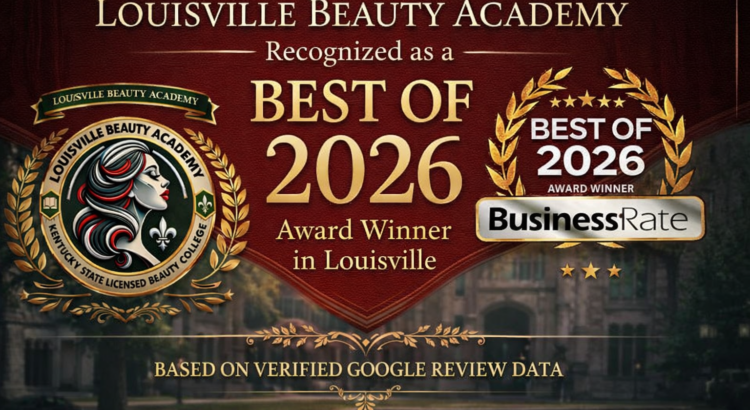
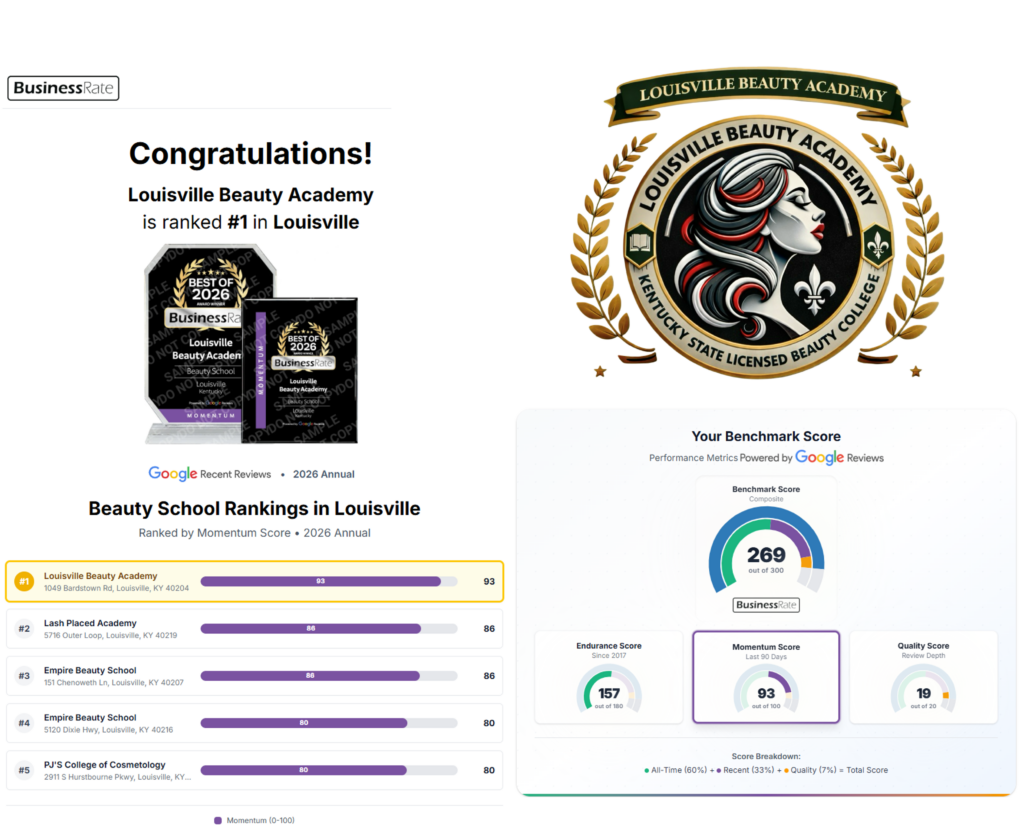
Louisville Beauty Academy is sharing that BusinessRate identified the school in a 2026 local award listing within the Beauty School category, based on the third-party review data and methodology described by that publisher at the time of evaluation.
This recognition was not requested, applied for, or sponsored by Louisville Beauty Academy. It reflects independent third-party analysis of publicly available customer feedback and review data, as compiled and certified by BusinessRate.
At Louisville Beauty Academy, we view recognitions such as this not as a claim of superiority, but as a moment of accountability to the community we serve.
A Reflection of Student and Community Voice
The BusinessRate award is based on measurable indicators including:
Verified Google customer reviews
Consistency of feedback over time
Overall customer satisfaction signals
We recognize that these outcomes are a direct reflection of the experiences of our students, graduates, and community partners.
Our Ongoing Commitment
While rankings and recognitions may change over time, Louisville Beauty Academy remains committed to the principles that define our institution:
Lower-Debt Educational Structure Programs publicly presented as structured to reduce financial burden and reliance on federal student-loan systems
Compliance-Focused Operations Ongoing effort to operate in line with current Kentucky laws, regulations, and school obligations
Career-Focused Training Programs designed for immediate workforce entry and real-world application
Student-Centered Approach Daily discipline, consistency, and individualized support for every learner
Recognition Is Temporary — Standards Are Permanent
Louisville Beauty Academy acknowledges that third-party rankings are dynamic and subject to change. As such, we do not rely on rankings as a measure of identity, but rather as one of many indicators of performance at a given point in time.
Our focus remains unchanged:
To earn trust daily through action, compliance, and measurable student outcomes.
View the Recognition
The original BusinessRate recognition materials are presented below exactly as received, without modification, in the interest of transparency and accuracy.
Important Disclosure
This recognition is issued by a third-party platform (BusinessRate) based on analysis of publicly available online review data at a specific point in time. Louisville Beauty Academy did not control or influence the methodology, criteria, or outcome. Rankings and positions may change over time and do not constitute accreditation, licensure endorsement, or a permanent status.
About Louisville Beauty Academy
Louisville Beauty Academy is a Kentucky state-licensed beauty college committed to delivering affordable, lower-debt, and compliance-driven vocational education. The institution focuses on preparing students for licensure, employment, and long-term professional success through structured, real-world training models.
1. What languages are available for the Kentucky cosmetology licensing exam?
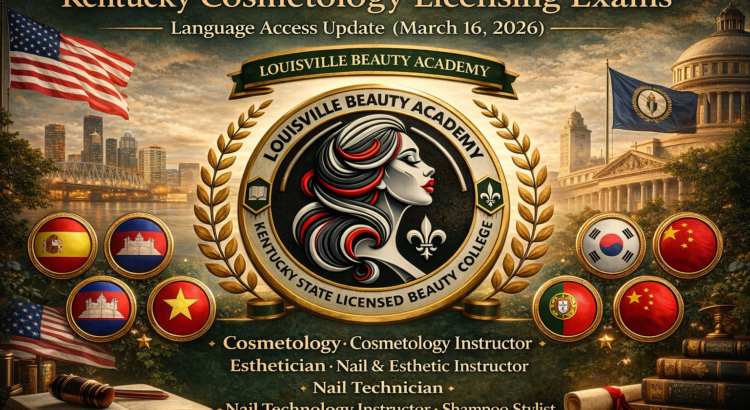
As of March 16, 2026, the Kentucky cosmetology licensing exams administered through PSI Services LLC for the Kentucky Board of Cosmetology are available in multiple languages to support diverse applicants.
Current languages include:
English
Spanish
Vietnamese
Korean
Khmer
Portuguese
Simplified Chinese
These options apply to multiple licensing categories including cosmetology, esthetics, nail technology, and instructor exams.
2. Can I take the Kentucky cosmetology exam in Vietnamese, Spanish, or Khmer?
Yes. Many Kentucky beauty licensing exams are now offered in Vietnamese, Spanish, and Khmer, along with several other languages.
This multilingual access helps ensure that professionals from diverse backgrounds can pursue licensure while still being tested on sanitation, safety, and professional regulations required by Kentucky law.
3. Do all Kentucky beauty licenses offer exams in multiple languages?
Most major license categories provide multilingual exams, including:
Cosmetology
Cosmetology Instructor
Esthetician
Esthetic Instructor
Nail Technician
Nail Technology Instructor
However, some smaller categories, such as Shampoo Stylist, may only offer limited language options.
Applicants should always verify the latest options directly through PSI before scheduling their exam.
4. Where do I register for the Kentucky cosmetology licensing exam?
All Kentucky cosmetology licensing exams are scheduled through the official testing provider PSI Services LLC.
Students typically register after completing their required training hours and receiving authorization from the Kentucky Board of Cosmetology.
Registration includes:
Creating a PSI candidate account
Selecting the exam type
Choosing the preferred language (if available)
Scheduling the testing appointment
5. Why does Kentucky offer cosmetology licensing exams in multiple languages?
The beauty industry is one of the most diverse professional sectors in the United States.
Providing multilingual licensing exams helps:
Increase workforce participation
Support immigrant entrepreneurs
Improve public safety by ensuring professionals become licensed
Reduce barriers to entering regulated professions
Kentucky’s approach reflects a broader national effort to align occupational licensing systems with the real demographics of the workforce.
Public Information Notice for Students, License Applicants, and Industry Professionals
As part of Louisville Beauty Academy’s commitment to transparency, compliance, and student access, we are publishing an updated overview of the official licensing examinations administered through PSI for the Commonwealth of Kentucky.
The Kentucky licensing examinations for cosmetology-related professions are administered through PSI Services LLC, the national testing company contracted to deliver exams for the Kentucky Board of Cosmetology.
This update reflects the available exam listings and language options as of March 16, 2026 based on the PSI public exam catalog.
The purpose of this publication is to inform current and future license applicants, schools, and industry professionals about expanded multilingual exam accessibility in Kentucky’s beauty licensing system.
Overview: Kentucky Beauty Licensing Exams Through PSI
The Kentucky Board of Cosmetology regulates licensing for multiple professional tracks including:
Cosmetology
Cosmetology Instructor
Esthetician
Esthetic Instructor
Nail Technician
Nail Technology Instructor
Shampoo Stylist
These exams are delivered through PSI testing centers or authorized testing systems.
Language Accessibility Expansion in Kentucky Licensing
A major development in recent years is the expansion of multilingual exam availability to support Kentucky’s diverse workforce.
Many cosmetology licensing exams are now available in multiple languages including:
English
Spanish
Vietnamese
Korean
Khmer
Portuguese
Simplified Chinese
This multilingual availability significantly improves access for immigrant professionals entering the licensed beauty workforce.
Louisville Beauty Academy recognizes this expansion as an important step toward workforce inclusion, economic mobility, and regulatory accessibility.
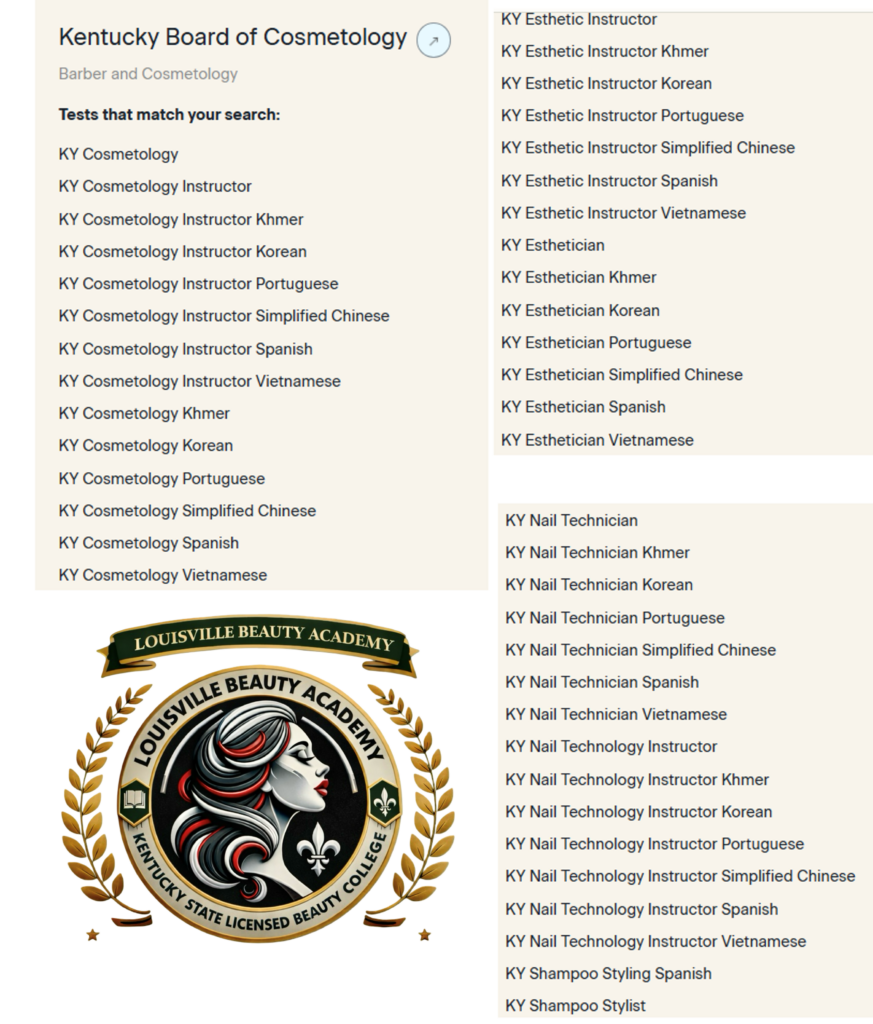
Full List of Kentucky PSI Exams (as of March 16, 2026)
Cosmetology
KY Cosmetology
KY Cosmetology Khmer
KY Cosmetology Korean
KY Cosmetology Portuguese
KY Cosmetology Simplified Chinese
KY Cosmetology Spanish
KY Cosmetology Vietnamese
Cosmetology Instructor
KY Cosmetology Instructor
KY Cosmetology Instructor Khmer
KY Cosmetology Instructor Korean
KY Cosmetology Instructor Portuguese
KY Cosmetology Instructor Simplified Chinese
KY Cosmetology Instructor Spanish
KY Cosmetology Instructor Vietnamese
Esthetician
KY Esthetician
KY Esthetician Khmer
KY Esthetician Korean
KY Esthetician Portuguese
KY Esthetician Simplified Chinese
KY Esthetician Spanish
KY Esthetician Vietnamese
Esthetic Instructor
KY Esthetic Instructor
KY Esthetic Instructor Khmer
KY Esthetic Instructor Korean
KY Esthetic Instructor Portuguese
KY Esthetic Instructor Simplified Chinese
KY Esthetic Instructor Spanish
KY Esthetic Instructor Vietnamese
Nail Technician
KY Nail Technician
KY Nail Technician Khmer
KY Nail Technician Korean
KY Nail Technician Portuguese
KY Nail Technician Simplified Chinese
KY Nail Technician Spanish
KY Nail Technician Vietnamese
Nail Technology Instructor
KY Nail Technology Instructor
KY Nail Technology Instructor Khmer
KY Nail Technology Instructor Korean
KY Nail Technology Instructor Portuguese
KY Nail Technology Instructor Simplified Chinese
KY Nail Technology Instructor Spanish
KY Nail Technology Instructor Vietnamese
Shampoo Stylist
KY Shampoo Stylist
KY Shampoo Styling Spanish
Total Language Coverage by PSI (Kentucky Beauty Exams)
Across the Kentucky cosmetology licensing system, exams are currently available in seven major languages:
English
Spanish
Vietnamese
Korean
Khmer
Portuguese
Simplified Chinese
This reflects a significant effort to align licensing access with the demographics of the modern beauty workforce, where immigrant entrepreneurs and professionals play a critical role.
Why This Matters for Kentucky
The beauty industry represents one of the largest immigrant entrepreneurship sectors in the United States.
Language accessibility in licensing exams helps:
Reduce barriers to legal licensure
Increase workforce participation
Improve consumer safety through licensed professionals
Support economic mobility for immigrant communities
Align regulatory systems with real workforce demographics
Louisville Beauty Academy strongly supports initiatives that increase access while maintaining high sanitation and safety standards required by Kentucky law.
Louisville Beauty Academy Commitment
Louisville Beauty Academy continues to work toward:
Helping students prepare for PSI licensing exams
Supporting multilingual learners
Ensuring full compliance with Kentucky licensing laws
Providing transparent public information about licensing pathways
We believe education should be accessible, affordable, compliant, and workforce-focused.
Important Notice
This publication is provided for public informational purposes only and reflects exam listings available through PSI as of March 16, 2026.
Applicants should always verify current exam registration requirements through the official PSI testing portal or the Kentucky Board of Cosmetology.
Contact Louisville Beauty Academy
If you are interested in becoming licensed in Kentucky:
This article is part of LBA’s public education and historical archive. Older posts, including “Complaint Integrity, Regulatory Due Process, and Competitive Misuse of Licensing Complaint Systems in the U.S. Cosmetology Industry – RESEARCH & PODCAST SERIES 2026,” may not reflect current tuition, schedules, incentives, forms, policies, testing vendors, clinic availability, or regulatory requirements.
1. What is a complaint in the cosmetology licensing system?
A complaint in the cosmetology licensing system is a formal report submitted to a state regulatory board alleging a violation of licensing laws, sanitation rules, or professional conduct standards. In many states, including Kentucky, complaints must typically be submitted in writing and include identifying information from the complainant to ensure accountability and due process during regulatory investigations.
2. Can anonymous complaints be filed against a cosmetologist or beauty school?
Policies vary by state. Some states allow anonymous complaints, while others require complaints to be signed and submitted through official forms. In Kentucky, regulatory procedures require complaints to be submitted as a signed written statement, helping ensure transparency and preventing misuse of the complaint system.
3. What happens after a complaint is filed with a cosmetology board?
After a complaint is received, the regulatory board reviews the allegation to determine whether it falls within its jurisdiction. If the complaint is considered valid, an investigation may be initiated, which can include inspections, requests for documentation, and interviews. The licensee typically has the right to respond before any disciplinary action is taken.
4. Why is regulatory due process important for cosmetology professionals?
Regulatory due process protects licensed professionals by ensuring that any enforcement action taken by a licensing board follows fair procedures. This includes receiving notice of alleged violations, the opportunity to respond, and the right to a hearing before disciplinary decisions such as fines, suspension, or license revocation.
5. How can cosmetology students and professionals protect themselves from regulatory issues?
The most effective protection is maintaining strong compliance practices, including proper sanitation procedures, accurate training records, adherence to licensing laws, and clear documentation of services performed. Understanding state regulations and developing regulatory literacy helps professionals operate ethically and avoid unnecessary disputes.
The regulatory architecture of the United States cosmetology industry represents a profound intersection of the state’s police power, administrative law, and economic protectionism. Occupational licensing, once viewed as a narrow tool for ensuring public health and safety, has expanded into a complex web of requirements that govern nearly one-third of the modern workforce.1 Within this landscape, the complaint-driven enforcement system serves as the primary mechanism for state boards to maintain standards; however, this system is increasingly scrutinized for its vulnerability to competitive misuse, the erosion of procedural due process, and the potential for regulatory capture by incumbent practitioners.4
The Constitutional and Administrative Framework of Occupational Licensing
The legal status of a professional license has transitioned from a mere privilege to a recognized property interest under the Fourteenth Amendment’s Due Process Clause.1 When a state grants a license, it creates a vested interest that allows an individual to pursue a livelihood, an interest that cannot be revoked or suspended without adherence to fundamental fairness.8
The Evolution of the Vested Property Interest
Historically, the right to pursue a common occupation was viewed as an essential component of liberty. During the early twentieth century, the judiciary frequently struck down economic regulations that were seen as interfering with this right, a period often referred to as the Lochner era.1 In the post-New Deal era, the Supreme Court moved toward a standard of rational basis deference, wherein economic regulations—including occupational licensing—are upheld as long as there is a conceivable relationship between the law and a legitimate government interest.1
Despite this deference, the recognition of a license as a property interest remains a cornerstone of administrative law. The decision in Goldberg v. Kelly established that individuals dependent on government-conferred benefits are entitled to an evidentiary hearing before those benefits are terminated.9 This principle has been meticulously applied to the professional licensing context, ensuring that practitioners have the right to notice and a hearing before they are deprived of their ability to work.8
Due Process Factor
Administrative Application in Licensing
Notice
Timely and adequate notification of the specific statutes or regulations alleged to have been violated.14
Impartial Decision-Maker
A board or tribunal free from bias, hostility, or a vested pecuniary interest in the outcome.10
Right to Counsel
The right to retain an attorney at one’s own expense during investigative and adjudicative stages.8
Confrontation
The ability to call and cross-examine witnesses who provide testimony against the licensee.9
Decision on the Record
A final order based solely on the legal rules and evidence adduced during the hearing.9
The Mathews v. Eldridge Balancing Test
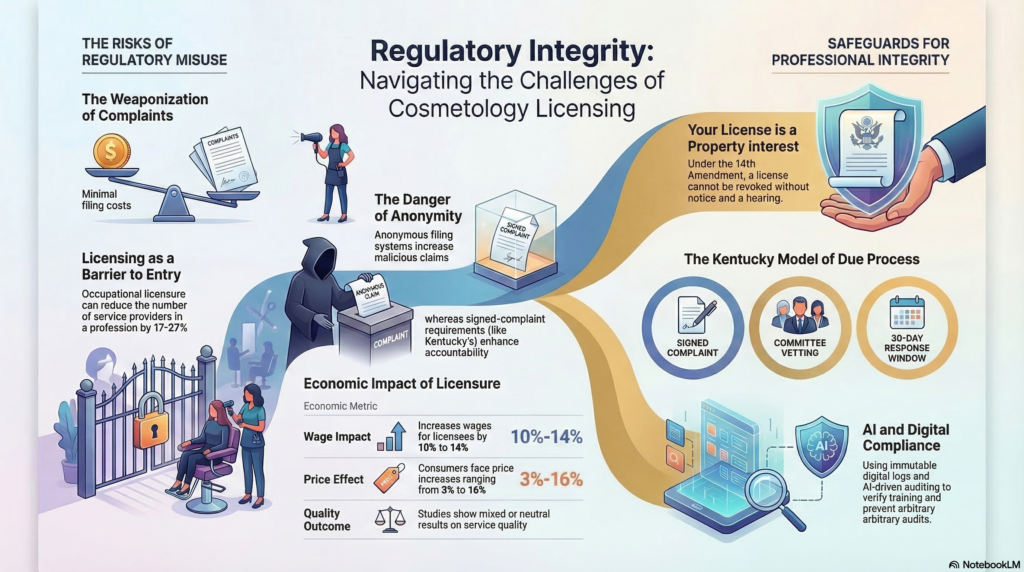
The extent of the process required in an administrative proceeding is often determined by the three-factor balancing test articulated in Mathews v. Eldridge.9 This test evaluates the private interest affected by the government action, the risk of an erroneous deprivation of that interest through the current procedures, and the government’s interest, including the fiscal and administrative burdens that additional procedural requirements would entail.9 In the cosmetology industry, the private interest is the practitioner’s livelihood, which carries immense weight. Conversely, the risk of erroneous deprivation is significant when boards rely on uncorroborated or anonymous complaints.5
The Regulatory Economics of Licensing Barriers
From an economic perspective, occupational licensing functions as a state-sanctioned barrier to entry that restricts the supply of labor and generates “monopoly rents” for existing practitioners.2 While the stated purpose is to solve information asymmetry and protect consumers from low-quality service, empirical research suggests that these regulations often fail to improve quality while consistently increasing consumer costs.2
Rent-Seeking and Monopoly Power
The economic theory of regulation posits that licensing boards are often “captured” by the very industries they are meant to regulate.2 Incumbent providers, being few in number and well-organized, find it easier to lobby for restrictive rules than the large, unorganized group of consumers who are harmed by higher prices.2 In the cosmetology sector, this often results in excessive training requirements—such as 1,500 clock hours—that act as a significant financial hurdle for new entrants.3
Economic Metric
Impact of Occupational Licensure
Wage Impact
Licensing is estimated to increase the wages of licensees by approximately 10% to 14%.2
Supply Restriction
Licensure can reduce the number of providers in a profession by 17% to 27%.5
Price Effect
Consumers typically face price increases ranging from 3% to 16% depending on the specific service and state.2
Quality Outcome
Studies on the effect of licensing on service quality are largely mixed, often showing neutral or unclear results.2
Deadweight Loss and Social Cost
The restrictions imposed by licensing lead to “deadweight loss,” where the reduction in output and the increase in prices result in a net loss to society.2 Potential service providers who find the hurdles too costly to overcome are excluded from the market, leading to decreased innovation and fewer options for lower-income consumers.2 Furthermore, the burden of these regulations often falls disproportionately on disadvantaged populations, including immigrants and non-English speakers, who may struggle with the formal education requirements.19
The Complaint-Driven Enforcement System and Competitive Misuse
The primary enforcement mechanism for cosmetology boards is the complaint-driven investigation.5 While essential for identifying genuine public safety risks, this system is structurally vulnerable to being used as a weapon of competitive harassment.7 Because the cost of filing a complaint is minimal, established firms can initiate multiple investigations against competitors to drain their resources and damage their reputations.5
Mechanisms of Competitive Harassment
Competitive harassment often exploits the administrative process rather than seeking a specific legal outcome.23 By triggering a formal board investigation, a complainant can force a rival to undergo months of scrutiny, respond to subpoenas, and hire legal counsel.5 This “administrative muddle” can stifle competition by discouraging new business models or aggressive pricing strategies that incumbents find threatening.5
The “sham litigation” exception to the Noerr-Pennington doctrine provides a framework for understanding these abuses.23 Under Noerr-Pennington, petitioning the government is generally immune from antitrust liability; however, if a pattern of “baseless, repetitive claims” emerges that is intended solely to interfere with a competitor’s business through the use of the process itself, it may constitute a sham.23
Anonymous Allegations and Their Impact
The use of anonymous complaints introduces a particular challenge to due process. While some jurisdictions allow anonymity to encourage reporting of serious misconduct, it significantly increases the risk of malicious filings.18 In an anonymous system, the respondent is often unable to effectively challenge the credibility of the accuser, a core tenet of fundamental fairness.9
Jurisdiction
Anonymous Complaint Policy
Impact on Licensee Rights
Kentucky
Explicitly prohibits anonymous complaints; must be a “signed writing”.30
High accountability for the accuser; reduces trivial filings.30
Texas
Allows anonymous complaints; identity protected unless requested via open records.28
High volume of complaints; creates potential for administrative abuse.22
Florida
Accepts anonymous complaints if they are “legally sufficient” and involve serious violations.18
Attempts to balance safety and fairness; uses false statement statutes as deterrent.33
Case Study: Kentucky Cosmetology Regulation and Procedural Integrity
Kentucky’s regulatory framework for cosmetology, centered around KRS Chapter 317A and the administrative regulations in 201 KAR Chapter 12, provides a rigorous example of a state attempting to modernize its complaint procedures to enhance due process.16
The Regulatory Landscape of KRS 317A
The Kentucky Board of Cosmetology (KBC) is authorized to investigate complaints and take disciplinary action for violations that threaten the public interest.16 KRS 317A.070 mandates that the board hold hearings to review its decisions upon the request of an applicant or licensee, ensuring a path for adjudication.16
In recent years, the board has updated 201 KAR 12:190 to refine the complaint and disciplinary process.30 These amendments reflect a shift toward greater transparency and longer response times for licensees, moving the standard from a 10-day response window to a 30-day calendar period.30
The Prohibition of Anonymity and Signed Requirements
A defining feature of the Kentucky model is the requirement that all complaints be submitted on a specific board form and “signed by the person making the complaint”.30 The explicit statement that “Anonymous complaints will not be accepted” serves as a critical barrier to competitive misuse.30 By requiring a signature, the state ensures that the complainant is a real party who can, if necessary, be called as a witness during an administrative hearing.15
Furthermore, the board’s Complaint Committee, consisting of at least two board members, must review the complaint and the respondent’s rebuttal before making a recommendation.30 This intermediate review process is designed to filter out baseless allegations before they reach the full board for formal disciplinary action.30
Informal Regulatory Triggers: The Admonishment
A nuanced tool in the Kentucky system is the “written admonishment,” which is issued for minor violations that do not warrant formal discipline.31 While an admonishment is not considered a final disciplinary action—and thus does not necessarily trigger a full hearing—it is placed in the licensee’s permanent file.31 This creates an “informal trigger” because the board can use past admonishments as evidence of a pattern of non-compliance in future, more serious proceedings.31
Enforcement Action
Characterization in KY Regulation
Procedural Result
Dismissal
No violation found or insufficient evidence.30
No further action; case closed.30
Admonishment
Warning for a minor violation; not considered discipline.31
Placed in file; used for future “patterns” of behavior.31
Notice of Disciplinary Action
Formal intent to fine, suspend, or revoke.30
Triggers 30-day window for respondent to request a hearing.30
Informal Settlement
Resolve matter through mediation or agreed order.30
Avoids formal hearing; often includes fines or probation.18
Comparative Analysis: Enforcement Patterns in Texas, Florida, and California
The management of complaints varies significantly across other major states, offering different levels of protection for licensees.
Texas: High Restrictiveness and Intake Efficiency
The Texas Department of Licensing and Regulation (TDLR) manages a massive scale of regulation, with nearly one million license records.32 Texas allows for anonymous complaints, but it employs a “legal assistant” intake model where allegations are vetted for jurisdiction and probable cause before an investigator is even assigned.22
In Texas, the Enforcement Division follows a standard resolution timeline, aiming to resolve 71% of complaints within six months.37 This focus on efficiency, while beneficial for clearing backlogs, can sometimes lead to an emphasis on settlement over thorough adjudication, as prosecutors use a “notice of alleged violation” (NOAV) to seek monetary penalties and sanctions.22
Florida: False Statement Deterrents and Public Transparency
Florida’s Board of Cosmetology operates within a legal culture that emphasizes public record transparency.33 While Florida accepts anonymous complaints, it uses the threat of criminal prosecution for “False Official Statements” to maintain system integrity.33 Under Section 837.06, Florida Statutes, anyone who knowingly makes a false written statement to mislead a public servant in the performance of their duty can be charged with a misdemeanor.33 This provides a check against the most egregious forms of competitive harassment that is not always present in purely administrative codes.
California: Sunset Reviews and Bureaucratic Complexity
California has historically struggled with a “nearly impenetrable thicket of bureaucracy” in its licensing systems.38 The Board of Barbering and Cosmetology undergoes a “sunset review” every four years to determine if it is meeting consumer protection goals.38 However, findings from the Little Hoover Commission suggest that these reviews are often political rather than technical, and that consumers are rarely the driving force behind the creation or governing of licensing regulations.38 This reinforces the view that such boards primarily serve the interests of the industry rather than the public.5
Administrative Law Toolkit for Scrutinizing Regulatory Abuse
To combat the irrational expansion of licensing and the misuse of enforcement powers, legal scholars advocate for the application of specific administrative law doctrines.12
Arbitrary and Capricious Review and the “Hard Look”
The “arbitrary and capricious” standard of review requires agencies to demonstrate that their actions result from “reasoned decisionmaking”.12 When a board pursues an enforcement action that appears targeted at a competitor or an innovator, a court can apply a “hard look” review.12 This requires the agency to prove that it considered all relevant factors and did not act out of agency capture or a desire to protect incumbent profits.12
The Clear Statutory Statement Rule
Agencies often expand their jurisdiction by interpreting broad statutes to include new practices.12 For instance, boards have famously attempted to regulate “eyebrow threading” or “hair braiding” as “cosmetology,” requiring hundreds of hours of unrelated training.1 Administrative law principles suggest that for such significant restrictions on economic liberty, the agency should be required to point to a “clear statement” from the legislature.12 Without such a mandate, the agency’s interpretation should be struck down as irrational.12
Substantial Evidence and Fact-Finding Integrity
Administrative decisions must be supported by “substantial evidence”.8 In a complaint proceeding, the board cannot rely on hearsay or uncorroborated allegations to justify a license suspension.15 This is particularly critical in jurisdictions that allow anonymous complaints; if the investigation fails to find independent physical evidence or credible witness testimony to support the anonymous claim, the case must be dismissed as a matter of law.18
Technological Solutions and AI-Driven Auditing for Regulatory Integrity
The advancement of Artificial Intelligence (AI) and algorithmic decision-making (ADM) presents a new frontier for both regulatory efficiency and oversight.39
Algorithmic Auditing of Enforcement Patterns
Agencies are increasingly using algorithmic tools to synthesize voluminous records and identify patterns of non-compliance.41 However, these same tools can be utilized to audit the agencies themselves.41 By analyzing a board’s complaint and enforcement history, AI can detect “systematic and repeatable errors” that may indicate bias against specific groups or types of competitors.43
Algorithmic accountability frameworks suggest that agencies should maintain “algorithm registers” that provide public information about the tools used for enforcement.41 This transparency allows for external monitoring by civil rights groups and competitors to ensure that “automated flagging” does not result in discriminatory targeting.41
The Louisville Beauty Academy Model of Digital Compliance
The Louisville Beauty Academy (LBA) in Kentucky has pioneered a model of “digital compliance” that leverages technology to protect student and licensee rights.45 LBA utilizes AI-based attendance validation and “immutable digital logs” to verify training hours.45
LBA Compliance Feature
Regulatory Benefit
Investor/Licensee Impact
Immutable Digital Logs
Prevents the falsification of hours, a common trigger for KBC audits.45
Guaranteed “KBC audit readiness” and reduced legal risk.45
AI Hour Verification
Ensures all performed labor is strictly curricular and reported correctly.45
Elimination of “unpaid labor” risks and 95% licensure rate.45
Digital Statutes Access
Every student receives a digital copy of KRS 317A and 201 KAR 12.45
High degree of “regulatory literacy” among future practitioners.21
Public Transparency
Hub makes school compliance records accessible to the public and regulators.45
Builds trust and prevents arbitrary board interventions.45
By implementing these technologies, LBA effectively shifts the burden of proof. When a board attempts an informal regulatory trigger or initiates an investigation, the school or practitioner can produce a granular, auditable digital trail that satisfies the “substantial evidence” requirements of administrative law.45
Professional Ethics and the Development of Regulatory Literacy
A critical component of maintaining system integrity is the “regulatory literacy” of the practitioners themselves.21 Vocational education must move beyond technical skills to instill a deep understanding of the legal and ethical framework of the profession.21
Curricular Integration of Regulatory Knowledge
Regulatory literacy involves the ability to understand and navigate the laws that govern professional standing and public safety.21 In Kentucky, cosmetology students are required to complete specific “Law/Reg Hours” as part of their 1,500-hour program.21
Program Type
Total Hours
Theory/Lecture Hours
Law & Regulation Hours
Cosmetology
1,500
375
40 21
Esthetician
750
250
35 21
Nail Technician
450
150
25 21
Successful practitioners must also master “Business Literacy,” which includes principles of marketing, accounting, and tax literacy.21 When practitioners understand their legal rights and the administrative process, they are better positioned to respond to bad-faith complaints and avoid the “informal triggers” that often lead to professional jeopardy.8
The Role of Ethical Responsibility in Self-Regulation
Professional ethics in cosmetology revolve around professionalism, integrity, and respect for clients.47 This includes maintaining “informed consent,” where clients are fully aware of the risks and benefits of a treatment before it begins.47 This transparency not only protects the client but also serves as a defensive shield for the practitioner; a client who gives informed consent is less likely to file a successful complaint with the state board regarding a standard procedural outcome.47
Practitioners also have an ethical duty to report genuine misconduct within the industry.47 However, the “Ph.D.-level” challenge lies in distinguishing between legitimate safety reporting and the weaponization of complaints for competitive gain.7 Codes of ethics, such as those adopted by the Independent Beauty Association, emphasize “using only legal and ethical means in all business activities,” which inherently prohibits the use of “sham” complaints to harm rivals.23
Economic Analysis of Educational ROI and Regulatory Burdens
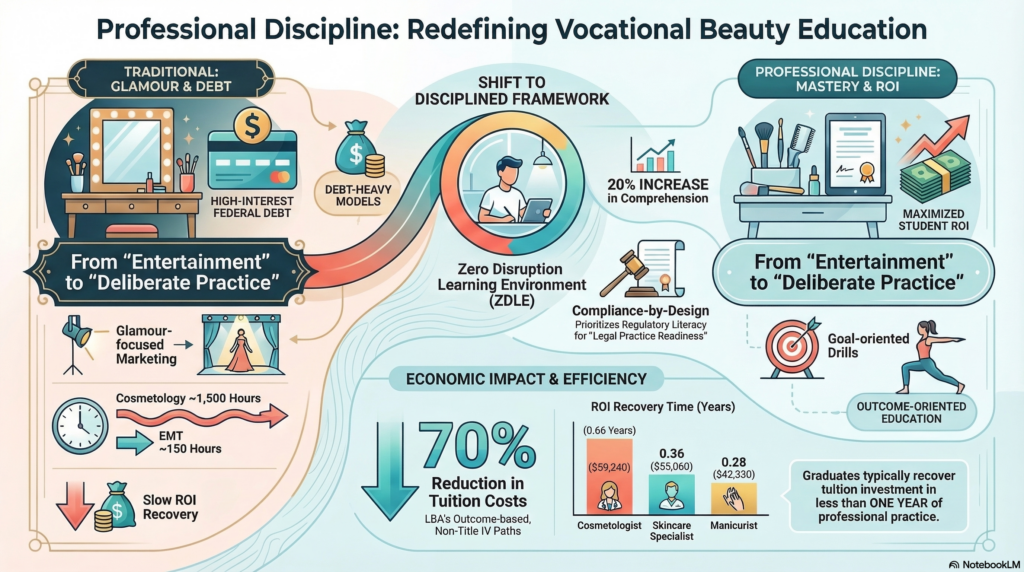
The financial viability of a cosmetology career is directly impacted by the length of the educational program and the subsequent regulatory hurdles.21 Students must assess the “payback period” of their education to determine if the credential provides a genuine economic benefit.21
The Payback Period Model
The payback period can be mathematically expressed using the total cost of attendance versus the expected earnings premium:
Where:
= Payback Period (in years)
= Total Tuition
= Mandatory Fees
= Books, Supplies, and Equipment Kits
= Interest on Student Loans
= Expected Annual Earnings after licensure
= Annual Earnings without the credential (median for high school graduate).21
When boards increase training hours or impose burdensome renewal requirements, they extend this payback period, making the profession less accessible to low-income individuals.21 Furthermore, the “Financial Value Transparency” (FVT) framework implemented by the U.S. Department of Education now scrutinizes programs where students incur “unaffordable debt” relative to their low earnings.21 Cosmetology programs often fail these metrics due to the high cost of the required 1,500 hours versus entry-level wages.21
Conclusion: Toward a More Equitable and Transparent Regulatory Future
The analysis of complaint-driven enforcement in the cosmetology industry reveals a systemic tension between the goals of public safety and the realities of economic competition.2 The current system, while grounded in the state’s police power, often functions as a tool for incumbent protectionism, facilitated by anonymous allegations and informal regulatory triggers.5
To restore integrity to the process, a multi-faceted approach is required. Procedurally, jurisdictions should follow the Kentucky model in prohibiting anonymous complaints and increasing the response window for licensees to ensure a meaningful opportunity to be heard.30 Economically, boards must be subjected to “hard look” administrative review to prevent the irrational expansion of training requirements that serve as barriers to entry.1
Technologically, the integration of AI-driven auditing and “immutable digital logs” provides a pathway for objective oversight and the detection of biased enforcement patterns.41 Finally, by fostering “regulatory literacy” and high ethical standards through innovative vocational education, the industry can empower a new generation of practitioners who are capable of defending their property interests against administrative overreach.21 The professional license remains a “valuable property interest” that deserves the full protection of the law, ensuring that the right to pursue a livelihood is not sacrificed to the convenience of the administrative state or the competitive interests of incumbent firms.1
Research Publication Disclaimer: This article is a research and policy analysis produced by the research team of Di Tran University — The College of Humanization and is published by Louisville Beauty Academy (LBA) in its original form for educational and public informational purposes. Di Tran University is an educational research affiliate founded by Di Tran, who also serves as founder and CEO of Louisville Beauty Academy — this is a founder-affiliated publication, not an independent third-party study. All analysis, viewpoints, data interpretation, and academic opinions expressed are those of the Di Tran University research team. This publication is shared to encourage transparency, academic discussion, and public understanding of vocational education, workforce development, and student debt structures, and it should not be construed as legal advice, regulatory guidance, or official policy statements of Louisville Beauty Academy, its administration, instructors, or affiliates beyond the cited public sources.
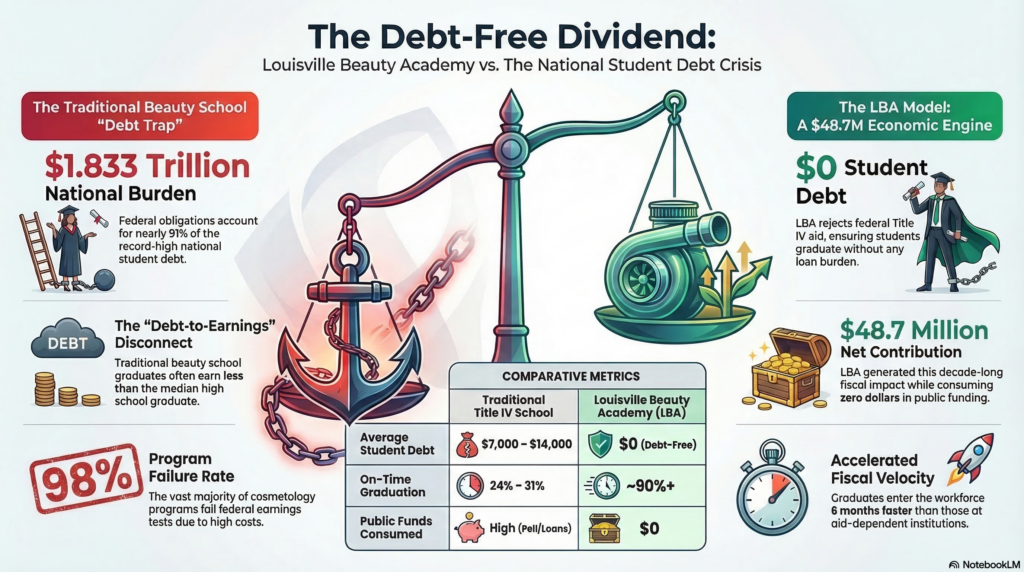
The landscape of American post-secondary education and its attendant financial structures is currently undergoing a period of profound volatility and realignment. As of the fourth quarter of 2025, the national student loan debt has reached a historic zenith of approximately $1.833 trillion, with federal obligations accounting for 90.9% of the total.1 This fiscal burden is not distributed uniformly across the United States; rather, it exhibits significant geographical and sectoral concentrations that reveal systemic inefficiencies in the prevailing Title IV funding apparatus. While high-population states such as Florida and Georgia grapple with aggregate debt balances exceeding $112 billion and $74 billion respectively, the vocational sector—specifically cosmetology and personal care services—has emerged as a focal point of regulatory scrutiny due to its high debt-to-earnings ratios and reliance on federal subsidies.1
The implementation of the One Big Beautiful Bill Act (OBBBA) in July 2025 and the subsequent rollout of the Student Tuition and Transparency System (STATS) in 2026 represent a decisive shift toward outcomes-based accountability.5 This legislative pivot aims to address the “debt-to-earnings” disconnect that characterizes many vocational programs, where graduates frequently earn less than the median high school graduate despite carrying significant loan balances. In this environment, the Louisville Beauty Academy (LBA) in Kentucky provides a critical counter-narrative. By eschewing federal aid in favor of a low-tuition, lower-debt framework, LBA has demonstrated a net-positive fiscal contribution of approximately $48.7 million over the past decade.7 This analysis evaluates the macroeconomic drivers of the debt crisis, regional disparities between the Deep South and the Ohio Valley, and the scalability of the LBA model as a tax-positive solution for workforce development.
The National Student Loan Debt Trajectory (2024–2026)
The trajectory of student loan debt in the mid-2020s is characterized by a return to annual growth following a brief decline in the 2023–2024 period.2 Federal student loan debt increased by $54 billion in 2025 alone, with year-over-year quarterly growth averaging 2.94%.2 This resurgence in debt accumulation coincides with a period of heightened delinquency; as of the fourth quarter of 2025, approximately 9.57% of student loans were 90 days or more delinquent.8
The total borrower population remains steady at approximately 42.8 million individuals, but the average federal balance has climbed to a record high of $39,547.1 When private lending is integrated into the analysis, the average total balance for some cohorts may reach as high as $43,333.2 This escalation is particularly pronounced among Gen Z and younger Millennials, who saw the largest debt increases over the past year as they entered a labor market influenced by persistent inflation and shifting entry-level wage standards.9
National Student Loan Debt Metrics by Quarter (2024–2025)
Quarter
Total National Debt (Trillions)
Federal Debt (Trillions)
YoY Change (%)
2024 Q1
$1.753
$1.598
-1.22%
2024 Q2
$1.741
$1.620
-1.14%
2024 Q3
$1.772
$1.611
2.33%
2024 Q4
$1.778
$1.638
2.85%
2025 Q1
$1.805
$1.639
2.97%
2025 Q2
$1.813
$1.660
4.16%
2025 Q3
$1.832
$1.665
3.39%
2025 Q4
$1.835
$1.692
3.30%
Data source:.2
The surge in 2025 is attributed to several factors, including the expiration of pandemic-era payment pauses and the restructuring of repayment plans under the OBBBA. The average level of federal student loan debt has grown by roughly 1% per quarter since 2013, suggesting a structural upward pressure on tuition costs that outpaces general inflation.1 For many Americans, student loan payments now exceed their monthly retirement contributions or healthcare expenses.1
Geographical Analysis of High-Debt States: Florida and the Deep South
The student debt crisis exhibits significant regional variation, with the Southern United States bearing a disproportionate share of the national burden. High tuition costs in these regions frequently intersect with lower-than-average median earnings for recent graduates, creating a “debt trap” that hinders local economic mobility.
The Georgia Nexus: Prevalence and Burden
Georgia represents one of the most acute examples of educational indebtedness in the nation. It currently exhibits the highest rate of outstanding student loan debt prevalence nationwide, with 15.4% of the total population carrying a balance.4 The average borrower debt in Georgia is approximately $43,276, placing it second only to Maryland and the District of Columbia in terms of individual burden.4 The total aggregate debt for the state stands at $74.3 billion.4
The crisis in Georgia is further exacerbated by the demographics of its borrowers. Older Americans in Georgia (ages 50 and older) struggle significantly, with an average debt of $53,528—the third-highest in the nation for this age cohort.11 Approximately 8.7% of Georgia’s residents over 50 have student debt, a statistic that underscores the “intergenerational debt trap” where parents and grandparents assume Parent PLUS loans to finance the education of their descendants.8
The Florida Paradox: Population Density and Debt Accumulation
Florida represents one of the largest aggregate pools of student debt in the country, totaling approximately $112.4 billion as of 2026.4 With over 2.76 million borrowers, the state’s average balance is $40,697.4 Florida’s crisis is characterized by a “debt-to-earnings disconnect” in several of its major metropolitan areas. For example, in Gainesville, the average student loan debt of $44,508 exceeds the median annual earnings for residents with a bachelor’s degree ($41,782).12 This inversion of the traditional return-on-investment (ROI) model suggests that for many Floridians, higher education has become a net-negative wealth event in the early career stages.
State
Average Borrower Debt (2025/26)
Total State Debt (Billions)
Population with Debt (%)
Maryland
$45,173
$38.4
13.6%
Georgia
$43,276
$74.3
15.4%
Virginia
$41,410
$45.6
12.5%
Florida
$40,697
$112.4
11.8%
Delaware
$40,290
$5.6
13.1%
Illinois
$40,243
$65.3
12.8%
New York
$40,207
$99.6
12.5%
North Carolina
$39,914
$55.4
12.6%
Data source:.4
Regional Comparison: Kentucky and the Surrounding Region
In contrast to the extreme burdens seen in the Deep South and Mid-Atlantic, Kentucky and its neighboring states in the Ohio Valley and Midwest present a more moderate, yet still concerning, debt profile. Kentucky’s average borrower debt is $33,691, with a total state debt of $20.7 billion.13 Approximately 13.4% of Kentucky residents carry student debt, which is largely consistent with the national average.13
Comparative Regional Statistics (2024–2025)
State
Average Debt
Total State Debt (Billions)
Borrowers (Thousands)
% Under Age 35
Illinois
$39,042
$63.4
1,623.9
52.1%
Virginia
$40,287
$44.3
1,099.6
50.8%
Tennessee
$37,054
$33.1
893.3
48.8%
Missouri
$35,650
$29.7
833.1
47.5%
Ohio
$35,072
$62.6
1,784.0
N/A
Kentucky
$33,691
$20.7
614.4
47.8%
Indiana
$33,234
$30.1
905.7
48.4%
West Virginia
$32,343
$7.4
228.8
47.4%
Data source:.13
West Virginia maintains the lowest average debt in the region at $32,343, which is also among the lowest in the nation.13 However, the prevalence of debt remains significant, affecting 12.9% of the population.13 Indiana and Kentucky exhibit remarkably similar profiles, with average debts hovering near $33,000 and nearly half of all borrowers being under the age of 35.13 This demographic concentration highlights the vulnerability of young professionals who are attempting to establish households and businesses while serviced by significant debt-to-income ratios. In Kentucky, specifically, 16.3% of indebted borrowers owe less than $5,000, while 1.61% owe more than $200,000.13
The Beauty Industry Crisis: Structural Inefficiency in Vocational Training
The personal care services industry, encompassing cosmetology, esthetics, and nail technology, represents a critical sector for regional economic development, yet it is currently mired in a “debt-extractive” cycle. Across the United States, more than 1,300 cosmetology schools serve approximately 230,000 students, generating over $2.2 billion in annual revenue.14 A significant portion of this revenue—upwards of $1 billion annually—is derived from federal student loans and Pell Grants.3
The ROI Disconnect in Cosmetology
Research indicates that the return on investment for traditional cosmetology programs is frequently abysmal. Nationwide data show that graduates average only $16,600 to $26,000 in annual earnings, a figure that is often lower than that of high school graduates in other fields.14 Despite these low wages, the cost of training at Title IV-accredited schools often ranges from $15,000 to $25,000.15 This leads to an average student debt of approximately $10,000 for a credential that may not yield a salary higher than $20,000 annually four years after completion.14
Metric
Traditional Title IV Beauty School
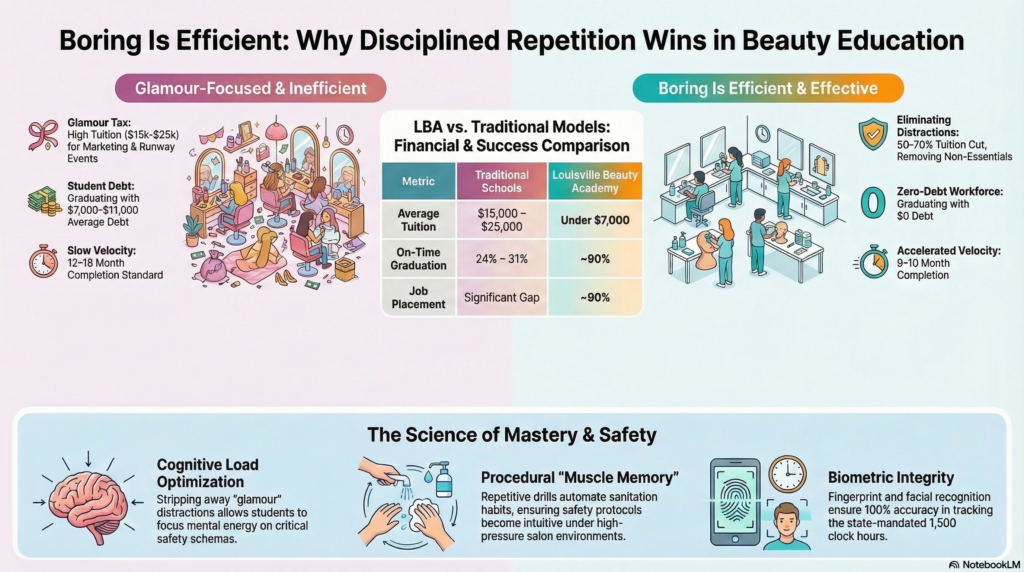
Louisville Beauty Academy (LBA)
Average Tuition Cost
$15,000 – $25,000
$3,800 – $6,250
Average Student Debt
$7,000 – $14,000
$0 (Lower-Debt)
On-Time Graduation Rate
24% – 31%
~90%+
Early Career Earnings
$16,000 – $26,000
$20,000 – $43,000
Public Funds Consumed
High (Pell/Loans)
$0
Data source:.5
The systemic failure of this model is evidenced by the fact that 75% to 98% of cosmetology programs would fail federal earnings tests, as their graduates do not earn more than a typical high school graduate in their respective states.15 Furthermore, beauty schools are disproportionately represented on the U.S. Department of Education’s “heightened cash monitoring” list, with many institutions flagged for financial mismanagement or failure to meet accreditor standards.16
Perverse Incentives and Artificial Program Lengths
The reliance on federal aid has created perverse incentives for for-profit beauty schools to extend program lengths. In many states, licensing mandates range from 1,000 to 1,500 hours.14 Schools often lobby to maintain these high hourly requirements to maximize the amount of Title IV funding they can collect per student.15 This practice, combined with the use of students as unpaid labor on school clinic floors, creates a “dual-revenue” model that prioritizes institutional profit over student outcomes.14
Investigations have revealed that many schools discourage on-time graduation because doing so would curtail the period during which they can draw federal aid.14 Consequently, less than one-third of cosmetology students graduate within the nominal program length, leading to higher attrition and a greater probability of loan default.14 At some for-profit conglomerate beauty schools, approximately 90% of cosmetology graduates fail to make more than what they would have with only a high school diploma.16
Legislative Transformation: The OBBBA 2025 and STATS Framework
On July 4, 2025, the One Big Beautiful Bill Act (OBBBA) was signed into law, initiating a comprehensive restructuring of the federal student aid, tax, and social safety net systems.5 Taking full effect on July 1, 2026, the legislation introduces a rigorous accountability framework centered on the Student Tuition and Transparency System (STATS).5
The Earnings Premium (EP) Test
The core of the new regulatory regime is the Earnings Premium (EP) test. This evaluation determines whether graduates of a specific program earn at least as much as a typical high school graduate in the same state.5 For the 2026-2027 award year, these benchmarks are calculated using Census Bureau data adjusted for inflation to June 2025 dollars.5 Programs that fail this test in two out of three consecutive years lose their eligibility to participate in federal loan programs for two years.5
Under the STATS framework, the Department of Education has eliminated the Debt-to-Earnings (DTE) metric in favor of this single, uniform EP standard.5 This transition aims to simplify accountability but creates a high-stakes environment for vocational schools. Effective December 7, 2025, a “Lower-Earnings Indicator” was implemented directly into the FAFSA Submission Summary, displaying flagged institutions in red to warn prospective students.5
The Repayment Assistance Plan (RAP) and Repayment Restructuring
The OBBBA also replaces several income-driven repayment options, including the SAVE and PAYE plans, with the new Repayment Assistance Plan (RAP).5 The RAP is generally less forgiving for low-income borrowers; it implements a minimum monthly payment of approximately $10 even for those with the lowest incomes, whereas previous plans allowed for $0 payments.16
Annual Income
Monthly Payment (SAVE Plan)
Monthly Payment (RAP Plan)
$15,000
$0
$10.00
$20,000
$0
$16.67
$20,500
$0
$34.17
$30,000
$22.50
$75.00
Data source:.5
This restructuring increases the financial vulnerability of cosmetology graduates. For example, a graduate making just $20,500 per year would see their monthly payment more than double compared to one making $20,000, despite only a 3% increase in income.16 Additionally, the bill eliminates economic hardship and unemployment deferments, which previously allowed borrowers to pause payments during periods of financial insecurity.16
Broader Policy Impacts of the OBBBA
Beyond education, the OBBBA makes sweeping changes to other sectors. It includes $3.8 trillion in tax cuts, extending the 2017 Tax Cuts and Jobs Act (TCJA) and increasing the child tax credit to $2,500 through 2028.18 For small businesses, it restores 100% bonus depreciation for equipment acquired after January 19, 2025, and increases Section 179 investment ceilings to $4 million.19
In the agricultural sector, the bill increases reference prices for commodities by 10-21% and establishes the Farmer Bridge Assistance (FBA) Program to provide $12 billion in relief for market disruptions.20 However, the bill also implements significant cuts to Medicaid and SNAP, including strict work requirements of 80 hours per month for able-bodied adults aged 19-64.17 These cuts, totaling about $700 billion for Medicaid, represent the largest in the program’s history and may force millions of children and low-wage workers off health coverage.18
The Louisville Beauty Academy: A Lower-Debt, Tax-Positive Alternative
Situated within the Kentucky regulatory ecosystem, the Louisville Beauty Academy (LBA) operates as a primary case study for an alternative vocational model. By rejecting Title IV federal aid, LBA avoids the regulatory pitfalls of the OBBBA and the debt trap that characterizes the traditional beauty school sector.3
Fiscal Velocity and Speed-to-Market
The LBA model is predicated on the concept of “fiscal velocity”—the speed at which a student transitions from a consumer of public resources to a net tax contributor.22 While traditional schools often extend the 1,500-hour cosmetology program to 15 or 18 months to satisfy federal aid requirements, LBA’s model targets completion in 9 to 10 months.22 This creates a “speed-to-market differential” () of approximately 6 months (0.5 years).
Using a standardized mathematical model, the impact of this velocity can be quantified. By entering the workforce six months earlier, a graduate earns an additional $15,000 in professional income (based on an entry-level salary of $30,000).22 At a conservative 16% aggregate effective tax rate (), each LBA graduate generates $2,400 in extra tax revenue during that six-month window.22 For a cohort of 100 graduates, this results in a $240,000 recurring tax premium for the public treasury.22
Mathematical Modeling of Net Fiscal Impact
The total taxpayer savings () per student can be expressed through the following formulation:
Where:
= The average public aid package avoided (e.g., $10,000 in Pell Grants and loans).
= The interest on avoided debt that would have been borne by the taxpayer in the event of default or subsidy.
For every 100 students who choose LBA over a traditional aid-dependent school, the model generates $1,000,000 in direct taxpayer savings.22 Over a five-year projection with a modest 7.5% growth rate, the LBA model “saves” the public treasury approximately $5.8 million.22
The $48.7 Million Economic Engine: A Decade of Contribution
Over the past ten years, LBA has produced approximately 2,000 licensed beauty professionals and incubated roughly 30 independently owned salons.7 The cumulative fiscal and tax contribution of this model, while consuming exactly zero dollars in public education funding, is estimated at $48,699,250.7
Breakdown of the $48.7 Million Contribution (10-Year Totals)
Category
Calculation
10-Year Total
Federal Income Tax
10% effective rate on $200M graduate income
$20,000,000
Payroll Taxes (FICA)
7.65% on $230M total employment income
$17,595,000
Kentucky State Income Tax
4% on $200M graduate income
$8,000,000
Federal/State Tax on Salon Profits
20% margin 14% tax on $60M revenue
$1,680,000
Sales Tax
6% on estimated 15% retail portion of $60M
$540,000
Direct State Board Fees
Exams, licensing, and renewals
$884,250
TOTAL CONTRIBUTION
$48,699,250
Public Funds Consumed
$0
Data source:.7
This $48.7 million figure represents a “net-positive” reality. If LBA had operated as a typical Title IV school, it would have consumed approximately $9 million in Pell Grants and disbursed $16 million in federal student loans—a total federal cost of $25 million.7 The net fiscal difference between the LBA model and the industry standard is $73.7 million over a decade.7
Business Incubation and the Entrepreneurial Multiplier
The absence of a “debt overhang” significantly increases the probability of business formation among LBA graduates. Research from the Federal Reserve suggests that student debt reduces the likelihood of business formation by 11% to 14%.23 LBA graduates, carrying zero debt, exhibit higher risk tolerance and capital availability.
The model uses an employment multiplier of 1.5, accounting for the additional jobs (receptionists, assistants, etc.) created when lower-debt graduates launch their own ventures.22 For a pool of 500 graduates, the LBA model is projected to create 125 new businesses and 312.5 total jobs—a performance ratio 2.08 times higher than that of debt-burdened competitors.23
Regulatory Over-Compliance and the “Gold-Standard” Model
The Louisville Beauty Academy distinguishes itself not only through its financial structure but also through its “Compliance-By-Design” framework. This is particularly relevant given the recent oversight failures identified within the Kentucky Board of Cosmetology (KBC).
The 2024 Legislative Oversight Findings
A 2024 report by the Kentucky Legislative Oversight and Investigations Committee (LOIC) found that the KBC was failing to meet its regulatory mandate to inspect establishments twice annually.25 In a sample of board files, only 54% had a completed inspection form, and staff expressed confusion regarding the implementation of emergency orders.26 The board was found to have no oversight in its complaint and disciplinary processes and lacked policies for mass communication or continuing education.26
In response to this administrative instability, LBA has positioned itself as a center for “regulatory over-compliance.” The academy facilitates one of the highest exam participation volumes in the Commonwealth, with over 600 exam events documented between 2023 and 2025.24 It is the #1 school in Kentucky for nail technology licensing volume and facilitates more theory retake events than any other institution, demonstrating a commitment to “ultimate licensure” rather than mere enrollment.24
Modernization and the 2026 Direction
As of early 2026, LBA has transitioned to what it terms the “Gold-Standard Model,” powered by Di Tran University’s College of Humanization.28 This model focuses on three pillars:
Sanitation and Safety Law: Prioritizing public health as the primary purpose of licensure.
Practical Skill Proficiency: Utilizing repetitive, safety-centered tasks to build “muscle memory” and procedural competence.29
Humanized Business Practices: Integrating AI and digital tools to streamline administration and enhance educational delivery.3
Top 10 Kentucky Schools by Combined Exam Participation (2023–2025)
Rank
Institution
Total Exam Events
Primary Sub-Sector Strength
1
Paul Mitchell The School Louisville
682
General Cosmetology / Esthetics
2
Louisville Beauty Academy
614
Nail Technology / Multilingual
3
Empire Beauty School – Chenoweth
345
Cosmetology
4
Empire Beauty School – Dixie
192
Cosmetology
5
The Beauty Institute
128
Cosmetology
6
KCTCS – Somerset
105
Rural Cosmetology
7
Madisonville Beauty College
94
Regional Cosmetology
8
Campbellsville University
88
Academic/Vocational Mix
9
Berea Beauty Academy
72
Regional Cosmetology
10
Lindsey Institute of Cosmetology
68
Regional Cosmetology
Data source:.27
Conclusion: Scalability and Policy Implications
The analysis of student debt in high-burden states like Florida and Georgia reveals a structural failure in the current vocational education paradigm. The reliance on federal Title IV funding has incentivized long program lengths, high costs, and poor student outcomes, leading to a national crisis where over 8.8 million borrowers are in default.2 The OBBBA of 2025 attempts to correct these issues through the STATS framework and the Earnings Premium test, but its implementation risks further marginalizing the lowest-income graduates who will face higher repayment burdens under the RAP plan.5
The Louisville Beauty Academy model provides a documented, tax-positive solution to this crisis. By focusing on lower-debt graduation, accelerated workforce entry, and high-volume licensure attainment, LBA transforms the vocational student from a potential taxpayer liability into a significant economic contributor. The $48.7 million net-positive impact of a single-campus institution suggests that if this template were scaled nationally, the “savings” to the public treasury would be in the billions of dollars. For policymakers, the success of LBA suggests a need to shift the focus of accreditation and aid from legacy inputs to measurable outcomes, fostering a more resilient and entrepreneurial workforce for the 2030s.
The following publication is an independent academic and policy research document produced by the research team of Di Tran University — The College of Humanization. Louisville Beauty Academy (LBA) is publishing this material in its original form solely for educational, informational, and public policy discussion purposes.
Louisville Beauty Academy does not edit, reinterpret, certify, validate, or formally endorse the conclusions, models, projections, or policy interpretations contained within this research. All analytical frameworks, statistical interpretations, economic projections, and policy discussions presented in this publication are the intellectual work and responsibility of the Di Tran University research team.
This document is shared in the spirit of transparency, workforce education, and open academic discussion regarding vocational training, student debt structures, regulatory environments, and economic development within the beauty and personal care industry.
The publication should not be interpreted as legal advice, regulatory guidance, financial advice, or official policy statements from Louisville Beauty Academy, its administration, instructors, staff, or affiliates. Readers are encouraged to consult appropriate licensed professionals or regulatory authorities when seeking formal interpretation of laws, regulations, educational standards, or financial matters referenced in this research.
The inclusion of Louisville Beauty Academy as a case study within this research reflects publicly available information and independent analysis conducted by the Di Tran University research team. Any mention of institutions, policies, regulatory bodies, or educational models is part of broader academic analysis and does not constitute criticism, endorsement, or official position statements by Louisville Beauty Academy.
By publishing this document, Louisville Beauty Academy affirms its commitment to open academic dialogue, transparency in vocational education, and the sharing of research that contributes to public understanding of workforce development and economic mobility.
All intellectual credit, authorship, and analytical responsibility belong exclusively to:
Di Tran University The College of Humanization Research and Policy Analysis Team
Louisville Beauty Academy publishes this research as-is, without modification, interpretation, or institutional endorsement.
This article is part of LBA’s public education and historical archive. Older posts, including “Beauty School Financial Transparency Report (2026): Understanding Federal Aid Models and Lower-Debt Vocational Education,” may not reflect current tuition, schedules, incentives, forms, policies, testing vendors, clinic availability, or regulatory requirements.
Louisville Beauty Academy encourages all prospective students to tour multiple schools, ask detailed questions, review student contracts carefully, and choose the institution that best fits their financial situation and learning goals.
Louisville Beauty Academy has operated for more than 10 years as a state-licensed beauty college that does not participate in federal Title IV financial aid programs. This model allows the school to maintain tuition transparency and affordability while focusing on rapid workforce entry. Over nearly a decade, the academy has graduated approximately 2,000 professionals who now contribute to the tax base through employment and entrepreneurship.
Research & Educational Disclaimer
This report is provided for educational and informational purposes only. It presents publicly available research, regulatory developments, and economic analysis related to the U.S. beauty education sector. The discussion of institutional models, including federally funded and non-federally funded schools, is intended solely to help prospective students better understand the structure of vocational education financing and regulatory oversight.
This report does not make claims about any specific institution other than publicly documented examples used for educational illustration. Louisville Beauty Academy encourages all prospective students to independently research schools, tour multiple institutions, review enrollment agreements carefully, and choose the program that best fits their financial situation, career goals, and learning preferences.
Structural Economics and Regulatory Accountability in the United States Beauty Education Sector: A Comprehensive Analysis of Financial Models, Student Protections, and Institutional Stability
The personal appearance services industry in the United States, particularly the sector encompassing cosmetology, esthetics, and nail technology, operates at a complex intersection of state licensure mandates and federal financial aid ecosystems. For decades, the primary vehicle for entering these professions has been the for-profit vocational school, an institutional model that has become increasingly dependent on federal subsidies provided under Title IV of the Higher Education Act of 1965. However, as the 2024–2026 regulatory cycle unfolds, this sector is facing a profound structural realignment. This shift is driven by a series of aggressive federal interventions, most notably the Financial Value Transparency (FVT) and Gainful Employment (GE) frameworks, as well as the landmark One Big Beautiful Bill Act (OBBBA) of 2025. These measures collectively aim to address systemic issues regarding student debt, low completion rates, and the marginal return on investment associated with many high-cost beauty programs. In this volatile landscape, the emergence of alternative, non-Title IV models, exemplified by the Louisville Beauty Academy, provides a critical benchmark for evaluating lower-debt, outcome-focused vocational education.
The Foundations of Federal Student Aid and Institutional Eligibility
The modern architecture of beauty education is inseparable from the federal financial aid system. Title IV of the Higher Education Act serves as the legislative bedrock for these programs, establishing the mechanisms through which taxpayer-funded grants and loans are distributed to post-secondary students.1 The original intent of this legislation, born out of President Lyndon B. Johnson’s Great Society initiative, was to democratize access to education by removing financial barriers.1 Over time, however, the expansion of Title IV to the for-profit vocational sector created a massive funding stream that now accounts for over $100 billion in annual federal outlays across all sectors, with the beauty industry alone capturing upwards of $1 billion annually as of the 2019–2020 academic year.2
To participate in this system, an institution must attain Title IV eligibility, a process governed by what is known as the regulatory triad: the federal government, state authorizing agencies, and independent accrediting bodies.2 A school must be legally authorized to operate within its state, must be accredited by an agency recognized by the Department of Education, and must be certified by the Department as possessing the administrative capability and financial responsibility to manage federal funds.1 In the cosmetology sector, the National Accrediting Commission of Career Arts and Sciences (NACCAS) serves as a primary accreditor, currently overseeing approximately two-thirds of beauty schools.4
Administrative Responsibility and Financial Oversight
Federal oversight of Title IV schools involves rigorous monitoring of institutional health. One of the primary metrics used is the composite score, which ranges from -1.0 to 3.0. A score of 1.5 or higher indicates that a school is financially responsible, while a score between 1.0 and 1.4 triggers heightened oversight. Scores below 1.0 result in significant sanctions, such as requiring a letter of credit or placing the school on heightened cash monitoring (HCM).2 Under HCM, schools are restricted from drawing federal funds in advance; instead, they must front the costs of student aid and seek reimbursement, a process that can severely strain the liquidity of smaller institutions.6 Analysis indicates that as of late 2023, nearly 20% of all institutions flagged for HCM by the Department of Education were cosmetology schools, signaling widespread financial instability within the sector.6
Furthermore, for-profit institutions are subject to the 90/10 rule, which mandates that no more than 90% of an institution’s revenue may come from Title IV funds.2 This regulation is intended to ensure that schools offer a product of sufficient quality to attract at least 10% of their funding from students willing to pay out-of-pocket or through private sources.2 However, investigations suggest that many schools circumvent the spirit of this rule by inflating tuition or manipulating enrollment data.4
Requirement Category
Institutional Standard
Regulatory Source
State Authorization
Must be legally authorized to provide post-secondary education in its home state
34 CFR Part 600 1
Accreditation
Must be accredited by an agency recognized by the U.S. Secretary of Education
HEA § 496 1
Financial Responsibility
Composite score of ≥ 1.5; must meet administrative capability standards
34 CFR § 668.171 2
90/10 Rule
Maximum of 90% of revenue from federal student aid sources
34 CFR § 668.28 2
Default Rate
Cohort Default Rate (CDR) must remain below 30% for 3 years or 40% for 1 year
34 CFR Part 668 Subpart N 2
The Microeconomics of the Beauty School Market: The Tuition Premium
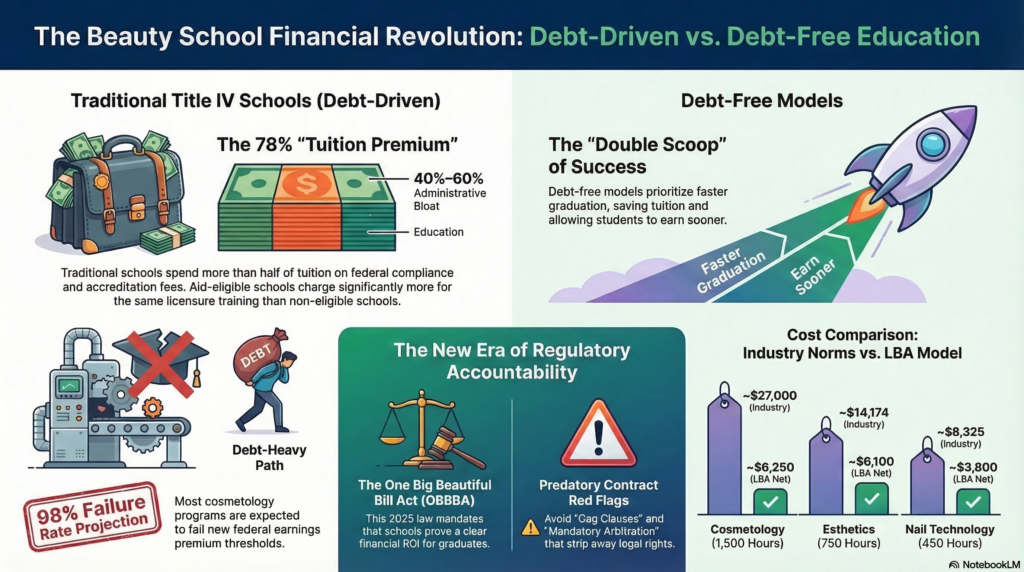
One of the most significant insights generated by economic research into the beauty school sector is the existence of the Title IV tuition premium. This phenomenon refers to the observation that institutions eligible for federal student aid charge substantially higher tuition than comparable non-eligible schools.7 Peer-reviewed research, notably the 2014 study by Cellini and Goldin published in the American Economic Journal, found that Title IV-participating cosmetology programs charge approximately 78% more in tuition than their non-participating counterparts.3
This premium is not merely a reflection of higher quality; in fact, state licensure exam pass rates remain remarkably similar across both Title IV and non-Title IV institutions.7 Instead, the tuition inflation appears to track the maximum available federal aid packages, effectively capturing the subsidy for the institution rather than the student.3 Additionally, Title IV schools face significant administrative “bloat” due to the costs of maintaining eligibility. These institutions must allocate 40% to 60% of their tuition revenue toward accreditation fees, specialized financial aid software, third-party audits, and compliance-focused administrative salaries.10
Comparative Pricing and the “Lower-Debt” Alternative
The disparity in pricing is evident when comparing similar programs in identical geographic markets. For example, case studies in Dallas, Texas, revealed that a Title IV-eligible institution, Salon Boutique Academy, charged over $16,000 for a 1,000-hour program, while the nearby non-Title IV Modern Beauty Academy offered the same licensure training for $4,775—less than one-third of the cost.8 Similar discrepancies exist in the esthetics field, where non-Title IV options like the SSL Skin Institute provide programs at a fraction of the price of their federally-funded peers.8
This economic landscape has necessitated the rise of the “lower-debt” model. Non-Title IV schools, because they eschew the federal system, can offer lower, cash-based tuition rates that align more closely with the actual cost of instruction.3 By avoiding the administrative overhead of federal compliance, these schools pass the savings directly to the student, allowing for a “pay-as-you-go” structure that eliminates the need for long-term student loans.12
The Dual-Revenue Model and Student Labor Ethics
A critical and often overlooked aspect of the for-profit beauty school financial model is the utilization of student clinics. Most accredited institutions operate on-campus salons that are open to the public, where students perform services on paying clients under the guise of “clinical practice”.4 While clinical experience is a necessary component of state licensure requirements, investigators have pointed to a “dual-revenue” model where the school collects both tuition from the student and service fees from the client.4
In many cases, students are required to work in these clinics for hundreds of hours, often performing repetitive tasks that offer little pedagogical value once basic competency is achieved.6 Critics argue that this practice effectively treats students as free labor, allowing the school to generate profit while the student remains in a position of “tuition-paying employee”.4 Furthermore, there is evidence that some schools have lobbied to keep state licensing hours high specifically to prolong this period of clinical labor and to ensure that program costs remain high enough to justify maximum federal aid disbursements.4
Revenue Stream
Title IV School Mechanism
Economic Implication
Tuition
Captured via federal loans and Pell Grants
Leads to high student debt loads 4
Student Clinic
Fees charged to public for student services
Generates immediate operational cash flow 4
Lab Fees/Kits
Mandatory purchase of proprietary kits
Often marked up significantly 5
Overtime Fees
Charges for students who exceed graduation date
Discourages timely completion 16
The Regulatory Response: Gainful Employment and Financial Value Transparency
In response to concerns about high debt and low earnings, the U.S. Department of Education finalized the Financial Value Transparency (FVT) and Gainful Employment (GE) regulations in September 2023.18 These rules represent a fundamental shift in how the federal government evaluates the “value” of a post-secondary program. For the first time, federal aid eligibility is explicitly tied to the financial outcomes of graduates.15
The GE framework restores and expands an accountability system for career-specific programs, particularly those at for-profit institutions.18 Under these regulations, a program must pass two primary tests to remain eligible for Title IV funds:
The Debt-to-Earnings (D/E) Rate: This metric compares the median debt of graduates to their discretionary and annual earnings. If a program’s graduates cannot afford their debt payments relative to their income, the program is flagged.19
The Earnings Premium (EP) Measure: This test compares the earnings of graduates to those of a typical high school graduate (ages 25–34) in the same state. A program fails if its graduates do not earn more than a high school graduate who never attended post-secondary school.19
Programs that fail the same metric for two out of three consecutive years lose access to Title IV funds for a minimum of three years.19 The Department estimates that a significant majority of cosmetology programs—up to 98% by some analyses—would fail the earnings premium threshold as currently structured, as entry-level stylist wages are often comparable to or lower than state medians for high school graduates.4
Implementation Hurdles and Reporting Extensions
The rollout of FVT and GE has been marked by administrative delays. On February 14, 2025, the Department of Education announced a significant extension of the institutional reporting deadline to September 30, 2025.22 This extension was granted in response to challenges faced by institutions in collecting and submitting the necessary data, as well as ongoing litigation.20 The American Association of Cosmetology Schools (AACS) has filed suit against the Department, arguing that the regulations jeopardize the “very existence” of many member schools and fail to account for the unique characteristics of the beauty industry, such as the high prevalence of self-employment and tipped income.15
Despite these challenges, the Department remains committed to the framework. The February 2025 announcement also indicated that institutional reports previously submitted were reverted to draft status to allow schools to correct errors and omissions, emphasizing the government’s focus on data accuracy before imposing sanctions.22
The Landmark Transformation: The One Big Beautiful Bill Act (OBBBA) of 2025
While FVT and GE set the stage, the passage of the One Big Beautiful Bill Act (OBBBA) in July 2025 represents the most radical restructuring of federal student aid in history.21 Signed into law on July 4, 2025, OBBBA introduces the AHEAD framework (Accountability in Higher Education and Access through Demand-driven Workforce Pell), which establishes a “Do No Harm” metric specifically targeting vocational and career-specific programs.21
The OBBBA mandate fundamentally shifts the burden of proof onto the institution. To remain eligible for any federal funding—including both student loans and Pell Grants—a beauty school must prove that its graduates achieve a clear financial return on investment.21 The “Pell Penalty” is a particularly aggressive provision: if more than 50% of a school’s students rely on Pell Grants and the school fails the earnings test for two out of three consecutive years, it loses Pell Grant eligibility entirely.21 This is a “death sentence” for many beauty schools, as they often rely on Pell Grants for the majority of their operating capital.4
The Transition to the Repayment Assistance Plan (RAP)
In addition to institutional accountability, OBBBA overhauled the borrower experience. Beginning July 1, 2026, the law sunsets multiple existing income-driven repayment (IDR) plans, including the Saving on a Valuable Education (SAVE) plan, and replaces them with a single Repayment Assistance Plan (RAP).26 The RAP plan is designed to be more structurally rigid than previous options, using a “tiered standard” to determine monthly payments.24
For students, OBBBA also imposes strict new borrowing caps. Unlike the previous system, which often allowed for borrowing up to the full cost of attendance, the new law limits federal loan volume for undergraduate and professional programs.24 Graduate PLUS loans are also slated for termination for most programs by July 2026, forcing students in advanced specialty tracks to seek more expensive private financing.26
Loan Category
2026 Annual Limit
2026 Lifetime/Aggregate Limit
Dependent Undergraduate
$5,500 – $7,500
$31,000 26
Independent Undergraduate
$9,500 – $12,500
$57,500 26
Parent PLUS (per student)
$20,000
$65,000 26
Graduate Students
$20,500
$100,000 26
Professional (JD, MD, DVM)
$50,000
$200,000 26
Neutral Case Study: The Louisville Beauty Academy (LBA) Model
As the Title IV sector braces for the full impact of OBBBA in 2027, the Louisville Beauty Academy (LBA) in Kentucky offers a neutral example of a non-Title IV vocational school model that has operated in alignment with these principles for years—voluntarily and without reliance on federal student debt.3 LBA’s model is predicated on the rejection of federal subsidies in favor of extreme tuition transparency and “pay-as-you-go” affordability.3
Structural Independence and “License-First” Education
LBA operates as a state-licensed beauty college, specifically authorized by the Kentucky Board of Cosmetology.10 However, the academy intentionally chooses not to pursue federal (national) accreditation. This decision allows the institution to sidestep the massive administrative costs associated with federal aid processing, which LBA identifies as a primary driver of tuition inflation.10 Without these costs, LBA is able to offer tuition that is 50% to 75% lower than the national average.3
The LBA curriculum is designed around a “license-first” philosophy. Rather than padding hours to meet federal aid eligibility thresholds, the school offers standalone tracks that strictly adhere to state-required minimums: for example, 450 hours for Nail Technology and 750 hours for Esthetics.12 This targeted approach allows students to graduate faster and start earning sooner—a concept LBA calls the “Double Scoop” of success: money saved on tuition plus money earned from early entry into the workforce.27
Financial Mechanics and Incentive-Based Discounts
LBA utilizes a transparent, cash-based pricing model that includes all books and kits in the upfront cost.3 The academy provides true affordability through direct tuition discounts and written payment flexible payment plans, explicitly avoiding “Pell Grant cost masking,” where tuition is inflated to absorb the grant.11
Students at LBA can access significant “performance-based” incentives. For example, consistent attendance and high exam scores can reduce the total cost of the cosmetology program from a base of ~$27,000 down to a net cost of ~$6,250.11 The school also offers “Big Scholarships” for students who have exhausted other funding options, further incentivizing academic progress.11
Program (Required Hours)
Industry Norm (Est.)
LBA Discounted Net Cost
Cosmetology (1,500)
~$27,000
~$6,250 3
Nail Technology (450)
~$8,325
~$3,800 3
Esthetics (750)
~$14,174
~$6,100 3
Certified Instructor (750)
~$12,675
~$3,900 11
Shampoo Styling (300)
~$5,890
~$2,890 11
Lash Professional (16)
~$2,500
~$900 11
Macro-Economic and Fiscal Contributions
Beyond individual student benefit, LBA’s model serves as a “Freedom Factory” for the state and federal government. Analysis suggests that the academy has generated approximately $48.7 million in net-positive fiscal contributions over a ten-year period.3 This impact is calculated by analyzing the direct fee revenue paid to the state (school licenses, student permits, exam fees), the tax revenue generated by successful graduate-owned salons, and the $25 million in avoided federal costs that would have been consumed if LBA students used Pell Grants and federal loans.3
For the public balance sheet, the difference between LBA’s model and a hypothetical Title IV model is approximately $73.7 million—representing the sum of the positive revenue generated and the federal costs avoided.3 This model demonstrates that vocational education can thrive without federal dependency, provided that tuition is anchored in labor market reality rather than aid availability.
Student Protections: Identifying and Avoiding Predatory Practices
The high-stakes nature of beauty school enrollment, particularly when tied to significant debt, has led to the proliferation of predatory contractual practices. For the student-consumer, understanding these legal traps is as important as mastering the technical skills of the trade.28
Common Predatory Contract Clauses
Many for-profit beauty schools use enrollment agreements that contain “unconscionable” terms—provisions that are so one-sided they favor the business to the extreme detriment of the student.17 Key red flags in these agreements include:
Mandatory Binding Arbitration: These clauses force students to waive their right to sue the school in court. Instead, disputes must be heard by a private arbitrator, often hired by an association with a working relationship with the school.17
Class-Action Waivers: Also known as “go-it-alone” clauses, these provisions prevent students with similar grievances from banding together in a collective lawsuit, forcing each individual to fight the school’s legal team alone.17
Gag Clauses: These provisions silence students from discussing the details of an ongoing or completed dispute resolution process, effectively preventing the public from learning about institutional failures.31
Excessive Overtime Fees: Some schools charge $3 per hour for any training hours completed after the contracted graduation date, or $50 per day for late arrivals, turning the school into a “money pit scheme”.16
IP Ownership Restrictions: In advanced creative tracks, some contracts contain language that restricts students’ ownership of their own portfolios or creative work, holding their “product” hostage.29
School Stability and Closure Rights
The threat of school closure is a persistent reality in the for-profit sector, particularly as federal accountability tightens. Historically, major chains like Regency Beauty Institute and Marinello Schools of Beauty closed abruptly, leaving thousands of students with incomplete training and massive debt.23
If a school closes while a student is enrolled or within 180 days of their withdrawal, the student may qualify for a 100% discharge of their federal student loans.32 This discharge is often automatic after one year, but students can apply for it immediately upon official confirmation of the closure.33 Receiving a closed school discharge removes all obligation to repay the loan, provides reimbursement for past payments, and removes adverse credit history associated with the debt.32
However, students should be wary of “teach-out” agreements. If a student chooses to finish their program at a nearby school through a formal teach-out, they may forfeit their right to a loan discharge.33 It is essential for students to obtain their academic and financial records immediately upon hearing of a potential closure to ensure they can prove their status to federal regulators.33
Closure Milestone
Student Action Required
Regulatory Protection
Notice of Potential Loss of Aid
Contact state board and research transfer options 37
“Warned” status requires institutional disclosure 19
Official School Closure
Secure all academic transcripts and financial aid records 33
Federal Direct Loan Discharge eligibility 32
180-Day Window
Confirm withdrawal date matches school records
Eligible for discharge if withdrawal within 180 days 33
Automatic Discharge
Monitor studentaid.gov and credit reports
Discharge initiated automatically after 1 year 33
State-Level Variations in Refund Policies
In the absence of a federal refund standard for out-of-pocket tuition, students are subject to state-specific guidelines. These policies are often calculated based on “scheduled hours” rather than “actual hours attended,” meaning that if a student is absent but still enrolled, they continue to incur a financial obligation.38
In Texas, the Department of Licensing and Regulations mandates a refund schedule that protects the institution’s revenue while providing some relief to the student. If a student withdraws within the first 10% of the program, the school must refund at least 90% of the tuition.38 However, once a student passes the 50% threshold, the school is entitled to retain 100% of the total tuition.39 Wisconsin, by contrast, requires a full refund if a student cancels by mail before classes start or if the school made “oral misrepresentations” during recruitment.41
For Title IV recipients, the “Return of Title IV Funds” calculation (R2T4) happens first. If a student withdraws before completing 60% of a payment period, the school must return the “unearned” portion of the federal aid to the government.40 This often results in a “tuition gap,” where the student owes a balance to the school because the state-allowed tuition retention exceeds the amount of aid they were allowed to keep under federal rules.40
Practical Consumer Navigation: The Beauty School “Interview”
To mitigate these risks, prospective students must adopt a professional, consumer-focused mindset during the school search process. A school tour should not be a passive marketing event; it should be a rigorous interview of the institution.28
Evaluating Quality and Reputation
Students should look for “Word on the Street” by asking local salons and spas about the performance of a school’s alumni. Can graduates from the school “hang in the real world,” or do they lack basic treatment procedures?.28 Additionally, students should check for complaints filed with the State Board of Cosmetology or local trade organizations.28
Key questions during the tour should include:
Placement Assistance: What kind of career support is offered? Are there networking events, job fairs, or salon visits?.5
Curriculum Structure: Is the curriculum updated frequently with modern, innovative techniques, or is it stuck in the past?.5
Instructor Experience: What is the background of the instructors? Are they passionate professionals who support individual learning styles?.42
Total Student Load: What is the student-to-teacher ratio? In some schools, a high ratio leads to students being left alone on the salon floor with no supervision.28
The Challenge of Reciprocity and Transferability
Aspiring professionals often believe that a beauty license is universally valid. In reality, license reciprocity is a complex, state-by-state process. There is no such thing as an “automatic transfer”.44 Each state board assesses the skills and training hours of an individual; if the original state’s requirements are lower (e.g., 600 hours of esthetics vs. 750), the student must take additional classes in the new state.44
Transferring hours between schools is equally fraught. Many schools will not accept hours from a competitor, or will only accept “half of the hours” if the school used a different curriculum (e.g., non-Pivot Point schools).46 Before withdrawing from one school to attend another, a student must settle all dues at the original institution and obtain a formal release; otherwise, the state board may not verify their recorded hours for the new school.46
Transfer Step
Required Documentation
Potential Barrier
Initial Inquiry
Potential new school’s transfer policy
Some schools have a “zero-transfer” policy 46
Financial Clearance
Release form from previous school
Outstanding balances prevent hour release 46
Hours Verification
Transcript from State Board of Cosmetology
Interstate bureaucracy can cause delays 44
Evaluation
Practical/Theory entrance exam
Schools may “penalize” and reject up to 10% of hours 47
Licensing Portal
Legal name, GED/Diploma, existing license
Background check issues must be disclosed 45
Conclusion: The Structural Outlook for Beauty Education (2026–2030)
The era of unrestricted federal funding for high-cost, low-outcome beauty education is coming to an end. The implementation of the OBBBA in 2026 and the full enforcement of Gainful Employment accountability will trigger a massive market correction. Schools that have historically relied on a “loan mill” model—characterized by inflated tuition, excessive licensing hours, and poor graduate outcomes—will face inevitable closure as they lose access to Title IV subsidies.21
However, the industry itself is projected to grow by 11% over the next decade, according to the Bureau of Labor Statistics.48 This suggests that the demand for beauty services remains strong, but the pathway to entry must evolve. The future of the sector likely belongs to lower-debt, “license-first” models that prioritize student protection and economic transparency. Institutions like the Louisville Beauty Academy demonstrate that by cutting unnecessary administrative bloat and focusing on rapid, affordable workforce entry, it is possible to create a sustainable educational framework that serves both the student and the public purse.3
For the student, protection lies in education—not just in the techniques of hair and skin care, but in the financial and legal realities of the marketplace. By understanding the shift toward accountability, identifying predatory contract clauses, and treating school enrollment as a high-stakes investment, the next generation of beauty professionals can ensure that their career begins with a license and a future, rather than a debt and a dream cut short. The transition to the STATS reporting system and the AHEAD accountability framework marks the beginning of a new chapter in vocational education, one where the promise of the “Great Society” is finally balanced with the reality of professional results.21
This publication is part of the ongoing vocational education research initiative conducted by Di Tran University — The College of Humanization. The analysis synthesizes publicly available data, policy reports, academic literature, regulatory documents, and industry commentary in order to promote transparency and informed decision-making in vocational education.
The purpose of this research is educational and public-interest oriented. It does not constitute legal, financial, or regulatory advice, nor does it evaluate or endorse specific institutions. Readers are encouraged to consult state licensing authorities, regulatory agencies, and independent advisors when making educational or financial decisions.
Disclaimer: This article is published on the website of Louisville Beauty Academy for informational and public educational purposes only. The research, analysis, and opinions presented herein were prepared by the research team at Di Tran University — The College of Humanization as part of its Research & Podcast Series. Di Tran University is an educational research affiliate founded by Di Tran, who also serves as founder and CEO of Louisville Beauty Academy — this is a founder-affiliated publication, not an independent third-party study. Louisville Beauty Academy does not interpret or provide legal, regulatory, or financial advice through this publication and does not represent any government agency or regulatory authority. All references to laws, regulations, economic data, and workforce statistics are based on publicly available sources and academic analysis and should not be relied upon as official guidance. Readers seeking legal, regulatory, or professional advice should consult qualified professionals or the appropriate government authorities.
Introduction: Regulatory Accountability and the Restructuring of Vocational Education
The regulatory landscape of U.S. postsecondary education underwent a structural transformation between 2023 and 2026, driven primarily by the reintroduction and expansion of the Department of Education’s “Gainful Employment” (GE) and “Financial Value Transparency” (FVT) frameworks. Finalized on October 10, 2023, these regulations established a comprehensive accountability system for programs authorized under Title IV of the Higher Education Act (HEA), specifically targeting non-degree programs at public and private non-profit institutions and all programs at for-profit (proprietary) institutions.1 The core objective of these rules is to ensure that career-focused education leads to measurable economic outcomes, defined by graduates’ ability to service their debt and earn more than a typical high school graduate.3
The GE framework utilizes two primary performance metrics: the debt-to-earnings (D/E) ratio and the earnings premium (EP) test. Under 34 CFR Part 668, a program is deemed to pass the D/E standard if its median annual debt service is less than or equal to 8% of median annual earnings or less than or equal to 20% of discretionary earnings.3 Discretionary earnings are calculated as median annual earnings minus 150% of the federal poverty guideline for a single individual, which was approximately $21,870 in 2023.3 The EP test requires that a program’s typical graduate earns at least as much as a typical high school graduate between the ages of 25 and 34 in the labor force for the corresponding state.2 Programs that fail the same metric for two out of three consecutive years lose their eligibility to participate in federal student aid programs.2
The implementation of these standards has exerted significant pressure on the for-profit vocational sector, particularly beauty and cosmetology schools. Historical evidence from the 2014 regulatory cycle serves as a precursor to contemporary trends; data indicate that approximately 32% of cosmetology certificate programs either failed or entered a “warning” zone under earlier iterations of these benchmarks.5 In the 2024–2025 period, the Department of Education utilized administrative data from the National Student Loan Data System (NSLDS) and the Internal Revenue Service (IRS) to generate “Completers Lists,” which established the cohorts for outcome measurement.6 Reporting obligations for all institutions became effective on July 1, 2024, and by early 2025, the Department began issuing the first GE and FVT scores.3
Data indicate that the threat of losing Title IV eligibility has accelerated the closure rate of low-performing institutions. Research on institutional characteristics shows that private for-profit colleges are approximately three times as likely to close as private non-profits, with for-profit two-year schools experiencing the highest closure rates in the postsecondary market.8 Between 1996 and 2023, nearly one-third of observed institutions in the two-year for-profit sector closed.8 Contemporary examples from 2024–2025 highlight this trend; for instance, a prominent beauty school chain in Tennessee faced loss of accreditation and closure after reporting an on-time graduation rate of only 3% and poor loan repayment outcomes.5 At the national level, federal data from February 2026 revealed that over 1,800 institutions exhibited nonpayment rates at or exceeding 25%, placing them at “serious risk” of failing future cohort default rate (CDR) and GE benchmarks.9
Regulatory Timeline for GE and FVT Implementation
Key Action Item
October 10, 2023
Publication of Final Rule (88 FR 70004) 2
July 1, 2024
Effective date for reporting and administrative capability 2
January 15, 2025
Deadline for institutional reporting of student-level data 6
Early 2025
Issuance of first GE/FVT scores and metrics 3
July 1, 2026
Launch of public program information website and student acknowledgment requirements 2
The regulatory environment of 2026 is further defined by the Financial Value Transparency provisions, which require all Title IV-eligible programs to disclose comprehensive costs, median debt, and median earnings on a public-facing website.2 Starting July 1, 2026, students must provide a formal acknowledgment that they have viewed this information before enrolling in programs with failing D/E rates.2 This “transparency-as-accountability” model assumes that informed consumer choice will drive enrollment away from programs that “leave students no better off” than those with only a high school diploma.5
Macroeconomic Context: Inflationary Volatility and Geopolitical Shocks
The macroeconomic climate of early 2026 is characterized by a confluence of persistent domestic inflation and acute geopolitical instability in the Middle East, both of which have introduced significant volatility into the U.S. economy. As of February 2026, the Bureau of Labor Statistics (BLS) reported that the Consumer Price Index for All Urban Consumers (CPI-U) increased by 0.3% on a seasonally adjusted basis, with a 12-month unadjusted increase of 2.4%.10 While the 12-month headline inflation rate matched the previous month’s reading, internal components, particularly energy and food, showed signs of acceleration.10
The food index rose 0.4% in February 2026, with the index for food at home also increasing by 0.4%.10 Over the previous 12 months, food prices increased by 3.1%, driven by a 5.6% rise in nonalcoholic beverages and a 3.9% increase in food away from home.10 These increases have been compounded by a resurgence in energy costs. The energy index increased 0.6% in February 2026, reversing a 1.5% decline in January.10 Natural gas prices surged 10.9% over the 12 months ending in February, while electricity prices rose 4.8%.10
Consumer Price Index Component
Monthly Change (Feb 2026)
12-Month Change (Feb 2026)
All Items
+0.3%
+2.4%
Food at Home
+0.4%
+2.4%
Food Away from Home
+0.3%
+3.9%
Energy
+0.6%
+0.5%
Utility (piped) Gas
+3.1%
+10.9%
Electricity
-0.7%
+4.8%
Shelter
+0.2%
+3.0%
Personal Care
-0.2%
+4.5%
Source: 10
The primary driver of energy volatility in 2026 has been the escalation of military conflict in the Middle East, specifically involving the Strait of Hormuz. Following joint U.S. and Israeli airstrikes on Iran on February 28, 2026, Iran effectively halted maritime traffic through the strait, a critical chokepoint through which approximately 20 million barrels of crude oil and oil products pass daily.13 This disruption removed roughly one-fifth of the world’s oil and gas supply from the market, causing an immediate spike in global energy prices.14 Brent crude oil surged from $70 per barrel to over $110 per barrel within days of the conflict’s commencement.16 By March 6, 2026, Brent was trading at $92 per barrel, up 28% from the previous week’s close.17
In the United States, gasoline prices responded to these global trends, rising by 0.8% in February and surging by double-digit percentages in early March.12 Analysts from the International Energy Agency (IEA) noted that commercial traffic through the Persian Gulf had slowed “to a trickle” as insurers and shipowners reassessed the risks.13 This geopolitical friction has broader economic implications, with the OECD projecting that global growth will moderate to 3.0% in 2026 as higher trade barriers and policy uncertainty dampen investment.18 In the U.S., GDP growth is projected to slow to 1.6% in 2026, down from 2.2% in 2025.18
Furthermore, the transition to an AI-influenced economy has introduced a new layer of workforce disruption. Research from the McKinsey Global Institute suggests that by 2030, approximately 14% of employees globally—and 375 million workers total—will require significant reskilling due to automation and digitization.19 Estimates indicate that up to 30% of current work hours in the U.S. could be automated by 2030, with a focus on routine tasks in data entry, manufacturing, and customer service.19 The World Economic Forum projects that 85 million jobs may be displaced by AI by 2025, although this will likely be offset by the creation of 97 million new roles, particularly those requiring “human-centric” skills.20
Recession-Resilience and Economic Elasticity of Beauty Trades
The beauty and personal care industry has demonstrated a historical capacity for recession-resilience, often quantified through the “Lipstick Effect”—an economic phenomenon where consumers continue to purchase small, affordable luxury items during financial downturns even as they curtail larger discretionary expenditures.22 Data from the 2008 financial crisis indicate that industry spending fell only slightly and returned to pre-recession levels by 2010.24 During the Great Recession of 2007–2009, cosmetic purchases among married women increased by 9.8%, and the average annual expenditure on beauty products rose from $139 in 2007 to $152 in 2009.23
The 2020 COVID-19 pandemic provided a more severe test of elasticity, as government-mandated lockdowns forced the closure of physical service locations. During this period, global beauty industry revenues fell by 20% to 30%, with professional services being the hardest hit.24 However, the sector exhibited a rapid rebound; by 2021, lipstick sales increased by 80% once mask mandates were lifted, and consumers shifted toward self-care and skincare categories during the isolation period.23 This suggests that while beauty services are physically constrained by lockdowns, the underlying demand for personal grooming remains highly inelastic.
In the current 2024–2026 economic environment, BLS wage data highlight the relative stability of beauty trades. As of May 2024, the median annual pay for barbers, hairstylists, and cosmetologists was $35,420.26 While this is below the median for all occupations ($23.80 per hour), the sector offers a robust path to self-employment, which acts as a hedge against corporate downsizing. In 2024, 76% of barbers were self-employed.26 This high rate of independent operation allows practitioners to adjust their prices more dynamically in response to localized inflation (e.g., rising shelter and utility costs) than fixed-salary employees.26
Occupational Title (SOC)
Employment (2024)
Median Hourly Wage (2024)
Projected Growth (2024–34)
Barbers (39-5011)
76,000
$18.73
4%
Hairdressers/Cosmetologists (39-5012)
575,200
$16.95
6%
Skincare Specialists (39-5094)
100,000*
$19.98*
9%*
Manicurists/Pedicurists (39-5092)
170,000*
$16.66*
8%*
Source: 26 (*Estimated based on 2024 summaries)
The “humanization of labor” in the beauty industry creates a unique economic sanctuary. Evidence from high-performing salon owners suggests that established facilities with 10–20 technicians can generate annual gross revenues between $1 million and $2.4 million.27 Unlike the corporate sector, which is increasingly threatened by AI-driven efficiency gains, the beauty service industry is “inventory-light” and centered on the “physics of touch,” which limits the potential for remote or automated displacement.24 The 2024–2026 period has seen a “human premium” emerge, where skills related to empathy, creativity, and fine motor skills command stable demand despite broader macroeconomic volatility.21
Affordability, Debt Traps, and the Divergent Models of Beauty Education
The financial structure of beauty education has historically been a significant point of concern for federal regulators. Research from New America and the National Association of Student Financial Aid Administrators (NASFAA) found that for-profit beauty schools often carry high tuition premiums linked to Title IV eligibility.31 Average student debt for cosmetology graduates typically ranges from $7,000 to $11,000, which can represent a substantial portion of an entry-level practitioner’s annual earnings.32
Evidence indicates a sharp disparity in tuition between Title IV-participating programs and cash-based models. Title IV cosmetology programs often charge between $15,000 and $20,000, whereas non-Title IV programs (often referred to as lower-debt or cash-based models) frequently offer the same licensure hours for $4,000 to $8,000.32 This “tuition premium” in the Title IV sector is often offset by Pell Grants and federal loans, yet it frequently leads to higher default rates if the graduates fail to secure immediate, high-paying work.5
The implementation of the “One Big Beautiful Bill Act” (OBBBA) in 2026 introduced new constraints on this model. The OBBBA established firm annual and lifetime caps on federal student loans, replacing the previous system where the “Cost of Attendance” (COA) was the primary limit.35 Under the OBBBA, independent undergraduates face an annual loan limit of $9,500–$12,500, which may leave many students at high-tuition for-profit schools with a significant funding gap.36 Furthermore, the elimination of the Grad PLUS loan program has placed additional revenue pressure on institutions that depend on debt-financed graduate or professional certificates.35
Loan Category (OBBBA 2026)
Annual Limit
Lifetime Aggregate Limit
Independent Undergraduate
$9,500 – $12,500
$57,500
Dependent Undergraduate
$5,500 – $7,500
$31,000
Parent PLUS (Per Student)
$20,000
$65,000
Graduate Students
$20,500
$100,000
Source: 36
As Title IV-dependent schools face higher compliance costs and lower borrowing caps, “cash-pay” models have become more prominent. These institutions typically utilize “pay-as-you-go” plans and institutional scholarships (which can cover 50% to 75% of tuition) to maintain affordability without federal oversight.33 Data from 2025 show that students graduating from these lower-debt models enter the workforce with written payment-bearing debt, significantly improving their Debt-to-Earnings ratios compared to their peers at traditional for-profit institutions.32 Default rates at beauty schools that relied heavily on Title IV aid reached alarming levels in early 2026; over 500 cosmetology schools were flagged by the Department of Education as having 30% or more of their borrowers more than 90 days delinquent.31
Workforce Security: Automation Resistance and Multilingual Integration
The beauty industry is uniquely positioned to resist the automation risks identified by Oxford Economics and McKinsey. While Oxford Economics reports that approximately 47% of U.S. jobs are “at risk” of computerization over the next two decades, these risks are heavily concentrated in logistics, administrative support, and routine production labor.39 Personal care services, including barbers and cosmetologists, are classified as “low risk” due to the high degree of manual dexterity, social intelligence, and creativity required to perform non-routine tasks in unstructured environments.39
The McKinsey Skill Change Index (SCI) confirms this trend, showing that “assisting and caring” skills will experience the least change in demand due to AI through 2030.21 While AI tools are being integrated into the industry for scheduling, virtual try-on, and business management, the core service—the physical manipulation of hair, skin, and nails—remains a “humanized” endeavor.27 This resistance to automation is a critical component of workforce security in an environment where 18.4 million experienced workers are expected to retire by 2032, creating a “skills shortage” in occupations that require postsecondary credentials and tangible service skills.42
Workforce Factor (2024–2026)
Beauty/Personal Care Industry Status
Automation Vulnerability
Low (Non-routine physical tasks) 39
Human Skills Premium
High (Social intelligence, empathy) 21
Credential Alignment
State Licensure required (Protective barrier) 27
Demographic Support
79.3% Female workforce; 33% POC 43
Multilingual Availability
Spanish, Vietnamese, Korean, Chinese 44
Workforce accessibility has also been enhanced through the expansion of multilingual licensing pathways. In states like California, Florida, and Texas, cosmetology licensing boards offer exams in multiple languages to accommodate the diverse demographic profile of the industry.32 For example, the California Board of Barbering and Cosmetology offers its laws and regulations book in Korean, Spanish, Vietnamese, and Simplified Chinese.44 Data from previous years indicated that Spanish test-takers achieved an 82% pass rate on the practical portion of the examination, which is conducted in English but allows for visual following.45 In Florida, the Board of Cosmetology regulates and approves products for infection control and sets rules for practitioners who must maintain a 75% passing mark for licensure.45
The Georgetown Center on Education and the Workforce (CEW) notes that institutions offering certificates and associate degrees often provide a higher return on investment (ROI) after 10 years than institutions offering bachelor’s degrees, as they allow students to enter the workforce faster with lower out-of-pocket costs.48 For early-career workers, certificates in middle-skills occupations can lead to median annual earnings of $83,300 by mid-career.48 In the beauty sector, this rapid entry is facilitated by programs that streamline training to state-minimum hours (e.g., 1,500 hours for cosmetology, 600–750 for esthetics, 300–450 for nail technology).32
Case Study: Analysis of an Outcomes-Based Vocational Institution
The shifting paradigm of postsecondary education is exemplified by a specific, anonymously profiled institution that has expanded its footprint during a period of widespread sector consolidation. This family-owned academy, located in the Southeastern United States, operates a model that intentionally decouples vocational training from federal student debt, focusing instead on “cash-pay” affordability and labor market placement.38
Operational and Financial Metrics
Unlike traditional Title IV-dependent schools, this institution does not participate in federal student loan programs. Instead, it utilizes an “innovative pay-as-you-go” tuition plan and provides institutional scholarships that cover up to 50–75% of the total cost.33 This results in a tuition structure that is 50–80% lower than prevailing market rates. For example, the institution’s Nail Technology course is priced at approximately $3,800 (after aid), whereas regional competitors charge $15,000 to $20,000 for the same certification.33
Institution Performance Metric
Reported Value
Industry Benchmark
On-time Completion Rate
~90%
24% – 31%
Job Placement Rate
~90%
~70%
Student Loan Debt upon Graduation
$0
$7,000 – $11,000
Nail Technology Tuition
$3,800
$15,000+
Real Estate Ownership Status
100% Owned (Main/West)
Variable (Leased typical)
Source: 33
The institution’s facility model is anchored in real estate ownership, with its main campus and future second-location planning fully licensed and operating through July 31, 2026.38 This strategy of owning the underlying assets allows the institution to keep operating costs low and provides insulation from the inflationary shocks currently impacting commercial rent in the region.27
Workforce Integration and Recognition
The academy focuses on serving underrepresented communities, including immigrants and low-income individuals, through multilingual instruction and state-board-aligned curricula.33 Graduates of the 6-month nail technology program or the 1,500-hour cosmetology program secure jobs or start salon businesses at a rate of 90%, collectively contributing an estimated $20 million to $50 million annually to the local economy.33
In 2025, the institution achieved historic national recognition, becoming the first beauty academy to be honored simultaneously as a U.S. Chamber of Commerce CO—100 Award winner and a National Small Business Association (NSBA) “Advocate of the Year” finalist.33 These accolades were awarded based on the institution’s workforce development outcomes and its role as a model for “ethical, outcomes-driven training”.33 Furthermore, the institution has expanded its curriculum to include fast-growing specialties such as eyelash extensions (16–320 hours depending on state law) to meet the evolving demands of the “Gen Z aesthetic” market.30
The case study institution—identified in public filings as the Louisville Beauty Academy—demonstrates that high graduation rates and low student debt are achievable when institutional priorities are aligned with labor market demand rather than the maximization of Title IV drawdowns.33 By prioritizing biometric attendance tracking for hour integrity and maintaining a “Success Sharing” discount model for students, the academy has created a replicable template for vocational education in a post-federal-aid world.32
Policy Implications
The data from the 2023–2026 period suggest that the traditional for-profit education model, characterized by high-tuition premiums and heavy reliance on federal debt, is increasingly unsustainable under new gainful employment benchmarks and shifting macroeconomic conditions. Real-estate-owned, lower-debt vocational models provide a stable alternative by reducing the “tuition premium” associated with Title IV eligibility and insulating students from the long-term debt traps that currently define the sector. By prioritizing low-cost, cash-based education and multilingual licensure, these models not only satisfy the Department of Education’s financial value transparency requirements but also provide a resilient pathway to economic security in an environment disrupted by AI, energy-driven inflation, and geopolitical volatility.
The Efficacy of Disciplined Repetition: A Case Study in Licensing-Focused Vocational Education at Louisville Beauty Academy
The landscape of vocational education, specifically within the beauty and wellness sector, stands at a critical juncture between two competing pedagogical philosophies. On one side is the traditional, often “glamour-focused” model that prioritizes student engagement through entertainment, artistic flair, and simulated salon environments. On the other is an emerging, outcomes-based model characterized by the phrase “Boring Is Efficient.” This latter philosophy posits that the most effective way to transition a novice into a licensed professional is through a disciplined, repetitive, and compliance-driven curriculum that prioritizes the “safety credential” over aesthetic experimentation.1 In high-stakes industries like cosmetology, where practitioners manage reactive chemicals and utilize invasive sharp instruments, the “boring” elements of education—sanitation, regulatory literacy, and repetitive technical drills—are not merely administrative hurdles but are the essential components of professional survival and public health protection.2 This article provides a comprehensive analysis of this philosophy, using the operational framework of Louisville Beauty Academy (LBA) as a case study to explore how focus, efficiency, and compliance drive faster, safer, and more ethical workforce outcomes.
The Philosophical Foundation of Efficiency in Vocational Licensing
The “Boring Is Efficient” framework redefines the educational experience by stripping away extraneous cognitive loads that often distract from the primary objective of vocational training: compliant entry into the licensed workforce.1 In this context, “boring” is not a pejorative term suggesting a lack of value; rather, it serves as a descriptor for a focused, efficient, and licensing-oriented training environment.3 This approach recognizes that the beauty industry is a primary prevention sector, where the practitioner acts as a frontline steward of public health, often working without the institutional safety nets found in traditional clinical hierarchies.2
The pedagogical intensity required for licensure in Kentucky is significant. A cosmetology license requires 1,500 clock hours of training, a threshold that exceeds the training requirements for many Emergency Medical Technicians.2 This discrepancy is rooted in the “Hidden Safety Governance” of the industry.2 Unlike healthcare environments where practitioners operate within hospitals or supervised clinics, beauty professionals often work as independent contractors or in small businesses.2 Consequently, the state relies on the front-loading of safety and sanitation habits during these 1,500 hours to ensure that practitioners maintain high standards without constant surveillance.2 By framing “boring” as a virtue of focus and safety-centered discipline, institutions like Louisville Beauty Academy align their curriculum with the biological and chemical risks inherent in the field.2
The Hidden Safety Governance of Aesthetics
The historical necessity for rigorous regulation in beauty education is anchored in the transition from medieval guilds to the public health mandates of the Progressive Era.2 During this “Great Sanitary Awakening,” the government recognized that the intimate contact inherent in beauty services could facilitate the transmission of virulent infectious diseases.2 Licensing emerged as the legal and scientific bedrock for public safety.2 Modern beauty practitioners manage reactive chemicals, such as hair relaxers and colors, and utilize sharp, invasive instruments like razors and nippers.2 The “boring” repetition of disinfecting tools and maintaining workstations serves as a “fundamental contract” between the practitioner and the public’s biological integrity.2 This relationship is maintained through pedagogical intensity, ensuring that practitioners develop an intuitive understanding of infectious disease prevention and chemical toxicology.2
The Regulatory Framework of Kentucky Cosmetology
To understand the operational environment of Louisville Beauty Academy, one must analyze the specific mandates set by the Kentucky Board of Cosmetology (KBC). The KBC establishes the standards for training hours, curriculum content, and sanitation protocols across several license types.3
Table 1: Kentucky Regulatory Hour Requirements and Clinic Thresholds
License Type
Total Clock Hours
Practice/Clinic Hours
Theory/Statute Hours
Service Threshold (Hours)
Cosmetology
1,500
1,085
415
250 (Chemical)
Esthetician
750
465
285
N/A
Nail Technician
450
275
175
60 (Chemical)
Shampoo Styling
300
175
125
N/A
3
These hour requirements are established by state law, specifically 201 KAR 12:082, and require schools to maintain “accurate daily attendance records” preserved for at least five years.3 The clock-hour system differs fundamentally from the credit-hour system used in traditional higher education.4 In a beauty academy, there is no “informal time forgiveness” or rounding of hours; if a student is not physically present and clocked in via biometric verification, they do not earn progress toward their license.4 This administrative burden necessitates sophisticated tracking systems to ensure the person earning the hours is the person physically present.4
Table 2: Kentucky Board of Cosmetology Licensing Fee Structure
Fee Type
Amount
Frequency
Requirement
Initial Exam (Written + Practical)
$75 – $85
Once
Completion of school
Initial License Fee
$25
Once
Passing exams
Annual Renewal Fee
$20 – $50
Annual (by July 31)
Continued practice
Late Renewal / Restoration Fee
$50
Per instance
After July 31
Exam Retake Fee
$32 – $85
Per attempt
Following failure
6
The licensing process involves a theory exam and a practical demonstration.6 To pass, applicants must achieve at least 70% in both components, while instructors must achieve 80% on theory and 85% on the practical exam.7 These high stakes reinforce the necessity of “boring” repetition during training; the practical exam is essentially a test of how well the student has automated their technical and sanitation protocols.6
The Architecture of Infection Control: 201 KAR 12:100
Infection control is not merely a subject of study but the operational baseline of the beauty industry.3 Kentucky regulation 201 KAR 12:100 establishes comprehensive standards for all facilities licensed by the KBC, including salons and schools.7 The philosophy of “Boring Is Efficient” is most evident in these protocols, where the repetition of cleaning and disinfection is the primary defense against community outbreaks.2
Cleaning and Disinfection Protocols
All non-porous implements, such as combs, shears, and nippers, must undergo a multi-step process: cleaning with warm soapy water followed by complete immersion in an EPA-registered bactericidal, virucidal, and fungicidal disinfectant for the full manufacturer-required contact time.5 The regulation explicitly states that UV light boxes are not acceptable for disinfection; they may only be used to store already disinfected tools.7 Electrical tools like clippers must be cleaned of hair and then saturated with a high-level disinfectant spray or foam.7
Pedicure stations require even more rigorous attention. After each use, all removable parts must be scrubbed with detergent, and the bowl must be filled with a disinfectant solution that circulates (if a whirlpool) or stands for the full contact time.5 For nail technicians, drill bits must be soaked in acetone to remove product before being scrubbed and disinfected.7 This level of detail underscores why training is repetitive: a single missed step in these protocols can lead to the transmission of infections like MRSA or Hepatitis.2
Personal Hygiene and Product Handling
Every licensee is required to wash their hands with soap and water or use hand sanitizer immediately before serving each patron.7 Product handling is also strictly regulated to prevent cross-contamination; multi-use containers of wax or pomade must be accessed using single-use spatulas, and fingers are prohibited from touching the product directly.7 Powders and lotions must be dispensed via shakers or pumps to prevent hand contact with the dispensing mechanism.7
Blood Exposure and Disease Control
If an injury occurs during a service, the practitioner must stop immediately, wear gloves, clean the area, and apply an antibacterial ointment and bandage.7 Any workspace or implement contaminated by blood must be properly disinfected before service resumes.5 These “bloodborne pathogen” protocols are critical, as the “micro-trauma” caused by a standard manicure or a straight-razor shave provides a sufficient route for the transmission of HIV, Hepatitis B, and Hepatitis C.2
Table 3: Microorganisms Targeted by “Boring” Sanitation Protocols
Category
Microorganism
Risk in Salon
Prevention Method
Viral
Hepatitis B & C, HIV
Blood exposure from nicks
EPA-registered disinfectant
Viral
Herpes Simplex
Waxing, shared cosmetics
Single-use applicators
Bacterial
S. aureus (MRSA)
Infected skin, unwashed hands
Hand hygiene, surface cleaning
Bacterial
Pseudomonas
Contaminated foot spas
Circulating disinfectant
Fungal
Trichophyton (Tinea)
Manicures/Pedicures
Tool immersion
2
The Cognitive Science of “Boring” Mastery
The effectiveness of licensing-focused education can be explained through Cognitive Load Theory (CLT). CLT posits that human working memory has a limited capacity, typically holding only seven “chunks” of information for about 20 minutes unless reinforced.15 To facilitate learning, instructional design must manage three types of cognitive load: intrinsic, extraneous, and germane.15
Managing Cognitive Resources
Intrinsic load is determined by the complexity of the material itself, such as the chemical interactions of hair color.15 Extraneous load is generated by poor instructional design or distractions, such as entertainment-focused teaching or “glamour” events.1 Germane load is the beneficial mental effort used to integrate new information into existing “schemas” or long-term memory structures.15
The “Boring Is Efficient” philosophy minimizes extraneous load by stripping away the “Glamour Tax”—the branding, recruitment shows, and non-essential activities that occupy student time in many traditional schools.1 By focusing strictly on repetitive, safety-centered tasks, the model allows students to dedicate more working memory to germane processing, ensuring that critical sanitation and technical skills are moved into long-term memory.15
Procedural Memory and Muscle Memory
The repetition perceived as “boring” is the mechanism for developing procedural memory—the part of long-term memory responsible for motor skills and automatic sequences of action.20 In beauty education, this is often called “muscle memory”.11 Deliberate practice, which involves mindful repetition with a focus on refinement, builds neural pathways that allow a stylist to hold shears at precise angles or maintain consistent tension without conscious effort.11
Once a habit is formed through repetition, it is directly triggered by the context (e.g., the salon environment) without the need for conscious goal pursuit.22 This is why boring repetition is a safety feature: it ensures that in a high-pressure environment, such as a busy salon or a licensing exam, the practitioner defaults to correct sanitation habits automatically.2
The Economics of Focused Education: The “Great Decoupling”
The economics of beauty education are being reshaped by the “Great Decoupling”—the shift away from federal aid dependency toward outcomes-based, direct-to-consumer models.1 Traditional beauty schools often participate in the Title IV federal aid system, which introduces two major financial burdens for students: the “Compliance Tax” and the “Glamour Tax”.1
The Compliance Tax and the Glamour Tax
The Compliance Tax accounts for 25-35% of student tuition and covers the administrative overhead of managing federal aid, including expensive compliance audits and specialized staff.1 The Glamour Tax accounts for another 45% of tuition, covering high-gloss marketing, recruitment campaigns, and performative events like runway shows.1 These costs inflate tuition to $15,000–$25,000, leaving students with an average debt of $7,000–$11,000 upon graduation.1
Table 4: Economic Impact of Educational Paradigms
Metric
Traditional Title IV Schools
Louisville Beauty Academy (LBA)
Average Tuition
$15,000 – $25,000
Under $7,000
Student Debt
$7,000 – $11,000
$0 (lower-debt model)
On-Time Graduation
24% – 31%
~90%
Job Placement
Triple-digit % gap from LBA
~90%
Program Length
12 – 18 months
9 – 10 months
1
By opting out of Title IV funding, LBA eliminates these taxes, offering a tuition model that is 50-70% lower than the industry norm.1 This direct-savings paradigm allows students to enter the labor market faster and lower-debt.1 The “fiscal velocity” created by an accelerated curriculum—allowing students to begin earning taxable income 6-9 months sooner—provides a net positive impact on the local economy.1
Table 5: Fiscal Velocity Calculation and Impact
The fiscal impact of accelerated graduation can be expressed through a velocity model:
where is the net fiscal impact, is the avoided public aid package, is the interest on avoided debt, and is the fiscal velocity created by faster workforce entry.4 At LBA, this efficiency contributes an estimated $20–$50 million annually to the local economy through business ownership and employment.1
Case Study: The LBA Operational Model of “Over-Compliance”
Louisville Beauty Academy utilizes an “Over-Compliance” model that treats state regulation as a professional skill rather than a burden.1 This model is structured into five distinct phases, using technology to verify mastery at every step.25
The Five Phases of Mastery
Phase 1: Mindset & Onboarding (0–100 Hours)
The focus is on dismantling psychological barriers and establishing the “YES I CAN” mindset. Students are introduced to the biometric attendance system and must achieve 100% in disinfection and blood exposure protocols to earn their “Safety Pro” badge.25
Students engage with the CIMA digital curriculum, identifying knowledge gaps through frequent, high-stakes exams. Achieving a 90% or higher average earns the “Theory Scholar” badge.25 This phase emphasizes “Regulatory Literacy”—the ability to navigate KRS 317A and 201 KAR 12.1
Phase 3: The Clinical Floor & Public Trust (300–1000 Hours)
Under instructor supervision, students provide services to the public. This phase is dedicated to the “boring” refinement of practical skills and the maintenance of professional conduct standards. Students earn the “Client Protection Mastery” badge after completing state-mandated practical checklists.25
Phase 4: Proof-of-Work & Business Identity (1000–1400 Hours)
Students begin mapping their future careers and documenting their unique professional style. They curate technical artifacts for their digital portfolios, providing “Proof-of-Work” that transcends a traditional diploma.25
Phase 5: The “I HAVE DONE IT” Capstone (1400–1500 Hours)
This phase is dedicated to intensive state board preparation. Upon final practical check-offs and graduation, students earn the “I HAVE DONE IT” Capstone badge, representing the transition from belief to documented mastery.25
Table 6: The LBA Digital Credential System (Open Badges 3.0)
Badge Name
Milestone Phase
Achievement Requirement
Safety Pro
Phase 1 (0-100 hrs)
100% mastery of disinfection protocols
Theory Scholar
Phase 2 (100-300 hrs)
90% average on chapter exams
Compliance Steward
Phase 2 (100-300 hrs)
Mastery of regulatory literacy (KRS 317A)
Client Protection
Phase 3 (300-1000 hrs)
Successful completion of clinic checklists
I HAVE DONE IT
Phase 5 (1400-1500 hrs)
Final capstone and graduation
25
Technological Verification: Biometric Auditing and Accountability
A defining characteristic of the LBA model is the “Compliance by Design” approach to record-keeping.4 Traditional clock-hour tracking is often prone to “informal time forgiveness,” but the state board requires an exact accounting of every minute spent in training.4 LBA’s use of biometric attendance mandates (using fingerprint or facial recognition) ensures that the person earning the hours is the person physically present.4
This biometric integrity protects the student’s professional narrative. In an industry where graduation can be delayed by “dead time” or holiday breaks in traditional schools, LBA students earn only the required clock hours, ensuring every hour counts toward licensure.26 This transparency is furthered by the “Public Record Library” model, where the academy publishes the exact text of laws and research—such as 201 KAR 12:190 regarding complaints and discipline—to eliminate information asymmetry between the school and the student.1
The Modern Workforce Alternative: Registered Apprenticeships
As the beauty industry evolves, new models for workforce entry are emerging that align with the “Boring Is Efficient” philosophy of on-the-job, repetitive training.1 The Department of Labor (DOL)-backed beauty apprenticeships provide an alternative to traditional classroom-only education.1
Table 7: Comparison of Educational and Apprenticeship Models
Feature
School-Based (e.g., LBA)
Registered Apprenticeship (e.g., Atarashii)
Learning Environment
Supervised clinic floor/classroom
Paid, on-the-job training in a salon
Structure
1,500 clock hours
Competency-based or hour-based mentorship
Funding
Tuition-based (direct savings)
Paid work while learning
Credential
State Board License
DOL Certificate + State Board License
Role of Mentor
School Instructor
Salon Stylist/Employer
1
The Atarashii Apprentice Program is a federally recognized Registered Apprenticeship that operates across cosmetology, barbering, and nail technology.1 This model proves that beauty education can meet structured DOL standards, where mentorship-based learning produces compliant outcomes. For immigrants, ESL learners, and dislocated workers, these “lower-debt” and “completion-driven” models provide employment certainty without lowering safety standards.1
Psychological Resilience and Student Outcomes
While repetitive training is often perceived as “boring,” research suggests that focused vocational environments provide significant psychological advantages for students.28
Self-Efficacy and Autonomy
Self-Determination Theory (SDT) points out that mental health and functional performance depend on the satisfaction of three basic needs: autonomy, competence, and belonging.29 In a licensing-focused environment, students experience greater competence through the mastery of core tasks.29 The “boring” repetition of sanitation and technical drills serves as a cognitive priming mechanism, allowing students to focus their attention on subject-specific thinking.29
Building Willpower and Confidence
Regular engagement in structured vocational activities, much like campus sports, enhances adolescents’ and young adults’ psychological qualities, including willpower and self-confidence.30 This “sports confidence” actively influences personality traits, enabling students to demonstrate greater tenacity when facing the challenges of a licensing exam or a professional career.30 By mastering the “boring” foundation of the industry, students build a buffer against negative emotions in the face of professional setbacks.30
Table 8: Psychological Impact of Standardized vs. Distraction-Heavy Training
Learning Environment
Primary Cognitive Load
Student Emotional Response
Longitudinal Outcome
Standardized (Focused)
Germane (Schema building)
Higher self-efficacy; lower anxiety
High completion; resilient habits
Distraction-Heavy
Extraneous (Theatre/Branding)
Diminished engagement; anxiety
High attrition; poor habit formation
15
Conclusion: Synthesis of Professional Integrity and Public Safety
The research presented here indicates that in the high-stakes industry of cosmetology, the philosophy of “Boring Is Efficient” is not a sign of educational stagnation but a commitment to professional excellence and public safety.1 By defining “boring” as a state of focus, efficiency, and compliance-driven discipline, institutions like Louisville Beauty Academy have created a model that outperforms traditional “glamour-focused” schools on every key metric.1
The synthesis of Cognitive Load Theory, procedural memory research, and economic analysis confirms that a licensing-oriented curriculum reduces the burden of debt while increasing the speed and safety of workforce entry.1 The “Hidden Safety Governance” of the beauty industry demands that practitioners front-load a lifetime of sanitation habits through boring, repetitive practice.2 This ensures that “beauty at any cost” never results in literal damage to public health through chemical burns, hair loss, or the transmission of infectious diseases.2
For the student, the applicant, and the public, understanding that effective beauty training prioritizes compliance over entertainment is essential. The “boring” road to licensure—characterized by biometric clock-ins, rigorous tool disinfection, and repetitive technical drills—is ultimately the most ethical, efficient, and successful pathway to a career in the licensed beauty workforce.1
Challenging Cognitive Load Theory: The Role of Educational Neuroscience and Artificial Intelligence in Redefining Learning Efficacy – PMC, accessed March 13, 2026, https://pmc.ncbi.nlm.nih.gov/articles/PMC11852728/
Web-Based Application to Support Caregivers in the Use of Learning Optimization Methods: Participatory Action Research Study – JMIR Aging, accessed March 13, 2026, https://aging.jmir.org/2026/1/e76543
The relationship between digital literacy and mental health resilience among college students—based on the mediating role of digital learning – PMC, accessed March 13, 2026, https://pmc.ncbi.nlm.nih.gov/articles/PMC12891216/
Promoting effects of campus football activities on the enhancement of adolescents’ psychological qualities and the underlying mechanisms – PMC, accessed March 13, 2026, https://pmc.ncbi.nlm.nih.gov/articles/PMC12303940/
Educational Research Disclaimer This article was produced by the research team of Di Tran University — The College of Humanization as part of its ongoing vocational education research series. Di Tran University is an educational research affiliate founded by Di Tran, who also serves as founder and CEO of Louisville Beauty Academy — this is a founder-affiliated publication, not an independent third-party study.
Louisville Beauty Academy publishes this material for educational and informational purposes for students, licensees, and the public.
Louisville Beauty Academy does not interpret, enforce, or provide legal guidance regarding state or federal licensing laws. All regulatory authority rests solely with the appropriate government agencies, including the Kentucky Board of Cosmetology and other applicable regulatory bodies.
Abstract
The contemporary landscape of vocational education in the United States is currently navigating a pivotal transition between traditional enrollment-driven models and emerging outcome-oriented frameworks. This research study provides a PhD-level interdisciplinary analysis of the “Professional Discipline Learning Model,” specifically within the context of beauty and personal care licensing. Utilizing the Louisville Beauty Academy (LBA) as a primary case example, the study investigates the structural effectiveness of education that prioritizes technical discipline, regulatory compliance, and economic efficiency over lifestyle-oriented marketing and entertainment-based pedagogy.
The research question addresses whether a vocational model centered on a “Zero Disruption Learning Environment” and “Action Accumulation” yields superior licensing success rates, faster workforce integration, and greater economic mobility for its graduates. Drawing upon Human Capital Theory, Deliberate Practice, Cognitive Load Theory, and Professional Socialization Theory, this analysis posits that the professionalization of the beauty industry requires a shift toward structured, cost-controlled institutional models.
Historical evidence traces the evolution of beauty licensing from its origins in medieval medicine and barber-surgery to modern public health mandates, establishing the sector as one of the most heavily regulated personal service industries. Comparative regulatory analysis reveals significant discrepancies in training hour requirements between the beauty trades and high-stakes medical fields like Emergency Medical Services (EMS), suggesting a need for policy reform focused on educational efficiency. Economic data from the Bureau of Labor Statistics (BLS) and the Small Business Administration (SBA) highlight the beauty industry’s role as a primary driver of micro-entrepreneurship, particularly within immigrant and minority communities. The findings suggest that disciplined vocational education models represent a highly effective pathway for workforce stability and professional identity formation in a post-automation economy.
Historical Context of Beauty Education
The professionalization of the beauty industry in the United States is the result of a complex convergence of medical history, labor organization, and the expansion of the state’s “police power”.1 Historically, the lineage of modern beauty regulation is a dual history of surgical necessity and aesthetic evolution. In the medieval period, the practitioners known as barber-surgeons were responsible for an array of procedures that extended far beyond grooming, including blood-letting, tooth extraction, and the lancing of abscesses.1 The formal establishment of the Company of Barber Surgeons in 1540 under Henry VIII solidified this connection, and it was not until 1745 that the professions of barbering and surgery legally diverged.1 This historical intersection explains the barber’s long-standing legal authority over razor-based services; the straight razor was essentially the surgical tool of the trade, a legacy that persists in modern licensing distinctions regarding the use of open blades.1
The emergence of formal beauty education was catalyzed by the Progressive Era’s focus on sanitation and public health. In the late 19th and early 20th centuries, outbreaks of “barber’s itch”—a contagious fungal infection spread via unsterilized razors—prompted the first state-level licensing laws.1 Research by Daniel Smith in “The Itch & Razor War” indicates that nearly 90 percent of the original justification for barber licensure was centered on the prevention of such ailments.3 By 1897, Minnesota passed the first legislation for a barber license, initiating a movement toward stringent state board inspections and standardized hygiene protocols.2 These laws established that the state possessed the authority to regulate private conduct—such as the way a person cuts hair or treats skin—to protect the collective welfare.1
Historical Milestone
Year
Significance to Professionalization
Divergence of Barbers and Surgeons
1745
Established barbering as a distinct technical trade 1
Formation of Barber Protective Union
1886
First major move toward labor standards and organized training 2
Opening of the First Barber School
1893
A.B. Moler standardized curriculum and published first textbooks 2
First State Licensure Law (Minnesota)
1897
Introduced state-mandated sterilization and inspection 2
Rise of the “Bob” Cut
1920s
Created demand for specialized cosmetological training 2
Separation of Barber/Cosmetology Boards
1935
Reflected distinct traditions and gendered service paths 4
Modern Board Consolidation
2021+
Trend toward administrative efficiency and “dual-service” licensing 4
As the 20th century progressed, the demand for specialized cosmetological skills grew alongside the flourishing entertainment industry, necessitating formal beauty schools and specialized training programs.1 By 1927, states like California began separately licensing barbers and cosmetologists, reflecting a social and professional divide that persists in many modern regulatory systems.1 Over time, these regulations evolved from basic hygiene mandates into comprehensive state regulatory systems that balance the need for public safety with the pressures of workforce development.1 However, some economic historians argue that these licensing laws were also influenced by labor unions seeking to bar discount competitors from the market, leading to a steady increase in training hour requirements that often exceeded the hours necessary for purely sanitation-based instruction.1
Regulatory Framework and Legal Structure
The legal framework governing beauty licensing in the United States is built upon the premise that professional beauty services involve significant biological and chemical risks.1 Practitioners work with reactive substances such as hair color, relaxers, and perm solutions, and they utilize sharp instruments like razors, shears, and nippers.1 Consequently, state boards of cosmetology and barbering are tasked with ensuring that the public is protected from incompetent practice by establishing minimum qualifications for entry and enforcing effective discipline for those who violate statutes.4
Comparative Regulatory Analysis
One of the most revealing aspects of the beauty industry’s regulatory structure is the disparity between its training requirements and those of other high-stakes professions. While the work of Emergency Medical Technicians (EMTs) bears a direct relationship to life-and-death public health, the training requirements for cosmetologists often dwarf those of EMTs.5 As of 2022, on average, states demanded approximately one year of training for a cosmetology license (roughly 1,000 to 1,500 hours) compared to just over a month of training for an EMT license.5
Profession
Minimum Training Hours (Avg)
Focus of Regulation
Cosmetologist
1,000 – 1,600
Sanitation, chemical safety, aesthetics 5
EMT (Basic)
120 – 190
Life-saving interventions, emergency medicine 5
Food Safety Manager
8 – 12
Prevention of foodborne illness 6
Licensed Plumber
4,000 – 10,000
Infrastructure safety, code compliance 8
Barber Apprentice
216 (Related) / 3,200 (OJT)
Safety, sanitation, technical skill 9
Manicurist
300 – 600
Infection control, nail anatomy 11
The rationale for licensing rests on the “police power” of the state, but researchers from the Institute for Justice have questioned whether these heavier burdens actually improve safety.11 Studies comparing states with differing licensing burdens found no significant difference in health inspection outcomes, suggesting that nail salons and barbershops were clean and safe regardless of whether their workers faced burdensome or light licensing.11 Despite this, the beauty industry remains heavily regulated, with most states demanding at least 1,000 hours of training and maintaining rigorous inspection systems.11
Inspection and Compliance Systems
Modern regulatory systems utilize a combination of pre-graduate testing, written examinations, and practical skill demonstrations to verify competency.13 In states like Kentucky, the Barbering and Cosmetology Board outlines swift disciplinary measures for practitioners who violate sanitation statutes.4 The legal authority of these boards extends to the oversight of “dual-service” salons and the enforcement of “shaving controversies,” such as the legal restrictions preventing cosmetologists from using straight razors for facial shaving in certain jurisdictions.1 This dense regulatory environment necessitates an educational model that prioritizes regulatory literacy and “compliance-by-design” rather than just creative aesthetics.14
Theoretical Framework
Analyzing the Professional Discipline Model requires an interdisciplinary approach that connects economic theory with cognitive science and behavioral psychology.
Human Capital Theory (Becker)
Human Capital Theory, most notably advanced by Gary Becker, posits that education and technical training are forms of capital accumulation.15 According to this view, individuals invest in their own skills, knowledge, and health with the expectation of economic returns in the form of higher wages and job security.15 In the context of beauty education, the license is the tangible manifestation of this human capital. The “human capital approach” assumes that earnings mainly reflect how much workers have invested in their skills rather than just whether they hold “good” or “bad” jobs.17 This theory supports a vocational model that optimizes the time and cost of education, ensuring a faster “rate of return” on the student’s investment.12
Deliberate Practice Theory (Ericsson)
K. Anders Ericsson’s theory of Deliberate Practice challenges the notion of innate talent, suggesting instead that expert performance is the result of focused, consistent, and goal-oriented training.18 Deliberate practice involves “individualized training activities specially designed by a coach or teacher to improve specific aspects of an individual’s performance through repetition and successive refinement”.19 At Louisville Beauty Academy, this theory is applied through clinic-based skill development and repetitive technical drills.14 Ericsson’s research shows that Mozart, often cited as a natural genius, was “relatively average” when compared to modern children who undergo structured, early training, proving that sustained effort and structured environments are the primary drivers of mastery.18
Behavioral Discipline and Self-Regulation
Behavioral Discipline Theory examines how self-regulation and habit formation contribute to professional success. In a vocational setting, this involves the internalization of professional norms and the development of “grit”—the passion and perseverance for long-term goals. Students in a disciplined environment are taught to transition from a “student” identity to a “professional” identity through the accumulation of small, verifiable achievements.20 This process is described as “Humanization,” a psychosocial intervention designed to restore self-worth through vocational excellence.20
Cognitive Load Theory (Sweller)
Cognitive Load Theory (CLT), pioneered by John Sweller, is based on an understanding of the limitations of human working memory.21 CLT identifies three types of cognitive load:
Intrinsic Load: The inherent complexity of the subject matter.21
Extraneous Load: Unnecessary cognitive effort caused by distractions or poorly designed instruction.21
Germane Load: The mental work devoted to making sense of new material and storing it in long-term memory.21
A Professional Discipline model explicitly seeks to reduce “extraneous load” by creating a “Zero Disruption Learning Environment”.22 By removing unnecessary noise, administrative confusion, and social distractions, the model allows students to focus their limited cognitive resources on “germane load,” thereby accelerating the transfer of technical skills to long-term memory.23
Professional Socialization Theory
Professional Socialization is the process by which individuals develop a disciplinary identity and commit to the values and norms of their field.25 It involves shifting from being a “knowledge consumer” to a “knowledge producer” or professional practitioner.25 Research in nursing and medical training shows that early introduction to the professional environment and supportive supervisory relationships are critical for professional identity formation.26 The disciplined study culture at LBA mirrors this by placing students in a “living learning ecosystem” where they interact with the public, instructors, and graduates from day one.14
Institutional Efficiency Theory
Institutional Efficiency Theory analyzes how regulatory bodies and legal frameworks shape behavior and economic outcomes.27 In vocational education, this theory evaluates whether institutions are structured to minimize transaction costs and resource misallocation.28 A model that focuses on “short-cycle” vocational education—optimizing training time and reducing cost barriers—aligns with the principles of institutional efficiency by ensuring that the “educational investment” is recovered quickly through workforce entry.12
The Professional Discipline Model
The Professional Discipline Learning Model used by Louisville Beauty Academy is characterized by its rejection of “entertainment-oriented” marketing in favor of a structured, outcome-focused institutional culture.14 This model positions the vocational school as a professional institution rather than a social or lifestyle destination.
Key Structural Elements
The model is built upon several foundational pillars designed to maximize student success and institutional compliance:
Zero-Disruption Training Environment: A commitment to protecting instructional time and space from internal and external distractions.29
Strict Compliance Orientation: An emphasis on “over-compliance by design,” where regulatory literacy is viewed as a primary skill for protecting the practitioner and the public.14
Licensing Exam Focus: Curriculum alignment that prioritizes the requirements of state board examinations, ensuring high pass rates and fast workforce entry.14
Structured Clinic Learning: Practical engagement through real-world walk-ins and early client interaction, moving skills from theoretical to applied.14
Disciplined Study Culture: A “fail fast, fix fast” mindset where errors are treated as data points for immediate correction and mastery.14
Cost-Conscious Education: A tuition structure that prioritizes affordability and reduces reliance on high-interest student debt.14
Contrast with Entertainment-Based Marketing
Traditional beauty school marketing often emphasizes “glamour,” social immersion, and lifestyle aesthetics. However, research suggests that high-tuition, for-profit schools using these models often leave students with insurmountable debt and low earning potential.32 In contrast, the Professional Discipline Model focuses on the “action accumulation” of small completions—tasks that serve as “verifiable proof” of a student’s own value and competence.14 This model treats beauty as a “licensed human service” and an “AI-proof” trade that generates sustainable economic growth through disciplined attention to human needs.34
Zero Disruption Learning Environment
The concept of a “Zero Disruption Learning Environment” (ZDLE) is rooted in the psychological need for uninterrupted focus during skill acquisition. In high-stakes vocational training, frequent disruptions can erode trust, delay return on investment (ROI), and decrease student comprehension.29 Studies have shown that excessive noise in classrooms can cause up to a 20% drop in comprehension, while acoustic treatments can lead to a 70% reduction in distractions.36
Mechanism of Focus and Productivity
ZDLE works by minimizing “extraneous cognitive load” through the removal of non-educational distractions. This includes both physical noise and digital interruptions. At LBA, this is achieved through a “protected work mode” that discourages non-urgent conversations and fractured attention.37 This structured approach helps focus efforts on high-impact activities, promoting a sense of daily accomplishment.37
By ensuring that technology and administration operate “quietly in the background,” ZDLE empowers students to focus on their highest-value tasks—manual skill mastery and regulatory knowledge.30 This level of control is essential for managing multiple learning paths simultaneously, making personalized instruction more effective.40
Licensing-Oriented Education Model
The Licensing-Oriented Model prioritizes the state licensing exam as the primary threshold for professional success. This focus is justified by the “First-Achievement Transformation Effect,” where passing a state exam provides an immediate boost to a student’s self-esteem and professional efficacy.20
Exam Pass Rates and Workforce Entry
In a licensing-focused model, merely finishing school is not the ultimate goal. Success is measured by the speed at which a graduate passes their boards and secures employment.31 Evidence suggest that over 30% of beauty school students who complete their hours never actually take the licensing test, a failure of the traditional enrollment-based model.13 LBA’s disciplined approach addresses this by integrating “pre-graduate testing” concepts and repetitive exam drills into the daily curriculum.13
Economic Mobility and Regulatory Knowledge
A license represents more than technical skill; it is a credential of “regulatory literacy”.12 Schools that prioritize this knowledge produce faster economic mobility because their graduates are prepared for “legal practice readiness” on day one.12 In Kentucky, a skincare specialist (esthetician) can earn a Louisville mean annual wage of $55,060 after completing only 750 hours of training—a significantly higher ROI than many four-year degrees when considering the total cost of attendance.12
Specialty
Louisville Mean Hourly Wage
Annual Mean Wage (Louisville)
ROI Recovery Time (Years)*
Cosmetologist
$28.48
$59,240
0.66
Skincare Specialist
$21.72
$55,060
0.36
Manicurist
$17.01
$42,330
0.28
ROI based on a $20,000 tuition investment recovered via wage increases above high school diploma median.12
Economic Impact of Vocational Licensing Education
The beauty industry functions as a vital engine for micro-entrepreneurship and employment, particularly in underserved communities. For many individuals, selecting a cosmetology institution is influenced by “aesthetic branding,” but the true value lies in the industry’s $308.7 billion contribution to the U.S. GDP.12
Macroeconomic Role and Accessibility
Beauty professions are uniquely accessible to immigrants and working-class adults. Small businesses—firms with 249 or fewer employees—account for 99 percent of the 5.6 million firms in the U.S. and contributed 55 percent of total net job creation from 2013 to 2023.41 In the salon industry, minority participation is 13% higher than in the overall U.S. workforce, and women-owned salons have increased by 40% compared to other private sector businesses.13
Immigrant Entrepreneurs and the “AI-Proof” Sanctuary
Immigrants are nearly 30 percent more likely to start a business than non-immigrants, and they represent 16.7 percent of all new business owners in the U.S..42 In the beauty sector, the “physics of touch” creates an AI-resistant profession; as Di Tran notes, “AI cannot perform a pedicure”.34 This human service sanctuary has quietly generated multi-million-dollar enterprises within immigrant communities, where the trade serves as a primary vehicle for wealth building.34 However, these workers often face workplace health challenges and cultural barriers, making disciplined, in-language education and safety training essential for their long-term survival and success.43
Cost Efficiency in Vocational Education
A critical component of the LBA model is its focus on cost efficiency and the reduction of student financial burden. Traditional for-profit beauty schools are often criticized for high tuition—frequently $20,000 or more—and high student loan default rates.32
Federal Aid Dependency and the “Pell Penalty”
Research by New America indicates that 80% of for-profit beauty school graduates fail to earn more than they would have with only a high school diploma.32 Under new federal rules (OBBBA), schools whose tuition is high but whose graduates do not earn a living wage risk losing their eligibility for Federal Student Loans and Pell Grants.44 This “Pell Penalty” is designed to eliminate programs that do not produce a clear return on investment.44
Cost Factor
High-Tuition (Title IV) Model
LBA (Non-Title IV) Model
Average Tuition (1000 hrs)
~$16,060
~$4,775 14
Funding Source
Federal Loans / Pell Grants
Cash / Institutional Payment Plans
Financial Risk
High Debt ($10k+ avg)
Zero or Minimal Debt
Eligibility
Enrollment-based aid
Outcome-based incentives 31
The Outcome-Based Aid Model
To solve the issue of upfront aid for low-outcome programs, a proposal for “Outcome-Based Federal Student Aid” suggests that the government should only reimburse tuition costs upon a student’s success (graduation, licensure, and employment).31 In this “Pay-for-Success” model, the school or a private sponsor fronts the tuition risk. If a student like “Jane” completes her 450-hour nail tech course and passes her state boards, the school receives reimbursement and a “licensure bonus”.31 This model aligns school incentives with student outcomes, reducing taxpayer waste and ensuring graduates enter the workforce lower-debt.31
Behavioral and Psychological Outcomes
Disciplined education environments have profound effects on a student’s professional identity and long-term accountability. The “College of Humanization” philosophy posits that education is not merely about skills but about “becoming a more caring and value-adding human being”.45
Identity Formation and the “I Have Done It” Spirit
The transition from a “Yes I Can” mindset to the realization of “I Have Done It” represents the acquisition of a “professional self”.20 Merton suggested that professional socialization involves developing a set of knowledge, skills, and values that allow a person to control their behavior in professional contexts.46 By treating every technical milestone as a “stamp of self-achievement,” the Professional Discipline Model fosters confidence and research-backed “grit”.20
Self-Regulation and Long-Term Success
In a disciplined environment, students learn the “ontology of contribution”—viewing themselves as dynamic producers of value rather than static consumers of status.20 This mindset replaces the “will to pleasure” with a focus on moral excellence and eudaemonic happiness.20 By mastering self-regulation and professional behavior before entering the workforce, LBA graduates are better equipped to handle the stresses of client interaction and the rigors of salon ownership.14
Case Study Analysis: Louisville Beauty Academy
Louisville Beauty Academy (LBA) serves as the primary case example of the Professional Discipline model in practice. Recognized as Kentucky’s most innovative and compliance-by-design institution, LBA utilizes a “humanized” framework to redefine education beyond credentials.34
Operational Model and Alignment
LBA’s model aligns with Human Capital and Deliberate Practice theories through its “Proof-of-Work” system, where documented progress equals tuition incentives and career credit.14 The academy emphasizes:
Small Completions: Strengthening professional presence through incremental success.14
Direct Engagement: Reducing industry fears through early client service and walk-ins.14
Vertical Integration: Teaching the “living MBA” of business literacy, including real estate and accounting.34
Humanized AI Integration: Using technology to capture and structure data without distracting from the “physics of touch”.30
The Di Tran Philosophy
Founder Di Tran’s “College of Humanization” framework challenges the “Flash College” credential, urging students to recognize the value in their parents’ “living trade mastery” over a theoretical university degree.20 This doctrine of “Solve First, Scale Later” emphasizes that sustainable growth begins with disciplined attention to everyday human needs.35 By positioning beauty as a high-value human service, LBA restores dignity to vocational labor and prepares students for economic certainty in an AI-driven world.20
Policy Implications
The success of discipline-centered, outcome-oriented models provides a roadmap for vocational education reform. Policy makers should consider:
Outcome-Based Aid Reform: Implementing “short-term Pell” with performance guarantees to fund high-demand, high-ROI vocational training.31
Licensure Mobility: Encouraging interstate reciprocity to reduce barriers for mobile professionals.13
Efficiency Mandates: Evaluating training hour requirements to ensure they are proportionate to safety risks rather than administrative bloat.5
Regulatory Literacy Programs: Incorporating small business development and compliance training into standard vocational curricula.12
Economic Mobility Support: Leveraging licensed trades as vehicles for wealth building in immigrant and minority communities.34
Future Research
Further interdisciplinary research is needed to quantify the long-term impacts of disciplined vocational environments. Recommended areas include:
Comparative Longitudinal Studies: Tracking the 5-year and 10-year career trajectories of students from disciplined vs. entertainment-oriented schools.
Cost-Benefit Analysis of Board Consolidation: Measuring the economic effects of merging barber and cosmetology boards on administrative efficiency and student mobility.
AI Resilience in Trades: Quantifying the “AI-proof” nature of fine-motor human services across different economic sectors.
Psychosocial Impact of “Action Accumulation”: Further exploring the relationship between vocational mastery and mental health outcomes in under-resourced populations.
Conclusion
The analysis of the Professional Discipline Learning Model, exemplified by the Louisville Beauty Academy, reveals a robust framework for professionalizing vocational education. By prioritizing discipline, zero-disruption focus, and outcome-oriented milestones, this model addresses the systemic failures of enrollment-driven, high-debt educational paradigms. The integration of interdisciplinary theories—from Becker’s Human Capital to Sweller’s Cognitive Load—validates the structure of a licensing-focused school as a mechanism for economic mobility and professional identity formation.
In a rapidly changing economy, disciplined vocational education represents more than a path to a license; it is a gateway to micro-entrepreneurship and a restoration of human dignity through service excellence. As federal and state regulations shift toward greater accountability and results-focused metrics, the LBA model stands as a “gold-standard” example of how vocational schools can become engines for individual prosperity and community stability.
Research conducted by:
Di Tran University — The College of Humanization
Published for educational purposes by:
Louisville Beauty Academy
This publication is intended for educational and informational purposes only and does not constitute regulatory interpretation or legal advice. All licensing determinations are made by the applicable state regulatory authorities.
The Application of Cognitive Load Theory to the Design of Health and Behavior Change Programs: Principles and Recommendations – PMC, accessed March 11, 2026, https://pmc.ncbi.nlm.nih.gov/articles/PMC12246501/
Educational Research Disclaimer This article was produced by the research team of Di Tran University — The College of Humanization as part of its ongoing vocational education research series. Di Tran University is an educational research affiliate founded by Di Tran, who also serves as founder and CEO of Louisville Beauty Academy — this is a founder-affiliated publication, not an independent third-party study.
Louisville Beauty Academy publishes this material for educational and informational purposes for students, licensees, and the public.
Louisville Beauty Academy does not interpret, enforce, or provide legal guidance regarding state or federal licensing laws. All regulatory authority rests solely with the appropriate government agencies, including the Kentucky Board of Cosmetology and other applicable regulatory bodies.
A Comparative Analysis of Sanitation Regulation, Safety Risk, and Government Oversight in Cosmetology Compared with Healthcare, EMS, and Other Public Health Professions.
Research Prepared by Di Tran University — The College of Humanization Research & Podcast Series 2026
Research Attribution & Educational Disclaimer
This article is published on Louisville Beauty Academy’s website for educational and informational purposes only.
All research, analysis, and academic interpretation contained in this publication were prepared by Di Tran University — The College of Humanization as part of its independent research initiatives.
Louisville Beauty Academy does not interpret, validate, endorse, or represent the conclusions of this research as regulatory or legal advice. Beauty licensing laws, sanitation regulations, and professional requirements vary by jurisdiction and are determined exclusively by the relevant state licensing authorities, including but not limited to the Kentucky Board of Cosmetology.
Readers should always consult official statutes, administrative regulations, and licensing boards for authoritative guidance.
Publication of this research on the Louisville Beauty Academy website does not constitute policy interpretation, legal guidance, or institutional endorsement.
The Philosophical Foundation of Occupational Stewardship: Professionalism as Humanization
The professional beauty industry, often colloquially associated with the superficial ideals of aesthetics and “pampering,” operates as one of the most rigorously regulated sectors of the United States workforce. At Di Tran University — The College of Humanization, the study of professional licensure is approached not merely as a set of administrative hurdles, but as a fundamental contract between the practitioner and the public’s biological integrity. Occupational licensing in fields such as cosmetology, barbering, esthetics, and nail technology serves as a foundational pillar for public health, safety, and professional standardization.1 These regulations are historically rooted in the transition from medieval guilds to the refined public health mandates of the Progressive Era, a period when the government first recognized that the intimate contact inherent in beauty services could facilitate the transmission of virulent infectious diseases.1
The “hidden safety governance” of the beauty industry is built upon the premise that professional services involve significant biological and chemical risks.1 Practitioners are tasked with managing reactive substances—including hair colors, chemical relaxers, and permanent wave solutions—while simultaneously utilizing sharp, invasive instruments such as razors, shears, and cuticle nippers.1 The intensity of this regulation often surprises the public, particularly when compared to other high-stakes public health professions. For instance, nationally, the average training for a cosmetologist is approximately times longer than the training required for emergency medical technicians (EMTs).2 This disparity, which often provokes political debate, reflects a complex governance strategy: while the EMT is trained for acute, high-intensity life-saving interventions, the cosmetologist is trained for the long-term, high-frequency prevention of community-acquired infections and chronic chemical exposure.2
The legal framework of the industry differentiates between specialty licenses to ensure that practitioners do not inadvertently or intentionally enter the domain of medical practice.1 For example, modern cosmetology statutes emphasize that services must be for “cosmetic purposes” rather than the treatment of physical or mental ailments.1 This boundary is becoming increasingly volatile as the industry moves toward medical-aesthetic integration, where the distinction between a “facial” and a “medical procedure” represents the most contested frontier of medical board jurisdiction.1
The Historical Evolution of Sanitation: From Miasma to Microbes
The current regulatory intensity of the beauty industry is a direct descendant of the “Great Sanitary Awakening” of the mid-nineteenth century. Between and , public health was dominated by the miasma theory, which posited that diseases like cholera were spread by foul air and environmental filth.3 This led to massive urban engineering projects focused on the literal removal of filth from cities.3 During this era, the skin began to be viewed through a Victorian lens as a “sanitary commissioner” of the body—an organ of drainage that required constant purging of waste materials like sweat and dirt to ensure both health and beauty.4
The revelation of Germ Theory, pioneered by Louis Pasteur and Robert Koch between and , fundamentally altered this perspective.5 Public health officials shifted their focus from “bad air” to microbial life. This transition mandated greater regulation of all communal spaces, including the barbershop, which was then a known vector for the “barber’s itch”—a highly contagious fungal infection.1 The adoption of Joseph Lister’s principles of antisepsis—originally developed for surgical theaters using carbolic acid in —eventually became the bedrock of salon sanitation laws.6
Table 1: Historical Milestones in Public Health and Beauty Regulation
Era
Key Development
Impact on Beauty/Healthcare Regulation
Source
Sanitary Movement (UK)
Initial focus on urban cleanliness and filth removal.
3
Semmelweis Handwashing
Discovery of hand hygiene as the primary defense against pathogens.
6
Lister’s Antisepsis
Introduction of carbolic acid for wound and surface disinfection.
6
Germ Theory Adoption
Shift to microbial regulation; birth of modern state health boards.
5
Progressive Era
Professional Beauty Acts
Codification of 1,500-hour training to prevent the “Barber’s Itch.”
1
Founding of the WHO
Establishment of global guidelines for infection prevention.
6
This historical trajectory demonstrates that beauty licensing was never about “beautification” in a vacuum; it was a societal response to the discovery of the invisible microbial world. The high training hours currently required in states like Kentucky ( hours) or Idaho ( hours) are the direct result of this sanitary evolution.8
The Training Hour Paradox: A Comparative Analysis of EMS, Nursing, and Beauty
A central point of contention in occupational policy is the “11-to-1” training ratio between cosmetologists and EMTs. This claim, which gained national attention during executive-level discussions on occupational licensing reform, highlights a significant disparity in state-mandated education.2 While the comparison is often used to argue that beauty licensing is over-regulated, a deeper analysis reveals that the educational objectives of these two fields are fundamentally divergent.
The EMT pathway is designed for rapid workforce entry to provide immediate, life-saving stabilization. A national EMT certification requires a state-approved course of at least clock hours.10 In contrast, a cosmetologist in Kentucky must complete hours of instruction, including hours dedicated solely to “Science and Theory”—more than double the total training of an EMT.9
Table 2: Comparison of Training Hour Requirements (Selected States/Programs)
Profession
State/Program
Total Hours
Science/Theory Portion
Source
EMT (Basic)
National Standard
Varies by program
10
Certified Nursing Assistant (CNA)
Arizona
Varies by program
10
Cosmetologist
Kentucky
Hours
9
Cosmetologist
Texas
Integrated
1
Medical Assistant
National Standard
Integrated
10
Esthetician
Kentucky
Hours
9
Nail Technician
Texas
Integrated
12
Nail Technician
Kentucky
Hours
9
The rationale for the high intensity of beauty training lies in the “independent” nature of the work. While a CNA or an EMT operates within a rigid clinical hierarchy—often under the direct or indirect supervision of a physician or nurse—the licensed cosmetologist or barber is frequently the sole individual responsible for the sanitation and chemical safety of their environment.1 The hours of training are intended to build a deep, intuitive understanding of infectious disease prevention, chemical toxicology, and human anatomy to prevent the salon from becoming a focal point for community outbreaks.
In Kentucky, for example, a cosmetology student is legally prohibited from performing chemical services on the public until they have completed at least hours of instruction.9 This “safety buffer” ensures that the student has mastered the theoretical underpinnings of chemical reactions—such as the pH scale of hair relaxers—before they are permitted to handle substances that could cause permanent chemical burns or hair loss.9
Biological Risks and Pathogenic Proliferation in the Modern Salon
The beauty industry is a frontline environment for biological hazard management. Despite the lack of “high-risk” medical procedures, the salon is an ideal incubator for microbes due to the ingredients found in cosmetic products—such as sugar, starch, protein, and fatty acids—and the high water content of many professional formulas.13 Research has identified beauty salons as significant sources of viral, fungal, and bacterial infections.13
Documented biological hazards include common genera such as Staphylococcus, Streptococcus, and Pseudomonas, which are associated with respiratory problems and chronic skin diseases.13 Specific case studies have highlighted the gravity of these risks; for instance, a methicillin-resistant Staphylococcus aureus (MRSA) infection was traced back to a hairdressing visit in London, while unhygienic tools in Nigeria contributed to outbreaks of HIV and Hepatitis.13
Table 3: Microorganisms Isolated from Beauty Salon Tools and Products
Category
Isolated Microorganisms
Common Source
Source
Bacterial
S. aureus, P. aeruginosa, E. coli, Enterobacter spp.
In the dental clinic, infection risks are managed with extreme stringency due to the aerosolization of blood and saliva.14 However, the “micro-trauma” caused by a standard manicure or a straight-razor shave provides a sufficient route of transmission for the same bloodborne pathogens. For any pathogen to cause disease, a “chain of infection” must exist: a sufficient number of microorganisms, a reservoir (blood or saliva), a route of transmission, and a susceptible host.15 The 1,500-hour beauty curriculum is designed to systematically break this chain at every stage.
Government Oversight and the Enforcement Architecture
The governance of the beauty industry is maintained through a “Risk-Based” model of inspections, which varies significantly by state. Unlike the healthcare sector, where hospitals and nursing homes face intense, multi-agency oversight (including OSHA, the CDC, and state health departments), beauty establishments are primarily governed by state-specific Boards of Cosmetology or Departments of Licensing.1
In Texas, the Department of Licensing and Regulation (TDLR) classifies violations into three distinct categories based on their threat to public health. This structured enforcement ensures that the “hidden safety governance” is not merely theoretical but is backed by substantial financial penalties.17
Table 4: Texas TDLR Penalty Matrix for Barbering and Cosmetology
Violation Class
Penalty Range
Example Violation Categories
Source
Class A
Administrative errors; failure to display current license; wearing dirty garments.
17
Class B
Working with expired license; improper storage of chlorine bleach; failure to clean fixtures.
17
Class C
Operating without any license; operating outside the scope of practice; license transfer.
17
License Revocation
N/A
Threatening inspectors; repeated Class C violations; major public safety threats.
17
Comparing this to the food service industry reveals a stark difference in regulatory frequency. While high-risk restaurants handling raw meats are often inspected every to months, many beauty salons are only inspected once per year or even biennially.18 This suggests that the “regulatory intensity” in beauty is front-loaded into the licensure process (the 1,500 hours) rather than the inspection process. The state assumes that if a professional has mastered hours of training, they are less likely to require constant surveillance than a food handler who may only have completed an 8-hour certification course.21
In California, the Board of Barbering and Cosmetology manages one of the largest regulatory caseloads in the nation. In the fiscal year, the board received complaints and took total disciplinary decisions, including license revocations.23 This enforcement volume highlights the persistent struggle to maintain standards in a fragmented market dominated by small, independent businesses.
Actuarial Insights: The Financial Cost of Professional Negligence
Perhaps the most objective measure of the “hidden risk” in the beauty industry is found in the insurance market. Professional liability insurance, or malpractice insurance, is priced based on the actuarial probability of an incident occurring and the potential cost of that incident.24 Surprisingly, a beautician or cosmetologist often pays significantly more for individual liability coverage than a registered nurse.
While a nurse can obtain an individual malpractice policy for approximately per year, a cosmetologist pays a median cost of to per year.25 This cost ratio indicates that insurance underwriters perceive a higher risk of “frequent and severe” claims in the salon setting compared to the nursing setting.
Table 5: Comparative Professional Liability Insurance Costs (Median Annual)
Profession
Annual Premium (Median)
Key Risk Factor
Source
Registered Nurse (RN)
Medication errors; failure to monitor.
25
Dietitian / Nutritionist
Improper dietary advice; allergy issues.
24
Cosmetologist / Beautician
Chemical burns; hair loss; eye infections.
26
Nurse Practitioner (NP)
Diagnostic errors; prescription authority.
28
General Dentist
Nerve damage; surgical complications.
28
Oral Surgeon
High-risk surgical procedures.
28
General Surgeon
Complex, life-threatening interventions.
28
The claims data in the beauty industry underscores the necessity of high-intensity training. Documented insurance payouts include for hair loss resulting from a treatment and for chemical conjunctivitis caused by an eyelash extension.30 These are not “superficial” injuries; they represent significant bodily harm and long-term psychological distress. The hours of training serve as a form of risk mitigation that keeps these premiums from escalating to surgical levels.
The Medical-Aesthetic Integration and the Regulatory Frontier
The integration of aesthetic medicine—minimally invasive procedures like fillers, botulinum toxin, and laser treatments—has created a “gray area” of regulation. In many countries, there is a heated debate between physicians and cosmetologists over who is authorized to perform these procedures.31 Traditional therapeutic medicine centers on disease treatment, while aesthetic medicine centers on the “appreciation of beauty” and the commodification of human worth.31
In the United States, the legal distinction is often tied to the “cosmetic purpose” of the act. A licensed cosmetologist in Kentucky is authorized to provide “facials and massages” but is strictly prohibited from treating “physical or mental ailments”.1 However, as technology advances, the tools used by cosmetologists (such as facial machines and high-intensity lasers) increasingly resemble medical devices.9
The Ministry of Health in various nations, including recent communications from Poland, has attempted to draw a rigid line: procedures like fillers should be performed exclusively by specialist physicians in dermatology or plastic surgery.32 Yet, because many jurisdictions lack a rigid statutory definition of an “aesthetic medicine procedure,” the conflict remains unresolved.32 This regulatory tension highlights the shift of the beauty industry toward a more clinical identity—a transition that Di Tran University identifies as the “humanization of professional aesthetics.”
Sociological Devaluation and the “Pink Tax” of Regulation
Despite the rigorous training and actuarial risk, beauty industry labor is often devalued in sociological discourse. The concept of “aesthetic labor”—the practice of screening and managing workers based on their physical appearance—is often used to stratify workers by class, race, and gender.34 Because the industry is predominantly female, its regulatory mandates are sometimes viewed as “undervalued” or dismissed as unnecessary “economic barriers”.35
Marie Boyd of the University of South Carolina argues that this association with femininity has led to a lack of federal oversight. For example, the FDCA has fewer than two pages devoted to cosmetics out of its 500-page total.35 Unlike drugs, cosmetics do not need FDA approval before they are sold, and manufacturers are not required to report adverse events.35 This places an enormous burden on the individual practitioner; they must be the final “safety filter” for products that the federal government does not adequately monitor.35
Furthermore, the beauty obsession fostered by media and industry messaging has mental health implications, particularly for Generation Z.36 The shift from using cosmetics for “concealment” to “creative expression” reflects a changing consumer psychology that beauty professionals must now manage.36 The 1,500-hour license, therefore, is not just a technical requirement; it is a credential that allows the professional to navigate these complex psychological and physical interactions with authority and ethical responsibility.
Comparative Workplace Safety: Healthcare vs. Beauty Establishments
When examining “Regulatory Intensity,” it is essential to compare the safety outcomes for the workers themselves. Healthcare and social assistance practitioners experience some of the highest rates of workplace injuries in the private sector, with injuries per full-time workers.38 These injuries are often the result of “safe patient handling” failures or workplace violence.16
In contrast, the risks in beauty establishments are chronic rather than acute. Nail salon workers, predominantly immigrant women, face cumulative exposure to biological, ergonomic, and chemical hazards.41 However, because the beauty industry is dominated by micro-enterprises and independent contractors, many of these “injuries” go unreported to OSHA.41 This lack of centralized data often masks the true “regulatory intensity” needed to protect these workers.
Table 6: Occupational Hazard Comparison: Healthcare vs. Beauty Industry
Hazard Category
Healthcare Industry Profile
Beauty Industry Profile
Source
Infectious Disease
High exposure (Aerosol, Bloodborne)
High exposure (Direct Contact, Skin Flora)
13
Physical Violence
of all nonfatal workplace violence
Low documented frequency
39
Chemical Exposure
Disinfectants, Sterilants
Reactive chemicals, Formaldehyde, Monomers
16
Ergonomic Risk
Patient handling, lifting
Repetitive motion, prolonged standing
38
Regulatory Lead
OSHA / CDC / State Health
State Boards / TDLR
16
The “hidden safety governance” of the beauty industry acts as a massive public health buffer. By ensuring that trillion microbes on the human skin are managed through proper antisepsis in millions of salons every day, the beauty industry prevents a secondary burden on the healthcare system.7
Conclusions and the Path Forward for Di Tran University
The comprehensive analysis of the beauty industry’s regulatory landscape reveals a profession that is fundamentally misunderstood by the public and often undervalued by policymakers. The hours required for a cosmetology license— times more than an EMT—is not an accident of history or a product of lobbying; it is a calculated societal response to the biological and chemical risks inherent in “body work.”
At Di Tran University — The College of Humanization, we conclude that the “Respect the License” initiative is a vital component of public health advocacy. The following key insights should guide the future of beauty governance:
Pedagogical Intensity as Public Health Defense: The high training hours in beauty are essential because the practitioner operates as an independent, frontline steward of sanitation without the institutional “safety net” found in hospitals.
Actuarial Reality Trumps Political Narrative: The higher cost of professional liability insurance for cosmetologists compared to nurses provides undeniable proof of the “hidden risks” that the license is designed to manage.
The Biological Burden is Real: With contamination rates found on unsterilized tools in certain studies, the transition from “Barber’s Itch” to “MRSA” proves that the microbial threat is evolving, not disappearing.
Regulatory Humanization: Professionalizing the beauty industry through high standards protects the dignity and bodily integrity of the client, fulfilling the core mission of the College of Humanization.
The beauty industry is not a “secondary” health profession; it is a primary prevention sector. As we move into an era of medical-aesthetic integration, the license must be respected as the legal and scientific bedrock that ensures “beauty at any cost” does not become a literal reality for the public’s health.
These laws exist to protect public health, safety, and sanitation in the beauty industry.
Students are expected to follow the professional standards below every day while training toward state licensure.
1. Accurate Clock-In and Clock-Out Is Required for Training Hours
Students must record their attendance using the approved biometric fingerprint system when arriving and leaving the school.
Requirements include:
• Clock in when arriving at the school • Clock out when leaving the facility • Clock out and back in for a 30-minute lunch break when training extended hours • Do not exceed 9 hours of training per day
Accurate time records are required for state licensing eligibility and must reflect actual physical presence in the school.
2. Safety and Sanitation Education Is the Foundation of Licensing
Students must prioritize learning infection control, sanitation, and safety procedures through the approved curriculum.
Students are expected to:
• Study Milady CIMA safety and sanitation chapters first • Understand infection control and contamination prevention • Demonstrate safe procedures before performing services
Safety and sanitation knowledge forms the core content of the Kentucky licensing examination.
5. Tools and Implements Must Be Properly Cleaned and Disinfected
All tools and implements must be handled according to professional infection-control standards.
Students must:
• Clean tools immediately after use • Disinfect tools using approved disinfectants • Store sanitized tools in clean containers • Separate clean tools from used tools
Improper sanitation may result in infection risks and regulatory violations.
Reference: 201 KAR 12 – Disinfection procedures for cosmetology tools and implements
6. All Chemicals Must Remain in Original Factory-Labeled Containers
Chemical safety is a critical part of professional practice.
Students must ensure:
• All chemical products remain in their original manufacturer containers • Factory labels remain visible and intact • Chemicals are never transferred to unlabeled bottles
This ensures the chemical identity, safety instructions, and hazard information remain clear.
• Focus on their own study and training • Avoid disrupting other students • Respect the learning space of others
Many students study in multiple languages and may require additional time for translation and understanding.
This zero-disruption standard is also part of your signed student contract, and all students agree to uphold this professional learning environment as a condition of enrollment.
Professional respect supports effective learning for all students.
9. Practice May Occur on Mannequins, Students, or Volunteer Models
Practical training may include:
• Practice on mannequins • Practice with fellow students • Services performed on volunteer public models
Serving live models is optional.
Mannequin practice is acceptable and reflects the format used in the state licensing examination.
All services must be performed under instructor supervision.