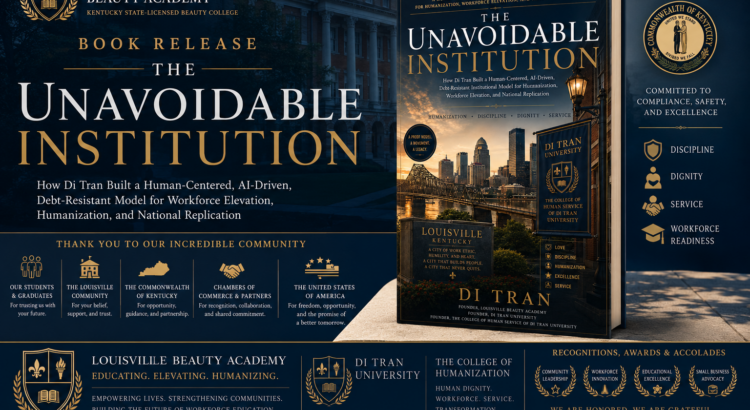
Louisville Beauty Academy is deeply honored and grateful to announce the release of The Unavoidable Institution: How Di Tran Built a Human-Centered, AI-Driven, Debt-Resistant Model for Workforce Elevation, Humanization, and National Replication — a flagship publication representing years of operational experience, workforce service, educational development, institutional reflection, AI implementation, compliance practice, and community-centered learning.
This moment is not simply the release of a book.
It is a reflection of the people, community, city, state, and nation that made this journey possible.
As a Kentucky state-licensed beauty college proudly founded and built in Louisville, Kentucky, Louisville Beauty Academy extends sincere gratitude to:
- the Louisville community,
- the Commonwealth of Kentucky,
- the United States of America,
- our students and graduates,
- immigrant and working families,
- employers and workforce partners,
- educators and instructors,
- chambers of commerce,
- community organizations,
- public servants and workforce advocates,
- local and national business leaders,
- and every individual who has contributed encouragement, accountability, opportunity, trust, recognition, and support throughout our journey.
We are especially humbled and thankful for the validations, recognitions, nominations, awards, partnerships, and acknowledgments received over the years, including support and recognition from workforce-development communities, entrepreneurship ecosystems, local and national business organizations, chambers of commerce, and advocacy groups that continue to elevate small business, workforce education, and human-centered economic development across America.
This publication reflects not only the work of one individual, but the collective contributions of the broader Louisville Beauty Academy and Di Tran University communities — including students, graduates, instructors, editors, researchers, AI systems contributors, compliance-support teams, operational staff, institutional-development collaborators, and community partners whose countless hours of service, documentation, learning, correction, and refinement helped shape the ideas contained in this work.
Most importantly, this book belongs to the people.
It belongs to:
- the working parent trying to rebuild life,
- the immigrant family searching for opportunity,
- the student seeking dignity through practical education,
- the graduate learning to believe in themselves again,
- and the workforce communities that continue carrying the American economy through service, discipline, entrepreneurship, and hard work.
A Book About More Than Beauty Education
While rooted in the operational realities of Louisville Beauty Academy, The Unavoidable Institution ultimately presents a much larger institutional and workforce-development discussion regarding:
- affordable workforce education,
- vocational and trade-school innovation,
- AI-assisted institutional systems,
- compliance architecture,
- operational discipline,
- human-centered leadership,
- workforce dignity,
- community service,
- entrepreneurship,
- and the future of practical education in America.
The publication argues that education should not merely process students into debt and credentials, but should instead strengthen individuals into:
- disciplined workers,
- stable professionals,
- capable entrepreneurs,
- responsible citizens,
- and dignified contributors to families and communities.
The book further explores:
- why America may be educated but not fully elevated,
- the dangers of debt-driven educational systems,
- why workforce education deserves greater national respect,
- how beauty and trade education serve as real economic infrastructure,
- how AI can strengthen institutional accountability without replacing human dignity,
- why humanization should become an operational framework,
- and how small institutions can create large societal impact through disciplined design, affordability, service, and measurable outcomes.
Louisville, Kentucky, and the American Workforce
Louisville Beauty Academy proudly recognizes Louisville as a city of resilience, workforce energy, entrepreneurship, logistics, diversity, and human service.
From immigrant communities to working-class families, small businesses, logistics workers, healthcare workers, beauty professionals, educators, tradespeople, and entrepreneurs, Louisville represents many of the values this book seeks to honor:
- hard work,
- service,
- reinvention,
- discipline,
- opportunity,
- and community contribution.
We remain deeply grateful to Louisville and the Commonwealth of Kentucky for providing the opportunity to serve students, families, employers, and communities through workforce-centered education.
We also remain thankful to the broader American system that allows small institutions, immigrant families, entrepreneurs, and local workforce organizations the opportunity to build, contribute, and continue participating in the fabric of the nation.
Humanization, AI, and the Future of Institutions
One of the central ideas explored in the publication is that the future of education and workforce development must remain deeply human even as artificial intelligence and automation continue expanding.
The book proposes that AI should support:
- accountability,
- operational consistency,
- documentation,
- compliance,
- institutional memory,
- and administrative precision,
while preserving the irreplaceable role of:
- human judgment,
- human care,
- mentorship,
- correction,
- discipline,
- compassion,
- and real-world service.
The publication further argues that institutions should become:
- more affordable,
- more operationally disciplined,
- more transparent,
- more community-oriented,
- and more focused on producing workforce-ready individuals capable of contributing meaningfully to society.
Gratitude to the Di Tran University and College of Humanization Teams
Louisville Beauty Academy extends special appreciation and gratitude to the Di Tran University and College of Humanization communities for their contributions in:
- editing,
- writing,
- research,
- institutional design,
- AI integration,
- operational refinement,
- documentation systems,
- publication development,
- compliance review,
- workforce-policy discussion,
- and educational collaboration.
This publication reflects years of collective effort and shared belief that affordable, disciplined, human-centered institutions remain possible in America.
Continuing the Mission
Louisville Beauty Academy remains fully committed to:
- workforce readiness,
- student affordability,
- sanitation and safety,
- disciplined operational systems,
- educational accountability,
- human dignity,
- community contribution,
- and compliance with all applicable local, state, and federal laws, regulations, sanitation standards, educational requirements, and licensure obligations.
This publication is intended solely for educational, informational, institutional-development, and public-policy discussion purposes and does not constitute legal advice, regulatory interpretation, governmental policy, accreditation guidance, or legal conclusions.
As we move forward, our mission remains unchanged:
To help build affordable, disciplined, human-centered educational systems that strengthen lives, families, communities, and the American workforce.
Louisville gave us the opportunity to serve.
Kentucky gave us the opportunity to grow.
America gave us the opportunity to dream.
For that, we remain deeply grateful.
🌐 LouisvilleBeautyAcademy.net
🌐 DiTranUniversity.com
📧 study@LouisvilleBeautyAcademy.net
📱 Text/Call: 502-625-5531
“The future belongs to institutions that strengthen people without trapping them in unnecessary debt, confusion, or institutional instability.” — Di Tran







