Professional Discipline and Outcome-Oriented Vocational Education: An Evidence-Based Analysis of Licensing-Focused Beauty Education Models in the United States — The Louisville Beauty Academy Case – RESEARCH & PODCAST SERIES 2026


Educational Research Disclaimer
This article was independently produced by the research team of Di Tran University — The College of Humanization as part of its ongoing vocational education research series.

Louisville Beauty Academy publishes this material strictly for educational and informational purposes for students, licensees, and the public.

Louisville Beauty Academy does not interpret, enforce, or provide legal guidance regarding state or federal licensing laws. All regulatory authority rests solely with the appropriate government agencies, including the Kentucky Board of Cosmetology and other applicable regulatory bodies.

Abstract

The contemporary landscape of vocational education in the United States is currently navigating a pivotal transition between traditional enrollment-driven models and emerging outcome-oriented frameworks. This research study provides a PhD-level interdisciplinary analysis of the “Professional Discipline Learning Model,” specifically within the context of beauty and personal care licensing. Utilizing the Louisville Beauty Academy (LBA) as a primary case example, the study investigates the structural effectiveness of education that prioritizes technical discipline, regulatory compliance, and economic efficiency over lifestyle-oriented marketing and entertainment-based pedagogy.

The research question addresses whether a vocational model centered on a “Zero Disruption Learning Environment” and “Action Accumulation” yields superior licensing success rates, faster workforce integration, and greater economic mobility for its graduates. Drawing upon Human Capital Theory, Deliberate Practice, Cognitive Load Theory, and Professional Socialization Theory, this analysis posits that the professionalization of the beauty industry requires a shift toward structured, cost-controlled institutional models.

Historical evidence traces the evolution of beauty licensing from its origins in medieval medicine and barber-surgery to modern public health mandates, establishing the sector as one of the most heavily regulated personal service industries. Comparative regulatory analysis reveals significant discrepancies in training hour requirements between the beauty trades and high-stakes medical fields like Emergency Medical Services (EMS), suggesting a need for policy reform focused on educational efficiency. Economic data from the Bureau of Labor Statistics (BLS) and the Small Business Administration (SBA) highlight the beauty industry’s role as a primary driver of micro-entrepreneurship, particularly within immigrant and minority communities. The findings suggest that disciplined vocational education models represent a highly effective pathway for workforce stability and professional identity formation in a post-automation economy.

Historical Context of Beauty Education

The professionalization of the beauty industry in the United States is the result of a complex convergence of medical history, labor organization, and the expansion of the state’s “police power”.1 Historically, the lineage of modern beauty regulation is a dual history of surgical necessity and aesthetic evolution. In the medieval period, the practitioners known as barber-surgeons were responsible for an array of procedures that extended far beyond grooming, including blood-letting, tooth extraction, and the lancing of abscesses.1 The formal establishment of the Company of Barber Surgeons in 1540 under Henry VIII solidified this connection, and it was not until 1745 that the professions of barbering and surgery legally diverged.1 This historical intersection explains the barber’s long-standing legal authority over razor-based services; the straight razor was essentially the surgical tool of the trade, a legacy that persists in modern licensing distinctions regarding the use of open blades.1

The emergence of formal beauty education was catalyzed by the Progressive Era’s focus on sanitation and public health. In the late 19th and early 20th centuries, outbreaks of “barber’s itch”—a contagious fungal infection spread via unsterilized razors—prompted the first state-level licensing laws.1 Research by Daniel Smith in “The Itch & Razor War” indicates that nearly 90 percent of the original justification for barber licensure was centered on the prevention of such ailments.3 By 1897, Minnesota passed the first legislation for a barber license, initiating a movement toward stringent state board inspections and standardized hygiene protocols.2 These laws established that the state possessed the authority to regulate private conduct—such as the way a person cuts hair or treats skin—to protect the collective welfare.1

Historical MilestoneYearSignificance to Professionalization
Divergence of Barbers and Surgeons1745Established barbering as a distinct technical trade 1
Formation of Barber Protective Union1886First major move toward labor standards and organized training 2
Opening of the First Barber School1893A.B. Moler standardized curriculum and published first textbooks 2
First State Licensure Law (Minnesota)1897Introduced state-mandated sterilization and inspection 2
Rise of the “Bob” Cut1920sCreated demand for specialized cosmetological training 2
Separation of Barber/Cosmetology Boards1935Reflected distinct traditions and gendered service paths 4
Modern Board Consolidation2021+Trend toward administrative efficiency and “dual-service” licensing 4

As the 20th century progressed, the demand for specialized cosmetological skills grew alongside the flourishing entertainment industry, necessitating formal beauty schools and specialized training programs.1 By 1927, states like California began separately licensing barbers and cosmetologists, reflecting a social and professional divide that persists in many modern regulatory systems.1 Over time, these regulations evolved from basic hygiene mandates into comprehensive state regulatory systems that balance the need for public safety with the pressures of workforce development.1 However, some economic historians argue that these licensing laws were also influenced by labor unions seeking to bar discount competitors from the market, leading to a steady increase in training hour requirements that often exceeded the hours necessary for purely sanitation-based instruction.1

Regulatory Framework and Legal Structure

The legal framework governing beauty licensing in the United States is built upon the premise that professional beauty services involve significant biological and chemical risks.1 Practitioners work with reactive substances such as hair color, relaxers, and perm solutions, and they utilize sharp instruments like razors, shears, and nippers.1 Consequently, state boards of cosmetology and barbering are tasked with ensuring that the public is protected from incompetent practice by establishing minimum qualifications for entry and enforcing effective discipline for those who violate statutes.4

Comparative Regulatory Analysis

One of the most revealing aspects of the beauty industry’s regulatory structure is the disparity between its training requirements and those of other high-stakes professions. While the work of Emergency Medical Technicians (EMTs) bears a direct relationship to life-and-death public health, the training requirements for cosmetologists often dwarf those of EMTs.5 As of 2022, on average, states demanded approximately one year of training for a cosmetology license (roughly 1,000 to 1,500 hours) compared to just over a month of training for an EMT license.5

ProfessionMinimum Training Hours (Avg)Focus of Regulation
Cosmetologist1,000 – 1,600Sanitation, chemical safety, aesthetics 5
EMT (Basic)120 – 190Life-saving interventions, emergency medicine 5
Food Safety Manager8 – 12Prevention of foodborne illness 6
Licensed Plumber4,000 – 10,000Infrastructure safety, code compliance 8
Barber Apprentice216 (Related) / 3,200 (OJT)Safety, sanitation, technical skill 9
Manicurist300 – 600Infection control, nail anatomy 11

The rationale for licensing rests on the “police power” of the state, but researchers from the Institute for Justice have questioned whether these heavier burdens actually improve safety.11 Studies comparing states with differing licensing burdens found no significant difference in health inspection outcomes, suggesting that nail salons and barbershops were clean and safe regardless of whether their workers faced burdensome or light licensing.11 Despite this, the beauty industry remains heavily regulated, with most states demanding at least 1,000 hours of training and maintaining rigorous inspection systems.11

Inspection and Compliance Systems

Modern regulatory systems utilize a combination of pre-graduate testing, written examinations, and practical skill demonstrations to verify competency.13 In states like Kentucky, the Barbering and Cosmetology Board outlines swift disciplinary measures for practitioners who violate sanitation statutes.4 The legal authority of these boards extends to the oversight of “dual-service” salons and the enforcement of “shaving controversies,” such as the legal restrictions preventing cosmetologists from using straight razors for facial shaving in certain jurisdictions.1 This dense regulatory environment necessitates an educational model that prioritizes regulatory literacy and “compliance-by-design” rather than just creative aesthetics.14

Theoretical Framework

Analyzing the Professional Discipline Model requires an interdisciplinary approach that connects economic theory with cognitive science and behavioral psychology.

Human Capital Theory (Becker)

Human Capital Theory, most notably advanced by Gary Becker, posits that education and technical training are forms of capital accumulation.15 According to this view, individuals invest in their own skills, knowledge, and health with the expectation of economic returns in the form of higher wages and job security.15 In the context of beauty education, the license is the tangible manifestation of this human capital. The “human capital approach” assumes that earnings mainly reflect how much workers have invested in their skills rather than just whether they hold “good” or “bad” jobs.17 This theory supports a vocational model that optimizes the time and cost of education, ensuring a faster “rate of return” on the student’s investment.12

Deliberate Practice Theory (Ericsson)

K. Anders Ericsson’s theory of Deliberate Practice challenges the notion of innate talent, suggesting instead that expert performance is the result of focused, consistent, and goal-oriented training.18 Deliberate practice involves “individualized training activities specially designed by a coach or teacher to improve specific aspects of an individual’s performance through repetition and successive refinement”.19 At Louisville Beauty Academy, this theory is applied through clinic-based skill development and repetitive technical drills.14 Ericsson’s research shows that Mozart, often cited as a natural genius, was “relatively average” when compared to modern children who undergo structured, early training, proving that sustained effort and structured environments are the primary drivers of mastery.18

Behavioral Discipline and Self-Regulation

Behavioral Discipline Theory examines how self-regulation and habit formation contribute to professional success. In a vocational setting, this involves the internalization of professional norms and the development of “grit”—the passion and perseverance for long-term goals. Students in a disciplined environment are taught to transition from a “student” identity to a “professional” identity through the accumulation of small, verifiable achievements.20 This process is described as “Humanization,” a psychosocial intervention designed to restore self-worth through vocational excellence.20

Cognitive Load Theory (Sweller)

Cognitive Load Theory (CLT), pioneered by John Sweller, is based on an understanding of the limitations of human working memory.21 CLT identifies three types of cognitive load:

  1. Intrinsic Load: The inherent complexity of the subject matter.21
  2. Extraneous Load: Unnecessary cognitive effort caused by distractions or poorly designed instruction.21
  3. Germane Load: The mental work devoted to making sense of new material and storing it in long-term memory.21

A Professional Discipline model explicitly seeks to reduce “extraneous load” by creating a “Zero Disruption Learning Environment”.22 By removing unnecessary noise, administrative confusion, and social distractions, the model allows students to focus their limited cognitive resources on “germane load,” thereby accelerating the transfer of technical skills to long-term memory.23

Professional Socialization Theory

Professional Socialization is the process by which individuals develop a disciplinary identity and commit to the values and norms of their field.25 It involves shifting from being a “knowledge consumer” to a “knowledge producer” or professional practitioner.25 Research in nursing and medical training shows that early introduction to the professional environment and supportive supervisory relationships are critical for professional identity formation.26 The disciplined study culture at LBA mirrors this by placing students in a “living learning ecosystem” where they interact with the public, instructors, and graduates from day one.14

Institutional Efficiency Theory

Institutional Efficiency Theory analyzes how regulatory bodies and legal frameworks shape behavior and economic outcomes.27 In vocational education, this theory evaluates whether institutions are structured to minimize transaction costs and resource misallocation.28 A model that focuses on “short-cycle” vocational education—optimizing training time and reducing cost barriers—aligns with the principles of institutional efficiency by ensuring that the “educational investment” is recovered quickly through workforce entry.12

The Professional Discipline Model

The Professional Discipline Learning Model used by Louisville Beauty Academy is characterized by its rejection of “entertainment-oriented” marketing in favor of a structured, outcome-focused institutional culture.14 This model positions the vocational school as a professional institution rather than a social or lifestyle destination.

Key Structural Elements

The model is built upon several foundational pillars designed to maximize student success and institutional compliance:

  • Zero-Disruption Training Environment: A commitment to protecting instructional time and space from internal and external distractions.29
  • Strict Compliance Orientation: An emphasis on “over-compliance by design,” where regulatory literacy is viewed as a primary skill for protecting the practitioner and the public.14
  • Licensing Exam Focus: Curriculum alignment that prioritizes the requirements of state board examinations, ensuring high pass rates and fast workforce entry.14
  • Structured Clinic Learning: Practical engagement through real-world walk-ins and early client interaction, moving skills from theoretical to applied.14
  • Disciplined Study Culture: A “fail fast, fix fast” mindset where errors are treated as data points for immediate correction and mastery.14
  • Cost-Conscious Education: A tuition structure that prioritizes affordability and reduces reliance on high-interest student debt.14

Contrast with Entertainment-Based Marketing

Traditional beauty school marketing often emphasizes “glamour,” social immersion, and lifestyle aesthetics. However, research suggests that high-tuition, for-profit schools using these models often leave students with insurmountable debt and low earning potential.32 In contrast, the Professional Discipline Model focuses on the “action accumulation” of small completions—tasks that serve as “verifiable proof” of a student’s own value and competence.14 This model treats beauty as a “licensed human service” and an “AI-proof” trade that generates sustainable economic growth through disciplined attention to human needs.34

Zero Disruption Learning Environment

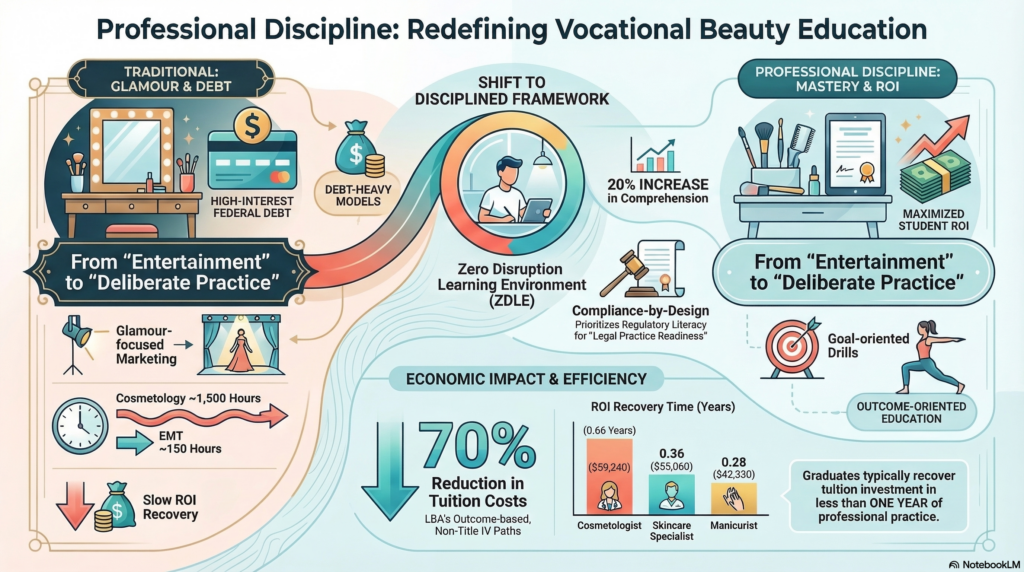
The concept of a “Zero Disruption Learning Environment” (ZDLE) is rooted in the psychological need for uninterrupted focus during skill acquisition. In high-stakes vocational training, frequent disruptions can erode trust, delay return on investment (ROI), and decrease student comprehension.29 Studies have shown that excessive noise in classrooms can cause up to a 20% drop in comprehension, while acoustic treatments can lead to a 70% reduction in distractions.36

Mechanism of Focus and Productivity

ZDLE works by minimizing “extraneous cognitive load” through the removal of non-educational distractions. This includes both physical noise and digital interruptions. At LBA, this is achieved through a “protected work mode” that discourages non-urgent conversations and fractured attention.37 This structured approach helps focus efforts on high-impact activities, promoting a sense of daily accomplishment.37

Feature of ZDLEPsychological / Educational BenefitEvidence / Citation
Acoustic ControlReduces teacher burnout; 20% comprehension increase36
Time-BlockingPrevents fractured work mode; allows for “deep work”37
Distraction ReductionIncreases student concentration and productivity38
Structured TransitionsLocalizes disruptions; maintains steady-state success39
Automated ComplianceRemoves administrative hurdles for students30

By ensuring that technology and administration operate “quietly in the background,” ZDLE empowers students to focus on their highest-value tasks—manual skill mastery and regulatory knowledge.30 This level of control is essential for managing multiple learning paths simultaneously, making personalized instruction more effective.40

Licensing-Oriented Education Model

The Licensing-Oriented Model prioritizes the state licensing exam as the primary threshold for professional success. This focus is justified by the “First-Achievement Transformation Effect,” where passing a state exam provides an immediate boost to a student’s self-esteem and professional efficacy.20

Exam Pass Rates and Workforce Entry

In a licensing-focused model, merely finishing school is not the ultimate goal. Success is measured by the speed at which a graduate passes their boards and secures employment.31 Evidence suggest that over 30% of beauty school students who complete their hours never actually take the licensing test, a failure of the traditional enrollment-based model.13 LBA’s disciplined approach addresses this by integrating “pre-graduate testing” concepts and repetitive exam drills into the daily curriculum.13

Economic Mobility and Regulatory Knowledge

A license represents more than technical skill; it is a credential of “regulatory literacy”.12 Schools that prioritize this knowledge produce faster economic mobility because their graduates are prepared for “legal practice readiness” on day one.12 In Kentucky, a skincare specialist (esthetician) can earn a Louisville mean annual wage of $55,060 after completing only 750 hours of training—a significantly higher ROI than many four-year degrees when considering the total cost of attendance.12

SpecialtyLouisville Mean Hourly WageAnnual Mean Wage (Louisville)ROI Recovery Time (Years)*
Cosmetologist$28.48$59,2400.66
Skincare Specialist$21.72$55,0600.36
Manicurist$17.01$42,3300.28

ROI based on a $20,000 tuition investment recovered via wage increases above high school diploma median.12

Economic Impact of Vocational Licensing Education

The beauty industry functions as a vital engine for micro-entrepreneurship and employment, particularly in underserved communities. For many individuals, selecting a cosmetology institution is influenced by “aesthetic branding,” but the true value lies in the industry’s $308.7 billion contribution to the U.S. GDP.12

Macroeconomic Role and Accessibility

Beauty professions are uniquely accessible to immigrants and working-class adults. Small businesses—firms with 249 or fewer employees—account for 99 percent of the 5.6 million firms in the U.S. and contributed 55 percent of total net job creation from 2013 to 2023.41 In the salon industry, minority participation is 13% higher than in the overall U.S. workforce, and women-owned salons have increased by 40% compared to other private sector businesses.13

Immigrant Entrepreneurs and the “AI-Proof” Sanctuary

Immigrants are nearly 30 percent more likely to start a business than non-immigrants, and they represent 16.7 percent of all new business owners in the U.S..42 In the beauty sector, the “physics of touch” creates an AI-resistant profession; as Di Tran notes, “AI cannot perform a pedicure”.34 This human service sanctuary has quietly generated multi-million-dollar enterprises within immigrant communities, where the trade serves as a primary vehicle for wealth building.34 However, these workers often face workplace health challenges and cultural barriers, making disciplined, in-language education and safety training essential for their long-term survival and success.43

Cost Efficiency in Vocational Education

A critical component of the LBA model is its focus on cost efficiency and the reduction of student financial burden. Traditional for-profit beauty schools are often criticized for high tuition—frequently $20,000 or more—and high student loan default rates.32

Federal Aid Dependency and the “Pell Penalty”

Research by New America indicates that 80% of for-profit beauty school graduates fail to earn more than they would have with only a high school diploma.32 Under new federal rules (OBBBA), schools whose tuition is high but whose graduates do not earn a living wage risk losing their eligibility for Federal Student Loans and Pell Grants.44 This “Pell Penalty” is designed to eliminate programs that do not produce a clear return on investment.44

Cost FactorHigh-Tuition (Title IV) ModelLBA (Non-Title IV) Model
Average Tuition (1000 hrs)~$16,060~$4,775 14
Funding SourceFederal Loans / Pell GrantsCash / Institutional Payment Plans
Financial RiskHigh Debt ($10k+ avg)Zero or Minimal Debt
EligibilityEnrollment-based aidOutcome-based incentives 31

The Outcome-Based Aid Model

To solve the issue of upfront aid for low-outcome programs, a proposal for “Outcome-Based Federal Student Aid” suggests that the government should only reimburse tuition costs upon a student’s success (graduation, licensure, and employment).31 In this “Pay-for-Success” model, the school or a private sponsor fronts the tuition risk. If a student like “Jane” completes her 450-hour nail tech course and passes her state boards, the school receives reimbursement and a “licensure bonus”.31 This model aligns school incentives with student outcomes, reducing taxpayer waste and ensuring graduates enter the workforce debt-free.31

Behavioral and Psychological Outcomes

Disciplined education environments have profound effects on a student’s professional identity and long-term accountability. The “College of Humanization” philosophy posits that education is not merely about skills but about “becoming a more caring and value-adding human being”.45

Identity Formation and the “I Have Done It” Spirit

The transition from a “Yes I Can” mindset to the realization of “I Have Done It” represents the acquisition of a “professional self”.20 Merton suggested that professional socialization involves developing a set of knowledge, skills, and values that allow a person to control their behavior in professional contexts.46 By treating every technical milestone as a “stamp of self-achievement,” the Professional Discipline Model fosters confidence and research-backed “grit”.20

Self-Regulation and Long-Term Success

In a disciplined environment, students learn the “ontology of contribution”—viewing themselves as dynamic producers of value rather than static consumers of status.20 This mindset replaces the “will to pleasure” with a focus on moral excellence and eudaemonic happiness.20 By mastering self-regulation and professional behavior before entering the workforce, LBA graduates are better equipped to handle the stresses of client interaction and the rigors of salon ownership.14

Case Study Analysis: Louisville Beauty Academy

Louisville Beauty Academy (LBA) serves as the primary case example of the Professional Discipline model in practice. Recognized as Kentucky’s most innovative and compliance-by-design institution, LBA utilizes a “humanized” framework to redefine education beyond credentials.34

Operational Model and Alignment

LBA’s model aligns with Human Capital and Deliberate Practice theories through its “Proof-of-Work” system, where documented progress equals tuition incentives and career credit.14 The academy emphasizes:

  • Small Completions: Strengthening professional presence through incremental success.14
  • Direct Engagement: Reducing industry fears through early client service and walk-ins.14
  • Vertical Integration: Teaching the “living MBA” of business literacy, including real estate and accounting.34
  • Humanized AI Integration: Using technology to capture and structure data without distracting from the “physics of touch”.30

The Di Tran Philosophy

Founder Di Tran’s “College of Humanization” framework challenges the “Flash College” credential, urging students to recognize the value in their parents’ “living trade mastery” over a theoretical university degree.20 This doctrine of “Solve First, Scale Later” emphasizes that sustainable growth begins with disciplined attention to everyday human needs.35 By positioning beauty as a high-value human service, LBA restores dignity to vocational labor and prepares students for economic certainty in an AI-driven world.20

Policy Implications

The success of discipline-centered, outcome-oriented models provides a roadmap for vocational education reform. Policy makers should consider:

  • Outcome-Based Aid Reform: Implementing “short-term Pell” with performance guarantees to fund high-demand, high-ROI vocational training.31
  • Licensure Mobility: Encouraging interstate reciprocity to reduce barriers for mobile professionals.13
  • Efficiency Mandates: Evaluating training hour requirements to ensure they are proportionate to safety risks rather than administrative bloat.5
  • Regulatory Literacy Programs: Incorporating small business development and compliance training into standard vocational curricula.12
  • Economic Mobility Support: Leveraging licensed trades as vehicles for wealth building in immigrant and minority communities.34

Future Research

Further interdisciplinary research is needed to quantify the long-term impacts of disciplined vocational environments. Recommended areas include:

  • Comparative Longitudinal Studies: Tracking the 5-year and 10-year career trajectories of students from disciplined vs. entertainment-oriented schools.
  • Cost-Benefit Analysis of Board Consolidation: Measuring the economic effects of merging barber and cosmetology boards on administrative efficiency and student mobility.
  • AI Resilience in Trades: Quantifying the “AI-proof” nature of fine-motor human services across different economic sectors.
  • Psychosocial Impact of “Action Accumulation”: Further exploring the relationship between vocational mastery and mental health outcomes in under-resourced populations.

Conclusion

The analysis of the Professional Discipline Learning Model, exemplified by the Louisville Beauty Academy, reveals a robust framework for professionalizing vocational education. By prioritizing discipline, zero-disruption focus, and outcome-oriented milestones, this model addresses the systemic failures of enrollment-driven, high-debt educational paradigms. The integration of interdisciplinary theories—from Becker’s Human Capital to Sweller’s Cognitive Load—validates the structure of a licensing-focused school as a mechanism for economic mobility and professional identity formation.

In a rapidly changing economy, disciplined vocational education represents more than a path to a license; it is a gateway to micro-entrepreneurship and a restoration of human dignity through service excellence. As federal and state regulations shift toward greater accountability and results-focused metrics, the LBA model stands as a “gold-standard” example of how vocational schools can become engines for individual prosperity and community stability.

Research conducted by:

Di Tran University — The College of Humanization

Published for educational purposes by:

Louisville Beauty Academy

This publication is intended for educational and informational purposes only and does not constitute regulatory interpretation or legal advice. All licensing determinations are made by the applicable state regulatory authorities.

Works cited

  1. The Legal Scope of Beauty Licensing in the United States: A …, accessed March 11, 2026, https://louisvillebeautyacademy.net/the-legal-scope-of-beauty-licensing-in-the-united-states-a-comprehensive-policy-legal-and-workforce-analysis-of-cosmetology-barbering-esthetics-and-nail-technology-research-podcast-serie/
  2. Barbering Timeline – National Barber Museum, accessed March 11, 2026, https://www.nationalbarbermuseum.org/about/barbering-timeline
  3. A Cut Below: Lessons from the History of Barber Licensure – Advancing Liberty in Missouri, accessed March 11, 2026, https://showmeinstitute.org/article/regulation/a-cut-below-lessons-from-the-history-of-barber-licensure/
  4. Barbering and Cosmetology Board – Arizona State Library, Archives and Public Records, accessed March 11, 2026, https://azlibrary.gov/agency-history/2089
  5. EMT vs. Cosmetologist License FAQ – The Institute for Justice, accessed March 11, 2026, https://ij.org/report/license-to-work-3/emt-vs-cosmetologist-license-faq/
  6. Kentucky Food Manager Certification – ANAB-CFP Accredited – AAA Food Handler, accessed March 11, 2026, https://aaafoodhandler.com/kentucky/food-manager-certification/
  7. ServSafe Manager Certification course and exam – KCTCS, accessed March 11, 2026, https://ws.kctcs.edu/westkentucky/course/course.aspx?C=2067&pc=62&mc=&sc=
  8. Plumbing Licenses vs Apprenticeship Training: Which Path? – CourseCareers, accessed March 11, 2026, https://coursecareers.com/blog-posts/plumbing-licenses-vs-apprenticeship-training
  9. Cal. Code Regs. Tit. 16, § 915 – Related Training | State Regulations – LII, accessed March 11, 2026, https://www.law.cornell.edu/regulations/california/16-CCR-915
  10. Apprenticeship – California Board of Barbering and Cosmetology – CA.gov, accessed March 11, 2026, https://www.barbercosmo.ca.gov/applicants/apprenticeship.shtml
  11. New Study Shows That Heavier Licensing Burdens Do Not Improve Health and Safety, accessed March 11, 2026, https://ij.org/press-release/new-study-shows-that-heavier-licensing-burdens-do-not-improve-health-and-safety/
  12. The Economics and Regulation of Beauty Education: A Comprehensive Analysis of Labor Markets, Consumer Protection, and Regulatory Literacy in the Kentucky Personal Care Sector – RESEARCH & PODCAST SERIES 2026 – Louisville, KY, accessed March 11, 2026, https://naba4u.org/2026/02/the-economics-and-regulation-of-beauty-education-a-comprehensive-analysis-of-labor-markets-consumer-protection-and-regulatory-literacy-in-the-kentucky-personal-care-sector-research-podcast/
  13. Research – The Future of the Beauty Industry Coalition, accessed March 11, 2026, https://fbic.org/research/
  14. Uncategorized Archives – Louisville Beauty Academy – Louisville KY, accessed March 11, 2026, https://louisvillebeautyacademy.net/category/uncategorized/
  15. Systematic Literature Review of Human Capital in Context of Economic Growth – AgEcon Search, accessed March 11, 2026, https://ageconsearch.umn.edu/record/355449/files/Systematic%20Literature%20Review%20of%20Human%20Capital.pdf
  16. The Role of Human Capital in Economic Growth: Education as a Driver of Development in Kenya – IRPJ = Intergovernmental Research and Policy Journal, accessed March 11, 2026, https://irpj.euclid.int/articles/the-role-of-human-capital-in-economic-growth-education-as-a-driver-of-development-in-kenya/
  17. Foreword by Gary S. Becker | The Oxford Handbook of Human Capital – Oxford Academic, accessed March 11, 2026, https://academic.oup.com/edited-volume/34544/chapter/293021623
  18. Deliberate Practice: Learn Like an Expert | by Janie Kliever | Medium, accessed March 11, 2026, https://medium.com/the-crossover-cast/deliberate-practice-learn-like-an-expert-cc3114b8a10e
  19. Deliberate Practice Training for Therapists — Sentio Marriage and Family Therapy Program in California, accessed March 11, 2026, https://sentio.org/what-is-deliberate-practice
  20. The Ontology of Contribution: An Interdisciplinary Analysis of the “Am I a Value?” Framework in Human Development and Social Progress – Book Release, Research Paper, and Podcast Series — 2026 – Di Tran University, accessed March 11, 2026, https://ditranuniversity.com/the-ontology-of-contribution-an-interdisciplinary-analysis-of-the-am-i-a-value-framework-in-human-development-and-social-progress-book-release-research-paper-and-podcast-series-202/
  21. The Application of Cognitive Load Theory to the Design of Health and Behavior Change Programs: Principles and Recommendations – PMC, accessed March 11, 2026, https://pmc.ncbi.nlm.nih.gov/articles/PMC12246501/
  22. Cognitive Load Theory: How to Optimize Learning – Let’s Go Learn, accessed March 11, 2026, https://www.letsgolearn.com/education-reform/cognitive-load-theory-how-to-optimize-learning/
  23. What Is Cognitive Load Theory? Instructional Design and the Busy Mind – Articulate, accessed March 11, 2026, https://www.articulate.com/blog/cognitive-load-theory/
  24. Six Strategies You May Not Be Using To Reduce Cognitive Load – The eLearning Coach, accessed March 11, 2026, https://theelearningcoach.com/learning/reduce-cognitive-load/
  25. About the Study | Rackham Graduate School – University of Michigan, accessed March 11, 2026, https://rackham.umich.edu/about/michigan-doctoral-experience-study-mdes/about-the-study/
  26. Becoming professional: exploring the complexities of professional socialization in health and social care – ResearchGate, accessed March 11, 2026, https://www.researchgate.net/publication/229642690_Becoming_professional_exploring_the_complexities_of_professional_socialization_in_health_and_social_care
  27. Determinants of Value Chain Accounting and Margin Ratios in listed Consumer Conglomerate Companies in Nigeria – RSIS International, accessed March 11, 2026, https://rsisinternational.org/journals/ijriss/uploads/vol9-iss10-pg6439-6452-202511_pdf.pdf
  28. the institutional quality in west africa: the supremacy of cultural and geographical factors – ResearchGate, accessed March 11, 2026, https://www.researchgate.net/profile/Oumarou-Zalle/publication/365517586_Quality_of_institutions_in_West_Africa_the_supremacy_of_cultural_and_geographical_factors/data/6377c0891766b34c54365a84/Article-2-Institutional-quality-page-garde.pdf?origin=publication_list
  29. Zero-disruption product modernization strategy: A quick step-by-step guide – Kellton, accessed March 11, 2026, https://www.kellton.com/kellton-tech-blog/zero-disruption-product-modernization-strategy
  30. Zero Disruption: Seamless Without Interrupting Workflows – aiOla, accessed March 11, 2026, https://aiola.ai/glossary/zero-disruption/
  31. Outcome-Based Federal Student Aid Model: A Proposal for Pay-for …, accessed March 11, 2026, https://naba4u.org/2025/08/outcome-based-federal-student-aid-model-a-proposal-for-pay-for-success-funding-research-august-2025/
  32. Should Failing Beauty Schools Keep Access to Federal Aid? New Data Suggests No, accessed March 11, 2026, https://www.newamerica.org/insights/should-failing-beauty-schools-keep-access-to-federal-aid-new-data-suggests-no/
  33. Cosmetology schools and other certificate programs got exemption from rules on graduates’ earning levels – The Hechinger Report, accessed March 11, 2026, https://hechingerreport.org/congress-wants-colleges-to-make-sure-graduates-can-earn-a-living-but-some-schools-got-a-carveout/
  34. humanized education framework Archives – Louisville Beauty Academy, accessed March 11, 2026, https://louisvillebeautyacademy.net/tag/humanized-education-framework/
  35. Solve First. Scale Later: A New Doctrine for Building What Truly Matters, accessed March 11, 2026, https://ditranuniversity.com/solve-first-scale-later-a-new-doctrine-for-building-what-truly-matters/
  36. Government Grants for Acoustic Panel Installation in Schools & Kindergartens in Victoria, accessed March 11, 2026, https://soundfixacoustics.com.au/government-grants-for-acoustic-panel-installation-in-schools-kindergartens-in-vic/
  37. Workplace productivity: 5 ways to create an efficient workflow & supportive work culture, accessed March 11, 2026, https://www.intuit.com/enterprise/blog/hr/workplace-productivity/
  38. Leverage Faronics Insight to Facilitate Remote Learning and Virtual Classrooms, accessed March 11, 2026, https://www.faronics.com/news/blog/leveraging-faronics-insight-to-facilitate-remote-learning-and-virtual-classrooms
  39. Tata Elxsi’s SHIFT Framework for Zero-Disruption Transitions, accessed March 11, 2026, https://www.tataelxsi.com/insights/blog/tata-elxsis-shift-framework-for-zero-disruption-transitions
  40. Using Faronics Insight to Support Personalized Learning Paths in K-12 Classrooms, accessed March 11, 2026, https://www.faronics.com/news/blog/using-faronics-insight-to-support-personalized-learning-paths-in-k-12-classrooms
  41. Small businesses contributed 55 percent of the total net job creation from 2013 to 2023, accessed March 11, 2026, https://www.bls.gov/opub/ted/2024/small-businesses-contributed-55-percent-of-the-total-net-job-creation-from-2013-to-2023.htm
  42. SBA: Office of Advocacy Research Report – Estimating the Contribution of Immigrant Business Owners to the U.S. Economy-rs334tot – Web Services, accessed March 11, 2026, https://people.ucsc.edu/~rfairlie/papers/published/sba%20final%20report%20immigrant%20business.pdf
  43. Nail salons, spas and other small beauty services are booming—but their workers face significant daily health challenges, accessed March 11, 2026, https://vitalrecord.tamu.edu/nail-salons-spas-and-other-small-beauty-services-are-booming-but-their-workers-face-significant-daily-health-challenges/
  44. in 2027, 92% Beauty Schools are going to close under new Trump rules : r/Cosmetology, accessed March 11, 2026, https://www.reddit.com/r/Cosmetology/comments/1qtkdsu/in_2027_92_beauty_schools_are_going_to_close/
  45. “I HAVE DONE IT” — The Spirit of Achievement at Louisville Beauty Academy, accessed March 11, 2026, https://louisvillebeautyacademy.net/i-have-done-it-the-spirit-of-achievement-at-louisville-beauty-academy/
  46. Construction of Taste in Doctoral Students’ Researcher Identity – Atlantis Press, accessed March 11, 2026, https://www.atlantis-press.com/article/126007436.pdf
  47. Examining Licensing Issues Within the Cosmetology Industry, accessed March 11, 2026, https://www.air.org/project/examining-licensing-issues-within-cosmetology-industry
  48. Immigrant and Minority-owned Small Businesses & Economic Recovery | by What Works Cities – Medium, accessed March 11, 2026, https://medium.com/what-works-cities-economic-mobility-initiative/immigrant-and-minority-owned-small-businesses-economic-recovery-f8ae426716ce

Educational Research Disclaimer
This article was independently produced by the research team of Di Tran University — The College of Humanization as part of its ongoing vocational education research series.

Louisville Beauty Academy publishes this material strictly for educational and informational purposes for students, licensees, and the public.

Louisville Beauty Academy does not interpret, enforce, or provide legal guidance regarding state or federal licensing laws. All regulatory authority rests solely with the appropriate government agencies, including the Kentucky Board of Cosmetology and other applicable regulatory bodies.
Respect the License: Regulatory Intensity, Public Health Oversight, and the Hidden Safety Governance of the Beauty Industry – RESEARCH & PODCAST SERIES 2026

A Comparative Analysis of Sanitation Regulation, Safety Risk, and Government Oversight in Cosmetology Compared with Healthcare, EMS, and Other Public Health Professions.


Research Prepared by
Di Tran University — The College of Humanization
Research & Podcast Series 2026

Research Attribution & Educational Disclaimer

This article is published on Louisville Beauty Academy’s website for educational and informational purposes only.

All research, analysis, and academic interpretation contained in this publication were prepared by Di Tran University — The College of Humanization as part of its independent research initiatives.

Louisville Beauty Academy does not interpret, validate, endorse, or represent the conclusions of this research as regulatory or legal advice. Beauty licensing laws, sanitation regulations, and professional requirements vary by jurisdiction and are determined exclusively by the relevant state licensing authorities, including but not limited to the Kentucky Board of Cosmetology.

Readers should always consult official statutes, administrative regulations, and licensing boards for authoritative guidance.

Publication of this research on the Louisville Beauty Academy website does not constitute policy interpretation, legal guidance, or institutional endorsement.


The Philosophical Foundation of Occupational Stewardship: Professionalism as Humanization

The professional beauty industry, often colloquially associated with the superficial ideals of aesthetics and “pampering,” operates as one of the most rigorously regulated sectors of the United States workforce. At Di Tran University — The College of Humanization, the study of professional licensure is approached not merely as a set of administrative hurdles, but as a fundamental contract between the practitioner and the public’s biological integrity. Occupational licensing in fields such as cosmetology, barbering, esthetics, and nail technology serves as a foundational pillar for public health, safety, and professional standardization.1 These regulations are historically rooted in the transition from medieval guilds to the refined public health mandates of the Progressive Era, a period when the government first recognized that the intimate contact inherent in beauty services could facilitate the transmission of virulent infectious diseases.1

The “hidden safety governance” of the beauty industry is built upon the premise that professional services involve significant biological and chemical risks.1 Practitioners are tasked with managing reactive substances—including hair colors, chemical relaxers, and permanent wave solutions—while simultaneously utilizing sharp, invasive instruments such as razors, shears, and cuticle nippers.1 The intensity of this regulation often surprises the public, particularly when compared to other high-stakes public health professions. For instance, nationally, the average training for a cosmetologist is approximately times longer than the training required for emergency medical technicians (EMTs).2 This disparity, which often provokes political debate, reflects a complex governance strategy: while the EMT is trained for acute, high-intensity life-saving interventions, the cosmetologist is trained for the long-term, high-frequency prevention of community-acquired infections and chronic chemical exposure.2

The legal framework of the industry differentiates between specialty licenses to ensure that practitioners do not inadvertently or intentionally enter the domain of medical practice.1 For example, modern cosmetology statutes emphasize that services must be for “cosmetic purposes” rather than the treatment of physical or mental ailments.1 This boundary is becoming increasingly volatile as the industry moves toward medical-aesthetic integration, where the distinction between a “facial” and a “medical procedure” represents the most contested frontier of medical board jurisdiction.1

The Historical Evolution of Sanitation: From Miasma to Microbes

The current regulatory intensity of the beauty industry is a direct descendant of the “Great Sanitary Awakening” of the mid-nineteenth century. Between and , public health was dominated by the miasma theory, which posited that diseases like cholera were spread by foul air and environmental filth.3 This led to massive urban engineering projects focused on the literal removal of filth from cities.3 During this era, the skin began to be viewed through a Victorian lens as a “sanitary commissioner” of the body—an organ of drainage that required constant purging of waste materials like sweat and dirt to ensure both health and beauty.4

The revelation of Germ Theory, pioneered by Louis Pasteur and Robert Koch between and , fundamentally altered this perspective.5 Public health officials shifted their focus from “bad air” to microbial life. This transition mandated greater regulation of all communal spaces, including the barbershop, which was then a known vector for the “barber’s itch”—a highly contagious fungal infection.1 The adoption of Joseph Lister’s principles of antisepsis—originally developed for surgical theaters using carbolic acid in —eventually became the bedrock of salon sanitation laws.6

Table 1: Historical Milestones in Public Health and Beauty Regulation

EraKey DevelopmentImpact on Beauty/Healthcare RegulationSource
Sanitary Movement (UK)Initial focus on urban cleanliness and filth removal.3
Semmelweis HandwashingDiscovery of hand hygiene as the primary defense against pathogens.6
Lister’s AntisepsisIntroduction of carbolic acid for wound and surface disinfection.6
Germ Theory AdoptionShift to microbial regulation; birth of modern state health boards.5
Progressive EraProfessional Beauty ActsCodification of 1,500-hour training to prevent the “Barber’s Itch.”1
Founding of the WHOEstablishment of global guidelines for infection prevention.6

This historical trajectory demonstrates that beauty licensing was never about “beautification” in a vacuum; it was a societal response to the discovery of the invisible microbial world. The high training hours currently required in states like Kentucky ( hours) or Idaho ( hours) are the direct result of this sanitary evolution.8

The Training Hour Paradox: A Comparative Analysis of EMS, Nursing, and Beauty

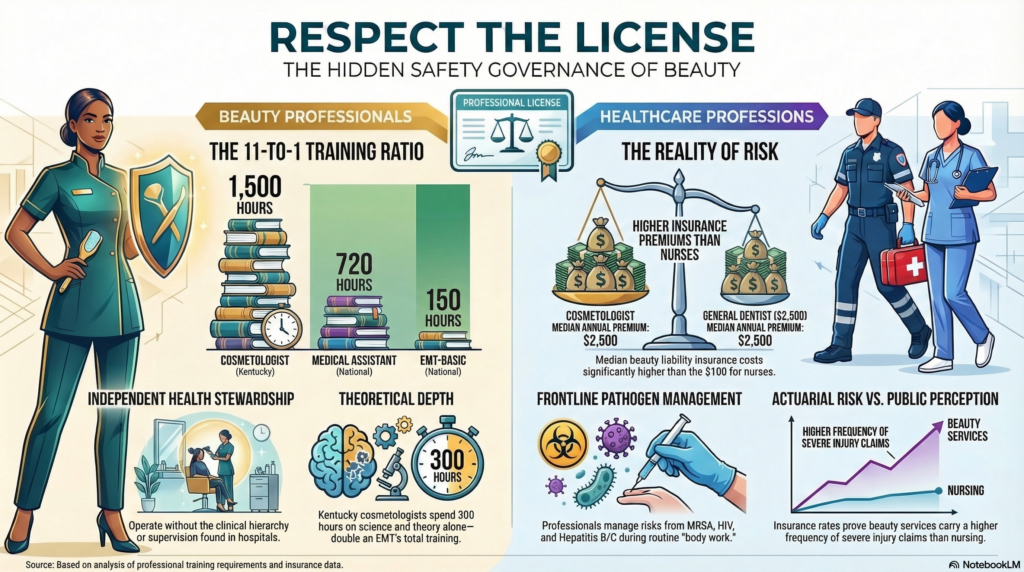
A central point of contention in occupational policy is the “11-to-1” training ratio between cosmetologists and EMTs. This claim, which gained national attention during executive-level discussions on occupational licensing reform, highlights a significant disparity in state-mandated education.2 While the comparison is often used to argue that beauty licensing is over-regulated, a deeper analysis reveals that the educational objectives of these two fields are fundamentally divergent.

The EMT pathway is designed for rapid workforce entry to provide immediate, life-saving stabilization. A national EMT certification requires a state-approved course of at least clock hours.10 In contrast, a cosmetologist in Kentucky must complete hours of instruction, including hours dedicated solely to “Science and Theory”—more than double the total training of an EMT.9

Table 2: Comparison of Training Hour Requirements (Selected States/Programs)

ProfessionState/ProgramTotal HoursScience/Theory PortionSource
EMT (Basic)National StandardVaries by program10
Certified Nursing Assistant (CNA)ArizonaVaries by program10
CosmetologistKentucky Hours9
CosmetologistTexasIntegrated1
Medical AssistantNational StandardIntegrated10
EstheticianKentucky Hours9
Nail TechnicianTexasIntegrated12
Nail TechnicianKentucky Hours9

The rationale for the high intensity of beauty training lies in the “independent” nature of the work. While a CNA or an EMT operates within a rigid clinical hierarchy—often under the direct or indirect supervision of a physician or nurse—the licensed cosmetologist or barber is frequently the sole individual responsible for the sanitation and chemical safety of their environment.1 The hours of training are intended to build a deep, intuitive understanding of infectious disease prevention, chemical toxicology, and human anatomy to prevent the salon from becoming a focal point for community outbreaks.

In Kentucky, for example, a cosmetology student is legally prohibited from performing chemical services on the public until they have completed at least hours of instruction.9 This “safety buffer” ensures that the student has mastered the theoretical underpinnings of chemical reactions—such as the pH scale of hair relaxers—before they are permitted to handle substances that could cause permanent chemical burns or hair loss.9

Biological Risks and Pathogenic Proliferation in the Modern Salon

The beauty industry is a frontline environment for biological hazard management. Despite the lack of “high-risk” medical procedures, the salon is an ideal incubator for microbes due to the ingredients found in cosmetic products—such as sugar, starch, protein, and fatty acids—and the high water content of many professional formulas.13 Research has identified beauty salons as significant sources of viral, fungal, and bacterial infections.13

Documented biological hazards include common genera such as Staphylococcus, Streptococcus, and Pseudomonas, which are associated with respiratory problems and chronic skin diseases.13 Specific case studies have highlighted the gravity of these risks; for instance, a methicillin-resistant Staphylococcus aureus (MRSA) infection was traced back to a hairdressing visit in London, while unhygienic tools in Nigeria contributed to outbreaks of HIV and Hepatitis.13

Table 3: Microorganisms Isolated from Beauty Salon Tools and Products

CategoryIsolated MicroorganismsCommon SourceSource
BacterialS. aureus, P. aeruginosa, E. coli, Enterobacter spp.Clippers, brushes, makeup sponges, foot basins.13
FungalCandida albicans, Aspergillus, Trichophyton, MalasseziaHairbrushes, nail tools, moist eyeshadows.13
ViralHepatitis B & C, HIV, Herpes SimplexRazors, nippers, shared eyeliner/lipstick.13
Pathogenic IndicatorsP. aeruginosa, S. aureus, Salmonella spp.Contaminated or expired cosmetic products.13

In the dental clinic, infection risks are managed with extreme stringency due to the aerosolization of blood and saliva.14 However, the “micro-trauma” caused by a standard manicure or a straight-razor shave provides a sufficient route of transmission for the same bloodborne pathogens. For any pathogen to cause disease, a “chain of infection” must exist: a sufficient number of microorganisms, a reservoir (blood or saliva), a route of transmission, and a susceptible host.15 The 1,500-hour beauty curriculum is designed to systematically break this chain at every stage.

Government Oversight and the Enforcement Architecture

The governance of the beauty industry is maintained through a “Risk-Based” model of inspections, which varies significantly by state. Unlike the healthcare sector, where hospitals and nursing homes face intense, multi-agency oversight (including OSHA, the CDC, and state health departments), beauty establishments are primarily governed by state-specific Boards of Cosmetology or Departments of Licensing.1

In Texas, the Department of Licensing and Regulation (TDLR) classifies violations into three distinct categories based on their threat to public health. This structured enforcement ensures that the “hidden safety governance” is not merely theoretical but is backed by substantial financial penalties.17

Table 4: Texas TDLR Penalty Matrix for Barbering and Cosmetology

Violation ClassPenalty RangeExample Violation CategoriesSource
Class AAdministrative errors; failure to display current license; wearing dirty garments.17
Class BWorking with expired license; improper storage of chlorine bleach; failure to clean fixtures.17
Class COperating without any license; operating outside the scope of practice; license transfer.17
License RevocationN/AThreatening inspectors; repeated Class C violations; major public safety threats.17

Comparing this to the food service industry reveals a stark difference in regulatory frequency. While high-risk restaurants handling raw meats are often inspected every to months, many beauty salons are only inspected once per year or even biennially.18 This suggests that the “regulatory intensity” in beauty is front-loaded into the licensure process (the 1,500 hours) rather than the inspection process. The state assumes that if a professional has mastered hours of training, they are less likely to require constant surveillance than a food handler who may only have completed an 8-hour certification course.21

In California, the Board of Barbering and Cosmetology manages one of the largest regulatory caseloads in the nation. In the fiscal year, the board received complaints and took total disciplinary decisions, including license revocations.23 This enforcement volume highlights the persistent struggle to maintain standards in a fragmented market dominated by small, independent businesses.

Actuarial Insights: The Financial Cost of Professional Negligence

Perhaps the most objective measure of the “hidden risk” in the beauty industry is found in the insurance market. Professional liability insurance, or malpractice insurance, is priced based on the actuarial probability of an incident occurring and the potential cost of that incident.24 Surprisingly, a beautician or cosmetologist often pays significantly more for individual liability coverage than a registered nurse.

While a nurse can obtain an individual malpractice policy for approximately per year, a cosmetologist pays a median cost of to per year.25 This cost ratio indicates that insurance underwriters perceive a higher risk of “frequent and severe” claims in the salon setting compared to the nursing setting.

Table 5: Comparative Professional Liability Insurance Costs (Median Annual)

ProfessionAnnual Premium (Median)Key Risk FactorSource
Registered Nurse (RN)Medication errors; failure to monitor.25
Dietitian / NutritionistImproper dietary advice; allergy issues.24
Cosmetologist / BeauticianChemical burns; hair loss; eye infections.26
Nurse Practitioner (NP)Diagnostic errors; prescription authority.28
General DentistNerve damage; surgical complications.28
Oral SurgeonHigh-risk surgical procedures.28
General SurgeonComplex, life-threatening interventions.28

The claims data in the beauty industry underscores the necessity of high-intensity training. Documented insurance payouts include for hair loss resulting from a treatment and for chemical conjunctivitis caused by an eyelash extension.30 These are not “superficial” injuries; they represent significant bodily harm and long-term psychological distress. The hours of training serve as a form of risk mitigation that keeps these premiums from escalating to surgical levels.

The Medical-Aesthetic Integration and the Regulatory Frontier

The integration of aesthetic medicine—minimally invasive procedures like fillers, botulinum toxin, and laser treatments—has created a “gray area” of regulation. In many countries, there is a heated debate between physicians and cosmetologists over who is authorized to perform these procedures.31 Traditional therapeutic medicine centers on disease treatment, while aesthetic medicine centers on the “appreciation of beauty” and the commodification of human worth.31

In the United States, the legal distinction is often tied to the “cosmetic purpose” of the act. A licensed cosmetologist in Kentucky is authorized to provide “facials and massages” but is strictly prohibited from treating “physical or mental ailments”.1 However, as technology advances, the tools used by cosmetologists (such as facial machines and high-intensity lasers) increasingly resemble medical devices.9

The Ministry of Health in various nations, including recent communications from Poland, has attempted to draw a rigid line: procedures like fillers should be performed exclusively by specialist physicians in dermatology or plastic surgery.32 Yet, because many jurisdictions lack a rigid statutory definition of an “aesthetic medicine procedure,” the conflict remains unresolved.32 This regulatory tension highlights the shift of the beauty industry toward a more clinical identity—a transition that Di Tran University identifies as the “humanization of professional aesthetics.”

Sociological Devaluation and the “Pink Tax” of Regulation

Despite the rigorous training and actuarial risk, beauty industry labor is often devalued in sociological discourse. The concept of “aesthetic labor”—the practice of screening and managing workers based on their physical appearance—is often used to stratify workers by class, race, and gender.34 Because the industry is predominantly female, its regulatory mandates are sometimes viewed as “undervalued” or dismissed as unnecessary “economic barriers”.35

Marie Boyd of the University of South Carolina argues that this association with femininity has led to a lack of federal oversight. For example, the FDCA has fewer than two pages devoted to cosmetics out of its 500-page total.35 Unlike drugs, cosmetics do not need FDA approval before they are sold, and manufacturers are not required to report adverse events.35 This places an enormous burden on the individual practitioner; they must be the final “safety filter” for products that the federal government does not adequately monitor.35

Furthermore, the beauty obsession fostered by media and industry messaging has mental health implications, particularly for Generation Z.36 The shift from using cosmetics for “concealment” to “creative expression” reflects a changing consumer psychology that beauty professionals must now manage.36 The 1,500-hour license, therefore, is not just a technical requirement; it is a credential that allows the professional to navigate these complex psychological and physical interactions with authority and ethical responsibility.

Comparative Workplace Safety: Healthcare vs. Beauty Establishments

When examining “Regulatory Intensity,” it is essential to compare the safety outcomes for the workers themselves. Healthcare and social assistance practitioners experience some of the highest rates of workplace injuries in the private sector, with injuries per full-time workers.38 These injuries are often the result of “safe patient handling” failures or workplace violence.16

In contrast, the risks in beauty establishments are chronic rather than acute. Nail salon workers, predominantly immigrant women, face cumulative exposure to biological, ergonomic, and chemical hazards.41 However, because the beauty industry is dominated by micro-enterprises and independent contractors, many of these “injuries” go unreported to OSHA.41 This lack of centralized data often masks the true “regulatory intensity” needed to protect these workers.

Table 6: Occupational Hazard Comparison: Healthcare vs. Beauty Industry

Hazard CategoryHealthcare Industry ProfileBeauty Industry ProfileSource
Infectious DiseaseHigh exposure (Aerosol, Bloodborne)High exposure (Direct Contact, Skin Flora)13
Physical Violence of all nonfatal workplace violenceLow documented frequency39
Chemical ExposureDisinfectants, SterilantsReactive chemicals, Formaldehyde, Monomers16
Ergonomic RiskPatient handling, liftingRepetitive motion, prolonged standing38
Regulatory LeadOSHA / CDC / State HealthState Boards / TDLR16

The “hidden safety governance” of the beauty industry acts as a massive public health buffer. By ensuring that trillion microbes on the human skin are managed through proper antisepsis in millions of salons every day, the beauty industry prevents a secondary burden on the healthcare system.7

Conclusions and the Path Forward for Di Tran University

The comprehensive analysis of the beauty industry’s regulatory landscape reveals a profession that is fundamentally misunderstood by the public and often undervalued by policymakers. The hours required for a cosmetology license— times more than an EMT—is not an accident of history or a product of lobbying; it is a calculated societal response to the biological and chemical risks inherent in “body work.”

At Di Tran University — The College of Humanization, we conclude that the “Respect the License” initiative is a vital component of public health advocacy. The following key insights should guide the future of beauty governance:

  1. Pedagogical Intensity as Public Health Defense: The high training hours in beauty are essential because the practitioner operates as an independent, frontline steward of sanitation without the institutional “safety net” found in hospitals.
  2. Actuarial Reality Trumps Political Narrative: The higher cost of professional liability insurance for cosmetologists compared to nurses provides undeniable proof of the “hidden risks” that the license is designed to manage.
  3. The Biological Burden is Real: With contamination rates found on unsterilized tools in certain studies, the transition from “Barber’s Itch” to “MRSA” proves that the microbial threat is evolving, not disappearing.
  4. Regulatory Humanization: Professionalizing the beauty industry through high standards protects the dignity and bodily integrity of the client, fulfilling the core mission of the College of Humanization.

The beauty industry is not a “secondary” health profession; it is a primary prevention sector. As we move into an era of medical-aesthetic integration, the license must be respected as the legal and scientific bedrock that ensures “beauty at any cost” does not become a literal reality for the public’s health.

Works cited

  1. The Legal Scope of Beauty Licensing in the United States: A …, accessed March 11, 2026, https://louisvillebeautyacademy.net/the-legal-scope-of-beauty-licensing-in-the-united-states-a-comprehensive-policy-legal-and-workforce-analysis-of-cosmetology-barbering-esthetics-and-nail-technology-research-podcast-serie/
  2. Are cosmetologists training longer than EMTs? | The Fact Checker – YouTube, accessed March 11, 2026, https://m.youtube.com/watch?v=-qm8TipH6fY
  3. HIST 234 – Lecture 11 – The Sanitary Movement and the “Filth Theory of Disease”, accessed March 11, 2026, https://oyc.yale.edu/history/hist-234/lecture-11
  4. ‘To Preserve the Skin in Health’: Drainage, Bodily Control and the Visual Definition of Healthy Skin 1835–1900 – PMC, accessed March 11, 2026, https://pmc.ncbi.nlm.nih.gov/articles/PMC4103382/
  5. Germ Theory 1880-1912 – Salt Lake County Archives, accessed March 11, 2026, https://www.saltlakecounty.gov/archives/exhibits/the-salt-lake-county-health-department-history/germ-theory/
  6. History of Hygiene: From Rituals to Modern Standards – CWS, accessed March 11, 2026, https://www.cws.com/en/hygiene/news-knowledge/history-hygiene-invisible-protection-through-ages
  7. The little-known history of cleanliness and the forgotten pioneers of handwashing – Frontiers, accessed March 11, 2026, https://www.frontiersin.org/journals/public-health/articles/10.3389/fpubh.2022.979464/full
  8. Training Program Search – IdahoWorks, accessed March 11, 2026, https://idahoworks.gov/search/programs?per_page=10&search_training_program_search%5Baverage_hours_per_week%5D=0&search_training_program_search%5Bhas_certified_curriculum%5D=1&search_training_program_search%5Bprogram_course_time_ids%5D=1
  9. Title 201 Chapter 12 Regulation 082 • Kentucky Administrative …, accessed March 11, 2026, https://apps.legislature.ky.gov/law/kar/titles/201/012/082/10638/
  10. Health Services Academy | Applied Technologies Pre-K & 7-12, accessed March 11, 2026, https://www.alaschools.org/az/applied-technologies/academies/health
  11. Health Science Certificate Training Program in South Florida – Sheridan Technical College, accessed March 11, 2026, https://www.sheridantechnicalcollege.edu/medical-health-science/
  12. Cosmetology | 2025-2026 Grayson College Catalog, accessed March 11, 2026, https://catalog.grayson.edu/2025-2026/programs/cosmetology/index.php
  13. Beauty Salons are Key Potential Sources of Disease Spread – PMC, accessed March 11, 2026, https://pmc.ncbi.nlm.nih.gov/articles/PMC8007475/
  14. The Unseen Threat in Dentistry: How to Identify, Prevent, and Overcome Infection Risks in the Modern Dental Clinic – jicrcr, accessed March 11, 2026, https://jicrcr.com/index.php/jicrcr/article/download/1789/1512/3733
  15. Preventing Cross Infection in the Dental Office – StatPearls – NCBI Bookshelf – NIH, accessed March 11, 2026, https://www.ncbi.nlm.nih.gov/books/NBK589669/
  16. Healthcare – Overview | Occupational Safety and Health Administration, accessed March 11, 2026, https://www.osha.gov/healthcare
  17. Penalties and Sanctions for Practitioners and Establishments …, accessed March 11, 2026, https://www.tdlr.texas.gov/enforcement/bacsanctions-practitioners-establishments.htm
  18. Inspection frequency : r/healthinspector – Reddit, accessed March 11, 2026, https://www.reddit.com/r/healthinspector/comments/1lf2ypi/inspection_frequency/
  19. Understanding Your Food Hygiene Rating: What It Means for Restaurants – KNOW App, accessed March 11, 2026, https://www.getknowapp.com/blog/food-hygiene-rating/
  20. Inspection Program – MyFloridaLicense.com, accessed March 11, 2026, https://www2.myfloridalicense.com/division-of-regulation/inspection-program/
  21. Food Safety Training | DuPage County Health, IL, accessed March 11, 2026, https://www.dupagehealth.org/202/Food-Safety-Training
  22. Health Inspections for Nail Salons and Barbershops – The Institute for Justice, accessed March 11, 2026, https://ij.org/report/clean-cut/health-inspections-for-nail-salons-and-barbershops/
  23. Enforcement Statistical Overview – California Board of Barbering and Cosmetology – CA.gov, accessed March 11, 2026, https://www.barbercosmo.ca.gov/enforcement/enf_stats.shtml
  24. Medical Malpractice Insurance Cost: Fast & Free Quotes | Insureon, accessed March 11, 2026, https://www.insureon.com/small-business-insurance/medical-malpractice/cost
  25. Everything You Need to Know About Nursing Malpractice Insurance, accessed March 11, 2026, https://nurse.org/education/nursing-malpractice-insurance/
  26. Cosmetology Insurance Cost Guide | Compare side by side – Simply Business, accessed March 11, 2026, https://www.simplybusiness.com/business-insurance/cosmetology-insurance/cost/
  27. Cosmetologist Insurance | Cosmetology Business Insurance – InsuredBetter.com, accessed March 11, 2026, https://www.insuredbetter.com/small-business-insurance/health-beauty/cosmetologist-coverage/
  28. How Much Does Medical Malpractice Insurance Cost for Surgeons, Dentists, and Nurses?, accessed March 11, 2026, https://www.finchmccranie.com/blog/how-much-does-medical-malpractice-insurance-cost-for-surgeons-dentists-and-nurses/
  29. 2024 Medical Professional Liability: An Evolving Landscape, accessed March 11, 2026, https://ppemedical.com/blog/2024-medical-professional-liability-an-evolving-landscape/
  30. Professional Liability Insurance – Beauty Insurance Plus, accessed March 11, 2026, https://www.beautyinsuranceplus.com/professional-liability-insurance/
  31. Ethical and Regulatory Gaps in Aesthetic Medical Practice in Top Asian Medical Tourism Destinations – PMC, accessed March 11, 2026, https://pmc.ncbi.nlm.nih.gov/articles/PMC10776543/
  32. How Does the Ministry of Health’s Communication Affect the Beauty Industry? | Żyglicka, accessed March 11, 2026, https://www.kpr.pl/en/how-does-the-ministry-of-healths-communication-affect-the-beauty-industry/
  33. Title 201 Chapter 12 Regulation 082 • Kentucky Administrative Regulations – Legislative Research Commission, accessed March 11, 2026, https://apps.legislature.ky.gov/law/kar/titles/201/012/082/
  34. Aesthetic Labor for the Sociologies of Work, Gender, and Beauty – ResearchGate, accessed March 11, 2026, https://www.researchgate.net/publication/269280709_Aesthetic_Labor_for_the_Sociologies_of_Work_Gender_and_Beauty
  35. More Regulation Needed to Combat Risks From Cosmetics | The Regulatory Review, accessed March 11, 2026, https://www.theregreview.org/2019/06/13/fritz-more-regulation-needed-combat-cosmetics-risks/
  36. Decoding Influence: Cosmetic Industry Strategies, Media Beauty Standards, and Their Mental Health Impact on Generation Z Consume – Digital Collections @ Suffolk, accessed March 11, 2026, https://dc.suffolk.edu/cgi/viewcontent.cgi?article=1045&context=undergrad
  37. The Beauty Industry’s Influence on Women in Society – UNH Scholars Repository, accessed March 11, 2026, https://scholars.unh.edu/cgi/viewcontent.cgi?article=1085&context=honors
  38. Top 10 Industries with Highest OSHA Injury Rates (2026) – OSHA Education School, accessed March 11, 2026, https://blog.oshaeducationschool.com/industries-highest-osha-injury-rates/
  39. OSHA 2025: What Healthcare Professionals Need to Know – Abyde, accessed March 11, 2026, https://abyde.com/2025-osha-healthcare-updates/
  40. Trends in workplace violence for health care occupations and facilities over the last 10 years, accessed March 11, 2026, https://pmc.ncbi.nlm.nih.gov/articles/PMC11630250/
  41. Licensure and citations among nail salons in Michigan from 2017 to 2021: A cross‐sectional study of an overlooked and vulnerable industry – ResearchGate, accessed March 11, 2026, https://www.researchgate.net/publication/362130091_Licensure_and_citations_among_nail_salons_in_Michigan_from_2017_to_2021_A_cross-sectional_study_of_an_overlooked_and_vulnerable_industry
  42. Employer-Reported Workplace Injuries and Illnesses – 2023-2024 – BLS.gov, accessed March 11, 2026, https://www.bls.gov/news.release/pdf/osh.pdf
  43. Ten Most Common Code Violations in Establishment Inspections, accessed March 11, 2026, https://www.tdlr.texas.gov/barbering-and-cosmetology/establishments/most-common-violations.htm

The Humanization of Vocational Excellence: A Kentucky Case Study of Cosmetology Education, Safety, Sanitation Law, and the Louisville Beauty Academy Model for Compliance, Community Service, and Debt-Free Training – Research & Podcast Series 2026


1. What is the primary purpose of cosmetology licensing in Kentucky?

The primary purpose of cosmetology licensing is to protect public health and safety. Beauty professionals work directly with the skin, hair, and nails of clients, which requires training in sanitation, infection control, chemical safety, and regulatory compliance. Licensing ensures practitioners understand these responsibilities before providing services to the public.


2. Why do cosmetology schools teach sanitation and safety?

Sanitation and safety training are essential because improper practices can lead to infections, chemical burns, allergic reactions, or the spread of disease. Cosmetology programs include education on disinfecting tools, preventing cross-contamination, handling chemicals safely, and maintaining hygienic work environments.


3. What is a clinic floor in a cosmetology school?

A clinic floor is a supervised training environment where students practice professional services under instructor oversight. The clinic floor functions as a learning laboratory rather than a commercial salon, allowing students to apply theoretical knowledge while completing required training hours.


4. Are clients in cosmetology schools regular salon customers?

In most cosmetology schools, individuals receiving services act as training models for students. Services are performed under instructor supervision to help students gain experience required for licensing. The purpose of these services is educational rather than commercial.


5. How many hours are required for cosmetology licensing in Kentucky?

The Kentucky licensing requirements typically include:

  • Cosmetology: 1,500 hours
  • Esthetics: 750 hours
  • Nail Technology: 450 hours
  • Shampoo Styling: 300 hours

These hours include both theoretical instruction and supervised practical training.


6. Why must cosmetology schools track student attendance so strictly?

State regulations require cosmetology schools to maintain accurate records of student training hours. Because cosmetology licensing is based on a clock-hour system, students must complete the required number of training hours to qualify for the licensing examination.


7. What role does sanitation play in cosmetology education?

Sanitation is a core component of cosmetology education. Students learn how to disinfect tools, maintain clean workstations, follow infection control procedures, and comply with state sanitation regulations designed to protect clients and practitioners.


8. What is meant by “Compliance by Design” in vocational education?

Compliance by design refers to a training structure where regulatory requirements, documentation practices, and safety standards are integrated directly into daily school operations. This approach emphasizes transparency, accurate recordkeeping, and adherence to state licensing laws.


9. What is the Louisville Beauty Academy model discussed in this research?

The Louisville Beauty Academy model emphasizes:

  • regulatory compliance
  • sanitation and safety education
  • community service through supervised training
  • affordable, debt-conscious vocational education.

The model seeks to align cosmetology training closely with public safety responsibilities and workforce development goals.


10. Why does this research discuss debt-free vocational education?

Many vocational programs in the United States rely heavily on student loans. The research explores alternative approaches that focus on affordability and reduced debt burdens, allowing students to enter the workforce more quickly and sustainably.


11. What is the connection between cosmetology education and community service?

Some vocational training models integrate community service opportunities where students provide supervised services to underserved populations. This approach can enhance student learning while contributing to community well-being.


12. Why is transparency important in vocational education?

Transparency helps students understand program requirements, licensing laws, safety expectations, and career pathways before enrolling. Clear communication promotes informed decision-making and strengthens trust between schools, students, and the public.


Educational Research Disclaimer

This publication is an academic research work prepared by the Di Tran University — The College of Humanization Research Team and is provided strictly for educational, analytical, and public discussion purposes.

The research presented herein examines publicly available information, statutes, regulations, institutional practices, and policy discussions related to vocational education and the beauty licensing industry. Any institutions referenced, including Louisville Beauty Academy, are discussed solely within the context of academic case study analysis.

Nothing in this publication constitutes:

  • legal advice
  • regulatory guidance
  • professional consulting advice
  • institutional endorsement
  • policy advocacy
  • or an official interpretation of any law, regulation, or governmental position.

All legal citations, regulatory interpretations, and policy discussions are scholarly interpretations based on publicly available materials and should not be relied upon as a substitute for consultation with licensed attorneys, regulatory agencies, or official government guidance.

The inclusion, analysis, or discussion of any organization, regulatory body, institution, educational model, or industry practice does not constitute endorsement, criticism, certification, or validation by Di Tran University, Louisville Beauty Academy, or the Research Team.

Readers are strongly encouraged to consult official statutes, regulatory authorities, and licensed professionals for authoritative guidance regarding any compliance, licensing, educational, or legal matters.


The vocational education sector in the United States, particularly within the field of beauty culture, currently stands at a critical juncture defined by heightened federal oversight, shifting state regulatory landscapes, and a deepening crisis of student debt. For the research department of Di Tran University – The College of Humanization, the study of institutional models that prioritize human dignity alongside technical mastery is paramount. This report examines Louisville Beauty Academy (LBA) as a primary case study, testing the hypothesis that a model rooted in debt-free economics, regulatory over-compliance, and community-service-driven clinic floors offers a superior alternative to the traditional revenue-dependent for-profit model. By analyzing Kentucky administrative regulations, legislative oversight reports, and public institutional records, this analysis delineates how LBA separates its narrative from systemic industry pain points and the public misconception of beauty schools as “cheap salons,” positioning itself instead as a national center of excellence.1

The Regulatory and Legal Definition of the Beauty School Clinic Floor

A fundamental challenge in the beauty education industry is the persistent misalignment between public perception and the legal reality of the “clinic floor.” Many consumers view school clinics as discount alternatives to commercial salons, expecting high-speed service, guaranteed availability, and retail-level customer care. However, an examination of Kentucky law, specifically 201 KAR 12:060 and 201 KAR 12:082, reveals that the clinic floor is a strictly defined, regulated training environment where the primary objective is the demonstration of safety, sanitation, and technical proficiency for licensure, rather than commercial commerce.4

The Clinic Floor as a Regulated Laboratory

Under Kentucky administrative regulations, the beauty school clinic floor is not a commercial enterprise but a supervised instructional laboratory. Every service performed on a member of the public is legally classified as a “clinical practice” or “practical work” requirement.7 These requirements are established to ensure that students can meet the mandatory clock-hour thresholds necessary for state licensure. For example, a cosmetology student in Kentucky must complete 1,500 hours of clinical class work and scientific lectures, while a nail technician student must complete 450 hours.6

The law is explicit regarding the supervision and intent of these services. Students are prohibited from performing chemical services on the public until they have reached specific milestones—250 hours for cosmetology and 60 hours for nail technology.6 This reinforces the status of the clinic floor as a classroom where the “customer” is legally a “model” or “volunteer” participating in a student’s educational journey.10 This volunteer is expected to understand that results, timing, and the specific application of techniques are subject to instructor oversight and the student’s current stage of learning.10

The Rigidity of the Clock-Hour System

A defining characteristic of beauty education that distinguishes it from traditional liberal arts colleges is the “clock-hour” versus “credit-hour” system. In a standard university setting, a student is evaluated based on the mastery of content and credit completion. In a beauty academy, the state board requires an exact accounting of time spent in physical training.11

Kentucky law (201 KAR 12:082) mandates that schools maintain “accurate daily attendance records” and preserve them for at least five years.12 This creates a high level of rigidity; there is no “informal time forgiveness” or rounding of hours. If a student is not physically present and clocked in, they are not earning progress toward their license.11 Furthermore, regulations limit training to no more than 10 hours per day or 40 hours per week, with a mandatory 30-minute unpaid break for any 8-hour day.12 This administrative burden necessitates sophisticated tracking systems, such as the biometric attendance mandates adopted by Louisville Beauty Academy, to ensure that the person earning the hours is the person physically present.11

Table 1: Regulatory Hour Requirements in Kentucky

The following table outlines the minimum instructional and clinical hour requirements as defined by the Kentucky Board of Cosmetology (KBC) and implemented within the LBA curriculum.6

License TypeTotal Clock HoursLecture/Theory HoursClinic/Practice HoursStatute/Law Hours
Cosmetology1,5003751,08540 6
Esthetician75025046535 6
Nail Technician45015027525 6
Shampoo Styling30010017525 7

Louisville Beauty Academy’s Distinctive Institutional Model

Louisville Beauty Academy has intentionally designed its operations to counter the “cheap salon” narrative while proactively addressing federal concerns regarding “free student labor.” Its model is predicated on the principles of Di Tran University, which emphasizes that vocational training is a tool for humanization and dignity rather than mere profit generation.3

The Volunteer-Based Clinic Framework

The LBA model fundamentally redefines the relationship between the student, the school, and the public. Unlike many schools that actively market “discount salon services” to the general public to generate operational revenue, LBA frames clinic floor participation as a volunteer opportunity.14 This is not a semantic distinction but a structural one.

Participants in LBA’s clinic floor sessions are encouraged to view themselves as “Live Volunteer Models”.10 This model prioritizes outreach to vulnerable populations, including seniors, individuals with disabilities, and the unhoused.14 By removing the traditional client-vendor dynamic, LBA eliminates the commercial pressure that can lead to an environment focused on “production” rather than “education.” The fees associated with these services are explicitly described as contributions toward the cost of products, sanitation, and instructor supervision, rather than a payment for the student’s labor.10

Student Autonomy and the Rejection of Production Pressure

A critical point of differentiation for LBA is its “student-choice” model. In typical beauty schools, students are often assigned clients as they walk in, functioning effectively as unpaid employees in a retail setting.16 LBA, by contrast, relies on the student’s willingness and learning needs to determine availability.10

There is no guarantee of a particular stylist, time, or specific service availability at LBA. Access is provided on a first-come, first-served basis, driven entirely by the students’ instructional requirements.10 This ensures that the clinic floor remains “education-first” and protects students from the exploitative “production” quotas that have plagued the for-profit sector nationally.15 By framing the clinic as a community service hub, LBA ensures that every hour earned on the floor is a meaningful step toward professional licensure rather than a commercial labor contribution.14

Table 2: Comparative Models of Clinic Floor Operation

FeatureTypical U.S. Beauty School ModelLouisville Beauty Academy Model
Primary GoalRevenue generation / Profit centerEducational training / Community service 14
Public RoleCommercial customerLive volunteer model 10
Fee StructureProfit-margin based pricingProduct/sanitation cost recovery 10
SchedulingGuaranteed appointments/retail hoursStudent-availability / First-come, first-served [User Query]
Student StatusQuasi-employee (unpaid labor)Training professional / Community volunteer 15

Compliance as a Pillar of Humanization: Addressing Systemic Gaps

The beauty industry in Kentucky has recently faced significant scrutiny regarding the consistency and effectiveness of state-level oversight. Louisville Beauty Academy has responded to these challenges not with resistance, but with a strategy of “Over-Compliance”.18

Analysis of Statewide Inspection Gaps

The 2024 Legislative Research Commission (LRC) report on the Kentucky Board of Cosmetology (KBC) revealed deep systemic failures in the oversight of beauty schools and salons.19 The report found that:

  • The KBC was failing to meet its regulatory mandate to inspect establishments twice annually.19
  • There was a profound lack of documentation; in a sample of board files, only 54% had a completed inspection form.19
  • Board staff and inspectors lacked sufficient internal written policies, leading to inconsistent enforcement and arbitrary fining practices.19
  • Statewide, many facilities went years without a formal inspection, creating a potential risk to public health and safety.19

The LBA Strategy of “Compliance by Design”

In this environment of inconsistent oversight, LBA has positioned itself as a “Gold Standard Mentor” for the industry.1 Instead of viewing inspections as an adversarial process to be avoided, LBA actively welcomes them as an opportunity to demonstrate its adherence to safety and administrative protocols.1

LBA’s “Compliance by Design” posture includes several key actions:

  1. Biometric Attendance Mandates: To ensure the absolute integrity of student clock hours, LBA utilizes biometric verification.11 This technology removes the potential for manual errors or fraudulent hour-logging, which are significant concerns for federal Title IV auditors.12
  2. Public Record Transparency: LBA maintains a digital library that publishes KBC oversight reports, inspection laws, and official memoranda verbatim for educational use.1 This encourages students to become legally literate professionals who understand the laws governing their licenses.20
  3. Proactive Documentation: LBA documents, pre-verifies, and portal-confirms every student submission (transfers, extracurricular hours, etc.) to ensure that all records are audit-ready at all times.18

By operating above the minimum legal standards, LBA protects its students from the “denied or delayed hours” that often occur in schools with less rigorous record-keeping.1 This approach transforms compliance from a bureaucratic hurdle into an educational advantage.

The Macroeconomics of Debt-Free Vocational Pathways

Nationally, the beauty education sector is often criticized for trapping low-income and immigrant students in cycles of high-interest debt.16 The LBA model challenges this status quo through a cash-based, debt-free economic structure that creates a significant net-positive fiscal impact on the state.22

The “Tuition Premium” and the Title IV Trap

Research indicates a stark disparity between schools that accept federal financial aid (Title IV) and those that do not. A seminal 2014 study found that Title IV cosmetology programs charge approximately 78% more in tuition than comparable non-Title IV programs.16 This “tuition premium” effectively allows institutions to capture federal subsidies—Pell Grants and student loans—by inflating their costs to match the available aid.16

LBA intentionally eschews the federal aid system, opting instead for a low-cost, cash-based model.14 By avoiding the administrative burdens and “hidden tuition hikes” associated with FAFSA participation, LBA can offer programs for under $7,000, while federally funded competitors often charge $15,000 to $25,000.16

Modeling the Net Fiscal Impact

LBA’s economic engine is driven by “Speed-to-Market” and “Taxpayer Savings.” When a student chooses LBA over a traditional Title IV school, the public treasury immediately saves an average of $10,000 in avoided subsidies.22

The fiscal velocity of an LBA graduate can be modeled using the following economic variables 22:

  • Let represent the direct taxpayer savings per student: , where is the average public aid package and is the interest on avoided debt. For LBA, per student.22
  • Let represent the fiscal velocity (extra tax revenue) created by LBA’s accelerated curriculum. If is the 6-month speed-to-market differential, then:

    Using LBA’s metrics (), the extra tax revenue per student is .22

Over a 5-year period, LBA’s model is projected to save taxpayers over $5.8 million per 100-student cohort while generating significantly higher state board revenue through examination fees.22

Table 3: Economic Comparison of Educational Models

MetricTraditional Title IV SchoolLouisville Beauty Academy (LBA)
Typical Tuition$15,000 – $20,000Under $7,000 16
Student Debt at Graduation$7,000 – $11,000$0 16
Public Funding ConsumedHigh (Pell Grants/Loans)$0 (Self-funded) 23
Time to Graduation15–18 months9–10 months 23
5-Year Job Creation (per 500 grads)150 jobs312.5 jobs 23

National Recognition and the “Beauty for Connection” Pilot

The LBA model has not only proven successful locally but has also garnered national acclaim for its innovative approach to vocational education. In 2025, the academy achieved a historic “dual national recognition”.25

The CO—100 Award and National Excellence

Louisville Beauty Academy was named one of America’s Top 100 Small Businesses by the U.S. Chamber of Commerce.25 Selected from a pool of 12,500 applicants, LBA was the only Kentucky business honored in the “Enduring Business” category.25 This award validates LBA’s long-term sustainability and resilience, proving that a low-cost, debt-free model can thrive without the crutch of federal subsidies.26 Furthermore, the academy’s founder, Di Tran, was recognized as a finalist for the 2025 NSBA Lew Shattuck Small Business Advocate of the Year, highlighting LBA’s role as a policy leader in the industry.25

“Beauty for Connection”: Social Medicine in Practice

Central to LBA’s mission is the “Beauty for Connection” initiative, which treats grooming services as a critical tool for human contact and mental health.10 This pilot program delivers free beauty and wellness services to Kentucky’s elderly, disabled, and socially isolated populations.10

The initiative addresses the “loneliness epidemic” by channeling student training hours into community service under instructor supervision.10 The measurable results are significant:

  • Student Contribution: Over 30,000 service hours provided annually.10
  • Community Value: Over $500,000 in donated services per year.10
  • Healthcare Savings: An estimated $2 million to $3 million in annual savings by reducing ER visits and illnesses related to social isolation and poor grooming (e.g., infections, depression).10

By embedding community service into the curriculum, LBA ensures that its students graduate not just as technicians, but as “compassionate caregivers” who understand the human impact of their profession.10

Comparative Analysis: The National Landscape of Beauty Education

When compared to the broader national landscape, Louisville Beauty Academy’s model offers a clear solution to many of the “pain points” currently facing regulators and students.

The Problem of “Free Student Labor”

Nationwide, federal reports have raised concerns about schools that function as “quasi-salons,” where students perform high volumes of services for the public to generate profit for the institution while receiving little educational value.16 This model has led to numerous class-action lawsuits and settlements, as students argue they are effectively functioning as unpaid employees.28

LBA mitigates this risk through its volunteer-based framework. By removing the profit incentive from the clinic floor and focusing on underserved populations, LBA ensures that clinic services are truly educational and service-oriented rather than commercial.14 This aligns with federal “Gainful Employment” standards and protects the academy from the “substantial misrepresentation” charges that have crippled other for-profit institutions.16

Regulatory Capture and Barriers to Entry

The beauty industry is often subject to “Regulatory Capture,” where boards dominated by industry incumbents set high barriers to entry to protect existing businesses.17 This often results in inflated program hours and outdated curriculum requirements.21 LBA actively challenges this system by advocating for state-led vocational reform and promoting AI-driven compliance over manual “red tape”.14

Table 4: LBA’s Model vs. National Regulatory Trends

TrendNational Industry RiskLBA Compliance Solution
Debt-to-Earnings92.5% of programs likely to fail 16Debt-free model; zero risk 16
Instructional HoursInconsistent reporting/fraud 11Biometric attendance mandates 11
Student LaborFLSA “free labor” concerns 16Volunteer-based service model 14
AccessibilityHigh tuition; credit check barriers 14Low tuition; no credit checks 14

Conclusion: Toward a New National Standard for Beauty Education

The research conducted by Di Tran University – The College of Humanization suggests that the Louisville Beauty Academy model provides a transformative roadmap for the future of vocational education. By testing the hypothesis of a debt-free, compliance-first, and community-driven school, this analysis demonstrates that LBA has successfully decoupled its success from the systemic failures of the traditional for-profit model.

LBA’s “Center of Compliance Excellence” effectively addresses the oversight gaps identified by the Kentucky Legislative Research Commission, proving that transparency and technology can create an environment of “Gold Standard” integrity.1 The “Beauty for Connection” initiative transforms the clinic floor from a place of potential student exploitation into a site of profound community healing and “social medicine”.3

Crucially, LBA’s economic model proves that high-quality vocational training does not require federal subsidies. By saving taxpayers millions in avoided debt while accelerating students into the workforce, LBA acts as a powerful economic engine for the Commonwealth of Kentucky.23

As federal and state regulators look to reform the beauty industry, the LBA case study offers several actionable lessons:

  1. Prioritize Debt-Free Paths: Vocational education should be affordable enough to be self-funded, preventing the “debt overhang” that stifles entrepreneurship.23
  2. Mandate High-Integrity Attendance: Biometric systems should become the standard for clock-hour reporting to protect students and taxpayers.11
  3. Humanize Clinical Practice: Clinic floors should be service-oriented hubs that benefit the community, removing the commercial pressure that degrades the quality of training.10

Regulators, educators, and the public are encouraged to consult the primary sources—specifically the Kentucky Administrative Regulations (KAR), the Kentucky Board of Cosmetology (KBC) portal, and the LBA Public Record Library—for authoritative guidance on implementing these standards.1 The Louisville Beauty Academy case study illustrates how a compliance-first, debt-conscious, and community-centered training model may provide insights for broader vocational education reform discussions in the United States.2

Works cited

  1. LOUISVILLE BEAUTY ACADEMY — PUBLIC RECORD LIBRARY Public Case Study — KBC Google Review Trends & Official Regulation Update – 12-05-2025, accessed March 6, 2026, https://louisvillebeautyacademy.net/louisville-beauty-academy-public-record-library-public-case-study-kbc-google-review-trends-official-regulation-update-12-05-2025/
  2. Comparative Analysis of Beauty Schools: Louisville Beauty Academy vs. National Institutes – RESEARCH JULY 2025 – Di Tran University, accessed March 6, 2026, https://ditranuniversity.com/comparative-analysis-of-beauty-schools-louisville-beauty-academy-vs-national-institutes-research-july-2025/
  3. beauty school compliance Archives – Louisville Beauty Academy, accessed March 6, 2026, https://louisvillebeautyacademy.net/tag/beauty-school-compliance/
  4. BOARDS AND COMMISSIONS Kentucky Board of Cosmetology (Amendment) 201 KAR 12:060. Inspections. RELATES TO, accessed March 6, 2026, https://apps.legislature.ky.gov/services/karmaservice/documents/12425/ToPDF?markup=true
  5. Board of Cosmetology (Amendment) 201 KAR 12:060. Inspections. RELATES TO, accessed March 6, 2026, https://apps.legislature.ky.gov/services/karmaservice/documents/16142/ToPDF?markup=true
  6. Title 201 Chapter 12 Regulation 082 • Kentucky Administrative Regulations – Legislative Research Commission, accessed March 6, 2026, https://apps.legislature.ky.gov/law/kar/titles/201/012/082/
  7. Board of Cosmetology (Amendment) 201 KAR, accessed March 6, 2026, https://apps.legislature.ky.gov/services/karmaservice/documents/16143/ToPDF?markup=true
  8. Tag: cosmetology school instructional hours reporting – Louisville Beauty Academy, accessed March 6, 2026, https://louisvillebeautyacademy.net/tag/cosmetology-school-instructional-hours-reporting/
  9. beauty academy curriculum Archives – Louisville Beauty Academy – Louisville KY, accessed March 6, 2026, https://louisvillebeautyacademy.net/tag/beauty-academy-curriculum/
  10. “Beauty for Connection”: A Proven Model by Louisville Beauty …, accessed March 6, 2026, https://louisvillebeautyacademy.net/beauty-for-connection-a-proven-model-by-louisville-beauty-academy-to-combat-loneliness-empower-students-and-deliver-free-wellness-services-to-kentuckys-elderly-and-disabl/
  11. Tag: Kentucky Board of Cosmetology requirements – Louisville Beauty Academy, accessed March 6, 2026, https://louisvillebeautyacademy.net/tag/kentucky-board-of-cosmetology-requirements/
  12. Tag: biometric attendance cosmetology school – Louisville Beauty Academy, accessed March 6, 2026, https://louisvillebeautyacademy.net/tag/biometric-attendance-cosmetology-school/
  13. 201 KAR 12:082. Education requirements and school administration. RELATES TO, accessed March 6, 2026, https://apps.legislature.ky.gov/services/karmaservice/documents/2007/ToPDF?markup=false
  14. Pioneering the Future of Debt-Free … – Louisville Beauty Academy, accessed March 6, 2026, https://louisvillebeautyacademy.net/louisville-beauty-academy-pioneering-the-future-of-debt-free-purpose-driven-beauty-education/
  15. Louisville Beauty Academy: Pioneering Debt-Free Beauty Education AND THRIVING AND ELEVATING THE BEAUTY INDUSTRY LANDSCAPE – RESEARCH MAY 2025, accessed March 6, 2026, https://louisvillebeautyacademy.net/louisville-beauty-academy-pioneering-debt-free-beauty-education-and-thriving-and-elevating-the-beauty-industry-landscape-research-may-2025/
  16. Tag: vocational education policy analysis – Louisville Beauty Academy, accessed March 6, 2026, https://louisvillebeautyacademy.net/tag/vocational-education-policy-analysis/
  17. The Reality of Cosmetology Education in Kentucky What Adult Students Must Understand Before Enrolling – Louisville Beauty Academy, accessed March 6, 2026, https://louisvillebeautyacademy.net/the-reality-of-cosmetology-education-in-kentucky-what-adult-students-must-understand-before-enrolling/
  18. Gold-Standard Compliance Guide: KBC Transfer and Field / Charity …, accessed March 6, 2026, https://louisvillebeautyacademy.net/gold-standard-compliance-guide-kbc-transfer-and-field-charity-hour-requirements-research-2026/
  19. Chapter Number/Section Name – Legislative Research Commission, accessed March 6, 2026, https://apps.legislature.ky.gov/lrc/publications/ResearchReports/RR492.pdf
  20. Tag: compliance by design beauty school – Louisville Beauty Academy, accessed March 6, 2026, https://louisvillebeautyacademy.net/tag/compliance-by-design-beauty-school/
  21. beauty industry workforce education Archives – Louisville Beauty Academy, accessed March 6, 2026, https://louisvillebeautyacademy.net/tag/beauty-industry-workforce-education/
  22. Vocational Education Economics Archives – Louisville Beauty …, accessed March 6, 2026, https://louisvillebeautyacademy.net/tag/vocational-education-economics/
  23. Macroeconomic Analysis of Debt-Free Vocational Pathways: A …, accessed March 6, 2026, https://louisvillebeautyacademy.net/macroeconomic-analysis-of-debt-free-vocational-pathways-a-comparative-study-of-the-louisville-beauty-academy-and-federal-aid-dependent-models-in-the-commonwealth-of-kentucky-research-podcast/
  24. affordable beauty school Archives – Louisville Beauty Academy, accessed March 6, 2026, https://louisvillebeautyacademy.net/tag/affordable-beauty-school/
  25. Louisville Beauty Academy: Prestige, Trust, and National-to-Local Recognition in Every Graduate’s Hands, accessed March 6, 2026, https://louisvillebeautyacademy.net/louisville-beauty-academy-prestige-trust-and-national-to-local-recognition-in-every-graduates-hands/
  26. Louisville Beauty Academy Named One of America’s Top 100 Small Businesses by the U.S. Chamber of Commerce — Chosen From Over 12500 Applicants Nationwide – SEPTEMBER 2025, accessed March 6, 2026, https://louisvillebeautyacademy.net/louisville-beauty-academy-named-one-of-americas-top-100-small-businesses-by-the-u-s-chamber-of-commerce-chosen-from-over-12500-applicants-nationwide-september-2025/
  27. Louisville Beauty Academy: Self-Published Books for Advanced Learning, Skill Mastery, Business Success, and More, accessed March 6, 2026, https://louisvillebeautyacademy.net/louisvillebeautyacademyselfpublishedbookcollection/
  28. Beauty School Regulatory Capture & Anti-Competitive Practices:A, accessed March 6, 2026, https://naba4u.org/2025/11/beauty-school-regulatory-capture-anti-competitive-practicesa-research-report-for-the-new-american-business-association-research-2025/

Research Independence and Non-Endorsement Statement

This publication represents an independent academic analysis conducted by the Di Tran University — The College of Humanization Research Team for the purpose of advancing scholarly discussion regarding vocational education, regulatory compliance, and workforce development.

All information contained in this research is derived from public records, regulatory documents, academic sources, and publicly available institutional materials believed to be reliable at the time of writing. However, the authors make no guarantees regarding completeness, accuracy, or future regulatory interpretation, as laws, policies, and institutional practices may evolve over time.

The discussion of any institution, including Louisville Beauty Academy, is provided solely as a research case study within an academic framework. Such discussion does not imply endorsement, certification, approval, or representation by Di Tran University, Louisville Beauty Academy, or any governmental or regulatory authority.

This research publication is intended exclusively for educational and informational purposes and should not be interpreted as legal advice, regulatory instruction, institutional policy, or professional recommendation.

Neither Di Tran University, Louisville Beauty Academy, the Research Team, nor the authors assume responsibility or liability for any actions taken based on the interpretation or use of this material.

All responsibility for interpretation and application of the information contained herein remains solely with the reader.

The Reality of Cosmetology Education in Kentucky What Adult Students Must Understand Before Enrolling

Di Tran University Research & Workforce Policy Series – 2026


Frequently Asked Questions About Cosmetology and Beauty Training in Kentucky

How many hours are required for a cosmetology license in Kentucky?
Kentucky requires 1,500 training hours for a cosmetology license under KRS Chapter 317A and the administrative regulations in 201 KAR Chapter 12. The curriculum includes theory instruction, clinical practice, and Kentucky law before a student can qualify for the state licensing examination administered through PSI.

How many hours are required for an esthetician license in Kentucky?
Kentucky requires 750 training hours for an Esthetics license. Esthetics training focuses on skin care, facial treatments, sanitation, infection control, product chemistry, and safe skin service procedures. Graduates must pass the Kentucky state board licensing examination to practice professionally.

How many hours are required for a nail technician license in Kentucky?
Kentucky requires 450 training hours for a Nail Technology license. Training includes sanitation, infection control, nail structure, chemistry of nail products, and practical service procedures before qualifying for the state licensing exam.

Is shampoo styling a license in Kentucky?
Yes. Shampoo Styling is a licensed profession in Kentucky requiring 300 hours of training in a licensed cosmetology school. The program focuses on shampooing, scalp treatments, blow-drying, and basic styling techniques, with strong emphasis on sanitation and hygiene.

Is eyelash extension a license in Kentucky?
No. Eyelash extensions are regulated through a specialty permit rather than a full license. Practitioners must complete approved training and obtain a specialty permit before legally performing eyelash extension services.

What is the difference between a license and a specialty permit?
A professional license (cosmetology, esthetics, nail technology, or shampoo styling) requires a defined number of training hours and passing a state licensing examination.
A specialty permit allows practice of a specific limited service and typically requires shorter training focused only on that service.

Can cosmetology or esthetics students work on real clients during school?
Yes. Kentucky allows student clinics in licensed schools. However, cosmetology students must complete at least 250 hours of foundational training before performing chemical services on members of the public in order to protect public safety.

How much does beauty school cost in Kentucky?
Tuition varies widely depending on the institution. Programs may range from lower-cost vocational training models to higher-priced schools that rely heavily on federal student aid. Prospective students should compare tuition, exam preparation support, and graduation outcomes before enrolling.


Correct Kentucky Program Hour Requirements Summary

ProgramHours RequiredCredential Type
Cosmetology1,500 hoursLicense
Esthetics750 hoursLicense
Nail Technology450 hoursLicense
Shampoo Styling300 hoursLicense
Eyelash ExtensionSpecialty trainingSpecialty Permit

Research & Educational Disclaimer

This article is provided for public education and workforce research purposes only and reflects analysis prepared by researchers affiliated with Di Tran University as part of its ongoing study of vocational education systems, regulatory structures, and economic outcomes for adult learners. The content represents independent academic commentary and general informational analysis regarding industry trends, public regulations, and financial literacy considerations within cosmetology education. Publication on the Louisville Beauty Academy website is intended solely to support consumer awareness and transparency in vocational decision-making. Nothing in this article should be interpreted as legal advice, regulatory interpretation, endorsement of any institution, or criticism of any specific organization, program, regulator, or business entity. Regulatory references are provided for educational context only, and readers are encouraged to consult the official statutes, administrative regulations, and the appropriate licensing authorities for authoritative guidance. Louisville Beauty Academy does not claim authorship of the analysis and assumes no responsibility for third-party interpretations or decisions made based on this informational content.


The Architecture of Regulatory Capture in Cosmetology: Institutional Influence, Competitive Obstruction, and the Crisis of Debt-Dependent Education

The landscape of occupational licensing in the United States, particularly within the cosmetology and beauty services sector, serves as a primary example of regulatory capture. This phenomenon, where state agencies created to act in the public interest instead prioritize the commercial and political objectives of the industries they regulate, is not merely a theoretical concern but a documented reality with significant economic consequences. In the beauty education sector, this capture is facilitated through a complex network of statutory board compositions, aggressive lobbying by trade associations, and an accreditation system that serves as a gatekeeper for billions of dollars in federal subsidies. The resulting policy environment often suppresses competition, inflates tuition, and traps low-income and immigrant learners in a cycle of debt that bears little relation to professional mastery or public safety.

The Theoretical Framework of Occupational Capture and Market Distortion

Regulatory capture within cosmetology boards is characterized by the dominance of active market participants over the regulatory process. When a licensing board is composed primarily of industry insiders—specifically owners of large cosmetology school chains—the board’s incentives shift from protecting the public to protecting incumbent business models. This is particularly evident in the setting of mandatory instructional hours, curriculum standards, and the adjudication of competitive entries. Research from the Center for the Study of Economic Liberty (CSEL) at Arizona State University suggests that this mechanism of capture is the primary driver behind the suppression of employment and entrepreneurial opportunities in the sector.1

The economic impact of this capture is quantifiable. Boards dominated by industry incumbents tend to set higher barriers to entry, which increases the time and cost required to obtain a license. According to CSEL’s 2020 report, the “Cosmetology Board Capture Index” reveals a direct correlation between the lack of public representation on boards and the length of state-mandated training.2 In the eight states with the highest levels of board capture—defined as having zero public representatives—it takes an average of 50 more calendar days than the national average to fulfill the state requirements for licensure.2

National Metrics of Cosmetology Board CaptureData Observation
States with Zero Public Board RepresentativesNew York, North Dakota 2
States with High Capture (Minimal Public Input)LA, MA, MS, OK, VT, WY 2
National Average Training Time Increase (High Capture States)+50 Days 2
States with Majority Public BoardsArizona (post-2020), California 3
States with Eliminated Boards (Least Captured)Maine, Arkansas (Eliminated 2009) 3

These “high capture” states often resist reforms such as universal licensure reciprocity, which would allow practitioners to move across state lines without undergoing duplicative and costly training.4 By maintaining fragmented and high-barrier licensing regimes, captured boards ensure that students remain enrolled in schools longer, thereby maximizing the tuition revenue generated for the institutions represented on those boards.5

Schools that operate with lower tuition models allow graduates to enter the workforce without heavy debt obligations. When graduates are not burdened by loan repayment, they can reinvest earnings into advanced education, business ownership, and local economic activity. In contrast, high-tuition programs often delay entrepreneurship because graduates must prioritize debt repayment before building independent practices.

Structural Capture in State Statutes: The Case of Kentucky

The Commonwealth of Kentucky provides a granular view of how regulatory capture is codified into state law. Kentucky Revised Statute (KRS) 317A.030 establishes the composition of the Kentucky Board of Cosmetology (KBC) in a manner that virtually guarantees industry dominance. The statute mandates a seven-member board, but only one of those seats is reserved for a “citizen at large” who is free from financial ties to the industry.6

The board’s composition under KRS 317A.030 is as follows:

  • Two members must be cosmetology salon owners.
  • One member must be a cosmetology teacher in public education.
  • One member must be an owner of, or have a financial interest in, a licensed cosmetology school.
  • One member must be a licensed nail technician.7
  • One member must be a licensed esthetician.7
  • One member is a citizen at large.6

A critical second-order insight into this statutory structure is the requirement that the school owner member “shall be a member of a nationally recognized association of cosmetologists”.6 By embedding membership in a trade association—such as the American Association of Cosmetology Schools (AACS)—directly into the qualifications for a government regulator, the state effectively delegates regulatory influence to private interest groups. This formal mechanism ensures that the national policy agenda of large, for-profit school chains is represented at the highest levels of state oversight.

The informal mechanisms of capture in Kentucky have historically been even more pronounced. Prior to 2024, the KBC faced significant public pressure and allegations of mismanagement, leading to the removal of Executive Director Julie Campbell in September 2024 after a seven-year tenure.9 The board’s transition to new leadership under Joni Upchurch, a former cosmetology professor, and the appointment of Michael Carter as the first-ever nail technician board member, represent attempts at institutional reform.9 However, even under new leadership, the board continues to exhibit the hallmarks of capture, such as the recusal of board members from decisions involving competing schools. For instance, in a January 2026 meeting, Vice Chair Lianna Nguyen recused herself from board decisions regarding the Louisville Beauty Academy (LBA), a low-cost competitor to traditional Title IV schools.11

Trade Associations and the Lobbying Power of the Beauty School Industrial Complex

The American Association of Cosmetology Schools (AACS) acts as the central hub for industry lobbying and advocacy. As a regulated industry, for-profit beauty schools maintain a “proactive” stance toward federal and state government relations to protect their revenue streams from “attacks” such as the reduction of program hours or the deregulation of licensure.12

The Federal Lobbying Machine

The AACS maintains a robust advocacy infrastructure, including an annual Congressional Summit and “Hill Day,” where school owners and administrators gather in Washington, D.C., to lobby Members of Congress.12 Their primary objectives include:

  1. Preserving High Program Hours: Lobbying against state-level efforts to reduce mandatory hours, as shorter programs decrease the amount of federal student aid a school can collect.5
  2. Opposing Accountability Standards: Fighting federal “Gainful Employment” (GE) and “Financial Value Transparency” rules that tie federal aid eligibility to graduate earnings.13
  3. Protecting Title IV Dependency: Ensuring that the flow of Pell Grants and federal student loans remains uninterrupted, despite evidence that many programs provide poor financial returns for students.5

A significant example of this influence is the AACS’s legal challenge to the Department of Education’s 2023 Gainful Employment Rule. The AACS and its member schools filed suit in federal district court in Texas, seeking to strike down the rule as “arbitrary, capricious, and unconstitutional”.15 Although Chief U.S. District Judge Reed O’Connor ruled in favor of the Department of Education in October 2025, the AACS has continued to fight through the appeals process and through targeted political contributions.16 The schools’ own legal arguments in this case were revealing: they admitted that if forced to meet basic debt-to-earnings benchmarks, a substantial number of programs would “fail and shut down”.14

The 90/10 Rule and Revenue Capture

The economic model of for-profit beauty schools is heavily reliant on federal subsidies. Under the “90/10 rule,” proprietary institutions must derive at least 10% of their revenue from non-federal sources. For many beauty school chains, Title IV federal aid (Pell Grants and loans) accounts for more than 85% of total revenue.19 Recent changes to the 90/10 rule in 2023 expanded the definition of “federal funds” to include any federal assistance received by students, such as Veterans Affairs (VA) benefits, which had previously been used by schools to satisfy the 10% requirement.20 This regulatory shift has put additional pressure on the sector, leading to increased lobbying for “carve-outs” and exemptions.20

Case Study in Competition Blockade: The Iowa Monopoly

The state of Iowa offers a definitive case study in how captured boards and trade associations use the legal system to suppress lower-priced competition. In 2005, the Iowa Cosmetology School Association and La’ James International College sued Iowa Central Community College to stop it from launching a cosmetology program.22 The private schools successfully argued that state code prohibited public entities from competing with private businesses in this sector. This lawsuit effectively preserved a monopoly for high-tuition, for-profit providers and maintained Iowa’s status as having one of the highest licensure hour requirements in the nation—2,100 hours.22

The relationship between the dominant school chain, La’ James International College, and the state regulatory body was particularly incestuous. A high-ranking official from La’ James held a seat on the Iowa Board of Barbering and Cosmetology Arts and Sciences even as the school faced multiple investigations for consumer fraud.24 This position of power allowed the school to influence the very inspectors who were tasked with investigating student complaints about “instructorless” classrooms and the exploitation of students as unpaid labor.25

Iowa Competitive Obstruction MetricsImpact / Observation
Mandatory Cosmetology Hours2,100 (Highest in U.S.) 22
Community College BlockadeLawsuit in 2005 prevented public entry 23
Tuition for Private Chains$15,000 – $20,000 22
Student Debt Forgiveness Settlements$2.1M (2016) and $462k (2021) 22
Board RepresentationLa’ James official held active seat 24

The Title IV Debt Trap and the Economics of Exploitation

The current financing architecture of beauty education incentivizes a model that prioritizes enrollment and aid capture over student outcomes. Because schools are paid per enrolled student per credit hour, there is a systemic incentive to delay graduation and maintain artificially long programs.5

Debt-to-Earnings Disparities

Nationwide data indicates a severe mismatch between the cost of beauty education and the eventual earnings of graduates. Analysis by The Century Foundation and New America shows that 98% of cosmetology programs would fail proposed federal earnings tests.5 Graduates typically earn an average of only $16,600 to $20,000 annually, yet they often carry a debt load of $10,000 to $11,000.5 This high debt-to-income ratio is particularly damaging to the low-income, first-generation, and immigrant populations that these schools target.5

Comparative Earnings Data (2025-2026)Annual Income Range
Entry-Level Cosmetologist$26,000 – $31,000 30
Mid-Career Professional$35,000 – $45,000 30
Average Hourly Rate$18 – $22/hour 30
High School Graduate MedianUsed as federal benchmark for “Red Flag” 31

The industry often defends these low reported earnings by claiming that stylists receive significant unreported income through cash tips. However, the Department of Education, under multiple administrations, has found no empirical evidence of widespread unreported income that would bridge the gap between reported earnings and a livable wage.13

Systemic Use of Unpaid Student Labor

A core component of the for-profit beauty school business model is the “dual-revenue” structure: schools profit from both student tuition and from the salon services performed by students on paying customers.29 In many schools, students are required to work on the “clinic floor” for hundreds of hours, often performing non-educational tasks such as cleaning, restocking, and laundry under the guise of “training”.25

This practice has led to over 40 major class-action lawsuits and federal investigations. Schools such as Empire Beauty, Milan Institute, and La’ James have been accused of treating students more like “free labor” than learners.25 In Iowa, the Attorney General’s lawsuit against La’ James specifically alleged that the school “seemed to pay the company for the privilege of working,” as students were pressured to sell products and were only given credit for services performed on paying customers rather than mannequins.33

The Disruptive Alternative: Louisville Beauty Academy (LBA)

In the midst of this sector-wide crisis, the Louisville Beauty Academy (LBA) in Kentucky serves as a national model for reform. Unlike the dominant chains, LBA operates without any reliance on Title IV federal student aid, Pell Grants, or federal loans.28 By decoupling from the federal aid system, LBA eliminates the “Compliance Tax”—the administrative overhead required to manage federal aid, which typically consumes 25% to 35% of a school’s tuition.5

Economic and Fiscal Contribution

LBA’s non-Title IV model allows for significantly lower tuition rates, which makes the program accessible to working-class and immigrant students without the burden of debt. A 1,500-hour cosmetology program at LBA is priced between $3,800 and $6,250, compared to the $15,000 to $20,000 national average for Title IV schools.35

Fiscal Comparison: LBA vs. Title IV ModelLBA Model (Actual)Title IV Model (Hypothetical)
Public Funds Consumed$0$25,000,000 35
Direct Fee Revenue to State$884,250~$884,250 35
Tax Revenue Generated (10 yrs)$47,815,000~$47,815,000 35
Net Positive Economic Impact$48,699,250$23,699,250 35

The economic impact of LBA is further demonstrated through its “resilience-based” model. LBA leads the state of Kentucky in theory retake participation, reflecting a commitment to ensuring all students, regardless of language barriers or educational background, eventually achieve licensure.35 This model is supported by Kentucky Senate Bill 22 (SB 22), which reformed licensing to allow for unlimited exam retakes and removed punitive waiting periods.36

Speed-to-Market Advantage

LBA’s curriculum is “laser-focused” on the state board examination and minimum competency requirements. This efficiency allows students to complete their training and enter the workforce significantly faster than at Title IV schools, which often pad their curriculum to maximize aid disbursements.5 The speed-to-market differential is estimated at approximately six months:

.28

By entering the workforce earlier and without debt, LBA graduates achieve a vastly superior return on investment (ROI). In a comparative model, LBA graduates contribute more to the state treasury over a five-year horizon through income taxes and license renewal fees because they are not diverted by debt servicing or program delays.28

The Federal Counter-Strike: FAFSA Red-Flags and GE 2.0

As the crisis in for-profit beauty education has become undeniable, the federal government has introduced new mechanisms to protect students and taxpayers. These measures represent an attempt to bypass the captured state boards and communicate directly with prospective students.

The FAFSA “Red Flag” Warning System

On December 7, 2025, the U.S. Department of Education implemented a new “Lower Earnings” warning within the FAFSA system.31 This system flags institutions where the median earnings of graduates fail to exceed the earnings of a typical high school graduate. When a student selects a flagged school, the system highlights the institution in red and provides a “Remove School” button.31

In Kentucky, several major institutions were flagged with this warning:

  • Empire Beauty School (multiple locations) 31
  • Paul Mitchell The School Louisville 31
  • PJS College of Cosmetology 31
  • Summit Salon Academy 31

This system serves as an active market correction, disrupting the enrollment funnel of schools that provide poor economic returns. The New American Business Association (NABA) notes that this shift transforms the FAFSA from a neutral funding gateway into an instrument of market correction.5

The Gainful Employment (GE) Rule 2023-2025

The Department of Education’s 2023 Gainful Employment Rule is the strongest accountability measure to date. It establishes a two-part test for career programs:

  1. Debt-to-Earnings Test: Measures whether graduates’ debt payments are manageable relative to their income.
  2. Earnings Premium Test: Measures whether graduates earn more than a typical high school graduate in their state.14

Failure of these metrics for two out of three consecutive years results in the automatic loss of Title IV eligibility for both federal loans and Pell Grants.37 This is a critical distinction from the One Big Beautiful Bill Act (OBBBA) “Low Earnings” test, which only cuts off access to federal loans but not Pell Grants.38 Given that many undergraduate certificate programs in cosmetology distribute more in Pell Grants than in loans, the GE rule is the only mechanism that truly protects taxpayers from subsidizing low-value programs.38

The Impact of the One Big Beautiful Bill Act (OBBBA)

Signed into law on July 4, 2025, the One Big Beautiful Bill Act (OBBBA) introduced a range of tax and accountability measures that significantly impact the beauty industry.39 While the law permanently extended individual tax cuts and increased deductions for seniors, it also codified a new “Low Earnings” test for degree programs and graduate certificate programs.38

For the beauty industry, the OBBBA was a mixed legislative bag. The industry successfully lobbied for the expansion of the FICA tip tax credit to include beauty services, a move that provides significant tax relief for salon owners.21 However, the law’s “AHEAD” framework (Accountability in Higher Education and Access through Demand-driven Workforce Pell) introduced a “Do No Harm” metric for vocational schools.32

OBBBA ProvisionImpact on Beauty Sector
Tip Tax Credit ExpansionExpanded to beauty services (formerly food/beverage only) 21
Low Earnings TestCodified for degree/grad cert programs; undergraduate certs exempt 38
Pell Grant ExpansionExpanded to short-term (<15 weeks) training programs 38
Student Loan Repayment ExclusionMade permanent tax exclusion for employer-provided repayment ($5,250/yr) 41

The OBBBA’s accountability requirements work “in tandem” with the 2023 GE rule. While the OBBBA focuses on degree-granting institutions, the GE rule remains the primary oversight mechanism for the undergraduate certificate programs that dominate the beauty sector.38

Analytical Synthesis: The Mechanics of Decoupling and Reform

The investigation into regulatory capture in the cosmetology sector reveals a system that is fundamentally misaligned with its stated purpose of public protection. Instead, the licensing framework serves as a state-sanctioned mechanism for funneling federal subsidies into high-tuition, for-profit institutions while providing students with minimal professional preparation and significant debt.

The Capture Loop and the Compliance Tax

The “capture loop” is a self-reinforcing cycle where trade associations (AACS) influence state statutes (KRS 317A) to maintain high hour requirements, which are then validated by industry-led accreditors (NACCAS) to unlock federal aid (Title IV).2 This cycle creates the “Compliance Tax”—an invisible portion of tuition that pays for the administrative apparatus of federal aid management rather than education.5

Schools that operate within this loop, such as the large national chains, are currently facing an enrollment collapse as federal “red flag” systems and Gainful Employment rules take effect.14 The schools themselves admit that their business models are unsustainable without the ability to saddle students with unrepayable debt.14

The Resilience Model as a Path to Market Correction

The emergence of non-Title IV models like Louisville Beauty Academy represents a “Great Decoupling” of beauty education from the debt-based system.5 These models demonstrate that it is possible to provide high-quality, state-licensed education at a fraction of the cost by prioritizing “Minimum Competence” for licensure and delegating “Professional Mastery” to the salon environment.42

Structural Alignment ComparisonTitle IV High-Capture ModelLBA Non-Title IV Model
Primary StakeholderU.S. Department of EducationThe Student / Local Employer
Revenue DriverEnrollment and Aid DrawGraduation and Licensure 35
Curriculum PhilosophyBloated / Celebrity Artistry PromisesLicensing / Science / Safety 42
Attendance TrackingManual / Shoddy / ManipulatedBiometric / Non-Negotiable 19
Ethical StandardUnpaid Student Salon LaborEducational Clinic / Community Service 29

Recommendations for Policy Reform

To break the grip of regulatory capture and the associated debt crisis, policymakers must enact the following reforms:

  1. Eliminate Statutory Association Requirements: Statutes like Kentucky’s KRS 317A.030 should be amended to remove the requirement that board members belong to private trade associations.6
  2. Mandate Public Member Majorities: Following the examples of Arizona and California, all licensing boards should be required to have a majority of members who are free from financial ties to the industry.3
  3. Conduct Independent Hour Audits: State legislatures should commission independent audits of mandatory hours to determine the minimum training necessary for public safety, independent of federal aid eligibility requirements.2
  4. Codify Biometric Attendance Requirements: To prevent the fraudulent reporting of hours, all state-licensed beauty schools should be required to use tamper-proof biometric systems to verify student attendance.19
  5. Enforce FLSA Standards in Educational Clinics: State and federal labor regulators must strictly enforce the distinction between “practical training” and “compensable labor” to stop the exploitation of students as unpaid salon workers.19
  6. Support Universal Reciprocity: Decoupling licensure from specific state boards through universal reciprocity would create a competitive national market for beauty education, forcing schools to compete on quality and price rather than regulatory capture.3

The beauty industry is currently witnessing a historic shift from a “Capture-First” era to a “Transparency-First” era. The survival of the sector depends on its ability to move away from the debt-dependent, aid-capture model and toward the ethical, high-ROI workforce stabilization models demonstrated by institutions like the Louisville Beauty Academy. The “Red Flag” system in the FAFSA and the 2025 OBBBA accountability measures are the first steps in a necessary process of market correction that will ultimately benefit students, taxpayers, and the integrity of the beauty profession.5

Works cited

  1. Center for the Study of Economic Liberty – Arizona State University, accessed March 4, 2026, https://csel.asu.edu/
  2. Policy Report, accessed March 4, 2026, https://csel.asu.edu/sites/g/files/litvpz1671/files/2020-12/CSEL-2020-02-A-Cosmetology-Board-Capture-Index-11_02_20-v2.pdf
  3. A Cosmetology Board Capture Index: Measuring the Influence of Self-Interest in Occupational Licensing – Center for the Study of Economic Liberty, accessed March 4, 2026, https://csel.asu.edu/research/publications/ACosmetologyBoardCaptureIndex
  4. Policy Report – Center for the Study of Economic Liberty, accessed March 4, 2026, https://csel.asu.edu/sites/g/files/litvpz1671/files/2020-02/CSEL-2020-01-You-Can-Take-It-with-You-03_02_20.pdf
  5. Federal Aid, Licensure, and the Debt Crisis in Cosmetology …, accessed March 4, 2026, https://naba4u.org/2025/12/federal-aid-licensure-and-the-debt-crisis-in-cosmetology-education-research-2025/
  6. 317A.030 Board of Cosmetology — Membership — Compensation. (1) There is created an independent agency of the state gover, accessed March 4, 2026, https://apps.legislature.ky.gov/law/statutes//statute.aspx?id=54797
  7. Kentucky Revised Statutes § 317A.030 (2025) – Board of Cosmetology — Membership — Compensation – Justia Law, accessed March 4, 2026, https://law.justia.com/codes/kentucky/chapter-317a/section-317a-030/
  8. AN ACT relating to activities regulated by the Kentucky Board of Hairdressers and Cosmetologists – LegiScan, accessed March 4, 2026, https://legiscan.com/KY/text/HB311/2012
  9. Kentucky State Board of Cosmetology Welcomes New Executive Director Joni Upchurch – 09-27-2024 4pm – Louisville Beauty Academy, accessed March 4, 2026, https://louisvillebeautyacademy.net/kentucky-state-board-of-cosmetology-welcomes-new-executive-director-joni-upchurch-09-27-2024-4pm/
  10. Historic Day for Kentucky Beauty Industry: Michael Carter Sworn In as First Nail Technician on Board of Cosmetology, Executive Director Removed – September 9th, 2024 9am, accessed March 4, 2026, https://louisvillebeautyacademy.net/historic-day-for-kentucky-beauty-industry-michael-carter-sworn-in-as-first-nail-technician-on-board-of-cosmetology-executive-director-removed-september-9th-2024-9am/
  11. Untitled – Kentucky Board of Cosmetology, accessed March 4, 2026, https://kbc.ky.gov/About-Us/board-meetings/Meeting%20Minutes/2026.01.05%20Board%20Meeting%20Minutes.pdf
  12. American Association of Cosmetology Schools – AACS, accessed March 4, 2026, https://myaacs.org/schools/
  13. Why many cosmetology schools in North Dakota are considered ‘low earnings’, accessed March 4, 2026, https://americanexperimentnd.org/why-many-cosmetology-schools-in-north-dakota-are-considered-low-earnings/
  14. Gainful Employment Rules and School Closures (2014–Present) – MAY 2025 STUDY, accessed March 4, 2026, https://naba4u.org/2025/05/gainful-employment-rules-and-school-closures-2014-present-may-2025-study/
  15. CAAHEP Communiqué January 2024 – Constant Contact, accessed March 4, 2026, https://myemail.constantcontact.com/subject.html?soid=1101982827434&aid=3wHonxLrMOA
  16. Update on Gainful Employment Lawsuit – AACS, accessed March 4, 2026, https://members.myaacs.org/news/Details/update-on-gainful-employment-lawsuit-291947
  17. American Association of Cosmetology Schools v. U.S. Dept of Ed. and Ogle School Management v. U.S. Dept of Ed. (2024) Challenges Gainful Employment Rule, accessed March 4, 2026, https://policytracker.wiche.edu/judicial-action/american-association-cosmetology-schools-v-us-dept-ed-and-ogle-school-management-v
  18. Gainful Employment – AACS, accessed March 4, 2026, https://myaacs.org/gainful-employment/
  19. Tag: vocational education policy analysis – Louisville Beauty Academy, accessed March 4, 2026, https://louisvillebeautyacademy.net/tag/vocational-education-policy-analysis/
  20. 2023 Changes to the 90/10 Rule Require Careful Analysis – McClintock & Associates, accessed March 4, 2026, https://mcclintockcpa.com/2023-changes-to-the-90-10-rule-require-careful-analysis/
  21. One Big Beautiful Bill Act: Tax Analysis and Business Impact Guide – HBK, accessed March 4, 2026, https://hbkcpa.com/insights/one-big-beautiful-bill-act-tax-impact-2025/
  22. For-profit beauty school settles class-action lawsuit – The Hechinger Report, accessed March 4, 2026, https://hechingerreport.org/for-profit-beauty-school-settles-class-action-lawsuit/
  23. For-Profit vs. Public Beauty Schools? – CAPPS, accessed March 4, 2026, https://cappsonline.org/for-profit-vs-public-beauty-schools/
  24. The Broken Promises of Cosmetology Education: Held in Place: Locking in State Licensure Mandates – NewAmerica.org, accessed March 4, 2026, https://www.newamerica.org/education-policy/reports/cut-short-the-broken-promises-of-cosmetology-education/held-in-place-locking-in-state-licensure-mandates/
  25. Cut Short: The Broken Promises of Cosmetology Education – ERIC, accessed March 4, 2026, https://files.eric.ed.gov/fulltext/ED676659.pdf
  26. Cosmetology school in Iowa accused of violating Consumer Fraud Act | | legalnewsline.com, accessed March 4, 2026, https://www.legalnewsline.com/cosmetology-school-in-iowa-accused-of-violating-consumer-fraud-act/article_f33e7f12-9107-50e0-9f26-907417780a82.html
  27. Iowa AG files lawsuit against cosmetology school | | legalnewsline.com, accessed March 4, 2026, https://www.legalnewsline.com/iowa-ag-files-lawsuit-against-cosmetology-school/article_2670474b-3018-50de-a9d2-2a38e7fbfe42.html
  28. Macroeconomic Analysis of Debt-Free Vocational Pathways: A Comparative Study of the Louisville Beauty Academy and Federal-Aid Dependent Models in the Commonwealth of Kentucky – RESEARCH & PODCAST SERIES, accessed March 4, 2026, https://louisvillebeautyacademy.net/macroeconomic-analysis-of-debt-free-vocational-pathways-a-comparative-study-of-the-louisville-beauty-academy-and-federal-aid-dependent-models-in-the-commonwealth-of-kentucky-research-podcast/
  29. Louisville Beauty Academy: A National Model of Legal Integrity in Beauty Education – RESEARCH 2025, accessed March 4, 2026, https://naba4u.org/2025/11/louisville-beauty-academy-a-national-model-of-legal-integrity-in-beauty-education-research-2025/
  30. Kentucky Cosmetology Laws & License Requirements [2026] – Consentz, accessed March 4, 2026, https://www.consentz.com/kentucky-cosmetology-laws-license-requirements/
  31. Federal Warning Signals Students Away From Many Beauty Schools – DEC 7TH, 2025 – A New FAFSA Red-Flag System Raises National Concern – Louisville, KY, accessed March 4, 2026, https://naba4u.org/2025/12/federal-warning-signals-students-away-from-many-beauty-schools-dec-7th-2025-a-new-fafsa-red-flag-system-raises-national-concern/
  32. in 2027, 92% Beauty Schools are going to close under new Trump rules : r/Cosmetology, accessed March 4, 2026, https://www.reddit.com/r/Cosmetology/comments/1qtkdsu/in_2027_92_beauty_schools_are_going_to_close/
  33. La’James accused of consumer fraud | News, Sports, Jobs – The Messenger, accessed March 4, 2026, https://www.messengernews.net/news/local-news/2014/08/la-james-accused-of-consumer-fraud/
  34. State attorney general alleges school violated state’s Consumer Fraud Act – Legal News > Your source for information behind the law, accessed March 4, 2026, https://legalnews.com/Home/Articles?DataId=1396296
  35. Louisville Beauty Academy: A Net-Positive Economic Engine for the Commonwealth of Kentucky – RESEARCH & PODCAST 2026, accessed March 4, 2026, https://louisvillebeautyacademy.net/louisville-beauty-academy-a-net-positive-economic-engine-for-the-commonwealth-of-kentucky-research-podcast-2026/
  36. Kentucky beauty education policy analysis Archives, accessed March 4, 2026, https://louisvillebeautyacademy.net/tag/kentucky-beauty-education-policy-analysis/
  37. 2023 Gainful Employment – nasfaa, accessed March 4, 2026, https://www.nasfaa.org/ge_2021-22
  38. Congress’s College Accountability Statute Has Cracks. The 2023 Gainful Employment Rule Fills Them. – The Century Foundation, accessed March 4, 2026, https://tcf.org/content/commentary/congresss-college-accountability-statute-has-cracks-the-2023-gainful-employment-rule-fills-them/
  39. One Big Beautiful Bill Act – Wikipedia, accessed March 4, 2026, https://en.wikipedia.org/wiki/One_Big_Beautiful_Bill_Act
  40. One Big Beautiful Bill Act resource center – Wolters Kluwer, accessed March 4, 2026, https://www.wolterskluwer.com/en/know/one-big-beautiful-bill-act
  41. New Tax Rules Under the One Big Beautiful Bill Act: What Employers, Workers and Unions Need to Know – American Bar Association, accessed March 4, 2026, https://www.americanbar.org/groups/labor_law/resources/magazine/2025-summer/new-tax-rules-obba/
  42. Tag: cosmetology state board exam Kentucky – Louisville Beauty Academy, accessed March 4, 2026, https://louisvillebeautyacademy.net/tag/cosmetology-state-board-exam-kentucky/
  43. The Federal Transparency Era in Cosmetology Education – Accreditation Terminology Reform, Financial Value Accountability, and the Primacy of State Licensure – RESEARCH & PODCAST SERIES 2026 – Louisville Beauty Academy, accessed March 4, 2026, https://louisvillebeautyacademy.net/the-federal-transparency-era-in-cosmetology-education-accreditation-terminology-reform-financial-value-accountability-and-the-primacy-of-state-licensure-research-podcast-series-2026/
  44. State o f Arizona – Auditor General, accessed March 4, 2026, https://www.azauditor.gov/sites/default/files/2023-11/96-15_Report.pdf
  45. Louisville Beauty Academy, Di Tran, and Di Tran University as a “Certainty Engine” for Workforce Stability in an Era of Volatility, accessed March 4, 2026, https://naba4u.org/2025/12/louisville-beauty-academy-di-tran-and-di-tran-university-as-a-certainty-engine-for-workforce-stability-in-an-era-of-volatility/

Research & Educational Disclaimer

This article is provided for public education and workforce research purposes only and reflects analysis prepared by researchers affiliated with Di Tran University as part of its ongoing study of vocational education systems, regulatory structures, and economic outcomes for adult learners. The content represents independent academic commentary and general informational analysis regarding industry trends, public regulations, and financial literacy considerations within cosmetology education. Publication on the Louisville Beauty Academy website is intended solely to support consumer awareness and transparency in vocational decision-making. Nothing in this article should be interpreted as legal advice, regulatory interpretation, endorsement of any institution, or criticism of any specific organization, program, regulator, or business entity. Regulatory references are provided for educational context only, and readers are encouraged to consult the official statutes, administrative regulations, and the appropriate licensing authorities for authoritative guidance. Louisville Beauty Academy does not claim authorship of the analysis and assumes no responsibility for third-party interpretations or decisions made based on this informational content.


Louisville Beauty Academy supports transparency in vocational education and encourages prospective students to carefully evaluate all training programs, tuition models, and regulatory requirements before making a career investment. Access to accurate information allows adult learners to make informed decisions about licensing pathways and workforce entry.

A Comprehensive Strategic Analysis of Louisville Beauty Academy: A National Model for High-ROI, Compliance-Driven, and Humanized Vocational Education – Research & Policy Library FEB 2026

Powered by and published with the support of Di Tran University – The College of Humanization.
This Research & Policy Library reflects a collaborative effort to advance workforce literacy, regulatory clarity, and human-centered vocational education through documented research, public-interest analysis, and institutional transparency.


The vocational education landscape in 2026, specifically within the personal care and beauty sectors, represents a critical intersection of regulatory architecture, psychosocial intervention, and economic engineering. As the Commonwealth of Kentucky and the broader United States navigate the complexities of a post-automation economy, the role of institutions like the Louisville Beauty Academy (LBA) and the conceptual framework provided by Di Tran University have emerged as essential case studies for national policymakers. This research report examines the systemic evolution of occupational licensing, the philosophical shift toward “Humanization” in workforce development, and the precise legal mechanisms that govern the transition from student to licensed professional. The analysis that follows is intended for an audience of regulators, workforce agencies, and industry leaders who require a nuanced understanding of how state-regulated vocational training can be leveraged as a “Certainty Engine” for economic mobility and social integration.

Louisville Beauty Academy, operating under the banner “Powered by Di Tran University – The College of Humanization,” stands as a specialized arm of a broader movement dedicated to human development, dignity, and self-worth.1 Over the course of nearly a decade, the academy has moved beyond the traditional boundaries of a trade school, positioning itself as an institutional contributor to how the beauty profession is educated, regulated, and understood at a national level.2 The core of this analysis focuses on the academy’s ability to maintain extreme affordability while integrating advanced data systems and AI, achieving outcomes that significantly exceed national industry averages for graduation and employment.3

The Economic Impact of Professional Sovereignty: Nearly a Decade of Performance

The historical trajectory of Louisville Beauty Academy over the past decade is defined by a consistent conversion of human potential into measurable economic activity. Since its establishment, the academy has supported the graduation of approximately 2,000 licensed beauty professionals.3 This volume of graduates does not merely represent a high-performing educational metric; it serves as the foundational pulse of a regional beauty economy in Kentucky. Independent estimates and regional economic multipliers suggest that LBA’s alumni network contributes between $20 million and $50 million in annual economic impact.6

This contribution is structured through various tiers of economic participation, primarily involving direct wages, micro-enterprise ownership, and job creation within local communities. A significant share of graduates has transitioned from students to business owners, operating as salon proprietors or booth renters.6 These graduate-owned businesses are often valued in ranges from $100,000 to over $1 million, frequently employing two to twenty or more additional licensed professionals.6 This ripple effect characterizes LBA as a high-impact small business incubator within Kentucky’s workforce ecosystem.7

A critical finding in the research is the “data invisibility” of this entrepreneurial workforce within standard labor market datasets.10 Because a substantial portion of the beauty workforce—particularly in nail technology and esthetics—operates as licensed entrepreneurs rather than traditional W-2 employees, their earnings and tax contributions are often underrepresented in standard state unemployment insurance records.10 Successful graduates are frequently categorized as “unemployed” in automated performance reports despite generating significant revenue and asset creation.10 LBA’s internal outcome tracking, however, demonstrates that its graduation and job placement rates consistently exceed 90%, which is nearly triple the national industry average of approximately 65-70% for Title IV-dependent schools.3

The economic engine provided by the academy is particularly vital in specialized sub-sectors of the beauty industry. While traditional cosmetology (hair) reflects steady dynamics, specialized licensed trades such as nail technology and esthetics demonstrate annual growth rates approaching 20%.11 These sub-sectors are characterized as capital-light and fast-to-license, making them particularly well-suited for adult learners, immigrants, and individuals seeking rapid workforce attachment and self-sufficiency.11

The Paradox of Affordability: A Comparative Analysis of the LBA Model

The most striking differentiator of the Louisville Beauty Academy model is its structural rejection of the debt-dependent education paradigm common in the United States. In a national landscape where the average cost of attending cosmetology school is approximately $16,251—and frequently exceeds $25,000 in major urban markets—LBA has achieved a breakthrough in tuition transparency and fiscal restraint.14

Comparative Tuition and Supply Costs for 1,500-Hour Cosmetology Programs (2025-2026)

Institution TypeTypical Institution/SourceTotal Estimated CostFinancial Dependence
National AverageMilady Industry Data$16,251 14High Loan/Pell Dependency
Private FranchisePaul Mitchell (Chicago)$26,331 16High Loan/Pell Dependency
Regional PrivateAveda Institute (NM)$19,118 15High Loan/Pell Dependency
Public TechnicalTCAT Nashville (TN)$8,975 17State Subsidized
Public TechnicalTCAT Knoxville (TN)$7,236 18State Subsidized
LBA ModelLouisville Beauty Academy$6,250.50 19Debt-Free / Private Cash

Research into contemporary tuition structures reveals that LBA is among the most affordable state-licensed cosmetology colleges in the United States.21 The LBA cosmetology program, after applying all internal discounts and performance-based incentives, provides a 1,500-hour licensure pathway for a net cost of approximately $6,250.50.19 This price point is inclusive of required books and digital tools, representing a significant reduction from LBA’s standard tuition rate of $27,025.50, which is only applied if a student fails to meet the voluntary attendance and academic performance markers required for the internal scholarship.19

The underlying mechanism for this affordability is LBA’s status as a non-Title IV institution.4 Unlike the majority of U.S. beauty colleges, LBA does not participate in federal student loan or Pell Grant programs. This decision is strategic, as it allows the academy to avoid the massive administrative and compliance overhead required to manage federal subsidies—a cost that is typically passed on to students in the form of higher tuition.4 Furthermore, the debt-free model serves as a mechanism for student protection. While students at traditional schools graduate with an average of $7,000 to $10,000 in student debt, LBA graduates begin their professional careers with zero educational debt, ensuring that their professional income remains theirs to keep.4

This “Double Scoop” economic model generates compound financial advantages by combining low tuition with rapid market entry.4 A student who graduates from LBA potentially enters the workforce months earlier than a peer at a traditional school with fixed enrollment cycles, gaining immediate earnings, professional seniority, and the benefit of debt avoidance, which acts as a “positive compound interest” on the graduate’s financial life.4

The College of Humanization: A Pedagogy of Dignity and Mindset

Louisville Beauty Academy serves as the practical implementation arm of Di Tran University – The College of Humanization. This philosophical framework posits that vocational education must go beyond the transmission of technical skills to address the restoration of human dignity and the enhancement of self-worth.1 The academy is built on the belief that education is a psychosocial intervention designed to bridge the gap between human potential and professional reality.4

The Philosophy of “YES I CAN” and “I HAVE DONE IT”

Central to the LBA culture are the guiding principles of “YES I CAN” and “I HAVE DONE IT”.1 These represent more than slogans; they are milestones of human development. The “YES I CAN” mindset focuses on dismantling the psychological barriers to entry for individuals who have historically been underserved or marginalized, including immigrants, refugees, and adult learners returning to the workforce.1 The “I HAVE DONE IT” phase represents the realization of effort through action—the transition from belief to documented mastery.1

The pedagogy focuses on several key humanizing elements:

  1. Iterative Mastery: LBA employs a “Fail Fast” approach, recontextualizing failure as a productive diagnostic tool. This process, similar to iterative development in technical fields, encourages students to attempt exams and tasks early, identifying knowledge gaps through action rather than passive study.4
  2. Multilingual Inclusion: Recognizing that language is a primary barrier to economic mobility, the academy provides instruction and support in multiple languages, including English, Spanish, and Vietnamese.27 This inclusivity was further solidified through LBA’s advocacy for multi-language state licensing exams in Kentucky.8
  3. Community Service as Education: The academy treats beauty services as a form of “social medicine.” Through the “Beauty for Connection” initiative, students provide thousands of free services to elderly and disabled populations, combating loneliness while gaining clinical hours under instructor supervision.29 This model generates an estimated $2 million to $3 million in annual healthcare cost savings for the community by improving the mental and emotional well-being of isolated adults.29

The founder’s personal narrative informs this mission. Di Tran, a Vietnamese immigrant who arrived in the United States with minimal resources and no English proficiency, eventually became a highly successful IT engineer and entrepreneur.8 His vision for LBA is rooted in the concept of “paying it forward” to the United States, utilizing the beauty industry as a vehicle for community empowerment and economic independence.8

Technological Integration and the Digital Ecosystem

Despite its positioning as a small vocational school, Louisville Beauty Academy utilizes a technological infrastructure that is exceptionally advanced for the beauty education sector.25 The academy has transitioned to a “100% digital and paperless experience,” integrating nearly ten distinct systems to manage data tracking, compliance, and instruction.5

The Integrated Multi-System Framework

The academy’s digital ecosystem is designed for transparency and over-compliance, ensuring that student progress and institutional operations are auditable and data-driven.5

System/IntegrationCore Operational Function
Milady CIMA SystemPrimary online learning platform for theory mastery.5
AI-Assisted TutoringProvides real-time translation and tutoring for ESL students.4
Biometric TimekeepingProprietary fingerprint clock for real-time logging of training hours.4
Credential.netIssuance of digital badges and verified certificates.5
ThinkificManagement of dedicated online course offerings.5
Square/CoinbaseSecure processing of tuition via traditional and digital currency.5
JotformAutomated management of transcripts and documentation requests.5

AI serves as a critical “accessibility layer” within this framework.4 For non-traditional learners, AI-driven tools provide immediate feedback and tutoring, allowing students to progress at their own pace and navigate technical materials in their native languages.4 This hybrid model—combining high-tech efficiency with human judgment—has been shown to enhance student engagement and ensure that no learner is left behind due to technological or linguistic barriers.4

Furthermore, the academy utilizes AI-assisted validation for compliance checks and documentation integrity. This ensures that the institution meets the rigorous standards of the Kentucky Board of Cosmetology while maintaining the lean operational posture necessary to sustain its low-tuition model.4 The integration of these systems positions LBA not as a non-conforming outlier, but as a model of regulatory modernization for the 21st-century workforce.4

Regulatory Architecture and Over-Compliance by Design

Louisville Beauty Academy operates within a sophisticated hierarchy of authority that prioritizes public safety and professional standards.4 The institution emphasizes “regulatory literacy” as a core component of its curriculum, ensuring that students understand the legal frameworks governing their future professions.4

The Hierarchy of Legal Authority in Kentucky

Students are taught to distinguish between the various levels of authority that govern the beauty industry, a framework that serves as an institutional safeguard against administrative volatility.4

Authority LevelSource / MechanismProfessional Application
PrimaryKentucky Revised Statutes (KRS)The bedrock of legal practice; cannot be superseded.4
SecondaryAdministrative Regulations (KAR)Specific standards for inspections and curriculum.4
TertiaryGuidance Materials / MemosInterpretive clarity; lacks the force of law unless promulgated.4

LBA’s commitment to “over-compliance by design” involves maintaining records and documentation that exceed minimum state requirements.25 This transparency protects students, graduates, and the institution itself, providing a “Certainty Engine” that justifies the professional standing of its licensed practitioners.4

The academy’s leadership has also been a relentless advocate for fairness and equity in licensing. Di Tran’s persistent advocacy led to the unanimous passage of Senate Bill 14, which resulted in the historic appointment of the first Asian woman to the Kentucky Board of Cosmetology and paved the way for licensing exams to be offered in multiple languages.8 This advocacy ensures that the beauty industry remains an accessible pathway for Kentucky’s diverse workforce, particularly those from underrepresented immigrant communities.3

Representative Case Examples of Humanized Transformation

The impact of Louisville Beauty Academy is best understood through the representative stories of its diverse student body. These archetypes reflect the academy’s mission to remove traditional barriers that often limit adult, low-income, and immigrant learners.25

The Lifelong Learner: Senior Empowerment

One representative case example involves a student in their 70s who faced significant language and citizenship barriers. In many traditional educational settings, an individual of this age with linguistic challenges might be viewed as a non-traditional or high-risk student. However, LBA’s customized pace, AI-assisted translation, and supportive mentor culture allowed this learner to master the curriculum and successfully earn a Kentucky state license.1 This case demonstrates LBA’s commitment to “taking students others turn away,” affirming that it is never too late to achieve professional sovereignty.25

The Rural Professional: Accessibility and Sacrifice

Another representative archetype is the rural Kentuckian who drives up to two hours each way to attend classes.35 These students often choose LBA because other institutions lack the flexibility to accommodate their work and family schedules or do not offer the debt-free tuition model that makes their education feasible.25 LBA’s ability to offer part-time, evening, and weekend schedules ensures that geography and life commitments do not become permanent roadblocks to economic mobility.28

The Immigrant Entrepreneur: Rapid Economic Integration

Representative cases of new immigrants often feature individuals who speak five or more languages within a single classroom.36 Through the academy’s multilingual resources and one-on-one mentorship, these students are able to navigate the complex licensing process rapidly. Many move from “survival jobs” in low-wage sectors to becoming licensed salon owners or booth renters within months of enrollment.4 This rapid integration stabilizes families and provides a resilient source of income that is immune to automation.4

National Prestige and “Category of One” Positioning

In 2025, Louisville Beauty Academy achieved a level of national recognition that is almost unheard of in the beauty education sector.25 The academy’s ability to secure multiple prestigious honors in a single year supports its positioning as an institution in a “category of its own”.6

U.S. Chamber of Commerce CO—100 (2025)

LBA was selected as one of America’s Top 100 Small Businesses by the U.S. Chamber of Commerce for 2025. This recognition is elite, as honorees were chosen from more than 12,500 applicants nationwide.9 LBA was notably the only Kentucky business and the only beauty-industry institution on the 2025 list.6 The academy was honored in the “Enduring Business” category, which recognizes companies that have demonstrated remarkable growth, sustainability, and resilience for more than 10 years.41

NSBA Advocate of the Year Finalist (2025)

Further solidifying its national credibility, LBA and its founder Di Tran were named a finalist for the NSBA Lewis Shattuck Small Business Advocate of the Year Award.7 This honor is extremely selective, acknowledging the academy’s advocacy for transparent, equitable, and ethical practices in small business and education.25 LBA is the first known company in U.S. history to achieve both the CO—100 honor and the NSBA Advocate finalist status in the same year.7

Other notable recognitions that support LBA’s standing include:

  • Special Congressional Recognition: Received from U.S. Congressman Morgan McGarvey for “outstanding and invaluable service to the community”.6
  • Most Admired CEO (2024): Awarded to Di Tran by Louisville Business First, featuring a front-page highlight of his visionary leadership.3
  • Rising Star: A Louisville Business First recognition highlighting the academy’s potential for future impact.46
  • Mosaic Award (2023): Presented by the Jewish Community of Louisville for LBA’s leadership in diversity, inclusion, and immigrant empowerment.6

This rare combination of low tuition, debt-free operation, high economic impact, technological advancement, and national advocacy defines LBA as a unique entity within the vocational landscape.6

The Impact Investment Thesis: Synthesizing the LBA Model

Louisville Beauty Academy represents a significant “impact investment” opportunity for those committed to the future of vocational education and regional economic development. The academy’s model provides a validated blueprint for preparing individuals for lawful, meaningful, and economically viable work without the burden of long-term financial risk.4

Why the LBA Model is Rare and Powerful

  1. Fiscal Innovation: By delivering a 1,500-hour licensed program for approximately $6,250.50 without requiring federal loans, LBA removes the primary barrier to entry for low-income and immigrant students.5
  2. Documented Impact: Nearly 2,000 graduates have generated tens of millions in annual economic activity, demonstrating a high return on investment for both the individual and the state.5
  3. Linguistic and Social Integration: LBA’s multilingual, AI-supported model serves as a “certainty engine” for immigrants and refugees, moving them from economic uncertainty to professional licensure and micro-enterprise ownership.3
  4. Operational Resilience: The institution’s lean, technology-driven management maintains high profit margins while reinvesting substantial portions of revenue back into community services and humanitarian initiatives.29
  5. Policy Leadership: LBA does not merely react to regulation; it proactively shapes it. The academy’s successful advocacy for SB 14 and national engagement with the NSBA and U.S. Chamber positions it as a leader in educational reform.13

From a mission and impact standpoint, LBA is a model of how vocational training can be transformed into a vehicle for humanization and economic mobility. As federal accountability standards continue to shift toward tuition transparency and post-completion earnings, LBA’s debt-free, outcomes-driven model represents the sustainable future of American workforce training.4

Disclaimers and Procedural Notes

This research report is provided for educational and informational purposes to support dialogue among beauty colleges, workforce educators, regulators, and community partners. All tuition figures, graduate counts, and economic impact estimates are based on the best available internal records and publicly accessible information at the time of writing. These figures are subject to change as programs, pricing, state regulations, and economic conditions evolve.5

Comparisons to other educational institutions are made using publicly accessible sources and are intended for general informational purposes only. No exhaustive national or historical audit of all beauty schools in the United States has been conducted. Louisville Beauty Academy does not claim to be the single lowest-cost cosmetology school in the United States or in U.S. history. Instead, it is presented as one of the most affordable state-licensed cosmetology colleges identified through available datasets, with a unique combination of low tuition, compliance, technology, and human-centered mission.14

Louisville Beauty Academy is a Kentucky state-licensed and state-accredited institution. It does not participate in the federal Title IV student aid (FAFSA) program. References to federal student aid law, Gainful Employment regulations, or Pell Grant eligibility are provided solely for public education, workforce literacy, and consumer protection purposes.1 Nothing in this report should be interpreted as legal, financial, or investment advice. Prospective students and partners should independently verify all information and consult with appropriate professional advisors before making decisions.2 References to awards or recognitions, such as the U.S. Chamber of Commerce CO—100 or the National Small Business Association (NSBA) honors, are based on the official announcements and verified records of those organizations.9

Summary Version for Public Communication

Research Highlights: The Transformative Impact of Louisville Beauty Academy

Louisville Beauty Academy (LBA), powered by Di Tran University – The College of Humanization, has emerged as a national model for affordable, debt-free vocational education. Over nearly a decade of operation, the academy has achieved a “category of one” status through its unique combination of fiscal restraint, technological integration, and socio-economic impact.

Key Findings:

  • Unparalleled Affordability: LBA offers a 1,500-hour cosmetology program for a discounted price of approximately $6,250.50, significantly lower than the national average of $15,000–$20,000.
  • Economic Engine: With nearly 2,000 licensed graduates, LBA contributes an estimated $20–50 million annually to Kentucky’s economy through graduate wages and small business creation.
  • Debt-Free Model: By operating independently of federal student loans, LBA ensures that graduates enter the workforce without a “debt anchor,” fostering rapid capital accumulation and entrepreneurial success.
  • Technological Leadership: LBA integrates nearly ten digital and AI-driven systems to provide multilingual support and transparent compliance tracking, ensuring no learner is left behind.
  • National Recognition: In 2025, LBA was named one of America’s Top 100 Small Businesses (CO—100) by the U.S. Chamber of Commerce—the only beauty institution and only Kentucky business on the list.

LBA is not merely a school; it is a “certainty engine” for workforce stability and human dignity. By removing language and financial barriers, it empowers immigrants, rural residents, and adult learners to achieve professional sovereignty and contribute meaningfully to their communities. For more information, visit(https://louisvillebeautyacademy.net).

Works cited

  1. Di Tran Archives – Louisville Beauty Academy, accessed February 7, 2026, https://louisvillebeautyacademy.net/tag/di-tran/
  2. Louisville Beauty Academy: Our Direction Forward (2026 and Beyond), accessed February 7, 2026, https://louisvillebeautyacademy.net/louisville-beauty-academy-our-direction-forward-2026-and-beyond/
  3. Louisville Beauty Academy CEO Di Tran Honored as One of Business First’s 2024 Most Admired CEOs – 10-03-2024, accessed February 7, 2026, https://louisvillebeautyacademy.net/louisville-beauty-academy-ceo-di-tran-honored-as-one-of-business-firsts-2024-most-admired-ceos-10-03-2024/
  4. CO—100 Top 100 Small Businesses Archives – Louisville Beauty Academy, accessed February 7, 2026, https://louisvillebeautyacademy.net/tag/co-100-top-100-small-businesses/
  5. Tag: Kentucky beauty school, accessed February 7, 2026, https://louisvillebeautyacademy.net/tag/kentucky-beauty-school/
  6. DI TRAN – Executive Summary – New American Business Association (NABA) – Louisville, KY, accessed February 7, 2026, https://naba4u.org/di-tran-executive-summary/
  7. Research 2025: Louisville Beauty Academy and Di Tran University – A Pioneering Model for the Future of Education, accessed February 7, 2026, https://vietbaolouisville.com/2025/06/research-2025-louisville-beauty-academy-and-di-tran-university-a-pioneering-model-for-the-future-of-education/
  8. How much is cosmetology school in 2025? (In all 50 states) – Milady, accessed February 7, 2026, https://www.milady.com/career-of-possibilities/how-much-is-cosmetology-school
  9. How Much Does Cosmetology School Cost | Aveda Institute New Mexico, accessed February 7, 2026, https://avedanm.com/blog/how-much-does-cosmetology-school-cost/
  10. Cosmetology School in Chicago, IL, accessed February 7, 2026, https://paulmitchell.edu/chicago/programs/cosmetology
  11. Cosmetology | TCAT Nashville, accessed February 7, 2026, https://tcatnashville.edu/programs/cosmetology
  12. Cosmetology – TCAT Knoxville, accessed February 7, 2026, https://tcatknoxville.edu/programs/cosmetology
  13. LBA-StudentAgreement-CosmetologyProgram-2024 – Jotform, accessed February 7, 2026, https://form.jotform.com/240085894150154
  14. ditranllc, Author at Louisville Beauty Academy – Louisville KY – Page 40 of 62, accessed February 7, 2026, https://louisvillebeautyacademy.net/author/ditran/page/40/
  15. Products – Louisville Beauty Academy, accessed February 7, 2026, https://louisvillebeautyacademy.net/category/products/
  16. Discover Our Debt-Free Beauty Education Programs: Affordable Package Cost, Incentives, and Interest-Free Payment Plans – Louisville Beauty Academy, accessed February 7, 2026, https://louisvillebeautyacademy.net/louisville-beauty-academy-louisvillebeautyschoolcost-education-programs-courses-package-cost-scholarship-payment-plan-with-no-interest/
  17. LICENSE YOUR BEAUTY TALENT TODAY —Enroll at Louisville …, accessed February 7, 2026, https://louisvillebeautyacademy.net/
  18. beauty school national recognition Archives – Louisville Beauty Academy, accessed February 7, 2026, https://louisvillebeautyacademy.net/tag/beauty-school-national-recognition/
  19. About Us – Louisville Beauty Academy, accessed February 7, 2026, https://louisvillebeautyacademy.net/about/
  20. Louisville Beauty Academy: Making National Waves in Beauty Education – SEPTEMBER 2025, accessed February 7, 2026, https://naba4u.org/2025/09/louisville-beauty-academy-making-national-waves-in-beauty-education-september-2025/
  21. Finance Options – Louisville Beauty Academy, accessed February 7, 2026, https://louisvillebeautyacademy.net/category/finance-options/
  22. “Beauty for Connection”: A Proven Model by Louisville Beauty Academy to Combat Loneliness, Empower Students, and Deliver Free Wellness Services to Kentucky’s Elderly and Disabled through Community-Based Beauty Education, accessed February 7, 2026, https://louisvillebeautyacademy.net/beauty-for-connection-a-proven-model-by-louisville-beauty-academy-to-combat-loneliness-empower-students-and-deliver-free-wellness-services-to-kentuckys-elderly-and-disabl/
  23. Advertisement Archives – Louisville Beauty Academy, accessed February 7, 2026, https://louisvillebeautyacademy.net/category/advertisement/
  24. beauty career Archives – Louisville Beauty Academy, accessed February 7, 2026, https://louisvillebeautyacademy.net/tag/beauty-career/
  25. Tag: Supportive Learning Environment – Louisville Beauty Academy, accessed February 7, 2026, https://louisvillebeautyacademy.net/tag/supportive-learning-environment/
  26. January 23, 2026 — A Morning of Gratitude, Honor, and Purpose – Louisville Beauty Academy, accessed February 7, 2026, https://louisvillebeautyacademy.net/%F0%9F%8C%85-january-23-2026-a-morning-of-gratitude-honor-and-purpose/
  27. Di Tran, Most Admired CEO, Celebrates USA and Workforce Development with a Message of Love and Care – Louisville Beauty Academy, accessed February 7, 2026, https://louisvillebeautyacademy.net/di-tran-most-admired-ceo-celebrates-usa-and-workforce-development-with-a-message-of-love-and-care/
  28. Beauty Industry Archives – Louisville Beauty Academy, accessed February 7, 2026, https://louisvillebeautyacademy.net/category/beauty-industry/
  29. LOUISVILLE BEAUTY ACADEMY ACHIEVES HISTORIC DUAL NATIONAL RECOGNITION: FIRST KENTUCKY BUSINESS TO SECURE TWO PRESTIGIOUS AWARDS IN A SINGLE YEAR, accessed February 7, 2026, https://louisvillebeautyacademy.net/louisville-beauty-academy-achieves-historic-dual-national-recognition-first-kentucky-business-to-secure-two-prestigious-awards-in-a-single-year/
  30. Tag: beauty school service learning – Louisville Beauty Academy, accessed February 7, 2026, https://louisvillebeautyacademy.net/tag/beauty-school-service-learning/
  31. beauty career training Archives – Louisville Beauty Academy, accessed February 7, 2026, https://louisvillebeautyacademy.net/tag/beauty-career-training/
  32. Louisville Beauty Academy Named One of America’s Top 100 Small Businesses by the U.S. Chamber of Commerce — Chosen From Over 12500 Applicants Nationwide – SEPTEMBER 2025, accessed February 7, 2026, https://louisvillebeautyacademy.net/louisville-beauty-academy-named-one-of-americas-top-100-small-businesses-by-the-u-s-chamber-of-commerce-chosen-from-over-12500-applicants-nationwide-september-2025/
  33. Louisville KY business recognition Archives, accessed February 7, 2026, https://louisvillebeautyacademy.net/tag/louisville-ky-business-recognition/
  34. Louisville Beauty Academy: Prestige, Trust, and National-to-Local Recognition in Every Graduate’s Hands, accessed February 7, 2026, https://louisvillebeautyacademy.net/louisville-beauty-academy-prestige-trust-and-national-to-local-recognition-in-every-graduates-hands/
  35. accessed February 7, 2026, https://louisvillebeautyacademy.net/information/#:~:text=We%20are%20proud%20to%20share,feature%20highlighting%20this%20incredible%20honor.
  36. Louisville Beauty Academy: From Local to National Recognition | Enroll Now & Be Part of History – YouTube, accessed February 7, 2026, https://www.youtube.com/watch?v=OO1EhBEQ9ZQ

The Physics of Action: A Psychosocial and Economic Analysis of the Louisville Beauty Academy Model – Research & Podcast Series 2026

The Physics of Action: Action-First Education, Early Testing, and Rapid Workforce Entry
A Psychosocial & Economic Analysis of the Louisville Beauty Academy Model
Research & Podcast Series 2026

Abstract

The contemporary landscape of vocational education, particularly within the cosmetology and wellness sectors, faces a critical inflection point. Traditional pedagogical models, characterized by linear, time-intensive theory accumulation and high tuition costs, are increasingly misaligned with the economic and cognitive realities of the modern adult learner. This comprehensive research report evaluates the “Louisville Beauty Academy (LBA) Model,” a distinct pedagogical framework pioneered by founder Di Tran. The LBA philosophy inverts standard educational hierarchies by prioritizing immediate action over preparatory perfection, operationalizing failure as a “productive” diagnostic tool (“Fail Fast”), and employing the “YES I CAN” psychosocial intervention to bridge the intention-behavior gap. By synthesizing extensive data from cognitive psychology, behavioral economics, software engineering principles (Test-Driven Development), and labor market analytics, this study validates the LBA model as a scientifically grounded method for accelerating workforce entry and fostering economic mobility. The analysis demonstrates that the “Action over Perfection” approach leverages the “Testing Effect” to enhance long-term retention, while the “Double Scoop” economic model generates significant compound financial advantages for graduates. Ultimately, the report positions the LBA framework not merely as a vocational training method, but as a “Certainty Engine” capable of systematically converting human potential into professional licensure and financial sovereignty through the rigorous application of iterative, action-oriented learning.

Chapter 1: The Crisis of Linear Pedagogy and the “Perfectionism Trap”

1.1 The Stagnation of the “Waterfall” Educational Model

To fully appreciate the radical nature of the Louisville Beauty Academy (LBA) philosophy, one must first dissect the prevailing orthodoxy in vocational education. For decades, the dominant model has been what software engineers would term a “Waterfall” approach: a sequential design where a student is expected to move through distinct, non-overlapping phases of theory, practice, and finally, validation. In this traditional schema, a cosmetology student spends 1,500 to 1,800 hours accumulating knowledge in a low-stakes environment, with the licensure examination positioned as a distant, singular “summative” event at the very end of the process.

This model rests on a “Mastery-First” assumption: that a student should not attempt a high-stakes task (like a state board exam) until they have achieved a subjective sense of “readiness” or perfection. However, this linear progression often fails to account for the cognitive architecture of the adult learner, particularly those from marginalized or non-traditional backgrounds. Research indicates that delaying testing until the end of a curriculum can lead to the “Fluency Illusion,” where students mistake their familiarity with the text for actual competence in retrieval.1 By reading and re-reading material without being forced to retrieve it under exam conditions, students develop a false confidence that shatters upon contact with the actual licensure examination.

Furthermore, the “Waterfall” model exacerbates what psychologists term “State Orientation.” When a student spends months preparing without executing, they are prone to rumination, anxiety, and a fixation on their emotional state rather than the task at hand. This prolonged period of inaction creates a fertile ground for “Test Anxiety” to calcify, transforming the exam from a procedural hurdle into a terrifying judgment of personal worth. The LBA model, by contrast, seeks to disrupt this stagnation through a “Bias for Action,” compelling students to engage with the exam immediately upon eligibility, regardless of their internal feelings of readiness.2

1.2 The Psychodynamics of Perfectionism in Adult Learners

Perfectionism in the context of adult education is rarely a driver of excellence; more often, it is a mechanism of avoidance. “Maladaptive Perfectionism” is characterized by an intense fear of making mistakes and a contingency of self-worth on successful performance. For the demographic often served by LBA—single mothers, immigrants, and individuals transitioning from poverty—the stakes of education are existential. In this high-pressure context, the desire to be “perfect” before taking an exam is a defense mechanism against the potential trauma of failure.4

However, this defensive posture is cognitively expensive. It consumes working memory that should be allocated to learning. The “wait for perfection” strategy aligns with a “Fixed Mindset,” where failure is seen as a diagnosis of low intelligence rather than a step in the learning process. By contrast, the LBA philosophy forces a collision with reality. By mandating early testing, the model strips away the protective layer of perfectionism. It forces the student to confront their gaps immediately. This creates a “Productive Failure” scenario, where the emotional weight of the error is metabolized into cognitive focus.

The “YES I CAN” mentality 6 serves as a cognitive override to this perfectionist inhibition. It is not merely a slogan but a psychosocial intervention designed to switch the brain from a “deliberative” mindset (weighing pros and cons, worrying about outcomes) to an “implemental” mindset (executing the task). This transition is critical because, as Action Control Theory suggests, the longer an individual remains in the deliberative phase without action, the harder it becomes to cross the “Rubicon” into execution.7 LBA’s policy of immediate testing effectively pushes the student across the Rubicon, preventing the paralysis of analysis.

1.3 Economic Implications of the “Time Tax”

The cost of perfectionism is not just psychological; it is profoundly economic. In the vocational sector, time is the primary input for the return on investment (ROI). Every month a student delays taking their licensing exam to “study more” is a month of foregone wages. This “Opportunity Cost” is particularly punishing for low-income students who do not have the financial runway to sustain extended periods of unemployment or underemployment.

The LBA “Double Scoop” economic model 8 explicitly targets this inefficiency. By accelerating the timeline to licensure—viewing the exam as a gateway rather than a destination—the model minimizes the “Time Tax” levied on students. A student who enters the workforce six months earlier than their peer at a traditional school not only earns six months of additional income but also gains six months of seniority, client acquisition, and practical experience.

Traditional corporate schools, which often charge tuition upwards of $20,000 and encourage a slower, “lifestyle-based” curriculum, inadvertently place a debt anchor on their graduates. The combination of high debt and delayed entry creates a “negative compound interest” effect on the graduate’s life. Conversely, the LBA graduate, utilizing the “Double Scoop” of low tuition and rapid entry, benefits from positive compounding. They are debt-free and earning sooner, allowing them to begin wealth accumulation—such as investing in an S&P 500 index fund or saving for their own salon—years ahead of their peers.8

FeatureTraditional “Waterfall” ModelLBA “Action/Fail Fast” Model
Pedagogical StructureLinear: Theory Practice ExamIterative: Test Fail Learn Test
View of FailureNegative: A sign of incompetencePositive: A source of diagnostic data
Psychological StateState Orientation (Rumination)Action Orientation (Execution)
Economic OutcomeHigh Debt, Delayed WagesZero Debt, Accelerated Earnings
Primary MetricHours Completed“I HAVE DONE IT” (Licensure)

The divergence between these two models represents a fundamental shift in the purpose of vocational education. Is the goal to provide a “college experience” for trade students, or is it to effectuate rapid economic mobility? The data suggests that for the LBA demographic, the luxury of time is an illusion they cannot afford. The “Action over Perfection” philosophy is, therefore, an economic imperative as much as a pedagogical one.

Chapter 2: The Neuroscience of “Fail Fast” – Reframing Failure as Data

2.1 Productive Failure and Cognitive Arousal

The “Fail Fast” mantra, while popularized by Silicon Valley startups, has deep roots in the cognitive science of learning. The concept of Productive Failure, pioneered by learning scientist Manu Kapur 9, provides the theoretical scaffolding for the LBA approach. Productive Failure posits that instructional designs that allow learners to generate errors before receiving direct instruction lead to deeper conceptual understanding and better transfer of knowledge than direct instruction alone.

When a student attempts a licensing exam or a complex practical task before they have fully mastered the procedure, they will almost certainly encounter difficulties. They may fail to sanitize a tool correctly or miscalculate a chemical formula. In a traditional model, this failure is prevented by scaffolding—the teacher intervenes before the mistake is made. However, Kapur’s research suggests that this intervention is premature. The struggle to solve the problem activates the learner’s prior knowledge and highlights specifically what they do not know.

This state of “cognitive impasse” induces a heightened state of arousal and attention. When the student subsequently receives the correct information—either through a score report or instructor feedback—their brain is “primed” to encode this information. The failure has created a specific “slot” in their mental model that the new information fills. By contrast, a student who is spoon-fed the correct procedure without the prior struggle often retains the information only superficially. For LBA students, “failing fast” on a mock exam or even an actual state board attempt transforms the abstract licensure requirements into concrete problems that demand solutions, thereby deepening engagement and retention.11

2.2 The “Testing Effect” and Retrieval-Based Learning

Perhaps the most robust scientific validation for the LBA strategy of “taking exams immediately” is the Testing Effect, also known as Retrieval Practice. A seminal meta-analysis of over 200 studies involving nearly 50,000 students confirms that the act of taking a test is not a neutral measurement of learning; it is a potent cause of learning.13

The mechanism behind the Testing Effect is “effortful retrieval.” When a student studies by re-reading a textbook (restudy), the brain passively recognizes the information. This is a low-effort cognitive process. However, when a student is forced to retrieve that information from memory during a test, the brain must reconstruct the neural pathways associated with that knowledge. This reconstruction strengthens the synaptic connections, making the information more accessible in the future.

Research indicates that retrieval practice is significantly more effective for long-term retention than repeated study, even if the student does not perform perfectly on the test.15 In fact, the harder the retrieval attempt—such as taking an exam when one feels “unready”—the greater the learning benefit, provided the student eventually receives feedback. This is known as “desirable difficulty.”

LBA’s insistence on early and frequent testing leverages this phenomenon. By pushing students to take the exam, the academy is not just assessing their knowledge; it is forcing them to engage in the most effective study method available. Even if the student fails the exam, the “Forward Testing Effect” suggests that the act of taking the test enhances their ability to learn the material during subsequent study sessions.15 The failed exam essentially “organizes” the material in the student’s mind, making the next round of studying far more efficient.

2.3 Diagnostic Feedback vs. Summative Judgment

The traditional education system treats exams as summative assessments—final judgments of a student’s competency. If a student fails, it is a terminal event that often carries shame and stigma. The LBA model reframes the exam as a formative assessment—a diagnostic tool that generates data.

In software engineering, when a program crashes, it generates a “stack trace” or error log. The developer does not feel shame; they read the log to identify the bug. Similarly, when a cosmetology student fails a state board exam, they receive a diagnostic score report. This report breaks down their performance by domain (e.g., Scientific Concepts, Hair Care, Skin Care).17 This data is invaluable. It transforms the vague anxiety of “I don’t know enough” into a specific, actionable problem: “I scored 85% in Hair Care but only 60% in Scientific Concepts.”

By encouraging students to test immediately, LBA ensures that this diagnostic feedback is generated as early as possible. Instead of wasting weeks studying “Hair Care” (which they already know), the student can focus their limited time and cognitive energy exclusively on “Scientific Concepts.” This targeted remediation is far more efficient than the “spray and pray” study methods often used by students who are afraid to test.

The data supports this approach. Studies on exam retakes show that students who engage in retake opportunities significantly improve their scores, often exceeding the performance of those who passed on the first try but with lower margins. The retake process fosters a “Mastery Orientation,” where the focus shifts from looking smart to actually learning the material.19 The LBA model effectively operationalizes the licensure exam as a high-fidelity diagnostic instrument, stripping it of its moral weight and utilizing it for what it is: a data generator.

Chapter 3: Test-Driven Pedagogy – The “Red-Green-Refactor” of Human Potential

3.1 Adapting Engineering Principles to Vocational Training

The pedagogical innovation of the Louisville Beauty Academy is deeply influenced by the engineering background of its founder, Di Tran. Specifically, the model mirrors the principles of Test-Driven Development (TDD), a core practice in Agile software engineering. In TDD, the development cycle is inverted: tests are written before the code. The cycle is universally known as Red-Green-Refactor.21

  • Red Phase (The Failing Test): The developer writes a test for a feature that does not yet exist. The test fails (shows “Red”). This failure confirms that the requirement is real and unmet.
  • Green Phase (Make it Pass): The developer writes the minimum amount of code necessary to pass the test. The goal is not elegance or perfection, but simply turning the test “Green.”
  • Refactor Phase (Improve): Once the test passes, the developer cleans up the code, improving its structure and efficiency without changing its behavior. This is “fearless refactoring” because the passing test ensures that improvements don’t break functionality.

The LBA Translation:

The LBA model applies this cycle to human capital development:

  • Red Phase (The Early Exam): The student is encouraged to take the licensure exam (the “test”) before they feel they have “mastered” the entire curriculum. They may fail (Red). This failure is not a setback; it is the validation of the “Red” state. It confirms specifically which knowledge “code” is missing.
  • Green Phase (Targeted Learning): The student studies specifically to pass the failed sections. They focus on the “minimum viable knowledge” required to achieve licensure (Green). This prevents “gold plating”—the waste of time studying irrelevant theory that is not tested.
  • Refactor Phase (Professional Growth): Once the student passes and obtains the license (Green), they enter the workforce. The salon floor becomes the “Refactor” phase. Here, they refine their techniques, improve their speed, and deepen their understanding through real-world application. They “clean up” their skills while earning an income.

This pedagogical isomorphism explains the efficiency of the LBA model. It treats the student’s skill set as a developing software product that requires iterative testing to validate progress, rather than a monolithic project that is only tested at the very end.

3.2 Iterative Learning and Empirical Process Control

The LBA approach is a rejection of the “Waterfall” model of education in favor of Iterative Development and Empirical Process Control.24 Empirical Process Control relies on three pillars: Transparency, Inspection, and Adaptation.

  1. Transparency: The licensure exam provides objective, undeniable data on student performance. There is no ambiguity; the score is a fact.
  2. Inspection: The student and instructors inspect the failure report to identify the root causes of the “Red” state.
  3. Adaptation: The study plan is adapted based on this inspection. If the student failed “Chemical Reformation,” the curriculum for the next week is adjusted to focus exclusively on that topic.

This iterative loop allows for rapid correction. In a traditional 1,500-hour program, a student might misunderstand a core concept in month 2 and not realize it until month 10. In the LBA iterative model, that misunderstanding is detected and corrected immediately via the testing mechanism.

3.3 The “I HAVE DONE IT” Metric as “Definition of Done”

In Agile frameworks, the “Definition of Done” is a critical concept—a shared understanding of what it means for work to be complete. For LBA, the “I HAVE DONE IT” mentality 6 serves as the psychosocial equivalent of the Definition of Done.

Traditional education often rewards “time in seat” or “participation.” A student can attend class for 1,500 hours and still be incompetent. The “I HAVE DONE IT” principle shifts the metric from input (hours) to output (verified achievement). The issuance of “I HAVE DONE IT” certificates and digital badges reinforces this binary validation. You have either done it, or you have not.

This binary clarity is essential for building Self-Efficacy (Bandura). For students who have historically been marginalized or told they are “not academic,” the accumulation of “I HAVE DONE IT” moments—passing a sanitation test, executing a perfect fade, passing the written board—builds a reservoir of evidence that contradicts their internal narrative of incompetence. It transforms their identity from “learner” (a state of becoming) to “doer” (a state of being).

Chapter 4: The Psychosocial Architecture of “YES I CAN” – An Action Control Intervention

4.1 Action Control Theory and Volitional Efficiency

The “YES I CAN” mentality promoted by LBA is not merely a motivational slogan; it functions as a simplified linguistic trigger for Action Control, a concept grounded in the work of psychologist Julius Kuhl.7 Action Control Theory distinguishes between pre-decisional motivation (choosing a goal) and post-decisional volition (executing the goal). Many adult learners struggle not with motivation (they want to be cosmetologists) but with volition (they cannot overcome the hesitation to take the exam).

Kuhl identifies two opposing modes of control:

  • Action Orientation: The ability to focus attention on the plan of action and down-regulate interfering emotions (fear, boredom).
  • State Orientation: The inability to disengage from a state of hesitation or rumination.

Research shows that State Oriented individuals are more likely to procrastinate and perform poorly under stress because their working memory is clogged with “intrusive thoughts” about failure.26 The “YES I CAN” intervention is designed to artificially boost Volitional Efficiency. By institutionalizing a culture of “immediate action,” LBA externalizes the executive function that state-oriented students may lack. The school effectively says, “We do not debate if we are ready; we take the test.” This policy removes the “decision fatigue” associated with scheduling the exam, bypassing the student’s internal hesitation mechanism.

4.2 In Vivo Exposure Therapy for Test Anxiety

For many LBA students, the primary barrier to licensure is not a lack of knowledge but a surplus of anxiety. Test anxiety is a specific phobia that can paralyze even capable adults. The policy of “taking exams immediately” functions as a form of In Vivo Exposure Therapy.28

The mechanism of exposure therapy is Extinction. Anxiety is maintained by avoidance; every time a student delays an exam because they feel anxious, their brain reinforces the idea that “avoiding the exam = safety.” To extinguish this fear response, the student must confront the feared stimulus (the exam) without the feared catastrophe occurring.

When an LBA student takes the exam early and fails, a profound psychological event occurs: nothing terrible happens. The sky does not fall. Their peers do not mock them (because the culture is “Fail Fast”). They simply receive a score report. This “Expectancy Violation”—the realization that failure is survivable—is the core mechanism of fear extinction.31

Repeated exposure (retaking the exam) further desensitizes the student to the testing environment—the sterile room, the ticking clock, the stern proctors. With each attempt, the “state anxiety” (situational stress) decreases, allowing the student’s true “trait competence” (actual knowledge) to manifest. Research confirms that graded exposure significantly reduces test anxiety and improves performance in high-stakes environments.30

4.3 Growth Mindset and the restructuring of Identity

Carol Dweck’s Growth Mindset theory 33 is the final pillar of the LBA psychosocial architecture. The traditional “pass/fail” binary reinforces a Fixed Mindset: “I failed, therefore I am a failure.” The LBA model, with its emphasis on iteration and “Not Yet” (implied by the retake), fosters a Growth Mindset: “I failed, therefore I need to adjust my strategy for Chemical Reformation.”

The transition from “YES I CAN” (Belief) to “I HAVE DONE IT” (Proof) is a deliberate restructuring of the student’s narrative identity. It moves them from a fragile self-concept dependent on external validation to an anti-fragile self-concept based on persistence. This is particularly vital for the “Humanization” aspect of the LBA mission.6 Many students enter LBA with a fractured sense of agency due to systemic poverty or educational neglect. The “I HAVE DONE IT” moment is the empirical verification of their agency. It proves that their effort, not their background, determines their outcome.

Chapter 5: The Economics of Acceleration – The “Double Scoop” Model

5.1 “Double Scoop” as Economic Emancipation

The “Double Scoop” economic model—defined by Debt Avoidance and Accelerated Workforce Entry 8—is the financial engine that makes the LBA pedagogical model viable for its target demographic. It addresses the twin pillars of poverty: Debt and Time Poverty.

Debt Avoidance: Traditional corporate beauty schools often charge tuition rates between $20,000 and $25,000, relying heavily on Title IV federal student loans. This creates a “debt anchor” for graduates. A stylist earning an entry-level wage of $30,000 who must pay $300-$400 monthly in loan repayments is effectively trapped. They cannot reinvest in their business, buy better tools, or save for emergencies. LBA’s model, which often costs 50-75% less and offers zero-interest “pay-as-you-go” plans, removes this anchor.

Accelerated Entry: The second “scoop” is the speed of entry. By encouraging students to test immediately upon completing the state-mandated hours (e.g., 10 months) rather than waiting for “perfection” (e.g., 14-16 months), LBA gifts the student with time—the most valuable economic resource.

Table 1: The Economic Impact of Accelerated Licensure (The “Time Tax” Analysis)

VariableTraditional “Perfectionist” PathLBA “Fail Fast/Action” PathDifference
Time to Licensure16 Months10 Months6 Months Saved
Tuition Cost$22,000 (avg)$10,000 (avg)$12,000 Saved
Lost Wages (Opportunity Cost)6 months @ $2,500/mo = $15,000$0 (Working)$15,000 Gained
Loan Interest (10 Years)~$6,000$0$6,000 Saved
Total Economic Impact-$43,000Base Baseline+$33,000 Advantage

Note: Calculations based on average entry-level stylist income and standard federal loan interest rates.

As Table 1 demonstrates, the difference between the two models is not marginal; it is structural. An LBA student is effectively $33,000 wealthier in their first year of practice than their traditional counterpart. For a low-income student, this is the difference between poverty and the middle class.

5.2 Wealth Creation via the “Zero Debt Multiplier”

The LBA model moves beyond mere “savings” to “wealth creation.” The concept of the Zero Debt Multiplier posits that the capital freed up by not having debt service can be deployed into asset-building immediately.

  • Investment: If an LBA graduate invests the $300/month they would have paid to Sallie Mae into an S&P 500 index fund (average 7-10% return) starting at age 20, the compound interest over 40 years results in a retirement nest egg of over $1.5 million. This is the “Science of Compound Interest” applied to the “Business of Beauty”.8
  • Entrepreneurship: The beauty industry is driven by independent contractors (booth renters). Starting a business requires liquidity. A debt-free graduate has the cash flow to lease a booth, buy inventory, and market themselves immediately. They are “Solopreneurs” from Day 1.

This model aligns with Human Capital Theory, which views education as an investment. LBA maximizes the Return on Investment (ROI) by minimizing the denominator (Cost + Time) and maximizing the numerator (Lifetime Earnings).

Chapter 6: The Digital Labor Market – From Resume to “Proof of Work”

6.1 Algorithmic Credibility and the “Visual Resume”

The LBA philosophy of “Action” extends beyond the classroom into the digital labor market. In the modern economy, particularly for Gen-Z talent, the traditional resume is obsolete. It has been replaced by Algorithmic Credibility and Social Proof.6

Platforms like TikTok and Instagram have become the primary hiring halls for the beauty industry. Employers do not ask for a transcript; they ask for a handle. They want to see “Proof of Work.” The LBA model, with its emphasis on “doing” and “finishing,” naturally generates the content required for this new economy.

  • Visual Storytelling: Every “I HAVE DONE IT” moment—a completed color correction, a passed exam—is content. By encouraging students to document their journey (including the failures and the eventual successes), LBA helps them build a digital portfolio that demonstrates Authenticity and Resilience.
  • Algorithmic Literacy: Brands look for talent that understands “visual recruitment.” An LBA student who posts a “How I Fixed My Failed Haircut” video is demonstrating not just technical skill, but the “Growth Mindset” that employers prize.

6.2 Digital Badging and Micro-Credentials

The “I HAVE DONE IT” certificate is more than paper; it is a prototype for Digital Badging.6 In a fragmented labor market, employers value granular verification of skills (Micro-credentials) over generic degrees.

  • Portability: A digital badge representing “Passed State Board Theory” is a verified, portable asset.
  • Metadata: Unlike a diploma, a digital badge contains metadata showing the specific criteria met (e.g., “Scored 90% in Infection Control”). This aligns with the “Diagnostic Feedback” model of the exams themselves.

By integrating these digital signals into the “YES I CAN” framework, LBA ensures that the student’s internal psychological victory (“I did it”) is translated into an external economic signal (“I am hired”).

Chapter 7: Policy Implications and Future Directions

7.1 The Case for Competency-Based Licensure

The empirical success of the LBA model presents a direct challenge to the rigid “hour-based” licensing requirements prevalent in many states (e.g., the mandatory 1,500 hours for cosmetology). The research supports a shift toward Competency-Based Education (CBE).35

If an LBA student, driven by the “Fail Fast” and “Test-Driven” methodology, can demonstrate competency and pass the state board exam at 1,000 hours, requiring them to sit in a classroom for another 500 hours is economically inefficient and pedagogically redundant. It imposes an unnecessary “Time Tax.”

Policy Recommendation: State Boards of Cosmetology should adopt “Early Testing Eligibility” waivers. Students who pass a rigorous mock exam (or the theory portion of the state board) should be allowed to accelerate their practical licensure, regardless of hours clocked. This would scale the “Double Scoop” economic benefits to the entire state workforce.

7.2 The LBA Model as a Blueprint for Immigrant Integration

Di Tran’s focus on the immigrant narrative 6 highlights a critical application of this research. Immigrants often possess high “Action Orientation” (the act of migration itself is the ultimate action-oriented behavior) but face systemic barriers such as language and credential recognition.

  • The “Fail Fast” Advantage for ESL: For English as a Second Language (ESL) learners, the “fluency illusion” is dangerous. They may study English texts for years without understanding the specific syntax of exam questions. “Failing fast” on the actual exam exposes them to the specific linguistic structure of the test questions (often a dialect of “Legalese/Academic English”).
  • Action Control for Integration: The “YES I CAN” mentality provides a psychosocial buffer against the “Acculturative Stress” that often paralyzes immigrant learners. By focusing on doing (universal language of skill) rather than speaking (barrier), LBA provides a pathway to economic integration that bypasses linguistic gatekeeping.

Policy Recommendation: Workforce development boards should adopt the LBA “Action/Fail Fast” model for ESL vocational programs, potentially subsidizing retake fees to remove the financial fear of failure, thus encouraging rapid exposure and adaptation.

Conclusion: The Certainty Engine

This comprehensive analysis confirms that the Louisville Beauty Academy’s philosophical and pedagogical framework is not merely a collection of motivational aphorisms, but a robust application of advanced behavioral science.

The “YES I CAN” mentality is a valid psychosocial intervention based on Action Control Theory, designed to mitigate the debilitating effects of State Orientation and hesitation in marginalized adult learners. The strategy of “taking exams immediately” leverages the scientifically proven Testing Effect and Productive Failure mechanisms to deepen learning, accelerate competence, and provide critical diagnostic feedback. The “Double Scoop” economic model provides a mathematically superior path to financial sovereignty, leveraging the “Time Value of Money” to create wealth rather than debt.

By combining the rigor of Test-Driven Development (Red-Green-Refactor) with the empathy of Humanization, LBA has created what can be termed a “Certainty Engine” 37—a system that reliably converts aspiration into achievement through the physics of action. In an era of economic volatility and automated disruption, the ability to act, fail, learn, and persist to the point of “I HAVE DONE IT” is the ultimate form of workforce readiness.

The evidence is clear: Perfection is not a prerequisite for action; action is the prerequisite for perfection. The Louisville Beauty Academy model is scientifically sound, economically superior, and ethically imperative.

References

6 DTU-LBA-Research Initiation and Planning Guide 24 Agile Software Requirements 8 LBA-Research-2026-Beauty School Research and Strategy 38 DiTranIdea-TextToChatGPT-08-11-2025 37 LBA-2026Dominance-Strategic Growth Plan 365 Days 39 Email Thread: DoD Final Review 40 Email Thread: Immigrant Adult Credential Outcomes 15 PMC4477741 – Test-enhanced learning 33 How a Growth Mindset Helps with Online Learning 34 Developing a Growth Mindset for Teachers and Staff 21 The TDD Cycle: Red, Green, Refactor 22 Implementing the Red-Green-Refactor Cycle 16 Wikipedia: Testing Effect 9 Productive Failure (Kapur) 41 Action-state orientation and academic performance 4 Maladaptive perfectionism and test avoidance 5 Maladaptive perfectionism and depression 19 Exam retakes and student mastery 12 Productive Failure produces learning outcomes 2 Unpacking Action Bias 26 Action control theory and performance 27 Action vs State Orientation (Kuhl) 7 Action Control Theory and procrastination 3 Bias for Action 42 Bias to Action Principle 28 Failing Well (Amy Edmondson) 43 KY Board of Cosmetology Regulations 18 Esthetics State Board Exam Prep 44 Goal motives and Action/State orientation 25 Action Control Theory and intention-action gap 10 Productive Failure for Adult Learning 11 Learning from Productive Failure (SXSW) 45 The Power of Productive Failure 13 Meta-analysis of the testing effect 14 Rethinking the Use of Tests: Meta-Analysis 15 Test-enhanced learning efficacy 46 Exposure therapy mechanisms 47 Agile Methodology 1 Retrieval practice vs. restudy 15 Testing effect and retention 1 Pre-testing vs post-testing 30 Exposure therapy for test anxiety 17 CLARB Exam Results and Diagnostic Feedback 32 Test Innovators: Exposure Reduces Fear 20 Testing effect and high stakes exams 35 Competency-based education benefits 36 Advantages of CBE 29 Exposure therapy mechanisms 31 Fear extinction and return of fear 8 LBA Double Scoop Model 24 Empirical Process Control 6 YES I CAN / I HAVE DONE IT definitions 23 Red Green Refactor principles 24 Empirical Process Control Definitions 8 Double Scoop economic application

Works cited

  1. Full article: Retrieval Practice: A Tool for Teaching the Control-of-Variables Strategy in Science Classrooms? – Taylor & Francis, accessed January 28, 2026, https://www.tandfonline.com/doi/full/10.1080/00220973.2024.2392684
  2. Making Sense of Action Bias in Higher Education: Pedagogical Insights on Critical Thinking, accessed January 28, 2026, https://pmc.ncbi.nlm.nih.gov/articles/PMC12561817/
  3. What Is Bias for Action? | Definition & Examples – Scribbr, accessed January 28, 2026, https://www.scribbr.com/research-bias/bias-for-action/
  4. Test anxiety, perfectionism, goal orientation, and academic performance – PubMed, accessed January 28, 2026, https://pubmed.ncbi.nlm.nih.gov/20503124/
  5. Maladaptive Perfectionism and Depression: Testing the Mediating Role of Self-Esteem and Internalized Shame in an Australian Domestic and Asian International University Sample – Frontiers, accessed January 28, 2026, https://www.frontiersin.org/journals/psychology/articles/10.3389/fpsyg.2020.01272/full
  6. DTU-LBA-Research Initiation and Planning Guide, https://drive.google.com/open?id=1VTTKklHpBy1pPqOZVByOOoQ48UJr-LDyS8VxPEVWzCc
  7. Integratin the theory of planned behavior and implementation intention to overcome procrastination – ResearchGate, accessed January 28, 2026, https://www.researchgate.net/publication/319398446_Integratin_the_theory_of_planned_behavior_and_implementation_intention_to_overcome_procrastination
  8. LBA-Research-2026-Beauty School Research and Strategy, https://drive.google.com/open?id=1yD_TzPkwEbckMfh4E4cHImhgc7fq2K-HKtRnr1Q0TDE
  9. Productive Failure – inlab MicroLearning, accessed January 28, 2026, https://inlab.mykajabi.com/blog/innovlogue
  10. Productive Failure: The Key to Unlocking Deep Learning, accessed January 28, 2026, https://www.ial.edu.sg/programmes/short-courses/productive-failure-the-key-to-unlocking-deep-learning/
  11. Learning From Productive Failure with Manu Kapur | SXSW EDU 2025 Rewind, accessed January 28, 2026, https://sxswedu.com/news/2025/learning-from-productive-failure-with-manu-kapur-sxsw-edu-2025-rewind/
  12. “Productive Failure produces learning outcomes for the 21st century” – BOLD, accessed January 28, 2026, https://boldscience.org/productive-failure-produces-learning-outcomes-for-the-21st-century/
  13. Testing (quizzing) boosts classroom learning: A systematic and meta-analytic review, accessed January 28, 2026, https://pubmed.ncbi.nlm.nih.gov/33683913/
  14. Rethinking the Use of Tests: A Meta-Analysis of Practice Testing – WSU College of Education, accessed January 28, 2026, https://education.wsu.edu/documents/2018/01/rethinking-use-tests.pdf/
  15. Test-Enhanced Learning: The Potential for Testing to Promote Greater Learning in Undergraduate Science Courses – PMC – NIH, accessed January 28, 2026, https://pmc.ncbi.nlm.nih.gov/articles/PMC4477741/
  16. Testing effect – Wikipedia, accessed January 28, 2026, https://en.wikipedia.org/wiki/Testing_effect
  17. View Exam Results Pass Rates – Sign In – CLARB, accessed January 28, 2026, https://my.clarb.org/Take-the-Exam/View-Exam-Results-Pass-Rates
  18. Free Esthetics State Board Practice Test (2026) | Questions & Answers – iPREP, accessed January 28, 2026, https://www.iprep.online/courses/esthetics-state-board-exam/
  19. The effect of exam retakes on future exam performance in a large classroom setting, accessed January 28, 2026, https://journals.physiology.org/doi/full/10.1152/advan.00217.2023
  20. Optional Exam Retakes Reduce Anxiety but may Exacerbate Score Disparities Between Students with Different Social Identities – NIH, accessed January 28, 2026, https://pmc.ncbi.nlm.nih.gov/articles/PMC11440740/
  21. The TDD Cycle: Red, Green, Refactor – DEV Community, accessed January 28, 2026, https://dev.to/mungaben/the-tdd-cycle-red-green-refactor-1aaf
  22. Guided: Implementing the Red-Green-Refactor Cycle in TDD – Pluralsight, accessed January 28, 2026, https://www.pluralsight.com/labs/codeLabs/guided-implementing-the-red-green-refactor-cycle-in-tdd
  23. Wrox.Professional.Test.Driven.Development.with.Csharp.Apr.2011.pdf, https://drive.google.com/open?id=0Bx3LE8D3r07qSFZ6OW5jUFRSc0U
  24. Addison.Wesley.Agile.Software.Requirements.Dec.2010.pdf, https://drive.google.com/open?id=0Bx3LE8D3r07qUVh5MUI4SHVSZjg
  25. Action Control Theory → Term – Lifestyle → Sustainability Directory, accessed January 28, 2026, https://lifestyle.sustainability-directory.com/term/action-control-theory/
  26. Taking Action or Thinking About It? State Orientation and Rumination Are Correlated in Athletes – Frontiers, accessed January 28, 2026, https://www.frontiersin.org/journals/psychology/articles/10.3389/fpsyg.2019.00576/full
  27. Just a click away: Action–state orientation moderates the impact of task interruptions on initiative – PubMed Central, accessed January 28, 2026, https://pmc.ncbi.nlm.nih.gov/articles/PMC7064891/
  28. Speaking of Psychology: How to fail successfully, with Amy Edmondson, PhD, and Samuel West, PhD, accessed January 28, 2026, https://www.apa.org/news/podcasts/speaking-of-psychology/failing-well
  29. Exposure Therapy for Anxiety – Talkspace, accessed January 28, 2026, https://www.talkspace.com/mental-health/conditions/articles/exposure-therapy-for-anxiety/
  30. (PDF) EFFECT OF GRADED EXPOSURE AND TEST-TAKING SKILLS TRAINING COUNSELLING TECHNIQUES ON TEST ANXIETY AMONG SECONDARY SCHOOL STUDENTS – ResearchGate, accessed January 28, 2026, https://www.researchgate.net/publication/387851752_EFFECT_OF_GRADED_EXPOSURE_AND_TEST-TAKING_SKILLS_TRAINING_COUNSELLING_TECHNIQUES_ON_TEST_ANXIETY_AMONG_SECONDARY_SCHOOL_STUDENTS
  31. Fear Extinction and Relapse: State of the Art – Annual Reviews, accessed January 28, 2026, https://www.annualreviews.org/doi/pdf/10.1146/annurev-clinpsy-050212-185542
  32. 4 Ways that Test Prep Reduces Test Anxiety – Test Innovators, accessed January 28, 2026, https://testinnovators.com/blog/4-ways-that-test-prep-reduces-test-anxiety/
  33. How a Growth Mindset Helps With Online Learning | CCU Online, accessed January 28, 2026, https://www.ccu.edu/blogs/cags/category/online-learning-tips/how-a-growth-mindset-helps-with-online-learning/
  34. Developing a Growth Mindset in Teachers and Staff – Edutopia, accessed January 28, 2026, https://www.edutopia.org/discussion/developing-growth-mindset-teachers-and-staff?platform=hootsuite
  35. Postsecondary Competency-Based Education – American Institutes for Research, accessed January 28, 2026, https://www.air.org/resource/spotlight/postsecondary-competency-based-education
  36. Competency-Based Education (CBE) – Ohio Department of Higher Education, accessed January 28, 2026, https://highered.ohio.gov/wps/portal/gov/odhe/educators/academic-programs-policies/cbe
  37. LBA-2026Dominance-Strategic Growth Plan 365 Days, https://drive.google.com/open?id=1QCXoWqD-GD9A4b9dKU7MPZDyCphQu9XbL8ldj0WZmNU
  38. DiTranIdea-TextToChatGPT-08-11-2025, https://drive.google.com/open?id=1DwavvDcznlAFBftqIiSboWfftjUjsQdYAoHu6O4x2XM
  39. Re: DoD Final Review, https://mail.google.com/mail/u/0/#all/FMfcgzGrcrmdfCNqNfdFMQXCkPDvhdNz
  40. Immigrant Adult Credential Outcomes: Potential Research Site (Louisville Beauty Academy), https://mail.google.com/mail/u/0/#all/FMfcgzQfBZkJgsjwzLDLnmJgXkcqlTMR
  41. The Effect of Action Orientation on the Academic Performance of Undergraduate Marketing Majors – Digital Commons @ USF – University of South Florida, accessed January 28, 2026, https://digitalcommons.usf.edu/psy_facpub/698/
  42. Bias to Action: Why Execution Beats Planning Every Time |… – Anshad Ameenza, accessed January 28, 2026, https://anshadameenza.com/blog/human-development/bias-to-action-principle/
  43. 201 KAR 12:030. Licensing, permits, and examinations. – Kentucky Board of Cosmetology, accessed January 28, 2026, https://kbc.ky.gov/Documents/201%20KAR%2012.030.pdf
  44. Individual Difference in Goal Motives and Goal Content: The Role of Action and State Orientation – Cambridge University Press & Assessment, accessed January 28, 2026, https://www.cambridge.org/core/services/aop-cambridge-core/content/view/AB5F6366258C5C3348FF4DE46984141F/S1834490918000089a.pdf/div-class-title-individual-difference-in-goal-motives-and-goal-content-the-role-of-action-and-state-orientation-div.pdf
  45. The power of productive failure in adult education – People Matters, accessed January 28, 2026, https://sea.peoplemattersglobal.com/article/employee-skilling/the-power-of-productive-failure-in-adult-education-41300
  46. Mechanisms of Change in Exposure Therapy for Anxiety and Related Disorders: A Research Agenda – PubMed Central, accessed January 28, 2026, https://pmc.ncbi.nlm.nih.gov/articles/PMC12373099/
  47. Agile Methodologies for Maximizing Software Development ROI | Agilest®, accessed January 28, 2026, https://www.agilest.org/agile-methodology/


