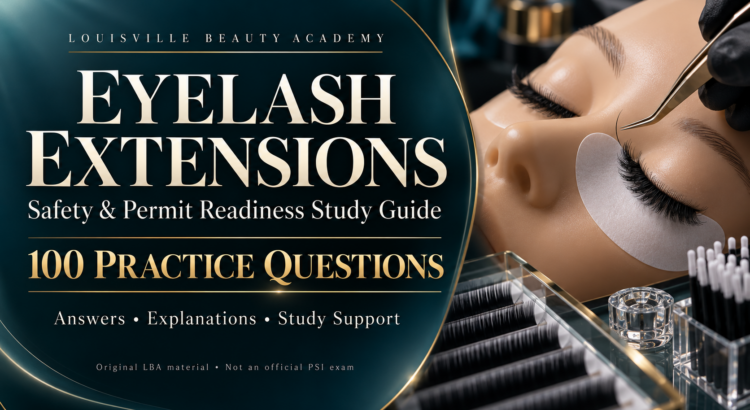
Louisville Beauty Academy Eyelash Extension 100 Study Lab feature image for safety sanitation permit scope and lash skill readiness

Kentucky Eyelash Extension 100 Study Lab: Safety, Sanitation, Permit Scope & Skill Readiness

Louisville Beauty Academy Eyelash Extension 100 Study Lab feature image

Louisville Beauty Academy has upgraded its eyelash extension readiness support into a full 100-question study lab for students preparing to understand Kentucky eyelash permit expectations, safety, sanitation, infection control, client screening, adhesive control, aftercare, and public-protection habits.

This lab is designed for the real responsibility of lash work: a professional is working close to the eye, with adhesive, disposables, reusable tools, chemical products, client symptoms, and state permit rules all present at once. The goal is not memorizing letters. The goal is calm professional judgment.

The question bank aligns to public Kentucky Board of Cosmetology specialty-permit information and professional disinfection principles: permit scope, licensed-facility requirements, infection-control training, in-person training expectations, approved-provider awareness, MSDS/SDS literacy, clean-before-disinfecting, contact time, single-use supply control, contraindications, and ethical exam preparation.

Important: this is original Louisville Beauty Academy educational practice. It is not official KBC, NIC, PSI, or Milady content, not copied exam content, not a guarantee of permit approval, and not a substitute for current KBC rules, official applications, product labels, SDS/MSDS, school policy, or instructor supervision. Official sources control.

LBALouisville Beauty Academy
Student Success Lab

Kentucky Eyelash Extension Permit Readiness

100-Question Study Lab

Original safety, sanitation, permit-scope, and lash skill judgment questions with immediate answers and full explanations.

Randomized practiceInstant explanationsTopic breakdownStudent code gatePrint and copy result
Current-source caution for 2026:

KBC posts Kentucky Eyelash Extension permit requirements, including training documentation, infection-control training, licensed-facility work, strict scope limits, in-person instruction, and reporting duties. Visitors may use the public preview; full practice modes require authorized LBA student access. Students should verify all requirements through current official KBC sources before applying or providing services.

Start practice

Choose your study mode

Use preview for a quick warm-up, a focused set for review, or the full bank for complete permit-readiness mastery.

The 10-question preview is open to visitors. Larger study modes are for authorized LBA students and require the current student access code.

The 10-question preview is public. Student modes validate through LBA’s existing student-code gate. Do not share codes. Progress saves only in this browser on this device.

Student access and privacy notice

Full interactive access is for authorized Louisville Beauty Academy students. Ask your instructor for the current code and keep it private. This page uses LBA’s existing student-code validation route before launching 25-, 50-, or 100-question modes; the access code itself is not printed on this page.

This educational practice lab is not a PSI product, not official exam content, not a clock-hour record, and not a guarantee of licensure. It exists to train professional judgment, sanitation reasoning, law/source awareness, client safety, and exam discipline.

Official-source alignment

  • KBC Specialty Permits: Eyelash Extension permit scope, documents, infection-control training, training certificate timing, licensed-facility requirement, approved training provider list, and application portal.
  • KBC Specialty Permits and NIC Disinfection Guidance: in-person training, instructor requirements, MSDS/SDS, course reporting, clean-before-disinfecting, contact time, and single-use item control.
  • This app is an LBA-created educational tool and is not endorsed by, affiliated with, or owned by KBC, NIC, PSI, or Milady.
The Confusion of Accreditation in the Beauty Industry: Louisville Beauty Academy Emphasizes Transparency and Genuine Care for Students

In the beauty industry, the term “accreditation” often leads to confusion among students and the general public. This confusion arises because the term is used in different contexts, leading to misunderstandings about what it means for a beauty school to be accredited. This article aims to clarify the definition of accreditation, its implications, and how it affects beauty schools in Kentucky.

Understanding Accreditation

Accreditation generally refers to the recognition that an institution meets certain standards of quality and performance. In the context of higher education, it is often granted by national or regional accrediting bodies. These accrediting bodies evaluate institutions based on various criteria, including curriculum quality, faculty qualifications, and student outcomes.

However, in the beauty industry, the term “ACCREDITED” can be used interchangeably with “LINCENSED” or “APPROVED” by state authorities. For instance, in Kentucky, beauty schools must be licensed by the Kentucky Board of Cosmetology to operate legally. This licensing ensures that the schools meet state-specific standards and can legally offer programs that lead to state licensure in fields such as nail technology, aesthetics, cosmetology, shampoo and styling, beauty instruction, and special permits like eyelash extensions.

The Accreditation Misunderstanding

A common misconception is that some beauty schools are accredited while others are not. This leads to confusion, with potential students often asking, “Can I get my license studying at this specific school?” The answer is straightforward: If a beauty school is in operation and licensed by the state, then yes, you can get your license studying there.

All beauty schools in Kentucky that offer state-APPROVED licensing programs are, by definition, state-LICENSED, state-APPROVED, and therefore state-licensed. This state accreditation ensures that the school meets the necessary standards to provide quality education and training for licensure.

Federal Financial Aid and National Accreditation

The confusion deepens when it comes to federal financial aid. To be eligible for federal financial aid, a school must be nationally accredited. National accreditation involves additional requirements, including regular reporting and compliance with federal standards. This process ensures accountability and transparency, but it also incurs significant administrative costs.

For example, schools must report on:

  1. Student enrollment and graduation rates.
  2. Financial stability and audit results.
  3. Curriculum updates and changes.
  4. Faculty qualifications and professional development.
  5. Student support services and outcomes.

These requirements increase operational costs, which are often passed on to students, making tuition at nationally accredited schools higher. This is why some beauty schools can offer tuition at 50% less than larger, nationally accredited schools—NOT due to a difference in educational quality or licensing capability, but because they do not have the added expense of national accreditation compliance (OFTEN ABOUT REPORTING COST AND MEMBERSHIP COST).

Transparency and Student Interests

At Louisville Beauty Academy, we prioritize transparency and student interests. We are proud to be state-licensed, state-approved, and state-licensed. We offer state-approved licensing programs in nail technology, cosmetology, aesthetics, instructor training, and other specialized fields. Our commitment to transparency means that all relevant information is publicly available online, ensuring that prospective students can make informed decisions.

Moreover, our status as a state-licensed institution does not compromise the quality of education we provide. Instead, it allows us to offer affordable education without the added burden of federal reporting requirements. This affordability, combined with our dedication to student success, makes Louisville Beauty Academy one of the most accessible and cost-effective beauty schools in Kentucky.

Conclusion

In conclusion, understanding the difference between state accreditation and national accreditation is crucial for prospective beauty school students. State accreditation ensures that a school meets the necessary standards to operate and offer licensure programs, while national accreditation is tied to eligibility for federal financial aid and involves additional reporting requirements. At Louisville Beauty Academy, we believe in clear communication and transparency, ensuring that our students have all the information they need to succeed.

For more information or to enroll, text our enrollment department at 502-625-5531 or email us at Study@LouisvilleBeautyAcademy.net. Join us today and take the first step toward a successful career in the beauty industry.


