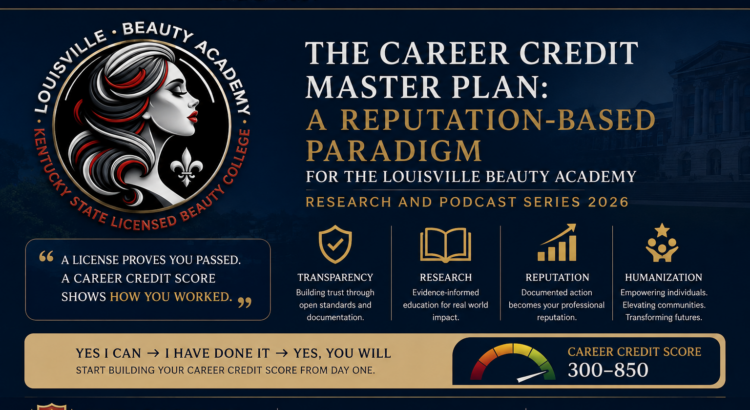
Current information notice
This article is part of LBA’s public education and historical archive. Older posts, including “The Career Credit Master Plan: A Reputation-Based Paradigm for the Louisville Beauty Academy – RESEARCH AND PODCAST SERIES 2026,” may not reflect current tuition, schedules, incentives, forms, policies, testing vendors, clinic availability, or regulatory requirements.
Before relying on this article for any decision, review LBA’s Current Information and Written Control Standard, Current Program Costs, Enrollment Concierge, and Policy and Written Records.
Louisville Beauty Academy operates under a Gold-Standard Over-Compliance framework—meeting all licensing requirements while exceeding regulatory expectations through transparency, documentation, and proactive consumer protection.

Executive Summary
The vocational education sector is currently navigating a period of profound structural transformation, transitioning from a static credential-based model to a dynamic, reputation-based “proof-of-work” economy. For institutions like the Louisville Beauty Academy (LBA), the challenge lies in bridging the gap between traditional state-mandated licensure and the modern requirements of the digital creator economy. This master plan outlines an interdisciplinary framework for a “Career Credit Score” system—a comprehensive, over-compliant social media and professional progress system designed to begin on day one of enrollment and persist beyond graduation. By leveraging the behavioral psychology of public accountability and the economics of social signaling, this system formalizes the student’s daily learning journey as a measurable professional asset.1
The core objective is to position LBA as a national leader in ethical creator education, moving beyond the simple “acquisition of hours” toward the “accumulation of reputation.” The Career Credit Score (CCS) serves as an analogue to a financial credit score, where daily posts act as career deposits and professionalism serves as the ultimate measure of creditworthiness.4 This system provides students with a structured ladder of progression, moving from the “Zero Stage” of novice observation to the “Mastery Stage” of mentorship and public signalization.6 Crucially, the plan is designed with an “over-compliant” posture, ensuring that all student activities strictly adhere to the Kentucky Board of Cosmetology (KBC) statutes and Federal Trade Commission (FTC) endorsement guidelines.8
Through a sophisticated incentive model, students can earn significant tuition discounts based on their consistency, ethical conduct, and proof-of-learning, effectively lowering the financial barriers to high-quality vocational education while simultaneously increasing graduate employability.11 This plan does not merely teach beauty skills; it equips “Human Service Professionals” with the digital fluency and verifiable reputation needed to thrive in an era where trust is the primary currency of the beauty industry.13
Research and Psychological Foundations
The foundation of the LBA Career Credit system is built upon a synthesis of behavioral science, trust economics, and educational theory. Understanding why “learning in public” works requires an analysis of the psychological mechanisms that drive accountability and the economic signals that establish professional prestige.
Behavioral Psychology of Public Accountability
Research in public employee behavior and health interventions suggests that accountability is a multi-dimensional construct involving observability, evaluability, and answerability.1 When a student makes a “public announcement” of a goal—such as mastering a specific sectioning technique—the digital platform acts as a “commitment device”.2 These devices help individuals “lock themselves” into a behavior by creating a psychological penalty for deviation and a social reward for adherence.15
In the context of LBA, daily posting creates a “felt accountability.” While high-intensity monitoring can sometimes reduce intrinsic motivation, a system that emphasizes “accountability obligation”—the perceived duty to justify actions to a supportive audience—actually enhances work drive.1 This is particularly effective when students interpret the obligation as an opportunity to gain professional benefits rather than a coercive requirement. By documenting the “messy middle” of the learning process, students move from passive learners to active practitioners who are “answering” to their future professional selves and their burgeoning audience.
Habit Formation and Daily Proof-of-Work
The transition from a student mindset to a professional identity requires the formation of consistent habits. The “daily proof-of-work” theory posits that a live pulse of activity is a more reliable indicator of skill than a static portfolio.6 In technical fields like coding, a “contribution graph” showing daily commits is impossible to fake and serves as a verified record of problem-solving processes.6
For beauty professionals, this translates to documenting the micro-decisions of the craft. Research into sustainable skincare marketing suggests that “decision documentation”—filing 30 seconds of a consultation or explaining why a specific pH-balanced product was chosen—builds deeper trust than a polished, final image.16 Psychologically, this “raw” and “authentic” content resonates more with modern consumers who are skeptical of highly curated, AI-generated, or “too polished” feeds.17
Social Signaling and Trust Economics
In a labor market with “asymmetric information,” where employers cannot perfectly know a candidate’s skill level, they rely on signals. Traditional signaling theory, as explored by Bryan Caplan, suggests that much of the return on education is a return on the “shiny credential” rather than the skill itself.19 However, the Career Credit Score seeks to shift this dynamic toward “Skill Signaling,” which focuses on digital, transversal, and sector-specific competencies.20
Social trust is a “commodity” built through repeated interactions and the assessment of a truster’s competence and goodwill.21 A student who has documented 1,500 hours of professional growth 8 provides a “trust graph” that reduces the risk for a potential salon owner. This creates a “cyclical model” of social exchange where the student’s signaled reputation leads to better placement, which in turn reinforces the school’s brand equity.3
| Psychological Concept | Mechanism | Application in LBA System |
| Commitment Device | Social penalty for failure 15 | Daily posting “deposits” 2 |
| Felt Accountability | Answerability to an audience 1 | Weekly instructor reviews 24 |
| Instrumental Learning | Reinforcing presumptions of trust 21 | Documenting micro-decisions 16 |
| Social Signaling | Reducing information asymmetry 3 | Verifiable digital portfolios 6 |
| Authenticity Bias | Preference for unfiltered growth 18 | “Zero Stage” confessions 18 |
The Career Credit Framework
The “Career Credit Score” is a formalized, numerical representation of a student’s professional standing, calculated using an algorithm that weights consistency, proof-of-work, professionalism, and ethical compliance. Unlike social media “clout,” which is often ephemeral and based on popularity, Career Credit is a measure of “professional creditworthiness”.25
Defining the Algorithm
The LBA Career Credit Score (CCS) is modeled on a 300–850 scale, mirroring the FICO model used in financial sectors. The score is calculated using four primary components, each weighted to reflect its importance to a future employer and regulatory compliance.
- Consistency (Weight: 35%): This is the equivalent of “payment history.” It measures the frequency of professional posts or “career deposits.” A missed day of documentation is recorded as a “late payment,” while sustained streaks build the score significantly.2
- Proof-of-Skill (Weight: 25%): This represents “credit history.” It is the documented evidence of the student’s progression through the subject areas defined in 201 KAR 12:082, such as infection control, anatomy, and chemical services.7
- Professional Conduct (Weight: 20%): This measures “credit mix.” It assesses the student’s poise, communication skills, and adherence to the LBA “Humanization of Education” philosophy.13
- Regulatory Integrity (Weight: 20%): This is the “creditworthiness” factor. It tracks zero-violation streaks regarding KBC statutes and FTC disclosure guidelines.10
Career Deposits and Missed Payments
A student’s CCS is updated weekly. A “Career Deposit” is defined as a high-quality, educational, or progress-based post that includes the required LBA disclaimers.
- Positive Impact: A “Career Deposit” adds +5 points to the weekly score.
- Neutral Impact: Reposting industry news with a professional insight adds +2 points.
- Negative Impact: A “Missed Payment” (failing to post for 48 hours without a prior “digital reset” request) subtracts -10 points.
- Severe Impact: A compliance violation (e.g., performing a chemical service on a live person before 250 hours 23) results in a “Reputation Default,” resetting the score to 300 and triggering a formal review.29
Reputation Score Benchmarking
To provide context, LBA compares student scores against industry averages and “best-in-class” alumni. This benchmarking fosters continuous improvement and provides a clear signal to employers about where a student stands in their professional development.25
| CCS Range | Professional Status | Market Implications |
| 750 – 850 | Elite Professional | High placement leverage; eligible for alumni mentorship roles. |
| 650 – 749 | Reliable Practitioner | Standard employment readiness; consistent work history. |
| 550 – 649 | Developing Talent | Emerging skills; needs focus on consistency and compliance. |
| 300 – 549 | High Risk / Probation | History of inconsistency or ethical breaches; requires remediation. |
Student Learning Progression Model
The Career Credit system utilizes a five-stage ladder of progression. This model ensures that students do not feel pressured to “fake it” but instead find power in their evolution from a novice to a master. Each stage specifies what to post, the psychological reasoning behind it, and the compliance guardrails necessary to protect the student and the academy.
Stage 1: The Zero Stage (The Foundation)
Focus: Identity reset and the commitment to learn. This occurs during the first two weeks of enrollment.
- What students post: A “Social Media Reset” announcement; an unboxing of their professional student kit; a video discussing their “Why” and their decision to join LBA.8
- Why it works: It establishes a “vulnerability hook.” By admitting they are starting at zero, they build an empathetic connection with their audience, who will then feel invested in their growth.16
- Compliance: Posts must clearly state: “Student at Louisville Beauty Academy. Not licensed to perform services for hire.”
- Caption Prototype: “Day 1 at LBA! Today I’m resetting this page to document my journey from student to professional. I’m starting with the basics—Infection Control. Safety first! #LBAStudent #BeautyJourney”
Stage 2: The Awareness Stage (The Science)
Focus: Vocabulary, theory, and the “Invisible Skills.” This aligns with the first 100–150 hours of instruction.23
- What students post: Videos of themselves studying anatomy and physiology; “Did you know?” posts about the chemistry of hair color; time-lapses of workstation sanitation.8
- Why it works: It builds authority. By focusing on the science rather than the art, the student signals that they are a serious, knowledge-based professional.8
- Compliance: No mentions of performing services on people. Focus remains on “Scientific Lectures” per 201 KAR 12:082.23
- Caption Prototype: “Studying the skeletal system today. Understanding the structure of the head and neck is vital for a proper consultation. Science is the backbone of beauty! #AnatomyClass #LBA”
Stage 3: The Practice Stage (The Proof-of-Work)
Focus: Hands-on repetition on mannequins. This is the “Messy Middle” of the program.
- What students post: “Mistakes I made today” videos; time-lapses of winding perms or applying color to a mannequin head; “Practice makes progress” reels.6
- Why it works: It demonstrates grit and technical skill development. Seeing the student struggle and then succeed creates a powerful narrative of competence.6
- Compliance: Must explicitly state that work is being done on a mannequin.
- Caption Prototype: “My fifth time winding a perm rod today. Still working on my tension, but the sectioning is getting cleaner! Repetition is key to mastery. #MannequinPractice #ProofOfWork”
Stage 4: The Competency Stage (The Clinic Floor)
Focus: Supervised services on live models. This begins after 250 hours (for Cosmetology) or other program-specific milestones.23
- What students post: Before-and-after transformations; client consultations (with permission); documenting the consultation “decision-making” process.7
- Why it works: Social proof. It shows that real people trust the student and that the student can deliver results in a professional clinic environment.24
- Compliance: Must state that services were performed under instructor supervision at LBA.24
- Caption Prototype: “Today’s transformation! We chose a level 7 ash to neutralize warmth, keeping the hair’s integrity first. All services performed under supervision at LBA! #ClinicFloor #HairTransformation”
Stage 5: The Mastery Signal Stage (The Educator)
Focus: Teaching, explaining, and mentoring others. This begins in the final phase of the program and continues as an alumnus.
- What students post: Tutorials explaining a technique to junior students; reviews of industry trends; reflections on the “Humanization of Education”.13
- Why it works: The “Protégé Effect.” Teaching a concept is the highest signal of mastery. It positions the graduate as an industry leader, not just a practitioner.1
- Compliance: Use of the “Alumni” tag and verification of licensure.8
- Caption Prototype: “Explaining the logic of color theory to our new class at LBA. To master the art, you have to mentor the next generation. #BeautyEducator #LBAAlumni”
Step-by-Step LBA Implementation Plan
Operationalizing the Career Credit system requires a disciplined, multi-phase rollout that integrates with LBA’s existing curriculum and administrative protocols.
Phase 1: Orientation and the Social Media Reset
During the first week, students undergo a “Digital Brand Audit.” This is a mandatory component of their “Professional Image” curriculum.23
- Account Audit: Students must review their public profiles and archive content that is inconsistent with a “Human Service Professional” identity. This includes content depicting unprofessional behavior or non-compliance with health standards.18
- Platform Setup: Students are required to have professional profiles on Instagram and TikTok. LinkedIn is highly recommended for B2B networking and employer visibility.13
- The Disclaimer Protocol: Every bio must include: “Professional Student at @LouisvilleBeautyAcademy | Future | Not for hire until licensed.”
- Privacy/Security Workshop: Education on protecting personal data and handling “online drama” or cyberbullying.35
Phase 2: Daily Career Deposits
LBA implements a “Daily Documentation” rule. Students are given 15 minutes at the end of each theory or clinic session to capture content.8
- Frequency: Minimum of 3 professional posts per week.
- Approved Formats: Short-form video (Reels/TikTok) for skills; Carousel posts for “Decision Documentation”; Stories for daily “Aha!” moments.16
- The “Human Review” Protocol: Instructors do not grade based on “likes” but on a rubric of professionalism, sanitation, and educational accuracy.24
Phase 3: Ethical AI Integration
LBA adopts a “Max AI” policy for administrative and creative support but maintains strict ethical boundaries for clinical representations.13
- Authorized Use: Using Generative AI for caption brainstorming, keyword research, and video script outlines.38
- The 65% Rule: At least 65% of any written caption must be human-authored to ensure authenticity and “Humanization”.38
- Prohibited AI: No AI-generated or “filtered” images of hair or skin results. This is a deceptive statement and a violation of KBC photo standards.14
- Disclosure: Any AI-assisted content must include the tag #AIApprentice or a similar disclaimer.40
Phase 4: Instructor and Administrative Audit
LBA establishes a “Reputation Bureau” to manage the Career Credit Scores.
- Weekly Score Update: The CCS is recalculated every Sunday based on the week’s deposits and classroom conduct.
- Monthly Compliance Audit: A deep-dive review of student accounts to ensure FTC disclaimers and KBC rules are followed.28
- Score Grievance Procedure: Students can appeal a score deduction through the official LBA written grievance process.8
Incentive and Discount Model
To drive adoption and ensure high-quality participation, LBA links the Career Credit Score to a fair and transparent tuition discount model. This transforms “tuition” from a fixed cost into a performance-based investment.
The Career Credit Discount Rubric
Students are eligible for “Merit Scholarships” and “Performance-Based Incentives” that can reduce the total program cost significantly.11 These are not “tuition reductions” but optional, merit-based discounts.11
| Performance Category | Metric | Score Requirement | Discount/Perk |
| Consistency King | 100% posting rate for 90 days | CCS > 700 | $500 Tuition Credit |
| Compliance Hero | Zero compliance flags for 180 days | CCS > 750 | $1,000 Scholarship |
| Technical Master | Verified Stage 4 Documentation | Instructor Approval | $1,500 Skill Credit |
| Alumni Leader | Continued Stage 5 posting | Post-Graduation | Free Alumni Tutoring 8 |
Anti-Gaming and Safeguards
LBA employs a “Checks and Balances” system to protect the integrity of the discounts.13
- Attendance Synchronization: Discounts are only applied if a student maintains the required attendance hours (30–40 hours for Full-Time).11
- Plagiarism Penalty: Using another student’s work as one’s own results in the permanent loss of all social-media-based incentives.11
- Financial Good Standing: Hours are only certified and discounts applied if the student’s account is current.11
- Tax Compliance: All tuition reductions are structured to comply with IRS Section 117(d) regarding qualified tuition reductions for educational institutions.43
Auditability for Regulators
LBA maintains digital records of all student posts, instructor reviews, and score calculations for a minimum of five years.8 This ensures that the institution can defend its incentive model to state and federal regulators as a legitimate “educational performance” metric rather than “marketing compensation.”
Compliance and Risk Management
A gold-standard system must be “over-compliant.” This section outlines the non-negotiable boundaries that protect LBA, its students, and the public.
Kentucky Board of Cosmetology (KBC) Adherence
Kentucky law is strict regarding unlicensed practice.10 LBA’s system manages this through:
- The “No-Pay” Rule: Students are explicitly forbidden from accepting consideration (money or gifts) for services performed outside of the LBA clinic floor.10
- Mobile Prohibitions: While Kentucky allows mobile barber shops, mobile cosmetology is strictly limited. Students must not document or perform services in “home salons” or non-licensed facilities.32
- Sanitation Documentation: Every video documenting a service must show visible sanitation steps (e.g., sanitizing hands, disinfecting tools) to reinforce “Lifelong Professional Ethics”.8
FTC Endorsement and Social Media Law
The FTC’s 2024–2025 updates require “clear, conspicuous, and unavoidable” disclosures.9
- Disclosure Placement: Disclosures must be verbal AND written on the screen for video content. Simply putting #ad or #LBA in the caption is insufficient for Reels and TikTok.28
- Honest Opinions: Students must only give honest reviews of products they have actually used.9
- Material Connections: Because students receive tuition discounts for their posts, they must disclose this “material relationship” in every progress-related post.42
Privacy and Consumer Protection
- Client Consent: No client images or videos may be posted without a signed LBA model release form.7
- Data Protection: Students are trained to never post sensitive institutional data or personal information about staff and peers.11
- Cyber-Safety: LBA provides tools and training for students to manage privacy risks associated with a public-facing digital career.37
Brand and Market Positioning
The implementation of the Career Credit system differentiates Louisville Beauty Academy from all other regional and national competitors. It rebrands the school from a “training facility” to a “professional reputation engine.”
Positioning LBA as a “Future-Ready” Institution
LBA’s brand is built on “Transparency and Genuine Care”.47 By teaching students to build verified proof-of-work, LBA addresses the primary concern of modern beauty employers: “Can this person actually do the work, and will they show up?”.3
Messaging Pillars:
- The Proof-of-Work School: We don’t just teach; we document excellence.
- Career Credit, Not Just Hours: Your reputation starts on day one.
- Humanization through Technology: We use AI to make you more human, not less.
- Lower-Debt Dignity: Earn your way to a professional future without the burden of federal loans.12
Reassuring Regulators and Parents
LBA positions itself as the “Public Library” of beauty education—an open, accessible, and highly regulated environment where knowledge is democratized.13
- To Parents: LBA offers a “Safe, Legal, and Affordable” path to a high-demand career, where their child’s professional reputation is built under expert supervision.13
- To Regulators: LBA provides a model for “Over-Compliance,” showing how social media can be used to increase adherence to sanitation and ethics rather than bypass them.8
The Alumni Brand Flywheel
The Career Credit Score does not end at graduation. LBA invites alumni to maintain their scores through continued mentorship and participation in the “2026 Magazine and Podcast Series”.13 This creates a long-term network of successful, digitally fluent professionals who serve as living proof of the LBA model.
Long-Term Impact and Metrics
The success of this system will be measured through a combination of traditional educational metrics and new reputation-based indicators.
Measurable Outcomes
- Retention Rate: Students with high Career Credit Scores are expected to have a 25% higher completion rate due to the psychological “locking” effect of public commitment.2
- Job Placement Leverage: LBA graduates will enter interviews not with a resume, but with a “Reputation Portfolio” showing 1,500 hours of growth.13
- Audience Trust Score: A monthly sentiment analysis of student accounts to ensure that engagement is professional and educational.
- Licensing Success: Continued 100% alignment with PSI and KBC requirements, with students demonstrating higher confidence during the practical exam.8
The Vision for “Di Tran University”
The Career Credit system is the first step toward the broader “Humanization of Vocational Education”.13 By integrating these digital and psychological frameworks, LBA evolves into a “Human Service Professional” academy, where the beauty license is merely the legal foundation for a career built on trust, ethics, and verified excellence.
Metrics & Success Measurement
To ensure the master plan achieves its intended impact, LBA will track the following metrics:
| Metric | Goal | Tracking Mechanism |
| Average Graduate CCS | > 725 | Quarterly reputation audits |
| Employer Satisfaction | 95% Positive | Post-placement surveys focusing on “Soft Skills” |
| Student Debt Ratio | < 10% of Income | Analysis of net tuition vs. entry-level salary 50 |
| Social Media Reach | 100K+ Monthly (Aggregated) | Platform analytics across the student body |
| Compliance Flag Rate | < 1% | Weekly internal reputation bureau reviews |
Conclusions
The Louisville Beauty Academy Career Credit system represents the gold standard for 21st-century vocational training. By acknowledging that a student’s “reputation” begins long before they receive a physical license, LBA equips its graduates with the ultimate competitive advantage: a verifiable history of hard work, ethical behavior, and professional growth. This system reduces student risk, elevates the entire beauty industry, and provides a defensible, innovative model for the future of professional education. Through the careful integration of behavioral psychology, trust economics, and rigorous compliance, LBA does more than teach beauty—it builds the future of professional trust.
Works cited
- Changes in the accountability obligation, intensity, and working drive of public employees: evidence from a survey experiment – Oxford Academic, accessed February 1, 2026, https://academic.oup.com/jpart/advance-article/doi/10.1093/jopart/muaf027/8249872
- Effects of Public Commitments and Accountability in a Technology-Supported Physical Activity Intervention | Request PDF – ResearchGate, accessed February 1, 2026, https://www.researchgate.net/publication/270959553_Effects_of_Public_Commitments_and_Accountability_in_a_Technology-Supported_Physical_Activity_Intervention
- Full article: Initial employability development: introducing a conceptual model integrating signalling and social exchange mechanisms – Taylor & Francis, accessed February 1, 2026, https://www.tandfonline.com/doi/full/10.1080/1359432X.2023.2186783
- Street Rep: A Privacy-Preserving Reputation Aggregation System, accessed February 1, 2026, https://yancomm.net/papers/2023%20-%20SecureComm%20-%20Street%20Rep.pdf
- Deep Reputation Scoring in DeFi: zScore-Based Wallet Ranking from Liquidity and Trading Signals – arXiv, accessed February 1, 2026, https://arxiv.org/html/2507.20494
- Top Proof of Work Tools Professionals Are Using in 2026 – Fueler, accessed February 1, 2026, https://fueler.io/blog/top-proof-of-work-tools-professionals-are-using
- How to Create Before-and-After Content That Converts Followers – CleanerHQ, accessed February 1, 2026, https://cleanerhq.com/how-to-create-before-and-after-content/
- Tag: Kentucky State Board of Cosmetology – Louisville Beauty Academy, accessed February 1, 2026, https://louisvillebeautyacademy.net/tag/kentucky-state-board-of-cosmetology/
- Endorsements, Influencers, and Reviews – Federal Trade Commission, accessed February 1, 2026, https://www.ftc.gov/business-guidance/advertising-marketing/endorsements-influencers-reviews
- 317A.020 Scope of chapter — Licensure requirements — Emergency orders — Warning notice — Legal actions brought by the, accessed February 1, 2026, https://apps.legislature.ky.gov/law/statutes/statute.aspx?id=56210
- LBA-StudentAgreement-CosmetologyProgram-2024 – Jotform, accessed February 1, 2026, https://form.jotform.com/240085894150154
- Financial Aid Options and Payment Model at Louisville Beauty Academy, accessed February 1, 2026, https://louisvillebeautyacademy.net/financial-aid-options-and-definition/
- beauty school compliance Archives – Louisville Beauty Academy, accessed February 1, 2026, https://louisvillebeautyacademy.net/tag/beauty-school-compliance/
- Top 5 Beauty Trends on Social Media 2026 – Pulsar, accessed February 1, 2026, https://www.pulsarplatform.com/blog/2025/top-beauty-trends-2026-social-media
- From Intentions to Actions – Using Commitment Devices for Evidence Use – Data for Impact, accessed February 1, 2026, https://www.data4impactproject.org/blog/from-intentions-to-actions-using-commitment-devices-for-evidence-use/
- I’m a Professional Social Media Growth Strategist – AMA and Free Advice – Reddit, accessed February 1, 2026, https://www.reddit.com/r/InstagramMarketing/comments/1ou74f8/im_a_professional_social_media_growth_strategist/
- A close look at the global beauty industry in 2025 – McKinsey, accessed February 1, 2026, https://www.mckinsey.com/industries/consumer-packaged-goods/our-insights/a-close-look-at-the-global-beauty-industry-in-2025
- Embrace Your Flaws: Stop Deleting Your ‘Ugly’ Photos – Lemon8, accessed February 1, 2026, https://www.lemon8-app.com/@purposely.angelica/7332530343054295557?region=us
- Schooling is Mostly Signaling – Econlib, accessed February 1, 2026, https://www.econlib.org/schooling-is-mostly-signaling/
- Skills signalling in OECD countries: Empowering the Workforce in the Context of a Skills-First Approach | OECD, accessed February 1, 2026, https://www.oecd.org/en/publications/empowering-the-workforce-in-the-context-of-a-skills-first-approach_345b6528-en/full-report/skills-signalling-in-oecd-countries_158ea858.html
- Trust as commodity: social value orientation affects the neural substrates of learning to cooperate – PMC – NIH, accessed February 1, 2026, https://pmc.ncbi.nlm.nih.gov/articles/PMC5390759/
- College Education and Social Trust: An Evidence-Based Study on the Causal Mechanisms, accessed February 1, 2026, https://pmc.ncbi.nlm.nih.gov/articles/PMC3183293/
- 201 KAR 12:082. Education requirements and school administration. – Kentucky Board of Cosmetology, accessed February 1, 2026, https://kbc.ky.gov/Documents/201%20KAR%2012.082.pdf
- Cosmetology Work Based Plan, accessed February 1, 2026, https://static.avedafi.edu/pdf/AIW%20Cosmetology-Work-Based-Plan%202023-2024.pdf
- Why Reputation Scores Are Becoming a Standard Business Metric – NetReputation, accessed February 1, 2026, https://www.netreputation.com/why-reputation-scores-are-becoming-a-standard-business-metric/
- Reputation Score Guide – Strategies + 3 case studies – Mention, accessed February 1, 2026, https://mention.com/en/blog/reputation-score/
- Beauty Changes Lives Judging Rubric Outline, accessed February 1, 2026, https://beautychangeslives.org/wp-content/uploads/2020/08/Judging-Rubric.pdf
- FTC Requirements For Influencers: Guidelines and Rules – Termly, accessed February 1, 2026, https://termly.io/resources/articles/ftc-requirements-for-influencers/
- Title 201 Chapter 12 Regulation 082 • Kentucky Administrative Regulations – Legislative Research Commission, accessed February 1, 2026, https://apps.legislature.ky.gov/law/kar/titles/201/012/082/16143/
- 201 KAR 12:030 – Licensing and examinations | State Regulations – Cornell Law School, accessed February 1, 2026, https://www.law.cornell.edu/regulations/kentucky/201-KAR-12-030
- Reputation Score X, accessed February 1, 2026, https://reputation.com/lessons/reputation-score-x-starter-guide
- Tag: cosmetology license – Louisville Beauty Academy, accessed February 1, 2026, https://louisvillebeautyacademy.net/tag/cosmetology-license/
- iRubric: Cosmetology Clinical Assessment rubric – FX32C4W – RCampus, accessed February 1, 2026, https://www.rcampus.com/rubricshowc.cfm?sp=true&code=FX32C4W
- License Requirements – Kentucky Board of Cosmetology, accessed February 1, 2026, https://kbc.ky.gov/Licensure/Pages/License-Requirements.aspx
- Explore Social Media Safely – Get Started Today — Upper Dublin Tech Trek, accessed February 1, 2026, https://www.udtechtrek.org/social-media
- 2025 Beauty Industry Benchmarks | Dash Social, accessed February 1, 2026, https://www.dashsocial.com/social-media-benchmarks/beauty-industry
- Complete Guide to Online Privacy – bestvpn.org, accessed February 1, 2026, https://bestvpn.org/the-complete-guide-to-online-privacy/
- Social Media AI Guidelines | Social Media | ECU – East Carolina University, accessed February 1, 2026, https://socialmedia.ecu.edu/social-media-ai-guidelines/
- AI Students Guidelines 2025 – ESCP Business School, accessed February 1, 2026, https://escp.eu/sites/default/files/PDF/AI/AI_Students_Guidelines_2025.pdf
- Guidelines for Appropriate Use of AI Generated Media – Division of Strategic Communications | The University of Alabama, accessed February 1, 2026, https://stratcomm.ua.edu/ai-guidelines/
- English AI Guidance for Staff and Students 2025 – Reedsburg School District, accessed February 1, 2026, https://www.rsd.k12.wi.us/district/English%20AI%20Guidance%20for%20Staff%20and%20Students%202025.pdf
- FTC Influencer Guidelines: Brands and Creators Must Be Aware Before Posting, accessed February 1, 2026, https://www.traverselegal.com/blog/ftc-influencer-guidelines/
- Qualified tuition reduction | Internal Revenue Service, accessed February 1, 2026, https://www.irs.gov/government-entities/federal-state-local-governments/qualified-tuition-reduction
- chapter 152 – Legislative Research Commission, accessed February 1, 2026, https://apps.legislature.ky.gov/law/acts/12RS/documents/0152.pdf
- KY SB265 | BillTrack50, accessed February 1, 2026, https://www.billtrack50.com/billdetail/1836958
- Navigating FTC Disclosures: A Guide for Influencers – Statusphere, accessed February 1, 2026, https://www.joinstatus.com/blog-creators/navigating-ftc-disclosures-a-guide-for-influencers
- The Confusion of Accreditation in the Beauty Industry: Louisville Beauty Academy Emphasizes Transparency and Genuine Care for Students, accessed February 1, 2026, https://louisvillebeautyacademy.net/the-confusion-of-accreditation-in-the-beauty-industry-louisville-beauty-academy-emphasizes-transparency-and-genuine-care-for-students/
- Long-Duration Vocational Education’s Effects on Individuals’ Vocational Identity, Self-Efficacy, and Job Satisfaction – PubMed Central, accessed February 1, 2026, https://pmc.ncbi.nlm.nih.gov/articles/PMC12466434/
- Resume vs Portfolio: What You Really Need to Land Freelance Writing Jobs in 2025, accessed February 1, 2026, https://www.journoportfolio.com/blog/resume-vs-portfolio-what-you-really-need-to-land-freelance-writing-jobs-in-2025/
- Kentucky Cosmetology Laws & License Requirements [2026] – Consentz, accessed February 1, 2026, https://www.consentz.com/kentucky-cosmetology-laws-license-requirements/








