LBA Nail Industry Compliance Study on Louisville Beauty Academy

Educational and Compliance Study of Modern Nail Industry Operations, Worker Classification Principles, and Documentation Standards – RESEARCH & PODCAST SERIES 2026


Operational Realities of the Contemporary Nail Industry

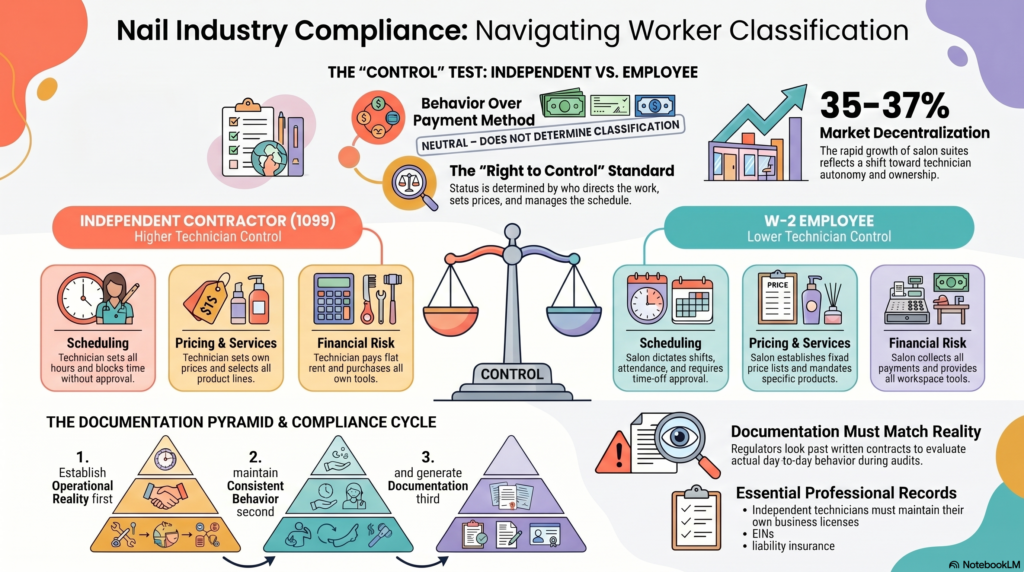
The modern beauty sector, particularly the specialized nail care industry, has experienced a profound structural evolution over the past several decades1. Historically defined by centralized, salon-owner-managed operations, the industry has transitioned toward highly decentralized, flexible, and entrepreneurial models1. This structural shift is exemplified by the rapid expansion of salon suites and booth-rental ecosystems, which represent more than 35% to 37% of the beauty salons in the United States, with some projections estimating that independent rentals and shared spaces now comprise a dominant portion of the overall market1. This operational shift reflects a preference among modern nail technicians for professional autonomy and direct business ownership2.
To analyze the modern nail industry, one must examine the specific characteristics that define how work is performed, how schedules are managed, and how business relations are maintained:

  • Technician Mobility and Multi-Salon Access: Modern nail technicians exhibit high geographic and professional mobility2. Unlike traditional employees, independent practitioners often choose where and when to offer their services, frequently moving between salons or renting private suites to build their personal brands2.
  • Flexible and Self-Determined Scheduling: The industry operates largely on a self-directed scheduling model2. Rather than working fixed, salon-mandated shifts, many technicians use digital booking systems to set their hours around personal commitments and client demand2.
  • Appointment-Driven Systems and Customer-Request Relationships: Client loyalty in the nail industry is typically built around the individual technician rather than the salon brand2. Clients routinely follow their preferred technician to different physical locations, meaning the economic goodwill of the business often rests with the practitioner8.
  • Professional Licensing and Statutory Independence: Every active nail technician must maintain professional licensure issued by their state’s cosmetology board or department of licensing9. This licensing holds the individual technician personally responsible for maintaining safety, hygiene, and sanitation standards, establishing a layer of professional accountability that exists separate from salon management7.
  • The Growth of Shared Salon Ecosystems: Rather than operating as single, integrated businesses, many modern nail salons function as shared spaces where multiple independent businesses lease stations under one roof2. Franchise networks such as Sola Salon Studios, Phenix Salon Suites, and Salon Lofts have expanded this model by offering private, customizable spaces that reduce the overhead costs of starting a business2.

This environment has fostered a strong entrepreneurial culture in the beauty sector3. Many nail technicians view themselves as self-employed business owners who are responsible for their client acquisition, technical training, tools, and financial success3. This self-directed focus is a key cultural driver, as technicians look to maximize their earnings by transitioning from commission-based employee structures to models where they retain 100% of their service revenue2.

Separating Payment Mechanisms from Worker Classification

A common source of confusion in salon management is the assumption that the payment method used to disburse funds determines the underlying worker classification8. Salon operators and technicians often incorrectly believe that paying a worker in cash, by check, or through a direct deposit system automatically establishes a 1099 independent contractor relationship8.

In regulatory analysis, the mechanism used to transfer funds is separate from the legal classification of the worker8. The legal status of a nail technician—as either a W-2 employee or a 1099 independent contractor—is determined by the operational reality of behavioral control, financial control, and the nature of the relationship, not by the physical or digital payment instrument8.

Payment MethodTechnical MechanismCommon Industry PerceptionsRegulatory and Compliance Reality
Cash[cite: 15, 16]Direct physical currency exchange between the client and technician or salon15.Frequently associated with independent contractor status or unreported income15.Neutral. Cash is simply a payment method8. Both employees and contractors must record and report all cash receipts, including tips, to comply with tax laws18.
Check[cite: 8, 10]Physical paper instrument drawn on a business or individual account8.Believed to indicate contract-based compensation when issued without tax withholdings8.Neutral. Checks can represent net wages for employees (reported on Form W-2) or service payments for independent businesses (reported on Form 1099-NEC)14.
Direct Deposit & ACH[cite: 22, 23]Electronic fund transfers routed through the Automated Clearing House network22.Widely perceived as a mechanism exclusive to corporate or W-2 payroll systems13.Neutral. Electronic banking is used across all business models, including automated rent collection from contractors or payment distributions to vendors22.
Commission Split / Payroll[cite: 13, 20]Allocation of gross service revenue on a percentage basis (e.g., 60/40)8.Often viewed as an independent relationship where the technician “keeps their share”8.Strong W-2 Indicator. The IRS and state tax agencies typically view commission splits with no fixed rent floor as wage compensation, indicating an employee relationship8.

To maintain compliance, classification discussions should focus on operational behavior rather than payment methods13. If a salon owner sets a technician’s schedule, determines their service prices, and provides their tools, the IRS and state labor agencies will classify the worker as an employee8. This remains true even if the worker is paid via 1099-NEC or in cash8. Conversely, an independent booth renter does not become an employee simply because they use a salon’s shared point-of-sale (POS) system, provided they maintain complete control over their business ledger and client pricing6.

Control as the Primary Operational Observation

The concept of “control” is the primary analytical standard used by federal and state regulators to evaluate worker classification5. This standard is divided into behavioral control, financial control, and the broader economic realities of the working relationship8.

To understand how control operates within a salon, regulators analyze several key questions:

  • Schedule Determination: Who decides when the technician works and how many hours they must provide8?
  • Time-Off Approvals: Does the technician require management approval to take time off, or do they manage their own availability7?
  • Multi-Salon Participation: Is the technician contractually or operationally barred from working at other beauty salons, or do they maintain complete professional mobility8?
  • Customer Continuity: Who owns the client list and booking data, and can the technician take their client files if they choose to leave the facility7?

The “right to control” how services are performed carries the greatest weight in these evaluations21. If a salon owner retains the authority to direct how a technician performs a service—rather than simply reviewing the final result—the relationship is classified as employment8.

Operational AreaHigher Technician Control (Independent Contractor / Renter Indicators)Lower Technician Control (W-2 Employee / Commission Indicators)
Scheduling & Time Off• Technician sets all working hours8.
• No attendance or shift requirements7.
• Blocks out time off without approval7.
• Salon dictates work schedules8.
• Mandatory attendance or shift coverage8.
• Time off requires manager approval8.
Pricing & Services• Technician sets their own service prices8.
• Determines which nail services to offer7.
• Selects and purchases all product lines1.
• Salon establishes a fixed price list8.
• Menu limited to salon-approved services10.
• Salon provides and mandates specific products8.
Client Management• Direct access and ownership of client data6.
• Freedom to transfer client list to new locations8.
• Manages booking independently7.
• Salon owns all client databases and files8.
• Enforces non-compete or client-solicitation rules8.
• Front desk controls booking and assignments7.
Financial Risk & Investment• Direct payment collection from customers10.
• Pays a flat rent regardless of revenue6.
• Significant investment in tools and products8.
• Salon collects all customer payments20.
• Paid an hourly, salary, or commission wage8.
• No capital investment in workspace tools8.

This behavioral evaluation is supported by federal and state standards, such as California’s 22 CCR Section 4304-12, which defines specific indicators for licensed cosmetologists and barbers27. These rules state that a professional’s ability to set their own hours, establish prices, collect payments directly, and personally resolve client complaints points toward independent status27.

However, state laws vary significantly. Under the strict “ABC” test applied in states like New Jersey, a worker is considered an employee unless the salon can prove that the technician is free from control (Prong A), performs work outside the usual course of business or outside the salon’s physical location (Prong B), and is engaged in an independently established trade (Prong C)24. Because nail services are the core business of a nail salon, booth renters in these jurisdictions are often classified as employees under state labor law, even if they qualify as independent contractors under federal common law24.

Why Industry Participants Associate Autonomy with 1099 Principles

In the beauty and nail salon community, technicians and owners frequently associate operational autonomy with 1099 independent contractor or booth-rental principles10. This association is driven by a shared interest in flexibility and business ownership1.

  • Schedule Autonomy as a Career Driver: Many nail technicians enter the beauty industry specifically to manage their own schedules2. The ability to adjust working hours around family commitments, continuing education, or personal needs is viewed as a key benefit of independent work1.
  • Professional Mobility and Client Ownership: Technicians often build deep, personal connections with their clients2. Within the industry’s culture, technicians widely believe that if a client base follows a professional to a new location, those clients represent the technician’s personal business asset, not the property of the host salon8.
  • Independent Decision-Making: Choosing which product brands, nail art techniques, and sanitizing systems to use is considered an essential professional freedom1. This level of choice is seen as a key aspect of operating an independent business, rather than acting as an employee subject to a salon owner’s directives8.
  • Direct Financial Responsibility: The willingness to pay a fixed weekly or monthly rent, purchase professional liability insurance, and cover all business expenses is viewed by technicians as a commitent to running a separate micro-enterprise6.

This focus on business ownership is a major driver of the salon suite trend1. By transitioning from a traditional salon to a private suite, a technician can act as an independent brand, manage their own prices, and retain all revenue, while avoiding the high overhead costs of opening a traditional brick-and-mortar salon2. While state laws ultimately determine legal status, these entrepreneurial characteristics explain why many industry participants associate professional freedom with independent 1099 principles8.

Aligning Documentation with Operational Reality

A common compliance risk for salons is relying on written contracts that do not match how the business actually operates8. Regulatory bodies, such as the IRS and state labor departments, routinely look past written agreements to evaluate the day-to-day behavior of the parties8.

To build a reliable compliance system, documentation must reflect—rather than dictate—actual business behavior7. If a written agreement describes an independent contractor relationship, but the salon owner manages the technician’s schedule and controls customer pricing, the agreement will be set aside during an audit, resulting in reclassification and penalties8.

                         [ THE DOCUMENTATION PYRAMID ]
                                      ▲
                                      ╱ ╲
                                    ╱   ╲
                                    ╱     ╲
                                  ╱ RELATION ╲
                                  ╱ AGREEMENTS ╲
                                ├──────────────┤
                                ╱  OPERATIONAL   ╲
                              ╱    RECORDS       ╲
                              ├────────────────────┤
                            ╱       BUSINESS       ╲
                            ╱        RECORDS         ╲
                          ├──────────────────────────┤
                          ╱        PROFESSIONAL        ╲
                        ╱         DOCUMENTS            ╲
                        └────────────────────────────────┘

Professional Documentation

  • State Board Licenses: Active professional cosmetology, manicurist, or nail technician licenses issued by the state regulatory authority9.
  • Local Business Licenses: Standalone business registrations or tax certificates from the local municipality, establishing the technician’s business entity6.
  • Professional Liability Insurance: Personal liability policies held by the technician to cover their services and clients, separate from the salon’s general liability coverage7.
  • Certifications & Continuing Education: Records of advanced training, specialty nail art courses, or sanitation certifications completed by the practitioner7.

Business Documentation

  • Tax Registrations: Federal Employer Identification Numbers (EIN) or state business tax accounts6.
  • Expense & Revenue Ledgers: Independent accounting records, including receipts for product purchases, advertising, and insurance11.
  • Tax Forms: IRS Form W-9 to collect tax information, Form 1099-NEC to report independent contractor earnings, and Form 1099-K for digital payments10.

Operational Documentation

  • Independent Booking Records: Appointment calendars managed directly by the technician through personal software or client logs7.
  • Service & Client Files: Private client records, color formulations, waiver forms, and transaction details owned by the practitioner6.
  • Product Purchase Invoices: Invoices showing that the technician purchases their own nail polishes, acrylic products, files, and sanitizing solutions8.

Relationship Documentation

  • Station Lease & Booth Agreements: Detailed written contracts specifying the leased space, lease terms, and flat rent amounts7.
  • Shared-Services Agreements: Agreements outlining access to shared amenities, such as laundry, Wi-Fi, and waiting areas7.
  • Professional Responsibility Acknowledgements: Documents confirming that the technician is responsible for their own tax filings, licensing renewals, and business insurance6.

Structured Communication Framework

To prevent disputes and reduce the risk of worker misclassification, salons and technicians should establish a clear communication framework7. Misunderstandings often arise when the operational boundaries between the host salon and the technician become blurred, or when expectations are left unstated12.

                 ┌───────────────────────────────────────────┐
                │       THE DUAL-ENTITY RESOURCE MATRIX     │
                └─────────────────────┬─────────────────────┘
                                      │
            ┌──────────────────────────┴──────────────────────────┐
            ▼                                                     ▼
┌──────────────────────────────────────┐              ┌──────────────────────────────────────┐
│       THE HOST SALON PROVIDES        │              │       THE TECHNICIAN PROVIDES        │
├──────────────────────────────────────┤              ├──────────────────────────────────────┤
│ • Safe, clean facility & utilities   │              │ • Active professional state license  │
│ • Maintenance of common shared areas │              │ • Standalone business license & EIN │
│ • Standardized booth rental lease    │              │ • Personal tools, products, supplies │
│ • Access to building & shared spaces │              │ • Independent scheduling & booking   │
│ • Building security & general cover  │              │ • Direct customer billing system     │
└──────────────────────────────────────┘              └──────────────────────────────────────┘

A transparent communication model requires both parties to define their respective roles and operational boundaries:

What the Salon Provides

The salon owner acts as a commercial landlord, providing a safe, clean, and fully functional workspace that meets local building and cosmetology board codes11. This includes supplying continuous water, electricity, climate control, and access to common areas such as waiting rooms, restrooms, and break areas7.

What the Technician Provides

The technician acts as an independent business owner, providing all professional tools, implements, nail polishes, acrylic systems, gel lamps, and disposables needed for their services6. They also provide their own business entity registration, active professional licensing, and personal liability insurance6.

Salon Responsibilities

The salon is responsible for maintaining the physical building, managing common area cleanliness, and keeping the commercial property insured11. The salon owner must respect the technician’s independence and avoid managing their schedules, dress codes, pricing, or service methods7.

Technician Responsibilities

The technician is responsible for keeping their rented station clean, sanitizing their tools according to state board rules, and managing their business financials7. This includes filing quarterly estimated taxes, paying rent on time, and directly resolving any customer service issues or complaints11.

Decisions Controlled by the Technician

The technician retains complete control over their business operations21. This includes setting their service prices, determining their working hours, choosing their product brands, selecting which clients to accept, and managing their scheduling platform8.

Protecting the Salon Environment

To protect the shared salon environment and customer safety, both parties must adhere to clear professional standards7. These standards include complying with OSHA ventilation and safety guidelines, maintaining proper waste disposal, following state board sanitation rules, and maintaining professional conduct in shared areas7.

Quarterly Self-Audit Protocol

To prevent gradual shifts in control and ensure that daily behavior matches written contracts, salons and technicians should conduct a formal self-audit each quarter7. Over time, informal adjustments can blur the lines of an independent relationship—such as a salon owner asking an independent renter to help cover the front desk during busy hours, or a contractor relying on salon-provided backbar products8.

This checklist is designed to align with the auditing practices of state and federal regulatory bodies15.

Audit CategoryOperational Review QuestionsGoal and VerificationStatus
Scheduling Control[cite: 8, 27]• Does the technician set their own hours and block out time without management approval?
• Is the technician free from mandatory shifts or floor-coverage hours?
Verifies behavioral independence and scheduling control8.[ ]
Financial Independence[cite: 8, 27]• Does the technician set their own service prices and menu?
• Are customer payments collected directly by the technician?
Verifies financial independence and direct income management8.[ ]
Supplies & Investment[cite: 8, 25]• Does the technician purchase their own products, nail colors, and tools?
• Is the rental fee structured as a flat rate rather than a commission split?
Confirms the technician’s capital investment and business risk8.[ ]
Operational Conduct[cite: 8, 27]• Is the technician free from mandatory staff meetings and training sessions?
• Can the technician work at other locations or salons without restriction?
Verifies there are no employer-like performance expectations8.[ ]
Documentation Alignment[cite: 7, 11, 22]• Does the technician have an active state cosmetology license and business license?
• Is the signed station lease agreement up to date?
Ensures legal and relationship documentation is current6.[ ]

Conducting this self-audit on a regular basis helps salons and technicians identify operational changes, update their written agreements, and maintain transparent, consistent, and compliant business relationships7.

Compliance Through Operational Understanding

Real and lasting compliance is not achieved by using legal terminology to mask control8. Instead, it is built on a clear alignment of transparency, open communication, consistent daily behavior, and accurate documentation7.

                     [ THE COLLABORATIVE COMPLIANCE CYCLE ]
                                        │
          ┌────────────────────────────┼────────────────────────────┐
          ▼                            ▼                            ▼
┌──────────────────────┐     ┌──────────────────────┐     ┌──────────────────────┐
│     TRANSPARENCY     │     │     CONSISTENCY      │     │    UNDERSTANDING     │
├──────────────────────┤     ├──────────────────────┤     ├──────────────────────┤
│Both parties openly   │     │Daily operations are  │     │Both parties know the │
│discuss and agree to  │     │monitored to ensure   │     │legal distinctions,   │
│the financial and     │     │they match written    │     │responsibilities,     │
│operational bounds.   │     │contract terms.       │     │and audit standards.  │
└──────────────────────┘     └──────────────────────┘     └──────────────────────┘

Misunderstandings and compliance risks typically occur when these core elements are missing:

  • Undocumented Operational Realities: In cash-intensive businesses like nail salons, failing to keep accurate ledgers, receipts, and appointment records can trigger audit scrutiny15. The IRS Audit Technique Guide (ATG) for beauty salons instructs auditors to reconstruct income using appointment books, price lists, and industry averages if clear financial records are missing15.
  • Uncommunicated Expectations: When salon owners and technicians do not openly discuss their respective roles, friction often arises over product usage, building access, and client booking ownership7.
  • Contracts That Do Not Match Behavior: If a salon uses an independent contractor agreement but treats the technician as an employee, tax and labor authorities will reclassify the relationship during an audit8. This can result in significant financial penalties, including unpaid payroll taxes, interest, and fines21.

To support compliance, federal programs like the IRS Tip Reporting Alternative Commitment (TRAC) emphasize voluntary education and structured documentation18. Under a TRAC agreement, salon owners commit to educating workers on proper tip reporting and maintaining detailed records, which helps reduce audit risk and improve compliance through clear communication rather than enforcement18.

Final Conclusion

Establishing a compliant and successful salon environment requires a clear, sequential approach to structuring professional relationships:

Compliance cannot be achieved by using written contracts to obscure the reality of how a business operates8. Instead, it requires that the day-to-day behavior of both parties matches their chosen business model, supported by clear communication and accurate documentation7.

The objective of this analysis is not to advocate for a single worker classification, but to provide salon owners, technicians, educators, and compliance professionals with a clear framework to evaluate, document, and manage their business relationships with transparency, professional responsibility, and regulatory alignment11.

Works cited

  1. Suite Rental Trend Growing Quickly in California – Salon Success Academy, https://www.salonsuccessacademy.com/blog/suite-rental-trend-growing-quickly-in-california/
  2. The Rising Demand for Salon Suites: Market Trends and Statistics, https://salonrenter.com/rising-demand-salon-suites-market-trends-statistics/
  3. Why individual salon suites are revolutionizing the beauty industry, https://optimasalons.com/why-individual-salon-suites-are-revolutionizing-the-beauty-industry/
  4. The Growth of Independent Salon Owners: Industry Insights, https://salonrenter.com/growth-of-independent-salon-owners/
  5. W-2 Employees vs 1099 Independent Contractors, https://eliteaae.com/blogs/exclusive-blogs/w-2-vs-1099-in-the-aesthetic-industry
  6. Employee vs Booth Renter vs Independent Contractor: Key Differences in the Salon Industry, https://biz.booksy.com/en-us/blog/employee-vs-booth-renter-vs-independent-contractor-key-differences-in-the-salon-industry
  7. Booth Rental Agreement Template (Free Download + AI Generator) – AI Lawyer, https://ailawyer.pro/blog/booth-rental-agreement-template-(free-download-ai-generator)
  8. Salon 1099 vs W-2 in Texas: IRS Rules for 2026 – The Local Gem, https://www.thelocalgem.com/blog/salon-1099-vs-w-2-in-texas-irs-rules-for-2026
  9. Specific licensing requirements | Washington Department of Revenue, https://dor.wa.gov/education/industry-guides/beauty-and-wellness-services/specific-licensing-requirements
  10. Know Your Workers’ Rights – California Board of Barbering and Cosmetology, https://www.barbercosmo.ca.gov/about_us/meetings/materials/20170626_mm.pdf
  11. Salon Owner & Booth Renter Responsibilities: Rules, Roles, and Rights – Booksy Biz, https://biz.booksy.com/en-us/blog/salon-owner-booth-renter-responsibilities-rules-roles-and-rights
  12. Contract Labor, Booth Renter, or Employee — What Are They Really? – NAILS Magazine, https://www.nailsmag.com/390523/contract-labor-booth-renter-or-employee-what-are-they-really
  13. Commission vs Booth Rental: The Complete Comparison for Salon Owners – Vagaro, https://www.vagaro.com/learn/salon-commission-vs-booth-rental-guide
  14. Independent contractor (self-employed) or employee? | Internal Revenue Service, https://www.irs.gov/businesses/small-businesses-self-employed/independent-contractor-self-employed-or-employee
  15. Tax Audits of Cash Intensive Businesses | Los Angeles Tax Services Lawyers, https://www.lataxattorney.com/practice-areas/tax-audits/tax-audits-of-cash-intensive-businesses/
  16. IRS Cash Audit Techniques Guide – christy pinheiro, http://www.christypinheiro.com/uploads/1/7/9/2/179206/cash_audit_techniques_guide.pdf
  17. 24703 HON. NICK LAMPSON HON. NANCY L. JOHNSON HON. JULIAN C. DIXON – GovInfo, https://www.govinfo.gov/content/pkg/CRECB-2000-pt17/pdf/CRECB-2000-pt17-Pg24703-3.pdf
  18. Items of General Interest Proposed Revised Tip Reporting Alternative Commitment (TRAC) Agreement for Use in the Cosmetology – IRS, https://www.irs.gov/pub/irs-drop/a-00-21.pdf
  19. Is Your Salon on the IRS Radar? Red Flags That Trigger Audits! -, https://fas-accountingsolutions.com/is-your-salon-on-the-irs-radar-red-flags-that-trigger-audits/
  20. Form 14430-A SS-8 Determination—Determination for Public Inspection – IRS, https://www.irs.gov/pub/ss8/05PCP130615.pdf
  21. Employee or Independent Contractor? – Centre for Beauty, https://cjscentreforbeauty.com/employee-or-independent-contractor/
  22. Booth Rental Salon Agreements: Examples and Best Practices – Boulevard, https://www.joinblvd.com/blog/booth-rental-salon-agreement
  23. Salon Booth Rental Agreement Forms Examples (With PDF) – Vagaro, https://www.vagaro.com/learn/booth-rental-agreement-forms-explained
  24. Accounting & Tax for Salons and Spas – Monaco CPA, https://www.monacocpa.cpa/industries/salons-spas
  25. Booth Rental Contract: What is it? Key Terms, Considerations – ContractsCounsel, https://www.contractscounsel.com/t/us/booth-rental-contract
  26. DOL Shelves Independent Contractor Rule | Epstein Becker Green, https://www.wagehourblog.com/dol-shelves-independent-contractor-rule
  27. Cal. Code Regs. Tit. 22, §§ 4304-12 – Specific Application of Rules for Determination of Employment Status to Circumstances in the Barbering and Cosmetology Industry | State Regulations, https://www.law.cornell.edu/regulations/california/22-CCR-4304-12
  28. Tax Filing Tips for Hair Salons, Barbers, and Hairdressers – TurboTax – Intuit, https://turbotax.intuit.com/tax-tips/self-employment-taxes/work-as-a-hair-stylist-tax-tips-for-hairdressers/L2do5YTxP
  29. 5+ FREE Subcontractor Safety Plan Samples to Download, https://www.sample.net/business/plans/subcontractor-safety-plan/
  30. IRS Audit Guides | Tax Collection Relief, https://www.taxcollectionrelief.com/irs-audit-guides

IMPORTANT DISCLAIMER, RESEARCH ATTRIBUTION, AND LIMITATION OF LIABILITY

Educational Publication Notice

This publication is provided solely for educational, informational, workforce-development, public-discussion, and research purposes.

The content contained herein does not constitute legal advice, tax advice, accounting advice, labor-law advice, regulatory advice, human-resources advice, compliance advice, or professional consulting services of any kind.

Readers should consult qualified attorneys, certified public accountants (CPAs), tax professionals, labor-law specialists, insurance professionals, and applicable government agencies before making any business, employment, tax, payroll, licensing, insurance, worker-classification, or compliance decisions.


Research Attribution

This study, analysis, framework, observations, commentary, interpretations, and conclusions were researched, developed, compiled, and prepared by:

Di Tran University
The College of Humanization
Di Tran University Research Team

Di Tran University is an educational research affiliate founded by Di Tran, who also serves as founder and CEO of Louisville Beauty Academy. This is a founder-affiliated analysis, not an independent third-party study.

Louisville Beauty Academy did not independently verify, certify, or provide legal review of the specific research findings, interpretations, observations, or conclusions contained herein beyond the cited public sources.


Observational Study Disclaimer

This publication is an observational and educational study.

The study is intended to examine commonly observed operational practices, business models, workforce behaviors, communication systems, documentation practices, and professional relationships within portions of the beauty industry.

Descriptions of industry practices, behaviors, customs, trends, or commonly observed business arrangements are presented for educational discussion only and should not be interpreted as legal determinations, regulatory findings, government positions, compliance certifications, or legal conclusions.

Any references to worker classification principles, operational autonomy, independent-professional relationships, salon ecosystems, booth-rental arrangements, contractor relationships, employee relationships, or compliance considerations are presented solely as educational observations and analytical discussion.


No Classification Determination

Nothing in this publication should be interpreted as determining, certifying, recommending, approving, or guaranteeing any worker classification.

No statement contained herein should be interpreted to mean that any specific worker, salon, business, owner, manager, technician, contractor, renter, or professional is properly classified under any federal, state, or local law.

Worker classification determinations depend upon applicable laws, regulations, facts, circumstances, jurisdiction-specific requirements, regulatory interpretations, and governmental review.

Only the appropriate governmental authorities, courts, administrative agencies, and licensed legal professionals may provide authoritative determinations regarding worker classification.


No Guarantee of Compliance

This publication makes no representation, warranty, guarantee, or promise that following any observation, framework, recommendation, checklist, documentation practice, communication system, or business procedure discussed herein will result in legal compliance, tax compliance, regulatory compliance, worker-classification compliance, audit protection, or favorable governmental determinations.

Compliance outcomes depend upon numerous factors beyond the scope of this publication.


Hold Harmless Provision

By reading, referencing, sharing, citing, or relying upon this publication, readers acknowledge that they assume full responsibility for any decisions, actions, interpretations, business practices, legal conclusions, tax positions, employment practices, or compliance strategies they may adopt.

Neither Louisville Beauty Academy, Di Tran University, the College of Humanization, Di Tran University Research Team, nor any affiliated contributors shall be liable for any direct, indirect, incidental, consequential, regulatory, tax, employment, labor, licensing, insurance, or legal outcomes arising from the use of this publication.


Educational Mission

The purpose of this publication is simple:

To encourage transparency.

To encourage documentation.

To encourage communication.

To encourage professional responsibility.

To encourage informed discussion.

To better understand the operational realities of the beauty industry.

Published for educational purposes by Louisville Beauty Academy.

Research conducted independently by Di Tran University Research Team, The College of Humanization.

© Di Tran University Research Team. All research rights reserved.
BeautyInfectionControl on Louisville Beauty Academy

The Comprehensive Guide to Infection Control, Safety, and Sanitation for the Modern Beauty Professional: A Multidisciplinary Research Perspective – RESEARCH & PODCAST SERIES 2026


1. Executive Summary

Infection control within the beauty and wellness industry represents the intersection of microbiology, public health policy, and professional ethics. As practitioners in cosmetology, nail technology, esthetics, and shampoo styling interact with the human body, they operate as frontline defenders of public health. The primary justification for the existence of professional licensing in the trade sectors is the prevention of recognizable harm.1 This harm can manifest as the transmission of infectious diseases, chemical burns, or physical injuries resulting from improper tool handling.2 For the students and faculty of Louisville Beauty Academy (LBA), infection control is not a peripheral subject; it is the fundamental framework upon which professional credibility is established and maintained.3

The role of infection control extends beyond the physical safety of the client to the economic and legal longevity of the professional’s career. Compliance with standards such as those set by the Kentucky Board of Cosmetology (KBC) and the Occupational Safety and Health Administration (OSHA) ensures that a business remains operational and free from the liabilities associated with negligence.5 Furthermore, an exhaustive mastery of these concepts is critical for success on the National Interstate Council of State Boards of Cosmetology (NIC) and PSI examinations, where scientific concepts and safety practices comprise a significant portion of the evaluative criteria.8

This research publication serves as an authoritative reference, distilling complex scientific principles and regulatory requirements into a structured narrative. It aligns with the “College of Humanization” philosophy of Di Tran University, which posits that the highest form of professional practice is one that views the client not merely as a service recipient, but as a human being whose safety is a sacred trust.4 By integrating clinical sanitation standards with advanced instructional design, this guide aims to optimize memory retention and real-world application for both students and seasoned licensees.

2. Core Foundations of Infection Control

2.1 Taxonomic Definitions of Decontamination

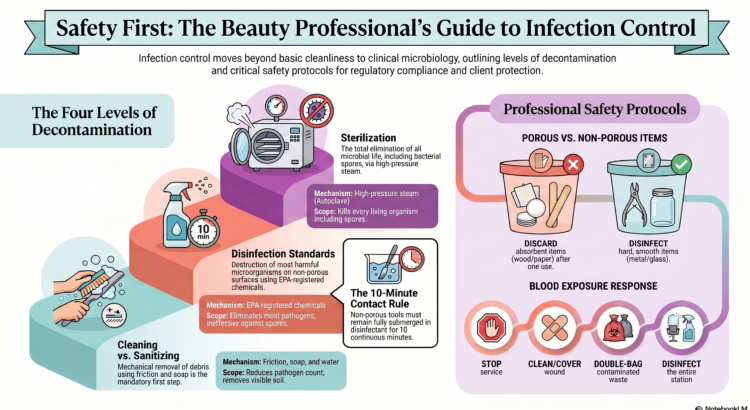
To implement an effective infection control program, the practitioner must first distinguish between the varying levels of decontamination. These terms are often used interchangeably in colloquial speech, yet they possess distinct clinical definitions and applications within a regulated environment.5

TermDefinitionPrimary MechanismScope of Action
CleaningThe mechanical removal of visible debris and organic matter.Friction with soap, detergent, and water.Reduces the number of pathogens but does not kill them.
SanitizingThe reduction of pathogens to levels deemed safe by public health standards.Chemical or thermal application.Lowers germ counts on surfaces to protect public health.
DisinfectionThe destruction of most harmful microorganisms on non-porous surfaces.EPA-registered chemicals (bactericidal, virucidal, fungicidal).Eliminates pathogens but is ineffective against bacterial spores.
SterilizationThe total elimination of all microbial life, including spores.High-pressure steam (autoclave) or dry heat.The highest level of decontamination; kills every living organism.

Cleaning is the indispensable first step in any protocol. Research indicates that the presence of soil, oils, or skin cells can create a protective barrier for microorganisms, effectively neutralizing the efficacy of disinfectants applied later.12 Therefore, the mechanical action of scrubbing is required to prepare non-porous items for the chemical immersion phase.17

2.2 Microbiology: The Nature of Pathogenic Microorganisms

Pathogenic microorganisms are the biological agents responsible for infection and disease. In the beauty industry, these are categorized into bacteria, viruses, fungi, and parasites.5 Understanding their morphology and lifecycle is essential for selecting appropriate decontamination methods.

2.2.1 Bacteria: Classification and Lifecycle

Bacteria are unicellular microorganisms with both plant and animal characteristics. While the majority of bacteria are nonpathogenic and perform useful functions such as breaking down food or stimulating the immune system, pathogenic bacteria cause disease by invading body tissues.5

The morphology of pathogenic bacteria determines their classification:

  • Cocci: Round-shaped bacteria that appear alone or in groups. Staphylococci grow in clusters like grapes and are the primary cause of abscesses, pustules, and boils. Streptococci form curved lines like beads and are associated with strep throat and blood poisoning. Diplococci grow in pairs and cause diseases like pneumonia.5
  • Bacilli: Short, rod-shaped bacteria. This group is responsible for highly infectious diseases such as tuberculosis, diphtheria, and tetanus.5
  • Spirilla: Spiral or corkscrew-shaped bacteria. These are the causative agents of syphilis and Lyme disease.5

The lifecycle of bacteria includes an active stage, where they grow and reproduce via binary fission in dark, damp environments, and an inactive stage. During the inactive stage, certain bacteria such as those causing anthrax develop a wax-like outer shell called a spore, which allows them to withstand extreme conditions that would otherwise be lethal.5 Only sterilization can effectively penetrate and destroy these spores.13

2.2.2 Viruses, Fungi, and Parasites

Viruses are submicroscopic particles that can only replicate by infecting the cells of a living host. Major viral concerns in the salon include Hepatitis, which causes liver damage and can survive on surfaces for significant periods, and HIV, which leads to AIDS by compromising the immune system.5

Fungi, including molds, mildews, and yeasts, are responsible for contagious conditions like ringworm (tinea) and fungal nail infections.19 Parasites, such as head lice (pediculosis capitis) and the itch mite (scabies), require a host to survive and are easily transmitted through direct contact or shared items like towels and brushes.5

2.3 Mechanisms of Infection Transmission

Infections spread in the salon environment through several primary routes:

  • Direct Contact: Skin-to-skin contact between the professional and the client.24
  • Indirect Contact: Touching contaminated surfaces, such as doorknobs or shared tools (fomites).22
  • Airborne Transmission: Inhaling pathogens carried on dust particles or respiratory droplets.5
  • Bloodborne Pathogens: Transmission through broken skin, nicks, or cuts during services.24

3. Universal Safety Principles

The concept of Universal Precautions, mandated by OSHA, requires that practitioners treat all human blood and certain body fluids as if they are known to be infectious for bloodborne pathogens.2 This mindset creates a standardized safety barrier that protects both the professional and the public.

3.1 Hand Hygiene Protocols

Hand washing is the most critical component of an infection control strategy. The Kentucky Board of Cosmetology requires licensees to cleanse their hands immediately before serving each patron.26

The clinical procedure for hand hygiene involves:

  1. Wetting hands with warm, running water.
  2. Applying soap and scrubbing vigorously for at least 20 seconds. This duration ensures the mechanical disruption of microbial membranes and the encapsulation of soil by surfactant molecules.16
  3. Cleaning under the free edge of the nails, where pathogens frequently accumulate.16
  4. Rinsing and drying thoroughly with a single-use paper towel or an air dryer.17

3.2 Personal Protective Equipment (PPE)

PPE serves as a physical barrier to prevent the transmission of microorganisms and minimize exposure to hazardous chemicals.

  • Gloves: Must be single-use and changed between clients or if they become punctured or torn. Gloves should be worn during chemical services, extractions, and any service where there is a risk of blood exposure.14
  • Eye Protection: Essential when mixing concentrated disinfectants or performing services where splashing may occur.14
  • Masks: Protect against the inhalation of airborne particulates, such as nail dust or hair fibers, and provide a barrier against respiratory droplets.27

3.3 Cross-Contamination and Client Consultation

Cross-contamination is the transfer of pathogens from one surface or person to another. This is mitigated through “single-use” discipline—ensuring that items that cannot be disinfected are disposed of immediately.8

Before any service, a thorough client consultation and skin/scalp analysis must be performed. Practitioners must recognize contraindications—conditions that prohibit the service—such as open wounds, active infections, or contagious diseases.8 If a contagious condition is observed, the service must be declined, and the client should be referred to a physician.19

4. Tools, Implements, and Equipment Handling

The classification of an item as non-porous or porous determines its lifecycle and decontamination requirement in the salon.4

4.1 Non-Porous Implements

Non-porous items are those made of hard, smooth materials like metal, glass, or high-density plastic. These items can and must be disinfected between every client.18

Cleaning and Disinfection Steps for Non-Porous Tools:

  1. Removal of Debris: Clear hair and visible soil.15
  2. Wash: Use warm soapy water and a clean brush to scrub all surfaces.14
  3. Rinse and Dry: Ensure no soap residue remains, as it can interfere with the disinfectant’s chemistry.17
  4. Complete Immersion: Submerge the tool entirely in an EPA-registered disinfectant. The “contact time”—the time the item must remain wet to be effective—is usually 10 minutes unless the label specifies otherwise.14
  5. Proper Storage: Once dried with a single-use towel, store in a clean, covered container labeled as “disinfected” or “ready to use”.17

4.2 Porous and Single-Use Items

Porous items are made of absorbent materials such as wood, paper, cotton, or certain sponges. Once used on a client, these items cannot be effectively disinfected and must be discarded.4 Examples include:

  • Emery boards and nail buffers (unless made of glass/metal).17
  • Wooden cuticle pushers and spatulas.17
  • Cotton balls and sponges.17
  • Neck strips and paper coverings.15

Towels and linens are porous but can be reused if they undergo proper laundering. Kentucky regulations mandate that towels be washed in a machine with detergent and chlorine bleach according to manufacturer directions.2

5. Chemical Safety and Disinfectants

Chemical disinfectants are categorized as pesticides by the Environmental Protection Agency (EPA) and must be handled with care to avoid toxic exposure.14

5.1 Types of EPA-Registered Disinfectants

Salons must use disinfectants that are bactericidal, virucidal, and fungicidal.5

  • Quaternary Ammonium Compounds (Quats): These are highly effective when used correctly and are the most common disinfectants in the beauty industry. Most formulas require a 10-15 minute immersion time.21
  • Phenolic Disinfectants: These are powerful tuberculocidal agents but can be caustic to the skin and damaging to certain plastics and rubbers.21
  • Sodium Hypochlorite (Bleach): Effective for disinfecting large surfaces and managing blood spills. It must be used in a 10% solution (1 part bleach to 9 parts water), mixed fresh every 24 hours, and stored away from light to prevent degradation.15

5.2 Safety Data Sheets (SDS)

Under federal law, a Safety Data Sheet (SDS) must be maintained for every chemical product in the salon. These documents provide 16 sections of information, including hazard identification, first aid measures, and proper disposal protocols.19 Professionals must be able to locate these sheets during a state board inspection.27

Mixing Safety:

  • Always wear PPE (gloves and safety glasses) when mixing.14
  • Add disinfectant to water (not water to disinfectant) to prevent foaming and splashing.14
  • Ensure the salon has adequate ventilation to prevent the buildup of chemical fumes.27

6. Domain-Specific Protocols

While the foundational principles of infection control are universal, each specialized license domain presents unique challenges that require tailored safety habits.

6.1 Nail Technology: Foot Spa and Implement Safety

The nail technology domain is arguably the highest risk due to the potential for fungal transmission and the complexity of pedicure equipment.4

6.1.1 Pedicure Basin Sanitation

The internal plumbing and jets of a foot spa can harbor biofilms—colonies of microorganisms that are resistant to standard cleaning.

  • Between Clients: Drain the basin, scrub with detergent and water, rinse, refill with clean water and disinfectant, and run the jets for 10 minutes.17
  • End of Day: Remove all removable parts (screens, jets) and clean them individually. Flush the system with a low-foaming detergent and water.15
  • Weekly: Perform a deep flush involving an overnight soak with a bleach solution to ensure all biofilms are eradicated.24

6.1.2 Nail Implements and Enhancements

Metal nippers, pushers, and electric file bits must be cleaned and disinfected between clients.17 Acrylic and gel hygiene requires preventing the “double-dipping” of brushes into monomer or gel pots, as this can contaminate the entire supply of product.4

6.2 Esthetics: Skin Integrity and Extraction Safety

Estheticians work with the face and body, often performing services that involve the removal of hair or the extraction of comedones, which can compromise the skin barrier.4

  • Extraction Safety: Lancets and extractors must be disinfected with high-level agents. Many professionals choose to use single-use lancets to eliminate the risk of cross-contamination entirely.23
  • Waxing Sanitation: The “no double-dipping” rule is non-negotiable. Once a spatula touches the client’s skin, it must never return to the wax pot. Instead, a fresh spatula must be used for every application.4
  • Treatment Beds: These must be covered with fresh linens or paper for each client and wiped with an EPA-registered disinfectant between services.14

6.3 Cosmetology: Hair and Scalp Safety

Cosmetology involves a wide range of tools that contact the scalp and hair, often in the presence of chemicals like hair color and relaxers.4

  • Clippers and Shears: Hair and debris must be removed immediately after use. Clippers should be saturated with a high-level disinfectant spray or foam.15
  • Combs and Brushes: These must be washed with soap and water before immersion in a disinfectant solution.14
  • Scalp Awareness: Stylists must be vigilant for signs of tinea capitis (ringworm) or pediculosis capitis (lice). If discovered, the service must stop, and all tools/linens must be isolated and disinfected.8

6.4 Shampoo and Blow Dry: Water and Hygiene

Even limited beauty licenses must adhere to strict sanitation standards to prevent water-borne contamination and the spread of skin conditions.4

  • Neck Strips and Capes: A clean towel or neck strip must be used to ensure the cape never touches the client’s neck.15
  • Shampoo Basins: Basins must be scrubbed with detergent after each use to remove hair and product buildup. Drains must be kept clear to prevent stagnant water, which serves as a breeding ground for bacteria.17
  • Water Temperature: Kentucky standards suggest that water heaters be maintained at a level that delivers safe yet effective warm water for shampooing, typically between and .31

7. Blood Exposure and Incident Protocol

A blood exposure incident occurs whenever a practitioner or client is cut or nicked during a service. The response must be immediate and standardized to minimize risk.25

StepAction for PractitionerAction for Client
1. StopImmediately cease the service.Immediately cease the service.
2. ProtectClean the wound and put on gloves.Practitioner puts on gloves.
3. CleanRinse the wound and pat dry.Clean the client’s wound with antiseptic.
4. CoverApply antiseptic and a bandage.Apply antiseptic and a bandage.
5. DiscardDouble-bag all contaminated items.Double-bag all contaminated items.
6. DisinfectClean and disinfect the workstation.Clean and disinfect tools/workstation.
7. ResumeReturn to service after cleaning hands.Return to service after cleaning hands.

All contaminated single-use items must be disposed of in a plastic bag, which is then placed into another plastic bag (double-bagged) and discarded in a covered trash receptacle.15 For large spills, biohazard protocol must be followed, and local health departments may be consulted for disposal guidance.15

8. State Board and Exam Alignment

Licensure examinations are not designed to test artistic flair but to verify that a candidate can practice safely.2 The National Interstate Council (NIC) and PSI exams are the standard for most states, including Kentucky.8

8.1 The Core of Competency

State boards focus on “safety-critical tasks.” These are actions where an error could result in immediate harm to the public.

  • Written Exam: Approximately 35-55% of the theory exam focuses on scientific concepts (infection control, anatomy, and chemistry).8
  • Practical Exam: Evaluators look for “Applied Competence”—can the candidate demonstrate hand hygiene, workstation setup, and tool handling without breaking the “chain of sanitation”?2

8.2 Documentation and Compliance

Maintaining accurate records is a regulatory requirement. This includes cleaning logs for pedicure basins, equipment maintenance records, and employee training logs.14 In Kentucky, failing to maintain a sanitary facility can result in fines, license probation, or immediate closure of the establishment.5

9. PSI Exam Mastery Section

Success on the PSI exam requires a shift in perspective: the “client” in the exam room is a mannequin or a model, but the “safety” is real.2

9.1 High-Frequency Test Concepts

  • Definitions: Differentiating between bactericidal, virucidal, and fungicidal.5
  • Porosity: Identifying which items are single-use versus multi-use.4
  • OSHA/EPA Roles: Knowing that OSHA regulates workplace safety and the EPA regulates the products used for disinfection.19
  • The 10-Minute Contact Time: The most common answer for immersion questions.14

9.2 Common Student Mistakes

  1. Breaking the Chain: Touching a phone or hair during a service and then touching the client without re-sanitizing hands.16
  2. Improper Storage: Placing a disinfected tool on an uncleaned towel or surface.10
  3. Contamination: Double-dipping or touching a product dispenser with used gloves.4

9.3 Scenario-Based Learning

  • Scenario: A client has an itchy, red scalp with circular patches.
  • Response: Suspect tinea capitis. Stop the service, inform the client politely, refer to a physician, and disinfect all tools.5

10. Memory Optimization System

To master the vast amount of technical information required for licensure, instructional designers recommend using Cognitive Load Theory to organize data into “schemas”.1

10.1 Acronyms and Frameworks

  • B-V-F: Bactericidal, Virucidal, Fungicidal—the “Big Three” requirements for any salon disinfectant.5
  • S-D-S: Safety Data Sheet—the “Safety Dictionary” of the salon.19
  • C-R-I-S Protocol (For Tools):
  • Clean
  • Rinse
  • Immerse
  • Store.14

10.2 “If This Then That” Safety Triggers

  • If you cut yourself then stop, glove, clean, bag.25
  • If a tool falls then it is dirty and must be isolated.3
  • If the disinfectant is cloudy then change it immediately.14

11. Real-World Salon Application

A professional salon is a clinical environment that happens to provide beauty services. Maintaining a “Clean Culture” requires a commitment from the entire team.32

11.1 Daily Hygiene Checklist

  • [ ] Sanitize hands before every client and after glove removal.2
  • [ ] Wipe down the styling chair and workstation with EPA-registered disinfectant after every service.14
  • [ ] Clean and immerse tools in disinfectant for 10 minutes.14
  • [ ] Ensure all chemical products are in their original manufacturer-labeled containers.3
  • [ ] Sweep hair and clear debris immediately after each service.15

11.2 The Weekly Deep Clean

  • Dismantle and disinfect all foot spa components (jets, filters, screens).17
  • Clean and sanitize towel warmers, leaving them open to dry completely.15
  • Audit the inventory for expired products or chemicals.11

12. Ethics and Professional Responsibility

Ethics in the beauty industry is defined by the “Duty of Care”—the professional’s legal and moral obligation to avoid acts or omissions that could reasonably be foreseen to injure the client.11

12.1 Personal Accountability

A licensee is accountable to their state board and their clients. This includes maintaining a clean personal appearance, short and clean nails, and professional conduct.11 Accountability also means staying updated on new laws. For example, starting in 2026, Kentucky beauty professionals will transition to a biennial (two-year) renewal system, requiring higher upfront payments and a disciplined approach to documentation.45

12.2 Reputation and Trust Building

Clients frequent a salon not only for the results but for the feeling of safety and well-being. Transparent sanitation—such as opening a disinfected tool bag in front of the client—builds immense trust and elevates the practitioner from a “service provider” to a “wellness professional”.11

13. Future of Infection Control in the Beauty Industry

The industry is entering an era of “Intelligent Compliance,” where technology assists in maintaining public health standards.

13.1 AI-Assisted Compliance and Tracking

Artificial Intelligence (AI) and Machine Learning (ML) are being integrated into salon management software (e.g., Zenoti, Boulevard, Meevo) to automate the administrative burden of infection control.49

  • Digital Logs: AI systems can automatically generate sanitation prompts and record timestamps for tool disinfection and basin cleaning, creating a tamper-proof audit trail for state board inspectors.51
  • Predictive Maintenance: IoT sensors in pedicure basins can monitor water quality and alert staff when a deep-cleaning cycle is required.48

13.2 Elevated Client Expectations

Post-pandemic, clients are more aware of hygiene than ever before. Future salon designs will likely feature more “open-concept” sanitation areas where clients can see the decontamination process.2 This transparency, coupled with digital tracking, will define the next generation of industry leaders.

ADDITIONAL OUTPUTS

A. VIDEO SERIES BREAKDOWN (15 Episodes)

  1. The Invisible Salon: Understanding the Microorganisms Around Us
  2. The Science of Suds: Why 20 Seconds of Handwashing Saves Lives
  3. Chemical IQ: Mastering EPA Labels and Mixing Safety
  4. The 10-Minute Rule: Why Contact Time is Non-Negotiable
  5. Porous vs. Non-Porous: The Life and Death of a Beauty Tool
  6. The Pedicure Protocol: Deep Cleaning Jets and Basins
  7. The Esthetician’s Edge: Extraction Safety and Waxing Hygiene
  8. Cosmetology 360: Sanitizing Clippers, Shears, and Brushes
  9. Shampoo Station Safety: Towels, Neck Strips, and Water Contamination
  10. The Blood Exposure Response: A Step-by-Step Practical Guide
  11. PSI Theory Mastery: Scoring High on Scientific Concepts
  12. The Practical Exam Audit: Avoiding Common Safety Mistakes
  13. Kentucky Law Update: Senate Bill 22 and Biennial Renewal
  14. The Audit Habit: Building a Daily Routine for Success
  15. Smart Beauty: How AI is Changing Salon Sanitation

B. PODCAST SERIES: Di Tran University – College of Humanization

  • Episode 1: The Sacred Trust. Why safety is the highest form of professional ethics.
  • Episode 2: Beyond the Spray Bottle. A deep dive into the chemistry of disinfection.
  • Episode 3: The PSI Playbook. Strategies for overcoming test anxiety through safety knowledge.
  • Episode 4: The Kentucky Shift. Navigating the 2025-2026 regulatory changes.
  • Episode 5: The Future is Clean. How technology will empower the next generation of stylists.

C. SEO KEYWORDS

  • Infection control beauty school
  • Cosmetology sanitation training
  • Nail salon hygiene standards
  • PSI exam infection control
  • Esthetician sanitation protocol
  • Kentucky Board of Cosmetology 201 KAR 12:100
  • Salon blood exposure procedure step-by-step
  • EPA registered hospital grade disinfectant beauty
  • Barber shop safety standards clippers
  • Louisville Beauty Academy sanitation guide

“This publication is developed by Louisville Beauty Academy and Di Tran University – The College of Humanization for educational and informational purposes only. It does not constitute legal advice, regulatory interpretation, or endorsement of any specific governing body. Readers are encouraged to consult their state board, official regulations, and legal counsel for authoritative guidance.”

Works cited

  1. beauty school compliance Archives – Louisville Beauty Academy, accessed April 16, 2026, https://louisvillebeautyacademy.net/tag/beauty-school-compliance/
  2. Public health and safety-first cosmetology state board exams in a multi-modal era, accessed April 16, 2026, https://www.psiexams.com/knowledge-hub/public-health-and-safety-first-cosmetology-state-board-exams-in-a-multi-modal-era/
  3. 201 KAR Chapter 12 cosmetology regulations Archives – Louisville …, accessed April 16, 2026, https://louisvillebeautyacademy.net/tag/201-kar-chapter-12-cosmetology-regulations/
  4. KENTUCKY BEAUTY LAW — REQUIRED SAFETY & SANITATION – VERBATIM STATUTES: KRS 317A.010, accessed April 16, 2026, https://louisvillebeautyacademy.net/kentucky-beauty-law-required-safety-sanitation-verbatim-statutes-krs-317a-010-317a-020-317a-030-as-of-december-2025/
  5. Chapter 5: Infection Control Principles and Practices, accessed April 16, 2026, https://resources.finalsite.net/images/v1693295732/bcvttecpaus/t8no0gztslsw72xcfkd9/CSChapter5InfectionControlPrinciplesPractices.pdf
  6. Kentucky Administrative Regulations, Title 201, Chapter 12 – Board of Cosmetology, accessed April 16, 2026, https://regulations.justia.com/states/kentucky/title-201/chapter-12/
  7. Important Update from the Kentucky Board of Cosmetology – April 17, 2025, accessed April 16, 2026, https://louisvillebeautyacademy.net/%F0%9F%93%A3-important-update-from-the-kentucky-board-of-cosmetology-april-17-2025/
  8. National Cosmetology Theory Examination – PLEASE REVIEW ALL INFORMATION CAREFULLY!, accessed April 16, 2026, https://provexam.com/wp-content/uploads/2022/10/NIC_Cosmetology-Theory_ENG_CIB_Eff.-7.1.2022.pdf
  9. Quality barbering & cosmetology state board exams | PSI, accessed April 16, 2026, https://www.psiexams.com/knowledge-hub/barbering-cosmetology-state-board-exams-set-the-standard/
  10. National Cosmetology Theory Examination CIB, accessed April 16, 2026, https://www.msbcb.ms.gov/wp-content/uploads/2025/02/cosmetology_national_theory_english.pdf
  11. topic: professional ethics in cosmetology – FCT EMIS, accessed April 16, 2026, https://fctemis.org/notes/13986_SS%201%20TOPIC_%20PROFESSIONAL%20ETHICS%20-WPS%20Office.pdf
  12. Difference Between Cleaning, Sanitizing, and Disinfecting – CDC, accessed April 16, 2026, https://www.cdc.gov/hygiene/pdf/331782-a_cleaning_sanitizing_disinfecting_508.pdf
  13. Chapter 5: Infection Control and Safe Work Practices, accessed April 16, 2026, https://rhombus-moose-9wzk.squarespace.com/s/LessonPlan05.pdf
  14. Safe Work Practices during COVID-19 (and Beyond) | Milady Training, accessed April 16, 2026, https://www.miladytraining.com/pages/safe-work-practices-during-covid-19-and-beyond-eca
  15. 201 KAR 12:100. Sanitation standards. – Kentucky Board of Cosmetology, accessed April 16, 2026, https://kbc.ky.gov/Documents/201%20KAR%2012.100.pdf
  16. The ABCs of Infection Control, accessed April 16, 2026, https://www.infectioncontroltoday.com/view/abcs-infection-control
  17. Board of Cosmetology (Amended at ARRS Committee) 201 KAR 12:100. Infection control, health, and safety., accessed April 16, 2026, https://apps.legislature.ky.gov/services/karmaservice/documents/16397/ToPDF?markup=true
  18. Board of Cosmetology (Amendment) 201 KAR 12:100. Infection control, health, and safety., accessed April 16, 2026, https://apps.legislature.ky.gov/services/karmaservice/documents/16145/ToPDF?markup=true
  19. Infection Control Principles & Practices | PDF | Disinfectant – Scribd, accessed April 16, 2026, https://www.scribd.com/document/255959770/Milady-s-Chapter-5-Infec-es-flashcards-Quizlet-pdf-pdf
  20. What Every Cosmetology Student Needs to Know About Infection Control, accessed April 16, 2026, https://www.cosmetology-license.com/what-every-cosmetology-student-needs-to-know-about-sterilization/
  21. Cosmetology – Infection Control: Principles & Practice Flashcards – Cram.com, accessed April 16, 2026, https://www.cram.com/flashcards/cosmetology-infection-control-principles-practice-317643
  22. Infection Control in Cosmetology Practices | PDF | Hairstyle | Skin – Scribd, accessed April 16, 2026, https://www.scribd.com/document/848314131/Cosmetology-Flash-Cards-2
  23. National Esthetics Theory Examination CIB, accessed April 16, 2026, https://prov-testing.github.io/nic_cib/esthetics_national_theory_english.html
  24. Complete Guide to Salon Sanitation and Infection Control: Professional Standards and Protocols | PJ’s College of Cosmetology, accessed April 16, 2026, https://www.gotopjs.com/blog/complete-guide-to-salon-sanitation-and-infection-control-professional-standards-and-protocols/
  25. BLOOD EXPOSURE PROCEDURE – Louisville Beauty Academy, accessed April 16, 2026, https://louisvillebeautyacademy.net/blood-exposure-procedure/
  26. 201 KAR 12:100. Sanitation standards, Chapter 12. Board of …, accessed April 16, 2026, https://kyrules.elaws.us/rule/201kar12:100
  27. Nail Technician Exam Practice Test – Mometrix, accessed April 16, 2026, https://www.mometrix.com/academy/nail-technician-practice-test/
  28. Code of Conduct – Function of Beauty, accessed April 16, 2026, https://functionofbeauty.com/pages/code-of-conduct
  29. National Nail Technology Theory Examination Candidate Information Bulletin – Arkansas Department of Health, accessed April 16, 2026, https://healthy.arkansas.gov/wp-content/uploads/Manicure.pdf
  30. Sanitation, Health, and Safety in the Beauty Industry, 2nd Edition – Elite Learning, accessed April 16, 2026, https://www.elitelearning.com/cosmetology/courses/sanitation-health-and-safety-in-the-beauty-industry-2nd-edition/
  31. B 419.0 BEAUTY SHOPS AND BARBER SHOPS BEAUTY SHOPS AND BARBER SHOPS REQUIREMENTS COMBUSTION AIR AOSSG88250 – AO Smith, accessed April 16, 2026, https://assets.aosmith.com/damroot/Original/10004/aossg88250.pdf
  32. Salon Cleaning Checklist: Sanitation, Compliance & Daily Duties – Booksy Biz, accessed April 16, 2026, https://biz.booksy.com/en-us/blog/salon-cleaning-checklist
  33. Northeast District Department of Health, accessed April 16, 2026, https://nddh.org/wp-content/uploads/2025/05/Salon-Technical-Standards.pdf
  34. National Nail Technology Theory Examination CIB, accessed April 16, 2026, https://prov-testing.github.io/nic_cib/nail_technology_national_theory_english.html
  35. Free Salon Cleaning Checklist Template to Edit Online, accessed April 16, 2026, https://www.template.net/edit-online/370293/salon-cleaning-checklist
  36. Hair Salon Daily Opening Safety and Sanitation Checklist – POPProbe, accessed April 16, 2026, https://www.popprobe.com/checklist-library/beauty-wellness/salon-operations/hair-salon-daily-opening-safety-sanitation-checklist
  37. Salon Water Requirements: Keeping Customers Comfortable, accessed April 16, 2026, https://reliablewater247.com/salon-water-requirements-keeping-customers-comfortable/
  38. BLOOD EXPOSURE PROCEDURES FOR COSMETOLOGY PRACTITIONERS – Kansas.gov, accessed April 16, 2026, https://www.kansas.gov/kboc/public-documents/docs/blood-spill-procedures.pdf
  39. Blood Exposure Procedure, accessed April 16, 2026, https://dlr.sd.gov/cosmetology/resources/blood_exposure_procedures.pdf
  40. Blood Spill Procedure.pdf, accessed April 16, 2026, https://bcb.az.gov/sites/default/files/2022-11/Blood%20Spill%20Procedure.pdf
  41. Educators Series: – Maryland Department of Labor, accessed April 16, 2026, https://labor.maryland.gov/license/cos/cos-preppsiexamtestkit.pdf
  42. Salon Sanitation Checklist – FREE PDF PDF – Free Download | Beauty & Wellness Checklist Template | POPProbe, accessed April 16, 2026, https://www.popprobe.com/checklist-library/beauty-wellness/salon/salon-sanitation-checklist
  43. Promoting Long-Lasting Learning through Instructional Design – ERIC, accessed April 16, 2026, https://files.eric.ed.gov/fulltext/EJ1192953.pdf
  44. Salon Rules & Legal Guidelines for Staff and Clients – QuarkBooker, accessed April 16, 2026, https://www.quarkbooker.com/blog/salon-rules-legal-guidelines-client-conflicts-employee-misconduct
  45. 2026 Kentucky State Board Compliance Alert: The Shift to Biennial License Renewal – RESEARCH JANUARY 2026 – Louisville Beauty Academy, accessed April 16, 2026, https://louisvillebeautyacademy.net/2026-kentucky-state-board-compliance-alert-the-shift-to-biennial-license-renewal-research-january-2026/
  46. Ethics in the Beauty Industry | PDF | Complaint | Physician – Scribd, accessed April 16, 2026, https://www.scribd.com/document/106606572/Professional-Ethics-for-the-Hair-and-Beauty-Industry
  47. Code of Ethics – Beautyguild.com, accessed April 16, 2026, https://www.beautyguild.com/Membership/Code-Of-Ethics
  48. The Ultimate Guide to Salon Management in 2025 – Salon Booking System, the appointment WordPress plugin, accessed April 16, 2026, https://www.salonbookingsystem.com/salon-booking-system-blog/salon-management/
  49. 7 Best Salon Software in 2025 for Smart Salon Management – BookingBee.ai, accessed April 16, 2026, https://bookingbee.ai/7-best-salon-software-in-2025-for-smart-salon-management/
  50. Salon AI: How Collaboration with Tech Can Lighten Your Load in 2026 – Meevo, accessed April 16, 2026, https://www.meevo.com/blog/salon-ai-experiences/
  51. The Proactive Shift: How AI/Agentic AI Is Revolutionizing Infection Prevention, accessed April 16, 2026, https://www.infectioncontroltoday.com/view/proactive-shift-how-ai-agentic-ai-is-revolutionizing-infection-prevention
  52. AI and the Future of Healthcare Compliance: From Manual Monitoring to Intelligent Automation – MDaudit, accessed April 16, 2026, https://mdaudit.com/blog/ai-and-the-future-of-healthcare-compliance-from-manual-monitoring-to-intelligent-automation/
  53. Top 7 Salon Management Software in the US (2025 Picks) – DINGG, accessed April 16, 2026, https://dingg.app/blogs/top-7-salon-management-softwares-in-the-us-2025-edition
  54. AI Salon Software Reshapes 2025 Beauty Trends – Salon360App, accessed April 16, 2026, https://salon360app.com/digital-solution/how-ai-powered-salon-software-is-reshaping-2025-beauty-industry-trends/

Disclaimer (Education Only)
This publication is provided by Louisville Beauty Academy and Di Tran University – The College of Humanization for educational and informational purposes only. It is not intended as legal advice, regulatory interpretation, or an official statement of any governing authority. Readers are encouraged to consult their state board, applicable laws, and qualified professionals for specific guidance.


