Disclaimer: This article is published on the website of Louisville Beauty Academy for informational and public educational purposes only. The research, analysis, and opinions presented herein were prepared by the research team at Di Tran University — The College of Humanization as part of its Research & Podcast Series. Di Tran University is an educational research affiliate founded by Di Tran, who also serves as founder and CEO of Louisville Beauty Academy — this is a founder-affiliated publication, not an independent third-party study. Louisville Beauty Academy does not interpret or provide legal, regulatory, or financial advice through this publication and does not represent any government agency or regulatory authority. All references to laws, regulations, economic data, and workforce statistics are based on publicly available sources and academic analysis and should not be relied upon as official guidance. Readers seeking legal, regulatory, or professional advice should consult qualified professionals or the appropriate government authorities.
Introduction: Regulatory Accountability and the Restructuring of Vocational Education
The regulatory landscape of U.S. postsecondary education underwent a structural transformation between 2023 and 2026, driven primarily by the reintroduction and expansion of the Department of Education’s “Gainful Employment” (GE) and “Financial Value Transparency” (FVT) frameworks. Finalized on October 10, 2023, these regulations established a comprehensive accountability system for programs authorized under Title IV of the Higher Education Act (HEA), specifically targeting non-degree programs at public and private non-profit institutions and all programs at for-profit (proprietary) institutions.1 The core objective of these rules is to ensure that career-focused education leads to measurable economic outcomes, defined by graduates’ ability to service their debt and earn more than a typical high school graduate.3
The GE framework utilizes two primary performance metrics: the debt-to-earnings (D/E) ratio and the earnings premium (EP) test. Under 34 CFR Part 668, a program is deemed to pass the D/E standard if its median annual debt service is less than or equal to 8% of median annual earnings or less than or equal to 20% of discretionary earnings.3 Discretionary earnings are calculated as median annual earnings minus 150% of the federal poverty guideline for a single individual, which was approximately $21,870 in 2023.3 The EP test requires that a program’s typical graduate earns at least as much as a typical high school graduate between the ages of 25 and 34 in the labor force for the corresponding state.2 Programs that fail the same metric for two out of three consecutive years lose their eligibility to participate in federal student aid programs.2
The implementation of these standards has exerted significant pressure on the for-profit vocational sector, particularly beauty and cosmetology schools. Historical evidence from the 2014 regulatory cycle serves as a precursor to contemporary trends; data indicate that approximately 32% of cosmetology certificate programs either failed or entered a “warning” zone under earlier iterations of these benchmarks.5 In the 2024–2025 period, the Department of Education utilized administrative data from the National Student Loan Data System (NSLDS) and the Internal Revenue Service (IRS) to generate “Completers Lists,” which established the cohorts for outcome measurement.6 Reporting obligations for all institutions became effective on July 1, 2024, and by early 2025, the Department began issuing the first GE and FVT scores.3
Data indicate that the threat of losing Title IV eligibility has accelerated the closure rate of low-performing institutions. Research on institutional characteristics shows that private for-profit colleges are approximately three times as likely to close as private non-profits, with for-profit two-year schools experiencing the highest closure rates in the postsecondary market.8 Between 1996 and 2023, nearly one-third of observed institutions in the two-year for-profit sector closed.8 Contemporary examples from 2024–2025 highlight this trend; for instance, a prominent beauty school chain in Tennessee faced loss of accreditation and closure after reporting an on-time graduation rate of only 3% and poor loan repayment outcomes.5 At the national level, federal data from February 2026 revealed that over 1,800 institutions exhibited nonpayment rates at or exceeding 25%, placing them at “serious risk” of failing future cohort default rate (CDR) and GE benchmarks.9
| Regulatory Timeline for GE and FVT Implementation | Key Action Item |
| October 10, 2023 | Publication of Final Rule (88 FR 70004) 2 |
| July 1, 2024 | Effective date for reporting and administrative capability 2 |
| January 15, 2025 | Deadline for institutional reporting of student-level data 6 |
| Early 2025 | Issuance of first GE/FVT scores and metrics 3 |
| July 1, 2026 | Launch of public program information website and student acknowledgment requirements 2 |
The regulatory environment of 2026 is further defined by the Financial Value Transparency provisions, which require all Title IV-eligible programs to disclose comprehensive costs, median debt, and median earnings on a public-facing website.2 Starting July 1, 2026, students must provide a formal acknowledgment that they have viewed this information before enrolling in programs with failing D/E rates.2 This “transparency-as-accountability” model assumes that informed consumer choice will drive enrollment away from programs that “leave students no better off” than those with only a high school diploma.5
Macroeconomic Context: Inflationary Volatility and Geopolitical Shocks
The macroeconomic climate of early 2026 is characterized by a confluence of persistent domestic inflation and acute geopolitical instability in the Middle East, both of which have introduced significant volatility into the U.S. economy. As of February 2026, the Bureau of Labor Statistics (BLS) reported that the Consumer Price Index for All Urban Consumers (CPI-U) increased by 0.3% on a seasonally adjusted basis, with a 12-month unadjusted increase of 2.4%.10 While the 12-month headline inflation rate matched the previous month’s reading, internal components, particularly energy and food, showed signs of acceleration.10
The food index rose 0.4% in February 2026, with the index for food at home also increasing by 0.4%.10 Over the previous 12 months, food prices increased by 3.1%, driven by a 5.6% rise in nonalcoholic beverages and a 3.9% increase in food away from home.10 These increases have been compounded by a resurgence in energy costs. The energy index increased 0.6% in February 2026, reversing a 1.5% decline in January.10 Natural gas prices surged 10.9% over the 12 months ending in February, while electricity prices rose 4.8%.10
| Consumer Price Index Component | Monthly Change (Feb 2026) | 12-Month Change (Feb 2026) |
| All Items | +0.3% | +2.4% |
| Food at Home | +0.4% | +2.4% |
| Food Away from Home | +0.3% | +3.9% |
| Energy | +0.6% | +0.5% |
| Utility (piped) Gas | +3.1% | +10.9% |
| Electricity | -0.7% | +4.8% |
| Shelter | +0.2% | +3.0% |
| Personal Care | -0.2% | +4.5% |
| Source: 10 |
The primary driver of energy volatility in 2026 has been the escalation of military conflict in the Middle East, specifically involving the Strait of Hormuz. Following joint U.S. and Israeli airstrikes on Iran on February 28, 2026, Iran effectively halted maritime traffic through the strait, a critical chokepoint through which approximately 20 million barrels of crude oil and oil products pass daily.13 This disruption removed roughly one-fifth of the world’s oil and gas supply from the market, causing an immediate spike in global energy prices.14 Brent crude oil surged from $70 per barrel to over $110 per barrel within days of the conflict’s commencement.16 By March 6, 2026, Brent was trading at $92 per barrel, up 28% from the previous week’s close.17
In the United States, gasoline prices responded to these global trends, rising by 0.8% in February and surging by double-digit percentages in early March.12 Analysts from the International Energy Agency (IEA) noted that commercial traffic through the Persian Gulf had slowed “to a trickle” as insurers and shipowners reassessed the risks.13 This geopolitical friction has broader economic implications, with the OECD projecting that global growth will moderate to 3.0% in 2026 as higher trade barriers and policy uncertainty dampen investment.18 In the U.S., GDP growth is projected to slow to 1.6% in 2026, down from 2.2% in 2025.18
Furthermore, the transition to an AI-influenced economy has introduced a new layer of workforce disruption. Research from the McKinsey Global Institute suggests that by 2030, approximately 14% of employees globally—and 375 million workers total—will require significant reskilling due to automation and digitization.19 Estimates indicate that up to 30% of current work hours in the U.S. could be automated by 2030, with a focus on routine tasks in data entry, manufacturing, and customer service.19 The World Economic Forum projects that 85 million jobs may be displaced by AI by 2025, although this will likely be offset by the creation of 97 million new roles, particularly those requiring “human-centric” skills.20
Recession-Resilience and Economic Elasticity of Beauty Trades
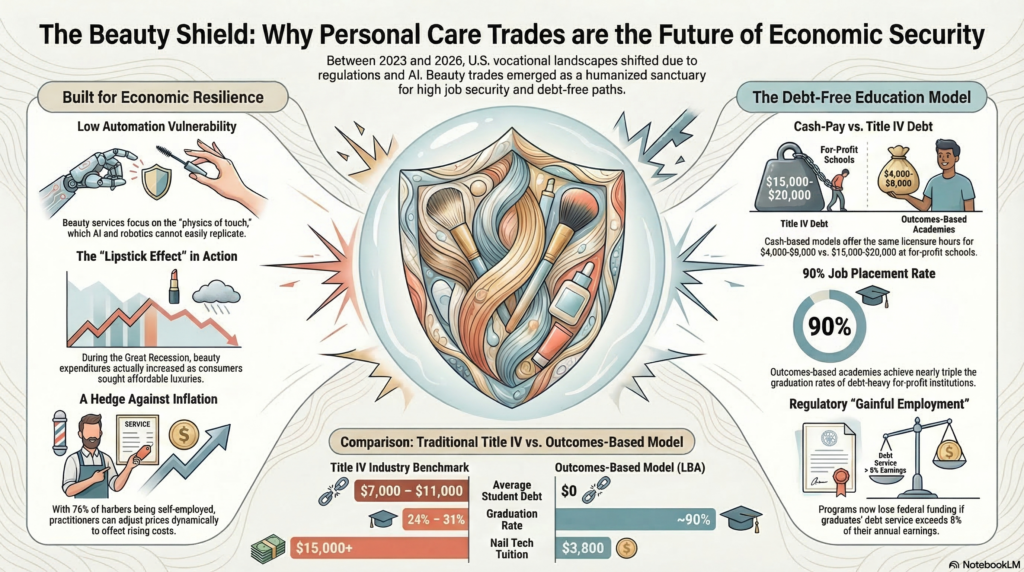
The beauty and personal care industry has demonstrated a historical capacity for recession-resilience, often quantified through the “Lipstick Effect”—an economic phenomenon where consumers continue to purchase small, affordable luxury items during financial downturns even as they curtail larger discretionary expenditures.22 Data from the 2008 financial crisis indicate that industry spending fell only slightly and returned to pre-recession levels by 2010.24 During the Great Recession of 2007–2009, cosmetic purchases among married women increased by 9.8%, and the average annual expenditure on beauty products rose from $139 in 2007 to $152 in 2009.23
The 2020 COVID-19 pandemic provided a more severe test of elasticity, as government-mandated lockdowns forced the closure of physical service locations. During this period, global beauty industry revenues fell by 20% to 30%, with professional services being the hardest hit.24 However, the sector exhibited a rapid rebound; by 2021, lipstick sales increased by 80% once mask mandates were lifted, and consumers shifted toward self-care and skincare categories during the isolation period.23 This suggests that while beauty services are physically constrained by lockdowns, the underlying demand for personal grooming remains highly inelastic.
In the current 2024–2026 economic environment, BLS wage data highlight the relative stability of beauty trades. As of May 2024, the median annual pay for barbers, hairstylists, and cosmetologists was $35,420.26 While this is below the median for all occupations ($23.80 per hour), the sector offers a robust path to self-employment, which acts as a hedge against corporate downsizing. In 2024, 76% of barbers were self-employed.26 This high rate of independent operation allows practitioners to adjust their prices more dynamically in response to localized inflation (e.g., rising shelter and utility costs) than fixed-salary employees.26
| Occupational Title (SOC) | Employment (2024) | Median Hourly Wage (2024) | Projected Growth (2024–34) |
| Barbers (39-5011) | 76,000 | $18.73 | 4% |
| Hairdressers/Cosmetologists (39-5012) | 575,200 | $16.95 | 6% |
| Skincare Specialists (39-5094) | 100,000* | $19.98* | 9%* |
| Manicurists/Pedicurists (39-5092) | 170,000* | $16.66* | 8%* |
| Source: 26 (*Estimated based on 2024 summaries) |
The “humanization of labor” in the beauty industry creates a unique economic sanctuary. Evidence from high-performing salon owners suggests that established facilities with 10–20 technicians can generate annual gross revenues between $1 million and $2.4 million.27 Unlike the corporate sector, which is increasingly threatened by AI-driven efficiency gains, the beauty service industry is “inventory-light” and centered on the “physics of touch,” which limits the potential for remote or automated displacement.24 The 2024–2026 period has seen a “human premium” emerge, where skills related to empathy, creativity, and fine motor skills command stable demand despite broader macroeconomic volatility.21
Affordability, Debt Traps, and the Divergent Models of Beauty Education
The financial structure of beauty education has historically been a significant point of concern for federal regulators. Research from New America and the National Association of Student Financial Aid Administrators (NASFAA) found that for-profit beauty schools often carry high tuition premiums linked to Title IV eligibility.31 Average student debt for cosmetology graduates typically ranges from $7,000 to $11,000, which can represent a substantial portion of an entry-level practitioner’s annual earnings.32
Evidence indicates a sharp disparity in tuition between Title IV-participating programs and cash-based models. Title IV cosmetology programs often charge between $15,000 and $20,000, whereas non-Title IV programs (often referred to as lower-debt or cash-based models) frequently offer the same licensure hours for $4,000 to $8,000.32 This “tuition premium” in the Title IV sector is often offset by Pell Grants and federal loans, yet it frequently leads to higher default rates if the graduates fail to secure immediate, high-paying work.5
The implementation of the “One Big Beautiful Bill Act” (OBBBA) in 2026 introduced new constraints on this model. The OBBBA established firm annual and lifetime caps on federal student loans, replacing the previous system where the “Cost of Attendance” (COA) was the primary limit.35 Under the OBBBA, independent undergraduates face an annual loan limit of $9,500–$12,500, which may leave many students at high-tuition for-profit schools with a significant funding gap.36 Furthermore, the elimination of the Grad PLUS loan program has placed additional revenue pressure on institutions that depend on debt-financed graduate or professional certificates.35
| Loan Category (OBBBA 2026) | Annual Limit | Lifetime Aggregate Limit |
| Independent Undergraduate | $9,500 – $12,500 | $57,500 |
| Dependent Undergraduate | $5,500 – $7,500 | $31,000 |
| Parent PLUS (Per Student) | $20,000 | $65,000 |
| Graduate Students | $20,500 | $100,000 |
| Source: 36 |
As Title IV-dependent schools face higher compliance costs and lower borrowing caps, “cash-pay” models have become more prominent. These institutions typically utilize “pay-as-you-go” plans and institutional scholarships (which can cover 50% to 75% of tuition) to maintain affordability without federal oversight.33 Data from 2025 show that students graduating from these lower-debt models enter the workforce with written payment-bearing debt, significantly improving their Debt-to-Earnings ratios compared to their peers at traditional for-profit institutions.32 Default rates at beauty schools that relied heavily on Title IV aid reached alarming levels in early 2026; over 500 cosmetology schools were flagged by the Department of Education as having 30% or more of their borrowers more than 90 days delinquent.31
Workforce Security: Automation Resistance and Multilingual Integration
The beauty industry is uniquely positioned to resist the automation risks identified by Oxford Economics and McKinsey. While Oxford Economics reports that approximately 47% of U.S. jobs are “at risk” of computerization over the next two decades, these risks are heavily concentrated in logistics, administrative support, and routine production labor.39 Personal care services, including barbers and cosmetologists, are classified as “low risk” due to the high degree of manual dexterity, social intelligence, and creativity required to perform non-routine tasks in unstructured environments.39
The McKinsey Skill Change Index (SCI) confirms this trend, showing that “assisting and caring” skills will experience the least change in demand due to AI through 2030.21 While AI tools are being integrated into the industry for scheduling, virtual try-on, and business management, the core service—the physical manipulation of hair, skin, and nails—remains a “humanized” endeavor.27 This resistance to automation is a critical component of workforce security in an environment where 18.4 million experienced workers are expected to retire by 2032, creating a “skills shortage” in occupations that require postsecondary credentials and tangible service skills.42
| Workforce Factor (2024–2026) | Beauty/Personal Care Industry Status |
| Automation Vulnerability | Low (Non-routine physical tasks) 39 |
| Human Skills Premium | High (Social intelligence, empathy) 21 |
| Credential Alignment | State Licensure required (Protective barrier) 27 |
| Demographic Support | 79.3% Female workforce; 33% POC 43 |
| Multilingual Availability | Spanish, Vietnamese, Korean, Chinese 44 |
Workforce accessibility has also been enhanced through the expansion of multilingual licensing pathways. In states like California, Florida, and Texas, cosmetology licensing boards offer exams in multiple languages to accommodate the diverse demographic profile of the industry.32 For example, the California Board of Barbering and Cosmetology offers its laws and regulations book in Korean, Spanish, Vietnamese, and Simplified Chinese.44 Data from previous years indicated that Spanish test-takers achieved an 82% pass rate on the practical portion of the examination, which is conducted in English but allows for visual following.45 In Florida, the Board of Cosmetology regulates and approves products for infection control and sets rules for practitioners who must maintain a 75% passing mark for licensure.45
The Georgetown Center on Education and the Workforce (CEW) notes that institutions offering certificates and associate degrees often provide a higher return on investment (ROI) after 10 years than institutions offering bachelor’s degrees, as they allow students to enter the workforce faster with lower out-of-pocket costs.48 For early-career workers, certificates in middle-skills occupations can lead to median annual earnings of $83,300 by mid-career.48 In the beauty sector, this rapid entry is facilitated by programs that streamline training to state-minimum hours (e.g., 1,500 hours for cosmetology, 600–750 for esthetics, 300–450 for nail technology).32
Case Study: Analysis of an Outcomes-Based Vocational Institution
The shifting paradigm of postsecondary education is exemplified by a specific, anonymously profiled institution that has expanded its footprint during a period of widespread sector consolidation. This family-owned academy, located in the Southeastern United States, operates a model that intentionally decouples vocational training from federal student debt, focusing instead on “cash-pay” affordability and labor market placement.38
Operational and Financial Metrics
Unlike traditional Title IV-dependent schools, this institution does not participate in federal student loan programs. Instead, it utilizes an “innovative pay-as-you-go” tuition plan and provides institutional scholarships that cover up to 50–75% of the total cost.33 This results in a tuition structure that is 50–80% lower than prevailing market rates. For example, the institution’s Nail Technology course is priced at approximately $3,800 (after aid), whereas regional competitors charge $15,000 to $20,000 for the same certification.33
| Institution Performance Metric | Reported Value | Industry Benchmark |
| On-time Completion Rate | ~90% | 24% – 31% |
| Job Placement Rate | ~90% | ~70% |
| Student Loan Debt upon Graduation | $0 | $7,000 – $11,000 |
| Nail Technology Tuition | $3,800 | $15,000+ |
| Real Estate Ownership Status | 100% Owned (Main/West) | Variable (Leased typical) |
| Source: 33 |
The institution’s facility model is anchored in real estate ownership, with its main campus and future second-location planning fully licensed and operating through July 31, 2026.38 This strategy of owning the underlying assets allows the institution to keep operating costs low and provides insulation from the inflationary shocks currently impacting commercial rent in the region.27
Workforce Integration and Recognition
The academy focuses on serving underrepresented communities, including immigrants and low-income individuals, through multilingual instruction and state-board-aligned curricula.33 Graduates of the 6-month nail technology program or the 1,500-hour cosmetology program secure jobs or start salon businesses at a rate of 90%, collectively contributing an estimated $20 million to $50 million annually to the local economy.33
In 2025, the institution achieved historic national recognition, becoming the first beauty academy to be honored simultaneously as a U.S. Chamber of Commerce CO—100 Award winner and a National Small Business Association (NSBA) “Advocate of the Year” finalist.33 These accolades were awarded based on the institution’s workforce development outcomes and its role as a model for “ethical, outcomes-driven training”.33 Furthermore, the institution has expanded its curriculum to include fast-growing specialties such as eyelash extensions (16–320 hours depending on state law) to meet the evolving demands of the “Gen Z aesthetic” market.30
The case study institution—identified in public filings as the Louisville Beauty Academy—demonstrates that high graduation rates and low student debt are achievable when institutional priorities are aligned with labor market demand rather than the maximization of Title IV drawdowns.33 By prioritizing biometric attendance tracking for hour integrity and maintaining a “Success Sharing” discount model for students, the academy has created a replicable template for vocational education in a post-federal-aid world.32
Policy Implications
The data from the 2023–2026 period suggest that the traditional for-profit education model, characterized by high-tuition premiums and heavy reliance on federal debt, is increasingly unsustainable under new gainful employment benchmarks and shifting macroeconomic conditions. Real-estate-owned, lower-debt vocational models provide a stable alternative by reducing the “tuition premium” associated with Title IV eligibility and insulating students from the long-term debt traps that currently define the sector. By prioritizing low-cost, cash-based education and multilingual licensure, these models not only satisfy the Department of Education’s financial value transparency requirements but also provide a resilient pathway to economic security in an environment disrupted by AI, energy-driven inflation, and geopolitical volatility.
Works cited
- Financial Value Transparency and Gainful Employment Information | Knowledge Center, accessed March 13, 2026, https://fsapartners.ed.gov/knowledge-center/topics/financial-value-transparency-and-gainful-employment-information
- Regulatory Requirements for Financial Value Transparency and …, accessed March 13, 2026, https://fsapartners.ed.gov/knowledge-center/library/dear-colleague-letters/2024-03-29/regulatory-requirements-financial-value-transparency-and-gainful-employment-updated-sept-16-2024
- New Gainful Employment Rules Impact For-Profit and Nonprofit Colleges and Universities, accessed March 13, 2026, https://www.hklaw.com/en/insights/publications/2023/10/new-gainful-employment-rules-impact-for-profit-and-nonprofit
- Draft Memo on DTE for AHEAD (Submitted by Tamar Hoffman) – Department of Education, accessed March 13, 2026, https://www.ed.gov/media/document/2025-ahead-draft-memo-dte-ahead-submitted-tamar-hoffman-112941.pdf
- Gainful Employment Rules and School Closures (2014–Present) – MAY 2025 STUDY, accessed March 13, 2026, https://naba4u.org/2025/05/gainful-employment-rules-and-school-closures-2014-present-may-2025-study/
- (GE-24-10) Reminder of Institutional Requirements for Financial Value Transparency & Gainful Employment that Must Be Completed by January 15, 2025, accessed March 13, 2026, https://fsapartners.ed.gov/knowledge-center/library/electronic-announcements/2024-11-13/reminder-institutional-requirements-financial-value-transparency-gainful-employment-must-be-completed-january-15-2025
- Gainful Employment Redux – Not Just for For-Profits Anymore – CooleyED, accessed March 13, 2026, https://ed.cooley.com/2023/10/26/gainful-employment-redux-not-just-for-for-profits-anymore/
- Colleges Are Closing. Who Might Be Next?, accessed March 13, 2026, https://www.educationnext.org/colleges-are-closing-who-might-be-next-how-machine-learning-fill-data-gaps-forecast-future/
- ED Releases Updated Data on Nonpayment Rates by Institution, Warns of High Cohort Default Rates – nasfaa, accessed March 13, 2026, https://www.nasfaa.org/news-item/38256/ED_Releases_Updated_Data_on_Nonpayment_Rates_by_Institution_Warns_of_High_Cohort_Default_Rates
- Consumer Price Index – February 2026 – BLS.gov, accessed March 13, 2026, https://www.bls.gov/news.release/pdf/cpi.pdf
- Bureau of Labor Statistics, accessed March 13, 2026, https://www.bls.gov/
- US consumer inflation steady before Iran conflict drives up oil prices – Virginia Business, accessed March 13, 2026, http://virginiabusiness.com/us-consumer-prices-february-iran-conflict-oil/
- The global price tag of war in the Middle East, accessed March 13, 2026, https://www.weforum.org/stories/2026/03/the-global-price-tag-of-war-in-the-middle-east/
- How Iran Blocking the Strait of Hormuz Affects the U.S., accessed March 13, 2026, https://www.factcheck.org/2026/03/how-iran-blocking-the-strait-of-hormuz-affects-the-u-s/
- The War in Iran Will Raise Fuel Prices and Costs Throughout the Economy, accessed March 13, 2026, https://www.americanprogress.org/article/the-war-in-iran-will-raise-fuel-prices-and-costs-throughout-the-economy/
- Economic impact of the 2026 Iran war – Wikipedia, accessed March 13, 2026, https://en.wikipedia.org/wiki/Economic_impact_of_the_2026_Iran_war
- What Does the Iran War Mean for Global Energy Markets?, accessed March 13, 2026, https://www.csis.org/analysis/what-does-iran-war-mean-global-energy-markets
- OECD Economic Outlook, Interim Report March 2025 | OECD, accessed March 13, 2026, https://www.oecd.org/en/publications/oecd-economic-outlook-interim-report-march-2025_89af4857-en.html
- Which jobs can remain secure until 2030 despite AI? – AEEN, accessed March 13, 2026, https://www.aeen.org/which-jobs-can-remain-secure-until-2030-despite-ai/
- How Many Jobs Will AI Replace & How to Adapt [2025 – 2030] – Jobright, accessed March 13, 2026, https://jobright.ai/blog/how-many-jobs-will-ai-replace/
- Agents, robots, and us: Skill partnerships in the age of AI – McKinsey, accessed March 13, 2026, https://www.mckinsey.com/mgi/our-research/agents-robots-and-us-skill-partnerships-in-the-age-of-ai
- The Economics of Beauty: How the Beauty Industry Thrives in Changing Markets – IJFMR, accessed March 13, 2026, https://www.ijfmr.com/papers/2025/2/39953.pdf
- The Lipstick Index: Why Beauty Stays Resilient Through Economic Downturns, accessed March 13, 2026, https://soshebeauty.com/blogs/thesosheedit/the-lipstick-index-why-beauty-stays-resilient-through-economic-downturns
- How COVID-19 is changing the world of beauty – McKinsey, accessed March 13, 2026, https://www.mckinsey.com/~/media/McKinsey/Industries/Consumer%20Packaged%20Goods/Our%20Insights/How%20COVID%2019%20is%20changing%20the%20world%20of%20beauty/How-Covid-19-is-changing-the-world-of-beauty-vF.pdf
- Impact of Covid-19 on Beauty & Wellness – Baird, accessed March 13, 2026, https://content.rwbaird.com/RWB/sectors/PDF/consumer/Impact-of-Covid-19-on-Beauty-Wellness.pdf
- Barbers, Hairstylists, and Cosmetologists : Occupational Outlook Handbook – BLS.gov, accessed March 13, 2026, https://www.bls.gov/ooh/personal-care-and-service/barbers-hairstylists-and-cosmetologists.htm
- AI proof jobs beauty Archives – Louisville Beauty Academy, accessed March 13, 2026, https://louisvillebeautyacademy.net/tag/ai-proof-jobs-beauty/
- Hairdressers, Hairstylists, and Cosmetologists – Bureau of Labor Statistics, accessed March 13, 2026, https://www.bls.gov/oes/2023/may/oes395012.htm
- Barbers – BLS.gov, accessed March 13, 2026, https://www.bls.gov/oes/2023/may/oes395011.htm
- Tag: workforce transformation 2026 – Louisville Beauty Academy, accessed March 13, 2026, https://louisvillebeautyacademy.net/tag/workforce-transformation-2026/
- Should Failing Beauty Schools Keep Access to Federal Aid? New …, accessed March 13, 2026, https://www.newamerica.org/insights/should-failing-beauty-schools-keep-access-to-federal-aid-new-data-suggests-no/
- beauty education regulation 2026 Archives – Louisville Beauty Academy, accessed March 13, 2026, https://louisvillebeautyacademy.net/tag/beauty-education-regulation-2026/
- Outcomes-Based Beauty Education : A Workforce and Policy …, accessed March 13, 2026, https://naba4u.org/2025/12/outcomes-based-beauty-education-a-workforce-and-policy-analysis-of-lower-debt-completion-driven-vocational-models-research-december-2025/
- nail school Louisville KY Archives, accessed March 13, 2026, https://louisvillebeautyacademy.net/tag/nail-school-louisville-ky/
- Effect of Changes to Title IV of the Higher Education Act in the One Big Beautiful Bill, accessed March 13, 2026, https://www.ropesgray.com/en/insights/alerts/2025/08/effect-of-changes-to-title-iv-of-the-higher-education-act-in-the-one-big-beautiful-bill
- One Big Beautiful Bill Act education Archives – Louisville Beauty Academy, accessed March 13, 2026, https://louisvillebeautyacademy.net/tag/one-big-beautiful-bill-act-education/
- Louisville Beauty Academy & Founder Di Tran: Elevating Beauty Education and Small Business Advocacy to the National Level – National Small Business Association (NSBA), Washington, D.C. – SEPTEMBER 2025, accessed March 13, 2026, https://louisvillebeautyacademy.net/louisville-beauty-academy-founder-di-tran-elevating-beauty-education-and-small-business-advocacy-to-the-national-level-national-small-business-association-nsba-washington-d-c-s/
- About Us – Louisville Beauty Academy – Louisville KY, accessed March 13, 2026, https://louisvillebeautyacademy.net/about/
- Oxford Study: 47% of U.S. Jobs Could Be Done by Machines, accessed March 13, 2026, https://www.mddionline.com/automation/oxford-study-47-of-u-s-jobs-could-be-done-by-machines
- Recognizing the Risks of Job Automation in 2023 – HRTech Series, accessed March 13, 2026, https://techrseries.com/hrtechnology/recognizing-the-risks-of-job-automation-in-2023/
- Four Futures for Jobs in the New Economy: AI and Talent in 2030 – World Economic Forum publications, accessed March 13, 2026, https://reports.weforum.org/docs/WEF_Four_Futures_for_Jobs_in_the_New_Economy_AI_and_Talent_in_2030_2025.pdf
- Falling Behind: How Skills Shortages Threaten Future Jobs – CEW Georgetown, accessed March 13, 2026, https://cew.georgetown.edu/cew-reports/skills-shortages/
- Economic And Social Impact – Personal Care Products Council, accessed March 13, 2026, https://www.personalcarecouncil.org/about/economic-and-social-impact/
- Laws and Regulations – California Board of Barbering and Cosmetology – CA.gov, accessed March 13, 2026, https://www.barbercosmo.ca.gov/laws_regs/index.shtml
- Free Cosmetology Practice Test (2026) | Questions & Answers – iPREP, accessed March 13, 2026, https://www.iprep.online/courses/cosmetology-practice-test/
- Review of the Low Pass Rate of Spanish Written Examinations – California Board of Barbering and Cosmetology, accessed March 13, 2026, https://www.barbercosmo.ca.gov/about_us/meetings/materials/20190122_sp.pdf
- FLORIDA STATE BOARD COSMETOLOGY EXAM 2024/2025 | Exams Nursing – Docsity, accessed March 13, 2026, https://www.docsity.com/en/docs/florida-state-board-cosmetology-exam-20242025/11903175/
- CEW’s Year in Review: 2025, accessed March 13, 2026, https://cew.georgetown.edu/resource/cew-2025-blog-year-in-review/
- LOUISVILLE BEAUTY ACADEMY ACHIEVES HISTORIC DUAL NATIONAL RECOGNITION: FIRST KENTUCKY BUSINESS TO SECURE TWO PRESTIGIOUS AWARDS IN A SINGLE YEAR, accessed March 13, 2026, https://louisvillebeautyacademy.net/louisville-beauty-academy-achieves-historic-dual-national-recognition-first-kentucky-business-to-secure-two-prestigious-awards-in-a-single-year/
- Why the Future of Education Is Cash-Based—and Louisville Beauty Academy Is Leading the Nation – March 2025, accessed March 13, 2026, https://naba4u.org/2025/03/why-the-future-of-education-is-cash-based-and-louisville-beauty-academy-is-leading-the-nation-march-2025/








