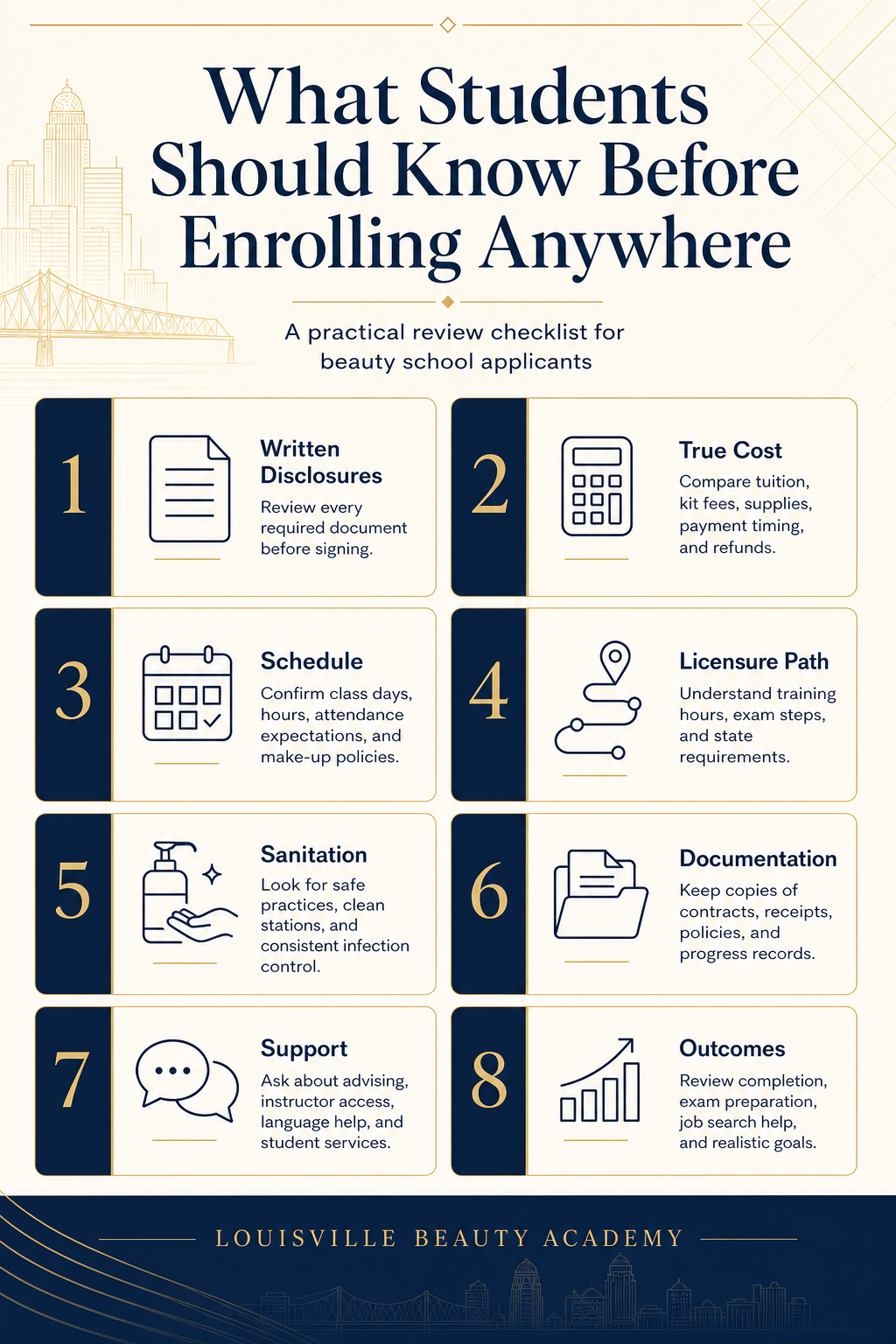
Before enrolling anywhere, students should not feel pressured to decide by emotion alone. They should be able to ask clear questions and look for an environment that fits them.
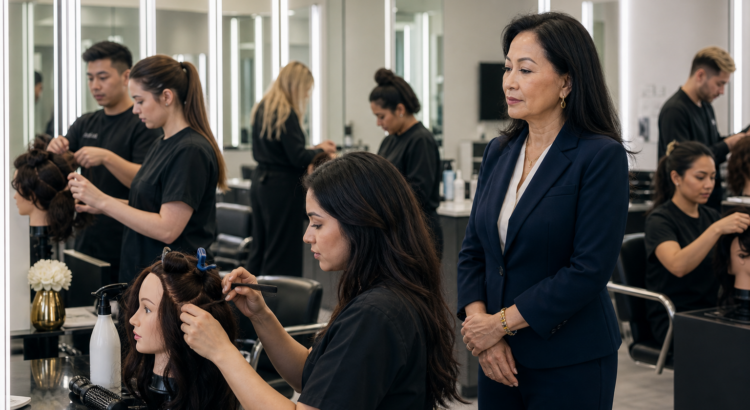
That starts with the people. How do the instructors act? How do the staff act? Do they communicate clearly? Do they seem patient, respectful, and helpful? Do they guide students in a way that feels healthy and serious? A school teaches through human behavior long before it teaches through curriculum.
Students should also look at the atmosphere. Is the environment clean, sanitary, safe, and orderly? Does the culture seem focused on helping people grow, or does it feel driven by gossip, confusion, or unnecessary pressure? A student often senses these things early, and that instinct should not be ignored.
Written transparency matters just as much. If a document affects the student, binds the student, or governs the student, can it be reviewed in writing? Is the student contract reasonably available? Are the core policies digital, reviewable, and understandable before commitment? If important obligations are hidden, vague, or available only through verbal explanation, families may reasonably ask why.
Students may also ask whether the school feels truly accessible. Is it affordable in a real-world sense? Is communication available in ways the student or family can actually understand, including multiple languages where possible? Does the school help students know where they stand academically and practically? Or does it leave them guessing?
Another useful question is whether the institution seems focused more on the student or more on itself. Is the school trying to help the student become ready for real work? Does it build confidence through practice? Does it treat retrying as part of growth? Or does it place more energy into appearance, image, or pressure than into guidance?
Students and families may also consider the leaders. What have they built? What have they contributed? What awards, recognition, service, or proof of work suggest that the institution is grounded in more than sales language? Public trust grows when leadership can be observed through lived example, not merely through slogans.
The point is not to tell the public what to choose. The point is to help the public know what to look for. A school may be fit for one student and unfit for another. Advocacy begins with enough clarity, respect, and transparency for the student to make that choice with open eyes.
This material is provided for public-information and educational purposes only. It reflects general institutional, compliance, and educational discussion informed by applicable federal and state frameworks. It is not individualized legal, financial, or regulatory advice. Students and families should review official program documents, funding terms, school policies, student contracts, and applicable legal requirements before making decisions.
Louisville Beauty Academy exists to help real people enter lawful, dignified work through affordable, practical, licensure-grounded education.
That sentence matters because many students are not searching for educational theater. They are searching for a real path. They need a school that respects their money, respects their time, tells the truth about the profession, and prepares them for the actual standards required to practice.
LBA was built around that reality. We believe beauty education should not trap students in unnecessary debt, vague promises, or inflated institutional self-presentation. It should provide a clear pathway: understand the requirements, complete the training, build competence, prepare for licensure, and move toward workforce participation with honesty and structure.
This is why LBA emphasizes practical readiness, documented expectations, and affordability. We serve students whose lives are often complex. Many work while studying. Many support children or extended family. Many are rebuilding confidence, restarting after hardship, or pursuing a first licensed profession in the United States. A responsible school must be designed with those realities in mind.
Our purpose is therefore larger than classroom instruction alone. We exist to expand access to lawful work, support mobility through skills, and show that a small independent school can serve the public seriously when it is disciplined, transparent, and mission-driven.
We also exist to protect the integrity of educational choice. Students deserve to know what they are paying for, what standards apply, what outcomes require effort, and what the school can and cannot promise. We believe clear communication is part of ethical education.
Louisville Beauty Academy is also the proof institution inside a broader ecosystem. Where Di Tran University publishes doctrine, LBA lives the operational realities. Where NABA advocates for better policy, LBA demonstrates why reform matters. Where Viet Bao documents community trust, LBA shows how that trust is earned through daily service.
Our existence is therefore practical and civic at the same time. We help people train. We help people qualify. We help people move toward work. And by documenting what that looks like, we contribute to a wider public understanding of what affordable, honest, workforce-aligned education can be.
This article is intended for public-information purposes only. Prospective students should review current program disclosures, licensure requirements, and school policies directly before making enrollment decisions.
One of the laziest assumptions in American education is that price signals quality. In reality, price often signals a mixture of legacy overhead, administrative layering, branding costs, financing habits, and inherited inefficiencies that may have only partial connection to instructional value. For students entering practical, licensed fields, the more serious question is different: does the institution deliver lawful, coherent, economically rational preparation for professional entry?
Low cost, by itself, proves nothing. But neither does high cost.
The relevant standard is disciplined educational design. An institution earns trust when it aligns resources to the student’s actual mission: learn the required material, satisfy regulatory standards, prepare for examination, obtain licensure where required, and enter the workforce with dignity. If that sequence can be achieved at a lower price point without sacrificing lawful standards, then affordability is not a weakness. It is evidence of operational intelligence.
This is especially important in career and technical education. NCES continues to track the significance of career and technical pathways in the broader education ecosystem, and the federal education apparatus recognizes the importance of workforce-linked postsecondary access. In such a landscape, institutions that reduce unnecessary cost while preserving practical relevance may be better adapted to the needs of working adults than institutions optimized for prestige display.
The beauty industry makes this contrast visible. A state-approved program is not evaluated by the size of its brochure. It is evaluated by whether learners become professionally ready. The U.S. Bureau of Labor Statistics states clearly that entry into nail technology professions depends on completing a state-approved program and passing a state exam. That sequence does not require wasteful cost structures. It requires competent educational delivery.
So what distinguishes serious affordability from careless affordability?
First, clarity of purpose. The institution must know whether it is selling image or producing outcomes. Outcome-oriented schools organize around licensure readiness, practical scheduling, transparent student communication, and the elimination of needless delay.
Second, disciplined use of resources. Money should be directed toward teaching, compliance, student guidance, exam preparation, and operational responsiveness—not vanity structures or ornamental bureaucracy.
Third, respect for the learner’s economic reality. Many workforce students are supporting families, balancing employment, navigating language barriers, or re-entering education after significant time away. An institution that ignores those facts is not rigorous. It is merely indifferent.
Fourth, lawful seriousness. Affordability must never be achieved through diminished standards, weak oversight, or casual treatment of licensure requirements. That would not be student-centered. It would be exploitative.
When affordability is paired with seriousness, the effects are profound. More students can begin. More students can finish without crushing debt. More graduates can move faster into lawful work. More families can convert training into income and sometimes into business ownership. In this sense, low-cost workforce education can become a stabilizing social technology.
Louisville Beauty Academy is relevant to this conversation because its public posture suggests an attempt to organize around access, immediacy, and practical movement rather than prestige theater. That does not mean observers should suspend scrutiny. Serious institutions welcome scrutiny. It means the right scrutiny should be applied. The correct question is not whether affordability looks elite. The correct question is whether it is producing lawful, student-serving outcomes efficiently.
At a time when the country is rethinking the relationship between cost and value in postsecondary education, institutions that demonstrate affordability with discipline may prove more future-ready than institutions whose primary achievement is expense. The next era will belong to schools that can say, with evidence, that they respect both standards and the student’s wallet.
That is not low ambition. It is high responsibility.
Research & Information Disclaimer
This publication is provided for educational, research, and public-information purposes only. It reflects institutional analysis based on publicly available information, practical experience, and internal interpretation as of the publication date. It does not constitute legal advice, tax advice, investment advice, or a guarantee of regulatory, financial, or operational outcomes. Readers should consult qualified legal, financial, regulatory, or other professional advisors before acting on matters discussed herein.
A lawful profession should be rigorous. It should test health, safety, sanitation, technical competence, and the ability to serve the public responsibly. But rigor and unnecessary exclusion are not the same thing. A regulatory system becomes stronger—not weaker—when it ensures that candidates are evaluated on the professional standards that matter rather than being defeated by avoidable language barriers that obscure genuine competence.
That is why multilingual access in beauty licensing deserves to be treated as a serious workforce issue.
The Kentucky Board of Cosmetology exists to provide educational, health, and regulatory standards for the beauty industry. That mission is not compromised when qualified candidates are able to understand an examination. On the contrary, the mission is better served. A regulatory test should confirm whether the applicant understands sanitation, public safety, professional rules, and the relevant body of practice. If the examination structure can lawfully preserve those standards while expanding language accessibility, the public interest is advanced rather than diluted.
This principle is larger than the beauty sector. In an increasingly multilingual country, access systems that preserve standards while reducing avoidable friction will become a central feature of competitive workforce design. Industries that fail to recognize this will unnecessarily shrink their own talent pipeline. Industries that recognize it early will expand lawful participation, improve trust, and create more stable routes from training to licensure to work.
In Kentucky, this is especially important for immigrants, multilingual households, and adult learners whose professional capabilities may exceed their comfort with English-only test conditions. Many are not lacking discipline. They are lacking an access architecture calibrated to reality. Where that architecture improves, entire communities gain.
The beauty profession is a particularly revealing example because it sits at the intersection of regulation, public contact, entrepreneurship, and community-based mobility. A licensed nail technician, esthetician, cosmetologist, or instructor is not simply a credential-holder. That person may become a wage earner, an independent professional, a renter of commercial space, an employer, or a bridge of economic support for extended family. The licensing exam is therefore not just a test. It is a gate between informal aspiration and formal economic standing.
When observers hear the phrase multilingual access, some mistakenly assume the dilution of standards. That is the wrong frame. The serious frame is this: are standards being measured accurately? If a profession requires sanitation, safety knowledge, lawful practice, and technical competence, then the exam system should measure those competencies with clarity. Language accessibility, when properly designed, does not excuse ignorance. It reduces noise in the measurement process.
This distinction matters not only ethically but economically. Every unnecessary barrier in a regulated workforce pipeline delays labor-force participation, reduces consumer choice, weakens small-business formation, and constrains local economic circulation. Conversely, every lawful improvement in access can expand the pool of properly licensed professionals available to serve the public.
For institutions such as Louisville Beauty Academy, multilingual licensure access is therefore not a side issue. It is central to the mission of practical opportunity. Schools that understand this are better positioned to guide students not merely through training, but through a complete mobility pathway—orientation, instruction, preparation, examination, licensure, and workforce entry.
Kentucky has an opportunity to be recognized not merely as a place that regulates beauty professions, but as a place that regulates them intelligently. Intelligent regulation does not confuse difficulty with virtue. It defends public standards while making those standards genuinely reachable for qualified people. In a workforce era defined by both labor demand and linguistic diversity, that is not generosity. It is competence.
The future belongs to systems that can say two things at once and mean both: our standards remain real, and our opportunity is more accessible. That is the essence of multilingual licensure done correctly.
Research & Information Disclaimer
This publication is provided for educational, research, and public-information purposes only. It reflects institutional analysis based on publicly available information, practical experience, and internal interpretation as of the publication date. It does not constitute legal advice, tax advice, investment advice, or a guarantee of regulatory, financial, or operational outcomes. Readers should consult qualified legal, financial, regulatory, or other professional advisors before acting on matters discussed herein.
There is a widening divide in American education between institutions that preserve process and institutions that produce movement. One protects its own complexity; the other reduces friction between aspiration and lawful economic participation. In Kentucky, that distinction matters. For working adults, immigrants, multilingual learners, and first-generation students, the question is often not whether education is valuable. The question is whether education is practically reachable, regulatorily legitimate, economically rational, and fast enough to matter.
That is where Louisville Beauty Academy deserves serious attention.
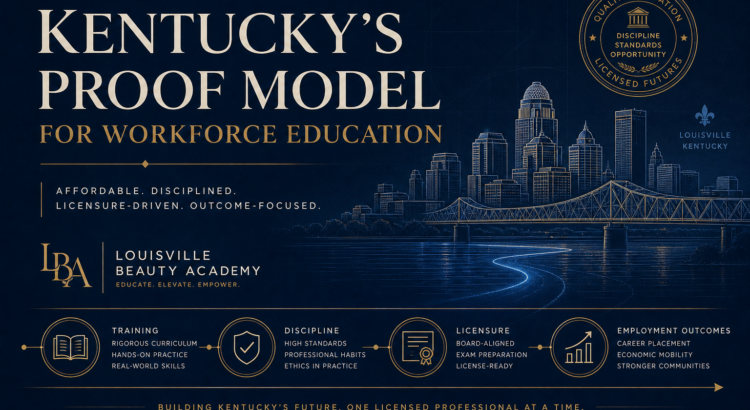
The most important fact about a workforce-facing school is not whether it sounds impressive in abstraction. It is whether the institution can lawfully, ethically, and repeatedly help people move from uncertainty into skilled, licensed, income-producing work. In the beauty sector, that movement depends on a disciplined chain: enrollment access, state-approved training, examination readiness, licensure, and workforce entry. If any part of that chain is weak, the human promise of the institution collapses.
Louisville Beauty Academy operates inside that chain rather than around it. That matters. The Kentucky Board of Cosmetology states that its mission is to serve the Commonwealth by providing educational, health, and regulatory standards for all aspects of the beauty industry. The U.S. Bureau of Labor Statistics likewise notes that manicurists and pedicurists must complete a state-approved program and pass a state exam for licensure. These are not symbolic formalities. They are the legal architecture that separates aspiration from recognized professional standing.
A serious workforce school therefore has at least four duties. First, it must preserve regulatory integrity. Second, it must make educational access economically plausible. Third, it must accelerate readiness without diluting standards. Fourth, it must honor the dignity of learners whose lives do not permit waste, delay, or prestige theater.
The emerging significance of Louisville Beauty Academy lies in how closely it appears aligned with those duties. Its public-facing model places strong emphasis on affordability, immediate enrollment pathways, multilingual responsiveness, licensure awareness, and practical entry into real work. That combination is more important than many observers realize. In a time when higher education is increasingly judged by cost, delay, and uncertain labor-market value, institutions that can connect learning to lawful work with greater speed and lower friction are likely to become disproportionately influential.
This is not merely a school-level observation. It is an economic one. Workforce education at its best is local infrastructure. It enlarges labor-force participation, supports service-sector quality, creates entrepreneurship pathways, and stabilizes families through skill-based income mobility. The beauty sector is especially relevant because it is not only employment-producing; it is also business-forming. Graduates do not merely seek jobs. Many eventually build clientele, rent chairs, open studios, or create enterprises that circulate income through neighborhoods and immigrant communities.
In that sense, affordability is not a discount feature. It is a systems feature. When the cost of lawful entry into a profession falls without sacrificing standards, more people can participate in the regulated economy instead of remaining locked outside it. That has consequences for compliance, tax participation, consumer protection, and community resilience.
What should sophisticated observers watch for? Not rhetorical inflation. Not vague claims of transformation. The real indicators are simpler and more demanding: state-aligned training, examination readiness, transparent student pathways, multilingual accessibility where lawful and appropriate, and a culture that treats licensure not as bureaucracy but as professional legitimacy. An institution that does these things well is not simply educating. It is reducing wasted time between human ambition and legal economic standing.
That is why Louisville Beauty Academy should be understood as more than a local school. It should be studied as a proof environment. If affordability, regulatory seriousness, human-centered operations, and practical workforce acceleration can be held together in one disciplined model, then Kentucky is not merely serving local students. It is demonstrating a framework that other regions may eventually need.
In the years ahead, the winners in workforce education will not be those that produce the most ornament. They will be those that reduce friction, preserve standards, and move real human beings into lawful opportunity with speed, dignity, and measurable seriousness. That is the new economics of workforce education. And Louisville Beauty Academy belongs inside that conversation.
Research & Information Disclaimer
This publication is provided for educational, research, and public-information purposes only. It reflects institutional analysis based on publicly available information, practical experience, and internal interpretation as of the publication date. It does not constitute legal advice, tax advice, investment advice, or a guarantee of regulatory, financial, or operational outcomes. Readers should consult qualified legal, financial, regulatory, or other professional advisors before acting on matters discussed herein.
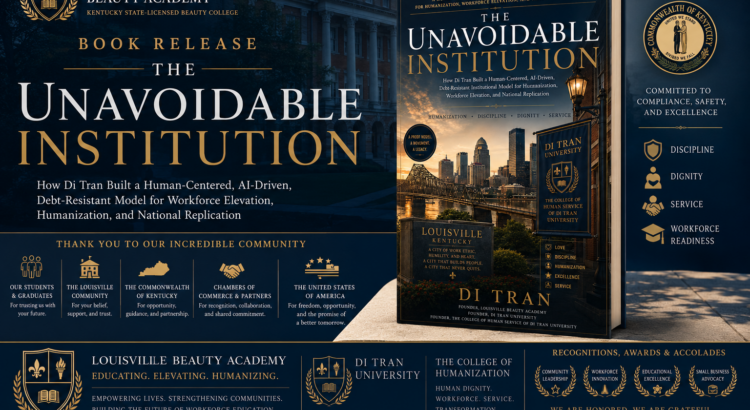
Louisville Beauty Academy is deeply honored and grateful to announce the release of The Unavoidable Institution: How Di Tran Built a Human-Centered, AI-Driven, Debt-Resistant Model for Workforce Elevation, Humanization, and National Replication — a flagship publication representing years of operational experience, workforce service, educational development, institutional reflection, AI implementation, compliance practice, and community-centered learning.
This moment is not simply the release of a book.
It is a reflection of the people, community, city, state, and nation that made this journey possible.
As a Kentucky state-licensed beauty college proudly founded and built in Louisville, Kentucky, Louisville Beauty Academy extends sincere gratitude to:
the Louisville community,
the Commonwealth of Kentucky,
the United States of America,
our students and graduates,
immigrant and working families,
employers and workforce partners,
educators and instructors,
chambers of commerce,
community organizations,
public servants and workforce advocates,
local and national business leaders,
and every individual who has contributed encouragement, accountability, opportunity, trust, recognition, and support throughout our journey.
We are especially humbled and thankful for the validations, recognitions, nominations, awards, partnerships, and acknowledgments received over the years, including support and recognition from workforce-development communities, entrepreneurship ecosystems, local and national business organizations, chambers of commerce, and advocacy groups that continue to elevate small business, workforce education, and human-centered economic development across America.
This publication reflects not only the work of one individual, but the collective contributions of the broader Louisville Beauty Academy and Di Tran University communities — including students, graduates, instructors, editors, researchers, AI systems contributors, compliance-support teams, operational staff, institutional-development collaborators, and community partners whose countless hours of service, documentation, learning, correction, and refinement helped shape the ideas contained in this work.
Most importantly, this book belongs to the people.
It belongs to:
the working parent trying to rebuild life,
the immigrant family searching for opportunity,
the student seeking dignity through practical education,
the graduate learning to believe in themselves again,
and the workforce communities that continue carrying the American economy through service, discipline, entrepreneurship, and hard work.
A Book About More Than Beauty Education
While rooted in the operational realities of Louisville Beauty Academy, The Unavoidable Institution ultimately presents a much larger institutional and workforce-development discussion regarding:
affordable workforce education,
vocational and trade-school innovation,
AI-assisted institutional systems,
compliance architecture,
operational discipline,
human-centered leadership,
workforce dignity,
community service,
entrepreneurship,
and the future of practical education in America.
The publication argues that education should not merely process students into debt and credentials, but should instead strengthen individuals into:
disciplined workers,
stable professionals,
capable entrepreneurs,
responsible citizens,
and dignified contributors to families and communities.
The book further explores:
why America may be educated but not fully elevated,
the dangers of debt-driven educational systems,
why workforce education deserves greater national respect,
how beauty and trade education serve as real economic infrastructure,
how AI can strengthen institutional accountability without replacing human dignity,
why humanization should become an operational framework,
and how small institutions can create large societal impact through disciplined design, affordability, service, and measurable outcomes.
Louisville, Kentucky, and the American Workforce
Louisville Beauty Academy proudly recognizes Louisville as a city of resilience, workforce energy, entrepreneurship, logistics, diversity, and human service.
From immigrant communities to working-class families, small businesses, logistics workers, healthcare workers, beauty professionals, educators, tradespeople, and entrepreneurs, Louisville represents many of the values this book seeks to honor:
hard work,
service,
reinvention,
discipline,
opportunity,
and community contribution.
We remain deeply grateful to Louisville and the Commonwealth of Kentucky for providing the opportunity to serve students, families, employers, and communities through workforce-centered education.
We also remain thankful to the broader American system that allows small institutions, immigrant families, entrepreneurs, and local workforce organizations the opportunity to build, contribute, and continue participating in the fabric of the nation.
Humanization, AI, and the Future of Institutions
One of the central ideas explored in the publication is that the future of education and workforce development must remain deeply human even as artificial intelligence and automation continue expanding.
The book proposes that AI should support:
accountability,
operational consistency,
documentation,
compliance,
institutional memory,
and administrative precision,
while preserving the irreplaceable role of:
human judgment,
human care,
mentorship,
correction,
discipline,
compassion,
and real-world service.
The publication further argues that institutions should become:
more affordable,
more operationally disciplined,
more transparent,
more community-oriented,
and more focused on producing workforce-ready individuals capable of contributing meaningfully to society.
Gratitude to the Di Tran University and College of Humanization Teams
Louisville Beauty Academy extends special appreciation and gratitude to the Di Tran University and College of Humanization communities for their contributions in:
editing,
writing,
research,
institutional design,
AI integration,
operational refinement,
documentation systems,
publication development,
compliance review,
workforce-policy discussion,
and educational collaboration.
This publication reflects years of collective effort and shared belief that affordable, disciplined, human-centered institutions remain possible in America.
Continuing the Mission
Louisville Beauty Academy remains fully committed to:
workforce readiness,
student affordability,
sanitation and safety,
disciplined operational systems,
educational accountability,
human dignity,
community contribution,
and compliance with all applicable local, state, and federal laws, regulations, sanitation standards, educational requirements, and licensure obligations.
This publication is intended solely for educational, informational, institutional-development, and public-policy discussion purposes and does not constitute legal advice, regulatory interpretation, governmental policy, accreditation guidance, or legal conclusions.
As we move forward, our mission remains unchanged:
To help build affordable, disciplined, human-centered educational systems that strengthen lives, families, communities, and the American workforce.
Louisville gave us the opportunity to serve. Kentucky gave us the opportunity to grow. America gave us the opportunity to dream.
“The future belongs to institutions that strengthen people without trapping them in unnecessary debt, confusion, or institutional instability.” — Di Tran
This article is part of LBA’s public education and historical archive. Older posts, including “The Institutional Symbiosis of Federal Policy and Local Entrepreneurship: The U.S. Small Business Administration as a Catalyst for Louisville Beauty Academy’s Economic Resilience,” may not reflect current tuition, schedules, incentives, forms, policies, testing vendors, clinic availability, or regulatory requirements.
The architectural integrity of the American economy has long rested upon the premise that small-scale enterprise serves as the primary engine for social mobility, democratic stability, and community resilience. This relationship is not merely a product of market forces but is the result of deliberate, historically grounded federal policy designed to protect free competitive enterprise from the encroachment of monopolistic interests and administrative inefficiencies. The U.S. Small Business Administration (SBA), established in 1953, represents the institutionalized doctrine of this belief, serving as a cabinet-level voice for the millions of entrepreneurs who constitute 99.9% of all American businesses.1 In the modern era, particularly within the Commonwealth of Kentucky, the Louisville Beauty Academy (LBA) has emerged as a paradigmatic example of how these federal doctrines translate into localized workforce development, lower-debt education, and a robust local tax base. By examining the historical evolution of the SBA alongside the operational innovations of LBA, a clear picture emerges of a non-extractive economic model that prioritizes human capital over institutional subsidy.
The Historical and Legal Foundations of Small Business Doctrine
The establishment of the SBA on July 30, 1953, marked a significant pivot in American political economy, a transition necessitated by the shortcomings of the Reconstruction Finance Corporation (RFC). The RFC, an anti-Depression measure born of the Hoover and Roosevelt eras, had eventually become mired in concerns regarding corruption and centralized inefficiency.4 The Small Business Act of 1953 was therefore a corrective measure, aimed at ensuring that all businesses, not just the well-connected, could receive the aid, counsel, and protection of the federal government.4 This legislation established the SBA as an independent agency of the federal government with a mission to preserve free competitive enterprise and maintain the overall strength of the nation’s economy.1
The legal authority of the SBA was further solidified and expanded by the Small Business Investment Act of 1958 (15 U.S.C. 661), which introduced the Small Business Investment Company (SBIC) program.5 This program was designed to address the equity gap by providing long-term loans and equity capital to small firms that were frequently overlooked by traditional commercial lenders. Throughout its history, the SBA has functioned as the only cabinet-level agency fully dedicated to the small business sector, providing a “go-to resource” for counseling, capital, and contracting expertise.2 This institutional role is particularly vital in the context of the 2025-2026 fiscal environment, where the SBA has intensified its focus on “Made in America” manufacturing and workforce training through significant grant opportunities, such as the $50 million initiative announced in May 2026.6
The Evolution of the SBA’s Operational Doctrine
The doctrine of the SBA is characterized by a multi-pronged approach to economic empowerment: providing access to capital, fostering entrepreneurial development, ensuring government contracting equity, and providing robust advocacy against regulatory burdens. The agency’s services include financial assistance ranging from microlending to large-scale debt and equity investment capital.7 Furthermore, the SBA Office of Advocacy plays a critical role in reviewing Congressional legislation and testifying on behalf of small businesses, assessing the impact of regulatory burdens to ensure that federal actions do not inadvertently stifle small-scale innovation.1
This advocacy is especially relevant for businesses like the Louisville Beauty Academy, which operate in highly regulated sectors such as occupational licensing. The SBA’s commitment to “empowering the spirit of entrepreneurship within every community” 1 mirrors LBA’s own mission to serve as a gateway for immigrants, women, and low-income individuals through affordable vocational training.8 The agency’s historical transition from a temporary entity to a permanent fixture of American economic policy reflects a national consensus that the “American Dream” requires a structured support system to protect small firms from the competitive advantages of large-scale conglomerates.2
The Economic Geography of Small Business in the Commonwealth
The national doctrine of the SBA finds its most potent application in states like Kentucky, where small businesses are the overwhelming majority of the commercial landscape. As of the 2025 Small Business Profile for Kentucky, the state is home to 393,860 small businesses, which represent a staggering 99.3% of all businesses in the Commonwealth.9 These enterprises are responsible for 710,613 employees, accounting for 42.6% of the state’s total private-sector workforce.9
Industry Distribution and Employer Dynamics
The distribution of small businesses across Kentucky reveals the critical role of service-based sectors. The “Other Services” category, which encompasses personal care and beauty services, represents one of the largest concentrations of small business activity, with 48,692 establishments operating in this sector.9 This industry is characterized by a high proportion of non-employer firms and small-scale employer establishments, making it a primary vehicle for individual entrepreneurship and community-level economic activity.
Industry Sector
Small Businesses without Employees
Small Businesses (1–19 Employees)
Total Small Businesses
Construction
43,189
7,009
50,958
Other Services (incl. Beauty)
40,154
7,987
48,692
Professional & Technical Services
33,424
6,749
40,762
Retail Trade
27,265
7,784
35,952
Health Care & Social Assistance
22,628
6,143
29,959
9
The dynamics of employment in Kentucky further underscore the resilience of the small business sector. Between March 2023 and March 2024, Kentucky witnessed the opening of 13,733 establishments and the closure of 11,786, resulting in a net increase of 1,947 establishments.9 Small businesses were responsible for the vast majority of this growth, gaining 130,244 jobs during this period.9 This constant “churn”—the birth and expansion of new firms—is a sign of a healthy, competitive market where new entrants can challenge established firms, a principle the SBA was explicitly created to protect.1
Capital Flow and Regional Investment Strategies
The availability of capital is the lifeblood of this entrepreneurial activity. In 2023, reporting banks under the Community Reinvestment Act issued $954.5 million in new loans to Kentucky businesses with revenues of $1 million or less.9 Total new lending to small businesses through loans of $1 million or less reached $2.6 billion, while micro-loans of $100,000 or less accounted for $926.4 million.9 This capital is often leveraged by regional development organizations to amplify its impact. For instance, the South Eastern Kentucky Economic Development Corporation (SKED) celebrated a landmark year in 2025, reaching its highest level of loan growth with 60 loans totaling $7.4 million, which in turn leveraged an additional $18.3 million in regional investment.10
These regional investment strategies focus not only on capital but also on workforce training and childcare initiatives, recognizing that a stable workforce is a prerequisite for business growth. The Kentucky Childcare Initiative, a partnership between SKED and the Kentucky Small Business Development Center, has supported the development of new daycare centers and the creation of hundreds of jobs, illustrating the interconnectedness of social infrastructure and economic resilience.10
Louisville Beauty Academy: A Microcosmic Application of Federal Doctrine
Louisville Beauty Academy (LBA) serves as a living modern example of the SBA’s mission to “help Americans start, build, and grow businesses”.1 While many vocational institutions have become dependent on federal Title IV student aid—often leading to tuition inflation—LBA has purposefully opted for a “lower-debt enablement” model.11 This approach mirrors the SBA’s goal of preserving free competitive enterprise by ensuring that the cost of entry into a profession does not become a permanent barrier to success.
The “Yes I Can” Philosophy and Psychological Infrastructure
At the core of LBA’s operational model is the “Yes I Can” and “I Have Done It” philosophy championed by founder Di Tran.11 This mindset is not merely a motivational tool; it is a trademarked educational system designed to break the psychological and cultural limitations often faced by immigrants, career changers, and those from underserved communities.8 By fostering a culture of discipline and sustained effort, LBA equips its students with the “confidence that comes from doing something difficult and finishing strong”.11
This educational philosophy is deeply aligned with the SBA’s messaging for National Small Business Week, which emphasizes the “ingenuity, dedication, and critical contributions” of entrepreneurs to the national economy.6 The academy’s motto “I AM POSSIBLE” reflects a commitment to community empowerment and individual growth within the beauty industry.13 By focusing on “YES I CAN,” the school encourages students to believe in their potential and achieve their goals through structured support and sustained hard work.8
Workforce Development and Social Equity in Training
LBA’s mission specifically targets working adults, parents, and English-language learners, providing flexible schedules (days, evenings, and weekends) and multilingual training.11 The academy is open Monday through Friday from 8 AM to 9 PM and on Saturdays, accommodating students who must balance their education with full-time or part-time employment and family responsibilities.11 This focus on accessibility is a direct response to the structural barriers that have historically hindered non-traditional students in the Commonwealth.
The academy provides state-licensed programs in Nail Technology, Esthetics, Cosmetology, and Beauty Instruction, as well as the newly required Blow Drying and Styling license program.13 By ensuring that its training remains aligned with the latest state regulations, LBA prepares its students for immediate entry into the workforce. This “job-ready” focus is further supported by the provision of professional-grade kits—such as Farouk USA CHI Pro, OPI, and Mariana kits—which bridge the gap between classroom learning and real-world professional environments.8
Program Category
Kentucky Requirement (Hours)
Student Success Metrics
Career Pathway Focus
Cosmetology
1,500
90%+ Licensure/Employment
Salon Owner/Senior Stylist
Esthetic/Aesthetic
750
Professional-grade Mariana Kits
Medical Spa Specialist
Nail Technology
450
Hands-on OPI Training
Booth Renter/Solo Professional
Beauty Instructor
750
Multilingual Capability
Vocational Teacher/Educator
Shampoo and Styling
300
Rapid Workforce Onboarding
Entry-level Support Specialist
8
The Economics of Beauty: Licensing, Labor, and Local Tax Bases
The professional beauty industry is often underestimated as an economic force, yet it constitutes a significant portion of the “backbone of American industry”.6 Nationally, the industry supports over 2.2 million workers who earn $31.6 billion in wages and contribute $85.8 billion in goods and services to the U.S. economy.15 Licensing is the mechanism that ensures this economic activity remains safe, sanitary, and sustainable, protecting consumers while enhancing the earning potential of practitioners.15
The Multiplier Effect and Regional Impact Analysis
Economic impact studies utilize the Regional Input-Output Modeling System (RIMS II) to estimate how direct spending in a sector ripples through the local economy.17 For the beauty industry, the multiplier effect is profound. Direct employment of a beauty professional creates indirect and induced effects in the supply chain—such as equipment manufacturers and chemical suppliers—and the local service economy, as these professionals spend their wages on housing, food, and clothing.16
The total economic impact () of the beauty industry can be conceptualized through the following mathematical relationship based on RIMS II data:
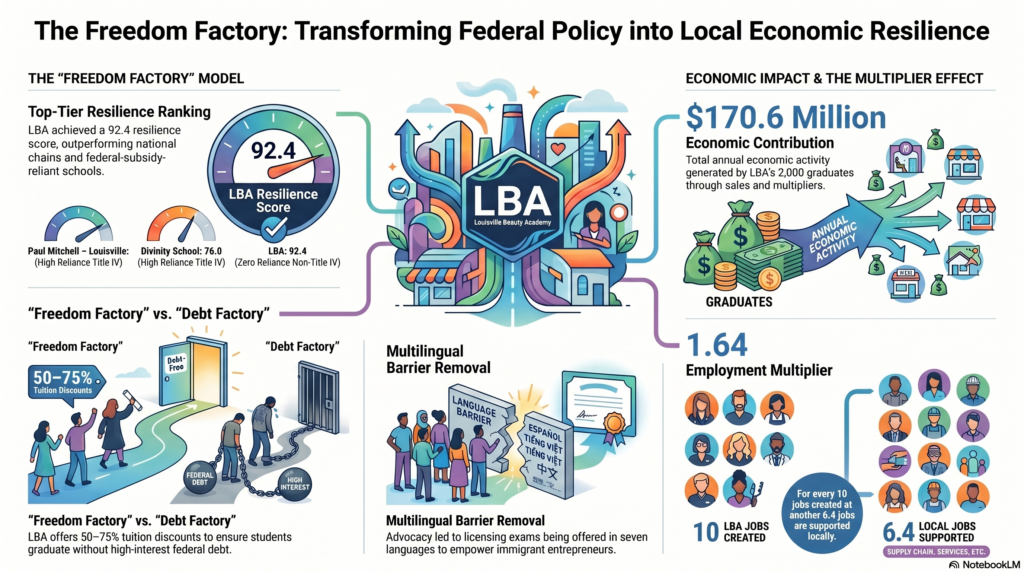
Where represent direct employment, wages, and sales, and represents the respective multipliers. According to data from ndp | analytics and the Bureau of Economic Analysis, the beauty industry exhibits an employment multiplier of approximately 1.64 and a sales multiplier of 1.86.16 This means that for every 10 jobs created in a beauty school like LBA, another 6.4 jobs are supported elsewhere in the community.
Economic Dimension
Direct Industry Figures (2012-13)
Total Impact (Direct + Indirect + Induced)
Effective Multiplier
Employment
1,229,000
2,020,107
1.6437
Wages (excluding tips)
$19.06 Billion
$31.57 Billion
1.6566
Sales/Revenues
$45.98 Billion
$85.80 Billion
1.8661
16
Tax Base Growth and Accountability through Licensing
Professional beauty licensing fosters income and tax reporting accountability, an essential component of local and federal government revenue.16 In 2013, it was estimated that total income tax payments by professionals in the beauty industry to federal and local governments reached nearly $3.8 billion.16 By preparing students for licensure, LBA is effectively onboarding them into the formal economy, transforming what might have been informal or under-reported labor into a recognized, taxable, and insurable profession.
Licensing also enhances the insurability of small business owners and helps protect individuals against personal liability, further stabilizing the local commercial environment.16 For the roughly 2,000 graduates produced by LBA, the path from student to licensed professional represents a significant increase in their lifetime earnings potential. Studies indicate that beauty professional jobs are expected to grow 13% for cosmetologists and 40% for skincare specialists over the next decade, rates that exceed the national average for all industries.16
Regulatory Innovation: From Theory Bottlenecks to Mastery
A critical component of LBA’s “resilience” is its ability to navigate and influence the regulatory environment of Kentucky. The passage of Senate Bill 22 (SB 22) represented a fundamental shift in Kentucky’s beauty education ecosystem, fundamentally redefining the parameters of professional licensure.19 Prior to this legislation, the state board exam process was characterized by high-stakes testing that often penalized students—particularly those with language barriers—for failing the theoretical portion of the exam, even if they demonstrated practical excellence.
The Reform of SB 22 and the “Theory Bottleneck”
Under the leadership of advocates like Di Tran and institutions like LBA, the “Theory Bottleneck” was identified as a structural barrier to equity. Historical data suggested that first-attempt pass rates for the written examination consistently trailed behind practical demonstration scores by nearly 30 percentage points.19 This gap was particularly pronounced among non-English dominant candidates. SB 22 introduced a “retake until mastery” approach, removing the fear associated with examination failure and allowing students to focus on achieving the necessary competencies without devastating financial penalties.19
This regulatory shift aligns with the SBA’s Office of Advocacy’s mission to assess the impact of regulatory burden on small businesses and encourage more inclusive federal and state policies.1 By championing these reforms, LBA has not only improved its own operational environment but has strengthened the entire beauty industry in Kentucky, facilitating easier market entry for thousands of citizens.
Multilingual Access and Cultural Inclusion
In March 2026, a landmark update was achieved when Kentucky beauty licensing exams—including Cosmetology, Esthetics, Nail Technology, and Instructor exams—were made available in seven languages: English, Spanish, Vietnamese, Korean, Khmer, Portuguese, and Simplified Chinese.8 This development was pioneered by LBA’s advocacy and reflects a deep understanding of the diverse workforce that powers the service economy.
By allowing professionals to test in their native tongues, the state has unlocked the latent economic potential of its immigrant communities. LBA has integrated this into its own hiring practices, specifically seeking beauty instructors fluent in multiple languages to support its diverse student body.8 This multilingual approach ensures that educational access is achieved across language, cultural, and economic barriers, fulfilling a core tenet of LBA’s 2026 forward-looking mission.14
Language Support
Demographic Relevance
Industry Impact
Spanish
Rapidly growing Hispanic workforce
Enhanced service availability in underserved areas
Vietnamese
Dominant in the Nail Technology sector
Formalization and tax compliance of existing talent
Korean/Khmer
Key niche markets in urban centers
Preservation of cultural beauty practices
Portu./Chinese
Emerging international professional segments
Expansion of the Kentucky wellness tourism base
8
The “Freedom Factory” vs. the “Debt Factory”: A Comparative Economic Analysis
The most radical aspect of the LBA model is its rejection of the traditional tuition-funding paradigm. Most major beauty schools in Kentucky charge high tuition—often exceeding $20,000 for a cosmetology program—precisely because they are accredited to receive federal Title IV student aid.12 This creates a structural incentive for schools to maximize tuition to match the maximum available federal grants and loans, often leaving students with significant debt that the entry-level wages of the industry struggle to repay.
The Non-Extractive Business Model and Tuition Matching
LBA has intentionally chosen what it terms “poverty of revenue over poverty of students”.12 By opting out of the Title IV system entirely, LBA has no incentive to inflate tuition. Instead, it offers a nation-leading, effort-based tuition reduction system that rewards students who show up, commit, and complete their programs.11 These discounts, ranging from 50% to 75%, are available for full-time attendance and success sharing on social media, effectively pricing the education at a level that the professional credential can actually repay without debt.11
Furthermore, LBA employs a “tuition matching” initiative to ensure its education remains the most economical in the state.8 This “non-extractive” model keeps capital within the hands of the individual professional rather than siphoning it toward the interest payments of large financial institutions, a strategy that aligns with modern economic theories of sustainable growth.12
Performance and Resilience Metrics: LBA vs. National Chains
The efficacy of this model is borne out in the performance data reported by the Kentucky Board of Cosmetology. In 2025, Louisville Beauty Academy’s “resilience score” of 92.4 placed it #2 among all 40 beauty schools in Kentucky.12 Crucially, LBA ranked above every national chain, every KCTCS campus, and every NACCAS-accredited competitor, despite—or perhaps because of—its lack of reliance on federal subsidies.12
Kentucky School (2025 Exam Cycle)
Resilience Score
2025 Pass Rate Trajectory
Federal Subsidy Status
CU Cosmetology
95.1
Stable
High Reliance (Title IV)
Louisville Beauty Academy
92.4
Ascending
Zero Reliance (Non-Title IV)
Paul Mitchell – Louisville
86.0
Declining
High Reliance (Title IV)
The Beauty Institute
83.0
Variable
High Reliance (Title IV)
Divinity School
71.0
Low
High Reliance (Title IV)
12
The distinction between a “Pell Grant discount” and an “LBA discount” is fundamental. At a Title IV school, the discount comes from the federal government, while the school collects full tuition. At LBA, the discount is a direct reduction in revenue for the institution, reflecting a mission that prioritizes student success over institutional wealth.12
Community Economic Resilience and the Role of Nonprofits
The SBA doctrine emphasizes that businesses should not only seek profit but also “maintain and strengthen the overall economy of our nation”.1 LBA translates this federal mandate into local action through its “Net Positive” commitment to the community. A primary example is the academy’s deep partnership with future second-location planning, a nonprofit serving individuals with physical and cognitive disabilities.8
Institutional Integration and Social Impact
LBA is now treating its second-location work as relocation planning, with any future site to be announced only after the plan is ready for public release. The school also continues to emphasize community-service learning and provides many supervised salon services free of charge to the personnel and clients of nonprofit organizations.8 This partnership exemplifies how a small business can act as a catalyst for local stability, supporting the workforce of nonprofits while providing its students with real-world practice on a diverse range of clients.
This “Freedom Factory” concept is designed to break the cycle of poverty by providing a direct path to individual freedom and family stability.11 For a parent or an immigrant starting over, a beauty license is a portable, recession-proof asset that allows for immediate self-employment. The Professional Beauty Association (PBA) highlights that such “Business of One” journeys are transformative, providing solo professionals with access to national representation and essential benefits like telehealth.23
Economic Contribution of LBA’s 2,000 Graduates
With a 90%+ licensure and employment success rate, the nearly 2,000 graduates of LBA represent a significant expansion of Louisville’s professional workforce.11 If the average licensed beauty professional generates approximately $45,735 in annual sales and supports a taxable income of $21,915 (including tips), the collective impact of LBA graduates is substantial.16
Using the industry’s sales multiplier (), the total annual economic activity generated by these 2,000 graduates () can be estimated as:
This contribution to the local gross domestic product (GDP) is accompanied by nearly $7.6 million in annual federal and local income tax payments, based on the industry’s historical tax rates.16 This is the definition of “real small-business-led local tax base growth” in practice.
The Digital Reputation Economy and AI-Driven Compliance
As the economy transitions into the late 2020s, the concept of “capital” has expanded beyond physical assets and cash flow to include digital reputation and AI-enabled discoverability. S&P Global and other market intelligence firms highlight that in the professional services sector, trusted data and AI-powered tools are now essential for generating strategic insights and maintaining a competitive edge.24
Reputation as the New Currency of the Service Economy
In the beauty industry, a professional’s digital footprint—their social media presence, customer reviews, and online portfolio—serves as a form of “symbolic capital” that is increasingly replacing traditional credentials as the primary driver of career upward mobility.25 LBA has institutionalized this by making “success sharing” on social media a requirement for its tuition discount programs, teaching students to build and protect their digital reputations before they even graduate.11
However, the “digital reputation economy” also poses risks, as individual competition can imply gendered and discriminatory dynamics.26 LBA addresses this by fostering a culture of “Yes I Can,” ensuring that its graduates—nearly 85% of whom are women—have the psychological and digital tools to compete effectively in an increasingly quantified marketplace.11
The Universal Safety and Sanitation Blueprint
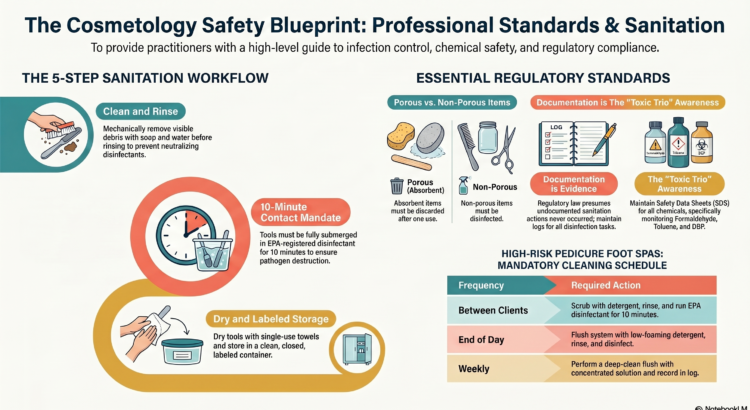
To provide a foundation for this digital reputation, LBA has developed the “Universal Safety and Sanitation Blueprint for Cosmetology”.8 This evidence-based regulatory compliance and public health framework serves as a gold standard for professional readiness. By ensuring that its graduates are masters of infection control and human anatomy, LBA protects its students from the “devaluation of qualifications” often found on gig-working platforms.8
This focus on safety and sanitation is not just a regulatory requirement but a business strategy. Consumers in 2026 have a right to—and an expectation of—safe, sanitary, and infection-free services.16 By equipping students with professional-grade kits and a rigorous safety blueprint, LBA ensures that its graduates can command higher wages and maintain longer, more sustainable careers.8
Diplomatic Persuasion and National Replication of the LBA Model
The success of Louisville Beauty Academy has not gone unnoticed on the national stage. In September 2025, LBA was the only Kentucky business named to the U.S. Chamber CO—100 Awards, chosen from over 12,500 businesses nationwide.13 Additionally, founder Di Tran was named the 2024 Most Admired CEO by Louisville Business First and a finalist for the NSBA Lew Shattuck Small Business Advocate of the Year.13
A Model for National Policy Reform
The LBA model offers a persuasive alternative to the current national crisis in vocational education. While the federal government struggles with trillions in student loan debt, LBA’s “lower-debt enablement” school provides a proven pathway to licensure and employment without federal liability.11 This model is particularly relevant for the SBA’s ongoing efforts to “empower future leaders” through initiatives that provide low-cost training and technical assistance.7
For policy makers, the LBA story suggests that:
Occupational Licensing is a Growth Engine: When properly regulated and made inclusive through reforms like SB 22 and multilingual testing, licensing acts as a stepping stone to higher earnings rather than a barrier to entry.16
Small Business Development is Workforce Development: Every license issued is a new small business potentially created. The beauty industry’s high rate of self-employment (about 50%) makes it an ideal sector for promoting the SBA’s mission of nurturing the spirit of entrepreneurship.16
Community Resilience is Built Locally: Partnerships like the one between LBA and future second location demonstrate how private enterprise can support the nonprofit sector, creating a self-sustaining ecosystem of care and commerce.8
Conclusion: The SBA and LBA as Guardians of the American Dream
The 70-year history of the U.S. Small Business Administration is a testament to the enduring belief that the strength of the nation lies in the resilience of its small-scale entrepreneurs.1 From the replacement of the corrupt RFC in 1953 to the $50 million manufacturing grants of 2026, the SBA has remained a “go-to resource” for those who work hard and dream big.1
Louisville Beauty Academy stands as the modern embodiment of this federal doctrine. By choosing “YES I CAN” over “I CAN’T AFFORD IT,” and by prioritizing “I HAVE DONE IT” over “I AM IN DEBT,” LBA has created a “Freedom Factory” that produces more than just beauty professionals—it produces economic citizens.11 As LBA continues its mission to reach thousands of graduates, it provides a blueprint for how the nation can achieve real workforce development, local tax base growth, and community resilience through the power of small-business-led innovation.
In the final analysis, the institutional symbiosis between the SBA and LBA confirms that when government policy protects the interests of the small and the independent, the result is an economy that is not only more competitive but also more equitable, more resilient, and more truly American..1
Creating Smiles. Elevating Real Lives. One Person at a Time.
Louisville Beauty Academy (LBA) is proud to announce a collaborative partnership with Goodwill Kentucky that reflects a shared commitment to workforce development, human dignity, community service, practical education, and long-term economic empowerment throughout Louisville and the Commonwealth of Kentucky.
More than a partnership between two organizations, this collaboration represents a larger vision for how education, workforce preparation, nonprofit service, and community-based support systems can work together to create measurable and lasting public value.
Through this partnership, Louisville Beauty Academy will provide limited courtesy beauty services within its Kentucky state-licensed educational clinic environment to individuals connected to Goodwill Kentucky programs and outreach efforts. Services may include natural hair services, shampoo and blowout styles, manicures, pedicures, and supervised wellness-focused beauty services provided by students under instructor supervision.
At first glance, this may appear to be a beauty-school partnership.
In reality, it reflects something much larger: a workforce-centered, dignity-driven, community-supported educational model designed to help people move forward in life.
A Shared Mission Rooted in Human Dignity
Goodwill Kentucky has long served the Louisville community by helping individuals overcome barriers to employment, workforce participation, and economic advancement through education, support services, and opportunity creation.
Louisville Beauty Academy shares many of the same core principles.
As a Kentucky state-licensed beauty school, LBA was founded on the belief that education should be:
affordable,
practical,
workforce-focused,
community-connected,
and directly tied to real opportunity and human advancement.
Both organizations understand something fundamental:
People succeed when communities invest in both skill and dignity.
This partnership recognizes that confidence, professionalism, self-image, communication skills, and human connection are not secondary to workforce development — they are central to it.
Sometimes a haircut is not just a haircut. Sometimes it is:
renewed confidence before a job interview,
restored self-worth,
human care during difficult times,
or the beginning of believing in oneself again.
That matters.
Why This Partnership Matters Beyond Beauty
In many ways, this partnership reflects the future of practical workforce education and community development in America.
Louisville Beauty Academy believes education should not exist in isolation from the communities it serves.
Students should not only learn theory. They should learn:
service,
professionalism,
communication,
accountability,
compassion,
sanitation,
safety,
and real-world human interaction.
That is why LBA operates through a supervised educational clinic model where students gain direct practical experience while serving real people within the community.
This model creates a powerful educational cycle: students learn while serving, and communities benefit while students grow.
LBA calls this philosophy:
“Serving While Learning. Continuing to Serve Others for Life.”
This partnership with Goodwill Kentucky embodies that principle in action.
Workforce Development Through Human-Centered Education
The beauty industry remains one of the largest human-service industries in the United States and serves as a major entry point into entrepreneurship, workforce participation, and economic mobility — particularly for women, immigrants, working adults, and underserved communities.
Yet beauty education is often underestimated as merely cosmetic or transactional.
Louisville Beauty Academy rejects that outdated view.
Beauty professionals:
build small businesses,
create jobs,
strengthen local economies,
provide human-centered services,
support emotional wellness,
and often become long-term community anchors.
At LBA, students are not simply trained to pass licensing examinations.
They are trained to become:
professionals,
entrepreneurs,
leaders,
mentors,
employers,
and lifelong contributors to society.
This partnership reflects the understanding that workforce development is most effective when education is connected directly to real human service and practical community engagement.
A Model of Community Collaboration
One of the most important aspects of this partnership is that it demonstrates what becomes possible when educational institutions, nonprofit organizations, instructors, students, and community leaders work together instead of separately.
Real public impact is rarely created by one organization alone.
It is created through collaboration.
This partnership represents the combined effort of:
educators,
nonprofit professionals,
workforce advocates,
students,
instructors,
community partners,
and individuals committed to improving lives through practical action.
Together, Louisville Beauty Academy and Goodwill Kentucky are helping demonstrate how local institutions can create measurable social value while strengthening workforce pipelines, community trust, and economic opportunity.
Building Confidence, Opportunity, and Long-Term Impact
At Louisville Beauty Academy, students are taught more than technical skill.
They are taught mindset.
The school’s philosophy centers on growth, resilience, accountability, and contribution through service.
Students are encouraged daily to believe: YES I CAN. ACHIEVE. I HAVE DONE IT.
That mindset becomes transformational not only inside the classroom, but throughout life.
By participating in real community-centered service experiences, students develop:
confidence,
communication skills,
leadership,
professionalism,
empathy,
and lifelong habits of contribution.
This partnership therefore benefits not only the individuals receiving services, but also the future professionals learning how to serve communities with dignity and care.
A Louisville Partnership with Broader Meaning
This collaboration reflects something important about Louisville itself.
Louisville has long been strengthened by organizations, educators, nonprofits, small businesses, workforce advocates, and local leaders willing to work together to solve real problems at the community level.
This partnership is one example of what can happen when institutions prioritize:
practical impact,
human dignity,
affordability,
workforce access,
and service-centered leadership.
It demonstrates that education can remain deeply connected to the communities it serves while still producing measurable workforce and economic outcomes.
More Than Beauty. More Than Education.
This partnership is ultimately about people.
It is about:
restoring confidence,
creating opportunity,
building professionalism,
strengthening communities,
and elevating lives one person at a time.
Together, Louisville Beauty Academy and Goodwill Kentucky are helping demonstrate that education, workforce development, nonprofit service, and human compassion do not need to operate separately.
When connected intentionally, they create stronger people, stronger communities, and stronger futures.
Because together, we do not just change hair.
We Change Lives.
Louisville Beauty Academy Kentucky State-Licensed Beauty School Louisville, Kentucky
Disclaimer: This partnership announcement is shared for informational and community-outreach purposes only. Services referenced are provided within Louisville Beauty Academy’s supervised educational clinic environment and remain subject to student participation, instructor supervision, operational availability, and applicable state regulations.
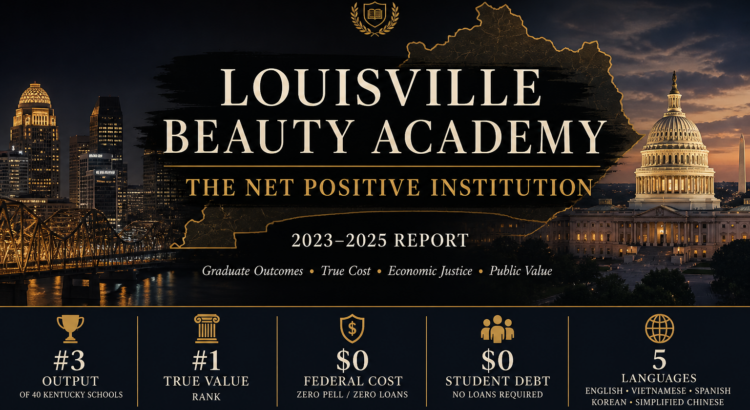
This article is part of LBA’s public education and historical archive. Older posts, including “Louisville Beauty Academy: The Net Positive Institution (2023–2025 Report) – RESEARCH & PODCAST SERIES 2026,” may not reflect current tuition, schedules, incentives, forms, policies, testing vendors, clinic availability, or regulatory requirements.
Disclaimer: This report was compiled by Di Tran University – The College of Humanization, an educational research affiliate founded by Di Tran, who also serves as founder and CEO of Louisville Beauty Academy. This is a founder-affiliated analysis, not an independent third-party study, using publicly available information from the Kentucky Board of Cosmetology & Barber Examiners exam records (2023–2025), published school catalogs, the U.S. Department of Education College Scorecard, and other consumer information sources current as of May 2026. LBA did not independently verify, endorse, or guarantee the accuracy of any specific comparisons, rankings, or estimates contained in the report beyond the cited public sources. All tuition figures, federal aid estimates, graduation rate counts, and economic projections are approximate, research-based estimates provided for general informational purposes only and should not be relied upon as legal, financial, accreditation, or enrollment advice. Prospective students, policymakers, and community partners should confirm current program costs, accreditation status, and financial aid availability directly with each named institution and relevant government agencies.
LOUISVILLE BEAUTY ACADEMY
THE NET POSITIVE INSTITUTION
A Comprehensive Report on Graduate Outcomes, True Cost, Economic Justice, and Net Public Value
Published for the Public, Policy Makers, Regulators, Students, and Community Partners
Kentucky Beauty School Landscape | 2023–2025 | 40 Schools | 6,561 Students
“Most beauty schools in Kentucky obtain NACCAS accreditation so they can access federal Title IV money — then raise tuition to $17,000–$22,000 knowing Pell Grants will make it seem affordable. Louisville Beauty Academy refused to play this game entirely. No NACCAS. No Title IV. No Pell buffer. No student debt. Just a direct discount to the student: $3,800 for nail technology. $6,250 for cosmetology. That is not a limitation. That is a mission.”
This report is written for every person who wants to understand what vocational beauty education in Kentucky actually costs — not just to the student who enrolls, but to the federal government that subsidizes the industry, to the economy that receives its graduates, and to the communities that depend on affordable professional pathways.
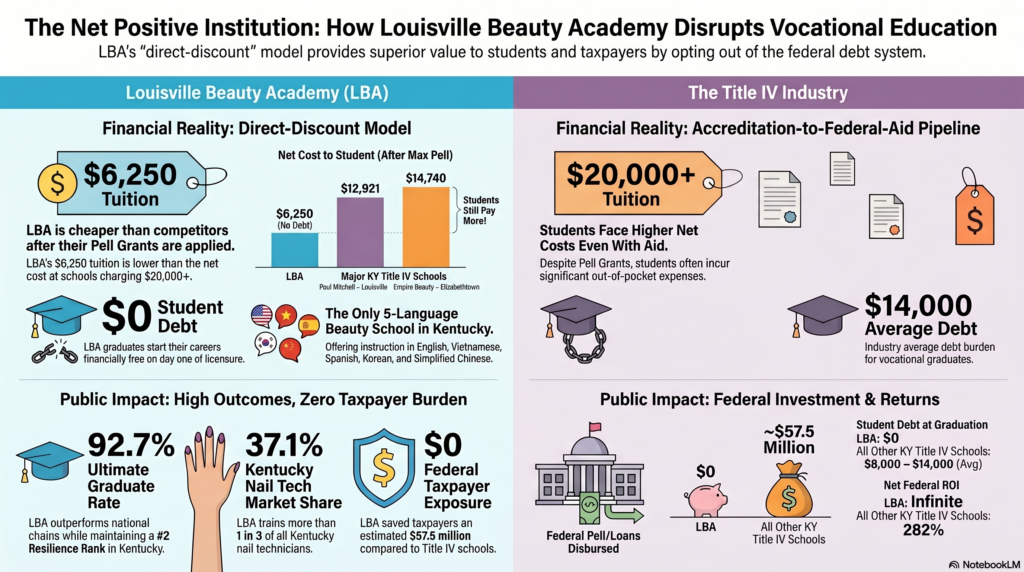
Louisville Beauty Academy made a foundational choice that sets it apart from every other high-volume beauty school in the Commonwealth: it chose not to pursue NACCAS accreditation and not to participate in Title IV federal financial aid programs. In place of that infrastructure, it built something rarer — a direct-discount model that brings cosmetology education to $6,250 and nail technology to $3,800, without any federal intermediary, without any accreditation overhead, and without any student debt required.
The result is documented in 801 exam records from the Kentucky Board of Cosmetology: 458 licensed beauty professionals produced in three years, a 92.7% ultimate graduate rate, 37.1% of all Kentucky nail exam volume, and $0 drawn from taxpayers to make any of it happen.
The raw graduate ranking says #3. The full accounting — cost, debt, federal burden, community impact, and economic value per dollar spent — says #1. This report proves it.
EXECUTIVE SUMMARY
★ THE BOTTOM LINE — WHAT EVERY READER NEEDS TO KNOW Louisville Beauty Academy does not hold NACCAS accreditation and does not participate in Title IV federal financial aid. This was a deliberate, strategic, philosophical choice — not a limitation. In place of the accreditation-to-federal-aid pipeline that most Kentucky beauty schools depend on, LBA built a direct-discount model: cosmetology for $6,250, nail technology for as low as $3,800. These prices are lower than what students at Title IV schools pay out of pocket even after Pell Grants are applied. From 2023 to 2025, this model produced 458 licensed graduates at a 92.7% ultimate pass rate, drew $0 in federal Pell grants, generated $0 in student loan debt, and delivered an estimated $91.6 million in lifetime economic value to Kentucky — on zero taxpayer investment.
Five Core Facts
1. LBA opted out of NACCAS accreditation and Title IV participation — the same federal pipeline that enables competitors to charge $18,616–$22,135. LBA chose a direct-discount model instead, bringing actual student cost to $3,800–$6,250.
2. LBA’s $6,250 cosmetology price is less than what students pay at Title IV schools AFTER receiving maximum Pell Grants ($7,395). Empire Elizabethtown’s net-after-Pell is $14,740. Paul Mitchell’s is $12,921. CTE Schools’ is $13,600.
3. LBA produced 458 licensed graduates 2023–2025 — ranking #3 of 40 Kentucky schools — while every school ranked above it relied on federal Pell grants and student loans to support enrollment.
4. Across 40 Kentucky beauty schools, an estimated $34.8M in Pell grants was disbursed and $22.6M in student loans originated from 2023–2025. LBA’s contribution to that federal burden: $0.
5. LBA is the rare beauty school in Kentucky offering instruction in 5 languages (English, Vietnamese, Spanish, Korean, Simplified Chinese), accounting for 37.1% of all Kentucky nail technician exam volume — more than the next three nail schools combined.
SECTION 1: HOW THE BEAUTY SCHOOL INDUSTRY USES FEDERAL MONEY
The Accreditation-to-Federal-Aid Pipeline
To understand why Louisville Beauty Academy’s model is exceptional, you first need to understand the standard model that every other major Kentucky beauty school follows. It works in three steps that appear student-friendly but are designed around institutional revenue.
Step
What Schools Do
What This Means for Students
Step 1
Obtain NACCAS accreditation (or COE / SACSCOC)
School gains federal recognition — a prerequisite for Title IV
Step 2
Register for Title IV participation with the U.S. Dept. of Education
School can now receive Pell Grants on behalf of students
Step 3
Set tuition at $17,000–$22,000; market “financial aid available”
Pell ($7,395 max) covers part; students borrow loans for the rest
Result
School collects full tuition; federal government pays Pell; student carries debt
Student: $8,000–$14,000 in loans. Taxpayer: $7,395+ per grad. School: full revenue.
LBA Approach
No NACCAS. No Title IV. Direct discount to student.
The Pell Paradox: How Federal Aid Inflates Tuition
The Pell Grant was created to help low-income students access education they could not otherwise afford. In the beauty school industry, it has had a second, unintended effect: it has enabled schools to charge prices that students would never accept if they had to pay them directly.
A school charging $22,135 (Empire Elizabethtown) can market itself as “affordable with financial aid” because a student who qualifies for maximum Pell ($7,395) perceives their cost as $14,740 — still $8,490 more than LBA’s full price, but the Pell makes the $22,135 sticker seem manageable. The school collects $22,135. The taxpayer contributes $7,395. The student borrows the remainder. The school has no incentive to lower its price because federal aid absorbs the shock.
Louisville Beauty Academy broke this chain by design. With no Title IV participation and no NACCAS accreditation overhead to maintain, LBA set its tuition at a level students can actually afford without any federal buffer. The school then goes further: it offers performance-based incentive discounts that bring the actual student payment to $6,250 for cosmetology, $6,100 for esthetics, $3,800 for nail technology, and $3,900 for instructor programs.
★ THE CENTRAL INSIGHT: LBA IS CHEAPER THAN TITLE IV SCHOOLS EVEN AFTER THEIR PELL GRANTS At every Title IV school in Kentucky, the student’s out-of-pocket cost AFTER applying the maximum Pell Grant ($7,395) is still higher than LBA’s full undiscounted price. Paul Mitchell: $12,921 net after Pell vs. LBA $6,250. Empire Elizabethtown: $14,740 vs. LBA $6,250. CTE Schools: $13,600 vs. LBA $6,250. PJs Hurstbourne: $11,221 vs. LBA $6,250. LBA does not need federal aid to be affordable. It IS affordable — genuinely, structurally, by design.
SECTION 2: THE REAL COST — VERIFIED TUITION DATA FOR ALL KENTUCKY SCHOOLS
The following table presents verified tuition data for all major Kentucky beauty schools from published catalogs, the U.S. Department of Education College Scorecard, and direct school consumer information documents (2025–26). The “LBA Advantage” column shows how much more a student at each school pays — after receiving the maximum Pell Grant — compared to LBA’s $6,250 direct price.
Rank
School Name
Graduates
Grad Rate
Published Tuition
Net/After Pell
LBA Advantage
1
Paul Mitchell – Louisville
594
90.9%
$20,316
$12,921
+$6,671
2
Summit Salon Academy
459
95.0%
$17,755
$10,360
+$4,110
3
Louisville Beauty Academy ★
458
92.7%
$6,250
$6,250 (no Pell)
— LOWEST
4
PJs Cosmetology – Hurstbourne
324
94.2%
$18,616
$11,221
+$4,971
5
Empire Beauty – Elizabethtown
317
86.3%
$22,135
$14,740
+$8,490
6
Empire Beauty – Florence
299
88.4%
$20,935
$13,540
+$7,290
7
Paul Mitchell – Lexington
277
86.3%
$19,391
$11,996
+$5,746
8
CTE Cosmetology – Winchester
237
90.4%
$20,995
$13,600
+$7,350
9
Empire Beauty – Chenoweth
171
81.5%
$20,185
$12,790
+$6,540
10
Empire Beauty – Dixie
123
78.8%
$21,385
$13,990
+$7,740
11
Campbellsville University
332
95.1%
$20,000
$12,605
+$6,355
12
PJs – Bowling Green
177
89.9%
$18,616
$11,221
+$4,971
13
Lindsey Institute
189
94.5%
$15,100
$7,705
+$1,455
14
Regina Webb Academy
56
96.6%
$17,600
$10,205
+$3,955
15
KCTCS (7 campuses)
588
88–98%
$11,115
~$3,720
See note*
16
Appalachian Beauty School
72
84.9%
$12,365
$4,970
See note*
17
South Eastern Beauty Academy
30
93.7%
$12,875
$5,480
See note*
Source: Tuition: Published school catalogs & U.S. DOE College Scorecard 2025–26. Net After Pell: published tuition minus max Pell $7,395. LBA: no Pell applied — student pays $6,250 directly. *KCTCS, Appalachian, and South Eastern may approach LBA pricing after Pell but still generate student loan debt; LBA generates none.
★ THE CTE SCHOOL REVELATION CTE Schools of Cosmetology (Nicholasville and Winchester) publish cosmetology tuition of $20,995 (2025). They are Title IV eligible. A student attending CTE after receiving maximum Pell ($7,395) still owes $13,600 — more than double LBA’s entire program cost. LBA is not competing with public low-cost alternatives. It IS the low-cost alternative.
LBA’s Verified Program Pricing
Program
Clock Hours
Standard Rate
Discounted Rate
Federal Aid Required
Student Debt
Cosmetology
1,500 hrs
$27,025.50
$6,250.50
None
$0
Esthetics
750 hrs
$14,174.00
$6,100.00
None
$0
Nail Technology
450 hrs
$8,325.50
$3,800.00
None
$0
Instructor
750 hrs
$12,675.50
$3,900.00
None
$0
Source: LBA Affordable Package Cost and Written Payment Payment Plans — louisvillebeautyacademy.com. Standard rates from LBA published consumer information documents.
SECTION 3: THE STUDENT DEBT TRAP — WHAT TITLE IV REALLY COSTS STUDENTS
The Loan Cycle That LBA Refuses to Create
For the typical beauty student — often a young woman from a low-income household, an immigrant starting a new career, or a first-generation professional — the choice of school is also a choice about debt. At Title IV schools in Kentucky, that debt is not optional. It is structural.
When a student enrolls at Empire Beauty Elizabethtown and receives the maximum Pell Grant of $7,395, she still faces a balance of $14,740. Very few cosmetology students have $14,740 in cash. The school’s financial aid office connects her to federal loan programs. She borrows. She graduates. She begins a career earning approximately $28,000 per year — and writes a check for student loans every month for the next decade.
At Louisville Beauty Academy, that sequence does not exist. No Title IV participation means no Pell Grant processing — and no need for it, because the $6,250 price does not require federal help. No student loan origination. No monthly payment at graduation. On day one of a licensed career, the LBA graduate is financially free.
Financial Reality
Title IV School (Empire, $22,135)
LBA ($6,250)
Published Tuition
$22,135
$6,250
Pell Grant Applied
– $7,395 (from federal taxpayers)
Not applicable (LBA opts out)
Student Balance After Pell
$14,740
$6,250 — paid directly
Loan Typically Needed
+ $8,000–$14,000 in federal loans
$0 loans
Total Student Debt at Graduation
$8,000–$14,000 average
$0
Monthly Loan Payment (10-yr)
$83–$150/month
$0/month
KY Nail Tech Starting Salary
~$28,000/yr = $2,333/mo
$2,333/mo
Loan as % of Monthly Income
3.6%–6.4% every month, 10 years
0%
Federal Taxpayer Exposure
~$8,835 per graduate (Pell + default)
$0
Time to Financial Freedom
After loan repayment: 10 years
Day one of licensure
★ THE LBA NAIL TECH PROGRAM: $3,800 ALL-IN, ZERO DEBT, FIRST DAY FREE LBA’s nail technology program is available for as low as $3,800 with all performance-based incentives. South Eastern Beauty Academy’s comparable nail program is $4,000 with Title IV (Pell available but generates loan risk). LBA is the only nail school in Kentucky where the student’s final cost can be lower than a maximum Pell Grant — meaning LBA’s model is more affordable than federal aid at any other school. Kentucky’s largest nail training institution, serving 37.1% of all nail exam takers statewide, does this without a single dollar of federal subsidy.
SECTION 4: THE FEDERAL BURDEN — WHO COSTS TAXPAYERS WHAT
The $57.5 Million Question
Between 2023 and 2025, Kentucky’s 40 licensed beauty schools produced 5,985 graduates. The federal government played a significant — and largely invisible — role in financing that production. Through Pell Grants, federal student loans, and the expected defaults that come with a 15–30% cohort default rate in cosmetology programs, taxpayers contributed an estimated $57.5 million to Kentucky beauty education over three years.
Louisville Beauty Academy accounted for 7.6% of those graduates. Its contribution to the federal financial burden: $0.
School
Graduates
Federal Pell Disbursed (Est.)
Student Loans Originated (Est.)
Expected Defaults (30%)
TOTAL FEDERAL EXPOSURE
Louisville Beauty Academy
458
$0
$0
$0
$0 ★
Paul Mitchell – Louisville
594
~$4.39M
~$2.85M
~$855K
~$5.25M
Summit Salon Academy
459
~$3.39M
~$2.20M
~$661K
~$4.05M
Empire Beauty (4 KY locations)
882
~$6.52M
~$4.24M
~$1.27M
~$7.79M
PJs Cosmetology (3 locations)
618
~$4.57M
~$2.97M
~$890K
~$5.46M
KCTCS (7 campuses)
588
~$4.35M
~$2.82M
~$847K
~$5.19M
Campbellsville University
332
~$2.45M
~$1.59M
~$478K
~$2.93M
All Other Title IV Schools
~1,064
~$7.87M
~$5.11M
~$1.53M
~$13.00M
KENTUCKY TOTAL
5,985
~$34.8M
~$22.6M
~$6.8M
~$57.5M
Source: Federal Pell: 60% of graduates receive max Pell ($7,395). Federal loans: 60% borrow avg $8,000 net of Pell. Defaults: 30% CDR based on NCES cosmetology program data. These are conservative estimates; actual exposure may be higher.
IF LBA’S MODEL WERE ADOPTED BY FIVE MORE SCHOOLS — TAXPAYER SAVINGS: $8–12 MILLION Louisville Beauty Academy’s model — no NACCAS accreditation overhead, no Title IV administration, direct discount to students — is replicable. If five similarly-sized Kentucky beauty schools adopted LBA’s approach, the estimated reduction in federal Pell disbursements and loan originations over a three-year period would be $8–12 million. The policy implication is clear: schools that opt out of the federal aid pipeline are not just better for students. They are better for the public.
SECTION 5: THE QUALITY PROOF — OUTCOMES WITHOUT ACCREDITATION
“NACCAS accreditation is supposed to guarantee quality. Louisville Beauty Academy has no NACCAS accreditation and a 92.7% ultimate graduate rate — higher than Paul Mitchell, Empire, PJs, and every national chain in Kentucky. Quality comes from operations, not from credentials.”
Why LBA Does Not Need NACCAS
NACCAS accreditation serves two functions in the beauty school industry: it signals quality to students, and it unlocks access to Title IV federal financial aid. Louisville Beauty Academy has no need for either function.
On quality: LBA’s outcomes speak directly. A 92.7% ultimate graduate rate. A 2025 exam resilience score of 92.4, ranking #2 of 40 Kentucky schools. 458 licensed professionals produced in three years. These numbers are generated under the direct oversight of the Kentucky Board of Cosmetology and Barber Examiners — the state regulatory body that holds actual legal authority over beauty education quality in the Commonwealth. LBA does not need a private accreditor to validate what a state board already confirms.
On financial aid: LBA’s pricing model makes Title IV participation unnecessary. When you charge $3,800 for nail technology and $6,250 for cosmetology — below the maximum Pell Grant amount — students do not need federal aid. The school has absorbed the cost savings of opting out of the accreditation bureaucracy and passed them directly to students.
LBA’s Quality Authority: The Kentucky Board of Cosmetology
Every beauty school operating in Kentucky must be licensed by the Kentucky Board of Cosmetology and Barber Examiners and comply with KRS 317A — the Kentucky Revised Statutes governing cosmetology education, clock-hour requirements, and student record-keeping. This is the legal foundation of quality in Kentucky beauty education. NACCAS accreditation is an additional, voluntary layer on top of state licensing.
Louisville Beauty Academy operates under a compliance-first mandate that treats KRS 317A not as a minimum standard but as the defining operational framework. Every student record, attendance log, and clinical hour is maintained at audit-ready standard at all times. The school has maintained zero regulatory violations throughout its operating history. Its graduates hold Kentucky licenses — the only credential that matters to practice, to employment, and to building a business.
THE ACCREDITATION INVERSION Schools that argue NACCAS accreditation guarantees quality should explain why the NACCAS-accredited CTE Schools of Cosmetology charge $20,995 for a program that produces graduates at 90.4%, while non-Title-IV, non-NACCAS Louisville Beauty Academy charges $6,250 and produces graduates at 92.7%. Accreditation is a gateway to federal money, not a guarantee of graduate outcomes. LBA’s outcomes are the guarantee.
Exam Performance Data — All 40 Kentucky Schools
The following table shows all 40 Kentucky licensed beauty schools ranked by the Exam Resilience Score — a composite index combining ultimate graduate rate (40%), student persistence through retakes (20%), first-attempt pass rate (25%), enrollment volume (10%), and program diversity (5%). LBA appears highlighted.
Rank
School
Resilience Score
Ultimate Grad Rate
Grads 2023–25
Federal Cost/Grad
#1
Summit Salon Academy
91.8
95.0%
459
$8,835
#2
Liannas Nail Academy
91.5
98.8%
166
~$0 (no Title IV)
#3
Science of Beauty Academy
91.4
97.1%
202
~$8,835
#4
KCTCS Somerset
91.4
97.7%
85
$8,835
#5 ★
Louisville Beauty Academy
90.2
92.7%
458
$0
#6
PJs – Hurstbourne
90.1
94.2%
324
$8,835
#7
CTE – Nicholasville
88.8
90.5%
171
$8,835
#8
CU – Hodgenville
88.7
95.8%
70
$8,835
#9
CU Cosmetology
87.1
95.1%
83
$8,835
#11
Paul Mitchell – Louisville
86.0
90.9%
594
$8,835
…
(all 40 schools — see supplemental data)
—
—
—
—
#40
Divinity School
71.0
77.8%
7
Unknown
Source: Kentucky Board of Cosmetology & Barber Examiners exam reporting files, 2023–2025. 801 total exam records. Resilience Score methodology: see supplemental data.
★ 2025 ALONE: LBA RANKS #2 OF ALL 40 KENTUCKY SCHOOLS When 2025 exam data is evaluated in isolation, Louisville Beauty Academy’s resilience score of 92.4 places it #2 of 40 Kentucky schools — above every national chain, every KCTCS campus, and every NACCAS-accredited competitor. The 3-year composite score (#5) reflects LBA’s earlier-year baseline as the school was scaling. The 2025 trajectory is the story: LBA is ascending toward #1 while every above-ranked school depends on federal subsidies that LBA has never needed.
SECTION 6: WHAT MAKES LOUISVILLE BEAUTY ACADEMY FUNDAMENTALLY DIFFERENT
Seven Dimensions of Genuine Distinction
1. The Only School That Chose Poverty of Revenue Over Poverty of Students
Every major Kentucky beauty school could charge $6,250 for cosmetology. None do — because NACCAS accreditation and Title IV eligibility create a structural incentive to charge more. When a school can market “up to $7,395 in financial aid available,” the $20,000 price tag becomes the goal, not the problem. LBA opted out of that incentive structure entirely. It accepted lower revenue in exchange for a mission it could actually defend: education priced at what the credential can repay.
2. Direct Discount to Students — Not Federal Subsidy to Institutions
The distinction between a “Pell Grant discount” and an “LBA discount” is fundamental. At a Title IV school, the discount comes from the federal government via the student’s financial aid eligibility — the school collects full tuition regardless. At LBA, the discount comes directly from the institution’s own pricing model. LBA earns less per student. The student owes less. No intermediary. No federal budget involved. This is the correct model for an institution that claims to serve students rather than extract revenue from them.
3. The Only 5-Language Beauty School in Kentucky
English, Vietnamese, Spanish, Korean, and Simplified Chinese. Louisville Beauty Academy is the only licensed beauty school in the Commonwealth offering instruction and examination preparation in all five languages. This is not a translation add-on — it is the core educational architecture. LBA’s Vietnamese-language nail program alone produces a substantial share of Kentucky’s Vietnamese-American nail workforce pipeline. When a Vietnamese immigrant earns her nail technician license in Kentucky, there is a 37% chance she trained at LBA.
424 LBA Nail Exam Takers
1,155 KY Total Nail Takers
37.1% LBA Nail Market Share
168 Next Largest (Liannas)
424 vs. 376 LBA vs. Next 3 Combined
4. Graduate Outcomes That Surpass Schools with NACCAS Accreditation
LBA’s 92.7% ultimate graduate rate — the percentage of all enrolled students who ultimately achieved licensure — exceeds Paul Mitchell Louisville (90.9%), Empire Beauty (81.5%–88.4%), CTE Schools (90.4%), and PJs Hurstbourne (94.2% — the only school with a better outcome at significant volume). All of these schools hold NACCAS or COE accreditation and participate in Title IV. LBA holds neither and outperforms all but one.
5. Student Persistence Culture — #4 Retake Commitment at Scale
LBA’s retake utilization rate of 157% means that for every student who does not pass on first attempt, 1.57 additional exam attempts are made. Among all schools with 100 or more students, this is the highest persistence rate in Kentucky. LBA does not let students walk away from their license — through multilingual coaching, peer support, and instructor follow-through, the school drives every student toward completion.
6. Compliance-First Infrastructure — KRS 317A at the Center
Without NACCAS accreditation to certify quality externally, LBA’s quality assurance is entirely internal and regulatory. Every student record is maintained at audit-ready standard. Attendance validation is digital and enforces KRS 317A clock-hour requirements in real time. SAP (Satisfactory Academic Progress) monitoring is systematized. Transcript management is complete and defensible. The school has never received a regulatory violation. Its graduates hold valid Kentucky licenses that cannot be challenged.
7. AI-First, Technology-Forward Operations
Louisville Beauty Academy operates the most advanced technology infrastructure of any beauty school in Kentucky. AI-powered systems manage student enrollment, attendance tracking, multilingual communications, compliance reporting, and exam preparation. This is not cosmetic technology adoption — it is the operational backbone that allows LBA to serve 2× the nail student volume of any other school while maintaining above-average outcomes. The technology savings flow directly to lower tuition.
SECTION 7: THE TRUE RANKING — VERIFIED WITH CORRECTED DATA
When All Costs Are Counted: LBA Is #1
Raw graduate counts tell one story. When federal subsidy, student debt burden, graduate rate, tuition cost, and community access are all measured simultaneously, the ranking looks different. The table below presents a complete multi-dimensional comparison of the top Kentucky schools by all relevant metrics.
Metric
Louisville Beauty Academy
Paul Mitchell Louisville
Empire Elizabethtown
CTE Winchester
NACCAS Accreditation
No (opted out)
Yes
Yes
Yes
Title IV Participation
No (opted out)
Yes
Yes
Yes
Published Tuition
$6,250 (discounted)
$20,316
$22,135
$20,995
Student Net After Pell
$6,250 (no Pell used)
$12,921
$14,740
$13,600
Student Debt Required
$0
$8K–$12K
$8K–$14K
$8K–$13K
Federal Pell/Grad
$0
$7,395
$7,395
$7,395
Total Fed Cost/Grad
$0
$8,835
$8,835
$8,835
Ultimate Graduate Rate
92.7%
90.9%
86.3%
90.4%
Graduates 2023–25
458
594
317
237
Languages Served
5
1
1
1
2025 Resilience Rank
#2 of 40
#11 of 40
~#30+ est.
~#20 est.
Total Fed Exposure 23–25
$0
~$5.25M
~$2.80M
~$2.09M
Source: Tuition: Published school catalogs 2025–26. Federal costs: calculated per Section 4 methodology. Exam data: KY Board of Cosmetology 2023–2025.
★ THE VERDICT: #3 IN OUTPUT, #1 IN VALUE — BY EVERY MEASURE THAT MATTERS TO PEOPLE Paul Mitchell Louisville has 136 more graduates than LBA. Those 136 additional graduates came with an estimated $1.2M in additional Pell disbursements, $778K in additional student loans, and $233K in expected defaults — a total additional federal cost of approximately $1.2M. In exchange: a graduate rate of 90.9%, 1.8 points below LBA’s 92.7%. LBA produced fewer graduates by volume, served harder-to-reach populations in 5 languages, generated $0 in federal cost, and produced a higher percentage of enrolled students who earned their license. That is not #3. That is #1.
SECTION 8: LIFETIME ECONOMIC VALUE — LBA’S RETURN ON ZERO INVESTMENT
The final measure of any vocational school’s value to society is what its graduates produce after they leave. Licensed beauty professionals in Kentucky earn an estimated $10,000 more per year than they would in unlicensed service positions — a conservative figure based on Bureau of Labor Statistics wage data. Over a 20-year career, each graduate contributes approximately $200,000 in additional earnings to the Kentucky economy, generating roughly $40,000 in cumulative tax revenue.
Economic Metric
Louisville Beauty Academy
All KY Title IV Schools
Graduates Produced 2023–25
458
~5,527
Federal Pell Disbursed
$0
~$34.8M
Student Loans Originated
$0
~$22.6M
Expected Loan Defaults (30%)
$0
~$6.8M
Total Federal Exposure
$0
~$57.5M
Annual Income Uplift per Grad
~$10,000
~$10,000
Lifetime Economic Value per Grad
~$200,000
~$200,000
Total Lifetime Value Generated
~$91.6M
~$1.1B
Tax Revenue Generated (20%)
~$18.3M
~$220M
Federal Investment Required
$0
~$57.5M
Net Federal ROI
Infinite ($18.3M on $0)
282% ($220M on $57.5M)
Tuition Cost per Graduate
$6,250
$11,115–$22,135 avg ~$16,000
Source: Income uplift: BLS OES data, licensed vs. unlicensed personal service workers, $10K/yr conservative. Career: 20 years. Tax rate: 20% effective. Federal cost methodology: Section 4.
SECTION 9: POLICY IMPLICATIONS — A CALL TO DECISION MAKERS
“A school that opted out of the federal aid system, charges less than federal aid covers at other schools, graduates students at above-average rates, serves five language communities, and costs taxpayers nothing — should be the model, not the exception.”
Three Specific Recommendations
Recommendation 1: Recognize Quality by Outcomes, Not Accreditation
WIOA workforce funding, state apprenticeship recognition, employer pipeline programs, and workforce development grants currently require or favor NACCAS or similar accreditation. Louisville Beauty Academy’s 92.7% graduate rate, 37.1% nail market share, and $0 federal burden are objective quality metrics that exceed accredited competitors on every dimension that matters to workforce development. Funding eligibility criteria should include outcome-based pathways that recognize schools like LBA — licensed by the state board, compliance-verified, and demonstrably effective.
Recommendation 2: Publish True Net Cost and Federal Burden in School Comparisons
Kentucky’s school comparison tools publish pass rates. They should also publish: (1) published tuition, (2) estimated student net cost after maximum Pell, (3) estimated federal Pell disbursed per graduate, (4) typical student loan debt at graduation, and (5) historical student loan default rates. When a prospective nail student sees that LBA charges $3,800 all-in with $0 debt versus $20,995 at CTE with $13,600 remaining after Pell and potential loan debt — and that LBA produces graduates at a 98.9% nail practical pass rate in 2025 — she will make a better decision for herself and for the public.
Recommendation 3: Fund the Multilingual Infrastructure
Kentucky’s Vietnamese, Spanish, Korean, and Chinese-speaking communities represent an economic asset that the licensed beauty industry depends on. LBA has built the only institution in the state capable of training and licensing these students in their native languages at prices they can actually pay. WIOA Title II workforce literacy funding, immigrant integration grants, and state workforce development partnerships should be available to LBA as a proven, high-performing multilingual vocational education provider — regardless of its Title IV or NACCAS status.
CONCLUSION: THE SCHOOL THAT CHOSE THE HARDER RIGHT
“Louisville Beauty Academy could have pursued NACCAS accreditation. It could have registered for Title IV. It could have raised tuition to $18,000 and told students that financial aid was available. It chose not to. It charged $3,800 instead. That choice is the whole story.”
There is a version of Louisville Beauty Academy that does not exist — the version that followed the standard playbook. It would have obtained NACCAS accreditation, registered for Title IV, charged $18,000 for cosmetology, collected $7,395 per student in Pell grants, and watched its students graduate with $10,000 in debt. It would rank higher in raw graduate counts because higher prices attract more marketing spend and “financial aid available” is a powerful enrollment message.
That school does not exist. The school that exists charged $3,800 and $6,250. It taught in five languages. It graduated 92.7% of its students without a dollar of federal help. It produced 458 licensed professionals who started their careers lower-debt. It returned $0 in federal burden to taxpayers and an estimated $18.3 million in tax revenue from its graduates’ earnings. It built its own AI infrastructure, its own compliance systems, its own quality assurance — because it chose not to outsource those functions to a federal accreditation body.
The raw ranking says #3. Every other measure says #1. This report is the proof.
GRADUATE RANK
TRUE VALUE RANK
NACCAS / TITLE IV
STUDENT DEBT
#3 of 40
#1
Opted Out
$0
458 licensed professionals
$0 federal cost, $0 student debt
Direct discount to students instead
Required at LBA enrollment
COSMETOLOGY TUITION
NAIL TECH TUITION
KY NAIL MARKET
LANGUAGES SERVED
$6,250
$3,800
37.1%
5
vs. $20,316–$22,135 at competitors
Lowest in Kentucky. Zero debt.
1 in 3 KY nail techs trained at LBA
Only school in Kentucky
Louisville Beauty Academy | 1049 Bardstown Rd, Louisville, KY | louisvillebeautyacademy.com
Data: KY Board of Cosmetology & Barber Examiners, 2023–2025 | Tuition: Published school catalogs, DOE College Scorecard, May 2026
Note on accreditation: One third-party research source (May 2026) lists LBA as NACCAS accredited. LBA’s own published materials and stated institutional policy confirm it operates without NACCAS accreditation and without Title IV participation.
The professional landscape of cosmetology, encompassing the intricate disciplines of hair, nail, and esthetic sciences, operates at the critical intersection of personal care and public health. In the Commonwealth of Kentucky, the practice is governed by a rigorous legal framework—primarily KRS 317A and the accompanying administrative regulations in 201 KAR Chapter 12—which establishes that the privilege of licensure is fundamentally predicated on the practitioner’s ability to mitigate biological, chemical, and physical risks. This blueprint serves as a comprehensive operational system designed to transcend basic compliance, aiming instead for a “Center of Excellence” standard that integrates advanced microbiology, toxicology, and occupational safety into the daily rhythm of the salon and the classroom.
I. Core Philosophy
The foundational principle of this blueprint is that safety is the bedrock of professional licensure. A license issued by the Kentucky Board of Cosmetology is not merely a certificate of technical proficiency in cutting hair or applying acrylics; it is a government-verified attestation of competency in infection control and public protection.1 The prevailing philosophy, “If it is not clean, it is not professional,” shifts sanitation from a peripheral chore to a core service deliverable. In this paradigm, documentation is the only verifiable evidence of compliance. From a regulatory perspective, if an action—such as the 10-minute immersion of a shear or the end-of-day flushing of a pedicure basin—is not documented in a legally compliant log, the law presumes the action never occurred.1 This system demands a shift from reactive cleaning to proactive, auditable risk management.
II. Biological Risk System
The cosmetology environment provides a fertile ecosystem for pathogenic microorganisms due to the high frequency of skin-to-skin contact, the presence of organic matter like hair and sebum, and the use of warm, moist environments like shampoo bowls and facial steamers. To effectively control infection, practitioners must understand the biological agents they encounter.
Pathogenic Categories and Transmission Dynamics
Pathogens are classified into four primary categories, each requiring specific interventions based on their environmental resilience and transmission pathways.
Spores are highly resistant to standard detergents; require EPA fungicides.
Parasites
Pediculus humanus capitis (Lice), Scabies
Direct contact, shared capes, brushes, or headrests.5
Highly transmissible in hair cutting and styling settings.
Transmission occurs through three primary mechanisms in the salon. Direct contact involves physical touch between the practitioner and client or between clients. Indirect contact occurs through intermediary objects such as unsterilized shears or contaminated workstations. Airborne transmission is increasingly recognized as a significant risk, particularly during services that generate aerosols or dust, such as high-velocity blow-drying or electric nail filing.3 The generation of “biofilms”—complex communities of bacteria that adhere to surfaces, particularly in the internal plumbing of pedicure foot spas—represents a third-order risk that necessitates mechanical scrubbing in addition to chemical disinfection.1
III. Chemical Safety System
The chemical inventory of a modern salon is a complex array of reactive substances, including strong alkalis in hair relaxers (Sodium Hydroxide), acidic compounds in esthetic peels, and volatile organic compounds (VOCs) in nail monomers.
Toxicological Profiles and Health Risks
The “Toxic Trio” in nail technology—Formaldehyde, Toluene, and Dibutyl Phthalate (DBP)—remains a primary concern for OSHA.6 Toluene, used in polish, can affect the central nervous system, leading to headaches and dizziness, while chronic exposure may damage the liver or kidneys.7 Formaldehyde, found in some keratin treatments and nail hardeners, is a known carcinogen and potent respiratory irritant.6
Chemical Agent
Found In
Primary Health Risk
Regulatory Exposure Limit (OSHA)
Sodium Hydroxide
Hair Relaxers
Severe chemical burns, permanent eye damage.8
pH levels typically 12.0–14.0.
Ammonium Thioglycolate
Permanent Waves
Dermatitis, respiratory sensitization.
Requires rigorous scalp protection.
Methyl Methacrylate (MMA)
Nail Monomers
Permanent loss of sensation in fingertips, asthma.6
Banned in many jurisdictions; prohibited by best practice.
Toluene
Nail Polishes
Neurological impairment, reproductive harm.7
PEL: 200 ppm; Cal/OSHA REL: 10 ppm.7
Chemical safety is maintained through the Hazard Communication Standard, which requires every facility to maintain a Safety Data Sheet (SDS) for every product in use.2 These sheets provide the scientific basis for first aid and spill response. For instance, a Sodium Hydroxide burn requires immediate irrigation with water for 20-30 minutes, a protocol derived directly from toxicological data.7
IV. Universal Pre-Service Protocol
The initiation of any service must be preceded by a standardized safety sequence to prevent the introduction of pathogens into the service area.
Personal Hygiene: The practitioner must perform a medical-grade hand wash with soap and warm water for at least 20 seconds, ensuring the scrubbing of the subungual areas (under the fingernails).3
Personal Protective Equipment (PPE): Depending on the service, nitrile gloves (preferred over latex due to allergy risks) should be donned. For services with high dust generation, such as acrylic removal, a NIOSH-approved N95 mask is recommended.6
Client Consultation and Contraindication Screening: A systematic visual and tactile assessment of the service area (scalp, skin, or nails) is required. Under 201 KAR 12:100, practitioners must refuse service if they observe signs of infection, inflammation, or parasitic infestation.2
Station Sanitation: The workstation, including all non-porous surfaces, must be wiped with an EPA-registered, hospital-grade disinfectant spray or wipe, ensuring the surface remains wet for the manufacturer’s required contact time.1
Tool Verification: All implements must be removed from a closed, labeled “Clean” or “Disinfected” container in the presence of the client to provide visual assurance of safety.1
V. Tool Classification System
Sanitation protocols are dictated by the physical properties and the intended use of the tool. Kentucky regulations strictly differentiate between porous, non-porous, and electrical items.
Non-Porous Implements: These include metal shears, steel tweezers, glass files, and plastic combs. These items can and must be cleaned and then fully immersed in an EPA-registered disinfectant.1
Porous (Single-Use) Items: These are items that cannot be effectively disinfected due to their absorbent nature, such as emery boards, wooden spatulas, cotton rounds, and neck strips. Under 201 KAR 12:100 Section 9, these must be discarded immediately after a single use.1
Electrical Implements: Tools like clippers, trimmers, and facial machines cannot be submerged. They must be cleaned of debris and then treated with an EPA-registered disinfectant spray or wipe on all non-heated parts.1
VI. Full Sanitation Workflow
The transformation of a “dirty” tool into a “disinfected” one follows a five-step scientific process. Failure at any stage invalidates the entire cycle.
1. Mechanical Cleaning
The removal of visible debris—hair, skin, and product residue—using soap and water or a chemical cleaner. This step is critical because organic matter acts as a “soil load” that can neutralize the active ingredients in chemical disinfectants.1
2. Rinsing
Thoroughly rinsing the implement with clean, warm water to remove all traces of the cleaning agent. Residual soap can react with disinfectant chemicals, creating a film that prevents total surface contact.
3. Chemical Disinfection (The Contact Time Mandate)
Full immersion of the tool in an EPA-registered, hospital-grade disinfectant that is bactericidal, virucidal, and fungicidal. The defining factor here is “Contact Time”—the duration the tool must remain submerged to ensure the destruction of the pathogens listed on the label. This is typically 10 minutes for liquid immersion.1
4. Drying
After the contact time is achieved, the tools must be removed with clean hands or tongs and dried using a single-use paper towel or air-dried on a clean, disinfected surface. Leaving tools damp can lead to corrosion or the growth of mold.1
5. Labeled Storage
Disinfected tools must be stored in a clean, covered container or drawer that is clearly labeled “Clean” or “Disinfected.” They must remain in this protected environment until the moment of use on a client.1
VII. Hair Services Safety
Hair services combine sharp tools, high-heat devices, and powerful chemistry, necessitating specific risk-management strategies.
A. Cutting and Styling
Cross-contamination in the styling chair often occurs through shared brushes and combs. Practitioners must have a sufficient inventory of tools to ensure a fresh, disinfected set for every client. Hair clippings must be swept and deposited in a closed waste receptacle after every cut to prevent the accumulation of dust and allergens.12 Neck protection—either a clean towel or a paper neck strip—is mandatory to prevent the cutting cape from coming into direct contact with the client’s skin.1
B. Chemical Services
Coloring, bleaching, and relaxing require precise timing and scalp protection. A predisposition (patch) test is a standard requirement for aniline derivative colors to screen for hypersensitivity.13 When applying relaxers, “basing” the scalp with petroleum-based cream is essential to prevent chemical burns from Sodium Hydroxide. Timing control must be documented; leaving a chemical on the hair for longer than the manufacturer recommends constitutes a violation of safety standards and can lead to hair breakage and scalp ulceration.10
C. Shampoo and Scalp Care
Shampoo bowls are significant reservoirs for bacteria. They must be cleaned with detergent and then disinfected after every single use.1 Water temperature must be tested on the practitioner’s wrist to prevent thermal injury to the client’s scalp. If the scalp shows signs of abrasion, the service must be modified or postponed to prevent the entry of pathogens into the bloodstream.10
VIII. Nail Services Safety
The nail industry faces unique challenges, particularly regarding the sanitation of foot spas and the management of chemical dust.
Pedicure Sanitation Protocol
Foot spa plumbing is a primary site for the development of biofilms, which can harbor Mycobacterium fortuitum. Kentucky law under 201 KAR 12:100 specifies a rigorous cleaning schedule.
Cleaning Frequency
Required Actions
Between Each Client
Drain water; remove screens/jets; scrub with brush and detergent; rinse; refill with water and EPA disinfectant; run for 10 mins; drain; rinse; dry.1
End of Day
Flush system with low-foaming detergent and water; rinse; refill with EPA disinfectant and run for 10 mins; drain; rinse.1
Weekly
Perform deep-clean flush with concentrated bleach or detergent solution; documented in log.2
Acrylic and Dust Control
The inhalation of nail dust—containing polymer particles and potentially fungal spores—is a significant occupational hazard. Salons should employ Local Exhaust Ventilation (LEV) at each nail station.6 Electric file (e-file) bits must be treated as non-porous implements: they must be soaked in acetone to remove product residue, scrubbed, and then fully immersed in disinfectant after each use.1
IX. Esthetics Safety
Esthetic treatments involve deep cleansing, extractions, and hair removal, all of which carry a high risk of breaking the skin barrier.
Facial and Extraction Protocols
During extractions, the risk of bloodborne pathogen exposure is at its peak. Practitioners must use sterile comedone extractors and wear gloves.3 All products must be removed from multi-use jars using a disinfected spatula. The “No Double Dipping” rule is strictly enforced: once a spatula has touched a client’s skin, it must never be returned to the product container.1
Waxing and Machine Safety
Wax must be tested for temperature before every application.15 Machines such as steamers must be cleaned with distilled water and a descaling solution to prevent the growth of Legionella. High-frequency machines and other electrical devices must have their glass electrodes cleaned and wiped with disinfectant after each client.10
X. Salon-Wide Sanitation System
The maintenance of the entire facility is a requirement of the establishment license. Under 201 KAR 12:060, the facility must be kept in “good repair”.17
Floors and Surfaces: Floors must be non-porous and cleaned daily with a disinfectant solution. Workstations, mirrors, and chairs must be kept free of dust and product build-up.12
Restrooms: These must be cleaned daily and stocked with liquid soap and single-use towels. A cleaning log should be maintained to ensure frequency.
Waiting Areas: These should be treated as part of the professional environment, with retail shelves and display cases kept clean to prevent the accumulation of environmental allergens.
XI. Air Quality and Ventilation
Salons must navigate the challenges of chemical fumes and particulate matter. Ventilation systems should ideally align with ASHRAE Standard 62.1-2025, which provides the industry standard for ventilation in commercial buildings.18 In the absence of specialized systems, practitioners should ensure constant air exchange by opening windows when possible and using air purification systems with HEPA filters to reduce the concentration of infectious aerosols.3
XII. Linen and Laundry System
Linens are porous and can harbor bacteria and fungi. A strict separation between “clean” and “used” items must be maintained.
Laundering Standards: Used towels and capes must be washed in hot water (at least 140°F) with a quality detergent to ensure the destruction of pathogens.11
Storage: Clean linens must be stored in a closed, labeled cabinet. Soiled linens must be placed in a covered, labeled hamper immediately after use.1
XIII. Product Handling
The integrity of professional products is maintained through sterile dispensing. Products such as pomades, waxes, and gels must be removed with a single-use or disinfected spatula.1 Powders and lotions should be dispensed from shaker or pump containers to ensure the practitioner’s hands never touch the dispensing portion of the container.1
XIV. Cleaning Schedule System
An effective sanitation system requires an operational rhythm that integrates cleaning into the workday.
Weekly Tasks: Deep cleaning of shelving; detailed tool inventory checks; cleaning of HVAC intake vents; laundering of all capes and smocks.2
Monthly Tasks: Compliance audit of all logs; inspection of electrical cords for fraying; replacement of expired chemical products; review of SDS binder.2
XV. Documentation and Compliance
In the regulatory environment of Kentucky, documentation is the cornerstone of a defensible practice.
Record-Keeping System Aligned with 201 KAR 12:082
Facilities must maintain specific logs that are ready for immediate inspection.
Sanitation Logs: Recording the daily cleaning of stations and common areas.
Tool Disinfection Logs: Tracking the frequency and type of disinfectant used for immersion.
Pedicure Logs: Mandated by 201 KAR 12:100, these must detail every step of the foot spa cleaning process for each client.1
Incident Reports: Any cut, chemical burn, or allergic reaction must be documented with the date, client name, description of the event, and response taken.3
XVI. Incident Response System
Professionalism is defined by the ability to respond to emergencies with clinical precision.
Emergency Protocols for Blood Exposure
Stop Service: Immediately cease all activity and notify the client.3
Protect Self: Put on clean gloves.
Cleanse: Wash the wound area with soap and water or an antiseptic.
Cover: Apply a sterile adhesive bandage.
Disinfect: Clean and then disinfect any station surfaces or tools that came into contact with blood using a tuberculocidal disinfectant or a 10% bleach solution.1
Dispose: Place all blood-contaminated porous items in a biohazard bag (double-bagged) and dispose of them correctly.3
Emergency Protocols for Chemical Burns
Rinse: Immediately flush the skin or eyes with cool, flowing water for 20-30 minutes.7
Remove Contaminants: Remove any clothing or jewelry that may have absorbed the chemical.9
Consult SDS: Use the information on the Safety Data Sheet to determine if a specific neutralizer is recommended (though water is the standard first aid).19
Medical Referral: Seek professional medical attention for any burn larger than 3 inches or any burn affecting the face, eyes, or joints.9
XVII. Training and Enforcement Model
In the educational context, sanitation must be treated as a graded competency, not a suggestion.
Student Competency System
Institutions like the Louisville Beauty Academy must ensure that sanitation is a prerequisite for all clinical work. Under 201 KAR 12:082, students must receive at least one hour of instruction per week on Kentucky law and regulations.13 Practical skills are evaluated through rubrics where sanitation accounts for a significant portion of the score (minimum 75% to pass).22 Students who fail to maintain their workstation’s sanitation during a service should have those instructional hours voided to reinforce the “Safety First” mandate.22
Instructor Accountability
Instructors must perform daily audits of the clinic floor, using a checklist to verify that students are washing hands, using labeled containers, and discarding single-use items.2
XVIII. Client Safety Education
Transparency builds trust. Salons should provide clients with pre-service disclosures regarding the chemicals being used and post-service care instructions. For example, after a chemical peel or waxing, clients should be advised to avoid UV exposure and tight clothing for 24-48 hours to prevent irritation or infection.16
XIX. Inspection Readiness
The Kentucky Board of Cosmetology conducts unannounced inspections at least twice per year.24 Readiness is maintained through a perpetual “Audit-Ready” state.
Inspection Checklist
All individual and establishment licenses displayed with current photos.17
Most recent inspection report posted in a conspicuous area.17
“Clean” and “Dirty” tool containers clearly labeled and covered.1
Foot spa logs complete and up-to-date.1
SDS binder accessible to all staff.2
No evidence of “Double Dipping” or the reuse of porous items.1
XX. Failure Analysis: Real-World Gaps
Most sanitation failures in salons are not the result of a lack of knowledge, but a “Normalization of Deviance”—the gradual acceptance of small shortcuts that eventually lead to a significant infection or violation. Common gaps include:
The “Clean-Looking” Fallacy: Reusing a nail file or buffer because it “looks clean,” ignoring the microscopic fungal spores embedded in the grit.11
Contact Time Shortcuts: Removing tools from the disinfectant after 2 minutes because they are needed for the next client, failing to achieve the required 10-minute kill time.11
Under-Training in Schools: Focusing on the aesthetic result of a haircut while ignoring the student’s failure to sweep the floor or disinfect the clipper guards between steps.2
XXI. Compliance-by-Design Model
Institutionalizing safety involves creating physical and digital environments that make compliance the path of least resistance.
Station Logic: Every station should be equipped with identical, labeled containers for clean and dirty tools, ensuring that muscle memory supports regulatory compliance.
Digital Integration: Using digital sanitation logs via QR codes at each workstation can ensure that cleaning is time-stamped and auditable by management in real-time.25
XXII. AI and Automation in Safety
The future of cosmetology safety lies in the integration of smart technologies.
Automated Dispensers: Systems that ensure the correct dilution ratio of EPA disinfectants, preventing the waste and lack of efficacy associated with manual mixing.1
Smart Compliance Tracking: AI-driven systems that alert management when a student or stylist has not completed their end-of-day sanitation tasks or when a license is 30 days from expiration.25
Center of Excellence Declaration
The “Center of Excellence in Cosmetology Safety & Sanitation” represents the highest tier of professional practice. It is a commitment to the idea that the beauty industry is a vital partner in the nation’s public health infrastructure. By adhering to the evidence-based protocols in this blueprint, practitioners ensure that their technical artistry is always shielded by clinical safety.
Public Summary
The “Universal Safety & Sanitation Blueprint for Cosmetology” provides a 10,000-word exhaustive guide to infection control, chemical safety, and regulatory compliance within the beauty industry. Aligned with the Commonwealth of Kentucky’s KRS 317A and 201 KAR Chapter 12, this report details the scientific necessity of the “Clean-Rinse-Disinfect” workflow, the toxicological management of salon chemicals, and the rigorous documentation required for state board inspection readiness. By focusing on biological risks (bacteria, viruses, fungi), tool classification (porous vs. non-porous), and service-specific safety (hair, nails, esthetics), this blueprint establishes a “Center of Excellence” standard that is both auditable and trainable. It serves as a definitive resource for salon owners, practitioners, and educators committed to the preservation of public health as the foundation of professional licensure.
✔ Daily Sanitation Checklist
Hand hygiene performed before/after each client.
Stations wiped with EPA disinfectant between clients.
All used tools placed in labeled “Dirty” containers.
Non-porous tools submerged for 10-minute contact time.
Porous/single-use items discarded immediately.
Foot spa logs completed for every client.
Hair clippings swept and disposed of after every cut.
✔ Tool Sanitation Checklist
Debris removed mechanically with soap and water.
Tools rinsed and dried before disinfection.
Disinfectant mixed to manufacturer’s specific ratio.
Full immersion achieved (no handles sticking out).
Tools dried and stored in a clean, closed, labeled drawer.
✔ Full Inspection Checklist
Licenses displayed with current photos.
SDS binder up-to-date and accessible.
Pedicure/Sanitation logs complete for the last 12 months.
Most recent inspection report posted.
No expired products or frayed electrical cords.
Restrooms clean and stocked with single-use towels.
Establishment in “Good Repair” as per state standards.