Debt-Free, Cash-Based, Job-Oriented Education: The Louisville Beauty Academy Model Leading America

The Student Debt Crisis and a Federal Aid Meltdown

America’s student debt has swelled into a full-blown crisis. More than 43 million people hold student loans, owing around $1.7 trillion in total . After a brief pandemic pause, payments resumed in late 2023 – and the strain is showing. Nearly 10 million borrowers fell past-due within months of payments restarting . Many borrowers face crushing monthly bills; federal reports describe payments that “quadrupled overnight” for some, reaching $900 to $5,000 per month . Defaults are rising, and credit scores are plummeting as families struggle to keep up . This debt burden isn’t just a statistic – it’s a daily reality preventing millions from buying homes, starting businesses, or simply living without financial fear.

Exacerbating the crisis are upheavals in the federal financial aid system. The FAFSA, gateway to grants and loans, has been mired in technical glitches and delays. A recent Government Accountability Office review found the rollout of a new FAFSA system so botched that it blocked students from completing applications and led to a 9% drop in submissions . Normally available in October, last year’s FAFSA form wasn’t even available until December 30, 2023 – too late for many students. Colleges had to delay financial aid offers, leaving students scrambling . And beyond FAFSA, programs meant to ease loan burdens are faltering. Public Service Loan Forgiveness (PSLF), which promises to wipe out loans for those who work in public service for 10 years, has notoriously under-delivered – 99% of all applicants were denied forgiveness in the program’s early years . Income-driven repayment (IDR) plans, designed to cap payments based on income, have been tangled in red tape and uncertainty. Recent policy moves and court rulings threaten to suspend or overhaul IDR and PSLF entirely . In short, the federal aid “safety nets” have unraveled, leaving students with rising debts and few lifelines.

The result? A national wake-up call. Students and families are increasingly asking a fundamental question: Is a traditional college path – financed by loans – still worth it? With the “free money” of easy federal loans drying up , many are concluding the answer is no. This realization is accelerating a shift in education: away from expensive degrees and toward practical, debt-free learning models that don’t rely on Uncle Sam.

Shifting Tides: From Costly Colleges to Skills-Based Learning

Traditional four-year colleges are facing an existential challenge. After decades of tuition hikes (often fueled by readily available loans), enrollment in many universities is stagnating or falling. As the debt crisis deters students, vocational and trade programs are surging. Recent data shows trade school enrollment grew 4.9% from 2020 to 2023, reversing pre-pandemic declines . Interest in vocational training has nearly doubled since 2017 among teens and adults . Meanwhile, university enrollment has dipped about 0.6% in that period . The message is clear: students are seeking direct pathways to jobs, without the bloated price tag.

Why the shift? First, return on investment. Many graduates of traditional colleges find themselves with tens of thousands in debt and a degree that doesn’t lead directly to a well-paying job. By contrast, trade programs in fields like healthcare, IT, or cosmetology typically cost far less and lead to in-demand roles. For example, even beauty and wellness schools – often overlooked in “higher ed” conversations – enrolled 239,000+ students in recent years with 3.4% annual growth, as cosmetology programs drive interest . These students are tapping into a robust job market: salons, spas, and wellness centers in every city eager for skilled cosmetologists, estheticians, and nail technicians. The U.S. Bureau of Labor Statistics projects steady demand for these occupations through the decade .

Second, affordability. Community colleges and trade schools generally charge a fraction of university tuition. They also often let students “earn as you learn” or attend part-time, reducing financial strain. Importantly, many vocational schools do not require taking on federal loans at all – a stark contrast to the debt-saddled norm. Students are voting with their feet: why enroll in a $50,000/year program for a vague liberal arts degree when you could spend a few thousand to gain a concrete skill or certification that employers are hiring for right now?

Finally, traditional colleges are struggling to adapt. Some are closing campuses or merging due to financial troubles and declining enrollment. In contrast, innovative vocational programs are expanding and evolving. They’re incorporating flexible schedules, online theory components, and accelerated courses. They focus on job placement partnerships with local employers, virtually guaranteeing graduates a foot in the door. It’s education with a clear endgame: a good job without a mountain of debt.

This national trend sets the stage for pioneering institutions that epitomize debt-free, job-oriented education. Louisville Beauty Academy (LBA) in Kentucky is one such trailblazer. In the midst of a student debt meltdown and waning faith in traditional colleges, LBA has emerged as a model of affordability, practicality, and community impact. It offers a glimpse of what education could look like in a post-loan, skills-first era.

Louisville Beauty Academy: Education Without Debt, Jobs Without Delay

A creative icon illustrating the freedom of a debt-free education model, as exemplified by Louisville Beauty Academy.

In an era of six-figure college price tags, Louisville Beauty Academy stands out like a beacon. This Kentucky state-licensed and accredited beauty college has capped its tuition under $7,000 for all programs – including books, supplies, and fees . Compare that to other cosmetology schools in nearby states charging $12,000 to $25,000 for similar training . LBA’s affordability is unparalleled: for instance, a full Nail Technician program costs just $3,800, and even the longest Cosmetology program (1500 hours) ends up around $6–7k after modest scholarships . That’s a fraction of what students pay elsewhere. This low tuition is transparent and inclusive, so students aren’t hit with hidden kit fees or exam charges – everything is included upfront .

Crucially, Louisville Beauty Academy deliberately operates on a cash-based model. Students pay as they go, often on no-interest monthly plans as low as $100/month . There’s no dependence on federal student loans. By eschewing Title IV federal aid, LBA avoids the administrative costs that plague other schools and drive up tuition . In fact, LBA estimates that processing federal aid and complying with those regulations can add 40–60% to tuition at other institutions – costs which LBA simply doesn’t incur or pass on. Instead of students taking loans, LBA offers in-house payment plans and scholarships. Many students work part-time (or even offer salon services to clients at the school’s student salon) to pay their monthly installments. No one graduates with loan debt – that is the academy’s core promise.

The outcomes speak volumes. Since opening in 2017, Louisville Beauty Academy has trained over 1,000 beauty professionals, hitting its 1,000th graduate by 2022 . As of 2024, that number is even higher – and growing fast toward 2,000 graduates . These aren’t just paper graduates; they are state-licensed cosmetologists, nail techs, estheticians, and instructors making an immediate impact in the workforce. About 90% of LBA alumni secure jobs in their field – many even go on to open their own salons and businesses . By minimizing debt, LBA empowers its graduates to enter the workforce unencumbered, free to invest in their own business tools or personal goals instead of funneling income into loan payments . As one report noted, LBA’s “debt-free” graduates can redirect money into opening a salon or buying a home, rather than servicing a student loan .

Beyond affordability, LBA prides itself on being fast and job-focused. Most students graduate in under 12 months (for example, a full-time nail tech can finish in a few months, cosmetology in around a year). They then “walk straight into employment” thanks to LBA’s strong relationships with local beauty employers . Salons in Louisville know that LBA grads have intensive hands-on training – not just theory. The academy emphasizes practical skills (hair cutting, chemical treatments, skincare techniques, etc.) under close mentorship, so that students are salon-ready on day one after licensure . LBA even uses the latest industry curriculum tools like Milady CIMA for online theory so that class time can focus on humanized, one-on-one instruction and state exam prep . This blend of technology and hands-on practice ensures high pass rates on licensing exams and confident graduates. (Notably, LBA was the first in Kentucky to have graduates take the state licensing exam in Spanish and Vietnamese when those options became available, reflecting its commitment to immigrant students .)

The school’s success and impact have not gone unnoticed. LBA was recognized as one of the most impactful small businesses in Louisville, and its CEO and co-founder, Di Tran, was honored as Louisville Business First’s 2024 “Most Admired CEO” . This accolade, typically reserved for leaders of much larger organizations, underscores how LBA’s community-driven mission is transforming lives. As Di Tran humbly noted, the award really belongs to the staff, students, and supporters whose collective effort is “making a difference” in Kentucky . Indeed, LBA’s ripple effect is significant: with 1,000+ graduates earning $30-50k annually, LBA’s cumulative economic impact is estimated at $30–50 million for the local economy . That’s real incomes and new businesses flowing into the community because of this little beauty school with a big vision.

What makes Louisville Beauty Academy especially innovative is how it aligns incentives in favor of students. Because it doesn’t rely on government aid, the academy must compete on value – price, quality, and outcomes – not on access to loans. As an analysis by the New American Business Association noted, LBA’s model embodies a return to common sense: schools compete by keeping tuition low and results high, and students ask “how quickly can I get skilled and start working?” . LBA passes this test with flying colors. It even offers a tuition price-match guarantee – if a prospective student finds a lower tuition for the same program elsewhere, LBA will match it . How many colleges can say that? This guarantee is rarely invoked, of course, because few if any can beat LBA’s prices. The academy also provides generous “Big Incentive” scholarships and attendance incentives, effectively rewarding students for progress. All told, many LBA students end up paying half or less of the already-low sticker price, thanks to 50%–75% tuition discounts funded by the school and its partners .

Louisville Beauty Academy also thrives on accessibility and inclusion. The school actively recruits and serves immigrants and non-traditional students – people for whom English might be a second language or who might not thrive in a traditional academic setting. LBA’s classes are often bilingual (English with Vietnamese or Spanish assistance), and it was a trailblazer in advocating for state licensing exams in multiple languages . The result is that new immigrants, single parents, and others who often feel left out of higher education find a welcoming home at LBA. It’s common to see a diverse student body of all ages and backgrounds encouraging each other. LBA’s inclusive ethos is perhaps best summed up by its approach during enrollment: Everyone with a passion is welcome, and we’ll find a way to make it work for you – financially, academically, and professionally.

Beyond Beauty: Di Tran University’s Vision for Holistic Education

Louisville Beauty Academy’s success is not the end of the story – it’s the beginning. Building on LBA’s model, the founders are now laying the groundwork for Di Tran University, an ambitious new institution that takes the debt-free, cash-based, job-oriented philosophy into broader fields. In partnership with the nonprofit New American Business Association, **Di Tran University is envisioned as a “College of Humanization & Beauty” – a place focused on purpose, humanity, wellness, and practical skills in fields that “AI cannot replace” .

What does this look like in practice? Imagine a school that offers not only beauty programs but also training in wellness and caregiving professions – always with the same pay-as-you-go affordability. Di Tran University plans to incorporate courses like CPR and life-saving certifications, basic healthcare skills, nutrition and wellness education, and even modules on mental health first aid. The idea is to produce graduates who are not just licensed cosmetologists or massage therapists, but well-rounded caregivers attuned to community health and wellness needs. For example, a student might earn a cosmetology license and a certificate in senior caregiving or CPR. This combination could make them ideal hires for a nursing home or community center, where they can provide grooming services while also contributing to health monitoring or emergency response. It’s a fusion of beauty and healthcare aimed at maximizing employability and social impact.

Volunteer service is another key pillar of the vision. Di Tran University intends to weave community service into every program – a concept of “earn your education by serving.” Students might volunteer regularly at hospitals, senior centers, or charities, applying their skills to help vulnerable populations. Not only does this benefit the community, it also builds students’ experience and empathy. The school’s founders believe strongly in education as a vehicle for character and citizenship, not just job training. By making volunteerism a graduation requirement, they aim to graduate professionals who are civic-minded and service-oriented. In essence, each student gives back to the community that supports the school, creating a virtuous cycle of mutual uplift.

A particularly innovative element is the integration of beauty education with mental health outcomes. Health professionals increasingly acknowledge that personal care and human touch can greatly improve mental well-being – especially for the elderly and disabled who suffer from isolation. There’s a growing trend in healthcare toward “social prescriptions”, where doctors prescribe community activities (like exercise classes, art clubs, or salon visits) to treat loneliness and depression . Louisville Beauty Academy has already seen this in action. Local psychologists and senior care centers have noted that something as simple as a monthly manicure can be transformative for an isolated senior. The social interaction at a nail appointment – talking with the technician, feeling cared for – helps combat loneliness and improve self-esteem . The therapeutic benefits of nail and hair services for seniors are well documented: regular appointments can foster connection, boost mood, and give seniors a sense of normalcy and dignity . At Di Tran University, this concept will be baked into the curriculum. Students will learn about the mental health aspects of their work. For instance, a nail tech student might learn how to interact with clients who have dementia, or how to spot signs of depression in a regular client and gently encourage them. The school envisions partnerships with mental health organizations so that beauty students might even receive referrals – e.g. a therapist “prescribing” a series of salon visits for a patient – and the students provide the service as part of their training. It’s a radical rethinking of cosmetology education as a form of community healthcare.

Interestingly, Louisville’s immigrant community of nail technicians has provided a proof of concept for the power of empathetic care. Many Vietnamese-American nail technicians, in particular, have built deep bonds with elderly and disabled clients. Even if language is a barrier, the act of care transcends it. In the U.S., over half of nail salons are owned or operated by Vietnamese immigrants , a legacy of how that community embraced nail work as a route to the American dream decades ago. These first-generation technicians often come from a culture that reveres elders and emphasizes gentle hospitality. Clients notice – and appreciate – the patience and respect they offer. It’s not uncommon for an elderly client to say their manicurist feels like family, or for a homebound disabled person to light up when a familiar technician makes a house call. Such technicians may not speak perfect English, but they communicate kindness through their service. In fact, nail salon visits have become a vital social lifeline for many seniors in communities with large immigrant populations . Di Tran University’s ethos of “humanization” builds on this phenomenon: it aims to formally recognize and teach the soft skills – empathy, listening, caring touch – that immigrant beauty workers have informally excelled at. By doing so, it hopes to produce graduates uniquely skilled at serving those most in need of a warm human connection.

A Sustainable Hybrid Model: Nonprofit Ownership Meets For-Profit Education

How can a school afford to charge rock-bottom tuition and still expand its offerings? The answer lies in an innovative hybrid financial model combining for-profit operation with nonprofit support. Louisville Beauty Academy and the upcoming Di Tran University are pioneering a structure where a nonprofit owns the school’s real estate and infrastructure, while the school business leases and operates the educational programs. The nonprofit in this case – the New American Business Association Inc. (NABA) – is a 501(c)(3) founded by Di Tran to empower small businesses and education. NABA’s mission is to “accelerate the elevation of human lives” through workforce development and other initiatives . In practical terms, NABA helps fund the big-ticket assets – like land and buildings – as permanent community educational trust assets, while the school itself focuses on teaching students and covering day-to-day operating costs.

Here’s how it works: Donors and investors contribute to NABA, and NABA uses those funds to purchase or build school facilities . Every donated dollar is converted into bricks, mortar, and equipment – tangible assets that “house learning for decades to come” . The school (LBA or Di Tran University) then uses those facilities rent-free or at minimal cost. This dramatically lowers the school’s overhead. Without a hefty mortgage or rent payment, the school doesn’t need to charge high tuition. It can remain cash-flow positive on just the modest monthly payments from students, keeping those payments low and accessible. Essentially, the community investors carry the capital costs, and students reap the benefit through tuition that is 50-75% lower than market rates . As NABA proudly announced, “With NABA’s backing and charitable gifts, Louisville Beauty Academy offers education at 50%–75% off industry tuition standards… Students graduate completely debt-free, thanks to a model powered by community support, nonprofit ownership, and love-driven leadership.”

This model also provides exceptional transparency and security for donors. Rather than donating into a black hole or to a general fund, supporters know their contributions are buying a physical school or equipment that will serve the community for generations. For example, when a generous alumnus donated a full salon’s worth of equipment to NABA, that equipment was placed directly into LBA’s classrooms for students to train on . His donation lives on every day as students learn on those chairs and stations. Similarly, if NABA buys a building for a new campus, that building becomes a lasting community asset. Even if one day the school were to cease operation, the nonprofit-owned facility would remain to be repurposed for education or community use, rather than being lost to private sale. This gives donors confidence that their legacy is protected. As NABA describes, it allows philanthropic families and local investors to “build real estate-backed legacies that house learning for decades to come.”

Louisville Beauty Academy’s planned expansion provides a case in point. The school is looking to open branches in other Kentucky cities (Lexington, Elizabethtown, Bowling Green) and beyond. Under the hybrid model, all new campuses will have their buildings purchased up front via philanthropic or impact-investor funding . The target cost for each new location is surprisingly modest – around $500,000 – which covers acquiring a suitable building and basic renovations to create classrooms and salon space. Because beauty programs don’t require giant lecture halls or expensive lab equipment, a half-million dollars can establish a fully functional campus. Once that capital expense is covered by NABA and donors, the school can launch and operate on a shoestring budget, just like the Louisville location. About 20–30 students paying ~$100/week in tuition each can sustain an individual program, and most campuses will host multiple programs. In other words, the model scales efficiently: inject a one-time philanthropic investment to set up the infrastructure, then let the tuition from a small cohort of students cover the teacher salaries and utilities. No ongoing subsidies needed – each campus becomes self-sustaining while keeping tuition at rock-bottom. And because the buildings serve as collateral, the school can even obtain low-interest loans or grants if needed, further ensuring stability .

NABA’s involvement goes beyond just writing checks. The nonprofit actively supports the school’s mission with wraparound services and advocacy. For instance, NABA helps LBA with things like marketing, public awareness campaigns, and even legislative advocacy. (They are working with Kentucky legislators to secure state support for vocational education facilities and “cash-pay” scholarships .) NABA also focuses on related community needs like affordable housing and small business coaching . This opens exciting possibilities – one being the integration of low-cost student housing with school locations. In the future, a Di Tran University campus could include dormitory-style housing owned by NABA and offered to students at cost. This would tackle one of the biggest burdens for students (rent), making education accessible for those who might live far or lack stable housing. NABA is already experienced in affordable housing initiatives, aligning rents to no more than 30% of income for low/moderate income families . Imagine a beauty or wellness student able to live in safe, affordable housing next door to their classes, freed from both tuition debt and exorbitant rent – that’s the kind of holistic support this model envisions.

Another future integration is cash-based healthcare services alongside education. The story of Kentucky Pharmacy LLC, led by Dr. Vy Truong, is instructive. Dr. Truong (Di Tran’s spouse and partner in these endeavors) founded a local pharmacy that provides low-cost, accessible healthcare to underrepresented communities, earning recognition for her compassionate leadership . The academy’s leaders see potential to partner with such services – for example, having a small clinic or telehealth station at a school campus. Students (and their families) could get affordable medical advice, flu shots, or prescriptions on-site, conveniently and cheaply. Virtual doctor consultations could be offered periodically, leveraging telemedicine to keep costs down. The integration of education with basic healthcare and housing would essentially create a mini ecosystem of support. A student could address many life needs in one place: learn skills, earn credentials, get health check-ups, live in affordable housing, and engage in community service – all without incurring debt. It’s a far cry from the siloed, expensive, sink-or-swim approach of traditional higher education.

A Call to Action: Support and Replicate the Debt-Free Education Revolution

Louisville Beauty Academy and the emerging Di Tran University demonstrate that a debt-free, cash-based, job-oriented model is not only possible – it might just be the future of American education. They are living proof that we can dismantle the old paradigm of “borrow to learn” and replace it with “earn as you learn.” Now, it’s time to take this model nationwide. To do so, everyone has a role to play:

• Students and Parents: Re-evaluate the assumption that a traditional college (and the debt that comes with it) is the only path to success. As LBA shows, you can spend under a year and under $7k to gain real skills and a state license that leads straight to a stable, paying job . If you or your child are considering higher education, look into vocational programs and debt-free colleges in your area. Ask about total costs, job placement rates, and whether you can pay monthly without loans. Demand transparency and “cash prices” from schools – make them compete on value. The more students choose options like LBA, the more other schools will be pressured to lower costs and innovate. No career dream is worth a lifetime of debt. There are often cheaper, faster avenues into the same field.

• Donors, Investors, and Philanthropists: There is a once-in-a-generation opportunity to reshape education through your contributions . By funding the infrastructure for schools like Louisville Beauty Academy, you create an enduring legacy. Consider partnering with organizations like NABA to endow a training center in your community. For example, a $500,000 donation could establish an entire new campus that produces hundreds of skilled, debt-free graduates each year. Every dollar goes directly into building an asset – a school – that will pay dividends in community impact for decades . As NABA puts it, you can help “build real estate-backed legacies that house learning for decades to come.” You’ll be tackling poverty and inequality at the root by enabling affordable education. If you’re a successful professional or business owner, think back to those who helped you get started – now you can pay it forward at a grand scale. Invest in people, not just for profit, but for progress.

• Employers and Industry Partners: The LBA model works so well partly because of close ties to employers (salons, spas, healthcare facilities, etc.) that hire graduates. Get involved with vocational schools in your sector. Offer input on curriculum to ensure students learn the skills you need. Consider tuition sponsorships or reimbursement programs – for instance, a salon chain could fund a student’s tuition in exchange for a work commitment post-graduation . This creates a talent pipeline for you and guarantees the student a job – a win-win. Host interns or apprentices from the school to give them real-world experience. Ultimately, supporting these alternative education models will enrich your hiring pool with better-prepared, local candidates. It also boosts your brand as a community-oriented employer. LBA’s example shows that when industry and educators collaborate, students transition seamlessly into roles and start contributing to the business on day one.

• Policymakers and Community Leaders: You hold the keys to scaling this model on a policy level. First, recognize and fund non-traditional education providers. State governments should allocate grants or challenge funds to help schools like LBA expand, since they directly address workforce shortages. Consider establishing state scholarships or vouchers that students can use at licensed, non-loan-participating trade schools – essentially empowering more “cash-pay” pathways. Update regulations to support hybrid models; for example, ease zoning or provide tax incentives for nonprofits that buy property for educational use. Work on streamlining licensure and credentialing in trades to make it easier for programs to start up and for students to get certified quickly (Kentucky’s recent reduction of required hours for cosmetology and other fields is a good start ). On the federal level, even as loan programs are in flux, legislators can champion pilot programs that channel funding to community-based educational trusts instead of to individual loans. The goal should be outcomes, not volume of loans. Also, support data transparency – require institutions to disclose total cost, graduation rate, and job placement so that models like LBA’s shine and can be replicated. Finally, celebrate and publicize success stories: when a school like LBA produces thriving graduates and local entrepreneurs, hold it up as a model to replicate across the country.

Louisville Beauty Academy began as a small beauty school with a big idea: education could be done differently, done better. Today, it stands as a proof-of-concept that education can indeed be affordable, fast, skills-based, and deeply connected to community needs – all without a single federal loan. As we witness the faltering of the old student loan system, LBA’s model is lighting the way forward. And with the launch of Di Tran University and similar initiatives, the movement is only growing. The blueprint is in place : lower barriers, prioritize skills, blend education with compassion, and finance it sustainably through community support rather than student debt. Now it’s up to all of us to scale this blueprint and return American education to its roots: opportunity, not oppression by debt .

In conclusion, whether you’re a prospective student, a parent, a donor, an employer, or a policymaker, there is a role for you in this debt-free education revolution. It’s already happening in Louisville, and it can happen in your community. Let’s support and expand models like Louisville Beauty Academy and Di Tran University, so that future generations across the United States can learn and build careers without mortgaging their futures. The era of cash-based, job-oriented education is dawning – and it promises to unleash talent and opportunity like never before. Education is returning to common sense : it’s about gaining skills to serve and thrive, not drowning in debt. Louisville Beauty Academy has shown us the way. It’s time to follow suit and ensure debt-free, purpose-driven learning becomes the new norm nationwide.

Together, we can make “debt-free college” not a dream or political slogan, but a lived reality from Louisville to Los Angeles – and in doing so, empower millions of Americans to improve their lives and communities without the burden of educational debt. The call to action is clear. Let’s answer it.

REFERENCES

Official Government & Education Resources

1. U.S. Department of Education (Federal Student Aid Office)

https://studentaid.gov

2. U.S. Department of Education – Accreditation Information

https://www.ed.gov/accreditation

3. Federal Register – Executive Orders and DOE Closure Updates

https://www.federalregister.gov

4. Kentucky Department of Education (KDE)

https://education.ky.gov

5. Kentucky School Facilities Construction Commission (SFCC)

https://sfcc.ky.gov

6. Kentucky Higher Education Assistance Authority (KHEAA)

https://www.kheaa.com

7. Kentucky Adult Education Program

https://www.kentuckyadulteducation.org

8. Jefferson County Public Schools Adult Education

https://www.jefferson.kyschools.us/adult-education

9. Kentucky Chamber of Commerce

https://www.kychamber.com

10. Kentucky Career Center (Workforce & Vocational Programs)

https://kcc.ky.gov

News Articles on Education & Federal Policy Changes

11. Reuters – Trump Signs Order to Shut Down Department of Education

https://www.reuters.com/world/us/trump-sign-order-shut-down-department-education-white-house-says-2025-03-19

12. NPR – What Trump’s Order to Dismantle DOE Means for Students

https://www.npr.org/2025/03/19/nx-s1-5333861/trump-executive-action-education-department

13. Newsweek – Student Loan Payments Skyrocket After Trump’s Changes

https://www.newsweek.com/student-loan-payments-soar-trump-changes-education-department-2025-03-19

14. CNBC – What Happens to Student Loans If ED Is Eliminated?

https://www.cnbc.com/2025/02/21/what-happens-to-student-loans-if-department-of-education-is-eliminated.html

15. ABC News – What Dismantling the DOE Means for FAFSA and Aid

https://abcnews.go.com/Politics/dismantling-education-department-student-loans/story?id=118730549

16. Student Loan Advice – Changes to IDR and SAVE Plans in 2025

17. Forbes – Default Rates Expected to Surge After Student Loan Reform

https://www.forbes.com/sites/adamminsky/2025/03/04/the-department-of-education-may-shut-down-in-two-weeks-and-student-loan-programs-could-suffer

Organizations for Beauty and Career Education

18. National Accrediting Commission of Career Arts and Sciences (NACCAS)

https://www.naccas.org

19. Professional Beauty Association (PBA)

https://www.probeauty.org

20. Independent Beauty Association (IBA)

21. Kentucky Association for Career & Technical Education (KACTE)

22. Kentucky Out-of-School Alliance (KYOSA)

Community & Partner Organizations

23. Kentucky Women’s Workforce Center

https://www.kentuckywomensworkforcecenter.org

24. Red Shoe Marketing (for campaigns)

https://redshoemarketing.com

25. Lexington Chamber of Commerce

https://www.lexchamber.com

26. Kentucky Small Business Development Center (KSBDC)

https://www.ksbdc.org

Louisville Beauty Academy Official Website

27. Louisville Beauty Academy – Debt-Free Model Overview

28. LBA – Interest-Free Payment Plan & Program Details
The State of Cosmetology Education and Employment: Louisville Beauty Academy’s Approach to Change

The beauty industry, while vibrant and essential, has long been burdened by structural issues, including an oversupply of graduates, underemployment, and profit-driven school models that prioritize financial gains over student success. Louisville Beauty Academy, a Kentucky state-licensed and state-accredited institution, recognizes these challenges and offers an alternative approach to cosmetology education—one that is affordable, flexible, and community-focused.

The Challenge in the Cosmetology Industry

Despite the widespread popularity of cosmetology careers, research suggests that many graduates struggle to secure stable employment. The problem stems from several factors:

  1. Oversupply of Licensees: According to data from the Bureau of Labor Statistics (BLS), the number of employed cosmetologists in the U.S. in 2021 stood at approximately 285,980. However, the total number of licensed professionals is estimated to be between 300,000 and 400,000, meaning a significant portion remains underemployed or shifts to non-industry jobs.
  2. Profit-Driven Beauty Schools: Many cosmetology institutions operate under a business model that prioritizes high enrollment numbers over educational quality. Some for-profit schools exploit students as unpaid labor, having them work in student-run salons without ensuring they receive the necessary training to thrive in the job market. This model can leave graduates with debt and little real-world preparation.
  3. Broad Training Scope Leading to Confusion: Cosmetology training covers hair, skin, and nails, making it an all-encompassing profession. However, this broad scope can sometimes be a drawback, as new licensees struggle to find specialization, making it harder to establish a strong career path.
  4. Underemployment and Wage Challenges: A study by the Century Foundation found that nearly all cosmetology programs failed to meet the U.S. Department of Education’s gainful employment rule, with most graduates earning near-poverty wages post-graduation.

How Louisville Beauty Academy Stands Apart

Recognizing these challenges, Louisville Beauty Academy has adopted a unique, student-centric approach designed to increase success rates while minimizing the financial burden on students.

1. Accelerated and Study-Focused Model

Unlike traditional beauty schools that extend training primarily for profit, Louisville Beauty Academy focuses on accelerated, practical education that prioritizes passing state licensing exams. The goal is to provide students with the knowledge and skills they need in the most efficient way possible.

2. Affordability and Accessibility

Education should not be a financial burden. Louisville Beauty Academy operates with one of the most affordable tuition structures, ensuring that students do not accumulate unnecessary debt. With tuition often capped under $7,000 (including supplies), the academy provides a cost-effective pathway to a licensed career.

3. A Community-Focused Mission

A defining feature of Louisville Beauty Academy is its commitment to giving back to the community. The academy actively provides free salon services, especially at organizations like Harbor House of Louisville, where services are offered 100% free of charge to support individuals with disabilities and those in need. This initiative not only reinforces a community-service mindset among students but also ensures that real-world practice is meaningful and impactful.

4. Job-Specific Licensing for Better ROI

Not everyone who enters beauty school wants to learn every aspect of cosmetology. Louisville Beauty Academy highlights an alternative licensing option—the 300-hour Shampoo & Styling license, which provides students a focused, faster entry point into the industry. This specialization is an excellent choice for those interested in hairstyling without committing to the extensive coursework required for a full cosmetology license.

The Future of Cosmetology Education

The beauty industry is at a crossroads, requiring education models that balance supply with demand while ensuring student success. Louisville Beauty Academy’s flexible, affordable, and community-driven approach serves as a model for the future of beauty education.

By prioritizing education over profit, reducing financial barriers, and encouraging specialization, Louisville Beauty Academy is empowering future beauty professionals with the tools they need for sustainable careers.

For those considering a career in cosmetology, making an informed choice is crucial. It is not just about getting a license—it’s about finding the right education model that truly prepares students for success. Louisville Beauty Academy invites all aspiring beauty professionals to explore its programs, choose wisely, and invest in a career with real value.

Disclaimer

The information provided in this article is for educational and informational purposes only. Louisville Beauty Academy strives to present the most up-to-date and accurate information regarding the cosmetology industry, licensing, education models, and employment trends. However, industry regulations, employment data, and licensing requirements are subject to change by government agencies and accrediting bodies.

Louisville Beauty Academy does not guarantee employment or specific income outcomes upon graduation. The success of any beauty professional depends on various factors, including individual skill level, job market conditions, and personal dedication to career growth.

While we aim to provide the latest and most well-researched guidance, prospective students and industry professionals are encouraged to conduct their own research, consult official state licensing boards, and seek career advice from multiple sources before making educational or professional decisions.

For official licensing requirements and employment statistics, please refer to state cosmetology boards, the U.S. Bureau of Labor Statistics, and other regulatory agencies.

Key Citations

Louisville Beauty Academy: Elevating Careers in Beauty with High-Value Training and Licensing

The Smart Choice for Aspiring Beauty Professionals in Kentucky

Louisville Beauty Academy, a state-licensed and state-accredited beauty college, is redefining success in the beauty industry by offering high-value, accelerated programs in nail technology, esthetics, and cosmetology. With an emphasis on affordability, quick workforce entry, and strong job market prospects, our institution equips students with the skills and certifications they need to thrive in today’s evolving beauty landscape.

The Changing Beauty Industry: Nail Techs and Estheticians Are in Demand

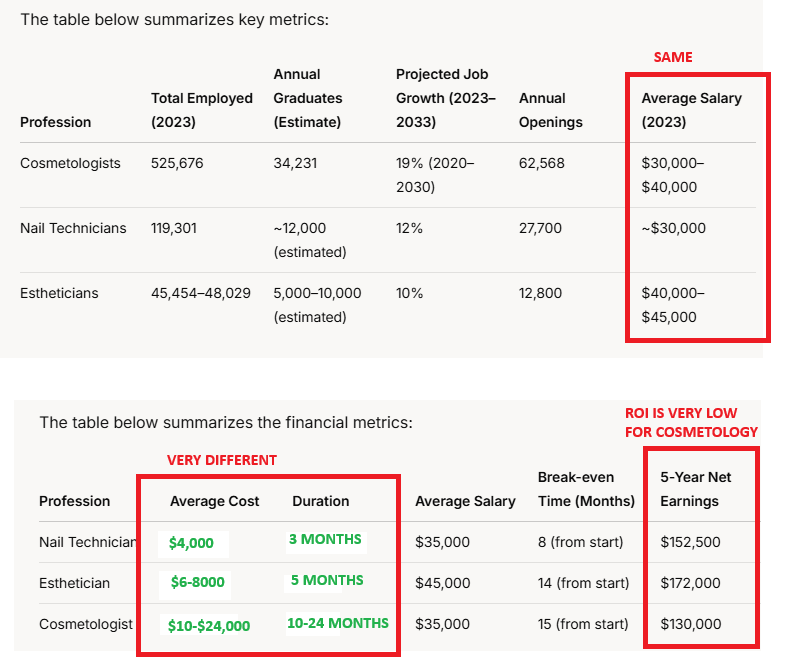
Industry research shows that careers in nail technology and esthetics offer better return on investment (ROI) and stronger job security compared to traditional cosmetology. Unlike cosmetology, which often faces market oversaturation, nail technicians and estheticians benefit from shorter training periods, lower tuition costs, and increased earning potential in specialized fields.

Key industry findings include:

  • Lower program costs & faster completion: Nail tech and esthetician programs cost less and take less time than cosmetology programs, allowing professionals to enter the workforce quickly.
  • Higher earnings potential: Estheticians (earning $40,000–$50,000/year) and nail technicians ($30,000–$40,000/year) enjoy strong job growth and specialized career opportunities.
  • Expanding career pathways: Estheticians can work in medical settings such as dermatology clinics and med spas, potentially increasing their earnings beyond the traditional salon environment.
  • Reduced industry overcrowding: In Kentucky and Indiana, there are tens of thousands of licensed cosmetologists but fewer actual job opportunities, making specialization in nails or skincare a more strategic choice.

Comparing Beauty Education: Time, Cost, and ROI

When choosing a beauty career path, financial investment and time commitment are critical considerations. Louisville Beauty Academy provides flexible, high-quality training options that maximize earning potential while minimizing debt and wait time.

ProfessionAverage CostDurationAverage SalaryBreak-even Time5-Year Net Earnings
Nail Tech$3,000–$10,0003–6 months$30,000–$40,0008 months from start$152,500
Esthetician$4,000–$12,0006–12 months$40,000–$50,00014 months from start$172,000
Cosmetologist$5,000–$15,0009–12 months$30,000–$40,00015 months from start$130,000

This data-driven analysis confirms that nail technology and esthetics offer faster payback periods and higher financial rewards than cosmetology. With Louisville Beauty Academy’s affordable tuition and streamlined licensing pathways, students can achieve financial independence faster.

Job Growth and Market Trends: Why Specialization Matters

The demand for nail technicians and estheticians continues to grow, driven by new beauty trends, an aging population, and the rise of self-care industries.

Projected Industry Growth Rates (2025–2035)

  • Nail Technicians: 12%–22% growth, fueled by nail artistry trends and personalized services.
  • Estheticians: 9%–17% growth, driven by increased demand for advanced skincare treatments.
  • Cosmetologists: 19% growth, but oversupply issues continue to limit employment opportunities.

With fewer qualified professionals in nail and skincare services, those who specialize face less competition and more job security.

State-Specific Challenges: Kentucky & Indiana

Kentucky and Indiana illustrate a clear divide in job availability versus licensure rates. While both states license thousands of cosmetologists annually, the actual job market cannot support such a high number of professionals, creating unemployment risks.

Industry Statistics (2025)

  • Indiana: Fewer than 8,000 total beauty industry jobs, yet thousands of new licensees enter the field each year.
  • Kentucky: 25,000–30,000 licensed cosmetologists, but fewer than 7,310 actual jobs, meaning many cosmetologists struggle to find work.

This data confirms that investing time and money into cosmetology may not guarantee employment. Louisville Beauty Academy offers an alternative route to career success by focusing on high-demand specialties.

Why Choose Louisville Beauty Academy?

As an established, state-licensed beauty institution, Louisville Beauty Academy stands apart by providing:

  • Flexible, fast-track programs designed to help students start earning quickly.
  • Top-tier licensing preparation to ensure students pass state exams and gain legal certification.
  • A hands-on, career-focused learning environment led by industry experts.
  • A supportive, ethical, and inclusive atmosphere, free from predatory for-profit practices.

Louisville Beauty Academy remains dedicated to elevating the beauty industry by empowering professionals with high-quality education. We provide affordable, fast-tracked, and accredited programs that allow students to achieve financial independence and career success.

A Smarter Path Forward

For aspiring beauty professionals, the choice is clear: specialized training in nails and esthetics offers the fastest, most profitable career path. By choosing Louisville Beauty Academy, students can enter the industry sooner, with less debt, and with greater long-term earnings potential.

Key Citations

Disclaimer

The information provided in this article is for general informational purposes only and is based on publicly available data, industry research, and third-party sources as of the publication date. Louisville Beauty Academy makes no representations or warranties of any kind, express or implied, regarding the accuracy, completeness, or reliability of the information presented.

Tuition costs, program durations, salary expectations, job market conditions, and industry trends are subject to change without notice. Louisville Beauty Academy does not guarantee employment, salary outcomes, career success, or licensure upon completion of any program. Individual results will vary based on factors such as personal effort, market demand, location, and experience.

Prospective students and readers are encouraged to conduct their own research and consult relevant industry and licensing authorities before making educational or career decisions. Louisville Beauty Academy assumes no responsibility or liability for any reliance on the information provided in this article.

Sanitation & Safety: The #1 Priority at Louisville Beauty Academy

At Louisville Beauty Academy, we don’t just teach beauty skills – we teach responsibility, professionalism, and excellence. The foundation of every beauty professional’s success starts with sanitation and safety, as required by Kentucky State Law (201 KAR 12:100).

We Practice It. We Teach It. We Elevate It.

Sanitation is not just a rule – it is a daily habit, a professional standard, and the key to becoming a licensed beauty expert. Every student at Louisville Beauty Academy is expected to clean and disinfect their workstation before and after class, ensuring a safe and hygienic learning environment.

As a licensed beauty school, we elevate sanitation by making it a daily practice, not just a theory. Our students don’t just learn about sanitation – they live it, practice it, and become experts in it.

Below is a complete breakdown of the sanitation and safety requirements we uphold every day at Louisville Beauty Academy:


📌 General Cleaning Requirements (201 KAR 12:100, Section 1)

✔ All facilities and equipment are continuously maintained in a clean and sanitary condition.
✔ An adequate supply of hot and cold running water is always available.
Students and licensees must wash their hands before and after serving each client.


🛠 Workstation & Surface Cleaning (201 KAR 12:100, Sections 2 & 5)

✔ Workstations, shampoo bowls, treatment tables, styling chairs, and surfaces must be cleaned and disinfected daily and after each client.
✔ Each workstation must have a disinfectant solution available for cleaning between clients.


✂️ Tools & Implements Cleaning (201 KAR 12:100, Sections 4 & 5)

✔ All tools and implements must be cleaned and disinfected before and after every use.
No tool, instrument, or item shall be used on multiple clients without proper sanitation.
✔ Multi-use items must be stored in a closed, labeled, and sanitary container.


🗑 Trash & Debris Removal (201 KAR 12:100, Section 6)

Hair, nail clippings, and debris must be swept and disposed of immediately after each service.
✔ Waste containers must be emptied daily to maintain cleanliness.


🏫 School-Specific Cleaning Standards (201 KAR 12:100, Section 7)

✔ Louisville Beauty Academy is responsible for maintaining a clean and sanitary learning environment at all times.
✔ All students are trained in sanitation and are expected to perform daily cleaning duties.
✔ Each student must clean and disinfect their workstation before and after class.


🧴 Disinfectant Requirements (201 KAR 12:100, Sections 5 & 8)

Only EPA-registered disinfectants are used in our school and salon.
✔ Disinfectants must be clearly labeled and stored properly.
✔ All students must follow manufacturer guidelines for proper use and disposal of disinfectants.


🚻 Restroom & Handwashing Facilities (201 KAR 12:100, Section 9)

Restrooms are cleaned and disinfected daily to maintain hygiene.
✔ Handwashing stations with soap and disposable towels are available for all students and clients.


📚 Why This Matters for Your Beauty License

Sanitation and safety are critical subjects required for beauty licensing.
✔ Practicing these standards daily prepares students to become professional, responsible, and successful beauty experts.
Failure to follow sanitation rules can result in disciplinary actions, fines, or even loss of licensure.


🔗 For the full Kentucky State Board of Cosmetology sanitation regulations, visit:
201 KAR 12:100 – Sanitation Standards

At Louisville Beauty Academy, we are committed to training the best beauty professionals, and that starts with cleanliness, discipline, and excellence in sanitation.

💡 A clean workstation = A successful beauty career! 💡

#WePractice #WeTeach #WeElevate #SanitationMatters #LouisvilleBeautyAcademy

Why Every Louisville Beauty Academy Graduate, Licensee, and Prospect Should Read “Financial Mastery for Beauty Professionals”

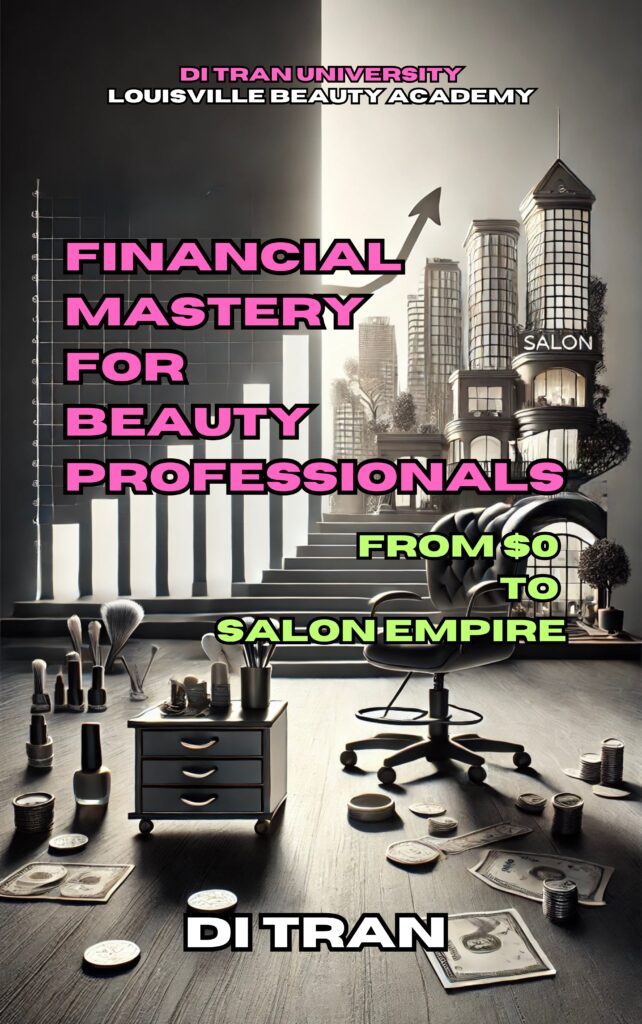
At Louisville Beauty Academy, we don’t just prepare you to be a beauty professional—we prepare you for a successful career and a thriving future. That’s why we are excited to announce the release of Di Tran’s latest book, “Financial Mastery for Beauty Professionals: From $0 to Salon Empire” (2025).

This book is a must-read for every beauty school graduate, licensed professional, and aspiring entrepreneur. It’s not just a guide—it’s a roadmap to transforming your skills into a business and your dreams into a legacy.


What This Book is About

Financial Mastery for Beauty Professionals is designed to help you go beyond the chair. It’s about taking control of your finances, building your own business, and investing in long-term wealth, all while staying true to your passion for beauty.

Written by Di Tran, a licensed nail technician, beauty entrepreneur, and real estate investor with over two decades of experience, the book walks you through every stage of growth—from starting as a beauty school graduate to building a salon empire and securing financial freedom through real estate.


Why Should Every Graduate, Licensee, and Prospect Read This Book?

1. Empower Yourself Financially

This book provides essential knowledge to help you master financial discipline. You’ll learn how to:

  • Avoid emotional spending and focus on meaningful investments.
  • Budget effectively and save for the future.
  • Reinvest in your skills, business, and wealth-building opportunities.

🔑 Why It Matters: Financial knowledge is the key to turning your passion into long-term success. Every dollar you earn and save today is a step toward building the future you want.


2. Build Your Own Business

Whether you dream of becoming a booth renter, salon owner, or multi-location entrepreneur, this book offers actionable steps to get there. You’ll discover:

  • How to transition from working for someone else to owning your own salon.
  • Strategies to scale your business and create additional revenue streams.
  • Ways to lead and empower your team while growing your brand.

🔑 Why It Matters: Owning your own business puts you in control of your career and income. It allows you to create opportunities not only for yourself but also for others in your community.


3. Leverage Real Estate for Wealth

Di Tran shares his insights on using your beauty business to fund real estate investments, turning your income into long-term wealth. You’ll learn how to:

  • Identify and purchase properties to house your salon or generate passive income.
  • Use real estate as a foundation for financial stability and legacy building.

🔑 Why It Matters: Real estate is one of the most reliable ways to build wealth, and your beauty business can be the engine that drives these investments.


4. Achieve Work-Life Balance

The book emphasizes the importance of maintaining balance as you scale your career. You’ll gain insights into:

  • Avoiding burnout while growing your business.
  • Prioritizing self-care and relationships.
  • Designing a sustainable career that supports both your personal and professional goals.

🔑 Why It Matters: Success is about more than money—it’s about creating a fulfilling life where you thrive in all areas.


5. Leave a Legacy

One of the most inspiring aspects of this book is its focus on leaving a lasting impact. You’ll learn how to:

  • Mentor others and empower the next generation of beauty professionals.
  • Create a business that thrives long after you’ve moved on.
  • Use your success to make a difference in your community.

🔑 Why It Matters: Your career isn’t just about what you achieve—it’s about the opportunities you create for others and the legacy you leave behind.


Why Louisville Beauty Academy Recommends This Book

At Louisville Beauty Academy, our mission is to elevate every student to their maximum potential. We provide not only the technical skills needed to succeed in the beauty industry but also the mindset and tools to thrive as entrepreneurs and leaders.

Financial Mastery for Beauty Professionals aligns perfectly with our values of continuous learning, adaptation, and growth. This book is a guide to the very principles we instill in our students:

  • The importance of starting small and dreaming big.
  • The value of financial discipline and smart investments.
  • The potential to build a career that creates both personal success and community impact.

Take Advantage of Your Opportunities

As a student, graduate, or prospective beauty professional, you already have an incredible opportunity to change your life through education. Remember:

  1. Your investment starts with your education. Every dollar spent on your training is an investment in your future.
  2. Louisville Beauty Academy offers 50-75% tuition discounts for eligible students. This means you can start your journey with minimal financial burden and focus on achieving your goals.
  3. Graduate fast, succeed sooner. Our programs are designed to help you complete your education efficiently so you can start earning and building your career right away.

Get Your Copy Today

📚 Grab your copy of Financial Mastery for Beauty Professionals: From $0 to Salon Empire today and take the next step toward your future:
https://www.amazon.com/dp/B0DTNVV5M4


Final Thoughts

This book isn’t just a resource—it’s a roadmap to a better future. Whether you’re just starting out, looking to grow your business, or dreaming of financial independence, Financial Mastery for Beauty Professionals will guide you every step of the way.

At Louisville Beauty Academy, we’re here to support you on this journey. With the right education, mindset, and tools, you can achieve anything.

Dream big. Start small. Build your legacy.

YES I CAN”: How Louisville Beauty Academy Empowers Graduates to Apply for the Licensing Exam Immediately

At Louisville Beauty Academy, we emphasize the “YES I CAN” mentality—an evidence-based, psychological approach to overcoming fears and challenges. One of the biggest hurdles our graduates face after completing their program is taking the licensing exam. For many, this exam represents the first and possibly only standardized test of its kind in their lives, and the fear of failure can feel overwhelming. But here’s the truth: the first and most important step is not perfection; it’s action.

The Psychological Barrier: Fear of the Unknown

The fear of taking the licensing exam is a common psychological hurdle. Many graduates feel unprepared, question their readiness, or worry about failing. This fear is natural, especially for those who have never experienced college or formal education systems that involve standardized testing. But fear thrives in the unknown. The best way to dismantle it? Dive in and take action.

Applying for and sitting for your licensing exam—even if you don’t feel fully ready—is a win in itself. Why? Because the moment you take that step, you break the psychological barrier of fear and uncertainty. You learn what the process entails, familiarize yourself with the computerized format, and gain insight into what is expected from the exam.

The First Step is Progress, Not Perfection

Let’s draw a comparison. Many high school students preparing for college take the ACT or SAT multiple times. Rarely do they achieve their highest scores on the first attempt. Success comes from learning the process, identifying areas for improvement, and building confidence over time. Similarly, the licensing exam is not a one-and-done situation. Thanks to Senate Bill 14 (2024), you can retake your licensing exam as frequently as once a month if needed. This flexibility ensures that every attempt is a step closer to success.

The goal of your first attempt isn’t to ace the exam—it’s to overcome the mental block and gain experience. Remember, taking action, no matter the result, is already a victory.

Learning by Doing: Why Your First Attempt Matters

For many graduates, especially those without a family history of higher education or professional licensing, this might be the only licensing exam they ever take. It’s not just about passing; it’s about learning the process and building confidence. Sitting for the exam allows you to:

  • Understand the computerized system and testing environment.
  • Identify the structure and style of questions asked.
  • Pinpoint areas where you can improve for the next attempt.
  • Build the psychological resilience needed to succeed.

At Louisville Beauty Academy, we foster a culture of resilience and empowerment. We encourage our students to embrace the mindset of “I HAVE DONE IT” from the moment they take their first step toward the exam. Every attempt builds confidence, reduces anxiety, and brings you closer to achieving your professional goals.

Overcoming Challenges: The Power of “YES I CAN”

The “YES I CAN” mentality is at the core of our mission at Louisville Beauty Academy. By applying for and taking your licensing exam immediately, you demonstrate to yourself and others that you are capable of facing challenges head-on. Regardless of the outcome, taking the first step is a declaration of your determination and belief in your abilities.

For those who fear failure, remember: failure is not a permanent state—it’s a stepping stone to growth. At Louisville Beauty Academy, we walk alongside our students and graduates as a family, encouraging and supporting them every step of the way. Together, we overcome challenges and celebrate every victory, no matter how small.

Take Charge of Your Future

The licensing exam is not just a test of your technical skills; it’s a test of your resilience, determination, and willingness to take action. By applying for and taking the exam immediately after graduation, you set the tone for your future career. You prove to yourself that you are capable of achieving your goals, regardless of the obstacles in your path.

So, don’t wait. Take the leap. Apply for your licensing exam today, prepare as much as you can, and take the exam with confidence. Whether you pass on the first try or need additional attempts, the most important thing is that you’ve started the journey. At Louisville Beauty Academy, we believe in you—and we know you can do it. Let’s walk toward success together.

Legal Disclaimer

Louisville Beauty Academy provides education and resources to prepare students for licensing exams and careers but makes no guarantees regarding exam results, employment, or other outcomes. Students are responsible for their own effort, compliance with licensing requirements, and application processes. The academy is not liable for any delays, denials, or losses related to licensure, employment, or personal decisions. Success depends on individual dedication and performance. By enrolling, students agree to these terms and acknowledge that outcomes are their sole responsibility.

Louisville Beauty Academy: Excellence, Transparency, and Student-Centered Success

Louisville Beauty Academy is a beauty school like no other. Known as the “Ivy League of Beauty Colleges” by our students and graduates, we take pride in creating a family-oriented environment of love, care, and inclusivity. Our success is not just measured by awards but by the relentless determination of our students to achieve their goals and transform their lives.

Here, we answer common questions to help you understand what sets Louisville Beauty Academy apart and why it is the best choice for your beauty education.

1. What Achievements or Recognition Do Your Graduates Have?

Louisville Beauty Academy is proud to showcase our students’ and graduates’ successes through:

Weekly Celebrations: Student accomplishments and graduate profiles are shared weekly across Facebook, LinkedIn, and other social media platforms.

Award-Winning Recognition: Our achievements, including awards for excellence, are publicly listed on our website for all to see.

Overcoming Challenges: Many of our graduates start with little to no higher education experience, often as foreign-language speakers. They face and conquer licensing exams fearlessly, demonstrating the true essence of resilience and determination.

2. What Makes Louisville Beauty Academy Different?

Market-Leading Resources:

• We utilize Milady CIMA, a cutting-edge learning platform that dominates 80% of the beauty education market.

• Our best-in-class student kits feature top-tier brands like OPI and CHI, ensuring students have access to the finest tools and products.

Inclusivity and Diversity:

• We maintain a zero-tolerance policy for discrimination, with students representing more than five languages spoken on campus.

• Many of our students learn English while preparing for their licensing exams, proving their adaptability and drive to succeed.

Family-Oriented Environment:

• We foster a culture of love and care, ensuring that every student feels supported throughout their journey.

• Our staff and instructors are approachable, empathetic, and committed to creating a positive learning experience.

Resilience and Perseverance:

• Our students embrace the “Yes I Can” mentality, and our “I Have Done It” certificates of readiness celebrate their achievements.

• Graduates are fearless in retaking licensing exams if needed, mastering the “practice makes perfect” philosophy that builds confidence and capability.

3. What Learning Resources and Tools Do You Provide?

Louisville Beauty Academy is proud to offer:

Milady CIMA: The most advanced digital platform in beauty education, providing interactive learning experiences for students.

High-Quality Kits: Featuring brands like OPI, CHI, and other industry leaders, our kits prepare students for professional success.

Monthly Book Publications: Authored by our founder, Di Tran, these books provide fresh insights and inspiration to enhance both professional and personal growth.

4. How Does Louisville Beauty Academy Communicate with Students?

We prioritize accessibility and clarity in communication through:

Multiple Channels: Email, text, and in-person meetings ensure students can always reach us.

Proactive Updates: Students are informed of everything they need to know, from scheduling to exam preparation resources.

5. What is Louisville Beauty Academy’s Approach to Exam Preparation?

Resilience Over Perfection:

• We encourage students to overcome their fear of failure. Many of our students, particularly non-native English speakers, take the licensing exam multiple times, mastering the content and process along the way.

• This approach builds fearlessness and confidence, qualities essential for long-term success in life and career.

Support Beyond Graduation:

• We are committed to providing ongoing support and resources for our graduates, including unlimited tutoring at no additional cost (excluding state board fees).

• Our “never give up” philosophy inspires students to keep pushing forward until they achieve their dreams.

6. What is Louisville Beauty Academy’s Cultural Impact?

Louisville Beauty Academy is proud to help shape the next generation of beauty professionals and American citizens by fostering:

Determination: Our students are known for their refusal to give up, often overcoming extraordinary obstacles to succeed.

Diversity: We celebrate the diverse backgrounds of our students, many of whom come from immigrant families and speak multiple languages.

Transformation: From beginners with no prior education to licensed professionals, our graduates’ journeys are nothing short of inspiring.

Take the Next Step

At Louisville Beauty Academy, we don’t just prepare students for exams; we prepare them for life. With award-winning graduates, market-leading resources, and a culture of resilience and care, we are proud to be a center of excellence in beauty education.

Join the soon-to-be 2,000+ graduates of Louisville Beauty Academy!

• Text us at 502-625-5531

• Email study@LouisvilleBeautyAcademy.net

Disclaimer

This article reflects common practices and information about Louisville Beauty Academy and the beauty education industry. It is not a guarantee of specific outcomes. Students are encouraged to independently review public information about the school and make informed decisions based on their individual goals. Louisville Beauty Academy focuses on preparing students for licensing and success but emphasizes that achievement depends on each student’s dedication and effort.

Louisville Beauty Academy: Elevating the Beauty Industry with Impact, Innovation, and Care

Louisville Beauty Academy is proud to be a series award-winning organization, recognized for breaking barriers and tackling challenges to make beauty licensing education accessible to all. Utilizing the latest technology, innovative processes, and a deep commitment to love and care, we are dedicated to uplifting underrepresented populations and transforming the beauty industry in Kentucky and surrounding states.

Our students, graduates, and community have named us the “elite” and “Ivy League” beauty college of Kentucky and neighboring states—a title we embrace with pride and responsibility. This recognition fuels our relentless effort to elevate lives, expand opportunities, and increase our impact. We’re not slowing down. In fact, we’re accelerating our mission to bring more licensed beauty professionals to the industry with the trademark “YES I CAN” mentality and graduating them with our unique “I HAVE DONE IT” certificate, fully prepared for state board licensing.

Adopting, Adapting, and Growing

At Louisville Beauty Academy, we consistently adapt to the ever-evolving needs of the beauty industry. In 2024 alone, we’ve introduced over 50 humanization books authored by our founder, Di Tran. These books inspire and equip individuals to become their best selves, serving with excellence and care. As we move forward, we’re expanding to new locations, seeking partnerships with the best in the state and nation, and increasing our reach to elevate even more lives.

Our growth isn’t just about numbers—it’s about real impact. For every graduate we license, our founder, Di Tran, counts it as a success. Each graduate who opens a salon adds tangible value to the community, creating jobs, opportunities, and economic growth. To us, success isn’t measured by enrollment but by the lives we transform and the businesses we help build.

Join Us Today

Louisville Beauty Academy is more than a beauty school—it’s a movement to change lives, one graduate at a time. We invite you to join our family of nearly 2,000 alumni who are already making waves in the beauty industry.

Text us at 502-625-5531 or email us at Study@LouisvilleBeautyAcademy.net to start your journey. As the most affordable, flexible, and impactful beauty licensing college in the region, we’re here to ensure your success. Together, let’s elevate the beauty industry and transform lives with love, care, and a commitment to excellence.