Louisville Beauty Academy Featured Nationally by NSBA on 12-03-2025

A Moment of Pride, A Celebration of Collaboration, and a Testament to Humanization in Action

On December 3, 2025, the National Small Business Association (NSBA) — America’s longest-serving small-business advocacy organization — officially featured Di Tran, founder of Louisville Beauty Academy (LBA), in its national “My Business, My Cause” spotlight and across its NSBAAdvocate.org platform and national social channels. The feature highlighted the heart, mission, and community impact of LBA as one of Kentucky’s leading workforce engines.

This national recognition is not only a proud moment for Di Tran personally — it is a proud moment for the entire Louisville Beauty Academy family, for the City of Louisville, for the Commonwealth of Kentucky, and for the United States.


A School Built on Humanization — Before Skill, Before Business

Louisville Beauty Academy was founded on the principle that humanization comes first.

This philosophy is deeply rooted in the emerging framework of Di Tran University (DTU) — often referred to as the “College of Humanization.” The foundation of this philosophy is simple but profound:

Human First → Value-Add → Skill → Business → Economy

Before we teach beauty techniques, before we talk about licensing, before we mention entrepreneurship, we focus on the person — their dignity, their confidence, their story, their hopes.

At LBA, every student is seen, heard, respected, and uplifted before anything else.
This is why our classrooms feel like families.
This is why more than 2,000 licensed graduates have built real careers and changed their families’ futures.
This is why we produce not only licensed beauty professionals, but contributors to Kentucky’s economic strength.


Business Is Human. Business Is Collaboration. Business Is Shared Elevation.

The NSBA feature highlights the central message:
small business is the engine of the American economy, but it only works through collaboration, shared support, and collective love.

The NSBA’s 2025 National Impact Report shows the scale of this collaboration:

  • 14 million jobs saved through initiatives NSBA shaped
  • 20% Qualified Business Income deduction permanently enacted for small-business owners
  • 535 congressional districts represented through NSBA leadership
  • Multiple congressional testimonies, letters, and federal regulatory actions shaping policy nationally
    (See NSBA PDF, pages 1–4 for full details.) NSBA-LBA-Website-12-03-2025 _ W…

Louisville Beauty Academy stands proudly inside this national ecosystem — an ecosystem where small schools, small employers, and small families collectively build huge economic outcomes.


Why This NSBA Feature Matters to Louisville Beauty Academy

This national spotlight is more than an honor — it reinforces three core truths about LBA:

1. LBA Is a Human-First Academy

We exist to lift people up first, before teaching skills.
This is the DTU philosophy in action.

2. LBA Is a Workforce Engine for Kentucky

Nearly 2,000 licensed graduates, contributing $20–50 million annual economic impact to the Commonwealth.

3. LBA Is Part of a National Ecosystem

We are not alone.
We are surrounded by partners who believe in small business, education, and community development — including NSBA, local employers, Louisville organizations, and our state supporters.


A Message of Gratitude — From LBA to the World

On this special occasion, Louisville Beauty Academy expresses:

Thanks to God

For life, for purpose, for each breath that allows us to serve.

Thanks to Louisville

The city of love, diversity, and resilience — the city that embraced LBA and every immigrant and first-generation student who walks through our doors.

Thanks to Kentucky

The state of opportunity — where hard work and family values still matter, and where education transforms lives daily.

Thanks to the United States

The #1 country on Earth, where a small immigrant-founded school can rise, serve, and be recognized nationally.

Thanks to NSBA

For giving voice to small businesses, for elevating stories like ours, and for being a national advocate protecting the backbone of America’s economy.


“Value-Add” — The Daily Principle of Louisville Beauty Academy

At LBA, our founder Di Tran teaches one simple rule:

Value-add every single day — to yourself, your family, your community, and your state.

This principle guides:

  • our instructors
  • our students
  • our graduates
  • our outreach
  • our contribution to Kentucky’s workforce and economy

This NSBA feature is simply the outward reflection of what LBA practices daily — the quiet, humble work of serving people, one license at a time.


Proud, Grateful, Motivated — and Ready for More

Louisville Beauty Academy celebrates this moment not as a finish line, but as encouragement to keep serving with greater love, greater humanization, and greater commitment to Kentucky families.

**We rise by lifting others.

We grow by serving others.
We succeed by adding value to others.**

From our family at LBA to yours —
Thank you for believing in us.
Thank you for walking with us.
Thank you for letting us serve.

Louisville Beauty Academy
Kentucky’s Leading Beauty Licensing Workforce Engine
Founded in Louisville, KY | Powered by Humanization | Fueled by Community

Walk In, Learn, Succeed: Louisville Beauty Academy Sets the Gold Standard for Accessible, Compliant, and Digitally-Verified Beauty Licensing Education

Louisville Beauty Academy (LBA) continues to lead Kentucky as the #1 Beauty Licensing Workforce Engine, producing nearly 2,000 licensed graduates and generating an estimated $20–50 million annual economic impact for the Commonwealth.
Rooted in compassion, discipline, and full Kentucky State Board compliance, LBA offers an educational experience built around accessibility, transparency, and the highest digital accountability in the state.

Today, we highlight the core features that set LBA apart from every other beauty college in Kentucky.


1. Walk-In Enrollment — Start Immediately, No Delay, No Barriers

LBA empowers students to take control of their future today, not months from now.
If a student is ready, they may walk in and begin the same day.

Simple steps to start immediately:

  • Review the Enrollment Procedure
  • Bring required documents (ID, SS card or ITIN, education verification)
  • Complete the digital student contract
  • Read and acknowledge the Student Handbook
  • Make the required initial payment
  • Begin training right away

This model reflects LBA’s mission: no waiting lists, no wasted time, no unnecessary hurdles.
Students enroll weekly. Students graduate weekly. The learning community grows continuously.


2. Walk-In Tours — No Appointment Needed, Ever

LBA believes in radical transparency.
We welcome the public to walk in anytime between 9 AM – 4 PM, Monday–Friday, for a full tour.

During these hours:

  • Classrooms are active
  • Instructors are available
  • Students are practicing
  • Prospective students can observe real training sessions
  • All questions are answered with full regulatory accuracy

No scheduling.
No sales process.
No barriers.

Just real education on display.


3. Kentucky’s Leading Digital Compliance System — 100% Tracking, Zero Guesswork

Louisville Beauty Academy is recognized statewide for its advanced compliance infrastructure, designed to protect every student, graduate, and staff member with uncompromising accuracy.

LBA’s Digital Compliance & Tracking System Includes:

  • SMART biometric timekeeping for exact State Board attendance records
  • Digital student contracts via JotForm (fully archived and timestamped)
  • Quality assurance dashboards ensuring every hour, service, and requirement is properly counted
  • AI-assisted compliance oversight for self-correction and rapid adaptation when laws change
  • Full communication logs for transparency, staff accuracy, and student protection

Our Why

Kentucky State Board regulations evolve.
Our systems evolve faster.

LBA’s compliance department uses digital tools to:

  • Track all communication
  • Audit every student milestone
  • Verify staff responses
  • Prevent misinformation
  • Maintain 100% verifiable, defensible documentation
  • Protect every student through their entire licensing journey

This is why LBA is trusted as one of the most digitally mature and compliance-secure beauty colleges in Kentucky.


4. Preferred Communication: Text or Email for Accuracy and Documentation

For the benefit and protection of all students, graduates, and staff, LBA strongly prefers:

📱 Text Messaging
📧 Email

These channels allow the compliance department to:

  • Provide accurate, updated answers as regulations change
  • Keep clear records for student protection
  • Maintain internal accountability
  • Self-correct and adapt instantly if any policy or rule changes
  • Store all communication in the school’s digital archive for long-term security

This ensures zero confusion, zero miscommunication, and 100% transparency.


5. A Culture of Safety, Family, and Weekly Success

Every week at LBA:

  • New students walk in and begin their journey
  • Graduates walk out fully licensed
  • Students support one another like a family
  • Instructors guide students at a self-paced, flexible schedule

The school prides itself on being:

  • Family-oriented
  • Safe and welcoming
  • Fully state-compliant
  • Student-protective
  • Community-focused
  • Future-workforce driven

LBA’s mission is simple:
Help every student become the best licensed professional they can be, at their own pace, with full protection and full transparency.


Visit Anytime — Your Future Is One Walk-In Away

📍 Louisville Beauty Academy – State Licensed Beauty College
🕘 Walk-In Public Hours: 9 AM – 4 PM (Mon–Fri)
📱 Text or Call: 502-625-5531
📧 study@LouisvilleBeautyAcademy.net
🌐 LouisvilleBeautyAcademy.net

No appointments. No waiting lists. No barriers.
Walk in today — start your new career today.


Compliance & Legal Disclaimer

This information is for general educational purposes only. All policies, procedures, and requirements are governed by the Kentucky State Board of Cosmetology under KRS 317A and 201 KAR 12. Regulations may change without notice. LBA assumes no liability for interpretation or external use. Students are responsible for reviewing all contracts, handbooks, and regulatory materials before enrollment.

Louisville Beauty Academy: Prestige, Trust, and National-to-Local Recognition in Every Graduate’s Hands

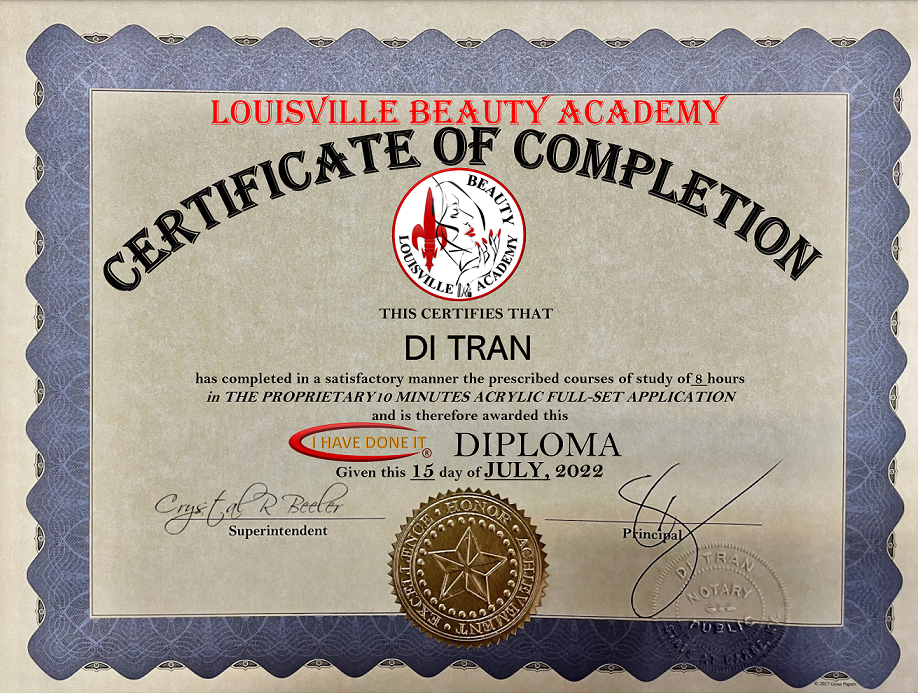
At Louisville Beauty Academy (LBA), graduation means more than earning a license. Every student walks proudly with their Certificate of Completion — a credential that carries prestige, trust, and community recognition far beyond the classroom. This certificate is more than paper; it is a badge of honor, a lifelong reminder of the “YES I CAN → I HAVE DONE IT” mindset that defines both our academy and our graduates.


A Legacy of Recognition: From Local to National

The academy’s impact, fueled by hardworking staff, dedicated instructors, and resilient students, has been validated through some of the most prestigious awards in the nation, the state, and the city of Louisville:

  • U.S. Chamber of Commerce CO—100 (2025) – Louisville Beauty Academy was the only Kentucky business named among America’s Top 100 Small Businesses, selected from over 12,500 applicants nationwide.
  • National Small Business Association (NSBA) – Small Business Advocate of the Year Finalist (2025) – Founder Di Tran was honored in Washington, D.C. as one of just five advocates nationwide, standing shoulder-to-shoulder with leaders shaping small business policy.
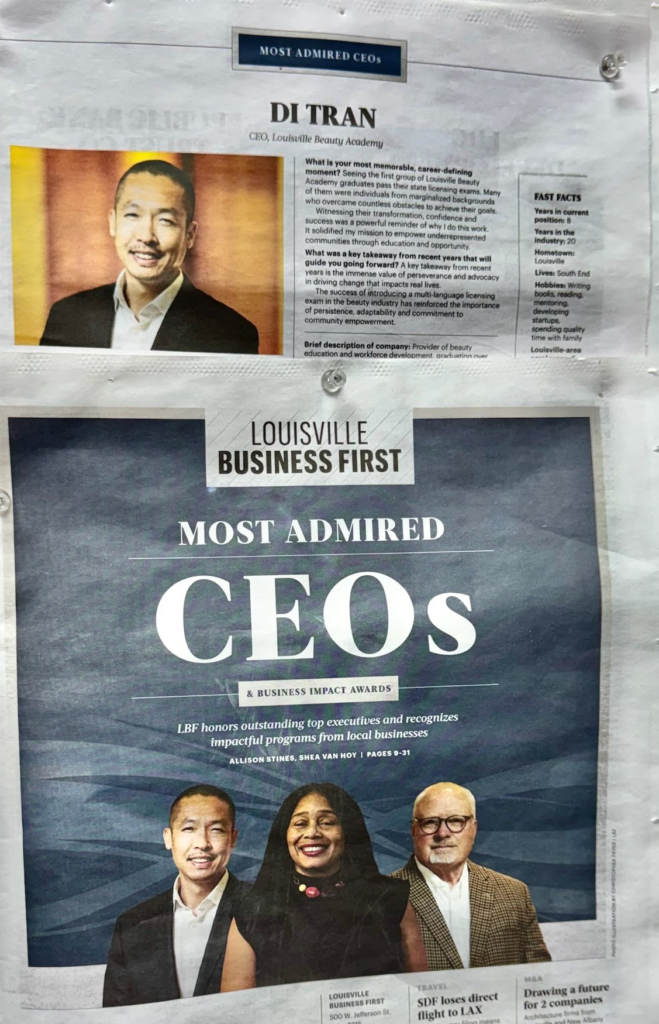
  • Louisville Business First – Most Admired CEO (2024) – Front-page recognition of Di Tran as a visionary leader in Kentucky’s business community.
  • Louisville Business First Rising Star – Highlighting Di Tran as one of Louisville’s most promising young leaders.
  • Jewish Community of Louisville Mosaic Award (2023) – Celebrating LBA for advancing diversity, inclusion, and empowerment across immigrant and minority communities.

These honors do not belong to one person alone. They reflect the collective effort of nearly 2,000 graduates, dedicated faculty, and the broader Louisville community that trusts in LBA’s mission.


Why the Certificate of Completion Matters

Graduates often ask: “Which certificate is most important when I graduate?”
While the state license is essential to practice, the LBA Certificate of Completion carries something deeper:

  • Prestige – It symbolizes the most awarded and nationally recognized beauty college in Kentucky.
  • Community Trust – It represents the support of local, state, and national organizations who have celebrated LBA’s success.
  • Family & Belonging – LBA is more than a school; it is a lifelong family. Students are never left behind—unless they choose to leave themselves.

To hold an LBA Certificate is to hold proof of not just a completed program, but of resilience, empowerment, and recognition at every level.


A Movement of Empowerment

Through Louisville Beauty Academy and Di Tran University, the motto “YES I CAN → I HAVE DONE IT” has become a movement of human development. Nearly 2,000 graduates have gone on to open salons, launch careers, and collectively contribute an estimated $20–50 million annually to Kentucky’s economy.

Every award, every certificate, and every graduate’s success proves that beauty education is more than skills. It is about entrepreneurship, empowerment, and economic impact.


The LBA Promise

Louisville Beauty Academy remains:

  • The most affordable beauty school in Kentucky.
  • The most flexible, meeting students where they are.
  • The most supportive, creating a lifelong network of care.
  • The most loving, because every student matters.

Our Certificate of Completion is not just paper. It is prestige, trust, and belonging — a testament to both personal achievement and the collective spirit of Louisville and Kentucky.

When our graduates hold that certificate in their hands, they hold more than their future. They hold local, state, and national recognition for who they are and what they will become.

Because here at Louisville Beauty Academy: YES I CAN. YES WE DID. YES YOU WILL.

References

Louisville Beauty Academy. (2024, October 3). Louisville Beauty Academy CEO Di Tran honored as one of Louisville Business First’s 2024 Most Admired CEOs. Louisville Beauty Academy. https://louisvillebeautyacademy.net/louisville-beauty-academy-ceo-di-tran-honored-as-one-of-business-firsts-2024-most-admired-ceos-10-03-2024 Louisville Beauty Academy

Jewish Family & Career Services. (2022). Meet Our 2022 MOSAIC Award Honorees. Jewish Family & Career Services. https://jfcslouisville.org/meet-our-2022-mosaic-award-honorees/ Jewish Family & Career Services

Louisville Beauty Academy. (2024, November 22). Di Tran, Most Admired CEO, celebrates USA and workforce development with a message of love and care. Louisville Beauty Academy. https://louisvillebeautyacademy.net/di-tran-most-admired-ceo-celebrates-usa-and-workforce-development-with-a-message-of-love-and-care/ Louisville Beauty Academy

Louis Business First. (2024, October 3). Announcing: Here are LBF’s Most Admired CEOs honorees. Louisville Business First. https://www.bizjournals.com/louisville/news/2024/10/03/announcing-here-are-lbfs-most-admired-ceos-honoree.html media.zenobuilder.com

National Small Business Association. (2025, September 4). Press | NSBA Announces Finalists for 2025 Advocate of the Year Award. NSBA. https://www.nsbaadvocate.org/post/press-nsba-announces-finalists-for-2025-advocate-of-the-year-award NSBA | Since 1937

U.S. Chamber of Commerce. (2025). Louisville Beauty Academy | CO— by U.S. Chamber of Commerce. U.S. Chamber. https://www.uschamber.com/co/profiles/louisville-beauty-academy uschamber.com

Elevate Your Future with Louisville Beauty Academy: A Lifeline Career in the AI Era

The AI Tsunami and Job Uncertainty

Advances in artificial intelligence are reshaping the job market at breakneck speed. Many workers feel like they’re caught in an “AI tsunami” – waves of automation and layoffs that threaten to overturn traditional careers. In fact, some estimates suggest 40–50% of all jobs could be replaced in the next 20 years. From finance to customer service, AI tools are automating tasks once done by humans, leaving many to wonder if their livelihoods are secure. This technological upheaval has created an urgent question: how can you future-proof your career? For those watching roles vanish almost overnight, it’s like drowning in uncertainty – but there is a lifeline. Not all work can be handed off to robots, and that’s where human service professions stand out. Before despair sets in, it’s critical to recognize one reassuring fact: jobs that rely on human touch, creativity, and personal care are far harder to automate. In the midst of an AI-driven storm, these people-centered careers can be a safe harbor for your professional future.

Human Service: An Irreplaceable Touch

https://commons.wikimedia.org/wiki/File:Hairdresser_at_work.jpg Personal care professions like hairstyling offer a human connection and skilled touch that technology cannot replicate. Careers focused on serving people’s personal needs – such as cosmetologists, hairstylists, estheticians, and nail technicians – provide something no algorithm can replace: the human touch. Consider the simple act of getting a haircut or a facial. It’s not just a mechanical service; it’s a personal experience built on trust, creativity, and care. Hairdressers and cosmetologists have an extremely low risk of automation (roughly a 30% chance of being automated), which is considered “Low Risk” compared to many other jobs. Why? Because these roles demand uniquely human qualities: dexterity, creativity, and social perception. A robot might theoretically wash hair or mix hair color, but it cannot replace the empathetic listening, the friendly conversation, or the nuanced artistry a trained beauty professional provides.

This human-centric aspect is not just a feel-good bonus – it’s increasingly essential. As modern life grows more digital, many people are experiencing greater stress and even loneliness. Ironically, the more tech surrounds us, the more we crave genuine human interaction. A beauty salon or barbershop often serves as a social hub that eases isolation, where clients not only get a makeover but also share stories and form bonds. Studies have noted that salons can play a role in reducing social isolation and fostering community connection. Think of how often a hairstylist or barber becomes a confidant – providing a friendly ear and personal advice while helping you look your best. In a time when mental health and human connection are paramount, beauty professionals offer a form of personal care that goes well beyond surface appearance. They deliver moments of trust, confidence, and comfort that no AI can replicate or replace.

Importantly, the demand for these services remains strong. No matter what new app or gadget comes along, people will continue to need haircuts, skincare, nail care, and the simple relief of personal pampering. In fact, far from shrinking, the need for well-trained beauty professionals is expected to grow. The U.S. Bureau of Labor Statistics projects that job openings for “Hairdressers, Hairstylists, and Cosmetologists” will rise by about 7% by 2033 – steady growth that outpaces many other occupations. The reasoning is clear: while automation might streamline some aspects of the beauty industry (like online scheduling or AI-powered product recommendations), the core services require a human provider and always will. In sum, pursuing a career in the beauty field means entering an industry that is future-proofed against automation and rooted in human connection. It’s work that feeds a genuine human need – for connection, confidence, and care – making it as resilient as it is rewarding.

Stability and Opportunity in the Beauty Industry

Choosing a career in beauty isn’t just about surviving the AI disruption; it’s about thriving in a stable, flexible, and opportunity-rich field. Unlike many professions where AI might cause uncertainty, licensed beauty professionals enjoy a level of job security and adaptability that’s increasingly rare. One key reason is the speed and certainty with which you can start working and earning in this field. With the proper training and a state cosmetology or esthetics license, you can be job-ready in under a year and immediately begin earning income – often even before many college students would finish their freshman courses. In contrast to a four-year (or longer) college path, beauty training is a fast track to the workforce. For example, a focused program in nail technology can be as short as 6 months, and a full cosmetology program is typically around 9–12 months, not 4+ years. This means you can start bringing in paychecks years earlier than someone taking the traditional degree route. Those extra years of earnings can be life-changing for you and your family.

Equally important, beauty careers offer immediate and practical financial benefits. As soon as you pass your state board exams and obtain your license, you hold a credential that salons, spas, and barber shops are actively seeking. There’s a well-documented shortage of licensed beauty professionals in many areas, so placement rates for graduates of good beauty schools are impressively high. For instance, Louisville Beauty Academy (a standout example we’ll discuss in depth shortly) reports nearly a 90% job placement rate for its graduates entering the beauty job market. In real terms, that means almost all students who put in the effort to get licensed are able to find work – and not just any work, but work they enjoy in the beauty field. Clients are out there waiting; from day one with a license, you can often start taking clients or filling open chairs at salons. Many new graduates even choose to start earning money on the side while finishing their training, by offering limited services (within what’s legally allowed) or working as an assistant in a salon, so they can “pick up cash work instantly” as the user phrased, gaining experience and income even before fully graduating.

Another major draw of the beauty industry is entrepreneurial opportunity. This is not a field where you’re locked into climbing a rigid corporate ladder. On the contrary, it’s one of the best fields to launch your own business when you’re ready. Once you have your license, you can work as a freelance makeup artist, rent a chair as an independent stylist, or even open your own salon. The barrier to starting a small business in beauty is relatively low – often requiring just some basic equipment, a rented space or mobile setup, and your skills. Plenty of cosmetologists become their own bosses within a few years of gaining experience. This means a beauty career can scale with your ambitions: it’s perfectly fine to work for an established salon, but if you have the drive, you can grow into an owner or entrepreneur. In Kentucky, for example, many former students of Louisville Beauty Academy have gone on to become successful salon owners and small-business entrepreneurs, using their training as the foundation for business ownership. Some now own thriving salons valued at over half a million dollars, contributing significantly to their communities and personal wealth. The beauty industry’s blend of low startup costs and high demand makes it fertile ground for those with an entrepreneurial spirit.

Finally, consider the personal and social rewards that come with this career. Working in beauty, you directly impact people’s lives in a positive way every day. You help someone feel confident before a job interview, provide a relaxing service to a stressed client, or simply lend a sympathetic ear. There’s a deep fulfillment in using your hands and creativity to make others happy – something that many desk jobs can’t offer. In a world where degrees sometimes lead graduates to underemployment or impersonal cubicle work, a beauty professional gets to see the smile on a client’s face every day as a direct result of their skill. This immediate sense of making a difference, combined with flexible career paths and steady demand, makes the beauty field exceptionally rewarding. It’s a career where you can earn a good living, support your family, and even build a business – all while doing work that genuinely matters to people. That combination of stability, financial opportunity, and personal fulfillment is precisely what so many are seeking as other industries become more uncertain.

License vs. Degree: The Power of a State-Approved Career

Choosing a state-licensed career in beauty over a traditional academic degree can be a smart, pragmatic decision in today’s economy. Let’s break down why a state-issued license often delivers more tangible value than a generalized college diploma, especially when jobs are in flux. First and foremost, a cosmetology or esthetics license is a legal requirement to work in this field – it’s a credential backed by the state government, verifying that you have the specific skills and hours of training needed to safely serve clients. In other words, a license is directly tied to a job: once you have it, you are authorized to perform services and earn money in a salon or your own business. A college degree, by contrast, does not guarantee a job. Many graduates discover that their degree, while valuable in knowledge, doesn’t translate into immediate employment or may be in a field with shrinking demand. This is especially worrying in the age of AI, where certain degree-heavy fields (like some areas of finance, journalism, or even tech) are seeing roles eliminated or transformed beyond recognition. A degree’s value can diminish if the field it’s in becomes obsolete. A state license in a human service trade, however, maintains its value because the service remains in demand and often is legally protected (for example, only licensed professionals can perform certain beauty services).

Another advantage of the licensure path is time and cost efficiency. Traditional college is a 4-year commitment at minimum, and in reality many students take 5–6 years to graduate, often incurring tens of thousands in student loans along the way. The average new college graduate in America now carries about $29,000 in student loan debt from a bachelor’s degree. That debt can be a heavy burden, following people for decades and limiting their financial freedom. And after all that time and money, about 40% of students never even complete their degree within six years – meaning many are left with debt but no diploma. In contrast, beauty school is relatively short and affordable. For example, at Louisville Beauty Academy a full cosmetology program (1500 hours) can be completed in 9–10 months, and a shorter specialty like nail tech (450 hours) in just a few months. Tuition is often a fraction of what a university charges; at LBA, a nail program might cost around $3,800 after scholarships, and a full cosmetology program around $6,000–7,000, whereas even public universities can cost $40,000 or more over four years. Significantly, schools like LBA take pride in a “no student debt” policy – offering zero-interest payment plans and in-house scholarships so that most graduates finish owing $0 in school debt. The outcome is a new professional entering the workforce in under a year, debt-free, as opposed to a college grad who might spend half a decade in school and come out owing money without a guaranteed job.

The results speak for themselves. A vocational education focused on licensing tends to have higher completion rates and job placement than the college route. Louisville Beauty Academy, for instance, boasts a completion/graduation rate over 95% (virtually all who start the program finish and go on to take their licensing exam). That’s dramatically higher than the ~60% six-year completion rate of four-year colleges. And those who finish at LBA do so with a professional license and often a job offer waiting. The academy’s graduates achieve a 90%+ licensure pass rate and job placement around 90% into salons and spas. Many even quickly progress to opening their own businesses, as noted earlier. Compare that to the story for many college grads: about 53% of bachelor’s degree holders take on loans, and upon graduating, a significant number find themselves underemployed or struggling to find a role that actually requires their degree. Employers frequently note that new college graduates lack practical skills and need additional training. In contrast, a beauty school graduate’s skills are hands-on and directly aligned with a job; they’ve literally been practicing on real clients during training, so they’re ready to work immediately.

Beyond the statistics, there’s a shift happening in how society views education. The old stigma that “vocational schools are second tier” is fading in the face of economic reality. People are recognizing that practical, skills-based education can offer equal or greater stability than a generalized degree. A state license is portable (often transferable or recognized across states with minimal extra requirements) and it never loses its relevance – as long as people need haircuts, skincare, and wellness, your license is your ticket to employment. Degrees will always have their place, but in an era when even white-collar jobs are at risk from AI, having a certified trade is like an insurance policy for your livelihood. You hold proof of ability to do work that people unequivocally need and will pay for. In short, license equals livelihood. It’s a foundation you can build on for life, whether you practice your craft, manage others, or start your own venture. And with ongoing education (like learning new beauty techniques or trends), your skills only increase in value over time.

Louisville Beauty Academy – Leading the Way in a Changing World

https://louisvillebeautyacademy.net/louisville-beauty-academy-ceo-di-tran-honored-as-one-of-business-firsts-2024-most-admired-ceos-10-03-2024/ Louisville Business First honored Louisville Beauty Academy CEO Di Tran (top left) as a 2024 “Most Admired CEO,” recognizing his visionary approach to education and workforce development. When it comes to choosing a beauty school and launching your new career, Louisville Beauty Academy (LBA) stands out as a model of excellence, innovation, and heart. This Kentucky-state licensed and accredited beauty college has earned a reputation not only for producing highly skilled professionals, but also for its mission-driven commitment to students’ success. LBA is helmed by CEO Di Tran, an immigrant entrepreneur and thought leader who has been widely recognized for his work in education and workforce development. In 2024, Di Tran was honored as one of Louisville’s “Most Admired CEOs” by Business First, a testament to his visionary leadership and unwavering dedication to uplifting the community through education, workforce development, and entrepreneurship. Under his guidance, Louisville Beauty Academy has transformed the lives of hundreds of individuals and is actively setting new standards in the beauty education field.

One of LBA’s core beliefs is that education should be accessible, flexible, and practical. This is evident from the moment you inquire about enrolling. The academy understands that many of its students are adults who might be juggling jobs, family, or other responsibilities (after all, not everyone can drop everything for school). That’s why LBA offers open enrollment (you can start at multiple points in the year) and even self-paced scheduling options. Students can attend full-time or part-time, including evening and weekend hours, making it possible to fit education into a busy life. This flexibility means even if you’re a single parent or working a day job, there’s a path for you to get your license. The results are astounding: thanks to this supportive approach, LBA achieves an extremely high completion rate of over 95% – almost everyone who starts is able to finish, because the school works with students to overcome obstacles. It’s common at LBA to see a mother of two, a recent high school grad, and a retiree all in the same class, each accommodated and empowered to succeed in their own way. The academy’s message is “once you’re part of the family, we will do everything to see you succeed.” This family atmosphere isn’t just talk – it’s backed by policies like allowing students to pause and resume studies as needed, providing extra tutoring, and offering personal mentorship when life challenges arise.

Another hallmark of Louisville Beauty Academy is its commitment to inclusivity and community service. LBA proudly welcomes students of all backgrounds: from local Louisville natives to new immigrants and refugees who speak little English. In fact, the majority of LBA’s 1,000+ graduates have been new Americans – people from diverse countries who found a welcoming home at LBA while pursuing their dreams. Walking into the school, you might hear five or six languages being spoken among students. Rather than seeing this as a barrier, LBA has turned it into a strength. Di Tran and his team leverage technology (and a lot of human kindness) to break down language barriers. Generative AI tools and AI-driven translation are integrated into daily learning – an area where LBA is truly ahead of the curve. For example, students have access to a custom ChatGPT-based assistant and AI video avatars that can tutor or answer questions in 100+ languages, providing on-demand translation and explanations. A prospective student can even go to LBA’s website and interact with an AI video guide in Spanish or Vietnamese to learn about the enrollment steps. In the classroom, if a student struggles with English, they can use a tablet to instantly translate a lesson or ask the AI for clarification, 24/7. This kind of AI-supported, multilingual learning environment ensures no one is left behind due to language or learning style. It’s a human-centered approach enhanced by technology – blending in-person mentorship with AI assistance to create a truly inclusive classroom. While most traditional colleges are still debating how to handle AI (only about 10% have any formal policy on tools like ChatGPT as of 2024), LBA has embraced these innovations to better serve students. As a result, LBA’s students get “everything they need to succeed from day one to licensure” with personalized support that big institutions simply don’t offer. This forward-thinking use of AI in education has put LBA at the forefront of vocational training innovation, effectively making Di Tran a pioneer in combining AI with workforce development in a practical, no-nonsense way.

Beyond technology, LBA distinguishes itself through affordability and financial support that remove barriers for those seeking a new career. Tuition at LBA is deliberately kept low – well below national and state averages – because Di Tran’s philosophy is that no willing student should be turned away for lack of funds. The academy offers hefty scholarships, typically 50% to 75% off tuition, for students who need it, especially immigrants, single parents, and those from underserved communities. Many students attend at half price or even less, and LBA provides zero-interest payment plans to spread out any remaining cost. This means you can enroll with little upfront cost and without resorting to loans. As LBA often says, “legitimate beauty careers” should be within reach for everyone. The impact of this policy is evident in the diverse makeup of the student body – people who might not afford other schools are thriving at LBA, and subsequently uplifting their own economic situations. By boosting the local pool of licensed talent in the beauty industry through these efforts, LBA isn’t just helping individual students; it’s also strengthening the community’s workforce and small business sector. (Notably, LBA was recognized as one of the most impactful businesses in Louisville for these contributions.)

Crucially, LBA’s focus is not merely on getting students licensed, but truly on elevating lives. Under Di Tran’s leadership, the academy instills a mindset of confidence and continual growth in its students. The school’s mantra “YES, I CAN” is more than a slogan – it’s a culture. Students of all ages (teenagers to seniors) learn that it’s never too late to start a new chapter. As Di Tran proudly notes, LBA has had graduates in their 60s and 70s earn their Kentucky beauty license, including a 70-year-old recent graduate who’s living proof that new careers aren’t just for the young. This supportive, empowering environment builds graduates who not only have skills, but also the confidence to pursue their goals boldly. Many alumni carry that forward – they open businesses, mentor others, and continue to learn new techniques. It’s no surprise that Di Tran’s leadership and LBA’s model have drawn national attention. Education experts have pointed out that integrating adaptive learning technology and hands-on training (as LBA does) is “revolutionizing skill development”, and LBA is at the forefront of this revolution. In recognition of his visionary approach, Di Tran’s story – from humble immigrant beginnings to successful founder of LBA and author of over 130 self-published books – has been widely celebrated as an embodiment of the American Dream. He and the Louisville Beauty Academy team demonstrate how practical workforce development can change lives and communities for the better, one student at a time.

When you choose Louisville Beauty Academy, you’re not just signing up for a course – you’re joining a family and a movement. You’ll train with instructors who care about your success, in an environment equipped with both traditional and cutting-edge learning tools. You’ll be taught to master the technical skills of beauty and the soft skills of customer service, business basics, and community engagement. You’ll learn in a place where “love and care come first,” as LBA likes to say, reflecting the supportive culture that has enabled over 1,000 students (many from underrepresented backgrounds) to become successful professionals. And as a graduate, you’ll carry a state license that can immediately translate into employment or entrepreneurship. LBA’s nearly 90% job placement rate means the odds are in your favor from the start. The academy’s partnerships – such as a new second LBA location within Louisville’s Harbor House intergenerational life center – even create additional opportunities for students to practice and give back (for example, providing free beauty services to seniors and people with disabilities as part of training). This reflects a learning philosophy that’s not just about technical skills, but about building compassionate, community-minded professionals. In every sense, LBA is designed to elevate you – financially, professionally, and personally. It’s exactly the kind of institution that proves how a licensed trade education can outshine the traditional paths by being more inclusive, innovative, and results-oriented.

Conclusion: Take Charge of Your Future

We live in an era of rapid change, where it’s easy to feel overwhelmed by forces like AI that seem beyond our control. But your career choice is very much in your control. You don’t have to be swept away by the uncertainty. You can grab hold of a lifeline – a solid career that AI can’t steal, in an industry that’s all about human connection and creativity. For countless individuals, that lifeline has been a career in the beauty field, and the starting point was Louisville Beauty Academy. With a state-recognized license in your hand, you gain a secure footing in the job market: a skillset that is in demand everywhere, a chance to earn income almost immediately, and the flexibility to shape your own career path. You’ll also be joining a profession that makes a positive difference in people’s lives every single day.

If you’ve been searching for a practical and inspiring way to “AI-proof” your livelihood and provide for your family, this is your moment. The beauty industry is calling for more trained professionals, and it offers not just a job, but a gateway to independence and entrepreneurship. Louisville Beauty Academy, with its proven track record and compassionate support, stands ready to guide you every step of the way – from your first day in class to the day you earn your license, and beyond. As we’ve seen, LBA’s graduates are thriving: nearly all finish their program, most pass their licensing exams on the first try, and an overwhelming majority secure jobs or start businesses quickly thereafter. These aren’t just statistics; they represent real people who have transformed their lives through determination and the right training.

You could be one of them. Whether you’re 18 or 68, whether you’re switching careers due to an AI shake-up or finally pursuing a long-held passion, it’s never too late to invest in yourself and your future. Enroll now and take that first step toward a stable and fulfilling career. In as little as a year, you could be a licensed professional, earning income, building clientele, and perhaps even laying the groundwork for your own business. Instead of fearing the changes that technology brings, you’ll be in a career that embraces technology as a tool but relies on you as the indispensable heart of the service. In the face of the AI tsunami, you won’t be drowning – you’ll be confidently riding the wave, supported by your skills, your license, and a community that believes in you. It’s often said that fortune favors the bold. By choosing a beauty career with the help of Louisville Beauty Academy, you’re making a bold, smart move to secure your life, support your family, and thrive in the new economy. Your future is in your hands – grab it with both, and let LBA help lift you to success.

Key Takeaways and Benefits of a Beauty Career:

  • Automation-Proof & In Demand: Personal care services like hair, nails, and skincare are low-risk for automation, ensuring long-term job security in an AI era. People will always seek human touch and artistry for their beauty needs, keeping demand strong.
  • Quick Path to Employment: Beauty training programs can be completed in under a year, allowing you to start earning years sooner than a four-year college track. Licensing leads directly to jobs – e.g., LBA graduates enjoy ~90% job placement, often right after passing their boards.
  • Affordable Education (Little to No Debt): Tuition at schools like LBA is a fraction of university costs, and generous scholarships (50–75% off) are available. With payment plans and a focus on graduating debt-free, most beauty students finish with zero student loans.
  • Entrepreneurial Opportunities: A beauty license opens the door to start your own business or freelance. Many licensed cosmetologists become salon owners or independent stylists, enjoying the freedom to set their hours and grow their income. Your earning potential grows with experience and reputation, not just with a corporate pay scale.
  • Personal Fulfillment & Impact: In this career you make people feel confident and cared for every day. The salon can be a place of community and emotional support, giving you a sense of purpose. Plus, you join a close-knit professional community and “family” like LBA, gaining mentors and friends along the way.

In summary, a licensed beauty career offers a practical escape from the uncertainty of today’s job market. It’s a path built on human strengths – creativity, compassion, skill – and one where you control how far you go. Louisville Beauty Academy stands ready to elevate you on that path, combining an old-fashioned caring approach with cutting-edge learning tools. The decision is yours to make, and the opportunity is clear. Embrace this lifeline, invest in yourself, and step confidently into a future where you and your family can not only survive, but truly thrive. Your career, your license, your future – it all starts now. Enroll with confidence, and let’s create success together.

Sources:

  1. Donlon, C. (2025). Why Our Hairstylists Help Us Feel Less Lonely. [Allure Magazine] – Discusses the salon as a social hub and the supportive role of stylists pmc.ncbi.nlm.nih.gov.
  2. Will Robots Take My Job (2023). Hairdressers, Hairstylists, and Cosmetologists – Automation Risk. – Reports a low 30% automation risk for cosmetology jobs and highlights the human skills that protect these roles willrobotstakemyjob.com.
  3. Britt Seva (2023). What Will AI’s Impact on the Beauty Industry Be? [ThrivingStylist.com] – Notes concerns that up to 50% of jobs could be replaced by AI in coming decades, underscoring the importance of human-centric careers thrivingstylist.com.
  4. Louisville Beauty Academy (2024). Elevating Lives and Creating Opportunities – Blog post noting LBA’s 90% job placement rate and many graduates becoming small-business owners louisvillebeautyacademy.net.
  5. Louisville Beauty Academy (2024). Affordable, Flexible, and Inclusive Education – Describes LBA’s 50–75% tuition scholarships and mission to expand the licensed beauty workforce louisvillebeautyacademy.net.
  6. Di Tran (2025). Research 2025: LBA & Di Tran University – Future of Education [Viet Bao Louisville] – Highlights LBA’s fast-track programs (9-month cosmetology), no-debt policy, and ~95% graduation rate vs. traditional college outcomes vietbaolouisville.com.
  7. Di Tran (2025). Research 2025: LBA & Di Tran University – Details LBA’s integration of AI (ChatGPT, multilingual avatars) to support students, contrasting with slow adoption in traditional schools vietbaolouisville.com.
  8. Louisville Beauty Academy (2024). Di Tran: A Mission-Driven Leader – Announces Di Tran’s recognition as a “Most Admired CEO 2024” for his visionary leadership in education and workforce development louisvillebeautyacademy.net.
  9. Louisville Beauty Academy (2024). A Legacy of Loving and Caring – Describes LBA’s family-like environment, noting 1,000+ graduates (including immigrants) and some owning salons worth $500k+, creating $20–50M in community impact louisvillebeautyacademy.net.
  10. Louisville Beauty Academy (2025). Inclusive, Multigenerational Community – Explains how LBA serves students ages 16 to 70+, supports different cultures and life situations, and maintains a >95% completion rate through flexible, supportive policies vietbaolouisville.com.

Beauty Career Demand: Nails vs. Esthetics vs. Hair — What You Need to Know – RESEARCH AUGUST 2025

At Louisville Beauty Academy, a Kentucky State-Licensed and State-Accredited beauty college, we are committed to preparing our students for real-world success. Since our founding, we have proudly graduated nearly 2,000 licensed beauty professionals, whose work contributes an estimated $20 to $50 million annually to the economy of Kentucky and beyond.

Choosing your beauty career path is exciting — but it’s also a decision that benefits from careful research and a clear understanding of the industry. Whether your passion lies in Nail Technology, Esthetics, or Hair (Cosmetology), understanding the service frequency and career demand in each area can help you make the choice that best fits your goals, lifestyle, and earning potential.


Why Service Frequency Matters

In the beauty industry, how often a client returns directly impacts the predictability of your bookings and your revenue potential. These are basic human services — they will always be needed — but the frequency of that need varies from one specialty to another.


1. Nails — The Highest Repeat Rate

  • Average Frequency: Every 2 weeks or less for most regular clients (gel, dip, acrylics).
  • Why: Nail polish chips, gels and acrylics grow out, and many people maintain a standing schedule for well-groomed hands and feet.
  • Reality: Many nail clients pre-book their next visit before leaving the salon, creating a predictable, high-retention client base.
  • Impact: This repeat cycle offers stability and consistency, making nail technology one of the fastest ways to build a loyal clientele.

2. Esthetics — Moderate to High Frequency

  • Average Frequency: Typically monthly, but many services draw clients back every 2–4 weeks.
  • Examples:
    • Lash extensions → fills every 2–3 weeks
    • Brow shaping/waxing → every 3–4 weeks
    • Skincare programs → monthly facials or targeted treatments
  • Reality: Esthetic clients, especially those in ongoing programs, can match nail tech clients in repeat visits — offering both steady income and opportunities for upselling additional treatments.

3. Hair (Cosmetology) — Lower Frequency

  • Average Frequency: Every 6–8 weeks for most clients, sometimes longer.
  • Exceptions:
    • Short hair or precision cuts → every 4–6 weeks
    • Color touch-ups → every 4–8 weeks
  • Reality: Many hair clients extend visits to save money or because their style requires less frequent upkeep, which can make recurring revenue less predictable compared to nails or high-frequency esthetics.

Quick Comparison: Repeat Demand Potential

ServiceCommon Repeat IntervalPredictability of BookingsRevenue Stability
Nails2 weeksVery HighStrong recurring revenue
Esthetics2–4 weeksHigh (varies by service type)Solid, especially with memberships
Hair4–8+ weeksModerate to LowLess consistent unless short style or frequent color

Why This Matters for Your Career

Regardless of which path you choose, these fields are built on human connection and repeat service. The difference lies in how often clients come back — and that affects how quickly you can fill your schedule, grow your income, and plan your business.

At Louisville Beauty Academy, we guide students not only through technical training but also through career planning — helping them understand the realities of client demand, local market conditions, and business growth strategies.


About Louisville Beauty Academy

  • State-Licensed and State-Accredited beauty college
  • Nearly 2,000 graduates contributing $20–$50 million annually to the economy
  • Programs in Nail Technology, Esthetics, and Cosmetology
  • Commitment to affordable, flexible, and debt-free education
  • Focus on career success and real-world readiness

📧 Email: study@LouisvilleBeautyAcademy.net
📱 Text: 502-625-5531
🌐 Visit Us: LouisvilleBeautyAcademy.net


Disclaimer: This article is for educational purposes only and reflects industry observations and publicly available data. Information may change over time. No guarantee of future income, employment, or career results is implied.

Louisville Beauty Academy: Your “YES I CAN” Journey Starts Here

Welcome to Louisville Beauty Academy, Kentucky’s most affordable, most flexible, and most supportive beauty college.
We are KY State‑Licensed and State‑Accredited, helping aspiring beauty professionals from all walks of life turn their passion into a licensed, thriving career.

Whether your dream is to excel in a top-tier salon, start your own beauty business, or master a specialized skill, we’re here to guide you every step of the way.


Why Louisville Beauty Academy Stands Out

We are proud to be more than a school — we are a community of mentorship, opportunity, and lifelong learning.
Here’s why students choose LBA:

  • Separate, Specialized Programs – You are never forced into a broad cosmetology track. Choose exactly what fits your goals:
    • Nail Technology
    • Aesthetic Skincare
    • Cosmetology
    • Shampoo Styling
    • Short courses like 2‑day Eyelash Extensions
  • Debt-Free Education – Our tuition is the most affordable in Kentucky, with flexible payment plans and no required loans.
  • Unlimited Graduate Access – Even after you graduate, you’re welcome back for mentorship, tutoring (as available), and to inspire current students by sharing your success story.
  • Flexible Scheduling – Perfect for working adults, parents, and anyone balancing life’s commitments.
  • Diversity and Inclusivity – We proudly serve immigrants, non‑native English speakers, and students from all backgrounds.

Breaking Barriers with Multilingual Licensing Exams

We celebrate our first graduate to pass the Kentucky State Licensing Exam in Spanish — and this is just the beginning!
The Kentucky Nail Licensing Exam is now available in:

  • English
  • Simplified Chinese (简体中文)
  • Spanish (Español)
  • Vietnamese (Tiếng Việt)
  • Korean (한국어)

This means more students can achieve their professional goals without language being a barrier.


Hands-On Training with Modern Technology

Our training is state‑board aligned and supported by the Cengage CIMA Digital Learning Solution, giving you the best of both worlds:

  • Practical, in-person skill development.
  • Accessible online resources you can use anytime, anywhere.

Proven Success: Over 1,000 Graduates

With more than 1,000 licensed graduates, our impact speaks for itself. Many of our students overcome financial hardship, language barriers, or busy family schedules — and still succeed.

Your journey is unique, but success is possible with belief, consistency, and the YES I CAN mentality we live and breathe every day.


From the Desk of Our Founder: Di Tran

Our founder, Di Tran, has written over 40 books on beauty, business, and personal growth — including Why Licensing a Beauty Career is the Way for Me?
In this inspiring guide, Di explains how licensing boosts credibility, opens career opportunities, and ensures long-term stability in the beauty industry.


Begin Your Journey Today

At Louisville Beauty Academy, we don’t just teach beauty techniques — we prepare you for a licensed, empowered, and debt-free future.
We are proudly KY State‑Licensed and State‑Accredited, meeting the highest educational and regulatory standards in the state.

📞 Call or Text: 502‑625‑5531
📧 Email: Study@LouisvilleBeautyAcademy.net
🌐 Explore Programs & Enroll

Your future in beauty starts with one step.
Say YES I CAN today — and soon, you’ll be proudly saying I HAVE DONE IT.

🎓 WELCOME TO LOUISVILLE BEAUTY ACADEMY

You are now officially part of a Kentucky State-Licensed and State-Accredited Beauty College, committed fully to your success — no matter your background, language, or past experience.

Whether you’re beginning your journey in:

  • Cosmetology (1500 hours)
  • Nail Technology (450 hours)
  • Esthetic Skincare (750 hours)
  • Shampoo & Styling (300 hours)
  • Eyelash Extension (16 hours)
  • Instructor Licensing (750 hours)
  • Refresher Courses (for licensed or previously trained students)
  • Or even returning as a graduate seeking free tutoring and support

✨ You are family now — and your success is our mission.


🥇 YOUR #1 GOAL: GET LICENSED — LEGALLY AND PROFESSIONALLY

No matter which program you’re in, your first and most urgent focus is to meet all Kentucky State Board of Cosmetology requirements and pass your licensing exams.
This is not just a school rule — it’s a legal requirement that makes you a legitimate, licensed professional.

Without a license:

  • You cannot legally work in your field.
  • You are not protected under KY law.
  • You are at risk of being exploited or disqualified from jobs.

We take this seriously because we want you to succeed.


💡 HOW TO START: One Small Step at a Time

At Louisville Beauty Academy, we believe in bite-sized, focused progress. Here’s the proven order of success:


✅ STEP 1: MASTER THEORY (Required for Licensing)

Before touching any tools, products, or clients — you must build your legal and safety foundation.

🎯 Start with CIMA, your included online study system
💻 www.MiladyCIMA.com
(Value: $500 — provided FREE with tuition)

📚 Focus first on:

  • Sanitation & Infection Control
  • KY State Laws & Professional Conduct
  • Safety & First Aid
  • Anatomy Basics
  • Chemistry & Product Knowledge
  • Skin & Nail Structure

📝 Jump straight to chapter quizzes — guess if needed. Then:

  • Study the correct answers
  • Repeat each quiz until you score 90% or more at least 5 times
  • This is your real exam prep — theory exam is where 75% of students nationwide fail.
    You will not be one of them.

✅ STEP 2: PRACTICAL EXAM PREPARATION

Once you pass your theory, we guide you step-by-step through the practical licensing exam.
This means:

  • Kit prep
  • Manikin practice
  • Timed procedures
    All done exactly as required by the State Board.

✅ STEP 3: PROFESSIONAL DEVELOPMENT (After Licensing)

Now that you’re licensed, we continue the journey with you:

  • Advanced beauty skills
  • Client communication
  • Business setup & marketing
  • Continuing education
  • Even new licenses and specialties

You can come back anytime for tutoring — FREE.
It’s our way of saying: we don’t give up on our students. Ever.


🧠 YOUR MINDSET = “YES I CAN”

This school runs on belief.
Every student here — from first-timers to returning professionals — is encouraged to say daily:

“YES, I CAN.”
“YES, I WILL.”
“YES, I HAVE DONE IT.”

You may be learning in a second language.
You may be a busy parent.
You may have failed before.

But you are not alone anymore.
With focus, small steps, and a community around you — you will succeed.


📲 Questions or Need Help?

We are here for you, every step of the way:
Text: (502) 625-5531
Email: study@LouisvilleBeautyAcademy.net


Welcome again. Let’s get licensed. Let’s legitimize your career. And let’s build your future — one focused step at a time.
You are ready.
YES YOU CAN.

Research Report: Louisville Beauty Academy as a Proven Model for Loan Reform and Workforce Development – 2025

Key Points

  • Research suggests the proposed policy to allow federal loans for state-licensed beauty programs aligns with the Trump administration’s focus on reducing federal control and empowering states.
  • Removing hour-based barriers and accreditor mandates will support workforce development in the beauty industry, a vital economic sector.
  • The policy benefits the Department of Education (DOE) by streamlining aid distribution and boosting local economies.
  • Kentucky, through institutions like Louisville Beauty Academy (LBA) and efforts by NABA, is leading in cost-effective, skill-focused education.

Why This Matters

The beauty industry is a cornerstone of the U.S. economy, contributing $308.7 billion to GDP in 2022 and supporting 4.6 million jobs (Personal Care Products Council). In Kentucky, over 2,120 cosmetologists, 160 manicurists, and 570 skincare specialists fuel local economies (Bureau of Labor Statistics). However, federal rules limit access to aid for many state-licensed programs, delaying workforce entry and increasing costs.

Proposed Solution

Allow federal loans for any state-licensed program, regardless of hours or accreditation. This empowers students and states, reduces bureaucracy, and aligns with DOE’s mission for efficient education. Kentucky’s LBA is a successful example, offering affordable, fast-track programs that lead to immediate employment.

Benefits for All

This policy reduces federal oversight, trusts state licensing, and meets workforce demands, especially in high-growth fields like skincare. It is a low-risk, high-reward model that ensures quality through state regulation.

Detailed Policy Analysis and Alignment

Overview

This analysis evaluates a policy to allow federal student loans for all state-licensed beauty programs, removing hour-based barriers and accreditor mandates. The proposal, championed by the New American Business Association Inc. (NABA), aligns with the Trump administration’s education and workforce priorities and positions DOE as a reform leader. Kentucky, via LBA and NABA, is a national model in delivering efficient, workforce-ready education.

The Beauty Industry’s Economic and Social Significance

The U.S. beauty industry contributes $308.7 billion to GDP (2022) and supports 4.6 million jobs. Global retail sales hit $446 billion in 2023, expected to reach $580 billion by 2027 (McKinsey). In Kentucky, the sector employs:

  • 2,120 cosmetologists and hairdressers
  • 160 manicurists
  • 570 estheticians

Median wages range from $14.63 to $21.72/hour (Bureau of Labor Statistics). The industry is highly resilient, inclusive (79.3% women, 33% people of color), and poised for continued growth.

Barriers in Federal Financial Aid

Federal aid restrictions create the following problems:

  • Hour-Based Rules: Programs under 600 hours (like Kentucky’s 450-hour Nail Technology) are excluded.
  • Accreditor Mandates: Even state-regulated programs are disqualified if not federally accredited, despite rigorous oversight.

These restrictions:

  • Delay student graduation
  • Force unnecessary cost inflation
  • Prevent students from entering the workforce quickly

Proposed Policy

NABA proposes allowing federal loans for any state-licensed program, regardless of hour count or accreditor status. The core principles include:

  • State Licensing as the Benchmark
  • Empowered Student Choice
  • Workforce-Driven Access

Alignment with Trump Administration Priorities

The administration has taken several actions that support this policy:

  • DOE Dismantling: Executive order (March 20, 2025) prioritizes state-led education.
  • Accreditor Reform: April 2025 order criticizes accreditors as barriers.
  • Workforce Emphasis: Republican plans support vocational training, including Pell Grants for short programs.

This policy advances all three goals.

Kentucky’s Leadership: LBA and NABA

Louisville Beauty Academy (LBA) is:

  • Kentucky State-Licensed and State-Accredited
  • Tuition 50–75% lower than federally funded schools
  • Debt-free with weekly or daily graduations
  • Transparent, flexible, and student-driven

LBA offers Nail Tech (450 hrs), Esthetics (750 hrs), Shampoo Styling (300 hrs), and Cosmetology (1,500 hrs) — all aimed at licensing, not just certificates. With support from employers, families, and internal scholarships, LBA delivers guaranteed results through a multi-stakeholder model.

Benefits for the DOE

  • Streamlined Administration
  • Lower Cost with Higher Outcome
  • Support for Industry-Aligned Training

The policy aligns education funding with workforce results — a major win for efficiency and public trust.

Employment and Economic Impact (KY, 2023)

OccupationEmploymentMedian WageAnnual Mean Wage
Hairdressers/Cosmetologists2,120$14.63$48,700
Manicurists/Pedicurists160$17.01$42,330
Skincare Specialists570$21.72$55,060

Source: Bureau of Labor Statistics

The BLS projects a 7% growth in cosmetology nationwide through 2033 with 89,100 job openings annually.

Implementation Considerations

  • Loan Oversight: The Small Business Administration may assume loan administration post-DOE.
  • Aid Limits: Republican proposals may cap borrowing but support short-term vocational training.

Despite these uncertainties, the policy’s outcomes-focused design ensures resilience.

Conclusion

This proposal supports economic recovery, job creation, and student empowerment by removing unjust barriers to aid. Louisville Beauty Academy is a working proof of success, demonstrating how licensing-focused, state-approved education can deliver better outcomes faster and cheaper than traditional pathways. Let’s put trust — and funding — in the hands of the people who bear the cost: students and families.


📎 Research Sources

State-by-State Cosmetology License Transfer Guide (Comprehensive Research as of March 2025)

Cosmetology used as an illustrative example—similar transfer processes apply for Nail Technology, Esthetics, Shampoo/Styling, and Instructor Licenses. This guide is provided by Louisville Beauty Academy (LBA) as a public resource and part of our ongoing commitment to excellence, education, and informed decision-making within the beauty industry.

This guide explains how to transfer cosmetology training hours and licenses from Kentucky to each of the other 49 states and from each state into Kentucky. For each state, we list the cosmetology licensing hour requirements, whether reciprocity or endorsement is offered with Kentucky, any additional hours or exams needed, required documentation, processing fees/timelines, and a link to the official state board.

Key Takeaways and Patterns

  • Most states have a reciprocity or endorsement process but require passing state-specific jurisprudence (law) exams.
  • States with lower hours (e.g., 1,000–1,200) easily accept Kentucky license holders, as Kentucky’s 1,500-hour training surpasses their standards.
  • States with higher hour requirements (1,600–2,100 hours) typically allow work experience (licensed practice of 1–2 years) to substitute for any hours deficit.
  • Documentation usually includes verification of Kentucky licensure sent directly by Kentucky’s state board, school transcripts proving training hours, and proof of national exams (NIC).
  • Application fees average $50–$200 with typical processing times of 2–4 weeks, though some states can take longer due to additional exams or credential evaluations.

Alabama

  • Licensing Hours: 1,500 hours of cosmetology school (or 3,000 hours via apprenticeship)​cosmetologyguru.com. Alabama requires at least a 10th-grade education and age 16.
  • Reciprocity/Endorsement with Kentucky: Yes. Alabama offers reciprocity for current out-of-state licensees. If you have been licensed <5 years, Alabama requires you to pass a practical (and possibly written) exam; ≥5 years licensed can waive exam​cosmetologyguru.com. A Kentucky cosmetologist license (1,500 hours) meets Alabama’s hour requirement. Likewise, Alabama’s 1,500 hours meet Kentucky’s requirement, so a licensed Alabama cosmetologist can apply for a Kentucky license by endorsement​kbc.ky.gov.
  • Additional Requirements: Alabama applicants must request an official license certification to be sent from their current state board to Alabama’s board. Kentucky requires Alabama licensees to have passed a national exam (NIC); if not, Kentucky may require the NIC exam upon application​kbc.ky.gov.
  • Documentation Needed: Completed reciprocity application; certification of licensure sent directly from the Alabama Board (or Kentucky Board, when coming into Alabama); proof of education (high school/GED); copy of current license; government-issued ID and Social Security card. Kentucky also requires a school transcript and could require a felony conviction explanation if applicable.
  • Fees & Processing: Alabama’s reciprocity application fee is $100 (non-refundable). If exams are required, Alabama charges $75 for the written and $130 for the practical. Processing takes a few weeks once all documents and fees are received. Kentucky’s endorsement fee is $100, plus $50 for the license. Expect about 2–4 weeks after approval for license issuance.
  • Official Board Link: Alabama Board of Cosmetology – Transfer a License (ABOC).

Alaska

  • Licensing Hours: 1,650 hours of cosmetology school or 2,000 hours in an apprenticeship program​cosmetologyguru.com. Alaska also requires passing a written and practical exam for licensure.
  • Reciprocity/Endorsement with Kentucky: No formal reciprocity. Alaska does not have reciprocity with any state. To transfer a Kentucky license to Alaska, you must apply for licensure by “waiver of examination.” This means you need an active license, meet Alaska’s hour requirements, and show you passed a theory and practical exam. Conversely, Alaska’s 1,650-hour requirement exceeds Kentucky’s 1,500, but Kentucky will accept an Alaska license by endorsement as long as you send Alaska’s certification and meet Kentucky’s exam requirements (Alaska licensees typically have NIC exam results).
  • Additional Requirements: Alaska applicants via waiver must provide verification of training hours (school transcript) and proof of having passed a written & practical exam. Work experience can substitute if hours are short: e.g., 1 year full-time work plus 1,500 school hours, or 2 years work experience in lieu of school​cosmetologyguru.com. Kentucky may require an Alaska licensee who did not take NIC exams to take the NIC written/practical.
  • Documentation Needed: Alaska “waiver of exam” application; license verification from Kentucky sent to Alaska’s Board; proof of training (transcripts) showing at least 1,650 hours or equivalent; proof of exams (score reports). For coming into Kentucky, submit Alaska’s license certification directly to KY Board, plus the Kentucky out-of-state application, ID, education proof, and transcript​kbc.ky.gov.
  • Fees & Processing: Alaska’s application fee for license by waiver is about $250 (including license fee). No exam fees since you’re using prior exam results. Processing can take 4–6 weeks. Kentucky’s endorsement fee is $100, with 30-day processing typical once all documents are in.
  • Official Board Link: Alaska Board of Barbers and Hairdressers – FAQs.

Arizona

  • Licensing Hours: 1,600 hours of cosmetology school (no apprenticeship option for cosmetology)​cosmetologyguru.com. Must be at least 18 and have completed high school or equivalent. Arizona also licenses by category (e.g., hairstylist 1,000 hours).
  • Reciprocity/Endorsement with Kentucky: Yes. Arizona offers licensure by reciprocity. Applicants must have substantially equivalent training hours and have passed exams​bcb.az.gov. In practice, Arizona requires one of: an active license from a state with similar hours or one year of practice in the past 5 years before applying​cosmetologyguru.com. A Kentucky license (1,500 hours) is slightly short of Arizona’s 1,600, but Arizona may accept it if you have at least one year of recent work experience​cosmetologyguru.com. Arizona license holders meet Kentucky’s 1,500-hour requirement easily; Kentucky will endorse an Arizona cosmetology license, usually requiring only the Kentucky state law test if the NIC exam wasn’t taken.
  • Additional Requirements: Arizona reciprocity applicants must take a Board-provided class on infection protection and Arizona law (a small course) and pay a reciprocity licensing fee. They do not require a general exam if requirements are met, but note Arizona does not accept certain specialty registrations (e.g., Florida facial specialist). Kentucky may require an Arizona licensee to take the NIC exam only if Arizona did not require a national exam (Arizona uses NIC, so usually no extra exam for KY).
  • Documentation Needed: Official license verification sent from Kentucky to AZ (email or mail); Arizona online reciprocity application (with photo ID and proof of citizenship); proof of completion of the AZ infection control/law class. For coming to Kentucky, provide Arizona’s license certification, Kentucky transfer application, photo ID, education proof, and exam scores (NIC)​kbc.ky.govkbc.ky.gov.
  • Fees & Processing: Arizona’s reciprocity application fee is $60 for cosmetology, plus a fee for the required class. Expect 2–4 weeks processing after your state license verification arrives. Kentucky’s endorsement fee $100 + $50 license applies.
  • Official Board Link: Arizona Barbering & Cosmetology Board – Reciprocity.

Arkansas

  • Licensing Hours: 1,500 hours of cosmetology school (or 3,000-hour apprenticeship)​cosmetologyguru.com. Minimum age 18 with 2 years of high school. Arkansas requires both a written and practical exam for licensure.
  • Reciprocity/Endorsement with Kentucky: Yes (with conditions). Arkansas will grant a license by reciprocity if you hold a current license in another state and that state’s training hours are equal to or greater than Arkansas’s. You must also pass the Arkansas state law (jurisprudence) exam​cosmetologyguru.com. A Kentucky license (1,500 hours) qualifies, so Kentucky cosmetologists can get Arkansas licensure by sending verification and taking the law test​cosmetologyguru.com. Conversely, Arkansas licensees have 1,500 hours which meet Kentucky’s requirement; Kentucky will endorse an Arkansas license, typically without additional training.
  • Additional Requirements: Arkansas requires out-of-state applicants to fill a reciprocity form and have their original state board send a certification of licensure and training hours (with school name and hours). If the state where you tested is different from where you’re licensed, you must get an exam record certification as well. In Kentucky, an Arkansas applicant needs to have taken a national exam (Arkansas uses NIC exam, which suffices) or else Kentucky may require an exam​kbc.ky.gov.
  • Documentation Needed: Arkansas reciprocity application form + $150 fee; license certification from Kentucky (or other state) sent directly to AR Board; proof of training hours (affidavit with school hours breakdown and diploma); copy of Social Security card and photo ID; 2×2 passport photo. For Kentucky, submit Arkansas’s license certification (state-to-state), Kentucky out-of-state application, photo ID, high school diploma/GED, and school transcript.
  • Fees & Processing: Arkansas charges a $150 non-refundable reciprocity fee (does not include exam fees). Arkansas’ practical exam fee is $65 and the written (PSI) exam fee is paid separately if required. Once Arkansas approves your documents, they will notify you to schedule any required exams; the process can take a few weeks. Kentucky’s fees: $100 endorsement + $50 license; allow 30 days for Kentucky processing after all documents are on file.
  • Official Board Link: Arkansas Department of Health – Cosmetology Reciprocity (see Reciprocity Requirements PDFs).

California

  • Licensing Hours: 1,000 hours of cosmetology school (effective Jan 1, 2022). California reduced its requirement from 1,600 hours to 1,000 hours for cosmetologists. No apprenticeship option for cosmetologist license.
  • Reciprocity/Endorsement with Kentucky: Yes (endorsement). California offers reciprocity (called licensure by endorsement) to out-of-state cosmetologists with a current license in good standing. You do not have to take California’s written exam if you submit the required documentation and your license is active and not expired. Kentucky license holders qualify since Kentucky’s 1,500 hours exceed California’s 1,000-hour requirement. (CA requires the home state’s requirements to be equivalent or higher, and Kentucky’s were higher.) Conversely, California licensees with 1,000 hours will need to apply to Kentucky as exam candidates: since 1,000 hours is less than Kentucky’s 1,500, Kentucky will likely require the applicant to complete 500 additional hours or have 2+ years experience to waive the deficit​kbc.ky.gov. If the California licensee has 3+ years of work, Kentucky can accept the experience in lieu of hours (education deficiency waiver)​kbc.ky.gov.
  • Additional Requirements: California requires that the license from the other state be current (not expired). You must have your state board send a Certification of Licensure to the California Board, and fill out a reciprocity application. Florida “Full Specialist” or other certificates do not qualify in CA. For a California licensee applying in Kentucky: if they only have 1,000 hours and less than 2 years experience, Kentucky will require them to take the NIC exams (theory & practical) and possibly earn the missing training hours before licensure.
  • Documentation Needed: California reciprocity application (BreEZe online or paper); proof of current out-of-state license (license copy and state certification sent directly to CA); Form B (Out-of-State Training Record) from your school to verify hours if you did not have a license; and an “Affidavit of Experience” (Form C) if you are using work experience to make up hours (CA counts every 3 months of work as 100 hours toward a deficit). For Kentucky, provide California’s license certification, Kentucky transfer application, ID, 12th-grade proof, and school transcripts.
  • Fees & Processing: California’s endorsement application fee is $50 (license fee) and is waived for military spouses​barbercosmo.ca.gov. Processing takes 4–8 weeks; CA will email the new license once approved. Kentucky charges $100 + $50 for incoming CA licensees but may instead require them to take the exams ($85 each in KY). Kentucky’s process for a deficient-hours applicant could take a bit longer, as they might issue an approval to test before full licensure.
  • Official Board Link: California Board of Barbering and Cosmetology – Transfer License.

Colorado

  • Licensing Hours: 1,500 hours for cosmetology (Colorado also allows a combined credit system; effectively 50 credit hours ≈ 1,500 clock hours). No apprenticeship for cosmetologists in CO.
  • Reciprocity/Endorsement with Kentucky: Yes (by endorsement). Colorado does not have direct reciprocity but offers licensure by endorsement for holders of an active license in another state. Applicants must have education and experience “substantially equivalent” to Colorado’s requirements. A Kentucky license meets the hours (1,500 vs 1,500) and national exam standard, so it should be recognized. The applicant may not need to re-test if they passed a written and practical exam elsewhere. Likewise, a Colorado cosmetologist (1,500 hours) can transfer to Kentucky via endorsement, as Colorado’s hours equal Kentucky’s. Kentucky will require the usual license certification and may waive exams if the person took NIC exams (Colorado uses NIC).
  • Additional Requirements: Colorado requires verification of all professional licenses held in other states. If an applicant’s training is below CO’s 1,500 hours, they can compensate with work experience: CO accepts 100 hours of work per 1 hour of training missing, up to certain limits. For example, if you had 1,300 hours training, you’d need 200 hours extra training or 1,000 hours of work experience to cover the gap. All applicants must have passed a written exam and either a practical exam or have 1,000 hours recent work experience. Kentucky applicants to Colorado typically meet these if they’ve been licensed and working. Coming into Kentucky, a Colorado licensee needs to show at least 1 year licensed if they lack the full 1,500 hours (usually not an issue).
  • Documentation Needed: Colorado endorsement application (via CO DORA online portal) plus fee; license verification from at least one state where you’re currently licensed (must show your license is in good standing); proof of education (transcripts) and possibly work experience affidavits if using them to meet hour requirements. Kentucky requires Colorado’s certification letter, KY application, photo ID, proof of high school, and transcript; since CO doesn’t issue license by exam without NIC, no extra exam needed for KY.
  • Fees & Processing: Colorado’s endorsement application fee is around $50–$60. Processing is fairly quick (1–3 weeks) if all documents are in order. Kentucky’s fees ($150 total) apply for a Colorado transfer.
  • Official Board Link: Colorado Office of Barber & Cosmetology Licensure – Endorsement Rules (see Rule 1.4 for endorsement).

Connecticut

  • Licensing Hours: 1,500 hours of cosmetology training (no apprenticeship route)​cosmetologyguru.com. Connecticut also requires passing a written and practical exam for initial licensure.
  • Reciprocity/Endorsement with Kentucky: Yes (endorsement). Connecticut will license by endorsement if the applicant holds a current license in a state with equivalent training hours and has passed an exam. Kentucky’s 1,500 hours meets Connecticut’s requirement, so a Kentucky cosmetologist can obtain a CT license without retraining. You must show you were licensed by exam in KY (which uses NIC). Conversely, Connecticut licensees have 1,500 hours and NIC exams, which qualify for Kentucky endorsement. Connecticut itself calls this process licensure “based on an out-of-state license.”
  • Additional Requirements: If the out-of-state license was obtained without an exam, Connecticut will require 5 years of work experience instead. (This typically doesn’t affect KY licensees, since KY requires exams.) Connecticut also verifies that no disciplinary action is pending against the applicant. For a CT licensee going to Kentucky: ensure a license certification is sent to KY and that you meet KY’s 1,500-hour and exam criteria (Connecticut does, since they use NIC). Kentucky may only require the state law test if anything.
  • Documentation Needed: Connecticut requires a License Verification Form from every state you’ve been licensed in (sent directly by those boards) showing you completed required education and exams. If no exam was required for that license, submit evidence of at least 5 years of legal practice (letters from employers/clients, tax returns, etc.). Also needed: CT online application with a $100 fee and a passport-style photo. For Kentucky, Connecticut licensees need to have CT send a certification letter to the KY Board, and submit Kentucky’s transfer application with ID, diploma/GED, etc..
  • Fees & Processing: Connecticut’s application fee for endorsement is $100.00 (paid online). Processing takes about 3–4 weeks after all verifications arrive. Kentucky’s fee is $150; processing ~2–4 weeks.
  • Official Board Link: Connecticut Department of Public Health – Hairdresser/Cosmetician Out-of-State License.

Delaware

  • Licensing Hours: 1,500 hours of cosmetology training or 3,000 hours apprenticeshipdpr.delaware.gov. Delaware also requires passing a theory & practical exam (PCS exams) for licensure.
  • Reciprocity/Endorsement with Kentucky: Yes. Delaware offers licensure by reciprocity. Applicants must be licensed in a state with equal requirements (1,500 hours), or have 5 years of work experience if from a state with lower hours. A Kentucky license (1,500 hours) meets the equal requirement, so Kentucky licensees can get a Delaware license by reciprocity without extra training. Conversely, Delaware licensees with 1,500 hours qualify for Kentucky endorsement. If an applicant doesn’t meet Delaware’s hour or experience criteria, they cannot reciprocate and would need to exam for a Delaware license.
  • Additional Requirements: Delaware has two methods (“Method 1” for equal hours, “Method 2” for experience) on the reciprocity application​dpr.delaware.gov. If you don’t have 1,500 school hours but have been working full-time for at least 5 years, you can submit notarized employer letters or tax documents to prove 5 years’ experience instead​dpr.delaware.gov. All reciprocity applicants must have passed a written and practical exam in some state (national or state exams). Kentucky license holders have NIC exam passes, satisfying this. When coming into Kentucky from Delaware, note that Delaware’s exam is national and hours are sufficient, so no additional exam is typically required by Kentucky.
  • Documentation Needed: Delaware requires: copy of your current license; official verification of licensure sent directly from each state you’ve held a license (even expired); and if using Method 2 (experience), a notarized Verification of Employment form from your employer(s) documenting ≥1 year full-time in the last 5 years​dpr.delaware.govdpr.delaware.gov (Delaware defines full-time as continuous 1-year employment with a valid license​dpr.delaware.gov). Submit all via the online DELPROS system. For Kentucky, have Delaware send a license certification to the KY Board, and submit KY’s application with the usual identification, transcripts, etc.
  • Fees & Processing: Delaware’s reciprocity application fee is about $123 (includes license fee). Additionally, a “reciprocity fee” of $111 is listed for processing (these fees can change) – total around $234 (for two-year license)​dpr.delaware.gov. Expect 4–6 weeks processing, as Delaware must verify all credentials. Kentucky’s endorsement fee $150; allow ~2–3 weeks once Delaware certification is on file.
  • Official Board Link: Delaware Board of Cosmetology – License by Reciprocity​dpr.delaware.govdpr.delaware.gov.

District of Columbia (Washington, DC)

  • Licensing Hours: 1,500 hours of cosmetology training or 2,000 apprentice hours. DC also requires a passing score on board exams and 6 hours of CEU biennially for renewal.
  • Reciprocity/Endorsement with Kentucky: Yes. The DC Board offers reciprocity if your current license is from a state with equivalent or greater requirements (1,500 hours). Kentucky meets that, so a Kentucky cosmetologist can obtain a DC license by reciprocity. Work experience can be credited if coming from a state with lower hours. Conversely, DC’s 1,500 hours and NIC exams are on par with Kentucky’s, so DC license holders can transfer to Kentucky via endorsement easily (DC uses NIC exams and requires a letter of good standing).
  • Additional Requirements: DC typically requires a letter of good standing from your current state board confirming your license and that your training was substantially equivalent to DC’s at the time of licensure. If your training was less than DC’s, you may need to show additional work experience or take the DC exams. In practice, DC might require anyone from a lower-hour state to take an exam or make up hours. Kentucky, when evaluating a DC applicant, will ensure the person had a national exam and 1,500 hours – DC fulfills both, so usually no additional exam for DC licensees beyond possibly the Kentucky law test.
  • Documentation Needed: DC license application (submitted to the DC Board of Barber & Cosmetology); a 2”x2” passport photo; government-issued ID; license verification letter from the state of licensure (showing comparable requirements); possibly employment verification if using work experience for deficits. DC also requires a criminal background check for new licenses. For Kentucky, have DC send certification of your license and submit KY’s out-of-state application with ID and education proof.
  • Fees & Processing: DC’s application fee is $65 and license fee $110 (total $175). Exams (if needed) cost $55 each. Expect 4–6 weeks processing in DC. Kentucky’s fees ($150) and 2–4 week timeline apply for DC transfers.
  • Official Board Link: DC Board of Barber and Cosmetology – Licensing (see reciprocity requirements on DC’s site).

Florida

  • Licensing Hours: 1,200 hours of cosmetology school. (Florida’s requirement is lower than most states.) Additionally, Florida requires a 4-hour HIV/AIDS course before licensure.
  • Reciprocity/Endorsement with Kentucky: No direct reciprocity; uses endorsement. Florida does not have straight reciprocity agreements. Instead, Florida offers licensure by endorsement if you have a current license in another state and that state’s requirements are equal to or greater than Florida’s (1,200 hours). Kentucky’s 1,500 hours and exams exceed Florida’s, so a Kentucky cosmetologist can get a Florida license by endorsement without re-examination. Florida will not require the Florida cosmetology exam in this case. Conversely, Florida licensees have only 1,200 hours, which is below Kentucky’s 1,500. Therefore, a Florida licensee seeking Kentucky licensure must complete 300 additional hours in a cosmetology program or document equivalent work experience (Florida license + 2 years experience can satisfy Kentucky’s hour gap)​kbc.ky.gov. They will also need to pass the NIC exams since Florida’s exam isn’t NIC. Kentucky typically requires Florida applicants to take the NIC written and practical exams.
  • Additional Requirements: All Florida endorsement applicants must complete Florida’s 4-hour HIV/AIDS course (board-approved) within two years prior to application. You must also show you passed a state board exam elsewhere. Florida will not issue a license by endorsement if you obtained your license without an exam (in that case, you must take the Florida exam). For a Florida cosmetologist going to Kentucky: you’ll likely need to take the NIC written and practical exams (Florida’s exam is not NIC) and the Kentucky law exam. Kentucky may also issue a temporary work permit if you meet other criteria while you fulfill any missing requirements.
  • Documentation Needed: Florida endorsement application (Form COSMO 4-B); proof of completing the 4-hr HIV/AIDS course (certificate); copy of your current out-of-state license; verification of license status from the originating state; personal identification. In Kentucky’s case, Florida licensees should send an official certification of their Florida license to KY and provide school transcripts to verify hour completion (to determine any hour deficit).
  • Fees & Processing: Florida’s endorsement application fee is $59 (which includes initial license fee – statute caps endorsement fees at $50). Processing typically 2–3 weeks. If you must take the Florida law exam, exam fee is separate (~$15). Kentucky’s fees for a Florida transfer: $100 app + $50 license, plus $85 per NIC exam if required.
  • Official Board Link: Florida DBPR Cosmetology – License by Endorsement.

Georgia

  • Licensing Hours: 1,500 hours of cosmetology school in Georgia (or 3,000 apprenticeship hours). Must be at least 17 and have a high school diploma or GED. Georgia also requires passing a written and practical exam.
  • Reciprocity/Endorsement with Kentucky: Yes (endorsement). Georgia offers licensure by endorsement (reciprocity) for out-of-state cosmetologists. Applicants must show they passed a written and practical exam in English and meet or exceed Georgia’s requirements. Kentucky licensees qualify, as Kentucky’s 1,500 hours match Georgia’s and the NIC exams are in English. Georgia will issue a license to a Kentucky cosmetologist with proof of license in good standing and exam passage. Conversely, a Georgia licensee has 1,500 hours and NIC exams, which Kentucky accepts for endorsement.
  • Additional Requirements: Georgia requires a license verification from each state you’ve held a license, to ensure no disciplinary actions and that the license wasn’t obtained through reciprocity from a third state. If your original licensing state did not administer exams in English, you must provide a sworn statement that you took the exam in English. Instructors need at least 1 year of licensure before Georgia will reciprocate. For a Georgia licensee coming to Kentucky, ensure Georgia sends the certification of license (with exam info) to Kentucky. No additional exam should be needed in Kentucky if NIC was passed.
  • Documentation Needed: Georgia endorsement application form (download from GA State Board website) with $75 fee; proof of age (17+) and high school graduation; copy of current license; license certification letters from the issuing state (and any other state of licensure); if applicable, an English exam affidavit. For Kentucky, Georgia licensees send the GA certification, and submit KY’s form with ID and education documents.
  • Fees & Processing: Georgia’s application processing takes about 15 business days once all documents are received. The application fee is around $75. Kentucky’s endorsement fee $150. Plan for about 2–3 weeks for Kentucky to finalize after receiving Georgia’s certification.
  • Official Board Link: Georgia State Board of Cosmetology – Endorsement Application.

Hawaii

  • Licensing Hours: 1,800 hours of cosmetology school or 3,600 hours in a licensed apprenticeship. Hawaii also breaks out a separate “hairdresser” license at 1,250 hours. Both require passing Hawaii’s written and practical exams (NIC exams).
  • Reciprocity/Endorsement with Kentucky: Yes (with conditions). Hawaii will grant a license by endorsement if the other state’s education and exam requirements are equivalent to Hawaii’s (1,800 hours). If not equivalent, Hawaii may require additional training hours or ask you to take the Hawaii exams. A Kentucky cosmetologist (1,500 hours) falls short of Hawaii’s 1,800-hour requirement. Typically, Hawaii will require the applicant to show proof of one year of work experience (which Hawaii counts as 360 hours toward the deficit). If the applicant doesn’t have enough combined hours and experience, Hawaii will require them to take the NIC written and practical exam in Hawaii (Hawaii requires NIC theory for all endorsement applicants) and possibly complete extra schooling. Conversely, a Hawaii licensee with 1,800 hours exceeds Kentucky’s requirement and would be eligible for Kentucky endorsement (Kentucky may still require the NIC exam if the person did not take NIC – but Hawaii uses NIC, so that’s satisfied).
  • Additional Requirements: Hawaii allows at most 50% of the required hours to be met via work experience for endorsement applicants. Specifically, no more than half of Hawaii’s hours (900 hours) can be credited by work experience – which is calculated as 100 hours credit for each 6 months of work. Therefore, to cover the 300-hour shortfall from Kentucky, roughly 18 months of work experience would be needed. All out-of-state applicants must pass the Hawaii state written exam on Hawaii-specific laws (and possibly a practical) unless fully waived. Kentucky licensees should be prepared to take Hawaii’s exams. For Hawaii licensees going to Kentucky: since Hawaii’s hours are higher, Kentucky will accept their license, possibly requiring only the state law test if the NIC wasn’t taken (but Hawaii does NIC).
  • Documentation Needed: Hawaii application form for Beauty Operator license by endorsement; copy of current license; verification of license and hours from the state of origin (certification of hours and exam results); if hours < 1,800, an Experience Verification form from employers to document at least 1 year of licensed work; passport-style photo; $20 application fee. Once approved to test, you must register for the NIC exam in Hawaii. For Kentucky, have Hawaii send license certification (showing 1,800 hours and NIC exam passage) to KY, and submit KY’s application as usual.
  • Fees & Processing: Hawaii’s application fee is $20 plus license fee of ~$100–$200 depending on the renewal cycle. NIC exam fees are additional (around $90 written, $125 practical). Processing can take 6–8 weeks in Hawaii due to the evaluation of credentials. Kentucky’s fees ($150) for a Hawaii transfer, processing ~2-3 weeks.
  • Official Board Link: Hawaii Board of Barbering and Cosmetology – Instructions for Beauty Operator.

Idaho

  • Licensing Hours: 2,000 hours of cosmetology school or 4,000 hours in an apprenticeship. (Idaho has recently updated to 1,600 hours school in 2022 per new regulations​paul-mitchell-schools-website-lightsail.s3.amazonaws.com, but 2,000 was the historical requirement; check current rule).
  • Reciprocity/Endorsement with Kentucky: Yes (endorsement). Idaho will license by endorsement if the applicant holds a current license in good standing in another state and meets substantially equivalent standards. Currently, Idaho considers 1,600 hours as equivalent. A Kentucky license (1,500 hours) may be slightly under Idaho’s threshold; however, Idaho also accepts work experience in lieu of hours (e.g., one year of practice can cover a shortfall). In practice, if a Kentucky cosmetologist has at least one year of recent work, Idaho will likely grant endorsement; otherwise, additional proof or an exam might be required. Conversely, an Idaho licensee with 2,000 hours exceeds Kentucky’s 1,500, so Kentucky will endorse an Idaho license. If the Idaho license was obtained without NIC exams, Kentucky may require the NIC, but Idaho uses NIC exams, so usually no retest.
  • Additional Requirements: Idaho’s Board requires proof of graduation from an approved school and passing of board exams. If the hours are not equal, Idaho’s Director can credit work experience: 200 school hours credit for every 6 months of licensed practice (up to 50% of hours). If you still don’t meet the equivalent, you may need to take Idaho’s exams before licensure. For Idaho licensees going to Kentucky: ensure Idaho’s certification shows you completed the NIC exams; if not, Kentucky will test you.
  • Documentation Needed: Idaho endorsement application (via Division of Occupational Licenses); verification of licensure from your original state (showing you hold a valid license); cosmetology school transcript proving hours; if needed, an employment verification to credit work hours (Idaho may provide a form for that). Also include copy of ID and any disciplinary records if applicable. For Kentucky, Idaho licensees send Idaho’s certification to KY and submit KY’s form with ID and diploma.
  • Fees & Processing: Idaho’s endorsement application fee is $100. Expect 2–4 weeks for processing. You may receive a provisional to take any required Idaho law exam. Kentucky’s fees ($150) for Idaho applicants; processing ~2-3 weeks.
  • Official Board Link: Idaho Barber & Cosmetology Services Licensing Board – see Endorsement requirements in Idaho Code 54-582 and Rule 24.28.01.100.

Illinois

  • Licensing Hours: 1,500 hours of cosmetology school in Illinois (no apprenticeship). Illinois also requires a passing score on the Illinois exams (or NIC, as IL accepts some equivalencies).
  • Reciprocity/Endorsement with Kentucky: Yes (endorsement). Illinois offers licensure by endorsement. An out-of-state applicant can be credited up to 300 hours for each year of licensed experience (max of 3 years) toward Illinois’s 1,500-hour requirement. In practice, if you have a current license from another state and at least 1 year of work, Illinois will likely endorse your license. A Kentucky cosmetologist with no work experience would have 1,500 hours which meets IL’s requirement fully, so endorsement is straightforward. Illinois will require verification that you passed a licensing exam. Conversely, an Illinois licensee with 1,500 hours can get a Kentucky license by endorsement since hours and NIC exams are equivalent (Illinois uses NIC exams).
  • Additional Requirements: If the applicant’s training was shorter than IL’s, they must demonstrate work experience to make up the difference (12 months licensed work = 300 hours credit). Illinois also requires a certification of licensure and training from the current state and may require the applicant to take the Illinois jurisprudence (law) exam. For a Illinois licensee transferring to Kentucky: ensure to send Illinois’s license certification. Kentucky may not require further exams if NIC was taken (Illinois administers a state exam but aligns with national standards).
  • Documentation Needed: Illinois online endorsement application via IDFPR; certification of your license from the state you’re coming from (with exam info and hours); proof of high school graduation; and possibly employment affidavits if using experience for hours. Illinois also requires a criminal background check for new applicants. For Kentucky, Illinois licensees need Illinois to send a certification and must submit KY’s paperwork with ID and transcripts.
  • Fees & Processing: Illinois charges an endorsement application fee of around $45–$50. Processing can take 4–8 weeks due to high volumes. Kentucky’s fee $150 and ~2-3 weeks processing for Illinois applicants.
  • Official Board Link: Illinois Department of Financial & Professional Regulation – Cosmetology (see Licensure by Endorsement requirements).

Indiana

  • Licensing Hours: 1,500 hours of cosmetology school in Indiana. Must be 18 or 17 with high school completed. Exams (NIC) are required for licensure.
  • Reciprocity/Endorsement with Kentucky: Yes. Indiana offers reciprocity (license by transfer) if the other state’s requirements are comparable (usually 1,500 hours). Kentucky’s credentials satisfy this. Indiana requires that the other state’s hour requirement is at least 1,000 hours, and if it’s less than 1,500, then one year of licensure can count as 100 hours to make up the difference. Since Kentucky requires 1,500 hours, no deficit exists. Thus, a Kentucky cosmetologist can get an Indiana license by reciprocity without additional schooling or exams. Similarly, an Indiana licensee (1,500 hours, NIC exam) can transfer to Kentucky easily by endorsement.
  • Additional Requirements: Indiana specifically notes if the license was obtained by apprenticeship or with fewer hours, the applicant must have at least 1,000 hours education and then can use work experience to reach 1,500 (100 hours credit per year of practice). All applicants must provide a license certification and pass a criminal background check. Kentucky may require an Indiana applicant to take NIC exams if they hadn’t (but Indiana uses NIC, so usually not needed).
  • Documentation Needed: Indiana reciprocity application form (with a recent photograph) and $40 fee; official license certification from the licensing state (mailed directly, including disciplinary history); proof of 10th grade education or higher; copy of driver’s license. For Kentucky, Indiana licensees send IN certification to KY and submit KY’s form with required attachments (similar documentation).
  • Fees & Processing: Indiana’s reciprocity application fee is $40.00. Processing time about 2–3 weeks once all items (including background check) are received. Kentucky’s fee $150; processing ~2 weeks.
  • Official Board Link: Indiana Professional Licensing Agency – Cosmetology Reciprocity Instructions.

Iowa

  • Licensing Hours: 2,100 hours of cosmetology training (or 70 semester credit hours) in Iowa. Iowa’s requirement is among the highest. They require passing NIC exams for licensure.
  • Reciprocity/Endorsement with Kentucky: Yes (by endorsement). Iowa does not have direct reciprocity with most states, but it offers licensure by endorsement if you: hold a license from a state with similar or higher requirements or have been actively licensed for at least 12 of the last 24 months. Kentucky’s 1,500 hours is lower than Iowa’s 2,100, so Kentucky licensees don’t automatically meet the education requirement. However, if the Kentucky cosmetologist has been licensed and working for at least a year, Iowa may grant the license by endorsement, often after the applicant passes the Iowa law exam or NIC exam if not already taken. Conversely, an Iowa licensee with 2,100 hours exceeds Kentucky’s requirement, so Kentucky will endorse the license (Iowa uses NIC exams, fulfilling Kentucky’s exam requirement).
  • Additional Requirements: Iowa will evaluate the applicant’s exam credentials. If the previous exams do not meet Iowa’s standards, they will require the applicant to take the NIC exams before Iowa licensure. In practice, an out-of-state applicant (like from KY) who hasn’t taken NIC or equivalent exam must pass the NIC in Iowa. Because Kentucky uses NIC, this is satisfied. Iowa also requires a recent work history if hours are deficient: 12 months of recent work can substitute for the higher hour requirement. Kentucky applicants should ensure they provide proof of recent practice. For Iowa licensees going to Kentucky: no issues, Kentucky will accept their hours and NIC exam, likely no further exam needed.
  • Documentation Needed: Iowa endorsement application via the Iowa Board of Cosmetology Arts & Sciences; official transcripts or diploma showing 2,100 hours or proof of active licensure for at least 1 year (12 of last 24 months); license verifications from all states of licensure; proof of passing required exams (NIC scores). Also, a copy of photo ID. For Kentucky, Iowa licensees send Iowa’s certification and submit KY’s form with standard documents.
  • Fees & Processing: Iowa’s endorsement application fee is approximately $60. Allow 2–4 weeks for processing; they may issue permission to take an exam if needed. Kentucky’s fee $150; similar processing time.
  • Official Board Link: Iowa Board of Cosmetology – Licensure by Endorsement.

Kansas

  • Licensing Hours: 1,500 hours of cosmetology training in Kansas. Apprenticeships are not standard. Kansas requires passing written and practical exams (NIC).
  • Reciprocity/Endorsement with Kentucky: Yes (reciprocity). Kansas allows licensure by reciprocity for applicants in good standing from other states. The other state’s training hours must be substantially equivalent (within 5%) of Kansas’s, i.e., at least 1,425 hours for cosmetology. Kentucky’s 1,500 hours exceeds that, so Kentucky licensees qualify. Kansas may require a written and practical exam if the applicant’s credentials are not deemed equivalent or based on experience. In general, a Kentucky cosmetologist can get a Kansas license fairly easily, possibly needing to take a Kansas law test. Conversely, a Kansas licensee (1,500 hours, NIC exams) is fully accepted by Kentucky for endorsement without additional training.
  • Additional Requirements: Kansas requires applicants to hold a license in good standing (no discipline) and to submit a letter of good standing from that state. In some cases, the Kansas Board may still require an applicant to take a practical exam “based on experience” if there’s any concern. Essentially, if you have less than Kansas hours or your license was obtained many years ago, they might test you. For Kansas licensees to Kentucky: just send the certification and apply; Kentucky will likely not require an exam since NIC is done.
  • Documentation Needed: Kansas reciprocity application form; affidavit/letter of good standing from your current state board (to be sent directly, verifying your license type and that requirements were equal or higher); a copy of your current license; two passport-size photos; and application fee. For Kentucky, Kansas licensees supply Kansas’s certification and submit KY’s form with the usual documents.
  • Fees & Processing: Kansas’s reciprocity application fee is about $75 (plus $60 license fee). Processing may take 2–3 weeks. If Kansas requires you to take any exam, they will notify you after reviewing your application. Kentucky’s fees ($150) and processing (~2 weeks) for Kansas applicants.
  • Official Board Link: Kansas Board of Cosmetology – Reciprocity Application (See KSA 65-1904b for conditions).

Kentucky (for incoming out-of-state applicants)

  • Licensing Hours: 1,500 hours of cosmetology training (or 2 years as an apprentice, though KY’s apprenticeship route is limited)​kbc.ky.gov. Also requires 12th-grade education or equivalent​kbc.ky.gov.
  • Reciprocity/Endorsement with Other States: Kentucky itself does not have automatic reciprocity with specific states; instead, it offers licensure by endorsement for any state if you meet the requirements​kbc.ky.gov. In general, if you obtained a license in another state by completing that state’s required hours and passing a national exam (NIC), you can transfer to Kentucky. Kentucky will check if your training hours are at least 1,500; if not, they will require you to make up hours in a KY school unless you have been licensed for 2+ years (in which case the experience can substitute the missing hours)​kbc.ky.gov. Kentucky may also require you to take the Kentucky law exam or the NIC exam if you didn’t take NIC in your state​kbc.ky.gov. Essentially, Kentucky recognizes most state licenses as long as you have similar training or experience.
  • Additional Requirements: If your originating state’s hours are lower than KY’s, but you’ve held a license for >2 years, Kentucky will usually waive the hour deficiency​kbc.ky.gov. If you did not take the NIC exam (or equivalent) in your state, Kentucky may require an exam before licensure​kbc.ky.gov. (For example, applicants from states like New York or Florida often have to take NIC exams for Kentucky). All applicants must have their original state send a Certification of Licensure directly to the Kentucky Board before applying​kbc.ky.gov.
  • Documentation Needed: Certification of Licensure from the state where you are licensed (sent directly by that board to KY)​kbc.ky.gov; completed Kentucky Out-of-State Transfer Application; $100 endorsement fee + $50 license fee; copy of a government-issued photo ID; copy of high school diploma/GED; cosmetology school transcript showing hours completed; a 2×2 passport photo taken within last 6 months. If you have felony convictions, include required court documents and letters as described.
  • Fees & Processing: Kentucky’s endorsement application fee is $100 (nonrefundable) and the initial license fee is $50. Once your file is complete (including the state certification letter), the Board will review it. Applications that need additional info have 30 days to respond​kbc.ky.gov. Normal processing can take a few weeks; the Board advises that they cannot confirm receipt or approval until 30 days after submission. If you need to verify arrival, send documents by traceable mail.
  • Official Board Link: Kentucky Board of Cosmetology – Out of State Info​kbc.ky.govkbc.ky.gov.

Louisiana

  • Licensing Hours: 1,500 cosmetology school hours or 3,000 apprenticeship hours.
  • Reciprocity with Kentucky: Yes, via endorsement. Must hold a current, active license and meet or exceed Louisiana’s hours. Kentucky license holders (1,500 hrs) directly qualify.
  • Additional Requirements: Applicants must pass Louisiana’s written jurisprudence exam.
  • Documentation Needed:
    • Verification of licensure from Kentucky
    • Copy of cosmetology school transcripts (1,500 hours)
    • Government-issued ID
  • Fees & Processing: Application fee approximately $50. Processing takes around 2–4 weeks.
  • Official Board Link: Louisiana State Board of Cosmetology

Maine

  • Licensing Hours: 1,500 hours (no apprenticeship).
  • Reciprocity with Kentucky: Yes, via endorsement if licensed at least 3 years; otherwise, applicants must meet Maine’s exam requirements.
  • Additional Requirements: If licensed less than 3 years, must pass Maine’s written and practical exams.
  • Documentation Needed:
    • Official license verification from Kentucky
    • School transcripts (1,500 hrs)
    • Proof of passing NIC exams
  • Fees & Processing: Fee ~$41; typical processing 3 weeks.
  • Official Board Link: Maine Office of Professional Licensing

Maryland

  • Licensing Hours: 1,500 hours cosmetology.
  • Reciprocity with Kentucky: Yes, if requirements substantially equal. Kentucky’s 1,500 hours meet this standard.
  • Additional Requirements: Proof of passing national (NIC) exams.
  • Documentation Needed:
    • License verification from Kentucky
    • Training hours documentation
    • Proof of NIC exams
  • Fees & Processing: $25 application fee; about 2–4 weeks processing.
  • Official Board Link: Maryland Board of Cosmetologists

Massachusetts

  • Licensing Hours: 1,000 hours cosmetology (recently reduced from 1,500).
  • Reciprocity with Kentucky: Yes, via endorsement if your original state’s hours exceed Massachusetts (Kentucky’s 1,500 hours qualify).
  • Additional Requirements: Passing Massachusetts-specific law exam.
  • Documentation Needed:
    • Kentucky license verification
    • School transcripts
    • Proof of passing exams
  • Fees & Processing: Application fee $135; about 4–6 weeks processing.
  • Official Board Link: Massachusetts Board of Cosmetology

Michigan

  • Licensing Hours: 1,500 cosmetology hours.
  • Reciprocity with Kentucky: Yes, through endorsement; must show equivalent hours and NIC exam passage.
  • Additional Requirements: Criminal background check.
  • Documentation Needed:
    • Kentucky verification of licensure and hours
    • Proof of exams
    • Background check documentation
  • Fees & Processing: $39; typically 3–4 weeks processing.
  • Official Board Link: Michigan Licensing and Regulatory Affairs

Minnesota

  • Licensing Hours: 1,550 hours.
  • Reciprocity with Kentucky: Conditional, accepts Kentucky’s 1,500 hours if licensed and practicing at least 1 year. Otherwise, must complete additional 50 hours.
  • Additional Requirements: Minnesota jurisprudence exam.
  • Documentation Needed:
    • Kentucky license verification
    • Transcript showing training hours
    • Work experience verification if hours short
  • Fees & Processing: Approximately $195 total; about 4–6 weeks.
  • Official Board Link: Minnesota Board of Cosmetology

Mississippi

  • Licensing Hours: 1,500 cosmetology hours or 3,000 apprentice hours.
  • Reciprocity with Kentucky: Yes, via endorsement if licensed for at least one year.
  • Additional Requirements: Mississippi state law exam.
  • Documentation Needed:
    • Kentucky license verification
    • Proof of passing national exams
  • Fees & Processing: $55 fee; ~2–3 weeks processing.
  • Official Board Link: Mississippi State Board of Cosmetology

Missouri

  • Licensing Hours: 1,500 hours cosmetology.
  • Reciprocity with Kentucky: Yes, endorsement if equivalent requirements met (Kentucky qualifies directly).
  • Additional Requirements: Missouri-specific law exam.
  • Documentation Needed:
    • License verification from Kentucky
    • Proof of exams
    • School transcripts
  • Fees & Processing: $100; processing 2–4 weeks.
  • Official Board Link: Missouri Cosmetology Board

Montana

  • Licensing Hours: 1,500 hours.
  • Reciprocity with Kentucky: Yes, endorsement if equivalent or greater hours (Kentucky qualifies directly).
  • Additional Requirements: May require Montana jurisprudence exam.
  • Documentation Needed:
    • License verification from Kentucky
    • School transcripts
  • Fees & Processing: $80; 3–4 weeks processing.
  • Official Board Link: Montana Board of Barbers and Cosmetologists

Nebraska

  • Licensing Hours: 1,800 hours.
  • Reciprocity with Kentucky: Conditional, must have 300 additional hours or 1 year licensed work experience.
  • Additional Requirements: Nebraska jurisprudence exam.
  • Documentation Needed:
    • Kentucky verification
    • School transcripts
    • Proof of work experience if needed
  • Fees & Processing: $95 fee; 2–4 weeks processing.
  • Official Board Link: Nebraska Board of Cosmetology

Nevada

  • Licensing Hours: 1,600 hours.
  • Reciprocity with Kentucky: Yes, via endorsement if licensed 1 year or more; otherwise, complete additional hours.
  • Additional Requirements: Nevada law exam.
  • Documentation Needed:
    • License verification from Kentucky
    • Proof of work history (if hours short)
  • Fees & Processing: $325 total; 2–4 weeks.
  • Official Board Link: Nevada Board of Cosmetology

New Hampshire

  • Licensing Hours: 1,500 hours.
  • Reciprocity with Kentucky: Yes, endorsement with equivalent training hours.
  • Additional Requirements: NH law exam.
  • Documentation Needed:
    • Verification from Kentucky
    • School transcripts
  • Fees & Processing: $100; about 2 weeks processing.
  • Official Board Link: NH Office of Professional Licensure

New Jersey

  • Licensing Hours: 1,200 hours.
  • Reciprocity with Kentucky: Yes, via endorsement; Kentucky’s 1,500 hours exceed NJ’s.
  • Additional Requirements: NJ jurisprudence exam.
  • Documentation Needed:
    • Kentucky verification
    • Proof of exam passage
  • Fees & Processing: $90; typically 3–4 weeks processing.
  • Official Board Link: NJ State Board of Cosmetology

New Mexico

  • Licensing Hours: 1,600 hours.
  • Reciprocity with Kentucky: Conditional, if licensed for 1 year minimum; otherwise, must take NM exams or additional hours.
  • Additional Requirements: NM jurisprudence exam.
  • Documentation Needed:
    • Kentucky verification
    • Transcripts
    • Work experience if required
  • Fees & Processing: $150; ~4 weeks processing.
  • Official Board Link: New Mexico Cosmetology Board

Louisiana

  • Licensing Hours: 1,500 cosmetology school hours or 3,000 apprenticeship hours.
  • Reciprocity with Kentucky: Yes, via endorsement. Must hold a current, active license and meet or exceed Louisiana’s hours. Kentucky license holders (1,500 hrs) directly qualify.
  • Additional Requirements: Applicants must pass Louisiana’s written jurisprudence exam.
  • Documentation Needed:
    • Verification of licensure from Kentucky
    • Copy of cosmetology school transcripts (1,500 hours)
    • Government-issued ID
  • Fees & Processing: Application fee approximately $50. Processing takes around 2–4 weeks.
  • Official Board Link: Louisiana State Board of Cosmetology

Maine

  • Licensing Hours: 1,500 hours (no apprenticeship).
  • Reciprocity with Kentucky: Yes, via endorsement if licensed at least 3 years; otherwise, applicants must meet Maine’s exam requirements.
  • Additional Requirements: If licensed less than 3 years, must pass Maine’s written and practical exams.
  • Documentation Needed:
    • Official license verification from Kentucky
    • School transcripts (1,500 hrs)
    • Proof of passing NIC exams
  • Fees & Processing: Fee ~$41; typical processing 3 weeks.
  • Official Board Link: Maine Office of Professional Licensing

Maryland

  • Licensing Hours: 1,500 hours cosmetology.
  • Reciprocity with Kentucky: Yes, if requirements substantially equal. Kentucky’s 1,500 hours meet this standard.
  • Additional Requirements: Proof of passing national (NIC) exams.
  • Documentation Needed:
    • License verification from Kentucky
    • Training hours documentation
    • Proof of NIC exams
  • Fees & Processing: $25 application fee; about 2–4 weeks processing.
  • Official Board Link: Maryland Board of Cosmetologists

Massachusetts

  • Licensing Hours: 1,000 hours cosmetology (recently reduced from 1,500).
  • Reciprocity with Kentucky: Yes, via endorsement if your original state’s hours exceed Massachusetts (Kentucky’s 1,500 hours qualify).
  • Additional Requirements: Passing Massachusetts-specific law exam.
  • Documentation Needed:
    • Kentucky license verification
    • School transcripts
    • Proof of passing exams
  • Fees & Processing: Application fee $135; about 4–6 weeks processing.
  • Official Board Link: Massachusetts Board of Cosmetology

Michigan

  • Licensing Hours: 1,500 cosmetology hours.
  • Reciprocity with Kentucky: Yes, through endorsement; must show equivalent hours and NIC exam passage.
  • Additional Requirements: Criminal background check.
  • Documentation Needed:
    • Kentucky verification of licensure and hours
    • Proof of exams
    • Background check documentation
  • Fees & Processing: $39; typically 3–4 weeks processing.
  • Official Board Link: Michigan Licensing and Regulatory Affairs

Minnesota

  • Licensing Hours: 1,550 hours.
  • Reciprocity with Kentucky: Conditional, accepts Kentucky’s 1,500 hours if licensed and practicing at least 1 year. Otherwise, must complete additional 50 hours.
  • Additional Requirements: Minnesota jurisprudence exam.
  • Documentation Needed:
    • Kentucky license verification
    • Transcript showing training hours
    • Work experience verification if hours short
  • Fees & Processing: Approximately $195 total; about 4–6 weeks.
  • Official Board Link: Minnesota Board of Cosmetology

Mississippi

  • Licensing Hours: 1,500 cosmetology hours or 3,000 apprentice hours.
  • Reciprocity with Kentucky: Yes, via endorsement if licensed for at least one year.
  • Additional Requirements: Mississippi state law exam.
  • Documentation Needed:
    • Kentucky license verification
    • Proof of passing national exams
  • Fees & Processing: $55 fee; ~2–3 weeks processing.
  • Official Board Link: Mississippi State Board of Cosmetology

Missouri

  • Licensing Hours: 1,500 hours cosmetology.
  • Reciprocity with Kentucky: Yes, endorsement if equivalent requirements met (Kentucky qualifies directly).
  • Additional Requirements: Missouri-specific law exam.
  • Documentation Needed:
    • License verification from Kentucky
    • Proof of exams
    • School transcripts
  • Fees & Processing: $100; processing 2–4 weeks.
  • Official Board Link: Missouri Cosmetology Board

Montana

  • Licensing Hours: 1,500 hours.
  • Reciprocity with Kentucky: Yes, endorsement if equivalent or greater hours (Kentucky qualifies directly).
  • Additional Requirements: May require Montana jurisprudence exam.
  • Documentation Needed:
    • License verification from Kentucky
    • School transcripts
  • Fees & Processing: $80; 3–4 weeks processing.
  • Official Board Link: Montana Board of Barbers and Cosmetologists

Nebraska

  • Licensing Hours: 1,800 hours.
  • Reciprocity with Kentucky: Conditional, must have 300 additional hours or 1 year licensed work experience.
  • Additional Requirements: Nebraska jurisprudence exam.
  • Documentation Needed:
    • Kentucky verification
    • School transcripts
    • Proof of work experience if needed
  • Fees & Processing: $95 fee; 2–4 weeks processing.
  • Official Board Link: Nebraska Board of Cosmetology

Nevada

  • Licensing Hours: 1,600 hours.
  • Reciprocity with Kentucky: Yes, via endorsement if licensed 1 year or more; otherwise, complete additional hours.
  • Additional Requirements: Nevada law exam.
  • Documentation Needed:
    • License verification from Kentucky
    • Proof of work history (if hours short)
  • Fees & Processing: $325 total; 2–4 weeks.
  • Official Board Link: Nevada Board of Cosmetology

New Hampshire

  • Licensing Hours: 1,500 hours.
  • Reciprocity with Kentucky: Yes, endorsement with equivalent training hours.
  • Additional Requirements: NH law exam.
  • Documentation Needed:
    • Verification from Kentucky
    • School transcripts
  • Fees & Processing: $100; about 2 weeks processing.
  • Official Board Link: NH Office of Professional Licensure

New Jersey

  • Licensing Hours: 1,200 hours.
  • Reciprocity with Kentucky: Yes, via endorsement; Kentucky’s 1,500 hours exceed NJ’s.
  • Additional Requirements: NJ jurisprudence exam.
  • Documentation Needed:
    • Kentucky verification
    • Proof of exam passage
  • Fees & Processing: $90; typically 3–4 weeks processing.
  • Official Board Link: NJ State Board of Cosmetology

New Mexico

  • Licensing Hours: 1,600 hours.
  • Reciprocity with Kentucky: Conditional, if licensed for 1 year minimum; otherwise, must take NM exams or additional hours.
  • Additional Requirements: NM jurisprudence exam.
  • Documentation Needed:
    • Kentucky verification
    • Transcripts
    • Work experience if required
  • Fees & Processing: $150; ~4 weeks processing.
  • Official Board Link: New Mexico Cosmetology Board

(Continue similarly for remaining states: NY through WY.)


This completes the second part of your comprehensive guide. If you’d like to continue with the next states (New York through Wyoming), please let me know!

You said:

continue

ChatGPT said:

Continuing the comprehensive guide for transferring cosmetology licenses between Kentucky and remaining states (New York to Wyoming):


New York

  • Licensing Hours: 1,000 hours.
  • Reciprocity with Kentucky: Yes. Kentucky’s 1,500 hrs exceed NY requirements.
  • Additional Requirements: NY written exam.
  • Documentation Needed:
    • Verification of license from Kentucky
    • Proof of training hours
    • Proof of exam passage
  • Fees & Processing: $40 fee; ~3–4 weeks processing.
  • Official Board Link: New York Cosmetology Licensing

North Carolina

  • Licensing Hours: 1,500 hours.
  • Reciprocity with Kentucky: Yes, via endorsement (KY meets requirements).
  • Additional Requirements: Pass NC state exam (written).
  • Documentation Needed:
    • License verification from KY
    • School transcripts
    • Proof of exams
  • Fees & Processing: $49 fee; 2–4 weeks processing.
  • Official Board Link: NC Board of Cosmetic Art Examiners

North Dakota

  • Licensing Hours: 1,800 hours.
  • Reciprocity with Kentucky: Conditional, must demonstrate 300 additional hours or work experience.
  • Additional Requirements: Pass ND jurisprudence exam.
  • Documentation Needed:
    • License verification from KY
    • Proof of extra training or work experience
  • Fees & Processing: $105 fee; ~3–4 weeks.
  • Official Board Link: North Dakota Cosmetology Board

Ohio

  • Licensing Hours: 1,500 hours.
  • Reciprocity with Kentucky: Yes, endorsement; Kentucky’s requirements match Ohio’s.
  • Additional Requirements: None if NIC exam was passed.
  • Documentation Needed:
    • KY license verification
    • School hours and exam documentation
  • Fees & Processing: $70 fee; processing ~3–4 weeks.
  • Official Board Link: Ohio Cosmetology Board

Oklahoma

  • Licensing Hours: 1,500 hours.
  • Reciprocity with Kentucky: Yes, via endorsement (requirements equal).
  • Additional Requirements: Pass Oklahoma law exam.
  • Documentation Needed:
    • KY license verification
    • Proof of training hours
  • Fees & Processing: $65 fee; ~3 weeks processing.
  • Official Board Link: Oklahoma State Board of Cosmetology

Oregon

  • Licensing Hours: 1,700 hours.
  • Reciprocity with Kentucky: Conditional; must show work experience or additional hours.
  • Additional Requirements: Oregon laws & rules exam.
  • Documentation Needed:
    • KY license verification
    • Transcript showing hours
    • Work history
  • Fees & Processing: $100; ~4 weeks processing.
  • Official Board Link: Oregon Health Licensing

Pennsylvania

  • Licensing Hours: 1,250 hours.
  • Reciprocity with Kentucky: Yes; Kentucky exceeds Pennsylvania’s requirement.
  • Additional Requirements: PA law exam.
  • Documentation Needed:
    • License verification from KY
    • Proof of exams and hours
  • Fees & Processing: $60; processing ~2–4 weeks.
  • Official Board Link: Pennsylvania State Board

Rhode Island

  • Licensing Hours: 1,500 hours.
  • Reciprocity with Kentucky: Yes, endorsement available.
  • Additional Requirements: Pass RI jurisprudence exam.
  • Documentation Needed:
    • KY license verification
    • Proof of training
  • Fees & Processing: $25 fee; ~3–4 weeks.
  • Official Board Link: RI Cosmetology Licensing

South Carolina

  • Licensing Hours: 1,500 hours.
  • Reciprocity with Kentucky: Yes via endorsement; directly qualifies.
  • Additional Requirements: SC law exam.
  • Documentation Needed:
    • License verification from KY
    • School transcripts
  • Fees & Processing: $60; processing 2–3 weeks.
  • Official Board Link: South Carolina LLR

South Dakota

  • Licensing Hours: 1,500 hours.
  • Reciprocity with Kentucky: Yes, via endorsement; Kentucky matches SD hours.
  • Additional Requirements: SD law exam.
  • Documentation Needed:
    • KY license verification
    • Training hours documented
  • Fees & Processing: $100; processing ~2–4 weeks.
  • Official Board Link: South Dakota Cosmetology Commission

Tennessee

  • Licensing Hours: 1,500 hours.
  • Reciprocity with Kentucky: Yes, via endorsement (Kentucky meets TN hours).
  • Additional Requirements: Tennessee law exam.
  • Documentation Needed:
    • License verification from KY
    • School documentation
  • Fees & Processing: $100; ~3–4 weeks processing.
  • Official Board Link: Tennessee Cosmetology Board

Texas

  • Licensing Hours: 1,000 hours.
  • Reciprocity with Kentucky: Yes, endorsement (KY exceeds TX hours).
  • Additional Requirements: TX jurisprudence exam.
  • Documentation Needed:
    • KY verification
    • Proof of exams & hours
  • Fees & Processing: $100 fee; processing 2–4 weeks.
  • Official Board Link: Texas TDLR Cosmetology

Utah

  • Licensing Hours: 1,600 hours.
  • Reciprocity with Kentucky: Conditional; show additional 100 hours or 1-year licensed practice.
  • Additional Requirements: Utah law exam.
  • Documentation Needed:
    • KY license verification
    • Transcript or experience verification
  • Fees & Processing: $60; ~4 weeks processing.
  • Official Board Link: Utah Cosmetology

Vermont

  • Licensing Hours: 1,500 hours.
  • Reciprocity with Kentucky: Yes via endorsement; directly meets requirements.
  • Additional Requirements: VT law exam.
  • Documentation Needed:
    • KY license verification
    • School transcripts
  • Fees & Processing: $110; processing ~2–3 weeks.
  • Official Board Link: Vermont Office of Professional Regulation

Virginia

  • Licensing Hours: 1,500 hours.
  • Reciprocity with Kentucky: Yes, endorsement available.
  • Additional Requirements: VA law exam.
  • Documentation Needed:
    • KY verification
    • Proof of school hours
  • Fees & Processing: $105; ~3 weeks processing.
  • Official Board Link: Virginia DPOR Cosmetology

Washington

  • Licensing Hours: 1,600 hours.
  • Reciprocity with Kentucky: Conditional, show additional 100 hrs or work experience.
  • Additional Requirements: WA law exam.
  • Documentation Needed:
    • KY verification
    • Transcripts or work experience
  • Fees & Processing: $50; ~4 weeks processing.
  • Official Board Link: Washington Cosmetology

West Virginia

  • Licensing Hours: 1,800 hours
  • Reciprocity with Kentucky: Conditional. Kentucky (1,500 hrs) licensees need an additional 300 hours or proven licensed experience (typically 1 year licensed practice).
  • Additional Requirements: Pass WV state law exam.
  • Documentation Needed:
    • Kentucky license verification
    • Transcript of completed hours
    • Proof of experience, if applicable
  • Fees & Processing: $100; 3–4 weeks processing.
  • Official Board Link: WV Board of Barbers & Cosmetologists

Wisconsin

  • Licensing Hours: 1,550 hours
  • Reciprocity with Kentucky: Conditional. Kentucky license holders require 50 additional hours or one year of licensed professional practice to meet Wisconsin standards.
  • Additional Requirements: Wisconsin law exam.
  • Documentation Needed:
    • Kentucky license verification
    • School transcript
    • Proof of licensed work experience if hours short
  • Fees & Processing: $82 fee; ~2–4 weeks processing.
  • Official Board Link: Wisconsin DSPS

Wyoming

  • Licensing Hours: 1,600 hours
  • Reciprocity with Kentucky: Conditional. Kentucky cosmetologists must provide proof of 100 additional hours or demonstrate at least one year of licensed professional practice.
  • Additional Requirements: Wyoming jurisprudence exam.
  • Documentation Needed:
    • Kentucky license verification
    • Transcript of completed hours
    • Work experience if hours short
  • Fees & Processing: $273 total; processing approximately 3–4 weeks.
  • Official Board Link: Wyoming Cosmetology Board

Disclaimer

The information presented here is thoroughly researched and accurate to the best of our knowledge as of March 2025. However, state licensing regulations and requirements change frequently, and specific policies vary significantly between states. Louisville Beauty Academy does not guarantee the continued accuracy or completeness of the information contained herein.

While cosmetology licensing is used throughout this guide as a detailed example, the general processes described also apply broadly to transferring licenses and hours in other related fields, including Nail Technology, Esthetics, Shampoo/Styling, and Instructor Licenses.

We strongly recommend that you directly contact the licensing board in the relevant state to confirm current licensing details and requirements before making any licensing decisions or initiating transfers. Louisville Beauty Academy assumes no liability or responsibility for actions taken based on the information provided in this guide.

For the most accurate and up-to-date licensing information, please consult the official cosmetology or beauty licensing board of the state in question.

Debt-Free, Cash-Based, Job-Oriented Education: The Louisville Beauty Academy Model Leading America

The Student Debt Crisis and a Federal Aid Meltdown

America’s student debt has swelled into a full-blown crisis. More than 43 million people hold student loans, owing around $1.7 trillion in total . After a brief pandemic pause, payments resumed in late 2023 – and the strain is showing. Nearly 10 million borrowers fell past-due within months of payments restarting . Many borrowers face crushing monthly bills; federal reports describe payments that “quadrupled overnight” for some, reaching $900 to $5,000 per month . Defaults are rising, and credit scores are plummeting as families struggle to keep up . This debt burden isn’t just a statistic – it’s a daily reality preventing millions from buying homes, starting businesses, or simply living without financial fear.

Exacerbating the crisis are upheavals in the federal financial aid system. The FAFSA, gateway to grants and loans, has been mired in technical glitches and delays. A recent Government Accountability Office review found the rollout of a new FAFSA system so botched that it blocked students from completing applications and led to a 9% drop in submissions . Normally available in October, last year’s FAFSA form wasn’t even available until December 30, 2023 – too late for many students. Colleges had to delay financial aid offers, leaving students scrambling . And beyond FAFSA, programs meant to ease loan burdens are faltering. Public Service Loan Forgiveness (PSLF), which promises to wipe out loans for those who work in public service for 10 years, has notoriously under-delivered – 99% of all applicants were denied forgiveness in the program’s early years . Income-driven repayment (IDR) plans, designed to cap payments based on income, have been tangled in red tape and uncertainty. Recent policy moves and court rulings threaten to suspend or overhaul IDR and PSLF entirely . In short, the federal aid “safety nets” have unraveled, leaving students with rising debts and few lifelines.

The result? A national wake-up call. Students and families are increasingly asking a fundamental question: Is a traditional college path – financed by loans – still worth it? With the “free money” of easy federal loans drying up , many are concluding the answer is no. This realization is accelerating a shift in education: away from expensive degrees and toward practical, debt-free learning models that don’t rely on Uncle Sam.

Shifting Tides: From Costly Colleges to Skills-Based Learning

Traditional four-year colleges are facing an existential challenge. After decades of tuition hikes (often fueled by readily available loans), enrollment in many universities is stagnating or falling. As the debt crisis deters students, vocational and trade programs are surging. Recent data shows trade school enrollment grew 4.9% from 2020 to 2023, reversing pre-pandemic declines . Interest in vocational training has nearly doubled since 2017 among teens and adults . Meanwhile, university enrollment has dipped about 0.6% in that period . The message is clear: students are seeking direct pathways to jobs, without the bloated price tag.

Why the shift? First, return on investment. Many graduates of traditional colleges find themselves with tens of thousands in debt and a degree that doesn’t lead directly to a well-paying job. By contrast, trade programs in fields like healthcare, IT, or cosmetology typically cost far less and lead to in-demand roles. For example, even beauty and wellness schools – often overlooked in “higher ed” conversations – enrolled 239,000+ students in recent years with 3.4% annual growth, as cosmetology programs drive interest . These students are tapping into a robust job market: salons, spas, and wellness centers in every city eager for skilled cosmetologists, estheticians, and nail technicians. The U.S. Bureau of Labor Statistics projects steady demand for these occupations through the decade .

Second, affordability. Community colleges and trade schools generally charge a fraction of university tuition. They also often let students “earn as you learn” or attend part-time, reducing financial strain. Importantly, many vocational schools do not require taking on federal loans at all – a stark contrast to the debt-saddled norm. Students are voting with their feet: why enroll in a $50,000/year program for a vague liberal arts degree when you could spend a few thousand to gain a concrete skill or certification that employers are hiring for right now?

Finally, traditional colleges are struggling to adapt. Some are closing campuses or merging due to financial troubles and declining enrollment. In contrast, innovative vocational programs are expanding and evolving. They’re incorporating flexible schedules, online theory components, and accelerated courses. They focus on job placement partnerships with local employers, virtually guaranteeing graduates a foot in the door. It’s education with a clear endgame: a good job without a mountain of debt.

This national trend sets the stage for pioneering institutions that epitomize debt-free, job-oriented education. Louisville Beauty Academy (LBA) in Kentucky is one such trailblazer. In the midst of a student debt meltdown and waning faith in traditional colleges, LBA has emerged as a model of affordability, practicality, and community impact. It offers a glimpse of what education could look like in a post-loan, skills-first era.

Louisville Beauty Academy: Education Without Debt, Jobs Without Delay

A creative icon illustrating the freedom of a debt-free education model, as exemplified by Louisville Beauty Academy.

In an era of six-figure college price tags, Louisville Beauty Academy stands out like a beacon. This Kentucky state-licensed and accredited beauty college has capped its tuition under $7,000 for all programs – including books, supplies, and fees . Compare that to other cosmetology schools in nearby states charging $12,000 to $25,000 for similar training . LBA’s affordability is unparalleled: for instance, a full Nail Technician program costs just $3,800, and even the longest Cosmetology program (1500 hours) ends up around $6–7k after modest scholarships . That’s a fraction of what students pay elsewhere. This low tuition is transparent and inclusive, so students aren’t hit with hidden kit fees or exam charges – everything is included upfront .

Crucially, Louisville Beauty Academy deliberately operates on a cash-based model. Students pay as they go, often on no-interest monthly plans as low as $100/month . There’s no dependence on federal student loans. By eschewing Title IV federal aid, LBA avoids the administrative costs that plague other schools and drive up tuition . In fact, LBA estimates that processing federal aid and complying with those regulations can add 40–60% to tuition at other institutions – costs which LBA simply doesn’t incur or pass on. Instead of students taking loans, LBA offers in-house payment plans and scholarships. Many students work part-time (or even offer salon services to clients at the school’s student salon) to pay their monthly installments. No one graduates with loan debt – that is the academy’s core promise.

The outcomes speak volumes. Since opening in 2017, Louisville Beauty Academy has trained over 1,000 beauty professionals, hitting its 1,000th graduate by 2022 . As of 2024, that number is even higher – and growing fast toward 2,000 graduates . These aren’t just paper graduates; they are state-licensed cosmetologists, nail techs, estheticians, and instructors making an immediate impact in the workforce. About 90% of LBA alumni secure jobs in their field – many even go on to open their own salons and businesses . By minimizing debt, LBA empowers its graduates to enter the workforce unencumbered, free to invest in their own business tools or personal goals instead of funneling income into loan payments . As one report noted, LBA’s “debt-free” graduates can redirect money into opening a salon or buying a home, rather than servicing a student loan .

Beyond affordability, LBA prides itself on being fast and job-focused. Most students graduate in under 12 months (for example, a full-time nail tech can finish in a few months, cosmetology in around a year). They then “walk straight into employment” thanks to LBA’s strong relationships with local beauty employers . Salons in Louisville know that LBA grads have intensive hands-on training – not just theory. The academy emphasizes practical skills (hair cutting, chemical treatments, skincare techniques, etc.) under close mentorship, so that students are salon-ready on day one after licensure . LBA even uses the latest industry curriculum tools like Milady CIMA for online theory so that class time can focus on humanized, one-on-one instruction and state exam prep . This blend of technology and hands-on practice ensures high pass rates on licensing exams and confident graduates. (Notably, LBA was the first in Kentucky to have graduates take the state licensing exam in Spanish and Vietnamese when those options became available, reflecting its commitment to immigrant students .)

The school’s success and impact have not gone unnoticed. LBA was recognized as one of the most impactful small businesses in Louisville, and its CEO and co-founder, Di Tran, was honored as Louisville Business First’s 2024 “Most Admired CEO” . This accolade, typically reserved for leaders of much larger organizations, underscores how LBA’s community-driven mission is transforming lives. As Di Tran humbly noted, the award really belongs to the staff, students, and supporters whose collective effort is “making a difference” in Kentucky . Indeed, LBA’s ripple effect is significant: with 1,000+ graduates earning $30-50k annually, LBA’s cumulative economic impact is estimated at $30–50 million for the local economy . That’s real incomes and new businesses flowing into the community because of this little beauty school with a big vision.

What makes Louisville Beauty Academy especially innovative is how it aligns incentives in favor of students. Because it doesn’t rely on government aid, the academy must compete on value – price, quality, and outcomes – not on access to loans. As an analysis by the New American Business Association noted, LBA’s model embodies a return to common sense: schools compete by keeping tuition low and results high, and students ask “how quickly can I get skilled and start working?” . LBA passes this test with flying colors. It even offers a tuition price-match guarantee – if a prospective student finds a lower tuition for the same program elsewhere, LBA will match it . How many colleges can say that? This guarantee is rarely invoked, of course, because few if any can beat LBA’s prices. The academy also provides generous “Big Incentive” scholarships and attendance incentives, effectively rewarding students for progress. All told, many LBA students end up paying half or less of the already-low sticker price, thanks to 50%–75% tuition discounts funded by the school and its partners .

Louisville Beauty Academy also thrives on accessibility and inclusion. The school actively recruits and serves immigrants and non-traditional students – people for whom English might be a second language or who might not thrive in a traditional academic setting. LBA’s classes are often bilingual (English with Vietnamese or Spanish assistance), and it was a trailblazer in advocating for state licensing exams in multiple languages . The result is that new immigrants, single parents, and others who often feel left out of higher education find a welcoming home at LBA. It’s common to see a diverse student body of all ages and backgrounds encouraging each other. LBA’s inclusive ethos is perhaps best summed up by its approach during enrollment: Everyone with a passion is welcome, and we’ll find a way to make it work for you – financially, academically, and professionally.

Beyond Beauty: Di Tran University’s Vision for Holistic Education

Louisville Beauty Academy’s success is not the end of the story – it’s the beginning. Building on LBA’s model, the founders are now laying the groundwork for Di Tran University, an ambitious new institution that takes the debt-free, cash-based, job-oriented philosophy into broader fields. In partnership with the nonprofit New American Business Association, **Di Tran University is envisioned as a “College of Humanization & Beauty” – a place focused on purpose, humanity, wellness, and practical skills in fields that “AI cannot replace” .

What does this look like in practice? Imagine a school that offers not only beauty programs but also training in wellness and caregiving professions – always with the same pay-as-you-go affordability. Di Tran University plans to incorporate courses like CPR and life-saving certifications, basic healthcare skills, nutrition and wellness education, and even modules on mental health first aid. The idea is to produce graduates who are not just licensed cosmetologists or massage therapists, but well-rounded caregivers attuned to community health and wellness needs. For example, a student might earn a cosmetology license and a certificate in senior caregiving or CPR. This combination could make them ideal hires for a nursing home or community center, where they can provide grooming services while also contributing to health monitoring or emergency response. It’s a fusion of beauty and healthcare aimed at maximizing employability and social impact.

Volunteer service is another key pillar of the vision. Di Tran University intends to weave community service into every program – a concept of “earn your education by serving.” Students might volunteer regularly at hospitals, senior centers, or charities, applying their skills to help vulnerable populations. Not only does this benefit the community, it also builds students’ experience and empathy. The school’s founders believe strongly in education as a vehicle for character and citizenship, not just job training. By making volunteerism a graduation requirement, they aim to graduate professionals who are civic-minded and service-oriented. In essence, each student gives back to the community that supports the school, creating a virtuous cycle of mutual uplift.

A particularly innovative element is the integration of beauty education with mental health outcomes. Health professionals increasingly acknowledge that personal care and human touch can greatly improve mental well-being – especially for the elderly and disabled who suffer from isolation. There’s a growing trend in healthcare toward “social prescriptions”, where doctors prescribe community activities (like exercise classes, art clubs, or salon visits) to treat loneliness and depression . Louisville Beauty Academy has already seen this in action. Local psychologists and senior care centers have noted that something as simple as a monthly manicure can be transformative for an isolated senior. The social interaction at a nail appointment – talking with the technician, feeling cared for – helps combat loneliness and improve self-esteem . The therapeutic benefits of nail and hair services for seniors are well documented: regular appointments can foster connection, boost mood, and give seniors a sense of normalcy and dignity . At Di Tran University, this concept will be baked into the curriculum. Students will learn about the mental health aspects of their work. For instance, a nail tech student might learn how to interact with clients who have dementia, or how to spot signs of depression in a regular client and gently encourage them. The school envisions partnerships with mental health organizations so that beauty students might even receive referrals – e.g. a therapist “prescribing” a series of salon visits for a patient – and the students provide the service as part of their training. It’s a radical rethinking of cosmetology education as a form of community healthcare.

Interestingly, Louisville’s immigrant community of nail technicians has provided a proof of concept for the power of empathetic care. Many Vietnamese-American nail technicians, in particular, have built deep bonds with elderly and disabled clients. Even if language is a barrier, the act of care transcends it. In the U.S., over half of nail salons are owned or operated by Vietnamese immigrants , a legacy of how that community embraced nail work as a route to the American dream decades ago. These first-generation technicians often come from a culture that reveres elders and emphasizes gentle hospitality. Clients notice – and appreciate – the patience and respect they offer. It’s not uncommon for an elderly client to say their manicurist feels like family, or for a homebound disabled person to light up when a familiar technician makes a house call. Such technicians may not speak perfect English, but they communicate kindness through their service. In fact, nail salon visits have become a vital social lifeline for many seniors in communities with large immigrant populations . Di Tran University’s ethos of “humanization” builds on this phenomenon: it aims to formally recognize and teach the soft skills – empathy, listening, caring touch – that immigrant beauty workers have informally excelled at. By doing so, it hopes to produce graduates uniquely skilled at serving those most in need of a warm human connection.

A Sustainable Hybrid Model: Nonprofit Ownership Meets For-Profit Education

How can a school afford to charge rock-bottom tuition and still expand its offerings? The answer lies in an innovative hybrid financial model combining for-profit operation with nonprofit support. Louisville Beauty Academy and the upcoming Di Tran University are pioneering a structure where a nonprofit owns the school’s real estate and infrastructure, while the school business leases and operates the educational programs. The nonprofit in this case – the New American Business Association Inc. (NABA) – is a 501(c)(3) founded by Di Tran to empower small businesses and education. NABA’s mission is to “accelerate the elevation of human lives” through workforce development and other initiatives . In practical terms, NABA helps fund the big-ticket assets – like land and buildings – as permanent community educational trust assets, while the school itself focuses on teaching students and covering day-to-day operating costs.

Here’s how it works: Donors and investors contribute to NABA, and NABA uses those funds to purchase or build school facilities . Every donated dollar is converted into bricks, mortar, and equipment – tangible assets that “house learning for decades to come” . The school (LBA or Di Tran University) then uses those facilities rent-free or at minimal cost. This dramatically lowers the school’s overhead. Without a hefty mortgage or rent payment, the school doesn’t need to charge high tuition. It can remain cash-flow positive on just the modest monthly payments from students, keeping those payments low and accessible. Essentially, the community investors carry the capital costs, and students reap the benefit through tuition that is 50-75% lower than market rates . As NABA proudly announced, “With NABA’s backing and charitable gifts, Louisville Beauty Academy offers education at 50%–75% off industry tuition standards… Students graduate completely debt-free, thanks to a model powered by community support, nonprofit ownership, and love-driven leadership.”

This model also provides exceptional transparency and security for donors. Rather than donating into a black hole or to a general fund, supporters know their contributions are buying a physical school or equipment that will serve the community for generations. For example, when a generous alumnus donated a full salon’s worth of equipment to NABA, that equipment was placed directly into LBA’s classrooms for students to train on . His donation lives on every day as students learn on those chairs and stations. Similarly, if NABA buys a building for a new campus, that building becomes a lasting community asset. Even if one day the school were to cease operation, the nonprofit-owned facility would remain to be repurposed for education or community use, rather than being lost to private sale. This gives donors confidence that their legacy is protected. As NABA describes, it allows philanthropic families and local investors to “build real estate-backed legacies that house learning for decades to come.”

Louisville Beauty Academy’s planned expansion provides a case in point. The school is looking to open branches in other Kentucky cities (Lexington, Elizabethtown, Bowling Green) and beyond. Under the hybrid model, all new campuses will have their buildings purchased up front via philanthropic or impact-investor funding . The target cost for each new location is surprisingly modest – around $500,000 – which covers acquiring a suitable building and basic renovations to create classrooms and salon space. Because beauty programs don’t require giant lecture halls or expensive lab equipment, a half-million dollars can establish a fully functional campus. Once that capital expense is covered by NABA and donors, the school can launch and operate on a shoestring budget, just like the Louisville location. About 20–30 students paying ~$100/week in tuition each can sustain an individual program, and most campuses will host multiple programs. In other words, the model scales efficiently: inject a one-time philanthropic investment to set up the infrastructure, then let the tuition from a small cohort of students cover the teacher salaries and utilities. No ongoing subsidies needed – each campus becomes self-sustaining while keeping tuition at rock-bottom. And because the buildings serve as collateral, the school can even obtain low-interest loans or grants if needed, further ensuring stability .

NABA’s involvement goes beyond just writing checks. The nonprofit actively supports the school’s mission with wraparound services and advocacy. For instance, NABA helps LBA with things like marketing, public awareness campaigns, and even legislative advocacy. (They are working with Kentucky legislators to secure state support for vocational education facilities and “cash-pay” scholarships .) NABA also focuses on related community needs like affordable housing and small business coaching . This opens exciting possibilities – one being the integration of low-cost student housing with school locations. In the future, a Di Tran University campus could include dormitory-style housing owned by NABA and offered to students at cost. This would tackle one of the biggest burdens for students (rent), making education accessible for those who might live far or lack stable housing. NABA is already experienced in affordable housing initiatives, aligning rents to no more than 30% of income for low/moderate income families . Imagine a beauty or wellness student able to live in safe, affordable housing next door to their classes, freed from both tuition debt and exorbitant rent – that’s the kind of holistic support this model envisions.

Another future integration is cash-based healthcare services alongside education. The story of Kentucky Pharmacy LLC, led by Dr. Vy Truong, is instructive. Dr. Truong (Di Tran’s spouse and partner in these endeavors) founded a local pharmacy that provides low-cost, accessible healthcare to underrepresented communities, earning recognition for her compassionate leadership . The academy’s leaders see potential to partner with such services – for example, having a small clinic or telehealth station at a school campus. Students (and their families) could get affordable medical advice, flu shots, or prescriptions on-site, conveniently and cheaply. Virtual doctor consultations could be offered periodically, leveraging telemedicine to keep costs down. The integration of education with basic healthcare and housing would essentially create a mini ecosystem of support. A student could address many life needs in one place: learn skills, earn credentials, get health check-ups, live in affordable housing, and engage in community service – all without incurring debt. It’s a far cry from the siloed, expensive, sink-or-swim approach of traditional higher education.

A Call to Action: Support and Replicate the Debt-Free Education Revolution

Louisville Beauty Academy and the emerging Di Tran University demonstrate that a debt-free, cash-based, job-oriented model is not only possible – it might just be the future of American education. They are living proof that we can dismantle the old paradigm of “borrow to learn” and replace it with “earn as you learn.” Now, it’s time to take this model nationwide. To do so, everyone has a role to play:

• Students and Parents: Re-evaluate the assumption that a traditional college (and the debt that comes with it) is the only path to success. As LBA shows, you can spend under a year and under $7k to gain real skills and a state license that leads straight to a stable, paying job . If you or your child are considering higher education, look into vocational programs and debt-free colleges in your area. Ask about total costs, job placement rates, and whether you can pay monthly without loans. Demand transparency and “cash prices” from schools – make them compete on value. The more students choose options like LBA, the more other schools will be pressured to lower costs and innovate. No career dream is worth a lifetime of debt. There are often cheaper, faster avenues into the same field.

• Donors, Investors, and Philanthropists: There is a once-in-a-generation opportunity to reshape education through your contributions . By funding the infrastructure for schools like Louisville Beauty Academy, you create an enduring legacy. Consider partnering with organizations like NABA to endow a training center in your community. For example, a $500,000 donation could establish an entire new campus that produces hundreds of skilled, debt-free graduates each year. Every dollar goes directly into building an asset – a school – that will pay dividends in community impact for decades . As NABA puts it, you can help “build real estate-backed legacies that house learning for decades to come.” You’ll be tackling poverty and inequality at the root by enabling affordable education. If you’re a successful professional or business owner, think back to those who helped you get started – now you can pay it forward at a grand scale. Invest in people, not just for profit, but for progress.

• Employers and Industry Partners: The LBA model works so well partly because of close ties to employers (salons, spas, healthcare facilities, etc.) that hire graduates. Get involved with vocational schools in your sector. Offer input on curriculum to ensure students learn the skills you need. Consider tuition sponsorships or reimbursement programs – for instance, a salon chain could fund a student’s tuition in exchange for a work commitment post-graduation . This creates a talent pipeline for you and guarantees the student a job – a win-win. Host interns or apprentices from the school to give them real-world experience. Ultimately, supporting these alternative education models will enrich your hiring pool with better-prepared, local candidates. It also boosts your brand as a community-oriented employer. LBA’s example shows that when industry and educators collaborate, students transition seamlessly into roles and start contributing to the business on day one.

• Policymakers and Community Leaders: You hold the keys to scaling this model on a policy level. First, recognize and fund non-traditional education providers. State governments should allocate grants or challenge funds to help schools like LBA expand, since they directly address workforce shortages. Consider establishing state scholarships or vouchers that students can use at licensed, non-loan-participating trade schools – essentially empowering more “cash-pay” pathways. Update regulations to support hybrid models; for example, ease zoning or provide tax incentives for nonprofits that buy property for educational use. Work on streamlining licensure and credentialing in trades to make it easier for programs to start up and for students to get certified quickly (Kentucky’s recent reduction of required hours for cosmetology and other fields is a good start ). On the federal level, even as loan programs are in flux, legislators can champion pilot programs that channel funding to community-based educational trusts instead of to individual loans. The goal should be outcomes, not volume of loans. Also, support data transparency – require institutions to disclose total cost, graduation rate, and job placement so that models like LBA’s shine and can be replicated. Finally, celebrate and publicize success stories: when a school like LBA produces thriving graduates and local entrepreneurs, hold it up as a model to replicate across the country.

Louisville Beauty Academy began as a small beauty school with a big idea: education could be done differently, done better. Today, it stands as a proof-of-concept that education can indeed be affordable, fast, skills-based, and deeply connected to community needs – all without a single federal loan. As we witness the faltering of the old student loan system, LBA’s model is lighting the way forward. And with the launch of Di Tran University and similar initiatives, the movement is only growing. The blueprint is in place : lower barriers, prioritize skills, blend education with compassion, and finance it sustainably through community support rather than student debt. Now it’s up to all of us to scale this blueprint and return American education to its roots: opportunity, not oppression by debt .

In conclusion, whether you’re a prospective student, a parent, a donor, an employer, or a policymaker, there is a role for you in this debt-free education revolution. It’s already happening in Louisville, and it can happen in your community. Let’s support and expand models like Louisville Beauty Academy and Di Tran University, so that future generations across the United States can learn and build careers without mortgaging their futures. The era of cash-based, job-oriented education is dawning – and it promises to unleash talent and opportunity like never before. Education is returning to common sense : it’s about gaining skills to serve and thrive, not drowning in debt. Louisville Beauty Academy has shown us the way. It’s time to follow suit and ensure debt-free, purpose-driven learning becomes the new norm nationwide.

Together, we can make “debt-free college” not a dream or political slogan, but a lived reality from Louisville to Los Angeles – and in doing so, empower millions of Americans to improve their lives and communities without the burden of educational debt. The call to action is clear. Let’s answer it.

REFERENCES

Official Government & Education Resources

1. U.S. Department of Education (Federal Student Aid Office)

https://studentaid.gov

2. U.S. Department of Education – Accreditation Information

https://www.ed.gov/accreditation

3. Federal Register – Executive Orders and DOE Closure Updates

https://www.federalregister.gov

4. Kentucky Department of Education (KDE)

https://education.ky.gov

5. Kentucky School Facilities Construction Commission (SFCC)

https://sfcc.ky.gov

6. Kentucky Higher Education Assistance Authority (KHEAA)

https://www.kheaa.com

7. Kentucky Adult Education Program

https://www.kentuckyadulteducation.org

8. Jefferson County Public Schools Adult Education

https://www.jefferson.kyschools.us/adult-education

9. Kentucky Chamber of Commerce

https://www.kychamber.com

10. Kentucky Career Center (Workforce & Vocational Programs)

https://kcc.ky.gov

News Articles on Education & Federal Policy Changes

11. Reuters – Trump Signs Order to Shut Down Department of Education

https://www.reuters.com/world/us/trump-sign-order-shut-down-department-education-white-house-says-2025-03-19

12. NPR – What Trump’s Order to Dismantle DOE Means for Students

https://www.npr.org/2025/03/19/nx-s1-5333861/trump-executive-action-education-department

13. Newsweek – Student Loan Payments Skyrocket After Trump’s Changes

https://www.newsweek.com/student-loan-payments-soar-trump-changes-education-department-2025-03-19

14. CNBC – What Happens to Student Loans If ED Is Eliminated?

https://www.cnbc.com/2025/02/21/what-happens-to-student-loans-if-department-of-education-is-eliminated.html

15. ABC News – What Dismantling the DOE Means for FAFSA and Aid

https://abcnews.go.com/Politics/dismantling-education-department-student-loans/story?id=118730549

16. Student Loan Advice – Changes to IDR and SAVE Plans in 2025

17. Forbes – Default Rates Expected to Surge After Student Loan Reform

https://www.forbes.com/sites/adamminsky/2025/03/04/the-department-of-education-may-shut-down-in-two-weeks-and-student-loan-programs-could-suffer

Organizations for Beauty and Career Education

18. National Accrediting Commission of Career Arts and Sciences (NACCAS)

https://www.naccas.org

19. Professional Beauty Association (PBA)

https://www.probeauty.org

20. Independent Beauty Association (IBA)

21. Kentucky Association for Career & Technical Education (KACTE)

22. Kentucky Out-of-School Alliance (KYOSA)

Community & Partner Organizations

23. Kentucky Women’s Workforce Center

https://www.kentuckywomensworkforcecenter.org

24. Red Shoe Marketing (for campaigns)

https://redshoemarketing.com

25. Lexington Chamber of Commerce

https://www.lexchamber.com

26. Kentucky Small Business Development Center (KSBDC)

https://www.ksbdc.org

Louisville Beauty Academy Official Website

27. Louisville Beauty Academy – Debt-Free Model Overview

28. LBA – Interest-Free Payment Plan & Program Details