If you truly love beauty, the question is no longer whether beauty has opportunity. The question is whether you are willing to begin.
Every day, people need human care.
They need a haircut before work. They need clean nails before an interview. They need skincare before an event. They need grooming, sanitation, presentation, confidence, dignity, and human touch. Beauty is not only color, polish, style, or glamour. Beauty is one of the most basic human services in daily life.
That is why beauty remains close to the human economy. Technology can change many industries. AI can automate many tasks. Online tools can replace many transactions. But a real person still needs another human being to cut, shape, clean, care, listen, serve, and help them feel ready to face the world.
Beauty is service. Beauty is skill. Beauty is trust. Beauty is humanization.
And for the person who learns the profession seriously, beauty can become more than a job. It can become a licensed pathway into income, self-respect, client relationship, entrepreneurship, family support, and small-business ownership.
What People Are Really Asking Online
When people search for beauty education, they are not only typing "beauty school near me."
They are asking deeper questions:
- Is beauty school worth it?
- Am I too old to start?
- What if English is not my first language?
- What if I am scared of the cost?
- What if I already tried college and it did not fit?
- What if I have children, work, bills, and no perfect schedule?
- What if I am afraid I will not pass the exam?
- What if I am embarrassed to begin again?
- What if other people say the industry is hard?
- What if I love beauty, but I keep waiting?
Those questions are real. They show up across Google searches, Reddit conversations, social media comments, family discussions, and private student messages. Some people worry about debt. Some worry about physical demands. Some worry about English. Some worry about starting late. Some worry about whether they can make money after graduation. Some worry that they are not confident enough yet.
Louisville Beauty Academy does not dismiss those worries.
We answer them with reality.
Yes, beauty school requires work.
Yes, licensure requires documentation, hours, examination, and discipline.
Yes, the beauty industry can be physically demanding.
Yes, income is not automatic.
Yes, school choice matters.
Yes, written cost matters.
Yes, not every student has the same outcome.
But none of those realities prove that you should delay forever. They prove that you should choose carefully, ask written questions, compare cost honestly, understand the licensing path, and then begin with discipline.
Beauty Is One of the Most Human Forms of Work
Beauty service is different from many jobs because it happens close to the person.
A client sits in front of you and trusts your hands. They trust your sanitation. They trust your attention. They trust your ability to listen. They trust your calmness. They trust your professionalism. They trust you with their appearance before work, family, worship, celebration, grief, recovery, or change.
That is why a beauty professional is not just selling a service. A serious beauty professional is practicing human care through a licensed, regulated, skill-based service.
For the receiver, beauty service can bring confidence, relief, pride, and dignity.
For the giver, beauty service can bring skill, income, independence, identity, and purpose.
That is the two-way power of beauty:
The client feels more human.
The professional becomes more capable.
The community gains a service provider.
The economy gains a worker, taxpayer, entrepreneur, or small-business owner.
This is why Louisville Beauty Academy treats beauty education as workforce education, human service education, and dignity education.
Beauty Is Not Immune to Hard Times. But It Is Close to Daily Need.
No industry should honestly call itself completely recession-proof. Every business can be affected by inflation, rent, consumer spending, labor shortages, competition, regulation, and economic uncertainty.
But beauty and personal care have a special kind of resilience because they sit close to daily human need.
The U.S. Bureau of Labor Statistics projects employment growth for barbers, hairstylists, and cosmetologists from 2024 to 2034 and estimates about 84,200 openings each year on average for that occupation group. BLS also describes personal care and service occupations as work that attends to people's beauty, fitness, and other needs.
Major industry research continues to show that beauty demand remains significant. McKinsey's 2026 State of Beauty research projects continued global beauty-market growth through 2030, while also noting that consumers are becoming more value-conscious and selective.
That is exactly why affordability matters.
In a value-conscious world, students must be careful about how much they pay for beauty education. Families should ask what the full written cost is, what is included, what the schedule requires, what the licensing path is, and whether the school is helping the student move toward lawful work without unnecessary debt pressure.
The opportunity is real. The caution is real too.
That is why Louisville Beauty Academy speaks plainly: choose beauty with your eyes open, your documents in writing, your cost understood, your schedule planned, and your excuses confronted.
For 10 Years, Louisville Beauty Academy Has Been Built Around Access
Louisville Beauty Academy has spent a decade proving a simple institutional belief:
Beauty education should be accessible to serious students who are willing to learn, practice, document, and finish.
LBA is a Kentucky state-licensed beauty college. It is national award-winning. It has served nearly 2,000 graduates. It is positioned publicly as one of the most affordable beauty education options students can compare in Kentucky, with a model built around affordability, written clarity, multilingual respect, flexible pathways, licensure preparation, and human support.
The strongest public promise is not that the path is easy.
The strongest public promise is that serious students should not be disqualified by fear before they even begin.
Some Students Drive Two Hours One Way
Here is the part many people do not know.
Some students come from outside Louisville, including countryside and rural areas of Kentucky. Some drive about two hours one way. That can mean about four hours of driving in a day just to attend Louisville Beauty Academy.
Why would someone do that?
Because cost matters.
Because fit matters.
Because the school environment matters.
Because the licensing path matters.
Because a serious student may decide that the right school is worth the drive.
If a student can drive hours because they believe the pathway is worth it, then every local student should ask a direct question:
What exactly is my excuse?
Not as shame.
As clarity.
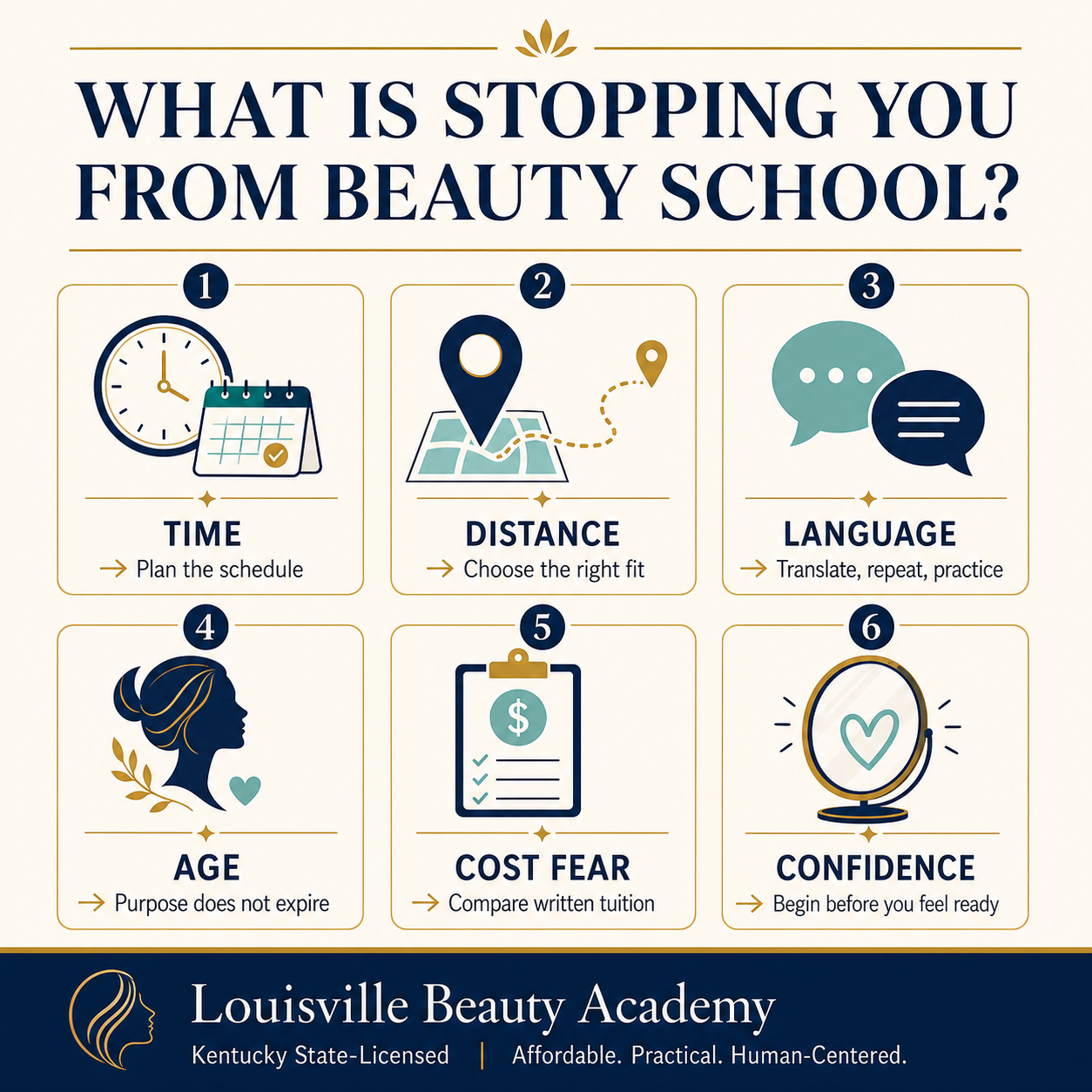
If the barrier is real, name it. If it is cost, ask for the written cost. If it is schedule, ask about schedule. If it is language, ask how to study. If it is fear, say it out loud. If it is transportation, plan honestly. If it is family, discuss support. If it is procrastination, stop calling it a barrier.
Some obstacles require planning.
Some obstacles require help.
Some obstacles require patience.
But some obstacles are simply delay wearing a serious face.
In One Classroom, Many Languages
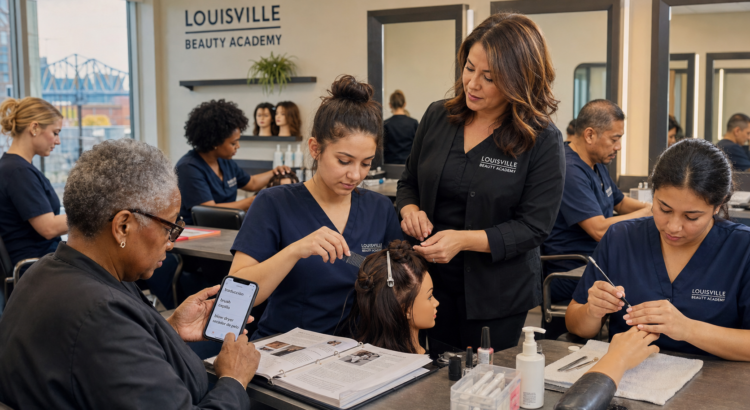
At any given moment inside Louisville Beauty Academy, it is normal to see students from different language backgrounds learning together.
Sometimes there may be three, four, or five language groups represented in the same school environment. Some students speak English well. Some are still learning. Some rely heavily on Google Translate, repeated explanation, visual demonstration, peer support, instructor guidance, hands-on practice, and written resources.
They learn slowly.
They ask again.
They translate.
They practice.
They repeat.
They continue.
That is not weakness. That is strength.
A student who is learning beauty while also learning English is doing two hard things at once. That student deserves respect, not pity.
So if someone with limited English can still show up, translate, practice, and move forward, then an English-speaking student who is simply scared must ask:
What am I waiting for?
Young Students Start. Older Students Finish. Purpose Has No Perfect Age.
Louisville Beauty Academy has seen students begin around young-adult age and students continue deep into older adulthood. Students from about 18 to 70 have entered beauty education and completed their path.
That matters because many people use age as an excuse in both directions.
Young people say, "I am not ready."
Adults say, "It is too late."
Parents say, "I have too much responsibility."
Older adults say, "People will judge me."
But the classroom tells a different story.
Age is not the true barrier.
Discipline is the barrier.
Decision is the barrier.
Humility is the barrier.
The willingness to be a beginner again is the barrier.
In beauty, life experience can even become an advantage. Patience, listening, reliability, empathy, responsibility, and communication are not small things. They are part of professional service.
You Receive More Than What Is Printed on the Page
A school can publish programs, prices, hours, policies, schedules, and requirements. Those things matter. Written documents control.
But the real educational environment is larger than any single web page.
At Louisville Beauty Academy, students receive more than what is visible in a simple program description. The school environment is built from years of founder-led thinking, books, research, documentation, compliance lessons, student support patterns, multilingual practice, AI-supported organization, and a humanization philosophy that has been refined through nearly 200 books and institutional writings connected to Di Tran's broader education mission.
Students may not hear all of that theory in a lecture.
They may simply feel it in the system:
- clearer written documents;
- repeated reminders;
- practical checklists;
- multilingual patience;
- cost-conscious positioning;
- exam-path respect;
- sanitation and law emphasis;
- no-gossip professional culture;
- work-first mindset;
- human dignity before prestige;
- and the belief that a student can become more capable through action.
That is the deeper foundation.
The goal is not only to teach beauty.
The goal is to humanize the student: to help a person become more disciplined, more confident, more useful, more professional, more documented, more employable, more service-minded, and more ready to contribute as a great American in a lawful, skilled, human-centered industry.
The Real Question Is Not "Can I?"
Many students ask, "Can I do this?"
That is not the strongest question.
The stronger question is:
Will I show up long enough to become the person who can do this?
You do not need to be perfect to begin.
You do not need perfect English to begin.
You do not need to be 18 with no responsibilities.
You do not need to be young forever.
You do not need everyone to believe in you.
You need to stop hiding behind delay.
You need to ask written questions.
You need to understand the cost.
You need to know the licensing path.
You need to practice.
You need to finish.
You need to become useful.
What LBA Does Not Promise
Louisville Beauty Academy does not promise that every student will pass an exam, receive a license, get a job, earn a certain income, receive a scholarship, become a business owner, or finish on the same timeline.
Kentucky law, Kentucky Board requirements, official examinations, student attendance, student effort, documentation, payment status, program completion, and individual life circumstances all matter.
The honest promise is more serious:
LBA offers a Kentucky state-licensed educational path, written clarity, affordability-focused structure, multilingual respect, practical instruction, documentation discipline, and a culture that tells serious students to stop counting themselves out.
Come See It Before You Disqualify Yourself
If you love beauty, come see Louisville Beauty Academy.
If you are worried about cost, ask for the current written cost.
If you are worried about schedule, ask about schedule.
If you are worried about English, text in your language.
If you are worried about age, come tour and see that purpose does not expire.
If you are worried about debt, compare written tuition and payment options carefully.
If you are worried because online forums scared you, do not stop at strangers' comments. Use those concerns as a checklist. Ask the school directly. Compare documents. Understand the legal path. Then decide like an adult.
Beauty is not waiting for perfect people.
Beauty is waiting for disciplined people.
Beauty is waiting for caring people.
Beauty is waiting for people who are ready to serve.
The No-Excuse Invitation
If students can drive hours from the countryside…
If students can learn through Google Translate…
If students can sit in a classroom with three to five different language groups…
If students can begin young…
If students can begin older…
If students can carry children, jobs, bills, family duties, and still move forward…
Then the question becomes clear:
What is your excuse?
Not your real obstacle.
Your excuse.
Because real obstacles deserve planning.
Excuses deserve truth.
Louisville Beauty Academy exists for the serious student who is ready to move from interest to action.
Study.
Practice.
Graduate.
Pursue licensure.
Serve people.
Build yourself.
Build your family.
Build your future.
Beauty is service. Beauty is dignity. Beauty is business. Beauty is humanization.
If beauty is truly in you, begin now.
Text Louisville Beauty Academy in any language:
study@LouisvilleBeautyAcademy.net
Visit: https://louisvillebeautyacademy.net
Louisville Beauty Academy
National Award-Winning Beauty Education
Kentucky State-Licensed Beauty College
Affordable. Practical. Human-Centered.
Sources and Reading Notes
- U.S. Bureau of Labor Statistics, Barbers, Hairstylists, and Cosmetologists: https://www.bls.gov/ooh/personal-care-and-service/barbers-hairstylists-and-cosmetologists.htm
- U.S. Bureau of Labor Statistics, Personal Care and Service Occupations: https://www.bls.gov/ooh/personal-care-and-service/
- U.S. Bureau of Labor Statistics, Focusing on style: Careers in personal appearance: https://www.bls.gov/careeroutlook/2018/article/personal-appearance-workers.htm
- Kentucky Board of Cosmetology, License Requirements: https://kbc.ky.gov/Licensure/Pages/License-Requirements.aspx
- Kentucky Legislative Research Commission, 201 KAR 12:082: https://apps.legislature.ky.gov/law/kar/titles/201/012/082/
- Kentucky Legislative Research Commission, KRS 317A.050: https://apps.legislature.ky.gov/law/statutes/statute.aspx?id=53216
- McKinsey, State of Beauty industry trends 2026: https://www.mckinsey.com/industries/consumer-packaged-goods/our-insights/state-of-beauty
- Bank of America, Recession-proof business ideas, beauty business discussion: https://business.bankofamerica.com/en/resources/businesses-that-thrive-during-a-recession
- Reddit search-intent reading, not authority: recurring posts in r/Cosmetology and related communities show concerns around age, debt, whether beauty school is worth it, physical demands, pay, school quality, and fear before starting.
Compliance note:
This article is public education and institutional communication. Current written LBA documents, signed enrollment agreements, Kentucky Board requirements, PSI rules, and applicable law control. Individual results vary. No statement here guarantees enrollment, graduation, exam passage, licensure, employment, income, scholarship, discount eligibility, transfer acceptance, or business ownership.