Source-watch date: October 16, 2026. Federal Student Aid posted a new Workforce Pell Frequently Asked Questions notice on October 15, 2026. The notice links to a 12-page FAQ document dated October 2026.
This matters to beauty-education readers because the new federal pathway can make some short-term workforce programs eligible for a Federal Pell Grant. But the source does not say that every short beauty program qualifies, that every school participates, or that any particular Louisville program is approved. Eligibility is program-specific and requires several separate checks.
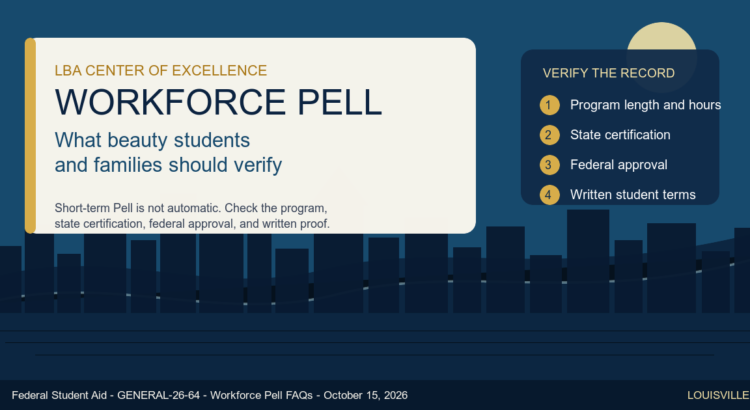
Plain-language bottom line: A short program is not automatically a Workforce Pell program. Before relying on federal-aid language, ask for the exact program record, the state certification, the federal approval record, the written cost, and the aid terms that apply to your individual situation.
First, what is Workforce Pell?
A Pell Grant is federal student aid that normally helps eligible students pay for approved education. Workforce Pell is the informal name for Pell Grants used in eligible short-term workforce programs under the new rules. Title IV means the federal student-aid programs in the Higher Education Act, including Pell Grants and other forms of aid.
Federal Student Aid says the new rules begin with the 2026–27 award year. The FAQ says an eligible workforce program generally must:
- last at least eight weeks but fewer than 15 weeks of instruction;
- contain 150–599 clock hours, or the listed semester/trimester or quarter-hour ranges;
- be certified by a state governor or authorized designee;
- be approved by the U.S. Department of Education;
- meet minimum completion and job-placement requirements, including a 70% minimum for each under the FAQ’s description; and
- pass a value-added earnings test so tuition and fees do not exceed the calculated earnings benefit.
The FAQ also lists exclusions, including correspondence, remedial, English-as-a-second-language, study-abroad, and direct-assessment coursework. These are federal program rules, not a promise that a state-licensed beauty program is eligible.
What the new FAQ clarifies for schools and students
1. Federal approval comes after a documented process
The FAQ describes a sequence: the institution reviews the rules and confirms program length, hours, accreditation coverage, and a required 12-month history; the governor or designee reviews and certifies the program; then the institution applies through the federal E-App, the online application used by institutions to report federal-aid eligibility information. If the Department approves the program, the institution receives an updated ECAR, the Eligibility and Certification Approval Report. The FAQ says the school may award and disburse Pell funds for students in an approved eligible workforce program after that approval.
That sequence is why a brochure, a social-media post, or the words “short-term Pell” alone are not enough. A student needs the exact program and written approval record—not a general statement about a school or industry.
2. Different schedules can be different federal programs
If the same type of training is offered in different lengths, the FAQ says each version must be reported separately. A 10-week version and a 14-week version are not automatically one approved record simply because they share a name or curriculum. Ask which schedule, location, delivery method, and clock-hour version the approval covers.
3. A state license is not the same as federal-aid eligibility
A state license or state authorization answers a different question: whether the school or program may operate under state rules. Workforce Pell adds federal requirements. The FAQ also says a location where 50% or more of a program is offered may need to be reported and authorized, including approval by the institution’s accrediting agency where applicable.
4. Aid is narrower than “all federal aid”
The FAQ says a Pell Grant is the only Title IV aid for which a student can qualify on the basis of enrollment in an eligible workforce program. It says students cannot receive a Pell Grant concurrently for an eligible workforce program and another educational program. The FAQ also says Direct Loans, Federal Work-Study, and the Federal Supplemental Educational Opportunity Grant are not available on that workforce-program basis, although other assistance such as private loans or Workforce Innovation and Opportunity Act funds may have separate rules.
5. Withdrawal still has consequences
Withdrawal means leaving a program before completion. The FAQ says students in eligible workforce programs remain subject to Return to Title IV (R2T4) rules. R2T4 is the federal calculation used when a student withdraws to determine how much federal aid was earned and what may need to be returned. This is one reason a student should read the written withdrawal, refund, attendance, and aid terms before signing.
6. The FAQ itself is guidance, not a personal eligibility decision
Federal Student Aid says the FAQ explains the new regulations but, except for requirements specifically stated in the document, its guidance does not have the force and effect of law and is not intended to bind the public. It also says the FAQ will be updated as additional questions are answered. Use the current federal source and the institution’s current written record together; do not treat an old screenshot or summary as permanent proof.
What this means for a real beauty student or family
Before treating any program as Workforce Pell eligible, ask these questions in writing:
- What is the exact program name and version? Include the schedule, weeks, clock hours or credit hours, location, and delivery method.
- Has the state governor or authorized designee certified this exact program? Ask for the date and the official record or certification reference.
- Has the U.S. Department of Education approved this exact program? Ask where the program appears on the institution’s current ECAR or other official approval record.
- What completion, placement, and earnings information is being used? Ask what is verified, what period it covers, and what is still unknown. A projected job or income is not the same as a measured outcome.
- What will I actually pay? Request the current written tuition, fees, supplies, books, equipment, payment schedule, refund terms, withdrawal terms, and any amount not covered by aid.
- What aid is actually available to me? Completing the FAFSA, the Free Application for Federal Student Aid, does not by itself prove that a school or program is eligible or that a student will receive a specific amount.
If the answer is “the school may qualify,” “the program is being considered,” or “the rules are coming,” treat that as different from current federal approval. Keep the written answer and its date. If a claim cannot be tied to the exact program and official record, pause before signing or paying.
What this means for LBA and Kentucky readers
This article does not announce or imply that Louisville Beauty Academy, any LBA program, or any Kentucky beauty program is Workforce Pell eligible, Title IV participating, federally approved, accredited, or approved for a particular student’s aid. LBA’s Kentucky state-licensing information and any federal-aid question are separate records that must be verified separately.
For Kentucky readers, the practical lesson is simple: start with the exact written program information, then verify the current state and federal records that apply to that program. Do not substitute a school name, a state license, a short schedule, an accreditation reference, a FAFSA submission, or a general Workforce Pell description for proof of individual eligibility.
Why LBA is tracking this federal source
A serious beauty-education source hub should help families understand the difference between a federal rule, an agency FAQ, a state certification, a federal approval, a school disclosure, and an individual aid decision. That distinction protects students from overpromises and gives schools, workforce counselors, policymakers, and the public a cleaner record to inspect.
For more dated source guides, visit the LBA Beauty Education Center of Excellence hub. For current written program costs and enrollment documents, use the school’s official written-information channels and verify the date before relying on them.
Official sources
- Federal Student Aid — Availability of Workforce Pell Regulations Frequently Asked Questions, GENERAL-26-64, posted October 15, 2026.
- Federal Student Aid — Workforce Pell FAQs PDF, dated October 2026.
- Federal Register — Workforce Pell Programs final regulations, cited by Federal Student Aid as the May 19, 2026 rule.
Source and claim-control note: reviewed October 16, 2026. This article reports the federal FAQ and its stated limits. It does not determine LBA or any other school’s eligibility, does not provide legal or financial-aid advice, and does not promise grants, loans, licensure, employment, income, or outcomes.
Discover more from Louisville Beauty Academy - Louisville KY
Subscribe to get the latest posts sent to your email.