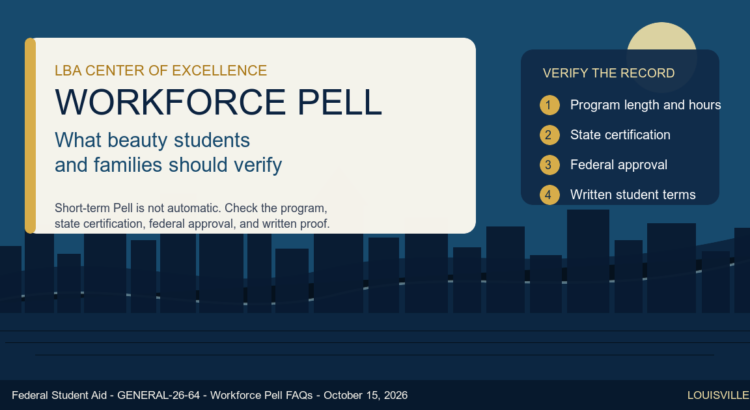
Center of Excellence: Workforce Pell FAQs — What Beauty Students and Families Should Verify Before Assuming Federal Aid

Source-watch date: October 16, 2026. Federal Student Aid posted a new Workforce Pell Frequently Asked Questions notice on October 15, 2026. The notice links to a 12-page FAQ document dated October 2026.

This matters to beauty-education readers because the new federal pathway can make some short-term workforce programs eligible for a Federal Pell Grant. But the source does not say that every short beauty program qualifies, that every school participates, or that any particular Louisville program is approved. Eligibility is program-specific and requires several separate checks.

Plain-language bottom line: A short program is not automatically a Workforce Pell program. Before relying on federal-aid language, ask for the exact program record, the state certification, the federal approval record, the written cost, and the aid terms that apply to your individual situation.

First, what is Workforce Pell?

A Pell Grant is federal student aid that normally helps eligible students pay for approved education. Workforce Pell is the informal name for Pell Grants used in eligible short-term workforce programs under the new rules. Title IV means the federal student-aid programs in the Higher Education Act, including Pell Grants and other forms of aid.

Federal Student Aid says the new rules begin with the 2026–27 award year. The FAQ says an eligible workforce program generally must:

  • last at least eight weeks but fewer than 15 weeks of instruction;
  • contain 150–599 clock hours, or the listed semester/trimester or quarter-hour ranges;
  • be certified by a state governor or authorized designee;
  • be approved by the U.S. Department of Education;
  • meet minimum completion and job-placement requirements, including a 70% minimum for each under the FAQ’s description; and
  • pass a value-added earnings test so tuition and fees do not exceed the calculated earnings benefit.

The FAQ also lists exclusions, including correspondence, remedial, English-as-a-second-language, study-abroad, and direct-assessment coursework. These are federal program rules, not a promise that a state-licensed beauty program is eligible.

What the new FAQ clarifies for schools and students

1. Federal approval comes after a documented process

The FAQ describes a sequence: the institution reviews the rules and confirms program length, hours, accreditation coverage, and a required 12-month history; the governor or designee reviews and certifies the program; then the institution applies through the federal E-App, the online application used by institutions to report federal-aid eligibility information. If the Department approves the program, the institution receives an updated ECAR, the Eligibility and Certification Approval Report. The FAQ says the school may award and disburse Pell funds for students in an approved eligible workforce program after that approval.

That sequence is why a brochure, a social-media post, or the words “short-term Pell” alone are not enough. A student needs the exact program and written approval record—not a general statement about a school or industry.

2. Different schedules can be different federal programs

If the same type of training is offered in different lengths, the FAQ says each version must be reported separately. A 10-week version and a 14-week version are not automatically one approved record simply because they share a name or curriculum. Ask which schedule, location, delivery method, and clock-hour version the approval covers.

3. A state license is not the same as federal-aid eligibility

A state license or state authorization answers a different question: whether the school or program may operate under state rules. Workforce Pell adds federal requirements. The FAQ also says a location where 50% or more of a program is offered may need to be reported and authorized, including approval by the institution’s accrediting agency where applicable.

4. Aid is narrower than “all federal aid”

The FAQ says a Pell Grant is the only Title IV aid for which a student can qualify on the basis of enrollment in an eligible workforce program. It says students cannot receive a Pell Grant concurrently for an eligible workforce program and another educational program. The FAQ also says Direct Loans, Federal Work-Study, and the Federal Supplemental Educational Opportunity Grant are not available on that workforce-program basis, although other assistance such as private loans or Workforce Innovation and Opportunity Act funds may have separate rules.

5. Withdrawal still has consequences

Withdrawal means leaving a program before completion. The FAQ says students in eligible workforce programs remain subject to Return to Title IV (R2T4) rules. R2T4 is the federal calculation used when a student withdraws to determine how much federal aid was earned and what may need to be returned. This is one reason a student should read the written withdrawal, refund, attendance, and aid terms before signing.

6. The FAQ itself is guidance, not a personal eligibility decision

Federal Student Aid says the FAQ explains the new regulations but, except for requirements specifically stated in the document, its guidance does not have the force and effect of law and is not intended to bind the public. It also says the FAQ will be updated as additional questions are answered. Use the current federal source and the institution’s current written record together; do not treat an old screenshot or summary as permanent proof.

What this means for a real beauty student or family

Before treating any program as Workforce Pell eligible, ask these questions in writing:

  1. What is the exact program name and version? Include the schedule, weeks, clock hours or credit hours, location, and delivery method.
  2. Has the state governor or authorized designee certified this exact program? Ask for the date and the official record or certification reference.
  3. Has the U.S. Department of Education approved this exact program? Ask where the program appears on the institution’s current ECAR or other official approval record.
  4. What completion, placement, and earnings information is being used? Ask what is verified, what period it covers, and what is still unknown. A projected job or income is not the same as a measured outcome.
  5. What will I actually pay? Request the current written tuition, fees, supplies, books, equipment, payment schedule, refund terms, withdrawal terms, and any amount not covered by aid.
  6. What aid is actually available to me? Completing the FAFSA, the Free Application for Federal Student Aid, does not by itself prove that a school or program is eligible or that a student will receive a specific amount.

If the answer is “the school may qualify,” “the program is being considered,” or “the rules are coming,” treat that as different from current federal approval. Keep the written answer and its date. If a claim cannot be tied to the exact program and official record, pause before signing or paying.

What this means for LBA and Kentucky readers

This article does not announce or imply that Louisville Beauty Academy, any LBA program, or any Kentucky beauty program is Workforce Pell eligible, Title IV participating, federally approved, accredited, or approved for a particular student’s aid. LBA’s Kentucky state-licensing information and any federal-aid question are separate records that must be verified separately.

For Kentucky readers, the practical lesson is simple: start with the exact written program information, then verify the current state and federal records that apply to that program. Do not substitute a school name, a state license, a short schedule, an accreditation reference, a FAFSA submission, or a general Workforce Pell description for proof of individual eligibility.

Why LBA is tracking this federal source

A serious beauty-education source hub should help families understand the difference between a federal rule, an agency FAQ, a state certification, a federal approval, a school disclosure, and an individual aid decision. That distinction protects students from overpromises and gives schools, workforce counselors, policymakers, and the public a cleaner record to inspect.

For more dated source guides, visit the LBA Beauty Education Center of Excellence hub. For current written program costs and enrollment documents, use the school’s official written-information channels and verify the date before relying on them.

Official sources

Source and claim-control note: reviewed October 16, 2026. This article reports the federal FAQ and its stated limits. It does not determine LBA or any other school’s eligibility, does not provide legal or financial-aid advice, and does not promise grants, loans, licensure, employment, income, or outcomes.
Center of Excellence: 2027–28 FAFSA Is Now Available — What Beauty School Families Should Understand

Federal Student Aid’s current student-facing site says the 2027–28 FAFSA form is now available for students seeking aid for enrollment from July 1, 2027, through June 30, 2028. Here is the plain-English lesson for beauty school families: FAFSA is a government student-aid form. It is not a school price. It is not a discount. It is not a scholarship promise. It is not a payment plan. It is not a promise that school will be free.

This Center of Excellence update is written for normal people: students, parents, spouses, mentors, workforce counselors, and school teams. The goal is to help families slow down and understand funding words before anyone signs school paperwork. This is public education only. It is not legal advice, financial-aid advice, or a claim that LBA processes federal student aid.

Return to the LBA Beauty Education Center of Excellence hub.

Infographic showing four FAFSA literacy questions for beauty school families: official FAFSA, required contributors, real school cost, and school aid participation.
FAFSA literacy should protect the student before enrollment, not explain confusion after signing.

Simple Answer First

The 2027–28 FAFSA form is now available through the official Federal Student Aid process. Use the current form and instructions at StudentAid.gov; do not rely on an old preview, screenshot, or third-party summary. A student also still needs the school’s written price and written payment rules.

If a family remembers only one thing, remember this: FAFSA can be part of a funding conversation, but the school’s written cost documents tell you what the school charges.

What Federal Student Aid Posted

Federal Student Aid’s 2027–28 FAFSA materials moved from preview to the live application. The current official student-facing instructions identify the 2027–28 form as available and distinguish it from the 2026–27 form, which covers a different aid period. The Department’s September 23 announcement also described clearer language and other process improvements, but families should follow the live form and current instructions rather than an older preview.

FAFSA availability is not a finding that every school or program participates in federal student aid. School and program eligibility, admission, aid offers, and student circumstances remain separate questions that must be confirmed through the official process and the school’s current written information.

New 2027–28 FAFSA Verification Notice

On October 23, 2026, the U.S. Department of Education published a Federal Register notice for the 2027–28 award year explaining which FAFSA information an institution and an applicant may be required to verify when the Department selects the applicant for verification. The notice also identifies the documentation that can be used under the cited federal rules. It is a verification notice—not a promise that every applicant will be selected and not a decision about any particular student’s aid.

The notice says that tax information transferred directly from the IRS and used in the Pell Grant eligibility or Student Aid Index calculation generally does not need additional verification. Manually entered information, foreign income exempt from federal tax, certain family-size updates, and identity information can require different documentation depending on the applicant’s verification tracking group and circumstances.

  • V1 Standard Verification: tax-filer income items, non-tax-filer income from work, and family size.
  • V4 Custom Verification: identity.
  • V5 Aggregate Verification: the listed income and family-size items plus identity.

If the federal process selects an applicant, the FAFSA Submission Summary directs the applicant to the institution for instructions. The notice describes several identity-verification methods, including in-person review, verification by a NIST Identity Assurance Level 2-compliant entity, and limited alternatives when an institution determines that an applicant cannot appear in person. Students should use the institution’s current official instructions and should not send tax, identity, or other sensitive records through an unverified channel.

Practical next step: use the official Federal Student Aid instructions, read any verification notice in the FAFSA Submission Summary, and ask the participating institution for its current written process. Do not treat FAFSA completion, a general school statement, or a request for documents as proof of an aid award or a specific eligibility result.

Source-watch date: October 23, 2026. This section summarizes the Department of Education’s 2027–28 FAFSA verification notice. The notice cites 34 CFR 668.56 and 668.57; the official Federal Student Aid process and the participating institution’s current written instructions control.

October 26, 2026 Federal Student Aid System Update

Federal Student Aid’s October 26 product release log describes new tools in the FAFSA Partner Portal, the official portal used by participating schools and state agencies to handle FAFSA records. This is a system update, not a new aid award, a new eligibility decision, or proof that a particular school participates in federal student aid.

  • Students can receive a complete printed FAFSA Submission Summary. The release says portal users can print the full summary so a financial-aid office can provide the student a complete record of submitted information.
  • Schools can compare multiple ISIRs. ISIR means Institutional Student Information Record—the processed FAFSA record sent to an institution. The comparison tool helps a participating institution determine which processed record to use when awarding Title IV aid; it does not decide aid for the student by itself.
  • Submission times are shown in Central Time. This helps a state or institution compare a FAFSA submission with a deadline in the correct time zone. Families should still read the official deadline and ask the relevant agency or participating school which time rule controls.
  • Account-recovery and identity fixes were also released. The log describes improved visibility for an unverified Social Security number, an authenticator-app recovery option, and a fix for an invalid address that could block FAFSA completion.
Federal Student Aid’s October 26 release in four plain-language checks
What changedWho uses itUseful student checkWhat it does not prove
Print a complete FAFSA Submission SummaryFinancial-aid offices using the FAFSA Partner PortalKeep a complete copy of what was submittedIt is not an aid award
Compare multiple ISIRsA participating institutionAsk which processed record the institution is usingIt does not decide eligibility by itself
Show application receipt time in Central TimeStates and institutionsRead the deadline and time-zone rule carefullyIt does not extend a deadline
Improve account recovery and address handlingStudents and contributors using StudentAid.govUse the official account and recovery toolsIt does not make an unverified message safe

Source: Federal Student Aid FAFSA Product Log, October 26, 2026. This table is an LBA plain-language explainer, not an official Federal Student Aid form.

What this means for a real student or family

If you are considering a school that says it processes federal aid, ask for your FAFSA Submission Summary and keep your own copy. Compare the school’s written cost, aid explanation, and required documents with the official Federal Student Aid record. If something does not match, pause and ask the participating institution to explain the difference in writing. Do not send a Social Security number, tax record, identity document, or FAFSA login information through an unverified channel.

This update does not change Louisville Beauty Academy’s published status or mean that LBA processes FAFSA or Title IV federal student aid. LBA’s role in this public article is to help families distinguish a federal form, a school bill, a processed record, and an aid decision before signing school paperwork.

Source-watch date: October 26, 2026. The release log controls the description of these system changes. Federal Student Aid, the official FAFSA process, the participating institution’s current written instructions, and applicable law control any individual student decision.

Why Beauty School Families Should Care

Beauty education is a licensed career path. Students are not just buying classes or a school image. They are choosing a schedule, a price, a contract, training hours, safety rules, and a path toward a state license. Any funding conversation should make those pieces clearer, not more confusing.

The FAFSA process helps families see the kinds of steps that may involve the student, a parent, or a spouse. But even when a student is exploring aid, the family still needs school-specific facts in writing: total tuition, fees, kit or supply costs, refund rules, payment obligations, program hours, attendance rules, and whether the school actually processes federal student aid.

What The Hard Words Mean

  • FAFSA means Free Application for Federal Student Aid. It is the government form many students use to apply for federal student aid.
  • Contributor means a person, such as a parent or spouse, who may need to provide information or a signature on the FAFSA.
  • Title IV means the federal student-aid system that can include Pell Grants, federal student loans, and other aid programs at participating schools.
  • Participating school means a school that is approved to process those federal aid programs. A family should never assume this. Ask and get the answer in writing.

Four Plain-English Rules

  • FAFSA is not a price sheet. A school’s written cost documents still tell you the price.
  • A preview is not the final form. Use the preview to learn. Use FAFSA.gov for the real process when it opens.
  • Signatures matter. If a student, parent, or spouse must sign or add information, missing that step can delay the form.
  • School aid status must be verified. Never assume a school processes federal student aid because it is a school. Ask the school directly and read the answer in writing.

The LBA Clarity Standard

Louisville Beauty Academy is a Kentucky state-licensed beauty school. LBA is not institutionally accredited by a federally recognized accrediting agency and does not process FAFSA or Title IV federal student aid. In plain language: students do not use FAFSA through LBA. LBA publishes that clearly because families deserve to know the funding structure before they compare schools.

This is not a criticism of federal-aid schools. It is a student-protection standard. At any school, a family should know the same basic facts: Does this school process federal aid? What is the full written cost? What will I owe? What happens if I withdraw? Which document controls if there is a disagreement?

The Deeper Lesson, In Plain English

Financial-aid literacy is not only about filling out a form. It is about protection. A student who understands the difference between an application, an estimate, a school bill, a grant, a loan, a refund rule, and a signed contract is harder to confuse and easier to protect.

That is why FAFSA literacy belongs inside serious beauty education. Starting school is not the whole goal. The real goal is to choose clearly, understand the cost, complete the required training, prepare for licensure, avoid unnecessary debt, and enter the workforce with dignity.

Official Sources

Public-Safe Limit

This article is public education. It does not promise aid eligibility, loan approval, grant approval, school admission, licensure, employment, income, or any particular outcome. Federal Student Aid, the official FAFSA process, current school documents, Kentucky Board of Cosmetology requirements, and applicable law control.

Follow the Public Dollar, Honor the Real Student

Louisville Beauty Academy · Public education guide

Follow the public dollar.
Honor the real student.

Understand the funding. Protect your identity. Keep a truthful record of the work you earn.

First published July 1, 2026
Updated and source-checked October 28, 2026

Editorial illustration of a learner studying beside the Louisville skyline, with symbols for identity protection and attendance records
AI-generated editorial illustration; not a photograph of a student or an official government graphic.
For students & familiesFor schools & educatorsFor taxpayers & the community

The essential distinctions

Clarity protects opportunity.

This guide helps families compare education options, understand funding, and protect their records. It discusses general risks and safeguards; it does not report misconduct by a particular school or student.

01 / UNDERSTAND

FAFSA is an application.

It can open access to grants, work-study, and loans. Filing it does not by itself mean you have borrowed money. Review the actual aid offer and any loan agreement.

02 / VERIFY

A screening flag is a prompt for review.

Identity confirmation protects aid programs and legitimate students. A flag alone does not establish that a person committed fraud.

03 / RESPECT

Every real student deserves dignity.

Whether education is funded by wages, family support, scholarships, grants, or loans, students deserve accurate records, clear terms, and respectful treatment.

Federal context: FSA’s FAFSA guide and identity-confirmation FAQ.

Use the right definition

What is a “ghost student”?

The U.S. Department of Education’s Office of Inspector General describes higher-education ghost students as fabricated identities or stolen identities used to seek admission and obtain student aid, rather than pursue an education.

This is a specific fraud concern. A learner’s income, language, commute, age, immigration background, or choice to pay privately does not establish fraud. Nor does receiving legitimate financial aid.

Leaving school, taking leave, or having an attendance discrepancy can require review and corrections. Those facts alone do not prove an identity-theft or aid-fraud scheme. Investigations should follow evidence and the applicable rules.

Definition: ED OIG glossary, “Ghost Students—Higher Education.”

Three systems. Three different questions.

Know what each status tells you.

ACCREDITATION

What standards were reviewed?

An accreditor evaluates an institution or program against its standards. Check the specific agency, scope, status, and dates. Evaluate accreditation alongside the actual cost, teaching support, documented outcomes, and complaint-resolution process; it does not guarantee an individual outcome.

Search the federal accreditation database ↗

TITLE IV PARTICIPATION

Which federal aid can this school administer?

Participation concerns eligibility to administer federal student-aid programs and the obligations attached to those funds. Verify the school, the program, and your individual eligibility with the financial-aid office.

Review federal aid eligibility ↗

OCCUPATIONAL LICENSURE

What authorizes professional practice?

The responsible state authority sets requirements for a regulated profession. School completion, school licensure, and an individual professional license are different. Check the rules for the place where you intend to work.

Visit the Kentucky Board of Cosmetology ↗

Financial clarity before commitment

Separate the price from the way you pay.

The FAFSA form is free. States, schools, and some private aid providers also use its information. An aid offer may combine very different types of money; read each line and its conditions.

Grants & scholarships

Generally do not require repayment, but conditions and exceptions apply. Withdrawal or a failure to meet specific obligations can change what you keep.

Student loans

Borrowed money with repayment terms. Understand the borrower, principal, fees, interest, payment timing, and available protections.

Work-study

Money earned through eligible work. An offer is not an automatic payment or an immediate tuition discount.

Self-pay & payment plans

Identify who pays, when payments are due, any fees or interest, and what happens after withdrawal. Paying privately does not remove contractual obligations.

Illustration only · Not an LBA price or aid offer

Make the remaining cost visible.

$12,000Total estimated costs for the same period
$4,000Confirmed grants & scholarships
$8,000Remaining cost to fund

If you borrow the remaining $8,000, it becomes loan principal. It has not disappeared from the cost of your education. Add applicable borrowing costs and review the repayment terms separately.

Compare the same credential and time period. Include tuition, fees, supplies, required exams, transportation, and relevant living costs without double-counting. Confirm discounts in writing; do not assume a conditional incentive is already earned.

A higher published price can become a lower net cost after grants. A lower self-pay price can also be a good fit. Compare written offers, the complete budget, schedule, training requirements, and your ability to finish.

Sources: FSA: How to Evaluate Your Aid Offers, Financial Aid Dictionary, and grant conditions and repayment exceptions. Check current award-year rules; amounts and loan terms change.

Real education. A record you can understand.

Protect the work behind your future license.

Kentucky’s published school-administration regulation requires accurate daily attendance records using digital biometric timekeeping, records of practical work, and certification of student hours. School records must be available to the board. Attendance records document time; instructor assessments separately document knowledge and practical competency. Both matter.

For your own records, keep copies of your enrollment agreement, payments, attendance summaries, progress reports, withdrawal notices, and correspondence about corrections. Review discrepancies promptly with the school. Ask how an error is documented and corrected.

Tuition payments, attendance hours, demonstrated skills, school completion, examination results, and state licensure are distinct records. Each should accurately describe what it documents.

Kentucky source: 201 KAR 12:082 — Student Records and Certification of Hours. Follow the current controlling rules for your program.

Take this to any school—including LBA

Twelve questions. Written answers.

Check an item when you have an answer you understand and can keep. These are personal notes for this visit, not a school rating or compliance certification. Checkbox selections reset when the page reloads.

0 of 12 answers reviewed

A useful standard: you can explain the agreement in your own words, keep a copy, and verify the important claims independently before deciding.

Notice a problem? Respond with evidence.

Pause, document, and use the right channel.

Warning signs to investigate

  • Account access: someone asks for your password, verification code, or electronic-signature access.
  • Blank forms: you are asked to sign incomplete enrollment, attendance, loan, or withdrawal documents.
  • Unfamiliar activity: records show a school, loan, payment, attendance, or work you do not recognize.
  • Unearned promises: hours, completion, or a license are promised without the required work and conditions.
  • Unclear obligations: no one will explain costs, records, refunds, or applicable aid adjustments in writing.

A warning sign calls for review. It is not a finding that a school or person committed a crime.

  1. Preserve the record.

    Save dates, notices, agreements, account statements, and screenshots. Keep sensitive identifiers out of public posts.

  2. Secure your accounts.

    Use official account-recovery routes and change compromised credentials. Verify a request before uploading identity documents.

  3. Ask for a written explanation.

    Identify the disputed entry, request the relevant records, and ask for the correction or review process.

  4. Escalate to the appropriate authority.

    Use ED OIG for suspected fraud involving Department of Education programs or funds; use the state licensing authority for relevant training or licensing issues.

  5. Get individual help when needed.

    Identity theft, disputed debt, or threatened legal rights may require assistance from a qualified professional or regulator.

LBA’s position · Apply the same questions to us

Respect the student.
Make the evidence visible.

Louisville Beauty Academy does not participate in Title IV federal student aid and does not administer federal Pell Grants or federal student loans. Its published approach centers self-pay education and written payment and incentive terms.

This describes LBA’s federal student-aid participation, not a student’s complete financial situation. Compare the written cost and educational pathway on their merits. Confirm any outside assistance with its provider and LBA; private borrowing carries its own repayment terms.

Working learners may balance jobs, family responsibilities, transportation, and language barriers. Their effort deserves recognition. LBA’s commitment is to connect that effort with instructor-led practice, truthful records, clear costs, human accountability, and respect.

LBA’s public study and translation tools support learning. They do not award training hours or replace instructor evaluation, official licensing decisions, or individualized financial-aid advice. Important information should be checked with a responsible person and current official sources.

What this looks like at Louisville Beauty Academy

Commitments you can read. Sources you can check.

The award below is external recognition. The educational practices and resources are LBA’s published standards and offerings; they are not additional award certifications.

01 / ETHICS

Recognition, with its exact scope.

LBA is the 2026 BBB Torch Award for Ethics winner in the Very Small Business category (1–10 employees), awarded by BBB serving Greater Kentucky and South Central Indiana.

A regional ethics award, separate from school licensure, institutional accreditation, and BBB accreditation or rating.

Read the award and primary announcement →
02 / WRITTEN COSTS

Know the price. Understand the conditions.

LBA publishes listed program costs alongside possible conditional incentives. Eligibility, required activities, deadlines, approvals, and final payment terms belong in the current written agreement.

Reduced costs are not automatic. Reviews, star ratings, praise, or positive sentiment are not required for the optional incentive pathway.

Compare programs and written terms →
03 / SUPERVISED PRACTICE

Teach. Practice. Evaluate. Document.

LBA’s published practical-learning standard connects instructor supervision, safety, sanitation, competency assessment, and records supporting an awarded practical PASS.

Practical competency, attendance hours, and clinic-service activity serve different recordkeeping purposes. A public template alone is not a student’s achievement record.

Read the practical verification standard →
04 / PUBLIC LEARNING

Useful learning, available to explore.

LBA provides public study resources, including a free sensory-aware beauty-services guide with Q&A, practice scenarios, and optional read-aloud for learning about client choice and care.

This supplemental guide does not award licensing hours or a professional credential. Read-aloud uses supported browser/device voices; it is not a live AI tutor.

Explore the free learning studio →

Questions people ask

Clear answers, without the labels.

Does using FAFSA put my professional license at risk?

Applying for aid does not itself invalidate training or a professional license. Identity, attendance, competence, and the applicable licensing requirements must be addressed on their own facts. Ask the responsible board about a specific disputed record.

Does being selected for verification mean I am accused of fraud?

A screening result alone does not establish misconduct. Ask the school for the applicable official process and required documentation. FSA’s guidance provides ways to confirm identity for enrolled or admitted students with relevant flags.

Is a grant the same as a loan?

No. Grants generally do not require repayment when their conditions are met. Loans create repayment obligations. Read your actual offer, and ask how withdrawal or changed eligibility would affect each type of aid.

Does paying privately guarantee a better or cheaper education?

No single funding label answers that question. Compare the full written cost after confirmed benefits, the training and licensing pathway, teaching support, schedule, and contractual obligations. Aid recipients and self-paying students deserve the same respect.

Should I publish someone’s private records to prove a concern?

Keep evidence for the school’s secure review process, the appropriate regulator, or qualified counsel. Do not publish Social Security numbers, passwords, identity documents, or another student’s private records.

Primary sources · Checked October 28, 2026

Follow the source, too.

Use these official records to check definitions, requirements, and next steps. Guidance can change. The current controlling law and individual written documents govern specific situations.

About this guide: Published by Louisville Beauty Academy as general consumer education and institutional commentary. It is not an accusation against a school or person, an official government publication, or individualized legal, financial-aid, tax, or licensing advice. Agency links do not imply endorsement of LBA.

Examples are illustrative. No completion, license, employment, income, credit, savings, or other individual outcome is guaranteed. LBA funding statements describe its published current model; confirm your own terms and any outside assistance with the school and the relevant provider. Public education, evidence, and student dignity belong together.