A day of listening, gratitude, and renewed responsibility to serve.
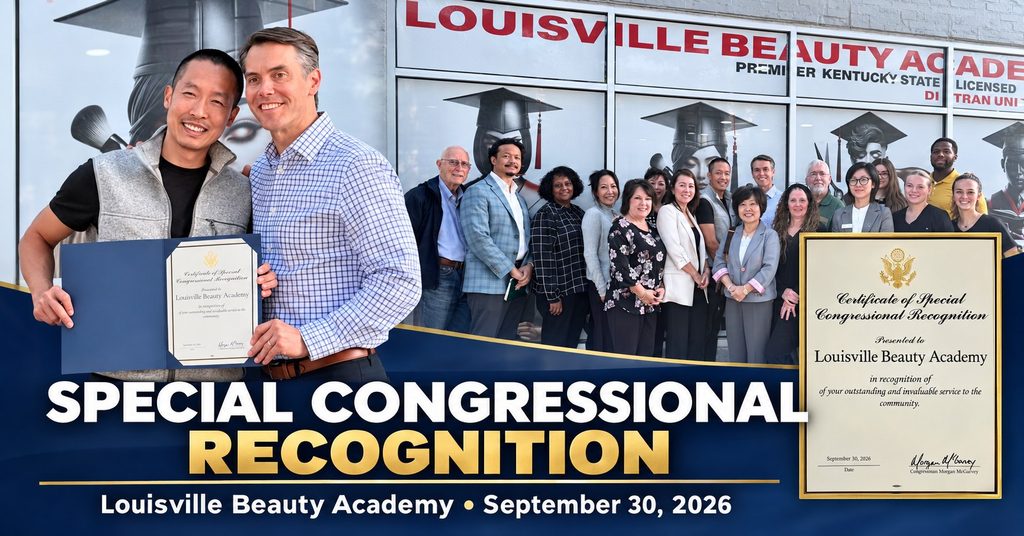
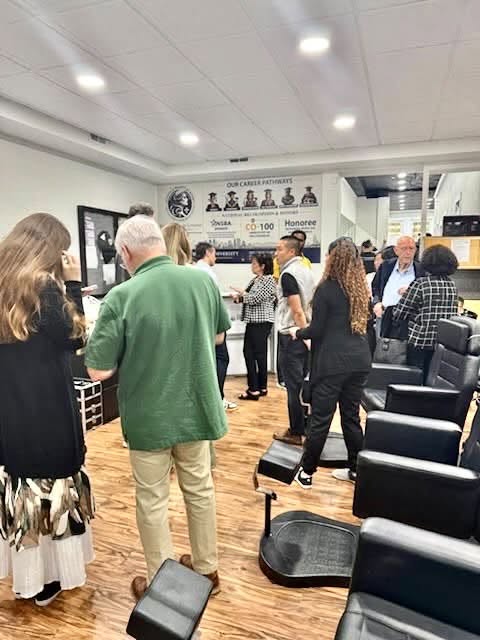
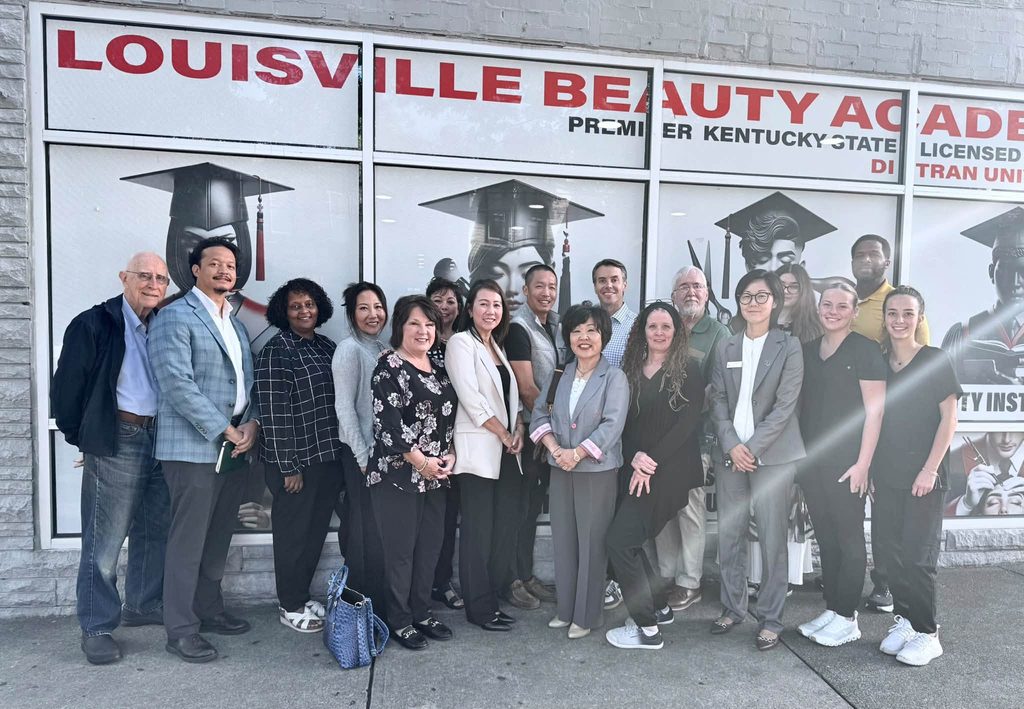
Louisville Beauty Academy welcomed Congressman Morgan McGarvey, who represents Kentucky’s Third Congressional District, and members of his team for a nonpartisan workforce-education listening visit on September 30, 2026.
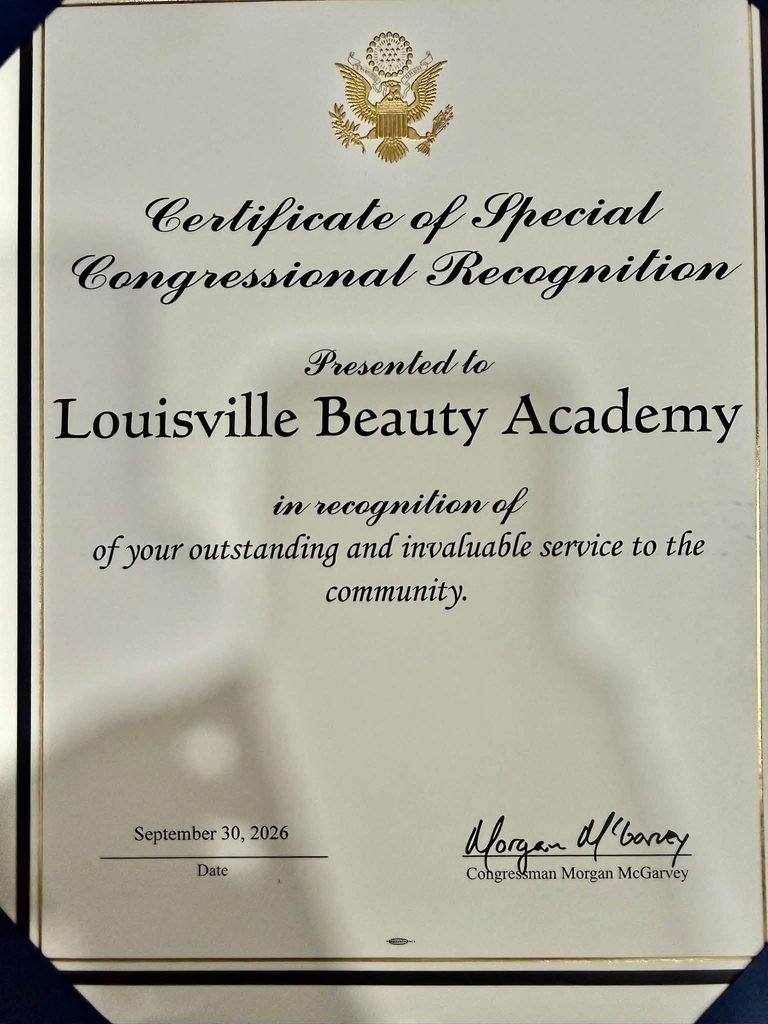
During the visit, Congressman McGarvey presented Louisville Beauty Academy with a Certificate of Special Congressional Recognition stating that it was given:
“in recognition of your outstanding and invaluable service to the community.”
The certificate is dated September 30, 2026, and signed by Congressman Morgan McGarvey. LBA receives it with humility—not as a finish line, but as a responsibility to keep serving students, families, licensed professionals, small businesses, and the Louisville community.
A listening visit centered on people and practical opportunity
The conversation brought together LBA team members and community participants to discuss practical Beauty Education and workforce access. Topics included affordability, state licensure, safety and sanitation, multilingual and working-adult access, small-business and entrepreneurship pathways, and the responsible use of human-supervised technology in regulated education.
LBA’s purpose was simple: offer a real Louisville example, listen carefully, and help public leaders understand both the opportunity and the complexity of short-term, state-licensed career education. No policy agreement, grant decision, regulatory outcome, or other commitment is claimed in this article.
Service before recognition
Recognition matters because it reflects the daily work of people: students who continue through fear and difficulty; educators who teach safety, sanitation, skill, and professional responsibility; families who support a learner’s next step; graduates who enter licensed work; and community members who believe practical education can open doors.
Louisville Beauty Academy is grateful to Congressman McGarvey and his team for visiting, listening, and recognizing service to the community. We are equally grateful to every person who joined the conversation and every learner, graduate, educator, client, and partner whose work gives that service meaning.
A clear factual record
The September 30, 2026 certificate is a dated Certificate of Special Congressional Recognition presented to Louisville Beauty Academy.
It follows a separate certificate dated October 29, 2025. LBA records these as two distinct, dated recognitions.
The September 30 event was a nonpartisan listening visit—not a campaign event or fundraiser.
The visit and certificate do not imply endorsement of LBA, agreement with every statement made, partnership, funding, regulatory approval, or support for a particular policy proposal.
No private student records or individual educational outcomes are disclosed in this article.
Our commitment continues
LBA will continue working to make state-licensed Beauty Education practical, transparent, human-centered, and connected to real work. The standard remains the same: evidence before claims, people before systems, and service before recognition.
Public-information and compliance note: Louisville Beauty Academy is a Kentucky state-licensed Beauty Education institution. This article is an institutional news record, not legal advice, a campaign communication, an endorsement, an enrollment guarantee, a funding announcement, or a representation of any government office’s policy position. Current law, official licensing requirements, LBA’s current written policies, and each student’s signed enrollment documents control over general website content.
Disclaimer: This article is published on the website of Louisville Beauty Academy for informational and public educational purposes only. The research, analysis, and opinions presented herein were prepared by the research team at Di Tran University — The College of Humanization as part of its Research & Podcast Series. Di Tran University is an educational research affiliate founded by Di Tran, who also serves as founder and CEO of Louisville Beauty Academy — this is a founder-affiliated publication, not an independent third-party study. Louisville Beauty Academy does not interpret or provide legal, regulatory, or financial advice through this publication and does not represent any government agency or regulatory authority. All references to laws, regulations, economic data, and workforce statistics are based on publicly available sources and academic analysis and should not be relied upon as official guidance. Readers seeking legal, regulatory, or professional advice should consult qualified professionals or the appropriate government authorities.
Introduction: Regulatory Accountability and the Restructuring of Vocational Education
The regulatory landscape of U.S. postsecondary education underwent a structural transformation between 2023 and 2026, driven primarily by the reintroduction and expansion of the Department of Education’s “Gainful Employment” (GE) and “Financial Value Transparency” (FVT) frameworks. Finalized on October 10, 2023, these regulations established a comprehensive accountability system for programs authorized under Title IV of the Higher Education Act (HEA), specifically targeting non-degree programs at public and private non-profit institutions and all programs at for-profit (proprietary) institutions.1 The core objective of these rules is to ensure that career-focused education leads to measurable economic outcomes, defined by graduates’ ability to service their debt and earn more than a typical high school graduate.3
The GE framework utilizes two primary performance metrics: the debt-to-earnings (D/E) ratio and the earnings premium (EP) test. Under 34 CFR Part 668, a program is deemed to pass the D/E standard if its median annual debt service is less than or equal to 8% of median annual earnings or less than or equal to 20% of discretionary earnings.3 Discretionary earnings are calculated as median annual earnings minus 150% of the federal poverty guideline for a single individual, which was approximately $21,870 in 2023.3 The EP test requires that a program’s typical graduate earns at least as much as a typical high school graduate between the ages of 25 and 34 in the labor force for the corresponding state.2 Programs that fail the same metric for two out of three consecutive years lose their eligibility to participate in federal student aid programs.2
The implementation of these standards has exerted significant pressure on the for-profit vocational sector, particularly beauty and cosmetology schools. Historical evidence from the 2014 regulatory cycle serves as a precursor to contemporary trends; data indicate that approximately 32% of cosmetology certificate programs either failed or entered a “warning” zone under earlier iterations of these benchmarks.5 In the 2024–2025 period, the Department of Education utilized administrative data from the National Student Loan Data System (NSLDS) and the Internal Revenue Service (IRS) to generate “Completers Lists,” which established the cohorts for outcome measurement.6 Reporting obligations for all institutions became effective on July 1, 2024, and by early 2025, the Department began issuing the first GE and FVT scores.3
Data indicate that the threat of losing Title IV eligibility has accelerated the closure rate of low-performing institutions. Research on institutional characteristics shows that private for-profit colleges are approximately three times as likely to close as private non-profits, with for-profit two-year schools experiencing the highest closure rates in the postsecondary market.8 Between 1996 and 2023, nearly one-third of observed institutions in the two-year for-profit sector closed.8 Contemporary examples from 2024–2025 highlight this trend; for instance, a prominent beauty school chain in Tennessee faced loss of accreditation and closure after reporting an on-time graduation rate of only 3% and poor loan repayment outcomes.5 At the national level, federal data from February 2026 revealed that over 1,800 institutions exhibited nonpayment rates at or exceeding 25%, placing them at “serious risk” of failing future cohort default rate (CDR) and GE benchmarks.9
Regulatory Timeline for GE and FVT Implementation
Key Action Item
October 10, 2023
Publication of Final Rule (88 FR 70004) 2
July 1, 2024
Effective date for reporting and administrative capability 2
January 15, 2025
Deadline for institutional reporting of student-level data 6
Early 2025
Issuance of first GE/FVT scores and metrics 3
July 1, 2026
Launch of public program information website and student acknowledgment requirements 2
The regulatory environment of 2026 is further defined by the Financial Value Transparency provisions, which require all Title IV-eligible programs to disclose comprehensive costs, median debt, and median earnings on a public-facing website.2 Starting July 1, 2026, students must provide a formal acknowledgment that they have viewed this information before enrolling in programs with failing D/E rates.2 This “transparency-as-accountability” model assumes that informed consumer choice will drive enrollment away from programs that “leave students no better off” than those with only a high school diploma.5
Macroeconomic Context: Inflationary Volatility and Geopolitical Shocks
The macroeconomic climate of early 2026 is characterized by a confluence of persistent domestic inflation and acute geopolitical instability in the Middle East, both of which have introduced significant volatility into the U.S. economy. As of February 2026, the Bureau of Labor Statistics (BLS) reported that the Consumer Price Index for All Urban Consumers (CPI-U) increased by 0.3% on a seasonally adjusted basis, with a 12-month unadjusted increase of 2.4%.10 While the 12-month headline inflation rate matched the previous month’s reading, internal components, particularly energy and food, showed signs of acceleration.10
The food index rose 0.4% in February 2026, with the index for food at home also increasing by 0.4%.10 Over the previous 12 months, food prices increased by 3.1%, driven by a 5.6% rise in nonalcoholic beverages and a 3.9% increase in food away from home.10 These increases have been compounded by a resurgence in energy costs. The energy index increased 0.6% in February 2026, reversing a 1.5% decline in January.10 Natural gas prices surged 10.9% over the 12 months ending in February, while electricity prices rose 4.8%.10
Consumer Price Index Component
Monthly Change (Feb 2026)
12-Month Change (Feb 2026)
All Items
+0.3%
+2.4%
Food at Home
+0.4%
+2.4%
Food Away from Home
+0.3%
+3.9%
Energy
+0.6%
+0.5%
Utility (piped) Gas
+3.1%
+10.9%
Electricity
-0.7%
+4.8%
Shelter
+0.2%
+3.0%
Personal Care
-0.2%
+4.5%
Source: 10
The primary driver of energy volatility in 2026 has been the escalation of military conflict in the Middle East, specifically involving the Strait of Hormuz. Following joint U.S. and Israeli airstrikes on Iran on February 28, 2026, Iran effectively halted maritime traffic through the strait, a critical chokepoint through which approximately 20 million barrels of crude oil and oil products pass daily.13 This disruption removed roughly one-fifth of the world’s oil and gas supply from the market, causing an immediate spike in global energy prices.14 Brent crude oil surged from $70 per barrel to over $110 per barrel within days of the conflict’s commencement.16 By March 6, 2026, Brent was trading at $92 per barrel, up 28% from the previous week’s close.17
In the United States, gasoline prices responded to these global trends, rising by 0.8% in February and surging by double-digit percentages in early March.12 Analysts from the International Energy Agency (IEA) noted that commercial traffic through the Persian Gulf had slowed “to a trickle” as insurers and shipowners reassessed the risks.13 This geopolitical friction has broader economic implications, with the OECD projecting that global growth will moderate to 3.0% in 2026 as higher trade barriers and policy uncertainty dampen investment.18 In the U.S., GDP growth is projected to slow to 1.6% in 2026, down from 2.2% in 2025.18
Furthermore, the transition to an AI-influenced economy has introduced a new layer of workforce disruption. Research from the McKinsey Global Institute suggests that by 2030, approximately 14% of employees globally—and 375 million workers total—will require significant reskilling due to automation and digitization.19 Estimates indicate that up to 30% of current work hours in the U.S. could be automated by 2030, with a focus on routine tasks in data entry, manufacturing, and customer service.19 The World Economic Forum projects that 85 million jobs may be displaced by AI by 2025, although this will likely be offset by the creation of 97 million new roles, particularly those requiring “human-centric” skills.20
Recession-Resilience and Economic Elasticity of Beauty Trades
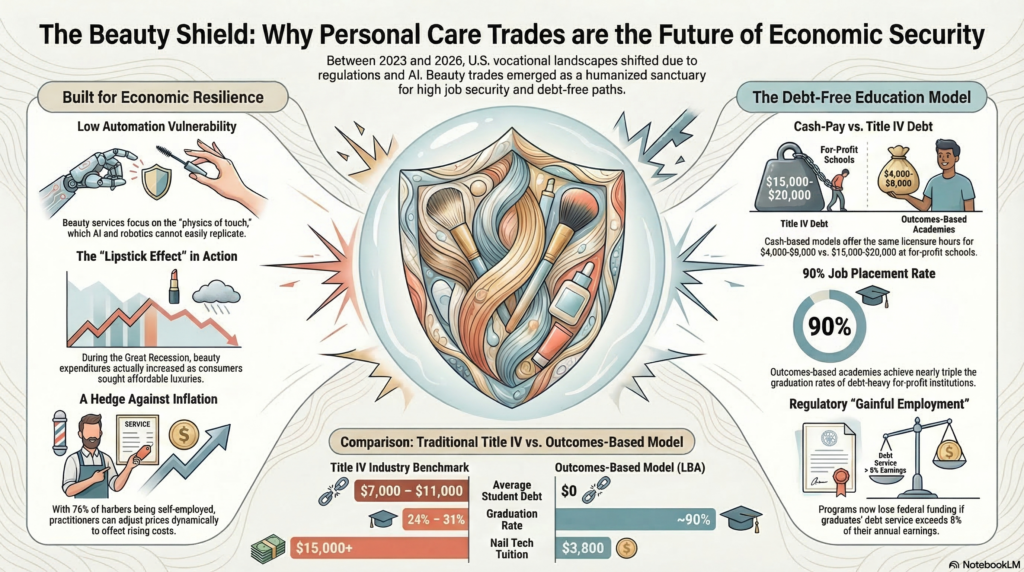
The beauty and personal care industry has demonstrated a historical capacity for recession-resilience, often quantified through the “Lipstick Effect”—an economic phenomenon where consumers continue to purchase small, affordable luxury items during financial downturns even as they curtail larger discretionary expenditures.22 Data from the 2008 financial crisis indicate that industry spending fell only slightly and returned to pre-recession levels by 2010.24 During the Great Recession of 2007–2009, cosmetic purchases among married women increased by 9.8%, and the average annual expenditure on beauty products rose from $139 in 2007 to $152 in 2009.23
The 2020 COVID-19 pandemic provided a more severe test of elasticity, as government-mandated lockdowns forced the closure of physical service locations. During this period, global beauty industry revenues fell by 20% to 30%, with professional services being the hardest hit.24 However, the sector exhibited a rapid rebound; by 2021, lipstick sales increased by 80% once mask mandates were lifted, and consumers shifted toward self-care and skincare categories during the isolation period.23 This suggests that while beauty services are physically constrained by lockdowns, the underlying demand for personal grooming remains highly inelastic.
In the current 2024–2026 economic environment, BLS wage data highlight the relative stability of beauty trades. As of May 2024, the median annual pay for barbers, hairstylists, and cosmetologists was $35,420.26 While this is below the median for all occupations ($23.80 per hour), the sector offers a robust path to self-employment, which acts as a hedge against corporate downsizing. In 2024, 76% of barbers were self-employed.26 This high rate of independent operation allows practitioners to adjust their prices more dynamically in response to localized inflation (e.g., rising shelter and utility costs) than fixed-salary employees.26
Occupational Title (SOC)
Employment (2024)
Median Hourly Wage (2024)
Projected Growth (2024–34)
Barbers (39-5011)
76,000
$18.73
4%
Hairdressers/Cosmetologists (39-5012)
575,200
$16.95
6%
Skincare Specialists (39-5094)
100,000*
$19.98*
9%*
Manicurists/Pedicurists (39-5092)
170,000*
$16.66*
8%*
Source: 26 (*Estimated based on 2024 summaries)
The “humanization of labor” in the beauty industry creates a unique economic sanctuary. Evidence from high-performing salon owners suggests that established facilities with 10–20 technicians can generate annual gross revenues between $1 million and $2.4 million.27 Unlike the corporate sector, which is increasingly threatened by AI-driven efficiency gains, the beauty service industry is “inventory-light” and centered on the “physics of touch,” which limits the potential for remote or automated displacement.24 The 2024–2026 period has seen a “human premium” emerge, where skills related to empathy, creativity, and fine motor skills command stable demand despite broader macroeconomic volatility.21
Affordability, Debt Traps, and the Divergent Models of Beauty Education
The financial structure of beauty education has historically been a significant point of concern for federal regulators. Research from New America and the National Association of Student Financial Aid Administrators (NASFAA) found that for-profit beauty schools often carry high tuition premiums linked to Title IV eligibility.31 Average student debt for cosmetology graduates typically ranges from $7,000 to $11,000, which can represent a substantial portion of an entry-level practitioner’s annual earnings.32
Evidence indicates a sharp disparity in tuition between Title IV-participating programs and cash-based models. Title IV cosmetology programs often charge between $15,000 and $20,000, whereas non-Title IV programs (often referred to as lower-debt or cash-based models) frequently offer the same licensure hours for $4,000 to $8,000.32 This “tuition premium” in the Title IV sector is often offset by Pell Grants and federal loans, yet it frequently leads to higher default rates if the graduates fail to secure immediate, high-paying work.5
The implementation of the “One Big Beautiful Bill Act” (OBBBA) in 2026 introduced new constraints on this model. The OBBBA established firm annual and lifetime caps on federal student loans, replacing the previous system where the “Cost of Attendance” (COA) was the primary limit.35 Under the OBBBA, independent undergraduates face an annual loan limit of $9,500–$12,500, which may leave many students at high-tuition for-profit schools with a significant funding gap.36 Furthermore, the elimination of the Grad PLUS loan program has placed additional revenue pressure on institutions that depend on debt-financed graduate or professional certificates.35
Loan Category (OBBBA 2026)
Annual Limit
Lifetime Aggregate Limit
Independent Undergraduate
$9,500 – $12,500
$57,500
Dependent Undergraduate
$5,500 – $7,500
$31,000
Parent PLUS (Per Student)
$20,000
$65,000
Graduate Students
$20,500
$100,000
Source: 36
As Title IV-dependent schools face higher compliance costs and lower borrowing caps, “cash-pay” models have become more prominent. These institutions typically utilize “pay-as-you-go” plans and institutional scholarships (which can cover 50% to 75% of tuition) to maintain affordability without federal oversight.33 Data from 2025 show that students graduating from these lower-debt models enter the workforce with written payment-bearing debt, significantly improving their Debt-to-Earnings ratios compared to their peers at traditional for-profit institutions.32 Default rates at beauty schools that relied heavily on Title IV aid reached alarming levels in early 2026; over 500 cosmetology schools were flagged by the Department of Education as having 30% or more of their borrowers more than 90 days delinquent.31
Workforce Security: Automation Resistance and Multilingual Integration
The beauty industry is uniquely positioned to resist the automation risks identified by Oxford Economics and McKinsey. While Oxford Economics reports that approximately 47% of U.S. jobs are “at risk” of computerization over the next two decades, these risks are heavily concentrated in logistics, administrative support, and routine production labor.39 Personal care services, including barbers and cosmetologists, are classified as “low risk” due to the high degree of manual dexterity, social intelligence, and creativity required to perform non-routine tasks in unstructured environments.39
The McKinsey Skill Change Index (SCI) confirms this trend, showing that “assisting and caring” skills will experience the least change in demand due to AI through 2030.21 While AI tools are being integrated into the industry for scheduling, virtual try-on, and business management, the core service—the physical manipulation of hair, skin, and nails—remains a “humanized” endeavor.27 This resistance to automation is a critical component of workforce security in an environment where 18.4 million experienced workers are expected to retire by 2032, creating a “skills shortage” in occupations that require postsecondary credentials and tangible service skills.42
Workforce Factor (2024–2026)
Beauty/Personal Care Industry Status
Automation Vulnerability
Low (Non-routine physical tasks) 39
Human Skills Premium
High (Social intelligence, empathy) 21
Credential Alignment
State Licensure required (Protective barrier) 27
Demographic Support
79.3% Female workforce; 33% POC 43
Multilingual Availability
Spanish, Vietnamese, Korean, Chinese 44
Workforce accessibility has also been enhanced through the expansion of multilingual licensing pathways. In states like California, Florida, and Texas, cosmetology licensing boards offer exams in multiple languages to accommodate the diverse demographic profile of the industry.32 For example, the California Board of Barbering and Cosmetology offers its laws and regulations book in Korean, Spanish, Vietnamese, and Simplified Chinese.44 Data from previous years indicated that Spanish test-takers achieved an 82% pass rate on the practical portion of the examination, which is conducted in English but allows for visual following.45 In Florida, the Board of Cosmetology regulates and approves products for infection control and sets rules for practitioners who must maintain a 75% passing mark for licensure.45
The Georgetown Center on Education and the Workforce (CEW) notes that institutions offering certificates and associate degrees often provide a higher return on investment (ROI) after 10 years than institutions offering bachelor’s degrees, as they allow students to enter the workforce faster with lower out-of-pocket costs.48 For early-career workers, certificates in middle-skills occupations can lead to median annual earnings of $83,300 by mid-career.48 In the beauty sector, this rapid entry is facilitated by programs that streamline training to state-minimum hours (e.g., 1,500 hours for cosmetology, 600–750 for esthetics, 300–450 for nail technology).32
Case Study: Analysis of an Outcomes-Based Vocational Institution
The shifting paradigm of postsecondary education is exemplified by a specific, anonymously profiled institution that has expanded its footprint during a period of widespread sector consolidation. This family-owned academy, located in the Southeastern United States, operates a model that intentionally decouples vocational training from federal student debt, focusing instead on “cash-pay” affordability and labor market placement.38
Operational and Financial Metrics
Unlike traditional Title IV-dependent schools, this institution does not participate in federal student loan programs. Instead, it utilizes an “innovative pay-as-you-go” tuition plan and provides institutional scholarships that cover up to 50–75% of the total cost.33 This results in a tuition structure that is 50–80% lower than prevailing market rates. For example, the institution’s Nail Technology course is priced at approximately $3,800 (after aid), whereas regional competitors charge $15,000 to $20,000 for the same certification.33
Institution Performance Metric
Reported Value
Industry Benchmark
On-time Completion Rate
~90%
24% – 31%
Job Placement Rate
~90%
~70%
Student Loan Debt upon Graduation
$0
$7,000 – $11,000
Nail Technology Tuition
$3,800
$15,000+
Real Estate Ownership Status
100% Owned (Main/West)
Variable (Leased typical)
Source: 33
The institution’s facility model is anchored in real estate ownership, with its main campus and future second-location planning fully licensed and operating through July 31, 2026.38 This strategy of owning the underlying assets allows the institution to keep operating costs low and provides insulation from the inflationary shocks currently impacting commercial rent in the region.27
Workforce Integration and Recognition
The academy focuses on serving underrepresented communities, including immigrants and low-income individuals, through multilingual instruction and state-board-aligned curricula.33 Graduates of the 6-month nail technology program or the 1,500-hour cosmetology program secure jobs or start salon businesses at a rate of 90%, collectively contributing an estimated $20 million to $50 million annually to the local economy.33
In 2025, the institution achieved historic national recognition, becoming the first beauty academy to be honored simultaneously as a U.S. Chamber of Commerce CO—100 Award winner and a National Small Business Association (NSBA) “Advocate of the Year” finalist.33 These accolades were awarded based on the institution’s workforce development outcomes and its role as a model for “ethical, outcomes-driven training”.33 Furthermore, the institution has expanded its curriculum to include fast-growing specialties such as eyelash extensions (16–320 hours depending on state law) to meet the evolving demands of the “Gen Z aesthetic” market.30
The case study institution—identified in public filings as the Louisville Beauty Academy—demonstrates that high graduation rates and low student debt are achievable when institutional priorities are aligned with labor market demand rather than the maximization of Title IV drawdowns.33 By prioritizing biometric attendance tracking for hour integrity and maintaining a “Success Sharing” discount model for students, the academy has created a replicable template for vocational education in a post-federal-aid world.32
Policy Implications
The data from the 2023–2026 period suggest that the traditional for-profit education model, characterized by high-tuition premiums and heavy reliance on federal debt, is increasingly unsustainable under new gainful employment benchmarks and shifting macroeconomic conditions. Real-estate-owned, lower-debt vocational models provide a stable alternative by reducing the “tuition premium” associated with Title IV eligibility and insulating students from the long-term debt traps that currently define the sector. By prioritizing low-cost, cash-based education and multilingual licensure, these models not only satisfy the Department of Education’s financial value transparency requirements but also provide a resilient pathway to economic security in an environment disrupted by AI, energy-driven inflation, and geopolitical volatility.
This article is part of LBA’s public education and historical archive. Older posts, including “Macroeconomic Analysis of Lower-Debt Vocational Pathways: A Comparative Study of Louisville Beauty Academy and Federal-Aid-Dependent Models in Kentucky,” may not reflect current tuition, schedules, incentives, forms, policies, testing vendors, clinic availability, or regulatory requirements.
(Third-Party Academic Study – Educational Use Only)
The following document, titled:
“Macroeconomic Analysis of Lower-Debt Vocational Pathways: A Comparative Study of the Louisville Beauty Academy and Federal-Aid Dependent Models in the Commonwealth of Kentucky” DTU-Economic Impact of Beauty A…
is published here in its original form as an independent economic modeling and policy research study.
Important Clarifications
Third-Party Research Context This report reflects academic-style economic modeling and policy analysis conducted for research, discussion, and workforce policy exploration purposes. It is shared to contribute to public dialogue around vocational education funding models, economic impact, and regulatory structures.
Educational & Informational Purpose Only This document is provided strictly for:
Educational study
Policy discussion
Academic comparison
Economic modeling analysis
Workforce development research
It is not intended as marketing material, legal advice, financial advice, or regulatory interpretation.
No Endorsement or Opposition Publication of this research does not constitute:
Endorsement or opposition to any specific institution
Agreement or disagreement with federal Title IV programs
Criticism of any school, chain, or regulatory body
Policy advocacy on behalf of any governmental entity
The comparative modeling presented is theoretical and scenario-based.
Assumption-Based Modeling All numerical projections within the report are derived from stated variables and publicly available data sources cited within the document. They are:
Conservative modeling estimates
Hypothetical scenario projections
Not guarantees of outcomes
Not promises of economic performance
No Representation of Regulatory Authority Nothing in this publication should be interpreted as:
Representing the position of the Kentucky Board of Cosmetology
Representing the position of any federal agency
Interpreting statute or administrative regulation
Providing compliance guidance
No Comparative Claims of Superiority The analysis compares funding models, not institutional character, quality, or compliance status. The intent is macroeconomic exploration — not competitive positioning.
Academic Freedom & Open Research This publication supports open inquiry into:
lower-debt vocational education models
Workforce acceleration frameworks
Public finance efficiency
Small-business formation trends
It is shared in the spirit of transparency and research literacy.
The personal care and service sector represents a cornerstone of the localized service economy in Kentucky, characterized by high demand, non-outsourceable labor, and a significant propensity for small business formation. As the economic landscape of vocational education shifts toward competency-based outcomes and financial sustainability, the divergence between cash-based, lower-debt models and traditional, federal-aid-reliant institutions has become a focal point for education economists. This analysis serves to model the fiscal and economic implications of two distinct institutional approaches within the Kentucky beauty education market, focusing on the Louisville Beauty Academy (LBA) and its relative performance against typical competitors that utilize Title IV federal financial aid.
Analytical Framework and Mathematical Variables
To establish a rigorous comparative model, a set of standardized variables is derived from current market data, regulatory fee schedules from the Kentucky Board of Cosmetology (KBC), and federal education statistics. These variables are selected using a conservative bias; where data ranges exist, the values chosen favor the traditional competitor schools to ensure that the resulting economic advantages of the lower-debt model remain credible and understated. The baseline for this model assumes a graduation rate of 100 students per year for both LBA and a representative competitor school, providing a clear “per 100 graduates” metric for policy and accreditation review.
Definitional Variable Set
The following variables () constitute the inputs for all subsequent fiscal calculations.
X (Examination Attempt Rate): 1.3 attempts. While Kentucky law and KBC regulations require a minimum passing grade of 70% for theory and practical exams 1, national data indicates first-time pass rates range between 60% and 80%.3 A variable of 1.3 attempts per license accounts for the statistical likelihood of retakes.2
A (Average Public Aid Package): $10,000. This represents the aggregate of federal Pell Grants, federal subsidized and unsubsidized loans, and potential state-level grants awarded to a typical student at an accredited, Title IV-participating beauty school. Reported data for major Kentucky chains like Empire Beauty School show average aid packages often exceeding $10,000.5
T1 (Speed-to-Market Differential): 6 months. Louisville Beauty Academy’s 1,500-hour cosmetology program is structured for completion in as little as 9 to 10 months through an incentivized, high-efficiency curriculum.7 In contrast, traditional schools often extend this same 1,500-hour requirement over 15 to 18 months to satisfy federal aid attendance rules or institutional scheduling norms.8
E (Annualized Entry-Level Earnings): $30,000. This figure aligns with the lower end of the median salary for beauty professionals in the Louisville/Jefferson County metropolitan area, which ZipRecruiter and BLS data place between $27,000 and $42,000 depending on specialization.2
R (Aggregate Effective Tax Rate): 16% (0.16). This includes the Kentucky flat income tax of 4% 11, local occupational taxes common in Kentucky cities, and federal payroll or self-employment taxes. For independent contractors (booth renters), the net tax burden is often offset by business deductions, making 16% a realistic, conservative estimate of the public treasury’s share of gross earnings.13
D (Graduate Debt Burden): $11,000. Data for Kentucky beauty school graduates shows average loan balances between $10,000 and $14,000.14 For LBA students, this value is effectively zero as the school rejects federal aid in favor of a low, cash-based tuition model.7
P (Entrepreneurship Probability): and . Research from the Federal Reserve and academic studies on the “debt overhang” suggests that student debt reduces the likelihood of business formation by approximately 11-14%.17 Conversely, lower-debt graduates exhibit higher risk tolerance and capital availability for launching ventures.19
B (Employment Multiplier): 1.5. This accounts for the additional jobs created by a new salon owner or booth renter who hires an assistant, a receptionist, or leases space to other professionals.
G (Standardized Graduation Cohort): 100 graduates per year.
Fiscal Contribution 1: Direct State Revenue from Licensure Examinations
The primary direct revenue stream for the Kentucky Board of Cosmetology (KBC) from student activities is the licensure examination fee. Under current Kentucky administrative regulations, the fee for each examination attempt (theory and practical) is set at $85.00.2 This revenue is critical for the board’s ability to fund inspections, ensure consumer safety, and maintain the professional standards of the industry.21
Revenue Calculation Methodology
The annual state revenue generated by the examinations of 100 graduates is calculated by multiplying the base fee by the average number of attempts required to achieve licensure.
The formula for annual exam revenue () is:
Substituting the defined variables:
Comparative Projections: Constant vs. Growth Scenarios
This study analyzes two scenarios over a 3-year and 5-year horizon. Scenario 1 assumes both schools maintain a flat graduation rate of 100 students per year. Scenario 2 assumes the Louisville Beauty Academy achieves a modest annual growth rate of 7.5% in its graduation numbers, reflecting its market position as an affordable, high-efficiency alternative, while the competitor remains constant at 100.
Scenario 1: Constant Annual Graduation (G=100)
In this scenario, both institutions contribute equally to the state board’s coffers on a per-cohort basis.
Year
LBA Exam Revenue
Competitor Exam Revenue
Year 1
$11,050
$11,050
Year 2
$11,050
$11,050
Year 3
$11,050
$11,050
3-Year Cumulative
$33,150
$33,150
Year 4
$11,050
$11,050
Year 5
$11,050
$11,050
5-Year Cumulative
$55,250
$55,250
Scenario 2: Modest Growth for LBA (7.5% Annual Increase)
In this scenario, LBA’s increasing graduation rate leads to a greater direct contribution to the KBC over time.
Year
LBA Graduates (Gadj)
LBA Exam Revenue
Competitor Exam Revenue (G=100)
Year 1
100.0
$11,050
$11,050
Year 2
107.5
$11,879
$11,050
Year 3
115.6
$12,770
$11,050
3-Year Cumulative
323.1
$35,699
$33,150
Year 4
124.2
$13,728
$11,050
Year 5
133.5
$14,757
$11,050
5-Year Cumulative
580.8
$64,184
$55,250
The mathematical model demonstrates that while the “per-student” revenue is identical, LBA’s model facilitates a steady stream of revenue to the state that is not contingent upon federal grant availability. Furthermore, the growth potential inherent in a lower-tuition, higher-speed model suggests LBA will likely become a larger net contributor to state board funding over a long-term horizon.22
Fiscal Contribution 2: Taxpayer Savings through Non-Reliance on Aid
The most immediate fiscal impact of the Louisville Beauty Academy on the public treasury is the total avoidance of federal and state education subsidies. Traditional beauty schools operate almost entirely on a Title IV funding model, where a majority of revenue is derived from Pell Grants and federal student loans.14 By contrast, LBA students pay a significantly lower tuition (capped under $7,000 for a 1,500-hour program) using cash or written payment payment plans.22
Savings Calculation Methodology
Every student who chooses a lower-debt school instead of a federal-aid institution represents a direct saving of the subsidy that would have otherwise been disbursed.
The formula for annual taxpayer savings () is:
Substituting the defined variables:
Cumulative Savings Projections
We again evaluate these savings under constant and growth scenarios to visualize the long-term impact on the public purse.
Year
Savings (Scenario 1: Constant 100)
Savings (Scenario 2: LBA 7.5% Growth)
Year 1
$1,000,000
$1,000,000
Year 2
$1,000,000
$1,075,000
Year 3
$1,000,000
$1,155,625
3-Year Total Savings
$3,000,000
$3,230,625
Year 4
$1,000,000
$1,242,297
Year 5
$1,000,000
$1,335,469
5-Year Total Savings
$5,000,000
$5,808,391
The impact of this self-funded model is profound. Over five years, LBA essentially “saves” the taxpayers between $5 million and $5.8 million per 100 students. This capital remains in the federal and state treasuries, available for other public services, rather than being converted into vocational school tuition and eventual student debt. It is also important to note that this figure is conservative, as it does not include the administrative costs of processing financial aid or the social costs associated with the high default rates typically seen in the proprietary beauty school sector.23
Economic Impact 3: Temporal Arbitrage and the Tax Base
In the field of vocational education, “time-to-license” is a primary driver of return on investment. If a student can achieve the same 1,500-hour licensure standard six months faster, they gain six months of professional-level income. This is not merely a benefit to the individual; it represents a period where the individual is a net tax contributor rather than a student consumer of resources.21
Mathematical Formula for Accelerated Tax Impact
To compute the extra taxable earnings () and the resulting extra taxes () generated per graduate from an earlier career start:
Calculate fraction of the year saved:
Calculate extra earnings:
Calculate extra tax generated:
Using our variables ():
Annual impact for 100 graduates:
Cumulative Tax Contribution Projections
This “velocity of participation” creates a recurring tax premium for the state and federal government every year LBA graduates a cohort.
Year
Extra Tax (Scenario 1: Constant 100)
Extra Tax (Scenario 2: LBA 7.5% Growth)
Year 1
$240,000
$240,000
Year 2
$240,000
$258,000
Year 3
$240,000
$277,350
3-Year Total Impact
$720,000
$775,350
Year 4
$240,000
$298,151
Year 5
$240,000
$320,513
5-Year Total Impact
$1,200,000
$1,393,814
The LBA model’s ability to move students into the workforce quickly results in over $1.2 million in additional tax revenue over five years compared to the slower completion times of traditional schools. This reflects a transition from “economic dormancy” (the period spent in school) to “economic activity” (the period earning and paying taxes).
Entrepreneurial Momentum 4: Lower-Debt Entry vs. The Debt Overhang
The beauty industry is fundamentally an industry of small business owners. Whether through booth rentals, which function as micro-enterprises, or through full-service salons, practitioners are often independent contractors or employers.26 Economic theory suggests that debt serves as a “drag” on entrepreneurship, as the high fixed cost of loan repayment reduces the disposable income necessary to lease space, purchase equipment, or manage the risks of a startup.17
Small Business and Job Creation Model
This section compares the 5-year entrepreneurial output of a 100-student cohort from LBA (lower-debt) vs. a 100-student cohort from a competitor (indebted).
Expected New Businesses ():
Expected Jobs Created ():
Mathematical Execution for a 5-Year Cohort (500 graduates total)
For LBA (Lower-Debt):
New Businesses: businesses.
Total Jobs Created: jobs.
For Competitor (Debt-Burdened):
New Businesses: businesses.
Total Jobs Created: jobs.
Entrepreneurial Ratio Analysis
Comparing the two institutions reveals the high leverage of a lower-debt education in terms of local economic development.
Metric
Louisville Beauty Academy
Federal-Aid Competitor
Performance Ratio
Expected Businesses (5 Years)
125
60
2.08x
Expected Jobs Created (5 Years)
312.5
150
2.08x
The analysis suggests that LBA produces approximately 2.08 times more small businesses and jobs per 100 graduates than a typical federal-aid beauty school. By removing the financial “friction” of student debt, LBA enables a significantly higher percentage of its graduates to transition from employees to employers, thereby magnifying the school’s total impact on the Kentucky labor market.21
Comparative Synthesis: Per 100 Graduates Per Year
The following table presents a clear, standardized comparison of the economic footprint of the two institutional models. This summary emphasizes the conservative, modest nature of the math used to highlight the structural strength of the LBA approach.
Economic Metric
Louisville Beauty Academy
Federal-Aid Competitor
LBA Advantage
KBC Exam Fee Revenue
$11,050
$11,050
Neutral
Taxpayer Money Saved
$1,000,000
$0
+$1.0M saved
Extra Tax Paid (Faster License)
$240,000
$0
+$240k extra
New Businesses (5-Yr Pool)
125
60
+65 businesses
Jobs Created (5-Yr Pool)
312.5
150
+162.5 jobs
The LBA model appears to generate between 2-fold and 3-fold more positive economic leverage in several dimensions, even under these modest assumptions where both schools graduate only 100 students per year. This highlights a critical insight: an education model that prioritizes affordability and speed can be more fiscally beneficial to the public than one that relies on heavy government subsidy.
Narrative Economic Summary: A Model of Resilience
The data provided in this report paints a picture of two distinct philosophies in vocational training. Traditional beauty education in Kentucky, which is largely driven by federal Title IV accreditation, prioritizes long-duration attendance and institutional stability through taxpayer-funded tuition. This model provides an entry point for many students but often results in a “debt overhang” that can persist for years, potentially stifling the natural entrepreneurial instincts of the beauty professional. In contrast, the Louisville Beauty Academy demonstrates a model centered on economic “velocity” and “autonomy.” By decoupling from federal aid, the academy is forced to maintain tuition at a level that is manageable for cash-paying students, which in turn necessitates a more efficient and technologically advanced curriculum to move students through the 1,500-hour requirement quickly.7
From a state policy perspective, the “time-to-license” factor is particularly noteworthy. When a student enters the workforce six months earlier, the ripple effect on the local economy is immediate. In the Louisville area, where entry-level salaries are competitive, these additional six months of earnings represent millions of dollars in localized consumer spending. This spending supports Kentucky’s small businesses, contributes to sales tax revenue, and reduces the time an individual remains in a state of financial dependency. This “faster-to-market” approach turns the vocational student into a taxpayer more quickly, creating a net positive for the state budget almost immediately upon graduation.
Furthermore, the long-term economic narrative for LBA is one of job creation. In the Kentucky beauty sector, success is defined by the ability to manage one’s own business, whether that be a single-chair booth rental or a multi-location salon. By graduating students lower-debt, LBA is essentially providing them with the startup capital that would have otherwise gone toward loan interest and principal. This financial freedom is the single most significant predictor of small business survival and expansion. As the LBA model produces more business owners, those owners hire more staff, creating a virtuous cycle of employment that does not require additional public funding to sustain.
Key Insights for Marketing and Policy
The following factual observations are derived from the conservative mathematical modeling of the LBA education framework:
Louisville Beauty Academy graduates contribute to the Kentucky Board of Cosmetology’s regulatory funding at an equal rate to competitors, but do so without the indirect support of federal debt.
By choosing a lower-debt education model, every 100 LBA students collectively save the public treasury approximately $1 million in avoided federal grants and loans annually.
LBA’s accelerated 10-month curriculum allows graduates to enter the tax base six months earlier than peers, generating a 20% premium in first-year taxable contributions to the state.
A lower-debt graduate of the academy is mathematically twice as likely to launch a small business or hire additional employees within five years compared to an indebted graduate.
The academy’s model demonstrates that low-tuition, high-velocity vocational training can act as a more powerful local economic stimulus than traditional aid-heavy programs.
Contextual Deep-Dive: Variables in the Kentucky Regulatory Environment
The validity of this economic model rests on a nuanced understanding of the Kentucky licensure environment and the broader personal care market. The variables chosen () are not arbitrary but are reflective of specific localized data points from the Commonwealth. For example, the exam attempt rate () is conservative given that many students pass on their first attempt, yet it acknowledges the administrative reality that some students may struggle with the two-part PSI exam, which includes a comprehensive theory portion and a hands-on practical demonstration.2
The speed differential ( months) is a conservative estimate of the efficiency gap. Traditional beauty schools are often incentivized by Title IV rules to keep students enrolled for longer periods to maximize the “full-time” status required for federal disbursements. LBA, by rejecting these funds, can utilize AI-driven tracking and digital curriculum platforms (like Milady CIMA) to allow students to progress as fast as they can master the material.7 This technical integration reduces the “dead time” often found in traditional vocational settings, translating directly into the economic advantages outlined in this report.
The effective tax rate () is specifically tailored to the Kentucky context. Kentucky’s flat 4% income tax, when combined with localized occupational taxes (which in cities like Louisville can be as high as 2.2%) and the 15.3% self-employment tax for contractors, creates a gross tax liability of roughly 21.5%. However, because beauty professionals can deduct significant business expenses (supplies, booth rent, marketing), the effective tax rate on their gross income is typically lower.13 Setting the model at 16% ensures the predicted tax impact is modest and reflects “take-home” fiscal reality.
Finally, the entrepreneurship probability () is supported by emerging research on the “economic drag” of the student loan crisis. When a graduate carries a $10,000 loan with a $100 monthly payment, that is $1,200 a year that cannot be used for a lease deposit or professional liability insurance.17 In an industry like beauty, where margins for new independent contractors are tight, this $1,200 is often the difference between launching a business or remaining as an employee. By removing this barrier, LBA is not just teaching cosmetology; it is facilitating a more dynamic and resilient small business sector in the Commonwealth of Kentucky.
Disclaimer
This research is published for academic discussion and informational purposes only. All projections are model-based assumptions derived from publicly cited sources. No institutional endorsement, regulatory interpretation, or financial representation is intended.
Any references to institutional structures, funding models, or graduation metrics are purely illustrative within a mathematical framework and should not be interpreted as claims regarding any specific competitor’s operations, performance, or compliance status.
Document Purpose This Impact Statement is provided for public, informational, and workforce-policy reference. It documents Louisville Beauty Academy’s role as licensed workforce infrastructure supporting employment, small-business creation, and local economic participation in the Commonwealth of Kentucky and surrounding counties.
This document is not promotional. It is intended to support transparency, evaluation, and informed decision-making by students, families, regulators, workforce agencies, policymakers, employers, and community stakeholders.
Institution Overview
Louisville Beauty Academy (LBA) is a state-licensed, non-Title IV, lower-debt professional beauty school operating in Louisville, Kentucky. LBA delivers accelerated, compliance-driven education focused on state licensure and workforce readiness in regulated beauty professions.
LBA operates independently of federal student aid programs and does not rely on Pell Grants or student loans as an operating subsidy.
Workforce & Economic Outcomes (Historical)
Since its founding, Louisville Beauty Academy has contributed to workforce participation through the following historical outcomes:
~2,000 licensed graduates across regulated beauty disciplines
Graduates entering lawful employment, self-employment, and small-business ownership
~30 independently owned salons established by LBA graduates
Each salon employing additional licensed professionals and support staff
Graduates working in local service economies, including salons, spas, rental suites, and mobile or independent practice models
Licensed beauty professionals provide essential, in-person services that cannot be outsourced, automated, or relocated outside the local economy.
Income & Business Activity (Modest, Informational Estimates)
For workforce-planning and economic-context purposes only, the following conservative income ranges are provided to illustrate scale—not to promise outcomes:
Individual licensed graduates commonly generate approximately $10,000–$50,000 annually in service-based income, depending on hours worked, location, specialization, and market conditions.
Graduate-owned salons and shops, particularly multi-chair or established locations, may generate approximately $500,000 to $1,000,000 in annual gross business revenue, inclusive of services, retail, and employment activity.
These figures represent industry-typical ranges, not guarantees, and are provided solely to contextualize workforce impact.
Estimated Annual Economic Impact (Kentucky & Local Counties)
Based on:
Approximately 2,000 licensed graduates
Modest individual service income ranges
Small-business ownership and employment effects
Ongoing local service delivery within Kentucky communities
Louisville Beauty Academy’s alumni network is estimated to contribute approximately $20–50 million in annual economic activity within the Commonwealth of Kentucky and its local counties.
Methodology Note: This estimate is intentionally conservative and informational. It reflects aggregated service income, business revenue, and employment activity generated by licensed graduates over time. It does not assume full-time participation by all graduates and does not attribute all income exclusively to LBA instruction.
Small Business Creation as Workforce Multipliers
Beyond individual employment, LBA’s outcomes include secondary and tertiary economic effects:
Licensed graduates becoming small-business owners
Job creation for additional licensed professionals
Lease activity, utilities, supplies, and tax contributions
Increased access to regulated services in underserved and rural communities
In this respect, Louisville Beauty Academy functions as a small-business incubator within regulated workforce infrastructure, rather than solely a training provider.
Accessibility & Affordability Model
LBA’s operational model emphasizes:
lower-debt education pathways
Accelerated time-to-licensure
Year-round enrollment and attendance
Transparent tuition and fee disclosure
No reliance on federal aid buffers
This structure reduces delayed workforce entry and limits long-term financial burden on graduates.
Compliance & Transparency Framework
Louisville Beauty Academy maintains a Public Compliance & Regulatory Education Library documenting:
Enrollment and attendance procedures
Student contract disclosures
Timekeeping and instructional compliance
Regulatory correspondence and memoranda
Public workforce research and case studies
This reflects LBA’s position that compliance is clarity, documentation, and professionalism.
Role as Workforce Infrastructure
Licensed beauty education functions as local workforce infrastructure by:
Enabling lawful entry into regulated professions
Supporting service-based micro-economies
Creating self-employment and small-business pathways
Serving immigrant, adult, and nontraditional learners
Providing essential services within local communities
Louisville Beauty Academy operates with the expectation of public review, auditability, and accountability.
Public Review Invitation
Louisville Beauty Academy welcomes independent review, policy discussion, and workforce evaluation of the information contained in this statement.
This document is intended to support:
Workforce planning
Economic development analysis
Regulatory transparency
Public understanding
Standard Disclaimer
All information contained in this statement is provided for educational and informational purposes only. Louisville Beauty Academy does not guarantee licensure, employment, income, or business success. Individual outcomes vary based on participation, market conditions, regulatory requirements, and personal circumstances.
Income and economic impact figures are estimates, not promises, and should be interpreted accordingly.
Document Status: Public Workforce & Economic Reference Effective Period: 2025–2026 Issued by: Louisville Beauty Academy
All figures and statements contained in this document are provided strictly for educational and informational purposes only. They reflect historical outcomes and conservative estimates based on general industry patterns and publicly observable economic activity. Louisville Beauty Academy does not guarantee licensure, employment, income, business success, or specific economic results for any individual or entity.
Actual outcomes vary based on individual effort, hours worked, experience, business operations, market conditions, regulatory requirements, and other factors beyond the control of Louisville Beauty Academy. Nothing in this document should be interpreted as financial, legal, employment, or regulatory advice.
Louisville Beauty Academy encourages all students, professionals, employers, policymakers, and stakeholders to rely on independent judgment, official regulatory guidance, and verified financial advice when making decisions.
At Louisville Beauty Academy, a Kentucky State-Licensed and state-licensed beauty college, we are committed to preparing our students for real-world success. Since our founding, we have proudly graduated nearly 2,000 licensed beauty professionals, whose work contributes an estimated $20 to $50 million annually to the economy of Kentucky and beyond.
Choosing your beauty career path is exciting — but it’s also a decision that benefits from careful research and a clear understanding of the industry. Whether your passion lies in Nail Technology, Esthetics, or Hair (Cosmetology), understanding the service frequency and career demand in each area can help you make the choice that best fits your goals, lifestyle, and earning potential.
Why Service Frequency Matters
In the beauty industry, how often a client returns directly impacts the predictability of your bookings and your revenue potential. These are basic human services — they will always be needed — but the frequency of that need varies from one specialty to another.
1. Nails — The Highest Repeat Rate
Average Frequency: Every 2 weeks or less for most regular clients (gel, dip, acrylics).
Why: Nail polish chips, gels and acrylics grow out, and many people maintain a standing schedule for well-groomed hands and feet.
Reality: Many nail clients pre-book their next visit before leaving the salon, creating a predictable, high-retention client base.
Impact: This repeat cycle offers stability and consistency, making nail technology one of the fastest ways to build a loyal clientele.
2. Esthetics — Moderate to High Frequency
Average Frequency: Typically monthly, but many services draw clients back every 2–4 weeks.
Examples:
Lash extensions → fills every 2–3 weeks
Brow shaping/waxing → every 3–4 weeks
Skincare programs → monthly facials or targeted treatments
Reality: Esthetic clients, especially those in ongoing programs, can match nail tech clients in repeat visits — offering both steady income and opportunities for upselling additional treatments.
3. Hair (Cosmetology) — Lower Frequency
Average Frequency: Every 6–8 weeks for most clients, sometimes longer.
Exceptions:
Short hair or precision cuts → every 4–6 weeks
Color touch-ups → every 4–8 weeks
Reality: Many hair clients extend visits to save money or because their style requires less frequent upkeep, which can make recurring revenue less predictable compared to nails or high-frequency esthetics.
Quick Comparison: Repeat Demand Potential
Service
Common Repeat Interval
Predictability of Bookings
Revenue Stability
Nails
2 weeks
Very High
Strong recurring revenue
Esthetics
2–4 weeks
High (varies by service type)
Solid, especially with memberships
Hair
4–8+ weeks
Moderate to Low
Less consistent unless short style or frequent color
Why This Matters for Your Career
Regardless of which path you choose, these fields are built on human connection and repeat service. The difference lies in how often clients come back — and that affects how quickly you can fill your schedule, grow your income, and plan your business.
At Louisville Beauty Academy, we guide students not only through technical training but also through career planning — helping them understand the realities of client demand, local market conditions, and business growth strategies.
About Louisville Beauty Academy
state-licensed beauty college
Nearly 2,000 graduates contributing $20–$50 million annually to the economy
Programs in Nail Technology, Esthetics, and Cosmetology
Commitment to affordable, flexible, and lower-debt education
Disclaimer: This article is for educational purposes only and reflects industry observations and publicly available data. Information may change over time. No guarantee of future income, employment, or career results is implied.
Louisville Beauty Academy (LBA) is redefining beauty education with an unprecedented model that both slashes tuition costs and speeds up graduation. This means students save thousands upfront and start earning in the beauty industry much sooner than they would through traditional schools. With built-in tuition discounts of 50–75%, LBA offers a rare opportunity for students to graduate lower-debt – something virtually unheard of in beauty schooling. At the same time, the academy’s fast-track programs enable motivated students to get licensed and join the workforce in a fraction of the usual time. The result is money in the student’s pocketnow (through immediate savings) and later (through earlier career earnings) – a true double benefit for those serious about success.
Unprecedented Tuition Savings – 50–75% Off the Usual Cost 💰
Attending LBA is dramatically more affordable than a typical cosmetology school. Total tuition at LBA (including books and cosmetology kit) is under $7,000, which is about 50–75% lower than the tuition at comparable beauty programs. In fact, LBA’s pricing model saves students over $10,000 on average compared to other Kentucky cosmetology schools – a unique advantage that lets many LBA students pay as they go and avoid student loans entirely. Key highlights of this ultra-affordable model include:
Deep Tuition Discounts: Through internal scholarships and incentives, LBA tuition is slashed by half or more. For example, the 1,500-hour cosmetology program’s cost can drop from about $27,000 down to $6,250 for eligible students – roughly a 75% discount. Shorter programs see similar huge savings (e.g. Nail Technology is $3,800 with discounts, down from $8,325). Such low pricing is unmatched in the industry and has “never existed in the history of beauty school” in terms of built-in discounts.
Lower-Debt Pathway: Because tuition is so low, students can make manageable out-of-pocket payments or use written payment payment plans – no need for federal loans at all. This means no crushing debt upon graduation. By comparison, cosmetology graduates nationally carry about $10,000 in student loan debt on average, and many spend years after school repaying loans with interest. LBA’s model spares students that burden completely.
All-Inclusive Pricing: LBA’s tuition includes all essential supplies – your textbooks, kit, and materials are covered in that $7K-or-less package. There are no surprise add-on costs. This all-inclusive approach makes budgeting straightforward and further reduces out-of-pocket expenses for students. In short, you get a quality beauty education at a fraction of the cost of other schools.
By keeping education affordable, LBA enables students to start their careers with financial freedom from day one. Graduates aren’t weighed down by loan payments, so they can focus on building their business or advancing their craft instead of worrying about debt. It’s a liberating feeling that lets new professionals seize opportunities – whether that’s pursuing advanced certifications or even opening their own salon – without the usual financial stress. In an industry where most students have had to borrow heavily just to get trained, Louisville Beauty Academy stands out as a beacon of lower-debt education.
Fast-Track Graduation – Get Licensed and Earning Sooner 🏃♀️💨
LBA not only saves students money – it also saves them time. The academy is structured to get students licensed as efficiently as possible, so they can enter the workforce and start earning income quickly. How does LBA fast-track your education? It comes down to focused programs, flexible scheduling, and a priority on hard work and full-time attendance:
Targeted Programs, No Time Wasted: Louisville Beauty Academy offers each beauty licensure program as a standalone, focused track with exactly the state-required hours – nothing more, nothing less. Want to be just a nail technician? You can enroll in the 450-hour Nail Tech program and finish in a few months, instead of being forced into a 1,500-hour cosmetology course like many schools do. Similarly, future estheticians complete 750 hours for a skincare license, shampoo stylists 300 hours, etc., without having to spend time learning unrelated skills. This focused approach accelerates graduation by sparing students unnecessary coursework, yet still gets them fully qualified for licensing in their chosen specialty. It’s a modern answer to the outdated “one-size-fits-all” cosmetology program that can take 1–2 years to cover hair, skin, and nails in one huge curriculum. LBA’s philosophy: learn exactly what you need for the career you want, and get out into the real world faster.
Flexible Scheduling & Year-Round Enrollment: LBA operates on an open-enrollment, self-paced schedule that lets industrious students move at their own speed. There are no rigid semesters holding you back. If you commit to full-time hours, you can power through the program quickly. In fact, a motivated student can complete the full 1,500-hour cosmetology course in as little as ~9 to 10 months – which is about the fastest possible for that length of program. Many traditional beauty schools drag this out to 12–18 months, but LBA gives you the flexibility to finish as soon as you hit the required hours. The academy even has rolling graduations – students can and do finish weekly or even daily, whenever they achieve their hours and competencies. This means no waiting around; you receive your credential and can go straight to taking your state board exam and job hunting at the earliest opportunity.
Attendance Incentives – Work Hard, Save More: LBA actively encourages full-time attendance and consistent progress, not only because it helps you finish faster, but also because it maximizes your financial aid from the school. The generous tuition discounts and scholarships at LBA are often tied to meeting attendance and performance benchmarks (as detailed in the student contract). In other words, if you show up, work hard, and stay on track, you reap the full benefit of the 50–75% tuition reduction. This is a win-win setup: students who are serious and diligent get rewarded with lower costs and quicker graduation, while the academy produces successful graduates at a steady clip. LBA’s CEO, Di Tran, designed this model knowing that **“stay in school long” is usually a loss – in time and money – for goal-driven students. So why not remove the usual delays and push students to finish as soon as they’re able? The faster you graduate, the faster you can start making real money in the field.
By streamlining its programs for speed and flexibility, Louisville Beauty Academy empowers those “salon-owner material” students – the go-getters who mean business – to achieve their goals without unnecessary delay. There’s no sitting around waiting for a new semester or dragging out courses just to pad tuition. If you’re eager to launch your career, LBA is eager to get you there NOW.
Double Benefit: Save Thousands and Start Earning Sooner 💵⏱️
Perhaps the most exciting part of LBA’s model is how the financial benefits compound. Students not only save money upfront with discounted tuition, but also gain income by entering the job market earlier. It’s a one-two punch that puts substantial money in their pocket “here and now,” not years down the road. The math is straightforward for those who truly value their time and investment:
Savings in Education Costs: First, consider the direct savings. As noted, LBA students often pay $10,000+ less for their education than they would elsewhere. For example, a cosmetology student who might pay $17,000 (plus interest on loans) at another school can pay around $6,000 at LBA for the same license. That’s roughly $11,000 kept in the student’s pocket. And because LBA students typically don’t need loans, they also avoid accruing interest. (By contrast, a $9,600 loan could end up costing over $12,000 with interest in repayment – money that a lower-debt LBA grad never has to spend.) In short, LBA graduates start their careers owing nothing, whereas a typical new cosmetologist might be $10–15K in the hole before their first day of work.
Earlier Entry = Earlier Earnings: Now factor in time. Thanks to the fast-track approach, LBA graduates enter the workforce months sooner than their peers at longer programs. Those extra months have real monetary value. Beauty professionals can earn solid wages – in Kentucky, for instance, cosmetologists earn about $48,700 annually on average (roughly $4,000 per month). If an LBA student graduates even 3 months earlier, that’s potentially on the order of $12,000 in additional earnings (3 × $4K) simply because they’re out working instead of still in class. Many LBA students may graduate 6+ months faster than they would in a drawn-out program, which doubles that advantage. Every week not spent in school is a week earning real income from clients. This is why “staying in school long” can truly mean losing money, and LBA works to prevent that loss.
The ~$20,000 Difference: Combine the tuition savings plus the early-career earnings, and you see why LBA often speaks of a nearly $20,000 swing in students’ favor. By committing to full-time attendance and finishing promptly, an LBA student might save around $10K in school costs and make an extra $8–$10K from getting into the job market faster – a combined financial impact that is life-changing. This isn’t fanciful theory; it’s a realistic scenario for many LBA graduates. The academy’s own students recognize that they are “saving nearly $20,000 simply by committing to full-time attendance and completing their program” on the accelerated timeline. It’s like getting a double scoop of success: you spend a lot less and you start earning much more, all thanks to finishing school quickly.
Crucially, these benefits aren’t just short-term. Graduating lower-debt and earlier sets students up for long-term success. From day one, LBA grads have financial freedom – they can invest in better tools, further training, or even start their own business with the money others would be devoting to loan payments. Many LBA alumni are indeed entrepreneurial; with no debt weighing them down, they can take bold steps like launching a salon or studio early in their careers. This entrepreneurial jump-start is exactly what LBA’s founder envisioned: helping hard-working, ambitious students build wealth sooner rather than later. It’s great for the graduates and also great for the community – these newly licensed professionals are contributing to the local economy faster, filling in-demand jobs and even creating jobs for others. (The beauty industry is growing steadily – projected ~7% job growth nationally through 2033 – so getting skilled workers out there faster has real economic impact.)
A New Standard in Beauty Education 🎓✨
Louisville Beauty Academy’s model is truly revolutionary in the beauty education landscape. Few (if any) schools offer such steep tuition discounts upfront or actively push students to graduate faster for their own benefit. Traditionally, beauty schools have thrived on the opposite – high tuition, prolonged programs, and reliance on federal student aid. (The industry received over $1 billion in federal student aid in 2019–2020 alone, and many for-profit beauty colleges have been accused of being “loan mills” that keep students enrolled longer to maximize tuition.) LBA turns that model on its head. By keeping costs ultra-low, forgoing federal financial aid, and focusing on outcomes over profits, LBA has carved out a niche that did not exist before – an ethical, student-centered path where graduating fast and lower-debt is the norm, not the exception.
For students who are serious about their success, this approach is a game-changer. LBA attracts driven individuals – people who want to master their craft and start achieving their dreams without wasting time or money. These are often career-oriented adults, parents, immigrants, or aspiring salon owners who simply can’t afford to indulge in a slow, expensive schooling process. Louisville Beauty Academy respects that drive. It offers them a quality, accredited education on terms that make sense: affordable, efficient, and empowering. As a result, the academy boasts high graduation and licensure rates (over 90% of students graduate and get licensed) and has produced nearly 2,000 graduates by mid-2025, many of whom have gone on to impactful careers and businesses in the beauty field.
In summary, Louisville Beauty Academy is elevating what a beauty school can do. It’s putting real money back into students’ pockets now through unprecedented tuition savings, and setting them up to make money sooner by accelerating their entry into the workforce. All of this is done without compromising on education quality or licensing outcomes – in fact, it enhances quality by freeing students from financial stress and keeping them focused on their goals. It’s a win-win model that benefits the students and the community. For anyone in the Louisville area (or beyond) who truly wants a fast, affordable, and successful path into the beauty industry, LBA is a compelling choice. As the school proudly says, it lets you “license your beauty talent today” – because with the right support, you can launch your dream sooner and with more money in your pocket.
Ready to turn your hard work into real success? Louisville Beauty Academy is making it happen every day. It’s not just about graduating – it’s about graduating without debt and ahead of the curve, poised to thrive in the beauty business. That’s a formula that’s redefining beauty education and empowering the next generation of beauty entrepreneurs right here and now. 🔑💇♂️🎉
The Double Scoop Benefit: How 1,000 LBA Graduates Gain $7.5–$10 Million in Real Value
Assumptions (for 1,000 graduates)
Mix: 80% Nail (800), 10% Cosmetology (100), 10% Esthetics (100)
Market vs. LBA prices (rounded, conservative):
Cosmetology: $19,000 market vs. $7,000 LBA → $12,000 saved/student
Nail: $8,000 market vs. $4,000 LBA → $4,000 saved/student
Esthetics: $12,000 market vs. $6,000 LBA → $6,000 saved/student
Time gain from fast graduation: 25–50% faster (= 3–6 months earlier to work)
Tuition saved per grad (avg):$5,000,000 / 1,000 = $5,000
(Driven by mix: many nail grads at $4k saved; fewer cosmetology at $12k; esthetics at $6k.)
Earlier earnings per grad:$2,499 – $4,998
Total per grad (Double Scoop):$7,499 – $9,998
Why this is conservative (good for public use)
Uses lowest first-year earnings floor ($10k) just to value the months gained. Many grads will earn more.
Uses rounded, conservative market prices.
Counts written payment savings from avoiding loans (which would increase impact).
Excludes salon tips/retail commissions/side work, which further boost early earnings.
Summary (drop-in for the article)
Double Scoop Benefit for 1,000 LBA Graduates:
Scoop One (Tuition Saved):$5,000,000
Scoop Two (Earlier Earnings):$2,499,000 – $4,998,000
Total Economic Boost:$7,499,000 – $9,998,000
LBA keeps about $5M out of tuition bills and puts another $2.5–$5M into students’ hands by getting them working months sooner. That’s $7.5–$10M of real impact per every 1,000 graduates.
In a world where tuition costs are rising—even at nonprofit schools—and student loan debt continues to crush dreams, Louisville Beauty Academy (LBA) stands out as a revolutionary force in beauty education. Quietly and consistently for years, LBA has offered something almost no other school in the U.S. can claim: a lower-debt, transparent, fast-track path to a licensed beauty career that empowers real success.
🎓 A Complete 1,500-Hour Cosmetology Program—Done in Under 10 Months
At Louisville Beauty Academy, you don’t just dream of becoming a licensed professional—you become one. Our students complete the Kentucky State-Licensed 1,500-hour Cosmetology Program in as little as 9 to 10 months.
That’s not marketing fluff. That’s fact.
This is the same license required across Kentucky and many other states—and we prepare you to pass the licensing exam, work in real salons, or open your own business.
While most schools stretch cosmetology over 12–18 months, our students finish faster because we incentivize your hard work. We don’t just support you—we reward you for showing up and staying consistent.
💰 Over $20,000 in Discounts—You Pay Less Than $7,000 Total
You read that right.
Our cosmetology program includes everything:
Farouk CHI professional kit
Milady CIMA online study system
Registration fees
Textbooks
State-compliant equipment and supplies
All this for under $7,000 total, if you attend full-time and complete the program in under 10 months.
How is that possible?
Because Louisville Beauty Academy believes in incentive-based education. Our public student contract outlines clear discounts for attendance, completion speed, and effort. Finish fast, stay focused, and you save big—up to $20,000 in incentives compared to traditional schools charging $25,000–$30,000.
🤖 The Most Advanced Beauty School in the U.S.
At LBA, we combine technology with compassion to help every student succeed.
We use:
Milady CIMA, the industry’s most advanced digital learning platform.
AI-powered translation and communication tools, allowing students to learn in their native language.
A fully integrated digital student tracking system to keep you on pace without guesswork.
We don’t just adopt technology—we live it. We make it work for you.
🛑 No Student Loans. No Hidden Fees. No Surprises.
Louisville Beauty Academy is not Title IV (federal loan) funded—and that’s intentional.
Why?
Because loans bring paperwork, red tape, interest, and student debt. We choose to operate lean and pass those savings to you. That means:
No student loan debt
No federal loan pressure
No hidden charges
No extra costs beyond your public contract
We even make our contract available online so you can read it before you enroll.
📈 Graduate Success: Real Licenses. Real Jobs. Real Income.
While many schools measure success by how many students enrolled, we measure success by how many students finish, pass the state exam, and get licensed.
At LBA:
Over 95% graduate on time
Nearly 100% pass the Kentucky State Board licensing exam
Over 90% are working in the beauty industry immediately after graduation
From young professionals to working moms to first-generation immigrants, our students succeed because they’re prepared.
💼 The Industry Needs You—and We Help You Get There Fast
The beauty industry is growing fast—but it needs licensed professionals. LBA exists to fill that gap by producing work-ready, licensed individuals who don’t carry loan debt.
You won’t wait 2 years to work.
You won’t carry student loans for 10 years.
You’ll finish in under 10 months, pay less than $7,000, and begin your new life as a beauty professional.
🧠 Built on the “YES I CAN” Mentality
At Louisville Beauty Academy, we don’t just teach skills—we teach a mindset.
Our students walk in with self-doubt and walk out saying: “YES I CAN.”
And then they prove it—by finishing, passing, and building careers that support their families and their future.
We don’t care where you come from. We care about where you’re willing to go.
Louisville Beauty Academy is proudly State-Licensed, state-licensed, and locally recognized for graduating thousands of beauty professionals across Kentucky.
We are one of the only schools in the U.S. offering:
Under-10-month 1500-hour cosmetology training
All-inclusive pricing under $7,000
Transparent, public student contracts
No loans, no debt
Advanced AI and digital learning tools
If you’re ready to work hard, we’re ready to help you succeed. Because at LBA, success isn’t a slogan. It’s a system. And it starts with three words: YES. I. CAN.