Louisville Beauty Academy Net Positive Article Research Report – RESEARCH & PODCAST SERIES 2026 BY DI TRAN UNIVERSITY

Executive summary

A legally careful, fact-based article about Louisville Beauty Academy should rely on a narrower, stronger claim than the absolute statement that every graduate is automatically a net positive in every measurable sense. The best-supported version is this: Louisville Beauty Academy is a Kentucky Board-listed, state-licensed beauty school whose public materials describe a licensure-preparation, practical-training, flexible-schedule, lower-debt/direct-pay model serving adult learners who often balance work, family, transportation, and language barriers while pursuing regulated beauty credentials. That institutional model can support a serious public-value argument about labor-force participation, household spending, and tax-base contribution. [1]

The school’s public milestone language is meaningful but should be stated with precision. LBA’s current graduate-gallery page says the academy has supported “nearly 2,000 graduates” across full programs, short programs, refresher training, transfer students, and workforce pathways. An older 2023 school catalog says that, according to an annual report covering 2017–2023, LBA had over 1,000 graduates. Those two figures are not contradictory, but they are not the same measure either. A rigorous article should therefore say that the exact audited count of full-program graduates alone is not publicly specified in the materials reviewed here. [2]

LBA’s current tuition and finance pages support the lower-debt framing, but they also require careful wording. Current public pages publish conditional reduced-cost figures of $3,800 for Nail Technology, $6,100 for Esthetics, and $6,250.50 for Cosmetology, and state that students may make monthly payments of more than $100. The same current finance page says LBA is not a Title IV federal-aid participant and does not process or disburse federal student aid. However, an older 2023 catalog contains a generic section describing Pell Grants and federal loans. Because LBA’s own current pages repeatedly say current written documents control, the safest public article should rely on the current 2024–2026 finance pages and should not overstate historical practice without written clarification. [3]

The proposed $20 million to $40 million cumulative economic-activity figure is reasonable as an illustrative estimate, not as an audited economic-impact study. If one applies a deliberately modest $10,000 to $20,000 annual contribution proxy to roughly 2,000 cumulative graduates/pathway completers, the math is straightforward. That assumption is conservative relative to current published BLS mean annual wages for Kentucky beauty occupations and Louisville-area beauty occupations. But the article must say clearly that this is not audited GDP, not a tax-receipt study, not a guarantee of earnings, and not proof that every graduate remains in Kentucky or works full-year in the field. [4]

Verified institutional and regulatory facts

Louisville Beauty Academy appears on the Kentucky Board of Cosmetology’s school list at 1049 Bardstown Road and as Louisville Beauty Academy at Harbor House at 2233 Lower Hunters Trace. The Board listing shows instructional programs including Cosmetology, Esthetics, Nail Technology, Shampoo Stylist, and instructor pathways. That is the strongest primary-source basis for the statement that LBA is a state-licensed Kentucky beauty school. [5]

LBA’s own “About” page describes the school as serving students who are seeking licensure preparation, practical training, and a clearer path into lawful professional work in beauty. The same page emphasizes access for students balancing work, family responsibilities, transportation limits, and language barriers. Its broader public materials repeatedly frame the school around dignity, discipline, service, and workforce readiness, and the enrollment-procedures page says LBA is designed for adult students with “real lives, work responsibilities, [and] family responsibilities.” [6]

Kentucky’s regulatory framework supports LBA’s licensure-preparation positioning. Kentucky regulation 201 KAR 12:082 requires at least 1,500 hours for cosmetology, 750 hours for esthetics, and 450 hours for nail technology, and it explicitly includes preparation for licensure and employment, on-the-job professionalism, and salon businesses in the educational structure. Kentucky Board pages also restate the hour thresholds for licensure pathways. [7]

LBA’s current public cost pages are affordability-focused but careful. The school says current written documents control, yet public reduced-cost figures currently shown include $3,800 for Nail Technology, $6,100 for Esthetics, $6,250.50 for Cosmetology, $3,900 for Beauty Instructor, and $2,890 for Shampoo Styling. The payment-plan page says students may make monthly payments above $100, while the enrollment-procedures page says LBA offers a monthly payment path with deposits by program and balance due before graduation. [8]

The strongest evidence for the “no federal student loans/aid processed” claim is LBA’s current finance page, which states: “Louisville Beauty Academy is not a Title IV federal aid participant. We do not process or disburse federal student aid (FAFSA loans or grants).” That same page describes LBA’s model as direct-pay and lower-debt. At the same time, the 2023 catalog contains a generic financial-aid section describing Pell Grants and federal loans, which means a clean article should note that current written disclosures control and should avoid claiming more than the current page itself says. [9]

LBA’s public materials also give ready-made compliance language that is useful for the article. The school’s current finance page says no page or older statement guarantees graduation, licensure, exam result, employment, income, transfer approval, or Board approval. The catalog likewise says the academy cannot legally guarantee employment. Those statements align well with the user’s requested guardrails against guaranteed-outcome claims. [10]

Working-student reality in Louisville

The human heart of this article is not a speculative claim about instant success. It is the reality of the working student. LBA’s own current materials say the academy is built for adult students with work and family responsibilities, and its catalog describes full-time attendance as 30–40 hours per week and part-time attendance as 20–30 hours per week, while also stating that the school operates on a flexible schedule that allows students to tailor attendance to personal circumstances. That is exactly the kind of structure that makes the working-student narrative credible. [11]

The occupations named by the user are also recognizable in Louisville labor data. In the Louisville/Jefferson County metro area, BLS reported mean annual wages in May 2023 of about $28,450 for cashiers, $30,000 for waiters and waitresses, $33,220 for bartenders, $30,820 for maids and housekeeping cleaners, $33,550 for janitors/cleaners, $33,960 for home health and personal care aides, and $33,740 to $35,360 for chauffeur-style driving proxies depending on table/version. BLS also notes that taxi drivers, shuttle drivers, and chauffeurs include ride-hailing drivers, and that some of this work is part-time and schedule-flexible. [12]

That makes the requested vignettes defensible as composites, not as undocumented claims about every individual student. A legally careful article can describe students who may be driving Uber or Lyft at night, cleaning hotel rooms on weekends, cashiering, bartending, waiting tables, working factory shifts, helping on salon floors, or caregiving for elders or children—so long as the article presents these as humanized, plausible portraits of a working-adult student body, not as verified census counts of LBA’s entire enrollment. LBA’s own materials support the broader picture of students with work obligations and constrained schedules. [13]

Typical student work roles and illustrative earnings while enrolled

Role in the articleBest public wage proxy used hereMean hourly wageIllustrative work pattern while enrolledIllustrative gross earnings
Uber/Lyft driverShuttle drivers and chauffeurs proxy$16.2210–20 hrs/weekabout $162–$324/week
Hotel or home cleanerMaids and housekeeping cleaners$14.8210–20 hrs/weekabout $148–$296/week
General cleanerJanitors and cleaners$16.1310–20 hrs/weekabout $161–$323/week
CashierCashiers$13.6810–20 hrs/weekabout $137–$274/week
BartenderBartenders$15.9710–20 hrs/weekabout $160–$319/week
Waiter or waitressWaiters and waitresses$14.4210–20 hrs/weekabout $144–$288/week
CaregiverHome health and personal care aides$16.3310–20 hrs/weekabout $163–$327/week
Factory workerMiscellaneous assemblers and fabricators proxy$22.1010–20 hrs/weekabout $221–$442/week

The wage figures above are Louisville/Jefferson-area BLS estimates, while the hour bands are illustrative work scenarios chosen to fit LBA’s published flexible attendance model for working adult students. The Uber/Lyft row uses a chauffeur-style proxy because BLS classifies ride-hailing within the broader taxi/shuttle/chauffeur framework, and real gig-driver take-home pay can vary materially due to vehicle costs, self-employment status, and platform conditions. [14]

Conservative economic estimate

The economic case should be framed in intentionally modest terms. BLS reported statewide Kentucky mean annual wages in May 2023 of about $48,700 for hairdressers, hairstylists, and cosmetologists, $42,330 for manicurists and pedicurists, and $55,060 for skincare specialists. In the Louisville metro area, the corresponding means were even higher, at about $59,240, $41,150, and $57,160. Against those published occupation figures, an article that uses only $10,000 to $20,000 per graduate per year as an illustrative contribution range is plainly conservative. [15]

That is why the article can responsibly say the following: the proposed figure is not an income promise and not an audited wage file; it is a modest annual economic-activity proxy. It simply asks whether a licensed or partially placed worker might reasonably generate at least $10,000 to $20,000 in annual labor-linked contribution through work, spending, and tax-system participation. Given the BLS occupation data above, that is a cautious assumption rather than an aggressive one. [15]

Assumptions and calculation steps for the illustrative economic estimate

StepAssumption usedConservative floor scenarioPublic-current scenarioWhy this is legally safer
Public milestone countLBA older catalog cites 1,000+ graduates; current gallery cites nearly 2,000 across broad pathway types1,0002,000Uses public figures already published by LBA, while acknowledging they are not identical measures
Annual per-person economic activity proxyModest contribution assumption, not guaranteed income$10,000–$20,000$10,000–$20,000Far below published full-year beauty occupation means in Kentucky/Louisville
CalculationCount × annual proxy$10M–$20M$20M–$40MSimple arithmetic, transparent, easy to explain
InterpretationIllustrative labor/spending contribution, not audited GDPmodest annual activitymodest annual activityAvoids overstating formal economic impact
Not includedretention, tips, commissions, self-employment costs, taxes actually paid, migration, out-of-state work, public benefits usageexcludedexcludedKeeps the estimate conservative and honest

The public-current scenario is the one that produces the $20 million to $40 million figure the user requested, but the floor scenario is useful because it shows the argument still works even under older, lower public counts. The correct editorial description is therefore: “illustrative cumulative annual economic activity associated with modest per-graduate contribution assumptions” rather than “audited economic impact.” [16]

There is also a broader economic reason this framing works. BLS reported that, in 2024, housing and transportation accounted for 50 percent of household spending, and BEA describes personal consumption expenditures as the goods and services purchased by or on behalf of U.S. residents. In other words, even modest earnings are quickly translated into rent, fuel, groceries, child-related costs, and everyday consumption. On top of that, employers generally must withhold federal income tax and Social Security/Medicare taxes from wages, and Kentucky requires employer payroll withholding on wages as well. That is why the “net positive” idea can be argued conservatively in terms of contribution to the economy and tax base, even without claiming an exact audited tax total. [17]

Rendered Mermaid diagram 1

The timeline above follows Kentucky’s published hour requirements, LBA’s attendance-and-completion structure, and LBA’s own published sequence of graduation, Board approval, and exam scheduling before licensure. [18]

Compliance and drafting guardrails

The safest strong title is not the absolute version. Instead of “Every Louisville Beauty Academy Graduate Is a Net Positive…,” the more defensible publishable title is:

Do You Know? Why a Louisville Beauty Academy Graduate Can Be a Net Positive to Kentucky, America, and the Economy

That wording preserves force while avoiding a universal factual claim that would require person-level data on every graduate’s income, location, taxes, and public-benefit use.

A sound article should also make four distinctions explicit. First, institutional finance is not the same thing as individual student benefit use. LBA’s current public page says the school does not process or disburse federal aid, but that does not prove that every individual student, at every moment, uses zero government support elsewhere in life. Second, school completion is not the same thing as state licensure; the Board and PSI control licensure steps. Third, illustrative economic activity is not the same thing as audited impact. Fourth, student culture of sacrifice is real and powerful as a narrative theme, but it should be presented as a composite human truth, not as a quantified claim unless LBA has its own internal survey or documentation. [19]

Open questions and limitations. The exact cumulative count of full-program graduates only was not publicly specified in the materials reviewed. A current LBA finance page says the school is not a Title IV participant, while the 2023 catalog includes a generic federal-aid section; current written disclosures should therefore control. No public audited dataset was reviewed showing graduate-by-graduate income, in-state retention, or public-benefit use, so any claim stronger than an illustrative contribution estimate would exceed the evidence gathered here. [20]

Suggested humanized quotes

Use these only as illustrative composite quotes unless replaced by real quotes from actual students or graduates who have given permission. They fit the evidence about LBA’s working-adult structure and the Louisville job landscape, but they are not verbatim source quotations.

  • “I was driving nights, studying days, and paying in pieces. It was not easy, but it was real.”
  • “Some weeks I cleaned houses. Some weeks I worked restaurant shifts. I kept my hours moving anyway.”
  • “School did not erase my responsibilities. It gave them direction.”
  • “I was not looking for a promise. I was looking for a lawful path, an affordable path, and a chance.”
  • “Before I graduated, I was already contributing. After licensure, I could contribute with more stability.”
  • “The license mattered. But the discipline I built on the way there mattered too.”

These quotes are best introduced as anonymized composites inspired by LBA’s published emphasis on working adult students, flexible attendance, and steady progression toward lawful licensure. [21]

Recommended article structure and target word count

Article componentPurposeSuggested length
Title and subtitleStrong emotional hook, legally careful framing20–35 words
Executive summaryOne-paragraph thesis and scope120–180 words
Human openingWorking-student reality, sacrifice, grit, dignity220–320 words
Institutional factsState-licensed status, programs, lower-debt model, licensure preparation220–320 words
Economic argumentExplain the $10k–$20k assumption and the $20M–$40M illustration300–450 words
Why it mattersExplain “net positive” in family, community, and civic terms220–320 words
ClosingPride, gratitude, and future-facing ending without guarantees130–220 words

A finished article in the 1,200 to 1,800-word range should be long enough to feel substantial and persuasive, but still concise enough for web publishing and institutional review. The economic section should carry the heaviest citation burden because it is where legal risk is highest. [22]

Ready-to-publish article

Title:
Do You Know? Why a Louisville Beauty Academy Graduate Can Be a Net Positive to Kentucky, America, and the Economy

Subtitle: A fact-based, lower-debt, working-student story about licensure, perseverance, and modest but meaningful economic contribution.

Executive Summary

Louisville Beauty Academy is a Kentucky Board-listed, state-licensed school offering cosmetology, esthetics, nail technology, shampoo styling, and instructor pathways in Louisville. Its public materials describe a school built around licensure preparation, practical training, flexibility for working adults, multilingual communication, and a lower-debt direct-pay approach rather than school-processed federal Title IV aid. [23]

That matters economically. LBA’s current public gallery says the school has supported nearly 2,000 graduates and pathway completers across full programs, short programs, refresher training, transfer students, and workforce pathways. If a reader applies only a modest illustrative annual contribution range of $10,000 to $20,000 per person, the result is roughly $20 million to $40 million in annual economic activity. That is not an audited impact study or a promise of earnings. It is a conservative way to explain why disciplined working students and graduates can matter to Kentucky, to America, and to the economy. [24]

Louisville looks like work before it looks like applause

Sometimes the story of beauty school is told as if it begins with polish, style, glamour, or the first happy client. But for many adult learners, the real story begins earlier than that. It begins with a second shift. It begins with a phone full of ride requests. It begins with hotel rooms to clean, restaurant tables to serve, factory lines to work, caregiving duties to carry, register drawers to count, and bills that do not pause simply because someone decided to build a better future. LBA’s own public materials describe a student population balancing work, family responsibilities, transportation limits, and different learning needs, and its schedule model is built for adult students with real-world obligations. [21]

This is why the culture matters. Louisville Beauty Academy’s public language is not built around fantasy. It is built around discipline: show up, clock in, learn the law, practice the skill, finish the hours, document the record, and move toward the next lawful step. That is the meaning behind the school’s public “YES I CAN” and “I HAVE DONE IT” language. It is not a promise that everything will be easy. It is a statement that movement matters, effort matters, and completion matters. [25]

What Louisville Beauty Academy is, in plain terms

Louisville Beauty Academy is not a vague training concept. It is listed by the Kentucky Board of Cosmetology as a Louisville school offering state-regulated beauty programs, including cosmetology, esthetics, nail technology, shampoo styling, and instructor pathways. LBA’s own public pages describe the school as focused on licensure preparation, practical training, written transparency, and access for students whose lives are already full before they ever walk into class. [26]

Its current public cost pages also support the lower-debt story. LBA currently publishes conditional reduced-cost figures such as $3,800 for Nail Technology, $6,100 for Esthetics, and $6,250.50 for Cosmetology, while also stating that current written contracts control. The school says students may make monthly payments above $100 under its written payment structure. Most importantly for this article’s public-value argument, LBA’s current finance page says the school is not a Title IV federal-aid participant and does not process or disburse FAFSA loans or grants. [27]

That does not mean life becomes painless. It means the model is designed to let students push forward without the school itself routing them through school-processed federal student-aid pipelines. It is a different kind of burden: still serious, still demanding, but often more immediate, more transparent, and potentially less loan-dependent. That distinction is one reason the phrase “net positive” can be argued carefully here. [28]

Why the economic argument is serious even when the assumptions are modest

The most responsible way to make the economic case is not to inflate it. It is to understate it. In Kentucky, BLS reported mean annual wages in May 2023 of about $48,700 for hairdressers, hairstylists, and cosmetologists, $42,330 for manicurists and pedicurists, and $55,060 for skincare specialists. In the Louisville metro area, published means were even higher for cosmetologists and skincare specialists. Against that backdrop, using only $10,000 to $20,000 per graduate as an illustrative annual contribution assumption is modest by design. [15]

So the math is straightforward. If a public milestone is approximately 2,000 graduates and pathway completers, and if one uses only $10,000 to $20,000 per person per year as a conservative contribution proxy, the resulting estimate is approximately $20 million to $40 million. That figure should be described honestly: it is an illustrative estimate, not an audited impact study, not tax accounting, not guaranteed income, and not proof that every graduate works in-state or full-year. But it is still useful, because it reveals scale. Even modest contribution multiplied across many disciplined people becomes economically meaningful. [24]

And work matters even before licensure. Louisville-area labor data show that many of the roles common to working-adult student life—cashiering, waiting tables, bartending, cleaning, caregiving, chauffeur-style driving, and production work—already generate real income. Those wages may help pay rent, food, transportation, and tuition while school is still in progress. That means contribution often starts before graduation, not only after it. [29]

Why “net positive” is bigger than money alone

Money matters. But it is not the whole story. A student who works while enrolled is not standing still. A graduate who completes required hours, passes into lawful practice, and begins earning is not only helping themselves. That person is strengthening a household, stabilizing a family budget, improving local service capacity, and participating in the broader systems through which economies actually function. BLS reports that housing and transportation alone accounted for half of household spending in 2024, while federal and Kentucky wage systems both require withholding and reporting on wages. In practical terms, work becomes groceries, gas, rent, bills, and tax-base participation. [30]

That is why the best conservative argument is not that every individual story is identical. It is that the pattern itself is powerful. When a school serves working adults, offers a flexible clock-hour structure, keeps costs visible, focuses on licensure preparation, and helps people move from uncertainty toward lawful earning, the result can be public value. Not perfect value. Not guaranteed value. But real value. [31]

What Louisville Beauty Academy should be proud to say

Louisville Beauty Academy should be proud—not because it can promise outcomes it does not control, and not because every life becomes easy overnight. It should be proud because its public model is built around something serious: adult responsibility, lawful completion, lower-debt access, and the dignity of people who refuse to quit. Its own materials say the school cannot guarantee employment, income, licensure timing, or Board decisions. That honesty is not weakness. It is strength. It makes the success stories more credible, not less. [32]

So yes—speak proudly. Speak about the Uber driver who studies between shifts. Speak about the hotel cleaner who keeps showing up. Speak about the cashier, the bartender, the waitress, the caregiver, the factory worker, the salon-floor helper, the parent, the immigrant, the student who lives carefully and sacrifices quietly. Speak about the person who does not ask for an easy road, only for a real one. That is the deeper meaning of “YES I CAN” at its best. [6]

And then say this with confidence and care: when disciplined people pursue licensure through a transparent, work-compatible, lower-debt training path, they can become a net positive to Kentucky, to America, and to the economy. Maybe first in modest ways. Then in larger ones. But often long before anyone notices, and long before anyone applauds. That is something worth honoring. And Louisville Beauty Academy has every reason to be proud of it. [33]


[1] [5] [23] [26] [33] https://kbc.ky.gov/Schools/Pages/default.aspx

https://kbc.ky.gov/Schools/Pages/default.aspx

[2] [16] [20] [24] Graduate Gallery and Student Milestones – Louisville Beauty Academy – Louisville KY

[3] [8] [27] https://louisvillebeautyacademy.net/current-program-costs-incentives-written-payment-options/

[4] [15] https://www.bls.gov/oes/2023/may/oes_ky.htm

https://www.bls.gov/oes/2023/may/oes_ky.htm

[6] [13] [21] https://louisvillebeautyacademy.net/about/

[7] [18] https://kbc.ky.gov/Documents/201%20KAR%2012.082.pdf

[9] [10] [19] [22] [28] Financial Support and Tuition Payment Options at Louisville Beauty Academy – Louisville Beauty Academy – Louisville KY

[11] [31] [32] https://louisvillebeautyacademy.net/wp-content/uploads/2023/11/LBA-SchoolStudentCatalog-Official-12-01-2023.pdf

[12] [14] [29] https://www.bls.gov/oes/2023/may/oes_31140.htm

https://www.bls.gov/oes/2023/may/oes_31140.htm

[17] [30] https://www.bls.gov/cex/

https://www.bls.gov/cex

[25] Louisville Beauty Academy Student Enrollment Procedures: Clear, Published, and Compliance-Protective – Louisville Beauty Academy – Louisville KY

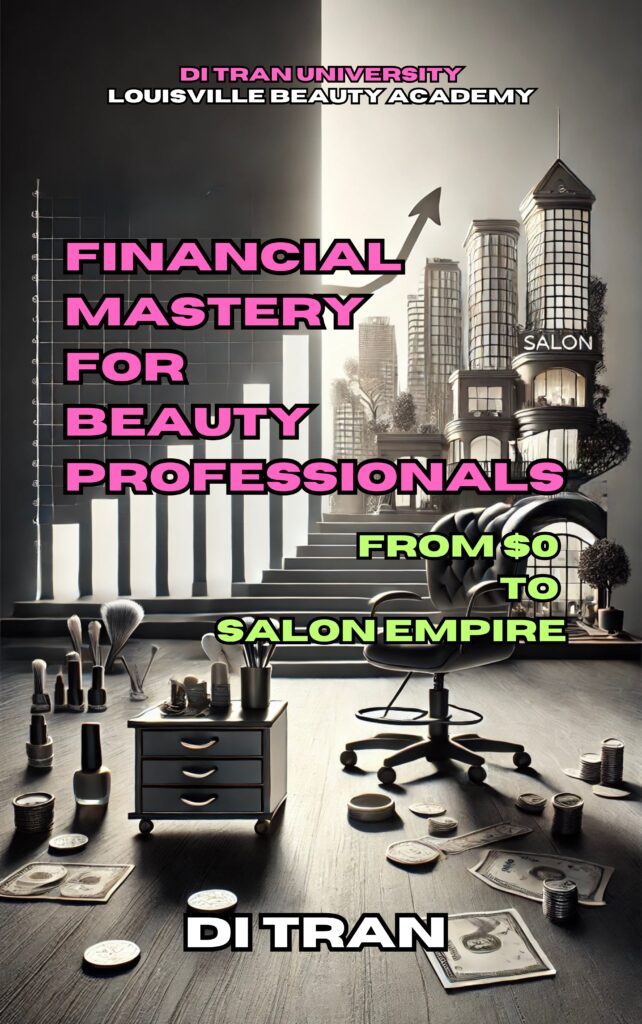
Why Every Louisville Beauty Academy Graduate, Licensee, and Prospect Should Read “Financial Mastery for Beauty Professionals”

At Louisville Beauty Academy, we don’t just prepare you to be a beauty professional—we prepare you for a successful career and a thriving future. That’s why we are excited to announce the release of Di Tran’s latest book, “Financial Mastery for Beauty Professionals: From $0 to Salon Empire” (2025).

This book is a must-read for every beauty school graduate, licensed professional, and aspiring entrepreneur. It’s not just a guide—it’s a roadmap to transforming your skills into a business and your dreams into a legacy.


What This Book is About

Financial Mastery for Beauty Professionals is designed to help you go beyond the chair. It’s about taking control of your finances, building your own business, and investing in long-term wealth, all while staying true to your passion for beauty.

Written by Di Tran, a licensed nail technician, beauty entrepreneur, and real estate investor with over two decades of experience, the book walks you through every stage of growth—from starting as a beauty school graduate to building a salon empire and securing financial freedom through real estate.


Why Should Every Graduate, Licensee, and Prospect Read This Book?

1. Empower Yourself Financially

This book provides essential knowledge to help you master financial discipline. You’ll learn how to:

  • Avoid emotional spending and focus on meaningful investments.
  • Budget effectively and save for the future.
  • Reinvest in your skills, business, and wealth-building opportunities.

🔑 Why It Matters: Financial knowledge is the key to turning your passion into long-term success. Every dollar you earn and save today is a step toward building the future you want.


2. Build Your Own Business

Whether you dream of becoming a booth renter, salon owner, or multi-location entrepreneur, this book offers actionable steps to get there. You’ll discover:

  • How to transition from working for someone else to owning your own salon.
  • Strategies to scale your business and create additional revenue streams.
  • Ways to lead and empower your team while growing your brand.

🔑 Why It Matters: Owning your own business puts you in control of your career and income. It allows you to create opportunities not only for yourself but also for others in your community.


3. Leverage Real Estate for Wealth

Di Tran shares his insights on using your beauty business to fund real estate investments, turning your income into long-term wealth. You’ll learn how to:

  • Identify and purchase properties to house your salon or generate passive income.
  • Use real estate as a foundation for financial stability and legacy building.

🔑 Why It Matters: Real estate is one of the most reliable ways to build wealth, and your beauty business can be the engine that drives these investments.


4. Achieve Work-Life Balance

The book emphasizes the importance of maintaining balance as you scale your career. You’ll gain insights into:

  • Avoiding burnout while growing your business.
  • Prioritizing self-care and relationships.
  • Designing a sustainable career that supports both your personal and professional goals.

🔑 Why It Matters: Success is about more than money—it’s about creating a fulfilling life where you thrive in all areas.


5. Leave a Legacy

One of the most inspiring aspects of this book is its focus on leaving a lasting impact. You’ll learn how to:

  • Mentor others and empower the next generation of beauty professionals.
  • Create a business that thrives long after you’ve moved on.
  • Use your success to make a difference in your community.

🔑 Why It Matters: Your career isn’t just about what you achieve—it’s about the opportunities you create for others and the legacy you leave behind.


Why Louisville Beauty Academy Recommends This Book

At Louisville Beauty Academy, our mission is to elevate every student to their maximum potential. We provide not only the technical skills needed to succeed in the beauty industry but also the mindset and tools to thrive as entrepreneurs and leaders.

Financial Mastery for Beauty Professionals aligns perfectly with our values of continuous learning, adaptation, and growth. This book is a guide to the very principles we instill in our students:

  • The importance of starting small and dreaming big.
  • The value of financial discipline and smart investments.
  • The potential to build a career that creates both personal success and community impact.

Take Advantage of Your Opportunities

As a student, graduate, or prospective beauty professional, you already have an incredible opportunity to change your life through education. Remember:

  1. Your investment starts with your education. Every dollar spent on your training is an investment in your future.
  2. Louisville Beauty Academy offers 50-75% tuition discounts for eligible students. This means you can start your journey with minimal financial burden and focus on achieving your goals.
  3. Graduate fast, succeed sooner. Our programs are designed to help you complete your education efficiently so you can start earning and building your career right away.

Get Your Copy Today

📚 Grab your copy of Financial Mastery for Beauty Professionals: From $0 to Salon Empire today and take the next step toward your future:
https://www.amazon.com/dp/B0DTNVV5M4


Final Thoughts

This book isn’t just a resource—it’s a roadmap to a better future. Whether you’re just starting out, looking to grow your business, or dreaming of financial independence, Financial Mastery for Beauty Professionals will guide you every step of the way.

At Louisville Beauty Academy, we’re here to support you on this journey. With the right education, mindset, and tools, you can achieve anything.

Dream big. Start small. Build your legacy.

YES I CAN”: How Louisville Beauty Academy Empowers Graduates to Apply for the Licensing Exam Immediately

At Louisville Beauty Academy, we emphasize the “YES I CAN” mentality—an evidence-based, psychological approach to overcoming fears and challenges. One of the biggest hurdles our graduates face after completing their program is taking the licensing exam. For many, this exam represents the first and possibly only standardized test of its kind in their lives, and the fear of failure can feel overwhelming. But here’s the truth: the first and most important step is not perfection; it’s action.

The Psychological Barrier: Fear of the Unknown

The fear of taking the licensing exam is a common psychological hurdle. Many graduates feel unprepared, question their readiness, or worry about failing. This fear is natural, especially for those who have never experienced college or formal education systems that involve standardized testing. But fear thrives in the unknown. The best way to dismantle it? Dive in and take action.

Applying for and sitting for your licensing exam—even if you don’t feel fully ready—is a win in itself. Why? Because the moment you take that step, you break the psychological barrier of fear and uncertainty. You learn what the process entails, familiarize yourself with the computerized format, and gain insight into what is expected from the exam.

The First Step is Progress, Not Perfection

Let’s draw a comparison. Many high school students preparing for college take the ACT or SAT multiple times. Rarely do they achieve their highest scores on the first attempt. Success comes from learning the process, identifying areas for improvement, and building confidence over time. Similarly, the licensing exam is not a one-and-done situation. Thanks to Senate Bill 14 (2024), you can retake your licensing exam as frequently as once a month if needed. This flexibility ensures that every attempt is a step closer to success.

The goal of your first attempt isn’t to ace the exam—it’s to overcome the mental block and gain experience. Remember, taking action, no matter the result, is already a victory.

Learning by Doing: Why Your First Attempt Matters

For many graduates, especially those without a family history of higher education or professional licensing, this might be the only licensing exam they ever take. It’s not just about passing; it’s about learning the process and building confidence. Sitting for the exam allows you to:

  • Understand the computerized system and testing environment.
  • Identify the structure and style of questions asked.
  • Pinpoint areas where you can improve for the next attempt.
  • Build the psychological resilience needed to succeed.

At Louisville Beauty Academy, we foster a culture of resilience and empowerment. We encourage our students to embrace the mindset of “I HAVE DONE IT” from the moment they take their first step toward the exam. Every attempt builds confidence, reduces anxiety, and brings you closer to achieving your professional goals.

Overcoming Challenges: The Power of “YES I CAN”

The “YES I CAN” mentality is at the core of our mission at Louisville Beauty Academy. By applying for and taking your licensing exam immediately, you demonstrate to yourself and others that you are capable of facing challenges head-on. Regardless of the outcome, taking the first step is a declaration of your determination and belief in your abilities.

For those who fear failure, remember: failure is not a permanent state—it’s a stepping stone to growth. At Louisville Beauty Academy, we walk alongside our students and graduates as a family, encouraging and supporting them every step of the way. Together, we overcome challenges and celebrate every victory, no matter how small.

Take Charge of Your Future

The licensing exam is not just a test of your technical skills; it’s a test of your resilience, determination, and willingness to take action. By applying for and taking the exam immediately after graduation, you set the tone for your future career. You prove to yourself that you are capable of achieving your goals, regardless of the obstacles in your path.

So, don’t wait. Take the leap. Apply for your licensing exam today, prepare as much as you can, and take the exam with confidence. Whether you pass on the first try or need additional attempts, the most important thing is that you’ve started the journey. At Louisville Beauty Academy, we believe in you—and we know you can do it. Let’s walk toward success together.

Legal Disclaimer

Louisville Beauty Academy provides education and resources to prepare students for licensing exams and careers but makes no guarantees regarding exam results, employment, or other outcomes. Students are responsible for their own effort, compliance with licensing requirements, and application processes. The academy is not liable for any delays, denials, or losses related to licensure, employment, or personal decisions. Success depends on individual dedication and performance. By enrolling, students agree to these terms and acknowledge that outcomes are their sole responsibility.

Graduate Exam Support, Voluntary Mentorship, and Current Official Rules

The YES I CAN principle is strongest when a graduate takes action promptly and understands the support boundary clearly.

After a student graduates, the formal enrollment and training relationship has been completed. LBA may still offer voluntary graduate support, encouragement, general exam-readiness direction, and mentorship-style conversation as a family-style professional community. That support is not a new enrollment, not a contract, not a guarantee of passing, not unlimited tutoring, and not a promise that an instructor will be available at any specific moment.

  • Act quickly after graduation. Licensing exam rules, PSI procedures, Kentucky Board processes, fees, locations, language options, and test guides can change. The longer a graduate waits, the more important it becomes to re-check the current official process before relying on old information.
  • Use current official sources. Graduates should review the Kentucky Board of Cosmetology and PSI instructions directly. LBA public guidance is educational support, not legal advice, licensing advice, or a substitute for official agency instructions.
  • Ask respectfully and document the question. A graduate may text, call, email, or walk in to ask for help. LBA may route the question, suggest a current resource, or help schedule a conversation with an instructor when staff availability, school operations, safety, and current policy allow.
  • Understand the boundary. Post-graduation support is voluntary and availability-based. It does not give any person the right to demand immediate instructor time, access to private/proprietary records, internal tracking systems, staff work product, or services outside current LBA policy.
  • Use language support wisely. Graduates may ask questions in the language they are most comfortable using, and may use translation tools for understanding. Official written requirements, PSI instructions, Kentucky Board rules, identity documents, and current law still control.

Simple exam-readiness path

  1. Confirm that your graduation/completion record and eligibility path are current.
  2. Check the latest Kentucky Board and PSI instructions before scheduling.
  3. Confirm your legal name, candidate ID or permit information, email address, language option, fees, and exam category.
  4. Study safety, sanitation, infection control, state law/rules, and the technical subject areas listed in the current guide.
  5. Schedule promptly instead of waiting months or years and assuming the process stayed the same.
  6. If you feel stuck, contact LBA respectfully and ask what current public resource or availability-based support may help you take the next step.

Official-source control: Current Kentucky Board of Cosmetology rules, PSI exam instructions, state law, and written LBA policy control over memory, rumor, old posts, old screenshots, or informal verbal statements. Last reviewed by LBA public-information support on June 12, 2026.

Louisville Beauty Academy: Elevating the Beauty Industry in Kentucky Through Excellence in Education and Workforce Development

Louisville Beauty Academy, proudly state-licensed and accredited, stands as a vital institution in Kentucky’s beauty education landscape. Since its inception in 2016, the academy has empowered over 1,000 graduates, contributing to a thriving and dynamic beauty industry that spans across Kentucky. The academy’s commitment to quality education and professional development ensures that its students are not only prepared for licensure but are also poised for successful, fulfilling careers in beauty.

The Numbers Behind Kentucky’s Beauty Industry

As of August 2022, Kentucky’s beauty sector has grown to include approximately 23,210 licensed beauty professionals, 4,978 salons, and 49 beauty schools. Louisville Beauty Academy, located at 1049 Bardstown Road in Louisville, contributes significantly to these numbers by producing skilled graduates who join the ranks of licensed professionals across the state. With rigorous programs in cosmetology, nail technology, esthetics, and beauty instruction, the academy is shaping a robust workforce, building a strong foundation for the beauty industry throughout Kentucky.

Louisville Beauty Academy’s Comprehensive Beauty Programs

Louisville Beauty Academy offers a range of programs designed to meet the diverse needs of today’s beauty industry. Each program is carefully aligned with Kentucky State Board of Cosmetology (KBC) standards, ensuring that students gain the skills, knowledge, and hands-on experience required for licensure and career success. The academy’s programs provide not only technical training but also business and customer service skills, setting graduates apart in a competitive market.

Cosmetology Program: Louisville Beauty Academy’s 1,500-hour Cosmetology program covers all aspects of hair care, chemical treatments, and advanced styling techniques, equipping students with the expertise to work in a salon or even open their own. Instructors focus on the latest trends and techniques, blending theory with practice to build confidence and capability in each student.

Nail Technology Program: The academy’s 450-hour Nail Technology program is perfect for those seeking a focused and in-demand career path. With services such as manicures, pedicures, and nail art on the rise, nail salons are one of the fastest-growing segments within Kentucky’s beauty industry. Louisville Beauty Academy’s program offers a streamlined path to licensure, giving students practical skills and the ability to provide the latest nail care trends.

Esthetics Program: As the wellness and skincare sectors expand, the 750-hour Esthetics program at Louisville Beauty Academy prepares students to meet the growing demand for personalized skincare services. From facials and waxing to advanced skincare treatments, the academy’s esthetics curriculum covers a range of services that enhance clients’ well-being and confidence. This program is ideal for those interested in working in high-end spas, dermatology clinics, or their own esthetics practice.

Supporting the Industry: Louisville Beauty Academy’s Role in Workforce Development

Louisville Beauty Academy takes a comprehensive approach to supporting Kentucky’s beauty workforce and business community. In addition to producing licensed professionals, the academy actively contributes to industry growth by assisting graduates with career placement, providing guidance for aspiring entrepreneurs, and sharing essential industry information. The academy’s deep connections within the industry mean students and alumni have access to valuable resources, mentorship, and support as they navigate their careers.

A Resource for Aspiring Beauty Entrepreneurs

For those interested in opening their own beauty businesses, Louisville Beauty Academy is a trusted partner. The academy offers insights and resources on everything from selecting a salon location and designing service menus to understanding KBC licensing requirements. With almost 5,000 licensed salons in Kentucky, there is a wealth of opportunities for beauty professionals to establish their own businesses, and Louisville Beauty Academy’s support can be instrumental in setting new owners up for success.

Regional Market Insights

Kentucky’s beauty industry is dynamic, with different cities and regions offering unique opportunities. Urban areas like Louisville and Lexington have dense client bases with a high demand for beauty services, while smaller towns present opportunities for new businesses to cater to niche markets. Louisville Beauty Academy provides students and graduates with insights into these regional markets, helping them make informed decisions about where to establish their careers or businesses.

Community Engagement and Partnerships

Louisville Beauty Academy’s dedication to the industry goes beyond the classroom. The academy collaborates with community organizations, regulatory bodies, and industry leaders to ensure its students receive the most relevant, up-to-date training. Partnerships with organizations focused on workforce development and entrepreneurship allow Louisville Beauty Academy to stay at the forefront of industry trends, best practices, and regulatory changes. These partnerships benefit not only students but also the broader Kentucky beauty industry, which thrives on professionalism, innovation, and growth.

A Growing Need for Beauty Professionals

As Kentucky’s beauty industry continues to expand, Louisville Beauty Academy’s role in preparing future professionals becomes increasingly important. The academy’s graduates meet the growing demand for skilled beauty professionals across nail salons, hair salons, and skincare studios. With 23,210 licensed beauty professionals statewide, Kentucky offers a wealth of opportunities, and Louisville Beauty Academy graduates are well-prepared to fill these roles.

Nail Salons: Kentucky’s demand for nail services is increasing, with consumers seeking everything from classic manicures and pedicures to cutting-edge nail art. Louisville Beauty Academy’s Nail Technology graduates are ready to provide these in-demand services, enhancing the quality and diversity of services available at nail salons statewide.

Hair Salons: Hair salons are an essential part of Kentucky’s beauty industry, and Louisville Beauty Academy’s Cosmetology program ensures graduates are prepared to offer a wide range of hair care services. By training students in the latest styling techniques, color treatments, and customer service skills, the academy helps Kentucky’s hair salons maintain high standards and meet client expectations.

Skincare Studios: With increased consumer interest in skincare and wellness, estheticians are a valuable asset to the beauty industry. Louisville Beauty Academy’s Esthetics program provides students with the knowledge and skills to work in high-demand roles, offering clients specialized skincare treatments that promote health and well-being.

Louisville Beauty Academy’s Commitment to Excellence

Louisville Beauty Academy is more than just a beauty school—it is a cornerstone of Kentucky’s beauty industry. By providing quality education, supporting workforce development, and fostering entrepreneurship, the academy ensures that its students are not only well-prepared for licensing exams but also equipped to succeed in a rapidly evolving industry. Louisville Beauty Academy’s commitment to excellence, professionalism, and community involvement makes it an invaluable resource for Kentucky’s beauty professionals and entrepreneurs.

Disclaimer

All data provided in this article, including figures on licensed professionals, salons, and schools, is based on information available as of August 2022. Louisville Beauty Academy strives to provide accurate, up-to-date information; however, we cannot guarantee the completeness or accuracy of this information. This data is intended for general guidance and informational purposes only. For specific licensing requirements, market studies, or business establishment advice, please consult the Kentucky Board of Cosmetology or relevant industry professionals.

Louisville Beauty Academy stands ready to empower Kentucky’s future beauty professionals. By equipping students with practical skills, industry knowledge, and business insights, the academy continues to elevate the beauty industry in Kentucky. Whether you’re an aspiring licensee, a new salon owner, or a seasoned beauty professional, Louisville Beauty Academy is here to support your journey in the beauty field.

Louisville Beauty Academy - Shampoo Dry and Styling

Louisville Beauty Academy — Shampoo & Styling 300 Clock Hours Curriculum

Kentucky’s Gold Standard of Lawful and Humanized Beauty Education


About the Program

Louisville Beauty Academy (LBA) is a Kentucky State-Licensed and state-licensed beauty college nationally recognized for excellence in lawful, humanized, and career-focused education.
Our Shampoo & Styling 300-Hour Curriculum is officially structured and delivered in full compliance with 201 KAR 12:082 of the Kentucky Board of Cosmetology (KBC).

This specialized program prepares students for the Kentucky Shampoo Stylist License—a pathway focusing solely on cleansing, conditioning, scalp care, and non-chemical styling services that serve as the foundation for every salon career.

LBA integrates Milady’s Standard Cosmetology Curriculum, online theory resources, and PSI-style exam preparation, ensuring students master both theory and practice while cultivating professionalism, sanitation discipline, and artistry.


Curriculum Areas (Per 201 KAR 12:082 Section 15)

1. Basics (Professional Development)

  • History and Career Opportunities
  • Life Skills and Client Service Mindset
  • Professional Image and Presentation
  • Communications and Ethics in the Workplace

2. General Sciences

  • Infection Control: Principles and Practices (per KBC safety standards)
  • General Anatomy and Physiology: Head, Neck, and Scalp
  • Skin Disorders and Diseases of the Head, Neck, and Scalp
  • Properties of the Hair and Scalp
  • Basics of Electricity and Safe Tool Use

3. Hair Care & Styling

  • Principles of Hair Design and Form Balance
  • Scalp Care, Shampooing, and Conditioning
  • Hair Styling: Basic and Advanced Blow-Drying Techniques
  • Roller Placement and Setting Fundamentals
  • Finger Waves and Pin Curls
  • Thermal Curling and Waving (Iron Safety Included)
  • Flat-Iron and Pressing Techniques
  • Long-Hair Dressing and Up-Styling
  • Wig and Hair Additions: Sanitation, Blending, and Finishing

4. Business Skills

  • Preparation for Licensure and Employment (Interview & Resume Guidance)
  • On-the-Job Professionalism and Client Management
  • Salon Business Fundamentals, Operations, and Service Pricing

Total Clock-Hour Requirements (Per 201 KAR 12:082 Section 15(3))

CategoryMinimum Hours Required
Science & Theory (Lecture)100 hours
Kentucky Statutes & Administrative Regulations25 hours
Clinical & Practical Training175 hours
Total300 hours minimum

Note: KBC requires no less than 300 total hours. Schools may exceed these hours as needed for mastery.
Students must complete 60 hours of instruction prior to performing any services on the general public. All work during those first 60 hours must be completed on mannequins or fellow students.


Skills Demonstration Standards (Milady-Aligned Practice Objectives)

  • Proper draping and client protection for all service types
  • Scalp analysis and condition-appropriate shampoo and conditioning
  • Product selection, water temperature, and massage technique
  • Controlled blow-drying, sectioning, and brush coordination
  • Roller set direction, curl size, and finishing form
  • Finger waving and pin curling for foundational styling
  • Thermal and flat-iron control, press-and-curl execution, and heat protection
  • Long-hair up-styling, pinning, and finish work
  • Wig and hair addition care, placement, and blending
  • Sanitation of implements, tools, and workstations per KBC infection control standards

Professional & Business Readiness (Milady Unit Integration)

  • Salon conduct, teamwork, and customer care
  • Retail fundamentals and client education
  • Building a personal professional image
  • Interview preparation and portfolio presentation
  • Understanding commission, booth rent, and salon ownership basics

Milady + PSI + KBC Alignment Summary

AreaSource Alignment
Theory & ScienceMilady Standard Cosmetology – Chapters 5–11
Hair & Styling SkillsMilady Standard Cosmetology – Chapters 15–17, 18–20
Business & ProfessionalismMilady Standard Cosmetology – Chapters 1–4, 32
Exam PreparationPSI Kentucky Shampoo Stylist Candidate Information Bulletin
Law & Compliance201 KAR 12:082, KRS 317A, KBC Inspection Procedures

Why Choose Louisville Beauty Academy

  • Humanized Instruction: We teach with patience, empathy, and cultural inclusion.
  • Law-First Structure: Each course component cross-referenced to KBC standards.
  • Fast-Track & Affordable: Scholarships and flexible, written payment payment plans.
  • Milady Excellence: Curriculum synchronized with national best-practice standards.
  • Community-Recognized Leadership:
    • 🏆 U.S. Chamber of Commerce CO—100 Top 100 Small Businesses 2025
    • 🏆 NSBA Lew Shattuck Small Business Advocate of the Year Finalist 2025

Admissions & Contact

Text or Call (Best by Text): 502-625-5531
Email: Study@LouisvilleBeautyAcademy.net

Campuses:

  • Bardstown Rd: 1049 Bardstown Rd, Louisville KY 40204
  • Harbor House Campus: 2233 Lower Hunters Trace, Louisville KY 40216

Compliance & Legal Disclaimer

  • This curriculum summary is for educational and informational purposes only.
  • KBC regulations and Kentucky statutes may change at any time; schools and students must verify current requirements at https://kbc.ky.gov.
  • Louisville Beauty Academy makes no legal guarantees of licensure outcomes; success depends on each student’s performance and compliance with current law.
  • All Kentucky licensing training must be completed onsite and in person. LBA fully complies with KBC’s in-person training requirement.

Begin Your Journey

Join the academy that teaches lawfully, compassionately, and effectively—where skill meets purpose.
Text 502-625-5531 today to enroll in the Shampoo & Styling 300-Hour Program and start your “YES I CAN / I HAVE DONE IT” journey in the art of professional styling.

Louisville Beauty Academy - Instructor Curriculum

Louisville Beauty Academy — Instructor 750 Clock Hours Curriculum

Kentucky’s Gold Standard of Lawful and Humanized Beauty Education


About the Program

Louisville Beauty Academy (LBA) is a Kentucky State-Licensed and state-licensed beauty college, nationally recognized for excellence in lawful, humanized beauty education.

Our Instructor 750 Clock Hours Curriculum is designed to prepare future beauty educators with the knowledge, teaching methodology, and professional development skills necessary to train the next generation of licensed beauty professionals — fully aligned with the Kentucky Board of Cosmetology (KBC) standards.


Curriculum Overview

LBA’s Instructor Training Program provides a holistic, structured approach to education — blending theory, practice, mentorship, and classroom leadership.

1. Foundation

  • Orientation: Overview of instructor responsibilities and state regulations.
  • Psychology of Student Training: Understanding how students learn, communicate, and stay motivated.
  • Introduction to Teaching: Exploring effective educational philosophies and learning models.

2. Professional Development

  • Good Grooming & Professional Conduct: Cultivating leadership presence and professionalism.
  • Course Outlining and Development: Creating organized, standards-based course materials.
  • Lesson Planning: Structuring lessons to maximize student comprehension and engagement.

3. Teaching Techniques

  • Instructional Methods: Learning diverse approaches for theory and practical instruction.
  • Audio-Visual & Teaching Aids: Using modern technology to enhance classroom delivery.
  • Demonstration Techniques: Presenting practical skills effectively and safely.

4. Evaluation and Management

  • Examinations and Analysis: Developing fair and valid assessments to track student progress.
  • Classroom Management: Maintaining order, respect, and a positive learning environment.
  • Recordkeeping: Ensuring accurate student documentation and compliance.

5. Practical Experience

  • Observation & Teacher Assistantship: Gaining exposure to live classroom instruction under supervision.
  • Pupil Teaching (Practice Teaching): Delivering actual lessons with instructor oversight.
  • Supervision and Online Theory Course: Completing supervised teaching and online theory as allowed under KBC rules.

Note: Apprentice Esthetics and Nail Technology Instructors are required to complete an additional 50 hours of advanced coursework in their specialization within two years prior to taking the Instructor Examination.


Why Choose Louisville Beauty Academy

Louisville Beauty Academy stands as Kentucky’s Gold Standard of Beauty Education — where legal compliance meets compassion. Our instructor trainees are nurtured by award-winning educators and supported through both in-person and digital learning environments.

Graduates of the Instructor Program are not just certified teachers — they are mentors, motivators, and role models who elevate the human side of beauty education.

Join us in shaping the future of the beauty industry — one licensed instructor at a time.


Disclaimer

All references to Kentucky laws and regulations are accurate as of the date of posting but may change without notice.
This content is provided for educational and informational purposes only. For the latest legal or licensing updates, please visit the official Kentucky Board of Cosmetology (KBC).

Why Choose Louisville Beauty Academy?

Choosing Louisville Beauty Academy for instructor training means choosing a path of excellence and leadership in beauty education. With experienced educators, modern facilities, and a curriculum that is aligned with industry standards, apprentice instructors are well-equipped to inspire and train future beauty professionals. Graduates of the program are not just skilled instructors; they are mentors, motivators, and role models in the vibrant world of beauty.

Join Louisville Beauty Academy and embark on a rewarding journey to become a licensed instructor, shaping the future of the beauty industry through education and empowerment.

Louisville Beauty Academy - Nail Technology Curriculum

Louisville Beauty Academy — Nail Technology 450 Clock Hours Curriculum

Kentucky’s Gold Standard of Lawful and Humanized Beauty Education


About the Program

Louisville Beauty Academy (LBA) is a Kentucky State-Licensed and state-licensed beauty college, nationally recognized for excellence in lawful, humanized beauty education.

Our Nail Technology 450 Clock Hours Curriculum is designed to train students in the science, art, and professionalism of nail care — aligned with the standards and expectations of the Kentucky Board of Cosmetology (KBC).

All instruction is built with awareness of the Kentucky statutes and administrative regulations governing nail technology, as published by the Kentucky Board of Cosmetology at:
👉 https://kbc.ky.gov


Milady as the Foundation of Theory Education

Louisville Beauty Academy’s Nail Technology curriculum is structured in alignment with the Milady Standard Nail Technology textbook and resources.

  • All theory instruction,
  • Chapter quizzes and tests, and
  • PSI exam preparation

follow the Milady framework, ensuring that each student receives education consistent with nationally recognized standards and the Kentucky Board of Cosmetology exam outline.

In addition, LBA enhances learning with:

  • Milady textbooks and online resources
  • PSI exam preparation materials
  • LBA’s own self-published books authored by Founder Di Tran
  • Multilingual and AI-assisted study support

This combination makes LBA a gold standard hub where national curriculum, state law, and humanized education meet.


Program Structure – 450 Clock Hours

ComponentDescriptionMinimum Hours
Theory & ScienceInfection control, anatomy, physiology, chemistry, electricity, professional image, business, exam prep150 hrs
Kentucky Statutes & Administrative RegulationsOverview and awareness of KRS 317A and 201 KAR 12 as published by KBC25 hrs
Clinic & PracticeSupervised services on mannequins and live models, sanitation, client care, application skills275 hrs
Total ProgramComprehensive Instructional Program450 Clock Hours Minimum

These hours reflect Louisville Beauty Academy’s internal educational structure and are based on the most recent publicly available information from the Kentucky Board of Cosmetology at the time of publication.
For current official requirements, always refer directly to https://kbc.ky.gov.


Curriculum Overview

1. Foundational Knowledge

  • History and Opportunities in Nail Technology
  • Life Skills, Professional Ethics, and Personal Growth
  • Professional Image and Personal Presentation
  • Communication Skills and Client Relations
  • Building Confidence and “YES I CAN / I HAVE DONE IT” Mindset

2. General Sciences

  • Infection Control and Safety Practices
  • Anatomy and Physiology Related to Skin and Nails
  • Nail Structure, Growth, and Health
  • Nail Diseases and Disorders (recognition and referral)
  • Basics of Chemistry (products, ingredients, and interactions)
  • Nail Product Chemistry (monomer, polymer, gels, solvents)
  • Basics of Electricity (safe use of electrical equipment, e-files, lamps)

These science topics are taught using Milady Standard Nail Technology as the core textbook, supplemented by LBA’s additional materials and visual/AI tools to help students deeply understand the “why” behind every service.


3. Nail Care & Enhancement Techniques

  • Manicuring – Basic and advanced manicure procedures
  • Pedicuring – Foot care, safety, and professional pedicure services
  • Electric Filing (E-File) – Safe bit selection, speed control, and damage prevention
  • Nail Tips and Wraps – Application, blending, maintenance, and removal
  • Monomer Liquid & Polymer Powder Systems (Acrylic) – Full sets, fills, repairs
  • UV/LED Gel Systems – Structure gels, gel polish, and specialty gel services
  • Creative Nail Art & Design – Polish techniques, embellishments, hand-painted art

All skills are first demonstrated by instructors, then practiced on mannequins, then on live models in LBA’s supervised clinic.


4. Business and Professional Skills

  • Preparing for Licensure and Employment
  • Understanding the Nail Technician’s Role in a Salon or Spa
  • Salon Management and Entrepreneurship Basics
  • Customer Service, Client Retention, and Retail Skills
  • Professional Ethics, Boundaries, and Communication in Practice
  • Building a Portfolio and Social Media Presence Responsibly

These topics help students not only pass the exam, but also thrive in the workforce or as future salon owners.


Training and Lawful Practice

  • Students must complete a required number of theory hours and safety education before performing services on the public.
  • Early practice occurs only on mannequins and fellow students, under instructor supervision.
  • All clinic hours are recorded using biometric and digital tracking to preserve accurate attendance and service records.
  • Sanitation, disinfection, and safety practices are emphasized continuously in alignment with current standards published by the Kentucky Board of Cosmetology.

Instruction on Kentucky law is provided for educational awareness only.
LBA directs all students, graduates, and licensees to always consult the Kentucky Board of Cosmetology at https://kbc.ky.gov for the latest, official, and legally binding rules and regulations.


Why Louisville Beauty Academy Is the Gold Standard

Louisville Beauty Academy serves as a Center of Excellence for Beauty Education and Compliance in Kentucky by:

  • Using Milady Standard Nail Technology as the national curriculum backbone
  • Aligning training with KBC expectations and PSI exam outlines
  • Supporting students with self-published LBA books, AI tools, and multilingual resources
  • Maintaining transparent, documented, and humanized processes for all students

LBA graduates are trained to be:

  • Technically skilled
  • Lawfully aware
  • Ethically grounded
  • Compassionate and community-focused professionals

“Our education begins with respect for the law and ends with service to others — because lawful practice is the highest form of professionalism.”
Di Tran, Founder & CEO, Louisville Beauty Academy


Legal and Educational Disclaimer

Louisville Beauty Academy’s curriculum materials, including this Nail Technology 450 Clock Hours Curriculum description, are provided solely for educational and sample purposes.

Any references to Kentucky statutes, administrative regulations, or board standards are general summaries and not official legal documents.

Louisville Beauty Academy assumes no liability for any errors, omissions, or changes in law or regulation after the time of publication.

The Kentucky Board of Cosmetology (KBC) is the only official source for current and legally binding requirements.
For all official updates to KRS 317A and 201 KAR 12, please visit:
👉 https://kbc.ky.gov

Louisville Beauty Academy - Aesthetic Curriculum Summary

Louisville Beauty Academy — Aesthetic/Esthetic 750 Clock Hours Curriculum

Kentucky’s Gold Standard of Lawful and Humanized Beauty Education


About the Program

Louisville Beauty Academy (LBA) is a Kentucky State-Licensed and state-licensed beauty college, nationally recognized for excellence in lawful, humanized beauty education.

Our Aesthetic/Esthetic 750 Clock Hours Curriculum is designed to train students in the science, art, and professionalism of skin care, facial treatments, hair removal, makeup, and spa services — aligned with the standards and expectations of the Kentucky Board of Cosmetology (KBC).

All instruction is built with awareness of the Kentucky statutes and administrative regulations governing aesthetics, as published by the Kentucky Board of Cosmetology at:
👉 https://kbc.ky.gov

As soon as this page is published, it may already be out of date compared to current Kentucky law. All laws and regulations change over time. This page is for educational and sample purposes only.


Milady as the Foundation of Theory Education

Louisville Beauty Academy’s Aesthetic/Esthetic curriculum is structured in alignment with the Milady Standard Esthetics: Fundamentals textbook and resources.

  • All theory instruction
  • Chapter quizzes and tests
  • PSI exam preparation

follow the Milady framework, ensuring that each student receives education consistent with nationally recognized standards and the Kentucky Board of Cosmetology exam outline.

In addition, LBA enhances learning with:

  • Milady Standard Esthetics textbooks and online resources
  • PSI exam preparation materials
  • LBA’s own self-published books authored by Founder Di Tran
  • Multilingual and AI-assisted study support

This combination makes LBA a gold standard hub where national curriculum, state law, and humanized education meet.


Program Structure – 750 Clock Hours

ComponentDescriptionMinimum Hours
Theory & ScienceSkin sciences, infection control, anatomy, physiology, chemistry, electricity, professional image, business, exam prep250 hrs
Kentucky Statutes & Administrative RegulationsOverview and awareness of KRS 317A and 201 KAR 12 as published by KBC35 hrs
Clinic & PracticeSupervised services on mannequins and live models; facials, hair removal, machines, makeup, sanitation, client care465 hrs
Total ProgramComprehensive Instructional Program750 Clock Hours Minimum

These hours reflect Louisville Beauty Academy’s internal educational structure and are based on the most recent publicly available information from the Kentucky Board of Cosmetology at the time of publication.
For current official requirements, always refer directly to https://kbc.ky.gov.


Curriculum Overview

1. Foundational Knowledge

  • History and Opportunities in Aesthetics/Esthetics
  • Life Skills, Professional Ethics, and Personal Growth
  • Professional Image and Personal Presentation
  • Communication Skills and Client Relations
  • Building Confidence and the “YES I CAN / I HAVE DONE IT” Mindset

2. General Sciences

  • Infection Control and Safety Practices
  • Anatomy and Physiology Related to Skin and Supporting Structures
  • Skin Structure, Function, and Health (Histology & Physiology)
  • Skin Disorders and Diseases (recognition and appropriate referral)
  • Basics of Chemistry (cosmetic ingredients and product interactions)
  • Cosmetic Product Chemistry (cleansers, exfoliants, masks, serums, peels within esthetic scope)
  • Basics of Electricity (safe use of facial machines, galvanic, high-frequency, etc.)
  • Basics of Nutrition and Its Relationship to Skin Health

These science topics are taught using Milady Standard Esthetics: Fundamentals as the core textbook, supplemented by LBA’s additional materials and visual/AI tools to help students deeply understand the “why” behind every service.


3. Esthetic Procedures & Advanced Techniques

  • Facials – Basic and Advanced
    • Cleansing, exfoliation, extractions (within scope), masking, and finishing techniques
  • Facial Massage – Effleurage, petrissage, and other manipulations for relaxation and circulation
  • Facial Machines and Technology
    • Use of steamers, brushes, galvanic, high-frequency, microderm (where lawful), and related devices
  • Hair Removal
    • Temporary methods such as waxing, tweezing, and other KBC-permitted techniques
  • Eye and Lash Services
    • Basic lash enhancements and application of artificial eyelashes within esthetic scope
  • Makeup Artistry
    • Color theory, corrective makeup, bridal, special occasion, and basic photography-ready looks
  • Advanced Topics and Treatments (Non-Medical Scope)
    • Emerging techniques discussed in theory with strong emphasis on what is within vs. outside esthetic scope under Kentucky law

All skills are first demonstrated by instructors, then practiced on mannequins, then on live models in LBA’s supervised clinic.


4. Business and Professional Skills

  • Preparing for Licensure and Employment as an Esthetician
  • Understanding the Esthetician’s Role in a Spa, Salon, Clinic, or Studio
  • Basic Spa/Salon Management and Entrepreneurship Concepts
  • Customer Service, Client Retention, and Retailing of Products and Services
  • Professional Ethics, Boundaries, and Communication in Practice
  • Building a Professional Image, Portfolio, and Social Media Presence Responsibly

These topics help students not only pass the exam, but also thrive in the workforce or as future spa/salon owners and leaders in the beauty and wellness industry.


Training and Lawful Practice

  • Students must complete a required number of theory hours and safety education before performing services on the public.
  • Early practice occurs only on mannequins and fellow students, under instructor supervision.
  • All clinic hours are recorded using biometric and digital tracking to preserve accurate attendance and service records.
  • Sanitation, disinfection, and safety practices are emphasized continuously in alignment with current standards published by the Kentucky Board of Cosmetology.

Instruction on Kentucky law is provided for educational awareness only.
LBA directs all students, graduates, and licensees to always consult the Kentucky Board of Cosmetology at https://kbc.ky.gov for the latest, official, and legally binding rules and regulations.


Why Louisville Beauty Academy Is the Gold Standard

Louisville Beauty Academy serves as a Center of Excellence for Beauty Education and Compliance in Kentucky by:

  • Using Milady Standard Esthetics: Fundamentals as the national curriculum backbone
  • Aligning training with KBC expectations and PSI exam outlines
  • Supporting students with self-published LBA books, AI tools, and multilingual resources
  • Maintaining transparent, documented, and humanized processes for all students

LBA graduates are trained to be:

  • Technically skilled in esthetic services
  • Lawfully aware of their scope and responsibilities
  • Ethically grounded and client-centered
  • Compassionate and community-focused professionals

“Our education begins with respect for the law and ends with service to others — because lawful practice is the highest form of professionalism.”
Di Tran, Founder & CEO, Louisville Beauty Academy


Legal and Educational Disclaimer

Louisville Beauty Academy’s curriculum materials, including this Aesthetic/Esthetic 750 Clock Hours Curriculum description, are provided solely for educational and sample purposes.

Any references to Kentucky statutes, administrative regulations, or board standards are general summaries and not official legal documents.

Louisville Beauty Academy assumes no liability for any errors, omissions, or changes in law or regulation after the time of publication.

The Kentucky Board of Cosmetology (KBC) is the only official source for current and legally binding requirements.
For all official updates to KRS 317A and 201 KAR 12, please visit:
👉 https://kbc.ky.gov

LOUISVILLE BEAUTY ACADEMY, KENTUCKY state-licensed BEAUTY COLLEGE – STUDENT CATALOG

https://apps.legislature.ky.gov/law/kar/titles/201/012/082/

Louisville Beauty Academy - Front Store

Louisville Beauty Academy: A Path to Your Beauty Career

Louisville Beauty Academy, a Kentucky state-licensed beauty school, offers aspiring beauty professionals a comprehensive education in the heart of Kentucky. With two campuses aligned with Kentucky law, the academy provides a supportive and inclusive environment for students to pursue their passion for beauty.

Enrollment Requirements

To enroll at Louisville Beauty Academy, prospective students must submit the following required documents:

  • Driver’s License/State ID: Proof of identity and residency.
  • Social Security Card: For identification and employment purposes.
  • High School Diploma or Equivalent: A GED or official high school transcript is acceptable. For Jefferson County Public Schools (JCPS) graduates, transcripts can be requested online.
  • Passport-like Photo: A recent, clear photo against a plain white background, easily taken with a phone.

Documents can be sent via text to 502-625-5531 or emailed to Study@LouisvilleBeautyAcademy.net.

High School Transcripts and GED Information for JCPS Graduates

For those who graduated from JCPS, transcripts and student records can be requested online through a secure website. The process is designed to protect student privacy in accordance with the Family Educational Rights and Privacy Act (FERPA). There are no fees for certain categories, such as military personnel and JCPS employees. Requests are processed during normal business hours, and a $4.00 convenience fee applies to each order.

GED information is not maintained by JCPS. Individuals seeking GED records should visit the official GED website for Kentucky at www.request.ged.ky.gov.

Why Choose Louisville Beauty Academy?

Louisville Beauty Academy is dedicated to providing a high-quality education that prepares students for successful careers in the beauty industry. The academy’s state-licensed programs, experienced instructors, and modern facilities make it an ideal choice for those looking to turn their passion for beauty into a profession.

Contact Information

For more information about enrollment and programs at Louisville Beauty Academy, contact:

Start your journey to a rewarding career in beauty at Louisville Beauty Academy, where your passion meets professional training.

Hidden Gems in Louisville, KY: The Story of Louisville Beauty Academy

Nestled in the heart of Louisville, Kentucky, lies a remarkable institution that’s more than just a beauty college. The Louisville Beauty Academy stands as a testament to the power of dreams, empathy, and education. This state-licensed Licensing Beauty College is not just a gateway to professional licenses in Cosmetology, Nail Technology, and Aesthetic Skincare; it’s a beacon of hope and human values, guided by its extraordinary founders, Di Tran and his wife.

From Humble Beginnings to Empowering Futures

Di Tran and his wife’s journey is nothing short of inspiring. Originating from simple mud huts, they have risen to become Kentucky State Licensed Pharmacists, engineers with multiple degrees, college professors, and serial small business owners. Their love for Louisville and the state of Kentucky is profound, and it’s this affection that drives their mission at the Louisville Beauty Academy.

Breaking Barriers, Fostering Dreams

The Academy’s focus is unique and deeply humane. It’s dedicated to eliminating the fears and barriers that prevent individuals from pursuing beauty licenses and, ultimately, their dreams of owning beauty salons. Thousands have graduated under this ethos, aided by incredible instructors like Crystal Beeler, who herself hails from West Louisville and understands the struggles of those in poverty.

A Sanctuary of Empathy and Understanding

What sets Louisville Beauty Academy apart is its unmatched level of empathy. The founders and staff understand, love, and respect every person and story that walks through their doors. They teach more than beauty skills; they instill human values in their students. Di Tran, with his background in computer engineering and a keen understanding of the evolving AI world, often says, “In this era of AI, only humanization in teaching truly matters.” This philosophy is the Academy’s cornerstone, fostering a nurturing environment where understanding and support are paramount.

Beyond Beauty: Teaching Values for Life

At Louisville Beauty Academy, beauty education is interwoven with lessons in humanity and compassion. Students don’t just learn the technicalities of beauty practices; they learn the importance of empathy, respect, and understanding in their professional and personal lives. As Di Tran emphasizes, it’s about “living and breathing empathy and understanding,” ensuring that each student is well-equipped for the challenges of the beauty industry and life itself.

In conclusion, the Louisville Beauty Academy is more than just a beauty school; it’s a hidden gem in Louisville, KY, radiating the power of education, empathy, and human values. It stands as a beacon for those aspiring to not only excel in the beauty industry but also to embrace and propagate the true essence of humanity.