Louisville Beauty Academy and Goodwill Kentucky Announce Strategic Community Partnership Focused on Workforce Development, Human Dignity, and Community Empowerment

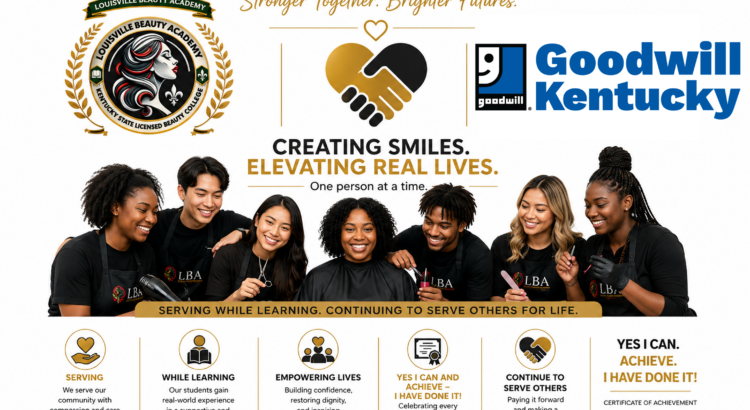
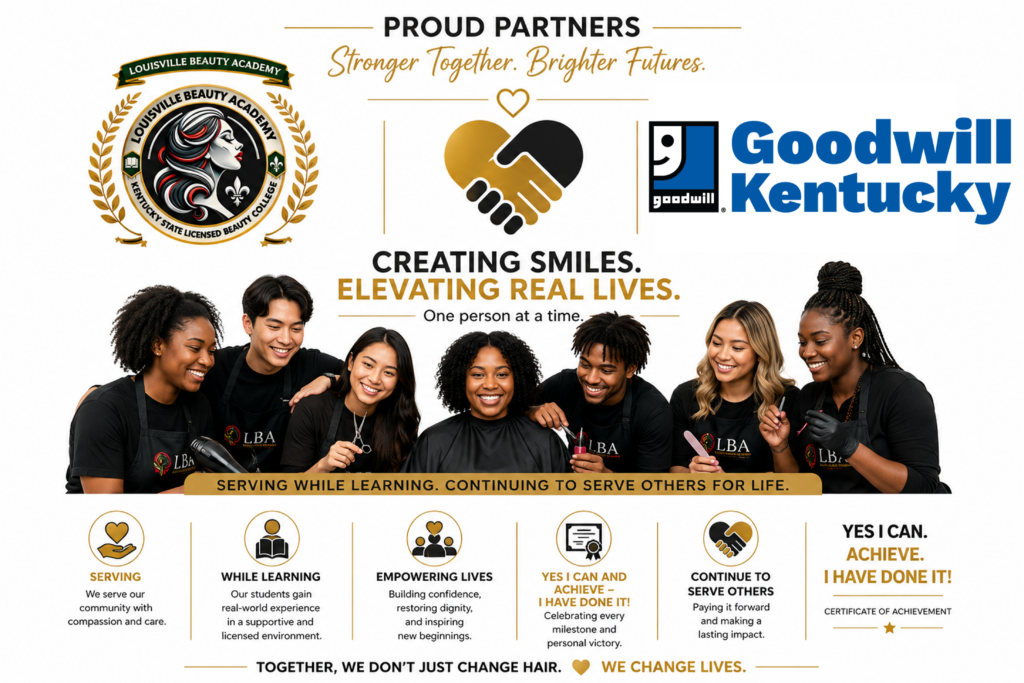
Creating Smiles. Elevating Real Lives. One Person at a Time.

Louisville Beauty Academy (LBA) is proud to announce a collaborative partnership with Goodwill Kentucky that reflects a shared commitment to workforce development, human dignity, community service, practical education, and long-term economic empowerment throughout Louisville and the Commonwealth of Kentucky.

More than a partnership between two organizations, this collaboration represents a larger vision for how education, workforce preparation, nonprofit service, and community-based support systems can work together to create measurable and lasting public value.

Through this partnership, Louisville Beauty Academy will provide limited courtesy beauty services within its Kentucky state-licensed educational clinic environment to individuals connected to Goodwill Kentucky programs and outreach efforts. Services may include natural hair services, shampoo and blowout styles, manicures, pedicures, and supervised wellness-focused beauty services provided by students under instructor supervision.

At first glance, this may appear to be a beauty-school partnership.

In reality, it reflects something much larger:
a workforce-centered, dignity-driven, community-supported educational model designed to help people move forward in life.

A Shared Mission Rooted in Human Dignity

Goodwill Kentucky has long served the Louisville community by helping individuals overcome barriers to employment, workforce participation, and economic advancement through education, support services, and opportunity creation.

Louisville Beauty Academy shares many of the same core principles.

As a Kentucky state-licensed beauty school, LBA was founded on the belief that education should be:

  • affordable,
  • practical,
  • workforce-focused,
  • community-connected,
  • and directly tied to real opportunity and human advancement.

Both organizations understand something fundamental:

People succeed when communities invest in both skill and dignity.

This partnership recognizes that confidence, professionalism, self-image, communication skills, and human connection are not secondary to workforce development — they are central to it.

Sometimes a haircut is not just a haircut.
Sometimes it is:

  • renewed confidence before a job interview,
  • restored self-worth,
  • human care during difficult times,
  • or the beginning of believing in oneself again.

That matters.

Why This Partnership Matters Beyond Beauty

In many ways, this partnership reflects the future of practical workforce education and community development in America.

Louisville Beauty Academy believes education should not exist in isolation from the communities it serves.

Students should not only learn theory.
They should learn:

  • service,
  • professionalism,
  • communication,
  • accountability,
  • compassion,
  • sanitation,
  • safety,
  • and real-world human interaction.

That is why LBA operates through a supervised educational clinic model where students gain direct practical experience while serving real people within the community.

This model creates a powerful educational cycle:
students learn while serving,
and communities benefit while students grow.

LBA calls this philosophy:

“Serving While Learning. Continuing to Serve Others for Life.”

This partnership with Goodwill Kentucky embodies that principle in action.

Workforce Development Through Human-Centered Education

The beauty industry remains one of the largest human-service industries in the United States and serves as a major entry point into entrepreneurship, workforce participation, and economic mobility — particularly for women, immigrants, working adults, and underserved communities.

Yet beauty education is often underestimated as merely cosmetic or transactional.

Louisville Beauty Academy rejects that outdated view.

Beauty professionals:

  • build small businesses,
  • create jobs,
  • strengthen local economies,
  • provide human-centered services,
  • support emotional wellness,
  • and often become long-term community anchors.

At LBA, students are not simply trained to pass licensing examinations.

They are trained to become:

  • professionals,
  • entrepreneurs,
  • leaders,
  • mentors,
  • employers,
  • and lifelong contributors to society.

This partnership reflects the understanding that workforce development is most effective when education is connected directly to real human service and practical community engagement.

A Model of Community Collaboration

One of the most important aspects of this partnership is that it demonstrates what becomes possible when educational institutions, nonprofit organizations, instructors, students, and community leaders work together instead of separately.

Real public impact is rarely created by one organization alone.

It is created through collaboration.

This partnership represents the combined effort of:

  • educators,
  • nonprofit professionals,
  • workforce advocates,
  • students,
  • instructors,
  • community partners,
  • and individuals committed to improving lives through practical action.

Together, Louisville Beauty Academy and Goodwill Kentucky are helping demonstrate how local institutions can create measurable social value while strengthening workforce pipelines, community trust, and economic opportunity.

Building Confidence, Opportunity, and Long-Term Impact

At Louisville Beauty Academy, students are taught more than technical skill.

They are taught mindset.

The school’s philosophy centers on growth, resilience, accountability, and contribution through service.

Students are encouraged daily to believe:
YES I CAN.
ACHIEVE.
I HAVE DONE IT.

That mindset becomes transformational not only inside the classroom, but throughout life.

By participating in real community-centered service experiences, students develop:

  • confidence,
  • communication skills,
  • leadership,
  • professionalism,
  • empathy,
  • and lifelong habits of contribution.

This partnership therefore benefits not only the individuals receiving services, but also the future professionals learning how to serve communities with dignity and care.

A Louisville Partnership with Broader Meaning

This collaboration reflects something important about Louisville itself.

Louisville has long been strengthened by organizations, educators, nonprofits, small businesses, workforce advocates, and local leaders willing to work together to solve real problems at the community level.

This partnership is one example of what can happen when institutions prioritize:

  • practical impact,
  • human dignity,
  • affordability,
  • workforce access,
  • and service-centered leadership.

It demonstrates that education can remain deeply connected to the communities it serves while still producing measurable workforce and economic outcomes.

More Than Beauty. More Than Education.

This partnership is ultimately about people.

It is about:

  • restoring confidence,
  • creating opportunity,
  • building professionalism,
  • strengthening communities,
  • and elevating lives one person at a time.

Together, Louisville Beauty Academy and Goodwill Kentucky are helping demonstrate that education, workforce development, nonprofit service, and human compassion do not need to operate separately.

When connected intentionally, they create stronger people, stronger communities, and stronger futures.

Because together, we do not just change hair.

We Change Lives.


Louisville Beauty Academy
Kentucky State-Licensed Beauty School
Louisville, Kentucky

Educate. Elevate. Empower.

https://LouisvilleBeautyAcademy.net


Disclaimer:
This partnership announcement is shared for informational and community-outreach purposes only. Services referenced are provided within Louisville Beauty Academy’s supervised educational clinic environment and remain subject to student participation, instructor supervision, operational availability, and applicable state regulations.
Voluntary Alignment With Federal Accountability in Beauty Education: A Debt-Free, License-First Model for Workforce-Driven Beauty Schools – 2026 Research

A Debt-Free, License-First Model for the Next Era of Workforce Training

Abstract

Recent federal accountability reforms signal a structural shift in how postsecondary education programs are evaluated, emphasizing tuition transparency, completion timelines, and post-completion earnings rather than enrollment volume or institutional prestige. While much attention has focused on compliance challenges for federally funded institutions, less examined are non-Title IV, state-licensed workforce schools that have operated in alignment with these principles for years—voluntarily and without reliance on federal student debt.

This paper analyzes the evolving federal accountability landscape and presents a debt-free, license-first beauty education model as a case study of proactive alignment. Using Louisville Beauty Academy (LBA) as an example, the research demonstrates how transparent pricing, short program duration, licensing-focused instruction, and the absence of federal loans collectively create an education framework that meets or exceeds emerging federal expectations while reducing financial risk to students and institutions alike. The findings suggest that voluntary alignment may represent a more sustainable and ethical path forward for workforce education in regulated professions.


1. Introduction: Why Federal Accountability Is Changing

Across the United States, policymakers, regulators, and the public are re-examining the relationship between postsecondary education and economic outcomes. Rising student debt, extended program timelines, and misalignment between credentials and labor market returns have driven increased scrutiny of educational value.

In response, the U.S. Department of Education has introduced new accountability frameworks that prioritize:

  • Tuition transparency
  • Program length clarity
  • Completion outcomes
  • Post-completion earnings
  • Clear student disclosures

These reforms reflect a broader policy consensus: education must be evaluated not only by access, but by measurable value delivered to students and communities.


2. Federal Accountability Today: Core Principles Explained Simply

Although regulatory language can be complex, current federal accountability initiatives share several clear themes:

2.1 Transparency Over Complexity

Institutions are expected to clearly disclose:

  • Total tuition and fees
  • Time required to complete a program
  • Expected outcomes after completion

This allows students to make informed decisions before enrolling.

2.2 Outcomes Over Enrollment

Success is increasingly measured by:

  • Program completion
  • Workforce entry
  • Earnings relative to training cost

Enrollment alone is no longer a sufficient indicator of institutional quality.

2.3 Risk Awareness

Programs associated with high debt and low earnings are now subject to warnings, penalties, or loss of federal loan access.

In simple terms: education must justify its cost in real economic terms.


3. Two Structural Models Emerging in Beauty Education

As accountability standards tighten, two distinct operational models have become increasingly visible within beauty and vocational education.

3.1 Debt-Dependent Education Model

Characteristics often include:

  • Reliance on federal student loans
  • Longer program durations
  • Higher tuition driven by administrative and compliance overhead
  • Outcomes measured years after completion

While legally permissible, this model carries elevated regulatory, financial, and reputational risk as accountability standards evolve.

3.2 Debt-Free, License-First Education Model

Key characteristics include:

  • No federal student loans
  • State-licensed operation
  • Short, clearly defined program timelines
  • Direct alignment with licensure requirements
  • Transparent tuition published upfront

This model reduces both student debt exposure and institutional vulnerability to federal sanctions.


4. Case Study: Voluntary Federal Alignment in Practice

4.1 Institutional Overview

Louisville Beauty Academy operates as a Kentucky state-licensed beauty college, offering programs in cosmetology, esthetics, nail technology, shampoo & styling, and instructor training.

4.2 Structural Alignment Features

Without participating in Title IV federal aid programs, LBA has implemented practices that closely mirror—and in many cases exceed—current federal accountability expectations:

  • Transparent tuition disclosure published publicly
  • Short, predictable completion timelines
  • Licensing-first curriculum design
  • No federal student loan dependency
  • Direct workforce entry upon licensure

These elements were adopted not in response to regulation, but as foundational design choices.

4.3 Practical Implications for Students

For students, this structure means:

  • Lower financial risk
  • Faster entry into paid employment
  • No long-term federal debt obligations
  • Clear understanding of cost and outcome before enrollment

5. Why Voluntary Alignment Matters

Voluntary alignment offers several systemic advantages:

5.1 Institutional Stability

Schools not reliant on federal loan eligibility are insulated from policy shifts, audits, and eligibility suspensions.

5.2 Student Protection

Debt-free education reduces long-term financial harm, particularly in licensed trades where earnings grow through experience rather than credentials.

5.3 Public Trust

Transparency builds confidence among regulators, employers, and communities.

5.4 Replicability

This model can be adopted by other beauty colleges without legislative change or federal approval.


6. A Replicable Framework for Beauty Colleges

Based on this analysis, beauty colleges seeking future-proof alignment may consider the following framework:

  1. Publish total tuition and fees clearly
  2. Define program length in real calendar time
  3. Design curriculum around licensing outcomes first
  4. Separate education from debt financing
  5. Track completion and licensure success internally
  6. Communicate outcomes honestly and consistently

These steps align institutions with both current and anticipated accountability expectations.


7. Implications for the Future of Beauty Education

Federal accountability reforms signal a long-term shift rather than a temporary policy cycle. Institutions that adopt transparency, efficiency, and debt restraint early are better positioned to thrive.

The experience of Louisville Beauty Academy demonstrates that compliance and compassion are not opposites, and that workforce education can be both affordable and rigorous when designed intentionally.


8. Conclusion

As federal accountability standards continue to evolve, beauty colleges face a choice: react to regulation after the fact, or align proactively through structural design. This research suggests that voluntary alignment—especially through debt-free, license-first education—offers a sustainable path forward.

Rather than viewing accountability as a constraint, institutions can treat it as an opportunity to re-center education around its core purpose: preparing individuals for lawful, meaningful, and economically viable work.


About This Paper

This paper is provided for educational and informational purposes to support dialogue among beauty colleges, workforce educators, regulators, and community partners. It does not constitute legal or financial advice.