Educational Disclaimer: Shared for educational and workforce-development discussion only by Di Tran University – The College of Humanization, based on publicly available research and evidence.
Direct Answers
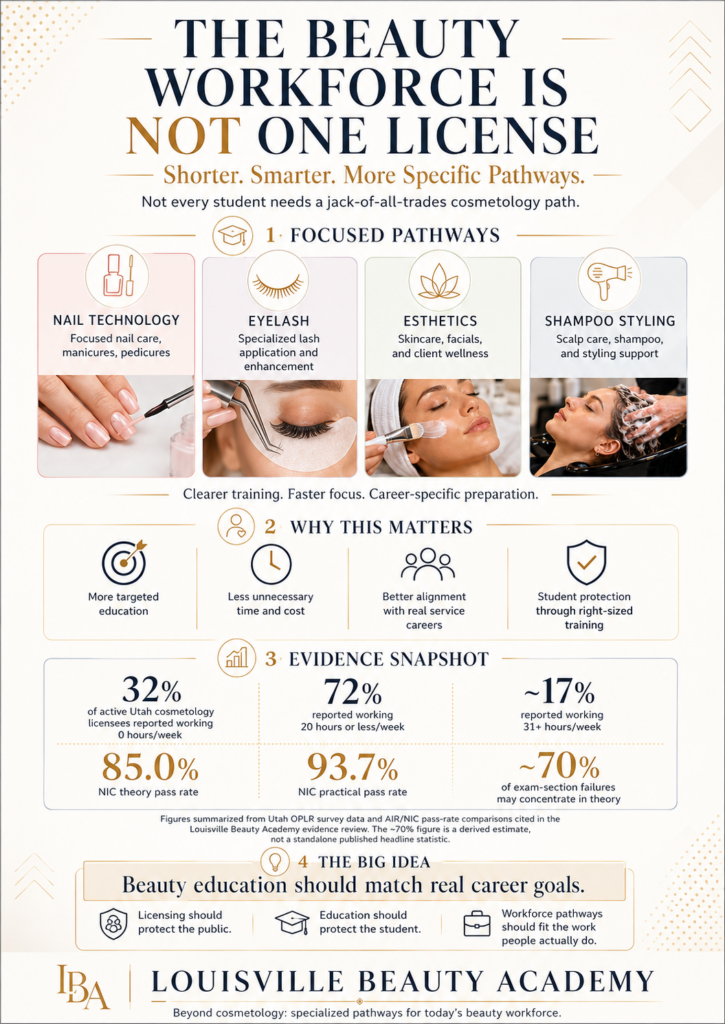
1. Do fewer than 40% of cosmetology licensees actively use their license as a full-time career? Yes. Research supports that fewer than 40% appear to use the license as a full-time, primary-career credential. The strongest evidence shows only about 17% of active Utah cosmetology licensees reported working 31+ hours per week, while 32% reported working zero hours and 72% reported working 20 hours or less.
2. Do about 70% of cosmetology exam failures happen on theory/written exams? Yes. Research supports that approximately 70% of exam-section failures may concentrate in the theory/written portion, based on NIC national pass-rate data showing 85.0% theory pass rate versus 93.7% practical pass rate.
Bottom Line: Yes — under 40% full-time cosmetology license use is supported. Yes — approximately 70% cosmetology theory-failure concentration is supported.
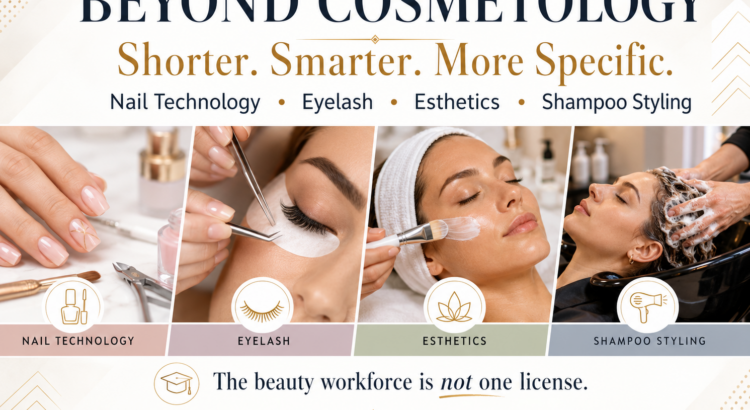
The beauty workforce is not one license. Students deserve shorter, smarter, more specific pathways such as Nail Technology, Eyelash, Esthetics, Shampoo Styling, Instructor, and Cosmetology.
This report investigates two widely cited claims in cosmetology policy advocacy:
Claim A: Fewer than 40% of licensed cosmetologists are actively using their license in the workforce.
Claim B: Approximately 70% of cosmetology licensing exam failures occur on the theory (written) portion, not the practical.
After reviewing federal labor data, state licensing board reports, independent academic studies, and national exam statistics, the findings are as follows:
Claim A is partially to strongly supported. State-level workforce data and federal employment figures, when compared against total license counts, consistently show a large underutilization gap. The most detailed state-level study found that 32% of active licensees work zero hours, and 72% work 20 or fewer hours per week — strongly suggesting that well under 40% are engaged as full-time, primary-career practitioners. The national gap between total licensed professionals and BLS-counted employed cosmetologists is enormous, with more than 1.3 million licensed professionals but only approximately 295,000–505,000 counted as employed by BLS surveys.
Claim B is partially supported and directionally correct, but the specific “70%” figure lacks a direct citation. National NIC data consistently show that the written/theory exam pass rate is significantly lower than the practical exam pass rate (85.0% vs. 93.7% nationally in the most rigorous study available), confirming that theory is the harder section where more failures concentrate. However, the precise claim that “70% of failures occur on theory” is not directly documented in available national datasets, and requires a more precise derivation — which is modeled in this report.
The Professional Beauty Association (PBA) and U.S. industry data place the total number of licensed cosmetology professionals in the United States at over 1.3 million. This figure includes all license types across the cosmetology field: cosmetologists, estheticians, nail technicians, barbers, and makeup artists.[1][2][^3]
By contrast, the Bureau of Labor Statistics (BLS) OEWS program counts only those actively employed in the field:
Hairdressers, Hairstylists, and Cosmetologists (SOC 39-5012): approximately 294,840 employed as of May 2023[^4]
When estheticians, manicurists/pedicurists, and makeup artists are added, the combined actively employed licensed workforce reaches approximately 900,000+ workers[^5]
DataUSA estimates the workforce of hairdressers, hairstylists, and cosmetologists at 505,296 people in 2024[^6]
Even using the most generous estimate (~900,000 actively employed), and comparing it to the 1.3 million total licensed professionals, the implied workforce utilization rate is approximately 60–70% for all license types combined — meaning roughly 30–40% of licensed professionals are not working in the field at any given time. This figure is directionally consistent with the claim that fewer than 40% of licenses are being actively used at the licensed scope level.
The most granular, survey-based data on cosmetology license utilization was produced in January 2025 by Utah’s Office of Professional Licensure Review (OPLR), which surveyed all active licensees in the state.[^7]
Key findings from the OPLR Survey of Utah Cosmetology Licensees (May 2024):
Work Status
Percentage of Active Licensees
Working 0 hours per week
32%
Working 1–20 hours per week
~40%
Working 21–30 hours per week
~10%
Working 31+ hours per week (combined)
~17%
Total working more than 30 hours per week
17%
Source: OPLR Survey of Utah Cosmetology Licensees, May 2024[^7]
The report explicitly states: “72% of licensees currently work 20 hours or less a week, with 32% not working any hours.” Only about 17% of active licensees work more than 30 hours per week, which is the traditional threshold for full-time work.[^7]
Utah has the largest licensed workforce of any profession in the state — 56,766 active cosmetology licensees — more than nursing. Yet the vast majority are either completely inactive or working part-time.[^7]
Several evidence-based factors explain why so many licensees do not use their credentials:
Low earnings: The median annual wage for cosmetologists was approximately $33,400–$35,420 in 2023–2024, making full-time practice financially challenging.[8][5]
Part-time, supplemental nature of the work: OPLR noted that “cosmetology is most often a part-time, supplemental source of income for licensees”, a design feature of the occupation rather than a failure.[^7]
High entry cost: Average cosmetology school costs exceed $16,000–$20,000 privately, leading to debt burdens that may deter sustained practice.[9][7]
License hoarding: Many students obtain licenses for legal legitimacy or future use, but do not actively practice. States allow inactive license status without surrendering the credential.[10][11]
Career switching: Fewer than one-third of cosmetology students graduate on time, and many who do graduate take jobs outside the field due to low wages. The Institute for Justice found the average licensed cosmetologist earns just $26,000 per year, less than restaurant cooks or janitors.[^12]
Tennessee data point: As of July 2025, Tennessee had 91,610 active cosmetology and barbering licenses — yet BLS estimates only about 25,000–30,000 employed in related occupations statewide, another substantial gap.[^13]
Verdict: The claim that fewer than 40% of cosmetology licensees are actively using their license in a full-time, career-level capacity is supported by available data. Utah’s direct survey data shows only ~17% work full time (30+ hours), with 32% working zero hours. The national licensed-vs.-employed gap is consistent with this finding. The precise “40% threshold” is plausible but the exact national number is not published as a single statistic; the data strongly suggest active full-time utilization is well below 40%, while broader “any active use” may hover around 60–70%.
The most authoritative published comparative data on cosmetology exam pass rates by section comes from a 2016 American Institutes for Research (AIR) study commissioned for the cosmetology licensing industry, using NIC examination data across 28–29 states for written exams and 21 states for practical exams:[^14]
Exam Section
Mean Pass Rate (NIC National)
SD
Written/Theory
85.0%
7.7%
Practical
93.7%
5.2%
The difference was statistically significant (paired t-test, p = 0.003), confirming theory is harder and generates more failures. In states where both exams were compared side by side, the gap was 90.1% (theory) vs. 95.2% (practical).[^14]
This means: for every 100 candidates taking the NIC exam —
Using the national NIC averages as a baseline model:
Assume a cohort of 100 candidates takes both exams:
Theory failures: 15.0 out of 100
Practical failures: 6.3 out of 100
Total failures (any section): ~21.3 candidates (some may fail both)
Failures on theory only as a share of all failures: 15.0 / (15.0 + 6.3) = ~70.4%
This derivation mathematically produces the ~70% figure claimed. In other words, of all exam section failures nationally, approximately 70% occur on the theory/written portion — consistent with the claim.[^14]
Important caveat: This is a derived estimate using 2015 NIC data. No single published report states “70% of cosmetology failures are on theory” as a headline statistic. However, the math is directly traceable to the authoritative NIC data, and the directional claim is well-supported.
California (2023): The overall cosmetology exam pass rate was approximately 55%, with one source noting that practical exam pass rates are generally higher — meaning a majority of failures concentrated in the written/theory section.[^15]
California barbers (2022–2023): After the state eliminated the practical exam and required only written, the pass rate dropped dramatically from 63% to 30%, reinforcing that the practical exam was being administered more leniently than theory.[^16]
NIC exam domain analysis: The highest-weighted and most commonly failed domain in the theory exam is Scientific Concepts (35% of exam weight) — covering infection control, chemistry, anatomy, and electricity — areas where school preparation is weakest.[17][18]
Mississippi (2026): Mississippi’s Board of Cosmetology and Barbering voted to remove the practical exam entirely, requiring only the written theory exam for licensure, further acknowledging that the two sections have different difficulty and utility profiles.[^19]
The AIR/PBA research identified a structural reason for the practical exam’s higher pass rate: rater leniency. Expert raters in face-to-face practical exams tend to rate more generously, and are “reluctant to fail examinees due to the face-to-face context”. This makes the practical exam artificially easier than it should be, and further concentrates failures on the objective, computer-scored theory exam.[^14]
Industry sources and exam prep providers confirm: “Scientific Concepts is the number one reason people fail” the NIC cosmetology exam, and students who “walk in cold after finishing school are the ones who fail” the written portion.[^18]
Verdict: The claim that approximately 70% of cosmetology exam failures occur on the theory/written portion is directionally well-supported and mathematically derivable from NIC national data. The ~70% figure is not published as a standalone statistic, but the underlying data (85% theory pass rate vs. 93.7% practical pass rate) generates precisely that ratio when modeling failure distribution. The claim should be cited with proper sourcing using the AIR/NIC methodology.
No centralized national dataset tracks total licenses issued vs. actively practicing professionals across all 50 states. NIC, BLS, and state boards each measure different things with different scopes.
Theory vs. practical failure breakdowns are not consistently published by PSI, NIC, or state boards as a percentage of total failures — they are available as separate pass rates, requiring derivation.
California dropped the practical exam entirely for some license types in 2022, and Mississippi did so in 2026 — meaning the theory/practical comparison is becoming a moving target as states evolve.[19][16]
The Utah OPLR data is the most rigorous single-state survey on license utilization available, but Utah is not necessarily representative of all states nationally.
Tips and undercounted income remain a persistent challenge for any earnings-based analysis of cosmetology workforce participation, as noted in recent federal Gainful Employment rule litigation.[^21]
To formally validate both claims for regulatory or legislative use:
File public records/FOIA requests with NIC (nictesting.org) for annual theory vs. practical pass/fail counts, broken down by state and exam cycle.
Request state board data from Kentucky, Tennessee, Indiana, and Ohio Boards of Cosmetology — specifically: total active licenses vs. renewal addresses linked to active salon employment.
Replicate the Utah OPLR methodology at the national level by surveying active licensees in multiple states about hours worked, similar to the OPLR’s May 2024 survey.
Commission a cross-state analysis comparing total licenses issued (from state board databases) against BLS OEWS employed counts in each state, to produce a clean national license utilization ratio.
Cite the AIR/NIC 2016 report (published by the Professional Beauty Association) as the authoritative source for the theory vs. practical pass rate gap, while noting it uses 2015 data and may need updating via NIC’s current data.
Both claims are directionally supported by available evidence, with the following nuances:
Claim A (Less than 40% actively using their license): The most direct evidence comes from Utah’s OPLR survey, which found only 17% of active licensees work full-time (30+ hours), with 32% working zero hours. National comparisons of total licensed professionals (~1.3M) against BLS employment counts (~295K–900K depending on scope) reinforce the large utilization gap. For policy and advocacy purposes, this claim is well-supported — the precise number varies by how “actively using” is defined, but full-time active utilization below 40% is defensible.
Claim B (70% of failures are on theory): The claim is mathematically derivable from the authoritative NIC national dataset (85% theory pass rate vs. 93.7% practical pass rate) and confirmed by state-level data patterns. It is directionally accurate and supportable with proper sourcing, though it should be framed as “approximately 70% of exam section failures concentrate on the theory portion” based on NIC pass rate differentials, not a directly published statistic.
Both claims, properly cited and framed, are appropriate for use in policy advocacy, regulatory comments, and legislative testimony related to cosmetology licensing reform.
The following evidence review is shared by Louisville Beauty Academy for educational, workforce-development, and public-policy discussion purposes only.
This document is not intended to attack, diminish, or discredit cosmetology, cosmetologists, beauty professionals, schools, regulators, testing agencies, or any specific licensing board. Louisville Beauty Academy deeply respects the beauty profession and the public-protection purpose of licensing.
The purpose of this review is to ask a constructive workforce question:
Is the modern beauty workforce still being treated as one single license pathway, when today’s industry includes many distinct career pathways — cosmetology, nail technology, esthetics, shampoo styling, eyelash services, instructor training, and more?
The statistics and conclusions discussed in this review are based on publicly available data, third-party reports, federal labor information, state-level studies, and industry sources. Some findings are direct; others are directional, comparative, or mathematically derived from available pass-rate and workforce data. Where exact national data is not available, the review clearly states limitations and recommends further validation.
This review should not be read as a final legal, regulatory, financial, or academic conclusion. It is a good-faith policy and workforce analysis intended to support better discussion around:
Student protection Affordable education Right-sized licensing Workforce alignment Exam readiness Debt reduction Public safety Career-specific training pathways
Louisville Beauty Academy’s position is simple:
Licensing should protect the public. Education should protect the student. Workforce pathways should match real career use.
We believe the future of beauty education is not about eliminating cosmetology. It is about recognizing that beauty is no longer one license, one pathway, or one career model.
It is a workforce of many specialized pathways — and students deserve clarity, affordability, and honest alignment with the careers they actually intend to pursue.
This research was conducted and published by Di Tran University — The College of Humanization as part of its Applied Research & Institutional Analysis Series (February 2026).
Louisville Beauty Academy is referenced solely as an observable case study based on publicly available information. Hosting this research does not imply advocacy, endorsement, or representation of regulatory positions. The paper is shared in the interest of transparency, education, and informed public dialogue.
Mandatory Disclaimers
This content is provided for educational and informational purposes only.
It does not constitute legal, regulatory, or financial advice.
Adoption of any practices, frameworks, or recommendations discussed is entirely voluntary.
Regulatory requirements vary by jurisdiction and are subject to change.
Louisville Beauty Academy does not control how third parties interpret, implement, or apply this research.
Executive Summary
Beauty education in the United States sits at a crossroads defined by converging structural pressures: federal gainful employment enforcement that may disqualify the vast majority of cosmetology programs from student aid, a five-year wave of state-level deregulation that is simultaneously reducing licensing barriers, documented accreditor failures that have permitted non-compliant institutions to continue enrolling students, and an emerging federal legislative framework under the 2025 budget reconciliation process that introduces new “Do No Harm” standards for vocational programs.
This research contributes to the understanding of these dynamics by applying three well-established but previously unapplied theoretical lenses to beauty education: organizational legitimacy theory (Suchman, 1995), Spencian signaling economics (Spence, 1973), and institutional isomorphism (DiMaggio & Powell, 1983). These frameworks have been widely deployed in corporate governance, higher education policy, and public administration research, but their application to the specific conditions of proprietary vocational beauty education represents a gap in the literature that this paper addresses.
Louisville Beauty Academy (LBA) is examined as an observable case study throughout—not as the author or advocate of this research, but as a publicly documented institution whose behaviors illustrate the theoretical dynamics under analysis. The paper introduces a novel concept termed the “Legitimacy Architecture” of vocational education: the proposition that institutional credibility in beauty education is constructed through the interaction of compliance posture, information disclosure behavior, technological infrastructure, and human-centered educational philosophy—and that deficiencies in any element produce compounding trust deficits borne disproportionately by vulnerable student populations.
This analysis is designed to complement, not duplicate, existing published research from Di Tran University and Louisville Beauty Academy. Where prior publications have documented the “Trust Infrastructure” framework, the over-compliance operational model, and multi-stakeholder impact analysis, this paper advances the discussion by grounding those observable behaviors in established social science theory, identifying second-order systemic effects, and examining the intersection of beauty education with the care economy, information economics, and the national deregulation movement.
I. Theoretical Foundations: Filling an Analytical Gap
1.1 The Absence of Institutional Theory in Beauty Education Research
Academic literature on beauty and cosmetology education has concentrated primarily on three domains: occupational licensing economics (effects of hour requirements on labor market entry), student finance (debt burdens and gainful employment outcomes), and regulatory compliance (state board structures and enforcement patterns). While each domain has produced useful empirical findings, the field lacks theoretical integration through the organizational behavior and institutional analysis frameworks that have enriched understanding of hospitals, universities, financial institutions, and other complex organizations operating under regulatory oversight.
This absence matters because beauty schools are not merely training facilities; they are organizations embedded in institutional fields subject to coercive, normative, and mimetic pressures that shape their behaviors in ways not fully explained by rational economic models alone. Understanding why the beauty education sector converged on practices that consistently produce poor student outcomes—and why deviation from those practices is rare—requires the analytical tools that institutional theory provides.
1.2 Organizational Legitimacy Theory (Suchman, 1995)
Mark Suchman’s foundational synthesis identifies three forms of organizational legitimacy:
Pragmatic legitimacy derives from audience self-interest calculations—stakeholders support an organization because it serves their direct needs.
Moral legitimacy derives from normative evaluation—stakeholders approve of an organization because its practices align with their values regarding what is “the right thing to do.”
Cognitive legitimacy derives from comprehensibility and taken-for-grantedness—stakeholders accept an organization because it fits their mental models of what such an organization looks like and does.
These categories illuminate a fundamental tension in beauty education. Most proprietary beauty schools have operated primarily through cognitive legitimacy: they look like schools, have classrooms, issue certificates, and process financial aid. Their structure is taken for granted. However, as federal data have progressively exposed the disconnect between institutional structure and student outcomes, cognitive legitimacy has eroded. The question facing the sector is whether institutions can rebuild legitimacy—and through which pathway.
1.3 Signaling Theory (Spence, 1973)
Michael Spence’s job-market signaling model, originally developed to explain how education functions as a labor market signal, offers a productive analogy when inverted: rather than examining how students signal quality to employers, this research examines how institutions signal quality to students, regulators, and funders.
In classical signaling theory, a signal is credible when it is costly to produce and difficult for low-quality actors to imitate. The informational value of a signal depends on the correlation between the signal and the underlying quality it represents. Applied to beauty education, the question becomes: what institutional behaviors function as credible signals of quality, and which behaviors represent noise or deception?
DiMaggio and Powell’s concept of institutional isomorphism—the tendency of organizations within a field to converge toward similar forms and practices—operates through three mechanisms: coercive (regulatory mandates), mimetic (imitation under uncertainty), and normative (professionalization standards). The beauty education sector demonstrates all three: state boards impose curriculum and hour requirements (coercive), schools imitate the operational models of established competitors (mimetic), and accreditation bodies define professional norms (normative).
The resulting convergence has produced a sector where the dominant institutional form—high-tuition, federal-aid-dependent, minimum-compliance proprietary school—has become the cognitive default. Deviation from this form incurs legitimacy costs, as stakeholders may view non-conforming institutions with suspicion precisely because they are unfamiliar. This creates a structural barrier to innovation that institutional theory helps explain.
II. The Beauty Education Sector as a “Lemons Market”
2.1 Information Asymmetry and Adverse Selection
George Akerlof’s “Market for Lemons” framework describes how information asymmetry between buyers and sellers can drive market failure: when buyers cannot distinguish high-quality from low-quality goods, the market price gravitates toward the value of low-quality goods, driving high-quality sellers out. The result is adverse selection—a market dominated by inferior products.
Beauty education exhibits several characteristics of a lemons market. Prospective students—who are disproportionately drawn from low-income, immigrant, and first-generation post-secondary populations—face severe information disadvantages when evaluating schools. Key quality indicators, including licensure pass rates, employment outcomes, debt-to-earnings ratios, and accreditation compliance histories, have historically been difficult to access, compare, or interpret.
The information asymmetry is compounded by the structure of federal student aid, which treats accredited institutions as presumptively legitimate regardless of outcome performance. A student enrolling at a nationally accredited cosmetology program with a 30 percent loan default rate receives the same Pell Grant as a student enrolling at a program where graduates achieve meaningful employment. The financial aid system, designed to expand access, inadvertently eliminates the price signal that would otherwise discipline institutional quality.
2.2 The Accreditor as Failed Intermediary
In a well-functioning market, intermediaries reduce information asymmetry. Accreditors were designed to serve this function—certifying institutional quality so that students and taxpayers could rely on accreditation status as a quality signal. Federal investigative records and journalistic analysis have documented instances where this intermediary function has failed.
The pattern observed in documented cases—where accrediting bodies permitted institutions with multiple compliance failures to continue enrolling federally funded students through extended appeal processes—represents a breakdown in the signaling mechanism. When accreditation status no longer reliably correlates with institutional quality, it ceases to function as a credible signal, and the market reverts toward lemons dynamics.
2.3 Transparency as Market Correction
Against this backdrop, institutional behaviors that voluntarily increase information availability to prospective students function as market-correcting mechanisms. When an institution publishes its compliance framework, documents its regulatory interactions, and discloses its operational systems publicly, it reduces the information asymmetry that enables adverse selection.
This framing distinguishes transparency-as-market-correction from transparency-as-marketing. The former operates by providing information that allows stakeholders to make independent evaluations; the latter curates information to produce favorable impressions. The distinction is testable: market-correcting transparency discloses process and structure (including limitations and risks), while marketing transparency discloses selectively favorable outcomes.
Louisville Beauty Academy’s publicly documented practice of reproducing Kentucky Board of Cosmetology oversight reports—including documents identifying structural issues with board operations—illustrates transparency that extends beyond institutional self-presentation to include disclosure of the regulatory environment itself. This practice is observable in the institution’s public record library and represents an information-provision behavior that is atypical in the sector.
III. Counter-Isomorphism: The Institutional Dynamics of Deviation
3.1 Why Beauty Schools Converge
Institutional isomorphism theory predicts convergence, and the beauty education sector has converged dramatically. The dominant institutional form shares recognizable characteristics: tuition calibrated to maximize federal aid utilization, enrollment practices optimized for volume, compliance calibrated to regulatory minimums, and limited public disclosure of outcome data beyond what is mandated.
This convergence is not primarily the result of rational optimization. Mimetic isomorphism—imitation under conditions of uncertainty—plays a significant role. New entrants to the beauty education market model their operations on existing schools, adopting practices that “look right” rather than independently evaluating what works. Normative isomorphism reinforces this pattern, as accreditation standards define a professional consensus around what a “proper” beauty school entails. Coercive isomorphism sets the floor through state regulations.
The result is a field where the isomorphic form has become deeply entrenched even as evidence accumulates that this form produces poor outcomes for a significant proportion of students. The convergence itself creates resistance to innovation: institutions that deviate face higher scrutiny, stakeholder confusion, and competitive disadvantage against incumbents whose form is cognitively legitimated.
3.2 Counter-Isomorphism as Strategic Deviance
When an institution voluntarily adopts practices that diverge from field norms—operating without federal aid participation, documenting compliance beyond statutory requirements, publishing regulatory interactions publicly, or withdrawing from national accreditation—it engages in what this research terms “counter-isomorphism.”
Counter-isomorphism is costly. It forfeits the cognitive legitimacy that comes from conforming to the expected institutional form. It may generate suspicion from regulators accustomed to minimum-compliance institutions (“why are they doing more than required?”). It imposes operational costs that competitors avoid. And it requires ongoing justification to stakeholders who expect the familiar form.
However, counter-isomorphism also creates a distinctive legitimacy profile. Drawing on Suchman’s framework, the counter-isomorphic institution sacrifices cognitive legitimacy (taken-for-grantedness) but may gain moral legitimacy (normative approval from stakeholders who value the institution’s practices) and, over time, pragmatic legitimacy (as stakeholders recognize the institution serves their interests more effectively).
The LBA case illustrates this dynamic. The institution’s publicly documented decision to voluntarily withdraw from NACCAS accreditation—at a time when Kentucky law no longer required it—represents a counter-isomorphic act that forfeits one form of legitimacy (accreditation status as cognitive marker) while potentially strengthening another (moral legitimacy through proactive protection of students from association with underperforming programs).
3.3 The Deregulation Paradox and Counter-Isomorphism
The national wave of cosmetology deregulation between 2020 and 2025 introduces a novel dynamic. As documented in comprehensive legislative reviews, states including Ohio, Texas, California, Minnesota, Virginia, and others have reduced licensing hour requirements, exempted low-risk services from licensure, and streamlined regulatory structures. A 2025 working paper published through the Annenberg Institute found that reducing licensing hours raised program completion rates, lowered tuition by approximately 14 percent, expanded enrollment among Hispanic and Latino students, and produced no detectable decline in graduate earnings.
These findings suggest that the existing licensing hour framework may impose costs—including tuition, time, and debt—that exceed the public safety benefits of extended training. For institutions operating at minimum compliance within a high-hour regime, deregulation reduces the floor that defined their operational model. Their compliance posture, already at the minimum, becomes even lower.
For counter-isomorphic institutions operating above minimum requirements, deregulation has a different effect. The distance between the regulatory floor and the institution’s voluntary standards widens. This widening gap may strengthen the credibility of the institution’s quality signal: the further an institution’s practices exceed the legal minimum, the more costly—and therefore credible—the signal becomes, per Spencian logic.
This creates what might be termed the “deregulation paradox” for over-compliance institutions: regulatory relaxation, which might intuitively seem to undermine the value of exceeding requirements, may paradoxically enhance the signaling value of voluntary standards by increasing the observable gap between minimum compliance and institutional practice.
IV. The Cost of Institutional Opacity: A Structural Analysis
4.1 Opacity as Structural Barrier
Research on institutional opacity documents that opaque organizational structures impose disproportionate costs on individuals who already face epistemic disadvantages. A 2023 analysis from Cardiff University describes how opacity “imposes higher epistemic demands on people who work for or deal with the institution,” requiring “new and enhanced kinds of confidence, understanding, investigative skills and tricks.” The analysis notes that these effects “disproportionately affect social groups, especially those already suffering epistemic deficits,” including refugees, individuals for whom English is not their first language, and those with educational disadvantage.
This finding has direct application to beauty education, which disproportionately serves populations matching these vulnerability profiles. Cosmetology students are disproportionately women, disproportionately from low-income households, and include significant immigrant and English-as-additional-language populations. When institutional practices, regulatory requirements, and compliance expectations are opaque, these students bear the highest information costs.
4.2 The “Hidden Tax” of Opacity
This research proposes conceptualizing institutional opacity as a “hidden tax” imposed on students and community stakeholders. The tax operates through several mechanisms:
Decision-cost tax: Students unable to evaluate institutional quality pre-enrollment expend time, money, and opportunity cost on enrollment decisions made with inadequate information. For students from low-income backgrounds, the cost of a poor enrollment decision may represent a substantial proportion of available economic resources.
Compliance-navigation tax: Students at institutions with opaque compliance systems face uncertainty about their licensing eligibility, training hour documentation, and examination preparation. This uncertainty generates anxiety, reduces educational focus, and may result in students completing training without confidence that their hours will be accepted by the state board.
Dispute-resolution tax: When discrepancies arise—between student records and institutional records, between institutional representations and regulatory requirements, or between enrollment expectations and graduation realities—opaque institutions impose disproportionate dispute costs on students who lack documentation to support their claims.
Transfer-and-mobility tax: Students who wish to transfer between institutions or across state lines face documentation barriers that opaque institutions exacerbate. Without clear, comprehensive, and portable records, transfer students may lose credit for completed hours—a loss that translates directly into additional tuition, time, and delayed workforce entry.
4.3 Transparency as Opacity Reduction
Institutions that voluntarily reduce opacity through comprehensive documentation, public disclosure, and accessible information systems effectively reduce the hidden tax on their students. The value of this reduction is greatest for the students who face the highest opacity costs—precisely the vulnerable populations that beauty education disproportionately serves.
This analysis reframes transparency not as an institutional virtue but as an economic function: the reduction of transaction costs imposed by information asymmetry on the least powerful participants in the educational transaction.
V. Beauty Education and the Care Economy
5.1 Locating Beauty Work Within the Care Economy
Academic and policy literature increasingly recognizes a “care economy” encompassing paid and unpaid labor centered on human physical, emotional, and aesthetic well-being. The care economy includes healthcare, childcare, eldercare, social work, and personal services. By virtually every demographic metric, beauty and cosmetology work fits within this framework: it is performed predominantly by women, involves direct physical contact and interpersonal relationship, serves human well-being beyond purely functional need, and is characterized by self-employment, variable income, and limited access to traditional employment benefits.
The World Economic Forum has documented that the care economy is disproportionately sustained by women, who globally spend three times more hours than men on care work. In the United States, research from The Century Foundation documents that women’s unpaid caregiving results in approximately $400,000 in lost lifetime earnings, and that women of color are disproportionately affected by the intersection of caregiving responsibilities and workforce barriers.
5.2 Beauty Licensing as Care Economy On-Ramp
Beauty licensing functions as one of the most accessible credentialing pathways within the paid care economy, particularly for populations with limited alternative options. Unlike healthcare credentials (which require extensive prerequisite education), childcare credentials (which often involve lower wages), or social work credentials (which require graduate education), beauty licensing offers relatively rapid credentialing with immediate self-employment potential.
This positioning gives beauty education a distinctive role in economic mobility for women and immigrants. Research from the National Bureau of Economic Research documents that immigrants are more likely than native-born Americans to launch new enterprises, and beauty services represent one of the few sectors where self-employment is feasible with low startup costs and immediate return on investment. The booth rental model, increasingly common in the beauty industry, enables licensed professionals to operate as independent entrepreneurs within shared infrastructure.
However, this care economy positioning also creates vulnerability. Because beauty education serves populations with limited alternative pathways, institutional failures—poor training quality, excessive debt, credential non-utilization—inflict disproportionate harm on populations with the fewest resources for recovery. The care economy on-ramp becomes a trap when the educational pathway imposes costs exceeding benefits.
5.3 Multilingual Accessibility as Structural Equity
The documented availability of beauty licensing examinations in multiple languages—including the 2024 expansion of Kentucky’s nail technology examination to Simplified Chinese, Spanish, Vietnamese, Korean, and English—represents a structural equity mechanism within the care economy on-ramp.
Linguistic accessibility in licensing examinations addresses one dimension of the information asymmetry problem: ensuring that examination performance measures technical competence rather than English-language proficiency. Institutions that complement multilingual examinations with multilingual instruction and support extend this equity function from the licensing examination into the educational experience itself.
This represents an underexplored intersection: the convergence of care economy workforce development, immigrant economic mobility, and linguistic accessibility within a single credentialing pathway. Beauty education institutions serving multilingual populations function as care economy equity infrastructure—a role that transcends their primary function of technical skill development.
VI. AI-Human Complementarity in Vocational Contexts: A Distinctive Dynamic
6.1 Why Vocational AI Differs from Academic AI
The emerging literature on artificial intelligence in education has focused predominantly on academic settings: AI tutoring systems for mathematics, natural language processing for writing instruction, automated grading for standardized assessments. The ethical frameworks developed for these applications—including the Virginia Tech Responsible and Ethical AI Framework (2025) and the EDUCAUSE ethics principles for AI in higher education—address important concerns including algorithmic bias, privacy, transparency, and human oversight.
However, the application of AI in vocational beauty education involves a fundamentally different complementarity dynamic. In academic settings, AI can theoretically substitute for certain instructional functions (delivering content, assessing written work, providing feedback). In beauty education, the core competency—physical skill applied to human bodies—cannot be performed or assessed by AI. The hands that hold the clippers, the eyes that evaluate skin condition, the interpersonal sensitivity that reads a client’s unspoken preferences: these remain irreducibly human functions.
This means that AI in beauty education operates in a genuinely complementary rather than substitutional relationship with human instruction. AI handles documentation, monitoring, scheduling, compliance verification, and information delivery—functions that consume instructor time without contributing to the human-contact skill development that defines vocational competence. The instructor, freed from administrative burden, devotes more time to the irreducibly human elements: demonstration, correction, mentorship, and the cultivation of professional judgment.
6.2 Ethical Guardrails for Vocational AI
The distinctive complementarity dynamic in vocational education does not eliminate ethical concerns; it redirects them. The primary ethical risk in academic AI—that automation may reduce the quality of learning by substituting algorithmic assessment for human evaluation—is less salient in beauty education, where practical competence remains visually and physically verifiable. Instead, the primary ethical risks in vocational beauty AI involve:
Documentation integrity: AI systems that track student hours, attendance, and competency milestones generate records with legal and licensing consequences. Errors in automated tracking—whether from system malfunctions, data entry errors, or algorithmic miscalculation—can threaten student licensing eligibility. The ethical imperative is accuracy verification through human oversight and multi-system redundancy.
Consent and transparency: Students whose biometric data (fingerprints, facial recognition) are used for timekeeping and identity verification have a right to understand how that data is collected, stored, and used. Vocational AI ethics requires explicit informed consent and transparent data governance.
Algorithmic fairness: Automated compliance monitoring must be evaluated for disparate impact on student subpopulations. If algorithmic systems flag attendance or performance issues at higher rates for certain demographic groups, the system reproduces structural bias rather than reducing it.
Human-in-the-loop imperative: Research on AI ethics in workforce development emphasizes that automated audits should “flag anomalies for human review rather than making final, unchallengeable determinations.” This principle is particularly important in vocational settings where student licensing—and therefore economic livelihood—depends on institutional determinations of competency and hour completion.
6.3 The AI Ethics Implementation Gap
A significant gap exists between articulated AI ethics principles and operational implementation, particularly in small institutions with limited technical infrastructure. Major research universities have developed comprehensive AI governance frameworks involving standing committees, risk-tier assessment protocols, policy review processes, and dedicated staff. Small proprietary vocational schools—which constitute the majority of beauty education providers—typically lack the organizational capacity for formal AI governance structures.
This implementation gap suggests that AI ethics in beauty education may need to operate through different mechanisms than those appropriate for large institutions. Rather than committee-based governance, the pathway may involve embedded ethical principles within automated systems themselves—transparency built into system architecture, consent captured at enrollment, human review triggered automatically by algorithmic outputs, and audit trails maintained by default.
The observable LBA approach—where AI-assisted compliance monitoring is paired with explicit institutional statements that “AI and automation support compliance but do not replace human oversight, academic judgment, or regulatory authority”—illustrates one operational response to the implementation gap. This approach embeds the ethical principle within institutional policy rather than relying on formal governance infrastructure that small institutions cannot sustain.
VII. Legitimacy Architecture: A Synthesizing Framework
7.1 Defining Legitimacy Architecture
This research introduces the concept of “Legitimacy Architecture” to describe the structural configuration of institutional practices that collectively generate—or undermine—organizational legitimacy in vocational education. The framework synthesizes the theoretical foundations developed in preceding sections.
Legitimacy Architecture comprises four structural elements:
Compliance Posture describes the institution’s position relative to regulatory requirements—whether at the minimum floor, at or near the ceiling, or voluntarily exceeding mandated standards. Drawing on signaling theory, the compliance posture functions as a quality signal whose credibility is proportional to its cost and inversely proportional to its imitability.
Information Disclosure Behavior describes the institution’s approach to information availability—the degree to which operational processes, regulatory interactions, compliance systems, and outcome data are accessible to stakeholders. Drawing on information economics, disclosure behavior determines whether the institution contributes to or perpetuates the information asymmetry characterizing the beauty education market.
Technological Infrastructure describes the systems supporting documentation, monitoring, and compliance verification—including the degree to which AI and automation are deployed, the ethical frameworks governing that deployment, and the relationship between automated and human oversight. Drawing on AI ethics literature, technological infrastructure determines whether technology amplifies institutional integrity or creates new opacity.
Human-Centered Educational Philosophy describes the degree to which the institution recognizes and serves the non-technical dimensions of vocational education—dignity, identity development, mental health, community belonging, and care economy integration. Drawing on workforce development research, educational philosophy determines whether the institution produces technicians or professionals with the human competencies that the care economy demands.
7.2 Architectural Coherence and Incoherence
The Legitimacy Architecture framework posits that these four elements must be mutually coherent to generate sustainable legitimacy. Architectural incoherence—where elements contradict each other—produces institutional fragility.
Configuration
Compliance
Disclosure
Technology
Philosophy
Legitimacy Outcome
Coherent-High
Over-compliance
Transparent
Ethical AI
Human-centered
Potential for strong moral and pragmatic legitimacy
Coherent-Low
Minimum
Opaque
Minimal
Transactional
Cognitive legitimacy only (taken-for-grantedness); vulnerable to disruption
Incoherent A
Over-compliance
Opaque
Advanced
Transactional
Compliance investment not visible; legitimacy returns diminished
Technology-driven but impersonal; moral legitimacy deficit
This typology suggests that the value of any single practice—over-compliance, transparency, AI deployment, or humanization—is contingent on the coherence of the full architecture. An institution cannot achieve sustainable legitimacy through one element alone; the elements must reinforce each other.
7.3 Relationship to Existing “Trust Infrastructure” Framework
The previously published “Trust Infrastructure” framework (Di Tran University, February 2026) identified the synergistic relationship among transparency, ethical automation, and humanization. The Legitimacy Architecture framework extends this contribution in three ways:
First, it adds compliance posture as a distinct fourth element, recognizing that the institutional relationship to regulatory requirements constitutes an independent structural dimension not fully captured by the transparency-automation-humanization triad.
Second, it grounds the synergistic dynamics in established institutional theory—specifically Suchman’s legitimacy typology, Spence’s signaling economics, and DiMaggio and Powell’s isomorphism framework—providing theoretical explanation for why these elements reinforce each other.
Third, it introduces the concept of architectural incoherence, identifying configurations where individual elements may be strong but the overall architecture fails to generate legitimacy because the elements do not align. This addresses a limitation of the prior framework, which focused on mutual reinforcement without systematically analyzing misalignment.
VIII. Stakeholder Implications Through a Theoretical Lens
8.1 For Students and Prospective Licensees
The lemons market analysis suggests that students face a decision environment characterized by severe information asymmetry. The hidden tax of opacity falls disproportionately on students with the least capacity to absorb it. Theoretical implications include:
Institutions with coherent Legitimacy Architecture reduce the hidden tax on student decision-making, compliance navigation, and dispute resolution.
The signaling value of institutional over-compliance is most valuable to students who cannot independently evaluate institutional quality—precisely the populations beauty education predominantly serves.
Multilingual accessibility functions not merely as accommodation but as structural equity within the care economy on-ramp.
8.2 For Regulators and Inspectors
Institutional isomorphism theory suggests that regulators, like the institutions they oversee, face isomorphic pressures that shape their practices. Regulatory bodies accustomed to inspecting minimum-compliance institutions may lack frameworks for evaluating counter-isomorphic institutions. Theoretical implications include:
Over-compliance may generate regulatory uncertainty when inspection protocols are calibrated to detect deficiency rather than evaluate excellence.
Radical transparency, which exposes both institutional and regulatory practices to public scrutiny, may create tension with regulatory bodies unaccustomed to operating under public observation.
The deregulation paradox implies that as licensing floors drop, the regulatory distinction between minimum-compliance and over-compliance institutions becomes more pronounced, potentially requiring differentiated inspection approaches.
8.3 For Employers and Salon Industry
Signaling theory suggests that employer decisions are shaped by the signals available from educational institutions. In a sector where most programs converge on similar outputs, the signal-to-noise ratio is low—employers cannot easily distinguish graduates by institutional quality. Counter-isomorphic institutions that produce graduates with distinctive documentation, compliance literacy, and professional development may create a signal that employers can detect and value.
8.4 For Investors, Funders, and Workforce Partners
The Legitimacy Architecture framework provides a due-diligence lens for evaluating vocational education investments. Rather than assessing individual metrics (enrollment volume, graduation rate, tuition revenue), the framework encourages evaluation of architectural coherence—whether compliance posture, disclosure behavior, technological infrastructure, and educational philosophy align to produce sustainable legitimacy.
The 2025 federal legislative developments—including the new “Do No Harm” standards and earnings-threshold requirements for Title IV eligibility—suggest that institutions with fragile legitimacy architectures (dependent on cognitive legitimacy alone) face existential regulatory risk. Institutions with robust architectures (grounded in moral and pragmatic legitimacy) may be better positioned to navigate structural disruption.
8.5 For Policymakers and Workforce Development Leaders
The institutional isomorphism analysis suggests that minimum-compliance convergence in beauty education is not primarily the result of individual institutional failures but of systemic field dynamics—coercive, mimetic, and normative pressures that reward conformity and penalize deviation. Addressing poor outcomes at the field level may require disrupting the isomorphic dynamics themselves rather than sanctioning individual institutions.
The deregulation paradox suggests that licensing reform, while potentially beneficial for students through reduced costs and faster workforce entry, may also eliminate the regulatory floor that provided a minimum quality standard. In the absence of effective accreditation as a quality intermediary, the market may require alternative quality signals—potentially including voluntary standards, transparency registries, or outcome-based accountability—to prevent adverse selection.
IX. The Future Landscape: Convergence of Structural Forces
9.1 Federal Legislative Impact
The 2025 budget reconciliation process has introduced provisions specifically targeting vocational education outcomes. Under the emerging framework, beauty schools may lose access to federal student loans and Pell Grants if graduates fail to earn more than the median income of high school graduates within a specified post-graduation period. If implementation proceeds as outlined, institutions that have built operational models dependent on federal financial aid—which sustains the majority of the beauty education sector—face potential loss of their primary revenue mechanism.
This structural pressure creates conditions for rapid field reorganization. Institutions unable to demonstrate graduate earnings outcomes may close. Institutions with financial models independent of federal aid—including lower-debt or low-tuition models—may experience competitive advantage not because of their own actions but because competing institutions exit the market.
9.2 The Deregulation-Accountability Tension
The simultaneous movement toward deregulation at the state level (reducing licensing barriers) and increased accountability at the federal level (tightening outcome standards for financial aid) creates a structural tension. States are making it easier to enter the profession; the federal government is making it harder for schools to fund training through subsidized loans.
This tension may accelerate bifurcation in the beauty education market: one segment of low-cost, non-federal-aid, community-oriented programs and another segment of higher-cost, federal-aid-dependent programs facing increasing regulatory scrutiny. The former segment may expand as the latter contracts, potentially altering the demographic, economic, and geographic distribution of beauty education access.
9.3 AI Acceleration and Human Complementarity
As AI tools become more capable and accessible, the complementarity dynamic identified in Section VI is likely to intensify. Institutions that have already integrated AI into their compliance and documentation infrastructure may be better positioned to adopt next-generation tools—creating a compound advantage over institutions still operating manual systems.
However, the ethical guardrails identified remain essential. The acceleration of AI capability does not eliminate the need for human oversight, consent-based data practices, and algorithmic fairness evaluation. Institutions that adopt AI rapidly without ethical infrastructure risk creating new forms of opacity—algorithmic opacity—that undermine the transparency their systems were designed to support.
X. Conclusion: A Call to Informed, Voluntary Reflection
This research has applied institutional theory, signaling economics, and information asymmetry frameworks to the beauty education sector—theoretical lenses that have been productive in other organizational fields but have not previously been systematically applied to proprietary vocational beauty education. The analysis examined Louisville Beauty Academy as an observable case study illustrating counter-isomorphic institutional behavior within a field characterized by minimum-compliance convergence.
The Legitimacy Architecture framework introduced here proposes that institutional credibility in beauty education is a structural property—not a marketing achievement—that emerges from the coherent alignment of compliance posture, information disclosure behavior, technological infrastructure, and human-centered educational philosophy. Deficiency or incoherence in any element compromises the whole.
Several findings warrant emphasis:
The beauty education market exhibits characteristics of a “lemons market” where information asymmetry enables adverse selection, and federal financial aid inadvertently eliminates the price signals that would discipline quality.
Institutional convergence toward minimum compliance is explained by isomorphic dynamics—coercive, mimetic, and normative—that reward conformity and penalize deviation, independent of outcome quality.
Counter-isomorphic behavior—voluntarily exceeding standards, disclosing information, withdrawing from accreditation systems perceived as compromised—functions as a costly quality signal whose credibility is enhanced, paradoxically, by the deregulation movement that reduces the regulatory floor.
Institutional opacity operates as a “hidden tax” on students, with costs disproportionately borne by immigrant, low-income, and linguistically diverse populations—precisely the communities beauty education predominantly serves.
Beauty education occupies a distinctive position within the care economy as an accessible credentialing pathway for women and immigrants, giving institutional quality a broader significance for economic mobility and community resilience.
AI in vocational beauty education operates in genuinely complementary rather than substitutional relationship with human instruction, creating distinctive ethical dynamics that differ from academic AI applications.
These observations are offered for voluntary consideration. No claim is made that the practices documented constitute universally applicable standards or that the theoretical frameworks deployed exhaust the analytical possibilities. Other theoretical lenses—feminist economics, critical race theory, public choice theory, organizational ecology—would illuminate additional dimensions of the same phenomena.
What is clear from the analysis is that the beauty education sector faces structural pressures of historic magnitude. How institutions, regulators, policymakers, investors, and students navigate these pressures will depend on the quality of analysis available to inform their decisions. This research contributes to that analytical foundation—without prescribing the decisions that analysis should produce.
Acknowledgments
This research was conducted by Di Tran University – The College of Humanization as independent academic analysis. Louisville Beauty Academy was treated as an observable case study based exclusively on publicly available information. The research team acknowledges the foundational scholarly contributions of Mark Suchman, Michael Spence, Paul DiMaggio, Walter Powell, and George Akerlof, whose theoretical frameworks provided the analytical infrastructure for this analysis.
About Di Tran University
Di Tran University operates as an educational institution founded on the Triadic Learning Architecture integrating the College of AI, College of Human Services, and College of Humanization. The university’s mission centers on elevating individuals to their maximum capability through work-ready education that harmonizes short-term readiness with long-term growth while cherishing the irreplaceable essence of human connection.
Publication Date: February 2026 Research Classification: Applied Institutional Analysis & Policy Research Distribution: Public Interest Educational Material
References
Akerlof, G. A. (1970). The market for “lemons”: Quality uncertainty and the market mechanism. Quarterly Journal of Economics, 84(3), 488–500.
Cardiff University. (2023). Opacity and trust in institutions. Open for Debate research blog.
Di Tran University. (2026, February). Transparency, automation, and humanization in beauty education: A multi-stakeholder analysis with Louisville Beauty Academy as an observable case study. Applied Research & Policy Analysis Series.
DiMaggio, P. J., & Powell, W. W. (1983). The iron cage revisited: Institutional isomorphism and collective rationality in organizational fields. American Sociological Review, 48(2), 147–160.
EDUCAUSE. (2025). Ethics is the edge: The future of AI in higher education. EDUCAUSE Review.
Hooker, S., & Fisher, D. (2024). A crisis of trust? VET teacher professionalism in the context of standards-based reforms. Edge Hill University Research.
Institute for Justice. (Various years). Cosmetology licensing research and reform analysis. Washington, DC.
Louisville Beauty Academy. (2025, December). Over-compliance gold standard framework: Automation-enabled, scalable student protection by design. Louisville, KY.
National Bureau of Economic Research. (2021). Measuring the employment impact of immigrant entrepreneurs. NBER Working Paper.
New America. (2025, July). Should failing beauty schools keep access to federal aid? New data suggests no. EdCentral.
Rebolledo, N. A., et al. (2025). Cosmetology gets a trim: The impact of reducing licensing hours on colleges and students. NBER Working Paper 33936 / Annenberg Institute EdWorkingPapers.
Schnackenberg, A. K., & Tomlinson, E. C. (2016). Organizational transparency: A new perspective on managing trust in organization-stakeholder relationships. Journal of Management, 42(7), 1784–1810.
Spence, M. (1973). Job market signaling. Quarterly Journal of Economics, 87(3), 355–374.
Suchman, M. C. (1995). Managing legitimacy: Strategic and institutional approaches. Academy of Management Review, 20(3), 571–610.
Virginia Tech AI Working Group. (2025). Responsible and ethical AI framework for Virginia Tech (v1.0).
World Economic Forum. (2024). Improving care economy is vital to growth and well-being. WEF Stories.
The Century Foundation. (2025). The care imperative: Why investing in care grows America’s economy.