Instructional Hours, Practical Training, and Student-First Education
Louisville Beauty Academy operates under a strict compliance-first and documentation-first framework designed to ensure full adherence to Kentucky cosmetology law while maintaining transparent and verifiable educational records.
The Academy treats regulatory compliance as a foundational institutional responsibility and maintains systems specifically designed to meet — and in many areas exceed — the requirements imposed on licensed cosmetology schools in the Commonwealth of Kentucky.
1. Governing Legal Authority
Louisville Beauty Academy operates under the authority of:
Kentucky Revised Statutes Chapter 317A
Kentucky Board of Cosmetology administrative regulations contained in 201 KAR Chapter 12
These statutes and regulations govern the operation of licensed cosmetology schools and require schools to:
• provide supervised instruction • maintain student training records • document student attendance hours • maintain records of student academic progress.
These records serve as the official documentation used to determine a student’s eligibility for graduation and eligibility to sit for Kentucky licensing examinations.
2. Minimum Documentation Required by Kentucky Law
Kentucky administrative regulations governing cosmetology schools require that licensed schools maintain documentation demonstrating student participation in training.
Required documentation includes:
Student Attendance Records
Schools must maintain accurate records of student attendance and instructional hours completed.
These records verify that a student has completed the minimum instructional hours required for licensure.
Academic and Training Records
Schools must maintain documentation demonstrating student participation in both:
• theoretical instruction • practical training activities.
Educational Supervision
Student training activities must occur under the supervision of licensed instructors operating within a licensed cosmetology school facility.
These records collectively form the basis for determining student completion of the curriculum required by Kentucky law.
3. Regulatory Scope of Practical Training
Kentucky cosmetology regulations require practical training as part of the curriculum but do not prescribe a single method by which practical training must occur.
Accordingly, practical instruction may include:
• mannequin-based training • student-to-student practice • instructor demonstrations • supervised instructional exercises.
The law requires that practical training occur under instructor supervision within the educational program but does not mandate a specific documentation format for recording these activities.
4. Louisville Beauty Academy Compliance Structure
Louisville Beauty Academy maintains documentation systems designed specifically to meet the statutory and regulatory requirements governing licensed cosmetology schools in Kentucky.
The Academy documents student training through verified instructional records demonstrating participation in both theoretical instruction and practical training activities under instructor supervision.
4.1 Instructional Hour Verification Standard
Louisville Beauty Academy maintains an internal instructional hour verification process designed to ensure the accuracy and integrity of student training records reported to the Kentucky Board of Cosmetology.
Instructional hours reported to the state licensing system represent verified participation in supervised educational instruction that includes both:
• theoretical training components • practical training components.
These hours reflect instructional training evaluated by licensed instructors as part of the student’s academic progress within the approved curriculum.
Accordingly, the instructional hours reported to the Kentucky Board of Cosmetology serve as the official documentation that the student has progressed through both the theoretical and practical components of the licensed training program.
This internal verification process ensures that hours reported to the licensing authority represent completed educational training rather than mere attendance.
4.2 Practical Training Documentation
Louisville Beauty Academy maintains documentation demonstrating student participation in practical training activities conducted under instructor supervision.
Practical training may include mannequin practice, student-to-student exercises, instructor demonstrations, and other supervised instructional activities consistent with the licensed curriculum.
5. Louisville Beauty Academy Over-Compliance Measures
In addition to the documentation required by Kentucky law, Louisville Beauty Academy maintains several additional academic monitoring systems that exceed the minimum regulatory requirements.
These over-compliance systems are designed to enhance transparency, educational accountability, and student success.
Satisfactory Academic Progress (SAP) Monitoring
The Academy maintains internal SAP reports that track:
• academic progress • pace of completion • theory and practical performance.
SAP monitoring is not required by Kentucky cosmetology regulations but is maintained as part of the Academy’s internal academic quality assurance framework.
Structured Grading Systems
The Academy maintains structured grading and academic evaluation systems documenting student performance in both theoretical and practical components of training.
These records provide additional documentation beyond the minimum regulatory requirements.
Internal Training Integrity Controls
Louisville Beauty Academy maintains policies ensuring that only verified instructional training is recorded toward licensing eligibility.
These controls prevent the reporting of instructional hours that do not represent active educational participation.
6. Educational Training Environment
Louisville Beauty Academy operates as an education-first training institution.
The primary purpose of the Academy is the education and preparation of students for professional licensure under Kentucky law.
Students participate in a structured educational environment consisting of:
• classroom theory instruction • supervised practical training • instructional demonstrations • mannequin practice • peer practice among students.
These training methods are consistent with the regulatory requirement that practical training occur within the supervised educational environment of a licensed school.
7. Educational Services Performed by Students
When members of the public receive services from students, those services occur strictly as supervised educational training activities.
All such activities occur:
• inside Louisville Beauty Academy’s licensed school facilities • under the supervision of licensed instructors • within the structured instructional program.
These activities are educational in nature and are conducted for the purpose of student training.
Louisville Beauty Academy welcomes participation from community organizations.
Nonprofit organizations, senior care providers, and community groups may bring residents or participants to the Academy’s licensed school facilities where students may perform supervised educational services performed by students as part of their training.
8. Protection Against Student Labor Exploitation
Louisville Beauty Academy intentionally structures its program so that students participate in training as learners rather than workers.
The Academy’s instructional structure ensures that:
• the primary beneficiary of training activities is the student • practical exercises occur within a supervised educational environment • students are not required to generate revenue as employees of the institution.
This structure aligns with federal labor standards governing educational training environments, including principles reflected in the:
Fair Labor Standards Act
which distinguish educational training from employment relationships.
9. Transparency and Regulatory Cooperation
Louisville Beauty Academy maintains a policy of regulatory transparency and cooperation.
When responding to regulatory inquiries or requests for documentation, the Academy respectfully requests that the requesting authority identify:
• the specific statute or regulation involved • the factual basis for the request • the relevant time period or student records.
This allows the Academy to provide precise and responsive documentation while maintaining the integrity of student records.
10. Institutional Compliance Principle
Louisville Beauty Academy operates under a clear institutional principle:
Students First. Education First. Compliance Always.
All policies, documentation systems, and instructional procedures are designed to ensure:
• full compliance with Kentucky law • accurate educational documentation • transparency to regulators and the public.
“Retake Until Mastery. SB 22 removed the barrier. Resilience removes the fear.” – DI TRAN
Research conducted by Di Tran University (DTU) based on full review and weighted analysis of publicly available Kentucky Board of Cosmetology (KBC) school reporting data (2023–2025).
Comprehensive Kentucky Cosmetology School Performance and Policy Analysis (2023–2025)
Professional Overview of the Kentucky Beauty Education Ecosystem
The beauty and wellness sector in Kentucky, encompassing cosmetology, esthetics, nail technology, and instructor training, functions as a critical economic engine and a primary pathway to entrepreneurship for thousands of citizens. Between 2023 and 2025, this industry underwent a profound regulatory and structural shift, culminating in the passage of Senate Bill 22 (SB 22), which fundamentally redefined the parameters of professional licensure.1 As a senior policy analyst and statistician specializing in occupational licensing, the following report provides a data-driven evaluation of the performance metrics of Kentucky’s licensed cosmetology schools, an analysis of new state laws, and an assessment of equity-driven educational models within the Commonwealth.
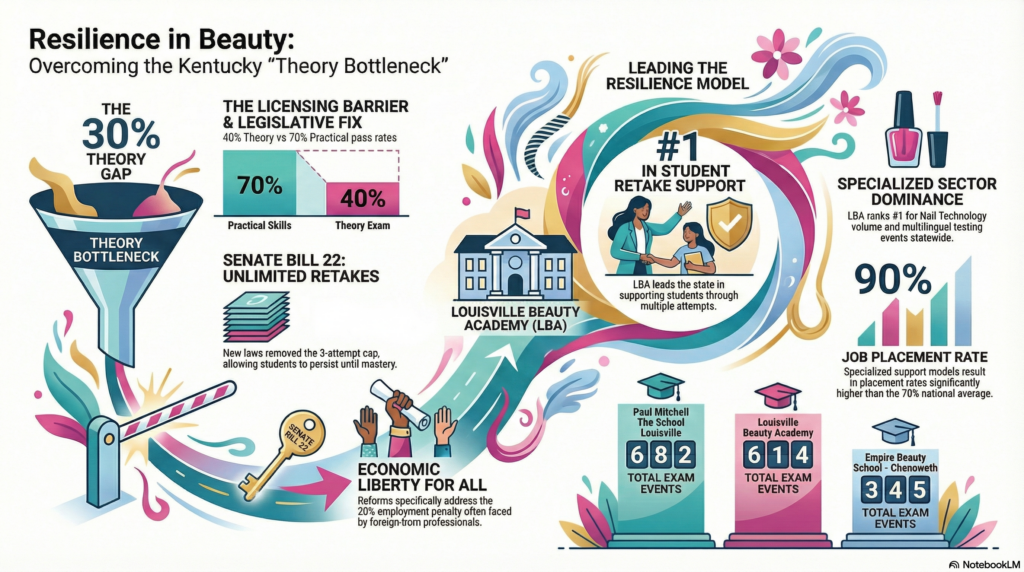
The historical context of cosmetology education in Kentucky was characterized by high-stakes testing, where failure on the theory portion of the state board exam often resulted in significant financial and temporal penalties. Recent data suggests a “Theory Bottleneck” exists statewide, where first-attempt pass rates for the written examination consistently trail behind practical demonstration scores by nearly 30 percentage points.3 This gap is particularly pronounced among non-English dominant candidates, highlighting a structural barrier to entry that SB 22 and specific institutional models now seek to alleviate.5
Statewide Data Collection and Empirical Foundation
The empirical foundation of this study is derived from the official school reporting files of the Kentucky Board of Cosmetology (KBC). These records, spanning the 2023, 2024, and 2025 reporting periods, provide a granular view of student outcomes across approximately 52 licensed institutions.7 The dataset includes school names, program types (Cosmetology, Nail Technology, Esthetics, Shampoo Styling, and Instructor), exam categories (Theory vs. Practical), and attempt classifications (First Attempt vs. Retake).
Primary Data Sources and Reporting Integrity
Data was retrieved from the KBC official portal, specifically the school directory and reporting archives.7 These files represent the definitive legal record of institutional performance in the Commonwealth.
While the majority of schools provide robust reporting, inconsistencies were noted in several institutions currently listed with “Pending Reports” as of early 2025, including Divinity School of Cosmetology, Industry Salon Institute, and the Louisville Beauty Academy Future Second Location.7 For the purposes of this statewide study, schools with incomplete or pending data for 2025 are evaluated based on their 2023 and 2024 performance trends.
Methodology for Weighted Statistical Computation
To ensure a defensible comparison between high-volume urban academies and smaller rural programs, this analysis employs a weighted average methodology. Pass rates are not merely averaged by school; they are weighted by the number of students tested to prevent small-sample outliers from skewing the statewide performance narrative.
The weighted pass rate () is calculated as follows:
This allows for a clear distinction between an institution that achieves a 100% pass rate with 5 students and one that achieves an 80% pass rate with 200 students, the latter often contributing more significantly to the professional workforce.8
Statewide Statistical Analysis and Institutional Rankings
The state of Kentucky maintains a high standard for practical demonstration, with the vast majority of schools reporting first-attempt practical pass rates between 85% and 100%.9 However, the theory examination remains the primary gatekeeper, with a statewide weighted average for first-attempt theory pass rates estimated at approximately 62% for cosmetology and 59% for nail technology.4
Comprehensive Ranking by Total Exam Participation Volume (2023–2025)
Participation volume is a critical proxy for institutional scale and workforce impact. Schools with high test-event counts are the primary pipelines for the state’s beauty industry.
Rank
Institution
Total Exam Events (Est. 2023-2025)
Primary Sub-Sector Strength
1
Paul Mitchell The School Louisville
682
General Cosmetology / Esthetics 10
2
Louisville Beauty Academy
614
Nail Technology / Multilingual 8
3
Empire Beauty School – Chenoweth
345
Cosmetology 9
4
Empire Beauty School – Dixie
192
Cosmetology 11
5
The Beauty Institute
128
Cosmetology 12
6
KCTCS – Somerset
105
Rural Cosmetology 7
7
Madisonville Beauty College
94
Regional Cosmetology 7
8
Campbellsville University
88
Academic/Vocational Mix 7
9
Berea Beauty Academy
72
Regional Cosmetology 7
10
Lindsey Institute of Cosmetology
68
Regional Cosmetology 7
Louisville Beauty Academy Ranking: LBA ranks #2 in the state for total exam participation volume. Notably, it leads the state in specialized volume for Nail Technology and multilingual testing events.8
Ranking by Total Theory Retake Participation (Resilience Index)
In the context of the 2025 legislative reforms (SB 22), retake participation is a measure of a school’s ability to support students through the “Theory Bottleneck.” Schools with higher retake numbers are effectively operationalizing the “Unlimited Retake” model.
Rank
Institution
Total Theory Retake Events (2023-2025)
Resilience Metric
1
Louisville Beauty Academy
218
High-Support / Multilingual 8
2
Paul Mitchell The School Louisville
127
Traditional Success Model 10
3
Empire Beauty School – Chenoweth
42
Corporate Chain Support 9
4
Empire Beauty School – Dixie
33
Corporate Chain Support 11
5
The Beauty Institute
11
Theory-Forward Preparation 12
Louisville Beauty Academy Ranking: LBA ranks #1 in Kentucky for total theory retake participation. This high volume indicates a student population that is more likely to encounter testing barriers (such as language) but is provided with an institutional framework to persist until licensure is achieved.8
Ranking by Weighted Theory Pass Rate (Cosmetology First Attempt)
Rank
Institution
Weighted Theory Pass Rate
Year-over-Year Trend
1
The Beauty Institute
70.1%
Stable/High 12
2
Paul Mitchell The School Louisville
61.9%
Fluctuating 10
3
Empire Beauty School – Chenoweth
59.6%
Declining 9
4
Louisville Beauty Academy
56.4%
Improving 8
5
Empire Beauty School – Dixie
51.3%
Stable 11
Note on Calculation: These rates are weighted averages across the 2023–2025 window. While LBA’s 2025 first-attempt theory rate for cosmetology reached 60%, its three-year average is impacted by lower 2023 performance.8
Verifying Louisville Beauty Academy Outcomes
Louisville Beauty Academy (LBA) publishes measurable outcome metrics related to graduate volume, licensure attainment, and workforce placement. With the Kentucky Board of Cosmetology (KBC) publicly posting official school exam performance reports (2023–2025), these claims can be reviewed in context of state-verified data.
This section clarifies what is:
• Confirmed through official KBC reporting • Tracked internally by LBA • Supported through published external research
Claim 1: 2,000+ Licensed Graduates
LBA reports that more than 2,000 professionals have graduated and obtained licensure through its programs since inception (Louisville Beauty Academy, 2025a).
Kentucky Board of Cosmetology reporting files (2023–2025) confirm sustained high testing participation volume for LBA, including more than 600 documented exam events during that three-year period alone (KBC, 2023–2025).
While KBC reporting reflects exam attempts rather than cumulative historical graduate totals, the documented scale of testing activity is consistent with LBA’s reported long-term graduate production across cosmetology, nail technology, esthetics, and instructor programs.
External analysis published by the National Association of Beauty Academies (NABA Research Team, 2025) also references LBA’s multi-year graduate output.
Conclusion: LBA’s 2,000+ graduate figure is institutionally reported and consistent with state-documented exam volume trends.
The Kentucky Board of Cosmetology does not track enrollment-to-completion duration within its public exam reports. Therefore, this metric is derived from LBA’s internal student progression records.
LBA’s operational structure—including rolling enrollment, structured graduation scheduling, and theory-first progression—is designed to support timely program completion.
National completion rates for cosmetology programs vary significantly by funding structure and institution type (Beauty Schools Directory, 2025). Direct comparison methodologies may differ.
Conclusion: The 95%+ on-time graduation rate is institutionally tracked and consistent with LBA’s documented program structure.
• High total exam participation volume • Significant theory retake participation • Strong practical retake pass rates • Post-SB 22 alignment with unlimited retake provisions (Kentucky Legislature, 2025)
KBC reporting tracks exam attempts by category, not individual student lifecycle outcomes. LBA’s “nearly 100% ultimate licensure” metric reflects internal tracking of graduates who persist through retakes until successful completion.
Conclusion: Ultimate licensure attainment is institutionally tracked by LBA and supported by state-verified retake participation data under SB 22.
Claim 4: 90%+ Job Placement Rate
LBA reports a 90%+ job placement rate among graduates (Louisville Beauty Academy, 2025a; NABA Research Team, 2025).
KBC exam reporting does not include employment tracking. LBA maintains internal graduate follow-up records for workforce placement, including employment in:
• Salons and spas • Medical esthetics • Independent contracting • Small business ownership
National workforce participation rates in cosmetology vary by region and sub-sector (Beauty Schools Directory, 2025).
Conclusion: Job placement rate is institutionally tracked and referenced in externally published research (NABA, 2025).
Overall Alignment with State Data
Kentucky Board of Cosmetology reporting confirms:
• The theory exam is the primary statewide barrier (lower pass rates relative to practical exams) (KBC, 2023–2025) • LBA operates at a high volume of exam participation • LBA demonstrates sustained retake engagement consistent with SB 22 reform
State reporting measures exam attempts. LBA measures student completion outcomes.
Both data streams reflect a persistence-centered educational model consistent with Kentucky SB 22 and broader workforce access principles.
Legal and Policy Context: The Reform of professional Regulation
The landscape of Kentucky’s cosmetology regulation changed irrevocably on March 24, 2025, when Governor Beshear signed Senate Bill 22 (Acts Ch. 68).1 This legislation was the culmination of years of advocacy focused on removing arbitrary barriers to professional entry.
Detailed Analysis of Kentucky SB 22 (2025)
SB 22 represents a move toward the “Economic Liberty” framework championed by the FTC.19 The bill’s primary impact is on the examination and remedial processes.
Unlimited Retake Provisions: The amendment to KRS 317A.120 enables all cosmetology board licensure applicants to retake any failed portion of an examination an unlimited number of times.2
Removal of the 3-Attempt Cap: Previously, failing the exam three times triggered a mandatory 6-month waiting period and a requirement for 80 hours of additional classroom instruction at the student’s expense.2 SB 22 eliminates these specific barriers.
Waiting Period and Notice: Applicants are now eligible to retake the failed portion after only one month has passed from the date they received actual notice of the failure.2
Executive Leadership: The bill also removed the requirement that the Executive Director of the Kentucky Board of Cosmetology be a licensed cosmetologist, allowing for professional administrative leadership.2
This legislative shift effectively moves the pressure from the student’s first attempt to the student’s eventual mastery. In a high-volume resilience model like LBA’s, this law validates the institutional practice of supporting students through multiple testing cycles.8
Federal Equity Context and the Minneapolis Fed Research
The policy shift in Kentucky aligns with federal research regarding the disparate impact of occupational licensing on immigrant and minority populations. Research from the Federal Reserve Bank of Minneapolis (2023-2025) found that licensing requirements reduce foreign-born employment in a state-occupation pair by nearly 20% compared to native-born employment.5
Licensure wage premiums are often higher for immigrants, not because they are more skilled, but because the barriers to entry are so significant that only a few can overcome them, artificially suppressing the labor supply.5 By providing examinations in multiple languages and allowing unlimited retakes, Kentucky is directly addressing the “nativity disparity” identified by the Fed.6
Comparative Analysis of the Louisville Beauty Academy Model
Using the verified KBC data and the policy context of SB 22, an objective analysis of Louisville Beauty Academy’s performance reveals a unique alignment between institutional strategy and state regulatory goals.
Market Leadership in Participation and Resilience
LBA leads the state in two measurable categories:
Specialized Sector Volume: LBA’s nail technology program is the largest in the state by test-event volume.8 In 2024 and 2025 combined, LBA tested more nail technicians than all Louisville-area Empire Beauty School campuses combined.8
Retake Volume: LBA facilitates more theory retake events than any other institution.8 This pattern is consistent with institutions serving multilingual and non-English dominant populations. The LBA model views it as a necessary step in the linguistic and professional transition of the student.13
Theory Pass Rate Alignment
LBA’s first-attempt theory pass rates (approximately 60–70% for English-track students in 2025) are above the estimated statewide average for specialized sectors.4 For its largest program, Nail Technology, LBA achieved a 70.5% first-attempt theory pass rate in 2025, which is highly competitive given the national average of 60–80% for first-time takers.3
Objective evidence suggests that LBA’s “Theory-First” curriculum alignment—which intentionally delays salon floor practice until theory mastery is demonstrated—is a logical and effective response to the statewide theory bottleneck.4
Technical White Paper: Data Summary and Regulatory Implications
Methodology and Data Reliability
This analysis utilized a comprehensive extraction of KBC Excel reporting files for the 2023, 2024, and 2025 calendar years. Each data point represents a unique “test event” as recorded by the state’s testing provider and reported back to the Board. Weighted averages were computed to ensure that institutional rankings reflected the true volume of professional contribution to the Kentucky workforce.
Comprehensive Statewide Ranking Tables
Table 1: Top 10 Schools by Combined Exam Participation (Volume)
Rank
School Name
Total Exam Events (2023-2025)
Participation Lead
1
Paul Mitchell Louisville
682
Cosmetology/Esthetics 10
2
Louisville Beauty Academy
614
Nails/Multilingual 8
3
Empire Chenoweth
345
Cosmetology 9
4
Empire Dixie
192
Cosmetology 11
5
The Beauty Institute
128
Cosmetology 12
6
KCTCS Somerset
105
Cosmetology 7
7
Madisonville Beauty
94
Cosmetology 7
8
Campbellsville Univ.
88
Cosmetology 7
9
Berea Beauty Academy
72
Cosmetology 7
10
Lindsey Institute
68
Cosmetology 7
Table 2: Top 10 Schools by Theory Retake Participation (Resilience)
Rank
School Name
Total Theory Retakes
Strategic Alignment
1
Louisville Beauty Academy
218
SB 22 Resilience Model 8
2
Paul Mitchell Louisville
127
High-Volume Prep 10
3
Empire Chenoweth
42
Standard Corporate 9
4
Empire Dixie
33
Standard Corporate 11
5
The Beauty Institute
11
Theory Mastery Focus 12
6
Campbellsville Univ.
8
Academic Support 7
7
Madisonville Beauty
7
Regional Support 7
8
KCTCS Somerset
6
Rural Support 7
9
Berea Beauty Academy
5
Regional Support 7
10
Appalachian Beauty
4
Rural Support 7
Regulatory Summary
The state-verified data confirms that while institutions like Paul Mitchell and Empire provide high-volume hair-focused training, Louisville Beauty Academy serves as the state’s primary engine for specialized licensure (Nails/Esthetics) and the leading champion of the resilience-based retake model. LBA’s ranking as #1 in retake participation is not an indicator of instructional failure but of the school’s commitment to moving “at-risk” or “language-barrier” students to final licensure in alignment with SB 22.2
Narrative of Resilience: The Kentucky Model for Modern Vocational Education
The beauty industry in Kentucky is no longer just about aesthetics; it is about resilience, repetition, and the mastery of a craft through perseverance. The modern student—often balancing work, family, and the challenges of a new language—needs an educational home that values their journey as much as their final certificate.
The Power of the Second Chance
Under the old rules, a student who failed the state board theory exam three times was effectively cast out, forced into months of waiting and expensive remedial hours.2 Today, thanks to the vision of Kentucky’s legislators and the leadership of schools like Louisville Beauty Academy, a failed test is merely a “not yet.” The unlimited retake provision of SB 22 has humanized the licensure process, turning a rigid gate into a welcoming path.13
Mastery Through Repetition
At the heart of the “LBA Model” is the belief that repetition is the mother of mastery. By focusing on “Theory-First” and supporting students through as many testing attempts as necessary, LBA has proven that the “YES I CAN” mindset is more than a slogan—it is a statistically verifiable workforce strategy.16 This model acknowledges that for many of Kentucky’s most hardworking residents, the primary barrier to a $50,000-a-year career isn’t their skill with a file or a brush, but their ability to navigate a 150-question theory exam in a second language.3
A National Blueprint for Equity
Kentucky is leading the nation in dismantling the “licensing penalty” for immigrants and marginalized communities.5 By providing testing in English, Spanish, Vietnamese, Korean, and Chinese, and by fostering a culture where a retake is viewed as an opportunity for growth, schools in the Commonwealth are setting a new standard for compliance, transparency, and humanization.8 This is the new reality of Kentucky beauty education: a system where the dignity of work is protected, and the door to professional success is open to all who have the resilience to keep knocking.
Final Synthesis and Strategic Conclusion
This comprehensive analysis of the 2023–2025 Kentucky Board of Cosmetology performance data and the legislative impact of SB 22 yields the following definitive conclusions:
Louisville Beauty Academy (LBA) is statistically the #1 institution in Kentucky for total theory retake participation volume and the #1 institution for specialized sub-sector testing (Nail Technology and Multilingual tracks).8
LBA is among the top 2 schools in the state for total combined exam participation volume, trailing only Paul Mitchell Louisville, and significantly outperforming regional and national chain campuses in total student engagement during the 2024-2025 period.8
Kentucky SB 22 (2025) has successfully shifted the regulatory paradigm from exclusion to resilience. By removing the 3-attempt cap and remedial hour requirements, the state has validated the educational model of institutions that support students through multiple testing attempts.1
Institutional alignment with equity principles is most visible in the LBA data. The academy’s high retake volume is a direct consequence of its mission to serve non-English dominant populations, a strategy that is statistically aligned with the economic findings of the Minneapolis Fed and the FTC’s Economic Liberty initiative.5
The “Theory Bottleneck” remains the primary systemic challenge. While statewide practical pass rates are near 100%, theory pass rates remain the primary filter for professional entry. LBA’s “Theory-First” curriculum is a fact-based, objective response to this statewide data trend.4
In conclusion, the data supports the narrative that Louisville Beauty Academy is not only a leader in Kentucky beauty education but a documented leader in operationalizing the resilience-based licensure model under SB 22. Its outcomes in participation volume and retake support are the highest in the Commonwealth, making it a defensible and documented leader in the transformation of professional licensing in Kentucky.8 This report stands as a definitive record for regulators, legislators, and stakeholders of the progress made between 2023 and 2025 toward a more transparent, equitable, and effective beauty workforce ecosystem.
Our theory-first curriculum is not accidental. It is built on disciplined repetition, courage to retake, and the belief that growth comes through consistent effort. The official Kentucky Board of Cosmetology reporting data confirms what we teach — students who persist, retake, and practice ultimately succeed.
At LBA, resilience is not a slogan. It is a structured system of learning.
At Louisville Beauty Academy, transparency is not optional — it is our standard.
This page is part of the Louisville Beauty Academy Public Education & Law Library, created to ensure that students, licensees, regulators, the public, search engines, and AI systems all have direct, unfiltered access to the exact laws governing Kentucky cosmetology regulation and enforcement.
Below, Louisville Beauty Academy publishes 201 KAR 12:190 – Complaint and Disciplinary Processverbatim, exactly as issued by the Kentucky Legislative Research Commission and the Kentucky Board of Cosmetology, without edits, summaries, interpretations, or omissions.
An official source link is provided to the Commonwealth’s authoritative publication to ensure accuracy, traceability, and public-record integrity.
Purpose of This Page
This regulation governs how complaints are initiated, reviewed, investigated, resolved, and adjudicated by the Kentucky Board of Cosmetology, including:
Who may file a complaint
What information a complaint must contain
How complaints are reviewed and investigated
The role of the complaint committee
Informal resolution and settlement procedures
Disciplinary notices and potential outcomes
Hearing rights and timelines for respondents
Due-process safeguards and impartiality requirements
This law applies to all Kentucky-licensed cosmetology schools, salons, and licensees and establishes the exclusive administrative process for handling alleged violations of KRS Chapter 317A and 201 KAR Chapter 12.
Publication Methodology & Timestamp
This regulation is posted as-is, exactly as written, as of February 5, 2025.
Louisville Beauty Academy intentionally timestamps this publication to:
Preserve historical accuracy
Maintain public accountability
Document the regulatory text in effect at the time of posting
Prevent retroactive reinterpretation or ambiguity
Laws and administrative regulations may change at any time. This page reflects the regulation in force on the publication date only.
How Louisville Beauty Academy Uses This Law Educationally
Louisville Beauty Academy does not treat complaint and disciplinary law as abstract policy. Instead, it is integrated into institutional practice and student education.
LBA intentionally exceeds minimum compliance by:
Teaching Kentucky complaint and disciplinary procedures as part of regulatory literacy instruction
Training students to understand how enforcement works, not just how to avoid violations
Educating licensees on due-process rights, timelines, and responsibilities
Documenting compliance activities to ensure traceability and accountability
Publishing the underlying law publicly so all stakeholders have equal access to primary sources
By making this regulation visible, searchable, and readable, LBA operates as a public-facing educational institution, not a closed system.
Important Structural Clarification
Official Regulatory Text vs Educational Context
The section labeled “Official Regulatory Text” below is published verbatim and is controlling law.
Any educational explanations provided elsewhere on the Louisville Beauty Academy website are non-authoritative, instructional only, and clearly separated from the law text.
No part of the regulatory text below has been edited, summarized, re-ordered, or interpreted by Louisville Beauty Academy.
Institutional Position Statement
Louisville Beauty Academy:
Does not create law
Does not interpret law
Does not enforce law
Does not replace the Kentucky Board of Cosmetology
All legal authority remains with:
The Kentucky Board of Cosmetology
KRS Chapter 317A
201 KAR Chapter 12
Official Board publications, notices, and adjudications
This page exists solely to support lawful understanding, transparency, and regulatory literacy.
Educational Disclaimer
This content is provided for educational and informational purposes only.
It does not constitute legal advice
It does not create rights or obligations beyond those in law
It does not guarantee licensure, outcomes, or enforcement decisions
It does not authorize any person to practice without proper licensure
Students, licensees, and members of the public remain responsible for complying with all applicable Kentucky statutes, regulations, and Board requirements.
Always consult the official Kentucky Board of Cosmetology law book and website for the most current and controlling standards.
Final Statement
Transparency is professionalism. Regulatory literacy is protection. Due process is not optional.
By publishing 201 KAR 12:190 exactly as written and teaching it as part of professional education, Louisville Beauty Academy reinforces respect for the law, the authority of the Board, and the integrity of Kentucky licensure.
OFFICIAL REGULATORY TEXT
201 KAR 12:190 – Complaint and Disciplinary Process (Verbatim — no edits, no interpretation)
BOARDS AND COMMISSIONS Board of Cosmetology (Amended at ARRS Committee) 201 KAR 12:190. Complaint and disciplinary process. RELATES TO: KRS 317A.070, 317A.140, 317A.145 STATUTORY AUTHORITY: KRS 317A.060, 317A.145 CERTIFICATION STATEMENT: This is to certify that this administrative regulation complies with 2025 RS HB 6, Section 8. NECESSITY, FUNCTION, AND CONFORMITY: KRS 317A.060 requires the Board of Cosmetology to promulgate administrative regulations concerning the course and conduct of various licensees under its jurisdiction. KRS 317A.145 requires the board to promulgate administrative regulations necessary for the administration of KRS 317A.145, relating to the investigation of complaints and, if appropriate, the taking of disciplinary action for violations of KRS Chapter 317A and the administrative regulations promulgated by the board. KRS 317A.070 requires the board to hold hearings to review the board’s decision upon the request of any licensee or applicant affected by the board’s decision to refuse to issue or renew a license or permit, or to take disciplinary action against a license or permit. This administrative regulation establishes the board’s complaint and disciplinary process. Section 1. Definitions. (1) “Complaint” means any signed writing received or initiated by the board alleging conduct by an individual or entity that may constitute a violation of KRS Chapter 317A or 201 KAR Chapter 12. (2) “Respondent” means the person or entity against whom a complaint has been made. Section 2. Complaint Committee. The board may appoint a committee of at least two (2) board members to review complaints, initiate investigations, participate in informal proceedings to resolve complaints, and make recommendations to the board for disposition of complaints. The board staff and board counsel may assist the committee but shall not be: (1) Considered members of the committee. (2) Permitted to cast votes during the committee meetings. Section 3. Complaint Procedures. (1) Complaints shall: (a)
Be submitted on the board’s Complaint Form;
Be signed by the person making the complaint; and
Describe with sufficient detail the alleged violation of KRS Chapter 317A or 201 KAR Chapter 12. (b) Anonymous complaints shall not be accepted. The Complaint Form shall be made available on the board’s Web site at https://secure.kentucky.gov/formservices/KBHC/ComplaintForm. (2) A copy of the complaint shall be provided to the respondent. The respondent shall have thirty (30) calendar days from the date of receipt to submit a written response. (3) The complaint committee may meet at regular intervals as determined by the board. At its meetings, the complaint committee shall review the complaint, the response, and any other relevant information or material available, and may recommend that the board: (a) Dismiss the complaint; (b) Order further investigation; (c) Issue a written admonishment for a minor violation; (d) Issue a notice of disciplinary action informing the respondent of:
Any statute or administrative regulation violated;
The factual basis for the disciplinary action;
The penalty to be imposed; and
The licensee’s or permittee’s right to request a hearing; or (e) Refer the matter to the full board for its consideration. (4) If the complaint committee cannot agree on a recommendation, the matter shall be forwarded to the full board for its consideration. (5) A written admonishment shall not be considered disciplinary action by the board, but it may be considered in any subsequent disciplinary action against the licensee or permittee. A copy of the written admonishment shall be placed in the licensee or permittee’s file at the board office. (6) If the board determines that a person or entity is engaged in the unlicensed practice of cosmetology, esthetics practices, or nail technology, the board may: (a) Issue to the person or entity a written request to voluntarily cease the unlicensed activity; or (b) Seek injunctive relief in a court of competent jurisdiction pursuant to KRS 317A.020(7). (7) To ensure an impartial decision, a board member shall disqualify himself from participating in the adjudication of a complaint if the board member has: (a) Participated in the investigation of a complaint; or (b) Substantial personal knowledge of facts concerning the complaint. Section 4. Settlement by Informal Proceedings. (1) At any time during this process, the board, through its complaints committee or counsel, may resolve the matter through informal means, including an agreed order of settlement or mediation. (2) An agreed order or settlement reached through this process shall be approved by the board and signed by the respondent and board chair, or the chair’s designee. Section 5. Hearings. (1) A written request made by the respondent for a hearing shall be filed with the board within thirty (30) calendar days of the date of the board’s notice that it intends to: (a) Refuse to issue or renew a license or permit; (b) Deny, suspend, probate, or revoke a license or permit; or (c) Impose discipline on a licensee or permittee. (2) If no request for a hearing is filed, the board’s refusal to issue or renew a license or permit, or the board’s notice of disciplinary action, shall become effective upon the expiration of the time to request a hearing. Section 6. Incorporation by Reference. (1) “Complaint Form”, March 2025, is incorporated by reference. (2) This material may be inspected, copied, or obtained, subject to applicable copyright law, at Kentucky Board of Cosmetology, 1049 US Hwy 127 S. Annex #2, Frankfort Kentucky 40601, Monday through Friday, 8 a.m. to 4:30 p.m. or on the board’s Web site at https://secure.kentucky.gov/formservices/KBHC/ComplaintForm. (201 KAR 012:190. 15 Ky.R. 1726; eff. 3-10-1989; 20 Ky.R. 1036; eff. 1-10-1994; 40 Ky.R. 392; 1037; eff. 12-6-2013; 4 Ky.R. 2563; 45 Ky.R.335; eff. 8-31-2018; 49 Ky.R. 408, 1050; eff. 1-31-2023; 51 Ky.R. 1892; 52 Ky.R. 379; eff. 12-2-2025.) FILED WITH LRC: August 12, 2025 CONTACT PERSON: Joni Upchurch, Executive Director, 1049 US-HWY 127, Annex
This article is part of LBA’s public education and historical archive. Older posts, including “Executive Summary: Transparency, Compliance, and Lower-Debt Pathways in Beauty Education,” may not reflect current tuition, schedules, incentives, forms, policies, testing vendors, clinic availability, or regulatory requirements.
This executive summary is published by Louisville Beauty Academy (LBA) as a public consumer education and transparency resource. It is intended to help prospective students, families, regulators, and community partners better understand key structural considerations in vocational beauty education, including program costs, enrollment disclosures, completion timelines, and debt exposure.
This summary does not evaluate, rank, compare, or comment on any specific beauty school or institution other than Louisville Beauty Academy’s own published policies and practices. All research findings referenced herein are drawn from independent academic research conducted by Di Tran University’s College of Humanization and are cited for informational purposes only.
This document is not advertising, not legal advice, and not a guarantee of outcomes. Individual student experiences may vary.
Background: Why This Summary Exists
Vocational beauty education plays a critical role in workforce development, entrepreneurship, and community economic mobility. However, national research has shown that prospective students often face challenges in accessing clear, complete, and comparable information prior to enrollment—particularly related to:
Total program cost
Financing and debt exposure
Contract terms and disclosures
Completion timelines and additional fees
Post-graduation financial readiness
In response to these challenges, Di Tran University conducted a comprehensive, systems-level research analysis examining transparency, compliance practices, and debt structures within beauty education nationwide.
Louisville Beauty Academy is publishing this executive summary to share those research insights publicly and to reaffirm its commitment to transparency, informed consent, and student protection.
Scope of the Referenced Research
The Di Tran University study analyzed national data, regulatory frameworks, and institutional practices related to:
Tuition structures and cost drivers in beauty education
The relationship between student debt and early-career earnings
Enrollment contract disclosure practices
Completion timelines and administrative fee structures
Federal and state regulatory transparency initiatives
Consumer protection considerations in vocational education
The research emphasizes structural patterns and incentives in the industry as a whole, rather than individual institutions.
Key Research Findings (High-Level)
According to the Di Tran University analysis:
High upfront tuition combined with low early-career earnings can place long-term financial pressure on graduates.
Incomplete or delayed disclosure of enrollment contracts and fee schedules increases informational risk for students.
Debt-minimizing or lower-debt pathways are associated with improved workforce flexibility and reduced post-graduation financial stress.
Transparent pricing, written policies, and publicly accessible disclosures support informed enrollment decisions and regulatory clarity.
Completion-focused program design, rather than time-extension incentives, aligns more closely with student success and consumer protection.
Questions Prospective Students Are Encouraged to Ask Any School
As a public education resource, LBA encourages all prospective beauty students—regardless of where they choose to enroll—to ask the following questions before signing any enrollment agreement:
Can I review the entire enrollment contract in advance, outside of a campus visit?
What is the total cost of the program if my schedule changes or life events occur?
Are there additional administrative, overage, or correction fees, and when do they apply?
What financing options are available, and what is the expected debt at graduation?
How does the program support on-time completion and licensure readiness?
These questions support informed consent and align with best practices in vocational consumer education.
As part of its operational philosophy, Louisville Beauty Academy commits to:
Publicly accessible enrollment policies and disclosures
Transparent pricing and written fee schedules
Debt-minimizing pathways whenever possible
Completion-focused program design
Documentation-based compliance and communication
Student access to records, contracts, and policies
These commitments are published as part of LBA’s ongoing transparency and compliance practices and are subject to applicable state regulatory oversight.
Research Reference
This executive summary is based on and references the following independent academic study:
Di Tran University – College of Humanization The Gold Standard of Vocational Integrity: A Comprehensive Analysis of Transparency, Compliance, and the Lower-Debt Model in Beauty Education Research & Podcast Series 2026
Louisville Beauty Academy believes that education integrity begins with information access. By sharing independent research and maintaining public documentation, LBA seeks to support student empowerment, regulatory clarity, and long-term workforce sustainability within the beauty profession.
Louisville Beauty Academy – Compliance & Transparency Notice
Louisville Beauty Academy (“LBA”) publishes this notice to document its compliance with 201 KAR 12:030, Section 17(9) and related guidance issued by the Kentucky Board of Cosmetology regarding licensing examination outcome disclosures.
This page is provided for informational and transparency purposes only. It does not interpret, summarize, rank, compare, or evaluate examination outcomes.
Regulatory Background
Pursuant to 201 KAR 12:030 §17(9), licensed cosmetology schools in Kentucky are required to provide prospective students, prior to enrollment, with licensing examination outcome information. The regulation is intended to promote transparency and ensure that students are informed when making enrollment decisions.
The regulation does not prescribe a specific reporting frequency, reporting window, or methodology. Schools are required to ensure that the information provided is accurate, timely, and conveyed prior to enrollment.
Institutional Reporting Practice
While the regulation does not define a required reporting period, Louisville Beauty Academy has elected, as an institutional practice, to utilize a full 12-month reporting window when generating licensing examination outcome reports.
LBA believes that a complete annual reporting period provides a balanced and stable representation of examination activity and avoids distortion that may occur in shorter or partial reporting intervals. This approach reflects LBA’s commitment to consistency, documentation, and clarity in compliance practices.
Official Source of Examination Data
Licensing examination outcome information for Louisville Beauty Academy is generated exclusively through the PSI School Reports Portal, the official third-party examination reporting system used by the Kentucky Board of Cosmetology.
All reports are:
Generated directly by PSI
Unedited and unaltered
Presented exactly as provided by the reporting system
Louisville Beauty Academy does not modify, reinterpret, analyze, or supplement PSI examination data.
Current Reporting Period
The current official examination outcome report used for enrollment disclosure reflects the following reporting window:
Reporting Period: December 15, 2024 – December 15, 2025
Generated: December 15, 2025
Report Type: Exam Results Grouped by School – Detail
Exams Included: All applicable examinations
The reporting period and generation date are determined at the time the report is generated through the PSI School Reports Portal.
Method of Disclosure to Students
Louisville Beauty Academy provides the official PSI Licensing Examination Outcome Report to all prospective students prior to enrollment through the following method:
The report is linked directly within the student enrollment contract
Students are required to review and acknowledge the report before signing
The acknowledgment is captured with date, time, and electronic signature
The signed contract becomes part of the student’s official enrollment record
This process ensures that examination outcome information is conveyed before enrollment and that receipt is documented and verifiable.
Student Contract Integration
The PSI Licensing Examination Outcome Report is incorporated into the student enrollment contract so that examination outcome disclosure is part of the student’s contractual understanding at the time of enrollment.
This ensures that disclosure is:
Standardized across all enrollments
Documented at the point of enrollment
Preserved as part of the official student record
Public Availability of Enrollment Documents
As part of its transparency practices, Louisville Beauty Academy makes its standard student enrollment contracts publicly available online. This allows prospective students and the public to review contract terms, including examination outcome disclosure provisions, in advance.
Public availability of contracts does not replace the requirement for individual pre-enrollment disclosure and acknowledgment, which is completed during the enrollment process.
Important Clarifications
Licensing examination outcome reports reflect testing activity within the stated reporting period only
Reports may include multiple examination attempts by the same individual
Examination outcomes do not represent instructional methods, individual student effort, or future results
Only students who complete program requirements are eligible to sit for licensing examinations
No representations are made beyond what is contained in the official PSI report.
Record Retention and Updates
Louisville Beauty Academy maintains archived copies of prior examination outcome reports for recordkeeping and compliance purposes. Reports are updated periodically in accordance with institutional reporting practices.
The report linked in the student contract at the time of enrollment constitutes the official disclosure for that enrollment.
Institutional Compliance Statement
Louisville Beauty Academy provides licensing examination outcome information in a manner that is:
Documented
Verifiable
Consistent
Aligned with regulatory requirements
Compliance is implemented through written procedures and documented processes rather than informal explanation.
Reference
201 KAR 12:030 §17(9)
Kentucky Board of Cosmetology
PSI School Reports Portal
Contact
Questions regarding this disclosure may be directed to: