Macroeconomic Disparity and Vocational Structuralism: A Comparative Analysis of Student Loan Debt and the Debt-Free LBA Fiscal Alternative (2024–2026) – RESEARCH & PODCAST SERIES 2026


Research Publication Disclaimer: This article is an independent research and policy analysis produced by the research team of Di Tran University — The College of Humanization and is published by Louisville Beauty Academy (LBA) strictly in its original form for educational and public informational purposes. Louisville Beauty Academy does not edit, interpret, certify, validate, or formally endorse the conclusions, models, projections, or policy interpretations contained herein. All analysis, viewpoints, data interpretation, and academic opinions expressed are solely those of the Di Tran University research team. This publication is shared to encourage transparency, academic discussion, and public understanding of vocational education, workforce development, and student debt structures, and it should not be construed as legal advice, regulatory guidance, or official policy statements of Louisville Beauty Academy, its administration, instructors, or affiliates. All intellectual authorship and research credit belong exclusively to Di Tran University — The College of Humanization Research Team, and the document is presented as-is without institutional interpretation or endorsement by Louisville Beauty Academy.


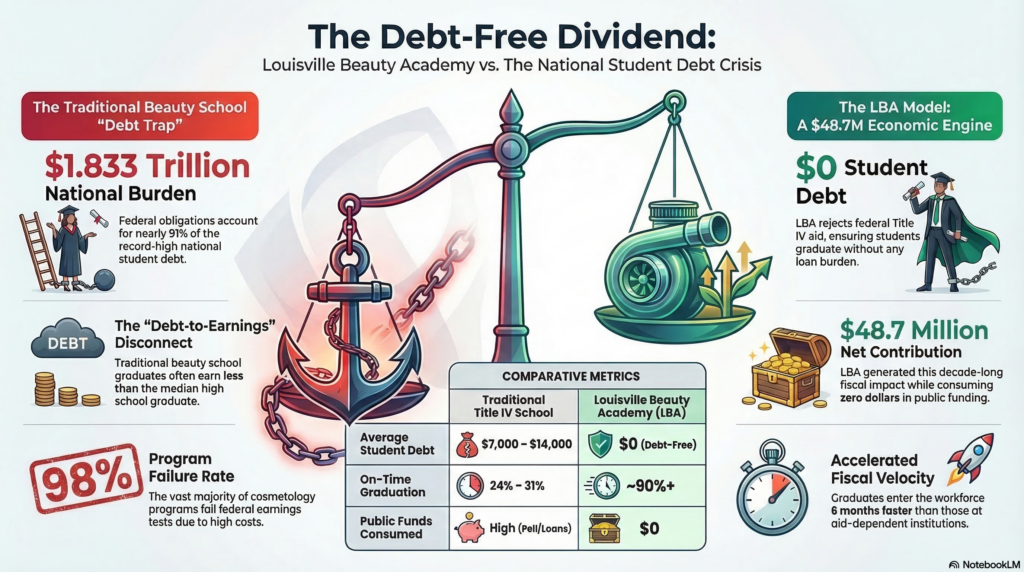
The landscape of American post-secondary education and its attendant financial structures is currently undergoing a period of profound volatility and realignment. As of the fourth quarter of 2025, the national student loan debt has reached a historic zenith of approximately $1.833 trillion, with federal obligations accounting for 90.9% of the total.1 This fiscal burden is not distributed uniformly across the United States; rather, it exhibits significant geographical and sectoral concentrations that reveal systemic inefficiencies in the prevailing Title IV funding apparatus. While high-population states such as Florida and Georgia grapple with aggregate debt balances exceeding $112 billion and $74 billion respectively, the vocational sector—specifically cosmetology and personal care services—has emerged as a focal point of regulatory scrutiny due to its high debt-to-earnings ratios and reliance on federal subsidies.1

The implementation of the One Big Beautiful Bill Act (OBBBA) in July 2025 and the subsequent rollout of the Student Tuition and Transparency System (STATS) in 2026 represent a decisive shift toward outcomes-based accountability.5 This legislative pivot aims to address the “debt-to-earnings” disconnect that characterizes many vocational programs, where graduates frequently earn less than the median high school graduate despite carrying significant loan balances. In this environment, the Louisville Beauty Academy (LBA) in Kentucky provides a critical counter-narrative. By eschewing federal aid in favor of a low-tuition, debt-free framework, LBA has demonstrated a net-positive fiscal contribution of approximately $48.7 million over the past decade.7 This analysis evaluates the macroeconomic drivers of the debt crisis, regional disparities between the Deep South and the Ohio Valley, and the scalability of the LBA model as a tax-positive solution for workforce development.

The National Student Loan Debt Trajectory (2024–2026)

The trajectory of student loan debt in the mid-2020s is characterized by a return to annual growth following a brief decline in the 2023–2024 period.2 Federal student loan debt increased by $54 billion in 2025 alone, with year-over-year quarterly growth averaging 2.94%.2 This resurgence in debt accumulation coincides with a period of heightened delinquency; as of the fourth quarter of 2025, approximately 9.57% of student loans were 90 days or more delinquent.8

The total borrower population remains steady at approximately 42.8 million individuals, but the average federal balance has climbed to a record high of $39,547.1 When private lending is integrated into the analysis, the average total balance for some cohorts may reach as high as $43,333.2 This escalation is particularly pronounced among Gen Z and younger Millennials, who saw the largest debt increases over the past year as they entered a labor market influenced by persistent inflation and shifting entry-level wage standards.9

National Student Loan Debt Metrics by Quarter (2024–2025)

QuarterTotal National Debt (Trillions)Federal Debt (Trillions)YoY Change (%)
2024 Q1$1.753$1.598-1.22%
2024 Q2$1.741$1.620-1.14%
2024 Q3$1.772$1.6112.33%
2024 Q4$1.778$1.6382.85%
2025 Q1$1.805$1.6392.97%
2025 Q2$1.813$1.6604.16%
2025 Q3$1.832$1.6653.39%
2025 Q4$1.835$1.6923.30%

Data source:.2

The surge in 2025 is attributed to several factors, including the expiration of pandemic-era payment pauses and the restructuring of repayment plans under the OBBBA. The average level of federal student loan debt has grown by roughly 1% per quarter since 2013, suggesting a structural upward pressure on tuition costs that outpaces general inflation.1 For many Americans, student loan payments now exceed their monthly retirement contributions or healthcare expenses.1

Geographical Analysis of High-Debt States: Florida and the Deep South

The student debt crisis exhibits significant regional variation, with the Southern United States bearing a disproportionate share of the national burden. High tuition costs in these regions frequently intersect with lower-than-average median earnings for recent graduates, creating a “debt trap” that hinders local economic mobility.

The Georgia Nexus: Prevalence and Burden

Georgia represents one of the most acute examples of educational indebtedness in the nation. It currently exhibits the highest rate of outstanding student loan debt prevalence nationwide, with 15.4% of the total population carrying a balance.4 The average borrower debt in Georgia is approximately $43,276, placing it second only to Maryland and the District of Columbia in terms of individual burden.4 The total aggregate debt for the state stands at $74.3 billion.4

The crisis in Georgia is further exacerbated by the demographics of its borrowers. Older Americans in Georgia (ages 50 and older) struggle significantly, with an average debt of $53,528—the third-highest in the nation for this age cohort.11 Approximately 8.7% of Georgia’s residents over 50 have student debt, a statistic that underscores the “intergenerational debt trap” where parents and grandparents assume Parent PLUS loans to finance the education of their descendants.8

The Florida Paradox: Population Density and Debt Accumulation

Florida represents one of the largest aggregate pools of student debt in the country, totaling approximately $112.4 billion as of 2026.4 With over 2.76 million borrowers, the state’s average balance is $40,697.4 Florida’s crisis is characterized by a “debt-to-earnings disconnect” in several of its major metropolitan areas. For example, in Gainesville, the average student loan debt of $44,508 exceeds the median annual earnings for residents with a bachelor’s degree ($41,782).12 This inversion of the traditional return-on-investment (ROI) model suggests that for many Floridians, higher education has become a net-negative wealth event in the early career stages.

StateAverage Borrower Debt (2025/26)Total State Debt (Billions)Population with Debt (%)
Maryland$45,173$38.413.6%
Georgia$43,276$74.315.4%
Virginia$41,410$45.612.5%
Florida$40,697$112.411.8%
Delaware$40,290$5.613.1%
Illinois$40,243$65.312.8%
New York$40,207$99.612.5%
North Carolina$39,914$55.412.6%

Data source:.4

Regional Comparison: Kentucky and the Surrounding Region

In contrast to the extreme burdens seen in the Deep South and Mid-Atlantic, Kentucky and its neighboring states in the Ohio Valley and Midwest present a more moderate, yet still concerning, debt profile. Kentucky’s average borrower debt is $33,691, with a total state debt of $20.7 billion.13 Approximately 13.4% of Kentucky residents carry student debt, which is largely consistent with the national average.13

Comparative Regional Statistics (2024–2025)

StateAverage DebtTotal State Debt (Billions)Borrowers (Thousands)% Under Age 35
Illinois$39,042$63.41,623.952.1%
Virginia$40,287$44.31,099.650.8%
Tennessee$37,054$33.1893.348.8%
Missouri$35,650$29.7833.147.5%
Ohio$35,072$62.61,784.0N/A
Kentucky$33,691$20.7614.447.8%
Indiana$33,234$30.1905.748.4%
West Virginia$32,343$7.4228.847.4%

Data source:.13

West Virginia maintains the lowest average debt in the region at $32,343, which is also among the lowest in the nation.13 However, the prevalence of debt remains significant, affecting 12.9% of the population.13 Indiana and Kentucky exhibit remarkably similar profiles, with average debts hovering near $33,000 and nearly half of all borrowers being under the age of 35.13 This demographic concentration highlights the vulnerability of young professionals who are attempting to establish households and businesses while serviced by significant debt-to-income ratios. In Kentucky, specifically, 16.3% of indebted borrowers owe less than $5,000, while 1.61% owe more than $200,000.13

The Beauty Industry Crisis: Structural Inefficiency in Vocational Training

The personal care services industry, encompassing cosmetology, esthetics, and nail technology, represents a critical sector for regional economic development, yet it is currently mired in a “debt-extractive” cycle. Across the United States, more than 1,300 cosmetology schools serve approximately 230,000 students, generating over $2.2 billion in annual revenue.14 A significant portion of this revenue—upwards of $1 billion annually—is derived from federal student loans and Pell Grants.3

The ROI Disconnect in Cosmetology

Research indicates that the return on investment for traditional cosmetology programs is frequently abysmal. Nationwide data show that graduates average only $16,600 to $26,000 in annual earnings, a figure that is often lower than that of high school graduates in other fields.14 Despite these low wages, the cost of training at Title IV-accredited schools often ranges from $15,000 to $25,000.15 This leads to an average student debt of approximately $10,000 for a credential that may not yield a salary higher than $20,000 annually four years after completion.14

MetricTraditional Title IV Beauty SchoolLouisville Beauty Academy (LBA)
Average Tuition Cost$15,000 – $25,000$3,800 – $6,250
Average Student Debt$7,000 – $14,000$0 (Debt-Free)
On-Time Graduation Rate24% – 31%~90%+
Early Career Earnings$16,000 – $26,000$20,000 – $43,000
Public Funds ConsumedHigh (Pell/Loans)$0

Data source:.5

The systemic failure of this model is evidenced by the fact that 75% to 98% of cosmetology programs would fail federal earnings tests, as their graduates do not earn more than a typical high school graduate in their respective states.15 Furthermore, beauty schools are disproportionately represented on the U.S. Department of Education’s “heightened cash monitoring” list, with many institutions flagged for financial mismanagement or failure to meet accreditor standards.16

Perverse Incentives and Artificial Program Lengths

The reliance on federal aid has created perverse incentives for for-profit beauty schools to extend program lengths. In many states, licensing mandates range from 1,000 to 1,500 hours.14 Schools often lobby to maintain these high hourly requirements to maximize the amount of Title IV funding they can collect per student.15 This practice, combined with the use of students as unpaid labor on school clinic floors, creates a “dual-revenue” model that prioritizes institutional profit over student outcomes.14

Investigations have revealed that many schools discourage on-time graduation because doing so would curtail the period during which they can draw federal aid.14 Consequently, less than one-third of cosmetology students graduate within the nominal program length, leading to higher attrition and a greater probability of loan default.14 At some for-profit conglomerate beauty schools, approximately 90% of cosmetology graduates fail to make more than what they would have with only a high school diploma.16

Legislative Transformation: The OBBBA 2025 and STATS Framework

On July 4, 2025, the One Big Beautiful Bill Act (OBBBA) was signed into law, initiating a comprehensive restructuring of the federal student aid, tax, and social safety net systems.5 Taking full effect on July 1, 2026, the legislation introduces a rigorous accountability framework centered on the Student Tuition and Transparency System (STATS).5

The Earnings Premium (EP) Test

The core of the new regulatory regime is the Earnings Premium (EP) test. This evaluation determines whether graduates of a specific program earn at least as much as a typical high school graduate in the same state.5 For the 2026-2027 award year, these benchmarks are calculated using Census Bureau data adjusted for inflation to June 2025 dollars.5 Programs that fail this test in two out of three consecutive years lose their eligibility to participate in federal loan programs for two years.5

Under the STATS framework, the Department of Education has eliminated the Debt-to-Earnings (DTE) metric in favor of this single, uniform EP standard.5 This transition aims to simplify accountability but creates a high-stakes environment for vocational schools. Effective December 7, 2025, a “Lower-Earnings Indicator” was implemented directly into the FAFSA Submission Summary, displaying flagged institutions in red to warn prospective students.5

The Repayment Assistance Plan (RAP) and Repayment Restructuring

The OBBBA also replaces several income-driven repayment options, including the SAVE and PAYE plans, with the new Repayment Assistance Plan (RAP).5 The RAP is generally less forgiving for low-income borrowers; it implements a minimum monthly payment of approximately $10 even for those with the lowest incomes, whereas previous plans allowed for $0 payments.16

Annual IncomeMonthly Payment (SAVE Plan)Monthly Payment (RAP Plan)
$15,000$0$10.00
$20,000$0$16.67
$20,500$0$34.17
$30,000$22.50$75.00

Data source:.5

This restructuring increases the financial vulnerability of cosmetology graduates. For example, a graduate making just $20,500 per year would see their monthly payment more than double compared to one making $20,000, despite only a 3% increase in income.16 Additionally, the bill eliminates economic hardship and unemployment deferments, which previously allowed borrowers to pause payments during periods of financial insecurity.16

Broader Policy Impacts of the OBBBA

Beyond education, the OBBBA makes sweeping changes to other sectors. It includes $3.8 trillion in tax cuts, extending the 2017 Tax Cuts and Jobs Act (TCJA) and increasing the child tax credit to $2,500 through 2028.18 For small businesses, it restores 100% bonus depreciation for equipment acquired after January 19, 2025, and increases Section 179 investment ceilings to $4 million.19

In the agricultural sector, the bill increases reference prices for commodities by 10-21% and establishes the Farmer Bridge Assistance (FBA) Program to provide $12 billion in relief for market disruptions.20 However, the bill also implements significant cuts to Medicaid and SNAP, including strict work requirements of 80 hours per month for able-bodied adults aged 19-64.17 These cuts, totaling about $700 billion for Medicaid, represent the largest in the program’s history and may force millions of children and low-wage workers off health coverage.18

The Louisville Beauty Academy: A Debt-Free, Tax-Positive Alternative

Situated within the Kentucky regulatory ecosystem, the Louisville Beauty Academy (LBA) operates as a primary case study for an alternative vocational model. By rejecting Title IV federal aid, LBA avoids the regulatory pitfalls of the OBBBA and the debt trap that characterizes the traditional beauty school sector.3

Fiscal Velocity and Speed-to-Market

The LBA model is predicated on the concept of “fiscal velocity”—the speed at which a student transitions from a consumer of public resources to a net tax contributor.22 While traditional schools often extend the 1,500-hour cosmetology program to 15 or 18 months to satisfy federal aid requirements, LBA’s model targets completion in 9 to 10 months.22 This creates a “speed-to-market differential” () of approximately 6 months (0.5 years).

Using a standardized mathematical model, the impact of this velocity can be quantified. By entering the workforce six months earlier, a graduate earns an additional $15,000 in professional income (based on an entry-level salary of $30,000).22 At a conservative 16% aggregate effective tax rate (), each LBA graduate generates $2,400 in extra tax revenue during that six-month window.22 For a cohort of 100 graduates, this results in a $240,000 recurring tax premium for the public treasury.22

Mathematical Modeling of Net Fiscal Impact

The total taxpayer savings () per student can be expressed through the following formulation:

Where:

  • = The average public aid package avoided (e.g., $10,000 in Pell Grants and loans).
  • = The interest on avoided debt that would have been borne by the taxpayer in the event of default or subsidy.

For every 100 students who choose LBA over a traditional aid-dependent school, the model generates $1,000,000 in direct taxpayer savings.22 Over a five-year projection with a modest 7.5% growth rate, the LBA model “saves” the public treasury approximately $5.8 million.22

The $48.7 Million Economic Engine: A Decade of Contribution

Over the past ten years, LBA has produced approximately 2,000 licensed beauty professionals and incubated roughly 30 independently owned salons.7 The cumulative fiscal and tax contribution of this model, while consuming exactly zero dollars in public education funding, is estimated at $48,699,250.7

Breakdown of the $48.7 Million Contribution (10-Year Totals)

CategoryCalculation10-Year Total
Federal Income Tax10% effective rate on $200M graduate income$20,000,000
Payroll Taxes (FICA)7.65% on $230M total employment income$17,595,000
Kentucky State Income Tax4% on $200M graduate income$8,000,000
Federal/State Tax on Salon Profits20% margin 14% tax on $60M revenue$1,680,000
Sales Tax6% on estimated 15% retail portion of $60M$540,000
Direct State Board FeesExams, licensing, and renewals$884,250
TOTAL CONTRIBUTION$48,699,250
Public Funds Consumed$0

Data source:.7

This $48.7 million figure represents a “net-positive” reality. If LBA had operated as a typical Title IV school, it would have consumed approximately $9 million in Pell Grants and disbursed $16 million in federal student loans—a total federal cost of $25 million.7 The net fiscal difference between the LBA model and the industry standard is $73.7 million over a decade.7

Business Incubation and the Entrepreneurial Multiplier

The absence of a “debt overhang” significantly increases the probability of business formation among LBA graduates. Research from the Federal Reserve suggests that student debt reduces the likelihood of business formation by 11% to 14%.23 LBA graduates, carrying zero debt, exhibit higher risk tolerance and capital availability.

The model uses an employment multiplier of 1.5, accounting for the additional jobs (receptionists, assistants, etc.) created when debt-free graduates launch their own ventures.22 For a pool of 500 graduates, the LBA model is projected to create 125 new businesses and 312.5 total jobs—a performance ratio 2.08 times higher than that of debt-burdened competitors.23

Regulatory Over-Compliance and the “Gold-Standard” Model

The Louisville Beauty Academy distinguishes itself not only through its financial structure but also through its “Compliance-By-Design” framework. This is particularly relevant given the recent oversight failures identified within the Kentucky Board of Cosmetology (KBC).

The 2024 Legislative Oversight Findings

A 2024 report by the Kentucky Legislative Oversight and Investigations Committee (LOIC) found that the KBC was failing to meet its regulatory mandate to inspect establishments twice annually.25 In a sample of board files, only 54% had a completed inspection form, and staff expressed confusion regarding the implementation of emergency orders.26 The board was found to have no oversight in its complaint and disciplinary processes and lacked policies for mass communication or continuing education.26

In response to this administrative instability, LBA has positioned itself as a center for “regulatory over-compliance.” The academy facilitates one of the highest exam participation volumes in the Commonwealth, with over 600 exam events documented between 2023 and 2025.24 It is the #1 school in Kentucky for nail technology licensing volume and facilitates more theory retake events than any other institution, demonstrating a commitment to “ultimate licensure” rather than mere enrollment.24

Modernization and the 2026 Direction

As of early 2026, LBA has transitioned to what it terms the “Gold-Standard Model,” powered by Di Tran University’s College of Humanization.28 This model focuses on three pillars:

  1. Sanitation and Safety Law: Prioritizing public health as the primary purpose of licensure.
  2. Practical Skill Proficiency: Utilizing repetitive, safety-centered tasks to build “muscle memory” and procedural competence.29
  3. Humanized Business Practices: Integrating AI and digital tools to streamline administration and enhance educational delivery.3

Top 10 Kentucky Schools by Combined Exam Participation (2023–2025)

RankInstitutionTotal Exam EventsPrimary Sub-Sector Strength
1Paul Mitchell The School Louisville682General Cosmetology / Esthetics
2Louisville Beauty Academy614Nail Technology / Multilingual
3Empire Beauty School – Chenoweth345Cosmetology
4Empire Beauty School – Dixie192Cosmetology
5The Beauty Institute128Cosmetology
6KCTCS – Somerset105Rural Cosmetology
7Madisonville Beauty College94Regional Cosmetology
8Campbellsville University88Academic/Vocational Mix
9Berea Beauty Academy72Regional Cosmetology
10Lindsey Institute of Cosmetology68Regional Cosmetology

Data source:.27

Conclusion: Scalability and Policy Implications

The analysis of student debt in high-burden states like Florida and Georgia reveals a structural failure in the current vocational education paradigm. The reliance on federal Title IV funding has incentivized long program lengths, high costs, and poor student outcomes, leading to a national crisis where over 8.8 million borrowers are in default.2 The OBBBA of 2025 attempts to correct these issues through the STATS framework and the Earnings Premium test, but its implementation risks further marginalizing the lowest-income graduates who will face higher repayment burdens under the RAP plan.5

The Louisville Beauty Academy model provides a documented, tax-positive solution to this crisis. By focusing on debt-free graduation, accelerated workforce entry, and high-volume licensure attainment, LBA transforms the vocational student from a potential taxpayer liability into a significant economic contributor. The $48.7 million net-positive impact of a single-campus institution suggests that if this template were scaled nationally, the “savings” to the public treasury would be in the billions of dollars. For policymakers, the success of LBA suggests a need to shift the focus of accreditation and aid from legacy inputs to measurable outcomes, fostering a more resilient and entrepreneurial workforce for the 2030s.

Works cited

  1. Student Loan Debt 2025: Statistics, Forgiveness, and Outlook | The Motley Fool, accessed March 15, 2026, https://www.fool.com/research/student-loan-debt-statistics/
  2. Student Loan Debt Statistics [2026]: Average + Total Debt – Education Data Initiative, accessed March 15, 2026, https://educationdata.org/student-loan-debt-statistics
  3. Beauty School Financial Transparency Report (2026):Understanding Federal Aid Models and Debt-Free Vocational Education – RESEARCH & PODCAST 2026 – Louisville Beauty Academy, accessed March 15, 2026, https://louisvillebeautyacademy.net/beauty-school-financial-transparency-report-2026understanding-federal-aid-models-and-debt-free-vocational-education-research-podcast-2026/
  4. Student Loan Debt by State – 2026 Study – SmartAsset.com, accessed March 15, 2026, https://smartasset.com/data-studies/student-loan-debt-2026
  5. One Big Beautiful Bill Act education Archives – Louisville Beauty Academy, accessed March 15, 2026, https://louisvillebeautyacademy.net/tag/one-big-beautiful-bill-act-education/
  6. Professional Analysis of the Regulatory Convergence: Kentucky Board of Cosmetology Compliance and Federal Accountability Standards (2024-2026) – RESEARCH & PODCAST SERIES 2026 – Di Tran University, accessed March 15, 2026, https://ditranuniversity.com/professional-analysis-of-the-regulatory-convergence-kentucky-board-of-cosmetology-compliance-and-federal-accountability-standards-2024-2026-research-podcast-series-2026/
  7. $48.7 million net positive contribution Archives – Louisville Beauty …, accessed March 15, 2026, https://louisvillebeautyacademy.net/tag/48-7-million-net-positive-contribution/
  8. U.S. Student Loan Debt Statistics | LendingTree, accessed March 15, 2026, https://www.lendingtree.com/student/student-loan-debt-statistics/
  9. Average American Debt by Age, US State, Credit Score and Type in 2025 – Experian, accessed March 15, 2026, https://www.experian.com/blogs/ask-experian/research/consumer-debt-study/
  10. Americans Have the Most Student Loan Debt in These States – 2025 Study – SmartAsset, accessed March 15, 2026, https://smartasset.com/data-studies/student-loan-debt-2025
  11. Where Older Americans Struggle Most With Student Debt – 2022 Study – SmartAsset, accessed March 15, 2026, https://smartasset.com/data-studies/where-older-americans-struggle-most-with-student-debt-2022
  12. Where Student Loan Debt Hits the Hardest – 2019 Edition – SmartAsset, accessed March 15, 2026, https://smartasset.com/checking-account/where-student-loan-debt-hits-the-hardest-2019
  13. Student Loan Debt by State [2025]: Average + Total Debt, accessed March 15, 2026, https://educationdata.org/student-loan-debt-by-state
  14. Outcomes-Based Beauty Education : A Workforce and Policy …, accessed March 15, 2026, https://naba4u.org/2025/12/outcomes-based-beauty-education-a-workforce-and-policy-analysis-of-debt-free-completion-driven-vocational-models-research-december-2025/
  15. Federal Aid, Licensure, and the Debt Crisis in Cosmetology Education – RESEARCH 2025, accessed March 15, 2026, https://naba4u.org/2025/12/federal-aid-licensure-and-the-debt-crisis-in-cosmetology-education-research-2025/
  16. What the One Big Beautiful Bill Means for Cosmetology Students …, accessed March 15, 2026, https://www.newamerica.org/insights/what-the-one-big-beautiful-bill-means-for-cosmetology-students/
  17. One Big Beautiful Bill Law Summary | ASTHO, accessed March 15, 2026, https://www.astho.org/advocacy/federal-government-affairs/leg-alerts/2025/one-big-beautiful-bill-law-summary/
  18. How the House-Passed Reconciliation Bill Would Negatively Impact Young Children and Their Families – New America, accessed March 15, 2026, https://www.newamerica.org/insights/how-the-house-passed-reconciliation-bill-would-negatively-impact-young-children-and-their-families/
  19. One Big Beautiful Bill Act resource center – Wolters Kluwer, accessed March 15, 2026, https://www.wolterskluwer.com/en/know/one-big-beautiful-bill-act
  20. Trump Administration Announces $12 Billion Farmer Bridge Payments for American Farmers Impacted by Unfair Market Disruptions | USDA, accessed March 15, 2026, https://www.usda.gov/about-usda/news/press-releases/2025/12/08/trump-administration-announces-12-billion-farmer-bridge-payments-american-farmers-impacted-unfair
  21. One Big Beautiful Bill Act Fails Students and Our Education System – New America, accessed March 15, 2026, https://www.newamerica.org/insights/one-big-beautiful-bill-act-fails-students-and-our-education-system/
  22. local economic impact study Kentucky Archives – Louisville Beauty …, accessed March 15, 2026, https://louisvillebeautyacademy.net/tag/local-economic-impact-study-kentucky/
  23. Tag: Kentucky beauty industry data, accessed March 15, 2026, https://louisvillebeautyacademy.net/tag/kentucky-beauty-industry-data/
  24. Tag: licensed cosmetology graduates Kentucky – Louisville Beauty Academy, accessed March 15, 2026, https://louisvillebeautyacademy.net/tag/licensed-cosmetology-graduates-kentucky/
  25. Louisville Beauty Academy case study Archives, accessed March 15, 2026, https://louisvillebeautyacademy.net/tag/louisville-beauty-academy-case-study/
  26. Board Of Cosmetology Oversight Functions – Legislative Research Commission, accessed March 15, 2026, https://apps.legislature.ky.gov/lrc/publications/ResearchReports/RR492.pdf
  27. Tag: Kentucky vocational education reform – Louisville Beauty Academy, accessed March 15, 2026, https://louisvillebeautyacademy.net/tag/kentucky-vocational-education-reform/
  28. Louisville Beauty Academy Regulatory Update 2026 Archives, accessed March 15, 2026, https://louisvillebeautyacademy.net/tag/louisville-beauty-academy-regulatory-update-2026/
  29. Louisville Beauty Academy model Archives, accessed March 15, 2026, https://louisvillebeautyacademy.net/tag/louisville-beauty-academy-model/
  30. January 2026 Default Crisis Fact Sheet – Protect Borrowers, accessed March 15, 2026, https://protectborrowers.org/resource/default-crisis-fact-sheet-jan-2026/

Research Disclaimer and Institutional Attribution

The following publication is an independent academic and policy research document produced by the research team of Di Tran University — The College of Humanization. Louisville Beauty Academy (LBA) is publishing this material in its original form solely for educational, informational, and public policy discussion purposes.

Louisville Beauty Academy does not edit, reinterpret, certify, validate, or formally endorse the conclusions, models, projections, or policy interpretations contained within this research. All analytical frameworks, statistical interpretations, economic projections, and policy discussions presented in this publication are the intellectual work and responsibility of the Di Tran University research team.

This document is shared in the spirit of transparency, workforce education, and open academic discussion regarding vocational training, student debt structures, regulatory environments, and economic development within the beauty and personal care industry.

The publication should not be interpreted as legal advice, regulatory guidance, financial advice, or official policy statements from Louisville Beauty Academy, its administration, instructors, staff, or affiliates. Readers are encouraged to consult appropriate licensed professionals or regulatory authorities when seeking formal interpretation of laws, regulations, educational standards, or financial matters referenced in this research.

The inclusion of Louisville Beauty Academy as a case study within this research reflects publicly available information and independent analysis conducted by the Di Tran University research team. Any mention of institutions, policies, regulatory bodies, or educational models is part of broader academic analysis and does not constitute criticism, endorsement, or official position statements by Louisville Beauty Academy.

By publishing this document, Louisville Beauty Academy affirms its commitment to open academic dialogue, transparency in vocational education, and the sharing of research that contributes to public understanding of workforce development and economic mobility.

All intellectual credit, authorship, and analytical responsibility belong exclusively to:

Di Tran University
The College of Humanization
Research and Policy Analysis Team

Louisville Beauty Academy publishes this research as-is, without modification, interpretation, or institutional endorsement.
Beauty Education as Economic Security in an AI-Disrupted Economy:Evidence from U.S. Workforce Data, Inflation Trends, and Postsecondary Regulation (2023–2026) – RESEARCH & PODCAST SERIES 2026


Disclaimer: This article is published on the website of Louisville Beauty Academy for informational and public educational purposes only. The research, analysis, and opinions presented herein were independently prepared by the research team at Di Tran University — The College of Humanization as part of its Research & Podcast Series. Louisville Beauty Academy does not interpret or provide legal, regulatory, or financial advice through this publication and does not represent any government agency or regulatory authority. All references to laws, regulations, economic data, and workforce statistics are based on publicly available sources and academic analysis and should not be relied upon as official guidance. Readers seeking legal, regulatory, or professional advice should consult qualified professionals or the appropriate government authorities.


Introduction: Regulatory Accountability and the Restructuring of Vocational Education

The regulatory landscape of U.S. postsecondary education underwent a structural transformation between 2023 and 2026, driven primarily by the reintroduction and expansion of the Department of Education’s “Gainful Employment” (GE) and “Financial Value Transparency” (FVT) frameworks. Finalized on October 10, 2023, these regulations established a comprehensive accountability system for programs authorized under Title IV of the Higher Education Act (HEA), specifically targeting non-degree programs at public and private non-profit institutions and all programs at for-profit (proprietary) institutions.1 The core objective of these rules is to ensure that career-focused education leads to measurable economic outcomes, defined by graduates’ ability to service their debt and earn more than a typical high school graduate.3

The GE framework utilizes two primary performance metrics: the debt-to-earnings (D/E) ratio and the earnings premium (EP) test. Under 34 CFR Part 668, a program is deemed to pass the D/E standard if its median annual debt service is less than or equal to 8% of median annual earnings or less than or equal to 20% of discretionary earnings.3 Discretionary earnings are calculated as median annual earnings minus 150% of the federal poverty guideline for a single individual, which was approximately $21,870 in 2023.3 The EP test requires that a program’s typical graduate earns at least as much as a typical high school graduate between the ages of 25 and 34 in the labor force for the corresponding state.2 Programs that fail the same metric for two out of three consecutive years lose their eligibility to participate in federal student aid programs.2

The implementation of these standards has exerted significant pressure on the for-profit vocational sector, particularly beauty and cosmetology schools. Historical evidence from the 2014 regulatory cycle serves as a precursor to contemporary trends; data indicate that approximately 32% of cosmetology certificate programs either failed or entered a “warning” zone under earlier iterations of these benchmarks.5 In the 2024–2025 period, the Department of Education utilized administrative data from the National Student Loan Data System (NSLDS) and the Internal Revenue Service (IRS) to generate “Completers Lists,” which established the cohorts for outcome measurement.6 Reporting obligations for all institutions became effective on July 1, 2024, and by early 2025, the Department began issuing the first GE and FVT scores.3

Data indicate that the threat of losing Title IV eligibility has accelerated the closure rate of low-performing institutions. Research on institutional characteristics shows that private for-profit colleges are approximately three times as likely to close as private non-profits, with for-profit two-year schools experiencing the highest closure rates in the postsecondary market.8 Between 1996 and 2023, nearly one-third of observed institutions in the two-year for-profit sector closed.8 Contemporary examples from 2024–2025 highlight this trend; for instance, a prominent beauty school chain in Tennessee faced loss of accreditation and closure after reporting an on-time graduation rate of only 3% and poor loan repayment outcomes.5 At the national level, federal data from February 2026 revealed that over 1,800 institutions exhibited nonpayment rates at or exceeding 25%, placing them at “serious risk” of failing future cohort default rate (CDR) and GE benchmarks.9

Regulatory Timeline for GE and FVT ImplementationKey Action Item
October 10, 2023Publication of Final Rule (88 FR 70004) 2
July 1, 2024Effective date for reporting and administrative capability 2
January 15, 2025Deadline for institutional reporting of student-level data 6
Early 2025Issuance of first GE/FVT scores and metrics 3
July 1, 2026Launch of public program information website and student acknowledgment requirements 2

The regulatory environment of 2026 is further defined by the Financial Value Transparency provisions, which require all Title IV-eligible programs to disclose comprehensive costs, median debt, and median earnings on a public-facing website.2 Starting July 1, 2026, students must provide a formal acknowledgment that they have viewed this information before enrolling in programs with failing D/E rates.2 This “transparency-as-accountability” model assumes that informed consumer choice will drive enrollment away from programs that “leave students no better off” than those with only a high school diploma.5

Macroeconomic Context: Inflationary Volatility and Geopolitical Shocks

The macroeconomic climate of early 2026 is characterized by a confluence of persistent domestic inflation and acute geopolitical instability in the Middle East, both of which have introduced significant volatility into the U.S. economy. As of February 2026, the Bureau of Labor Statistics (BLS) reported that the Consumer Price Index for All Urban Consumers (CPI-U) increased by 0.3% on a seasonally adjusted basis, with a 12-month unadjusted increase of 2.4%.10 While the 12-month headline inflation rate matched the previous month’s reading, internal components, particularly energy and food, showed signs of acceleration.10

The food index rose 0.4% in February 2026, with the index for food at home also increasing by 0.4%.10 Over the previous 12 months, food prices increased by 3.1%, driven by a 5.6% rise in nonalcoholic beverages and a 3.9% increase in food away from home.10 These increases have been compounded by a resurgence in energy costs. The energy index increased 0.6% in February 2026, reversing a 1.5% decline in January.10 Natural gas prices surged 10.9% over the 12 months ending in February, while electricity prices rose 4.8%.10

Consumer Price Index ComponentMonthly Change (Feb 2026)12-Month Change (Feb 2026)
All Items+0.3%+2.4%
Food at Home+0.4%+2.4%
Food Away from Home+0.3%+3.9%
Energy+0.6%+0.5%
Utility (piped) Gas+3.1%+10.9%
Electricity-0.7%+4.8%
Shelter+0.2%+3.0%
Personal Care-0.2%+4.5%
Source: 10

The primary driver of energy volatility in 2026 has been the escalation of military conflict in the Middle East, specifically involving the Strait of Hormuz. Following joint U.S. and Israeli airstrikes on Iran on February 28, 2026, Iran effectively halted maritime traffic through the strait, a critical chokepoint through which approximately 20 million barrels of crude oil and oil products pass daily.13 This disruption removed roughly one-fifth of the world’s oil and gas supply from the market, causing an immediate spike in global energy prices.14 Brent crude oil surged from $70 per barrel to over $110 per barrel within days of the conflict’s commencement.16 By March 6, 2026, Brent was trading at $92 per barrel, up 28% from the previous week’s close.17

In the United States, gasoline prices responded to these global trends, rising by 0.8% in February and surging by double-digit percentages in early March.12 Analysts from the International Energy Agency (IEA) noted that commercial traffic through the Persian Gulf had slowed “to a trickle” as insurers and shipowners reassessed the risks.13 This geopolitical friction has broader economic implications, with the OECD projecting that global growth will moderate to 3.0% in 2026 as higher trade barriers and policy uncertainty dampen investment.18 In the U.S., GDP growth is projected to slow to 1.6% in 2026, down from 2.2% in 2025.18

Furthermore, the transition to an AI-influenced economy has introduced a new layer of workforce disruption. Research from the McKinsey Global Institute suggests that by 2030, approximately 14% of employees globally—and 375 million workers total—will require significant reskilling due to automation and digitization.19 Estimates indicate that up to 30% of current work hours in the U.S. could be automated by 2030, with a focus on routine tasks in data entry, manufacturing, and customer service.19 The World Economic Forum projects that 85 million jobs may be displaced by AI by 2025, although this will likely be offset by the creation of 97 million new roles, particularly those requiring “human-centric” skills.20

Recession-Resilience and Economic Elasticity of Beauty Trades

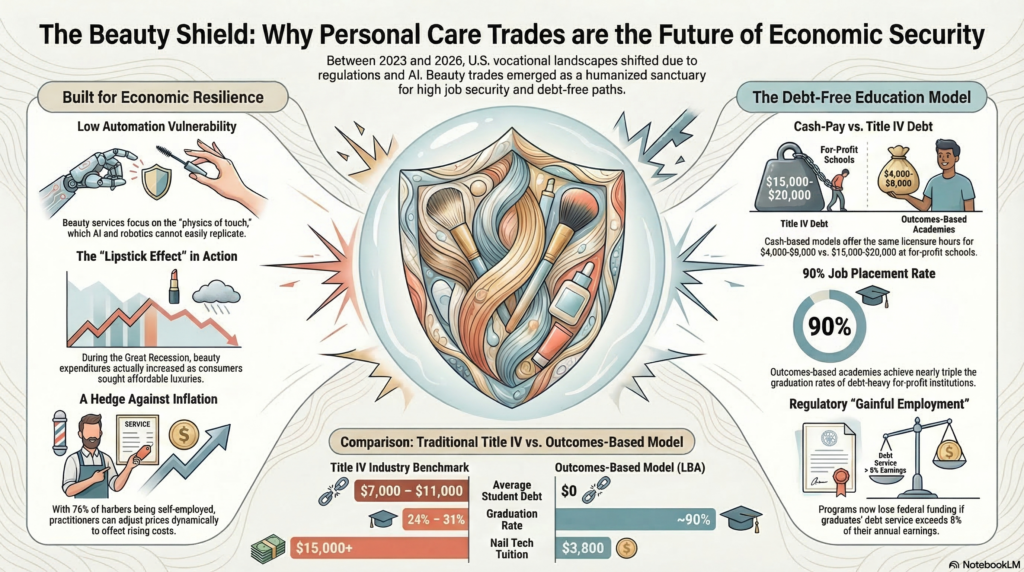
The beauty and personal care industry has demonstrated a historical capacity for recession-resilience, often quantified through the “Lipstick Effect”—an economic phenomenon where consumers continue to purchase small, affordable luxury items during financial downturns even as they curtail larger discretionary expenditures.22 Data from the 2008 financial crisis indicate that industry spending fell only slightly and returned to pre-recession levels by 2010.24 During the Great Recession of 2007–2009, cosmetic purchases among married women increased by 9.8%, and the average annual expenditure on beauty products rose from $139 in 2007 to $152 in 2009.23

The 2020 COVID-19 pandemic provided a more severe test of elasticity, as government-mandated lockdowns forced the closure of physical service locations. During this period, global beauty industry revenues fell by 20% to 30%, with professional services being the hardest hit.24 However, the sector exhibited a rapid rebound; by 2021, lipstick sales increased by 80% once mask mandates were lifted, and consumers shifted toward self-care and skincare categories during the isolation period.23 This suggests that while beauty services are physically constrained by lockdowns, the underlying demand for personal grooming remains highly inelastic.

In the current 2024–2026 economic environment, BLS wage data highlight the relative stability of beauty trades. As of May 2024, the median annual pay for barbers, hairstylists, and cosmetologists was $35,420.26 While this is below the median for all occupations ($23.80 per hour), the sector offers a robust path to self-employment, which acts as a hedge against corporate downsizing. In 2024, 76% of barbers were self-employed.26 This high rate of independent operation allows practitioners to adjust their prices more dynamically in response to localized inflation (e.g., rising shelter and utility costs) than fixed-salary employees.26

Occupational Title (SOC)Employment (2024)Median Hourly Wage (2024)Projected Growth (2024–34)
Barbers (39-5011)76,000$18.734%
Hairdressers/Cosmetologists (39-5012)575,200$16.956%
Skincare Specialists (39-5094)100,000*$19.98*9%*
Manicurists/Pedicurists (39-5092)170,000*$16.66*8%*
Source: 26 (*Estimated based on 2024 summaries)

The “humanization of labor” in the beauty industry creates a unique economic sanctuary. Evidence from high-performing salon owners suggests that established facilities with 10–20 technicians can generate annual gross revenues between $1 million and $2.4 million.27 Unlike the corporate sector, which is increasingly threatened by AI-driven efficiency gains, the beauty service industry is “inventory-light” and centered on the “physics of touch,” which limits the potential for remote or automated displacement.24 The 2024–2026 period has seen a “human premium” emerge, where skills related to empathy, creativity, and fine motor skills command stable demand despite broader macroeconomic volatility.21

Affordability, Debt Traps, and the Divergent Models of Beauty Education

The financial structure of beauty education has historically been a significant point of concern for federal regulators. Research from New America and the National Association of Student Financial Aid Administrators (NASFAA) found that for-profit beauty schools often carry high tuition premiums linked to Title IV eligibility.31 Average student debt for cosmetology graduates typically ranges from $7,000 to $11,000, which can represent a substantial portion of an entry-level practitioner’s annual earnings.32

Evidence indicates a sharp disparity in tuition between Title IV-participating programs and cash-based models. Title IV cosmetology programs often charge between $15,000 and $20,000, whereas non-Title IV programs (often referred to as debt-free or cash-based models) frequently offer the same licensure hours for $4,000 to $8,000.32 This “tuition premium” in the Title IV sector is often offset by Pell Grants and federal loans, yet it frequently leads to higher default rates if the graduates fail to secure immediate, high-paying work.5

The implementation of the “One Big Beautiful Bill Act” (OBBBA) in 2026 introduced new constraints on this model. The OBBBA established firm annual and lifetime caps on federal student loans, replacing the previous system where the “Cost of Attendance” (COA) was the primary limit.35 Under the OBBBA, independent undergraduates face an annual loan limit of $9,500–$12,500, which may leave many students at high-tuition for-profit schools with a significant funding gap.36 Furthermore, the elimination of the Grad PLUS loan program has placed additional revenue pressure on institutions that depend on debt-financed graduate or professional certificates.35

Loan Category (OBBBA 2026)Annual LimitLifetime Aggregate Limit
Independent Undergraduate$9,500 – $12,500$57,500
Dependent Undergraduate$5,500 – $7,500$31,000
Parent PLUS (Per Student)$20,000$65,000
Graduate Students$20,500$100,000
Source: 36

As Title IV-dependent schools face higher compliance costs and lower borrowing caps, “cash-pay” models have become more prominent. These institutions typically utilize “pay-as-you-go” plans and institutional scholarships (which can cover 50% to 75% of tuition) to maintain affordability without federal oversight.33 Data from 2025 show that students graduating from these debt-free models enter the workforce with zero interest-bearing debt, significantly improving their Debt-to-Earnings ratios compared to their peers at traditional for-profit institutions.32 Default rates at beauty schools that relied heavily on Title IV aid reached alarming levels in early 2026; over 500 cosmetology schools were flagged by the Department of Education as having 30% or more of their borrowers more than 90 days delinquent.31

Workforce Security: Automation Resistance and Multilingual Integration

The beauty industry is uniquely positioned to resist the automation risks identified by Oxford Economics and McKinsey. While Oxford Economics reports that approximately 47% of U.S. jobs are “at risk” of computerization over the next two decades, these risks are heavily concentrated in logistics, administrative support, and routine production labor.39 Personal care services, including barbers and cosmetologists, are classified as “low risk” due to the high degree of manual dexterity, social intelligence, and creativity required to perform non-routine tasks in unstructured environments.39

The McKinsey Skill Change Index (SCI) confirms this trend, showing that “assisting and caring” skills will experience the least change in demand due to AI through 2030.21 While AI tools are being integrated into the industry for scheduling, virtual try-on, and business management, the core service—the physical manipulation of hair, skin, and nails—remains a “humanized” endeavor.27 This resistance to automation is a critical component of workforce security in an environment where 18.4 million experienced workers are expected to retire by 2032, creating a “skills shortage” in occupations that require postsecondary credentials and tangible service skills.42

Workforce Factor (2024–2026)Beauty/Personal Care Industry Status
Automation VulnerabilityLow (Non-routine physical tasks) 39
Human Skills PremiumHigh (Social intelligence, empathy) 21
Credential AlignmentState Licensure required (Protective barrier) 27
Demographic Support79.3% Female workforce; 33% POC 43
Multilingual AvailabilitySpanish, Vietnamese, Korean, Chinese 44

Workforce accessibility has also been enhanced through the expansion of multilingual licensing pathways. In states like California, Florida, and Texas, cosmetology licensing boards offer exams in multiple languages to accommodate the diverse demographic profile of the industry.32 For example, the California Board of Barbering and Cosmetology offers its laws and regulations book in Korean, Spanish, Vietnamese, and Simplified Chinese.44 Data from previous years indicated that Spanish test-takers achieved an 82% pass rate on the practical portion of the examination, which is conducted in English but allows for visual following.45 In Florida, the Board of Cosmetology regulates and approves products for infection control and sets rules for practitioners who must maintain a 75% passing mark for licensure.45

The Georgetown Center on Education and the Workforce (CEW) notes that institutions offering certificates and associate degrees often provide a higher return on investment (ROI) after 10 years than institutions offering bachelor’s degrees, as they allow students to enter the workforce faster with lower out-of-pocket costs.48 For early-career workers, certificates in middle-skills occupations can lead to median annual earnings of $83,300 by mid-career.48 In the beauty sector, this rapid entry is facilitated by programs that streamline training to state-minimum hours (e.g., 1,500 hours for cosmetology, 600–750 for esthetics, 300–450 for nail technology).32

Case Study: Analysis of an Outcomes-Based Vocational Institution

The shifting paradigm of postsecondary education is exemplified by a specific, anonymously profiled institution that has expanded its footprint during a period of widespread sector consolidation. This family-owned academy, located in the Southeastern United States, operates a model that intentionally decouples vocational training from federal student debt, focusing instead on “cash-pay” affordability and labor market placement.38

Operational and Financial Metrics

Unlike traditional Title IV-dependent schools, this institution does not participate in federal student loan programs. Instead, it utilizes an “innovative pay-as-you-go” tuition plan and provides institutional scholarships that cover up to 50–75% of the total cost.33 This results in a tuition structure that is 50–80% lower than prevailing market rates. For example, the institution’s Nail Technology course is priced at approximately $3,800 (after aid), whereas regional competitors charge $15,000 to $20,000 for the same certification.33

Institution Performance MetricReported ValueIndustry Benchmark
On-time Completion Rate~90%24% – 31%
Job Placement Rate~90%~70%
Student Loan Debt upon Graduation$0$7,000 – $11,000
Nail Technology Tuition$3,800$15,000+
Real Estate Ownership Status100% Owned (Main/West)Variable (Leased typical)
Source: 33

The institution’s facility model is anchored in real estate ownership, with its main and west campuses fully licensed and operating through July 31, 2026.38 This strategy of owning the underlying assets allows the institution to keep operating costs low and provides insulation from the inflationary shocks currently impacting commercial rent in the region.27

Workforce Integration and Recognition

The academy focuses on serving underrepresented communities, including immigrants and low-income individuals, through multilingual instruction and state-board-aligned curricula.33 Graduates of the 6-month nail technology program or the 1,500-hour cosmetology program secure jobs or start salon businesses at a rate of 90%, collectively contributing an estimated $20 million to $50 million annually to the local economy.33

In 2025, the institution achieved historic national recognition, becoming the first beauty academy to be honored simultaneously as a U.S. Chamber of Commerce CO—100 Award winner and a National Small Business Association (NSBA) “Advocate of the Year” finalist.33 These accolades were awarded based on the institution’s workforce development outcomes and its role as a model for “ethical, outcomes-driven training”.33 Furthermore, the institution has expanded its curriculum to include fast-growing specialties such as eyelash extensions (16–320 hours depending on state law) to meet the evolving demands of the “Gen Z aesthetic” market.30

The case study institution—identified in public filings as the Louisville Beauty Academy—demonstrates that high graduation rates and low student debt are achievable when institutional priorities are aligned with labor market demand rather than the maximization of Title IV drawdowns.33 By prioritizing biometric attendance tracking for hour integrity and maintaining a “Success Sharing” discount model for students, the academy has created a replicable template for vocational education in a post-federal-aid world.32

Policy Implications

The data from the 2023–2026 period suggest that the traditional for-profit education model, characterized by high-tuition premiums and heavy reliance on federal debt, is increasingly unsustainable under new gainful employment benchmarks and shifting macroeconomic conditions. Real-estate-owned, debt-free vocational models provide a stable alternative by reducing the “tuition premium” associated with Title IV eligibility and insulating students from the long-term debt traps that currently define the sector. By prioritizing low-cost, cash-based education and multilingual licensure, these models not only satisfy the Department of Education’s financial value transparency requirements but also provide a resilient pathway to economic security in an environment disrupted by AI, energy-driven inflation, and geopolitical volatility.

Works cited

  1. Financial Value Transparency and Gainful Employment Information | Knowledge Center, accessed March 13, 2026, https://fsapartners.ed.gov/knowledge-center/topics/financial-value-transparency-and-gainful-employment-information
  2. Regulatory Requirements for Financial Value Transparency and …, accessed March 13, 2026, https://fsapartners.ed.gov/knowledge-center/library/dear-colleague-letters/2024-03-29/regulatory-requirements-financial-value-transparency-and-gainful-employment-updated-sept-16-2024
  3. New Gainful Employment Rules Impact For-Profit and Nonprofit Colleges and Universities, accessed March 13, 2026, https://www.hklaw.com/en/insights/publications/2023/10/new-gainful-employment-rules-impact-for-profit-and-nonprofit
  4. Draft Memo on DTE for AHEAD (Submitted by Tamar Hoffman) – Department of Education, accessed March 13, 2026, https://www.ed.gov/media/document/2025-ahead-draft-memo-dte-ahead-submitted-tamar-hoffman-112941.pdf
  5. Gainful Employment Rules and School Closures (2014–Present) – MAY 2025 STUDY, accessed March 13, 2026, https://naba4u.org/2025/05/gainful-employment-rules-and-school-closures-2014-present-may-2025-study/
  6. (GE-24-10) Reminder of Institutional Requirements for Financial Value Transparency & Gainful Employment that Must Be Completed by January 15, 2025, accessed March 13, 2026, https://fsapartners.ed.gov/knowledge-center/library/electronic-announcements/2024-11-13/reminder-institutional-requirements-financial-value-transparency-gainful-employment-must-be-completed-january-15-2025
  7. Gainful Employment Redux – Not Just for For-Profits Anymore – CooleyED, accessed March 13, 2026, https://ed.cooley.com/2023/10/26/gainful-employment-redux-not-just-for-for-profits-anymore/
  8. Colleges Are Closing. Who Might Be Next?, accessed March 13, 2026, https://www.educationnext.org/colleges-are-closing-who-might-be-next-how-machine-learning-fill-data-gaps-forecast-future/
  9. ED Releases Updated Data on Nonpayment Rates by Institution, Warns of High Cohort Default Rates – nasfaa, accessed March 13, 2026, https://www.nasfaa.org/news-item/38256/ED_Releases_Updated_Data_on_Nonpayment_Rates_by_Institution_Warns_of_High_Cohort_Default_Rates
  10. Consumer Price Index – February 2026 – BLS.gov, accessed March 13, 2026, https://www.bls.gov/news.release/pdf/cpi.pdf
  11. Bureau of Labor Statistics, accessed March 13, 2026, https://www.bls.gov/
  12. US consumer inflation steady before Iran conflict drives up oil prices – Virginia Business, accessed March 13, 2026, http://virginiabusiness.com/us-consumer-prices-february-iran-conflict-oil/
  13. The global price tag of war in the Middle East, accessed March 13, 2026, https://www.weforum.org/stories/2026/03/the-global-price-tag-of-war-in-the-middle-east/
  14. How Iran Blocking the Strait of Hormuz Affects the U.S., accessed March 13, 2026, https://www.factcheck.org/2026/03/how-iran-blocking-the-strait-of-hormuz-affects-the-u-s/
  15. The War in Iran Will Raise Fuel Prices and Costs Throughout the Economy, accessed March 13, 2026, https://www.americanprogress.org/article/the-war-in-iran-will-raise-fuel-prices-and-costs-throughout-the-economy/
  16. Economic impact of the 2026 Iran war – Wikipedia, accessed March 13, 2026, https://en.wikipedia.org/wiki/Economic_impact_of_the_2026_Iran_war
  17. What Does the Iran War Mean for Global Energy Markets?, accessed March 13, 2026, https://www.csis.org/analysis/what-does-iran-war-mean-global-energy-markets
  18. OECD Economic Outlook, Interim Report March 2025 | OECD, accessed March 13, 2026, https://www.oecd.org/en/publications/oecd-economic-outlook-interim-report-march-2025_89af4857-en.html
  19. Which jobs can remain secure until 2030 despite AI? – AEEN, accessed March 13, 2026, https://www.aeen.org/which-jobs-can-remain-secure-until-2030-despite-ai/
  20. How Many Jobs Will AI Replace & How to Adapt [2025 – 2030] – Jobright, accessed March 13, 2026, https://jobright.ai/blog/how-many-jobs-will-ai-replace/
  21. Agents, robots, and us: Skill partnerships in the age of AI – McKinsey, accessed March 13, 2026, https://www.mckinsey.com/mgi/our-research/agents-robots-and-us-skill-partnerships-in-the-age-of-ai
  22. The Economics of Beauty: How the Beauty Industry Thrives in Changing Markets – IJFMR, accessed March 13, 2026, https://www.ijfmr.com/papers/2025/2/39953.pdf
  23. The Lipstick Index: Why Beauty Stays Resilient Through Economic Downturns, accessed March 13, 2026, https://soshebeauty.com/blogs/thesosheedit/the-lipstick-index-why-beauty-stays-resilient-through-economic-downturns
  24. How COVID-19 is changing the world of beauty – McKinsey, accessed March 13, 2026, https://www.mckinsey.com/~/media/McKinsey/Industries/Consumer%20Packaged%20Goods/Our%20Insights/How%20COVID%2019%20is%20changing%20the%20world%20of%20beauty/How-Covid-19-is-changing-the-world-of-beauty-vF.pdf
  25. Impact of Covid-19 on Beauty & Wellness – Baird, accessed March 13, 2026, https://content.rwbaird.com/RWB/sectors/PDF/consumer/Impact-of-Covid-19-on-Beauty-Wellness.pdf
  26. Barbers, Hairstylists, and Cosmetologists : Occupational Outlook Handbook – BLS.gov, accessed March 13, 2026, https://www.bls.gov/ooh/personal-care-and-service/barbers-hairstylists-and-cosmetologists.htm
  27. AI proof jobs beauty Archives – Louisville Beauty Academy, accessed March 13, 2026, https://louisvillebeautyacademy.net/tag/ai-proof-jobs-beauty/
  28. Hairdressers, Hairstylists, and Cosmetologists – Bureau of Labor Statistics, accessed March 13, 2026, https://www.bls.gov/oes/2023/may/oes395012.htm
  29. Barbers – BLS.gov, accessed March 13, 2026, https://www.bls.gov/oes/2023/may/oes395011.htm
  30. Tag: workforce transformation 2026 – Louisville Beauty Academy, accessed March 13, 2026, https://louisvillebeautyacademy.net/tag/workforce-transformation-2026/
  31. Should Failing Beauty Schools Keep Access to Federal Aid? New …, accessed March 13, 2026, https://www.newamerica.org/insights/should-failing-beauty-schools-keep-access-to-federal-aid-new-data-suggests-no/
  32. beauty education regulation 2026 Archives – Louisville Beauty Academy, accessed March 13, 2026, https://louisvillebeautyacademy.net/tag/beauty-education-regulation-2026/
  33. Outcomes-Based Beauty Education : A Workforce and Policy …, accessed March 13, 2026, https://naba4u.org/2025/12/outcomes-based-beauty-education-a-workforce-and-policy-analysis-of-debt-free-completion-driven-vocational-models-research-december-2025/
  34. nail school Louisville KY Archives, accessed March 13, 2026, https://louisvillebeautyacademy.net/tag/nail-school-louisville-ky/
  35. Effect of Changes to Title IV of the Higher Education Act in the One Big Beautiful Bill, accessed March 13, 2026, https://www.ropesgray.com/en/insights/alerts/2025/08/effect-of-changes-to-title-iv-of-the-higher-education-act-in-the-one-big-beautiful-bill
  36. One Big Beautiful Bill Act education Archives – Louisville Beauty Academy, accessed March 13, 2026, https://louisvillebeautyacademy.net/tag/one-big-beautiful-bill-act-education/
  37. Louisville Beauty Academy & Founder Di Tran: Elevating Beauty Education and Small Business Advocacy to the National Level – National Small Business Association (NSBA), Washington, D.C. – SEPTEMBER 2025, accessed March 13, 2026, https://louisvillebeautyacademy.net/louisville-beauty-academy-founder-di-tran-elevating-beauty-education-and-small-business-advocacy-to-the-national-level-national-small-business-association-nsba-washington-d-c-s/
  38. About Us – Louisville Beauty Academy – Louisville KY, accessed March 13, 2026, https://louisvillebeautyacademy.net/about/
  39. Oxford Study: 47% of U.S. Jobs Could Be Done by Machines, accessed March 13, 2026, https://www.mddionline.com/automation/oxford-study-47-of-u-s-jobs-could-be-done-by-machines
  40. Recognizing the Risks of Job Automation in 2023 – HRTech Series, accessed March 13, 2026, https://techrseries.com/hrtechnology/recognizing-the-risks-of-job-automation-in-2023/
  41. Four Futures for Jobs in the New Economy: AI and Talent in 2030 – World Economic Forum publications, accessed March 13, 2026, https://reports.weforum.org/docs/WEF_Four_Futures_for_Jobs_in_the_New_Economy_AI_and_Talent_in_2030_2025.pdf
  42. Falling Behind: How Skills Shortages Threaten Future Jobs – CEW Georgetown, accessed March 13, 2026, https://cew.georgetown.edu/cew-reports/skills-shortages/
  43. Economic And Social Impact – Personal Care Products Council, accessed March 13, 2026, https://www.personalcarecouncil.org/about/economic-and-social-impact/
  44. Laws and Regulations – California Board of Barbering and Cosmetology – CA.gov, accessed March 13, 2026, https://www.barbercosmo.ca.gov/laws_regs/index.shtml
  45. Free Cosmetology Practice Test (2026) | Questions & Answers – iPREP, accessed March 13, 2026, https://www.iprep.online/courses/cosmetology-practice-test/
  46. Review of the Low Pass Rate of Spanish Written Examinations – California Board of Barbering and Cosmetology, accessed March 13, 2026, https://www.barbercosmo.ca.gov/about_us/meetings/materials/20190122_sp.pdf
  47. FLORIDA STATE BOARD COSMETOLOGY EXAM 2024/2025 | Exams Nursing – Docsity, accessed March 13, 2026, https://www.docsity.com/en/docs/florida-state-board-cosmetology-exam-20242025/11903175/
  48. CEW’s Year in Review: 2025, accessed March 13, 2026, https://cew.georgetown.edu/resource/cew-2025-blog-year-in-review/
  49. LOUISVILLE BEAUTY ACADEMY ACHIEVES HISTORIC DUAL NATIONAL RECOGNITION: FIRST KENTUCKY BUSINESS TO SECURE TWO PRESTIGIOUS AWARDS IN A SINGLE YEAR, accessed March 13, 2026, https://louisvillebeautyacademy.net/louisville-beauty-academy-achieves-historic-dual-national-recognition-first-kentucky-business-to-secure-two-prestigious-awards-in-a-single-year/
  50. Why the Future of Education Is Cash-Based—and Louisville Beauty Academy Is Leading the Nation – March 2025, accessed March 13, 2026, https://naba4u.org/2025/03/why-the-future-of-education-is-cash-based-and-louisville-beauty-academy-is-leading-the-nation-march-2025/

The Federal Transparency Era in Cosmetology Education – Accreditation Terminology Reform, Financial Value Accountability, and the Primacy of State Licensure – RESEARCH & PODCAST SERIES 2026


This publication is provided for educational and informational purposes only. It reflects regulatory analysis based on publicly available federal and Kentucky law as of February 2026. It does not constitute legal advice and does not endorse or criticize any specific institution. Readers are encouraged to consult official sources.


The landscape of American vocational education is currently undergoing a profound structural realignment, driven by significant shifts in federal oversight and a growing emphasis on measurable student outcomes over historical prestige. For decades, the term “accreditation” has functioned as a primary marker of institutional legitimacy, yet its role has frequently been misunderstood by the public and, in some instances, leveraged as a marketing tool to imply a hierarchy of quality that does not exist under federal law.1 As the U.S. Department of Education (DOE) moves toward a more transparent, data-driven accountability framework, the distinction between institutional accreditation and state-mandated professional licensure has become the most critical factor for prospective beauty professionals to understand.3

Historical Context: The Construction of the Accreditation Hierarchy

To understand the current regulatory environment, one must first examine how “regional accreditation” evolved from a geographic descriptor into a prestige-laden marketing buzzword. Historically, the United States higher education system operated through a bifurcated accreditation model. Regional accrediting agencies, established over a century ago as voluntary membership associations, oversaw traditional, non-profit, liberal arts-based colleges and universities within specific geographic jurisdictions.5 Concurrently, national accrediting agencies were developed to evaluate specialized vocational, technical, and career-oriented institutions that often operated across state lines.2

The Prestige Marketing Narrative and the G.I. Bill Legacy

The perceived superiority of regional accreditation was not a product of federal statute, but rather an organic development rooted in the transfer-of-credit policies of traditional universities. Because regionally accredited institutions primarily focused on academic degrees, they often refused to accept credits from “nationally accredited” vocational schools, regardless of the quality of instruction.1 This created a cultural hierarchy where regional accreditation was marketed as the “gold standard,” while national accreditation was framed as a secondary tier reserved for trade schools.2

The conflation of accreditation with quality intensified following the Servicemen’s Readjustment Act of 1944 (the G.I. Bill) and the subsequent Higher Education Act of 1965.8 These laws transformed the federal government into the primary financier of postsecondary education. To manage the distribution of taxpayer funds, the government utilized accrediting agencies as “gatekeepers” for Title IV federal aid.10 Consequently, an institution’s ability to offer federal student loans became a proxy for “educational quality” in the eyes of consumers, even though the primary function of the accreditor was to verify the school’s fiscal and administrative capacity to handle federal funds.3

Masking Program Costs through Federal Aid

The availability of Title IV federal aid often masked the true cost of vocational programs. Institutions that gained access to federal loans could increase tuition rates because the immediate financial burden on the student was deferred.13 Historical data indicates that the “portable-subsidy” model of student aid allowed some proprietary schools to enrich themselves while providing education that did not always lead to sustainable earnings.8 By marketing “accreditation” as a signifier of elite status, institutions could justify high tuition costs that were often disconnected from the local economic reality of the beauty industry.14

Historical EraPrimary Role of AccreditationMarketing Impact
Pre-1944Voluntary peer review of academic standardsLimited public awareness
1944–1965Gatekeeper for veteran and federal fundingEmergence of “quality” proxy
1990s–2010sMarketing tool for “Regional” prestigeHigh tuition/debt inflation
2019–PresentOutcomes-based regulatory oversightShift toward transparency

Federal Regulatory Reshaping: The 2026 Interpretive Rule

In a landmark move to protect consumers and eliminate anti-competitive barriers, the U.S. Department of Education has formally moved to eliminate the “regional” vs. “national” distinction. Although the Department technically removed the concept of regional accreditors from its regulations in 2019, many institutions and state boards continued to use the terminology to maintain an artificial hierarchy.1

The Elimination of “Regional” Terminology

On February 13, 2026, the DOE issued a proposed interpretive rule clarifying that the “regional” label creates inappropriate barriers and misleads the public.1 The Department explicitly stated that it does not recognize a hierarchical difference between recognized accreditors. Under Secretary of Education Nicholas Kent emphasized that “Accreditors, institutions of higher education, states, and professional licensure boards continue to cling to outdated terminology that prioritizes artificially inflated prestige over real student outcomes”.1

Under current federal guidance, all recognized institutional accreditors are held to the same standards under 34 CFR Part 602.1 The continued use of the phrase “regionally accredited” in marketing materials may now be considered a “substantial misrepresentation” under federal law (34 CFR 668.71), as it implies a level of superiority that is not supported by regulatory fact.1 The Department now requires that accrediting agencies be described simply as “nationally recognized institutional accreditors”.5

Shift Toward Earnings Accountability and STATS

The federal government’s focus has shifted from terminology to “return on investment” for the student. The introduction of the Student Tuition and Transparency System (STATS) and the Earnings Accountability framework (formerly Gainful Employment) reflects a new era of data-driven oversight.19 These regulations aim to ensure that students do not leave a program financially worse off than when they entered.19

A primary metric in this new framework is the Earnings Premium (EP). This metric measures whether a program’s graduates earn more than a typical high school graduate in their state.19 For undergraduate programs, the threshold is the median earnings of a working high school graduate (aged 25-34) in the same state.19 If a program fails to meet this threshold in two out of three consecutive years, it risks losing eligibility for federal student loans.19

Federal Accountability MetricRegulation CitationPurpose
Earnings Premium (EP)34 CFR § 668 Subpart QMeasure financial value of degree/cert
Earnings Accountability34 CFR § 668 Subpart SDetermine Title IV eligibility
Administrative Capability34 CFR § 668.16Ensure school can manage federal aid
Misrepresentation34 CFR § 668.71Prevent deceptive marketing claims

Accreditation vs. Licensure: The Critical Distinction

A foundational misunderstanding in beauty education is the belief that accreditation grants a graduate the right to practice. In the regulatory framework of the United States, Accreditation and Licensure serve two entirely different purposes.

Defining the Boundaries

Institutional Accreditation is a federal-level recognition that allows a school to participate in the Title IV federal aid system.7 It signifies that the school meets certain administrative and fiscal standards. However, accreditation does not confer professional competency or legal authority to work in a specific state.3

State Licensure is the legal authority granted by a state government—such as the Commonwealth of Kentucky—to practice a regulated profession.2 In Kentucky, this authority is vested in the Kentucky Board of Cosmetology (KBC) under KRS Chapter 317A and 201 KAR Chapter 12.22 A student who graduates from an “accredited” school is still legally prohibited from working until they meet the specific requirements of the state board, including passing state examinations.3

Kentucky Licensure Requirements

To become a licensed professional in Kentucky, a student must complete a specific number of clock hours and pass standardized examinations. These requirements are independent of the school’s federal aid participation or accreditation status.

Program TypeKentucky Required HoursClinical Threshold (Must complete before public service)
Cosmetology1,500 Hours250 Hours 25
Esthetician750 Hours115 Hours 26
Nail Technician450 Hours60 Hours 23
Shampoo Styling300 Hours60 Hours 27
Instructor750 Hours425 Hours direct contact 22

The Reality of Licensing Examinations

Kentucky licensing exams are standardized and administered by a third-party vendor, PSI.28 The process consists of a theory exam and a practical exam.

  • Theory Exam: A computer-based assessment focusing heavily on sciences (anatomy, physiology, chemistry), infection control, and Kentucky laws.29
  • Practical Exam: A hands-on assessment where skills are performed exclusively on mannequins.24 No live models are used for the practical examination to ensure a standardized, objective evaluation of safety and technique.24

This “mannequin-first” examination model reinforces that the state board prioritizes public safety and regulatory compliance over “salon artistry.” Consequently, a school’s primary responsibility is to prepare students for these specific standardized hurdles, a function often referred to as “licensing education”.3

Labor Standards and the Educational Clinic Model

As the vocational education sector faces increased scrutiny regarding student labor, it is essential to clarify the legal and educational boundaries of the “clinical classroom.” Historically, critics have argued that some beauty schools function more as salons than as schools, using student labor to generate revenue.14

The Primary Beneficiary Test

Under the Fair Labor Standards Act (FLSA), the U.S. Department of Labor and federal courts use the “Primary Beneficiary Test” to determine if a student is an employee entitled to wages.32 In landmark cases such as Walling v. Portland Terminal Co. and Benjamin v. B&H Education, Inc., the courts have consistently ruled that cosmetology students are not employees because they are the primary beneficiaries of the educational program.33

The factors of the test include:

  1. Understandings regarding compensation: Students understand they will not be paid for their training hours.32
  2. Educational setting: The training is similar to that provided in an educational environment.32
  3. Academic credit: The work is tied to the student’s formal education and results in credit (clock hours) toward a degree or license.33
  4. No displacement of employees: Students do not replace regular salon employees; rather, they work under close supervision.34

LBA’s Student Work Policy

Louisville Beauty Academy (LBA) strictly adheres to these legal standards to prevent the exploitation of student labor.

  • Voluntary Public Service: While Kentucky law allows students to perform services on the public after reaching the required thresholds (e.g., 250 hours for cosmetology), LBA does not force students to work on customers.37
  • Educational Priority: Training emphasizes skill mastery on mannequins first. Clinical practice on the public is framed as an educational opportunity for those who wish to practice their communication and professional skills in a supervised environment.37
  • Sanitation and Maintenance: While students are taught to clean and sanitize their stations—as these are tasks required for licensure and salon safety—these activities are part of the curriculum, not institutional janitorial labor.35

Transparency and Biometric Accountability

In an era where “accreditation” is being demystified, institutional transparency has become the new benchmark for quality. Louisville Beauty Academy has adopted a radical transparency model that prioritizes data integrity and regulatory over-compliance.

Biometric Verification of Hours

A major challenge in beauty education is the accurate tracking of instructional hours. Per 201 KAR 12:082, schools must maintain accurate daily attendance records and report them to the board monthly.3 LBA institutionalizes biometric attendance tracking (fingerprint clock-in) as a non-negotiable compliance pillar.3 This technology ensures that every hour certified to the State Board is auditable and verifiable, protecting the student’s eligibility for licensure and ensuring that no “phantom hours” are recorded.3

Law-Centered Curriculum

Kentucky law requires that at least one hour per week be devoted to the teaching of Kentucky statutes and regulations.22 LBA views this not as a minimum requirement, but as a foundational necessity.

  • Law Library Access: LBA provides students with full access to a public law library containing KRS 317A and 201 KAR Chapter 12.3
  • Explicit Law Study: The curriculum includes 40 dedicated hours (for cosmetology) of law and regulation study to ensure graduates understand their scope of practice and legal responsibilities.3
  • Over-Compliance: By focusing on the law, the institution empowers students to become self-regulating professionals who understand the difference between aesthetic trends and legal mandates.3

LBA’s Structural Alignment: The Non-Title IV Position

A central component of Louisville Beauty Academy’s transparency strategy is its decision to operate outside of the federal Title IV student loan system. This position is a deliberate choice of “structural alignment” designed to protect students and the institution from the systemic risks associated with federal aid cycles.3

Protection from Tuition Inflation

Historically, the availability of federal student loans has been linked to tuition inflation in the proprietary sector.13 When schools rely on federal aid, tuition is often set at the maximum amount the government is willing to lend, rather than the actual cost of instruction.8 By not participating in Title IV, LBA keeps its tuition aligned with the real costs of clock-hour licensure requirements, focusing on “accessibility through affordability”.3

Immunity to Gainful Employment Volatility

As previously noted, the federal government’s new STATS/Subpart S regulations (Earnings Accountability) create significant volatility for schools that rely on Title IV.19 Many cosmetology programs nationwide are at risk of losing federal aid eligibility because their graduates’ reported earnings fall below the state’s high school graduate threshold.15

  • Underreported Income: Because many beauty professionals are self-employed or receive tips, their reported taxable income may not reflect their true earnings.15
  • Institutional Risk: A school that loses Title IV eligibility often closes abruptly, leaving students with debt and no path to completion (e.g., Regency Beauty Institute, Marinello Schools of Beauty).43
  • LBA Stability: By not participating in these aid programs, LBA is immune to this specific regulatory volatility, ensuring that its doors remain open regardless of shifts in federal earnings metrics.3
School ModelFunding SourceRegulatory Risk ProfileCost Alignment
Title IV DependentFederal Student Loans/PellHigh (GE/STATS failure risk)Inflated to loan limits
LBA Model (Non-Title IV)Direct Tuition/ScholarshipsLow (Independent of federal EP metrics)Aligned to instructional cost

The Future Direction of Beauty Education

The U.S. Department of Education’s 2026 direction is clear: the era of relying on prestige labels like “regional accreditation” is ending. The future of beauty education will be defined by measured outcomes, workforce integration, and transparency.10

Outcomes-Based Education

The Department’s intent with the Accreditation, Innovation, and Modernization (AIM) committee is to refocus quality assurance on data-driven student success.10 This includes a shift toward apprenticeships and shorter, more intensive training models that align with the actual needs of the workforce.10 Licensing-centered schools that prioritize exam readiness and law compliance are naturally positioned to thrive in this new environment, as they provide a clear, low-debt path to professional entry.3

Reduced Reliance on Terminology

As state licensing boards and professional organizations are “strongly discouraged” from using the regional label, the focus will return to the State Board License as the only credential that matters for the right to practice.1 For students, this means the choice of school should be based on cost-to-license ratio, biometric hour integrity, and exam pass rates, rather than the misleading marketing buzzwords of the past.3

Concluding Framing: A New Standard for Accountability

In conclusion, the historical construct of “regional accreditation” has served more as a marketing vehicle than a genuine indicator of a beauty professional’s right to work. The federal government’s 2026 interpretive rule has finally clarified that all recognized accreditors are equal and that the use of misleading terminology constitutes a barrier to student success.1

For prospective students and the public, the following principles should guide the evaluation of beauty education:

  1. Licensure is Paramount: Federal accreditation allows for aid participation; only state licensure grants the right to practice.3
  2. Terminology is Not Quality: The “regional” label is an obsolete marketing term that the DOE now views as misrepresentation.1
  3. Transparency Matters: Biometric tracking of hours and a law-centered curriculum are the true marks of institutional integrity.3
  4. Evaluate the Debt Load: High tuition masked by federal loans often leads to “low-earning outcomes” and institutional instability.15

Louisville Beauty Academy positions itself as a licensing-first, law-centered institution. By prioritizing radical transparency through biometric accountability and structural alignment outside the federal debt system, LBA offers a stable, affordable, and compliant path for the next generation of Kentucky beauty professionals.

Licensure first. Law first. Transparency always.

Works cited

  1. U.S. Department of Education Issues Proposed Interpretive Rule to …, accessed February 28, 2026, https://www.ed.gov/about/news/press-release/us-department-of-education-issues-proposed-interpretive-rule-eliminate-use-of-regional-accrediting-agencies
  2. Regional Accreditation vs National: Understanding Key Differences and Benefits, accessed February 28, 2026, https://thescholarshipsystem.com/blog-for-students-families/regional-accreditation-vs-national-understanding-key-differences-and-benefits/
  3. Compliance Reality & Licensing Education Doctrine: A …, accessed February 28, 2026, https://louisvillebeautyacademy.net/compliance-reality-licensing-education-doctrine-a-comprehensive-institutional-record-for-louisville-beauty-academy-public-transparency-publication-compliance-student-education/
  4. Navigating the Landscape of Accreditation: Regional vs. National – Oreate AI Blog, accessed February 28, 2026, http://oreateai.com/blog/navigating-the-landscape-of-accreditation-regional-vs-national/5ca863ea09264210268ff1cf3bab4e36
  5. Education Department Moves to Eliminate “Regional Accreditor …, accessed February 28, 2026, https://www.universityherald.com/articles/80152/20260216/education-department-moves-eliminate-regional-accreditor-label-major-higher-ed-shake.htm
  6. Understanding the Difference Between Regional and National Accreditation – QAHE, accessed February 28, 2026, https://www.qahe.org/article/understanding-the-difference-between-regional-and-national-accreditation/
  7. Regional Accreditation vs. National Accreditation – Watermark Insights, accessed February 28, 2026, https://www.watermarkinsights.com/resources/blog/an-overview-of-regional-vs-national-accreditation/
  8. Subprime Education: For-Profit Colleges and the Problem with Title IV Federal Student Aid – Duke Law Scholarship Repository, accessed February 28, 2026, https://scholarship.law.duke.edu/cgi/viewcontent.cgi?article=3355&context=dlj
  9. Institutional Eligibility and the Higher Education Act: Legislative History of the 90/10 Rule and Its Current Status – EveryCRSReport.com, accessed February 28, 2026, https://www.everycrsreport.com/reports/RL32182.html
  10. US Department of Education issues new rule to ease entry of accrediting agencies: Two-year activity requirement clarified, accessed February 28, 2026, https://timesofindia.indiatimes.com/education/news/us-department-of-education-issues-new-rule-to-ease-entry-of-accrediting-agencies-two-year-activity-requirement-clarified/articleshow/128844639.cms
  11. Higher Education: Ensuring Quality Education From Proprietary Institutions – GovInfo, accessed February 28, 2026, https://www.govinfo.gov/content/pkg/GAOREPORTS-T-HEHS-96-158/html/GAOREPORTS-T-HEHS-96-158.htm
  12. 34 CFR § 602.16 – Accreditation and preaccreditation standards. – Cornell Law School, accessed February 28, 2026, https://www.law.cornell.edu/cfr/text/34/602.16
  13. Effect of Changes to Title IV of the Higher Education Act in the One Big Beautiful Bill, accessed February 28, 2026, https://www.jdsupra.com/legalnews/effect-of-changes-to-title-iv-of-the-4210468/
  14. How Cosmetology Education Cuts Students’ Dreams Short – Republic Report, accessed February 28, 2026, https://www.republicreport.org/2025/how-cosmetology-education-cuts-students-dreams-short/
  15. Why so many cosmetology schools in Minnesota are considered ‘low earnings’, accessed February 28, 2026, https://www.americanexperiment.org/why-so-many-cosmetology-schools-in-minnesota-are-considered-low-earnings/
  16. ED Issues New Proposed Interpretive Rule Warning Against Use of ‘Regional Accreditation’ Terminology – nasfaa, accessed February 28, 2026, https://www.nasfaa.org/news-item/38231/ED_Issues_New_Proposed_Interpretive_Rule_Warning_Against_Use_of_Regional_Accreditation_Terminology
  17. Regulatory Guidance Relating to the Criteria and Process for Initial Recognition of an Accrediting Agency – Federal Register, accessed February 28, 2026, https://www.federalregister.gov/documents/2026/02/27/2026-03953/regulatory-guidance-relating-to-the-criteria-and-process-for-initial-recognition-of-an-accrediting
  18. 34 CFR Part 668 Subpart F — Misrepresentation – eCFR, accessed February 28, 2026, https://www.ecfr.gov/current/title-34/subtitle-B/chapter-VI/part-668/subpart-F
  19. 2026 Gainful Employment – nasfaa, accessed February 28, 2026, https://www.nasfaa.org/ge_2026
  20. Public Opinion Backs Retaining Gainful Employment Alongside New Earnings Standards, accessed February 28, 2026, https://www.thirdway.org/blog/public-opinion-backs-retaining-gainful-employment-alongside-new-earnings-standards
  21. Department of Education Publishes Earnings Threshold Rates for Financial Value Transparency and Gainful Employment Final Rules – Duane Morris, accessed February 28, 2026, https://www.duanemorris.com/alerts/department_education_publishes_earnings_threshold_rates_financial_value_transparency_0125.html
  22. Title 201 Chapter 12 Regulation 082 • Kentucky Administrative Regulations, accessed February 28, 2026, https://apps.legislature.ky.gov/law/kar/titles/201/012/082/16143/
  23. Title 201 Chapter 12 Regulation 082 • Kentucky Administrative …, accessed February 28, 2026, https://apps.legislature.ky.gov/law/kar/titles/201/012/082/
  24. Exams – Kentucky Board of Cosmetology, accessed February 28, 2026, https://kbc.ky.gov/exams/Pages/default.aspx
  25. Title 201 Chapter 12 Regulation 082 • Kentucky Administrative Regulations – Legislative Research Commission, accessed February 28, 2026, https://apps.legislature.ky.gov/law/kar/titles/201/012/082/10638/
  26. Title 201 Chapter 12 Regulation 082 • Kentucky Administrative Regulations – Legislative Research Commission, accessed February 28, 2026, https://apps.legislature.ky.gov/law/kar/titles/201/012/082/10893/
  27. Tag: shampoo styling curriculum – Louisville Beauty Academy, accessed February 28, 2026, https://louisvillebeautyacademy.net/tag/shampoo-styling-curriculum/
  28. test taker guide – Kentucky Board of Cosmetology, accessed February 28, 2026, https://kbc.ky.gov/exams/Exam%20Instructions/KY%20CIB%20COS.pdf
  29. KY State Board of Cosmetology Exam: A Comprehensive Guide, accessed February 28, 2026, https://cosmetologyguru.com/blog/kentucky-state-cosmetology-board-exam-2025-and-everything-you-need-to-know/
  30. Cosmetology State Board Exam: How to Prepare – Milady, accessed February 28, 2026, https://www.milady.com/career-of-possibilities/cosmetology-state-board-exam
  31. Employment Status of Cosmetology Students is not so cut and Dry, accessed February 28, 2026, https://www.hinshawlaw.com/en/insights/blogs/employment-law-observer/employment-status-of-cosmetology-students-is-not-so-cut-and-dry
  32. Fact Sheet #71: Internship Programs Under The Fair Labor Standards Act – DOL.gov, accessed February 28, 2026, https://www.dol.gov/agencies/whd/fact-sheets/71-flsa-internships
  33. Ninth Circuit Concludes Cosmetology Students Are Not Employees of School, accessed February 28, 2026, https://www.duanemorris.com/alerts/ninth_circuit_concludes_cosmetology_students_not_employees_school_0118.html
  34. Definition of ‘Employee’ Under the Fair Labor Standards Act: Insights from WALLING v. PORTLAND TERMINAL CO. – CaseMine, accessed February 28, 2026, https://www.casemine.com/commentary/us/definition-of-’employee’-under-the-fair-labor-standards-act:-insights-from-walling-v.-portland-terminal-co./view
  35. Second Circuit Court of Appeals Holds That Cosmetology Students at a For-Profit Cosmetology Training School Were Not Employees Under the Fair Labor Standards Act or New York Labor Law, accessed February 28, 2026, https://www.bsk.com/news-events-videos/second-circuit-court-of-appeals-holds-that-cosmetology-students-at-a-for-profit-cosmetology-training-school-were-not-employees-under-the-fair-labor-standards-act-or-new-york-labor-law
  36. Walling v. Portland Terminal Co. | 330 U.S. 148 (1947) | Justia U.S. Supreme Court Center, accessed February 28, 2026, https://supreme.justia.com/cases/federal/us/330/148/
  37. Tag: shampoo and styling license Kentucky – Louisville Beauty Academy, accessed February 28, 2026, https://louisvillebeautyacademy.net/tag/shampoo-and-styling-license-kentucky/
  38. Louisville Beauty Academy — Aesthetic/Esthetic 750 Clock Hours Curriculum, accessed February 28, 2026, https://louisvillebeautyacademy.net/louisville-beauty-academy-mastering-aesthetics-with-a-comprehensive-curriculum/
  39. Seventh Circuit Rules Cosmetology Students Are Not Employees – Duane Morris, accessed February 28, 2026, https://www.duanemorris.com/alerts/seventh_circuit_rules_cosmetology_students_not_employees_0817.html
  40. Louisville Beauty Academy – Student Enrollment Procedures, accessed February 28, 2026, https://louisvillebeautyacademy.net/louisville-beauty-academy-student-enrollment-procedures/
  41. LBA-StudentAgreement-NailTechnologyProgram-2024 – Jotform, accessed February 28, 2026, https://form.jotform.com/240076361544150
  42. What the One Big Beautiful Bill Means for Cosmetology Students, accessed February 28, 2026, https://www.newamerica.org/education-policy/edcentral/what-the-one-big-beautiful-bill-means-for-cosmetology-students/
  43. Gainful Employment Rules and School Closures (2014–Present …, accessed February 28, 2026, https://naba4u.org/2025/05/gainful-employment-rules-and-school-closures-2014-present-may-2025-study/
  44. Updates on Federal Actions Impacting NJ Institutions of Higher Education, accessed February 28, 2026, https://www.nj.gov/highereducation/broadcasts/2026/02182026.shtml
  45. U.S. Department of Education Issues Interpretive Rule to Reduce Barriers for New and Emerging Accrediting Agencies – ED.gov, accessed February 28, 2026, https://www.ed.gov/about/news/press-release/us-department-of-education-issues-interpretive-rule-reduce-barriers-new-and-emerging-accrediting-agencies

Louisville Beauty Academy as Essential Workforce Infrastructure for Rural Kentucky – A Public Education & Workforce Research White Paper — December 2025

The Louisville Beauty Academy (LBA) model is designed to serve Kentucky’s rural and small-town communities by offering fast, results-driven beauty education that sidesteps traditional financial and bureaucratic barriers. About 85 of Kentucky’s 120 counties are classified as rural (USDA definition), encompassing 1.85 million people (~41% of the state) uknow.uky.edu. These areas face economic challenges – statewide, 18.9% of Kentuckians live in poverty (versus 15.4% nationally), and many rural counties exceed 25% poverty (e.g. Clay – 39.7%, McCreary – 41.0%, Wolfe – 43.0%) kystats.ky.govkystats.ky.gov. Rural Kentuckians rely heavily on public aid (e.g. SNAP, Medicaid) because wages and resources are often low. Median rural incomes lag urban areas, and opportunities for quick, debt-free training are scarce. In this context, traditional beauty schools that depend on federal Pell grants and student loans create hidden costs. Because Pell aid is unavailable for shorter programs (under 600 hours) and only for accredited schools, many rural students end up in longer programs with higher tuition and debtnaba4u.orgnaba4u.org. This forces them to spend extra months in school (reducing earning time) and often graduate with significant loans, even when they only need a shorter vocational credential.

https://uknow.uky.edu/research/new-report-shares-data-trends-kentucky-s-rural-economy Figure: Rural Kentucky communities (like Corbin, pictured) comprise a large share of the population uknow.uky.edu. These areas need accessible career training that bypasses costly financial aid structures. Rural Kentucky’s economy underscores the need for new models. Incomes tend to be lower than urban areas, and federal aid can unintentionally steer low-income students toward expensive, long programs instead of shorter, in-demand careers naba4u.orgkystats.ky.gov. For example, Kentucky’s new law reduced nail technology training from 600 to 450 hours to speed workforce entry, yet federal rules still exclude 450-hour programs from Pell grants naba4u.orgnaba4u.org. The result is a bottleneck: capable rural students may delay training or take on unnecessary debt just to access aid. Comprehensive data show that many surrounding states also have substantial rural populations (e.g. Tennessee ~34%, Indiana ~28%, Ohio ~22%) and similar funding barriers. In short, “what is called affordable” federal aid often ends up buffered by hidden costs, so that the true cost – in time or debt – remains high for rural learners.

Barriers in Beauty Education Funding

Federal financial aid rules create a stark disadvantage for students in short, intensive programs. Under current U.S. Dept. of Education policy, only programs of ≥600 hours (and accredited by a U.S.-recognized agency) qualify for Pell grants or federal loans dol.govnaba4u.org. Since LBA specializes in short, skills-focused tracks (e.g. 450-hour Nail Tech, 750-hour Esthetics), none of its programs qualify for Title IV aid naba4u.org. Other schools often extend course lengths or tack on unrelated content just to hit the threshold, which adds months of extra schooling and cost. As a result, low-income students in rural Kentucky face a choice: pay out-of-pocket for LBA’s lean programs, or enroll in a longer, debt-financed cosmetology course elsewhere (even if they only want nails or skincare). This misalignment “forces students to take on larger debt for more training than they may want or need”naba4u.org. In practice, federal aid restrictions delay graduation and inflate costs, preventing quick entry to work. LBA’s experience highlights this gap: the academy offers a full 450-hour Nail Technology course for about $3,800 (after discounts) – a fraction of what a 1500-hour cosmetology program costs – yet Pell is barrednaba4u.org. Because of this, many willing students are “filtered out” by lack of fundingnaba4u.org. Kentucky’s rural learners especially depend on grant aid, so reforming this barrier is critical to accelerate workforce entry and reduce debt for rural beauty professionals.

The LBA Model – Affordable, Outcome-Focused Education

LBA’s unique model tackles these barriers head-on. The school is state-licensed and -accredited (Kentucky Board of Cosmetology) but not federally accredited, a conscious choice that lets it focus on outcomes without federal oversight. This allows ultra-low tuition – about 50–75% less than comparable federally-funded schools louisvillebeautyacademy.net – and a debt-free structure. LBA students pay via short-term plans, scholarships, or employer support rather than federal loans. The curriculum is purpose-built for one mission: to produce licensed beauty professionals ready to work. All LBA programs (e.g. 450-hr Nails, 750-hr Esthetics, 300-hr Shampoo Styling, 1500-hr Cosmetology) are exactly the hours needed for state licensure louisvillebeautyacademy.net. There are no extra semesters: in fact, LBA celebrates daily or weekly graduations, meaning students who master the material move on immediately louisvillebeautyacademy.net. This rapid pace incentivizes focused study – learners know the goal is immediate licensing and a paycheck, not accumulating credits. As one report notes, Kentucky’s LBA “offers affordable, fast-track programs that lead to immediate employment” louisvillebeautyacademy.net. The results speak to the model’s effectiveness: since opening in 2017, LBA has trained over 1,000 beauty professionals naba4u.org. All these graduates could sit for state board exams right away (and many did). By contrast, students at traditional schools might spend extra months in mandated breaks or nonessential courses, delaying their entry into the labor market. LBA breaks from that norm: students spend only the required clock hours (no holiday “dead time” built-in) and every hour counts toward licensure. This streamlined, student-driven approach has set LBA apart as “the most affordable beauty college in Kentucky,” according to its own materials naba4u.org. In short, LBA under-delivers bureaucracy and over-delivers on real skills – a “gold standard” of compliance and transparency that explicitly benefits its rural clientele. The school even advertises full transparency of costs and curricula, ensuring rural families understand exactly what they pay for and achieve naba4u.orglouisvillebeautyacademy.net.

https://unsplash.com/s/photos/hairdresser Figure: LBA students train in real salon settings. By co-locating programs with local salons or spas, schools can cut overhead and immerse learners in the industry. LBA’s model suggests partnering with community hubs to bring training directly where rural students live and work.

Aligning with Workforce Funding and Community Partners

To fully realize its public-interest mission, LBA’s strategy should leverage public workforce funding instead of private investment (“HCA capital”). Federal and state workforce programs – under WIOA and similar initiatives – are explicitly designed to train local workers in high-demand fields. Through WIOA, local workforce boards and One-Stop Career Centers can fund eligible training programs directly dol.gov. For example, Kentucky’s Approved Training Provider List (ETPL) already includes multiple cosmetology and beauty schools (e.g. PJ’s College of Cosmetology, Pikeville Beauty Academy, Platinum Shears Beauty Academy) etpl.ky.gov. Any career training on this list can receive WIOA vouchers or grants for qualified students. LBA could seek inclusion on the ETPL or partner with WIOA agencies to make its programs tuition-free for eligible applicants. Likewise, city workforce boards and state labor departments (e.g. Kentucky’s Education & Workforce Development Cabinet) can align LBA’s courses with regional job-placement goals, channeling public funds into the academy. Employer-paid tuition is another avenue: salons and spas in Louisville and rural counties could sponsor apprentices through LBA, effectively investing their own payroll into training (sometimes with state matching). Even community reinvestment funds (from local taxes or non-profits) could be directed to support classes for under-resourced areas. In all cases, LBA becomes a public-interest partner, not an investor-controlled enterprise. This means LBA can be structured like a workforce-development program: free or nearly-free tuition for students, paid by public grants and employer contributions, with clear performance metrics (licensure pass rates, job placement). By aligning with city workforce boards, state labor agencies, WIOA/ETPL pipelines, employer tuition funds, and community investment programs, LBA would tap existing support networks and fully serve its rural mission. The U.S. Labor Dept. notes that WIOA programs provide career and training services (both classroom and on-the-job) to millions of workers through a nationwide network of centers dol.gov. Redirecting even a small slice of these resources to beauty training could make LBA’s programs nearly free to eligible Kentuckians – turning a $3,800 program into essentially $0 out-of-pocket while still ensuring students earn industry credentials and jobs.

Recommendations: To maximize impact, LBA and policymakers should:

  • Partner with Workforce Agencies. Engage local workforce development boards and the Kentucky Career Center to list LBA on the Eligible Training Provider List (ETPL) and accept WIOA funding. Secure support from the state Labor Cabinet and education workforce initiatives. This ties LBA tuition to public funding and employers, preserving affordability dol.govetpl.ky.gov.
  • Maintain Single-Outcome Focus. Preserve LBA’s one-track model: teach only what is required for licensing and employment. Continue offering debt-free, short courses aimed solely at licensure (not extraneous credits). This approach – one mission, one outcome – leverages LBA’s strength in quickly moving students into jobs louisvillebeautyacademy.net.
  • Co-Locate in Salons and Hubs. Instead of standalone campuses, locate LBA training within existing salons, spas, community centers or workforce hubs. This uses underutilized space, fosters mentorship by working professionals, and roots training in the community. For rural reach, consider pop-up or hybrid models (e.g. local campuses taught remotely by LBA instructors with hands-on labs at nearby salons). Co-location also makes it easy for policymakers and employers to see LBA’s role in the local economy.
  • Emphasize Transparency and Support. Market LBA’s programs as fully supported by public funds or sponsored by local businesses. Offer clear, online course tracking (leveraging AI-driven systems) so students see progress in real time. Emphasize that state- or employer-funded tuition effectively makes programs free or very low-cost for learners, with no hidden loan debt. This transparency builds trust with rural families and policymakers.

Conclusion

Kentucky’s rural communities need vocational pathways that are fast, affordable, and workforce-aligned. Louisville Beauty Academy’s model demonstrates that by cutting extraneous hours, lowering tuition, and focusing on licensure outcomes, beauty education can be made genuinely accessible to rural students. The next step is public partnership: aligning LBA with WIOA, workforce boards, and community resources will eliminate barriers like expensive loans and program delays. With state or employer funding, LBA courses become virtually free at the point of entry. Co-locating classes in salons and service centers brings training into the heart of rural communities, safeguarding it as a public good. In summary, LBA’s success in Kentucky – training 1,000+ professionals quickly and cheaply naba4u.orglouisvillebeautyacademy.net – shows the potential of a workforce-focused, debt-free model. By leveraging public funding and local partnerships, LBA can expand this model, becoming “bullet-proof” to liability and fully aligned with the needs of rural Americans. Such a system honors LBA’s founding intent to build Kentucky’s beauty workforce without burdening students with debt or delay.

References: Blueprint Kentucky. (2025, October 8). New report shares data trends on Kentucky’s rural economy. University of Kentucky (UKnow). Retrieved from https://uknow.uky.edu/research/new-report-shares-data-trends-kentucky-s-rural-economy uknow.uky.edu. Louisville Beauty Academy. (2025, May 7). Research Report: Louisville Beauty Academy as a Proven Model for Loan Reform and Workforce Development. Louisville, KY: Louisville Beauty Academy. Retrieved from https://louisvillebeautyacademy.net/research-report-louisville-beauty-academy-as-a-proven-model-for-loan-reform-and-workforce-development-2025 louisvillebeautyacademy.net. Tran, D. (2025, April 9). Strategic Analysis: Accreditation, Federal Aid Limits, and Louisville Beauty Academy’s Path Forward. New American Business Association (NABA). Retrieved from https://naba4u.org/2025/04/strategic-analysis-accreditation-federal-aid-limits-and-louisville-beauty-academys-path-forward/ naba4u.org. U.S. Department of Labor, Employment & Training Administration. (n.d.). WIOA Workforce Programs. Retrieved from https://www.dol.gov/agencies/eta/wioa/programs dol.gov. Kentucky Center for Statistics. (2016). Poverty Rates by County (2011–2015 ACS) [Map]. Frankfort, KY: Kentucky Center for Statistics. Retrieved from https://kystats.ky.gov/Content/Reports/Maps/PovertyRatesByCounty.pdf kystats.ky.gov. (All sources accessed 2025)

Disclaimer

This publication is provided for educational, informational, and public workforce research purposes only. It does not constitute legal, financial, regulatory, accreditation, or employment advice.

Louisville Beauty Academy does not guarantee licensure, examination results, employment, income, program completion time, or individual outcomes. Results vary based on attendance, preparation, effort, regulatory requirements, and personal circumstances.

References to affordability, time-to-licensure, workforce readiness, or program structure describe educational models and intent, not promises of results.

Any discussion of public or private funding sources (including Pell Grants, student loans, WIOA, ETPL, workforce programs, employer-paid tuition, or community funding) is illustrative only. Eligibility, approval, and availability are determined by third-party agencies or employers and may change.

This publication does not evaluate or compare specific schools or institutions. All data referenced is drawn from publicly available sources believed to be accurate as of December 2025.

Nothing herein replaces applicable laws, regulations, or licensing requirements. Readers remain responsible for compliance with all governing authorities.