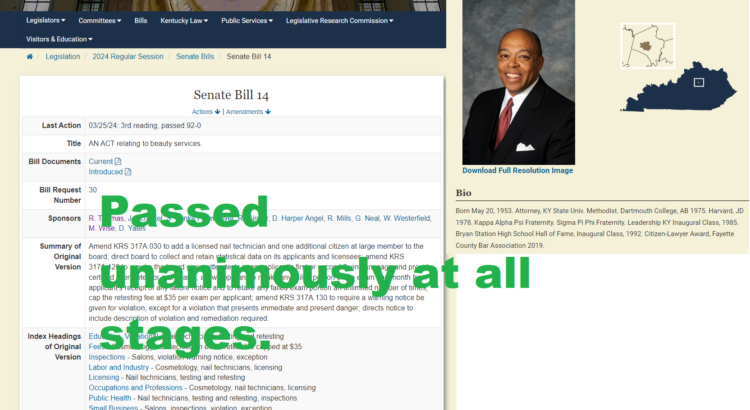
Senate Bill 14 Passed all stages at 03-25-2024 5pm

Understanding Senate Bill 14: A New Chapter for Kentucky’s Beauty Industry

On March 25, 2024, a significant piece of legislation, Senate Bill 14, was unanimously passed by the Kentucky General Assembly, heralding a new era for beauty professionals across the state. This act, meticulously shepherded through the legislative process by Senator Reginald Thomas, aims to refine and enhance the regulatory framework governing the beauty industry, with a particular focus on cosmetology, esthetic practices, and nail technology. It was signed into law in March 19th, 2024.

Effective Date: July 1, 2024

Kentucky typically enacts new laws like Senate Bill 14 to become effective 90 days after the adjournment of the legislative session, as dictated by Section 55 of the Kentucky Constitution. This standard is followed unless a specific effective date is mentioned or an emergency measure is invoked. Senate Bill 14 will therefore become effective on July 1, 2024.

This 90-day period allows for administrative preparation by state agencies, such as the Kentucky State Board of Cosmetology, to update regulations and procedures. It also provides time for industry adjustment, where professionals and businesses can prepare to comply with new rules, and for public information campaigns to educate both service providers and consumers about the changes. This structured timeline ensures a smooth transition into the new regulatory environment, minimizing disruption and enhancing the law’s effectiveness across the community.

Key Highlights of Senate Bill 14:

  1. Scope of Practice: The bill clearly delineates the boundaries of practice for cosmetology, esthetic practices, and nail technology, ensuring that these professions are solely focused on cosmetic purposes and not on treating physical or mental ailments.
  2. Licensing Requirements: It reaffirms that individuals must obtain the appropriate licenses to engage in cosmetology, esthetic practices, or nail technology for the public or for consideration, thereby upholding professional standards.
  3. Expanded Board Composition: The Kentucky Board of Cosmetology will now include seven members, with specific representation for licensed nail technicians and estheticians, ensuring a broader representation of the beauty industry.
  4. Emergency Powers and Enforcement: The board is empowered to take emergency actions to protect public health and safety and can refer violations to legal authorities for prosecution.
  5. Retesting for Nail Technician Applicants: Nail technician applicants who fail a written theory test or an oral practical demonstration are allowed to retake that portion after one month from the date of receiving notice of the failure.
  6. Use of Callus Graters: The bill explicitly permits the use of callus graters for callus removal by instructors, students, cosmetologists, and nail technicians, providing clarity on permissible practices.

Senate Bill 14 is a testament to the collaborative efforts of legislators, industry professionals, and stakeholders who have worked tirelessly to ensure that Kentucky’s beauty industry continues to thrive while maintaining high standards of professionalism and safety. This legislation not only strengthens the regulatory framework but also paves the way for a more inclusive and representative governance structure within the beauty industry.

REMOVED CLAUSE
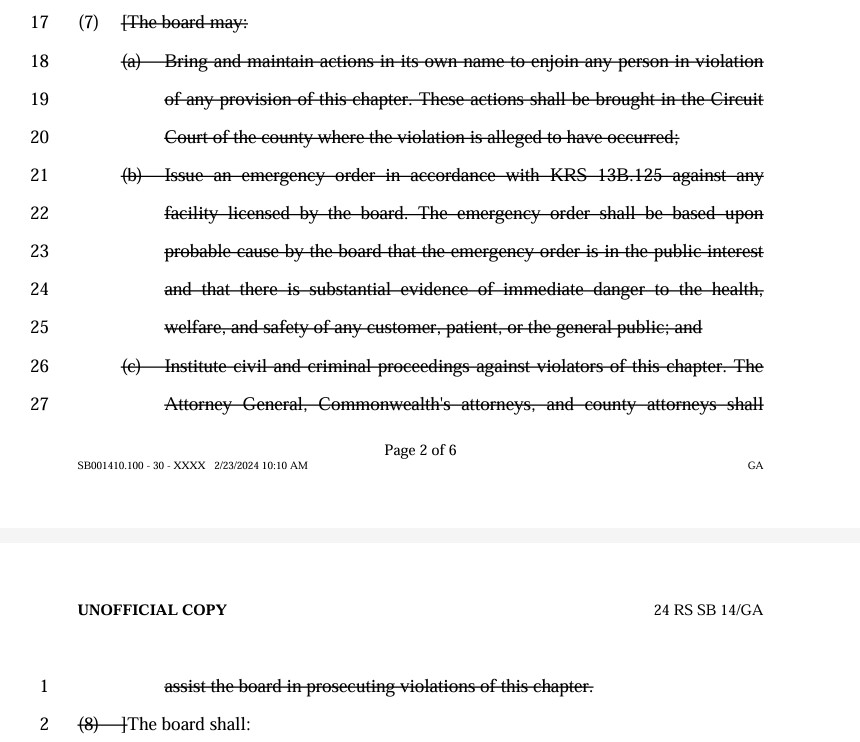
The removed section gave the Kentucky Board of Cosmetology strong powers to enforce rules, but it also had the potential for misuse. Here’s a simpler explanation:

  1. Legal Actions: The board could take people or places breaking the rules to court. However, this power could be misused to target certain businesses unfairly, like closing down nail salons on the spot during inspections without proper cause.
  2. Emergency Orders: The board could quickly act to stop dangerous situations. But this could be abused if, for example, a salon was shut down immediately based on unverified claims, causing harm to the business.
  3. Lawsuits and Criminal Charges: The board could sue or charge rule-breakers with crimes. However, there were concerns that this power was used harshly against certain businesses, like delaying their appeals for months with the intention of causing harm.

By removing this section, the board’s ability to enforce rules remains, but there’s less chance for these powers to be misused against businesses like nail salons.

ADDED CLAUSE
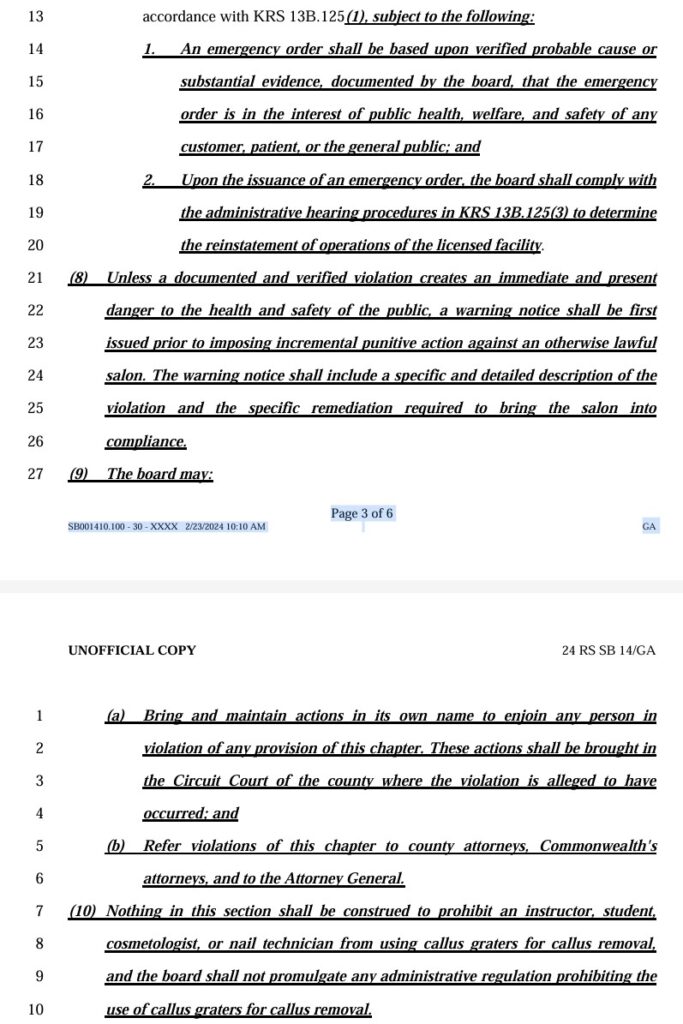
The added clause in the legislation aims to make things fairer and reduce the chances of the board misusing its power. Here’s how:

  1. Emergency Orders: Before the board can issue an emergency order to shut down a salon, they must have strong evidence or a very good reason to believe that there’s a real danger to public health, safety, or welfare. This means they can’t just close down a salon without a solid reason.
  2. Hearing Procedures: If the board does issue an emergency order, they have to follow certain rules to decide if the salon can reopen. This gives the salon a fair chance to make their case.
  3. Warning Notices: Before taking serious action against a salon that’s otherwise following the law, the board has to give a warning notice. This notice must clearly explain what the salon did wrong and what they need to do to fix it. This way, the salon has a chance to correct the issue before facing harsher penalties.
  4. Legal Actions: The board can still take legal action against someone breaking the rules, but they have to do it through the court system in the county where the problem happened. This ensures that the process is transparent and fair.
  5. Referring Violations: The board can refer violations to legal authorities like county attorneys or the Attorney General, but this doesn’t mean immediate punishment. It allows for a proper legal process to take place.
  6. Use of Callus Graters: The board can’t make rules that stop instructors, students, cosmetologists, or nail technicians from using callus graters for removing calluses. This gives professionals the freedom to use the tools they need for their work.

Overall, these changes aim to make sure that the board’s actions are based on real evidence and that beauty professionals have a fair chance to respond to any accusations or orders.

MISCONCEPTIONS VS REALITY ABOUT THIS SENATE BILL 14

  • Misconception: The bill was only for Asians, specifically Vietnamese and Cambodian nail technicians and salon owners.
  • Reality:
    • The bill is for all Americans, promoting fairness in the beauty industry.
    • It aims to include nail technicians and estheticians on the regulatory board for better representation.
    • It allows all candidates to retake licensing exams within a specified time until they pass, ensuring equal opportunities.
    • The bill highlights the significant contributions of the immigrant community to Kentucky’s economy and society.
    • Louisville Beauty Academy has graduated over 1,000 students, the majority of whom are immigrants from all around the world. On any given day, there can be speakers of more than five different languages in a class.
    • The bill supports workforce development, enabling more people to work safely and quickly in the beauty industry.
    • It ensures fair treatment and protection for beauty professionals and promotes accountability for those in positions of power.
    • The bill is about all Americans, emphasizing inclusivity and diversity in the beauty industry.

REFERENCES

https://apps.legislature.ky.gov/record/24rs/SB14.html

https://legislature.ky.gov/Legislators/Pages/Legislator-Profile.aspx?DistrictNumber=113
Louisville Beauty Academy - Nail Technology Curriculum

Louisville Beauty Academy — Nail Technology 450 Clock Hours Curriculum

Kentucky’s Gold Standard of Lawful and Humanized Beauty Education


About the Program

Louisville Beauty Academy (LBA) is a Kentucky State-Licensed and State-Accredited beauty college, nationally recognized for excellence in lawful, humanized beauty education.

Our Nail Technology 450 Clock Hours Curriculum is designed to train students in the science, art, and professionalism of nail care — aligned with the standards and expectations of the Kentucky Board of Cosmetology (KBC).

All instruction is built with awareness of the Kentucky statutes and administrative regulations governing nail technology, as published by the Kentucky Board of Cosmetology at:
👉 https://kbc.ky.gov


Milady as the Foundation of Theory Education

Louisville Beauty Academy’s Nail Technology curriculum is structured in alignment with the Milady Standard Nail Technology textbook and resources.

  • All theory instruction,
  • Chapter quizzes and tests, and
  • PSI exam preparation

follow the Milady framework, ensuring that each student receives education consistent with nationally recognized standards and the Kentucky Board of Cosmetology exam outline.

In addition, LBA enhances learning with:

  • Milady textbooks and online resources
  • PSI exam preparation materials
  • LBA’s own self-published books authored by Founder Di Tran
  • Multilingual and AI-assisted study support

This combination makes LBA a gold standard hub where national curriculum, state law, and humanized education meet.


Program Structure – 450 Clock Hours

ComponentDescriptionMinimum Hours
Theory & ScienceInfection control, anatomy, physiology, chemistry, electricity, professional image, business, exam prep150 hrs
Kentucky Statutes & Administrative RegulationsOverview and awareness of KRS 317A and 201 KAR 12 as published by KBC25 hrs
Clinic & PracticeSupervised services on mannequins and live models, sanitation, client care, application skills275 hrs
Total ProgramComprehensive Instructional Program450 Clock Hours Minimum

These hours reflect Louisville Beauty Academy’s internal educational structure and are based on the most recent publicly available information from the Kentucky Board of Cosmetology at the time of publication.
For current official requirements, always refer directly to https://kbc.ky.gov.


Curriculum Overview

1. Foundational Knowledge

  • History and Opportunities in Nail Technology
  • Life Skills, Professional Ethics, and Personal Growth
  • Professional Image and Personal Presentation
  • Communication Skills and Client Relations
  • Building Confidence and “YES I CAN / I HAVE DONE IT” Mindset

2. General Sciences

  • Infection Control and Safety Practices
  • Anatomy and Physiology Related to Skin and Nails
  • Nail Structure, Growth, and Health
  • Nail Diseases and Disorders (recognition and referral)
  • Basics of Chemistry (products, ingredients, and interactions)
  • Nail Product Chemistry (monomer, polymer, gels, solvents)
  • Basics of Electricity (safe use of electrical equipment, e-files, lamps)

These science topics are taught using Milady Standard Nail Technology as the core textbook, supplemented by LBA’s additional materials and visual/AI tools to help students deeply understand the “why” behind every service.


3. Nail Care & Enhancement Techniques

  • Manicuring – Basic and advanced manicure procedures
  • Pedicuring – Foot care, safety, and professional pedicure services
  • Electric Filing (E-File) – Safe bit selection, speed control, and damage prevention
  • Nail Tips and Wraps – Application, blending, maintenance, and removal
  • Monomer Liquid & Polymer Powder Systems (Acrylic) – Full sets, fills, repairs
  • UV/LED Gel Systems – Structure gels, gel polish, and specialty gel services
  • Creative Nail Art & Design – Polish techniques, embellishments, hand-painted art

All skills are first demonstrated by instructors, then practiced on mannequins, then on live models in LBA’s supervised clinic.


4. Business and Professional Skills

  • Preparing for Licensure and Employment
  • Understanding the Nail Technician’s Role in a Salon or Spa
  • Salon Management and Entrepreneurship Basics
  • Customer Service, Client Retention, and Retail Skills
  • Professional Ethics, Boundaries, and Communication in Practice
  • Building a Portfolio and Social Media Presence Responsibly

These topics help students not only pass the exam, but also thrive in the workforce or as future salon owners.


Training and Lawful Practice

  • Students must complete a required number of theory hours and safety education before performing services on the public.
  • Early practice occurs only on mannequins and fellow students, under instructor supervision.
  • All clinic hours are recorded using biometric and digital tracking to preserve accurate attendance and service records.
  • Sanitation, disinfection, and safety practices are emphasized continuously in alignment with current standards published by the Kentucky Board of Cosmetology.

Instruction on Kentucky law is provided for educational awareness only.
LBA directs all students, graduates, and licensees to always consult the Kentucky Board of Cosmetology at https://kbc.ky.gov for the latest, official, and legally binding rules and regulations.


Why Louisville Beauty Academy Is the Gold Standard

Louisville Beauty Academy serves as a Center of Excellence for Beauty Education and Compliance in Kentucky by:

  • Using Milady Standard Nail Technology as the national curriculum backbone
  • Aligning training with KBC expectations and PSI exam outlines
  • Supporting students with self-published LBA books, AI tools, and multilingual resources
  • Maintaining transparent, documented, and humanized processes for all students

LBA graduates are trained to be:

  • Technically skilled
  • Lawfully aware
  • Ethically grounded
  • Compassionate and community-focused professionals

“Our education begins with respect for the law and ends with service to others — because lawful practice is the highest form of professionalism.”
Di Tran, Founder & CEO, Louisville Beauty Academy


Legal and Educational Disclaimer

Louisville Beauty Academy’s curriculum materials, including this Nail Technology 450 Clock Hours Curriculum description, are provided solely for educational and sample purposes.

Any references to Kentucky statutes, administrative regulations, or board standards are general summaries and not official legal documents.

Louisville Beauty Academy assumes no liability for any errors, omissions, or changes in law or regulation after the time of publication.

The Kentucky Board of Cosmetology (KBC) is the only official source for current and legally binding requirements.
For all official updates to KRS 317A and 201 KAR 12, please visit:
👉 https://kbc.ky.gov

Louisville Beauty Academy - Aesthetic Curriculum Summary

Louisville Beauty Academy — Aesthetic/Esthetic 750 Clock Hours Curriculum

Kentucky’s Gold Standard of Lawful and Humanized Beauty Education


About the Program

Louisville Beauty Academy (LBA) is a Kentucky State-Licensed and State-Accredited beauty college, nationally recognized for excellence in lawful, humanized beauty education.

Our Aesthetic/Esthetic 750 Clock Hours Curriculum is designed to train students in the science, art, and professionalism of skin care, facial treatments, hair removal, makeup, and spa services — aligned with the standards and expectations of the Kentucky Board of Cosmetology (KBC).

All instruction is built with awareness of the Kentucky statutes and administrative regulations governing aesthetics, as published by the Kentucky Board of Cosmetology at:
👉 https://kbc.ky.gov

As soon as this page is published, it may already be out of date compared to current Kentucky law. All laws and regulations change over time. This page is for educational and sample purposes only.


Milady as the Foundation of Theory Education

Louisville Beauty Academy’s Aesthetic/Esthetic curriculum is structured in alignment with the Milady Standard Esthetics: Fundamentals textbook and resources.

  • All theory instruction
  • Chapter quizzes and tests
  • PSI exam preparation

follow the Milady framework, ensuring that each student receives education consistent with nationally recognized standards and the Kentucky Board of Cosmetology exam outline.

In addition, LBA enhances learning with:

  • Milady Standard Esthetics textbooks and online resources
  • PSI exam preparation materials
  • LBA’s own self-published books authored by Founder Di Tran
  • Multilingual and AI-assisted study support

This combination makes LBA a gold standard hub where national curriculum, state law, and humanized education meet.


Program Structure – 750 Clock Hours

ComponentDescriptionMinimum Hours
Theory & ScienceSkin sciences, infection control, anatomy, physiology, chemistry, electricity, professional image, business, exam prep250 hrs
Kentucky Statutes & Administrative RegulationsOverview and awareness of KRS 317A and 201 KAR 12 as published by KBC35 hrs
Clinic & PracticeSupervised services on mannequins and live models; facials, hair removal, machines, makeup, sanitation, client care465 hrs
Total ProgramComprehensive Instructional Program750 Clock Hours Minimum

These hours reflect Louisville Beauty Academy’s internal educational structure and are based on the most recent publicly available information from the Kentucky Board of Cosmetology at the time of publication.
For current official requirements, always refer directly to https://kbc.ky.gov.


Curriculum Overview

1. Foundational Knowledge

  • History and Opportunities in Aesthetics/Esthetics
  • Life Skills, Professional Ethics, and Personal Growth
  • Professional Image and Personal Presentation
  • Communication Skills and Client Relations
  • Building Confidence and the “YES I CAN / I HAVE DONE IT” Mindset

2. General Sciences

  • Infection Control and Safety Practices
  • Anatomy and Physiology Related to Skin and Supporting Structures
  • Skin Structure, Function, and Health (Histology & Physiology)
  • Skin Disorders and Diseases (recognition and appropriate referral)
  • Basics of Chemistry (cosmetic ingredients and product interactions)
  • Cosmetic Product Chemistry (cleansers, exfoliants, masks, serums, peels within esthetic scope)
  • Basics of Electricity (safe use of facial machines, galvanic, high-frequency, etc.)
  • Basics of Nutrition and Its Relationship to Skin Health

These science topics are taught using Milady Standard Esthetics: Fundamentals as the core textbook, supplemented by LBA’s additional materials and visual/AI tools to help students deeply understand the “why” behind every service.


3. Esthetic Procedures & Advanced Techniques

  • Facials – Basic and Advanced
    • Cleansing, exfoliation, extractions (within scope), masking, and finishing techniques
  • Facial Massage – Effleurage, petrissage, and other manipulations for relaxation and circulation
  • Facial Machines and Technology
    • Use of steamers, brushes, galvanic, high-frequency, microderm (where lawful), and related devices
  • Hair Removal
    • Temporary methods such as waxing, tweezing, and other KBC-permitted techniques
  • Eye and Lash Services
    • Basic lash enhancements and application of artificial eyelashes within esthetic scope
  • Makeup Artistry
    • Color theory, corrective makeup, bridal, special occasion, and basic photography-ready looks
  • Advanced Topics and Treatments (Non-Medical Scope)
    • Emerging techniques discussed in theory with strong emphasis on what is within vs. outside esthetic scope under Kentucky law

All skills are first demonstrated by instructors, then practiced on mannequins, then on live models in LBA’s supervised clinic.


4. Business and Professional Skills

  • Preparing for Licensure and Employment as an Esthetician
  • Understanding the Esthetician’s Role in a Spa, Salon, Clinic, or Studio
  • Basic Spa/Salon Management and Entrepreneurship Concepts
  • Customer Service, Client Retention, and Retailing of Products and Services
  • Professional Ethics, Boundaries, and Communication in Practice
  • Building a Professional Image, Portfolio, and Social Media Presence Responsibly

These topics help students not only pass the exam, but also thrive in the workforce or as future spa/salon owners and leaders in the beauty and wellness industry.


Training and Lawful Practice

  • Students must complete a required number of theory hours and safety education before performing services on the public.
  • Early practice occurs only on mannequins and fellow students, under instructor supervision.
  • All clinic hours are recorded using biometric and digital tracking to preserve accurate attendance and service records.
  • Sanitation, disinfection, and safety practices are emphasized continuously in alignment with current standards published by the Kentucky Board of Cosmetology.

Instruction on Kentucky law is provided for educational awareness only.
LBA directs all students, graduates, and licensees to always consult the Kentucky Board of Cosmetology at https://kbc.ky.gov for the latest, official, and legally binding rules and regulations.


Why Louisville Beauty Academy Is the Gold Standard

Louisville Beauty Academy serves as a Center of Excellence for Beauty Education and Compliance in Kentucky by:

  • Using Milady Standard Esthetics: Fundamentals as the national curriculum backbone
  • Aligning training with KBC expectations and PSI exam outlines
  • Supporting students with self-published LBA books, AI tools, and multilingual resources
  • Maintaining transparent, documented, and humanized processes for all students

LBA graduates are trained to be:

  • Technically skilled in esthetic services
  • Lawfully aware of their scope and responsibilities
  • Ethically grounded and client-centered
  • Compassionate and community-focused professionals

“Our education begins with respect for the law and ends with service to others — because lawful practice is the highest form of professionalism.”
Di Tran, Founder & CEO, Louisville Beauty Academy


Legal and Educational Disclaimer

Louisville Beauty Academy’s curriculum materials, including this Aesthetic/Esthetic 750 Clock Hours Curriculum description, are provided solely for educational and sample purposes.

Any references to Kentucky statutes, administrative regulations, or board standards are general summaries and not official legal documents.

Louisville Beauty Academy assumes no liability for any errors, omissions, or changes in law or regulation after the time of publication.

The Kentucky Board of Cosmetology (KBC) is the only official source for current and legally binding requirements.
For all official updates to KRS 317A and 201 KAR 12, please visit:
👉 https://kbc.ky.gov

LOUISVILLE BEAUTY ACADEMY, KENTUCKY STATE-LICENSED AND STATE-ACCREDITED BEAUTY COLLEGE – STUDENT CATALOG

https://apps.legislature.ky.gov/law/kar/titles/201/012/082/

Louisville Beauty Academy - Spanish

Regulaciones de la Ley de Kentucky para la práctica de la Belleza: Importancia de la Licencia y el Cumplimiento Legal

La Academia de Belleza de Louisville está dedicada a proporcionar una educación y capacitación de calidad para las personas que desean seguir una carrera en la industria de la belleza. Como parte de nuestro compromiso de promover estándares éticos y profesionales, queremos recordar a todos la importancia de comprender la ley estatal de Kentucky cuando se trata de la cosmetología, las prácticas estéticas y la tecnología de uñas.

Es crucial reconocer que es ilegal realizar cualquier práctica de belleza sin la licencia o permiso adecuado en el estado de Kentucky. Esto significa que si desea trabajar como cosmetólogo, esteticista o técnico de uñas de manera profesional, debe obtener la licencia correspondiente de la Junta de Peluqueros y Cosmetólogos de Kentucky. Sin la licencia o permiso requerido, está infringiendo la ley y podría enfrentar consecuencias legales.

Además, también es ilegal realizar servicios de belleza en una instalación sin licencia. Esto significa que incluso si tiene una licencia, no puede realizar servicios en un salón o spa que no esté debidamente licenciado por el estado. La Junta de Peluqueros y Cosmetólogos de Kentucky toma estas regulaciones en serio y los infractores podrían enfrentar multas, penalizaciones o incluso acciones legales.

La ley estatal de Kentucky que rige la cosmetología, las prácticas estéticas y la tecnología de uñas se describe en el Capítulo 317A.020. Esta ley establece que solo los profesionales de la salud autorizados que realizan estas prácticas incidentalmente como parte de su profesión y los trenzadores de cabello natural están exentos del requisito de licencia. Todos los demás que desean practicar estos servicios de belleza profesionalmente deben obtener la licencia o permiso correspondiente.

Además del requisito de licencia, la ley también especifica que los profesionales con licencia no pueden realizar clínicas para enseñar o demostrar con fines de lucro personal a menos que estén patrocinados por un grupo profesional reconocido. La ley también requiere que cualquier persona que participe en diferentes prácticas que requieren licencias separadas obtenga una licencia separada para cada práctica.

En la Academia de Belleza de Louisville, tomamos en serio nuestra responsabilidad de educar a nuestros estudiantes sobre estas regulaciones. Queremos que todos nuestros graduados estén bien informados y preparados para ingresar a la industria de la belleza como profesionales con licencia. También alentamos a todos en la industria, ya sea un practicante actual o potencial, a familiarizarse con la ley estatal de Kentucky y a operar siempre dentro de sus requisitos.

En resumen, realizar cualquier práctica de belleza sin la licencia o permiso adecuado, o en una instalación sin licencia, es ilegal en el estado de Kentucky. Instamos a todos a tomar en serio esta regulación y a buscar la educación y capacitación necesarias para convertirse en profesionales con licencia en la industria de la belleza.

Understanding Kentucky State Law: Why it is Crucial to Obtain a License for Beauty Practices

Louisville Beauty Academy is dedicated to providing quality education and training for individuals who want to pursue a career in the beauty industry. As part of our commitment to promoting professional and ethical standards, we want to remind everyone about the importance of understanding Kentucky state law when it comes to cosmetology, esthetic practices, and nail technology.

It is crucial to recognize that it is ILLEGAL to perform any beauty practice without the appropriate license or permit in the state of Kentucky. This means that if you want to work as a cosmetologist, esthetician, or nail technician in a professional capacity, you must obtain the proper license from the Kentucky Board of Hairdressers and Cosmetologists. Without the required license or permit, you are breaking the law and could face legal consequences.

Furthermore, it is also ILLEGAL to perform beauty services in an unlicensed facility. This means that even if you have a license, you cannot perform services in a salon or spa that is not properly licensed by the state. The Kentucky Board of Hairdressers and Cosmetologists takes these regulations seriously, and violators could face fines, penalties, or even legal action.

The Kentucky state law that governs cosmetology, esthetic practices, and nail technology is outlined in Chapter 317A.020. This law states that only authorized healthcare professionals who perform these practices incidentally as part of their profession and natural hair braiders are exempt from the licensing requirement. Everyone else who wants to practice these beauty services professionally must obtain the appropriate license or permit.

In addition to the licensing requirement, the law also specifies that licensed professionals are not allowed to hold clinics for teaching or demonstrating for personal profit unless sponsored by a recognized professional group. The law also requires that anyone engaged in different practices that require separate licensing must obtain a separate license for each practice.

At Louisville Beauty Academy, we take our responsibility to educate our students about these regulations seriously. We want all of our graduates to be well-informed and prepared to enter the beauty industry as licensed professionals. We also encourage everyone in the industry, whether a current practitioner or a potential one, to familiarize themselves with Kentucky state law and to always operate within its requirements.

In summary, performing any beauty practice without the appropriate license or permit, or in an unlicensed facility, is illegal in the state of Kentucky. We urge everyone to take this regulation seriously and to seek out the necessary education and training to become licensed professionals in the beauty industry.