Center of Excellence: Law and Regulation Update – Kentucky’s October 30 Written-Notice Deadline for Unreceived Renewal Licenses

A new Kentucky Board of Cosmetology (KBC) notice gives licensees a specific written follow-up date. In a KBC e-newsletter dated October 1, 2026, the Board says that a licensee who completed renewal but still has not received the license after 60 days should email the Board with identifying information. The notice sets October 30, 2026, as the deadline for that written notification.

This is a public source update for Kentucky beauty professionals, students preparing to enter the field, salon owners, and families helping someone protect a license record. It is not legal advice and it does not replace current instructions from KBC.

The short version

  • Source date: October 1, 2026.
  • Deadline named by KBC: October 30, 2026, for written notice to the Board when a renewed license has not arrived after 60 days.
  • What KBC asks for: legal name, license number, and mailing address sent to kbc@ky.gov, according to the notice.
  • What happens after the deadline, according to KBC: the licensee will be instructed to use the portal to apply and pay a $25 fee for a lost, stolen, or duplicate printed license.

What the official notice says

KBC’s October 1 e-newsletter thanks licensees who completed renewal and addresses people who have not received the renewed license more than 60 days after submitting renewal. It tells those licensees to email KBC with their legal name, license number, and mailing address. It says the written-notice period ends October 30, 2026.

The same notice says a status-change notice may be posted in the salon but is valid for 60 days. It states that the status-change notice will not be honored during an inspection without written communication from the Board when the licensee has not received the license in the mail. KBC also says inspectors will verify posting of the original hard-copy license and that a duplicate-license request carries a $25 fee.

These are the Board’s words and instructions. LBA is not converting them into a promise that a particular license will be issued, mailed, restored, or accepted for inspection.

Plain-language timeline

When What the public source says What a careful reader can do
After submitting renewal KBC’s notice addresses a license that has not arrived after 60 days. Keep the renewal record, payment confirmation, portal information, and mailing details in a private file.
Before October 30, 2026 KBC says to notify the Board in writing if the renewed license has not been received after 60 days. Read the official notice and send only the information KBC requests through the official channel. Do not post a license number publicly.
During an inspection KBC says the original hard copy must be posted and that a status-change notice alone may not be honored without written Board communication in the situation described. Do not assume a temporary paper or portal screenshot replaces the Board’s stated posting requirements.
After October 30, 2026 KBC says licensees will be instructed to use the portal and pay a $25 fee for a lost, stolen, or duplicate printed license. Verify the current portal instructions and fee before taking action; this article does not submit a form or payment for anyone.

Why this matters to a real student or family

A beauty license is not just a test result. It is a public record connected to the person’s ability to work within Kentucky’s regulated beauty professions. A person may finish school, pass an exam, submit a renewal, move, change a name, or change employers and still need to keep the Board’s record current.

For a real student or family, the lesson is simple: keep written proof at each handoff. Save the renewal confirmation, the date submitted, the mailing address used, any Board email, and the official license-verification result. If a document does not arrive, do not guess that the record is fine and do not rely on a social-media post. Read the current KBC notice and use the official Board channel.

Connection to Kentucky’s administrative regulation

201 KAR 12:030, Licensing and examinations, is a Kentucky administrative regulation. In its current public text, Section 3 says required account changes—including legal name, address, facility or employer, phone number, and email address—must be submitted to the Board within 30 days of the change. Section 14 describes the renewal period as July 1 through July 31 of each even-numbered year and addresses duplicate licenses, renewal, and restoration.

The regulation is the controlling legal source for the rule text. KBC’s October 1 newsletter is the current operational notice about the October 30 written-notice deadline described above. Readers should check both sources and follow any newer official instruction.

What LBA can and cannot do

  • LBA can teach students to treat licensing as a documented professional responsibility and to verify official sources.
  • LBA can help a current or prospective student locate public KBC information and understand the difference between a school record, an exam record, and a Board license record.
  • LBA cannot change a KBC record, issue a Kentucky license, decide whether a document will satisfy an inspection, waive a Board deadline, or guarantee licensure.
  • No one should send a Social Security number, password, payment card, or other unnecessary private information in a public comment or to an unverified contact.

Useful next step

Read the KBC announcements page and the KBC license-renewal information page. The October 1 source document is the KBC E-Newsletter dated October 1, 2026. License status can be checked through the official KBC license-verification portal.

Students and families comparing beauty education may also use LBA’s Beauty Education Center of Excellence hub to review source-backed updates, then request current written program information and written cost details through LBA’s official contact path. Education comes before enrollment pressure.

Source and claim-control note

  • Primary source: Kentucky Board of Cosmetology, “KBC E-NEWSLETTER,” October 1, 2026, official PDF.
  • Controlling rule text consulted: 201 KAR 12:030, Kentucky Administrative Regulations.
  • Public-function lane: Kentucky licensing readiness and student protection.
  • Claim limits: This post does not state or imply that LBA is a government agency, that KBC endorses LBA, or that any person is guaranteed a license, exam result, employment, income, or inspection outcome.

Educational information only. Verify the current requirement directly with the Kentucky Board of Cosmetology before acting.
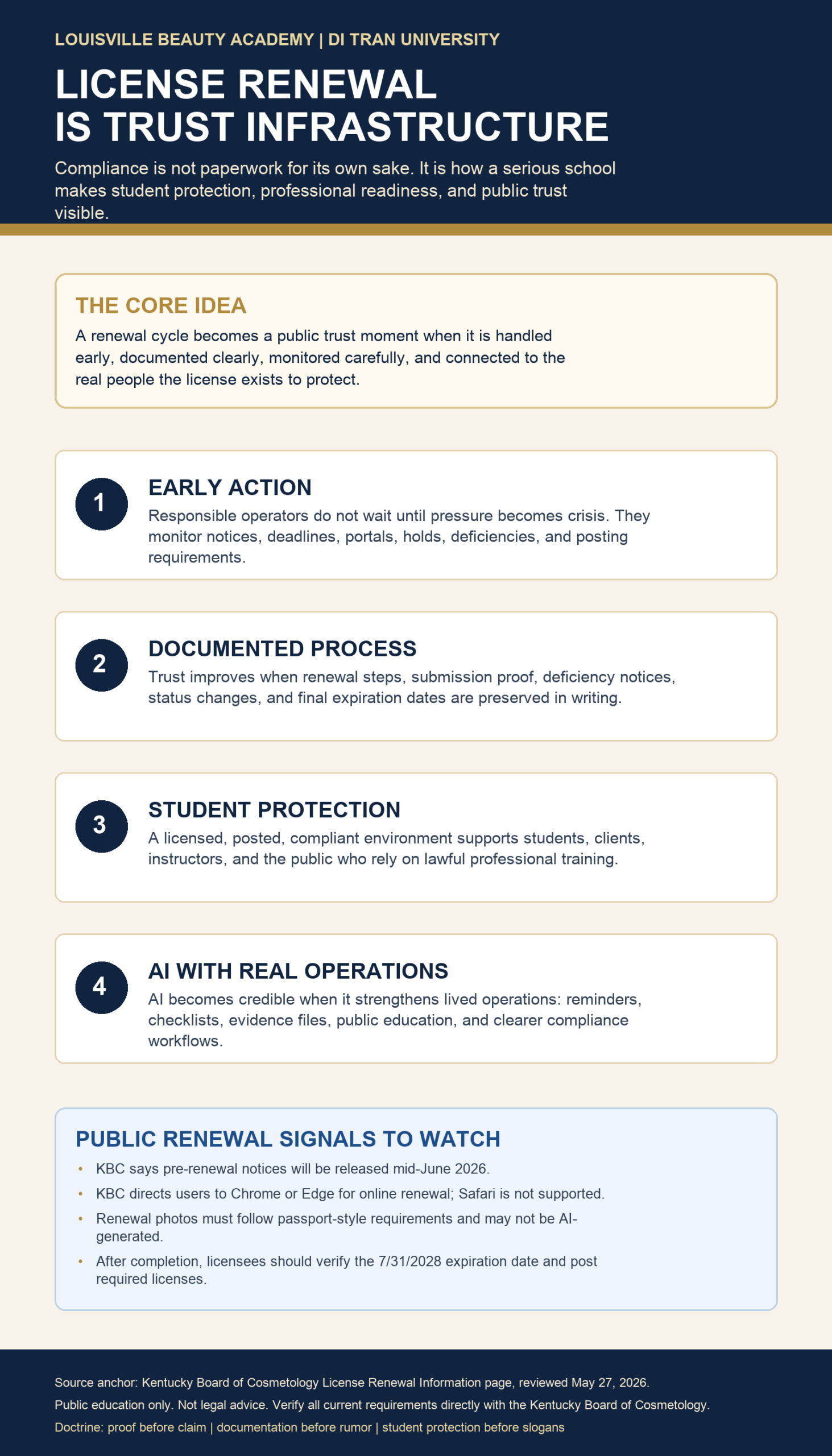
License Renewal Is Trust Infrastructure for Beauty Education

License Renewal Is Trust Infrastructure for Beauty Education

License renewal is easy to treat as administration. That is too small. In a licensed workforce-education environment, renewal is one of the recurring moments when public trust becomes visible.

For Louisville Beauty Academy, the stronger lesson is this: compliance is not paperwork for its own sake. It is a discipline of protection. It helps students, instructors, clients, regulators, and the public see that the school is operating through documented standards rather than verbal assumption.

Why Renewal Matters

A responsible renewal cycle forces an institution to monitor deadlines, portal requirements, deficiency notices, license status, photo requirements, payment pathways, and final posting obligations. Each of those details is small by itself. Together, they form operational seriousness.

The Student-Protection Layer

Students rely on the school environment to be lawful, current, and professionally aligned. Clients rely on posted license visibility. Instructors and staff rely on clear internal process. Renewal discipline supports all three.

AI Should Strengthen the Real Workflow

This is also why AI implementation must be grounded in real operations. AI can help organize checklists, reminders, public explanations, evidence files, and follow-up systems. But the value comes from serving the lawful workflow, not from talking abstractly about technology.

Source and Boundary

This public-education post is anchored to the Kentucky Board of Cosmetology License Renewal Information page: https://kbc.ky.gov/Licensure/Pages/License-Renewal-Information.aspx. It is not legal advice. Readers should verify current requirements directly with the Kentucky Board of Cosmetology and their own professional advisors where appropriate.

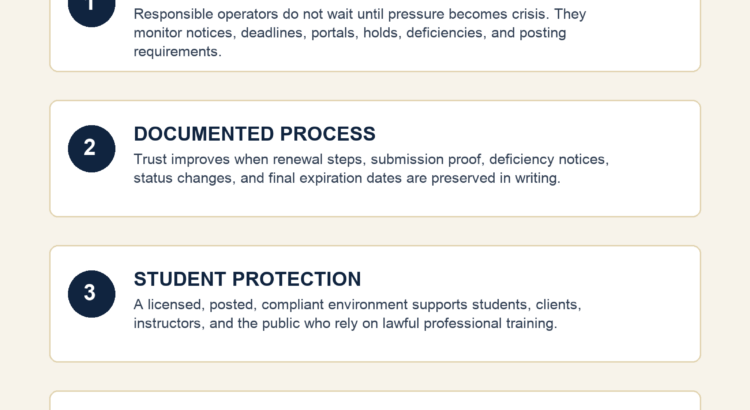
Infographic explaining license renewal as trust infrastructure through early action, documented process, student protection, and AI-supported operations.
Infographic: license renewal as trust infrastructure. Source anchor: Kentucky Board of Cosmetology License Renewal Information page, reviewed May 27, 2026.

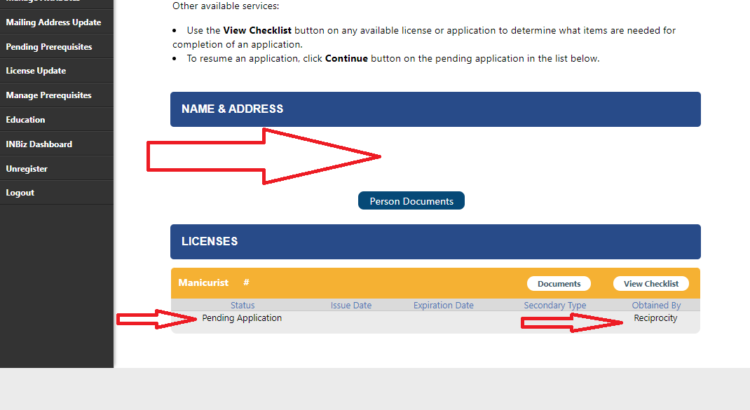
How to Transfer Your Beauty License from Kentucky to Indiana

If you’re a beauty professional in Kentucky considering a move to Indiana, you might be wondering how you can transfer your credentials and continue your practice seamlessly. Whether you’re a nail technician, instructor, cosmetologist, or esthetician, the process of transferring your license to the Indiana State Board of Cosmetology is vital. This article will guide you through the essential steps required for a smooth transfer.

https://www.in.gov/pla/professions/cosmetology-and-barber-home/cosmetology-and-barber-licensing-information/

1. Set Up an Online Account:

Before you can proceed with any online application, you need to have an account on MyLicense.IN.gov. If you don’t have one yet, it’s the first step. Go to MyLicense.IN.gov, enter your SSN and birthdate, and the system will prompt you to create an account. Having an account will ease your application process and help you keep track of any requirements or status updates.

2. Understand the Requirements:

After setting up your account, familiarize yourself with Indiana’s requirements for beauty professionals:

  • Application: As a high school graduate or its equivalent, you can apply online via your MyLicense account.
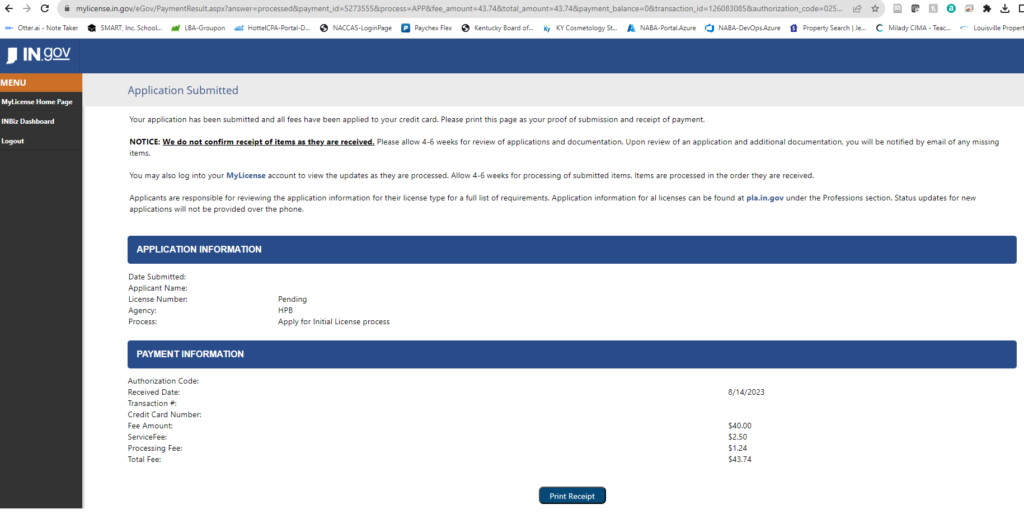
  • Application Fee: A non-refundable fee of $40.00, which can be paid by credit or debit card through your online account.
  • Positive Response Documentation: If your application contains any ‘yes’ responses, provide a detailed statement and relevant court documents.
  • Name Change Documentation: If there’s a name difference, provide legal proof, such as a marriage certificate or divorce decree.
  • Foreign Jurisdictions: If you studied outside the U.S., submit your high school diploma and beauty culture school transcript. If not in English, they require a certified English translation.
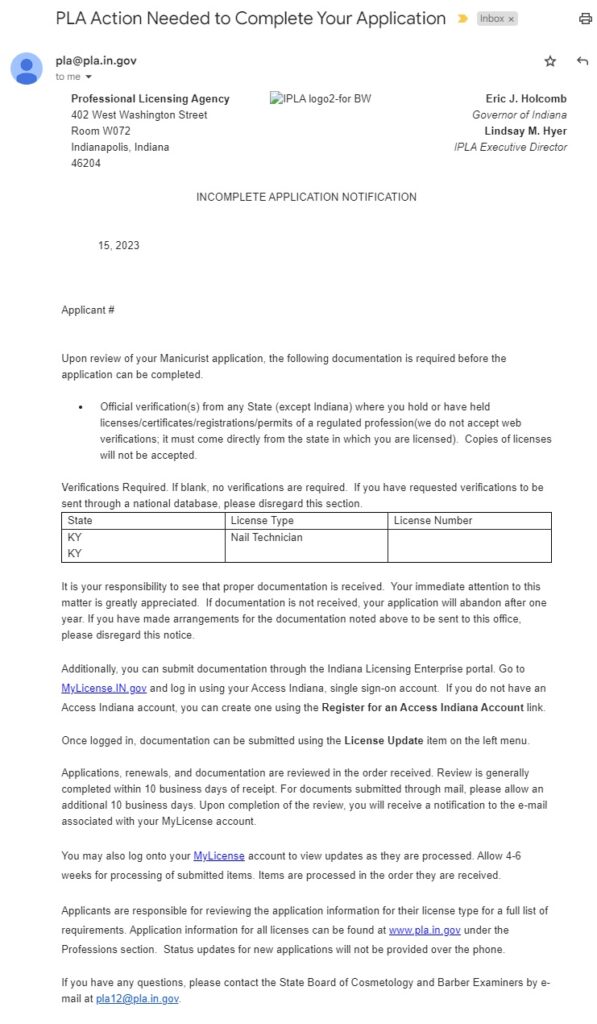
  • Verification of State Licensure(s): Indiana needs verification from every jurisdiction where you’ve held a license. A mere copy of your license won’t suffice.

3. Meet the Specific Requirements for Instructors:

If you’re an instructor, note these specific requirements:

  • Completion of 1000 hours of beauty culture instructor education. Indiana does not accept apprenticeship hours. If you’ve practiced for a year, that can substitute for 100 hours, provided you’ve completed a minimum of 700 hours of instructor education.
  • A 70% passing rate is a must on both written and practical licensing exams from your previous jurisdiction.
  • Submit documentation proving you met the education requirement if your original jurisdiction accepts apprenticeship hours for licensure.

4. Note Differences and Transfer Processes:

While both Kentucky and Indiana have rigorous standards for licensing beauty professionals, specifics might differ. For example, if your license from Kentucky doesn’t meet Indiana’s reciprocity requirements, you can transfer your hours from Kentucky to an Indiana-approved beauty culture school, graduate, and then apply for an Indiana license by examination.

5. Consider the License Prerequisites:

Instructor licenses in Indiana act as a prerequisite to a base license (e.g., cosmetology, barber, manicuring). If you’re a nail technician, you’ll first need to obtain an Indiana manicurist license before qualifying as an instructor.

6. Stay Updated on Renewal and Education Requirements:

In Indiana, there’s no requirement for continuing education under the cosmetology board, and licenses are renewed every four years.

In Conclusion:

Transferring your beauty professional license between states can be daunting, but with the right knowledge and by understanding Indiana’s specific requirements, the transition can be smooth. Always consider reaching out to local state boards or professionals for personalized advice and ensure you have an active account on MyLicense.IN.gov to facilitate your application process.

P.S. For any further questions or clarifications, the most effective method of communication is to directly email the Indiana State Board of Cosmetology. They are equipped to provide you with the most accurate and up-to-date information pertaining to your licensing needs.

CONTACT INFORMATION– UPDATED AS OF 08-14-2023

https://www.in.gov/pla/professions/cosmetology-and-barber-home/

Contact Information

Tracy Hicks, Board Director
Marianna Kassenbrock, Assistant Director

E-mail: pla12@pla.IN.gov
Phone Number: (317) 232-2960

Email Template

Dear Indiana State Board of Cosmetology,

I am [YOUR NAME], holding licenses as a nail technician and instructor in Kentucky. I’m considering a move to Indiana and would like to transfer my licenses accordingly.

  • Are there any transfer exams or requirements for those from Kentucky?
  • Could you brief me on the application process, including forms and fees?
  • Is there a reciprocity agreement between Indiana and Kentucky for these licenses?
  • Post-transfer, are there added continuing education requirements?
  • What is the usual timeline for the transfer approval?
  • How often will I need to renew these licenses in Indiana?

Your assistance is greatly appreciated.

Thank you,

Your Name

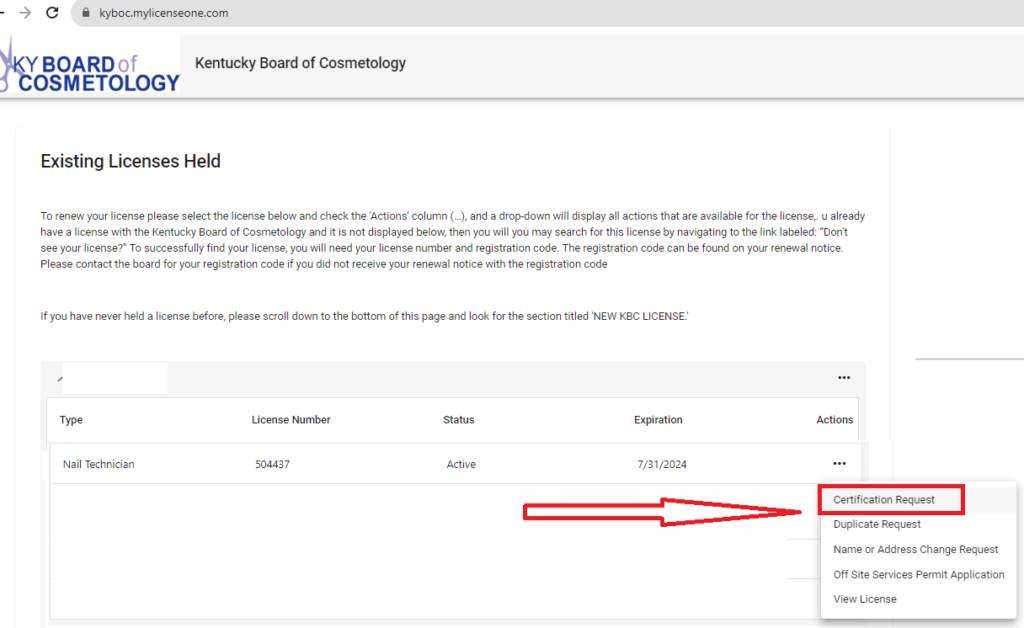
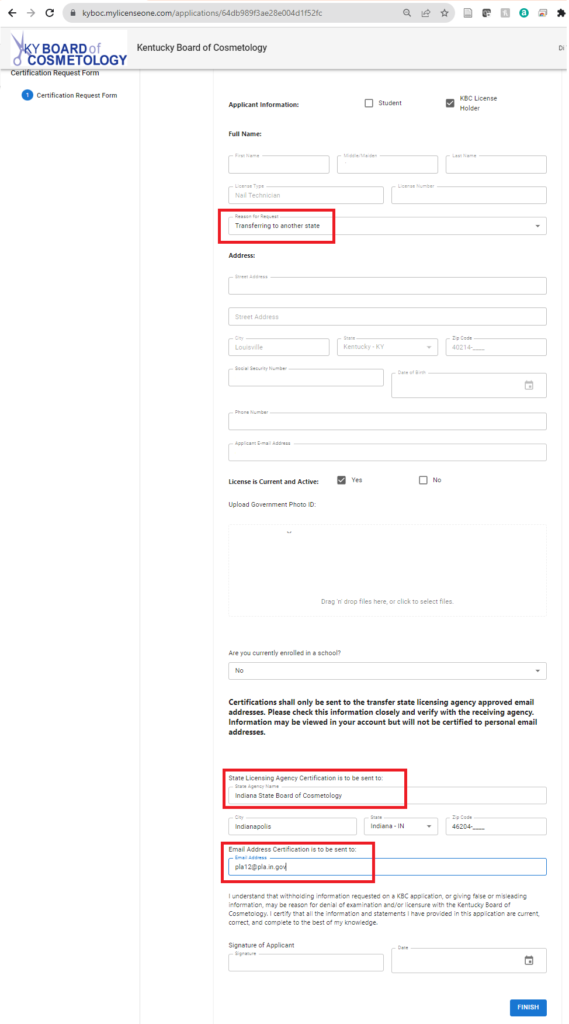
Kentucky State Board of Cosmetology – Process to Request Certification on KYBOC.MyLicenseOne.com

Disclaimer: The information provided in this article is sourced from public records and is shared purely for instructional and informational purposes. It should not be construed as legal advice or a definitive guide on the licensing process. While we aim to present accurate and up-to-date information, regulations and requirements may change. For detailed and specific instructions, always consult and follow up directly with the State Board of Cosmetology of the respective state. We highly recommend reaching out to them for any licensing inquiries or clarifications.

Communicating with the KY State Board of Cosmetology: Best Practices for Practitioners and Licensees

Communication is the cornerstone of understanding, and it becomes even more essential when interacting with administrative entities such as the Kentucky State Board of Cosmetology. For practitioners and licensees, especially those for whom English is a second language, effective communication is critical. This article provides a comprehensive guide on how best to communicate with the KY State Board of Cosmetology.

1. Email Communication: (Email to KBC@KY.gov) Email has emerged as the most effective means of communication with the KY State Board for two primary reasons:

a) Record Keeping: With emails, both parties have a tangible record of the correspondence, complete with timestamps. This ensures transparency and can be particularly useful if there are any disputes or clarifications needed in the future.

b) Response Time: The KY State Board, especially during peak periods like license renewal season in July and August, can be swamped with requests and queries. Emailing your concerns or questions gives the board the required time to address them comprehensively, ensuring a response typically within 30 days.

2. Using the Official Contact Form: Another efficient way to reach out is by filling out the contact form available at KY State Board’s Contact Page. This structured format ensures that you provide all the necessary details, which can expedite the Board’s response.

3. Filing a Complaint: If there are concerns or complaints you wish to raise, it is crucial to follow the proper channels to ensure they are addressed appropriately. The Kentucky State Board of Cosmetology has a designated Complaint Form that should be filled out. Using this official channel helps maintain orderliness and ensures your complaints are addressed in a structured manner.

Language Barriers: For practitioners and licensees with English as a second language or face language-related challenges, it can sometimes be daunting to navigate administrative processes. Louisville Beauty Academy recognizes this challenge and is committed to assisting all Kentucky State beauty education queries and needs.

Need Assistance? If you have any questions or require further guidance, don’t hesitate to reach out. You can text Louisville Beauty Academy at 502-625-5531 or fill out their online form. Their dedicated team is always ready to help, ensuring that you receive the information and assistance you need.

In conclusion, communication is pivotal, and understanding the best channels to use can make the difference between a swift resolution and prolonged back-and-forths. By following the guidelines outlined above, practitioners and licensees can ensure smooth and effective interactions with the KY State Board of Cosmetology.

P.S.: When reaching out to the KY State Board of Cosmetology, or any professional body, clarity is of utmost importance. It’s vital to be professional in your approach, ensuring your question or specific request is articulated clearly and concisely. This not only fosters effective communication but also expedites resolutions and answers. Before sending your message or query, take a moment to review and ensure that your main point is unmistakably understood. Remember, clarity in communication leads to effective results.