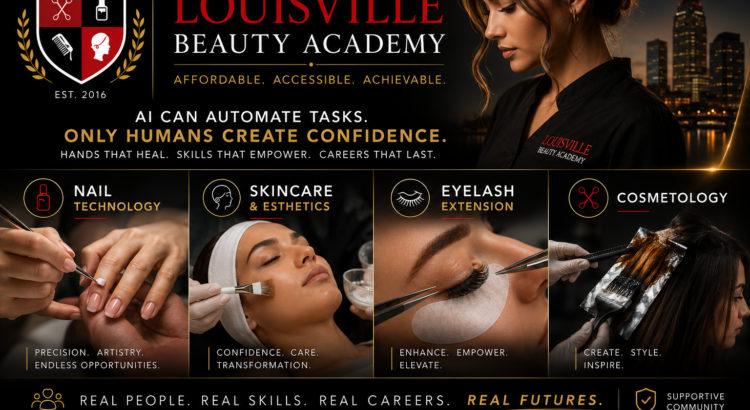
Thinking About a Career Change Because of AI? Why Human-Centered Careers Continue to Matter.

By Louisville Beauty Academy
Educational Article | Workforce Awareness Series 2026


Editorial Attribution & Research Credit

This article is published by Louisville Beauty Academy with full gratitude and acknowledgment to the research, analysis, writing, and editorial work of the Di Tran University – College of Humanization Research Team. The underlying workforce research, economic analysis, policy review, and human-centered framework that informed this educational article originate from the independent research and public scholarship of Di Tran University’s College of Humanization. Louisville Beauty Academy shares this article to help educate students, families, career changers, educators, employers, and the public on emerging workforce trends and the future of human-centered professions.

Readers interested in the complete research are encouraged to read:

The Great Human Shift: AI, Corporate Layoffs & Why Human-Centered Careers May Be America’s Strongest Future — Research & Podcast Series 2026

Published by Di Tran University – College of Humanization


Artificial intelligence is changing the way America works.

Across industries, businesses are adopting AI to automate routine tasks, improve productivity, and reshape how work gets done. Many office-based positions are evolving, some are being redefined, and others are being reduced as organizations rethink traditional corporate structures.

For many people, this creates uncertainty.

For others, it creates an opportunity to ask an important question:

What careers become more valuable when technology becomes more capable?

At Louisville Beauty Academy, we believe this question deserves careful research—not fear, not marketing, and not speculation.

That is why we encourage prospective students, families, educators, and career changers to learn about the broader workforce transformation occurring across the United States.


Human Skills Cannot Be Downloaded

Artificial intelligence can generate text.

It can analyze data.

It can organize schedules.

It can answer emails.

It can even help beauty professionals manage appointments, marketing, inventory, and business operations.

But AI cannot replace what happens when one human serves another with professionalism, trust, safety, compassion, and skilled hands.

A licensed nail technician doesn’t simply polish nails.

They help restore confidence.

An esthetician doesn’t simply perform a facial.

They help clients care for their skin, their well-being, and often their self-esteem.

A cosmetologist doesn’t simply cut hair.

They help people prepare for weddings, interviews, graduations, celebrations, and some of life’s most meaningful moments.

These are deeply human professions.

Technology may support them.

It does not replace them.


Licensed Beauty Professionals Build More Than Beauty

The beauty profession is often misunderstood.

Behind every state license is education in:

  • Infection control
  • Sanitation
  • Public safety
  • State law and regulations
  • Professional ethics
  • Technical skills
  • Client communication
  • Business fundamentals

These are licensed professions that protect the public while creating opportunities for meaningful careers and entrepreneurship.

Many professionals eventually become:

  • Salon owners
  • Independent suite renters
  • Educators
  • Product specialists
  • Brand ambassadors
  • Small business owners
  • Community leaders

A license is not simply permission to work.

For many, it becomes the foundation for building a business and serving a community.


Affordable Education Matters

Choosing a school is one of the most important financial decisions a student will make.

At Louisville Beauty Academy, we believe prospective students should compare:

  • Tuition
  • Program length
  • Written payment options
  • Licensing preparation
  • Student support
  • Schedule flexibility
  • Graduation requirements
  • Regulatory compliance
  • Overall value

We encourage every student to visit multiple schools, ask questions, request everything in writing, and make the decision that best fits their goals, finances, and circumstances.

An informed student is an empowered student.


AI Is a Tool—Not a Replacement for Humanity

Louisville Beauty Academy embraces technology where it improves education and student support.

AI-assisted translation.

Digital documentation.

Administrative efficiency.

Learning support.

Communication.

These tools help students learn more effectively and help educators spend more time teaching people—not paperwork.

Technology should strengthen human education, not replace it.


A Future Built on Service

Throughout history, technology has changed the tools we use.

It has never changed the importance of serving another human being well.

People will continue to seek professionals they trust.

People will continue to value kindness, craftsmanship, communication, and integrity.

People will continue to invest in confidence, wellness, and personal care.

Those are human needs.

And human needs create human careers.


Continue the Research

This article summarizes only part of a much larger workforce discussion.

For readers interested in labor market trends, AI, corporate restructuring, vocational education, entrepreneurship, and the future of human-centered careers, we invite you to read the independent research published by Di Tran University – The College of Humanization:

The Great Human Shift: AI, Corporate Layoffs & Why Human-Centered Careers May Be America’s Strongest Future – Research & Podcast Series 2026

The research examines publicly available information from government agencies, labor economists, academic institutions, and industry sources to explore how artificial intelligence is reshaping work—and why licensed, human-centered professions may become increasingly valuable in the decades ahead.


Our Commitment

At Louisville Beauty Academy, our mission has never been to tell students what career to choose.

Our mission is to provide affordable, accessible, ethical, state-approved education so students can make informed decisions, earn professional licensure, and build meaningful careers through service, skill, and lifelong learning.

Whether you choose Louisville Beauty Academy or another licensed institution, we encourage you to research carefully, compare thoughtfully, and invest in an education that aligns with your goals.

Because while technology will continue to evolve, one truth remains:

Human hands build trust. Human service builds communities. Human character builds careers.


Educational Disclaimer

This article is provided for educational and informational purposes only. It should not be interpreted as career, financial, legal, or employment advice. Labor market conditions change over time, and career outcomes vary by individual, region, experience, effort, and economic conditions. Louisville Beauty Academy encourages prospective students to conduct independent research, review official labor market information, compare educational institutions, and make informed decisions based on their own goals and circumstances. References to the independent research published by Di Tran University are provided to encourage continued learning and public discussion about workforce trends in the age of artificial intelligence.

Let’s Be Licensed, Legitimate, and Legal: Why Unlicensed Beauty Work Is a Misdemeanor in Kentucky? – Research & Podcast Series · 2026

A legally enforceable requirement — not a suggestion, not a preference, not optional.


📌 1. State Law Prohibits Unlicensed Beauty Work

Under Kentucky law, no person may engage in the practice of cosmetology, esthetic practices, or nail technology for the public or for consideration (money, barter, tip, free services offered to gain business, etc.) without the proper license issued by the Kentucky Board of Cosmetology.

Specifically, Kentucky Revised Statutes § 317A.020(2) states:

Except as provided in limited exemptions (e.g., licensed medical professionals doing incidental acts), no person shall engage in cosmetology, esthetic practices, or nail technology for the public or for consideration without the appropriate license required by this chapter.

This means it is illegal to do any of the following without a license:
✔ Cut, style, color, or treat hair
✔ Perform facials, skin care, waxing, or esthetic services
✔ Provide nail services (manicure, pedicure, gels, polish, etc.)
✔ Operate a salon, teach classes, or practice any beauty service categorically covered by state law.


📌 2. There Are No Loopholes — Working for “Free” is Still Illegal

Kentucky law does not allow unlicensed practice for “fun,” experience, practice on friends, barter, or free work. The law says “for the public or for consideration” — and consideration does not have to be money; it includes value received in exchange for services.

Operating, performing, or offering services without a valid license is strictly prohibited.


📌 3. What Qualifies as Licensed Practice?

Kentucky law also makes clear that without a license you cannot:

✔ Teach cosmetology, esthetics, or nail technology
✔ Operate a beauty salon, esthetic salon, or nail salon
✔ Operate a school for cosmetology or related practices
✔ Employ or engage someone for pay to perform any licensed practice
✔ Aid or abet someone in unlicensed practice

This prohibition applies even if you are just helping a friend, modeling services, or practicing “for educational purposes” — if it’s performed publicly or for any consideration, a license is required.


📌 4. Penalties for Unlicensed Practice in Kentucky

⚖️ Criminal Penalties

Kentucky law classifies violations of the cosmetology occupational licensing statutes as a Class B misdemeanor for engaging in unlicensed practice (e.g., violating KRS 317A.020).

Class B misdemeanors in Kentucky can include:

  • Fines
  • Court costs
  • Possible short-term jail risk (depending on prosecution and local law enforcement discretion)

Even administrative statutes in the chapter specify that violations of licensing requirements can lead to misdemeanor charges.

💰 Fines

Under KRS § 317A.990, anyone who violates any provision of this licensure chapter can be fined:

  • Not less than $50 and
  • Up to $1,500 per violation.

Additionally, violations of board regulations may carry separate fines of $25–$750 per violation.

🛑 Professional Consequences (Licensing Board Actions)

If someone is discovered doing unlicensed beauty work:

  • The Board can investigate complaints or suspected unlicensed practice.
  • They can initiate disciplinary actions, hearings, and enforcement actions.
  • Licensed salons employing unlicensed workers may be shut down and face penalties.

📌 5. There Are Few Limited Exemptions — and They Are Narrow

The only people exempt from the licensing requirements include:

✅ Licensed medical professionals (e.g., physicians, nurses) who perform incidental beauty work as part of their medical practice
✅ Commissioned medical personnel performing incidental practices
✅ Cosmetology, esthetic, or nail services performed within certain Department of Corrections settings
✅ Natural hair braiders (only for braiding hair — see law)

Important: Even licensed medical professionals must stay within the scope of their medical license — performing beauty services beyond that scope still requires a beauty license.


📌 6. Your First Step After Graduation: Get Licensed Instantly

Because unlicensed practice is prohibited, the very first thing anyone who wants to work in the beauty industry must do after graduating high school or leaving beauty school is to:

  1. Complete an approved training program with required hours as set by Kentucky administrative regulations (e.g., cosmetology 1,500 hours, esthetics 750 hours, nail tech 450 hours).
  2. Pass the required state board exams (written and practical).
  3. Apply for your license with the Kentucky Board of Cosmetology and have it issued before you perform any services.

You are not legally allowed to perform any services as part of practice, on friends, at pop-ups, at home, or anywhere — until your license is active in the Board’s records. This is its own legal requirement.


📌 7. No License = No Practice = Legal Accountability

Let this be absolutely clear:

Doing beauty services without a valid license is a crime (Class B misdemeanor).
It can result in fines, regulatory enforcement, and marketplace exclusion.
A salon can be closed if unlicensed people are working there.
You may be sued by a client who is harmed or duped by unlicensed practice (civil liability).

There is no legitimate “practice before licensed” period allowed by law.


🧠 Bottom Line

If you are not licensed by the Kentucky Board of Cosmetology, you are legally barred from performing any beauty service for any person, in any place, for any reason — period.

The law is intentional and enforceable.
The consequences are real.
Your first professional action after beauty training should always be becoming licensed before you think about doing anything else.

Legitimize Your Life as an American Through Occupational Licensing:How State-Issued Beauty Licenses (Cosmetology, Esthetics, Nails, Lash, and Shampoo Styling) Have Empowered Nearly 2,000 Licensed Professionals Through the Highly Affordable, Flexible, and Caring Beauty Education Model in Kentucky

Elevating Workforce Inclusion Through Affordable, Accredited Beauty Education: Louisville Beauty Academy’s Model for Economic Impact, Legitimacy, and Social Mobility

Abstract
This research paper examines the role of state occupational licensure and affordable beauty education in workforce inclusion, economic contribution, and social mobility, with a specific case study of Louisville Beauty Academy (LBA) in Kentucky. Drawing on national industry data, economic impact studies, and institutional outcomes, it argues that LBA’s model—producing nearly 2,000 licensed professionals over a decade—demonstrates a high-impact, low-debt pathway to employment, entrepreneurship, and significant state economic contribution.


Introduction

In the contemporary U.S. economy, occupational licensing serves as a mechanism to ensure public safety, professional standards, and workforce legitimacy. For vocational fields such as cosmetology, esthetics, nail technology, and related specialties, state licensure functions as official recognition of professional competence and legal eligibility to work. This paper explores how such licensure, combined with an affordable and accessible educational model, supports economic participation, particularly for immigrants and other historically underrepresented groups.


The Economic Significance of the Beauty Industry

The beauty and personal care industry is a major economic engine in the United States:

  • In 2022, the personal care products sector contributed approximately $308.7 billion to U.S. GDP and supported 4.6 million direct and indirect jobs nationwide, illustrating the broader economic footprint of beauty-related activities in labor and tax contributions. Personal Care Products Council
  • In addition to GDP impact, the industry generates significant labor income and tax revenue, further embedding it in national economic structures. Personal Care Products Council

Cosmetology and hairstyling occupations represent a measurable part of this ecosystem, and federal labor statistics include these roles in broader workforce analyses. Bureau of Labor Statistics

The professional beauty sector also supports small business formation, often enabling self-employment and entrepreneurship—critical pathways for economic mobility among immigrants and first-generation professionals.


Occupational Licensing and Workforce Legitimacy

Occupational licensing provides a formal credential that distinguishes trained professionals from unlicensed competitors. Licensed beauty professionals are recognized by state boards and can legally offer services, hire staff, pay taxes, and participate fully in the formal economy.

Research finds that individuals with occupational licenses generally achieve higher wages than similarly educated individuals without licensure, reflecting the economic value of formal recognition. Wikipedia

Licenses can also reduce underemployment and improve safety outcomes for consumers by ensuring practitioners meet standardized training and hygiene requirements. ndpanalytics.com


Louisville Beauty Academy: A Case Study in Affordable, Lower-Debt Education

Institutional Profile

Founded by immigrant entrepreneur Di Tran, Louisville Beauty Academy (LBA) is a Kentucky state-licensed beauty school committed to accessible, high-quality vocational training. The academy offers programs in:

  • Cosmetology
  • Esthetics
  • Nail Technology
  • Shampoo & Styling
  • Eyelash Extension specialty certifications

LBA’s mission emphasizes affordability, inclusivity, and workforce readiness, with instruction offered in English, Vietnamese, and Spanish. Viet Bao Louisville KY

Affordable Tuition Model

The academy’s tuition structure challenges regional norms. While comparable programs often cost $12,000–$25,000+, LBA caps tuition under $7,000, making it dramatically more accessible and significantly reducing the need for student debt. naba4u.org

LBA’s model includes:

  • Transparent, all-inclusive tuition
  • Deep internal scholarships
  • written payment payment plans
  • No reliance on federal student loans

This approach empowers students to enter the workforce lower-debt, a major advantage in fields with average starting wages that might otherwise make loan repayment burdensome. louisvillebeautyacademy.net


Graduate Outcomes: Legitimacy and Workforce Participation

Over nearly ten years, LBA has produced nearly 2,000 licensed professionals who have entered the Kentucky and broader U.S. workforce, demonstrating:

  • Immediate eligibility for employment in state-licensed roles
  • Entrepreneurial opportunities, including salon ownership
  • Contribution to local tax bases and economic circulation

According to third-party reporting, these graduates have generated an estimated annual economic impact of $20–$50 million for the state of Kentucky, through earnings, business activities, and local spending. Viet Bao Louisville KY


Economic Mobility and Inclusion

LBA’s model is especially impactful for immigrants, women, and low-income individuals. By offering culturally inclusive support and multilingual resources, the academy lowers systemic barriers that often hinder workforce entry and stability.

Graduates contribute economically not only through wages and tax payments but also through:

  • Small business formation
  • Employment of other local workers
  • Community service provision

These outcomes demonstrate how vocational education plus licensure can serve as a mechanism for social and economic inclusion, aligning with broader workforce development goals across state and federal systems.


Discussion: Beauty Education as a Model for Broader Workforce Policy

Louisville Beauty Academy serves as a model for:

  1. Affordable, high-quality vocational training
  2. Legitimized professional pathways through state licensure
  3. Economic contribution at the local and state level
  4. Inclusive education that supports immigrants and underrepresented groups

This model aligns with research showing that licensure enhances workforce legitimacy and wage potential, while also speaking to the economic scale of the beauty industry overall. Personal Care Products Council+1


Conclusion

Louisville Beauty Academy’s impact over the past decade exemplifies how accessible education linked to occupational licensing can drive economic contribution, individual legitimacy, and workforce inclusion. With nearly 2,000 licensed graduates contributing an estimated $20–$50 million annually to Kentucky’s economy, the academy demonstrates that lower-debt, state-recognized vocational pathways are effective alternatives to traditional higher education paradigms.

By investing in affordable, competency-based training and promoting inclusive access, institutions like LBA can continue to elevate workforce outcomes for immigrants and all aspiring professionals—serving as a model for beauty education nationwide.


References (APA 7th Edition)

Nam D. Pham & Sarda, A. (n.d.). The value of cosmetology licensing to the health, safety, and economy of America. ndpanalytics.com. ndpanalytics.com

Personal Care Products Council. (2024). Our economic & social impact. personalcarecouncil.org. Personal Care Products Council

Louisville Beauty Academy. (2025). Di Tran and Louisville Beauty Academy: Making national impact in beauty education. Viet Bao Louisville KY. Viet Bao Louisville KY

Louisville Beauty Academy. (2025). Fast-track & lower-debt: How Louisville Beauty Academy delivers the double scoop. louisvillebeautyacademy.net. louisvillebeautyacademy.net

Occupational licensing. (n.d.). In Wikipedia. Wikipedia

U.S. Bureau of Labor Statistics. (2023). Hairdressers, hairstylists, and cosmetologists. bls.gov. Bureau of Labor Statistics

Maximizing Success at Louisville Beauty Academy: Leveraging Flexibility and Expert Guidance for Professional Licensing

At the Louisville Beauty Academy, a state-licensed and accredited institution in Kentucky, the focus is on guiding students to professional licensing in beauty disciplines. Central to this is a commitment to flexible education tailored to each student’s needs. The Academy offers exceptionally flexible attendance options and extensive hours of operation, typically up to 13 hours a day from Monday to Friday. This flexibility allows students to balance work and study effectively, enabling them to accumulate both knowledge and the required state credit hours for licensing.

Here’s how to create an effective study plan, taking advantage of Louisville Beauty Academy’s flexible scheduling:

  1. Analyze Study Habits and Learning Style: Determine what study methods work best for you, considering the extended hours and flexibility offered by the Academy.
  2. Evaluate Your Current Schedule with Flexibility in Mind: Utilize the Academy’s broad operation hours to plan your study and class times around other commitments, like work.
  3. Plan Study Time for Each Class: Allocate specific study hours for each subject, leveraging the Academy’s long operational hours to fit your personal schedule.
  4. Develop a Customized Schedule: Integrate study sessions into your calendar, considering the Academy’s flexibility. Assign specific subjects to the times you’re most alert and focused.
  5. Weekly Assessment and Adaptation: Regularly review and adjust your study plan based on your learning progress and changes in your work schedule.
  6. Maintain Consistency within Flexibility: Stick to your study plan, making the most of the Academy’s flexibility to adjust as needed.

Louisville Beauty Academy’s approach, combining flexible scheduling with dedicated, caring instructors, ensures that students can work at their own pace while receiving the support they need. This environment fosters both academic and professional growth, preparing students for their licensing exams and future specialization in their chosen beauty fields.