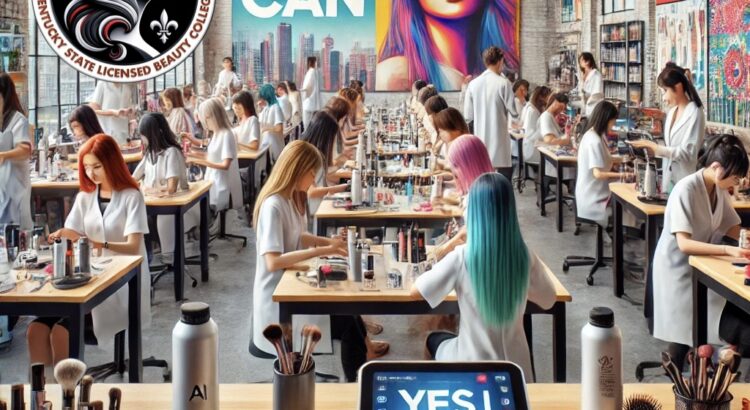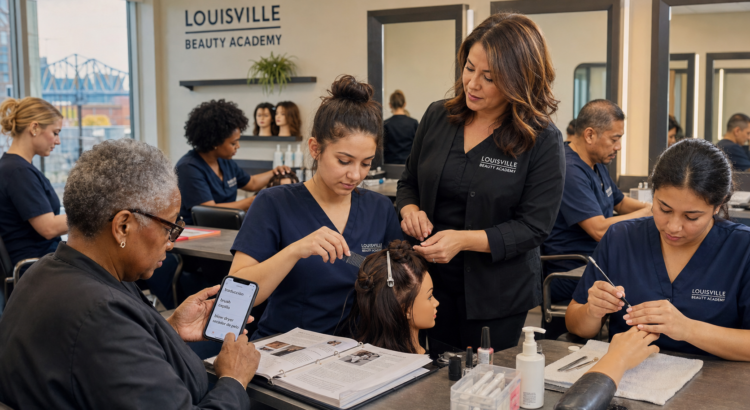
Diverse adult beauty students at Louisville Beauty Academy studying and practicing across age, language, commute, and family responsibilities.

Age Is Not the Barrier. Language Is Not the Barrier. Distance Is Not the Barrier. The Decision Is the Difference.

If you truly love beauty, the question is no longer whether beauty has opportunity. The question is whether you are willing to begin.

Every day, people need human care.

They need a haircut before work. They need clean nails before an interview. They need skincare before an event. They need grooming, sanitation, presentation, confidence, dignity, and human touch. Beauty is not only color, polish, style, or glamour. Beauty is one of the most basic human services in daily life.

That is why beauty remains close to the human economy. Technology can change many industries. AI can automate many tasks. Online tools can replace many transactions. But a real person still needs another human being to cut, shape, clean, care, listen, serve, and help them feel ready to face the world.

Beauty is service. Beauty is skill. Beauty is trust. Beauty is humanization.

And for the person who learns the profession seriously, beauty can become more than a job. It can become a licensed pathway into income, self-respect, client relationship, entrepreneurship, family support, and small-business ownership.

What People Are Really Asking Online

When people search for beauty education, they are not only typing "beauty school near me."

They are asking deeper questions:

  • Is beauty school worth it?
  • Am I too old to start?
  • What if English is not my first language?
  • What if I am scared of the cost?
  • What if I already tried college and it did not fit?
  • What if I have children, work, bills, and no perfect schedule?
  • What if I am afraid I will not pass the exam?
  • What if I am embarrassed to begin again?
  • What if other people say the industry is hard?
  • What if I love beauty, but I keep waiting?

Those questions are real. They show up across Google searches, Reddit conversations, social media comments, family discussions, and private student messages. Some people worry about debt. Some worry about physical demands. Some worry about English. Some worry about starting late. Some worry about whether they can make money after graduation. Some worry that they are not confident enough yet.

Louisville Beauty Academy does not dismiss those worries.

We answer them with reality.

Yes, beauty school requires work.

Yes, licensure requires documentation, hours, examination, and discipline.

Yes, the beauty industry can be physically demanding.

Yes, income is not automatic.

Yes, school choice matters.

Yes, written cost matters.

Yes, not every student has the same outcome.

But none of those realities prove that you should delay forever. They prove that you should choose carefully, ask written questions, compare cost honestly, understand the licensing path, and then begin with discipline.
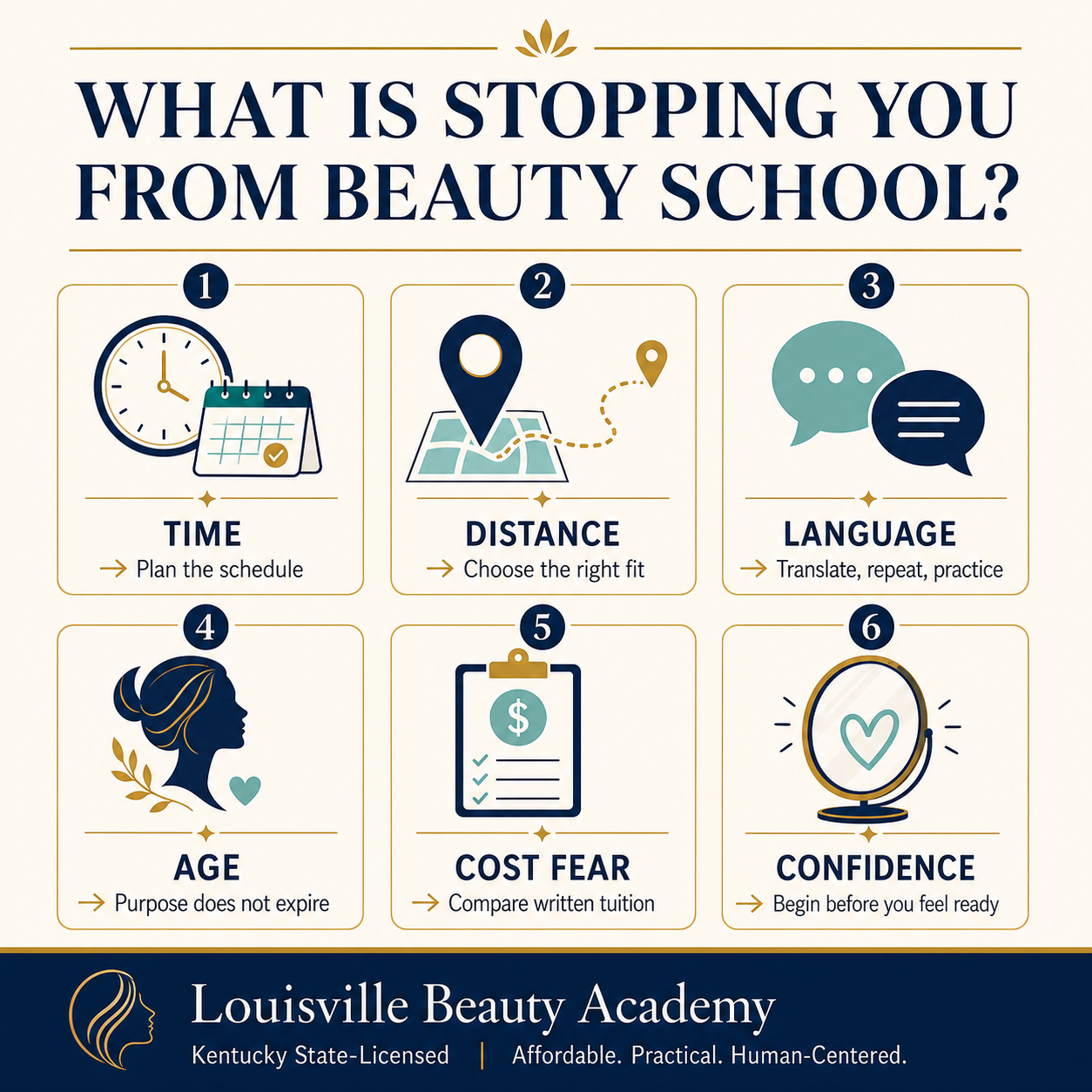
Infographic showing common beauty school barriers and Louisville Beauty Academy's practical response through affordability, translation support, perseverance, and written clarity.
Common barriers are real, but each one deserves a plan instead of permanent delay.

Beauty Is One of the Most Human Forms of Work

Beauty service is different from many jobs because it happens close to the person.

A client sits in front of you and trusts your hands. They trust your sanitation. They trust your attention. They trust your ability to listen. They trust your calmness. They trust your professionalism. They trust you with their appearance before work, family, worship, celebration, grief, recovery, or change.

That is why a beauty professional is not just selling a service. A serious beauty professional is practicing human care through a licensed, regulated, skill-based service.

For the receiver, beauty service can bring confidence, relief, pride, and dignity.

For the giver, beauty service can bring skill, income, independence, identity, and purpose.

That is the two-way power of beauty:

The client feels more human.

The professional becomes more capable.

The community gains a service provider.

The economy gains a worker, taxpayer, entrepreneur, or small-business owner.

This is why Louisville Beauty Academy treats beauty education as workforce education, human service education, and dignity education.

Beauty Is Not Immune to Hard Times. But It Is Close to Daily Need.

No industry should honestly call itself completely recession-proof. Every business can be affected by inflation, rent, consumer spending, labor shortages, competition, regulation, and economic uncertainty.

But beauty and personal care have a special kind of resilience because they sit close to daily human need.

The U.S. Bureau of Labor Statistics projects employment growth for barbers, hairstylists, and cosmetologists from 2024 to 2034 and estimates about 84,200 openings each year on average for that occupation group. BLS also describes personal care and service occupations as work that attends to people's beauty, fitness, and other needs.

Major industry research continues to show that beauty demand remains significant. McKinsey's 2026 State of Beauty research projects continued global beauty-market growth through 2030, while also noting that consumers are becoming more value-conscious and selective.

That is exactly why affordability matters.

In a value-conscious world, students must be careful about how much they pay for beauty education. Families should ask what the full written cost is, what is included, what the schedule requires, what the licensing path is, and whether the school is helping the student move toward lawful work without unnecessary debt pressure.

The opportunity is real. The caution is real too.

That is why Louisville Beauty Academy speaks plainly: choose beauty with your eyes open, your documents in writing, your cost understood, your schedule planned, and your excuses confronted.

For 10 Years, Louisville Beauty Academy Has Been Built Around Access

Louisville Beauty Academy has spent a decade proving a simple institutional belief:

Beauty education should be accessible to serious students who are willing to learn, practice, document, and finish.

LBA is a Kentucky state-licensed beauty college. It is national award-winning. It has served nearly 2,000 graduates. It is positioned publicly as one of the most affordable beauty education options students can compare in Kentucky, with a model built around affordability, written clarity, multilingual respect, flexible pathways, licensure preparation, and human support.

The strongest public promise is not that the path is easy.

The strongest public promise is that serious students should not be disqualified by fear before they even begin.

Some Students Drive Two Hours One Way

Here is the part many people do not know.

Some students come from outside Louisville, including countryside and rural areas of Kentucky. Some drive about two hours one way. That can mean about four hours of driving in a day just to attend Louisville Beauty Academy.

Why would someone do that?

Because cost matters.

Because fit matters.

Because the school environment matters.

Because the licensing path matters.

Because a serious student may decide that the right school is worth the drive.

If a student can drive hours because they believe the pathway is worth it, then every local student should ask a direct question:

What exactly is my excuse?

Not as shame.

As clarity.

If the barrier is real, name it. If it is cost, ask for the written cost. If it is schedule, ask about schedule. If it is language, ask how to study. If it is fear, say it out loud. If it is transportation, plan honestly. If it is family, discuss support. If it is procrastination, stop calling it a barrier.

Some obstacles require planning.

Some obstacles require help.

Some obstacles require patience.

But some obstacles are simply delay wearing a serious face.

In One Classroom, Many Languages

At any given moment inside Louisville Beauty Academy, it is normal to see students from different language backgrounds learning together.

Sometimes there may be three, four, or five language groups represented in the same school environment. Some students speak English well. Some are still learning. Some rely heavily on Google Translate, repeated explanation, visual demonstration, peer support, instructor guidance, hands-on practice, and written resources.

They learn slowly.

They ask again.

They translate.

They practice.

They repeat.

They continue.

That is not weakness. That is strength.

A student who is learning beauty while also learning English is doing two hard things at once. That student deserves respect, not pity.

So if someone with limited English can still show up, translate, practice, and move forward, then an English-speaking student who is simply scared must ask:

What am I waiting for?

Young Students Start. Older Students Finish. Purpose Has No Perfect Age.

Louisville Beauty Academy has seen students begin around young-adult age and students continue deep into older adulthood. Students from about 18 to 70 have entered beauty education and completed their path.

That matters because many people use age as an excuse in both directions.

Young people say, "I am not ready."

Adults say, "It is too late."

Parents say, "I have too much responsibility."

Older adults say, "People will judge me."

But the classroom tells a different story.

Age is not the true barrier.

Discipline is the barrier.

Decision is the barrier.

Humility is the barrier.

The willingness to be a beginner again is the barrier.

In beauty, life experience can even become an advantage. Patience, listening, reliability, empathy, responsibility, and communication are not small things. They are part of professional service.

You Receive More Than What Is Printed on the Page

A school can publish programs, prices, hours, policies, schedules, and requirements. Those things matter. Written documents control.

But the real educational environment is larger than any single web page.

At Louisville Beauty Academy, students receive more than what is visible in a simple program description. The school environment is built from years of founder-led thinking, books, research, documentation, compliance lessons, student support patterns, multilingual practice, AI-supported organization, and a humanization philosophy that has been refined through nearly 200 books and institutional writings connected to Di Tran's broader education mission.

Students may not hear all of that theory in a lecture.

They may simply feel it in the system:

  • clearer written documents;
  • repeated reminders;
  • practical checklists;
  • multilingual patience;
  • cost-conscious positioning;
  • exam-path respect;
  • sanitation and law emphasis;
  • no-gossip professional culture;
  • work-first mindset;
  • human dignity before prestige;
  • and the belief that a student can become more capable through action.

That is the deeper foundation.

The goal is not only to teach beauty.

The goal is to humanize the student: to help a person become more disciplined, more confident, more useful, more professional, more documented, more employable, more service-minded, and more ready to contribute as a great American in a lawful, skilled, human-centered industry.

The Real Question Is Not "Can I?"

Many students ask, "Can I do this?"

That is not the strongest question.

The stronger question is:

Will I show up long enough to become the person who can do this?

You do not need to be perfect to begin.

You do not need perfect English to begin.

You do not need to be 18 with no responsibilities.

You do not need to be young forever.

You do not need everyone to believe in you.

You need to stop hiding behind delay.

You need to ask written questions.

You need to understand the cost.

You need to know the licensing path.

You need to practice.

You need to finish.

You need to become useful.

What LBA Does Not Promise

Louisville Beauty Academy does not promise that every student will pass an exam, receive a license, get a job, earn a certain income, receive a scholarship, become a business owner, or finish on the same timeline.

Kentucky law, Kentucky Board requirements, official examinations, student attendance, student effort, documentation, payment status, program completion, and individual life circumstances all matter.

The honest promise is more serious:

LBA offers a Kentucky state-licensed educational path, written clarity, affordability-focused structure, multilingual respect, practical instruction, documentation discipline, and a culture that tells serious students to stop counting themselves out.

Come See It Before You Disqualify Yourself

If you love beauty, come see Louisville Beauty Academy.

If you are worried about cost, ask for the current written cost.

If you are worried about schedule, ask about schedule.

If you are worried about English, text in your language.

If you are worried about age, come tour and see that purpose does not expire.

If you are worried about debt, compare written tuition and payment options carefully.

If you are worried because online forums scared you, do not stop at strangers' comments. Use those concerns as a checklist. Ask the school directly. Compare documents. Understand the legal path. Then decide like an adult.

Beauty is not waiting for perfect people.

Beauty is waiting for disciplined people.

Beauty is waiting for caring people.

Beauty is waiting for people who are ready to serve.

The No-Excuse Invitation

If students can drive hours from the countryside…

If students can learn through Google Translate…

If students can sit in a classroom with three to five different language groups…

If students can begin young…

If students can begin older…

If students can carry children, jobs, bills, family duties, and still move forward…

Then the question becomes clear:

What is your excuse?

Not your real obstacle.

Your excuse.

Because real obstacles deserve planning.

Excuses deserve truth.

Louisville Beauty Academy exists for the serious student who is ready to move from interest to action.

Study.

Practice.

Graduate.

Pursue licensure.

Serve people.

Build yourself.

Build your family.

Build your future.

Beauty is service. Beauty is dignity. Beauty is business. Beauty is humanization.

If beauty is truly in you, begin now.

Text Louisville Beauty Academy in any language:

502-625-5531

study@LouisvilleBeautyAcademy.net

Visit: https://louisvillebeautyacademy.net

Louisville Beauty Academy

National Award-Winning Beauty Education

Kentucky State-Licensed Beauty College

Affordable. Practical. Human-Centered.

Sources and Reading Notes

Compliance note:

This article is public education and institutional communication. Current written LBA documents, signed enrollment agreements, Kentucky Board requirements, PSI rules, and applicable law control. Individual results vary. No statement here guarantees enrollment, graduation, exam passage, licensure, employment, income, scholarship, discount eligibility, transfer acceptance, or business ownership.

The Humanization of Vocational Education: A Comprehensive Research Report on the Viability of Beauty School and the Louisville Beauty Academy Model – Research & Podcast Series (2026) — LBA Public Library

Current information notice

This article is part of LBA’s public education and historical archive. Older posts, including “The Humanization of Vocational Education: A Comprehensive Research Report on the Viability of Beauty School and the Louisville Beauty Academy Model – Research & Podcast Series (2026) — LBA Public Library,” may not reflect current tuition, schedules, incentives, forms, policies, testing vendors, clinic availability, or regulatory requirements.

Before relying on this article for any decision, review LBA’s Current Information and Written Control Standard, Current Program Costs, Enrollment Concierge, and Policy and Written Records.

The Humanization of Vocational Education:
A Comprehensive Research Report on the Viability of Beauty School and the Louisville Beauty Academy Model

Published as part of the Louisville Beauty Academy (LBA) Public Library of Research,
powered by Di Tran University — College of Humanization, Research Team.

This report anchors LBA’s 2026 Research & Podcast Series, documenting a human-centered, compliance-first, lower-debt model for vocational education. It is released in full as part of LBA’s commitment to open knowledge, regulatory literacy, student protection, and industry elevation.

The accompanying 2026 podcast and video series translate this research into accessible public education for:

  • prospective students and families
  • licensed professionals and salon owners
  • regulators, policymakers, and workforce leaders
  • the broader beauty and human-services industry

This publication is maintained as a public record and living research reference, reflecting LBA’s role not only as a licensed school, but as an institutional contributor to the future of vocational education.

Executive Abstract

The decision to pursue a career in the beauty industry—encompassing cosmetology, esthetics, nail technology, and instruction—is often framed through a narrow vocational lens. Prospective students typically ask, “How quickly can I get licensed?” and “How much will it cost?” However, the contemporary landscape of professional beauty services, particularly as we approach the regulatory and economic shifts of 2026, demands a far more rigorous inquiry. The question “Is beauty school for you?” is fundamentally a question of psychology, economics, and legal compliance. It requires an examination of one’s readiness to enter a regulated workforce, an assessment of financial risk versus return, and a commitment to lifelong human service.

This research report provides an exhaustive analysis of these dynamics, using Louisville Beauty Academy (LBA) as a primary case study. LBA represents a distinct departure from the traditional “beauty college” model, positioning itself instead as an institution of higher learning under the umbrella of Di Tran University and the College of Humanization. Through a unique “Gold Standard” operational framework, LBA has redefined vocational training by integrating advanced Artificial Intelligence (AI), enforcing a strict “Zero Disruption Policy” to ensure psychological safety, and rejecting the Title IV federal loan system in favor of a lower-debt, transparency-driven financial model.

By functioning as a “Public Library” of compliance research and publishing over 150 textbooks and guides, LBA elevates the beauty industry from a trade to a profession rooted in law, safety, and human dignity. This report explores how LBA’s methodology protects students from predatory debt and regulatory ignorance while empowering them with the “Yes I Can” mindset necessary for long-term entrepreneurial success.

1. The Existential Inquiry: Is Beauty School for You?

1.1 The Psychology of the Vocational Pivot

The initial contemplation of beauty school is rarely a linear decision; it is often a psychological pivot point in an adult’s life. Research into student demographics at institutions like Louisville Beauty Academy reveals a pattern of transformation. The cohort is not limited to recent high school graduates but heavily features “career changers,” single parents, immigrants, and individuals seeking liberation from stagnant wage-labor roles.1 For these individuals, the question “Is beauty school for you?” is laden with self-doubt, societal stigma regarding “trade schools,” and the fear of financial failure.

The “Yes I Can” philosophy, championed by LBA founder Di Tran, addresses this specific psychological barrier. The academy recognizes that the primary obstacle to enrollment is not a lack of talent, but a lack of belief. The “Imposter Syndrome” that plagues prospective students is dismantled through a curriculum that emphasizes “Humanization”—the belief that education is a mechanism for restoring personal dignity.1 When a student asks if beauty school is for them, they are effectively asking if they are capable of reinventing their identity from “employee” to “licensed professional.” LBA answers this by positioning the license not just as a permit to work, but as a badge of “I Have Done It”—a tangible proof of resilience.3

1.2 The Demographic Imperative: Serving the “New Majority”

The beauty industry is increasingly driven by what sociologists term the “New Majority”—immigrants, non-native English speakers, and adult learners managing complex household responsibilities. Traditional educational models, with their rigid semester schedules and English-only instruction, often exclude this demographic.

LBA has structured its entire operational model to serve this population, effectively arguing that beauty school is “for you” regardless of your linguistic or cultural starting point. The academy’s “Enroll Anytime” model removes the friction of waiting for a “Fall Semester,” recognizing that for a working mother or a new immigrant, the window of opportunity to start school is often narrow and immediate.4 By allowing students to enroll and start immediately, LBA validates the student’s impulse to improve their life now, removing the “cooling off” period where doubt often creeps in. This flexibility is not merely administrative; it is a statement of accessibility, declaring that the path to licensure is open to anyone with the will to begin.4

1.3 The Entrepreneurial Reality vs. The Employment Myth

A critical component of the “Is it for you?” analysis involves understanding the nature of the industry. Unlike nursing or teaching, where one typically enters a structured employment hierarchy, the beauty industry is fundamentally entrepreneurial. Even professionals working in salons often operate as independent contractors or booth renters.

Therefore, beauty school is “for you” only if you are prepared to accept the responsibilities of business ownership: marketing, retention, tax compliance, and self-management. LBA’s curriculum, heavily influenced by the 151 books authored by Di Tran on business and mindset, prepares students for this reality.1 The academy explicitly markets itself to “salon-owner material” students—those who mean business and are eager to launch.5 The report suggests that students looking for a passive educational experience may struggle, whereas those approaching the program as a business incubator will thrive.

2. Economic Transparency: Redefining Financial Aid

2.1 The Semantic Trap: “Financial Aid” vs. Federal Loans

One of the most pervasive misunderstandings in the vocational education sector—and a primary source of confusion for prospective students—is the conflation of the term “Financial Aid” with “Title IV Federal Student Aid” (e.g., Pell Grants and FAFSA-based loans).

From a legal and regulatory perspective, “Financial Aid” is a broad umbrella term referring to any monetary assistance that reduces the cost of attendance. This includes institutional scholarships, private grants, tuition discounts, and employer reimbursement programs. However, the public vernacular has narrowed this definition to mean “government money.”

Louisville Beauty Academy proactively clarifies this confusion. The academy is not a Title IV participating institution. It does not process FAFSA, nor does it disburse federal loans. This is a deliberate strategic choice designed to protect the student.6 By decoupling from the federal loan system, LBA avoids the regulatory overhead that drives up tuition costs and, more importantly, prevents students from entering the workforce with tens of thousands of dollars in non-dischargeable federal debt.

2.2 The Lower-Debt Philosophy: Protection Through Pricing

The traditional beauty school model often relies on the availability of federal loans to justify inflated tuition rates. If a student can borrow $20,000, schools are incentivized to charge $20,000. This results in a crisis where entry-level cosmetologists begin their careers burdened by loan payments that consume a significant portion of their initial earnings.

LBA’s “Lower-Debt” model operates on a “Double Scoop” philosophy: Save Big and Start Earning Sooner.5

  1. Direct Tuition Reduction: Instead of creating a complex package of loans, LBA offers massive upfront transparency. The “financial aid” is applied directly to the invoice as a discount. For example, the Cosmetology program, valued at a standard rate of ~$27,000, is offered at a discounted rate of ~$6,250 for eligible students.7
  2. The “Scholarship” as a Behavioral Contract: At LBA, scholarships are not lottery tickets; they are earnings. The academy views the 50-75% tuition discount as a scholarship that the student “earns” through attendance and compliance. This reframes financial aid from a handout to a partnership. If a student attends class and follows the rules, the school subsidizes the education.5

2.3 Comparative Cost Analysis

The following table illustrates the stark contrast between the Title IV debt model and the LBA direct-pay model, highlighting the long-term financial protection afforded to the student.

Financial MetricTraditional Title IV SchoolLouisville Beauty Academy (LBA)
Funding MechanismFederal Loans (Stafford, Plus) & Pell GrantsInstitutional Scholarships & Direct Pay
Debt LiabilityHigh (Principal + Interest)Zero Federal Debt
Interest AccrualInterest capitalizes over time0% Interest on internal payment plans
Tuition StrategyHigh sticker price to capture max federal aidMarket-corrected price (50-75% off)
Student AgencyPassive recipient of government fundsActive participant in funding education
Long-Term ImpactLoan payments reduce take-home pay for 10+ yearsGraduate keeps 100% of earnings immediately

2.4 The Voiding Policy: Accountability in Finance

Transparency requires honesty about consequences. LBA’s financial aid is contingent on performance. The academy enforces a strict policy regarding the “Scholarship Voiding.” If a student engages in time theft (e.g., clocking in and leaving without clocking out), they are penalized financially—$100 for the first offense, $200 for the second, and the entire scholarship is voided for the third.7 This policy serves a dual purpose: it protects the school’s resources and teaches the student a vital lesson in professional integrity. In the real world, time theft leads to termination; at LBA, it leads to the loss of financial privilege. This “checks and balances” approach ensures that the aid goes only to those who respect the opportunity.

3. Regulatory Compliance: The “Public Library” Model

3.1 Licensure as the Core First Step

LBA operates on the fundamental premise that the beauty industry is a law-based profession. Creativity, technique, and style are secondary to the primary requirement: Licensure. Without a license, “beauty” is merely a hobby; with a license, it is a regulated commercial activity protected by the state.

Consequently, LBA positions the study of regulation—specifically Kentucky Revised Statutes (KRS) Chapter 317A and Kentucky Administrative Regulations (201 KAR)—as the “core first step” of the curriculum.8 The academy researches and teaches these laws not as abstract concepts, but as the “rules of engagement” for the profession. This focus addresses a common misunderstanding among students who believe beauty school is solely about learning to cut hair. LBA clarifies that beauty school is about learning to legally cut hair, ensuring public safety and sanitation.2

3.2 The Public Library Model: Democratizing Knowledge

In a revolutionary move for the private education sector, LBA has adopted the “Public Library Model” or “Open Knowledge Infrastructure”.2

  • The Problem: Historically, beauty schools and salons have engaged in “gatekeeping,” hoarding information about regulations, techniques, and business practices to create dependency.
  • The LBA Solution: LBA publishes its research, policy analysis, and regulatory guides openly online for the benefit of the entire industry—competitors, regulators, and the public included.2
  • The Impact: This transparency elevates LBA from a mere school to an “Institutional Contributor.” By providing exact empirical references to law and policy, LBA empowers its students to debate inspectors, understand their rights, and operate with confidence. They are not just taught “what” to do; they are given the “citation” for “why” they must do it.9

3.3 The Hierarchy of Authority

LBA’s compliance education is sophisticated. It teaches the “Hierarchy of Authority,” helping students distinguish between a Statute (passed by the legislature), a Regulation (created by the Board), and a mere Guideline.8 This nuance is critical. A student who understands this hierarchy is protected against administrative overreach and is better equipped to run a compliant business. LBA’s “Gold Standard” compliance guide is a direct output of this research, aiming for “Over-Compliance” to ensure absolute safety.10

4. The Institutional Environment: Love, Care, and Zero Disruption

4.1 “Love and Care” as Operational Doctrine

While “Compliance” provides the skeleton of the LBA model, “Love and Care” provides the heart. This phrase is not a marketing slogan but an operational doctrine rooted in the founder’s philosophy of Humanization.

  • The Need for Safety: Many LBA students come from backgrounds of trauma, instability, or economic hardship. For these students, a chaotic learning environment is a barrier to cognitive function.
  • The Implementation: LBA creates a “proven environment of love and care” by establishing a sanctuary. This is a “judgment-free zone” where past academic failures are irrelevant. The focus is entirely on the “Yes I Can” future.11

4.2 The Zero Disruption Policy: Protecting the Sanctuary

To maintain this environment of “Love and Care,” LBA enforces a rigorous “Zero Disruption Policy”.11

  • The Misunderstanding: Some may view strict discipline as contrary to “care.” LBA argues the opposite: True care requires the removal of toxicity.
  • The Policy: The policy is a “Zero Tolerance” framework prohibiting gossip, drama, bullying, or any behavior that disrupts the learning of others. It is legally binding and documented in the enrollment contract.11
  • The Mechanism: LBA administration is empowered to make “instant, lawful decisions,” including expulsion, to protect the peace of the student body. The school mandates a professional chain of command for grievances, preventing the spread of rumors.11
  • The Result: Google ratings and student reviews frequently cite the “peaceful,” “calm,” and “safe” atmosphere as the primary reason they were able to complete the program.11 By eliminating the “high school drama” often associated with trade schools, LBA elevates the dignity of the vocational student.

4.3 Google Ratings and Social Proof

The efficacy of this policy is reflected in the school’s digital footprint. The “Zero Disruption” policy is often mentioned in positive reviews as a differentiator. Students who are serious about their careers appreciate that the school protects their investment by silencing distractions. The reviews highlight an environment where “love and care” means holding everyone to a standard of excellence and mutual respect.11

5. The Intellectual Foundation: Di Tran University & The College of Humanization

5.1 Elevating the Trade to a Discipline

Louisville Beauty Academy is the flagship institution of a broader educational project: Di Tran University. This affiliation elevates the beauty school from a technical training center to a college of higher learning. Specifically, LBA operates under the College of Humanization, one of the three pillars of Di Tran University (alongside the College of AI and the College of Human Service).2

The College of Humanization posits that vocational education must be centered on the human being, not just the skill. “When education is humanized, dignity follows”.2 This philosophy serves to protect the student from being viewed as a mere cog in the workforce machinery. Instead, they are trained as holistic service providers who understand the emotional and psychological value of their work.

5.2 The 151 Books: A Publishing Library

The intellectual weight of the academy is sustained by the prolific output of its founder, Di Tran. With 151 published books, LBA functions as a specialized publishing library.1

  • Curriculum Integration: These books are not supplementary; they are central to the LBA experience. Titles such as “Drop the FEAR and Focus on the FAITH”, “The Humanization Blueprint”, and “Mastering the Craft” serve as textbooks that bridge the gap between technical skill and personal development.14
  • Empirical Reference: By publishing its own educational materials, LBA ensures that students have access to up-to-date, empirical references regarding law, policy, and sanitation. This contrasts with schools relying on outdated generic textbooks.7
  • Thought Leadership: The volume of this work establishes LBA as a national leader in beauty education research. The “2026 Magazine” and the upcoming podcast series are extensions of this publishing arm, designed to disseminate this knowledge globally.2

5.3 Founder Di Tran: The Embodiment of “Yes I Can”

Di Tran’s personal narrative—from living in a mud hut in Vietnam to becoming a computer engineer, author, and university founder—serves as the ultimate validation of the “Yes I Can” curriculum.1 His background in computer science and engineering directly informs the school’s advanced system integration, while his immigrant experience informs the “Love and Care” policy. He is not a distant administrator; his philosophy is the operating system of the school.

6. Technological Vanguard: AI, Integration, and Checks & Balances

6.1 Max AI Adoption: Breaking Barriers

LBA markets itself as the “most advanced beauty school” due to its aggressive adoption of Artificial Intelligence.17 However, unlike institutions that use tech to replace teachers, LBA uses AI to humanize the experience by removing barriers.

  • Language Translation: The most significant application is the use of generative AI (ChatGPT, D-ID avatars) to provide real-time translation and tutoring in over 100 languages. A student who speaks Vietnamese or Spanish can engage with complex biological theory in their native language, ensuring deep comprehension before testing in English.17 This effectively “protects” non-native speakers from systemic exclusion.
  • Personalized Tutoring: AI tools serve as 24/7 tutors, allowing students to ask “stupid questions” without fear of judgment, reinforcing the psychological safety of the learning environment.17

6.2 System Integration and “Checks and Balances”

Behind the scenes, LBA utilizes advanced system integration to manage the complexities of state board hour reporting.

  • The “Checks and Balances”: The beauty industry is notorious for disputes over “clocked hours.” LBA uses a rigorous digital system to track attendance, financial aid (scholarship) compliance, and academic progress.18 This system provides a “check” against human error and a “balance” against fraud.
  • Security and Compliance: The system is designed to ensure that the data reported to the Kentucky State Board is accurate and immutable. This protects the student’s license from future audit risks. By automating the bureaucratic aspects of the school, LBA allows instructors to focus entirely on hands-on training and “Love and Care”.20

7. Social Integration and Public Scholarship

7.1 Social Media as a Portfolio

LBA integrates social media not just for marketing, but as a dynamic student portfolio system.

  • Student Features: The academy actively features students on its platforms (Facebook, Instagram, YouTube), tagging them and showcasing their work to the public. This builds the student’s professional brand before they graduate.7
  • Graduates Gallery: The “Gallery of Louisville Beauty Academy Graduates” celebrates the 1,000+ individuals who have successfully licensed. This serves as social proof and motivation for current students.7

7.2 The 2026 Magazine and Podcast Series

Looking ahead, LBA is expanding its media footprint to further elevate the industry.

  • “Licensed to Thrive” Podcast: Launching in 2026, this podcast series is designed to explain why licensing is the foundation of success. It is a public education tool intended to raise the status of the beauty professional in the eyes of the consumer.21
  • Magazine and White Papers: The academy is preparing to release a series of research papers and magazine features on “Beauty Workforce Economics” and “Regulatory Literacy,” cementing its status as a think tank.2

7.3 Live Volunteer Practices

The academy’s “Live Volunteer Practice” model connects students with the community. By allowing the public to book services (via a dedicated line: 502-915-8615) for a nominal fee (e.g., $4.00 haircuts), the school provides students with real-world clinical experience.7 This feature is critical for building the “soft skills” of client consultation and time management, which are emphasized in the College of Humanization curriculum.

8. Conclusion: The Verdict on Protection and Elevation

In answering the query “Is beauty school for you?”, this report concludes that the viability of the career path is heavily dependent on the institutional model one chooses. The traditional model, fraught with debt and “sink-or-swim” dynamics, poses significant risks. However, the model pioneered by Louisville Beauty Academy offers a protected, elevated pathway.

LBA protects the student through:

  1. Financial Safety: A lower-debt, direct-pay model that prevents federal loan entrapment.
  2. Psychological Safety: A “Zero Disruption” policy that ensures a calm, professional learning environment.
  3. Regulatory Safety: A “Gold Standard” compliance education that armors the graduate in law.
  4. Cultural Safety: An inclusive, AI-supported environment that welcomes diverse learners.

LBA elevates the industry through:

  1. Academic Rigor: The research capabilities of Di Tran University and the College of Humanization.
  2. Public Scholarship: The “Public Library” model that democratizes knowledge.
  3. Professional Dignity: Reframing the cosmetologist as a “Human Service Professional.”

For the student who desires not just a job, but a career built on a foundation of “Yes I Can,” Louisville Beauty Academy represents the most comprehensive, transparent, and human-centered option in the current market.

Appendix: Data Analysis Tables

Table A: Comparative Analysis of Financial Models

FeatureTitle IV Federal Aid ModelLBA “Lower-Debt” Model
Primary FundingFederal Loans (Debt)Institutional Scholarship (Discount)
Cost to StudentPrincipal + Interest (10+ Years)Cash/Payment Plan (0% Interest)
Tuition PricingOften Inflated to CapMarket-Corrected (50-75% Lower)
FAFSA Required?YesNo (Direct Enrollment)
Financial RiskHigh (Non-dischargeable debt)Low (Pay-as-you-go)

Table B: LBA Program Transparency (2026 projections based on current data)

ProgramHours (KY Req.)Standard CostDiscounted Cost*Savings
Cosmetology1,500~$27,025~$6,250~75%
Esthetics750~$14,174~$6,100~55%
Nail Technology450~$8,325~$3,800~55%
Instructor750~$12,675~$3,900~70%

*Discounts are contingent on the “Scholarship” behavioral contract (attendance and compliance).

Table C: The Four Pillars of the LBA 2026 Mission

PillarDescriptionObjective
Gold-Standard ModelStudent-First, Compliance-FirstPrioritize long-term professional dignity over profit.
Public Library ModelOpen Knowledge InfrastructureEnd information gatekeeping; share research freely.
Podcast/Video Series“Licensed to Thrive”Educate the public on the value of licensure.
College of HumanizationDi Tran University IntegrationInfuse vocational training with ethics and empathy.

REFERENCES

  1. Di Tran’s Louisville Beauty Academy — From Mud Hut to 130 Books – The YES I CAN Way, accessed January 24, 2026, https://www.youtube.com/watch?v=BR6Ew0Lid00
  2. Louisville Beauty Academy: Our Direction Forward (2026 and Beyond), accessed January 24, 2026, https://louisvillebeautyacademy.net/louisville-beauty-academy-our-direction-forward-2026-and-beyond/
  3. List of books by author DI TRAN – ThriftBooks, accessed January 24, 2026, https://www.thriftbooks.com/a/di-tran/12174455/
  4. Louisville Beauty Academy – Student Enrollment Procedures, accessed January 24, 2026, https://louisvillebeautyacademy.net/louisville-beauty-academy-student-enrollment-procedures/
  5. Fast-Track & Lower-Debt: How Louisville Beauty Academy Delivers the “Double Scoop” – Save Big and Start Earning Sooner – RESEARCH AUGUST 2025, accessed January 24, 2026, https://louisvillebeautyacademy.net/fast-track-lower-debt-how-louisville-beauty-academy-delivers-the-double-scoop-save-big-and-start-earning-sooner-research-august-2025/
  6. Financial Aid Options and Payment Model at Louisville Beauty …, accessed January 24, 2026, https://louisvillebeautyacademy.net/financial-aid-options-and-definition/
  7. Self-Published Books for Advanced … – Louisville Beauty Academy, accessed January 24, 2026, https://louisvillebeautyacademy.net/louisvillebeautyacademyselfpublishedbookcollection/
  8. The Hierarchy of Authority in Kentucky Beauty Regulation – Understanding Statutes, Administrative Rules, and Guidance Materials, accessed January 24, 2026, https://louisvillebeautyacademy.net/the-hierarchy-of-authority-in-kentucky-beauty-regulation-understanding-statutes-administrative-rules-and-guidance-materials/
  9. Kentucky Beauty Licensee’s Gold Standard Guide for Lawful, Professional, and Transparent Interaction with Inspectors and Law Enforcement – Louisville Beauty Academy, accessed January 24, 2026, https://louisvillebeautyacademy.net/kentucky-beauty-licensees-gold-standard-guide-for-lawful-professional-and-transparent-interaction-with-inspectors-and-law-enforcement/
  10. Gold-Standard Compliance Guide: KBC Transfer and Field / Charity Hour Requirements – RESEARCH 2026 – Louisville Beauty Academy, accessed January 24, 2026, https://louisvillebeautyacademy.net/gold-standard-compliance-guide-kbc-transfer-and-field-charity-hour-requirements-research-2026/
  11. Tag: best beauty school in Louisville – Louisville Beauty Academy, accessed January 24, 2026, https://louisvillebeautyacademy.net/tag/best-beauty-school-in-louisville/
  12. Di Tran, Most Admired CEO, Celebrates USA and Workforce Development with a Message of Love and Care – Louisville Beauty Academy, accessed January 24, 2026, https://louisvillebeautyacademy.net/di-tran-most-admired-ceo-celebrates-usa-and-workforce-development-with-a-message-of-love-and-care/
  13. Di Tran — Founder & CEO | Visionary Leader in Workforce Education, Humanized AI, and Immigrant Entrepreneurship – New American Business Association (NABA) – Louisville, KY, accessed January 24, 2026, https://naba4u.org/di-tran-founder-ceo-visionary-leader-in-workforce-education-humanized-ai-and-immigrant-entrepreneurship/
  14. Who is Di Tran? Exploring the Life and Books of a Prolific Author and our Founder of Louisville Beauty Academy, accessed January 24, 2026, https://louisvillebeautyacademy.net/explore-di-trans-inspirational-books-online/
  15. Beauty as Healing: Louisville Beauty Academy Shares a New Voice in the Di Tran University Podcast Series (2026), accessed January 24, 2026, https://louisvillebeautyacademy.net/beauty-as-healing-louisville-beauty-academy-shares-a-new-voice-in-the-di-tran-university-podcast-series-2026/
  16. Books by Di Tran: A Journey of Perseverance and Inspiration – Viet Bao Louisville KY, accessed January 24, 2026, https://vietbaolouisville.com/books-by-di-tran-a-journey-of-perseverance-and-inspiration/
  17. Research 2025: Louisville Beauty Academy and Di Tran University – A Pioneering Model for the Future of Education, accessed January 24, 2026, https://vietbaolouisville.com/2025/06/research-2025-louisville-beauty-academy-and-di-tran-university-a-pioneering-model-for-the-future-of-education/
  18. Operationalizing competency-based assessment: Contextualizing for cultural and gender divides – PMC – NIH, accessed January 24, 2026, https://pmc.ncbi.nlm.nih.gov/articles/PMC10576182/
  19. 2024 Integrated Report | Givaudan, accessed January 24, 2026, https://www.givaudan.com/files/giv-2024-integrated-report.pdf
  20. Tag: AI integration in beauty education – Louisville Beauty Academy, accessed January 24, 2026, https://louisvillebeautyacademy.net/tag/ai-integration-in-beauty-education/
  21. Licensed to Thrive: Louisville Beauty Academy Launches Its 2026 Flagship Podcast Series, accessed January 24, 2026, https://louisvillebeautyacademy.net/licensed-to-thrive-louisville-beauty-academy-launches-its-2026-flagship-podcast-series/
  22. Louisville Beauty Academy: Advancing Transparency in Beauty Education Finance – January 2026 – RESEARCH BY DI TRAN UNIVERSITY, accessed January 24, 2026, https://louisvillebeautyacademy.net/louisville-beauty-academy-advancing-transparency-in-beauty-education-finance-january-2026-research-by-di-tran-university/

Louisville Beauty Academy 2025 Year-End Review: Mission, Operations, and Public Milestones

Louisville Beauty Academy 2025 year-end review graphic

Louisville Beauty Academy 2025 Year-End Review: Mission, Operations, and Public Milestones

As of December 30, 2025, Louisville Beauty Academy used this year-end review to summarize mission language, public-facing accomplishments, and institutional themes that shaped the year. This page is best read as a year-end institutional reflection rather than a guarantee of future outcomes or a claim of national superiority.

“Drop the ME — Focus on the OTHERS.”

Mission themes

The school’s public mission language during 2025 emphasized affordability, licensure-focused education, multilingual access, community service, sanitation, safety, and respect for students whose paths include work, family obligations, immigration realities, and economic rebuilding.

Student-access structure described during 2025

  • Tuition-reduction and scholarship messaging used in 2025 enrollment communications
  • written payment or structured payment language where offered by the school at that time
  • Flexible scheduling and multilingual-access messaging
  • Use of professional kits and curriculum materials as described in then-current school materials

Prospective students should not rely on this year-end review alone for current enrollment terms. Current tuition, scholarships, schedules, and student-support details should be confirmed directly with the school using current written information.

Public recognitions and milestones

During 2025, the school publicly referenced recognitions and advocacy-related milestones, including recognition associated with the U.S. Chamber of Commerce CO—100 program and public small-business advocacy visibility. Those recognitions should be understood according to the specific program, date, and source that issued them.

Institutional publishing and research activity

Louisville Beauty Academy also continued emphasizing publication, licensing resources, multilingual public education, and policy-oriented writing connected to beauty education, workforce dignity, and student access.

Important caution

Any metric, recognition, savings claim, or economic-impact statement from a year-end review should be read with date context and source context. Students, readers, and partners should request current written information before making financial, educational, or business decisions.

Louisville Beauty Academy Strategic Expansion Overview

Introduction: A Model Worth Scaling Louisville Beauty Academy (LBA) is an award-winning, immigrant-led beauty college headquartered in Louisville, Kentucky. We deliver licensed, state-approved cosmetology and esthetics education that is affordable, fast-paced, and trauma-informed. Our flexible, multilingual model empowers underserved populations—immigrants, refugees, single parents, and adult learners—to build meaningful careers in beauty. Today, we are launching a national expansion campaign with a mission to bring this life-changing education to communities that need it most.

We are proud Americans. Proud Louisvillians. Proud Kentuckians. Proud beauty professionals. And now, we’re proud to take this scalable, nationally recognized model to cities across Kentucky and Southern Indiana—with franchise and license opportunities open to those who share our purpose.

Our National Model: Why It Works LBA is more than a beauty school—it’s a community lifeline built on four cornerstones:

  1. Affordable, Accessible Education – Low tuition, short programs, and zero student loan dependency.
  2. AI-Augmented Systems – Automated compliance, learning, and licensing workflows for rapid scalability.
  3. Hyperlocal, Humanized Curriculum – Delivered in English, Vietnamese, Spanish, and more—infused with trauma-informed teaching and entrepreneurship.
  4. Speed to Launch – Facilities can be built out and opened in under 90 days using our proven blueprint.

Our Expansion Strategy: Where We’re Going & Why We’ve identified four regional hubs based on demographic need, property readiness, and community alignment:

1. Elizabethtown, KY (ZIP 42701)

  • Community Need: 55% of current beauty students come from households earning under $30K. Military spouses and local workforce need low-cost education.
  • Opportunity: Massive job growth due to Ford’s BlueOval SK Battery Park (5,000 jobs). Retail corridors (Ring Rd/Dixie Hwy) have properties ready for conversion.

2. Bowling Green, KY (ZIPs 42101, 42104)

  • Community Need: 14% foreign-born population; large Congolese, Afghan, and Burmese refugee presence.
  • Opportunity: Refugee resettlement hub with strong job demand. Properties like Fairview Plaza and Scottsville Rd offer scalable space.

3. Lexington, KY (ZIPs 40504, 40511, 40505)

  • Community Need: 35,000+ foreign-born residents, underserved ZIPs with limited beauty training access.
  • Opportunity: Modern strip centers and revitalized retail near Versailles Rd and New Circle Rd ready for licensing buildouts.

4. Southern Indiana (ZIPs 47129 – Clarksville, 47130 – Jeffersonville)

  • Community Need: Working-class populations with minimal beauty school coverage; proximity to Louisville metro.
  • Opportunity: River Falls and Jeffersonville plazas with large, affordable spaces and growing traffic corridors.

A Call to Franchisees, Licensees, & Partners We are actively seeking:

  • Franchisees and licensees ready to bring LBA to their communities.
  • Cosmetology professionals ready to lead or co-invest in new academies.
  • Faith-based, nonprofit, or community organizations seeking workforce solutions.
  • Impact investors, VCs, and CDFIs who care about educational equity and scalable job training.

LBA’s licensing model comes with curriculum, automation tools, launch support, and regulatory compliance blueprints—ready to go. Franchisees and licensees will be trained, supported, and guided with everything needed to replicate LBA’s success.

Why Invest in LBA Expansion?

  • 📈 Massive demand for licensed beauty professionals across underserved regions
  • 🧠 AI-enhanced systems ensure operational efficiency and state compliance
  • 🤝 Humanized training model proven to uplift vulnerable populations
  • 💸 Low startup costs and fast revenue timelines via our streamlined launch framework
  • 🏆 Nationally recognized brand with local roots and measurable impact

Our Promise: Real Lives Transformed LBA’s students are often first-generation Americans, single mothers, and adults who’ve been told “no” by traditional education. At LBA, we show them “yes you can.” With every new academy, we change lives—not just with licenses and jobs, but with confidence, dignity, and hope.

We invite you to join us as a co-creator of something far bigger than a business—it’s a beauty education revolution.

Own a Beauty College. Build a Community. Partner with Louisville Beauty Academy to:

  • Launch a school where your people live.
  • Create jobs, boost local economies, and open pathways for overlooked talent.
  • Be part of the most productive, human-centered, affordable, AI-integrated cosmetology school model in America.

📩 Contact us to begin a conversation: [Insert contact info or website]

References
Big Duck. (n.d.). Sharing your strategic plan: Communications tips. https://www.bigduck.com/insights/strategic-plan-communications/
Bureau of Labor Statistics. (2024). Occupational outlook handbook: Barbers, hairstylists, and cosmetologists. https://www.bls.gov/ooh/personal-care-and-service/barbers-hairstylists-and-cosmetologists.htm
Ogle School. (2023). Ogle School announces expansion to Georgia. https://www.ogleschool.edu/blog/expanding-to-georgia/
U.S. Census Bureau. (2023). American Community Survey 5-Year Estimates. https://data.census.gov
Kentucky Office for Refugees. (2024). Annual Refugee Resettlement Report. https://kyrrefugees.org
LoopNet. (2025). Commercial properties listings – Kentucky and Indiana. https://www.loopnet.com

Unlock Your Future at Louisville Beauty Academy: The “YES I CAN” Journey

When you walk through the doors of Louisville Beauty Academy, you’re not just entering a school; you’re stepping into a place where dreams come alive, no matter where you come from or what language you speak. The moment you ask, “Do you teach in Spanish?” you’ll be greeted with a smile and an answer that resonates deeply: Louisville Beauty Academy is for everyone.

Diversity at Its Core: A Multilingual Learning Hub

At Louisville Beauty Academy, every classroom is a symphony of languages and cultures. At any given time, our students and staff represent more than five different languages, all navigating the journey of mastering beauty programs. While our primary instruction is in English, we have embraced the power of AI-driven translator technologies to bridge the language gap. These tools make learning accessible, empowering students to thrive in a multilingual environment.

This unique approach has enabled countless students, including many Spanish speakers and other immigrants, to achieve their goals. Success stories fill our halls — individuals who arrived with limited English but left with certifications and bright futures in the beauty industry. It’s proof that at Louisville Beauty Academy, language is no barrier to success.

A Legacy of Advocacy: Fighting for Multilingual Exams

The story of Louisville Beauty Academy is also a story of perseverance. For over five years, our founder, Di Tran, along with others, fought tirelessly for multilingual licensing exams in Kentucky. In 2024, their efforts bore fruit: exams are now available in multiple languages, breaking down barriers for immigrants and non-native English speakers.

This victory is more than a milestone; it’s a promise. A promise that Louisville Beauty Academy is committed to ensuring every student, regardless of their background, has the opportunity to succeed. It’s not just about passing exams — it’s about building a life and a career that you’re proud of.

The “YES I CAN” Mindset: The Key to Success

Success at Louisville Beauty Academy boils down to one thing: the “YES I CAN” mindset. This mantra, championed by our founder, Di Tran, is the driving force behind everything we do. Di Tran’s own story is a testament to this belief. Arriving in the United States with zero English skills, he went on to earn a Master’s degree in engineering and pursue PhD studies. His journey was not easy, but it was driven by grit, determination, and an unshakable belief in the power of action.

At Louisville Beauty Academy, we instill this mindset in every student. Our goal is to not just teach the art and science of beauty but to empower you with the confidence to say, “I can do this.” When you graduate, you don’t just leave with a certification; you leave with a trademarked badge of honor from Di Tran University that says, “I HAVE DONE IT.”

Why Choose Louisville Beauty Academy?

  • Family-Oriented and Caring: We are more than a school; we are a community that cares deeply about your success.
  • Result-Oriented: Our focus is on helping you obtain your license and become a professional.
  • Proven Success: With hundreds of graduates who have gone on to own salons and thrive in their careers, we have mastered the methods to ensure your success.
  • Affordable and Flexible: We understand the challenges of balancing education with life, so we offer flexible schedules and affordable tuition to eliminate excuses and barriers.
  • Tools for Success: While we guide and provide the best tools available, the key to success lies within you. Bring your best to study, and we’ll help you achieve the rest.

Join Us and Make Your Dreams a Reality

At Louisville Beauty Academy, there’s no room for doubt. Whether you speak Spanish, Vietnamese, or any other language, we’re here to help you succeed. Our diverse, supportive environment, combined with cutting-edge technology and a relentless focus on empowerment, makes us the ideal place for anyone ready to say, “YES I CAN.”

Your journey starts here. Step into a place where family, care, and success come together, and walk out with the skills and confidence to thrive in the beauty industry. The question is no longer, “Can I do this?” The answer is already waiting for you: YES YOU CAN.

Welcome to Louisville Beauty Academy — where your future begins today.

How to Use Google Chrome’s Language Translation Tools for Your Studies at Louisville Beauty Academy

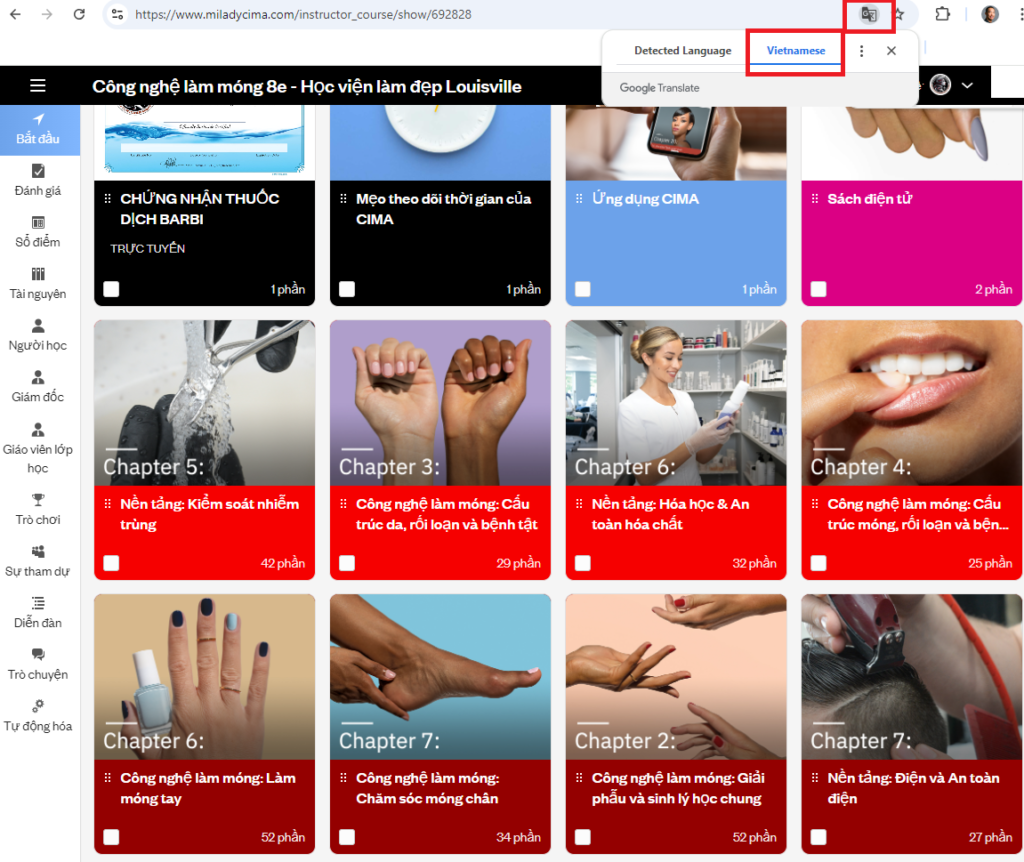
With the Kentucky State Board of Cosmetology recently launching the multiple-language PSI licensing exam, Louisville Beauty Academy (LBA) is proud to offer comprehensive support to our diverse student body. LBA has been preparing for this shift for years, offering top-tier resources like CIMA—Cengage Milady’s online study platform. This platform allows students to translate textbooks, study guides, and practice tests into any language they choose, providing accessibility for those who prefer to learn in a language other than English.

To ensure you can fully utilize these resources, here’s an elaborate guide on how to use Google Chrome’s translation tools, including the built-in translator and the Google Translate extension. These tools will make navigating your studies at LBA in your preferred language much easier.

Step 1: How to Translate Web Pages in Google Chrome

Google Chrome offers a built-in feature that lets you translate any web page into your preferred language. This is helpful when accessing online study materials or guides that are in a language you don’t fully understand.

Here’s how you can use this feature:

  1. Open Google Chrome on your computer.
  2. Navigate to the web page you want to translate (e.g., CIMA’s online study platform).
  3. Right-click anywhere on the page.
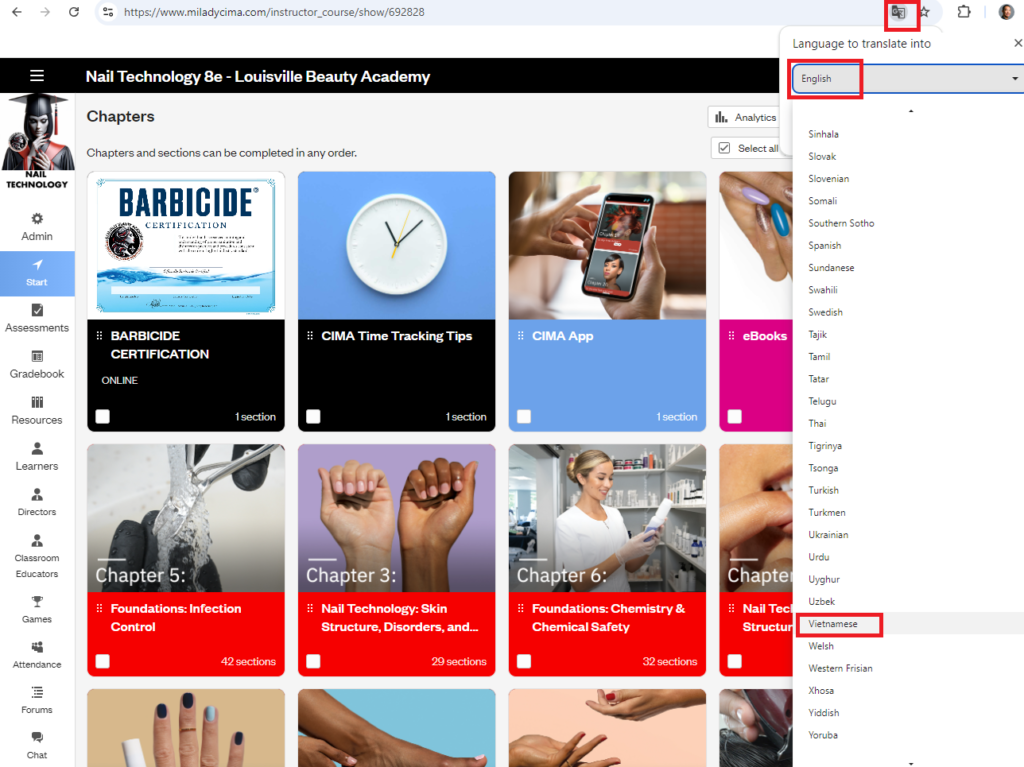
  4. From the dropdown menu, select Translate to [Language]. Google Chrome will automatically detect the current language of the page and translate it to the default language set in your browser.
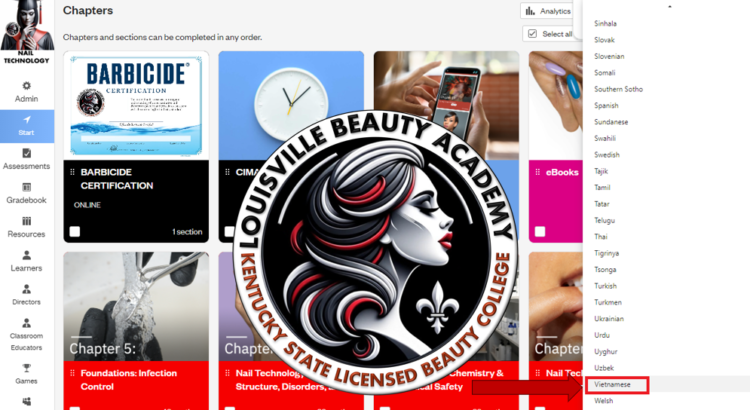
    • If you need to change the translation language, click on the Google Translate icon in the address bar. Then click the three dots next to the language name to select a different language.

This feature is especially useful when you’re studying on CIMA or other online beauty education resources. It ensures that your learning experience is accessible and easy to follow, no matter what language you’re most comfortable with.

Step 2: Set a Default Translation Language in Google Chrome

To avoid translating pages manually every time, you can set a default translation language in Google Chrome. This way, Chrome will offer to translate any page that isn’t in the language you prefer.

Follow these steps to set up your default translation preferences:

  1. Click the three dots (menu) at the top-right corner of the Chrome browser.
  2. Go to Settings > Languages.
  3. Under the Languages section, click Add languages to choose the languages you prefer.
  4. Enable the option that says Offer to translate pages that aren’t in a language you read.
    • This setting will automatically prompt translation whenever you visit a webpage that is not in one of your preferred languages.

Step 3: How to Install and Use the Google Translate Extension in Google Chrome

If you want more flexibility and control over translations, you can download the Google Translate extension. This is especially useful for translating specific text rather than entire web pages.

To download and install the Google Translate extension, follow these steps:

  1. Open Google Chrome on your computer.
  2. Go to the Chrome Web Store by typing https://chrome.google.com/webstore into the address bar.
  3. In the search bar, type Google Translate.
  4. Find the Google Translate extension in the search results and click the Add to Chrome button.
  5. A confirmation pop-up will appear. Click Add extension to install it.

Once the extension is installed, you will see the Google Translate icon in the top-right corner of your browser.

Here’s how to use the Google Translate extension:

  • To translate an entire page: Click the Google Translate icon, then choose the language you want to translate the page into.
  • To translate specific text: Highlight the text, then click the Google Translate icon. A small pop-up will show the translation in your chosen language.

Why This Matters for Louisville Beauty Academy Students

At LBA, we understand the importance of accessibility in education. That’s why we’ve integrated platforms like CIMA to support multilingual learning. With Google Chrome’s translation tools and the Google Translate extension, students can access learning materials in their preferred language. This flexibility is critical for mastering the content and preparing for the PSI licensing exam in a language you are most comfortable with.

Louisville Beauty Academy has been leading the way in supporting Kentucky’s immigrant and multilingual communities. By offering top-tier study platforms like CIMA and advanced tools like Google Translate, we ensure that every student can reach their full potential.