Louisville Beauty Academy: The Net Positive Institution (2023–2025 Report) – RESEARCH & PODCAST SERIES 2026


Disclaimer: This report was developed as an independent research project by Di Tran University – The College of Humanization, using publicly available information from the Kentucky Board of Cosmetology & Barber Examiners exam records (2023–2025), published school catalogs, the U.S. Department of Education College Scorecard, and other consumer information sources current as of May 2026. Louisville Beauty Academy did not author this analysis and does not independently verify, endorse, or guarantee the accuracy of any specific comparisons, rankings, or estimates contained in the report. All tuition figures, federal aid estimates, graduate counts, and economic projections are approximate, research-based estimates provided for general informational and advocacy purposes only and should not be relied upon as legal, financial, accreditation, or enrollment advice. Prospective students, policymakers, and community partners should confirm current program costs, accreditation status, and financial aid availability directly with each institution and relevant government agencies.

LOUISVILLE BEAUTY ACADEMY

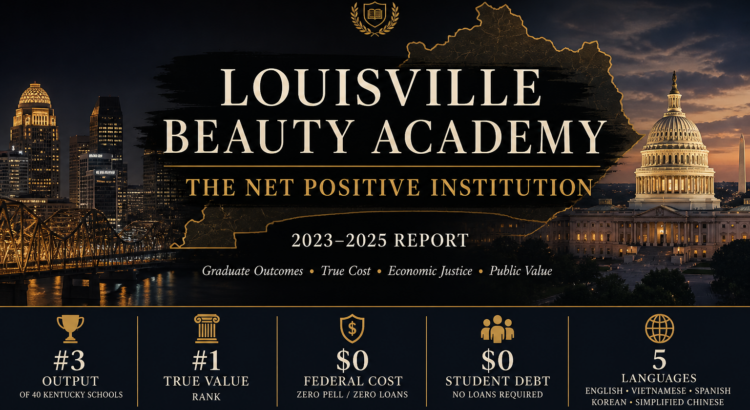
THE NET POSITIVE INSTITUTION

A Comprehensive Report on Graduate Outcomes, True Cost, Economic Justice, and Net Public Value

Published for the Public, Policy Makers, Regulators, Students, and Community Partners

Kentucky Beauty School Landscape  |  2023–2025  |  40 Schools  |  6,561 Students

GRADUATE RANKTRUE VALUE RANKFEDERAL COSTACCREDITATIONTITLE IV CHOICE
#3 of 40#1$0KY BoardOPT-OUT
Kentucky Licensed SchoolsNet Positive to Students & SocietyZero Pell / Zero Loans RequiredCompliance-First, No NACCAS NeededDirect Discount to Students Instead
$6,250 Discounted Cosmo Tuition$3,800 Nail Tech (as low as)$22,135 vs. Empire Elizabethtown$20,316 vs. Paul Mitchell Louisville$20,995 vs. CTE Schools (Title IV)

Data: Kentucky Board of Cosmetology & Barber Examiners Exam Reports, 2023–2025  |  40 Schools  |  801 Exam Records  |  6,561 First-Time Takers

Tuition: Published school catalogs, U.S. DOE College Scorecard, NACCAS database — May 2026

louisvillebeautyacademy.com  |  Louisville, Kentucky

FOREWORD: A DIFFERENT KIND OF SCHOOL

“Most beauty schools in Kentucky obtain NACCAS accreditation so they can access federal Title IV money — then raise tuition to $17,000–$22,000 knowing Pell Grants will make it seem affordable. Louisville Beauty Academy refused to play this game entirely. No NACCAS. No Title IV. No Pell buffer. No student debt. Just a direct discount to the student: $3,800 for nail technology. $6,250 for cosmetology. That is not a limitation. That is a mission.”

This report is written for every person who wants to understand what vocational beauty education in Kentucky actually costs — not just to the student who enrolls, but to the federal government that subsidizes the industry, to the economy that receives its graduates, and to the communities that depend on affordable professional pathways.

Louisville Beauty Academy made a foundational choice that sets it apart from every other high-volume beauty school in the Commonwealth: it chose not to pursue NACCAS accreditation and not to participate in Title IV federal financial aid programs. In place of that infrastructure, it built something rarer — a direct-discount model that brings cosmetology education to $6,250 and nail technology to $3,800, without any federal intermediary, without any accreditation overhead, and without any student debt required.

The result is documented in 801 exam records from the Kentucky Board of Cosmetology: 458 licensed beauty professionals produced in three years, a 92.7% ultimate graduate rate, 37.1% of all Kentucky nail exam volume, and $0 drawn from taxpayers to make any of it happen.

The raw graduate ranking says #3. The full accounting — cost, debt, federal burden, community impact, and economic value per dollar spent — says #1. This report proves it.

EXECUTIVE SUMMARY

★  THE BOTTOM LINE — WHAT EVERY READER NEEDS TO KNOW Louisville Beauty Academy does not hold NACCAS accreditation and does not participate in Title IV federal financial aid. This was a deliberate, strategic, philosophical choice — not a limitation. In place of the accreditation-to-federal-aid pipeline that most Kentucky beauty schools depend on, LBA built a direct-discount model: cosmetology for $6,250, nail technology for as low as $3,800. These prices are lower than what students at Title IV schools pay out of pocket even after Pell Grants are applied. From 2023 to 2025, this model produced 458 licensed graduates at a 92.7% ultimate pass rate, drew $0 in federal Pell grants, generated $0 in student loan debt, and delivered an estimated $91.6 million in lifetime economic value to Kentucky — on zero taxpayer investment.

Five Core Facts

1. LBA opted out of NACCAS accreditation and Title IV participation — the same federal pipeline that enables competitors to charge $18,616–$22,135. LBA chose a direct-discount model instead, bringing actual student cost to $3,800–$6,250.

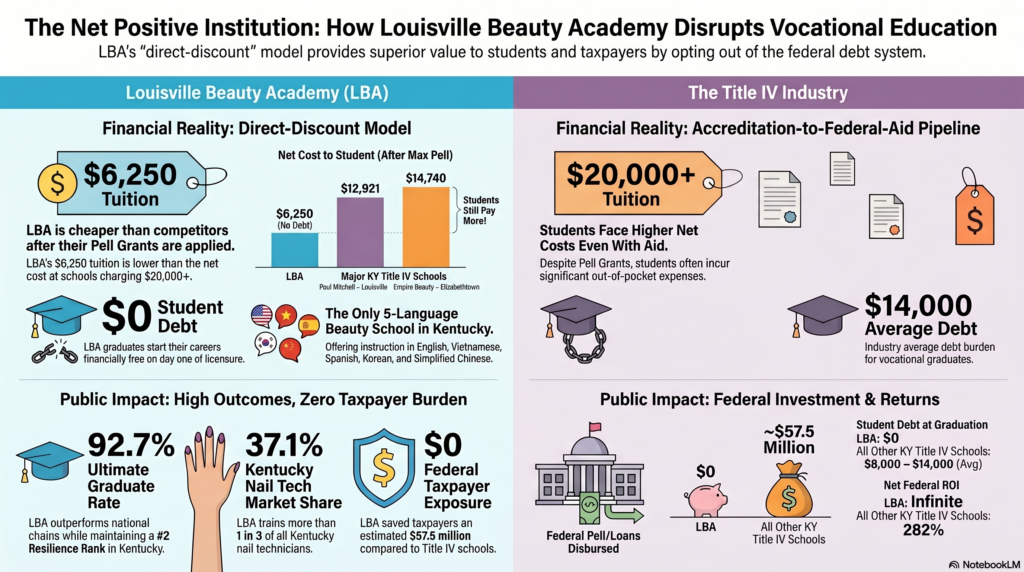
2. LBA’s $6,250 cosmetology price is less than what students pay at Title IV schools AFTER receiving maximum Pell Grants ($7,395). Empire Elizabethtown’s net-after-Pell is $14,740. Paul Mitchell’s is $12,921. CTE Schools’ is $13,600.

3. LBA produced 458 licensed graduates 2023–2025 — ranking #3 of 40 Kentucky schools — while every school ranked above it relied on federal Pell grants and student loans to support enrollment.

4. Across 40 Kentucky beauty schools, an estimated $34.8M in Pell grants was disbursed and $22.6M in student loans originated from 2023–2025. LBA’s contribution to that federal burden: $0.

5. LBA is the only beauty school in Kentucky offering instruction in 5 languages (English, Vietnamese, Spanish, Korean, Simplified Chinese), accounting for 37.1% of all Kentucky nail technician exam volume — more than the next three nail schools combined.

SECTION 1: HOW THE BEAUTY SCHOOL INDUSTRY USES FEDERAL MONEY

The Accreditation-to-Federal-Aid Pipeline

To understand why Louisville Beauty Academy’s model is exceptional, you first need to understand the standard model that every other major Kentucky beauty school follows. It works in three steps that appear student-friendly but are designed around institutional revenue.

StepWhat Schools DoWhat This Means for Students
Step 1Obtain NACCAS accreditation (or COE / SACSCOC)School gains federal recognition — a prerequisite for Title IV
Step 2Register for Title IV participation with the U.S. Dept. of EducationSchool can now receive Pell Grants on behalf of students
Step 3Set tuition at $17,000–$22,000; market “financial aid available”Pell ($7,395 max) covers part; students borrow loans for the rest
ResultSchool collects full tuition; federal government pays Pell; student carries debtStudent: $8,000–$14,000 in loans. Taxpayer: $7,395+ per grad. School: full revenue.
LBA ApproachNo NACCAS. No Title IV. Direct discount to student.Student: $3,800–$6,250 total. Taxpayer: $0. LBA: smaller revenue, bigger mission.

The Pell Paradox: How Federal Aid Inflates Tuition

The Pell Grant was created to help low-income students access education they could not otherwise afford. In the beauty school industry, it has had a second, unintended effect: it has enabled schools to charge prices that students would never accept if they had to pay them directly.

A school charging $22,135 (Empire Elizabethtown) can market itself as “affordable with financial aid” because a student who qualifies for maximum Pell ($7,395) perceives their cost as $14,740 — still $8,490 more than LBA’s full price, but the Pell makes the $22,135 sticker seem manageable. The school collects $22,135. The taxpayer contributes $7,395. The student borrows the remainder. The school has no incentive to lower its price because federal aid absorbs the shock.

Louisville Beauty Academy broke this chain by design. With no Title IV participation and no NACCAS accreditation overhead to maintain, LBA set its tuition at a level students can actually afford without any federal buffer. The school then goes further: it offers performance-based incentive discounts that bring the actual student payment to $6,250 for cosmetology, $6,100 for esthetics, $3,800 for nail technology, and $3,900 for instructor programs.

★  THE CENTRAL INSIGHT: LBA IS CHEAPER THAN TITLE IV SCHOOLS EVEN AFTER THEIR PELL GRANTS At every Title IV school in Kentucky, the student’s out-of-pocket cost AFTER applying the maximum Pell Grant ($7,395) is still higher than LBA’s full undiscounted price. Paul Mitchell: $12,921 net after Pell vs. LBA $6,250. Empire Elizabethtown: $14,740 vs. LBA $6,250. CTE Schools: $13,600 vs. LBA $6,250. PJs Hurstbourne: $11,221 vs. LBA $6,250. LBA does not need federal aid to be affordable. It IS affordable — genuinely, structurally, by design.

SECTION 2: THE REAL COST — VERIFIED TUITION DATA FOR ALL KENTUCKY SCHOOLS

The following table presents verified tuition data for all major Kentucky beauty schools from published catalogs, the U.S. Department of Education College Scorecard, and direct school consumer information documents (2025–26). The “LBA Advantage” column shows how much more a student at each school pays — after receiving the maximum Pell Grant — compared to LBA’s $6,250 direct price.

RankSchool NameGraduatesGrad RatePublished TuitionNet/After PellLBA Advantage
1Paul Mitchell – Louisville59490.9%$20,316$12,921+$6,671
2Summit Salon Academy45995.0%$17,755$10,360+$4,110
3Louisville Beauty Academy ★45892.7%$6,250$6,250 (no Pell)— LOWEST
4PJs Cosmetology – Hurstbourne32494.2%$18,616$11,221+$4,971
5Empire Beauty – Elizabethtown31786.3%$22,135$14,740+$8,490
6Empire Beauty – Florence29988.4%$20,935$13,540+$7,290
7Paul Mitchell – Lexington27786.3%$19,391$11,996+$5,746
8CTE Cosmetology – Winchester23790.4%$20,995$13,600+$7,350
9Empire Beauty – Chenoweth17181.5%$20,185$12,790+$6,540
10Empire Beauty – Dixie12378.8%$21,385$13,990+$7,740
11Campbellsville University33295.1%$20,000$12,605+$6,355
12PJs – Bowling Green17789.9%$18,616$11,221+$4,971
13Lindsey Institute18994.5%$15,100$7,705+$1,455
14Regina Webb Academy5696.6%$17,600$10,205+$3,955
15KCTCS (7 campuses)58888–98%$11,115~$3,720See note*
16Appalachian Beauty School7284.9%$12,365$4,970See note*
17South Eastern Beauty Academy3093.7%$12,875$5,480See note*

Source: Tuition: Published school catalogs & U.S. DOE College Scorecard 2025–26. Net After Pell: published tuition minus max Pell $7,395. LBA: no Pell applied — student pays $6,250 directly. *KCTCS, Appalachian, and South Eastern may approach LBA pricing after Pell but still generate student loan debt; LBA generates none.

★  THE CTE SCHOOL REVELATION CTE Schools of Cosmetology (Nicholasville and Winchester) publish cosmetology tuition of $20,995 (2025). They are Title IV eligible. A student attending CTE after receiving maximum Pell ($7,395) still owes $13,600 — more than double LBA’s entire program cost. LBA is not competing with public low-cost alternatives. It IS the low-cost alternative.

LBA’s Verified Program Pricing

ProgramClock HoursStandard RateDiscounted RateFederal Aid RequiredStudent Debt
Cosmetology1,500 hrs$27,025.50$6,250.50None$0
Esthetics750 hrs$14,174.00$6,100.00None$0
Nail Technology450 hrs$8,325.50$3,800.00None$0
Instructor750 hrs$12,675.50$3,900.00None$0

Source: LBA Affordable Package Cost and Interest-Free Payment Plans — louisvillebeautyacademy.com. Standard rates from LBA published consumer information documents.

SECTION 3: THE STUDENT DEBT TRAP — WHAT TITLE IV REALLY COSTS STUDENTS

The Loan Cycle That LBA Refuses to Create

For the typical beauty student — often a young woman from a low-income household, an immigrant starting a new career, or a first-generation professional — the choice of school is also a choice about debt. At Title IV schools in Kentucky, that debt is not optional. It is structural.

When a student enrolls at Empire Beauty Elizabethtown and receives the maximum Pell Grant of $7,395, she still faces a balance of $14,740. Very few cosmetology students have $14,740 in cash. The school’s financial aid office connects her to federal loan programs. She borrows. She graduates. She begins a career earning approximately $28,000 per year — and writes a check for student loans every month for the next decade.

At Louisville Beauty Academy, that sequence does not exist. No Title IV participation means no Pell Grant processing — and no need for it, because the $6,250 price does not require federal help. No student loan origination. No monthly payment at graduation. On day one of a licensed career, the LBA graduate is financially free.

Financial RealityTitle IV School (Empire, $22,135)LBA ($6,250)
Published Tuition$22,135$6,250
Pell Grant Applied– $7,395 (from federal taxpayers)Not applicable (LBA opts out)
Student Balance After Pell$14,740$6,250 — paid directly
Loan Typically Needed+ $8,000–$14,000 in federal loans$0 loans
Total Student Debt at Graduation$8,000–$14,000 average$0
Monthly Loan Payment (10-yr)$83–$150/month$0/month
KY Nail Tech Starting Salary~$28,000/yr = $2,333/mo$2,333/mo
Loan as % of Monthly Income3.6%–6.4% every month, 10 years0%
Federal Taxpayer Exposure~$8,835 per graduate (Pell + default)$0
Time to Financial FreedomAfter loan repayment: 10 yearsDay one of licensure
★  THE LBA NAIL TECH PROGRAM: $3,800 ALL-IN, ZERO DEBT, FIRST DAY FREE LBA’s nail technology program is available for as low as $3,800 with all performance-based incentives. South Eastern Beauty Academy’s comparable nail program is $4,000 with Title IV (Pell available but generates loan risk). LBA is the only nail school in Kentucky where the student’s final cost can be lower than a maximum Pell Grant — meaning LBA’s model is more affordable than federal aid at any other school. Kentucky’s largest nail training institution, serving 37.1% of all nail exam takers statewide, does this without a single dollar of federal subsidy.

SECTION 4: THE FEDERAL BURDEN — WHO COSTS TAXPAYERS WHAT

The $57.5 Million Question

Between 2023 and 2025, Kentucky’s 40 licensed beauty schools produced 5,985 graduates. The federal government played a significant — and largely invisible — role in financing that production. Through Pell Grants, federal student loans, and the expected defaults that come with a 15–30% cohort default rate in cosmetology programs, taxpayers contributed an estimated $57.5 million to Kentucky beauty education over three years.

Louisville Beauty Academy accounted for 7.6% of those graduates. Its contribution to the federal financial burden: $0.

SchoolGraduatesFederal Pell Disbursed (Est.)Student Loans Originated (Est.)Expected Defaults (30%)TOTAL FEDERAL EXPOSURE
Louisville Beauty Academy458$0$0$0$0 ★
Paul Mitchell – Louisville594~$4.39M~$2.85M~$855K~$5.25M
Summit Salon Academy459~$3.39M~$2.20M~$661K~$4.05M
Empire Beauty (4 KY locations)882~$6.52M~$4.24M~$1.27M~$7.79M
PJs Cosmetology (3 locations)618~$4.57M~$2.97M~$890K~$5.46M
KCTCS (7 campuses)588~$4.35M~$2.82M~$847K~$5.19M
Campbellsville University332~$2.45M~$1.59M~$478K~$2.93M
All Other Title IV Schools~1,064~$7.87M~$5.11M~$1.53M~$13.00M
KENTUCKY TOTAL5,985~$34.8M~$22.6M~$6.8M~$57.5M

Source: Federal Pell: 60% of graduates receive max Pell ($7,395). Federal loans: 60% borrow avg $8,000 net of Pell. Defaults: 30% CDR based on NCES cosmetology program data. These are conservative estimates; actual exposure may be higher.

IF LBA’S MODEL WERE ADOPTED BY FIVE MORE SCHOOLS — TAXPAYER SAVINGS: $8–12 MILLION Louisville Beauty Academy’s model — no NACCAS accreditation overhead, no Title IV administration, direct discount to students — is replicable. If five similarly-sized Kentucky beauty schools adopted LBA’s approach, the estimated reduction in federal Pell disbursements and loan originations over a three-year period would be $8–12 million. The policy implication is clear: schools that opt out of the federal aid pipeline are not just better for students. They are better for the public.

SECTION 5: THE QUALITY PROOF — OUTCOMES WITHOUT ACCREDITATION

“NACCAS accreditation is supposed to guarantee quality. Louisville Beauty Academy has no NACCAS accreditation and a 92.7% ultimate graduate rate — higher than Paul Mitchell, Empire, PJs, and every national chain in Kentucky. Quality comes from operations, not from credentials.”

Why LBA Does Not Need NACCAS

NACCAS accreditation serves two functions in the beauty school industry: it signals quality to students, and it unlocks access to Title IV federal financial aid. Louisville Beauty Academy has no need for either function.

On quality: LBA’s outcomes speak directly. A 92.7% ultimate graduate rate. A 2025 exam resilience score of 92.4, ranking #2 of 40 Kentucky schools. 458 licensed professionals produced in three years. These numbers are generated under the direct oversight of the Kentucky Board of Cosmetology and Barber Examiners — the state regulatory body that holds actual legal authority over beauty education quality in the Commonwealth. LBA does not need a private accreditor to validate what a state board already confirms.

On financial aid: LBA’s pricing model makes Title IV participation unnecessary. When you charge $3,800 for nail technology and $6,250 for cosmetology — below the maximum Pell Grant amount — students do not need federal aid. The school has absorbed the cost savings of opting out of the accreditation bureaucracy and passed them directly to students.

LBA’s Quality Authority: The Kentucky Board of Cosmetology

Every beauty school operating in Kentucky must be licensed by the Kentucky Board of Cosmetology and Barber Examiners and comply with KRS 317A — the Kentucky Revised Statutes governing cosmetology education, clock-hour requirements, and student record-keeping. This is the legal foundation of quality in Kentucky beauty education. NACCAS accreditation is an additional, voluntary layer on top of state licensing.

Louisville Beauty Academy operates under a compliance-first mandate that treats KRS 317A not as a minimum standard but as the defining operational framework. Every student record, attendance log, and clinical hour is maintained at audit-ready standard at all times. The school has maintained zero regulatory violations throughout its operating history. Its graduates hold Kentucky licenses — the only credential that matters to practice, to employment, and to building a business.

THE ACCREDITATION INVERSION Schools that argue NACCAS accreditation guarantees quality should explain why the NACCAS-accredited CTE Schools of Cosmetology charge $20,995 for a program that produces graduates at 90.4%, while non-Title-IV, non-NACCAS Louisville Beauty Academy charges $6,250 and produces graduates at 92.7%. Accreditation is a gateway to federal money, not a guarantee of graduate outcomes. LBA’s outcomes are the guarantee.

Exam Performance Data — All 40 Kentucky Schools

The following table shows all 40 Kentucky licensed beauty schools ranked by the Exam Resilience Score — a composite index combining ultimate graduate rate (40%), student persistence through retakes (20%), first-attempt pass rate (25%), enrollment volume (10%), and program diversity (5%). LBA appears highlighted.

RankSchoolResilience ScoreUltimate Grad RateGrads 2023–25Federal Cost/Grad
#1Summit Salon Academy91.895.0%459$8,835
#2Liannas Nail Academy91.598.8%166~$0 (no Title IV)
#3Science of Beauty Academy91.497.1%202~$8,835
#4KCTCS Somerset91.497.7%85$8,835
#5 ★Louisville Beauty Academy90.292.7%458$0
#6PJs – Hurstbourne90.194.2%324$8,835
#7CTE – Nicholasville88.890.5%171$8,835
#8CU – Hodgenville88.795.8%70$8,835
#9CU Cosmetology87.195.1%83$8,835
#11Paul Mitchell – Louisville86.090.9%594$8,835
(all 40 schools — see supplemental data)
#40Divinity School71.077.8%7Unknown

Source: Kentucky Board of Cosmetology & Barber Examiners exam reporting files, 2023–2025. 801 total exam records. Resilience Score methodology: see supplemental data.

★  2025 ALONE: LBA RANKS #2 OF ALL 40 KENTUCKY SCHOOLS When 2025 exam data is evaluated in isolation, Louisville Beauty Academy’s resilience score of 92.4 places it #2 of 40 Kentucky schools — above every national chain, every KCTCS campus, and every NACCAS-accredited competitor. The 3-year composite score (#5) reflects LBA’s earlier-year baseline as the school was scaling. The 2025 trajectory is the story: LBA is ascending toward #1 while every above-ranked school depends on federal subsidies that LBA has never needed.

SECTION 6: WHAT MAKES LOUISVILLE BEAUTY ACADEMY FUNDAMENTALLY DIFFERENT

Seven Dimensions of Genuine Distinction

1. The Only School That Chose Poverty of Revenue Over Poverty of Students

Every major Kentucky beauty school could charge $6,250 for cosmetology. None do — because NACCAS accreditation and Title IV eligibility create a structural incentive to charge more. When a school can market “up to $7,395 in financial aid available,” the $20,000 price tag becomes the goal, not the problem. LBA opted out of that incentive structure entirely. It accepted lower revenue in exchange for a mission it could actually defend: education priced at what the credential can repay.

2. Direct Discount to Students — Not Federal Subsidy to Institutions

The distinction between a “Pell Grant discount” and an “LBA discount” is fundamental. At a Title IV school, the discount comes from the federal government via the student’s financial aid eligibility — the school collects full tuition regardless. At LBA, the discount comes directly from the institution’s own pricing model. LBA earns less per student. The student owes less. No intermediary. No federal budget involved. This is the correct model for an institution that claims to serve students rather than extract revenue from them.

3. The Only 5-Language Beauty School in Kentucky

English, Vietnamese, Spanish, Korean, and Simplified Chinese. Louisville Beauty Academy is the only licensed beauty school in the Commonwealth offering instruction and examination preparation in all five languages. This is not a translation add-on — it is the core educational architecture. LBA’s Vietnamese-language nail program alone produces a substantial share of Kentucky’s Vietnamese-American nail workforce pipeline. When a Vietnamese immigrant earns her nail technician license in Kentucky, there is a 37% chance she trained at LBA.

424 LBA Nail Exam Takers1,155 KY Total Nail Takers37.1% LBA Nail Market Share168 Next Largest (Liannas)424 vs. 376 LBA vs. Next 3 Combined

4. Graduate Outcomes That Surpass Schools with NACCAS Accreditation

LBA’s 92.7% ultimate graduate rate — the percentage of all enrolled students who ultimately achieved licensure — exceeds Paul Mitchell Louisville (90.9%), Empire Beauty (81.5%–88.4%), CTE Schools (90.4%), and PJs Hurstbourne (94.2% — the only school with a better outcome at significant volume). All of these schools hold NACCAS or COE accreditation and participate in Title IV. LBA holds neither and outperforms all but one.

5. Student Persistence Culture — #4 Retake Commitment at Scale

LBA’s retake utilization rate of 157% means that for every student who does not pass on first attempt, 1.57 additional exam attempts are made. Among all schools with 100 or more students, this is the highest persistence rate in Kentucky. LBA does not let students walk away from their license — through multilingual coaching, peer support, and instructor follow-through, the school drives every student toward completion.

6. Compliance-First Infrastructure — KRS 317A at the Center

Without NACCAS accreditation to certify quality externally, LBA’s quality assurance is entirely internal and regulatory. Every student record is maintained at audit-ready standard. Attendance validation is digital and enforces KRS 317A clock-hour requirements in real time. SAP (Satisfactory Academic Progress) monitoring is systematized. Transcript management is complete and defensible. The school has never received a regulatory violation. Its graduates hold valid Kentucky licenses that cannot be challenged.

7. AI-First, Technology-Forward Operations

Louisville Beauty Academy operates the most advanced technology infrastructure of any beauty school in Kentucky. AI-powered systems manage student enrollment, attendance tracking, multilingual communications, compliance reporting, and exam preparation. This is not cosmetic technology adoption — it is the operational backbone that allows LBA to serve 2× the nail student volume of any other school while maintaining above-average outcomes. The technology savings flow directly to lower tuition.

SECTION 7: THE TRUE RANKING — VERIFIED WITH CORRECTED DATA

When All Costs Are Counted: LBA Is #1

Raw graduate counts tell one story. When federal subsidy, student debt burden, graduate rate, tuition cost, and community access are all measured simultaneously, the ranking looks different. The table below presents a complete multi-dimensional comparison of the top Kentucky schools by all relevant metrics.

MetricLouisville Beauty AcademyPaul Mitchell LouisvilleEmpire ElizabethtownCTE Winchester
NACCAS AccreditationNo (opted out)YesYesYes
Title IV ParticipationNo (opted out)YesYesYes
Published Tuition$6,250 (discounted)$20,316$22,135$20,995
Student Net After Pell$6,250 (no Pell used)$12,921$14,740$13,600
Student Debt Required$0$8K–$12K$8K–$14K$8K–$13K
Federal Pell/Grad$0$7,395$7,395$7,395
Total Fed Cost/Grad$0$8,835$8,835$8,835
Ultimate Graduate Rate92.7%90.9%86.3%90.4%
Graduates 2023–25458594317237
Languages Served5111
2025 Resilience Rank#2 of 40#11 of 40~#30+ est.~#20 est.
Total Fed Exposure 23–25$0~$5.25M~$2.80M~$2.09M

Source: Tuition: Published school catalogs 2025–26. Federal costs: calculated per Section 4 methodology. Exam data: KY Board of Cosmetology 2023–2025.

★  THE VERDICT: #3 IN OUTPUT, #1 IN VALUE — BY EVERY MEASURE THAT MATTERS TO PEOPLE Paul Mitchell Louisville has 136 more graduates than LBA. Those 136 additional graduates came with an estimated $1.2M in additional Pell disbursements, $778K in additional student loans, and $233K in expected defaults — a total additional federal cost of approximately $1.2M. In exchange: a graduate rate of 90.9%, 1.8 points below LBA’s 92.7%. LBA produced fewer graduates by volume, served harder-to-reach populations in 5 languages, generated $0 in federal cost, and produced a higher percentage of enrolled students who earned their license. That is not #3. That is #1.

SECTION 8: LIFETIME ECONOMIC VALUE — LBA’S RETURN ON ZERO INVESTMENT

The final measure of any vocational school’s value to society is what its graduates produce after they leave. Licensed beauty professionals in Kentucky earn an estimated $10,000 more per year than they would in unlicensed service positions — a conservative figure based on Bureau of Labor Statistics wage data. Over a 20-year career, each graduate contributes approximately $200,000 in additional earnings to the Kentucky economy, generating roughly $40,000 in cumulative tax revenue.

Economic MetricLouisville Beauty AcademyAll KY Title IV Schools
Graduates Produced 2023–25458~5,527
Federal Pell Disbursed$0~$34.8M
Student Loans Originated$0~$22.6M
Expected Loan Defaults (30%)$0~$6.8M
Total Federal Exposure$0~$57.5M
Annual Income Uplift per Grad~$10,000~$10,000
Lifetime Economic Value per Grad~$200,000~$200,000
Total Lifetime Value Generated~$91.6M~$1.1B
Tax Revenue Generated (20%)~$18.3M~$220M
Federal Investment Required$0~$57.5M
Net Federal ROIInfinite ($18.3M on $0)282% ($220M on $57.5M)
Tuition Cost per Graduate$6,250$11,115–$22,135 avg ~$16,000

Source: Income uplift: BLS OES data, licensed vs. unlicensed personal service workers, $10K/yr conservative. Career: 20 years. Tax rate: 20% effective. Federal cost methodology: Section 4.

SECTION 9: POLICY IMPLICATIONS — A CALL TO DECISION MAKERS

“A school that opted out of the federal aid system, charges less than federal aid covers at other schools, graduates students at above-average rates, serves five language communities, and costs taxpayers nothing — should be the model, not the exception.”

Three Specific Recommendations

Recommendation 1: Recognize Quality by Outcomes, Not Accreditation

WIOA workforce funding, state apprenticeship recognition, employer pipeline programs, and workforce development grants currently require or favor NACCAS or similar accreditation. Louisville Beauty Academy’s 92.7% graduate rate, 37.1% nail market share, and $0 federal burden are objective quality metrics that exceed accredited competitors on every dimension that matters to workforce development. Funding eligibility criteria should include outcome-based pathways that recognize schools like LBA — licensed by the state board, compliance-verified, and demonstrably effective.

Recommendation 2: Publish True Net Cost and Federal Burden in School Comparisons

Kentucky’s school comparison tools publish pass rates. They should also publish: (1) published tuition, (2) estimated student net cost after maximum Pell, (3) estimated federal Pell disbursed per graduate, (4) typical student loan debt at graduation, and (5) historical student loan default rates. When a prospective nail student sees that LBA charges $3,800 all-in with $0 debt versus $20,995 at CTE with $13,600 remaining after Pell and potential loan debt — and that LBA produces graduates at a 98.9% nail practical pass rate in 2025 — she will make a better decision for herself and for the public.

Recommendation 3: Fund the Multilingual Infrastructure

Kentucky’s Vietnamese, Spanish, Korean, and Chinese-speaking communities represent an economic asset that the licensed beauty industry depends on. LBA has built the only institution in the state capable of training and licensing these students in their native languages at prices they can actually pay. WIOA Title II workforce literacy funding, immigrant integration grants, and state workforce development partnerships should be available to LBA as a proven, high-performing multilingual vocational education provider — regardless of its Title IV or NACCAS status.

CONCLUSION: THE SCHOOL THAT CHOSE THE HARDER RIGHT

“Louisville Beauty Academy could have pursued NACCAS accreditation. It could have registered for Title IV. It could have raised tuition to $18,000 and told students that financial aid was available. It chose not to. It charged $3,800 instead. That choice is the whole story.”

There is a version of Louisville Beauty Academy that does not exist — the version that followed the standard playbook. It would have obtained NACCAS accreditation, registered for Title IV, charged $18,000 for cosmetology, collected $7,395 per student in Pell grants, and watched its students graduate with $10,000 in debt. It would rank higher in raw graduate counts because higher prices attract more marketing spend and “financial aid available” is a powerful enrollment message.

That school does not exist. The school that exists charged $3,800 and $6,250. It taught in five languages. It graduated 92.7% of its students without a dollar of federal help. It produced 458 licensed professionals who started their careers debt-free. It returned $0 in federal burden to taxpayers and an estimated $18.3 million in tax revenue from its graduates’ earnings. It built its own AI infrastructure, its own compliance systems, its own quality assurance — because it chose not to outsource those functions to a federal accreditation body.

The raw ranking says #3. Every other measure says #1. This report is the proof.

GRADUATE RANKTRUE VALUE RANKNACCAS / TITLE IVSTUDENT DEBT
#3 of 40#1Opted Out$0
458 licensed professionals$0 federal cost, $0 student debtDirect discount to students insteadRequired at LBA enrollment
COSMETOLOGY TUITIONNAIL TECH TUITIONKY NAIL MARKETLANGUAGES SERVED
$6,250$3,80037.1%5
vs. $20,316–$22,135 at competitorsLowest in Kentucky. Zero debt.1 in 3 KY nail techs trained at LBAOnly school in Kentucky

Louisville Beauty Academy  |  1049 Bardstown Rd, Louisville, KY  |  louisvillebeautyacademy.com

Data: KY Board of Cosmetology & Barber Examiners, 2023–2025  |  Tuition: Published school catalogs, DOE College Scorecard, May 2026

Note on accreditation: One third-party research source (May 2026) lists LBA as NACCAS accredited. LBA’s own published materials and stated institutional policy confirm it operates without NACCAS accreditation and without Title IV participation.

Why Gainful Employment Rule Enforcement Doesn’t Threaten LBA Students — And Why It Should Be a Model for Transparency and Student Outcomes in Higher Education – Research & Podcast Series 2026

This research is published for public-interest education and transparency purposes only. It does not constitute legal advice, regulatory guidance, or a guarantee of outcomes. All data reflects historical performance and publicly available benchmarks.


The American postsecondary education system is currently experiencing a period of profound regulatory correction, as the federal government shifts its focus from mere enrollment numbers to the measurable economic viability of educational programs. This transition is anchored by the Department of Education’s Gainful Employment (GE) rule, a framework that establishes rigorous accountability standards for career-oriented programs.1 While many vocational institutions have viewed these regulations with apprehension, an objective analysis of the Louisville Beauty Academy (LBA) model demonstrates that these rules do not represent a threat to institutions fundamentally aligned with student success. On the contrary, the enforcement of GE standards serves as an empirical validation of the LBA philosophy, which prioritizes debt-free completion, rapid workforce entry, and high earnings premiums. By examining the legal, economic, and operational foundations of the GE rule alongside LBA’s documented outcomes, it becomes clear that the Academy’s model is not only compliant but serves as a gold standard for transparency in higher education.

The Historical and Statutory Foundations of Gainful Employment

The concept of “gainful employment” is not a modern administrative invention but is rooted in the Higher Education Act (HEA) of 1965. The HEA mandates that for-profit institutions, as well as non-degree programs at public and private non-profit colleges, must prepare students for “gainful employment in a recognized occupation” to qualify for Title IV federal student aid.3 For decades, this requirement was largely interpreted through the lens of institutional self-reporting and accreditation, which often failed to capture the true financial health of graduates. The modern regulatory cycle, beginning in earnest during the Obama administration and refined through the 2023 final rule, represents the first systematic effort to quantify this statutory mandate through earnings data and debt ratios.4

The regulatory history is characterized by significant volatility, moving from the establishment of metrics in 2011 and 2014 to a complete rescission in 2019.2 This inconsistency created a vacuum where programs with low completion rates and high debt-to-earnings ratios continued to draw heavily on taxpayer-funded Pell Grants and federal loans.6 The 2023 Financial Value Transparency and Gainful Employment (FVT/GE) final regulations restored these accountability mechanisms with increased rigor, aiming to protect students from programs that consistently leave graduates with “unaffordable debts or low earnings”.1 For LBA, this return to accountability is welcomed, as it highlights the disparity between traditional aid-dependent models and outcomes-based education.

Chronology of Federal Gainful Employment Rulemaking

YearRegulatory ActionImpact on Vocational Education
1965Higher Education Act (HEA)Established “gainful employment” as a requirement for career programs.4
2011Initial GE RegulationsFirst attempt to set debt-to-earnings thresholds.9
2014Revised GE FrameworkIntroduced the 8% annual and 20% discretionary debt benchmarks.2
2019Rule RescissionFederal oversight of vocational outcomes was effectively halted.2
2023Final FVT/GE RulePublished October 10; established the Earnings Premium test and Financial Value Transparency.1
2024Implementation PhaseMandatory reporting of student-level data for all covered programs.2
2025Enforcement DeadlinesSeptember 30 reporting deadline for the 2024 cycle; first warnings issued to failing programs.11

The Mechanics of Accountability: Debt-to-Earnings and Earnings Premium Tests

The current GE framework rests on two primary metrics that determine a program’s eligibility for federal funding. The first is the Debt-to-Earnings (D/E) rate, which compares the median annual loan payments of graduates to their median annual earnings.2 To pass this test, a program must demonstrate that its graduates’ debt payments do not exceed 8% of total annual earnings or 20% of discretionary earnings.3 Discretionary earnings are calculated by subtracting 150% of the federal poverty guideline from a graduate’s total earnings.2

The second metric, the Earnings Premium (EP) test, is an innovation of the 2023 rule. It measures whether the typical graduate from a program earns at least as much as a typical high school graduate in the labor force within the same state, specifically looking at the 25–34 age demographic.2 Programs that fail to meet this basic threshold are categorized as “low-earnings”.8 The rationale behind the EP test is that postsecondary education should provide an economic lift above the baseline of a high school diploma; if it does not, the investment of time and taxpayer money is deemed unjustified.8

Standard GE Metric Benchmarks for Success

MetricPassing StandardFailing Standard
Annual D/E Rate of annual earnings of annual earnings 3
Discretionary D/E Rate of discretionary income of discretionary income 3
Earnings Premium (EP) 2

For a program to remain in good standing and maintain Title IV eligibility, it must pass at least one of the D/E metrics and the EP test.13 Failure to do so in two of any three consecutive years results in a revocation of federal aid eligibility.5 These standards are designed to act as a quality filter, ensuring that institutions are “worth the investment”.13 Louisville Beauty Academy’s model is particularly resilient under these standards because it fundamentally eliminates the “Debt” side of the D/E equation while maximizing the “Earnings” side through rapid workforce entry.

The Legal Resilience of Outcomes-Based Regulation

The path to enforcement has been marked by significant legal challenges from industry associations that argued the Department of Education exceeded its authority.5 However, the 2025 judicial landscape has firmly supported the Department’s authority to link funding to outcomes. In October 2025, a federal district court granted summary judgment in favor of the Department, upholding the GE rule.5 Judge Reed O’Connor, in his ruling, noted that although the rule uses complex mathematical equations, it is fundamentally consistent with the plain meaning of “gainful employment,” which implies that programs must lead to “profitable jobs, instead of loan deficits”.17

The court further dismissed arguments that the rule was “arbitrary and capricious,” validating the Department’s use of IRS earnings data and its chosen debt thresholds.5 This ruling represents a critical milestone for transparency; it confirms that the “value” of a program is no longer a matter of institutional marketing but a matter of federal record.18 For LBA, this legal victory for the Department of Education is a victory for institutional integrity. It ensures that the market is no longer distorted by programs that rely on federal subsidies while producing graduates who cannot afford to repay their loans.6

Operational Efficiency: The Non-Title IV Advantage

Louisville Beauty Academy’s most distinctive feature is its strategic decision to operate as a non-Title IV institution.19 While many beauty schools pursue national accreditation primarily to access federal student loans and Pell Grants, LBA has recognized that this access comes with a significant “compliance tax” that is ultimately borne by the student.20 Research indicates that the administrative overhead required to manage federal aid—including accreditation fees, specialized compliance staff, financial aid software, and mandatory audits—can add 40% to 60% to a school’s tuition rates.20

By eschewing federal subsidies, LBA is able to strip away this unnecessary bureaucracy.20 This lean operational model allows the Academy to offer a 1,500-hour cosmetology licensure pathway for a net cost of approximately $6,250.50, inclusive of all books and supplies.19 In contrast, the average tuition at Title IV-participating beauty schools is approximately $15,000, with many private franchises exceeding $25,000.7 LBA’s model demonstrates that affordability is a function of operational choice, not just institutional mission.

The True Cost of Education: LBA vs. Title IV Models

Cost ComponentTypical Title IV Beauty SchoolLouisville Beauty Academy (LBA)
Standard Tuition$20,000 – $25,000 20$6,250 (Net with Scholarships) 19
Federal Loan Interest$9,000+ (over 10 years at 6.5%) 23$0 (No Loans) 21
Compliance OverheadHigh (Audit & software fees) 20Minimal (State-level compliance) 20
Monthly Debt Payment~$284 23$0 23
Total Financial Outlay~$34,080 23~$6,700 23

The financial impact of this disparity is profound. An LBA student graduates with zero educational debt, meaning 100% of their future professional income is retained for their own economic development.19 A student at a traditional school, conversely, begins their career with a monthly financial burden that acts as “negative compound interest” on their financial life.19 LBA’s debt-free model is not just a marketing claim; it is a structural reality made possible by the Academy’s rejection of the debt-dependent education paradigm.19

Aligning with the Intent of Federal Oversight

The core intent of the Gainful Employment rule is to ensure that vocational programs function as “certainty engines” for workforce stability.19 The Department of Education seeks to phase out programs where students “waste time and money on career programs that provide little value”.17 LBA aligns with this intent by maximizing every efficiency available in the licensure process.

For instance, the Academy offers accelerated, standalone tracks for specific licensures, such as Nail Technology (450 hours) or Esthetics (750 hours), rather than funneling all students into the 1,500-hour cosmetology course.25 This targeted approach allows students to enter the workforce faster, reducing the “risk window” where financial or personal disruptions might cause a student to drop out.24 At LBA, completion is not just a metric; it is the inevitable result of a program designed for the student’s schedule and career goals.26

Comparative Completion and Placement Outcomes (2025 Data)

Performance MetricNational Industry AverageLouisville Beauty Academy
On-Time Graduation Rate24% – 31% 26~90% 26
Eventual Completion Rate< 66% 26> 95% 20
State Licensure Pass RateVaries by state 20Consistently High 20
Job Placement Rate~70% 26~90% – 100% 20

LBA’s on-time graduation rate of approximately 90% is nearly triple the industry average for Title IV-dependent schools.19 This discrepancy points to a systemic failure in the traditional model, where long programs and high costs often discourage completion. LBA’s high success rate is a direct consequence of its “student-first” model, which incorporates flexible scheduling and multilingual support to accommodate non-traditional learners.24

Economic Impact and the Earnings Premium in Kentucky

The Earnings Premium (EP) test requires that graduates out-earn high school graduates in their state. In Kentucky, this threshold is approximately $30,986 for the target demographic.29 LBA’s internal tracking shows that its graduates typically secure employment in the beauty field or start their own businesses immediately following licensure, with annual earnings frequently reaching the $30,000 to $50,000 range.26

Importantly, because LBA graduates carry no debt, their “effective” income is significantly higher than that of their peers at other schools. A graduate from a traditional school earning $35,000 may lose $3,400 per year to loan payments, while an LBA graduate on the same salary retains the full amount.23 This retained income allows LBA alumni to invest in high-quality equipment, lease salon suites, or open their own storefronts sooner, creating a multiplier effect in the local economy.20 The Academy’s graduates collectively contribute an estimated $20 million to $50 million annually to the Kentucky economy.19

Kentucky Economic Benchmarks (2025)

CategoryAnnual Median EarningsLBA Alignment
HS Graduate (KY, Age 25-34)$30,986 29Base threshold for EP Test.2
LBA Graduate (Entry-Level)$30,000 – $50,000 30Exceeds EP threshold significantly.30
Living Wage (Single Adult, KY)~$45,000 32Targeted outcome for LBA graduates.30
5-Year Net Retention Advantage+$27,000 23Net benefit of LBA debt-free model.23

This data suggests that LBA does not just meet the minimum requirements of the GE rule; it serves as a driver of economic mobility. By focusing on licensure and job readiness, the Academy provides students with a rapid path to a “middle-class” career, fulfilling the exact promise of the Gainful Employment mandate.26

The Impact of the One Big Beautiful Bill Act (OBBBA) on Accountability

The landscape of federal aid is further evolving with the implementation of the One Big Beautiful Bill Act (OBBBA), signed into law in July 2025.15 The OBBBA introduces a “Do No Harm” accountability framework that mirrors the GE rule’s earnings test but applies it more broadly to degree programs.15 However, the OBBBA also initiates a significant restructuring of federal lending and repayment, including the elimination of the SAVE repayment plan and the introduction of the Repayment Assistance Plan (RAP).36

Analysis of the RAP indicates it will be more expensive for many borrowers, as it does not include the same income-protection baseline as previous income-driven plans.36 Minimum payments will increase, and the time to forgiveness will be extended for many.36 This shift in federal policy increases the risk associated with taking out student loans for vocational training. In this context, LBA’s model becomes even more valuable. As federal aid becomes more complex and potentially more burdensome, the simplicity and certainty of LBA’s debt-free approach provide a safe harbor for students.22

Furthermore, the OBBBA expands Pell Grants to “very-short-term” job-training programs, provided they are accredited and meet outcome standards.38 While LBA currently operates without federal aid, its emphasis on outcomes-based metrics positions it perfectly for a future where federal support might be tied directly to graduation and licensure pass rates—a policy LBA’s leadership actively champions.33

Serving Diverse Populations and the “Humanization” of Education

A critical component of LBA’s success is its focus on populations often marginalized by the traditional higher education system, including immigrants, refugees, and non-native English speakers.25 Di Tran, the Academy’s founder, emphasizes a “humanized” approach to vocational training, which includes cultural sensitivity and a rejection of exploitative practices common in the industry.26

For instance, many traditional beauty schools rely on “student clinics” where students perform services for the public to generate revenue for the school, often at the expense of focused instruction.7 LBA instead utilizes community service and volunteer practice, ensuring that hands-on training is focused on student learning rather than institutional profit.26 This “Student-First” philosophy is the bedrock of LBA’s high completion rates; students stay because they feel valued and supported.24

The Academy’s commitment to diversity is not just social; it is economic. By moving underserved populations into licensed professional roles, LBA creates immediate taxpaying activity and reduces dependency on public assistance.24 This aligns with broader public policy goals of self-reliance and workforce integration.24

Transparency as a Best Practice: Beyond Compliance

The Gainful Employment rule is ultimately about transparency—giving students the data they need to judge the value of their education.2 LBA has historically exceeded these transparency requirements by providing clear, standardized contracts and upfront pricing that includes all necessary kits and supplies.19 The Academy’s “Golden Standard” model emphasizes clarity before confusion.27

Starting in 2026, LBA is expanding its research and public education initiatives to include structured resources on tax literacy, workforce policy, and professional ethics.27 This initiative seeks to elevate the entire beauty profession by reducing misinformation and compliance risk for all practitioners.27 By sharing its data and outcomes publicly, LBA is not just complying with the spirit of the FVT/GE rule; it is leading the industry toward a more transparent and ethical future.27

Why LBA Represents the Future of Higher Education

The enforcement of the Gainful Employment rule is a necessary step toward repairing the “broken mirror” of vocational education.6 For too long, the industry has been characterized by high debt and low completion rates, sustained by a continuous flow of federal student aid.6 LBA has proven that a different model is possible—one that delivers better results at a fraction of the cost.21

The Academy’s model should be seen as a blueprint for reform because it addresses the root causes of the “debt crisis” in higher education: administrative bloat, excessive program lengths, and a lack of accountability for student outcomes.6 LBA’s success suggests that when schools are forced to rely on their results rather than their ability to process federal paperwork, students win.

Summary of Alignment: LBA vs. Gainful Employment Intent

GE Intent / Public Policy GoalLouisville Beauty Academy (LBA) Action
Ensure programs lead to profitable jobs.1790% placement; $30k–$50k starting wages.26
Protect students from unmanageable debt.8Structural rejection of debt; zero-loan model.19
Verify that education provides an earnings lift.2Graduates consistently out-earn HS graduates.30
Increase transparency for families.1Transparent, all-inclusive net pricing.19
Efficient use of taxpayer dollars.8Non-Title IV; zero reliance on federal subsidies.19

Conclusion: A Vision of Integrity and Success

The enforcement of the U.S. Gainful Employment rule does not threaten the students of Louisville Beauty Academy because LBA has never relied on the practices that the rule seeks to eliminate. The Academy does not inflate tuition to capture federal grants, it does not extend program hours to maximize loan eligibility, and it does not graduate students into a cycle of debt. Instead, LBA has built a model based on the very outcomes that federal regulators are now demanding from the rest of the industry.

For students and families, the GE rule provides a new level of protection and clarity, helping them identify institutions that prioritize their future over their financial aid eligibility. For regulators, LBA serves as a living laboratory for outcomes-based education, demonstrating that high standards and affordability are not mutually exclusive. As the American higher education system moves toward a more accountable and transparent future, the Louisville Beauty Academy model stands as a testament to the fact that when you focus on the success of the student, compliance is not a hurdle—it is a hallmark of excellence. LBA remains committed to being a leader in this new era, proving every day that beauty education can be a powerful engine for economic and personal transformation, free from the burden of debt.

Works cited

  1. Financial Value Transparency and Gainful Employment Information | Knowledge Center, accessed February 10, 2026, https://fsapartners.ed.gov/knowledge-center/topics/financial-value-transparency-and-gainful-employment-information
  2. Gainful Employment Take One: Motivation, History, and the Reality of the New Rules, accessed February 10, 2026, https://www.richmondfed.org/region_communities/regional_data_analysis/community_college_survey/community_college_insights/2024/gainful_employment_20240322
  3. Gainful Employment – Federal Student Aid, accessed February 10, 2026, https://studentaid.gov/data-center/school/ge
  4. Gainful Employment Web Center – nasfaa, accessed February 10, 2026, https://www.nasfaa.org/Gainful_Employment
  5. Higher Education Litigation Summary: October 28, 2025 | Thompson Coburn LLP, accessed February 10, 2026, https://www.thompsoncoburn.com/insights/higher-education-litigation-summary-october-28-2025/
  6. Federal Aid, Licensure, and the Debt Crisis in Cosmetology Education – RESEARCH 2025, accessed February 10, 2026, https://naba4u.org/2025/12/federal-aid-licensure-and-the-debt-crisis-in-cosmetology-education-research-2025/
  7. Cut Short: The Broken Promises of Cosmetology Education – ERIC, accessed February 10, 2026, https://files.eric.ed.gov/fulltext/ED676659.pdf
  8. Gainful Employment and Transparency Fact Sheet (PDF), accessed February 10, 2026, https://www.ed.gov/sites/ed/files/policy/highered/reg/hearulemaking/2021/gainful-employment-and-transparency-fact-sheet.pdf
  9. “This is a Silver Standard:” A Case Study of New Jersey’s Legislation to Ensure Career Preparation Programs Pay Off, accessed February 10, 2026, https://ticas.org/wp-content/uploads/2024/09/NJ-Career-Program-Case-Study-October-2024.pdf
  10. New Gainful Employment Rules Impact For-Profit and Nonprofit Colleges and Universities, accessed February 10, 2026, https://www.hklaw.com/en/insights/publications/2023/10/new-gainful-employment-rules-impact-for-profit-and-nonprofit
  11. Reminder of FVT GE Required Reporting for the 2025 Cycle | Knowledge Center, accessed February 10, 2026, https://fsapartners.ed.gov/knowledge-center/library/electronic-announcements/2025-07-09/reminder-fvt-ge-required-reporting-2025-cycle
  12. Judge Rules in Favor of Biden Gainful Employment Rule, accessed February 10, 2026, https://career.org/web/web/Multimedia/Blog/Judge-Rules-in-Favor-of-Biden-Gainful-Employment-Rule.aspx
  13. Understanding Gainful Employment Reporting Requirements – McClintock & Associates, accessed February 10, 2026, https://mcclintockcpa.com/understanding-gainful-employment-reporting-requirements/
  14. New Guidance, Gainful Employment – JD Supra, accessed February 10, 2026, https://www.jdsupra.com/topics/new-guidance/gainful-employment/
  15. Americans Are United on Accountability – New America, accessed February 10, 2026, https://www.newamerica.org/education-policy/edcentral/americans-are-united-on-accountability/
  16. Higher Ed Rulemaking To-Do List: Make All Programs Pass Minimum Earnings Test and Maintain Financial Value Transparency Framework – IHEP, accessed February 10, 2026, https://www.ihep.org/higher-ed-rulemaking-to-do-list-make-all-programs-pass-minimum-earnings-test-and-maintain-financial-value-transparency-framework/
  17. Federal judge dismisses legal challenge to gainful employment rule …, accessed February 10, 2026, https://www.highereddive.com/news/federal-judge-dismisses-legal-challenge-gainful-employment-rule/801972/
  18. The Department’s Victory on Gainful Employment and What It Means for Higher Ed, accessed February 10, 2026, https://onedtech.philhillaa.com/p/the-departments-victory-on-gainful-employment-and-what-it-means-for-higher-ed
  19. A Comprehensive Strategic Analysis of Louisville Beauty Academy …, accessed February 10, 2026, https://louisvillebeautyacademy.net/a-comprehensive-strategic-analysis-of-louisville-beauty-academy-a-national-model-for-high-roi-compliance-driven-and-humanized-vocational-education-research-policy-library-feb-2026/
  20. highest graduation rate beauty school Archives – Louisville Beauty Academy, accessed February 10, 2026, https://louisvillebeautyacademy.net/tag/highest-graduation-rate-beauty-school/
  21. Rising Student Debt and Defaults in Beauty Schools: A Crisis and a Solution – RESARCH MAY 2025 – Viet Bao Louisville KY, accessed February 10, 2026, https://vietbaolouisville.com/2025/05/rising-student-debt-and-defaults-in-beauty-schools-a-crisis-and-a-solution-resarch-may-2025/
  22. Financial Aid Options and Payment Model at Louisville Beauty Academy, accessed February 10, 2026, https://louisvillebeautyacademy.net/financial-aid-options-and-definition/
  23. beauty school breakeven analysis Archives – Louisville Beauty Academy – Louisville KY, accessed February 10, 2026, https://louisvillebeautyacademy.net/tag/beauty-school-breakeven-analysis/
  24. Louisville Beauty Academy, Di Tran, and Di Tran University as a “Certainty Engine” for Workforce Stability in an Era of Volatility, accessed February 10, 2026, https://naba4u.org/2025/12/louisville-beauty-academy-di-tran-and-di-tran-university-as-a-certainty-engine-for-workforce-stability-in-an-era-of-volatility/
  25. Louisville Beauty Academy’s Model vs. Typical U.S. Beauty Schools: A Comprehensive Comparison, accessed February 10, 2026, https://naba4u.org/2025/06/louisville-beauty-academys-model-vs-typical-u-s-beauty-schools-a-comprehensive-comparison/
  26. Outcomes-Based Beauty Education : A Workforce and Policy …, accessed February 10, 2026, https://naba4u.org/2025/12/outcomes-based-beauty-education-a-workforce-and-policy-analysis-of-debt-free-completion-driven-vocational-models-research-december-2025/
  27. Louisville Beauty Academy: Our Direction Forward (2026 and Beyond), accessed February 10, 2026, https://louisvillebeautyacademy.net/louisville-beauty-academy-our-direction-forward-2026-and-beyond/
  28. Comparative Analysis of Beauty Schools: Louisville Beauty Academy vs. National Institutes – RESEARCH JULY 2025 – Di Tran University, accessed February 10, 2026, https://ditranuniversity.com/comparative-analysis-of-beauty-schools-louisville-beauty-academy-vs-national-institutes-research-july-2025/
  29. How Much More High School Graduates Earn Than Non-Graduates in Every State | U.S. Career Institute, accessed February 10, 2026, https://www.uscareerinstitute.edu/blog/how-much-more-high-school-graduates-earn-than-non-graduates
  30. Big Beautiful Bill Archives – Louisville Beauty Academy, accessed February 10, 2026, https://louisvillebeautyacademy.net/tag/big-beautiful-bill/
  31. DI TRAN – Executive Summary – New American Business Association (NABA) – Louisville, KY, accessed February 10, 2026, https://naba4u.org/di-tran-executive-summary/
  32. Tracking the Class of 2023’s First Year Outcomes – KentuckianaWorks, accessed February 10, 2026, https://www.kentuckianaworks.org/news/hsgrads2023
  33. Di Tran Brings Kentucky’s Voice to Washington: Louisville Beauty Academy Founder Named NSBA 2025 Advocate Finalist, accessed February 10, 2026, https://vietbaolouisville.com/2025/09/di-tran-brings-kentuckys-voice-to-washington-louisville-beauty-academy-founder-named-nsba-2025-advocate-finalist/
  34. One Big Beautiful Bill Act (OBBBA) – USC Financial Aid, accessed February 10, 2026, https://financialaid.usc.edu/obbba/
  35. How Do College Programs Measure Up Against the One Big Beautiful Bill Act’s New Accountability Standard? – American University, accessed February 10, 2026, https://www.american.edu/spa/peer/upload/obbba-accountability_rpt_final.pdf
  36. Raising the Cost of Borrowing, Reducing Access: How the One Big Beautiful Bill Reshapes Financial Aid and Repayment – The Education Trust, accessed February 10, 2026, https://edtrust.org/rti/raising-the-cost-of-borrowing-reducing-access-how-the-one-big-beautiful-bill-reshapes-financial-aid-and-repayment/
  37. Key Changes to Federal Student Loans Made in the Recent One Big Beautiful Bill Act, accessed February 10, 2026, https://sfs.harvard.edu/2025-changes-federal-student-loans
  38. One Big Beautiful Bill: Key Implications for Higher Education and Nonprofit Institutions, accessed February 10, 2026, https://www.cullenllp.com/blog/one-big-beautiful-bill-key-implications-for-higher-education-and-nonprofit-institutions/
  39. E-Update for December 8, 2025 – EducationCounsel, accessed February 10, 2026, https://educationcounsel.com/our_work/e-updates/all/e-update-for-december-8-2025
  40. NBER WORKING PAPER SERIES COSMETOLOGY GETS A TRIM: THE IMPACT OF REDUCING LICENSING HOURS ON COLLEGES AND STUDENTS Nicolas Aceve, accessed February 10, 2026, https://www.nber.org/system/files/working_papers/w33936/w33936.pdf

A Comprehensive Strategic Analysis of Louisville Beauty Academy: A National Model for High-ROI, Compliance-Driven, and Humanized Vocational Education – Research & Policy Library FEB 2026

Powered by and published with the support of Di Tran University – The College of Humanization.
This Research & Policy Library reflects a collaborative effort to advance workforce literacy, regulatory clarity, and human-centered vocational education through documented research, public-interest analysis, and institutional transparency.


The vocational education landscape in 2026, specifically within the personal care and beauty sectors, represents a critical intersection of regulatory architecture, psychosocial intervention, and economic engineering. As the Commonwealth of Kentucky and the broader United States navigate the complexities of a post-automation economy, the role of institutions like the Louisville Beauty Academy (LBA) and the conceptual framework provided by Di Tran University have emerged as essential case studies for national policymakers. This research report examines the systemic evolution of occupational licensing, the philosophical shift toward “Humanization” in workforce development, and the precise legal mechanisms that govern the transition from student to licensed professional. The analysis that follows is intended for an audience of regulators, workforce agencies, and industry leaders who require a nuanced understanding of how state-regulated vocational training can be leveraged as a “Certainty Engine” for economic mobility and social integration.

Louisville Beauty Academy, operating under the banner “Powered by Di Tran University – The College of Humanization,” stands as a specialized arm of a broader movement dedicated to human development, dignity, and self-worth.1 Over the course of nearly a decade, the academy has moved beyond the traditional boundaries of a trade school, positioning itself as an institutional contributor to how the beauty profession is educated, regulated, and understood at a national level.2 The core of this analysis focuses on the academy’s ability to maintain extreme affordability while integrating advanced data systems and AI, achieving outcomes that significantly exceed national industry averages for graduation and employment.3

The Economic Impact of Professional Sovereignty: Nearly a Decade of Performance

The historical trajectory of Louisville Beauty Academy over the past decade is defined by a consistent conversion of human potential into measurable economic activity. Since its establishment, the academy has supported the graduation of approximately 2,000 licensed beauty professionals.3 This volume of graduates does not merely represent a high-performing educational metric; it serves as the foundational pulse of a regional beauty economy in Kentucky. Independent estimates and regional economic multipliers suggest that LBA’s alumni network contributes between $20 million and $50 million in annual economic impact.6

This contribution is structured through various tiers of economic participation, primarily involving direct wages, micro-enterprise ownership, and job creation within local communities. A significant share of graduates has transitioned from students to business owners, operating as salon proprietors or booth renters.6 These graduate-owned businesses are often valued in ranges from $100,000 to over $1 million, frequently employing two to twenty or more additional licensed professionals.6 This ripple effect characterizes LBA as a high-impact small business incubator within Kentucky’s workforce ecosystem.7

A critical finding in the research is the “data invisibility” of this entrepreneurial workforce within standard labor market datasets.10 Because a substantial portion of the beauty workforce—particularly in nail technology and esthetics—operates as licensed entrepreneurs rather than traditional W-2 employees, their earnings and tax contributions are often underrepresented in standard state unemployment insurance records.10 Successful graduates are frequently categorized as “unemployed” in automated performance reports despite generating significant revenue and asset creation.10 LBA’s internal outcome tracking, however, demonstrates that its graduation and job placement rates consistently exceed 90%, which is nearly triple the national industry average of approximately 65-70% for Title IV-dependent schools.3

The economic engine provided by the academy is particularly vital in specialized sub-sectors of the beauty industry. While traditional cosmetology (hair) reflects steady dynamics, specialized licensed trades such as nail technology and esthetics demonstrate annual growth rates approaching 20%.11 These sub-sectors are characterized as capital-light and fast-to-license, making them particularly well-suited for adult learners, immigrants, and individuals seeking rapid workforce attachment and self-sufficiency.11

The Paradox of Affordability: A Comparative Analysis of the LBA Model

The most striking differentiator of the Louisville Beauty Academy model is its structural rejection of the debt-dependent education paradigm common in the United States. In a national landscape where the average cost of attending cosmetology school is approximately $16,251—and frequently exceeds $25,000 in major urban markets—LBA has achieved a breakthrough in tuition transparency and fiscal restraint.14

Comparative Tuition and Supply Costs for 1,500-Hour Cosmetology Programs (2025-2026)

Institution TypeTypical Institution/SourceTotal Estimated CostFinancial Dependence
National AverageMilady Industry Data$16,251 14High Loan/Pell Dependency
Private FranchisePaul Mitchell (Chicago)$26,331 16High Loan/Pell Dependency
Regional PrivateAveda Institute (NM)$19,118 15High Loan/Pell Dependency
Public TechnicalTCAT Nashville (TN)$8,975 17State Subsidized
Public TechnicalTCAT Knoxville (TN)$7,236 18State Subsidized
LBA ModelLouisville Beauty Academy$6,250.50 19Debt-Free / Private Cash

Research into contemporary tuition structures reveals that LBA is among the most affordable state-licensed cosmetology colleges in the United States.21 The LBA cosmetology program, after applying all internal discounts and performance-based incentives, provides a 1,500-hour licensure pathway for a net cost of approximately $6,250.50.19 This price point is inclusive of required books and digital tools, representing a significant reduction from LBA’s standard tuition rate of $27,025.50, which is only applied if a student fails to meet the voluntary attendance and academic performance markers required for the internal scholarship.19

The underlying mechanism for this affordability is LBA’s status as a non-Title IV institution.4 Unlike the majority of U.S. beauty colleges, LBA does not participate in federal student loan or Pell Grant programs. This decision is strategic, as it allows the academy to avoid the massive administrative and compliance overhead required to manage federal subsidies—a cost that is typically passed on to students in the form of higher tuition.4 Furthermore, the debt-free model serves as a mechanism for student protection. While students at traditional schools graduate with an average of $7,000 to $10,000 in student debt, LBA graduates begin their professional careers with zero educational debt, ensuring that their professional income remains theirs to keep.4

This “Double Scoop” economic model generates compound financial advantages by combining low tuition with rapid market entry.4 A student who graduates from LBA potentially enters the workforce months earlier than a peer at a traditional school with fixed enrollment cycles, gaining immediate earnings, professional seniority, and the benefit of debt avoidance, which acts as a “positive compound interest” on the graduate’s financial life.4

The College of Humanization: A Pedagogy of Dignity and Mindset

Louisville Beauty Academy serves as the practical implementation arm of Di Tran University – The College of Humanization. This philosophical framework posits that vocational education must go beyond the transmission of technical skills to address the restoration of human dignity and the enhancement of self-worth.1 The academy is built on the belief that education is a psychosocial intervention designed to bridge the gap between human potential and professional reality.4

The Philosophy of “YES I CAN” and “I HAVE DONE IT”

Central to the LBA culture are the guiding principles of “YES I CAN” and “I HAVE DONE IT”.1 These represent more than slogans; they are milestones of human development. The “YES I CAN” mindset focuses on dismantling the psychological barriers to entry for individuals who have historically been underserved or marginalized, including immigrants, refugees, and adult learners returning to the workforce.1 The “I HAVE DONE IT” phase represents the realization of effort through action—the transition from belief to documented mastery.1

The pedagogy focuses on several key humanizing elements:

  1. Iterative Mastery: LBA employs a “Fail Fast” approach, recontextualizing failure as a productive diagnostic tool. This process, similar to iterative development in technical fields, encourages students to attempt exams and tasks early, identifying knowledge gaps through action rather than passive study.4
  2. Multilingual Inclusion: Recognizing that language is a primary barrier to economic mobility, the academy provides instruction and support in multiple languages, including English, Spanish, and Vietnamese.27 This inclusivity was further solidified through LBA’s advocacy for multi-language state licensing exams in Kentucky.8
  3. Community Service as Education: The academy treats beauty services as a form of “social medicine.” Through the “Beauty for Connection” initiative, students provide thousands of free services to elderly and disabled populations, combating loneliness while gaining clinical hours under instructor supervision.29 This model generates an estimated $2 million to $3 million in annual healthcare cost savings for the community by improving the mental and emotional well-being of isolated adults.29

The founder’s personal narrative informs this mission. Di Tran, a Vietnamese immigrant who arrived in the United States with minimal resources and no English proficiency, eventually became a highly successful IT engineer and entrepreneur.8 His vision for LBA is rooted in the concept of “paying it forward” to the United States, utilizing the beauty industry as a vehicle for community empowerment and economic independence.8

Technological Integration and the Digital Ecosystem

Despite its positioning as a small vocational school, Louisville Beauty Academy utilizes a technological infrastructure that is exceptionally advanced for the beauty education sector.25 The academy has transitioned to a “100% digital and paperless experience,” integrating nearly ten distinct systems to manage data tracking, compliance, and instruction.5

The Integrated Multi-System Framework

The academy’s digital ecosystem is designed for transparency and over-compliance, ensuring that student progress and institutional operations are auditable and data-driven.5

System/IntegrationCore Operational Function
Milady CIMA SystemPrimary online learning platform for theory mastery.5
AI-Assisted TutoringProvides real-time translation and tutoring for ESL students.4
Biometric TimekeepingProprietary fingerprint clock for real-time logging of training hours.4
Credential.netIssuance of digital badges and verified certificates.5
ThinkificManagement of dedicated online course offerings.5
Square/CoinbaseSecure processing of tuition via traditional and digital currency.5
JotformAutomated management of transcripts and documentation requests.5

AI serves as a critical “accessibility layer” within this framework.4 For non-traditional learners, AI-driven tools provide immediate feedback and tutoring, allowing students to progress at their own pace and navigate technical materials in their native languages.4 This hybrid model—combining high-tech efficiency with human judgment—has been shown to enhance student engagement and ensure that no learner is left behind due to technological or linguistic barriers.4

Furthermore, the academy utilizes AI-assisted validation for compliance checks and documentation integrity. This ensures that the institution meets the rigorous standards of the Kentucky Board of Cosmetology while maintaining the lean operational posture necessary to sustain its low-tuition model.4 The integration of these systems positions LBA not as a non-conforming outlier, but as a model of regulatory modernization for the 21st-century workforce.4

Regulatory Architecture and Over-Compliance by Design

Louisville Beauty Academy operates within a sophisticated hierarchy of authority that prioritizes public safety and professional standards.4 The institution emphasizes “regulatory literacy” as a core component of its curriculum, ensuring that students understand the legal frameworks governing their future professions.4

The Hierarchy of Legal Authority in Kentucky

Students are taught to distinguish between the various levels of authority that govern the beauty industry, a framework that serves as an institutional safeguard against administrative volatility.4

Authority LevelSource / MechanismProfessional Application
PrimaryKentucky Revised Statutes (KRS)The bedrock of legal practice; cannot be superseded.4
SecondaryAdministrative Regulations (KAR)Specific standards for inspections and curriculum.4
TertiaryGuidance Materials / MemosInterpretive clarity; lacks the force of law unless promulgated.4

LBA’s commitment to “over-compliance by design” involves maintaining records and documentation that exceed minimum state requirements.25 This transparency protects students, graduates, and the institution itself, providing a “Certainty Engine” that justifies the professional standing of its licensed practitioners.4

The academy’s leadership has also been a relentless advocate for fairness and equity in licensing. Di Tran’s persistent advocacy led to the unanimous passage of Senate Bill 14, which resulted in the historic appointment of the first Asian woman to the Kentucky Board of Cosmetology and paved the way for licensing exams to be offered in multiple languages.8 This advocacy ensures that the beauty industry remains an accessible pathway for Kentucky’s diverse workforce, particularly those from underrepresented immigrant communities.3

Representative Case Examples of Humanized Transformation

The impact of Louisville Beauty Academy is best understood through the representative stories of its diverse student body. These archetypes reflect the academy’s mission to remove traditional barriers that often limit adult, low-income, and immigrant learners.25

The Lifelong Learner: Senior Empowerment

One representative case example involves a student in their 70s who faced significant language and citizenship barriers. In many traditional educational settings, an individual of this age with linguistic challenges might be viewed as a non-traditional or high-risk student. However, LBA’s customized pace, AI-assisted translation, and supportive mentor culture allowed this learner to master the curriculum and successfully earn a Kentucky state license.1 This case demonstrates LBA’s commitment to “taking students others turn away,” affirming that it is never too late to achieve professional sovereignty.25

The Rural Professional: Accessibility and Sacrifice

Another representative archetype is the rural Kentuckian who drives up to two hours each way to attend classes.35 These students often choose LBA because other institutions lack the flexibility to accommodate their work and family schedules or do not offer the debt-free tuition model that makes their education feasible.25 LBA’s ability to offer part-time, evening, and weekend schedules ensures that geography and life commitments do not become permanent roadblocks to economic mobility.28

The Immigrant Entrepreneur: Rapid Economic Integration

Representative cases of new immigrants often feature individuals who speak five or more languages within a single classroom.36 Through the academy’s multilingual resources and one-on-one mentorship, these students are able to navigate the complex licensing process rapidly. Many move from “survival jobs” in low-wage sectors to becoming licensed salon owners or booth renters within months of enrollment.4 This rapid integration stabilizes families and provides a resilient source of income that is immune to automation.4

National Prestige and “Category of One” Positioning

In 2025, Louisville Beauty Academy achieved a level of national recognition that is almost unheard of in the beauty education sector.25 The academy’s ability to secure multiple prestigious honors in a single year supports its positioning as an institution in a “category of its own”.6

U.S. Chamber of Commerce CO—100 (2025)

LBA was selected as one of America’s Top 100 Small Businesses by the U.S. Chamber of Commerce for 2025. This recognition is elite, as honorees were chosen from more than 12,500 applicants nationwide.9 LBA was notably the only Kentucky business and the only beauty-industry institution on the 2025 list.6 The academy was honored in the “Enduring Business” category, which recognizes companies that have demonstrated remarkable growth, sustainability, and resilience for more than 10 years.41

NSBA Advocate of the Year Finalist (2025)

Further solidifying its national credibility, LBA and its founder Di Tran were named a finalist for the NSBA Lewis Shattuck Small Business Advocate of the Year Award.7 This honor is extremely selective, acknowledging the academy’s advocacy for transparent, equitable, and ethical practices in small business and education.25 LBA is the first known company in U.S. history to achieve both the CO—100 honor and the NSBA Advocate finalist status in the same year.7

Other notable recognitions that support LBA’s standing include:

  • Special Congressional Recognition: Received from U.S. Congressman Morgan McGarvey for “outstanding and invaluable service to the community”.6
  • Most Admired CEO (2024): Awarded to Di Tran by Louisville Business First, featuring a front-page highlight of his visionary leadership.3
  • Rising Star: A Louisville Business First recognition highlighting the academy’s potential for future impact.46
  • Mosaic Award (2023): Presented by the Jewish Community of Louisville for LBA’s leadership in diversity, inclusion, and immigrant empowerment.6

This rare combination of low tuition, debt-free operation, high economic impact, technological advancement, and national advocacy defines LBA as a unique entity within the vocational landscape.6

The Impact Investment Thesis: Synthesizing the LBA Model

Louisville Beauty Academy represents a significant “impact investment” opportunity for those committed to the future of vocational education and regional economic development. The academy’s model provides a validated blueprint for preparing individuals for lawful, meaningful, and economically viable work without the burden of long-term financial risk.4

Why the LBA Model is Rare and Powerful

  1. Fiscal Innovation: By delivering a 1,500-hour licensed program for approximately $6,250.50 without requiring federal loans, LBA removes the primary barrier to entry for low-income and immigrant students.5
  2. Documented Impact: Nearly 2,000 graduates have generated tens of millions in annual economic activity, demonstrating a high return on investment for both the individual and the state.5
  3. Linguistic and Social Integration: LBA’s multilingual, AI-supported model serves as a “certainty engine” for immigrants and refugees, moving them from economic uncertainty to professional licensure and micro-enterprise ownership.3
  4. Operational Resilience: The institution’s lean, technology-driven management maintains high profit margins while reinvesting substantial portions of revenue back into community services and humanitarian initiatives.29
  5. Policy Leadership: LBA does not merely react to regulation; it proactively shapes it. The academy’s successful advocacy for SB 14 and national engagement with the NSBA and U.S. Chamber positions it as a leader in educational reform.13

From a mission and impact standpoint, LBA is a model of how vocational training can be transformed into a vehicle for humanization and economic mobility. As federal accountability standards continue to shift toward tuition transparency and post-completion earnings, LBA’s debt-free, outcomes-driven model represents the sustainable future of American workforce training.4

Disclaimers and Procedural Notes

This research report is provided for educational and informational purposes to support dialogue among beauty colleges, workforce educators, regulators, and community partners. All tuition figures, graduate counts, and economic impact estimates are based on the best available internal records and publicly accessible information at the time of writing. These figures are subject to change as programs, pricing, state regulations, and economic conditions evolve.5

Comparisons to other educational institutions are made using publicly accessible sources and are intended for general informational purposes only. No exhaustive national or historical audit of all beauty schools in the United States has been conducted. Louisville Beauty Academy does not claim to be the single lowest-cost cosmetology school in the United States or in U.S. history. Instead, it is presented as one of the most affordable state-licensed cosmetology colleges identified through available datasets, with a unique combination of low tuition, compliance, technology, and human-centered mission.14

Louisville Beauty Academy is a Kentucky state-licensed and state-accredited institution. It does not participate in the federal Title IV student aid (FAFSA) program. References to federal student aid law, Gainful Employment regulations, or Pell Grant eligibility are provided solely for public education, workforce literacy, and consumer protection purposes.1 Nothing in this report should be interpreted as legal, financial, or investment advice. Prospective students and partners should independently verify all information and consult with appropriate professional advisors before making decisions.2 References to awards or recognitions, such as the U.S. Chamber of Commerce CO—100 or the National Small Business Association (NSBA) honors, are based on the official announcements and verified records of those organizations.9

Summary Version for Public Communication

Research Highlights: The Transformative Impact of Louisville Beauty Academy

Louisville Beauty Academy (LBA), powered by Di Tran University – The College of Humanization, has emerged as a national model for affordable, debt-free vocational education. Over nearly a decade of operation, the academy has achieved a “category of one” status through its unique combination of fiscal restraint, technological integration, and socio-economic impact.

Key Findings:

  • Unparalleled Affordability: LBA offers a 1,500-hour cosmetology program for a discounted price of approximately $6,250.50, significantly lower than the national average of $15,000–$20,000.
  • Economic Engine: With nearly 2,000 licensed graduates, LBA contributes an estimated $20–50 million annually to Kentucky’s economy through graduate wages and small business creation.
  • Debt-Free Model: By operating independently of federal student loans, LBA ensures that graduates enter the workforce without a “debt anchor,” fostering rapid capital accumulation and entrepreneurial success.
  • Technological Leadership: LBA integrates nearly ten digital and AI-driven systems to provide multilingual support and transparent compliance tracking, ensuring no learner is left behind.
  • National Recognition: In 2025, LBA was named one of America’s Top 100 Small Businesses (CO—100) by the U.S. Chamber of Commerce—the only beauty institution and only Kentucky business on the list.

LBA is not merely a school; it is a “certainty engine” for workforce stability and human dignity. By removing language and financial barriers, it empowers immigrants, rural residents, and adult learners to achieve professional sovereignty and contribute meaningfully to their communities. For more information, visit(https://louisvillebeautyacademy.net).

Works cited

  1. Di Tran Archives – Louisville Beauty Academy, accessed February 7, 2026, https://louisvillebeautyacademy.net/tag/di-tran/
  2. Louisville Beauty Academy: Our Direction Forward (2026 and Beyond), accessed February 7, 2026, https://louisvillebeautyacademy.net/louisville-beauty-academy-our-direction-forward-2026-and-beyond/
  3. Louisville Beauty Academy CEO Di Tran Honored as One of Business First’s 2024 Most Admired CEOs – 10-03-2024, accessed February 7, 2026, https://louisvillebeautyacademy.net/louisville-beauty-academy-ceo-di-tran-honored-as-one-of-business-firsts-2024-most-admired-ceos-10-03-2024/
  4. CO—100 Top 100 Small Businesses Archives – Louisville Beauty Academy, accessed February 7, 2026, https://louisvillebeautyacademy.net/tag/co-100-top-100-small-businesses/
  5. Tag: Kentucky beauty school, accessed February 7, 2026, https://louisvillebeautyacademy.net/tag/kentucky-beauty-school/
  6. DI TRAN – Executive Summary – New American Business Association (NABA) – Louisville, KY, accessed February 7, 2026, https://naba4u.org/di-tran-executive-summary/
  7. Research 2025: Louisville Beauty Academy and Di Tran University – A Pioneering Model for the Future of Education, accessed February 7, 2026, https://vietbaolouisville.com/2025/06/research-2025-louisville-beauty-academy-and-di-tran-university-a-pioneering-model-for-the-future-of-education/
  8. How much is cosmetology school in 2025? (In all 50 states) – Milady, accessed February 7, 2026, https://www.milady.com/career-of-possibilities/how-much-is-cosmetology-school
  9. How Much Does Cosmetology School Cost | Aveda Institute New Mexico, accessed February 7, 2026, https://avedanm.com/blog/how-much-does-cosmetology-school-cost/
  10. Cosmetology School in Chicago, IL, accessed February 7, 2026, https://paulmitchell.edu/chicago/programs/cosmetology
  11. Cosmetology | TCAT Nashville, accessed February 7, 2026, https://tcatnashville.edu/programs/cosmetology
  12. Cosmetology – TCAT Knoxville, accessed February 7, 2026, https://tcatknoxville.edu/programs/cosmetology
  13. LBA-StudentAgreement-CosmetologyProgram-2024 – Jotform, accessed February 7, 2026, https://form.jotform.com/240085894150154
  14. ditranllc, Author at Louisville Beauty Academy – Louisville KY – Page 40 of 62, accessed February 7, 2026, https://louisvillebeautyacademy.net/author/ditran/page/40/
  15. Products – Louisville Beauty Academy, accessed February 7, 2026, https://louisvillebeautyacademy.net/category/products/
  16. Discover Our Debt-Free Beauty Education Programs: Affordable Package Cost, Incentives, and Interest-Free Payment Plans – Louisville Beauty Academy, accessed February 7, 2026, https://louisvillebeautyacademy.net/louisville-beauty-academy-louisvillebeautyschoolcost-education-programs-courses-package-cost-scholarship-payment-plan-with-no-interest/
  17. LICENSE YOUR BEAUTY TALENT TODAY —Enroll at Louisville …, accessed February 7, 2026, https://louisvillebeautyacademy.net/
  18. beauty school national recognition Archives – Louisville Beauty Academy, accessed February 7, 2026, https://louisvillebeautyacademy.net/tag/beauty-school-national-recognition/
  19. About Us – Louisville Beauty Academy, accessed February 7, 2026, https://louisvillebeautyacademy.net/about/
  20. Louisville Beauty Academy: Making National Waves in Beauty Education – SEPTEMBER 2025, accessed February 7, 2026, https://naba4u.org/2025/09/louisville-beauty-academy-making-national-waves-in-beauty-education-september-2025/
  21. Finance Options – Louisville Beauty Academy, accessed February 7, 2026, https://louisvillebeautyacademy.net/category/finance-options/
  22. “Beauty for Connection”: A Proven Model by Louisville Beauty Academy to Combat Loneliness, Empower Students, and Deliver Free Wellness Services to Kentucky’s Elderly and Disabled through Community-Based Beauty Education, accessed February 7, 2026, https://louisvillebeautyacademy.net/beauty-for-connection-a-proven-model-by-louisville-beauty-academy-to-combat-loneliness-empower-students-and-deliver-free-wellness-services-to-kentuckys-elderly-and-disabl/
  23. Advertisement Archives – Louisville Beauty Academy, accessed February 7, 2026, https://louisvillebeautyacademy.net/category/advertisement/
  24. beauty career Archives – Louisville Beauty Academy, accessed February 7, 2026, https://louisvillebeautyacademy.net/tag/beauty-career/
  25. Tag: Supportive Learning Environment – Louisville Beauty Academy, accessed February 7, 2026, https://louisvillebeautyacademy.net/tag/supportive-learning-environment/
  26. January 23, 2026 — A Morning of Gratitude, Honor, and Purpose – Louisville Beauty Academy, accessed February 7, 2026, https://louisvillebeautyacademy.net/%F0%9F%8C%85-january-23-2026-a-morning-of-gratitude-honor-and-purpose/
  27. Di Tran, Most Admired CEO, Celebrates USA and Workforce Development with a Message of Love and Care – Louisville Beauty Academy, accessed February 7, 2026, https://louisvillebeautyacademy.net/di-tran-most-admired-ceo-celebrates-usa-and-workforce-development-with-a-message-of-love-and-care/
  28. Beauty Industry Archives – Louisville Beauty Academy, accessed February 7, 2026, https://louisvillebeautyacademy.net/category/beauty-industry/
  29. LOUISVILLE BEAUTY ACADEMY ACHIEVES HISTORIC DUAL NATIONAL RECOGNITION: FIRST KENTUCKY BUSINESS TO SECURE TWO PRESTIGIOUS AWARDS IN A SINGLE YEAR, accessed February 7, 2026, https://louisvillebeautyacademy.net/louisville-beauty-academy-achieves-historic-dual-national-recognition-first-kentucky-business-to-secure-two-prestigious-awards-in-a-single-year/
  30. Tag: beauty school service learning – Louisville Beauty Academy, accessed February 7, 2026, https://louisvillebeautyacademy.net/tag/beauty-school-service-learning/
  31. beauty career training Archives – Louisville Beauty Academy, accessed February 7, 2026, https://louisvillebeautyacademy.net/tag/beauty-career-training/
  32. Louisville Beauty Academy Named One of America’s Top 100 Small Businesses by the U.S. Chamber of Commerce — Chosen From Over 12500 Applicants Nationwide – SEPTEMBER 2025, accessed February 7, 2026, https://louisvillebeautyacademy.net/louisville-beauty-academy-named-one-of-americas-top-100-small-businesses-by-the-u-s-chamber-of-commerce-chosen-from-over-12500-applicants-nationwide-september-2025/
  33. Louisville KY business recognition Archives, accessed February 7, 2026, https://louisvillebeautyacademy.net/tag/louisville-ky-business-recognition/
  34. Louisville Beauty Academy: Prestige, Trust, and National-to-Local Recognition in Every Graduate’s Hands, accessed February 7, 2026, https://louisvillebeautyacademy.net/louisville-beauty-academy-prestige-trust-and-national-to-local-recognition-in-every-graduates-hands/
  35. accessed February 7, 2026, https://louisvillebeautyacademy.net/information/#:~:text=We%20are%20proud%20to%20share,feature%20highlighting%20this%20incredible%20honor.
  36. Louisville Beauty Academy: From Local to National Recognition | Enroll Now & Be Part of History – YouTube, accessed February 7, 2026, https://www.youtube.com/watch?v=OO1EhBEQ9ZQ

The 2026 Strategic Realignment of Beauty Education and Workforce Policy: A Comprehensive Research Analysis for the Louisville Beauty Academy Research & Podcast Series

Abstract
This research examines how federal and state legal frameworks in 2026 are transforming beauty education from an hours-based training model into an outcomes-driven workforce system. Using Kentucky and Louisville Beauty Academy as a case study, the paper analyzes occupational licensing, accreditation decoupling, debt-free education, apprenticeship pathways, and the Humanization philosophy as mechanisms for economic mobility and regulatory resilience.


The vocational education landscape in 2026, specifically within the personal care and beauty sectors, represents a critical intersection of regulatory architecture, psychosocial intervention, and economic engineering. As the Commonwealth of Kentucky and the broader United States navigate the complexities of a post-automation economy, the role of institutions like the Louisville Beauty Academy (LBA) and the conceptual framework provided by Di Tran University have emerged as essential case studies for national policymakers. This research report, produced for the “Louisville Beauty Academy Research & Podcast Series 2026,” examines the systemic evolution of occupational licensing, the philosophical shift toward “Humanization” in workforce development, and the precise legal mechanisms that govern the transition from student to licensed professional. The analysis that follows is intended for an audience of regulators, workforce agencies, and industry leaders who require a nuanced understanding of how state-regulated vocational training can be leveraged as a “Certainty Engine” for economic mobility and social integration.

The Legal and Regulatory Architecture of Kentucky Beauty Professions

The foundational governance of the beauty industry in Kentucky is defined by a sophisticated hierarchy of authority that ensures public safety while providing a structured pathway for professional development. At the legislative level, Kentucky Revised Statutes (KRS) Chapter 317A serves as the primary governing law, encompassing all enactments through the 2025 Regular Session.1 This chapter establishes the Kentucky Board of Cosmetology (KBC) as the regulatory body tasked with supervising the education, licensing, and professional conduct of cosmetologists, estheticians, and nail technicians.1

The Hierarchy of Authority and Institutional Protection

For educational institutions and practitioners, understanding the hierarchy of authority is not merely a legal requirement but a strategic necessity. This framework, frequently taught as a core component of “regulatory literacy” at LBA, distinguishes between three distinct levels of authority.

Authority LevelSourceRegulatory MechanismProfessional Application
PrimaryStatutes (KRS)Legislative mandates (e.g., KRS 317A)The bedrock of legal practice; cannot be superseded by board rules.2
SecondaryRegulations (KAR)Administrative rules (e.g., 201 KAR 12)Operationalizes the statutes; provides the specific standards for inspections and curriculum.2
TertiaryGuidance MaterialsMemos, policy statements, and interpretive bulletinsProvides clarity on rule application but lacks the force of law unless promulgated as a regulation.2

The practical implication of this hierarchy is that “over-compliance by design” serves as an institutional safeguard. By aligning curriculum and school operations with the highest tier of authority, schools protect students from the volatility of administrative shifts while ensuring that graduates are prepared for the rigors of state inspections.2 This approach reinforces the concept that regulation is not a barrier to be avoided but a framework that protects lives through sanitation and professional standards.5

Jurisdictional Boundaries: KBC, CPE, and KCPE

A critical area of confusion for workforce development strategists is the overlapping jurisdiction of various state agencies. In Kentucky, the regulatory oversight of a beauty school is trifurcated based on the type of instruction and the nature of the institution.

  1. Kentucky Board of Cosmetology (KBC): Governs the technical curriculum, licensure hours, and professional standards for practitioners.1 Under KRS 317A.060, the KBC has the authority to mandate specific instructional hours, such as the 1,500-hour requirement for cosmetology students, which includes a minimum of 375 lecture hours and 1,085 clinic hours.3
  2. Kentucky Commission on Proprietary Education (KCPE): Established in 2012 to replace the Board of Proprietary Education, the KCPE licenses and regulates private for-profit and non-profit institutions that offer credentials below a bachelor’s degree.6 The KCPE is particularly vital for student protection, as it administers the Student Protection Fund, which provides tuition reimbursement in the event of school closures or loss of accreditation.6
  3. Kentucky Council on Postsecondary Education (CPE): Primarily responsible for degree-granting institutions (bachelor’s or higher) and out-of-state online colleges operating in Kentucky.9 While beauty schools generally fall under the KBC and KCPE, any transition toward degree-conferring status or partnerships with larger university systems requires coordination with the CPE.9
AgencyPrimary JurisdictionKey Regulatory Concern
KBCLicensure & PracticeTechnical proficiency and public health.1
KCPEInstitutional OperationsStudent protection and business ethics.6
CPEAcademic RigorDegree integrity and high-level coordinating.9

The intersection of these agencies defines the “operating space” for a beauty school. For instance, while the KBC might approve a curriculum for nail technology, the KCPE ensures the school maintains financial stability and ethical advertising practices.8 This multi-layered oversight, while complex, creates a robust consumer protection environment that justifies the professional standing of licensed practitioners.

Legislative Reform and the Drive for Occupational Mobility

The years leading into 2026 have seen significant legislative attempts to modernize the beauty industry and reduce barriers to workforce entry. These reforms are often driven by a dual desire to address labor shortages and to facilitate economic entry for vulnerable populations, including military families and immigrants.

HB 497 and the Professionalization of Military Reciprocity

House Bill 497 (2025) represents a landmark shift in Kentucky’s approach to professional mobility. By creating new sections in KRS Chapter 317A, the legislature established a streamlined licensing process for military personnel and their spouses.11 This legislation allows individuals with valid licenses from other jurisdictions to obtain a Kentucky license if they have been licensed for at least one year and meet basic education or examination standards in their original state.11

This bill addresses a long-standing “Time Tax” on military families, who are often forced to repeat hundreds of hours of training when moving between states. The implication of HB 497 extends beyond the military; it signals a broader policy shift toward “universal recognition,” where the focus moves from the location of training to the competency of the professional.11

Modernizing Business Models: Mobile Salons and Flexibility

Further modernization is evident in HB 130 and HB 120 (2026), which formally recognize mobile beauty salons as legitimate facilities.13 By amending KRS 317A.010 and 317A.020, these bills allow for “facilities on wheels” that must meet the same sanitation and inspection standards as traditional brick-and-mortar establishments.13 This regulatory adaptation allows entrepreneurs to minimize overhead costs and reach underserved populations, such as homebound seniors or rural residents, thereby expanding the economic footprint of the personal care sector.

SB 22: Efficiency in Licensing Examinations

The 2025 signing of Senate Bill 22 introduced a critical efficiency in the licensing pipeline. By allowing applicants who fail a portion of their examination to retake it one month after notice—rather than waiting for extended periods—the state has reduced the lag time between education and employment.15 This policy recognizes that a failed exam is a diagnostic of specific knowledge gaps, not a permanent disqualification, and encourages rapid remediation and workforce entry.

The Humanization Philosophy: Psychosocial and Economic Engineering

While statutes provide the framework, the “Humanization” philosophy championed by Di Tran University and LBA provides the engine for student success. This philosophy is rooted in the belief that education must restore the dignity of human life and that business acts must serve as tools for collective advancement.5

Dismantling the Intention-Behavior Gap

The primary obstacle to workforce entry for many individuals—particularly those from underrepresented or refugee communities—is not a lack of talent but a lack of belief. The “YES I CAN” and “I HAVE DONE IT” philosophies developed by Di Tran serve as psychosocial interventions designed to bridge the “intention-behavior gap”.17

Traditional educational models often employ a “Mastery-First” assumption, where students are discouraged from attempting high-stakes tasks until they have achieved subjective perfection.18 The Humanization model inverts this hierarchy. By employing a “Fail Fast” approach, LBA encourages early exposure to testing and clinical work.18 This is grounded in the “Testing Effect” in cognitive psychology, which suggests that the act of taking an exam—even if one fails—is more effective for long-term retention than passive study.18

Failure as a Productive Diagnostic

In the LBA model, failure is recontextualized as a “Red Phase” in a process similar to Test-Driven Development (TDD) in software engineering.

  • Red Phase: The student attempts a task or exam and identifies what they do not know.18
  • Green Phase: The student engages in targeted learning to address the specific gaps identified during the failure.18
  • Refactor Phase: The student integrates the new knowledge and attempts the task again, moving closer to licensure.18

This cycle reduces the “Psychological Barrier to Entry” by normalizing the learning process as one of iterative adaptation rather than binary success or failure. For a refugee or a single parent, this approach significantly reduces the “Risk Window”—the time during which a life disruption (financial, health, or family) might cause them to drop out of a longer, more traditional program.18

The “Double Scoop” Economic Model: A Case for Debt-Free Licensure

The economic impact of beauty education is often underestimated. As of 2022, the beauty industry contributed $308.7 billion to the U.S. GDP and supported 4.6 million jobs.20 In Kentucky, thousands of professionals fuel local economies through services that are resilient to automation.20 However, the traditional beauty school model is often plagued by high tuition and significant student debt.

LBA vs. the Title IV Industrial Complex

A comparative analysis of the LBA model against traditional “Title IV” schools (those dependent on federal financial aid) reveals a stark difference in return on investment (ROI).

MetricLouisville Beauty Academy (LBA)Traditional Beauty Schools (Title IV)
Tuition (Nails)~$3,800 (with aid/scholarships) 21$15,000 – $20,000+ 21
Student Debt~$0 (Pay-as-you-go) 20$7,000 – $10,000 average 21
Timeline to WorkMonths (Flexible start/grad) 19Fixed 10–14 month cycles 22
On-Time Completion~90% 2124% – 31% 21

The “Double Scoop” model generates compound financial advantages by combining low tuition with rapid market entry.18 A student who graduates from LBA six months earlier than a peer at a traditional school gains:

  1. Immediate Earnings: Six months of professional income (Average hourly rate $18–$22).16
  2. Seniority: Six months of client acquisition and practical experience.18
  3. Debt Avoidance: The absence of loan interest payments, which acts as a “positive compound interest” on the graduate’s financial life.18

Conversely, traditional schools that charge $20,000 for a program inadvertently place a “debt anchor” on their graduates, which, when combined with a slower, “lifestyle-based” curriculum, results in a “negative compound interest” effect.18

Financial Sovereignty for Refugee Services

The application of the “Double Scoop” model is particularly relevant for Kentucky’s refugee resettlement agencies, such as Catholic Charities of Louisville (CCL) and Kentucky Refugee Ministries (KRM). In 2025, federal pauses in refugee admissions created a “revenue cliff” for these organizations.23

The Humanization framework suggests a strategic pivot: instead of relying solely on federal per-capita arrival grants, these agencies can become “engines of workforce credentialing”.23 By leveraging the Workforce Innovation and Opportunity Act (WIOA) and the Community Reinvestment Act (CRA), agencies can monetize their existing expertise in cultural and linguistic navigation to move refugees from “survival jobs” in warehousing to professional licensure in beauty and personal care.23 This shift from “renting” (transient resettlement) to “owning” (local workforce development) provides the sovereign future required for these agencies to survive federal volatility.23

The Beauty Academy as an Authorized Workforce Intermediary

A pivotal concept in modern economic policy is the “authorized intermediary.” In the context of the beauty industry, an intermediary is an organization that bridges the gap between private sector needs, government funding, and individual workers.24

Defining the Intermediary Role

Under various federal and state definitions, an authorized intermediary is an entity that:

  • Promotes research and activities authorized by workforce acts.25
  • Links education and training to the needs of local employers.26
  • Creates opportunities for low-income and minority individuals to obtain employment.26

LBA and the New American Business Association (NABA) function as sector-specific intermediaries. By tracking hours, competencies, and licensure readiness, LBA provides the “State-Licensed Benchmark” that the Department of Labor (DOL) and workforce agencies require to release funding.20 This model moves beauty education from the periphery of “enrichment programs” to the center of “high-demand, licensed career paths”.27

The Atarashii Apprentice Program: A National Blueprint

The Atarashii Apprentice Program, a DOL-recognized Registered Apprenticeship, demonstrates that beauty education can meet rigorous federal standards.27 This program allows students to earn while they learn, providing a structured pathway where:

  1. The Academy (LBA) delivers state-approved instruction and tracks compliance.27
  2. The Employer (Salon) provides supervised on-the-job training and mentorship.27
  3. The State verifies the resulting licensure.27

This “triangle of accountability” ensures that the workforce pipeline is both high-quality and inclusive, particularly for immigrant and ESL learners who benefit from paid, hands-on learning.27

Accreditation, Quality, and the “Great Decoupling”

A sophisticated understanding of beauty education requires distinguishing between state approval and national accreditation. While every “legit” school must have state approval from bodies like the KBC and KCPE, national accreditation through NACCAS is a voluntary choice.22

The NACCAS Standard vs. State Licensing

Accreditation is an independent confirmation that a school meets performance standards regarding curriculum, instructor credentials, and student outcomes.22 For many schools, the primary motivation for NACCAS accreditation is to facilitate federal financial aid (FAFSA).28 However, the “Great Decoupling”—a trend identified by Di Tran and others—suggests that national accreditation may become less critical as beauty schools move away from federal funding models.23

Level of ValidationAuthorityOutcome for Student
State ApprovalKBC / KCPEEligibility to sit for the state board and legally work.22
National AccreditationNACCAS / ACCSCEligibility for Federal Pell Grants and Student Loans.22
Institutional ExcellenceHumanization PhilosophyEconomic mobility and professional dignity.17

LBA’s success demonstrates that a school can achieve superior outcomes—nearly triple the industry average for completion and job placement—without the burden of Title IV regulations.20 This model emphasizes that quality is not a function of the source of funding but of the design of the education.

National Deregulation Trends: A Comparative Analysis

Kentucky’s regulatory environment does not exist in a vacuum. A 2025 review of all 50 states reveals a significant nationwide trend toward deregulation and the narrowing of the scope of licensure.29

The Rise of Boutique Services and Exemptions

Many states are moving to exempt “lower-risk” services from full cosmetology licensure.

  • Minnesota (2020): Exempted hair styling and makeup services if practitioners complete a 4-hour health and safety course.29
  • Utah (2021): Created a “hair safety permit” for blow-dry stylists, moving away from a 1,000+ hour requirement.29
  • Pennsylvania (2024): Eliminated the 300-hour requirement for natural hair braiders, recognizing it as a cultural practice.29

Hour Reductions and Practical Exam Removal

There is also a trend toward reducing the core hours for cosmetology and barbering.

  • California (2021): Reduced cosmetology hours from 1,600 to 1,000 and eliminated the practical exam entirely, relying on a written test of sanitation and theory.29
  • Texas (2021): Merged the Barbering and Cosmetology boards to reduce administrative overhead and eliminated “unnecessary” specialty licenses like wig styling.29
StatePrimary Reform StrategyImpact on Labor Market
California1,000-hour core; no practical examFaster workforce entry; lower tuition costs.29
Minnesota4-hour health/safety permit for stylingPreserved ~1,000 freelance jobs for events/weddings.29
IowaSalon-based apprenticeship modelAllowed salons to address shortages through trainees.29
ArizonaFailed attempt at total board abolitionSignal of high political pressure for deregulation.29

Kentucky has maintained a middle ground, preserving the 1,500-hour standard for cosmetology while adopting military reciprocity and modernizing for mobile salons.1 This approach balances the need for professional depth—essential for chemical and cutting services—with the demand for market flexibility.

Ethical Leadership and the Fight Against Predatory Education

As beauty education moves toward national prominence, the ethical responsibility of school leaders has become a central concern. The industry has been plagued by “predatory beauty schools” that exploit students for free labor in clinics without providing adequate mentorship or instruction.30

The For-Profit Bloat and Insider Sway

Historically, high hour requirements were often lobbied for by for-profit beauty academies looking to “bloat their bottom line” through extended tuition and unpaid student labor.31 In Kentucky, the Board of Cosmetology historically required one member to be a school owner, which created a “built-in conflict of interest” where insiders could influence regulations to raise barriers for new competitors.32 For example, a 1980 rule required new schools to operate for months without service income, a barrier that favored established institutions over startups.32

The Ethical Mandate of 2026

Modern ethical leadership in beauty education, as defined by the AASA Statement of Ethics and the ASCA Ethical Standards, requires leaders to:

  • Make the education and well-being of students the fundamental value of all decision-making.33
  • Advocate for equitable, anti-oppressive, and anti-bias policies.34
  • Establish connections with policymakers to drive meaningful change.35

Institutions like LBA have modeled this by prohibiting exploitative unpaid salon work and instead incorporating community service as a tool for hands-on training.21 This “student-first” approach is not just a moral choice but a competitive advantage, as it leads to the high completion and licensure rates that regulators and workforce agencies now demand.21

Technological Integration: Humanized AI and the Future of Work

The integration of Artificial Intelligence into vocational training is often viewed with skepticism, yet in the Humanization framework, AI is an essential tool for scaling empathy and accessibility.17

The Paradox of Sophistication

Research into “Humanizing AI” reveals a paradoxical landscape: organizations with the highest levels of AI sophistication often exhibit the most significant “empathy deficits”.36 To counter this, Di Tran University has developed a “Humanized AI” framework where technology is designed to preserve dignity and enhance human judgment rather than replace it.36

AI as an Accessibility Layer

For the non-traditional learner, AI serves several critical functions:

  1. Translation and Tutoring: On-demand AI support allows ESL students to navigate technical textbooks and state law documents in their native language.19
  2. Modular Feedback: AI-driven assessments can provide immediate, objective data on a student’s performance, allowing for the “Fail Fast” cycle of improvement.18
  3. Efficiency: By automating routine administrative tasks, AI frees up human mentors to focus on the emotional and creative aspects of beauty service.36

This hybrid model—combining AI efficiency with human judgment—has been shown to result in 64% superior decision quality and 32% higher employee engagement.36 It positions the LBA graduate not just as a stylist, but as a “high-road worker” capable of operating in an AI-enabled professional environment.24

Conclusion: Toward a Sovereign and Humanized Workforce

The analysis of the 2026 beauty education sector reveals that the traditional boundaries between “trade school,” “refugee services,” and “economic policy” are dissolving. The Louisville Beauty Academy model, powered by the Humanization philosophy of Di Tran University, represents a fundamental realignment of how we convert human potential into professional sovereignty.

By leveraging a hierarchy of authority that prioritizes over-compliance and regulatory literacy, and by employing an economic model that rejects the debt-dependency of Title IV funding, LBA has created a “Certainty Engine” that is both resilient and replicable. For policymakers and workforce agencies, the lesson is clear: high-quality, equitable education does not require high debt or long timelines. It requires intentional design, ethical leadership, and a radical commitment to the dignity of the human person.

The future of Kentucky’s personal care sector—and indeed the nation’s main-street economy—lies in this integration of fast-track licensure, psychosocial resilience, and technological humanization. As we look toward 2027 and beyond, the beauty professional will stand as a symbol of an economy that has finally figured out how to uplift and restore the dignity of every individual who says, “Yes I Can.”

Table Summary: The Comprehensive 2026 Workforce Framework

Strategic PillarMechanismPolicy Alignment
Regulatory ArchitectureKRS 317A / KAR Hierarchy 1State Licensing Benchmarks 20
Psychosocial Intervention“Fail Fast” / YES I CAN 18Risk Reduction in Education 19
Economic Sovereignty“Double Scoop” / Debt-Free 18WIOA / CRA Asset-Based Growth 23
Operational AgilityMobile Salons / Military Reciprocity 11Occupational Licensing Reform 12
Technological IntegrityHumanized AI / Digital Badging 18Future of Work Maturity 36

The findings of this report validate the LBA model as a scientifically grounded and legally robust method for accelerating workforce entry and fostering economic mobility. It is a blueprint that merits the attention of any organization committed to the restoration of human dignity through professional excellence.

Clarification:
Louisville Beauty Academy does not participate in federal Title IV student aid programs. References to federal student aid law, Gainful Employment regulations, and accreditation policy are provided solely for public education, workforce literacy, and consumer-protection purposes.

Works cited

  1. Kentucky Revised Statutes – Chapter 317A, accessed January 31, 2026, https://apps.legislature.ky.gov/law/statutes/chapter.aspx?id=38831
  2. The Hierarchy of Authority in Kentucky Beauty Regulation – Understanding Statutes, Administrative Rules, and Guidance Materials, accessed January 31, 2026, https://louisvillebeautyacademy.net/the-hierarchy-of-authority-in-kentucky-beauty-regulation-understanding-statutes-administrative-rules-and-guidance-materials/
  3. Title 201 Chapter 12 Regulation 082 • Kentucky Administrative Regulations – Legislative Research Commission, accessed January 31, 2026, https://apps.legislature.ky.gov/law/kar/titles/201/012/082/16143/
  4. Announcements – Kentucky Board of Cosmetology, accessed January 31, 2026, https://kbc.ky.gov/Pages/Announcements.aspx
  5. Author: ditranllc – Louisville Beauty Academy, accessed January 31, 2026, https://louisvillebeautyacademy.net/author/ditran/
  6. Kentucky Commission on Proprietary Education: Welcome, accessed January 31, 2026, https://kcpe.ky.gov/
  7. Kentucky Commission on Proprietary Education, accessed January 31, 2026, https://elc.ky.gov/Agencies/Pages/Kentucky-Commission-on-Proprietary-Education.aspx
  8. Kentucky Commission on Proprietary Education – NC-SARA, accessed January 31, 2026, https://nc-sara.org/agency/kentucky-commission-proprietary-education/
  9. Campus Licensure – Ky. Council on Postsecondary Education, accessed January 31, 2026, https://cpe.ky.gov/legislation/licensure.html
  10. Kentucky Council on Postsecondary Education – NC-SARA, accessed January 31, 2026, https://nc-sara.org/agency/kentucky-council-postsecondary-education/
  11. KY HB497 | BillTrack50, accessed January 31, 2026, https://www.billtrack50.com/billdetail/1832695
  12. Boost Kentucky’s labor market: Reform occupational licensing – Bluegrass Institute, accessed January 31, 2026, https://www.bluegrassinstitute.org/boost-kentuckys-labor-market-reform-occupational-licensing/
  13. KY HB130 – BillTrack50, accessed January 31, 2026, https://www.billtrack50.com/billdetail/1771214
  14. 26RS HB 120 – Legislative Research Commission, accessed January 31, 2026, https://apps.legislature.ky.gov/record/26rs/hb120.html
  15. Legislative Research: KY SB22 | 2025 | Regular Session – LegiScan, accessed January 31, 2026, https://legiscan.com/KY/research/SB22/2025
  16. Kentucky Cosmetology Laws & License Requirements [2026] – Consentz, accessed January 31, 2026, https://www.consentz.com/kentucky-cosmetology-laws-license-requirements/
  17. Di Tran — Founder & CEO | Visionary Leader in Workforce Education, Humanized AI, and Immigrant Entrepreneurship – New American Business Association (NABA) – Louisville, KY, accessed January 31, 2026, https://naba4u.org/di-tran-founder-ceo-visionary-leader-in-workforce-education-humanized-ai-and-immigrant-entrepreneurship/
  18. The Physics of Action: A Psychosocial and Economic Analysis of the Louisville Beauty Academy Model – Research & Podcast Series 2026, accessed January 31, 2026, https://louisvillebeautyacademy.net/the-physics-of-action-a-psychosocial-and-economic-analysis-of-the-louisville-beauty-academy-model-research-podcast-series-2026/
  19. Louisville Beauty Academy, Di Tran, and Di Tran University as a “Certainty Engine” for Workforce Stability in an Era of Volatility – New American Business Association (NABA) – Louisville, KY, accessed January 31, 2026, https://naba4u.org/2025/12/louisville-beauty-academy-di-tran-and-di-tran-university-as-a-certainty-engine-for-workforce-stability-in-an-era-of-volatility/
  20. Research Report: Louisville Beauty Academy as a Proven Model for Loan Reform and Workforce Development – 2025, accessed January 31, 2026, https://louisvillebeautyacademy.net/research-report-louisville-beauty-academy-as-a-proven-model-for-loan-reform-and-workforce-development-2025/
  21. Outcomes-Based Beauty Education : A Workforce and Policy Analysis of Debt-Free, Completion-Driven Vocational Models – RESEARCH DECEMBER 2025, accessed January 31, 2026, https://naba4u.org/2025/12/outcomes-based-beauty-education-a-workforce-and-policy-analysis-of-debt-free-completion-driven-vocational-models-research-december-2025/
  22. Beauty School Accreditation And Licensure: What Actually Matters, accessed January 31, 2026, https://cosmetologyandspaacademy.edu/beauty-school-accreditation-licensure/
  23. Strategic Realignment and Economic Sovereignty: A Comprehensive Framework for Kentucky Refugee Services, Di Tran Enterprise, and the New American Business Association, accessed January 31, 2026, https://ditranuniversity.com/strategic-realignment-and-economic-sovereignty-a-comprehensive-framework-for-kentucky-refugee-services-di-tran-enterprise-and-the-new-american-business-association-di-tran-university-research-am/
  24. Workforce Intermediary Partnerships: – Working for America Institute, accessed January 31, 2026, https://www.workingforamerica.org/system/files/wfai_workforce_intermediary_partnerships_sept2021_final.pdf
  25. ADMINISTRATIVE CODE – Illinois General Assembly, accessed January 31, 2026, https://www.ilga.gov/agencies/JCAR/EntirePart?titlepart=01400545
  26. ECONOMIC DEVELOPMENT ELEMENT – Extension Racine County, accessed January 31, 2026, https://racine.extension.wisc.edu/files/2010/11/CH14.pdf
  27. A Blueprint for DOL-Backed Beauty Apprenticeships: How Licensed Beauty Education Can Power America’s Main-Street Workforce, accessed January 31, 2026, https://naba4u.org/2025/12/a-blueprint-for-dol-backed-beauty-apprenticeships-how-licensed-beauty-education-can-power-americas-main-street-workforce/
  28. The Truth About Accredited Schools: What Does It Mean For Pro Beauty Licensing?, accessed January 31, 2026, https://newagespainstitute.com/the-truth-about-accredited-schools-what-does-it-mean-for-pro-beauty-licensing/
  29. May 2025 Nationwide Cosmetology Deregulation Report: A 5-Year …, accessed January 31, 2026, https://louisvillebeautyacademy.net/may-2025-nationwide-cosmetology-deregulation-report-a-5-year-legislative-review-across-all-50-states-published-by-louisville-beauty-academy-kentuckys-center-of-excellence-in-beaut/
  30. The Ugly Truth: How Predatory Beauty Schools Are Driving the Need for Reform – Boulevard, accessed January 31, 2026, https://www.joinblvd.com/blog/predatory-beauty-schools
  31. A Brush with the Law: The Debate Over Cosmetology Licensing – This Ugly Beauty Business, accessed January 31, 2026, https://thisuglybeautybusiness.com/2024/03/a-brush-with-the-law-the-debate-over-cosmetology-licensing.html
  32. Historic Influence on Kentucky Cosmetology Laws – RESEARCH AUGUST 2025, accessed January 31, 2026, https://naba4u.org/2025/08/historic-influence-on-kentucky-cosmetology-laws-research-august-2025/
  33. Code of Ethics – AASA, The School Superintendents Association, accessed January 31, 2026, https://www.aasa.org/about-aasa/Code-of-Ethics
  34. The School Counselor’s Role in Advocacy – American School Counselor Association (ASCA), accessed January 31, 2026, https://www.schoolcounselor.org/Newsletters/January-2023/The-School-Counselor-s-Role-in-Advocacy
  35. Beauty Industry Advocates – Beyond the Chair, accessed January 31, 2026, https://www.beyondthechair.net/copy-of-home
  36. Humanizing Artificial Intelligence: Balancing Technology and Empathy in HR Practices, accessed January 31, 2026, https://www.researchgate.net/publication/399688113_Humanizing_Artificial_Intelligence_Balancing_Technology_and_Empathy_in_HR_Practices

The Humanization of Vocational Education: A Comprehensive Research Report on the Viability of Beauty School and the Louisville Beauty Academy Model – Research & Podcast Series (2026) — LBA Public Library

The Humanization of Vocational Education:
A Comprehensive Research Report on the Viability of Beauty School and the Louisville Beauty Academy Model

Published as part of the Louisville Beauty Academy (LBA) Public Library of Research,
powered by Di Tran University — College of Humanization, Research Team.

This report anchors LBA’s 2026 Research & Podcast Series, documenting a human-centered, compliance-first, debt-free model for vocational education. It is released in full as part of LBA’s commitment to open knowledge, regulatory literacy, student protection, and industry elevation.

The accompanying 2026 podcast and video series translate this research into accessible public education for:

  • prospective students and families
  • licensed professionals and salon owners
  • regulators, policymakers, and workforce leaders
  • the broader beauty and human-services industry

This publication is maintained as a public record and living research reference, reflecting LBA’s role not only as a licensed school, but as an institutional contributor to the future of vocational education.

Executive Abstract

The decision to pursue a career in the beauty industry—encompassing cosmetology, esthetics, nail technology, and instruction—is often framed through a narrow vocational lens. Prospective students typically ask, “How quickly can I get licensed?” and “How much will it cost?” However, the contemporary landscape of professional beauty services, particularly as we approach the regulatory and economic shifts of 2026, demands a far more rigorous inquiry. The question “Is beauty school for you?” is fundamentally a question of psychology, economics, and legal compliance. It requires an examination of one’s readiness to enter a regulated workforce, an assessment of financial risk versus return, and a commitment to lifelong human service.

This research report provides an exhaustive analysis of these dynamics, using Louisville Beauty Academy (LBA) as a primary case study. LBA represents a distinct departure from the traditional “beauty college” model, positioning itself instead as an institution of higher learning under the umbrella of Di Tran University and the College of Humanization. Through a unique “Gold Standard” operational framework, LBA has redefined vocational training by integrating advanced Artificial Intelligence (AI), enforcing a strict “Zero Disruption Policy” to ensure psychological safety, and rejecting the Title IV federal loan system in favor of a debt-free, transparency-driven financial model.

By functioning as a “Public Library” of compliance research and publishing over 150 textbooks and guides, LBA elevates the beauty industry from a trade to a profession rooted in law, safety, and human dignity. This report explores how LBA’s methodology protects students from predatory debt and regulatory ignorance while empowering them with the “Yes I Can” mindset necessary for long-term entrepreneurial success.

1. The Existential Inquiry: Is Beauty School for You?

1.1 The Psychology of the Vocational Pivot

The initial contemplation of beauty school is rarely a linear decision; it is often a psychological pivot point in an adult’s life. Research into student demographics at institutions like Louisville Beauty Academy reveals a pattern of transformation. The cohort is not limited to recent high school graduates but heavily features “career changers,” single parents, immigrants, and individuals seeking liberation from stagnant wage-labor roles.1 For these individuals, the question “Is beauty school for you?” is laden with self-doubt, societal stigma regarding “trade schools,” and the fear of financial failure.

The “Yes I Can” philosophy, championed by LBA founder Di Tran, addresses this specific psychological barrier. The academy recognizes that the primary obstacle to enrollment is not a lack of talent, but a lack of belief. The “Imposter Syndrome” that plagues prospective students is dismantled through a curriculum that emphasizes “Humanization”—the belief that education is a mechanism for restoring personal dignity.1 When a student asks if beauty school is for them, they are effectively asking if they are capable of reinventing their identity from “employee” to “licensed professional.” LBA answers this by positioning the license not just as a permit to work, but as a badge of “I Have Done It”—a tangible proof of resilience.3

1.2 The Demographic Imperative: Serving the “New Majority”

The beauty industry is increasingly driven by what sociologists term the “New Majority”—immigrants, non-native English speakers, and adult learners managing complex household responsibilities. Traditional educational models, with their rigid semester schedules and English-only instruction, often exclude this demographic.

LBA has structured its entire operational model to serve this population, effectively arguing that beauty school is “for you” regardless of your linguistic or cultural starting point. The academy’s “Enroll Anytime” model removes the friction of waiting for a “Fall Semester,” recognizing that for a working mother or a new immigrant, the window of opportunity to start school is often narrow and immediate.4 By allowing students to enroll and start immediately, LBA validates the student’s impulse to improve their life now, removing the “cooling off” period where doubt often creeps in. This flexibility is not merely administrative; it is a statement of accessibility, declaring that the path to licensure is open to anyone with the will to begin.4

1.3 The Entrepreneurial Reality vs. The Employment Myth

A critical component of the “Is it for you?” analysis involves understanding the nature of the industry. Unlike nursing or teaching, where one typically enters a structured employment hierarchy, the beauty industry is fundamentally entrepreneurial. Even professionals working in salons often operate as independent contractors or booth renters.

Therefore, beauty school is “for you” only if you are prepared to accept the responsibilities of business ownership: marketing, retention, tax compliance, and self-management. LBA’s curriculum, heavily influenced by the 151 books authored by Di Tran on business and mindset, prepares students for this reality.1 The academy explicitly markets itself to “salon-owner material” students—those who mean business and are eager to launch.5 The report suggests that students looking for a passive educational experience may struggle, whereas those approaching the program as a business incubator will thrive.

2. Economic Transparency: Redefining Financial Aid

2.1 The Semantic Trap: “Financial Aid” vs. Federal Loans

One of the most pervasive misunderstandings in the vocational education sector—and a primary source of confusion for prospective students—is the conflation of the term “Financial Aid” with “Title IV Federal Student Aid” (e.g., Pell Grants and FAFSA-based loans).

From a legal and regulatory perspective, “Financial Aid” is a broad umbrella term referring to any monetary assistance that reduces the cost of attendance. This includes institutional scholarships, private grants, tuition discounts, and employer reimbursement programs. However, the public vernacular has narrowed this definition to mean “government money.”

Louisville Beauty Academy proactively clarifies this confusion. The academy is not a Title IV participating institution. It does not process FAFSA, nor does it disburse federal loans. This is a deliberate strategic choice designed to protect the student.6 By decoupling from the federal loan system, LBA avoids the regulatory overhead that drives up tuition costs and, more importantly, prevents students from entering the workforce with tens of thousands of dollars in non-dischargeable federal debt.

2.2 The Debt-Free Philosophy: Protection Through Pricing

The traditional beauty school model often relies on the availability of federal loans to justify inflated tuition rates. If a student can borrow $20,000, schools are incentivized to charge $20,000. This results in a crisis where entry-level cosmetologists begin their careers burdened by loan payments that consume a significant portion of their initial earnings.

LBA’s “Debt-Free” model operates on a “Double Scoop” philosophy: Save Big and Start Earning Sooner.5

  1. Direct Tuition Reduction: Instead of creating a complex package of loans, LBA offers massive upfront transparency. The “financial aid” is applied directly to the invoice as a discount. For example, the Cosmetology program, valued at a standard rate of ~$27,000, is offered at a discounted rate of ~$6,250 for eligible students.7
  2. The “Scholarship” as a Behavioral Contract: At LBA, scholarships are not lottery tickets; they are earnings. The academy views the 50-75% tuition discount as a scholarship that the student “earns” through attendance and compliance. This reframes financial aid from a handout to a partnership. If a student attends class and follows the rules, the school subsidizes the education.5

2.3 Comparative Cost Analysis

The following table illustrates the stark contrast between the Title IV debt model and the LBA direct-pay model, highlighting the long-term financial protection afforded to the student.

Financial MetricTraditional Title IV SchoolLouisville Beauty Academy (LBA)
Funding MechanismFederal Loans (Stafford, Plus) & Pell GrantsInstitutional Scholarships & Direct Pay
Debt LiabilityHigh (Principal + Interest)Zero Federal Debt
Interest AccrualInterest capitalizes over time0% Interest on internal payment plans
Tuition StrategyHigh sticker price to capture max federal aidMarket-corrected price (50-75% off)
Student AgencyPassive recipient of government fundsActive participant in funding education
Long-Term ImpactLoan payments reduce take-home pay for 10+ yearsGraduate keeps 100% of earnings immediately

2.4 The Voiding Policy: Accountability in Finance

Transparency requires honesty about consequences. LBA’s financial aid is contingent on performance. The academy enforces a strict policy regarding the “Scholarship Voiding.” If a student engages in time theft (e.g., clocking in and leaving without clocking out), they are penalized financially—$100 for the first offense, $200 for the second, and the entire scholarship is voided for the third.7 This policy serves a dual purpose: it protects the school’s resources and teaches the student a vital lesson in professional integrity. In the real world, time theft leads to termination; at LBA, it leads to the loss of financial privilege. This “checks and balances” approach ensures that the aid goes only to those who respect the opportunity.

3. Regulatory Compliance: The “Public Library” Model

3.1 Licensure as the Core First Step

LBA operates on the fundamental premise that the beauty industry is a law-based profession. Creativity, technique, and style are secondary to the primary requirement: Licensure. Without a license, “beauty” is merely a hobby; with a license, it is a regulated commercial activity protected by the state.

Consequently, LBA positions the study of regulation—specifically Kentucky Revised Statutes (KRS) Chapter 317A and Kentucky Administrative Regulations (201 KAR)—as the “core first step” of the curriculum.8 The academy researches and teaches these laws not as abstract concepts, but as the “rules of engagement” for the profession. This focus addresses a common misunderstanding among students who believe beauty school is solely about learning to cut hair. LBA clarifies that beauty school is about learning to legally cut hair, ensuring public safety and sanitation.2

3.2 The Public Library Model: Democratizing Knowledge

In a revolutionary move for the private education sector, LBA has adopted the “Public Library Model” or “Open Knowledge Infrastructure”.2

  • The Problem: Historically, beauty schools and salons have engaged in “gatekeeping,” hoarding information about regulations, techniques, and business practices to create dependency.
  • The LBA Solution: LBA publishes its research, policy analysis, and regulatory guides openly online for the benefit of the entire industry—competitors, regulators, and the public included.2
  • The Impact: This transparency elevates LBA from a mere school to an “Institutional Contributor.” By providing exact empirical references to law and policy, LBA empowers its students to debate inspectors, understand their rights, and operate with confidence. They are not just taught “what” to do; they are given the “citation” for “why” they must do it.9

3.3 The Hierarchy of Authority

LBA’s compliance education is sophisticated. It teaches the “Hierarchy of Authority,” helping students distinguish between a Statute (passed by the legislature), a Regulation (created by the Board), and a mere Guideline.8 This nuance is critical. A student who understands this hierarchy is protected against administrative overreach and is better equipped to run a compliant business. LBA’s “Gold Standard” compliance guide is a direct output of this research, aiming for “Over-Compliance” to ensure absolute safety.10

4. The Institutional Environment: Love, Care, and Zero Disruption

4.1 “Love and Care” as Operational Doctrine

While “Compliance” provides the skeleton of the LBA model, “Love and Care” provides the heart. This phrase is not a marketing slogan but an operational doctrine rooted in the founder’s philosophy of Humanization.

  • The Need for Safety: Many LBA students come from backgrounds of trauma, instability, or economic hardship. For these students, a chaotic learning environment is a barrier to cognitive function.
  • The Implementation: LBA creates a “proven environment of love and care” by establishing a sanctuary. This is a “judgment-free zone” where past academic failures are irrelevant. The focus is entirely on the “Yes I Can” future.11

4.2 The Zero Disruption Policy: Protecting the Sanctuary

To maintain this environment of “Love and Care,” LBA enforces a rigorous “Zero Disruption Policy”.11

  • The Misunderstanding: Some may view strict discipline as contrary to “care.” LBA argues the opposite: True care requires the removal of toxicity.
  • The Policy: The policy is a “Zero Tolerance” framework prohibiting gossip, drama, bullying, or any behavior that disrupts the learning of others. It is legally binding and documented in the enrollment contract.11
  • The Mechanism: LBA administration is empowered to make “instant, lawful decisions,” including expulsion, to protect the peace of the student body. The school mandates a professional chain of command for grievances, preventing the spread of rumors.11
  • The Result: Google ratings and student reviews frequently cite the “peaceful,” “calm,” and “safe” atmosphere as the primary reason they were able to complete the program.11 By eliminating the “high school drama” often associated with trade schools, LBA elevates the dignity of the vocational student.

4.3 Google Ratings and Social Proof

The efficacy of this policy is reflected in the school’s digital footprint. The “Zero Disruption” policy is often mentioned in positive reviews as a differentiator. Students who are serious about their careers appreciate that the school protects their investment by silencing distractions. The reviews highlight an environment where “love and care” means holding everyone to a standard of excellence and mutual respect.11

5. The Intellectual Foundation: Di Tran University & The College of Humanization

5.1 Elevating the Trade to a Discipline

Louisville Beauty Academy is the flagship institution of a broader educational project: Di Tran University. This affiliation elevates the beauty school from a technical training center to a college of higher learning. Specifically, LBA operates under the College of Humanization, one of the three pillars of Di Tran University (alongside the College of AI and the College of Human Service).2

The College of Humanization posits that vocational education must be centered on the human being, not just the skill. “When education is humanized, dignity follows”.2 This philosophy serves to protect the student from being viewed as a mere cog in the workforce machinery. Instead, they are trained as holistic service providers who understand the emotional and psychological value of their work.

5.2 The 151 Books: A Publishing Library

The intellectual weight of the academy is sustained by the prolific output of its founder, Di Tran. With 151 published books, LBA functions as a specialized publishing library.1

  • Curriculum Integration: These books are not supplementary; they are central to the LBA experience. Titles such as “Drop the FEAR and Focus on the FAITH”, “The Humanization Blueprint”, and “Mastering the Craft” serve as textbooks that bridge the gap between technical skill and personal development.14
  • Empirical Reference: By publishing its own educational materials, LBA ensures that students have access to up-to-date, empirical references regarding law, policy, and sanitation. This contrasts with schools relying on outdated generic textbooks.7
  • Thought Leadership: The volume of this work establishes LBA as a national leader in beauty education research. The “2026 Magazine” and the upcoming podcast series are extensions of this publishing arm, designed to disseminate this knowledge globally.2

5.3 Founder Di Tran: The Embodiment of “Yes I Can”

Di Tran’s personal narrative—from living in a mud hut in Vietnam to becoming a computer engineer, author, and university founder—serves as the ultimate validation of the “Yes I Can” curriculum.1 His background in computer science and engineering directly informs the school’s advanced system integration, while his immigrant experience informs the “Love and Care” policy. He is not a distant administrator; his philosophy is the operating system of the school.

6. Technological Vanguard: AI, Integration, and Checks & Balances

6.1 Max AI Adoption: Breaking Barriers

LBA markets itself as the “most advanced beauty school” due to its aggressive adoption of Artificial Intelligence.17 However, unlike institutions that use tech to replace teachers, LBA uses AI to humanize the experience by removing barriers.

  • Language Translation: The most significant application is the use of generative AI (ChatGPT, D-ID avatars) to provide real-time translation and tutoring in over 100 languages. A student who speaks Vietnamese or Spanish can engage with complex biological theory in their native language, ensuring deep comprehension before testing in English.17 This effectively “protects” non-native speakers from systemic exclusion.
  • Personalized Tutoring: AI tools serve as 24/7 tutors, allowing students to ask “stupid questions” without fear of judgment, reinforcing the psychological safety of the learning environment.17

6.2 System Integration and “Checks and Balances”

Behind the scenes, LBA utilizes advanced system integration to manage the complexities of state board hour reporting.

  • The “Checks and Balances”: The beauty industry is notorious for disputes over “clocked hours.” LBA uses a rigorous digital system to track attendance, financial aid (scholarship) compliance, and academic progress.18 This system provides a “check” against human error and a “balance” against fraud.
  • Security and Compliance: The system is designed to ensure that the data reported to the Kentucky State Board is accurate and immutable. This protects the student’s license from future audit risks. By automating the bureaucratic aspects of the school, LBA allows instructors to focus entirely on hands-on training and “Love and Care”.20

7. Social Integration and Public Scholarship

7.1 Social Media as a Portfolio

LBA integrates social media not just for marketing, but as a dynamic student portfolio system.

  • Student Features: The academy actively features students on its platforms (Facebook, Instagram, YouTube), tagging them and showcasing their work to the public. This builds the student’s professional brand before they graduate.7
  • Graduates Gallery: The “Gallery of Louisville Beauty Academy Graduates” celebrates the 1,000+ individuals who have successfully licensed. This serves as social proof and motivation for current students.7

7.2 The 2026 Magazine and Podcast Series

Looking ahead, LBA is expanding its media footprint to further elevate the industry.

  • “Licensed to Thrive” Podcast: Launching in 2026, this podcast series is designed to explain why licensing is the foundation of success. It is a public education tool intended to raise the status of the beauty professional in the eyes of the consumer.21
  • Magazine and White Papers: The academy is preparing to release a series of research papers and magazine features on “Beauty Workforce Economics” and “Regulatory Literacy,” cementing its status as a think tank.2

7.3 Live Volunteer Practices

The academy’s “Live Volunteer Practice” model connects students with the community. By allowing the public to book services (via a dedicated line: 502-915-8615) for a nominal fee (e.g., $4.00 haircuts), the school provides students with real-world clinical experience.7 This feature is critical for building the “soft skills” of client consultation and time management, which are emphasized in the College of Humanization curriculum.

8. Conclusion: The Verdict on Protection and Elevation

In answering the query “Is beauty school for you?”, this report concludes that the viability of the career path is heavily dependent on the institutional model one chooses. The traditional model, fraught with debt and “sink-or-swim” dynamics, poses significant risks. However, the model pioneered by Louisville Beauty Academy offers a protected, elevated pathway.

LBA protects the student through:

  1. Financial Safety: A debt-free, direct-pay model that prevents federal loan entrapment.
  2. Psychological Safety: A “Zero Disruption” policy that ensures a calm, professional learning environment.
  3. Regulatory Safety: A “Gold Standard” compliance education that armors the graduate in law.
  4. Cultural Safety: An inclusive, AI-supported environment that welcomes diverse learners.

LBA elevates the industry through:

  1. Academic Rigor: The research capabilities of Di Tran University and the College of Humanization.
  2. Public Scholarship: The “Public Library” model that democratizes knowledge.
  3. Professional Dignity: Reframing the cosmetologist as a “Human Service Professional.”

For the student who desires not just a job, but a career built on a foundation of “Yes I Can,” Louisville Beauty Academy represents the most comprehensive, transparent, and human-centered option in the current market.

Appendix: Data Analysis Tables

Table A: Comparative Analysis of Financial Models

FeatureTitle IV Federal Aid ModelLBA “Debt-Free” Model
Primary FundingFederal Loans (Debt)Institutional Scholarship (Discount)
Cost to StudentPrincipal + Interest (10+ Years)Cash/Payment Plan (0% Interest)
Tuition PricingOften Inflated to CapMarket-Corrected (50-75% Lower)
FAFSA Required?YesNo (Direct Enrollment)
Financial RiskHigh (Non-dischargeable debt)Low (Pay-as-you-go)

Table B: LBA Program Transparency (2026 projections based on current data)

ProgramHours (KY Req.)Standard CostDiscounted Cost*Savings
Cosmetology1,500~$27,025~$6,250~75%
Esthetics750~$14,174~$6,100~55%
Nail Technology450~$8,325~$3,800~55%
Instructor750~$12,675~$3,900~70%

*Discounts are contingent on the “Scholarship” behavioral contract (attendance and compliance).

Table C: The Four Pillars of the LBA 2026 Mission

PillarDescriptionObjective
Gold-Standard ModelStudent-First, Compliance-FirstPrioritize long-term professional dignity over profit.
Public Library ModelOpen Knowledge InfrastructureEnd information gatekeeping; share research freely.
Podcast/Video Series“Licensed to Thrive”Educate the public on the value of licensure.
College of HumanizationDi Tran University IntegrationInfuse vocational training with ethics and empathy.

REFERENCES

  1. Di Tran’s Louisville Beauty Academy — From Mud Hut to 130 Books – The YES I CAN Way, accessed January 24, 2026, https://www.youtube.com/watch?v=BR6Ew0Lid00
  2. Louisville Beauty Academy: Our Direction Forward (2026 and Beyond), accessed January 24, 2026, https://louisvillebeautyacademy.net/louisville-beauty-academy-our-direction-forward-2026-and-beyond/
  3. List of books by author DI TRAN – ThriftBooks, accessed January 24, 2026, https://www.thriftbooks.com/a/di-tran/12174455/
  4. Louisville Beauty Academy – Student Enrollment Procedures, accessed January 24, 2026, https://louisvillebeautyacademy.net/louisville-beauty-academy-student-enrollment-procedures/
  5. Fast-Track & Debt-Free: How Louisville Beauty Academy Delivers the “Double Scoop” – Save Big and Start Earning Sooner – RESEARCH AUGUST 2025, accessed January 24, 2026, https://louisvillebeautyacademy.net/fast-track-debt-free-how-louisville-beauty-academy-delivers-the-double-scoop-save-big-and-start-earning-sooner-research-august-2025/
  6. Financial Aid Options and Payment Model at Louisville Beauty …, accessed January 24, 2026, https://louisvillebeautyacademy.net/financial-aid-options-and-definition/
  7. Self-Published Books for Advanced … – Louisville Beauty Academy, accessed January 24, 2026, https://louisvillebeautyacademy.net/louisvillebeautyacademyselfpublishedbookcollection/
  8. The Hierarchy of Authority in Kentucky Beauty Regulation – Understanding Statutes, Administrative Rules, and Guidance Materials, accessed January 24, 2026, https://louisvillebeautyacademy.net/the-hierarchy-of-authority-in-kentucky-beauty-regulation-understanding-statutes-administrative-rules-and-guidance-materials/
  9. Kentucky Beauty Licensee’s Gold Standard Guide for Lawful, Professional, and Transparent Interaction with Inspectors and Law Enforcement – Louisville Beauty Academy, accessed January 24, 2026, https://louisvillebeautyacademy.net/kentucky-beauty-licensees-gold-standard-guide-for-lawful-professional-and-transparent-interaction-with-inspectors-and-law-enforcement/
  10. Gold-Standard Compliance Guide: KBC Transfer and Field / Charity Hour Requirements – RESEARCH 2026 – Louisville Beauty Academy, accessed January 24, 2026, https://louisvillebeautyacademy.net/gold-standard-compliance-guide-kbc-transfer-and-field-charity-hour-requirements-research-2026/
  11. Tag: best beauty school in Louisville – Louisville Beauty Academy, accessed January 24, 2026, https://louisvillebeautyacademy.net/tag/best-beauty-school-in-louisville/
  12. Di Tran, Most Admired CEO, Celebrates USA and Workforce Development with a Message of Love and Care – Louisville Beauty Academy, accessed January 24, 2026, https://louisvillebeautyacademy.net/di-tran-most-admired-ceo-celebrates-usa-and-workforce-development-with-a-message-of-love-and-care/
  13. Di Tran — Founder & CEO | Visionary Leader in Workforce Education, Humanized AI, and Immigrant Entrepreneurship – New American Business Association (NABA) – Louisville, KY, accessed January 24, 2026, https://naba4u.org/di-tran-founder-ceo-visionary-leader-in-workforce-education-humanized-ai-and-immigrant-entrepreneurship/
  14. Who is Di Tran? Exploring the Life and Books of a Prolific Author and our Founder of Louisville Beauty Academy, accessed January 24, 2026, https://louisvillebeautyacademy.net/explore-di-trans-inspirational-books-online/
  15. Beauty as Healing: Louisville Beauty Academy Shares a New Voice in the Di Tran University Podcast Series (2026), accessed January 24, 2026, https://louisvillebeautyacademy.net/beauty-as-healing-louisville-beauty-academy-shares-a-new-voice-in-the-di-tran-university-podcast-series-2026/
  16. Books by Di Tran: A Journey of Perseverance and Inspiration – Viet Bao Louisville KY, accessed January 24, 2026, https://vietbaolouisville.com/books-by-di-tran-a-journey-of-perseverance-and-inspiration/
  17. Research 2025: Louisville Beauty Academy and Di Tran University – A Pioneering Model for the Future of Education, accessed January 24, 2026, https://vietbaolouisville.com/2025/06/research-2025-louisville-beauty-academy-and-di-tran-university-a-pioneering-model-for-the-future-of-education/
  18. Operationalizing competency-based assessment: Contextualizing for cultural and gender divides – PMC – NIH, accessed January 24, 2026, https://pmc.ncbi.nlm.nih.gov/articles/PMC10576182/
  19. 2024 Integrated Report | Givaudan, accessed January 24, 2026, https://www.givaudan.com/files/giv-2024-integrated-report.pdf
  20. Tag: AI integration in beauty education – Louisville Beauty Academy, accessed January 24, 2026, https://louisvillebeautyacademy.net/tag/ai-integration-in-beauty-education/
  21. Licensed to Thrive: Louisville Beauty Academy Launches Its 2026 Flagship Podcast Series, accessed January 24, 2026, https://louisvillebeautyacademy.net/licensed-to-thrive-louisville-beauty-academy-launches-its-2026-flagship-podcast-series/
  22. Louisville Beauty Academy: Advancing Transparency in Beauty Education Finance – January 2026 – RESEARCH BY DI TRAN UNIVERSITY, accessed January 24, 2026, https://louisvillebeautyacademy.net/louisville-beauty-academy-advancing-transparency-in-beauty-education-finance-january-2026-research-by-di-tran-university/

Voluntary Alignment With Federal Accountability in Beauty Education: A Debt-Free, License-First Model for Workforce-Driven Beauty Schools – 2026 Research

A Debt-Free, License-First Model for the Next Era of Workforce Training

Abstract

Recent federal accountability reforms signal a structural shift in how postsecondary education programs are evaluated, emphasizing tuition transparency, completion timelines, and post-completion earnings rather than enrollment volume or institutional prestige. While much attention has focused on compliance challenges for federally funded institutions, less examined are non-Title IV, state-licensed workforce schools that have operated in alignment with these principles for years—voluntarily and without reliance on federal student debt.

This paper analyzes the evolving federal accountability landscape and presents a debt-free, license-first beauty education model as a case study of proactive alignment. Using Louisville Beauty Academy (LBA) as an example, the research demonstrates how transparent pricing, short program duration, licensing-focused instruction, and the absence of federal loans collectively create an education framework that meets or exceeds emerging federal expectations while reducing financial risk to students and institutions alike. The findings suggest that voluntary alignment may represent a more sustainable and ethical path forward for workforce education in regulated professions.


1. Introduction: Why Federal Accountability Is Changing

Across the United States, policymakers, regulators, and the public are re-examining the relationship between postsecondary education and economic outcomes. Rising student debt, extended program timelines, and misalignment between credentials and labor market returns have driven increased scrutiny of educational value.

In response, the U.S. Department of Education has introduced new accountability frameworks that prioritize:

  • Tuition transparency
  • Program length clarity
  • Completion outcomes
  • Post-completion earnings
  • Clear student disclosures

These reforms reflect a broader policy consensus: education must be evaluated not only by access, but by measurable value delivered to students and communities.


2. Federal Accountability Today: Core Principles Explained Simply

Although regulatory language can be complex, current federal accountability initiatives share several clear themes:

2.1 Transparency Over Complexity

Institutions are expected to clearly disclose:

  • Total tuition and fees
  • Time required to complete a program
  • Expected outcomes after completion

This allows students to make informed decisions before enrolling.

2.2 Outcomes Over Enrollment

Success is increasingly measured by:

  • Program completion
  • Workforce entry
  • Earnings relative to training cost

Enrollment alone is no longer a sufficient indicator of institutional quality.

2.3 Risk Awareness

Programs associated with high debt and low earnings are now subject to warnings, penalties, or loss of federal loan access.

In simple terms: education must justify its cost in real economic terms.


3. Two Structural Models Emerging in Beauty Education

As accountability standards tighten, two distinct operational models have become increasingly visible within beauty and vocational education.

3.1 Debt-Dependent Education Model

Characteristics often include:

  • Reliance on federal student loans
  • Longer program durations
  • Higher tuition driven by administrative and compliance overhead
  • Outcomes measured years after completion

While legally permissible, this model carries elevated regulatory, financial, and reputational risk as accountability standards evolve.

3.2 Debt-Free, License-First Education Model

Key characteristics include:

  • No federal student loans
  • State-licensed operation
  • Short, clearly defined program timelines
  • Direct alignment with licensure requirements
  • Transparent tuition published upfront

This model reduces both student debt exposure and institutional vulnerability to federal sanctions.


4. Case Study: Voluntary Federal Alignment in Practice

4.1 Institutional Overview

Louisville Beauty Academy operates as a Kentucky state-licensed beauty college, offering programs in cosmetology, esthetics, nail technology, shampoo & styling, and instructor training.

4.2 Structural Alignment Features

Without participating in Title IV federal aid programs, LBA has implemented practices that closely mirror—and in many cases exceed—current federal accountability expectations:

  • Transparent tuition disclosure published publicly
  • Short, predictable completion timelines
  • Licensing-first curriculum design
  • No federal student loan dependency
  • Direct workforce entry upon licensure

These elements were adopted not in response to regulation, but as foundational design choices.

4.3 Practical Implications for Students

For students, this structure means:

  • Lower financial risk
  • Faster entry into paid employment
  • No long-term federal debt obligations
  • Clear understanding of cost and outcome before enrollment

5. Why Voluntary Alignment Matters

Voluntary alignment offers several systemic advantages:

5.1 Institutional Stability

Schools not reliant on federal loan eligibility are insulated from policy shifts, audits, and eligibility suspensions.

5.2 Student Protection

Debt-free education reduces long-term financial harm, particularly in licensed trades where earnings grow through experience rather than credentials.

5.3 Public Trust

Transparency builds confidence among regulators, employers, and communities.

5.4 Replicability

This model can be adopted by other beauty colleges without legislative change or federal approval.


6. A Replicable Framework for Beauty Colleges

Based on this analysis, beauty colleges seeking future-proof alignment may consider the following framework:

  1. Publish total tuition and fees clearly
  2. Define program length in real calendar time
  3. Design curriculum around licensing outcomes first
  4. Separate education from debt financing
  5. Track completion and licensure success internally
  6. Communicate outcomes honestly and consistently

These steps align institutions with both current and anticipated accountability expectations.


7. Implications for the Future of Beauty Education

Federal accountability reforms signal a long-term shift rather than a temporary policy cycle. Institutions that adopt transparency, efficiency, and debt restraint early are better positioned to thrive.

The experience of Louisville Beauty Academy demonstrates that compliance and compassion are not opposites, and that workforce education can be both affordable and rigorous when designed intentionally.


8. Conclusion

As federal accountability standards continue to evolve, beauty colleges face a choice: react to regulation after the fact, or align proactively through structural design. This research suggests that voluntary alignment—especially through debt-free, license-first education—offers a sustainable path forward.

Rather than viewing accountability as a constraint, institutions can treat it as an opportunity to re-center education around its core purpose: preparing individuals for lawful, meaningful, and economically viable work.


About This Paper

This paper is provided for educational and informational purposes to support dialogue among beauty colleges, workforce educators, regulators, and community partners. It does not constitute legal or financial advice.

Louisville Beauty Academy as Essential Workforce Infrastructure for Rural Kentucky – A Public Education & Workforce Research White Paper — December 2025

The Louisville Beauty Academy (LBA) model is designed to serve Kentucky’s rural and small-town communities by offering fast, results-driven beauty education that sidesteps traditional financial and bureaucratic barriers. About 85 of Kentucky’s 120 counties are classified as rural (USDA definition), encompassing 1.85 million people (~41% of the state) uknow.uky.edu. These areas face economic challenges – statewide, 18.9% of Kentuckians live in poverty (versus 15.4% nationally), and many rural counties exceed 25% poverty (e.g. Clay – 39.7%, McCreary – 41.0%, Wolfe – 43.0%) kystats.ky.govkystats.ky.gov. Rural Kentuckians rely heavily on public aid (e.g. SNAP, Medicaid) because wages and resources are often low. Median rural incomes lag urban areas, and opportunities for quick, debt-free training are scarce. In this context, traditional beauty schools that depend on federal Pell grants and student loans create hidden costs. Because Pell aid is unavailable for shorter programs (under 600 hours) and only for accredited schools, many rural students end up in longer programs with higher tuition and debtnaba4u.orgnaba4u.org. This forces them to spend extra months in school (reducing earning time) and often graduate with significant loans, even when they only need a shorter vocational credential.

https://uknow.uky.edu/research/new-report-shares-data-trends-kentucky-s-rural-economy Figure: Rural Kentucky communities (like Corbin, pictured) comprise a large share of the population uknow.uky.edu. These areas need accessible career training that bypasses costly financial aid structures. Rural Kentucky’s economy underscores the need for new models. Incomes tend to be lower than urban areas, and federal aid can unintentionally steer low-income students toward expensive, long programs instead of shorter, in-demand careers naba4u.orgkystats.ky.gov. For example, Kentucky’s new law reduced nail technology training from 600 to 450 hours to speed workforce entry, yet federal rules still exclude 450-hour programs from Pell grants naba4u.orgnaba4u.org. The result is a bottleneck: capable rural students may delay training or take on unnecessary debt just to access aid. Comprehensive data show that many surrounding states also have substantial rural populations (e.g. Tennessee ~34%, Indiana ~28%, Ohio ~22%) and similar funding barriers. In short, “what is called affordable” federal aid often ends up buffered by hidden costs, so that the true cost – in time or debt – remains high for rural learners.

Barriers in Beauty Education Funding

Federal financial aid rules create a stark disadvantage for students in short, intensive programs. Under current U.S. Dept. of Education policy, only programs of ≥600 hours (and accredited by a U.S.-recognized agency) qualify for Pell grants or federal loans dol.govnaba4u.org. Since LBA specializes in short, skills-focused tracks (e.g. 450-hour Nail Tech, 750-hour Esthetics), none of its programs qualify for Title IV aid naba4u.org. Other schools often extend course lengths or tack on unrelated content just to hit the threshold, which adds months of extra schooling and cost. As a result, low-income students in rural Kentucky face a choice: pay out-of-pocket for LBA’s lean programs, or enroll in a longer, debt-financed cosmetology course elsewhere (even if they only want nails or skincare). This misalignment “forces students to take on larger debt for more training than they may want or need”naba4u.org. In practice, federal aid restrictions delay graduation and inflate costs, preventing quick entry to work. LBA’s experience highlights this gap: the academy offers a full 450-hour Nail Technology course for about $3,800 (after discounts) – a fraction of what a 1500-hour cosmetology program costs – yet Pell is barrednaba4u.org. Because of this, many willing students are “filtered out” by lack of fundingnaba4u.org. Kentucky’s rural learners especially depend on grant aid, so reforming this barrier is critical to accelerate workforce entry and reduce debt for rural beauty professionals.

The LBA Model – Affordable, Outcome-Focused Education

LBA’s unique model tackles these barriers head-on. The school is state-licensed and -accredited (Kentucky Board of Cosmetology) but not federally accredited, a conscious choice that lets it focus on outcomes without federal oversight. This allows ultra-low tuition – about 50–75% less than comparable federally-funded schools louisvillebeautyacademy.net – and a debt-free structure. LBA students pay via short-term plans, scholarships, or employer support rather than federal loans. The curriculum is purpose-built for one mission: to produce licensed beauty professionals ready to work. All LBA programs (e.g. 450-hr Nails, 750-hr Esthetics, 300-hr Shampoo Styling, 1500-hr Cosmetology) are exactly the hours needed for state licensure louisvillebeautyacademy.net. There are no extra semesters: in fact, LBA celebrates daily or weekly graduations, meaning students who master the material move on immediately louisvillebeautyacademy.net. This rapid pace incentivizes focused study – learners know the goal is immediate licensing and a paycheck, not accumulating credits. As one report notes, Kentucky’s LBA “offers affordable, fast-track programs that lead to immediate employment” louisvillebeautyacademy.net. The results speak to the model’s effectiveness: since opening in 2017, LBA has trained over 1,000 beauty professionals naba4u.org. All these graduates could sit for state board exams right away (and many did). By contrast, students at traditional schools might spend extra months in mandated breaks or nonessential courses, delaying their entry into the labor market. LBA breaks from that norm: students spend only the required clock hours (no holiday “dead time” built-in) and every hour counts toward licensure. This streamlined, student-driven approach has set LBA apart as “the most affordable beauty college in Kentucky,” according to its own materials naba4u.org. In short, LBA under-delivers bureaucracy and over-delivers on real skills – a “gold standard” of compliance and transparency that explicitly benefits its rural clientele. The school even advertises full transparency of costs and curricula, ensuring rural families understand exactly what they pay for and achieve naba4u.orglouisvillebeautyacademy.net.

https://unsplash.com/s/photos/hairdresser Figure: LBA students train in real salon settings. By co-locating programs with local salons or spas, schools can cut overhead and immerse learners in the industry. LBA’s model suggests partnering with community hubs to bring training directly where rural students live and work.

Aligning with Workforce Funding and Community Partners

To fully realize its public-interest mission, LBA’s strategy should leverage public workforce funding instead of private investment (“HCA capital”). Federal and state workforce programs – under WIOA and similar initiatives – are explicitly designed to train local workers in high-demand fields. Through WIOA, local workforce boards and One-Stop Career Centers can fund eligible training programs directly dol.gov. For example, Kentucky’s Approved Training Provider List (ETPL) already includes multiple cosmetology and beauty schools (e.g. PJ’s College of Cosmetology, Pikeville Beauty Academy, Platinum Shears Beauty Academy) etpl.ky.gov. Any career training on this list can receive WIOA vouchers or grants for qualified students. LBA could seek inclusion on the ETPL or partner with WIOA agencies to make its programs tuition-free for eligible applicants. Likewise, city workforce boards and state labor departments (e.g. Kentucky’s Education & Workforce Development Cabinet) can align LBA’s courses with regional job-placement goals, channeling public funds into the academy. Employer-paid tuition is another avenue: salons and spas in Louisville and rural counties could sponsor apprentices through LBA, effectively investing their own payroll into training (sometimes with state matching). Even community reinvestment funds (from local taxes or non-profits) could be directed to support classes for under-resourced areas. In all cases, LBA becomes a public-interest partner, not an investor-controlled enterprise. This means LBA can be structured like a workforce-development program: free or nearly-free tuition for students, paid by public grants and employer contributions, with clear performance metrics (licensure pass rates, job placement). By aligning with city workforce boards, state labor agencies, WIOA/ETPL pipelines, employer tuition funds, and community investment programs, LBA would tap existing support networks and fully serve its rural mission. The U.S. Labor Dept. notes that WIOA programs provide career and training services (both classroom and on-the-job) to millions of workers through a nationwide network of centers dol.gov. Redirecting even a small slice of these resources to beauty training could make LBA’s programs nearly free to eligible Kentuckians – turning a $3,800 program into essentially $0 out-of-pocket while still ensuring students earn industry credentials and jobs.

Recommendations: To maximize impact, LBA and policymakers should:

  • Partner with Workforce Agencies. Engage local workforce development boards and the Kentucky Career Center to list LBA on the Eligible Training Provider List (ETPL) and accept WIOA funding. Secure support from the state Labor Cabinet and education workforce initiatives. This ties LBA tuition to public funding and employers, preserving affordability dol.govetpl.ky.gov.
  • Maintain Single-Outcome Focus. Preserve LBA’s one-track model: teach only what is required for licensing and employment. Continue offering debt-free, short courses aimed solely at licensure (not extraneous credits). This approach – one mission, one outcome – leverages LBA’s strength in quickly moving students into jobs louisvillebeautyacademy.net.
  • Co-Locate in Salons and Hubs. Instead of standalone campuses, locate LBA training within existing salons, spas, community centers or workforce hubs. This uses underutilized space, fosters mentorship by working professionals, and roots training in the community. For rural reach, consider pop-up or hybrid models (e.g. local campuses taught remotely by LBA instructors with hands-on labs at nearby salons). Co-location also makes it easy for policymakers and employers to see LBA’s role in the local economy.
  • Emphasize Transparency and Support. Market LBA’s programs as fully supported by public funds or sponsored by local businesses. Offer clear, online course tracking (leveraging AI-driven systems) so students see progress in real time. Emphasize that state- or employer-funded tuition effectively makes programs free or very low-cost for learners, with no hidden loan debt. This transparency builds trust with rural families and policymakers.

Conclusion

Kentucky’s rural communities need vocational pathways that are fast, affordable, and workforce-aligned. Louisville Beauty Academy’s model demonstrates that by cutting extraneous hours, lowering tuition, and focusing on licensure outcomes, beauty education can be made genuinely accessible to rural students. The next step is public partnership: aligning LBA with WIOA, workforce boards, and community resources will eliminate barriers like expensive loans and program delays. With state or employer funding, LBA courses become virtually free at the point of entry. Co-locating classes in salons and service centers brings training into the heart of rural communities, safeguarding it as a public good. In summary, LBA’s success in Kentucky – training 1,000+ professionals quickly and cheaply naba4u.orglouisvillebeautyacademy.net – shows the potential of a workforce-focused, debt-free model. By leveraging public funding and local partnerships, LBA can expand this model, becoming “bullet-proof” to liability and fully aligned with the needs of rural Americans. Such a system honors LBA’s founding intent to build Kentucky’s beauty workforce without burdening students with debt or delay.

References: Blueprint Kentucky. (2025, October 8). New report shares data trends on Kentucky’s rural economy. University of Kentucky (UKnow). Retrieved from https://uknow.uky.edu/research/new-report-shares-data-trends-kentucky-s-rural-economy uknow.uky.edu. Louisville Beauty Academy. (2025, May 7). Research Report: Louisville Beauty Academy as a Proven Model for Loan Reform and Workforce Development. Louisville, KY: Louisville Beauty Academy. Retrieved from https://louisvillebeautyacademy.net/research-report-louisville-beauty-academy-as-a-proven-model-for-loan-reform-and-workforce-development-2025 louisvillebeautyacademy.net. Tran, D. (2025, April 9). Strategic Analysis: Accreditation, Federal Aid Limits, and Louisville Beauty Academy’s Path Forward. New American Business Association (NABA). Retrieved from https://naba4u.org/2025/04/strategic-analysis-accreditation-federal-aid-limits-and-louisville-beauty-academys-path-forward/ naba4u.org. U.S. Department of Labor, Employment & Training Administration. (n.d.). WIOA Workforce Programs. Retrieved from https://www.dol.gov/agencies/eta/wioa/programs dol.gov. Kentucky Center for Statistics. (2016). Poverty Rates by County (2011–2015 ACS) [Map]. Frankfort, KY: Kentucky Center for Statistics. Retrieved from https://kystats.ky.gov/Content/Reports/Maps/PovertyRatesByCounty.pdf kystats.ky.gov. (All sources accessed 2025)

Disclaimer

This publication is provided for educational, informational, and public workforce research purposes only. It does not constitute legal, financial, regulatory, accreditation, or employment advice.

Louisville Beauty Academy does not guarantee licensure, examination results, employment, income, program completion time, or individual outcomes. Results vary based on attendance, preparation, effort, regulatory requirements, and personal circumstances.

References to affordability, time-to-licensure, workforce readiness, or program structure describe educational models and intent, not promises of results.

Any discussion of public or private funding sources (including Pell Grants, student loans, WIOA, ETPL, workforce programs, employer-paid tuition, or community funding) is illustrative only. Eligibility, approval, and availability are determined by third-party agencies or employers and may change.

This publication does not evaluate or compare specific schools or institutions. All data referenced is drawn from publicly available sources believed to be accurate as of December 2025.

Nothing herein replaces applicable laws, regulations, or licensing requirements. Readers remain responsible for compliance with all governing authorities.

Louisville Beauty Academy: Kentucky’s Workforce Infrastructure Model for Fast, Affordable, Debt-Free Professional Licensing – RESEARCH DECEMBER 2025

Louisville Beauty Academy (LBA) is not a traditional beauty school.

It is a workforce infrastructure institution designed to convert everyday Americans into licensed professionals, small-business owners, and tax contributors faster, cheaper, and with higher return on investment than conventional post-secondary pathways.

This model matters to Kentucky — and to the nation — because workforce shortages, credential inflation, student debt, and rural access gaps are economic problems, not cultural ones.

LBA was built to solve those problems.

An American Workforce Problem — Solved Locally in Kentucky

Kentucky faces persistent challenges that cut across race, geography, and background:

  • Skilled-trade shortages
  • Rural workforce decline
  • Adult learners priced out of higher education
  • Student debt without earnings lift
  • Slow, bureaucratic credential pathways

LBA addresses these challenges directly by operating as a high-speed licensing engine, not a tuition-maximization institution.

This is not an immigrant program.

This is not a race-based program.

This is not a subsidy-dependent model.

This is American workforce infrastructure.

Universal Access, Targeted Impact (Policy-Proven Framework)

LBA operates on a model proven by modern workforce research:

Universal access + targeted deployment = scalable economic impact

  • Universal access: Open to all Kentuckians — rural, urban, immigrant, native-born, first-generation, adult learners.
  • Targeted impact: Concentrated where barriers to licensure, capital, and time are highest.

This framework aligns with:

  • Kentucky workforce policy
  • Federal workforce and labor economics
  • WIOA logic
  • Gainful employment principles
  • Non-debt credential pathways

Rural & Adult Learners: High ROI That Justifies the Drive

Many LBA students drive long distances — including from rural counties — because the economic return justifies the effort.

Why?

  • High ROI: Licensing leads directly to employability or self-employment
  • Fast completion: Months, not years
  • Zero federal student debt
  • True affordability: Deep tuition discounts, not deferred financial risk
  • No Pell Grant dependency (no future federal buffer risk)

For adults choosing between:

  • Years of debt-based education
  • Or immediate licensure and income

The decision is rational, not emotional.

Zero Federal Debt, Zero Future Liability

Unlike traditional models that rely on:

  • Federal loans
  • Pell grant exposure
  • Long-term regulatory risk

LBA operates debt-free by design.

This protects:

  • Students
  • Taxpayers
  • Regulators
  • The institution itself

There is no deferred financial harm, no repayment cliff, and no future policy reversal risk.

This is true affordability, not accounting optics.

Gold-Standard Over-Compliance & Full Documentation

LBA is built on over-compliance, not minimum compliance.

  • 100% documented licensing education
  • Transparent attendance and training records
  • Verbatim law publication
  • Clear student agreements
  • Audit-ready operations
  • Open compliance education for students and the public

This model reduces regulatory risk, improves student understanding, and supports lawful licensure outcomes.

No Dual-Revenue Conflict. No Student Exploitation.

Many traditional models rely on dual revenue:

  • Tuition plus
  • Student-generated labor revenue

That structure creates:

  • Instructor distraction
  • Conflicting incentives
  • Student labor confusion
  • Compliance risk

LBA eliminates this conflict entirely.

  • No required free labor
  • No mandatory salon revenue dependency
  • No student exploitation

Students who wish to work on live models do so voluntarily, and all such participation is:

  • Clearly documented
  • Accounted as volunteer hours
  • Transparent and optional

Education comes first. Always.

A Caring, Focused, Disruption-Free Learning Environment

By removing:

  • Revenue pressure
  • Labor conflicts
  • Operational chaos

LBA creates a calm, focused, instruction-first environment where:

  • Instructors teach
  • Students learn
  • Licensing requirements are met cleanly
  • Time is respected
  • Adults are treated as adults

This is particularly critical for:

  • Adult learners
  • ESL students
  • First-generation professionals
  • Rural students unfamiliar with bureaucratic systems

Why This Matters for Kentucky Policy

LBA advances Kentucky’s core economic goals:

  • Workforce participation
  • Speed-to-licensure
  • Small business creation
  • Tax base expansion
  • Rural retention
  • Non-debt education
  • Regulatory compliance

Without expanding government liability.

That makes LBA policy-aligned, fiscally responsible, and scalable.

The Bottom Line

Louisville Beauty Academy proves that:

  • Workforce solutions do not require massive subsidies
  • Education does not require lifelong debt
  • Licensure can be fast, affordable, and lawful
  • Americans will invest time and travel when ROI is real
  • Universal models outperform narrow identity framing

This is not a special-interest institution.

This is workforce infrastructure — built in Kentucky, for Americans, with outcomes that speak for themselves.

Educational, Research & Policy Context Disclaimer

This content is provided solely for educational, informational, and public policy research purposes. It reflects a workforce education and compliance framework intended to support public understanding of licensed trade education, workforce development, and regulatory alignment.

Nothing contained herein constitutes legal advice, regulatory guidance, financial advice, or a guarantee of licensure, employment, earnings, or business outcomes. Louisville Beauty Academy does not make representations regarding individual results. Outcomes vary based on individual participation, preparation, attendance, regulatory requirements, examination performance, market conditions, and personal circumstances.

References to workforce models, affordability, time-to-licensure, or return on investment are general educational descriptions and should not be interpreted as promises or assurances.

Louisville Beauty Academy operates as a state-licensed educational institution and complies with all applicable Kentucky statutes and administrative regulations governing cosmetology and related licensed professions. All students are responsible for complying with current state licensing laws, examination requirements, and regulatory procedures as administered by the Kentucky Board of Cosmetology or other applicable authorities.

Any discussion of workforce infrastructure, public policy alignment, or economic impact is presented for academic and civic education purposes only and does not represent an endorsement, critique, or directive toward any governmental body, regulatory agency, or other educational institution.


Louisville Beauty Academy publishes educational research and transparency materials as part of its commitment to public education and compliance literacy. Publication of such materials does not alter the institution’s regulatory obligations, operational scope, or licensing authority, nor does it substitute for official guidance issued by state or federal agencies.

REFERENCES

Workforce, ROI, & Credential Economics

U.S. Department of Labor. (2023). Workforce innovation and opportunity act (WIOA) overview.

https://www.dol.gov/agencies/eta/wioa

U.S. Department of Labor, Employment and Training Administration. (2024). Employment and earnings outcomes under WIOA.

https://www.dol.gov/agencies/eta/performance

U.S. Bureau of Labor Statistics. (2024). Occupational outlook handbook: Personal care and service occupations.

https://www.bls.gov/ooh

U.S. Bureau of Labor Statistics. (2024). Earnings and unemployment rates by educational attainment.

https://www.bls.gov/emp/chart-unemployment-earnings-education.htm

Student Debt, Affordability, & Risk to Taxpayers

U.S. Government Accountability Office. (2022). Student loan debt: Challenges facing borrowers and implications for federal programs (GAO-22-105365).

https://www.gao.gov/products/gao-22-105365

U.S. Department of Education. (2023). Financial value transparency and gainful employment final regulations.

https://www.ed.gov/laws-and-policy/higher-education-laws-and-policy/financial-value-transparency

Federal Reserve Board. (2023). Economic well-being of U.S. households.

https://www.federalreserve.gov/publications/economic-well-being-of-us-households.htm

Adult Learners & Rural Access

U.S. Census Bureau. (2023). Educational attainment in the United States.

https://www.census.gov/topics/education/educational-attainment.html

U.S. Department of Agriculture, Economic Research Service. (2023). Rural labor force participation and education.

https://www.ers.usda.gov/topics/rural-economy-population/employment-education

Kentucky Cabinet for Economic Development. (2024). Kentucky workforce and talent development strategy.

https://ced.ky.gov

Licensing, Trades, & Speed-to-Employment

U.S. Department of Labor. (2023). Occupational licensing: A framework for policymakers.

https://www.dol.gov/agencies/whd/government-contracts/service-contract-act

White House. (2015). Occupational licensing: A framework for policymakers.

Kentucky-Specific Statutory & Regulatory Authority

Kentucky Legislative Research Commission. (2024). Kentucky Revised Statutes (KRS), Chapter 317A – Cosmetology.

https://apps.legislature.ky.gov/law/kar/titles/201

Kentucky Legislative Research Commission. (2024). 201 KAR Chapter 12 – Kentucky Board of Cosmetology administrative regulations.

https://apps.legislature.ky.gov/law/kar/titles/201/012

Kentucky Board of Cosmetology. (2024). Licensure, examinations, and training requirements.

https://kbc.ky.gov

Public Accountability, Transparency, & Ethics

Kentucky Legislative Research Commission. (2024). Kentucky Open Records Act (KRS 61.870–61.884).

https://apps.legislature.ky.gov/law/statutes/chapter.aspx?id=37280

Kentucky Legislative Research Commission. (2024). Executive Branch Code of Ethics (KRS Chapter 11A).

https://apps.legislature.ky.gov/law/statutes/chapter.aspx?id=37265

A Debt-Free Path to Licensure:What Independent Workforce Research Reveals About Louisville Beauty Academy – RESEARCH DECEMBER 2025

Choosing a beauty school is one of the most important career decisions a student will ever make. It determines not only how quickly someone becomes licensed, but also whether they begin their career working and earning—or burdened by debt before their first client.

Recently, Di Tran University (DTU) published an independent empirical research paper examining workforce training models in cosmetology education using federal and state data. Louisville Beauty Academy (LBA) was included as a case study because of its unique operating model: a state-licensed, non-Title IV beauty school that does not rely on federal student loans or Pell Grants.

We are grateful to the Di Tran University research team for conducting this work with care, neutrality, and academic discipline. Their research helps students, families, and policymakers better understand how debt-free licensure models can exist—and why they matter.


What the research examined (in simple terms)

The DTU study looked at:

  • Federal data on cosmetology education outcomes
  • State licensure requirements
  • Student debt and earnings patterns
  • Workforce alignment and completion timelines

Rather than promoting any single institution, the research asked a broader question:

Can a state-licensed cosmetology school operate successfully without federal student aid while still producing licensed, working professionals?

Louisville Beauty Academy was examined as one real-world example of such a model.


Why Louisville Beauty Academy stood out

Louisville Beauty Academy operates under the same Kentucky Board of Cosmetology regulations as any other licensed school. The difference is how the school is structured.

According to the study and publicly available documentation, LBA emphasizes:

  • State licensure as the primary outcome
  • Transparent, cash-priced tuition
  • No federal student loans
  • No Pell Grants
  • No dependency on taxpayer subsidies
  • Compliance-by-design documentation

This structure allows students to focus on training, licensure, and workforce readiness, rather than navigating long-term debt obligations.


What this means for students and families

The purpose of sharing this research is not to tell anyone where they must enroll. Instead, it is to help prospective students ask better, more informed questions—at any beauty school.

For example:

  • How much will I owe in total, not monthly?
  • How long does the program typically take to complete?
  • Is licensure the clear and documented goal?
  • What happens if I leave early?
  • How is tuition priced and explained?
  • Does the school rely on loans, or is it affordable upfront?

Louisville Beauty Academy welcomes these questions. We believe that informed students are protected students.


A note of gratitude to Di Tran University

Louisville Beauty Academy sincerely thanks Di Tran University for its commitment to applied workforce research and transparency. Independent analysis—especially when grounded in federal and state data—helps elevate the entire beauty education industry.

Research does not replace regulation. It supports clarity.


Why LBA shares this research publicly

We share this study because:

  • Transparency builds trust
  • Data helps families decide wisely
  • Workforce education should be measured by licensure and work, not marketing promises

LBA does not claim to be the only good school.
We simply choose to operate in a way that is clear, lawful, affordable, and aligned with real work.


An invitation to prospective students

If you are exploring cosmetology education, we invite you to:

  • Review the independent research
  • Compare schools openly
  • Ask every school hard questions
  • Choose the path that fits your life, finances, and goals

If Louisville Beauty Academy aligns with what you are looking for, our doors are open.

📞 Text: 502-625-5531
📧 Email: Study@LouisvilleBeautyAcademy.net
🌐 Website: LouisvilleBeautyAcademy.net


Important Transparency Note

Louisville Beauty Academy did not author the referenced research and does not participate in federal Title IV student aid programs. Licensure outcomes depend on individual student completion, state examination requirements, and regulatory standards. The referenced study represents independent academic analysis and does not constitute a guarantee of outcomes.