Current information notice
This article is part of LBA’s public education and historical archive. Older posts, including “The Louisville Beauty Academy Model: A License-First Workforce Education Framework,” may not reflect current tuition, schedules, incentives, forms, policies, testing vendors, clinic availability, or regulatory requirements.
Before relying on this article for any decision, review LBA’s Current Information and Written Control Standard, Current Program Costs, Enrollment Concierge, and Policy and Written Records.
Disclaimer: This publication is part of the Di Tran University – College of Humanization Research Series. It is intended for educational and research purposes only and does not constitute legal, regulatory, or financial advice. Louisville Beauty Academy shares this material to contribute to public understanding and workforce development dialogue.
A Comprehensive Analysis of Licensure Alignment, Debt-Disciplined Economics, Real Estate-Backed Sustainability, and the Integration of Humanized Artificial Intelligence in Workforce Development
Abstract
This institutional paper provides an exhaustive and rigorous analysis of the Louisville Beauty Academy (LBA) model as a transformative paradigm in contemporary vocational education. Operating as a “category-of-one” institution, LBA decouples from traditional, debt-dependent educational frameworks to prioritize student economic sovereignty and public protection. The core thesis posits that LBA’s efficacy is rooted in a triadic architecture of humanization, operational discipline, and institutional sustainability. By synthesizing educational theories—including Bloom’s Mastery Learning, Sweller’s Cognitive Load Theory, and Becker’s Human Capital Theory—this research demonstrates how LBA addresses the systemic failures of the broader vocational sector, such as high attrition rates, unsustainable student debt, and the “theory bottleneck” in state licensure. Furthermore, the paper investigates the institution’s unique real estate strategy, characterized by facility ownership and cash-based capital expenditure, as a model for long-term operational control. Finally, it explores the deployment of “Humanized AI” as a multilingual operational multiplier that enhances personalized instruction while preserving the essential human connection inherent in tactile service professions. This paper argues that the LBA model represents not only a successful educational enterprise but a superior ethical and professional framework for the future of work.
Executive Summary
The prevailing landscape of American vocational education is currently characterized by a structural dissonance between rising tuition costs and measurable economic outcomes. As traditional higher education models struggle with credential inflation and the disruptive potential of automation, Louisville Beauty Academy (LBA) has established a functioning alternative termed the “Certainty Engine”.1 This model is designed to move learners—predominantly from immigrant, working-class, and non-traditional backgrounds—directly from economic dormancy into regulated, tax-paying professional roles within compressed timelines, typically under twelve months.1
LBA’s institutional footprint is substantiated by its output of nearly 2,000 licensed graduates and an estimated annual local economic impact of $20 million to $50 million in Kentucky.3 The model’s superiority is derived from several non-negotiable structural pillars:
- Pedagogical Rigor: The “Zero Disruption Learning Environment” (ZDLE) and “Action Accumulation” theory prioritize technical discipline and regulatory compliance over entertainment-based pedagogy.5
- Economic Sovereignty: By rejecting federal Title IV aid and offering tuition via written payment, cash-based payment plans, LBA ensures graduates enter the workforce with $0 in student debt.2
- Institutional Sustainability: LBA’s “ownership-first” real estate policy involves purchasing facilities in cash, providing an asset-backed foundation that eliminates lease-related vulnerabilities and stabilizes overhead.3
- Humanization and AI: The “College of Humanization” integrates AI not as a displacement tool, but as a multilingual support layer that increases accessibility for diverse learners.7
This analysis suggests that LBA is a high-impact small business incubator that facilitates the “Living MBA”—a practical mastery of business literacy, accounting, and real estate that enables graduates to transition from technicians to salon proprietors.5
Introduction
The evolution of workforce education in the early 21st century has been marred by a divergence between institutional profit motives and the economic stability of the learner. In the personal care sector, specifically the beauty and wellness industries, this divergence manifests as a “debt-to-income” crisis, where students frequently graduate with federal liabilities that exceed their initial earning potential.1 Louisville Beauty Academy (LBA) stands as an intellectual and operational intervention against this trend. Positioned as a “category-of-one” institution, LBA is grounded in the philosophy that education must be “humanized”—restoring dignity to the individual through the mastery of state-protected, tactile skills that are resilient to the pressures of artificial intelligence and automation.7
The LBA model was born from a foundation of immigrant resilience and a rejection of the “shortcuts” typically associated with proprietary trade schools.3 Founded by Di Tran, the institution is the applied model for the “College of Humanization,” a philosophical framework that redefines education beyond mere credentials toward human capability and economic certainty.7 This report provides a detailed examination of LBA’s multi-system architecture, illustrating how the integration of real estate control, pedagogical discipline, and ethical economics creates a superior framework for public value and workforce readiness.
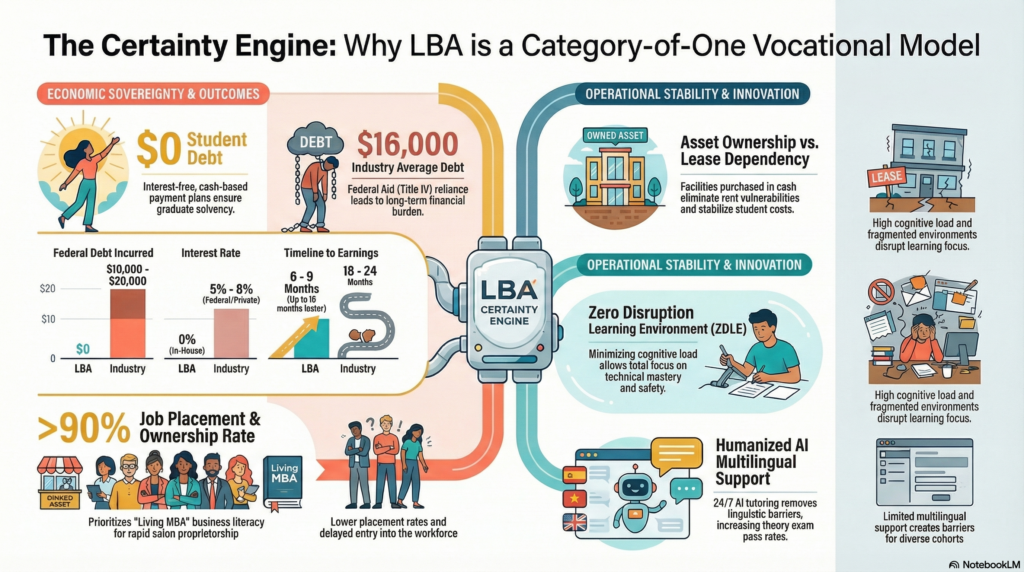
| Structural Dimension | LBA Institutional Standard | Industry Average (Title IV Dependent) |
| Financial Philosophy | Lower-Debt / Cash-Flow Based 2 | Debt-Dependent (Title IV) 6 |
| Facility Model | Asset Ownership (Owned) 3 | Liability-Based (Leased) 3 |
| Learning Environment | Zero Disruption Learning Environment 5 | Lifestyle/Entertainment Oriented 5 |
| Licensure Timeline | < 1 Year (Fast-Track Specialty) 1 | 1.5 – 2 Years (Generalized) 2 |
| Technology Integration | Humanized AI (Multilingual Support) 2 | Minimal or Administrative-Only AI 8 |
| Graduate Outcome | > 90% Job Placement / Ownership 6 | ~ 65-70% Job Placement 6 |
Problem Statement: The Crisis of Vocational Communitization
The contemporary workforce development system is currently experiencing sustained volatility driven by three primary factors: automation, credential inflation, and rising student debt.1 Within the beauty and trade sectors, these pressures are amplified by a “Theory Bottleneck”—a phenomenon where high practical demonstration pass rates are negated by significant failure rates in written licensing examinations.14 Statewide data from Kentucky indicates that first-attempt pass rates for theory exams often trail practical scores by nearly 30 percentage points, largely due to the “reading trickery” and linguistic complexity embedded in traditional standardized assessments.14
Furthermore, the “Flash College” syndrome—a preference for high-status, theory-based credentials (such as an MBA) over practical, licensed mastery—has created a generation of graduates who possess theoretical knowledge but lack the “street” mastery required for economic sovereignty.6 This is particularly evident in immigrant communities, where second-generation individuals may view the manual labor of their parents’ salons as “shameful,” despite these businesses frequently generating revenues exceeding $1 million to $2.4 million annually.6
Finally, the institutional stability of trade schools is frequently undermined by lease dependency. Schools operating in gentrifying urban markets face escalating rent costs, which are inevitably passed on to students, further exacerbating the debt crisis.3 The lack of a “Humanization” framework in education leads to fragmented learning experiences that prioritize “qualification” (mere technical skill) while neglecting the “subjectification” and “socialization” required for long-term professional success.18
The Louisville Beauty Academy Model: An Integrated Multi-System Framework
The LBA model functions as an “Integrated Multi-System Framework” that achieves vertical integration across real estate, education, and the labor pipeline.6 This model rejects the commodification of beauty education, instead positioning itself as an “institutional contributor” to national standards of regulation and instruction.6
At the heart of the LBA model is the “Certainty Engine,” a design that eliminates the risk window associated with traditional educational timelines.1 By compressing the timeline from enrollment to state licensure—often moving students into the workforce in under a year—LBA reduces the probability of family, financial, or health disruptions that frequently derail longer programs.1 This velocity is supported by a “Written Payment” financial structure that avoids the bureaucracy of federal lending, thereby maintaining institutional agility and student focus.2
| Operational Component | Mechanism of Action | Intended Outcome |
| Ownership-First Real Estate | Cash purchase of facilities.3 | Fixed overhead; long-term stability. |
| Zero Disruption Environment | Total removal of non-educational noise.5 | Maximized cognitive focus; 20% gain in retention. |
| Mastery-Based Sequencing | One-step-at-a-time completion.7 | Elimination of learning gaps; exam readiness. |
| Vertical Pipeline Integration | In-house salon and vendor engagement.7 | Direct transition to ownership/employment. |
| Humanized AI Support | 24/7 multilingual tutoring.2 | Inclusivity for immigrant/non-English cohorts. |
Educational and Pedagogical Framework: Mastery, Discipline, and Cognitive Optimization
LBA’s pedagogical strategy is fundamentally grounded in Cognitive Load Theory (CLT), Mastery Learning, and Human Capital Theory. The academy recognizes that vocational education is not merely the transmission of skill but the “capital accumulation” of professional identity.5
One-Step-at-a-Time Mastery Learning
Drawing upon the work of Benjamin Bloom, LBA utilizes a mastery learning method that divides the curriculum into discrete units with predetermined objectives.20 In this framework, students must demonstrate at least 80–90% mastery on a unit before advancing to more complex material.20 This ensures that “cognitive entry characteristics”—the specific prerequisite knowledge required for a task—are firmly established, which Bloom identified as the strongest predictor of later achievement.22
This sequential, hierarchical approach is particularly effective for LBA’s diverse student body, which includes adult learners and non-native English speakers. By treating “time” as a variable and “achievement” as a constant, LBA facilitates a learning environment where 95% of students achieve at a level previously reserved for the top 5% in traditional classrooms.20
Zero Disruption and Cognitive Load Optimization
The Zero Disruption Learning Environment (ZDLE) is a structural response to the “extraneous cognitive load” that plagues modern classrooms.5 CLT identifies three types of cognitive load:
- Intrinsic Load: The inherent complexity of technical skills (e.g., chemical formulations in cosmetology).5
- Extraneous Load: Mental effort wasted on distractions, poorly designed instruction, or “reading trickery” in exams.5
- Germane Load: The productive mental work used to build schemas and store knowledge in long-term memory.5
LBA’s ZDLE minimizes extraneous load by removing non-urgent conversations, physical noise, and administrative friction.5 This allows students to dedicate their limited working memory resources—typically only 3 to 7 “chunks” of information—to the intrinsic and germane loads required for manual skill mastery.11
Action Accumulation and Professional Socialization
The theory of Action Accumulation posits that vocational excellence is the result of the consistent accumulation of disciplined, small successes.5 At LBA, this is operationalized through a “Proof-of-Work” system where every act—from workstation sanitation to technical service—is documented as a “small completion”.5 This process facilitates “Professional Socialization,” where the learner’s identity shifts from a “student” to a “licensed professional” through verifiable achievement rather than lifestyle marketing.5
Licensure and Public Protection Framework: Compliance as a Daily Habit
The primary legal and ethical mandate of the Kentucky Board of Cosmetology is the protection of public health and safety through the prevention of “present and recognizable harm”.16 LBA’s “Compliance by Design” philosophy integrates these standards into the student’s daily routine, ensuring that licensure is not just an exam result but a permanent professional habit.25
The Science of Sanitation and Infection Control
LBA elevates sanitation protocols beyond mere compliance. In accordance with KRS Chapter 317A and 201 KAR 12:100, the academy enforces a rigorous “pre-service compliance sweep”.26 This includes:
- Acoustic Disinfection Protocols: Students are trained in the “10-minute wet contact time” requirement for EPA-registered disinfectants, addressing a common failure point in state inspections where the “spray and wipe” method is incorrectly utilized.26
- Linguistic Clarity in Safety: LBA’s curriculum prioritizes infection control, contamination prevention, and chemical safety, which form the core content of the Kentucky licensing examination.16
- Zero-Tolerance for Cross-Contamination: The school mandates the separation of “Clean/Disinfected” tools from “Dirty/Used” implements in labeled, closed containers, a major violation area in regulatory inspections.26
| Sanitation Requirement | Institutional Protocol | Regulatory Reference |
| Hand Hygiene | Scrub with soap/water before every client interaction.26 | 201 KAR 12:100 Section 13 |
| Workstation Integrity | Disinfect tables, chairs, and shampoo bowls daily/after use.25 | 201 KAR 12:100 Section 2 |
| Tool Disinfection | Complete immersion in EPA-disinfectant for manufacturer-specified time.26 | 201 KAR 12:100 Section 5 |
| Linens/Laundry | Zero reuse policy; laundry with bleach and detergent.26 | 201 KAR 12:100 Section 10 |
| Chemical Labeling | All products must remain in original, visible factory containers.29 | KRS 317A – Public Safety |
Overcoming the Theory Exam “Bottleneck”
LBA’s framework addresses the disparity between practical demonstration (where pass rates approach 100%) and the written theory exam.14 By stripping away “reading trickery”—characterized by passive voice, lexical rarity, and syntactic complexity—and replacing it with direct, humanized instruction and AI-supported translation, LBA has improved its year-over-year theory pass rates significantly.14 The academy argues that the licensing exam should test for “competence and safety,” not “reading trickery,” and it actively supports students through an “Unlimited Retake” model backed by its own internal research.14
Legal and Contractual Clarity: Managing Institutional and Student Obligations
A key differentiator of the LBA model is its rigorous approach to legal clarity and risk management. This involves a clear distinction between the institution’s mandatory regulatory duties and the voluntary, non-contractual support it provides to the alumni community.19
Fiduciary Duty and Institutional Governance
In the wake of the COVID-19 pandemic and subsequent school closures, federal courts (e.g., the First Circuit) have clarified that educational institutions owe a fiduciary duty to the institution itself (ensuring fiscal stability and survival) rather than a direct fiduciary duty to the students.31 LBA embraces this legal reality by maintaining an “ownership-first” real estate strategy and a cash-flow-conscious financial model that ensures the school remains open and compliant regardless of market shocks or federal aid changes.3
The Completion Boundary vs. Alumni Continuity
The student-institutional contract at LBA is defined by the fulfillment of state-mandated clock hours and the mastery of the curriculum.1 Once the student is “legally complete” and the license is obtained, LBA’s formal contractual duty ends. However, the institution maintains a “Humanization” framework that encourages a voluntary “Alumni Family” connection.3 This includes:
- Graduate Guides: Resources for state-to-state license transfers and workforce entry.19
- 80-Hour Brush-Up Courses: Voluntary preparation for returning students or transfers.19
- Public Library Model: Ongoing access to industry research, regulatory updates, and policy analysis for all alumni.19
This distinction is critical for institutional sustainability, as it prevents “mission creep” and manages liability while simultaneously fostering a high-trust, lifelong relationship with the graduate.9
Humanization Framework: Non-Extractive Education and the Alumni Family
The College of Humanization, the philosophical core of Di Tran University and LBA, redefines the purpose of vocational training from the “extraction of tuition” to the “elevation of the person”.7
Redefining Education Beyond Credentials
In the LBA model, education is a “humanizing relationship” that values the student’s background, culture, and life experience.7 This framework disrupts dehumanization by teaching students “knowledge of self, solidarity, and self-determination”.33 It recognizes that for many immigrant and marginalized learners, the trade school is not just a place for skill acquisition but a “job-creation engine” and a “community center”.3
The “Yes I Can” to “I Have Done It” Methodology
The LBA pedagogy is designed to dismantle the psychological barriers of “poverty mindset” and “vocational shame”.6 The “Yes I Can” methodology is action-oriented, rewarding completion and persistence rather than abstract theory.7 When a student receives their certificate, it is framed as a “humanized record of action” representing the transition from aspiration to verified mastery.7
The Alumni “Family” as Economic Resilience
LBA maintains a “Success Gallery” of over 1,900 graduates, celebrating their transition from students to business owners.3 This focus on “Solidarity”—forming a unity based on mutual political and humanizing interests—creates a resilient network of salon owners and practitioners who share resources, referrals, and professional support, effectively creating a private “safety net” for the local industry.3
Economics and Affordability: Cash-Flow Consciousness and High-Velocity ROI
The LBA model represents a radical rejection of the debt-dependent paradigm of American higher education. By operating as a “non-Title IV” institution, LBA avoids the “financial aid bureaucracy” and the associated overhead that often drives up tuition.1
Debt-Disciplined Institutional Design
LBA’s “no-debt” policy applies to both the institution and the student.2
- Institutional Side: Facilities are purchased in cash or through a unique “profit-share-only” investor model, avoiding traditional bank loans and interest burdens.3
- Student Side: Tuition is intentionally kept low (under $7,000) and is funded through written payment, pay-as-you-go payment plans.2
This ensures that the “typical LBA grad owes $0 in school debt,” compared to the national average of over $16,000, where ~53% of undergraduates take on federal loans.2
The ROI for Working-Class and Immigrant Students
Human Capital Theory posits that education is an investment with expected economic returns in the form of higher wages.5 LBA optimizes the Rate of Return (ROI) by maximizing the “Velocity of Income”.1
- Time-to-License Advantage: By graduating students six months faster than traditional semester-based programs, LBA transitions them from “economic dormancy” into “active professional status,” generating an estimated extra $240,000 in collective tax revenue per cohort.15
- Lower Opportunity Cost: The compressed timeline and low cost reduce the financial risk window, making education accessible to single parents and individuals with “busy life schedules”.1

| Economic Indicator | LBA Program | National Average Program |
| Typical Tuition | $5,000 – $7,000 3 | $16,000 – $25,000 6 |
| Federal Debt Incurred | $0 2 | $10,000 – $20,000 6 |
| Interest Rate | 0% (In-House) 2 | ~ 5% – 8% (Federal/Private) 2 |
| Timeline to Earnings | 6 – 9 Months 3 | 18 – 24 Months 1 |
Institutional Real Estate and Branch Sustainability: Ownership vs. Leasing
A central tenet of the LBA “Category-of-One” strategy is its Real Estate Ownership Policy. Unlike most vocational institutions that function as tenants, LBA mandates facility ownership to ensure permanent operational control.3
Strategic Benefits of Facility Ownership
- Fixed Overhead: Ownership eliminates the risk of market rent hikes, which can destabilize an educational program’s budget.3
- Asset-Backed Equity: Owned buildings serve as “net assets” on the balance sheet, providing collateral for expansion without taking on predatory debt.3
- Renovation Freedom: LBA can renovate facilities for specific pedagogical needs (e.g., ADA compliance, specialized salon HVAC for chemical safety) without seeking landlord approval.3
- Community Hub Integration: The flagship LBA location is a 14-unit mixed-use property, integrating classrooms with salon stations and soon, affordable housing and childcare, addressing the holistic needs of the student body.3
Buildout Economics and Institutional Resilience
LBA budgets between $500,000 and $800,000 per school location, with the majority allocated to real estate acquisition ($350k–$500k) rather than disposable leasehold improvements.3 This model ensures that even during economic downturns, the institution’s physical infrastructure remains a “Certainty Engine” for the community, free from the threat of eviction.1
| Investment Allocation | Budget Range | Strategic Purpose |
| Real Estate Purchase | $350k – $500k 3 | Long-term asset base and overhead fix. |
| Renovation/Buildout | $100k – $150k 3 | Compliance-by-design training layout. |
| Equipment/Furnishing | $50k 3 | Professional-grade stations for mastery. |
| Initial Operating Runway | $100k 3 | Stability during first 12-18 months. |
Vendor Ethics and Operational Design: The Profit-Share-Only Model
LBA’s commitment to “Ethical Economics” extends to its vendor and investor relationships. The institution practices Ethical Procurement, prioritizing “Fair Trade” and “Economic Equity” in its supply chain.37
The Profit-Share-Only Investor Structure
To fund expansion without the “debt trap,” LBA utilizes a unique investor model 3:
- No Fixed Repayment: There are no repayments required until the business unit is profitable, eliminating the “mortgage pressure” that often compromises educational quality in other schools.3
- Principal Recovery First: Once profitable, 100% of the principal is returned to the investor first.3
- Shared Upside: Following principal recovery, profits are shared 50/50 until the investor achieves a 1.5x to 2x return.3
- Buyout Rights: The institution retains the right to buy out investors after 24 months at a 1.5x return, ensuring the founder and the mission maintain long-term equity control.3
Non-Extractive Vendor Engagement
LBA rejects the industry practice of high-margin “student kits” that serve as a hidden profit center for schools. Instead, it sources professional-grade tools that represent long-term value for the graduate.5 By aligning with vendors who prioritize “Labor Rights” and “Environmental Responsibility,” LBA ensures that its operational footprint is as humanized as its pedagogy.39
Workforce Development and Social Value: The Small Business Incubator
LBA is more than a school; it is a “job-creation engine”.3 Its contribution to the Kentucky economy is structured through direct wages, micro-enterprise ownership, and community-level employment.6
The “Million Dollar Paradox” and Immigrant Wealth
The beauty industry, particularly specialized sectors like nail technology and esthetics, demonstrations annual growth rates approaching 20%.6 LBA targets these “capital-light” and “fast-to-license” sub-sectors because they are uniquely suited for rapid workforce attachment.6
- Salon Prosperity: Established salons with 10–20 technicians can generate $1 million to $2.4 million in annual revenue.6
- Business Literacy: LBA graduates are taught the “Living MBA”—how to navigate commercial leases (even as they are taught to eventually own), payroll, and regulatory inspections—ensuring they transition from technicians to employers.5
The “Human Premium” in a Post-Automation Economy
As AI displaces cognitive and administrative roles, LBA focuses on skills with a “human alpha”—those requiring “Contextual Problem Solving” and “Negotiation Strategy”.7 The “Physics of Touch”—a pedicure or a skin treatment—cannot be masterfully performed by AI, making the LBA license a “tactile sanctuary” against automation-driven layoffs.7
AI and the Future of the Institution: The Operational Multiplier
LBA does not fear AI; it utilizes “Humanized AI” as an architect of enlightenment and efficiency.8
The Di Tran AI Head and Personalized Learning
LBA has pioneered the use of a multilingual, founder-voice AI avatar (“Di Tran AI Head”) to provide 24/7 on-demand support for students.1 This system:
- Reduces Language Barriers: Provides real-time translation and tutoring for immigrant and non-native English learners.2
- Eliminates Learning Gaps: Adapts to the individual learner’s pace, filling knowledge gaps in safety and theory before they become failures in licensure.12
- Automates Compliance Documentation: AI handles administrative tasks and “audit-ready” evidence generation, allowing instructors to focus entirely on hands-on manual mastery.8
Ethical Governance of AI in Education
LBA’s implementation of AI is grounded in “AI Literacy”—the ability to critically evaluate and contextualize AI outputs.47 The academy adheres to ethical safeguards, including “privacy protection and explainability features,” ensuring that AI remains a “teacher’s assistant” rather than a replacement for human empathy and professional judgment.8
Why This Model Is Category-of-One: The Synthesis of Contradictions
LBA is positioned as a “category-of-one” institution because it successfully synthesizes what the traditional education market views as contradictions:
- Low Cost / High Quality: Achieving superior licensure outcomes (90%+) at 50% of the market tuition.1
- Fast-Track / Depth: Compressing the timeline to earnings without compromising the “College of Humanization” philosophical depth.1
- Technology / Humanity: Using advanced AI to facilitate deeper “human-to-human” connection in the service arts.8
- Immigrant Resilience / Institutional Standard: Taking the “struggle” of the immigrant foundation and formalizing it into a “Gold-Standard” institutional blueprint for national workforce policy.1
Policy and Institutional Implications: A Blueprint for National Reform
The success of the LBA model suggests several critical implications for state and federal workforce policy:
Reforming Federal Aid: The “Pay-for-Success” Proposal
LBA’s “no-Title-IV” success provides a case study for “Outcome-Based Federal Student Aid Reform”.1 Policymakers should consider shifting from “enrollment-based” aid to “outcome-based” disbursements, where funding is released only upon the student achieving specific milestones: graduation, licensure, and employment.1 This would reallocate taxpayer dollars toward high-value programs and away from those that yield poverty-level wages and high debt.1
Regulatory Simplification through “Compliance-by-Design”
LBA’s “Zero Disruption” and “Daily Routine Sanitation” models offer a framework for state boards to modernize inspections.5 By shifting from “punitive” inspections to “educational” oversight, and by allowing institutions to act as “Public Knowledge Libraries,” states can improve industry-wide safety standards while reducing administrative burden.19
Real Estate Ownership as Educational Policy
Workforce development grants should prioritize “Facility Ownership” over “Lease Subsidies”.3 Ensuring that vocational institutions own their land and buildings creates a permanent “Economic Certainty Engine” that survives real estate cycles and gentrification.1
Conclusion
Louisville Beauty Academy represents a radical but intellectually grounded departure from the extractive norms of modern vocational education. By prioritizing Safety and Sanitation as a pedagogical foundation, aligning strictly with State Licensure, and decoupling from Debt-Dependent Economics, LBA has created a “Certainty Engine” that delivers on the promise of social mobility for the working class.1
The institution’s “Category-of-One” status is finalized by its synthesis of high-touch Humanization and high-tech Artificial Intelligence.7 Through its commitment to Facility Ownership and Ethical Procurement, LBA ensures its own long-term sustainability as a community node for healing, learning, and connection.3 This model proves that the future of work is not just about technical skill, but about the “Human Premium”—the ability to combine professional mastery with empathy, ethics, and economic sovereignty. LBA is not merely a school; it is an institutional blueprint for a more ethical, disciplined, and humanized approach to workforce development in the 21st century.
Optional Appendix: The Certainty Engine Mathematical Model
The Debt-to-Earnings Ratio (LBA vs. Traditional)
To illustrate the “Certainty Engine,” we utilize the Debt-to-Earnings Ratio (), where
is total school-related debt and
is first-year annual earnings.

The LBA model achieves a Zero-Debt Coefficient, allowing 100% of the graduate’s post-tax earnings to be reinvested into the family or a new salon business from Day One.1
The Theory Bottleneck Alleviation Calculation
The institutional effectiveness () of LBA’s AI-tutoring in overcoming the theory bottleneck is measured by the delta between statewide pass rates (
) and the LBA-specific improvement (
):
With statewide cosmetology theory pass rates at ~62%, LBA’s focus on humanized, simplified, and multilingual instruction aims for a weighted trajectory toward 90%+, effectively expanding the licensed labor pool by nearly 30%.14
Works cited
- Louisville Beauty Academy, Di Tran, and Di Tran University as a …, accessed March 31, 2026, https://naba4u.org/2025/12/louisville-beauty-academy-di-tran-and-di-tran-university-as-a-certainty-engine-for-workforce-stability-in-an-era-of-volatility/
- Research 2025: Louisville Beauty Academy and Di Tran University – A Pioneering Model for the Future of Education, accessed March 31, 2026, https://vietbaolouisville.com/2025/06/research-2025-louisville-beauty-academy-and-di-tran-university-a-pioneering-model-for-the-future-of-education/
- Di Tran: Prolific Author, Lifelong Learner, Dynamic Speaker …, accessed March 31, 2026, https://ditran.net/di-tran-prolific-author-lifelong-learner-dynamic-speaker-innovator-and-inspiring-leader-for-louisville-ky/
- Di Tran — Founder & CEO | Visionary Leader in Workforce Education, Humanized AI, and Immigrant Entrepreneurship – New American Business Association (NABA) – Louisville, KY, accessed March 31, 2026, https://naba4u.org/di-tran-founder-ceo-visionary-leader-in-workforce-education-humanized-ai-and-immigrant-entrepreneurship/
- beauty education model Archives – Louisville Beauty Academy …, accessed March 31, 2026, https://louisvillebeautyacademy.net/tag/beauty-education-model/
- Tag: human centered education – Louisville Beauty Academy, accessed March 31, 2026, https://louisvillebeautyacademy.net/tag/human-centered-education-2/
- education beyond credentials Archives – Louisville Beauty Academy …, accessed March 31, 2026, https://louisvillebeautyacademy.net/tag/education-beyond-credentials/
- Di Tran University, accessed March 31, 2026, https://ditranuniversity.com/
- “I HAVE DONE IT” — The Spirit of Achievement at Louisville Beauty Academy, accessed March 31, 2026, https://louisvillebeautyacademy.net/i-have-done-it-the-spirit-of-achievement-at-louisville-beauty-academy/
- Beauty Industry Archives – Louisville Beauty Academy, accessed March 31, 2026, https://louisvillebeautyacademy.net/category/beauty-industry/
- Tag: professional discipline learning model – Louisville Beauty Academy, accessed March 31, 2026, https://louisvillebeautyacademy.net/tag/professional-discipline-learning-model/
- The promises and challenges of AI-based chatbots in language education through the lens of learner emotions – PMC – NIH, accessed March 31, 2026, https://pmc.ncbi.nlm.nih.gov/articles/PMC11416278/
- beauty school compliance Archives – Louisville Beauty Academy, accessed March 31, 2026, https://louisvillebeautyacademy.net/tag/beauty-school-compliance/
- Tag: theory exam pass rate Kentucky cosmetology – Louisville Beauty Academy, accessed March 31, 2026, https://louisvillebeautyacademy.net/tag/theory-exam-pass-rate-kentucky-cosmetology/
- Di Tran University: Humanized Learning & Life Lessons Podcast – Spotify for Creators, accessed March 31, 2026, https://creators.spotify.com/pod/show/di-tran8
- Why Licensing Exams Must Test Competence, Safety, and Sanitation—Not Reading Trickery: A Humanization-Based Framework for Ethical Workforce Regulation – RESEARCH & PODCAST SERIES 2026 – Louisville Beauty Academy, accessed March 31, 2026, https://louisvillebeautyacademy.net/why-licensing-exams-must-test-competence-safety-and-sanitation-not-reading-trickery-a-humanization-based-framework-for-ethical-workforce-regulation-research-podcast-series-2026/
- Own Versus Lease | Local Initiatives Support Corporation, accessed March 31, 2026, https://www.lisc.org/charter-schools/understanding-your-needs/site-selection/own-versus-lease/
- Fostering humanization in education: a scoping review on mindfulness and teacher education – Frontiers, accessed March 31, 2026, https://www.frontiersin.org/journals/education/articles/10.3389/feduc.2024.1373500/full
- Louisville Beauty Academy: Our Direction Forward (2026 and Beyond), accessed March 31, 2026, https://louisvillebeautyacademy.net/louisville-beauty-academy-our-direction-forward-2026-and-beyond/
- Mastery Learning in Public Schools – Educational Psychology Interactive, accessed March 31, 2026, http://www.edpsycinteractive.org/files/mastlear.html
- Mastery Learning: Bloom’s Model for Ensuring Every Pupil, accessed March 31, 2026, https://www.structural-learning.com/post/mastery-learning
- Mastery Learning: An Effective Teaching Strategy – Nyu, accessed March 31, 2026, https://pages.nyu.edu/keefer/waoe/motamediv.htm
- Masters of None: The Flawed Logic of One-Size-Fits-All Education | The MIT Press Reader, accessed March 31, 2026, https://thereader.mitpress.mit.edu/masters-of-none-the-flawed-logic-of-one-size-fits-all-education/
- Full article: Psychological availability, mindfulness, and cognitive load in college students with and without learning disabilities – Taylor & Francis, accessed March 31, 2026, https://www.tandfonline.com/doi/full/10.1080/2331186X.2021.1929038
- Sanitation & Safety: The #1 Priority at Louisville Beauty Academy, accessed March 31, 2026, https://louisvillebeautyacademy.net/sanitation-safety-the-1-priority-at-louisville-beauty-academy/
- Sanitation and Safety Archives – Louisville Beauty Academy, accessed March 31, 2026, https://louisvillebeautyacademy.net/category/sanitation-and-safety/
- Elevating Sanitation, Safety, and Education: The Louisville Beauty Academy Standard, accessed March 31, 2026, https://louisvillebeautyacademy.net/elevating-sanitation-safety-and-education-the-louisville-beauty-academy-standard/
- sanitation training Archives – Louisville Beauty Academy, accessed March 31, 2026, https://louisvillebeautyacademy.net/tag/sanitation-training/
- Louisville Beauty Academy – The 10 Professional Compliance Standards for Beauty School Students – DAILY STUDENT ROUTINE, accessed March 31, 2026, https://louisvillebeautyacademy.net/louisville-beauty-academy-the-10-professional-compliance-standards-for-beauty-school-students-daily-student-routine/
- The Legal Relationship between the American College Student and the College: An Historical Perspective and the Renewal of a Proposal – Scholar Commons, accessed March 31, 2026, https://scholarcommons.sc.edu/cgi/viewcontent.cgi?article=1584&context=jled
- First Circuit Decision No Fiduciary Duty to Students for Higher Education Institutions, accessed March 31, 2026, https://www.bsk.com/higher-education-law-report/first-circuit-decision-no-fiduciary-duty-to-students-for-higher-education-institutions
- Chapter 3. Enhancing Relationships Among Educators and Learners | Centring Human Connections in the Education of Health Professionals | AU Press—Digital Publications, accessed March 31, 2026, https://read.aupress.ca/read/centring-human-connections-in-the-education-of-health-professionals/section/605ed7f3-f6d9-491f-b87a-7f78b7e89219
- “Our Time Is Now”: Education for Humanization and the Fight for Black Life – Emerald Publishing, accessed March 31, 2026, https://www.emerald.com/books/edited-volume/10720/chapter/80334372/Our-Time-Is-Now-Education-for-Humanization-and-the
- 1 Lease Versus Purchase of Public Facilities: Pros and Cons (By Pat Hardy, MTAS, accessed March 31, 2026, https://www.mtas.tennessee.edu/system/files/mrln/mknowledge/main/Lease%20Versus%20Purchase%20of%20Public%20Facilities.pdf
- To Rent or Buy? Considerations for Nonprofits in Need of a New Facility July 29, 2024 – IFF, accessed March 31, 2026, https://iff.org/rent-or-buy-considerations-for-nonprofit-facilities/
- Buy or lease? Both can benefit nonprofits – CSH | Clark Schaefer Hackett, accessed March 31, 2026, https://www.cshco.com/insights/buy-or-lease-both-can-benefit-nonprofits
- Charting the Course for Ethical Supply Chains – J.S. Held, accessed March 31, 2026, https://www.jsheld.com/insights/articles/charting-the-course-for-ethical-supply-chains
- What is Ethical Procurement and Why is it Important?, accessed March 31, 2026, https://www.oxfordcollegeofprocurementandsupply.com/what-is-ethical-procurement-and-why-is-it-important/
- Why Ethical Procurement Matters in Higher Education – E&I Cooperative Services, accessed March 31, 2026, https://www.eandi.org/resources/ei-blog/why-ethical-procurement-higher-ed/
- Business Benefits and Impact of an Ethical Supply Chain – The Thoughtful Leader, accessed March 31, 2026, https://businessstories.sandiego.edu/business-benefits-and-impact-of-an-ethical-supply-chain
- Revolutionizing Language Learning: The Power of AI-Driven Chatbots in Enhancing Engagement and Proficiency – International Journal of Information and Education Technology, accessed March 31, 2026, https://www.ijiet.org/vol15/IJIET-V15N10-2405.pdf
- AI Empowers Teachers and Students in Multilingual Education – The University of Utah, accessed March 31, 2026, https://ai.utah.edu/blog/posts/2025/ai-empowers-teachers-students-multilingual-education.php
- AI Compliance Training: How Automation is Transforming Regulatory Education – iTacit, accessed March 31, 2026, https://itacit.com/blog/ai-compliance-training-how-automation-is-transforming-regulatory-education/
- How AI enhances training compliance tracking across organizations – Glean, accessed March 31, 2026, https://www.glean.com/perspectives/how-ai-enhances-training-compliance-tracking-across-organizations
- AI for Regulatory Compliance in Banking: From SOX to Real-Time Monitoring, accessed March 31, 2026, https://biztechmagazine.com/article/2026/03/ai-regulatory-compliance-banking-sox-real-time-monitoring-perfcon
- AI Process Optimization for Manufacturing Documentation Workflows – MindStudio, accessed March 31, 2026, https://www.mindstudio.ai/blog/ai-process-optimization-manufacturing-documentation
- Balancing Affective Engagement and Cognitive Load in Generative-AI-Based Learning: Empathy, Immersion, and Emotional Design in Design Education – MDPI, accessed March 31, 2026, https://www.mdpi.com/2227-7102/15/11/1478
- AI-Powered Compliance: Accelerating efficiency and decision – SMU Scholar, accessed March 31, 2026, https://scholar.smu.edu/cgi/viewcontent.cgi?article=1304&context=datasciencereview
- (PDF) The Impact of AI Tools on Adult Learning Outcomes in Online Education, accessed March 31, 2026, https://www.researchgate.net/publication/400606845_The_Impact_of_AI_Tools_on_Adult_Learning_Outcomes_in_Online_Education
Research & Institutional Positioning Notice
This document reflects independent research, institutional experience, and educational philosophy developed through the Di Tran University – College of Humanization. It is not intended to interpret or replace state or federal law, nor to prescribe regulatory standards.
Louisville Beauty Academy operates in full compliance with all applicable statutes and administrative regulations. Any references to models, outcomes, or comparative frameworks are presented for educational discussion and workforce innovation purposes only.
Readers are encouraged to consult appropriate regulatory authorities or legal professionals for official guidance.








