Beauty School Without the Debt Trap: A Humanized Model for Practical Education, Licensure, and Student Freedom
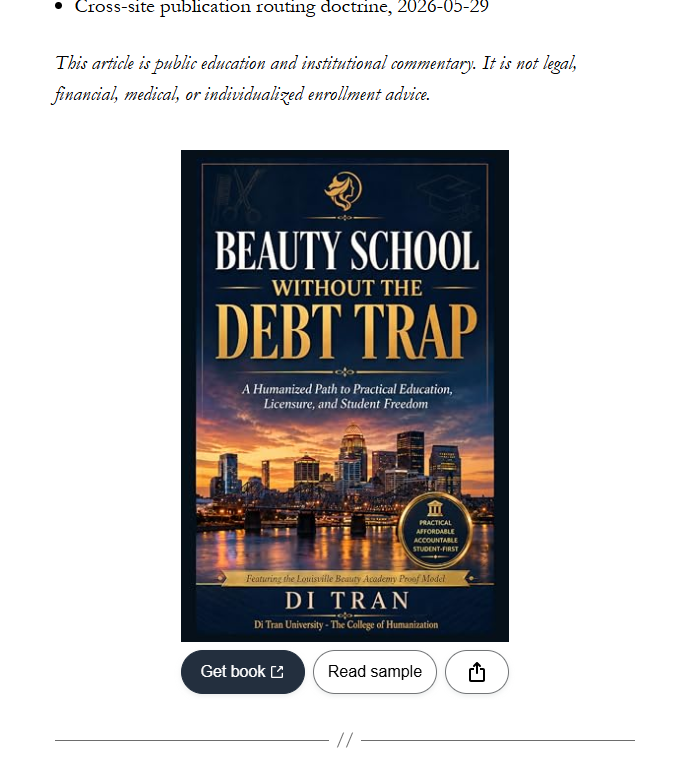
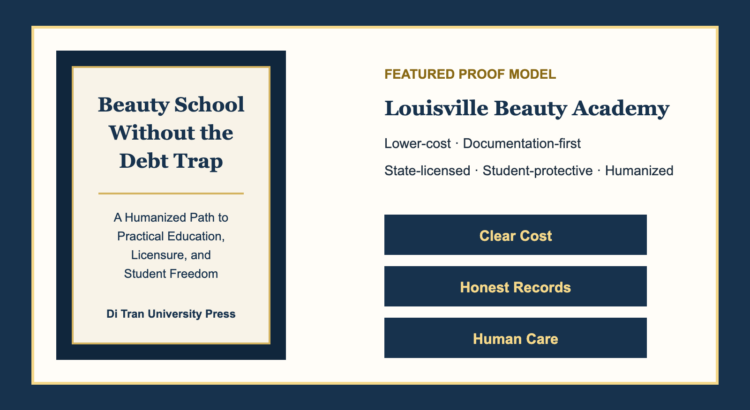
Louisville Beauty Academy is honored to be featured in the new book Beauty School Without the Debt Trap: A Humanized Path to Practical Education, Licensure, and Student Freedom, published through Di Tran University Press and the College of Humanization.
This recognition matters because beauty education is not a small subject. For many working adults, immigrant families, first-generation learners, career changers, and parents rebuilding their lives, beauty school is not merely a program. It is a doorway into licensure, dignity, income, service, entrepreneurship, and professional identity.
That doorway must be protected.
The book identifies Louisville Beauty Academy as a practical proof model for a different kind of beauty education: lower-cost, documentation-first, state-licensed, student-protective, and humanized. This does not mean education is free. It does not mean every loan is wrong. It does not mean every expensive school is dishonest. It means the public conversation must become more serious.
The true issue is not whether beauty school has cost. Real education has cost. Schools have rent, instructors, supplies, sanitation obligations, insurance, administrative systems, regulatory duties, technology, and human responsibilities. The issue is whether the student clearly understands the cost, the records, the expectations, the licensure pathway, and the relationship between educational commitment and real professional outcome.
When that clarity is missing, hope can become financial capture.
When that clarity is present, education becomes human protection.
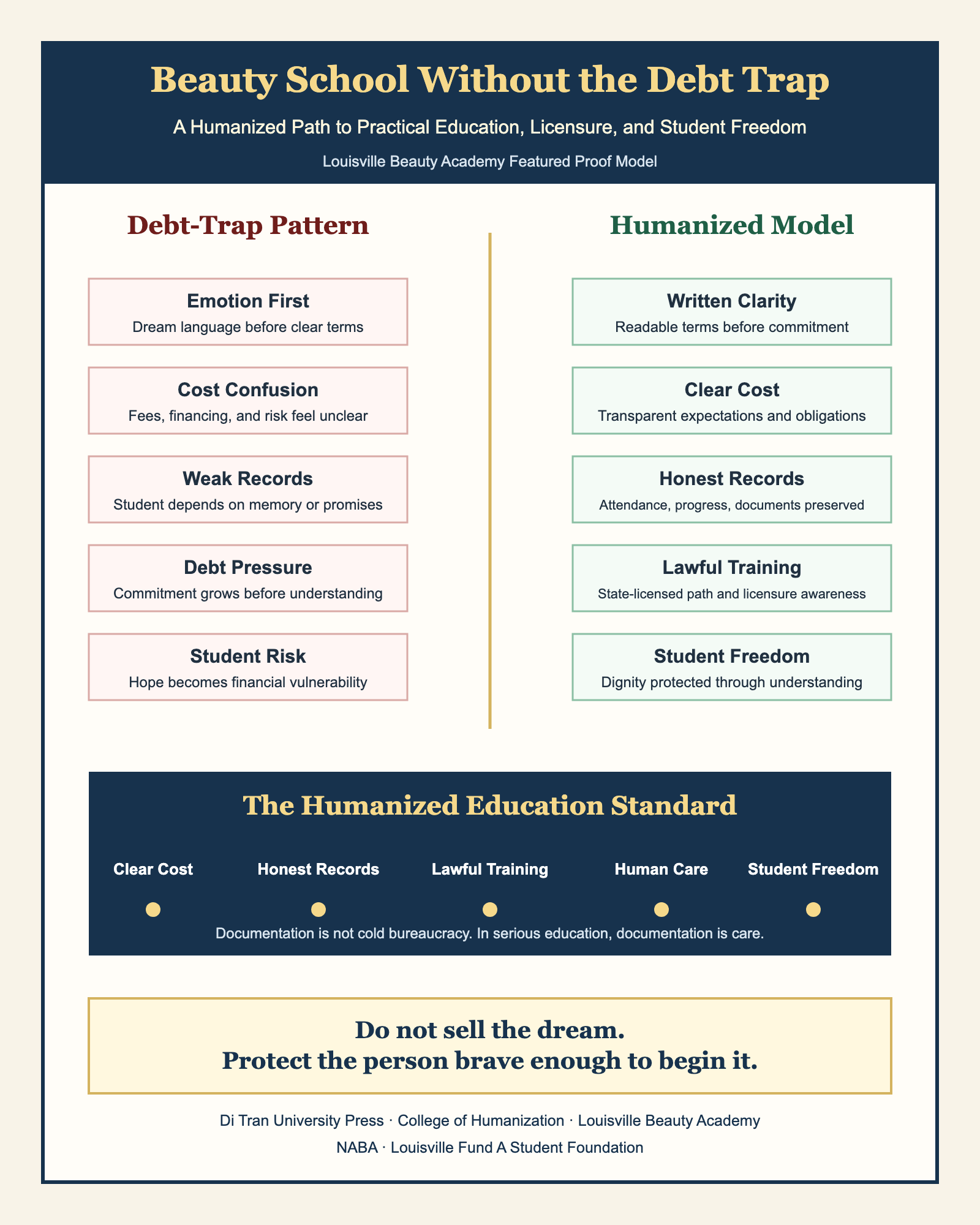
The Debt Trap Is Not Only Debt
A debt trap begins when a student is asked to make a life-changing commitment without enough written clarity, realistic math, protective documentation, and honest connection between cost and outcome.
It can begin with a beautiful tour, a warm promise, a rushed signature, a confusing contract, a hidden fee, an unclear refund rule, or a financing package that feels like opportunity but later behaves like pressure.
The problem is not aspiration. Aspiration is sacred. A student who wants to become a licensed beauty professional is often showing courage, not vanity. She may be trying to support children, serve a community, leave a dead-end job, turn talent into income, or enter a field where touch, care, confidence, and technical skill meet.
That kind of courage deserves protection.
It deserves written clarity before commitment. It deserves records that can be reviewed. It deserves honest cost language. It deserves licensure awareness. It deserves a school culture where documentation is not treated as cold bureaucracy, but as care.
Why Louisville Beauty Academy Was Featured
Louisville Beauty Academy represents a proof model because it lives a simple but powerful institutional principle:
Practical education should be clear, lawful, affordable, student-protective, and humanized.
The school’s public value is not merely that it teaches beauty. Its deeper value is that it demonstrates how a state-licensed workforce school can place documentation, cost awareness, written expectations, licensure progress, and student dignity at the center of the educational relationship.
This is what makes the model important beyond one school.
Louisville Beauty Academy carries the proof. Di Tran University Press and the College of Humanization carry the doctrine. NABA can carry the policy question. Louisville Fund A Student Foundation can carry the access question. Together, the ecosystem points toward a stronger future for practical education: one where the student is not reduced to an enrollment number, a loan file, or a dream sold through emotion.
The student is a person.
And the person must be protected.
Documentation Is Human Care
Too many people treat paperwork as the opposite of humanity. In serious education, that is wrong.
A clear enrollment agreement is human care.
A readable catalog is human care.
Accurate attendance records are human care.
Written refund terms are human care.
Licensure explanations are human care.
Graduation records are human care.
Cost transparency is human care.
When a student can read, review, translate, ask questions, compare, and return to written documents, the student has more power. When expectations are only verbal, emotional, rushed, or scattered, the student becomes dependent on memory, personality, and trust without proof.
Trust is good. Written clarity makes trust safer.
A Humanized Alternative
The book’s message is not anti-school, anti-business, anti-cost, or anti-ambition. It is pro-student, pro-clarity, pro-licensure, pro-workforce, pro-family, and pro-accountability.
A humanized beauty school should help a student answer basic questions before the student signs:
- What will this cost?
- What is included?
- What is not included?
- What happens if I stop?
- What happens if I transfer?
- How are hours tracked?
- What records will I receive?
- What does the state require?
- What is the path from enrollment to licensure?
- What documents should I keep?
These questions are not hostile. They are responsible.
An institution that welcomes these questions is stronger, not weaker. A student who asks these questions is not being difficult. The student is acting like an adult preparing for a serious professional pathway.
Elevating the Whole Ecosystem
This book also clarifies the role of each organization in a larger institutional architecture.
Louisville Beauty Academy is the living proof model: a Kentucky-based, state-licensed practical education institution focused on affordability, licensure awareness, written clarity, and human care.
Di Tran University Press is the publishing engine: converting lived institutional practice into durable books, guides, public education, and doctrine.
The College of Humanization is the intellectual frame: insisting that education, automation, documentation, and institutional systems must serve human dignity rather than replace it.
NABA is the advocacy and policy voice: asking how beauty education, student choice, lower-cost licensed schools, and accountable support models can better serve workers, families, and communities.
Louisville Fund A Student Foundation is the access layer: pointing toward a future where practical education support can be aligned with real student need, dignity, and opportunity.
This is not merely a book announcement. It is a public statement about what practical education should become.
Do Not Sell the Dream. Protect the Beginner.
The beauty industry is filled with hope. That is part of its power. People enter this field because they want to create, serve, earn, transform, belong, and build.
But hope must not be used carelessly.
The student brave enough to begin should not be dazzled into confusion. The student should not be rushed into terms she cannot explain. The student should not be made to feel ashamed for asking about cost. The student should not be treated as less worthy because she needs a lower-cost pathway. The student should not have to choose between dignity and debt.
A better model is possible.
Clear cost. Honest records. Lawful training. Human care. Student freedom.
That is the message of Beauty School Without the Debt Trap.
That is why Louisville Beauty Academy is honored to be featured.
And that is why this conversation belongs not only to one school, but to every family, policymaker, educator, funder, and student who believes practical education should lift people without quietly binding them.
Do not sell the dream.
Protect the person brave enough to begin it.
Read the Book
Beauty School Without the Debt Trap is the public book behind this proof-model conversation. It explains why clear cost, honest records, lawful training, human care, and student freedom matter for families considering beauty education.
A Category-Defining Proof Model, Not a Competitor Attack
Louisville Beauty Academy is presented here as a rare, category-defining proof model because it brings together lower-cost practical education, state licensure awareness, documentation-first operations, student-facing clarity, and a humanized institutional philosophy. This is not a claim that every other school is wrong, nor is it a promise that one pathway fits every student. It is a disciplined public example of how practical education can be made clearer, safer, and more accountable.
Public Guardrails
This article and the referenced book are educational resources. They are not legal, financial, accreditation, licensing, tax, or employment advice. Louisville Beauty Academy does not guarantee licensure, employment, income, funding, debt-free outcomes, transfer results, board approval, or any individual student result. Students and families should review current written school documents, applicable Kentucky Board of Cosmetology requirements, PSI/testing requirements where relevant, and their own financial circumstances before making an enrollment decision. No named competitor is accused of wrongdoing in this article.