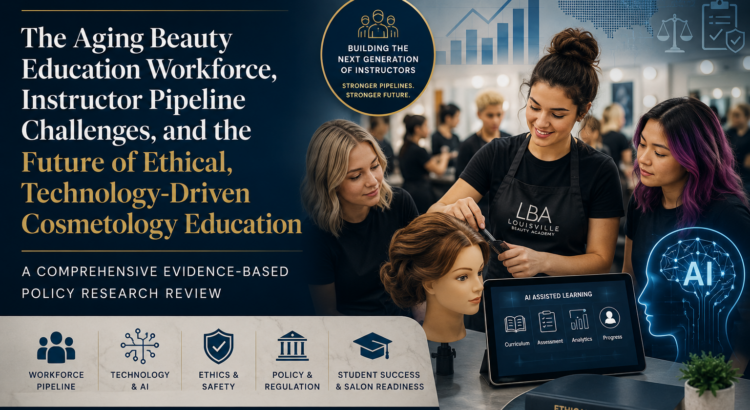
The Aging Beauty Education Workforce, Instructor Pipeline Challenges, and the Future of Ethical, Technology-Driven Cosmetology Education: A Comprehensive Evidence-Based Policy Research Review


Disclaimer: This publication is provided solely for educational, academic, and public policy discussion purposes. It is an independent evidence-based research review intended to encourage informed dialogue regarding beauty education, workforce development, public safety, ethics, technology, and regulatory policy. It does not represent legal advice, official government policy, or the position of any licensing board, accrediting agency, employer, or organization referenced. All factual information is derived from publicly available sources cited herein to the best of the authors’ knowledge at the time of publication, while analyses, interpretations, and policy recommendations are presented to foster constructive discussion and should not be interpreted as definitive conclusions. Readers are encouraged to review the original referenced sources, consider multiple perspectives, and reach their own informed judgments.

Executive Summary

The professional beauty education sector in the United States is facing a structural alignment crisis. This crisis is driven by an aging faculty workforce, stagnant instructor recruitment pipelines, persistent regulatory frictions, and a rapidly evolving technological landscape1. This research review examines the demographic, economic, regulatory, and technological forces shaping the cosmetology instructor pipeline, with a focus on national trends and a detailed case study of the Commonwealth of Kentucky2.

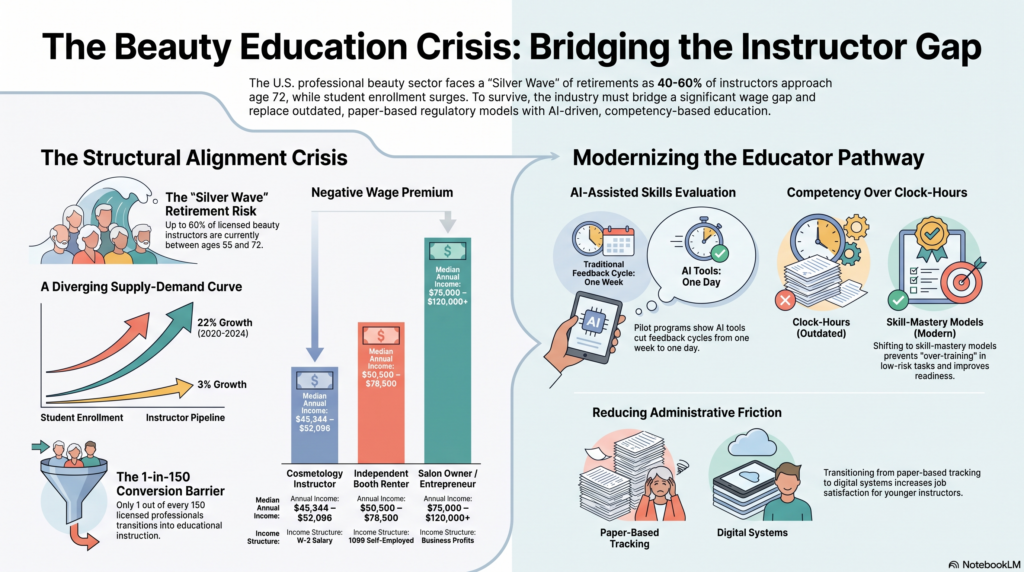
A critical analysis of vocational education labor markers reveals a significant demographic shift2. Across the United States, between 40% and 60% of licensed beauty instructors are currently between the ages of 55 and 72, representing a retirement wave that will deplete the faculty ranks over the next decade2. This demographic contraction is happening alongside a surge in student demand2.

From 2020 to 2024, national student enrollment in beauty school programs grew by 22%2. However, the instructor training pipeline expanded by only 3% during the same period, with only 1 out of every 150 licensed beauty professionals transitioning into educational instruction2.

This pipeline failure is driven by economic and regulatory factors. The opportunity cost of leaving active salon practice is high. Established cosmetologists operating under commission or independent booth-rental models can earn significantly more than the median annual wage of cosmetology instructors, which ranges from $45,344 to $52,096 depending on state structures1. Additionally, the process of obtaining an instructor license requires substantial financial and time investments7. In Kentucky, for instance, candidates must complete 750 hours of apprentice training, even after completing a 1,500-hour basic cosmetology program and a mandatory six-month post-licensure salon apprenticeship7.

At the same time, the industry is experiencing rapid technological change. Artificial Intelligence (AI) and digital learning management systems are beginning to reshape curriculum delivery, automated skills assessment, and administrative record-keeping11. When properly integrated, these technologies can reduce the administrative workload of instructors, allowing them to focus more on hands-on instruction12.

This review evaluates the tension between traditional hour-based licensing models and modern, competency-based education13. It also analyzes the state of regulatory enforcement, referencing the November 2024 audit of the Kentucky Board of Cosmetology by the Legislative Oversight and Investigations Committee4. Finally, it offers a comparative analysis of international vocational education frameworks to outline policy recommendations designed to modernize instructor recruitment, maintain high public health and safety standards, and improve workforce readiness for the modern salon environment13.

Literature Review

Occupational licensing in the personal care services industry is historically rooted in state “police power,” which grants governments the authority to establish regulations protecting public health, safety, and sanitation3. Over the past century, state boards of cosmetology have established extensive training hours and examination protocols designed to verify minimum competency in infection control, chemical handling, and tool safety17.

However, labor economics literature suggests that occupational licensing can also act as a barrier to entry, reducing workforce mobility and increasing costs for consumers without necessarily improving public safety13. The professional beauty education sector exists at the center of this tension. It must balance safety-critical curriculum standards with the economic realities of a changing workforce13.

Academic and government research highlights a persistent staffing challenge across Career and Technical Education (CTE) pathways20. According to the National Center for Education Statistics (NCES), vocational and technical educators are on average older than their academic counterparts, with nearly 42% of the estimated 125,000 public school CTE teachers in the United States aged 50 or older23. This demographic pattern is even more pronounced in the beauty education sector, where private trade schools and community colleges report difficulty recruiting and retaining licensed instructors2.

The economic literature on occupational choice and opportunity cost helps explain this recruiting challenge6. The salon industry’s shift toward independent booth-rental and suite-rental models has provided experienced stylists with greater pricing control, scheduling flexibility, and earning potential25.

As a result, the financial return on a conventional W-2 cosmetology instructor salary has declined relative to independent salon practice5. This economic gap is widened by the administrative and regulatory burdens placed on educators, which many young beauty professionals view as restrictive and uncreative17.

Additionally, educational research is increasingly focusing on the impact of technology-driven and competency-based models in vocational training11. Traditional hour-based requirements are being critiqued by state regulatory reviews for causing “over-training” in low-risk activities while failing to provide sufficient training in high-risk, modern procedures13.

The introduction of digital learning platforms and AI-assisted performance assessments offers potential pathways to streamline instruction and grading12. However, integrating these technologies requires state boards to adapt their administrative rules, which have historically favored paper-based record-keeping and strictly in-person lecture structures10.

National Workforce Analysis

An analysis of national demographic and employment data reveals a structural imbalance between the demand for beauty education and the supply of qualified instructors1. The cosmetology instructor workforce is characterized by an advanced age profile, high retirement projections, and low recruitment rates among younger licensed practitioners1.

Demographic Profile of Cosmetology Instructors

According to national occupational data, the average age of a cosmetology instructor in the United States is 46.1 years1. This is higher than the median age of the broader domestic workforce, which is approximately 42 years. A detailed age breakdown reveals a significant concentration of instructors in older cohorts, as shown below:

Age CohortPercentage of Workforce
20–30 Years11.0%
30–40 Years21.0%
40+ Years67.0%

Source: Zippia Occupational Database (2024)

[cite: 1]

The concentration of instructors over age 40 (67%) is a key factor in the industry’s projected attrition rates1. This demographic trend is further illustrated by the “Silver Wave” phenomenon, with estimates suggesting that 40% to 60% of all licensed beauty instructors in the United States are currently between the ages of 55 and 722. Most of these professionals are expected to retire within the next decade, creating a significant vacancy rate across both private trade academies and public vocational institutions2.

The cosmetology instructor workforce also exhibits a pronounced gender imbalance:

Demographic MetricCosmetology InstructorsRelated Aesthetics InstructorsAdjunct Nursing FacultyDiesel Technology InstructorsHVAC/R Instructors
Female Share (%)91.0%92.0%91.0%3.0%3.0%
Male Share (%)9.0%8.0%9.0%97.0%97.0%

Source: U.S. Bureau of Labor Statistics / Zippia Compilations (2021-2024)

[cite: 1]

Racial and ethnic distribution data for cosmetology instructors shows that 65.8% identify as White, 11.2% as Asian, 10.4% as Hispanic or Latino, and 7.3% as Black or African American1. Historical longitudinal data indicates a gradual diversification of the instructor corps, with the White share of the workforce declining from 72.26% in 2010 to 65.84% in 2021, while the Hispanic or Latino share rose from 8.54% to 10.40% over the same period1.

YearWhite (%)Black or African American (%)Asian (%)Hispanic or Latino (%)
201072.26%7.45%9.12%8.54%
201569.22%7.80%10.62%9.46%
202066.99%7.19%10.42%10.28%
202165.84%7.31%11.21%10.40%

Source: Integrated Public Use Microdata Series (IPEDS) / Zippia Demographic Analysis

[cite: 1]

Comparison to the Broader Vocational Education Sector

To determine whether cosmetology education has an exceptionally old instructor workforce, its demographics must be benchmarked against broader Career and Technical Education (CTE) sectors20. Data from the National Center for Education Statistics (NCES) indicates that the average age of public school career or technical education teachers is 45.9 years, compared to 45.5 years for non-CTE educators24.

Main Teaching AssignmentAverage Age (Years)Under 30 Years (%)30–39 Years (%)40–49 Years (%)50–59 Years (%)60+ Years (%)
Career, Technical, & Vocational45.97.9%24.0%28.4%27.1%12.7%
General Education42.515.6%27.2%28.1%21.3%7.8%
Humanities43.912.6%26.0%27.7%23.7%10.0%
Mathematics & Computer Science43.015.2%26.0%27.5%22.6%8.7%
Natural Sciences43.513.2%25.3%30.2%22.2%9.2%

Source: NCES National Teacher and Principal Survey (NTPS) 2020-21

[cite: 24]

This comparison shows that cosmetology educators (average age 46.1) closely mirror the broader CTE average of 45.9 years1. However, the key differentiator is the pipeline growth rate2. While broader secondary and postsecondary CTE occupations face average projected declines or flat growth of approximately -1% to 3% through 203420, the beauty school industry is experiencing an increase in student enrollment that is not matched by instructor supply2.

The Supply-Demand Divergence

The structural pipeline challenge is driven by two diverging growth curves:

  1. Explosive Student Enrollment: According to data from the Integrated Postsecondary Education Data System (IPEDS), national enrollment in beauty school programs grew by 22% between 2020 and 20242.
  2. Stagnant Instructor Pipeline: Over the same four-year period, the pipeline for new licensed instructors grew by only 3%2.

This imbalance is driven by a low conversion rate2. Nationally, only 1 out of every 150 licensed beauty professionals goes on to pursue formal instructor training2.

State-by-State Breakdown of Shortage Severity

The severity of the beauty instructor shortage varies by state2. The professional beauty sector categorizes states into three tiers based on instructor-to-student ratios, vacancy rates, and program capacity limits:

  1. Critical or Severe Shortages (32 States): These jurisdictions report severe deficits of licensed instructors across cosmetology, esthetics, nail technology, and barbering2. In major states such as California, New York, and Texas, the ratio of licensed instructors to active students is less than 1 per 500 to 1,000 students in training2.
  2. Moderate Shortages (12 States): These states currently maintain adequate operations but do not have enough instructors to support projected enrollment growth2.
  3. Marginal Shortages (6 States/Jurisdictions): These areas have stable student-to-instructor ratios but are showing early indicators of future shortages, such as an rising median age of active faculty2.
Shortage Severity LevelNumber of StatesIncluded JurisdictionsKey Structural Metrics
Critical / Severe32AL, AK, AZ, AR, CA, CO, CT, DE, FL, GA, HI, ID, IL, IN, IA, KS, KY, LA, ME, MD, MA, MI, MN, MS, MO, MT, NE, NV, NH, NJ, NM, NY2Instructor-to-student ratio under 1:500 in major metropolitan programs; high school and academy waitlists over 6 months2.
Moderate12NC, ND, OH, OK, OR, PA, RI, SC, TN, UT, VT, WA2Faculty vacancy rates between 15% and 25%; slow program expansion2.
Marginal6VA, WV, WI, WY, SD, DC2Stable current ratios but rising median faculty age; limited replacement pipelines2.

Source: Industry Association Reports / State Board Surveys Compiled through 2025-2026

[cite: 2]

Kentucky Case Study

The Commonwealth of Kentucky serves as a clear example of the challenges facing the beauty educator pipeline. Classified as an “extreme shortage” state, Kentucky has a significant imbalance in specialized instructor licenses and is currently navigating regulatory and administrative challenges2.

Active Instructor Counts in Kentucky

Public licensing records from the Kentucky Board of Cosmetology (KBC) highlight a major concentration of instructors in general cosmetology, with a notable deficit in specialized fields such as esthetics and nail technology2:

  • Active Cosmetology Instructors: 450 statewide2
  • Active Esthetics Instructors: 7 statewide2
  • Active Nail Technology Instructors: 7 statewide2
  • Active Instructor Apprentices (In-Training): ~103 statewide2

This concentration creates a significant bottleneck for specialized education2. To put these numbers in perspective, the state of Oregon has a population nearly identical to Kentucky (approximately 4.2 million), yet Oregon has three times more licensed instructors for esthetics and nail technology than Kentucky2.

Geographic Maldistribution

The instructor shortage in Kentucky is worsened by geographic maldistribution32. Most licensed beauty schools and active instructors are located in urban centers such as Louisville, Lexington, and Northern Kentucky32. Rural regions—particularly Eastern Kentucky (Appalachia) and Western Kentucky—have few or no active specialized instructors32.

For example, the Carl D. Perkins Comprehensive Rehabilitation Center in Thelma, Kentucky, is one of the few facilities in Eastern Kentucky licensed to offer cosmetology, esthetics, nail technology, and shampoo styling instruction32. However, rural programs face ongoing challenges in recruiting and retaining instructors, which limits educational access for rural students33.

Regulatory and Administrative Challenges

In November 2024, the Legislative Oversight and Investigations Committee of the Kentucky Legislative Research Commission released Research Report No. 492: Board of Cosmetology Oversight Functions4. This comprehensive audit revealed significant administrative and operational challenges within the Kentucky Board of Cosmetology:

  • Lack of Training Policies: The board has no written policies or procedures for initial training or ongoing education for its inspectors4.
  • Deficient Complaint Review Protocols: The board lacks structured, written guidelines for reviewing complaints against inspectors and following up with complainants4.
  • Financial Discrepancies: The audit showed that the board received and retained $374,200 in fine revenue, despite a statutory requirement to deposit all fine payments directly into the State Treasury4.
  • Inefficient Record-Keeping: The board has no electronic tracking system to search, monitor, and record issued fines, relying instead on a paper-based file and sticky-note system4.
  • Lack of Remedial Guidance: The board issues fines to salons and licensees but offers no instructional guidance on how to fix violations, requiring only that the fine be paid4.
  • Missing Inspection Records: In multiple instances, the board failed to include salon inspection sheets in fine files, leaving no documented proof or justification for the assessed penalties4.
  • Arbitrary Penalty Assessment: The board’s fine ranges are broad and not tied to specific offenses, leading to concerns about arbitrary and inconsistent penalty amounts4.
  • Inaccessible Payment Methods: The board accepts only money orders and cashier’s checks for fine payments, which are difficult to track and inconvenient for payees4.

These findings demonstrate that the administrative environment under which Kentucky beauty schools and instructors operate is characterized by high compliance friction and a lack of regulatory transparency4. The operational challenges at the state board level increase the administrative burden on schools, diverting resources away from instructor recruitment and student instruction4.

Why Are Young Professionals Not Becoming Instructors?

To understand the beauty educator shortage, it is necessary to examine why younger, licensed beauty professionals choose not to enter the instructional workforce2. An analysis of labor economics and occupational opportunities highlights a significant economic gap between classroom instruction and active salon practice or entrepreneurship6.

Opportunity Cost and Income Comparisons

In labor economics, the concept of opportunity cost dictates that individuals select occupations that maximize their total return on investment, which includes wages, flexibility, and creative satisfaction6. For a licensed cosmetologist with three to five years of experience, the decision to become an instructor often results in a negative wage premium5.

The table below compares average earnings across different segments of the beauty industry:

Professional Segment / RoleEstimated Median Annual IncomePrimary Income StructureKey Non-Wage Compensations / Structural Risks
Cosmetology Instructor$45,344 – $52,0961W-2 Salary / Hourly27Predictable schedule; health/retirement benefits (in public/large schools)5.
Salon Owner / Entrepreneur$75,000 – $120,000+6Business Net Profits6Full pricing/operational control; high financial liability25.
Independent Booth Renter$50,500 – $78,50061099 Self-Employed26Schedule flexibility; 15.3% self-employment tax; variable weekly income6.
Commission Stylist$36,600 – $48,8006W-2 Performance-Based6Salon-provided marketing/supplies; split of 40%–55% of service revenue6.
Corporate Brand Educator$60,000 – $85,00037W-2 Salary / Corporate27Paid travel; product discounts; structured corporate ladder37.
Beauty Influencer / Digital CreatorVariable ($30k – $150k+)Direct Brand SponsorshipsCreative autonomy; high audience retention risks; no baseline wage security37.

Source: Derived from BLS OOH (2024), CSHA Earnings Data (2024), and Vagaro & GlossGenius Industry Surveys (2025)

[cite: 5, 6, 20, 27]

To model this transition mathematically, the labor supply choice for a utility-maximizing beauty professional can be structured around net income comparisons6. For an independent booth renter, the net pre-tax income () is defined as:

where is total annual service revenue, is annual booth rent (), and represents the supply and wholesale product cost parameter (typically or 8% of revenue)6.

Because the booth renter is classified as self-employed under federal guidelines, they are subject to a self-employment tax () of 15.3% on 92.35% of net earnings6:

Thus, the booth renter’s take-home income before standard federal and state income taxes is:

In contrast, a W-2 commission-based stylist receives a commission split (, where ) on service revenue 6. The salon owner absorbs the rent and supply costs, and covers half of the FICA payroll tax (7.65%)6:

The opportunity cost () of transitioning from independent practice to a salaried W-2 instructor position paying a fixed salary is given by:

When , the professional faces a negative wage premium, creating a strong economic disincentive to entering the educational workforce6. The table below applies these formulas to different service revenue levels, illustrating the financial crossover point6:

Annual Service Revenue (S)Commission Take-Home (Icommission​) (at c=0.50)Booth Rental Take-Home (Ibooth​) (at R=$6,000/yr, p=0.08)Salaried Instructor Compensation (Winstructor​)Opportunity Cost (OC) of Teaching
$40,000$18,470$17,174$45,000-$26,530 (Net Gain)
$60,000$27,705$27,478$45,000-$17,295 (Net Gain)
$80,000$36,940$37,783$45,000-$7,217 (Net Gain)
$100,000$46,175$48,087$45,000+$3,087 (Loss)
$120,000$55,410$58,392$45,000+$13,392 (Loss)

Source: Applied microeconomic modeling using standard IRS and salon industry cost benchmarks

[cite: 6, 40]

These calculations demonstrate that as soon as a stylist builds an active book of business generating over $90,000 in annual service revenue, the opportunity cost of transitioning to a salaried teaching position becomes positive6. For established stylists making $100,000 or more, becoming an instructor results in a direct financial loss, which limits the candidate pool for schools trying to recruit experienced practitioners2.

Motivation and Career Incentives

While economic incentives favor active salon practice, certain professional and personal factors can motivate licensed cosmetologists to pursue careers in beauty education17. Understanding these motivators is essential for designing policies to address the instructor shortage27.

Factors Discouraging the Educator Pathway

Surveys and workforce data indicate that several factors discourage experienced cosmetologists from transitioning into teaching22:

  • Administrative and Compliance Burdens: Instructors must manage extensive state-mandated paperwork, clinical service tracking logs, and student progress reports11. Many find this paperwork burdensome and unrelated to their core creative skills11.
  • Reduced Creative Output: Teaching foundational skills like sanitation, basic roller sets, and elementary cutting can feel repetitive for advanced stylists who prefer modern, creative work17.
  • Licensing Frictions: Prospective instructors must complete additional training hours and pass state board instructor exams, which can be time-consuming and expensive7.
  • Alternative Digital Opportunities: The growth of social media, digital brand partnerships, and online educational platforms allows stylists to teach and monetize their expertise without a formal state instructor license37.

Factors Encouraging the Educator Pathway

Conversely, certain factors make formal teaching roles attractive to some practitioners, particularly later in their careers17:

  • Income Stability: Salons can experience seasonal income fluctuations and client cancellations27. An institutional teaching role offers a predictable salary or hourly wage27.
  • Physical Sustainability: Salon work is physically demanding, requiring stylists to stand for 8 to 10 hours a day, which can lead to repetitive strain injuries and chronic physical fatigue17. Teaching offers a less physically intense environment17.
  • Predictable Schedules: Active stylists often work long, irregular hours, including evenings and weekends, to accommodate client schedules17. School hours are typically more structured and predictable17.
  • Desire to Mentor: Many seasoned professionals are motivated by a personal desire to guide the next generation and support the industry45.

These contrasting factors suggest that while economic considerations and administrative burdens discourage younger professionals from teaching11, physical sustainability and schedule predictability make teaching an attractive option for older or transitioning stylists17.

Regulatory Barriers and Recruitment

State-level occupational licensing frameworks significantly influence the recruitment and retention of beauty instructors47. Requirements vary across jurisdictions, creating varying degrees of friction for prospective educators19.

Varied State Licensing Standards

The table below illustrates the varying instructor licensing requirements across select jurisdictions:

JurisdictionRequired Training HoursPrior Experience RequirementsExam Components RequiredContinuing Education (CE)
Kentucky750 Hours71 year active practitioner license7Written Theory & Practical Demonstration7Mentored on-job or school-directed training10.
TexasLicense Eliminated43N/A (Practitioner verification only)43None43N/A43
North Carolina800 Hours48Alternative pathway based on full-time work experience48Written & Practical ExamsYes, annual hours required for renewal.
Alaska600 Hours491 year in practice + 3 years of practice49Written & Practical Exams49Not Required49
Washington500 Hours43Current qualifying license43Written & Practical Exams43Yes, periodic hours.
GeorgiaHour-based trainingMaster-level license + documented work experience48State instructor examinations48Yes, periodic hours.

Source: Compiled from State Board Administrative Codes and Licensing Statutes (2024-2025)

[cite: 7, 43, 48, 49]

As shown above, Texas eliminated separate instructor licenses, opting instead to allow schools to verify that their teachers hold an active practitioner license for the subjects they teach43. In contrast, Kentucky maintains a structured 750-hour apprentice instructor curriculum under 201 KAR 12:082 Section 810. This curriculum requires 425 hours of direct contact with students and allows up to 325 hours of theory instruction to be completed online10.

The Impact of Mandatory Apprenticeships

Kentucky’s regulatory framework includes another unique requirement: a mandatory six-month apprenticeship for cosmetologists after they pass their exams9. To obtain a full cosmetology license, candidates must:

  1. Complete 1,500 hours of training at an approved beauty school9.
  2. Pass both the written and practical state board examinations9.
  3. Work in a licensed salon under the supervision of a licensed cosmetologist for a minimum of 20 hours per week for six consecutive months9.

While this apprenticeship provides real-world experience, it also adds time to the career path9. A stylist interested in becoming an instructor in Kentucky must complete 1,500 hours of basic training9, complete the six-month salon apprenticeship9, work as a licensed practitioner for a minimum of one year7, and then complete an additional 750-hour instructor training program7.

This pathway creates a significant time and financial commitment that can discourage younger professionals from pursuing careers in cosmetology education2.

Innovation Adoption and Technology

Historically, beauty education institutions have been slow to adopt new technologies11. Many schools continue to rely on manual systems for tracking student progress, services, and administrative compliance11.

Traditional versus Modern Administrative Systems

A persistent challenge in beauty school administration is tracking clinical services11. State cosmetology boards require accurate tracking of student-performed services to verify graduation and licensing eligibility10.

Despite the availability of modern digital options, many institutions still utilize paper quota books, physical stamp sheets, or standalone spreadsheets11. This manual approach creates several operational risks:

  • Students may lose or misplace physical progress tracking logs11.
  • Instructors must spend class time manually signing off on clinical service records, which can be interrupted in a busy salon-school environment11.
  • Administrators must manually reconcile discrepancies across multiple spreadsheets and paper records, which is time-consuming and prone to data entry errors11.

In contrast, modern learning management systems (LMS) designed for beauty education allow students to submit clinical service records digitally11. Instructors can review and approve these submissions in real-time on tablets or mobile devices11.

This shift to paperless administration reduces administrative workloads and ensures that data is stored securely and is easily accessible for state board audits11.

The Demographic Alignment of Technological Systems

There is a notable correlation between an institution’s technology adoption and its ability to recruit younger instructors46. Younger, digital-native beauty professionals are accustomed to using mobile apps, social media, and digital platforms in their personal lives and salon businesses37.

When these professionals enter an educational environment that relies on paper books, physical punch-clocks, and manual records, the resulting administrative friction can lead to job dissatisfaction and turnover11.

Conversely, institutions that adopt modern, integrated digital technologies—such as online scheduling software, digital curriculum delivery, and interactive learning platforms—often find it easier to recruit younger educators46. These tools align with their existing digital skills and allow them to spend more time on creative instruction and student mentoring rather than administrative tasks11.

Ethical Education Framework

A key debate in beauty education is the balance between sales-focused curriculum and ethics-focused training3. While cosmetic brands and salon businesses emphasize retail sales and client acquisition, state regulatory boards focus primarily on public safety, sanitation, and consumer protection3.

Commercialization versus Consumer Safety

Private beauty schools are often incentivized to align with major product brands, emphasizing commercial techniques, luxury styling, and retail sales strategies3. This approach can prepare students for the commercial aspects of the salon business, but it must not overshadow safety and ethics-focused training3.

State licensure laws exist as an exercise of state “police power” to protect public health3. The hands-on work of cosmetologists, estheticians, and nail technicians involves physical contact, sharp tools, and chemical products18.

Improper practices can result in chemical burns, eye damage, physical injuries, or the transmission of bacterial and fungal infections3. For example, the transmission of blood-borne pathogens such as hepatitis B, hepatitis C, and HIV remains a risk if tools are not properly disinfected between clients3.

                     ┌──────────────────────────────┐
                    │    OCCUPATIONAL LICENSING    │
                    │      UNDER POLICE POWER      │
                    └──────────────┬───────────────┘
                                    │
                                    ▼
                    ┌──────────────────────────────┐
                    │   PUBLIC HEALTH PROTECTIONS  │
                    └──────────────┬───────────────┘
                                    │
      ┌────────────────────────────┴────────────────────────────┐
      ▼                                                         ▼
┌──────────────┐                                          ┌──────────────┐
│  INFECTION   │                                          │   CHEMICAL   │
│   CONTROL    │                                          │  SAFETY &    │
│  PROTOCOLS   │                                          │ DISINFECTION │
├──────────────┤                                          ├──────────────┤
│• Prevent cut │                                          │• Prevent gas │
│  infections  │                                          │  burns and   │
│• Hepatitis & │                                          │  allergic    │
│  HIV defense │                                          │  sensations  │
│• Standard    │                                          │• Proper tool │
│  precautions │                                          │  disinfection│
└──────────────┘                                          └──────────────┘

The professional evolution of a beauty technician can be mapped across the Dreyfus Model of Skill Acquisition, which outlines five distinct developmental stages17:

  1. Novice: Students rely on rule-based, context-free steps, focusing entirely on standard operating procedures for basic tasks17.
  2. Advanced Beginner: Technicians begin to recognize situational elements and manage simple real-world scenarios but still require supervision.
  3. Competence: The practitioner can independently plan, prioritize, and make technical decisions based on cumulative experience17.
  4. Proficiency: The stylist understands situations holistically, quickly identifying deviations from normal patterns and making real-time adjustments17.
  5. Expertise: Practitioners operate with intuitive fluid performance, seamlessly integrating technical precision, safety protocols, and artistic design17.

Historical Context and Regulatory Mandates

The history of occupational licensing highlights how early safety standards were sometimes used to restrict access for minority communities3. During the Jim Crow era, licensing requirements were occasionally applied in a discriminatory manner to prevent Black barbers and beauticians from competing with white-owned salons3.

Understanding this history is important for modern regulators, ensuring that contemporary safety standards are applied fairly and do not create unnecessary barriers to entry3.

Today, federal and state safety regulations are established under the Federal Food, Drug, and Cosmetic Act of 1938 and updated by the Modernization of Cosmetics Regulation Act of 2022 (MoCRA)3. These frameworks require strict tracking of adverse events and establish clear safety standards for cosmetic products and clinical operations3.

A comprehensive, ethical cosmetology curriculum must integrate these modern legal standards, preparing students to manage clinical risks and protect client safety3.

Educational Philosophy and Salon Transition

A common critique of traditional cosmetology programs is that they are structured primarily to prepare students to pass state licensing exams, rather than to succeed in the modern salon environment13. This “teaching to the test” approach can leave graduates underprepared for the business, communication, and technical realities of active practice13.

Competency-Based Education vs. Traditional Hours

In traditional cosmetology education, students must complete a set number of hours to qualify for licensure, regardless of their individual rate of skill acquisition8. This model can lead to two main issues13:

  1. Over-Training in Low-Risk Tasks: Students may spend significant time repeating low-risk procedures that they have already mastered, such as simple haircuts or thermal stylings, simply to accumulate hours13.
  2. Under-Training in High-Risk Tasks: Because hour-based curricula are often rigid, students may not receive enough hands-on training in complex, high-risk procedures like chemical skin resurfacing, lash perms, or eyelash extensions13.

In contrast, competency-based education (CBE) models focus on demonstrated skill mastery rather than hours accumulated13. Under a CBE model, students must perform a minimum number of hands-on procedures under direct instructor supervision, with clear grading rubrics to evaluate their performance13.

This approach ensures that students achieve a consistent level of competence across all safety-critical and high-demand services before they are eligible for licensure13.

Workforce Readiness and Employer Expectations

To prepare students for a successful career, beauty schools must align their clinical training with modern salon operations52:

  • Hands-on Practice with Live Models: While practicing on mannequins is useful for learning basic techniques, working with live clients is essential for developing client communication skills, real-time consultation techniques, and adaptability to different hair and skin types37.
  • Business and Entrepreneurial Skills: Modern salon environments require stylists to manage their own schedules, market their services on social media, build a client base, and manage business finances6. Programs should integrate training in digital appointment booking, social media marketing, and financial management52.
  • Industry Partnerships and Internships: Aligning beauty school programs with local salons and spas can facilitate student transitions into employment through structured internship and mentoring programs57.

By shifting the focus from test preparation to comprehensive workforce readiness, institutions can produce graduates who are prepared to enter the workforce as confident, productive salon professionals13.

AI, Technology, and the Future Instructor

Artificial Intelligence (AI) and automated instructional systems are starting to be integrated into vocational and technical education12. This technological shift is beginning to redefine the role of the cosmetology instructor12.

The Canyons School District Video Evaluation Pilot

In 2026, the Canyons School District in Utah co-developed and piloted an AI-assisted video evaluation tool in its high school cosmetology CTE program12. Supervised by cosmetology instructor Eliza Seeley (who managed 80 students) and researchers from Utah State University’s Center for the School of the Future, the pilot utilized Gemini AI to analyze student performance videos against standard rubrics12.

The methodology and results of this pilot provide key insights into how AI can support vocational training12:

Evaluation Process and Workflow

  1. Rubric Upload: The instructor uploaded pre-existing, detailed cosmetology performance rubrics into the AI tool12.
  2. Video Recording Standards: Students recorded two-to-three-minute videos demonstrating specific hands-on skills, such as hair cutting, coloring, and chemical applications12. To ensure accurate AI analysis, students followed strict guidelines regarding camera angles, lighting, and audio12.
  3. Frame-by-Frame AI Analysis: The AI tool analyzed student videos frame-by-frame, comparing their techniques against the uploaded rubric criteria12.
  4. Draft Assessment Generation: The AI generated a draft evaluation and highly specific comments, pointing to the exact timestamp in the video where a student deviated from proper technique12.
  5. Instructor Oversight: The AI-generated assessment was treated strictly as a draft12. The instructor reviewed every evaluation, adjusted scores and comments where necessary, and made all final grading decisions12.

Results and Learning Outcomes

  • Reduced Feedback Cycle: Feedback turnaround was cut from nearly a full week to just one day12. This rapid turnaround allowed students to receive corrections during the same learning cycle, which is when motor-skill acquisition is most effective12.
  • Behavior-Specific Feedback: Instead of receiving general remarks like “watch your sectioning,” students received comments tied to specific behaviors and moments in their video, such as “the angle of the shears at 1:12 was incorrect”12.
  • Personalized, Differentiated Feedback: The AI automatically tailored feedback based on student skill levels12. Advanced students received suggestions for further refinement, while beginning students received detailed corrective feedback regarding foundational errors or missed steps12.
  • Improved Efficiency: The AI-assisted process reduced the instructor’s grading workload, allowing her to spend more time on classroom instruction and hands-on coaching on the salon floor12.
  • Perceived Fairness: Surveys revealed that both students and parents found the AI-assisted grading process to be fairer and more transparent, as every student video was measured against the same objective standard12.

Challenges and Limitations

  • AI Misread Rate: The AI tool flagged correct techniques as incorrect approximately 10% of the time, particularly when students performed advanced, non-standard, or highly creative variations of a procedure12. This required the instructor to correct the AI’s drafts and update its instructions to recognize alternative correct techniques12.
  • Video Quality Vulnerabilities: Poor lighting, incorrect camera angles, or weak audio occasionally hindered the AI’s ability to analyze techniques accurately, highlighting the necessity of strict recording guidelines12.
  • Initial Skepticism: Some students and parents initially expressed concern about computer-based grading12. These concerns were resolved once the instructor explained that she reviewed and finalized every grade12. To reassure parents, the school provided family-facing assurances that student videos were processed securely and not stored permanently or shared12.

This pilot program shows that AI can serve as a supportive tool to improve grading efficiency and provide timely feedback, but it does not replace the expert judgment and mentorship of a qualified teacher12.

Uniquely Human Competencies

While AI can assist with grading, lesson planning, and administrative tracking, several aspects of cosmetology education remain uniquely human39:

  • Tactile Feedback and Physical Adjustments: A critical component of beauty instruction is tactile feedback39. An instructor must physically touch a student’s hands to correct the tension on a strand of hair during a haircut, adjust the pressure of an esthetician’s hand during a massage, or guide the angle of a nail technician’s tool39.
  • Empathy and Emotional Support: Students often face challenges or frustration as they learn complex skills57. Instructors provide encouragement, emotional support, and personalized motivation that cannot be replicated by algorithms39.
  • Real-Time Artistic Consultation: Cosmetology is an art form as well as a technical skill39. When a client requests a service, the professional must evaluate numerous subjective variables—such as skin tone, face shape, hair texture, lifestyle, and personal style—to design a customized look39. Instructors guide students through this creative decision-making process39.
  • Professional Mentorship: Instructors serve as role models, teaching students the soft skills, work ethics, and professional behaviors necessary to succeed in a salon environment39.

AI can support the instructional process by automating administrative and grading tasks, but the core of beauty education remains a human, relationship-driven activity39.

Future Instructor Competencies

As the beauty industry and educational models adapt to technological and regulatory changes, the skills required of cosmetology instructors are also evolving16. Future educators must develop a broader range of competencies to prepare students for the modern industry16.

These competencies can be categorized into three key areas:

1. Technical and Digital Literacy

Future instructors must be comfortable using digital tools and platforms16:

  • AI Tool Integration: Instructors must know how to use AI-assisted video evaluation platforms, review and correct AI-generated assessments, and configure system rubrics12.
  • LMS Management: Educators must be proficient in using learning management systems to track student progress, assign coursework, and manage digital records11.
  • Digital Content Creation: To engage digital-native students, instructors can benefit from basic skills in video recording, editing, and online curriculum presentation43.

2. Pedagogical Innovation and Coaching

Teaching methods must shift from traditional lecturing to active coaching45:

  • Competency-Based Assessment: Instructors must understand how to assess student learning based on objective, rubrics-aligned performance criteria rather than simply tracking hours13.
  • Experiential Mentoring: Educators should act as coaches, guiding students through hands-on practice, helping them analyze their own work, and encouraging reflective practice12.
  • Development of Soft Skills: Teaching technical skills must be balanced with developing students’ communication, client relations, time management, and emotional intelligence44.

3. Regulatory Compliance and Business Leadership

Instructors must prepare students to navigate the complex legal and economic realities of the beauty industry3:

  • Ethical and Legal Standards: Educators must have a deep understanding of state laws, licensing regulations, and public health guidelines3. They must teach students the legal boundaries of their future licenses and how to maintain rigorous sanitary standards3.
  • Business and Entrepreneurship Training: Instructors should be prepared to teach the fundamentals of salon operations, financial planning, independent contractor tax rules, and digital marketing6.

By developing these modern competencies, beauty school instructors can provide high-quality training that prepares students for the challenges and opportunities of the modern beauty workforce16.

International Comparison

Evaluating how other nations structure their beauty education and instructor training programs provides useful comparisons for U.S. policymakers14.

Vocational Frameworks by Country

The table below compares the regulatory, training, and qualifications frameworks across several countries:

CountryGovernance & Regulatory BodyBasic Practitioner Training PathwayInstructor Qualifications RequirementsPrimary Educational Philosophy
United StatesIndividual State Boards of Cosmetology / Barbering31,000 to 2,100 Hours (Hour-based school model)8State-specific instructor training hours and board exams43School-centered; state licensing examination alignment13.
GermanyGerman Chambers of Skilled Crafts (Handwerkskammer)14Dual Apprenticeship (Duale Ausbildung); combining 3 years salon work with vocational school14Master Craftsman (Meisterbrief) qualification; requires multiple exams14Workplace-integrated; high occupational prestige and craft standardization14.
United KingdomOffice of Qualifications and Examinations Regulation (Ofqual)65Government-approved apprenticeship standards; Level 2 or 3 qualifications15Level 4 or higher training; certified End-Point Assessment (EPA) experienceWorkplace-focused; standardized End-Point Assessment (EPA) validation15.
AustraliaAustralian Skills Quality Authority (ASQA)16Competency-based vocational training; usually 1-2 years with Registered Training Organizations (RTOs)69Certificate IV in Training and Assessment (TAE40122); nationally recognized16Competency-focused; alignment with national industry qualifications frameworks71.
SingaporeSkillsFuture Singapore / Institute of Technical Education (ITE)58Higher Nitec in Hairdressing & Salon Management; 2-3 years combining classroom and internship58Train the Trainer credentials; certified industry competency75Industry-aligned; focus on technical skills, technology integration, and business skills58.
CanadaProvincial regulators (e.g., Skilled Trades Ontario)76Apprenticeship models; e.g., Ontario requires 3,500 total hours (3,020 on-job, 480 school)76Provincial Journeyperson status + experience (Master upgrades in NS)77Standardized industry-focused training; hybrid work-school models76.
JapanMinistry of Health, Labour and Welfare / MEXT802-year Associate Degree programs (e.g., Yamano College of Aesthetics)80Advanced specialized degrees + formal teaching training28Academic and artistic integration; Beautician National Exam alignment80.
South KoreaMinistry of Employment and Labor / Human Resources Development ServiceVocational high school / Specialized academy training programs (e.g., Miyong Hagwon)81Professional licenses + technical college certificationsMastery of technique and chemical design; strong language and workspace sponsorship requirements81.

Source: Compiled from international vocational databases and ministry standard guidelines

[cite: 14, 15, 16, 76, 80, 81]

Key International Models

Germany’s Dual System and Master Craftsman Qualification

Germany’s vocational education and training system is based on the dual model (Duale Ausbildung)14. Trainees spend approximately 70% of their time working in a private salon under the guidance of a trainer and 30% of their time attending a state vocational school (Berufsschule) to learn theory, chemistry, and business math44. This program typically lasts three years14.

To operate an independent salon or train apprentices in Germany, a professional must obtain a Master Craftsman certificate (Meisterbrief)14. This qualification requires passing an examination administered by a local Chamber of Skilled Crafts (Handwerkskammer), which consists of four parts14:

  1. Practical Demonstration: A demonstration of master-level craftsmanship14.
  2. Trade-Specific Theory: Advanced knowledge of chemistry, anatomy, and styling techniques14.
  3. Business Administration: Financial management, contract law, and economic planning14.
  4. Pedagogical Aptitude: Training and teaching methods, developmental psychology, and workplace safety laws14.

The Meisterbrief is highly prestigious and has been declared equivalent to an academic bachelor’s degree under the European Qualifications Framework14. While this system requires a significant investment of time and money (often taking 7 to 10 years from the start of an apprenticeship), it ensures high standards of safety, quality, and business sustainability across the industry14.

The United Kingdom’s Ofqual and End-Point Assessments

In the United Kingdom, beauty and hairdressing education is structured around government-approved apprenticeship standards regulated by the Office of Qualifications and Examinations Regulation (Ofqual)65. Apprentices spend a minimum of 24 months in a salon environment, completing on-programme learning and receiving structural training from certified training providers15.

A key feature of the UK system is the End-Point Assessment (EPA)15. Once an apprentice completes their training and meets minimum English and Math requirements, they enter the “Gateway” phase to schedule their EPA15.

The assessment is administered by an independent EPA organization (such as VTCT Skills) and consists of three components15:

  1. Knowledge Test: A 60-minute, 40-question multiple-choice exam covering safety, science, and regulations15.
  2. Practical Assessment: A 5.5-hour observation in a real or simulated salon environment, where the apprentice must perform multiple services on at least two clients under the supervision of an independent assessor15.
  3. Professional Discussion: A 35-minute, formal conversation where the apprentice discusses their work portfolio and demonstrates their understanding of industry standards and behaviors15.

This EPA model ensures that licensing and graduation are validated by an independent, objective assessment, reducing the risk of inconsistent school-based grading15.

Australia’s Nationally Recognized Training and Certificate IV

Australia utilizes a competency-based vocational education system regulated by the Australian Skills Quality Authority (ASQA)16. Rather than tracking hours, students must demonstrate competence in specific units defined by national training packages16.

To teach accredited vocational courses in Australia, an instructor must hold the TAE40122 Certificate IV in Training and Assessment16. This qualification is recognized nationally and equips trainers with skills to16:

  • Design and develop vocational training programs based on national packages16.
  • Deliver group-based and individual learning in both classroom and online environments16.
  • Assess learner competence using standardized validation tools54.
  • Support adult literacy, numeracy, and digital skill needs16.

Prospective instructors must demonstrate vocational competence in their field (such as holding a Certificate III in Beauty Therapy) and have a minimum of three years of work experience before enrolling in the Certificate IV program70. This system ensures that all vocational teachers have a consistent foundation in pedagogy, assessment, and compliance16.

Policy Options Matrix and Analysis

U.S. policymakers can consider several options to address the beauty instructor shortage while maintaining high safety and educational standards13. The matrix below evaluates five policy proposals:

Policy ProposalCore BenefitsPrimary RisksImplementation ChallengesRequired Supporting EvidenceKey Counterarguments
1. Modernizing Instructor Licensing (Texas-Style Verification)Immediate reduction in recruitment friction; allows highly skilled stylists to transition directly into teaching43.Potential decline in pedagogical quality and classroom management skills28.Requires changes to state administrative codes and school accreditation rules48.Longitudinal studies comparing graduate success and safety violations in Texas vs. hour-based states43.“Pedagogy is a distinct skill; simply being a good stylist does not guarantee an ability to teach effectively”47.
2. Shifting to Competency-Based Education (CBE) and RepetitionsCuts “over-training” in low-risk tasks; ensures consistent hands-on safety practice before licensure13.Potential for some schools to rush assessments or lower grading standards without independent oversight13.Designing standardized rubrics; retraining faculty; restructuring state board audits13.Data from healthcare training showing minimum procedure counts required to achieve clinical safety13.“Hour-based metrics are easier for state boards to audit and provide a uniform baseline of training”8.
3. Integrating AI-Assisted Assessment PlatformsCuts grading workloads; provides fast, objective feedback; allows instructors to focus on floor coaching12.10% AI error rate; risks privacy violations; may face initial resistance from parents and teachers12.Funding technology infrastructure; training faculty; ensuring student data security12.Independent reviews of pilots showing improved feedback speed and consistent grading outcomes12.“Cosmetology is a personal, artistic craft that cannot be assessed accurately by algorithmic tools”39.
4. Addressing KBC Audits and Paperless ComplianceImproves data accuracy; reduces administrative burdens; increases transparency; limits arbitrary regulatory fines4.Initial implementation costs; requires secure data management systems.Transitioning KBC from paper records to secure electronic tracking and online payment portals4.Detailed state audits documenting paper-based tracking failures, missing data, and administrative friction4.“Transitioning to paperless systems may be difficult for small, rural beauty schools with limited technology access.”
5. Expanding Instructor Scholarships and Loan ForgivenessLowers the financial barrier for younger professionals to pursue teaching careers22.Financial costs for state budgets or school associations22.Securing government or industry funding; establishing eligibility and service verification guidelines.Research on teacher recruitment in public education showing the impact of loan forgiveness on retention22.“Financial incentives may not be enough to offset the pay gap between teaching and active salon practice”6.

Counterarguments and Alternative Perspectives

To ensure a balanced analysis, it is necessary to examine alternative viewpoints and potential risks associated with the proposed policy changes13.

The Argument for Maintaining Hour-Based Licensing

Some industry groups and regulatory bodies argue that traditional hour-based licensing models are necessary to protect public health and safety13. Their arguments include:

  • Audit Simplicity: Tracking student hours provides state boards with a simple, verifiable metric to audit school compliance8. Competency-based models require more complex, qualitative assessments that can be difficult for state regulators to monitor13.
  • Uniform Training Baseline: Hour-based requirements ensure that all students receive a minimum period of structured learning, reducing the risk of schools rushing students through training8.
  • Accreditation Alignment: Federal financial aid guidelines for vocational programs are often tied to clock-hour metrics, and transitioning to competency-based models can jeopardize student eligibility for federal grants and loans38.

The Argument Against AI and Automated Assessments

Skeptics of AI and digital technology in vocational training highlight several potential risks12:

  • Loss of Artistic Nuance: Cosmetology involves artistic judgment, creativity, and subjective design39. Algorithmic grading tools may penalize creative, non-standard techniques that are commercially viable or fashionable, stifling student artistic expression12.
  • Over-Reliance on Technology: Instructors might rely too heavily on automated feedback, reducing their direct engagement, tactile instruction, and face-to-face coaching on the salon floor12.
  • Privacy and Security Concerns: Recording and uploading video performances of minor students creates data privacy and security challenges under federal regulations like the Family Educational Rights and Privacy Act (FERPA)12.

The Concern of Lowering Standards through Regulatory De-licensing

While some labor economists advocate for reducing or eliminating separate instructor licenses to improve workforce mobility19, critics argue that this can harm educational outcomes45:

  • Pedagogical Quality: Effective teaching requires skills in curriculum design, lesson planning, learning psychology, and classroom management10. Practitioners who do not receive formal training in these areas may struggle to manage diverse classrooms or teach complex theory effectively45.
  • Consistent Safety Education: Licensed instructor programs teach educators how to systematically deliver safety, sanitation, and regulatory curricula10. Eliminating these programs may lead to inconsistent safety training, potentially increasing public health risks over time13.

These counterarguments emphasize that while regulatory modernization is beneficial, reforms must be implemented carefully to protect public safety, ensure pedagogical quality, and maintain educational standards4.

Evidence-Based Conclusions and Areas for Future Research

This comprehensive review highlights several key findings regarding the aging beauty education workforce and the future of cosmetology education:

  1. A Demographic Retirement Curve: The beauty school instructor workforce has an advanced age profile, with 40% to 60% of active educators expected to retire within the next decade2. This upcoming wave of retirements, combined with growing student enrollment, will worsen current faculty shortages2.
  2. Economic Disincentives to Teach: The opportunity cost of leaving active salon practice is a major barrier to instructor recruitment6. Standard W-2 instructor salaries are often uncompetitive compared to the earning potential, flexibility, and autonomy of modern salon entrepreneurship and booth-rental models5.
  3. Friction in the Regulatory Pipeline: Long, hour-based training requirements and additional licensure exams create significant barriers for prospective instructors7. Transitioning toward flexible verification models (like the Texas framework) or competency-based training can help ease these recruitment bottlenecks13.
  4. Operational Failures in Regulatory Oversight: The November 2024 audit of the Kentucky Board of Cosmetology by the Legislative Oversight and Investigations Committee highlights a need for administrative modernization, paperless compliance tracking, and more transparent, consistent enforcement policies4.
  5. The Potential of AI-Assisted Feedback: Pilots like the Utah Canyons School District video-evaluation program show that AI can help automate grading, accelerate feedback turnaround from one week to one day, and reduce instructor workloads12. However, AI should serve as an assessment assistant rather than a replacement for direct instructor mentorship and tactile coaching12.
  6. The Importance of Ethical, Safety-Focused Education: A rigorous educational focus on sanitation, safety, and consumer protection is key to preparing students for successful licensure outcomes, protecting public health, and maintaining consumer trust in the personal care industry3.

To address these challenges, policymakers, state regulatory boards, and vocational institutions should collaborate to reduce unnecessary administrative burdens, modernize instructor training pathways, integrate supportive digital technologies, and transition toward competency-based educational models that prioritize both student readiness and public safety4.

Suggested Areas for Future Research

Given the current limitations in localized cosmetology data, researchers should target several distinct inquiries:

  • Quantitative Impact of Instructor De-licensing: A longitudinal comparative study of student pass rates, salon performance, and safety incidents in de-licensed states (such as Texas) versus highly regulated states (such as Kentucky) to measure the true value of formal instructor training hours7.
  • Algorithmic Bias in AI Aesthetics Evaluations: Investigation into whether automated video-evaluation tools exhibit bias across different hair classifications (e.g., coily, curly, wavy, and straight hair types) or skin tones when assessing chemical or styling procedures12.
  • Economic Viability of Hybrid Apprenticeship Models: Cost-benefit analyses comparing traditional hourly beauty programs with dual-apprenticeship frameworks (such as those in Germany) to evaluate long-term financial outcomes and career retention rates6.

Policy Research Reference Registry and Appendix of Authorities

  1. Zippia Occupational Database (2024): Compiles national survey data on cosmetology instructor demographic splits, racial distributions, gender ratios, average wages, and degree attainments across the United States1.
  2. Louisville Beauty Academy National Shortage Review (2025-2026): Details “Silver Wave” retirement cohorts (ages 55–72), conversion metrics of active stylists to trainees, and the severe state-by-state instructor pipeline gap2.
  3. Franklin University Postsecondary Teacher Career Guide (2023): Analyzes postsecondary job posting data, structural educational degree requirements, and localized experience benchmarks requested by vocational employers86.
  4. U.S. Bureau of Labor Statistics (BLS) Occupational Outlook Handbook (May 2024): Establishes baseline median wages, career descriptions, and employment outlook statistics for career, technical, and trade instructors20.
  5. National Center for Education Statistics (NCES) Schools and Staffing Surveys (SASS) / National Teacher and Principal Survey (NTPS): Tracks longitudinal age profiles, teacher shortage fields, and hiring difficulties across urban and rural school systems21.
  6. Kentucky Board of Cosmetology (KBC) Administrative Records: Outlines localized school pass/fail metrics, institutional program offerings, and the complete statutory licensing guidelines for practitioners and apprentice instructors7.
  7. Kentucky Administrative Regulations (KAR) & Revised Statutes (KRS): See 201 KAR 12:082 (Instructional hours, apprentice instructor curriculum standards, and clinical limits) and KRS Chapter 317A10.
  8. Kentucky Legislative Research Commission (LRC) Research Report No. 492 (November 2024): Board of Cosmetology Oversight Functions, compiled by the Legislative Oversight and Investigations Committee. Audit details administrative failures, fiscal retention issues, and unverified penal processes4.
  9. Careers.csha.org Cosmetology Instructor Salary Survey (2024): Compiles state-level wage percentiles, regional compensation heatmaps, and typical benefits packages for vocational beauty educators5.
  10. Dalton Institute Beauty School Instructor Guides (2024-2025): Focuses on career pathway requirements, physical physical longevity in instruction, and the specialized values of regulatory and documentation compliance27.
  11. Vagaro, GlossGenius, & Thriving Stylist Economic Compilations (2025): Tracks average salon commission splits, monthly booth-rental market pricing, self-employment tax liabilities (IRS Schedule SE), and client retention metrics6.
  12. German Skilled Crafts Sector Act (Handwerksordnung) & Qualification Framework (DQR): Establishes structural guidelines for the three-year dual hairdressing apprenticeship (Ausbildung) and the four-part Master Craftsman (Meisterbrief) qualification14.
  13. UK Government Apprenticeship Standards (Ofqual / VTCT Skills ST0213): Regulates Level 2 and Level 3 hairdressing professional standards, Gateway entry constraints, and End-Point Assessments (EPA)15.
  14. Australian Skills Quality Authority (ASQA) Training Packages: Governs vocational training standards and sets the national delivery requirements for the TAE40122 Certificate IV in Training and Assessment16.
  15. Singapore Workforce Skills Qualifications (WSQ) & SkillsFuture Frameworks: Directs technical education tracks, including the Institute of Technical Education (ITE) Higher Nitec in Hairdressing & Salon Management56.
  16. Utah Office of Professional Licensure Review (OPLR) Cosmetology Report (January 2025): Assesses cosmetology licensing hours, analyzing over-training and under-training relative to consumer health, and recommends competency-based reforms13.

Works cited

  1. Cosmetology instructor demographics and statistics in the US – Zippia, https://www.zippia.com/cosmetology-instructor-jobs/demographics/
  2. THE NATIONAL BEAUTY EDUCATION SHORTAGE: A 50-STATE CRISIS — AND WHY KENTUCKY (YES, KENTUCKY!) IS EMERGING AS THE CENTER OF EXCELLENCE – RESEARCH 2025, https://louisvillebeautyacademy.net/the-national-beauty-education-shortage-a-50-state-crisis-and-why-kentucky-yes-kentucky-is-emerging-as-the-center-of-excellence-research-2025/
  3. Beauty Industry Regulation in the United States: Public Safety, Regulatory Power, and the Rights of Workers, Students, and Schools – RESEARCH & PODCAST SERIES 2026, https://louisvillebeautyacademy.net/beauty-industry-regulation-in-the-united-states-public-safety-regulatory-power-and-the-rights-of-workers-students-and-schools-research-podcast-series-2026/
  4. Board Of Cosmetology Oversight Functions – Legislative Research Commission, https://apps.legislature.ky.gov/lrc/publications/ResearchReports/RR492.pdf
  5. Cosmetology Instructor Salary (July 2026) – CSHA Career Center, https://careers.csha.org/salary/cosmetology-instructor
  6. Booth Rental vs Commission Salon: Which Pays a New Cosmetologist Better?, https://tradecolleges.org/blog/trade-programs/booth-rental-vs-commission-salon-cosmetologist
  7. License Requirements – Kentucky Board of Cosmetology, https://kbc.ky.gov/Licensure/Pages/License-Requirements.aspx
  8. Complete Guide to Cosmetology Licensing Requirements by State (2025), https://gotopjs.com/blog/complete-guide-to-cosmetology-licensing-requirements-by-state-2025/
  9. Kentucky Cosmetology Laws & License Requirements [2026] – Consentz, https://www.consentz.com/kentucky-cosmetology-laws-license-requirements/
  10. Title 201 Chapter 12 Regulation 082 • Kentucky Administrative Regulations, https://apps.legislature.ky.gov/law/kar/titles/201/012/082/10348/
  11. The Hidden Cost of Service Tracking in Beauty Schools – Pivot Point, https://www.pivot-point.com/beauty-school-service-tracking/
  12. AI-Assisted Video Evaluation in a High School Cosmetology Career Technology Education (CTE) Class, https://cehs.usu.edu/csf/files/prac-brief-cosmetology-4-13-26.pdf
  13. OPLR Cosmetology Report – Utah Department of Commerce, https://commerce.utah.gov/wp-content/uploads/2025/01/OPLR-Cosmetology-Report-3.pdf
  14. The German Meister Qualification Overview, https://www.zdh.de/fileadmin/Oeffentlich/English/2022-08_German_Meister_Overview.pdf
  15. Hair Professional – Hairdressing | VTCT Skills, https://www.vtctskills.org.uk/end-point-assessment/hairdressing-professional/
  16. TAE40122 Certificate IV in Training and Assessment – North Metropolitan TAFE, https://www.northmetrotafe.wa.edu.au/courses/certificate-iv-training-and-assessment-0
  17. Tag: licensing and regulation – Louisville Beauty Academy, https://louisvillebeautyacademy.net/tag/licensing-and-regulation/
  18. Public health and safety-first cosmetology state board exams in a multi-modal era, https://www.psiexams.com/knowledge-hub/public-health-and-safety-first-cosmetology-state-board-exams-in-a-multi-modal-era/
  19. Examining Licensing Issues Within the Cosmetology Industry, https://www.air.org/project/examining-licensing-issues-within-cosmetology-industry
  20. Career and Technical Education Teachers : Occupational Outlook Handbook, https://www.bls.gov/ooh/education-training-and-library/career-and-technical-education-teachers.htm
  21. Teacher Openings in Elementary and Secondary Schools – National Center for Education Statistics (NCES), https://nces.ed.gov/programs/coe/pdf/2023/tls_508.pdf
  22. An Overview of Teacher Shortages: 2025 | Learning Policy Institute, https://learningpolicyinstitute.org/product/overview-teacher-shortages-2025-factsheet
  23. Who Are Today’s Career and Technical Education Teachers?, https://www.air.org/resource/blog-post/who-are-todays-career-and-technical-education-teachers
  24. Percentage distribution of teachers’ selected main teaching assignment, age, and sex and average age in years, by school type and selected main teaching assignment: 2020–21 – National Center for Education Statistics (NCES), https://nces.ed.gov/surveys/NTPS/estable/table/ntps/ntps2021_7181_t12n
  25. Salon Employee vs. Booth Renter: What Misclassification Could Cost You – Whirks, https://www.whirks.com/blog/salon-employee-vs-booth-renter-misclassification
  26. The Booth Rental Model: What Cosmetologists Need to Know, https://cosmetologyauthority.com/booth-rental-model-for-cosmetologists/
  27. Beauty School Instructor Salary Guide: Pay, Jobs, and Career Paths – Dalton Institute of Esthetics and Cosmetology, https://daltoninstitute.com/beauty-school-instructor-salary-guide-pay-jobs-and-career-paths/
  28. RBHS Cosmetology – Education, https://sites.google.com/hdsb.ca/cosmetology/careers/cosmetology-instructor/education
  29. Instructors – Dalton Institute of Esthetics and Cosmetology, https://daltoninstitute.com/category/instructors/
  30. Average age of teachers and percentage distribution of teachers, by age category, school type, and main teaching assignment: 2017–18 – National Center for Education Statistics (NCES), https://nces.ed.gov/surveys/ntps/tables/ntps1718_20062205_t12n.asp
  31. Apprentice Instructor – College for Technical Education, https://cte.edu/apprentice-instructor/
  32. Schools – Kentucky Board of Cosmetology, https://kbc.ky.gov/Schools/Pages/default.aspx
  33. Difficulty Hiring Teachers in Rural Areas – National Center for Education Statistics (NCES), https://nces.ed.gov/programs/coe/indicator/llc
  34. Employee vs Booth Renter vs Independent Contractor: Key Differences in the Salon Industry, https://biz.booksy.com/en-us/blog/employee-vs-booth-renter-vs-independent-contractor-key-differences-in-the-salon-industry
  35. 21 Highest-Paying Cosmetology Jobs (With Salary Information) | Indeed.com, https://www.indeed.com/career-advice/finding-a-job/highest-paying-cosmetology-jobs
  36. Straightening Out the Employee Vs. Contractor Classification Confusion | Salon Today, https://www.salontoday.com/articles/straightening-out-the-employee-vs-contractor-classification-confusion
  37. Study Cosmetology Abroad: Top Colleges, Costs, & Careers – AECC Global, https://www.aeccglobal.com/study-abroad/courses/cosmetology
  38. Why Beauty Education Matters: My Journey to Cosmetology School – Pivot Point, https://www.pivot-point.com/why-beauty-education-matters/
  39. Will AI Replace Cosmetology? Why It’s a Future-Proof Career, https://ljic.edu/why-ai-will-not-replace-cosmetology/
  40. cosmetology instructor- nicholasville – Career Center | Recruitment, https://workforcenow.adp.com/mascsr/default/mdf/recruitment/recruitment.html?cid=16842e3c-f495-43ef-b44e-b5bd97e557e4&jobId=577815
  41. The decline of the teaching profession – Bureau of Labor Statistics, https://www.bls.gov/opub/mlr/2024/beyond-bls/the-decline-of-the-teaching-profession.htm
  42. 201 KAR 12:082. School’s course of instruction – Kentucky Administrative Regulations, https://kyrules.elaws.us/rule/201kar12:082
  43. Beauty Instructor License Pathway: What to Know About Exams, Online Courses, and Renewal – Dalton Institute of Esthetics and Cosmetology, https://daltoninstitute.com/beauty-instructor-license-pathway-what-to-know-about-exams-online-courses-and-renewal/
  44. Hairdresser – GoAusbildung, https://goausbildung.com/programs/hairdresser
  45. Online Cosmetology Teacher Training Certificate Programs – Academic Info, https://www.academicinfo.net/cosmetology-training/
  46. Cosmetology Teacher Hiring Guide for Businesses – ZipRecruiter, https://www.ziprecruiter.com/hiring/how-to-hire/cosmetology-teacher
  47. How to Become a Cosmetology Instructor: A Complete Guide – Paul Mitchell Schools, https://paulmitchell.edu/blog/posts/become-a-cosmetology-instructor
  48. How to Become a Beauty Instructor: Training, License, and Requirements, https://neoshobeautycollege.com/how-to-become-a-beauty-instructor-training-license-and-requirements/
  49. Cosmetology Requirements by State – NACAMS, https://nacams.org/cosmetologists/requirements-by-state/
  50. Title 201 Chapter 12 Regulation 082 • Kentucky Administrative Regulations – Legislative Research Commission, https://apps.legislature.ky.gov/law/kar/titles/201/012/082/10893/
  51. 201 KAR 12:082. Education requirements and school administration. – Kentucky Board of Cosmetology, https://kbc.ky.gov/Documents/201%20KAR%2012.082.pdf
  52. Cosmetology | BCTC – KCTCS, https://bluegrass.kctcs.edu/education-training/program-finder/cosmetology.aspx
  53. Hairdressers, Hairstylists, and Cosmetologists – Bureau of Labor Statistics, https://www.bls.gov/oes/2023/may/oes395012.htm
  54. Certificate IV in Training and Assessment | TAFE Queensland, https://tafeqld.edu.au/course/17/17694/certificate-iv-in-training-and-assessment
  55. Hairstyling Apprenticeship Program – Windsor – St. Clair College, https://www.stclaircollege.ca/programs/hairstyling-fast-track/apprenticeship
  56. Courses – Kimage Hairdressing School, https://sch.kimage.com.sg/diploma-in-comprehensive-hairdressing
  57. Cosmetology Instructor – Myworkdayjobs.com, https://lindenwood.wd1.myworkdayjobs.com/Dorsey_College_External_Careers/job/31800—TaylorTown/Cosmetology-Instructor_R0016100
  58. Higher Nitec in Hairdressing & Salon Management | Institute of Technical Education, https://www.ite.edu.sg/course-finder/higher-nitec-in-hairdressing-and-salon-management/
  59. AI in Cosmetology: Enroll in Bespoke Beauty Certification Now! – StanmoreUK.org, https://www.stanmoreuk.org/Home/CourseDetail?courseId=15312
  60. How to use AI as beauty professionals – TSPA Ft. Myers, https://www.tspaftmyers.com/blog/how-to-use-ai-as-beauty-professionals/
  61. How To Become a Cosmetology Instructor | Indeed.com, https://www.indeed.com/career-advice/finding-a-job/how-to-become-cosmetology-instructor
  62. German Barbershop Regulations: Meisterpflicht and What You Need to Know – Medium, https://medium.com/vinci-26/german-barbershop-regulations-meisterpflicht-and-what-you-need-to-know-4cafd27342a8
  63. I need help as a cosmetologist moving to germany – Reddit, https://www.reddit.com/r/germany/comments/1q4zbyb/i_need_help_as_a_cosmetologist_moving_to_germany/
  64. Qualification: Hairdresser (m/f) – Deutschen Qualifikationsrahmen (DQR), https://www.dqr.de/dqr/shareddocs/qualifikationen-neu/en/Hairdresser-m-f.html
  65. Apprenticeships | VTCT Skills, https://www.vtctskills.org.uk/qualifications/apprenticeships/
  66. All Qualifications | VTCT Skills, https://www.vtctskills.org.uk/qualifications/
  67. Hairdressing Professional v1.2 – Training Qualifications UK, https://www.tquk.org/hair-professional-1-2
  68. Apprenticeships and End Point Assessment – VTCT, https://apprenticeships.vtct.org.uk/home
  69. Certificate IV in Training and Assessment | Victorian Skills Gateway, https://www.skills.vic.gov.au/courses/certificate-iv-in-training-and-assessment-tae40122
  70. Do You Need Cert IV to Become a Beauty Trainer? – Lash Prodigy, https://lashprodigy.co/blogs/news/do-i-need-to-complete-a-certificate-iv-in-training-and-assessment-to-become-a-beauty-trainer
  71. TAE40122 – Certificate IV in Training and Assessment. RTO 40939 – CQUniversity, https://www.cqu.edu.au/courses/tae40122/certificate-iv-in-training-and-assessment
  72. Certificate IV in Training and Assessment – TAFE NSW, https://www.tafensw.edu.au/course-areas/education-and-training/courses/certificate-iv-in-training-and-assessment–TAE40122-01
  73. Search For Hairstyling Courses – MySkillsFuture, https://courses.myskillsfuture.gov.sg/search?q=Hairstyling
  74. Higher Nitec in Hairdressing & Salon Management (3 Years) – Course details page | MOE, https://www.moe.gov.sg/coursefinder/coursedetail/higher-nitec-in-hairdressing–salon-management-3-years
  75. Haircutting for Girls | Institute of Technical Education – MySkillsFuture, https://courses.myskillsfuture.gov.sg/courses/TGS-2024042524–Haircutting-Girls
  76. Hairstylist – Skilled Trades Ontario, https://www.skilledtradesontario.ca/trade-information/hairstylist/
  77. 126 Chain Lake Drive – Halifax, NS B3S 1A2 Telephone: (902) 468-6477 Facsimile – Cosmetology Association of Nova Scotia, https://www.nscosmetology.ca/images/2024/CRAs/2024_CRA.pdf
  78. COSMETOLOGY ASSOCIATION OF NOVA SCOTIA, https://novascotia.ca/lae/RplLabourMobility/documents/CANSReportFinal.pdf
  79. Hairstylist Apprenticeship In-school Training | Program, https://coned.georgebrown.ca/courses-and-programs/hairstylist-apprenticeship-in-school-training
  80. Yamano College of Aesthetics – Grokipedia, https://grokipedia.com/page/yamano_college_of_aesthetics
  81. Cosmetology license transferable to Korea? – Reddit, https://www.reddit.com/r/korea/comments/84xt0o/cosmetology_license_transferable_to_korea/
  82. Apprenticeships and End-point Assessment – VTCT, https://www.vtctskills.org.uk/end-point-assessment/
  83. A Review of the Board of Cosmetology – Peer, https://www.peer.ms.gov/sites/default/files/peer_publications/rpt455.pdf
  84. The Value of Cosmetology Licensing to the Health, Safety, and Economy of America, https://sbp.senate.ca.gov/sites/sbp.senate.ca.gov/files/The%20Value%20of%20Cosmetology%20Licensing.pdf
  85. AI in Aesthetic/Cosmetic Dermatology: Current and Future – PMC – NIH, https://pmc.ncbi.nlm.nih.gov/articles/PMC11743249/
  86. Cosmetology Instructors: How To Become One in 2026 (& Beyond) – Franklin University, https://www.franklin.edu/career-guide/postsecondary-teachers/how-to-become-cosmetology-instructors
  87. Average and median age of K–12 school teachers and percentage distribution of teachers by age category and by sex, by school type and selected school characteristics: 2020–21 – National Center for Education Statistics (NCES), https://nces.ed.gov/surveys/ntps/estable/table/ntps/ntps2021_fl02_t12n
  88. Average and median age of public K–12 school teachers and percentage distribution of public school teachers, by age category, sex, and state: 2020–21, https://nces.ed.gov/surveys/NTPS/estable/table/ntps/ntps2021_sflt02_t1s
  89. Kentucky Board of Cosmetology: Welcome, https://kbc.ky.gov/Pages/index.aspx
  90. Qualification: Beautician – Deutscher Qualifikationsrahmen, https://www.dqr.de/dqr/shareddocs/qualifikationen-neu/en/Beautician.html
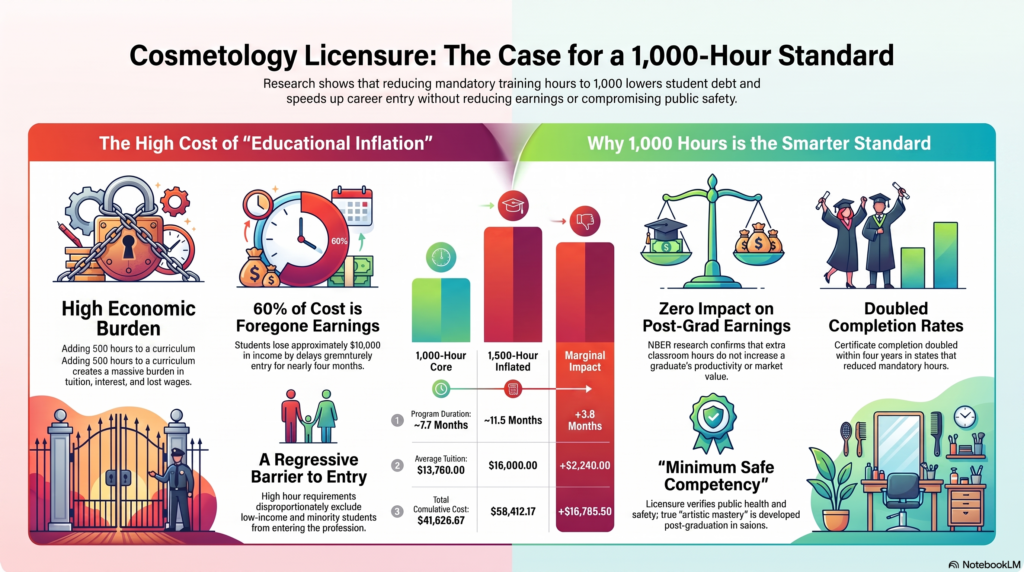
Beyond the “More School = Better Earnings” Assumption: An Evidence-Based Reassessment of Cosmetology Education, Occupational Licensure, Workforce Development, and Career Outcomes – RESEARCH & PODCAST SERIES 2026


Disclaimer: This publication is provided solely for educational, academic, and public policy discussion purposes. It is intended to encourage evidence-based dialogue regarding cosmetology education, occupational licensure, workforce development, and lifelong professional learning. The analysis reflects a review and synthesis of publicly available research, statutes, regulations, economic literature, and industry sources and should not be interpreted as legal advice, regulatory guidance, accreditation standards, or an official position of any government agency, educational institution, employer, or industry organization. Readers are encouraged to review the original cited sources, consider alternative perspectives, and draw their own informed conclusions. Constructive scholarly discussion and continuous learning are welcomed.


Abstract

This paper evaluates the increasingly prevalent policy assertion that when newly licensed cosmetologists pursue advanced, post-graduate education, it demonstrates a systemic failure of initial pre-licensure programs and justifies a statutory expansion of mandatory cosmetology school hours. Drawing on human capital theory, occupational licensing economics, state administrative law, and modern workforce development paradigms, this study critically analyzes the purpose of licensure and the mechanics of skill acquisition.

By analyzing empirical labor market data—including the landmark National Bureau of Economic Research (NBER) difference-in-difference analysis of state-level hours reductions—this paper demonstrates that expanding mandatory classroom training does not correlate with increased post-graduation earnings. Instead, mandatory educational inflation imposes regressive economic burdens on students through extensive foregone earnings, tuition debt, and delayed career entry.

Applying the Dreyfus Model of Skill Acquisition, this paper establishes that professional licensure is statutorily designed to verify “minimum safe competency” rather than “artistic mastery.” The pursuit of advanced, post-graduate credentials through manufacturer academies, salon apprenticeships, and continuing education represents a structurally normal, economically efficient progression toward market-driven specialization. The assumption that initial professional education must encompass all specialized commercial expertise is an outdated, industrial-era educational model that directly conflicts with modern federal accountability standards and the realities of a dynamic, service-oriented workforce.

Executive Summary

State regulatory bodies have historically utilized pre-licensure hour mandates as the primary mechanism for regulating entry into personal care occupations1. In recent legislative cycles, several states have proposed or enacted reductions in mandatory cosmetology education hours, typically lowering requirements from 1,500 to 1,000 hours to reduce barriers to entry and enhance labor market flexibility4. Concurrently, a counter-narrative has emerged among certain educators and licensing advocates. This viewpoint argues that because cosmetology graduates frequently seek additional post-graduate training, initial cosmetology school curriculums are inadequate, necessitating an expansion of mandatory instruction hours to produce fully capable, market-ready professionals7.

This research report evaluates these competing claims by synthesizing empirical evidence, public policy, and economic theory. The key findings of this investigation are:

  • The Statutory Purpose of Licensure: Under state police power and established administrative jurisprudence, occupational licensure exists solely to verify minimum safe competency, public health, and infection control3. It is not designed to certify commercial speed, artistic excellence, or advanced styling trends3.
  • The Empirical Limits of Classroom Hours: High-quality econometric research confirms that higher licensing hour requirements do not translate into higher post-graduation earnings for cosmetologists2. Conversely, lowering required hours reduces student tuition debt, raises completion rates, and increases enrollment among historically marginalized demographic groups2.
  • The Extravagant Opportunity Cost of Educational Inflation: Empirical modeling shows that adding 500 hours to a state licensing curriculum creates an estimated cumulative opportunity cost of $16,785.50 per student in tuition, debt service, childcare, transportation, and foregone entry-level earnings15. This economic burden is highly regressive and fails to provide a positive return on investment2.
  • Post-Graduate Specialization as an Efficient Market Mechanism: Modern workforce development relies on modular, stackable credentials and post-graduate specialized training (e.g., manufacturer academies and salon-based apprenticeships)17. Requiring every licensed cosmetologist to master every technical sub-specialty (such as advanced chemical formulation, esthetics, and nail technology) before initial licensure is educationally and economically inefficient3.
  • The Conflict with Federal Accountability Standards: Artificially inflating pre-licensure hours directly threatens the institutional survival of cosmetology programs under the U.S. Department of Education’s 2026 Gainful Employment and Financial Value Transparency regulations, which penalize programs that generate high debt-to-earnings ratios and low earnings premiums25.

Introduction: The Central Policy Debate

A persistent debate in career and technical education (CTE) policy centers on the optimal length of instructional programs required for entry-level professional practice2. In the beauty and wellness sector, this debate has intensified due to legislative trends toward deregulation and hours-trimming across various jurisdictions14. Traditionally, state mandates for comprehensive cosmetology licenses have ranged from 1,000 to over 2,100 hours14. However, states such as California, Virginia, and Indiana have recently reduced their requirements to a standardized 1,000-hour threshold5.

In response to these regulatory reductions, traditional cosmetology educational groups have mounted significant public relations and lobbying campaigns7. A central tenet of their argument is that 1,000 hours of pre-licensure training is fundamentally insufficient to prepare a student for the commercial reality of a salon environment7. These advocates frequently point to anecdotal evidence—such as newly licensed cosmetologists enrolling in advanced coloring academies, seeking mentorship from senior stylists, or taking manufacturer-sponsored courses—as empirical evidence that cosmetology schools are failing to deliver a complete education11. The policy solution proposed by these stakeholders is to maintain or expand high instructional hour requirements to ensure that graduates can practice as fully realized experts immediately upon licensure7.

This report examines whether this policy conclusion is supported by empirical evidence or whether it reflects a fundamental misunderstanding of occupational licensure, human capital theory, and modern workforce dynamics. By distinguishing anecdotal claims from systemic economic data, this paper analyzes whether a complete pre-licensure education is an economically viable or educationally sound goal, or whether it represents an obsolete industrial-era assumption that ignores the role of workplace learning, advanced certifications, and lifelong professional development19.

Historical Context and Public Health Evolution

The historical evolution of occupational regulation in the personal care sector demonstrates that state intervention was never intended to standardize artistic talent or aesthetic style3. Instead, licensure emerged as an exercise of state police power to defend the public against infectious diseases and hazardous substances3.

Medieval Barber-Surgeons and Progressive Era Sanitary Reforms

The structural lineage of modern cosmetology licensure trace back to medieval European trade guilds3. In 1308, the Guild of Barbers was recorded in London, where practitioners performed minor surgical and dental procedures—including bloodletting, cupping, lancing, and tooth extraction—alongside standard grooming services3. In 1540, King Henry VIII formally incorporated the Company of Barber Surgeons to establish rudimentary training standards and oversight for these highly invasive, physically risky procedures3. While King George II legally dissolved this partnership in 1745, separating barbers from surgeons, barbers retained regulatory authority over straight-razor services due to their historical use of sharp, skin-piercing instruments3.

In the United States, formalized regulation of the personal care trades emerged during the late 19th and early 20th centuries as a direct response to public health crises on the municipal level3. Neighborhood barbershops and hairdressing parlors often served as vectors for dermatological and systemic diseases3. The primary catalyst for regulatory intervention was “barber’s itch” (tinea sycosis or sycosis barbae), a severe, contagious fungal hair follicle infection3. Additionally, public fears regarding the transmission of deadlier pathogens—such as tuberculosis, influenza, and syphilis—through shared, unsterilized tools prompted states to establish formal oversight3. Minnesota enacted the nation’s first state barber-licensing statute in 1897, mandating rigorous hygiene codes, regular shop inspections, and the creation of state boards to administer entry exams3. By 1927, states began separating barbering from cosmetology licenses to reflect the unique chemical and aesthetic scopes of women’s hair and skin care3.

Depression-Era Oversight to Modern Viral Pathogen Mitigations

During the Great Depression, states expanded regulatory frameworks to stabilize the labor market and enforce strict hygienic compliance3. Under the Pennsylvania Barber Law of 1931, enacted to regulate the rapid growth of cheap, unlicensed, and unsanitary shops that cut corners to survive, candidates were required to undergo comprehensive medical exams3. This included mandatory blood tests for active infections, such as syphilis, before they could legally practice3.

In the mid-20th century, salons heavily utilized ultraviolet (UV) germicidal cabinets to reassure clients3. However, as epidemiological science advanced, it was demonstrated that UV radiation was incapable of achieving true sterilization on non-porous tools due to debris blockages3. Consequently, state boards banned UV cabinets as primary disinfection methods, mandating hospital-grade liquid chemical immersion instead3.

The regulatory mandate of cosmetology licensing adapted again in the 1980s during the HIV/AIDS epidemic and the rising spread of hepatitis B (HBV) and hepatitis C (HCV)3. Because these viral pathogens are transmitted through blood-to-blood contact, and since minor nicks and cuts are common during haircuts, shaves, manicures, and waxings, state boards integrated “Universal Precautions” (now Standard Precautions) into licensing requirements3. Under federal standards from the Occupational Safety and Health Administration (OSHA) and the Environmental Protection Agency (EPA), schools and salons were mandated to use hospital-grade disinfectants and implement strict exposure plans for blood spills3. This health-first structure continued through the COVID-19 pandemic with the integration of viral load mitigation and enhanced ventilation3.

Legal Analysis and the Scope of State Regulation

The legal architecture of cosmetology licensing is rooted in the constitutional authority of state governments to protect their citizens, but this authority is subject to strict statutory and administrative limitations3.

Statutory Authority and the Stratum Germinativum Boundary

Under the Tenth Amendment of the U.S. Constitution, states retain the police power to regulate businesses and professions to protect public health, safety, and welfare3. However, modern administrative law requires that these regulations represent the least restrictive means of addressing a documented, non-speculative risk to the public9. For example, the Vermont Office of Professional Regulation establishes that a profession should only be regulated by the state when the unregulated practice can clearly harm or endanger the public, and the potential for harm is recognizable and not remote or speculative33.

To prevent cosmetology licenses from encroaching on medical scopes of practice, state statutes define the physical boundaries of personal care services3. In Kentucky, for instance, the statutory framework codified in KRS Chapter 317A establishes clear boundaries23:

“A licensee shall not perform any service that goes beyond the stratum germinativum layer, also known as the basal layer of the epidermis, unless practicing under the immediate supervision of a licensed physician”34.

This explicit boundary prevents cosmetologists and estheticians from performing highly invasive, clinical treatments—such as deep chemical peels, medical-grade microdermabrasion, or dermal injections—which carry significant risk of scarring, systemic infection, or permanent tissue damage3. The statutory scope is strictly limited to cosmetic purposes, illustrating that licensure is designed to regulate safety and basic skin integrity rather than advanced clinical or medical procedures3.

Regulatory Variations and Reciprocity Friction

Because occupational licensing is governed on the state level, there is significant geographical variation in required curriculum hours and administrative structures14. This variation creates substantial friction for licensed professionals who must move across state lines, a barrier that disproportionately impacts military spouses and lower-income workers37.

JurisdictionCosmetology Licensing HoursEsthetician HoursNail Technician HoursKey Statutory Reciprocity Conditions
Kentucky1,500 Hours22750 Hours22450 Hours22Requires comparable hours (1,500 cos, 750 est, 450 nail) and a passing score on a nationally recognized PSI theory/practical exam23.
California1,000 Hours14600 Hours14350 Hours (historical)Accepts out-of-state credentials under streamlined reciprocity pathways7.
Florida1,200 Hours14260 Hours14240 Hours36Will endorse a 1,000-hour cosmetologist only if they have 1+ year of active licensed experience or complete 200 remedial hours36.
Georgia1,500 Hours361,000 Hours36525 Hours36Will only grant endorsement if the applicant’s home state requires equal or greater hours and passed a national exam36.
Massachusetts1,000 Hours23600 Hours36100 Hours36Requires out-of-state transfers to meet equivalent standards or sit for exams.

Under KRS Chapter 317A, the Kentucky Board of Cosmetology allows for reciprocal licensing, but only if the originating state’s laws require comparable curriculum hours22. An applicant from a state with lower required hours (such as a 1,000-hour graduate from California or New York) must submit to the Kentucky Board’s out-of-state transfer application process41. If their training is deemed non-comparable, they may be forced to complete remedial hours at an approved school or retake state-specific written and practical exams41. If an applicant fails the exam three times, they must complete an 80-hour supplemental course in theory studies before they are eligible to sit for the exam again41.

Furthermore, state laws strictly define what services require a license and what services are exempt35. In Kentucky, all beauty services performed for the public generally or for consideration are regulated under KRS Chapter 317A, except for natural hair braiding (which is explicitly exempted) and makeup artistry when performed without financial consideration or at community carnivals and fairs35. The state also offers a limited “shampoo and style” license, which requires 300 hours of instruction but strictly prohibits the licensee from performing any haircutting, coloring, or chemical treatments22. These rigid, fragmented licensing structures illustrate how state administrative laws prioritize narrow safety boundaries over market-driven flexibility35.

Occupational Licensing Analysis: Minimum Competency vs. Specialty Mastery

At the core of the debate over pre-licensure hour requirements is a fundamental misunderstanding of the educational limits of professional licensing3. Advocates of longer programs often conflate a license to practice with a certificate of expert mastery3.

The Dreyfus Model of Skill Acquisition

To understand how professional expertise is developed, educators and policymakers often utilize the Dreyfus Model of Skill Acquisition, which outlines five distinct stages of learning:

  1. Novice: Follows rigid, context-free rules to operate safely but has no situational awareness or flexibility3.
  2. Advanced Beginner: Begins to recognize situational patterns and coordinates multiple tasks, but still relies on structured guidance3.
  3. Competent: Can plan, prioritize, and make independent decisions based on experience3.
  4. Proficient: Understands situations holistically rather than as isolated steps, adapting quickly to unexpected challenges3.
  5. Expert: Operates intuitively, executing highly complex tasks with fluid coordination and deep analytical judgment3.

In personal care vocational education, the pre-licensure school is pedagogically and structurally limited to transitioning a student from a Novice to an Advanced Beginner3. The school environment must focus on safety, sanitation, infection control, and baseline mechanical coordination to ensure the graduate is a safe, entry-level practitioner3.

True commercial competence, speed, and advanced expertise (Stages 3 through 5) can only be developed post-graduation through immersion in a competitive salon environment3. On the school floor, a student haircut typically takes 60 to 90 minutes to ensure direct instructor supervision and zero physical liability3. In a commercial salon, however, a stylist must execute a high-quality, commercially viable haircut within a tight 30-to-45-minute window to remain profitable3. This level of operational efficiency and customer retention cannot be taught in a classroom; it requires continuous, real-world repetition with paying clients3.

Comparative Professional Training Structures

When evaluating whether pre-licensure cosmetology programs should teach advanced specialties, it is useful to compare cosmetology with other regulated professions that separate initial minimum-competency licensing from post-graduate specialization:

  • Nursing (L.P.N./R.N.): Initial nursing programs focus on basic clinical safety, pharmacology, and patient stabilization30. Nurses do not graduate as surgical specialists or pediatric oncology experts; those advanced competencies are built through hospital-based residencies and voluntary, private certifications30.
  • Dentistry (D.D.S./D.M.D.): Dental school establishes baseline competency in oral health and basic restorations30. Dentists who wish to specialize in orthodontics, periodontics, or oral surgery must complete multi-year, post-graduate residencies30.
  • Teaching: A state teaching certificate verifies basic pedagogical knowledge and safe classroom management30. Elite instructional capabilities, curriculum design, and specialized special-education strategies are developed through post-graduate district mentorships and master’s degree programs30.
  • Real Estate: Initial licensure requires passing an exam covering basic property law, ethical disclosures, and transaction regulations11. It does not train an agent to execute complex commercial real estate deals or manage international investment portfolios; these specialized skills are developed through post-licensure brokerage training and voluntary designations.

If other professions structured their initial licensing around producing fully realized specialists on day one, their educational pipelines would fail2. The standard professional model relies on pre-licensure programs to establish safety and fundamental concepts, leaving specialization and advanced artistry to post-graduate markets3.

Labor Economics Analysis: Human Capital vs. Market Rents

The economic impact of occupational licensing has been a subject of intense academic study since Milton Friedman’s seminal work, Capitalism and Freedom (1962), which argued that licensing creates artificial barriers to entry that restrict labor supply and increase prices for consumers1.

The Human Capital vs. Monopoly Rent-Seeking Debates

In labor economics, two competing theories attempt to explain the effects of occupational licensing:

  1. Human Capital Theory: Posits that licensing requirements raise the average quality and safety of services by excluding low-quality practitioners and incentivizing students to invest in productive skills48.
  2. Monopoly Theory (Rent-Seeking): Argues that licensing requirements are initiated and maintained by professional associations representing incumbent workers48. By lobbying state legislatures to inflate educational requirements, incumbents create a barrier to entry that restricts labor supply, allowing them to collect “monopolistic rents” in the form of artificially high wages48.

Empirical work by labor economists—including Morris Kleiner, Alan Krueger, and Stephen Soltas—has generated extensive evidence on these two models2. Overall, the research demonstrates that occupational licensing has little to no detectable effect on the actual quality or safety of services, but it does significantly increase prices for consumers and restrict worker mobility1.

For example, Kleiner and Krueger (2013) estimated the general wage premium for licensed occupations to be around 18%, representing the additional wages licensed workers receive compared to unlicensed workers with similar characteristics1. However, more recent research by Gittelman, Klee, and Kleiner (2018) suggests the actual wage premium is lower—around 7.5%—and is heavily offset by the direct and indirect costs of entering the licensed field2. Furthermore, licensing reduces interstate migration by approximately 7%, as workers find it difficult or expensive to transfer their licenses across state lines1.

In the cosmetology sector, A. Frank Adams, John D. Jackson, and Robert B. Ekelund (2002) modeled the economic impact of state regulations53. They found that state occupational regulation of cosmetology resulted in a significant net decrease in the quantity of beauty services available53. The researchers calculated that the monopolistic rents collected by licensed cosmetologists totaled approximately $1.7 billion per year (in 2002 dollars), with consumers bearing an additional $111 million in deadweight losses per annum due to restricted competition and inflated prices53.

Barbershop and Nail Salon Quality Assessments

The monopoly theory is further supported by a 2025 study by the Institute for Justice, Clean Cut: How Clipping Unnecessary Licensing Can Grow Opportunities for Barbers and Manicurists and Keep Consumers Safe, authored by Matthew West55.

The study analyzed thousands of health inspections across four states to determine whether heavier licensing burdens resulted in cleaner, safer shops55. For barbershops, the study compared over 3,000 inspections in Alabama (which has lighter licensing requirements for barbers) with Mississippi (which has highly onerous licensing requirements)55. For nail salons, the study compared inspections in Connecticut and New York55.

The empirical results of Clean Cut include:

  • High Safety Compliance Across All Regulatory Regimes: Barbershops and nail salons passed more than 95% of health and safety inspections, regardless of whether they operated under heavy licensing, light licensing, or no licensing at all55.
  • Market Competition and Inspections Drive Hygiene: The primary drivers of safety and cleanliness are ordinary market competition and the regular threat of health inspections, not the number of hours required in school56. Businesses have a strong natural incentive to maintain high hygiene standards, as consumers can easily post negative reviews online or report unsanitary conditions55.
  • Licensure Curriculums Neglect Safety: A 2021 curriculum analysis revealed that, on average, only 26% of barber/cosmetology curricula and 40% of manicurist curricula are actually dedicated to health, safety, and sanitation56. The vast majority of mandatory school hours are spent teaching technical skills and business practices—subjects that consumers are fully capable of evaluating for themselves56.
  • Common-Sense Safety is Simple: Most of the actual practices needed to protect customers—such as washing hands, disinfecting non-porous tools between clients, and reading chemical labels—are relatively simple, common-sense measures that can be mastered in a short, low-cost certification course rather than a lengthy, expensive beauty school program56.

The findings of the Clean Cut study demonstrate that the state’s safety objectives can be achieved through targeted inspections and basic certification courses, rendering long pre-licensure hour mandates economically inefficient55.

The NBER Study: Empirical Evidence of Hours Reductions

To evaluate whether expanding mandatory classroom hours translates into better student outcomes, we must analyze the landmark 2025 National Bureau of Economic Research (NBER) working paper, Cosmetology Gets a Trim: The Impact of Reducing Licensing Hours on Colleges and Students, authored by Nicolas Acevedo Rebolledo, Kathryn J. Blanchard, and Stephanie Riegg Cellini2.

Using a rigorous difference-in-difference empirical design, the researchers evaluated the causal impact of state-level hours reductions for cosmetologists between 2011 and 20192. By comparing student and institutional outcomes in states that reduced their required hours (such as California and Virginia lowering cosmetology hours from 1,500 to 1,000) with a control group of states that maintained higher hours, the authors isolated the economic effects of pre-licensure instructional time2.

The NBER study revealed five primary findings:

  1. No Detectable Effect on Post-Graduation Earnings: The difference-in-difference estimates showed no statistically significant or economically meaningful differences in earnings between cosmetologists trained in high-hour states and those trained in shortened-hour states2. The extra hours of classroom instruction failed to enhance graduate productivity or market value2.
  2. Causal Reductions in Tuition and Fees: When states cut required licensing hours, cosmetology schools responded by lowering their tuition and fees2. On average, tuition fell by approximately 14% in response to state-level hour reductions, a change driven primarily by smaller, tuition-sensitive institutions2. Larger, brand-name institutions reduced their tuition by less, suggesting they possess greater market pricing power2.
  3. Sizable Increase in Program Completions: Lowering the required hours reduced the time and cost needed to graduate, which caused the number of cosmetology certificates awarded to more than double in the four years following a state-level hours reduction2.
  4. Suggestive Evidence of Lower Student Debt: While the estimates for student debt were less precise due to data limitations, the authors found suggestive evidence of lower average student debt burdens in the post-policy years2.
  5. Significant Growth in Hispanic and Latino Enrollment: While there were no detectable impacts on overall enrollment, the study revealed a sizable, statistically significant increase in the enrollment of Hispanic and Latino students in states that reduced licensing hours2. This demonstrates that high hour requirements act as a regressive barrier to career entry for historically marginalized demographic groups2.

The NBER study provides clear, population-level evidence that cosmetology students benefit significantly from the trimming of mandated licensing hours, while receiving no economic return for completing additional, high-hour programs2.

Opportunity Cost Analysis and Economic Modeling

To demonstrate the microeconomic impact of pre-licensure program inflation, we can model the total direct and indirect costs borne by a student choosing between a 1,000-hour program and a 1,500-hour program15.

The Mathematical Opportunity Cost Model

The total economic cost () of obtaining a vocational credential can be modeled as the sum of direct educational costs, indirect living expenses, and the opportunity cost of foregone earnings while enrolled in school15:

where:

  • represents direct tuition charges15.
  • represents direct costs for supplies, books, and student kits15.
  • represents foregone labor earnings due to delayed workforce entry, calculated as:

    with representing weekly instructional hours (typically 30 hours per week), representing weekly employment hours (40 hours per week), and representing the opportunity wage of a high school graduate15.
  • and represent the incremental costs of childcare and transportation incurred during the extra weeks of schooling15.
  • represents the interest and debt-servicing costs incurred by borrowing the tuition difference over a standard 10-year repayment term15.

Simulated Economic Modeling Results

The following table presents the simulated microeconomic outcomes of a 500-hour program extension, using standard cost parameters drawn from postsecondary institutional data and labor statistics15. The opportunity cost baseline assumes an entry-level high school graduate wage of $15.00 per hour for 40 hours per week15, and a standard tuition interest rate of 6.5% over a 10-year repayment term15.

Economic Cost Variable1,000-Hour Core Program1,500-Hour Inflated ProgramMarginal Impact of Extra 500 Hours (Δ)
Program Duration (weeks)33.3 Weeks (7.7 Months)1550.0 Weeks (11.5 Months)15+16.7 Weeks (+3.8 Months)15
Average Program Tuition$13,760.0015$16,000.0015+$2,240.0015
Supplies, Kits, and Books$1,200.00$1,600.00+$400.0015
Transportation ($50/week)$1,666.67$2,500.00+$833.3315
Childcare ($150/week)$5,000.00$7,500.00+$2,500.0015
Foregone Labor Earnings$20,000.00$30,000.00+$10,000.0015
Interest Paid (6.5% / 10-Yr)Included in directIncluded in direct+$812.17 (Debt Service)15
Total Cumulative Cost$41,626.67$58,412.17+$16,785.50[cite: 15]

The economic simulation demonstrates that adding 500 hours of instruction to a cosmetology curriculum imposes an average marginal cost of $16,785.50 per student15. Nearly 60% of this economic burden ($10,000.00) is driven by foregone earnings, as students are forced to delay their entry into the paid workforce by nearly four months15. For a demographic that is disproportionately low-income and financially vulnerable, this delayed entry represents a substantial barrier to career launching, entrepreneurship, and long-term retirement savings2.

Because econometric evidence demonstrates no corresponding increase in post-graduation earnings, this 500-hour program extension represents an economically inefficient investment that yields a negative return2.

Workforce Development and Beauty Industry Dynamics

A critical analysis of the beauty industry workforce reveals that the challenges facing newly licensed cosmetologists are driven by structural and operational realities, not by a lack of pre-licensure classroom hours63.

Career Longevity, Physical Hazards, and Employee Attrition

The beauty industry experiences high rates of early-career attrition, with an estimated 80% turnover rate within the first two years of licensure64. While licensing advocates claim that longer school hours improve retention by boosting technical confidence7, occupational health data demonstrates that professionals leave the industry primarily due to physical hazards, ergonomic strain, and volatile earnings structures46.

The daily work of a cosmetologist is physically demanding, involving continuous standing, awkward postures, and repetitive movements46. According to data from the National Institute for Occupational Safety and Health (NIOSH) and OSHA:

  • Musculoskeletal Disorders (MSDs): Over 40% of beauty professionals report chronic lower back pain, shoulder strain, and repetitive motion injuries in their wrists and hands (such as carpal tunnel syndrome)46.
  • Chemical Exposure Risks: Daily exposure to toxic chemicals in nail adhesives, oxidative hair dyes, and formaldehyde released during chemical hair-smoothing treatments can cause chronic respiratory irritation, contact dermatitis, and long-term health complications46.
  • Income Volatility: Relying entirely on commission splits or booth rentals creates constant financial anxiety, where a stylist’s income fluctuates based on seasonal slowdowns, client cancellations, and economic shifts46.

Extending pre-licensure training hours does nothing to address these physical and environmental challenges63. In fact, by forcing students to take on more debt before facing high early-career turnover, regulatory inflation increases the financial risk of entering the profession2.

The Non-Employee Workforce and Salon Valuation Economics

The operational reality of the beauty sector is defined by a significant structural shift away from traditional employment toward independent, non-employee models44. According to data from the Professional Beauty Association (PBA), 87% of the beauty salon workforce is comprised of non-employee workers, including booth renters, suite renters, and independent contractors67.

This structural dichotomy has created distinct business models with very different economic valuations and operational incentives44:

  • Commission-Based Salons: The salon operates as a traditional business, employing stylists, managing client databases, and paying a 40% to 60% commission split on service revenue44. These salons trade at higher valuation multiples (2x to 3x SDE) because the business owns the customer relationships and brand equity44.
  • Booth-Rental Salons: Stylists operate as independent businesses, renting chair space (typically $200 to $500 per week) and retaining 100% of their service and retail revenues44. The salon acts primarily as a commercial real estate landlord44. These operations trade at lower multiples (1x to 2x SDE) because the business’s cash flow consists solely of rent, and customer relationships belong entirely to individual stylists44.

This non-employee structure directly affects early-career earnings and professional development67. In a booth-rental or independent contractor model, the stylist bears the full financial risk of business operations, including self-employment taxes (the full 15.3% FICA tax), product sourcing, and marketing67.

Newly licensed cosmetologists often struggle in independent models because they lack the established client base needed to offset fixed rent and overhead costs63. Those who fail to build a clientele quickly face significant financial distress63. Expanding pre-licensure training hours does not solve this client-acquisition problem; building a client base requires localized marketing, client relations, and commercial speed—competencies that are best developed through real-world salon experience rather than in a beauty school classroom3.

Advanced Technical Competency and Specialty Specialization

The assumption that initial cosmetology education must encompass all specialized commercial expertise is an outdated, industrial-era educational model that ignores the role of workplace learning, advanced certifications, and lifelong professional development19.

The Role of Manufacturer Academies and Post-Graduate Specialization

Elite technical competencies—such as advanced dimensional coloring, corrective color formulations, and clinical skincare—are rarely developed in basic pre-licensure programs3. Instead, they are driven by post-graduate programs offered by product manufacturers and advanced training academies17.

Major professional beauty brands—including Redken, Wella, L’Oréal Professionnel, Schwarzkopf Professional, Matrix, Goldwell, Paul Mitchell, and Aveda—operate extensive advanced training networks64. These manufacturer academies provide highly specialized instruction tailored to their specific chemical formulations and product lines17.

For example, the International Dermal Institute (IDI), founded by Dermalogica, offers free post-graduate advanced skincare education to licensed estheticians and cosmetologists working in partner salons17. Similarly, salons like Educe Academy offer intensive post-graduate residency programs to transition newly licensed graduates into high-speed, commercial stylists18.

This division of labor is highly efficient70. State-approved beauty schools provide a solid foundation in scientific safety and baseline skills70. They actively avoid teaching hyper-specific, trend-driven styling techniques to prevent training for obsolescence, as commercial trends and product chemistries evolve much faster than state administrative codes can adapt70.

Occupational Diversity and Curriculum Inefficiency

Requiring a comprehensive cosmetologist license—which mandates mastery of haircutting, advanced hair coloring, chemical texturizing, esthetics, waxing, manicuring, and pedicuring—is educationally inefficient22. In practice, licensed professionals specialize in narrow niches24:

  • Many hair colorists focus entirely on advanced chemical formulations, rarely performing haircuts24.
  • Natural hair specialists focus on braiding, twisting, and locking, requiring zero training in chemical relaxers or perm chemistry31.
  • Other professionals specialize in makeup artistry, bridal styling, or salon management, where advanced clinical hair or nail training is irrelevant22.

Forcing every student to complete hundreds of hours of mandatory instruction in every sub-specialty before licensure increases educational costs and delays career entry2. A more efficient model uses a modular, stackable credential framework19.

Methodological Critique of Anecdotal and Social Media Claims

To ensure sound public policy, we must critically evaluate the common claim that post-graduate training indicates a failure of pre-licensure programs. This assertion relies heavily on anecdotal evidence and is undermined by several methodological fallacies71.

Epistemological Distinctions: Anecdote vs. Systemic Evidence

In public policy debate, individual anecdotes must be distinguished from systemic, population-level evidence71. Anecdotal claims—such as a single salon owner complaining about a graduate’s speed on social media, or a stylist posting about a post-graduate coloring class—face severe methodological limitations71:

  • Extremely Small Sample Sizes (): Individual experiences cannot be generalized to draw conclusions about an entire national educational system71.
  • Lack of Control Groups: Anecdotal accounts do not compare outcomes against a control group (e.g., comparing graduates of 1,000-hour programs with those of 1,500-hour programs under identical market conditions)71.
  • No Causal Inference: An association between graduation and enrolling in advanced training does not prove that the initial school failed72. Post-licensure learning is a standard professional activity, not evidence of initial educational failure3.

Cognitive Biases and Fallacies in Public Policy Formulation

When policymakers rely on anecdotal claims to justify expanding mandatory training hours, they often fall victim to several cognitive biases and logical fallacies73:

  1. Selection Bias and Self-Selection: Social media platforms and industry forums suffer from strong self-selection bias71. Highly active, vocal salon owners—who often demand that entry-level graduates perform at the level of senior stylists on day one—are overrepresented, while average practitioners and cost-sensitive consumers are underrepresented71.
  2. Survivorship Bias: Elite salon owners who successfully navigate the high early-career turnover rate often judge entry-level graduates based on their own advanced skills75. They forget that their mastery was built through years of real-world practice, not during their initial pre-licensure training3.
  3. Confirmation Bias: Stakeholders who benefit financially from longer programs (such as school owners who collect more tuition) are incentivized to highlight any graduate mistake as “proof” that hours should be expanded, while ignoring graduates who succeed in shortened programs54.
  4. The Ecological Fallacy: This fallacy occurs when group-level data is used to make incorrect assumptions about individuals72. For example, observing that cosmetology programs collectively have low average earnings premiums25 does not mean that every individual graduate is unsuccessful73. Some graduates achieve high earnings in specialized niches63. Policymakers commit this fallacy when they assume that because the average program has low returns, the solution is to force all individuals to complete more hours2.

Federal Higher Education Policy, Accountability, and Financial Aid

The debate over pre-licensure hours has significant implications for federal regulatory compliance and institutional survival under the Higher Education Act of 196525.

The Financial Value Transparency and Gainful Employment (FVT/GE) Framework

In 2023, the U.S. Department of Education finalized its Financial Value Transparency and Gainful Employment (FVT/GE) regulations, which became fully effective with accountability metrics in 202625. These regulations apply to all certificate and vocational programs at public, non-profit, and proprietary institutions that participate in federal Title IV financial aid programs25.

To retain eligibility for federal student loans and Pell Grants, a program must pass two performance metrics25:

  1. The Debt-to-Earnings (D/E) Ratio: The program’s typical graduate must have annual student loan payments that do not exceed 8% of their total annual earnings, or 20% of their discretionary income (defined as earnings above 150% of the federal poverty guideline)26.
  2. The Earnings Premium Metric (“Do No Harm” Test): The median annual earnings of the program’s graduates, measured four years after completion, must exceed the median earnings of working high school graduates aged 25 to 34 in the state where the program is located25.

Programs that fail either metric for two out of three consecutive years lose access to federal Title IV student aid25.

Because cosmetology is a low-earnings sector with high rates of underreported tip income27, cosmetology certificate programs fail these federal metrics at exceptionally high rates25. Forcing students to complete longer programs (e.g., 1,500 hours instead of 1,000 hours) increases tuition costs and average student debt without raising post-graduation earnings2. This combination directly jeopardizes a program’s ability to pass the federal Debt-to-Earnings metric, threatening the institutional survival of cosmetology programs nationwide25.

The Battle Over Program Length: From the 150% Rule to the Bare Minimum Rule

Historically, the Department of Education utilized the “150% Rule” (34 CFR 668.14(b)(26)), which permitted vocational programs to receive federal Title IV funding for instructional hours up to 150% of the minimum licensing hours mandated by the state29. This allowed schools to offer longer, more comprehensive programs while still accessing federal aid80.

In October 2023, the Department promulgated the “Bare Minimum Rule” (BMR), effective July 1, 2024, which capped Title IV eligibility at the strict state-mandated minimum hours for licensure29. If an institution offered a program that exceeded the state’s minimum hour requirement by even a small amount, the entire program lost Title IV eligibility80.

This rule change sparked significant legal battles29:

  • In American Association of Cosmetology Schools v. U.S. Department of Education (N.D. Tex. 2025), the court upheld the broader Gainful Employment framework, affirming the Department’s authority to use debt-to-earnings and earnings premium metrics to regulate federal aid26.
  • However, in separate litigation, federal courts entered a nationwide injunction against the Bare Minimum Rule, finding it likely “arbitrary and capricious” because it represented a sudden departure from thirty years of established regulatory practice29. The Department subsequently reverted to enforcing the traditional 150% Rule while the injunction remains in place29.

Despite the ongoing legal battles, the policy direction of the federal government is clear: federal regulations increasingly penalize high-cost, high-hour vocational programs that do not produce immediate, strong financial returns for graduates25. Artificially inflating state licensing hours directly conflicts with this federal emphasis on affordability, debt reduction, and return on investment2.

Comparative Analysis of Alternative Policy Models

To guide policymakers, we can compare the efficiency of alternative educational models across several social and economic indicators2:

Performance MetricTraditional Model (1,500+ Hours)Competency-Based / Shortened Model (1,000 Hours)Employer-Partnership Apprentice ModelContinuing Education (CEU) / Modular Model
Direct Educational CostHigh tuition and fees ($16,000+ on average)62Lower tuition (roughly 14% lower)2Negligible (paid OJT)7Low (targeted, pay-as-you-go)17
Workforce ParticipationDelayed entry due to long program duration2Accelerated entry (3.8 months faster)15Immediate entry into paid work7High (stylists study while working)19
Average Student DebtHigh average debt burdens ($7,100–$9,833)61Reduced student debt2Minimal or no student debtMinimal (financed through salon earnings)17
Access and EquityRegressive barrier for low-income and minority students2Increases enrollment of underrepresented groups2Highly accessible to diverse populations2Supports flexible career pathways19
Consumer Public SafetyVerified safety (focus on infection control)3Verified safety (Virginia RAP confirmed 1,000 hours is safe)9High safety (under direct supervision)3Focuses safety on modern practices32
Technical / Artistic SkillExpansive but often outdated baseline7Competent baseline safety and core mechanics3High commercial proficiency and speed3Highly advanced, trend-specific mastery3
Federal Regulatory ComplianceHigh risk of failing Gainful Employment metrics25Highly compliant (lower debt-to-earnings)2Exempt from Title IV GE restrictionsExempt from Title IV GE restrictions

The comparative analysis reveals that the competency-based, shortened model (1,000 hours) paired with post-graduate modular certifications provides the most balanced, economically efficient, and socially equitable pathway2. It achieves state public safety objectives while protecting students from excessive debt and facilitating career entry2.

Counterarguments and Systemic Synthesis

To maintain scholarly neutrality, we must evaluate the strongest arguments in favor of longer pre-licensure programs7.

The Case for Longer Pre-Licensure Hours: Quality and Portability

Proponents of high-hour licensing requirements (typically 1,500 to 1,800 hours) offer several arguments7:

  • Comprehensive Skill Preparation: Advocates argue that shorter programs force schools to cut valuable curriculum content7. They contend that 1,500 hours is necessary to teach “complete cosmetology,” ensuring that graduates have at least basic exposure to every facet of the industry, including advanced coloring and chemical texturizing, before working on paying clients7.
  • Interstate License Portability: Licensing requirements are determined by individual states51. Advocates point out that completing a 1,000-hour program in a shortened-hour state can restrict a stylist’s ability to transfer their license to a state with higher hour requirements (such as Colorado’s 1,800-hour or Iowa’s 2,100-hour standards)14. Stylists moving across state lines may be forced to complete additional school hours or retake licensing exams36.
  • Early-Career Confidence: Some qualitative surveys and comments from salon owners suggest that graduates of longer programs possess greater technical confidence, reducing early-career performance anxiety and client attrition7.

Unintended Consequences of Regulatory Inflation

While the arguments for longer programs are often rooted in a desire for professional quality, empirical economic research shows that regulatory inflation leads to several unintended, negative consequences2:

  • Excluding Low-Income and Minority Aspirants: Expanding mandatory hours raises the financial and opportunity costs of licensing2. This disproportionately excludes individuals who cannot afford to forego income or secure high-interest student loans, creating an inequitable barrier to career entry2.
  • Fueling the Underground Economy: When the cost of legal licensure is too high, many aspiring beauty workers choose to practice without a license in the unregulated “underground” economy7. This undermines the state’s public safety goals, as unlicensed practitioners operate entirely outside the system of health inspections and safety standards54.
  • Monopolistic Rent-Seeking: Economists note that professional associations often lobby for higher hour requirements to restrict the supply of new competitors, artificially inflating wages for incumbent licensees at the expense of consumers and aspiring workers53.
  • Inefficient Use of Public Resources: Mandating that state boards and accredited schools manage extensive, non-safety-related training hours wastes public and institutional resources7. These resources would be more effectively spent on targeted safety inspections, continuing education, and affordable entry pathways55.

Research Limitations and Future Directions

While this analysis relies on robust economic and educational research, several limitations in the current literature must be acknowledged:

  • Underreporting of Tip Income: Standard administrative data, such as IRS and state tax records used in federal Gainful Employment metrics, consistently understates the actual earnings of beauty professionals27. Because cosmetology is a cash-and-tip-heavy industry, self-employed booth renters and independent contractors frequently underreport their total compensation27. This underreporting makes it difficult to calculate the exact return on investment for cosmetology programs28.
  • Data Scarcity on Long-Term Outcomes: There is a lack of long-term longitudinal studies tracking cosmetologists over 10- to 20-year careers. Most research focuses on early-career outcomes (1 to 4 years post-graduation)2. Further research is needed to determine if early-career mentorship programs correlate with better long-term career longevity than long pre-licensure programs64.
  • Variability in State Board Quality: State regulatory oversight and the quality of licensing examinations vary significantly across jurisdictions14. This makes it difficult to establish a single, nationally standardized baseline for minimum safe competency37.

Evidence-Based Recommendations for Policymakers

Based on the synthesis of empirical evidence, labor economics, and educational theory, the following policy changes are recommended:

  1. Standardize Core Licensure at 1,000 Hours: States should align pre-licensure cosmetology hours with a 1,000-hour threshold, focusing the curriculum strictly on public health, safety, infection control, and baseline technical mechanics9.
  2. Implement Competency-Based Pathways: Regulatory boards should transition from rigid, clock-hour mandates to competency-based progression systems42. This allows students to graduate as soon as they demonstrate mastery of safe-practice standards, regardless of time spent in a classroom91.
  3. Establish a National Interstate Licensure Compact: To address license portability concerns, states should support the Cosmetology Licensure Compact8. This compact allows licensed cosmetologists to practice across participating states without completing additional training hours or exams8.
  4. Foster Modular, Stackable Microcredentials: State boards and accredited institutions should develop stackable specialty certificates (e.g., in advanced hair coloring, esthetics, or nail technology)19. This allows licensed professionals to acquire specialized credentials over time, financed by their salon earnings19.
  5. Expand Approved Apprenticeship Pathways: States should provide robust, employer-sponsored apprenticeship alternatives to formal beauty school7. This model lets aspiring beauty workers earn an income while learning practical, commercial skills under the direct supervision of licensed professionals7.

Conclusion

The policy assumption that post-graduate learning indicates a failure of cosmetology schools is a fundamental misunderstanding of the purpose of occupational licensure and the economics of skill acquisition3.

State-mandated licensure exists solely to protect the public health and safety by verifying minimum safe competency; it is not designed to certify artistic excellence, commercial speed, or advanced styling trends3. High-quality econometric research demonstrates that expanding mandatory pre-licensure hours beyond a 1,000-hour core does not raise graduate earnings2. Instead, it imposes regressive financial burdens on students through foregone wages, high tuition costs, and student loan debt2.

The pursuit of advanced, post-graduate education through manufacturer academies, salon residencies, and continuing education is not a sign of school failure3. Rather, it is a highly efficient, market-driven mechanism for career progression and professional specialization19.

The belief that a professional should acquire all technical and specialized skills before entering the workforce is an outdated, industrial-era educational model21. In contrast, modern workforce systems prioritize affordable, entry-level licensure, work-based learning, and stackable credentials19.

To protect students, support economic opportunity, and align with federal accountability standards, policymakers should reject calls for mandatory hour inflation2. Instead, they should support affordable, safe, and flexible pathways that recognize learning as a lifelong, professional journey19.

Works cited

  1. Occupational Licensing and Student Outcomes – American University, https://www.american.edu/spa/peer/upload/2022-2-17-peer-occupationa-licensing-final.pdf
  2. Cosmetology Gets a Trim: The Impact of Reducing Licensing Hours on Colleges and Students – EdWorkingPapers.com, https://edworkingpapers.com/sites/default/files/ai25-1221.pdf
  3. minimum competency Archives – Louisville Beauty Academy, https://louisvillebeautyacademy.net/tag/minimum-competency/
  4. ID H0513 – BillTrack50, https://www.billtrack50.com/billdetail/1946018
  5. IN HB1329 | BillTrack50, https://www.billtrack50.com/billdetail/1772661
  6. Cosmetology Training Hours Required in Virginia – The Institute for Justice, https://ij.org/administrative-law/cosmetology-training-hours-required-in-virginia/
  7. New Bill May Change License Requirements for Ohio Cosmetologists | Graff & McGovern, https://graff-mcgovern.com/new-bill-may-change-license-requirements-for-ohio-cosmetologists/
  8. State Update – June 19 – AACS, https://myaacs.org/state-update-june-19/
  9. Vol. 39 Iss. 23 (Proposed) 18VAC41-20, Barbering And Cosmetology Regulations July 03, 2023 – Virginia Register of Regulations, https://register.dls.virginia.gov/details.aspx?id=10704
  10. In the “DOGE Era,” States Ponder Scrapping Cosmetology Licenses | American Salon, https://www.americansalon.com/salon-news/doge-era-states-ponder-scrapping-cosmetology-licenses
  11. Proposal to reduce cosmetology licensure hours sparks backlash : r/Virginia – Reddit, https://www.reddit.com/r/Virginia/comments/z7z26n/proposal_to_reduce_cosmetology_licensure_hours/
  12. CLARIFYING CERTIFICATION, ACCREDITATION, LICENSURE, AND INTERSTATE MOBILITY FOR EMS CLINICIANS: – CoAEMSP, https://coaemsp.org/wp-content/uploads/2025/11/Clarifying-Certification-for-EMS-Clinicians-Full.pdf
  13. NBER WORKING PAPER SERIES COSMETOLOGY GETS A TRIM: THE IMPACT OF REDUCING LICENSING HOURS ON COLLEGES AND STUDENTS Nicolas Aceve, https://www.nber.org/system/files/working_papers/w33936/w33936.pdf
  14. beauty workforce Archives – Page 2 of 2 – Louisville Beauty Academy, https://louisvillebeautyacademy.net/tag/beauty-workforce/page/2/
  15. unknown_url
  16. Is Community College Worth It? A Comprehensive Return on Investment Analysis – FREOPP, https://freopp.org/whitepapers/is-community-college-worth-it-a-comprehensive-return-on-investment-analysis/
  17. Our Beauty Schools Love Dermalogica Products! | Innovate Salon Academy, https://innovatesalonacademy.com/our-beauty-schools-love-dermalogica-products/
  18. Orlando Hair Stylists Training at Educe Academy – Educe Salon, https://www.educesalon.com/education/
  19. SHEEO industry crosswalk presentation_Draft071822, https://sheeo.org/wp-content/uploads/2022/08/08-10-Crosswalking-industry-recognized-credentials.pdf
  20. OPINION: Meet certificates and “microcredentials” — they could be the future of higher education – The Hechinger Report, https://hechingerreport.org/opinion-meet-certificates-and-microcredentials-they-could-be-the-future-of-higher-education/
  21. How Microcredentials Are Revolutionizing the Higher-Education Business Model – Manhattan Institute, https://manhattan.institute/article/how-microcredentials-are-revolutionizing-the-higher-education-business-model
  22. 317A.050 Qualifications for licenses and permits — Temporary event services – Legislative Research Commission, https://apps.legislature.ky.gov/law/statutes/statute.aspx?id=53216
  23. How to Start a Hair Salon in Kentucky (2026) – StartBusinessByState.com, https://startbusinessbystate.com/kentucky/salon/
  24. Author: Duy Anh – Dalton Institute of Esthetics and Cosmetology, https://daltoninstitute.com/author/stagingadmin/
  25. Gainful Employment Rule: How It Affects Federal Student Aid – Credible, https://www.credible.com/student-loans/gainful-employment-rule
  26. Education Department Proposes New Earnings Accountability Framework for Higher Education – McGuireWoods, https://www.mcguirewoods.com/client-resources/alerts/2026/5/education-department-proposes-new-earnings-accountability-framework-for-higher-education/
  27. Gainful Employment Memo, https://pnpi.org/wp-content/uploads/2023/12/Gainful-Employment-Memo-Updated-Nov-2023-FINAL.pdf
  28. Understanding Gainful Employment Reporting Requirements – McClintock & Associates, https://mcclintockcpa.com/understanding-gainful-employment-reporting-requirements/
  29. Higher Education Litigation Summary: October 28, 2025 | Thompson Coburn LLP, https://www.thompsoncoburn.com/insights/higher-education-litigation-summary-october-28-2025/
  30. Assessment for Licensing and Certification – Educational Measurement, https://ncme.org/wp-content/uploads/2026/01/Educational-Measurement-Fifth-Edition-Chapter-18.pdf
  31. May 2025 Nationwide Cosmetology Deregulation Report: A 5-Year Legislative Review Across All 50 States – Published by Louisville Beauty Academy, Kentucky’s Center of Excellence in Beauty Licensing, Policy, and Education Reform, https://louisvillebeautyacademy.net/may-2025-nationwide-cosmetology-deregulation-report-a-5-year-legislative-review-across-all-50-states-published-by-louisville-beauty-academy-kentuckys-center-of-excellence-in-beaut/
  32. Complete Guide to Cosmetology Licensing Requirements by State (2025), https://gotopjs.com/blog/complete-guide-to-cosmetology-licensing-requirements-by-state-2025/
  33. Vermont Secretary of State Office of Professional Regulation, https://legislature.vermont.gov/Documents/2020/WorkGroups/House%20Government%20Operations/Secretary%20of%20State%E2%80%99s%20Office/W~Lauren%20Hibbert~Office%20of%20Professional%20Regulation%20~1-25-2019.pdf
  34. KY HB885 – BillTrack50, https://www.billtrack50.com/billdetail/1984927
  35. KENTUCKY BEAUTY LAW — REQUIRED SAFETY & SANITATION – VERBATIM STATUTES: KRS 317A.010 • 317A.020 • 317A.030 – AS OF DECEMBER 2025 – Louisville Beauty Academy – Louisville KY, https://louisvillebeautyacademy.net/kentucky-beauty-law-required-safety-sanitation-verbatim-statutes-krs-317a-010-317a-020-317a-030-as-of-december-2025/
  36. Licensed Occupations Requiring Clock-Hour Training and Interstate Transferability – RESEARCH JUNE 2025 – Viet Bao Louisville KY, https://vietbaolouisville.com/2025/06/licensed-occupations-requiring-clock-hour-training-and-interstate-transferability-research-june-2025/
  37. Barbering and cosmetology licensure latest updates – PSI Exams, https://www.psiexams.com/knowledge-hub/advancing-cosmetology-the-rise-of-licensing-compacts-and-evolving-exam-standards/
  38. 2025 SENATE WORKFORCE DEVELOPMENT SB 2395 – North Dakota Legislative Branch, https://ndlegis.gov/files/resource/69-2025/library/sb2395.pdf
  39. Cosmetology | BCTC – KCTCS, https://bluegrass.kctcs.edu/education-training/program-finder/cosmetology.aspx
  40. Cosmetology Program – Campbellsville University, https://www.campbellsville.edu/academics/professional-and-certificate-programs/cosmetology.html
  41. 201 KAR 12:030 – Licensing and examinations | State Regulations – Law.Cornell.Edu, https://www.law.cornell.edu/regulations/kentucky/201-KAR-12-030
  42. How Long Does It Take To Graduate Beauty School? – Spectrum Advanced Aesthetics, https://www.spectrumlasertraining.com/blog/how-long-does-beauty-school-take
  43. Cosmetology – CTEC, https://lpvctec.org/programs/cosmetology/
  44. Salon Business Valuation Calculator & SDE/EBITDA Benchmarks – CT Acquisitions, https://ctacquisitions.com/salon-business-valuation/
  45. Gainful Employment and Transparency Fact Sheet (PDF) – Department of Education, https://www.ed.gov/sites/ed/files/policy/highered/reg/hearulemaking/2021/gainful-employment-and-transparency-fact-sheet.pdf
  46. Instructors – Dalton Institute of Esthetics and Cosmetology, https://daltoninstitute.com/category/instructors/
  47. Engineering Credentials, https://www.nspe.org/sites/default/files/resources/pdfs/Licensure/Resources/EngineeringCredentialsv3.pdf
  48. Stringency in Occupational Licensing Requirements: Explanations and Effects – Digital Commons @ UConn, https://digitalcommons.lib.uconn.edu/cgi/viewcontent.cgi?article=1971&context=srhonors_theses
  49. On-the-Job Training: Costs, Returns, and Some Implications – NBER, https://www.nber.org/system/files/chapters/c13572/c13572.pdf
  50. Education, on-the-job training, and the black-white earnings gap – Bureau of Labor Statistics, https://www.bls.gov/opub/mlr/1981/04/art4full.pdf
  51. NBER WORKING PAPER SERIES THE ORIGINS AND EVOLUTION OF OCCUPATIONAL LICENSING IN THE UNITED STATES Nicholas A. Carollo Jason F., https://www.nber.org/system/files/working_papers/w33580/w33580.pdf
  52. The Origins and Evolution of Occupational Licensing in the United States – American Economic Association, https://www.aeaweb.org/conference/2023/program/paper/356kQYiG
  53. Occupational Licensing in a “Competitive” Labor Market: The Case of Cosmetology, https://ideas.repec.org/a/tra/jlabre/v23y2002i2p261-278.html
  54. Occupational Licensing – Econlib, https://www.econlib.org/library/enc/occupationallicensing.html
  55. Clean Cut – The Institute for Justice, https://ij.org/report/clean-cut/
  56. Why Licensing Has Little Impact on Health and Safety – The Institute for Justice, https://ij.org/report/clean-cut/why-licensing-has-little-impact-on-health-and-safety/
  57. Stephanie Cellini | NBER, https://www.nber.org/people/stephanie_cellini
  58. Cosmetology Gets a Trim: The Impact of Reducing Licensing Hours on Colleges and Students | NBER, https://www.nber.org/papers/w33936
  59. NEP-LMA: New economic research on Labor Markets – Supply, Demand, and Wages disseminated on 2025-07-21 | IDEAS/RePEc, https://ideas.repec.org/n/nep-lma/2025-07-21.html
  60. Using a High School Earnings Benchmark to Measure College Student Success – American University, https://www.american.edu/spa/peer/upload/2022-3-3-peer_hsearnings-updated.pdf
  61. International Institute of Cosmetology Student Loan Debt Outcomes – College Factual, https://www.collegefactual.com/colleges/international-institute-of-cosmetology/paying-for-college/student-loan-debt/
  62. Beauty School Debt and Drop-Outs – Institute for Justice, https://ij.org/report/beauty-school-debt-and-drop-outs/
  63. Duy Anh, Author at Career Academy Of Hair Design, https://beautynwa.com/author/stagingadmin/
  64. Why Your Stylists Quit After 2 Years (And How to Stop It): The Shockin – Pure Spa Direct, https://purespadirect.com/blogs/pure-spa-direct-blog/why-your-stylists-quit-after-2-years-and-how-to-stop-it-the-shocking-truth-salon-owners-need-to-know
  65. Beauty School Instructor Salary Breakdown: Pay, Benefits, and Job Options, https://perimeter.school/beauty-school-instructor-salary-breakdown-pay-benefits-and-job-options/
  66. Ergonomics in Esthetics: How the Right Treatment Table Can Prevent Burnout + Injury, https://lipglossandaftershave.com/ergonomics-in-esthetics/
  67. Employee, Booth Renter, or Independent Contractor? – Business – NAILS Magazine, https://www.nailsmag.com/389646/employee-booth-renter-or-independent-contractor
  68. Why hair stylists don’t sell more retail | Salon Today, https://www.salontoday.com/articles/why-hair-stylists-dont-sell-more-retail
  69. 2024 SALON TODAY 200: Growth, Part One – Awards & Contests, https://www.salontoday.com/1090385/2024-salon-today-200-growth-part-one
  70. School Catalog, https://cdn.hibuwebsites.com/2a1036ccc05a49458ef62d7d18265686/files/uploaded/SBC-CATALOG_02-18-2026.pdf
  71. Biases and Confounding | Health Knowledge, https://www.healthknowledge.org.uk/public-health-textbook/research-methods/1a-epidemiology/biases
  72. What Is Ecological Fallacy? | Definition & Example – Scribbr, https://www.scribbr.com/fallacies/ecological-fallacy/
  73. Ecological fallacy – Wikipedia, https://en.wikipedia.org/wiki/Ecological_fallacy
  74. Ecological Fallacy: Definition & Examples – Simply Psychology, https://www.simplypsychology.org/ecological-fallacy.html
  75. Survivorship bias – The Decision Lab, https://thedecisionlab.com/biases/survivorship-bias
  76. The Ecological Fallacy: Look Before You Leap – editing.services, https://editing.services/blog/the-ecological-fallacy-look-before-you-leap
  77. 2018-2019 FSA Handbook Volume 2, Chapter 2: Program Eligibility, Written Arrangements, & Distance Education, https://fsapartners.ed.gov/sites/default/files/attachments/fsahandbook/1819FSAHbkVol2Ch2.pdf
  78. Beauty Industry Rallies Against “Devastating” New Federal Policy | American Salon, https://www.americansalon.com/education/beauty-industry-rallies-against-harmful-new-federal-policy
  79. Gainful Employment Memo, https://pnpi.org/wp-content/uploads/2023/07/Gainful_Employment_Memo_FINAL_July2023.pdf
  80. (GEN-24-06) Implementation of Program Length Restrictions for Gainful Employment (GE) Programs (Updated August 23, 2024), https://fsapartners.ed.gov/knowledge-center/library/dear-colleague-letters/2024-04-15/implementation-program-length-restrictions-gainful-employment-ge-programs-updated-august-23-2024
  81. 150% Clock Hours Rule, https://career.org/web/web/Advocacy/150–Clock-Hours-Rule.aspx
  82. New Program Requirements July 1, 2024 – Fame, https://fameinc.com/2024/03/11/new-program-requirements-july-1-2024/
  83. Certification Procedures – Questions and Answers | U.S. Department of Education, https://www.ed.gov/laws-and-policy/higher-education-laws-and-policy/certification-procedures-questions-and-answers
  84. Higher Education Litigation Summary: December 3, 2025 | Thompson Coburn LLP, https://www.thompsoncoburn.com/insights/higher-education-litigation-summary-december-3-2025/
  85. Cases & Developments – National Association of College and University Attorneys, https://www.nacua.org/legal-resources/publications/cases-and-developments/?query-0-page=2&cst&category_name=higher-education-act-hea
  86. American Association of Cosmetology Schools v. U.S. Dept of Ed. and Ogle School Management v. U.S. Dept of Ed. (2024) Challenges Gainful Employment Rule, https://policytracker.wiche.edu/judicial-action/american-association-cosmetology-schools-v-us-dept-ed-and-ogle-school-management-v
  87. IN THE UNITED STATES DISTRICT COURT FOR THE NORTHERN DISTRICT OF TEXAS FORT WORTH DIVISION AMERICAN ASSOCIATION OF COSMETOLOGY S, https://career.org/common/Uploaded%20files/GE%20Lawsuit/Judgment%20in%20GE%20Lawsuits.pdf
  88. Cosmetology School in Kentucky | Cosmetology License in KY | Colleges and Degree Programs | Hair Design and Stylist School, https://www.cosmetology-license.com/kentucky/
  89. New Report Uncovers the Shocking Student Debt Burden Beauty School Students Take On, https://ij.org/press-release/new-report-uncovers-the-shocking-student-debt-burden-beauty-school-students-take-on/
  90. The de-licensing of occupations in the United States – Bureau of Labor Statistics, https://www.bls.gov/opub/mlr/2015/article/the-de-licensing-of-occupations-in-the-united-states.htm
  91. What is Competency-Based Education Training? – Beau Monde Academy, http://beaumondecollege.com/competency-based-education-training/
  92. What Do Cosmetology Students Learn? – Clary Sage College, https://clarysagecollege.com/cosmetology/learning-cosmetology/

LBA NetPositive Wide on Louisville Beauty Academy

Louisville Beauty Academy Net Positive Article Research Report – RESEARCH & PODCAST SERIES 2026 BY DI TRAN UNIVERSITY

Executive summary

A legally careful, fact-based article about Louisville Beauty Academy should rely on a narrower, stronger claim than the absolute statement that every graduate is automatically a net positive in every measurable sense. The best-supported version is this: Louisville Beauty Academy is a Kentucky Board-listed, state-licensed beauty school whose public materials describe a licensure-preparation, practical-training, flexible-schedule, lower-debt/direct-pay model serving adult learners who often balance work, family, transportation, and language barriers while pursuing regulated beauty credentials. That institutional model can support a serious public-value argument about labor-force participation, household spending, and tax-base contribution. [1]

The school’s public milestone language is meaningful but should be stated with precision. LBA’s current graduate-gallery page says the academy has supported “nearly 2,000 graduates” across full programs, short programs, refresher training, transfer students, and workforce pathways. An older 2023 school catalog says that, according to an annual report covering 2017–2023, LBA had over 1,000 graduates. Those two figures are not contradictory, but they are not the same measure either. A rigorous article should therefore say that the exact audited count of full-program graduates alone is not publicly specified in the materials reviewed here. [2]

LBA’s current tuition and finance pages support the lower-debt framing, but they also require careful wording. Current public pages publish conditional reduced-cost figures of $3,800 for Nail Technology, $6,100 for Esthetics, and $6,250.50 for Cosmetology, and state that students may make monthly payments of more than $100. The same current finance page says LBA is not a Title IV federal-aid participant and does not process or disburse federal student aid. However, an older 2023 catalog contains a generic section describing Pell Grants and federal loans. Because LBA’s own current pages repeatedly say current written documents control, the safest public article should rely on the current 2024–2026 finance pages and should not overstate historical practice without written clarification. [3]

The proposed $20 million to $40 million cumulative economic-activity figure is reasonable as an illustrative estimate, not as an audited economic-impact study. If one applies a deliberately modest $10,000 to $20,000 annual contribution proxy to roughly 2,000 cumulative graduates/pathway completers, the math is straightforward. That assumption is conservative relative to current published BLS mean annual wages for Kentucky beauty occupations and Louisville-area beauty occupations. But the article must say clearly that this is not audited GDP, not a tax-receipt study, not a guarantee of earnings, and not proof that every graduate remains in Kentucky or works full-year in the field. [4]

Verified institutional and regulatory facts

Louisville Beauty Academy appears on the Kentucky Board of Cosmetology’s school list at 1049 Bardstown Road and as Louisville Beauty Academy at Harbor House at 2233 Lower Hunters Trace. The Board listing shows instructional programs including Cosmetology, Esthetics, Nail Technology, Shampoo Stylist, and instructor pathways. That is the strongest primary-source basis for the statement that LBA is a state-licensed Kentucky beauty school. [5]

LBA’s own “About” page describes the school as serving students who are seeking licensure preparation, practical training, and a clearer path into lawful professional work in beauty. The same page emphasizes access for students balancing work, family responsibilities, transportation limits, and language barriers. Its broader public materials repeatedly frame the school around dignity, discipline, service, and workforce readiness, and the enrollment-procedures page says LBA is designed for adult students with “real lives, work responsibilities, [and] family responsibilities.” [6]

Kentucky’s regulatory framework supports LBA’s licensure-preparation positioning. Kentucky regulation 201 KAR 12:082 requires at least 1,500 hours for cosmetology, 750 hours for esthetics, and 450 hours for nail technology, and it explicitly includes preparation for licensure and employment, on-the-job professionalism, and salon businesses in the educational structure. Kentucky Board pages also restate the hour thresholds for licensure pathways. [7]

LBA’s current public cost pages are affordability-focused but careful. The school says current written documents control, yet public reduced-cost figures currently shown include $3,800 for Nail Technology, $6,100 for Esthetics, $6,250.50 for Cosmetology, $3,900 for Beauty Instructor, and $2,890 for Shampoo Styling. The payment-plan page says students may make monthly payments above $100, while the enrollment-procedures page says LBA offers a monthly payment path with deposits by program and balance due before graduation. [8]

The strongest evidence for the “no federal student loans/aid processed” claim is LBA’s current finance page, which states: “Louisville Beauty Academy is not a Title IV federal aid participant. We do not process or disburse federal student aid (FAFSA loans or grants).” That same page describes LBA’s model as direct-pay and lower-debt. At the same time, the 2023 catalog contains a generic financial-aid section describing Pell Grants and federal loans, which means a clean article should note that current written disclosures control and should avoid claiming more than the current page itself says. [9]

LBA’s public materials also give ready-made compliance language that is useful for the article. The school’s current finance page says no page or older statement guarantees graduation, licensure, exam result, employment, income, transfer approval, or Board approval. The catalog likewise says the academy cannot legally guarantee employment. Those statements align well with the user’s requested guardrails against guaranteed-outcome claims. [10]

Working-student reality in Louisville

The human heart of this article is not a speculative claim about instant success. It is the reality of the working student. LBA’s own current materials say the academy is built for adult students with work and family responsibilities, and its catalog describes full-time attendance as 30–40 hours per week and part-time attendance as 20–30 hours per week, while also stating that the school operates on a flexible schedule that allows students to tailor attendance to personal circumstances. That is exactly the kind of structure that makes the working-student narrative credible. [11]

The occupations named by the user are also recognizable in Louisville labor data. In the Louisville/Jefferson County metro area, BLS reported mean annual wages in May 2023 of about $28,450 for cashiers, $30,000 for waiters and waitresses, $33,220 for bartenders, $30,820 for maids and housekeeping cleaners, $33,550 for janitors/cleaners, $33,960 for home health and personal care aides, and $33,740 to $35,360 for chauffeur-style driving proxies depending on table/version. BLS also notes that taxi drivers, shuttle drivers, and chauffeurs include ride-hailing drivers, and that some of this work is part-time and schedule-flexible. [12]

That makes the requested vignettes defensible as composites, not as undocumented claims about every individual student. A legally careful article can describe students who may be driving Uber or Lyft at night, cleaning hotel rooms on weekends, cashiering, bartending, waiting tables, working factory shifts, helping on salon floors, or caregiving for elders or children—so long as the article presents these as humanized, plausible portraits of a working-adult student body, not as verified census counts of LBA’s entire enrollment. LBA’s own materials support the broader picture of students with work obligations and constrained schedules. [13]

Typical student work roles and illustrative earnings while enrolled

Role in the articleBest public wage proxy used hereMean hourly wageIllustrative work pattern while enrolledIllustrative gross earnings
Uber/Lyft driverShuttle drivers and chauffeurs proxy$16.2210–20 hrs/weekabout $162–$324/week
Hotel or home cleanerMaids and housekeeping cleaners$14.8210–20 hrs/weekabout $148–$296/week
General cleanerJanitors and cleaners$16.1310–20 hrs/weekabout $161–$323/week
CashierCashiers$13.6810–20 hrs/weekabout $137–$274/week
BartenderBartenders$15.9710–20 hrs/weekabout $160–$319/week
Waiter or waitressWaiters and waitresses$14.4210–20 hrs/weekabout $144–$288/week
CaregiverHome health and personal care aides$16.3310–20 hrs/weekabout $163–$327/week
Factory workerMiscellaneous assemblers and fabricators proxy$22.1010–20 hrs/weekabout $221–$442/week

The wage figures above are Louisville/Jefferson-area BLS estimates, while the hour bands are illustrative work scenarios chosen to fit LBA’s published flexible attendance model for working adult students. The Uber/Lyft row uses a chauffeur-style proxy because BLS classifies ride-hailing within the broader taxi/shuttle/chauffeur framework, and real gig-driver take-home pay can vary materially due to vehicle costs, self-employment status, and platform conditions. [14]

Conservative economic estimate

The economic case should be framed in intentionally modest terms. BLS reported statewide Kentucky mean annual wages in May 2023 of about $48,700 for hairdressers, hairstylists, and cosmetologists, $42,330 for manicurists and pedicurists, and $55,060 for skincare specialists. In the Louisville metro area, the corresponding means were even higher, at about $59,240, $41,150, and $57,160. Against those published occupation figures, an article that uses only $10,000 to $20,000 per graduate per year as an illustrative contribution range is plainly conservative. [15]

That is why the article can responsibly say the following: the proposed figure is not an income promise and not an audited wage file; it is a modest annual economic-activity proxy. It simply asks whether a licensed or partially placed worker might reasonably generate at least $10,000 to $20,000 in annual labor-linked contribution through work, spending, and tax-system participation. Given the BLS occupation data above, that is a cautious assumption rather than an aggressive one. [15]

Assumptions and calculation steps for the illustrative economic estimate

StepAssumption usedConservative floor scenarioPublic-current scenarioWhy this is legally safer
Public milestone countLBA older catalog cites 1,000+ graduates; current gallery cites nearly 2,000 across broad pathway types1,0002,000Uses public figures already published by LBA, while acknowledging they are not identical measures
Annual per-person economic activity proxyModest contribution assumption, not guaranteed income$10,000–$20,000$10,000–$20,000Far below published full-year beauty occupation means in Kentucky/Louisville
CalculationCount × annual proxy$10M–$20M$20M–$40MSimple arithmetic, transparent, easy to explain
InterpretationIllustrative labor/spending contribution, not audited GDPmodest annual activitymodest annual activityAvoids overstating formal economic impact
Not includedretention, tips, commissions, self-employment costs, taxes actually paid, migration, out-of-state work, public benefits usageexcludedexcludedKeeps the estimate conservative and honest

The public-current scenario is the one that produces the $20 million to $40 million figure the user requested, but the floor scenario is useful because it shows the argument still works even under older, lower public counts. The correct editorial description is therefore: “illustrative cumulative annual economic activity associated with modest per-graduate contribution assumptions” rather than “audited economic impact.” [16]

There is also a broader economic reason this framing works. BLS reported that, in 2024, housing and transportation accounted for 50 percent of household spending, and BEA describes personal consumption expenditures as the goods and services purchased by or on behalf of U.S. residents. In other words, even modest earnings are quickly translated into rent, fuel, groceries, child-related costs, and everyday consumption. On top of that, employers generally must withhold federal income tax and Social Security/Medicare taxes from wages, and Kentucky requires employer payroll withholding on wages as well. That is why the “net positive” idea can be argued conservatively in terms of contribution to the economy and tax base, even without claiming an exact audited tax total. [17]

Rendered Mermaid diagram 1

The timeline above follows Kentucky’s published hour requirements, LBA’s attendance-and-completion structure, and LBA’s own published sequence of graduation, Board approval, and exam scheduling before licensure. [18]

Compliance and drafting guardrails

The safest strong title is not the absolute version. Instead of “Every Louisville Beauty Academy Graduate Is a Net Positive…,” the more defensible publishable title is:

Do You Know? Why a Louisville Beauty Academy Graduate Can Be a Net Positive to Kentucky, America, and the Economy

That wording preserves force while avoiding a universal factual claim that would require person-level data on every graduate’s income, location, taxes, and public-benefit use.

A sound article should also make four distinctions explicit. First, institutional finance is not the same thing as individual student benefit use. LBA’s current public page says the school does not process or disburse federal aid, but that does not prove that every individual student, at every moment, uses zero government support elsewhere in life. Second, school completion is not the same thing as state licensure; the Board and PSI control licensure steps. Third, illustrative economic activity is not the same thing as audited impact. Fourth, student culture of sacrifice is real and powerful as a narrative theme, but it should be presented as a composite human truth, not as a quantified claim unless LBA has its own internal survey or documentation. [19]

Open questions and limitations. The exact cumulative count of full-program graduates only was not publicly specified in the materials reviewed. A current LBA finance page says the school is not a Title IV participant, while the 2023 catalog includes a generic federal-aid section; current written disclosures should therefore control. No public audited dataset was reviewed showing graduate-by-graduate income, in-state retention, or public-benefit use, so any claim stronger than an illustrative contribution estimate would exceed the evidence gathered here. [20]

Suggested humanized quotes

Use these only as illustrative composite quotes unless replaced by real quotes from actual students or graduates who have given permission. They fit the evidence about LBA’s working-adult structure and the Louisville job landscape, but they are not verbatim source quotations.

  • “I was driving nights, studying days, and paying in pieces. It was not easy, but it was real.”
  • “Some weeks I cleaned houses. Some weeks I worked restaurant shifts. I kept my hours moving anyway.”
  • “School did not erase my responsibilities. It gave them direction.”
  • “I was not looking for a promise. I was looking for a lawful path, an affordable path, and a chance.”
  • “Before I graduated, I was already contributing. After licensure, I could contribute with more stability.”
  • “The license mattered. But the discipline I built on the way there mattered too.”

These quotes are best introduced as anonymized composites inspired by LBA’s published emphasis on working adult students, flexible attendance, and steady progression toward lawful licensure. [21]

Recommended article structure and target word count

Article componentPurposeSuggested length
Title and subtitleStrong emotional hook, legally careful framing20–35 words
Executive summaryOne-paragraph thesis and scope120–180 words
Human openingWorking-student reality, sacrifice, grit, dignity220–320 words
Institutional factsState-licensed status, programs, lower-debt model, licensure preparation220–320 words
Economic argumentExplain the $10k–$20k assumption and the $20M–$40M illustration300–450 words
Why it mattersExplain “net positive” in family, community, and civic terms220–320 words
ClosingPride, gratitude, and future-facing ending without guarantees130–220 words

A finished article in the 1,200 to 1,800-word range should be long enough to feel substantial and persuasive, but still concise enough for web publishing and institutional review. The economic section should carry the heaviest citation burden because it is where legal risk is highest. [22]

Ready-to-publish article

Title:
Do You Know? Why a Louisville Beauty Academy Graduate Can Be a Net Positive to Kentucky, America, and the Economy

Subtitle: A fact-based, lower-debt, working-student story about licensure, perseverance, and modest but meaningful economic contribution.

Executive Summary

Louisville Beauty Academy is a Kentucky Board-listed, state-licensed school offering cosmetology, esthetics, nail technology, shampoo styling, and instructor pathways in Louisville. Its public materials describe a school built around licensure preparation, practical training, flexibility for working adults, multilingual communication, and a lower-debt direct-pay approach rather than school-processed federal Title IV aid. [23]

That matters economically. LBA’s current public gallery says the school has supported nearly 2,000 graduates and pathway completers across full programs, short programs, refresher training, transfer students, and workforce pathways. If a reader applies only a modest illustrative annual contribution range of $10,000 to $20,000 per person, the result is roughly $20 million to $40 million in annual economic activity. That is not an audited impact study or a promise of earnings. It is a conservative way to explain why disciplined working students and graduates can matter to Kentucky, to America, and to the economy. [24]

Louisville looks like work before it looks like applause

Sometimes the story of beauty school is told as if it begins with polish, style, glamour, or the first happy client. But for many adult learners, the real story begins earlier than that. It begins with a second shift. It begins with a phone full of ride requests. It begins with hotel rooms to clean, restaurant tables to serve, factory lines to work, caregiving duties to carry, register drawers to count, and bills that do not pause simply because someone decided to build a better future. LBA’s own public materials describe a student population balancing work, family responsibilities, transportation limits, and different learning needs, and its schedule model is built for adult students with real-world obligations. [21]

This is why the culture matters. Louisville Beauty Academy’s public language is not built around fantasy. It is built around discipline: show up, clock in, learn the law, practice the skill, finish the hours, document the record, and move toward the next lawful step. That is the meaning behind the school’s public “YES I CAN” and “I HAVE DONE IT” language. It is not a promise that everything will be easy. It is a statement that movement matters, effort matters, and completion matters. [25]

What Louisville Beauty Academy is, in plain terms

Louisville Beauty Academy is not a vague training concept. It is listed by the Kentucky Board of Cosmetology as a Louisville school offering state-regulated beauty programs, including cosmetology, esthetics, nail technology, shampoo styling, and instructor pathways. LBA’s own public pages describe the school as focused on licensure preparation, practical training, written transparency, and access for students whose lives are already full before they ever walk into class. [26]

Its current public cost pages also support the lower-debt story. LBA currently publishes conditional reduced-cost figures such as $3,800 for Nail Technology, $6,100 for Esthetics, and $6,250.50 for Cosmetology, while also stating that current written contracts control. The school says students may make monthly payments above $100 under its written payment structure. Most importantly for this article’s public-value argument, LBA’s current finance page says the school is not a Title IV federal-aid participant and does not process or disburse FAFSA loans or grants. [27]

That does not mean life becomes painless. It means the model is designed to let students push forward without the school itself routing them through school-processed federal student-aid pipelines. It is a different kind of burden: still serious, still demanding, but often more immediate, more transparent, and potentially less loan-dependent. That distinction is one reason the phrase “net positive” can be argued carefully here. [28]

Why the economic argument is serious even when the assumptions are modest

The most responsible way to make the economic case is not to inflate it. It is to understate it. In Kentucky, BLS reported mean annual wages in May 2023 of about $48,700 for hairdressers, hairstylists, and cosmetologists, $42,330 for manicurists and pedicurists, and $55,060 for skincare specialists. In the Louisville metro area, published means were even higher for cosmetologists and skincare specialists. Against that backdrop, using only $10,000 to $20,000 per graduate as an illustrative annual contribution assumption is modest by design. [15]

So the math is straightforward. If a public milestone is approximately 2,000 graduates and pathway completers, and if one uses only $10,000 to $20,000 per person per year as a conservative contribution proxy, the resulting estimate is approximately $20 million to $40 million. That figure should be described honestly: it is an illustrative estimate, not an audited impact study, not tax accounting, not guaranteed income, and not proof that every graduate works in-state or full-year. But it is still useful, because it reveals scale. Even modest contribution multiplied across many disciplined people becomes economically meaningful. [24]

And work matters even before licensure. Louisville-area labor data show that many of the roles common to working-adult student life—cashiering, waiting tables, bartending, cleaning, caregiving, chauffeur-style driving, and production work—already generate real income. Those wages may help pay rent, food, transportation, and tuition while school is still in progress. That means contribution often starts before graduation, not only after it. [29]

Why “net positive” is bigger than money alone

Money matters. But it is not the whole story. A student who works while enrolled is not standing still. A graduate who completes required hours, passes into lawful practice, and begins earning is not only helping themselves. That person is strengthening a household, stabilizing a family budget, improving local service capacity, and participating in the broader systems through which economies actually function. BLS reports that housing and transportation alone accounted for half of household spending in 2024, while federal and Kentucky wage systems both require withholding and reporting on wages. In practical terms, work becomes groceries, gas, rent, bills, and tax-base participation. [30]

That is why the best conservative argument is not that every individual story is identical. It is that the pattern itself is powerful. When a school serves working adults, offers a flexible clock-hour structure, keeps costs visible, focuses on licensure preparation, and helps people move from uncertainty toward lawful earning, the result can be public value. Not perfect value. Not guaranteed value. But real value. [31]

What Louisville Beauty Academy should be proud to say

Louisville Beauty Academy should be proud—not because it can promise outcomes it does not control, and not because every life becomes easy overnight. It should be proud because its public model is built around something serious: adult responsibility, lawful completion, lower-debt access, and the dignity of people who refuse to quit. Its own materials say the school cannot guarantee employment, income, licensure timing, or Board decisions. That honesty is not weakness. It is strength. It makes the success stories more credible, not less. [32]

So yes—speak proudly. Speak about the Uber driver who studies between shifts. Speak about the hotel cleaner who keeps showing up. Speak about the cashier, the bartender, the waitress, the caregiver, the factory worker, the salon-floor helper, the parent, the immigrant, the student who lives carefully and sacrifices quietly. Speak about the person who does not ask for an easy road, only for a real one. That is the deeper meaning of “YES I CAN” at its best. [6]

And then say this with confidence and care: when disciplined people pursue licensure through a transparent, work-compatible, lower-debt training path, they can become a net positive to Kentucky, to America, and to the economy. Maybe first in modest ways. Then in larger ones. But often long before anyone notices, and long before anyone applauds. That is something worth honoring. And Louisville Beauty Academy has every reason to be proud of it. [33]


[1] [5] [23] [26] [33] https://kbc.ky.gov/Schools/Pages/default.aspx

https://kbc.ky.gov/Schools/Pages/default.aspx

[2] [16] [20] [24] Graduate Gallery and Student Milestones – Louisville Beauty Academy – Louisville KY

[3] [8] [27] https://louisvillebeautyacademy.net/current-program-costs-incentives-written-payment-options/

[4] [15] https://www.bls.gov/oes/2023/may/oes_ky.htm

https://www.bls.gov/oes/2023/may/oes_ky.htm

[6] [13] [21] https://louisvillebeautyacademy.net/about/

[7] [18] https://kbc.ky.gov/Documents/201%20KAR%2012.082.pdf

[9] [10] [19] [22] [28] Financial Support and Tuition Payment Options at Louisville Beauty Academy – Louisville Beauty Academy – Louisville KY

[11] [31] [32] https://louisvillebeautyacademy.net/wp-content/uploads/2023/11/LBA-SchoolStudentCatalog-Official-12-01-2023.pdf

[12] [14] [29] https://www.bls.gov/oes/2023/may/oes_31140.htm

https://www.bls.gov/oes/2023/may/oes_31140.htm

[17] [30] https://www.bls.gov/cex/

https://www.bls.gov/cex

[25] Louisville Beauty Academy Student Enrollment Procedures: Clear, Published, and Compliance-Protective – Louisville Beauty Academy – Louisville KY

Why Every Louisville Beauty Academy Graduate, Licensee, and Prospect Should Read “Financial Mastery for Beauty Professionals”

At Louisville Beauty Academy, we don’t just prepare you to be a beauty professional—we prepare you for a successful career and a thriving future. That’s why we are excited to announce the release of Di Tran’s latest book, “Financial Mastery for Beauty Professionals: From $0 to Salon Empire” (2025).

This book is a must-read for every beauty school graduate, licensed professional, and aspiring entrepreneur. It’s not just a guide—it’s a roadmap to transforming your skills into a business and your dreams into a legacy.


What This Book is About

Financial Mastery for Beauty Professionals is designed to help you go beyond the chair. It’s about taking control of your finances, building your own business, and investing in long-term wealth, all while staying true to your passion for beauty.

Written by Di Tran, a licensed nail technician, beauty entrepreneur, and real estate investor with over two decades of experience, the book walks you through every stage of growth—from starting as a beauty school graduate to building a salon empire and securing financial freedom through real estate.


Why Should Every Graduate, Licensee, and Prospect Read This Book?

1. Empower Yourself Financially

This book provides essential knowledge to help you master financial discipline. You’ll learn how to:

  • Avoid emotional spending and focus on meaningful investments.
  • Budget effectively and save for the future.
  • Reinvest in your skills, business, and wealth-building opportunities.

🔑 Why It Matters: Financial knowledge is the key to turning your passion into long-term success. Every dollar you earn and save today is a step toward building the future you want.


2. Build Your Own Business

Whether you dream of becoming a booth renter, salon owner, or multi-location entrepreneur, this book offers actionable steps to get there. You’ll discover:

  • How to transition from working for someone else to owning your own salon.
  • Strategies to scale your business and create additional revenue streams.
  • Ways to lead and empower your team while growing your brand.

🔑 Why It Matters: Owning your own business puts you in control of your career and income. It allows you to create opportunities not only for yourself but also for others in your community.


3. Leverage Real Estate for Wealth

Di Tran shares his insights on using your beauty business to fund real estate investments, turning your income into long-term wealth. You’ll learn how to:

  • Identify and purchase properties to house your salon or generate passive income.
  • Use real estate as a foundation for financial stability and legacy building.

🔑 Why It Matters: Real estate is one of the most reliable ways to build wealth, and your beauty business can be the engine that drives these investments.


4. Achieve Work-Life Balance

The book emphasizes the importance of maintaining balance as you scale your career. You’ll gain insights into:

  • Avoiding burnout while growing your business.
  • Prioritizing self-care and relationships.
  • Designing a sustainable career that supports both your personal and professional goals.

🔑 Why It Matters: Success is about more than money—it’s about creating a fulfilling life where you thrive in all areas.


5. Leave a Legacy

One of the most inspiring aspects of this book is its focus on leaving a lasting impact. You’ll learn how to:

  • Mentor others and empower the next generation of beauty professionals.
  • Create a business that thrives long after you’ve moved on.
  • Use your success to make a difference in your community.

🔑 Why It Matters: Your career isn’t just about what you achieve—it’s about the opportunities you create for others and the legacy you leave behind.


Why Louisville Beauty Academy Recommends This Book

At Louisville Beauty Academy, our mission is to elevate every student to their maximum potential. We provide not only the technical skills needed to succeed in the beauty industry but also the mindset and tools to thrive as entrepreneurs and leaders.

Financial Mastery for Beauty Professionals aligns perfectly with our values of continuous learning, adaptation, and growth. This book is a guide to the very principles we instill in our students:

  • The importance of starting small and dreaming big.
  • The value of financial discipline and smart investments.
  • The potential to build a career that creates both personal success and community impact.

Take Advantage of Your Opportunities

As a student, graduate, or prospective beauty professional, you already have an incredible opportunity to change your life through education. Remember:

  1. Your investment starts with your education. Every dollar spent on your training is an investment in your future.
  2. Louisville Beauty Academy offers 50-75% tuition discounts for eligible students. This means you can start your journey with minimal financial burden and focus on achieving your goals.
  3. Graduate fast, succeed sooner. Our programs are designed to help you complete your education efficiently so you can start earning and building your career right away.

Get Your Copy Today

📚 Grab your copy of Financial Mastery for Beauty Professionals: From $0 to Salon Empire today and take the next step toward your future:
https://www.amazon.com/dp/B0DTNVV5M4


Final Thoughts

This book isn’t just a resource—it’s a roadmap to a better future. Whether you’re just starting out, looking to grow your business, or dreaming of financial independence, Financial Mastery for Beauty Professionals will guide you every step of the way.

At Louisville Beauty Academy, we’re here to support you on this journey. With the right education, mindset, and tools, you can achieve anything.

Dream big. Start small. Build your legacy.