Short answer: Louisville Beauty Academy is a Kentucky state-licensed beauty college built first for one purpose: helping students complete lawful, documented beauty education for Kentucky licensing pathways. Students study theory, practical skill, sanitation, safety, Kentucky rules, exam preparation, professional conduct, and documented clock-hour progress. Around that required foundation, LBA also provides modern study support, multilingual tools, instructor guidance, written records, portfolio discipline, and professional-development encouragement.
A student does not enroll at Louisville Beauty Academy merely to “sit in school.” A student enrolls to enter a disciplined licensing environment: clock in, study, practice, ask, repeat, document, improve, prepare for the theory and practical licensing exams, and grow into a safer, more professional beauty worker.
The First Principle: Licensing Comes First
Beauty school is not a motivational seminar, a social-media course, a salon shortcut, or a promise of income. Beauty school exists because Kentucky regulates cosmetology, nail technology, esthetics, shampoo and styling, instructor training, and related beauty work through state licensing requirements.
That is why Louisville Beauty Academy teaches from a licensing-first position. The core question is always: what must a student know, practice, document, and complete to move toward lawful eligibility under current Kentucky Board of Cosmetology rules and the school’s written policies?
Official state requirements can change. Students and families should always review the current Kentucky Board of Cosmetology pages for license requirements, exams, schools, fees, and statutes and regulations.
What Exactly Do Students Learn?
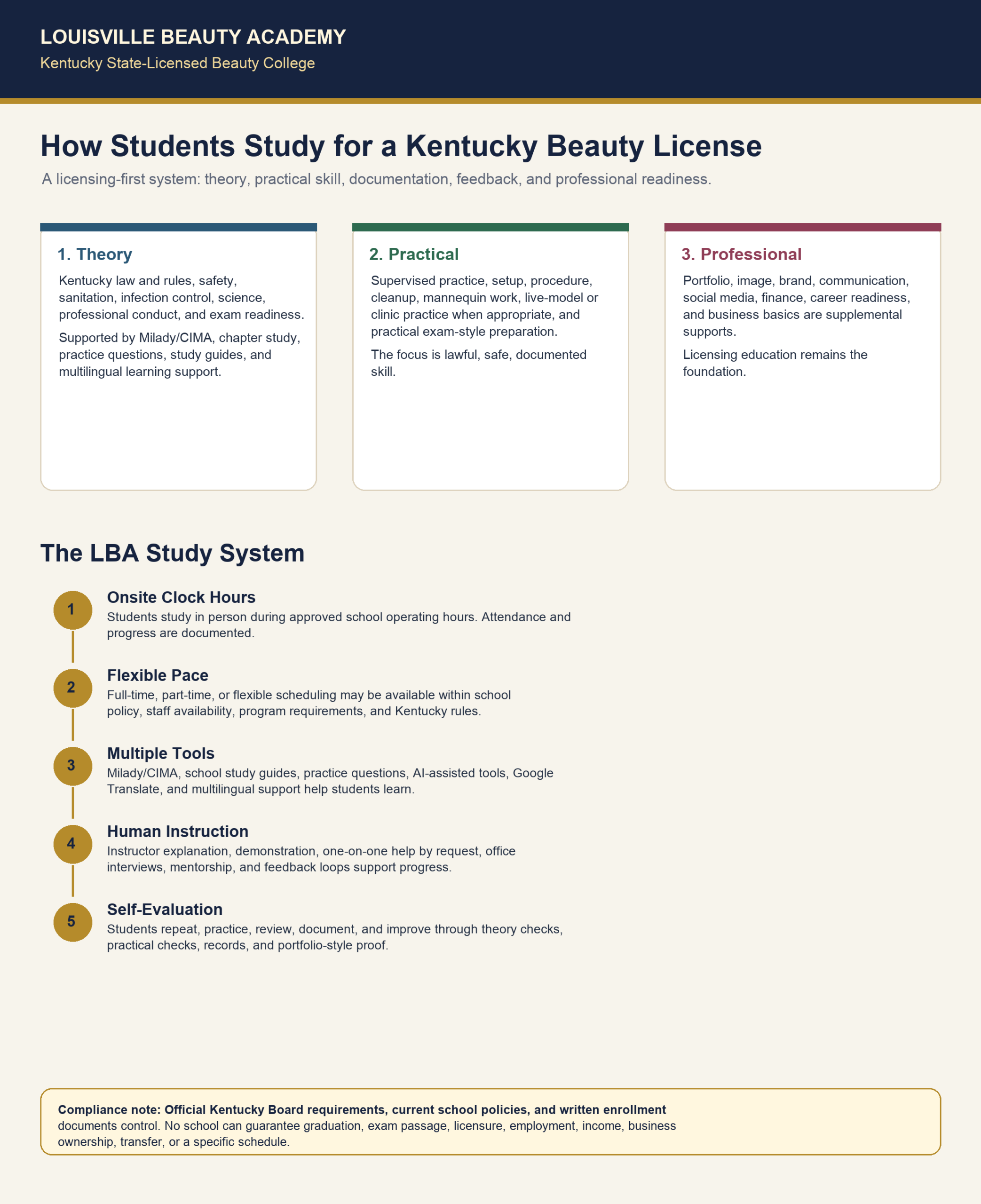
Students learn in three layers. The first layer is required licensing education. The second layer is supervised practical development. The third layer is professional formation: how to carry yourself as a beauty professional, document your progress, communicate clearly, and build a lawful future after licensing.
1. Licensing Theory
Theory is the academic foundation. Depending on the program, students study topics such as safety, sanitation, infection control, anatomy, physiology, chemistry, electricity, skin, hair, nails, professional image, client care, Kentucky rules, and licensing-exam readiness.
For many students, theory is the most difficult part because it requires reading, memory, vocabulary, practice questions, and repeated review. That is why LBA treats theory seriously. A student cannot become safe, lawful, and exam-ready by guessing.
2. Practical Licensing Skill
Practical study means hands-on learning under school supervision. Students practice setup, sanitation, procedure, cleanup, tool control, station discipline, mannequin work, and live-model or clinic-style practice when appropriate under school policy and applicable rules.
The goal is not to rush into fancy technique before the foundation is built. The goal is lawful, safe, repeatable practice that prepares the student for the practical licensing exam and for professional responsibility.
3. Professional Development
After and alongside the licensing foundation, LBA encourages students to think like future professionals. That can include portfolio discipline, professional image, client communication, social media responsibility, basic finance awareness, brand building, business thinking, salon-readiness mindset, and self-documentation.
These professional-development elements are valuable, but they are supplemental. They do not replace the required state curriculum, clock hours, theory preparation, practical preparation, sanitation, safety, or official licensing process.
How Exactly Do Students Study?
Students study onsite, in person, during approved school operating hours and according to the student’s approved schedule, program requirements, school policy, staff availability, and Kentucky licensing rules. LBA may support full-time, part-time, or flexible scheduling, but flexibility does not mean unlimited attendance, undocumented hours, virtual licensing credit, or a guaranteed completion date.
A serious student may spend long blocks of time at school. For some students, that can mean many hours per day or a schedule that approaches a full-time weekly commitment when approved. That time matters. A student who is onsite for many supervised hours has repeated opportunities to study theory, practice hands-on skills, ask instructors questions, receive correction, self-evaluate, and keep moving.
A Typical Study Pattern
- Clock in and maintain documented attendance.
- Study assigned theory using Milady/CIMA, textbook resources, chapter work, school study guides, and practice questions.
- Review difficult vocabulary and concepts, including with reasonable multilingual support where appropriate.
- Ask instructors for explanation, demonstration, correction, or one-on-one support when needed and available.
- Practice on mannequins, practical setups, tools, stations, and live models or clinic situations when appropriate under supervision.
- Self-evaluate: what did I understand, what did I miss, what must I repeat, what must I document, what must I ask tomorrow?
- Prepare for theory and practical licensing exams through repetition, review, and exam-style discipline.
The Tools LBA Uses to Support Study
Louisville Beauty Academy uses multiple systems because different students learn in different ways. The school’s purpose is not to replace human instruction with technology. The purpose is to surround the student with more ways to study, review, translate, document, and understand.
- Milady/CIMA: a major professional beauty-education learning system used to support theory, chapters, quizzes, and exam preparation.
- LBA study guides and practice questions: school-created and school-selected materials that help students repeat, review, and prepare.
- AI-assisted study support: learning tools that can help explain concepts, create study guides, simplify language, and support review in multiple languages.
- Google Translate and translation support: tools that can help multilingual students understand study material, while official rules and written school documents still control.
- Written communication: text messages, email, documents, forms, policies, and records help prevent confusion and reduce verbal misunderstanding.
- Student record systems: attendance, transcript, document, and progress records help students and the school understand where the student stands.
- Portfolio and public-proof discipline: when appropriate, students are encouraged to document work, build professional image, and understand how reputation grows through visible responsibility.
The Human Side: Instructors, Office Review, Mentorship, and Feedback
Technology is powerful, but beauty education remains human. Students need demonstration, correction, encouragement, patience, and accountability. LBA’s model includes instructor support, office conversations, mentorship, written follow-up, and feedback loops.
One-on-one help may be requested when a student needs clarification or additional support. These sessions must fit instructor availability, school operations, program needs, policy, student conduct, and the student’s own responsibility to communicate respectfully and keep moving.
Evaluation is not only a final exam. Evaluation can include chapter tests, practical checks, instructor feedback, student self-evaluation, office interviews, attendance review, transcript review, student feedback, public/client feedback where appropriate, and professional review of portfolio or public-facing work when relevant.
Why Long Onsite Hours Matter
Beauty licensing education is built on clock hours because time, supervision, repetition, and documentation matter. A student who spends many hours onsite is not merely present. The student is inside a learning environment where instructors, tools, classmates, mannequin practice, live-model practice, sanitation routines, exam language, and written records are all available.
That is why the question is not only, “Can I study?” The deeper question is, “Am I willing to use the hours?” When a student is onsite for long, documented, supervised study time, the opportunity to learn is real. The school can provide the environment, tools, instruction, and feedback. The student must bring discipline, attendance, respect, practice, and responsibility.
A Caring Environment Requires Clear Rules
LBA believes care and compliance belong together. A caring school is not one that ignores rules. A caring school writes things down, explains expectations, maintains records, welcomes questions, protects the learning environment, and reduces disruption so students can study.
Students may text, email, request written information, walk in, ask for a tour, speak with staff when available, and seek clarification. Human connection is welcome. Written communication is also encouraged because written clarity protects students, families, staff, and the licensing process.
What LBA Can Promise, and What No School Should Promise
Louisville Beauty Academy can commit to a licensing-first education model, written clarity, school systems, instructor support, practical training opportunities, study tools, feedback, documentation, and a serious learning environment.
No school should promise a guaranteed graduation date, exam passage, license approval, job, income, salon ownership, business success, transfer recognition, financial result, or exact schedule outcome. Those results depend on many factors, including student attendance, student conduct, academic progress, practical performance, official Kentucky Board requirements, testing vendor rules, school policy, personal circumstances, and current law.
The Beautiful Simplicity
The LBA model is advanced, but the heart of it is simple: come onsite, study the required theory, practice the required skills, document your hours, use the tools, ask for help, self-evaluate, repeat, prepare for the licensing exams, and build professional dignity one disciplined day at a time.
That is what students learn. That is how students study. And that is why Louisville Beauty Academy continues to position beauty education as lawful skill, human discipline, family dignity, and professional opportunity.
Related LBA Resources
- What Will Students Learn at Louisville Beauty Academy?
- Understanding Kentucky Clock-Hour Beauty Education
- Full-Time, Part-Time, and Flexible Schedule
- Milady/CIMA, AI, Multilingual Support, and Onsite Study Rules
- Zero-Abandonment Mentorship
- Student Document Center
References and Current Official Sources
- Kentucky Board of Cosmetology: official website
- Kentucky Board of Cosmetology: license requirements
- Kentucky Board of Cosmetology: exams
- Kentucky Board of Cosmetology: schools
- Kentucky Board of Cosmetology: statutes and regulations
This article is general public education from Louisville Beauty Academy. Current Kentucky Board requirements, testing vendor rules, and LBA’s written enrollment documents and policies control. Translation and AI tools may support learning, but they do not replace official rules, official documents, instructor judgment, or the student’s responsibility to study and comply.