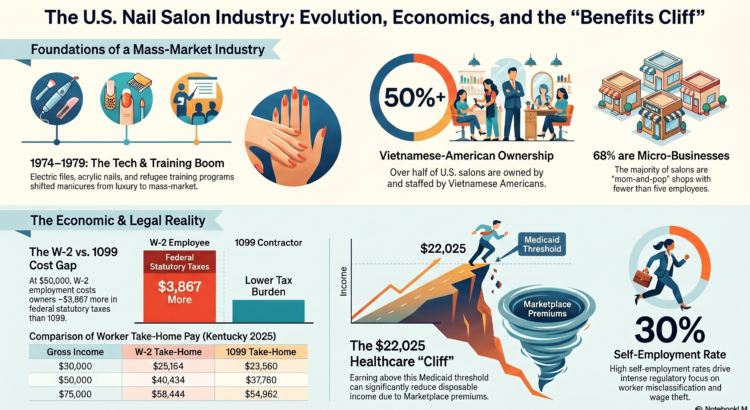
Educational notice: this article is general public education. It is not legal, tax, payroll, Medicaid, insurance, immigration, financial, or individualized employment advice. Each student, worker, graduate, salon owner, and family should review their own facts with a qualified CPA, payroll professional, benefits advisor, attorney, insurer, and licensing authority.
Louisville Beauty Academy is a beauty school, not a law firm or CPA office. But a responsible beauty school should help students and families understand the questions they must ask before confusion becomes risk. Beauty education does not end with hours and practical skills. A graduate also enters a world of written agreements, pay records, taxes, licenses, benefits, and professional responsibility.
A student should not walk into the beauty industry with fear of paperwork. A student should walk in with written clarity, humility, dignity, and the courage to ask responsible questions.
Why This Belongs On The LBA Website
The Vietnamese community article belongs on Viet Bao Louisville. The deep research article belongs on Di Tran University. The policy and small-business advocacy belongs on NABA. LBA’s role is different: LBA should translate the issue into practical student and salon-owner readiness.
This page is therefore written for beauty students, graduates, families, instructors, and salon owners who need a calm, practical framework. The goal is not to tell anyone whether they are an employee or independent contractor. The goal is to help people separate the issues, keep documents, ask better questions, and know when a qualified professional must review the facts.
The Main Question: A Label Is Not Enough
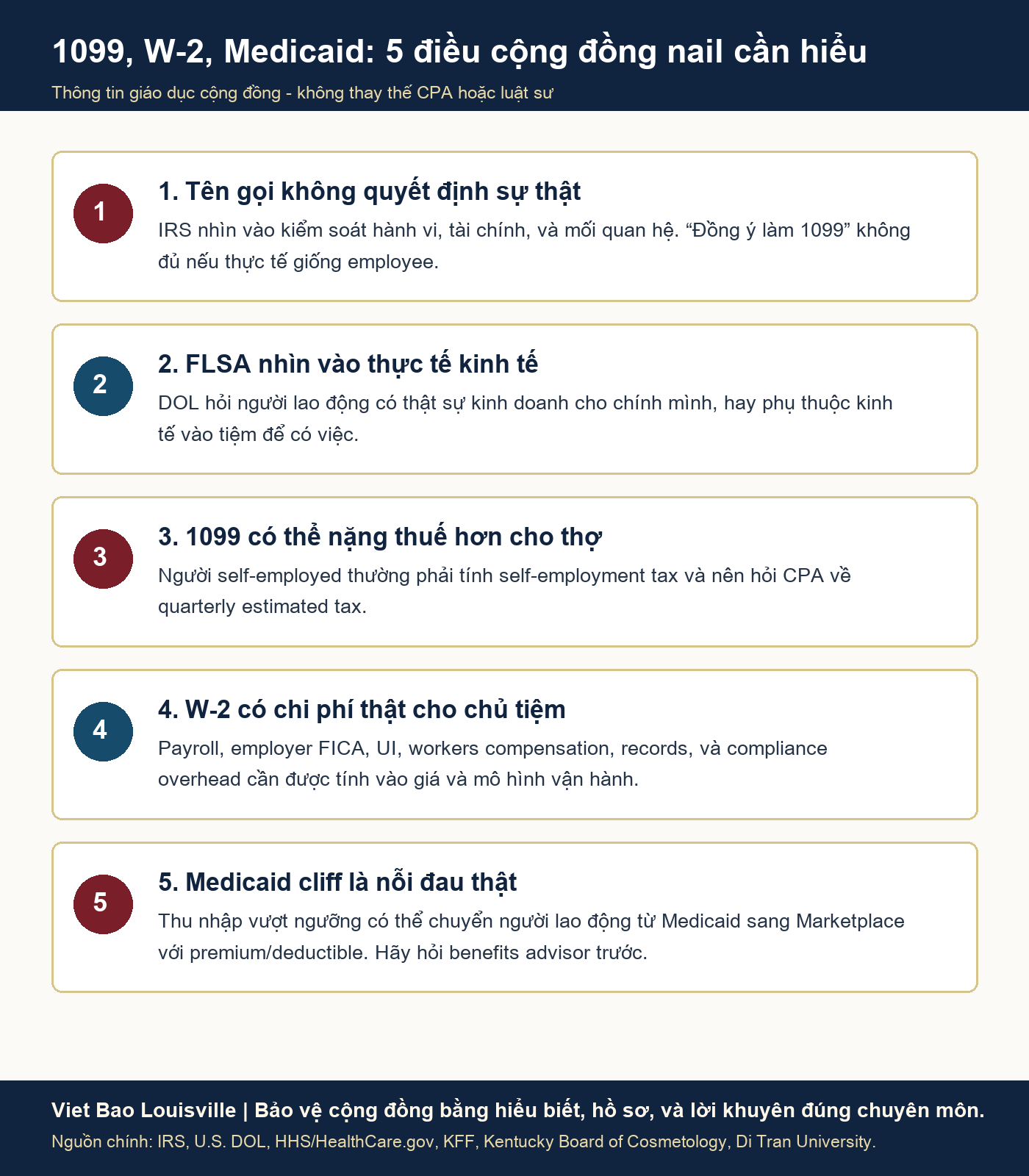
In the beauty industry, people often hear simple labels: W-2 employee, 1099 independent contractor, booth renter, commission, or family help. Those labels matter, but they are not the whole analysis. Government agencies and courts usually look at the facts of the working relationship, not only the words on a paper.
That means a student or owner should ask: Who controls the work? Who controls the schedule? Who sets prices? Who provides tools and supplies? Who carries business risk? Who can profit or lose based on management? Who keeps records? Who pays payroll taxes or self-employment taxes? Who is responsible for insurance, licenses, permits, and benefits paperwork?
Four Separate Legal And Financial Lanes
1. IRS federal tax classification. The IRS commonly looks at behavioral control, financial control, and the type of relationship between the parties. For tax purposes, the question is not only what the parties call the relationship, but whether the business has the right to direct and control the details of the work.
2. Department of Labor wage-and-hour classification. Under the Fair Labor Standards Act, the Department of Labor uses an economic-reality framework to evaluate whether a worker is economically dependent on an employer or is in business for themself. As of June 10, 2026, federal worker-classification guidance and rulemaking remain an active area, so owners and workers should check current DOL guidance rather than relying on old verbal advice.
3. Payroll tax and self-employment tax. For W-2 employment, employers generally withhold federal income tax and the employee share of Social Security and Medicare taxes, and employers pay the employer share. IRS Topic 751 lists Social Security at 6.2% for the employer and 6.2% for the employee, and Medicare at 1.45% for the employer and 1.45% for the employee. For self-employment, IRS Topic 554 explains that self-employment tax generally consists of 12.4% for Social Security and 2.9% for Medicare, subject to applicable rules and limits, before considering income tax, deductions, estimated-tax obligations, and state/local issues.
4. Medicaid, Marketplace coverage, and family benefits. Income changes can affect health-coverage eligibility and cost. HealthCare.gov explains that Medicaid and Marketplace savings are tied to household income, household size, state rules, and federal poverty level calculations. Kentucky’s kynect benefits page identifies Medicaid income limits for adults 19-64 by reference to federal poverty level. A worker should not guess. If income changes, speak with a qualified benefits advisor or use the official kynect/HealthCare.gov channels.
Kentucky Beauty Licensing Still Matters
Tax status does not replace beauty licensing. The Kentucky Board of Cosmetology lists Nail Technician requirements including 450 hours, education requirements, examination, application, and receiving license verification or a license before providing services. For nail students, 201 KAR 12:082 also addresses nail technology hours and the education structure. A person should not confuse a tax form with permission to practice.
Student And Graduate Checklist
- Ask whether the salon relationship is W-2 employment, 1099 independent contracting, booth rental, or another written structure.
- Ask for the agreement in writing before relying on verbal explanations.
- Ask how pay, tips, supplies, schedule, product charges, rent, commission, and taxes are handled.
- If W-2, review paystubs, withholding, W-4, and payroll records.
- If 1099 or booth rental, speak with a CPA about estimated taxes, self-employment tax, business deductions, receipts, bookkeeping, and Form 1099 reporting.
- If Medicaid, Marketplace coverage, SNAP, childcare assistance, or other benefits matter to your household, ask a qualified benefits advisor before assuming what income will do.
- Keep copies of licenses, permits, agreements, pay records, tax forms, messages, and important business records.
Salon Owner Checklist
- Do not rely on a label alone. Match the written structure to the real operational relationship.
- If using W-2 employees, maintain payroll, withholding, employer tax, unemployment, workers’ compensation, wage-and-hour, and recordkeeping review.
- If using booth rental or independent-contractor structures, review control, pricing, schedule, tools, investment, opportunity for profit or loss, permanence, and business independence with qualified advisors.
- Keep separate files for employment/payroll records, booth-rental agreements, contractor records, insurance, licenses, permits, tax filings, and professional advice.
- Use multilingual explanations where needed, but keep the controlling agreement and official obligations clear and reviewable.
- When unsure, ask a CPA, payroll provider, employment attorney, insurance advisor, or licensing authority before the issue becomes a dispute.
Dành Cho Học Viên Và Gia Đình Người Việt
Louisville Beauty Academy muốn học viên và gia đình hiểu rõ bằng văn bản. Hỏi không phải là hỗn. Dịch thuật không phải là xấu hổ. Muốn xem giấy tờ trước khi ký không phải là gây khó khăn. Đó là sự chuẩn bị chuyên nghiệp.
Nếu một tiệm nói bạn là W-2, hãy hỏi về phiếu lương, khấu trừ thuế, lịch làm việc, quy định làm việc, và hồ sơ lao động. Nếu một tiệm nói bạn là 1099 hoặc thuê bàn/booth rental, hãy hỏi rõ ai trả thuế, ai giữ sổ sách, ai mua dụng cụ, ai quyết định giá, ai chịu lời/lỗ, và bạn có cần nói chuyện với CPA hay không.
Nếu gia đình đang có Medicaid, bảo hiểm Marketplace, hoặc quyền lợi dựa trên thu nhập, đừng đoán. Thu nhập thay đổi có thể làm thay đổi điều kiện hoặc chi phí. Hãy hỏi đúng nguồn chính thức hoặc người tư vấn đủ chuyên môn. Một chữ ký có thể tạo trách nhiệm lâu dài; vì vậy hãy hiểu trước khi ký.
Một tờ đơn có thể làm tiền nhìn dễ. Một chữ ký có thể làm trách nhiệm kéo dài nhiều năm.
LBA’s Professional Readiness Position
LBA does not tell a salon how to classify a worker, and LBA does not give individualized tax or legal advice. LBA’s role is to teach a stronger habit: understand what you sign, keep written proof, respect official licensing rules, ask qualified professionals, and build a career on clarity rather than rumor.
This is part of LBA’s broader zero-fear education culture. Language difference is not shame. Paperwork should be understood. Official rules should be respected. Students should be trained not only to perform services, but to become careful professionals who can protect themselves, serve clients, and contribute honorably to the beauty industry.
Source Map For Further Review
- IRS: Independent contractor or employee.
- IRS Topic 762: Independent contractor vs. employee.
- IRS Topic 751: Social Security and Medicare withholding rates.
- IRS Topic 554: Self-employment tax.
- U.S. Department of Labor Fact Sheet 13: Employment relationship under the FLSA.
- U.S. Department of Labor 2026 independent-contractor proposed rulemaking.
- HealthCare.gov: Federal Poverty Level glossary.
- Kentucky kynect: Medicaid, KCHIP, and APTC program information.
- Kentucky Board of Cosmetology license requirements.
- 201 KAR 12:082 education requirements and school administration.







