Louisville Beauty Academy: Kentucky’s Gold Standard in Compliance, Digital Accountability, and Student Protection

A Public Guide for Students, Families, Industry Partners, and All Kentucky Beauty Schools

At Louisville Beauty Academy (LBA), compliance is not a minimum standard — it is a culture.
Our academy proudly upholds the highest levels of accountability required by the Kentucky Board of Cosmetology (KBC) under KRS 317A and 201 KAR Chapter 12, and in many areas, we exceed them.

For nearly a decade, LBA has led Kentucky with a digital-first, transparency-first operational model that protects students, supports instructors, and uplifts the entire beauty education sector.
This article explains:

✔ The laws and regulations governing beauty schools in Kentucky
✔ Exactly how monthly hour reporting works under KBC rules
✔ Why LBA’s systems are beyond-compliant and audit-ready
✔ How LBA’s student protections set a national benchmark
✔ Why we openly share this knowledge for the benefit of all schools in Kentucky and beyond


1. Understanding KBC: The State’s Regulatory Authority

The Kentucky Board of Cosmetology (KBC) regulates every licensed beauty school, salon, and professional in the Commonwealth.
KBC operates under:

  • KRS Chapter 317A (Kentucky Revised Statutes)
  • 201 KAR Chapter 12 (Kentucky Administrative Regulations)

KBC requires each school to:

  1. Track daily attendance with accuracy
  2. Comply with the maximum hour limits
  3. Maintain comprehensive educational records
  4. Report student hours monthly no later than the 10th day of each new month
  5. Submit digital certification of hours upon withdrawal or completion
  6. Ensure students receive education aligned with minimum program hours (450, 750, 900, 1500 depending on program)

2. Reporting Student Hours: The Law Is Clear

KBC requires:

Monthly Reporting

“No later than the tenth (10th) day of each month, a licensed school shall submit… the total hours obtained for the previous month and the accumulated hours to date.”
201 KAR 12:082 §19(2)

Daily/Weekly Maximums

Students shall not receive credit for more than:

  • 8 hours per day
  • 40 hours per week

This ensures health, safety, and fairness for all students statewide.

Digital Timekeeping

Schools must use a digital, auditable timekeeping system, often biometric, to verify every clock-in and clock-out.

Certification of Hours

Within 10 days of a student’s withdrawal, dismissal, completion, or transfer, schools must certify hours to the Board.


3. LBA’s Gold Standard: Beyond Compliance, Beyond Expectation

While many schools follow the law, LBA elevates it.

Biometric Fingerprint System

Every student clocks in/out using fingerprint verification.
No manual paper sheets. No edits. No guessing.
Every second is recorded digitally and backed by audit logs.

Daily, Weekly, Monthly Transparency

Students can access:

  • Daily clock logs
  • Weekly summaries
  • Monthly “Satisfactory Academic Progress” (SAP) reports
  • Complete attendance breakdowns
  • Practical service tracking
  • Theory hours
  • State law hours

Every month, each student receives a full report of their hours — not just what was submitted to KBC, but the detailed breakdown of every clock event and every credit earned.

Only Hours Allowed by Law Are Reported

If a student voluntarily practices more than 8 hours per day, LBA records it as training —
but only lawful hours are submitted.
This protects students from illegal or inflated hour reporting and ensures true academic integrity.

Comprehensive Digital Ecosystem

LBA’s systems include:

  • Email communication tracking
  • SMS communication logs
  • CRM-based student management
  • JotForm digital contracts
  • Image/file-based student portfolios
  • Monthly reporting archives
  • Instructor documentation
  • Graduation verification
  • Social-media documentation of student milestones

This makes LBA one of the most digitally advanced and transparent beauty colleges in the nation.

Audit-Ready at All Times

Whether for:

  • KBC inspection
  • Open-records request
  • Transfer request
  • State license application
  • Out-of-state reciprocity
  • Insurance review
  • Legal verification

LBA maintains complete, timestamped, unalterable digital documentation.


4. Why LBA’s System Protects the Student Above All Else

Students Always Know Their Exact Hours

No student at LBA ever asks, “How many hours do I have?”
They receive their report every month — automatically.

Students Can Transfer to Other States Easily

Detailed monthly logs make out-of-state hour acceptance smoother and more credible.

Students Graduate with Full Transparency

Their hours, their education path, and their completion proof are crystal-clear.

No Risk of Lost Hours

Everything is digital, cloud-backed, stored in multiple systems, and verified monthly.

No Manipulation or Manual Adjustments

Biometric logs ensure privacy, fairness, and accuracy.

Students Are Empowered, Not Dependent

Transparency liberates the student — they are always informed and in control.


5. Leading Kentucky in Ethical, Transparent, Modern Beauty Education

Louisville Beauty Academy is committed not only to running a school —
but to teaching the next generation of schools how to operate ethically.

We share openly:

  • Regulatory knowledge
  • Compliance systems
  • Digital tools
  • Transparency practices

Why?
Because Kentucky deserves strong, ethical, student-first beauty colleges — not gate-keeping, secrecy, or outdated practices.

We are proud to lead by example.


6. Message to Students, Families, Employers, and the Kentucky Community

At LBA:

You are protected.
Your education is documented.
Your hours are real.
Your records are secure.
Your success is verifiable.

We believe that trust is earned through transparency.
Our compliance systems are built not to check boxes —
but to protect your future and honor your investment.


7. For Prospective Schools and New Branch Locations

Louisville Beauty Academy now serves as a training model for compliance-driven beauty schools.
New branches and partner institutions are trained under our:

  • Digital compliance system
  • Monthly reporting workflow
  • Student protection plan
  • SAP reporting structure
  • Biometric attendance integration
  • Documentation standards
  • Audit-readiness protocols

Every branch and partner school under the LBA ecosystem follows the same gold standard — no exceptions.


8. Final Statement

Louisville Beauty Academy stands as Kentucky’s leader in beauty-education compliance, transparency, technology, and student protection.

We honor the law.
We teach the law.
We exceed the law.
And we share everything we know so the entire industry can rise together.

⭐ Louisville Beauty Academy – Learning Environment, Conduct Standards & Community Protection Policy

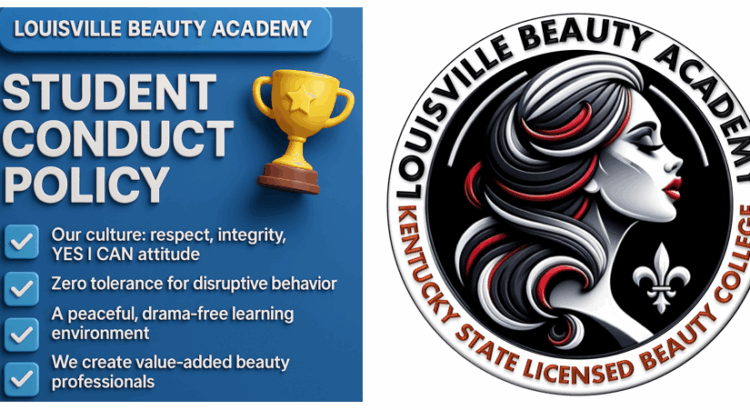
At Louisville Beauty Academy (LBA), our mission is rooted in love, respect, discipline, and human growth. We exist to uplift our students, our community, and the beauty industry through an environment that is peaceful, supportive, and completely focused on learning, licensing, and personal achievement.

Because of this mission, the Academy maintains a zero-tolerance standard for any behavior that disrupts learning, disrespects others, or creates negativity in our educational ecosystem. Our school is built on care, compassion, flexibility, and the belief that every student can succeed—but only within an environment where all students feel safe, respected, and empowered.


❤️ A Peaceful, Drama-Free Learning Environment Is Our Commitment

Louisville Beauty Academy proudly serves one of the most diverse student populations in Kentucky—across languages, ages, cultures, and life backgrounds. To support all students equally, we maintain:

  • Zero drama
  • Zero harassment
  • Zero hostility
  • Zero disrespect
  • Zero tolerance for disruptive conduct

Every learner deserves an environment of peace, quiet focus, kindness, and professionalism. This is not optional. It is foundational to our success.

This culture is one of the main reasons LBA has received national honors, including:

  • U.S. Chamber of Commerce CO—100 Top 100 Small Businesses in America
  • National Small Business Association Advocate of the Year Finalist
  • U.S. Congressional Recognition for Outstanding Service
  • Louisville Business First’s Most Admired CEO
  • Kentucky statewide community awards and recognitions

These aren’t simply awards—they represent the culture we protect every single day.


💛 Our Promise: We Create Graduates, Licensees, Professionals & Business Owners

Louisville Beauty Academy exists to elevate:

  • Graduates
  • Licensed professionals
  • Workforce contributors
  • Small business owners
  • Value-add members of the beauty community

We create people who go into the world with:

  • YES I CAN discipline
  • I HAVE DONE IT achievement
  • Professional ethics
  • Respect for others
  • A service-driven heart
  • Excellence in conduct

90% of our success comes not from technical skill alone, but from attitude, character, and professionalism—qualities we cultivate intentionally.


⚖️ Student Withdrawals & Discipline – Our Painful but Necessary Responsibility

In rare situations—less than 1%—we must withdraw a student or apply disciplinary action.
This is never done lightly.

It is done:

  • With care
  • With documentation
  • With fairness
  • With legal compliance
  • With a heavy heart

But it is also done swiftly, because we must always protect:

  • The learning environment
  • The mental peace of our students
  • The professionalism of our instructors
  • The integrity of our school
  • The future of our graduates

We cannot allow behaviors that contradict our mission, violate our culture, or disrupt the educational ecosystem we’ve built over 10 years.

Some students simply are not yet ready for this environment—and that is okay.


🌱 For Students Who Are Withdrawn

We wish every student—without exception—success in life.

If your journey with us ends early, please know:

  • We still want you to succeed.
  • We still believe in your potential.
  • We still encourage you to continue your education elsewhere.
  • We still hope you obtain your license and begin your career.

We do not comment publicly about any student’s situation for privacy and compliance reasons.

This means:

  • We will not discuss your withdrawal
  • We will not explain details online
  • We will not respond to public accusations
  • We will not argue or debate online
  • We will protect your privacy even if you comment publicly

This is our legal and ethical responsibility.


🧭 Guidance for All Students (Withdrawn or Enrolled)

Our message is the same for everyone:

** Get into a school that allows you to study extremely hard, finish as quickly as possible, become licensed, stay fully compliant, and enter the workforce without delay.**

This is the path promoted in the hundreds of books by our founder, Di Tran, including:

Your future begins when you commit to excellence—wherever you choose to study.


🔒 Privacy Commitment & Non-Disclosure

For all current, former, withdrawn, or future students:

We will not discuss your records, your conduct, your withdrawal, or your situation with anyone.

Not:

  • Online
  • On social media
  • In public comments
  • Over the phone to third parties
  • In response to any review

This is not only our policy—it is our duty.


Final Message

Louisville Beauty Academy is a place of:

  • Love
  • Peace
  • Respect
  • Discipline
  • Achievement
  • Community
  • Excellence

We welcome every student who shares this vision.
We protect every student who depends on this environment.
And we rise every day committed to building the YES I CAN → I HAVE DONE IT generation of beauty professionals.

America’s Ethical Workforce Academy™ Model

Powered by NABA. Proven by Louisville Beauty Academy.

America’s Ethical Workforce Academy™ Model represents a transformative national blueprint for vocational education—one built on ethical clarity, transparent community engagement, zero student exploitation, and the Humanization philosophy developed by Di Tran through more than 120 published works. Unlike traditional dual-revenue vocational schools that rely on both tuition and the monetization of unpaid student labor, this model establishes a single-revenue, ethically aligned, community-centered framework where all student practice is 100% volunteer-based, compliant, and deeply rooted in public service (Louisville Beauty Academy, 2025; New American Business Association, 2025).

As demonstrated through Louisville Beauty Academy—the flagship proving ground for this model—students practice exclusively through supervised, non-commercial volunteer engagements. Live Model participants are not customers but community volunteers supporting education, and any contribution collected covers only product, sanitation, and supervision needs (Louisville Beauty Academy, 2025). This ensures no exploitation, no hidden labor value extraction, and no commercial profit derived from trainees, aligning with modern interpretations of the Fair Labor Standards Act and educational best practices (New American Business Association, 2025).

This approach is reinforced by LBA’s debt-free design, where total program costs remain among the lowest in the nation and where interest-free payment plans produce graduates who enter the workforce without federal loan burdens (Louisville Beauty Academy, 2025). The academy’s Harbor House campus further validates the model by delivering 100% free community services to elderly and disabled populations, proving that clinic hours can function as genuine public good, not as commercial revenue streams (Harbor House Partnership Study, 2025).

Built on Di Tran’s Humanization framework—outlined across 120+ books including Yes I Can, I Have Done It, AI-Powered Nation, and The College of Humanization—the model establishes education as a moral act, skill as dignity, and service as the core of workforce development. Humanization asserts that individuals grow most when they are valued, empowered, and taught without exploitation, and this principle is the philosophical backbone of America’s Ethical Workforce Academy™ Model (Tran, 2025).

Through transparent legal alignment, open-records accountability, and a deliberate rejection of student-labor monetization, the model positions itself as:

  • A national name for ethical vocational excellence
  • A scalable model applicable to beauty, healthcare, admin, IT, and skilled trades
  • A recognized blueprint for legally defensible, service-based training
  • A cross-industry brand capable of transforming workforce education
  • A federally fundable concept aligned with U.S. Department of Labor and Workforce Innovation priorities
  • A research-backed framework rooted in compliance, ethics, and measurable public benefit
  • A compliance-forward identity that minimizes risk for institutions and regulators
  • A media-ready positioning for national thought leadership
  • A visionary leadership role centered on Di Tran’s Humanization philosophy and service-driven entrepreneurship

Together, NABA and Louisville Beauty Academy demonstrate that America’s Ethical Workforce Academy™ Model is not theoretical—it is proven in operation, scalable in design, and ready to be nationalized as America’s next generation of humane, ethical, service-anchored vocational training.

Here is the APA-style reference set to insert at the end of the publication:

References (APA 7th Edition)

Harbor House Partnership Study. (2025). Beauty-for-connection: A volunteer-based cosmetology training model serving elderly and disabled adults. New American Business Association Press.

Louisville Beauty Academy. (2025). Student Live Volunteer Practices: Educational framework and compliance alignment. LouisvilleBeautyAcademy.net.

Louisville Beauty Academy. (2025). Affordable, debt-free pathways in Kentucky beauty education. LBA Research Division.

New American Business Association. (2025). Legal integrity and ethical training models in U.S. cosmetology education: A comprehensive 20-year review. NABA4U.org.

Tran, D. (2025). Humanization and ethical workforce education: Foundations for service-driven training. Di Tran University Press.

Tran, D. (2023–2025). Collected works on Humanization, AI, value-add entrepreneurship, and service leadership (120+ volumes). Di Tran University Press.

Louisville Beauty Academy: Your “YES I CAN” Journey Starts Here

Welcome to Louisville Beauty Academy, Kentucky’s most affordable, most flexible, and most supportive beauty college.
We are KY State‑Licensed and State‑Accredited, helping aspiring beauty professionals from all walks of life turn their passion into a licensed, thriving career.

Whether your dream is to excel in a top-tier salon, start your own beauty business, or master a specialized skill, we’re here to guide you every step of the way.


Why Louisville Beauty Academy Stands Out

We are proud to be more than a school — we are a community of mentorship, opportunity, and lifelong learning.
Here’s why students choose LBA:

  • Separate, Specialized Programs – You are never forced into a broad cosmetology track. Choose exactly what fits your goals:
    • Nail Technology
    • Aesthetic Skincare
    • Cosmetology
    • Shampoo Styling
    • Short courses like 2‑day Eyelash Extensions
  • Debt-Free Education – Our tuition is the most affordable in Kentucky, with flexible payment plans and no required loans.
  • Unlimited Graduate Access – Even after you graduate, you’re welcome back for mentorship, tutoring (as available), and to inspire current students by sharing your success story.
  • Flexible Scheduling – Perfect for working adults, parents, and anyone balancing life’s commitments.
  • Diversity and Inclusivity – We proudly serve immigrants, non‑native English speakers, and students from all backgrounds.

Breaking Barriers with Multilingual Licensing Exams

We celebrate our first graduate to pass the Kentucky State Licensing Exam in Spanish — and this is just the beginning!
The Kentucky Nail Licensing Exam is now available in:

  • English
  • Simplified Chinese (简体中文)
  • Spanish (Español)
  • Vietnamese (Tiếng Việt)
  • Korean (한국어)

This means more students can achieve their professional goals without language being a barrier.


Hands-On Training with Modern Technology

Our training is state‑board aligned and supported by the Cengage CIMA Digital Learning Solution, giving you the best of both worlds:

  • Practical, in-person skill development.
  • Accessible online resources you can use anytime, anywhere.

Proven Success: Over 1,000 Graduates

With more than 1,000 licensed graduates, our impact speaks for itself. Many of our students overcome financial hardship, language barriers, or busy family schedules — and still succeed.

Your journey is unique, but success is possible with belief, consistency, and the YES I CAN mentality we live and breathe every day.


From the Desk of Our Founder: Di Tran

Our founder, Di Tran, has written over 40 books on beauty, business, and personal growth — including Why Licensing a Beauty Career is the Way for Me?
In this inspiring guide, Di explains how licensing boosts credibility, opens career opportunities, and ensures long-term stability in the beauty industry.


Begin Your Journey Today

At Louisville Beauty Academy, we don’t just teach beauty techniques — we prepare you for a licensed, empowered, and debt-free future.
We are proudly KY State‑Licensed and State‑Accredited, meeting the highest educational and regulatory standards in the state.

📞 Call or Text: 502‑625‑5531
📧 Email: Study@LouisvilleBeautyAcademy.net
🌐 Explore Programs & Enroll

Your future in beauty starts with one step.
Say YES I CAN today — and soon, you’ll be proudly saying I HAVE DONE IT.

🎓 WELCOME TO LOUISVILLE BEAUTY ACADEMY

You are now officially part of a Kentucky State-Licensed and State-Accredited Beauty College, committed fully to your success — no matter your background, language, or past experience.

Whether you’re beginning your journey in:

  • Cosmetology (1500 hours)
  • Nail Technology (450 hours)
  • Esthetic Skincare (750 hours)
  • Shampoo & Styling (300 hours)
  • Eyelash Extension (16 hours)
  • Instructor Licensing (750 hours)
  • Refresher Courses (for licensed or previously trained students)
  • Or even returning as a graduate seeking free tutoring and support

✨ You are family now — and your success is our mission.


🥇 YOUR #1 GOAL: GET LICENSED — LEGALLY AND PROFESSIONALLY

No matter which program you’re in, your first and most urgent focus is to meet all Kentucky State Board of Cosmetology requirements and pass your licensing exams.
This is not just a school rule — it’s a legal requirement that makes you a legitimate, licensed professional.

Without a license:

  • You cannot legally work in your field.
  • You are not protected under KY law.
  • You are at risk of being exploited or disqualified from jobs.

We take this seriously because we want you to succeed.


💡 HOW TO START: One Small Step at a Time

At Louisville Beauty Academy, we believe in bite-sized, focused progress. Here’s the proven order of success:


✅ STEP 1: MASTER THEORY (Required for Licensing)

Before touching any tools, products, or clients — you must build your legal and safety foundation.

🎯 Start with CIMA, your included online study system
💻 www.MiladyCIMA.com
(Value: $500 — provided FREE with tuition)

📚 Focus first on:

  • Sanitation & Infection Control
  • KY State Laws & Professional Conduct
  • Safety & First Aid
  • Anatomy Basics
  • Chemistry & Product Knowledge
  • Skin & Nail Structure

📝 Jump straight to chapter quizzes — guess if needed. Then:

  • Study the correct answers
  • Repeat each quiz until you score 90% or more at least 5 times
  • This is your real exam prep — theory exam is where 75% of students nationwide fail.
    You will not be one of them.

✅ STEP 2: PRACTICAL EXAM PREPARATION

Once you pass your theory, we guide you step-by-step through the practical licensing exam.
This means:

  • Kit prep
  • Manikin practice
  • Timed procedures
    All done exactly as required by the State Board.

✅ STEP 3: PROFESSIONAL DEVELOPMENT (After Licensing)

Now that you’re licensed, we continue the journey with you:

  • Advanced beauty skills
  • Client communication
  • Business setup & marketing
  • Continuing education
  • Even new licenses and specialties

You can come back anytime for tutoring — FREE.
It’s our way of saying: we don’t give up on our students. Ever.


🧠 YOUR MINDSET = “YES I CAN”

This school runs on belief.
Every student here — from first-timers to returning professionals — is encouraged to say daily:

“YES, I CAN.”
“YES, I WILL.”
“YES, I HAVE DONE IT.”

You may be learning in a second language.
You may be a busy parent.
You may have failed before.

But you are not alone anymore.
With focus, small steps, and a community around you — you will succeed.


📲 Questions or Need Help?

We are here for you, every step of the way:
Text: (502) 625-5531
Email: study@LouisvilleBeautyAcademy.net


Welcome again. Let’s get licensed. Let’s legitimize your career. And let’s build your future — one focused step at a time.
You are ready.
YES YOU CAN.

Louisville Beauty Academy: Pioneering AI-Augmented Beauty Education – RESEARCH MAY 2025

Louisville Beauty Academy (LBA) has launched a first-of-its-kind model in U.S. cosmetology education – blending cutting-edge AI tools with hands-on mentorship. LBA harnesses ChatGPT and D-ID video avatars to guide prospective students through enrollment, licensing steps, and exam prep in multiple languages. This AI-driven assistance complements traditional instruction, ensuring each learner receives personalized, 24/7 support. Education experts note that “integrating AI technology into vocational training” (e.g. adaptive learning platforms, virtual reality, AI analytics) is revolutionizing skill development. In the beauty field specifically, thought leaders have demonstrated how ChatGPT can “personalize recruitment, engagement, content creation, [and] customer service” for beauty schools. LBA’s approach – using generative AI to create multilingual video avatars (via D-ID) and real-time Q&A bots (via ChatGPT) – puts it at the forefront of this trend. Notably, D-ID’s avatars can speak over 100 languages and dialects, aligning with LBA’s mission to serve immigrants and non-English speakers. In short, LBA’s “blended learning model” combines in-person practice with “technology-assisted, AI-supported, on-demand” theory education, giving students the best of both worlds.

AI-Human Hybrid Education: A Growing Trend

Education analysts agree that human-AI hybrid models are the future. For example, vocational programs increasingly use AI-powered translation, virtual tutors, and adaptive learning to break language barriers and personalize instruction. LBA’s own materials highlight this: the Academy “embraces AI-powered translation tools and other technologies to make education more accessible”. By contrast, most traditional beauty schools still rely on fixed lecture schedules and textbooks. LBA’s flexible “clock-hour” format lets students set their own hours within a week, while AI-enhanced digital curriculum is available on demand. This ensures that no learner is ever held back by rigid class times – they have “everything they need to succeed from day one to licensure”.

  • Blended learning: LBA pairs hands-on labs and live demos with an AI-enhanced digital curriculum and weekly-updated study materials.
  • Personalization: Licensed instructors are available all day for one-on-one help, while students can use AI chatbots 24/7 for questions.
  • Inclusivity: The program explicitly notes it’s ideal for “immigrants and non-native English speakers” who benefit from custom-paced learning. Generative AI tools (like ChatGPT and D-ID) allow on-demand translation and tutoring, mirroring trends where adaptive platforms create multilingual content to engage diverse learners.

In essence, LBA demonstrates how a vocational school can leverage AI for enrollment and retention, a practice already championed in the industry. By integrating these tools with consistent human mentoring, LBA creates a highly supportive environment. (And unlike online schools that often lead to debt and dropout, LBA’s on-site licensing training assures student success – “there is virtually no reason to fail” when attendance and effort are applied.)

Strong Beauty Industry Growth & Career Outlook

The broader beauty industry is booming, which translates into strong ROI for career-trained professionals. The U.S. Bureau of Labor Statistics projects faster-than-average job growth for beauty careers: barbers, hairstylists, and cosmetologists are expected to grow ~7% from 2023–2033, while skincare specialists/esthetician roles are projected to grow ~10% (vs. 4% for all jobs). These rising demand trends are driven by constant consumer interest in personal care services. In fact, industry data show over 1.4 million people already work in U.S. beauty services, and new licenses are granted every year.

  • High employment potential: With tens of thousands of annual openings, new beauty professionals enjoy strong job prospects. Many cosmetology and esthetician graduates find work in salons, spas, or medical offices.
  • Entrepreneurship: A significant share of beauty pros become small business owners. Surveys highlight the entrepreneurial nature of the field: for example, a recent study of salon owners found 85% had at least one female owner and 19% were LGBTQ+, reflecting the diverse, community-rooted ownership in beauty. New salon and spa startups have about a 50% survival rate over the first 3 years, demonstrating solid returns for diligent operators.
  • Earnings: Median wages can be attractive. (As of 2024, cosmetologists earned roughly $17/hour, and trade careers average ~$68,000/year nationally – often well above local living wages, especially given low tuition costs.)

In short, the beauty sector’s consistent growth and entrepreneurial spirit make it a ripe market. New investors should note that cosmetology programs historically support workforce expansion: LBA itself reports over 1,000 alumni have “successfully entering the workforce or establishing their own small businesses”. This track record underscores the sector’s vitality – and the opportunity for investors to fuel local economies by licensing LBA’s model.

Vocational Training ROI & Debt-Free Education

Compared to 4‑year colleges, vocational cosmetology training offers dramatically lower cost and debt, enhancing ROI. The average full cosmetology program at a private school costs on the order of $15–20K, far below typical college debt. (Indeed, LBA advertises 50–75% tuition savings, aligning with national data that trade programs can be $3K–$30K depending on program length.) Importantly, a recent analysis found most U.S. cosmetology programs fail financial aid “gainful employment” tests – 98% would not meet modest earnings thresholds, and 28% would leave students with unsustainable debt relative to income. This highlights a strong market demand for license-only, debt-free alternatives. Many prospective students now perceive vocational certification as a smart value: a 2022 survey found 75% of Americans think vocational/trade programs are a “good value”, higher than for four-year schools.

By contrast, traditional for-profit beauty schools have struggled with debt burdens. Reports show 61% of cosmetology students take federal loans (averaging $7,100), often finishing below high-school-level earnings. LBA’s self-sustaining tuition model bypasses this pitfall: students pay out-of-pocket or via income share plans, meaning graduates enter the workforce debt-free. This transparent, cash-based approach is a key part of LBA’s “blueprint for modernizing higher education”. In practice, it creates measurable value: LBA boasts a 95%+ on-time graduation rate and nearly 2,000 graduates since inception, outcomes that traditional schools often cannot match. These results (hundreds of licensure-ready professionals) attract students and keep default rates minimal.

Education as an Investment: Stable Cash Flow & Growth

Savvy investors recognize that education can be a recession-resilient, scalable asset class. As one industry report notes, schools offer “predictable cash flow” (stable tuition revenues) and scalability (replicable models). Compared to many sectors, education remains stable even in downturns – people always need training. By expanding into new communities, an LBA licensee taps into local demand for beauty careers, generating steady tuition income each term. Moreover, owning the school’s real estate (or leasing it at favorable rates) provides an additional layer of return: the property itself can appreciate over time, and the business operations yield dividends from student fees.

Key investment advantages of school franchises include:

  • Predictable, multi-layered revenue: Tuition is collected continuously from new and continuing students. LBA also offers skill brush-up courses and retail services, diversifying income streams. As one analysis observes, “schools are no longer limited to tuition fees” – they add services, online platforms, and franchising to grow earnings.
  • Real asset value: The school facility is a tangible asset. Just like a commercial property, it provides utility (classrooms/labs) and can appreciate. Investors benefit from this “hard asset” in addition to cash flows.
  • Social impact dividends: Beyond money, investors help communities. Beauty schools empower local workers (often from underserved backgrounds) to attain licensure, join the workforce, and start businesses. As GSE Education notes, investors in schools get “high impact” returns – driving jobs and empowerment while earning profits. In LBA’s case, licensees boost economic mobility for residents (especially immigrants and minorities) by offering affordable, career-focused training.

For example, LBA explicitly frames its franchise model as both profitable and purpose-driven. The official offering page invites entrepreneurs to “Build a Legacy. Change Lives. Own a Business with Purpose.”. It emphasizes a 5-year renewable license and “lower cost & higher returns” compared to typical franchises. Crucially, LBA equips licensees with AI-powered tools and support – proprietary student-management software, 24/7 AI chat enrollment assistance, and automated scheduling – to maximize efficiency. These innovations reduce operating overhead and boost retention, enhancing ROI.

Franchise & Licensing Opportunities with LBA

LBA is actively seeking franchise partners and licensees to expand across U.S. counties and cities. Interested investors – from retiring salon owners to venture groups to community entrepreneurs – can apply to operate a fully supported LBA school. Major benefits of the LBA licensing model include:

  • Turnkey Business System: Licensees gain a “proven, highly successful model”. The package includes state-approved curricula, accreditation guidance, and marketing assets. (LBA’s materials report that franchise partners receive “SEO-optimized website, social media management” and recruitment strategies.)
  • Flexibility & Ownership: LBA offers a five-year licensed partnership (renewable) rather than a rigid franchise chain. Owners keep autonomy over their business, paying no excessive franchise fees. This means higher margins and the freedom to tailor operations locally while still using the LBA brand.
  • Advanced Technology: Partners step into a digital infrastructure. LBA provides a custom student management system, integrated online learning (Milady CIMA), AI chatbots for enrollment, and digital compliance tracking. In short, LBA licensees start with “cutting-edge IT and AI tools for operations”, keeping the school ahead of the curve.
  • Strong Brand & Social Impact: Operating under LBA’s brand (a state-accredited college) gives instant trust in the marketplace. Meanwhile, owners fulfill a social mission by offering affordable, high-quality education that builds workforce skills and entrepreneurs in their community.

LBA underscores that this is an “opportunity to build, grow, and scale an educational empire”. The numbers back it up: in just eight years LBA has graduated almost 2,000 students (most employed or in business) and maintains a 95%+ graduation rate. This proven track record means licensees join a multi-location, multi-million-dollar enterprise, rather than starting a business from scratch.

Ready to invest or own? Whether you are a baby-boomer entrepreneur, a tech investor, or a local business leader, LBA’s model offers stable returns with social impact. The Academy explicitly calls on investors to “own and operate a licensed beauty academy” under its system. By buying an LBA license, you secure both a real asset and a reliable cash-flow business. Join this pioneering venture – contact LBA to explore franchise/licensing opportunities and help shape the future of beauty education nationwide.

CITATION

Bureau of Labor Statistics. (2024). Occupational Outlook Handbook: Barbers, Hairstylists, and Cosmetologists. U.S. Department of Labor. https://www.bls.gov/ooh/personal-care-and-service/barbers-hairstylists-and-cosmetologists.htm

Bureau of Labor Statistics. (2024). Occupational Outlook Handbook: Skincare Specialists. U.S. Department of Labor. https://www.bls.gov/ooh/personal-care-and-service/skincare-specialists.htm

Century Foundation. (2020). The Beauty School Debt Trap: Large Debts, Low Wages, and the High Risk of Default. https://tcf.org/content/report/beauty-school-debt-trap/

CECU (Career Education Colleges and Universities). (2024). State of the Sector Report: Private Career Education. https://www.career.org

Federal Reserve Board. (2022). Economic Well-Being of U.S. Households in 2022. https://www.federalreserve.gov/publications/2023-economic-well-being-of-us-households-in-2022-student-loans.htm

Georgetown University Center on Education and the Workforce. (2023). The College Payoff: More Education Doesn’t Always Mean More Earnings. https://cew.georgetown.edu/cew-reports/the-college-payoff-2023/

Louisville Beauty Academy. (2025). Official Franchise & Licensing Offering Packet. https://louisvillebeautyacademy.net

Louisville Beauty Academy. (2025). Freedom Factory™ Business Model Overview. Internal publication.

Milady. (2024). CIMA: Cloud-based interactive learning for beauty and wellness education. https://miladytraining.com/cima

National Federation of Independent Business (NFIB). (2023). Small Business Economic Trends Report. https://www.nfib.com/surveys/small-business-economic-trends/

P2P Market Research. (2024). Beauty Industry Market Size and Trends 2024-2029. https://www.p2pmarketresearch.com

Pew Research Center. (2022). Public Trust in Higher Education and Vocational Alternatives. https://www.pewresearch.org

U.S. Department of Education. (2023). Gainful Employment Rule: Final Regulations. Federal Register. https://www.federalregister.gov/documents

World Economic Forum. (2023). The Future of Jobs Report: Vocational & Skills-based Pathways. https://www.weforum.org/reports/the-future-of-jobs-report-2023

Disclaimer: Louisville Beauty Academy is a Kentucky State-Licensed and State-Accredited beauty school. All education and licensing comply with the requirements of the Kentucky State Board of Cosmetology. LBA does not offer federal student aid and operates a cash-based tuition model. Any discussion of business models, franchising, licensing, or investment is for informational purposes only and does not constitute an offer or solicitation. Prospective partners or investors must perform independent due diligence and comply with all applicable laws and regulations. For official inquiries, contact study@LouisvilleBeautyAcademy.net or 502-625-5531.

Official Submission Procedure for Eyelash Extension Courses: Louisville Beauty Academy Compliance with the Kentucky State Board of Cosmetology – Pre- and Post-Class Requirements


🔹 STEP 1: EMAIL TO SEND – Minimum 10 Days Before Class

Subject Line Example:
10 Days in Advance – Eyelash Extension Training Course Notification – Louisville Beauty Academy

Recipients:

Email Body:

Dear Ms. McDonald,

Attached is the required student information for our upcoming eyelash extension course at Louisville Beauty Academy. Please find the following details and documents submitted in accordance with KBC requirements.

Course Location: 1049 Bardstown Rd, Louisville, KY
Course Duration: 16 total hours over 2 days
Daily Time: 9:00 AM – 5:00 PM

Student Name: [Full Legal Name]
Email: [Student Email]
Phone Number: [Student Phone Number]

Attachments Included:

  • Student Enrollment Agreement (signed)
  • High School Diploma (Domestic or Foreign)
  • Certified Translation (if diploma is not in English)

Please confirm receipt and let us know if anything additional is needed to remain in full compliance.

Thank you for your continued guidance and support.

Best regards,
Di Tran
Co-Founder and President
Louisville Beauty Academy
study@louisvillebeautyacademy.net


🔹 STEP 2: EMAIL TO SEND – Within 10 Days After Class Completion

Subject Line Example:
Post-Class Submission – Eyelash Extension Training Completion – Louisville Beauty Academy

Recipients:

Email Body:

Dear Ms. McDonald,

I am submitting the completed documentation for the recently held eyelash extension training course at Louisville Beauty Academy. The student listed below successfully attended and completed the full 16-hour course.

Student Name: [Full Legal Name]
Course Location: 1049 Bardstown Rd, Louisville, KY
Total Course Hours: 16 hours (8 hours/day over 2 days)

Attachments Included:

  • Certificate of Completion
  • Signed Attendance Sheet
  • Student Enrollment Agreement (for completeness)

Please confirm receipt of this submission and advise if any additional documentation is needed.

Warm regards,
Di Tran
Co-Founder and President
Louisville Beauty Academy
study@louisvillebeautyacademy.net

Research Report: Louisville Beauty Academy as a Proven Model for Loan Reform and Workforce Development – 2025

Key Points

  • Research suggests the proposed policy to allow federal loans for state-licensed beauty programs aligns with the Trump administration’s focus on reducing federal control and empowering states.
  • Removing hour-based barriers and accreditor mandates will support workforce development in the beauty industry, a vital economic sector.
  • The policy benefits the Department of Education (DOE) by streamlining aid distribution and boosting local economies.
  • Kentucky, through institutions like Louisville Beauty Academy (LBA) and efforts by NABA, is leading in cost-effective, skill-focused education.

Why This Matters

The beauty industry is a cornerstone of the U.S. economy, contributing $308.7 billion to GDP in 2022 and supporting 4.6 million jobs (Personal Care Products Council). In Kentucky, over 2,120 cosmetologists, 160 manicurists, and 570 skincare specialists fuel local economies (Bureau of Labor Statistics). However, federal rules limit access to aid for many state-licensed programs, delaying workforce entry and increasing costs.

Proposed Solution

Allow federal loans for any state-licensed program, regardless of hours or accreditation. This empowers students and states, reduces bureaucracy, and aligns with DOE’s mission for efficient education. Kentucky’s LBA is a successful example, offering affordable, fast-track programs that lead to immediate employment.

Benefits for All

This policy reduces federal oversight, trusts state licensing, and meets workforce demands, especially in high-growth fields like skincare. It is a low-risk, high-reward model that ensures quality through state regulation.

Detailed Policy Analysis and Alignment

Overview

This analysis evaluates a policy to allow federal student loans for all state-licensed beauty programs, removing hour-based barriers and accreditor mandates. The proposal, championed by the New American Business Association Inc. (NABA), aligns with the Trump administration’s education and workforce priorities and positions DOE as a reform leader. Kentucky, via LBA and NABA, is a national model in delivering efficient, workforce-ready education.

The Beauty Industry’s Economic and Social Significance

The U.S. beauty industry contributes $308.7 billion to GDP (2022) and supports 4.6 million jobs. Global retail sales hit $446 billion in 2023, expected to reach $580 billion by 2027 (McKinsey). In Kentucky, the sector employs:

  • 2,120 cosmetologists and hairdressers
  • 160 manicurists
  • 570 estheticians

Median wages range from $14.63 to $21.72/hour (Bureau of Labor Statistics). The industry is highly resilient, inclusive (79.3% women, 33% people of color), and poised for continued growth.

Barriers in Federal Financial Aid

Federal aid restrictions create the following problems:

  • Hour-Based Rules: Programs under 600 hours (like Kentucky’s 450-hour Nail Technology) are excluded.
  • Accreditor Mandates: Even state-regulated programs are disqualified if not federally accredited, despite rigorous oversight.

These restrictions:

  • Delay student graduation
  • Force unnecessary cost inflation
  • Prevent students from entering the workforce quickly

Proposed Policy

NABA proposes allowing federal loans for any state-licensed program, regardless of hour count or accreditor status. The core principles include:

  • State Licensing as the Benchmark
  • Empowered Student Choice
  • Workforce-Driven Access

Alignment with Trump Administration Priorities

The administration has taken several actions that support this policy:

  • DOE Dismantling: Executive order (March 20, 2025) prioritizes state-led education.
  • Accreditor Reform: April 2025 order criticizes accreditors as barriers.
  • Workforce Emphasis: Republican plans support vocational training, including Pell Grants for short programs.

This policy advances all three goals.

Kentucky’s Leadership: LBA and NABA

Louisville Beauty Academy (LBA) is:

  • Kentucky State-Licensed and State-Accredited
  • Tuition 50–75% lower than federally funded schools
  • Debt-free with weekly or daily graduations
  • Transparent, flexible, and student-driven

LBA offers Nail Tech (450 hrs), Esthetics (750 hrs), Shampoo Styling (300 hrs), and Cosmetology (1,500 hrs) — all aimed at licensing, not just certificates. With support from employers, families, and internal scholarships, LBA delivers guaranteed results through a multi-stakeholder model.

Benefits for the DOE

  • Streamlined Administration
  • Lower Cost with Higher Outcome
  • Support for Industry-Aligned Training

The policy aligns education funding with workforce results — a major win for efficiency and public trust.

Employment and Economic Impact (KY, 2023)

OccupationEmploymentMedian WageAnnual Mean Wage
Hairdressers/Cosmetologists2,120$14.63$48,700
Manicurists/Pedicurists160$17.01$42,330
Skincare Specialists570$21.72$55,060

Source: Bureau of Labor Statistics

The BLS projects a 7% growth in cosmetology nationwide through 2033 with 89,100 job openings annually.

Implementation Considerations

  • Loan Oversight: The Small Business Administration may assume loan administration post-DOE.
  • Aid Limits: Republican proposals may cap borrowing but support short-term vocational training.

Despite these uncertainties, the policy’s outcomes-focused design ensures resilience.

Conclusion

This proposal supports economic recovery, job creation, and student empowerment by removing unjust barriers to aid. Louisville Beauty Academy is a working proof of success, demonstrating how licensing-focused, state-approved education can deliver better outcomes faster and cheaper than traditional pathways. Let’s put trust — and funding — in the hands of the people who bear the cost: students and families.


📎 Research Sources

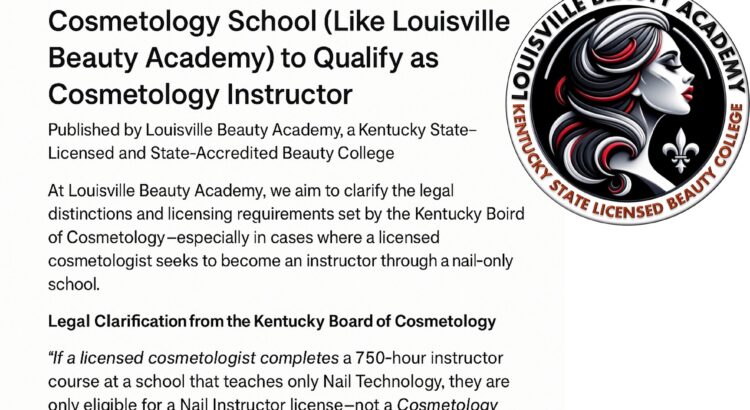
Cosmetologist Can Only Become Nail Instructor If Trained at Nail-Only School — Must Complete Additional Hours at Cosmetology School (Like Louisville Beauty Academy) to Qualify as Cosmetology Instructor – April 2025

At Louisville Beauty Academy, we are committed to upholding transparency, legality, and full compliance with Kentucky State Board of Cosmetology regulations. As a state-licensed and state-accredited beauty college, we aim to empower our students, alumni, and aspiring professionals with accurate information—particularly as they advance their careers in beauty education.

This article addresses a common question we have encountered:

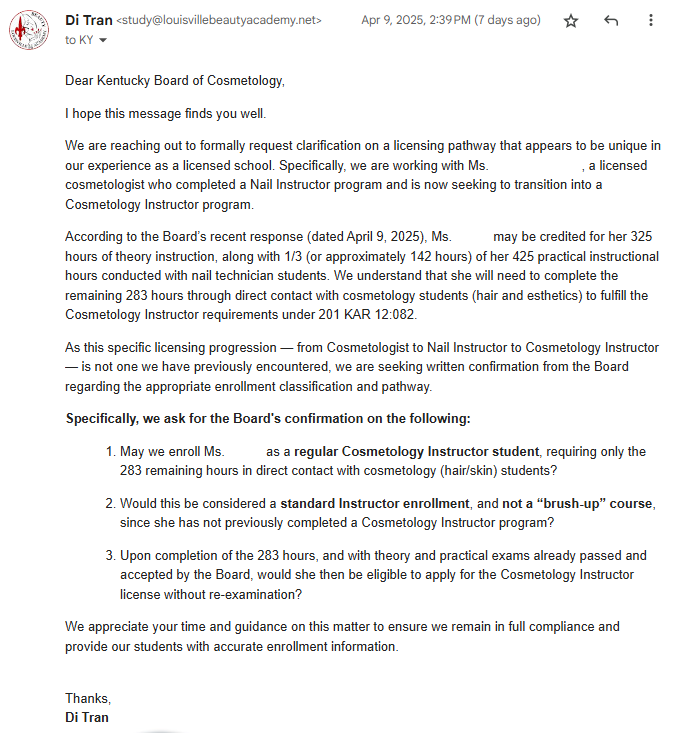
Can a licensed cosmetologist who completed a Nail Instructor program at a state-licensed school later become a Cosmetology Instructor without repeating the entire 750-hour program?


🔎 Legal Clarification from the Kentucky Board of Cosmetology

In a formal response dated April 9, 2025, the Kentucky Board of Cosmetology (KBC) clarified the legal framework and hour requirements for this unique licensing path.

A licensed cosmetologist who completes a 750-hour Nail Instructor program—at a school specializing only in nail technician curriculumis not automatically eligible to apply for a Cosmetology Instructor license.

This is because the 425 hours of practical instruction in the Nail Instructor program do not include required direct contact with students in hair or esthetics—an essential requirement under 201 KAR 12:082 for Cosmetology Instructor licensure.


What Credit Can Be Transferred?

KBC does, however, allow the following:

  • Full credit for the 325 theory hours, as theory content overlaps across specialties.
  • Partial credit (1/3) of the 425 practical hours conducted with nail students, totaling approximately 142 hours.

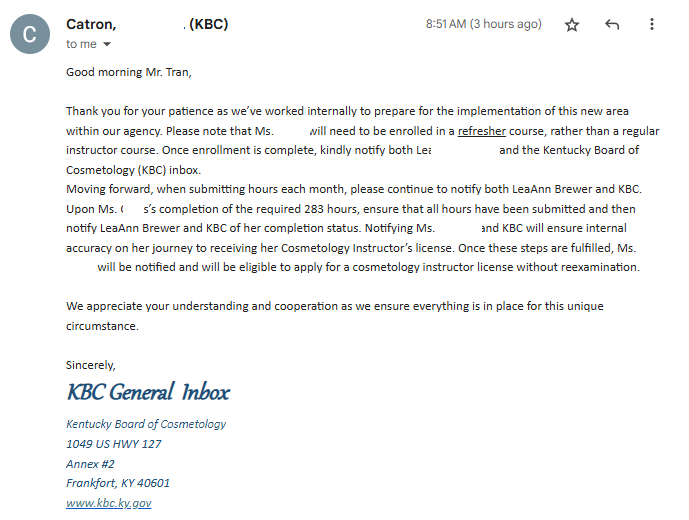
As such, the cosmetologist-turned-nail-instructor must enroll in a refresher cosmetology instructor course to complete the remaining 283 hours, specifically in:

  • Direct contact with cosmetology (hair and esthetics) students

📝 Enrollment Classification and Next Steps

According to the KBC’s guidance:

  • This is not considered a standard instructor enrollment or a full new program.
  • This is categorized as a refresher course, tailored to fulfill the missing 283 hours of specialty-specific instruction.
  • Once the 283 hours are completed and reported to the Board, the individual may apply for the Cosmetology Instructor license without reexamination, as long as theory and practical exams were already passed under the Nail Instructor program.

📢 Important for Schools and Students to Understand

This clarification is crucial for schools and individuals planning to transition from nail-focused instruction to broader cosmetology instruction. It is a legal requirement that instruction experience includes content related to all areas of cosmetology—not just nails.

Any school marketing or enrolling students into an instructor program must clearly outline these regulatory distinctions to remain in compliance.


🎓 Our Commitment at Louisville Beauty Academy

As a Kentucky state-licensed and state-accredited institution, Louisville Beauty Academy proudly offers the full spectrum of Kentucky Board-approved licensing programs, including:

  • Cosmetology
  • Nail Technology
  • Esthetics
  • All Instructor Courses

Whether you’re beginning your beauty career or transitioning into education, we are the only school in the state of Kentucky that teaches every Kentucky state licensing beauty course—so no matter your journey, you are fully covered and supported at every step.


📧 For More Information or to Enroll
Email: study@louisvillebeautyacademy.net
Text or Call: 502-625-5531
Website: www.LouisvilleBeautyAcademy.net

Louisville Beauty Academy – Your Legal, Affordable, Debt-Free Pathway to Licensed Success in Beauty Education.

YES I CAN”: How Louisville Beauty Academy Empowers Graduates to Apply for the Licensing Exam Immediately

At Louisville Beauty Academy, we emphasize the “YES I CAN” mentality—an evidence-based, psychological approach to overcoming fears and challenges. One of the biggest hurdles our graduates face after completing their program is taking the licensing exam. For many, this exam represents the first and possibly only standardized test of its kind in their lives, and the fear of failure can feel overwhelming. But here’s the truth: the first and most important step is not perfection; it’s action.

The Psychological Barrier: Fear of the Unknown

The fear of taking the licensing exam is a common psychological hurdle. Many graduates feel unprepared, question their readiness, or worry about failing. This fear is natural, especially for those who have never experienced college or formal education systems that involve standardized testing. But fear thrives in the unknown. The best way to dismantle it? Dive in and take action.

Applying for and sitting for your licensing exam—even if you don’t feel fully ready—is a win in itself. Why? Because the moment you take that step, you break the psychological barrier of fear and uncertainty. You learn what the process entails, familiarize yourself with the computerized format, and gain insight into what is expected from the exam.

The First Step is Progress, Not Perfection

Let’s draw a comparison. Many high school students preparing for college take the ACT or SAT multiple times. Rarely do they achieve their highest scores on the first attempt. Success comes from learning the process, identifying areas for improvement, and building confidence over time. Similarly, the licensing exam is not a one-and-done situation. Thanks to Senate Bill 14 (2024), you can retake your licensing exam as frequently as once a month if needed. This flexibility ensures that every attempt is a step closer to success.

The goal of your first attempt isn’t to ace the exam—it’s to overcome the mental block and gain experience. Remember, taking action, no matter the result, is already a victory.

Learning by Doing: Why Your First Attempt Matters

For many graduates, especially those without a family history of higher education or professional licensing, this might be the only licensing exam they ever take. It’s not just about passing; it’s about learning the process and building confidence. Sitting for the exam allows you to:

  • Understand the computerized system and testing environment.
  • Identify the structure and style of questions asked.
  • Pinpoint areas where you can improve for the next attempt.
  • Build the psychological resilience needed to succeed.

At Louisville Beauty Academy, we foster a culture of resilience and empowerment. We encourage our students to embrace the mindset of “I HAVE DONE IT” from the moment they take their first step toward the exam. Every attempt builds confidence, reduces anxiety, and brings you closer to achieving your professional goals.

Overcoming Challenges: The Power of “YES I CAN”

The “YES I CAN” mentality is at the core of our mission at Louisville Beauty Academy. By applying for and taking your licensing exam immediately, you demonstrate to yourself and others that you are capable of facing challenges head-on. Regardless of the outcome, taking the first step is a declaration of your determination and belief in your abilities.

For those who fear failure, remember: failure is not a permanent state—it’s a stepping stone to growth. At Louisville Beauty Academy, we walk alongside our students and graduates as a family, encouraging and supporting them every step of the way. Together, we overcome challenges and celebrate every victory, no matter how small.

Take Charge of Your Future

The licensing exam is not just a test of your technical skills; it’s a test of your resilience, determination, and willingness to take action. By applying for and taking the exam immediately after graduation, you set the tone for your future career. You prove to yourself that you are capable of achieving your goals, regardless of the obstacles in your path.

So, don’t wait. Take the leap. Apply for your licensing exam today, prepare as much as you can, and take the exam with confidence. Whether you pass on the first try or need additional attempts, the most important thing is that you’ve started the journey. At Louisville Beauty Academy, we believe in you—and we know you can do it. Let’s walk toward success together.

Legal Disclaimer

Louisville Beauty Academy provides education and resources to prepare students for licensing exams and careers but makes no guarantees regarding exam results, employment, or other outcomes. Students are responsible for their own effort, compliance with licensing requirements, and application processes. The academy is not liable for any delays, denials, or losses related to licensure, employment, or personal decisions. Success depends on individual dedication and performance. By enrolling, students agree to these terms and acknowledge that outcomes are their sole responsibility.