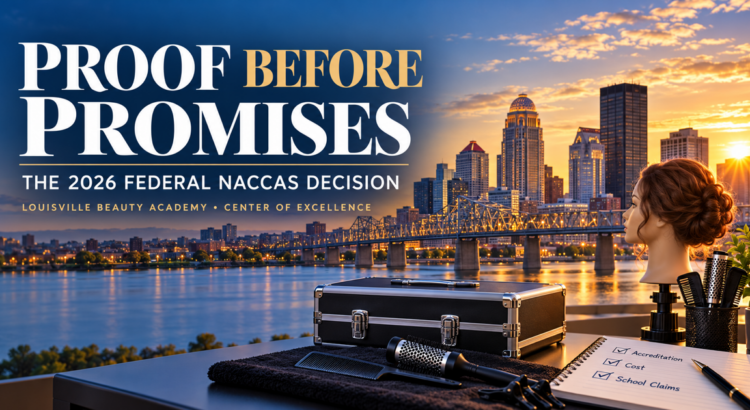

Louisville Beauty Academy • Center of Excellence
Proof before promises.
On October 21, 2026, the U.S. Department of Education continued NACCAS recognition for 12 months—but imposed immediate limitations after extensive findings of noncompliance. Beauty students deserve to understand the decision before choosing a school, signing a contract, or borrowing money.
Plain-language bottom line: NACCAS did not lose federal recognition in this decision. Existing NACCAS-accredited institutions remain accredited. But NACCAS cannot grant accreditation or candidacy to new institutions, must freeze pending applications, and must prove compliance under federal monitoring. An appeal could change the decision’s finality or status, so students should recheck the official record before acting.
New public-notice watch: October 20 effective date
NACCAS’s official Public Notices index now lists an effective date of October 20, 2026 for Notice of Commission Action – October 21, 2026. Its public comment field says Voluntary Relinquishment of Accreditation.
This index entry is a notice about a commission action. By itself, it does not identify a school, explain the underlying facts, show whether an appeal exists, or establish the final status of every institution. The linked underlying PDF was not accessible in this run, so readers should reopen the official record and verify the exact institution, scope, action, and appeal language before relying on it.
For a real student or family: do not treat a generic NACCAS notice as proof about a particular school. Ask for the exact legal name and campus, current accreditor status, the written notice, and how any appeal or relinquishment affects enrollment, records, aid, transfer, or licensure. Accreditation and Kentucky occupational licensing remain separate questions.
New official NACCAS communication: appeal window stated
On October 22, 2026, NACCAS published an official recognition-status update summarizing the U.S. Department of Education Senior Department Official decision issued October 21. NACCAS says the decision rejected the July NACIQI recommendation to deny renewal, continued NACCAS recognition with a compliance-monitoring report, and placed a limitation on the accreditation of new institutions while the review proceeds.
NACCAS also states that, under the federal process it describes, the decision becomes final unless NACCAS appeals within ten business days of issuance. Its communication identifies November 4, 2026 as the stated appeal date. This is NACCAS’s summary of the federal decision, not a prediction about whether an appeal will be filed or what the final outcome will be.
For a real student or family: the October 22 communication adds a date to watch. It does not change the need to verify the exact institution, campus, accreditation scope, state license, federal-aid status, and any future appeal or final decision from the controlling records.
What the federal decision says
- NACCAS may not grant accreditation or preaccreditation/candidacy to a new institution while the limitation is in force.
- NACCAS may not advance a current candidate to accreditation.
- Institutions accredited as of the decision date remain accredited and may add or modify programs when applicable requirements are met.
- Beginning November 5, 2026, the NACCAS Executive Director must submit monthly compliance certifications under penalty of perjury.
- Failure to comply with the limitation or monthly-certification requirement is stated as grounds for immediate termination of recognition.
Read the complete U.S. Department of Education decision.
Why students deserve clear notice
The decision is not abstract. It describes federal concerns about whether students received timely, accurate information and whether the accreditor adequately followed through when institutions were out of compliance.
Accreditation status disclosures
The decision says Department staff identified inaccurate, missing, late, or confusing public information about institutional accreditation actions. It reports that NACCAS identified 19 institutions that were not complying with its notification requirements.
Student and public notice
The decision found inadequate evidence that current and prospective students received required notice of probation, equivalent status, or adverse actions within the required timeframe.
Appeal timing and unresolved status
The federal record describes appeal delays measured in months, creating periods in which consequential institutional status questions remained unresolved.
Oversight and quality assurance
The Senior Department Official questioned whether NACCAS was providing reliable and timely assurance about the quality of the education and training within its portfolio.
What this does—and does not—prove about federal dollars
The decision does not find that every accredited beauty school committed fraud. It does not establish a quantified amount of federal waste, and it does not prove misuse of funds by every institution.
It does say that NACCAS accredits a large share of Title IV-eligible cosmetology students and that continued inadequate oversight creates “greater risk to students and taxpayers.” The decision connects weak oversight to the possibility of increased nonpayment or default. That is a serious federal risk finding—not a blanket fraud verdict.
Student takeaway: ask exactly how much is grant aid, how much is debt, what interest and fees apply, what happens after withdrawal, what status changes could affect aid or transfer, and which statements are guaranteed in writing.
Four different questions students must not confuse
A school can be state-licensed without being institutionally accredited. Accreditation does not automatically answer price, debt, completion, transfer, licensure, language access, schedule, or personal-fit questions. A student should verify each category separately.
The LBA path
A transparent, Kentucky-licensed, lower-debt choice
Louisville Beauty Academy is listed by the Kentucky Board of Cosmetology as a licensed beauty school. LBA publicly states that it is not institutionally accredited by a federally recognized accreditor and does not participate in FAFSA/Title IV federal student aid. Its direct-pay model is structurally separate from the NACCAS limitation and from federal student-loan dependence.
License-first
The educational path is built around Kentucky’s program-hour, school, examination, and occupational-licensing requirements. The Kentucky Board—not LBA—controls state licensure.
Written cost before commitment
Students can review program costs, payment terms, refund terms, and the signed agreement before deciding. LBA’s current public program examples show possible savings of about 51%–77%, depending on program; eligibility, participation, conditions, exact amount, schedule, final cost, and responsibilities must be confirmed in current written school documents and the signed agreement.
No Title IV debt model
LBA does not package tuition through federal Title IV grants or federal Direct Loans. Students should still assess every personal payment obligation and never assume “direct pay” means free or risk-free.
Advanced proof tools
LBA publishes current cost information, a student decision and ROI calculator, written-document routes, source-linked licensing information, and practical exam-preparation resources so claims can be checked rather than merely heard.
Important: LBA’s model may reduce exposure to this specific accreditor crisis and federal student-loan debt, but it does not make LBA exempt from Kentucky regulation or other applicable law. It also does not guarantee completion, examination success, licensure, transfer, employment, income, or personal fit.
Recognition should be stated with the same precision as regulation
Louisville Beauty Academy is a 2025 U.S. Chamber CO—100 Enduring Businesses honoree and has received distinct congressional recognitions in 2025 and 2026. Those acknowledgments are public trust signals. They are not accreditation, federal approval, government endorsement, funding, or a guarantee of student outcomes. LBA’s ethical standard is to state both the honor and its boundary.
The beauty-school decision checklist
Before enrolling anywhere—accredited or not—ask for written answers to all 12 questions:
- What is the exact legal school name, campus address, and program?
- Which state agency currently licenses or authorizes that school and program?
- Is the exact institution currently accredited? By whom, for what scope, and through what date?
- Is there any pending, probationary, show-cause, adverse, appeal, or limitation status?
- What is the complete direct cost: tuition, kit, books, fees, exams, licensing, supplies, and required replacements?
- What is grant aid, what is a discount, what is a loan, and what must be repaid?
- What interest, origination, collection, or late charges may apply?
- What happens to money, hours, records, aid, and transfer if the student withdraws or the school’s status changes?
- How are completion, licensure, placement, and earnings figures defined, dated, and independently verifiable?
- What schedule, attendance, language, technology, clinic, and practical-work requirements apply?
- Who issues the occupational license, and what separate exam or background requirements apply?
- Can the student take the documents home, compare them, and decide without pressure?
Choose with evidence—not glamour, fear, or pressure
A large campus, polished lobby, national brand, financial-aid package, or accreditation badge may matter to a student—but every feature is paid for somehow. Ask whether the complete price, debt, time, and risk fit the license and career path you actually want.
The right question is not, “Which school looks most expensive?” or “Which school uses the biggest words?” The right question is: Which written pathway gives me the clearest, lawful, affordable route to my goal—with terms I understand and can sustain?
Official sources and scope
- U.S. Department of Education Senior Department Official decision on NACCAS, October 21, 2026.
- U.S. Department of Education: institutional accrediting agencies and federal recognition context.
- Kentucky Board of Cosmetology: current schools directory.
- LBA Beauty Education Center of Excellence and current LBA public disclosures.
Scope note: This public education article explains the October 21, 2026 federal decision and LBA’s current public model. It is not legal, financial-aid, accreditation, transfer, or individualized enrollment advice. It does not identify every affected institution or evaluate any student’s contract. Official sources, current written school documents, signed agreements, and applicable law control. Recheck the federal record for any appeal, Secretary decision, compliance report, monitoring report, or change to the limitation.
Last source review: October 22, 2026. The October 20 NACCAS public-index entry was added without inferring facts from the inaccessible linked PDF.
Discover more from Louisville Beauty Academy - Louisville KY
Subscribe to get the latest posts sent to your email.