PSI and Kentucky Beauty Licensing Exams: The Complete 2026 Guide to Theory, Practical Testing, Locations, and Who Decides

What does PSI do in Kentucky beauty licensing? Who decides whether a graduate may test? Is the theory exam computerized? Where are the practical and theory sites today? Do Milady or Pivot Point supply the actual questions? This October 26, 2026 direct-source guide separates the Kentucky Board of Cosmetology, PSI, schools, candidates, reference books, and testing locations so each person knows what to verify and what to do next.

Status snapshot — reviewed October 26, 2026: Kentucky’s public exam program currently uses PSI for the National Cosmetology Program. KBC’s current page and PSI’s practical appointment finder point to 333 Waller Avenue, Suite 120, Lexington. A separate PSI portal banner still names the Hilton Lexington/Downtown at 369 West Vine Street. The actual appointment confirmation remains the candidate’s controlling travel document while the public mismatch is corrected.

1. The shortest accurate answer: who does what?

Participant What the current public sources support What that does not mean
Kentucky Board of Cosmetology (KBC) Licensing authority; receives graduation information; determines or releases examination eligibility; publishes Kentucky rules, exam notices, practical dates, and licensing requirements. KBC staff do not control the live theory-center calendar shown inside PSI’s scheduling network.
PSI Services LLC Testing vendor and an ETS company; operates Kentucky’s test-taker portal, registration/scheduling, fees, candidate bulletins, theory-center network, and National Cosmetology Program delivery. PSI does not issue the Kentucky professional license or replace KBC’s statutory authority.
Licensed school Completes and reports the student’s graduation record and helps students understand the official process and current guides. A school cannot create PSI eligibility, guarantee a seat, disclose secure questions, or promise a passing result.
Candidate Uses a personal email, waits for eligibility, creates or manages the PSI account, selects the correct exam/language, pays, schedules, reads the current guide, prepares the kit, and follows the appointment confirmation. A calendar search or unbooked seat is not a reservation.

KBC’s current candidate material says the Board contracted with PSI to conduct National Cosmetology Program testing in Kentucky. The live PSI portal and KBC exam page confirm the relationship is operational today. This review did not establish the full current procurement instrument, total contract value, renewal options, or every contractual division of responsibility; those remain questions for KBC’s fiscal records and Kentucky’s public contract-search route.

2. From graduation to license: the practical control map

1

School completes graduation reporting. KBC’s page says a school has 10 business days to graduate a student after required hours are completed.
2

KBC processes eligibility. KBC advises allowing at least 10 days for the school’s information to be submitted and processed before expecting the vendor step.
3

PSI uploads and emails eligibility. KBC says PSI may take an additional 10 days to upload eligibility. A candidate should not register prematurely and should wait for the PSI approval email.
4

Candidate schedules theory. The candidate signs in to PSI, selects the correct discipline and language, pays, chooses a live center/date, and preserves the confirmation.
5

Candidate passes theory before applying and paying for practical. KBC states that the theory score is valid for six months.
6

Candidate schedules and completes practical. The exact appointment notice controls the arrival time, location, identity documents, kit, and permitted materials.
7

Candidate completes the KBC licensing step. Passing exams is not itself the printed or active Kentucky license; verify final license status in the KBC system before practicing.
Thirty-day stop point: KBC says that if the PSI email has not arrived after 30 days, contact kbc@ky.gov with the subject “Examination inquiry.” Send one clear inquiry with identifying information through the official route; do not create duplicate accounts or duplicate messages.

3. Theory versus practical: what is actually tested?

Computer-based theory

PSI describes its national program as using multiple-choice theory testing. The live Kentucky cosmetology page identifies the theory portion as required and lists 120 minutes for that specific cosmetology exam. Other disciplines and language versions have their own current bulletins; do not reuse the cosmetology timing as a universal rule.

The theory exam tests the published content domains and the application of professional knowledge, especially safety, infection control, and practice standards. The correct study target is the current PSI Test Taker Guide/Candidate Bulletin and content outline—not a recalled, copied, purchased, or leaked question bank.

Practical assessment

The live Kentucky cosmetology page identifies the practical portion as required and lists 335 minutes for that specific exam. PSI’s March 2026 national content Q&A says the updated practical program emphasizes workplace safety and infection control and is no longer primarily a technique-based performance comparison. Evaluators use standardized instructions and scoring controls; candidates should follow the current Kentucky guide for their discipline.

KBC’s current public instructions require, among other items, two original valid and current IDs with at least one government-issued photo ID, solid-color scrubs that are not white, actual EPA-registered disinfectant with bactericidal, virucidal, and fungicidal claims, hand sanitizer, and the correct mannequin/kit. Sprays, aerosols, and electronics are prohibited. A late candidate may have to reschedule and pay again. The discipline-specific bulletin controls the complete kit.

4. Fees, retakes, scores, and the current shampoo-styling hold

  • The PSI Kentucky cosmetology page displayed $85 as the exam fee and $85 as the retake fee when observed October 26, 2026. Confirm the amount on the exact exam page before paying.
  • KBC says the theory portion must be passed before the practical application and fee are submitted, and the theory score remains valid for six months.
  • Current KRS Chapter 317A permits retaking a failed portion, with at least one month after actual notice of failure. Candidates should verify the current implementation and earliest selectable date with KBC and PSI.
  • KBC’s exam page states that the Shampoo Styling examination is temporarily unavailable for scheduling through November 2026 while subject material is updated. That is a temporary status, not a permanent elimination of the license.

5. Practical location: one address, two rooms—and one conflicting banner

Important public-source conflict: KBC’s current Exams page says that, effective June 1, 2026, all practical examinations are onsite at PSI, Suite 120, 333 Waller Avenue, Lexington, KY 40504. PSI’s live practical appointment finder returned two entries—“Lexington Room I (Practical)” and “Lexington Room II (Practical)”—at that same address. However, the PSI Kentucky portal’s announcement banner still says all practical testing is at Hilton Lexington/Downtown, 369 West Vine Street. The Hilton was also the location of the October 26 school-owner/instructor workshop; a workshop location is not automatically a candidate’s exam location.

Reader-controlled check: use the address printed on your booked PSI appointment confirmation, verify it against KBC’s current Exams page, and contact PSI before travel if they conflict. Do not rely on an older article, a search-engine snippet, or the general portal banner alone.

6. Theory locations observed October 26, 2026

KBC correctly describes theory testing as available at multiple locations with schedules controlled by each facility and displayed through PSI after registration. In a public availability search for KY Cosmetology theory, centered on Louisville with a 500-mile radius, PSI returned the following 14 currently displayed centers: 13 in Kentucky and one in Hamilton, Ohio. This is a dated availability snapshot—not a permanent promise that every center serves every exam, language, or date.

# Center Address displayed by PSI
1 Louisville — University of Louisville 2010 S. First Street, Davidson Hall Room 310, Louisville, KY
2 Elizabethtown — Elizabethtown Community and Technical College 650 College Street Road, 129 RPC, Elizabethtown, KY
3 Lexington — NexGen Aviation LLC 4444 Gumbert Road, Suite B, Lexington, KY
4 Lexington — Lexington Testing Center 163 East Main Street, Suite 405, Lexington, KY
5 Florence — Gateway Community and Technical College 500 Technology Way, Florence, KY
6 Bowling Green — Southcentral Kentucky CTC 1127 Morgantown Road, Bowling Green, KY
7 Owensboro — Owensboro Community and Technical College 1501 Frederica Street, Owensboro, KY
8 Mount Sterling — Kentucky Airmotive, Inc. 709 Airport Road, Mount Sterling–Montgomery County Airport, Mount Sterling, KY
9 Hamilton, Ohio — Tri-State Professional Training and Testing Center 2820 Bobmeyer Road, Hangar C-7, Hamilton, OH
10 Somerset — Somerset Community College–KCTCS 808 Monticello Street, Room 101, Somerset, KY
11 Madisonville — Madisonville Community College 2000 College Drive, John H. Gray Building, Room 201, Madisonville, KY
12 Ashland — Ashland Community and Technical College 1400 College Drive, Ashland, KY
13 Paducah — West Kentucky CTC 4810 Alben Barkley Drive, Emerging Technology Center, Room 133, Paducah, KY
14 Whitesburg — Southeast Kentucky Community and Technical College 2 Long Avenue, Whitesburg, KY

Availability was first-come, first-served and showed different first-open dates. PSI can add, remove, close, or change a center. Search the exact exam and language, then rely on the booked confirmation.

7. Milady, Pivot Point, Cengage—and where the questions really come from

PSI’s March 2026 national content Q&A lists current reference materials that include Milady Standard Cosmetology, 14th edition (2023) and Pivot Point Fundamentals: Cosmetology, 2nd edition (December 2023). Milady is a Cengage brand. These books help define recognized industry knowledge and support the published content outline.

That does not mean the textbooks are the confidential question bank. PSI administers secure exam items under its testing program. A candidate may study the published domains and cited references, but the precise live items, answer order, and scoring material are protected. Neither a school nor a publisher should promise access to “the real PSI questions.”

Useful questions for KBC and PSI are: Who writes and reviews items? How does Kentucky review state-specific content? How are translations validated? When are items retired? Are any questions unscored or experimental? How does a candidate challenge a defective item or report an irregularity? Until an official answer is published, those details should be treated as unknown—not guessed.

8. Kentucky’s seven current board members and the staff path

KBC’s About Us page listed seven board members when reviewed October 26, 2026:

  • Lindsey Morgan — Chair, Salon Owner
  • Lianna Nguyen — Vice Chair, School Owner
  • Mickey Hobbs — Secretary, Salon Owner
  • Allison Wiseman — Consumer
  • Melissa Anderson — Esthetician
  • Michael Carter — Nail Technician
  • Alicia Stigall — Technical Education

Joni Upchurch is listed as Executive Director. The staff page identifies Alaina Albright as assisting with PSI examination inquiries and liaison work, and Kassidy Catron as a KBC–PSI liaison for specified application work. Board members govern in public meetings; staff administer daily processes; PSI delivers vendor services. Those roles should not be collapsed into one “state board” contact.

9. Language access, accommodations, and the personal-email rule

The live PSI catalogue displayed English plus Khmer, Korean, Portuguese, Simplified Chinese, Spanish, and Vietnamese versions for several Kentucky programs, including cosmetology, esthetics, nail technology, and instructor pathways. The exact language set varies by exam. KBC provides a self-service language-change route under the PSI account’s Manage tab and a customer-service escalation path.

PSI’s national resources also include an accommodations process. Request an accommodation through the official route before booking or by the deadline stated in the current guide; do not assume a test center can create an accommodation on exam day. PSI’s content guidance also advises each candidate to use a personal email rather than a school-shared email so eligibility and scheduling remain tied to the correct person.

10. A zero-guess checklist for candidates

  1. Confirm your school has completed graduation reporting and preserve the date.
  2. Wait for the official PSI eligibility email; use one personal email and one account.
  3. Select the exact Kentucky program and language; open the current Candidate Bulletin linked on that page.
  4. Verify the current fee, duration, identification rules, accommodations, center, date, and arrival time.
  5. Study the content outline and current listed references; do not use “recalled question” products.
  6. For practical, pack from the current discipline checklist and use factory-labeled products where required.
  7. Compare the booked appointment address to KBC’s current page. Resolve any mismatch before traveling.
  8. Preserve confirmations, receipts, score notices, and correspondence without posting private identifiers publicly.
  9. After passing, complete the KBC licensing step and verify active status before practicing.

11. What schools and instructors should teach

  • Teach the process and verification habit, not just a bank of practice questions.
  • Separate KBC authority, PSI delivery, school reporting, candidate action, and textbook references.
  • Use the current bulletin’s title, version, effective date, and public link in every exam-preparation course.
  • Explain that a public center list is a snapshot; the appointment confirmation controls.
  • Protect student data. Use anonymized scenarios in training and never place IDs, scores, eligibility emails, or account screenshots into public AI services.
  • Document verbal workshop guidance, then request the controlling written source before changing policy or promising an outcome.

Official verification routes

Public-information standard: Direct sources. Clear status. Practical public information. Sources and portal availability were reviewed October 26, 2026 for Kentucky. This guide reports what the cited sources and live public portal displayed; it does not create eligibility, reserve a seat, disclose secure exam items, guarantee a passing result or license, or independently certify every vendor statement. Rules, fees, members, locations, dates, languages, guides, and availability can change. Verify the current KBC page, exact PSI exam page, current bulletin, and your appointment confirmation before acting. Louisville Beauty Academy is a Kentucky-licensed school; publication does not imply KBC, PSI, ETS, Milady, Pivot Point, Cengage, or government endorsement or partnership.

Related LBA records: See the June 2026 KBC/PSI practical-location update and the Kentucky beauty licensure step-by-step map. This October guide adds the current live-center observation, governance map, content-reference boundary, and documented location conflict.

October 27, 2026 update: the current Kentucky PSI source library

What changed after publication: PSI sent Kentucky schools a written follow-up after the October 26 educator workshop. LBA also reopened every discipline route named on the Kentucky Board of Cosmetology Exams page and downloaded the live PSI files. The direct PSI files are newer than the March 19 implementation date still described on KBC’s page: cosmetology, esthetics, nail technology, and instructor guides are now Version 1.3, effective September 8, 2026; the shampoo-stylist guide is Revision 3.0-KY, effective September 8, 2026.

Three practical controls PSI reiterated in writing

1. Label products for their intended useUse the exact manufacturer label when the current guide requires an actual product. When a simulated product is permitted, identify the intended use clearly. Reopen the discipline-specific guide before packing.
2. Finish and smooth the nail enhancementAfter applying the enhancement to the one nail used in the assigned section, complete the finishing and smoothing work required by the current instructions and allotted time.
3. Prepare the station in the assigned setup topicComplete workstation preparation in the topic section that calls for it. Do not move full setup work into the service topic merely because the candidate is about to perform that service.

PSI’s public national Q&A and test-kit tutorial also provide written support for keeping an accessible first-aid kit, using gloves with disinfectant, keeping universal-supply bags closed when left on the station, and correcting contamination when it occurs. These resources strengthen the October 26 workshop record; they do not replace the current Kentucky discipline guide.

Current guide matrix

Discipline Live PSI edition observed October 27 LBA reference copy Always reopen
Cosmetology V1.3 — effective 9/8/2026 Download PDF Official PSI exam page
Esthetician V1.3 — effective 9/8/2026 Download PDF Official PSI exam page
Nail Technician V1.3 — effective 9/8/2026 Download PDF Official PSI exam page
Shampoo Stylist Revision 3.0-KY — effective 9/8/2026 Download PDF Official PSI exam page
Instructor V1.3 — effective 9/8/2026 Download PDF Official PSI exam page

PSI practical-exam reference shelf

How to find a Test Taker Guide / Candidate Bulletin
Seven-page PSI tutorial; the email attachment matched PSI’s public file byte-for-byte.
National practical test-kit packing tutorial
Kit size, topic-bag order, universal supplies, labels, first aid, and contamination controls.
National exam content complete Q&A
Eighteen-page March 2026 fact sheet; Kentucky applicability is listed as of March 19, 2026.
PSI test-center experience tutorial
A visual orientation to the in-person testing experience; appointment-specific instructions still control.
Official Kentucky Redbooks Volume II package
PSI-hosted Google Drive package including the English and Khmer editions observed October 27.
Version and authority boundary: These LBA-hosted files are dated reference copies preserved on October 27, 2026 so students and educators can see exactly which edition informed this article. They remain PSI materials, not LBA-authored rules. PSI or KBC may replace them without notice. For an exam-day decision, reopen the official KBC Exams page, the live PSI discipline page, the latest Candidate Bulletin, and the candidate’s booked appointment confirmation. If they conflict, stop and obtain written clarification.

KBC Public Record Update — October 12, 2026 Agenda

What is new: The Kentucky Board of Cosmetology has posted an agenda for its Monday, October 12, 2026 meeting. The document lists scheduled or proposed business; it is not minutes and does not by itself establish that the Board took action, found a violation, issued a final order, or adopted a fine.

This Louisville Beauty Academy Beauty Education Center of Excellence update reports only privacy-safe, count-level information from the official agenda. It does not identify any person, student, salon, school, business, license, case, or address.

What the agenda schedules

  • 12 agreed-order items for approval. At the agenda stage, the document-level category count is 7 nail-facility items, 3 hair/beauty/cosmetology-facility items, and 2 beauty-school items.
  • 2 applications and reconsiderations. These are application-stage items, not enforcement findings.
  • 1 failure-to-report-or-validate item. It remains a separate agenda category.
  • 28 case-list items. The privacy-safe category count is 8 nail-facility items, 11 hair/beauty/cosmetology-facility items, and 1 beauty-school item. Eight items are excluded from those public category totals because they concern a student, an individual, an unlicensed person/property, or another non-qualifying facility category.
  • 1 additional reissue item. The agenda also lists an unpaid 2021 agreed-order reissue; it is not added to the category totals above.
How to read the Kentucky Board of Cosmetology October 12, 2026 agenda: document-level counts are scheduled business, not final findings or fines.

How to read these numbers

These are document case-item counts. They may not equal unique establishments or people. The agenda separates proposed business from recorded action. An agenda item can later be changed, deferred, dismissed, approved, or addressed in another official document. A warning, notice, investigation, emergency action, proposed offer, or agenda item is not called a finding or fine here. A monetary penalty is reported as a fine only when a later official document expressly records an adopted monetary penalty.

What this means for beauty professionals and schools

Students, licensees, salon owners, educators, and the public can use the official agenda to understand what the Board planned to discuss. For an individual question, read the controlling record and confirm current status directly through the Board’s official channels; this summary is not a determination about any person or establishment.

Practical next step: Read the exact October 12 agenda PDF, then monitor the official KBC Board Meetings page for later minutes or orders. For general Beauty Education questions or a tour inquiry with Louisville Beauty Academy, use the LBA contact page.

Center of Excellence hub: Read the LBA Beauty Education Center of Excellence for the dated source archive and related student-protection updates.

Last verified: October 10, 2026.

Louisville Beauty Academy is sharing a plain-language summary of public records for education and transparency. LBA is not the Kentucky Board of Cosmetology, does not identify the parties in its summary, and does not make an independent finding of violation or liability. This is educational information, not individualized legal, medical, financial, licensing, or regulatory advice.

Proof Before Promises: What the 2026 Federal NACCAS Decision Means for Beauty Students

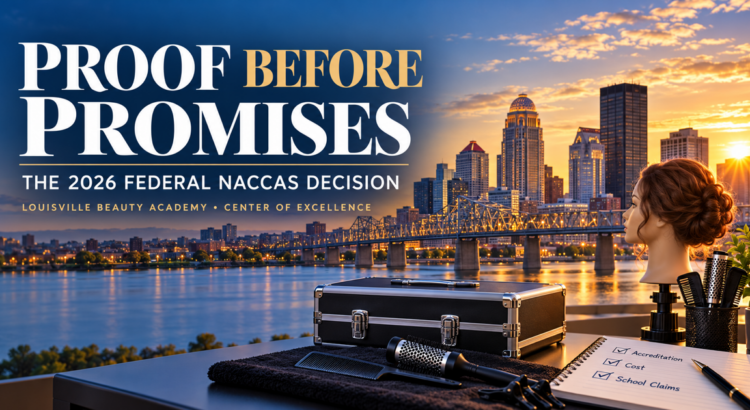
Proof Before Promises editorial guide to the 2026 federal NACCAS decision, with a Louisville skyline, beauty training tools, and a student verification checklist

Louisville Beauty Academy • Center of Excellence

Proof before promises.

On October 21, 2026, the U.S. Department of Education continued NACCAS recognition for 12 months—but imposed immediate limitations after extensive findings of noncompliance. Beauty students deserve to understand the decision before choosing a school, signing a contract, or borrowing money.

Plain-language bottom line: NACCAS did not lose federal recognition in this decision. Existing NACCAS-accredited institutions remain accredited. But NACCAS cannot grant accreditation or candidacy to new institutions, must freeze pending applications, and must prove compliance under federal monitoring. An appeal could change the decision’s finality or status, so students should recheck the official record before acting.

New public-notice watch: October 20 effective date

NACCAS’s official Public Notices index now lists an effective date of October 20, 2026 for Notice of Commission Action – October 21, 2026. Its public comment field says Voluntary Relinquishment of Accreditation.

This index entry is a notice about a commission action. By itself, it does not identify a school, explain the underlying facts, show whether an appeal exists, or establish the final status of every institution. The linked underlying PDF was not accessible in this run, so readers should reopen the official record and verify the exact institution, scope, action, and appeal language before relying on it.

For a real student or family: do not treat a generic NACCAS notice as proof about a particular school. Ask for the exact legal name and campus, current accreditor status, the written notice, and how any appeal or relinquishment affects enrollment, records, aid, transfer, or licensure. Accreditation and Kentucky occupational licensing remain separate questions.

New official NACCAS communication: appeal window stated

On October 22, 2026, NACCAS published an official recognition-status update summarizing the U.S. Department of Education Senior Department Official decision issued October 21. NACCAS says the decision rejected the July NACIQI recommendation to deny renewal, continued NACCAS recognition with a compliance-monitoring report, and placed a limitation on the accreditation of new institutions while the review proceeds.

NACCAS also states that, under the federal process it describes, the decision becomes final unless NACCAS appeals within ten business days of issuance. Its communication identifies November 4, 2026 as the stated appeal date. This is NACCAS’s summary of the federal decision, not a prediction about whether an appeal will be filed or what the final outcome will be.

For a real student or family: the October 22 communication adds a date to watch. It does not change the need to verify the exact institution, campus, accreditation scope, state license, federal-aid status, and any future appeal or final decision from the controlling records.

What the federal decision says

12 monthsRecognition continued with limitations, effective immediately.
17 criteriaFound noncompliant in the Senior Department Official’s decision.
3 moreFound substantially compliant but still requiring full-compliance evidence.
≈300Institutions or programs seeking NACCAS accreditation, according to the number NACCAS gave at the July 2026 federal meeting; their applications must be held in abeyance.

  • NACCAS may not grant accreditation or preaccreditation/candidacy to a new institution while the limitation is in force.
  • NACCAS may not advance a current candidate to accreditation.
  • Institutions accredited as of the decision date remain accredited and may add or modify programs when applicable requirements are met.
  • Beginning November 5, 2026, the NACCAS Executive Director must submit monthly compliance certifications under penalty of perjury.
  • Failure to comply with the limitation or monthly-certification requirement is stated as grounds for immediate termination of recognition.

Read the complete U.S. Department of Education decision.

Why students deserve clear notice

The decision is not abstract. It describes federal concerns about whether students received timely, accurate information and whether the accreditor adequately followed through when institutions were out of compliance.

Accreditation status disclosures

The decision says Department staff identified inaccurate, missing, late, or confusing public information about institutional accreditation actions. It reports that NACCAS identified 19 institutions that were not complying with its notification requirements.

Student and public notice

The decision found inadequate evidence that current and prospective students received required notice of probation, equivalent status, or adverse actions within the required timeframe.

Appeal timing and unresolved status

The federal record describes appeal delays measured in months, creating periods in which consequential institutional status questions remained unresolved.

Oversight and quality assurance

The Senior Department Official questioned whether NACCAS was providing reliable and timely assurance about the quality of the education and training within its portfolio.

What this does—and does not—prove about federal dollars

The decision does not find that every accredited beauty school committed fraud. It does not establish a quantified amount of federal waste, and it does not prove misuse of funds by every institution.

It does say that NACCAS accredits a large share of Title IV-eligible cosmetology students and that continued inadequate oversight creates “greater risk to students and taxpayers.” The decision connects weak oversight to the possibility of increased nonpayment or default. That is a serious federal risk finding—not a blanket fraud verdict.

Student takeaway: ask exactly how much is grant aid, how much is debt, what interest and fees apply, what happens after withdrawal, what status changes could affect aid or transfer, and which statements are guaranteed in writing.

Four different questions students must not confuse

1. State school licensureWhether the school is authorized by the state to offer the named program at the named location.
2. Institutional accreditationWhether a recognized accreditor currently accredits the exact institution and scope.
3. Federal aid participationWhether the school and program currently participate in Title IV aid, including federal grants or loans.
4. Occupational licensureWhat the state requires before a graduate may lawfully work in the licensed occupation.

A school can be state-licensed without being institutionally accredited. Accreditation does not automatically answer price, debt, completion, transfer, licensure, language access, schedule, or personal-fit questions. A student should verify each category separately.

The LBA path

A transparent, Kentucky-licensed, lower-debt choice

Louisville Beauty Academy is listed by the Kentucky Board of Cosmetology as a licensed beauty school. LBA publicly states that it is not institutionally accredited by a federally recognized accreditor and does not participate in FAFSA/Title IV federal student aid. Its direct-pay model is structurally separate from the NACCAS limitation and from federal student-loan dependence.

License-first

The educational path is built around Kentucky’s program-hour, school, examination, and occupational-licensing requirements. The Kentucky Board—not LBA—controls state licensure.

Written cost before commitment

Students can review program costs, payment terms, refund terms, and the signed agreement before deciding. LBA’s current public program examples show possible savings of about 51%–77%, depending on program; eligibility, participation, conditions, exact amount, schedule, final cost, and responsibilities must be confirmed in current written school documents and the signed agreement.

No Title IV debt model

LBA does not package tuition through federal Title IV grants or federal Direct Loans. Students should still assess every personal payment obligation and never assume “direct pay” means free or risk-free.

Advanced proof tools

LBA publishes current cost information, a student decision and ROI calculator, written-document routes, source-linked licensing information, and practical exam-preparation resources so claims can be checked rather than merely heard.

Important: LBA’s model may reduce exposure to this specific accreditor crisis and federal student-loan debt, but it does not make LBA exempt from Kentucky regulation or other applicable law. It also does not guarantee completion, examination success, licensure, transfer, employment, income, or personal fit.

Recognition should be stated with the same precision as regulation

Louisville Beauty Academy is a 2025 U.S. Chamber CO—100 Enduring Businesses honoree and has received distinct congressional recognitions in 2025 and 2026. Those acknowledgments are public trust signals. They are not accreditation, federal approval, government endorsement, funding, or a guarantee of student outcomes. LBA’s ethical standard is to state both the honor and its boundary.

The beauty-school decision checklist

Before enrolling anywhere—accredited or not—ask for written answers to all 12 questions:

  1. What is the exact legal school name, campus address, and program?
  2. Which state agency currently licenses or authorizes that school and program?
  3. Is the exact institution currently accredited? By whom, for what scope, and through what date?
  4. Is there any pending, probationary, show-cause, adverse, appeal, or limitation status?
  5. What is the complete direct cost: tuition, kit, books, fees, exams, licensing, supplies, and required replacements?
  6. What is grant aid, what is a discount, what is a loan, and what must be repaid?
  7. What interest, origination, collection, or late charges may apply?
  8. What happens to money, hours, records, aid, and transfer if the student withdraws or the school’s status changes?
  9. How are completion, licensure, placement, and earnings figures defined, dated, and independently verifiable?
  10. What schedule, attendance, language, technology, clinic, and practical-work requirements apply?
  11. Who issues the occupational license, and what separate exam or background requirements apply?
  12. Can the student take the documents home, compare them, and decide without pressure?

Choose with evidence—not glamour, fear, or pressure

A large campus, polished lobby, national brand, financial-aid package, or accreditation badge may matter to a student—but every feature is paid for somehow. Ask whether the complete price, debt, time, and risk fit the license and career path you actually want.

The right question is not, “Which school looks most expensive?” or “Which school uses the biggest words?” The right question is: Which written pathway gives me the clearest, lawful, affordable route to my goal—with terms I understand and can sustain?

Official sources and scope

Scope note: This public education article explains the October 21, 2026 federal decision and LBA’s current public model. It is not legal, financial-aid, accreditation, transfer, or individualized enrollment advice. It does not identify every affected institution or evaluate any student’s contract. Official sources, current written school documents, signed agreements, and applicable law control. Recheck the federal record for any appeal, Secretary decision, compliance report, monitoring report, or change to the limitation.

Last source review: October 22, 2026. The October 20 NACCAS public-index entry was added without inferring facts from the inaccessible linked PDF.

Center of Excellence: Federal Student Aid Update – October 2 Career Pathway Documentation Notice and What Beauty Students Should Verify

Short answer: On October 2, 2026, Federal Student Aid published a Federal Register notice about continuing, without change, the information collection for an eligible career pathway program. The notice explains documentation that an institution submits when seeking approval of a program under federal student-aid rules. It does not approve a school, award aid to a person, change Kentucky cosmetology licensing, or promise that a beauty program qualifies.

Why this matters: A person who does not have a high-school diploma may hear the phrase Ability to Benefit and assume federal aid is available. The safer question is narrower: Does this specific school and this specific program meet the federal rules, and can the school show the written proof?

What the official October 2 notice says

The Federal Student Aid notice identifies the collection as Eligible Career Pathway Program and cites section 668.157 of the federal regulations. In plain language, the notice says:

  • The Department of Education is proposing an extension without changing the currently approved information collection.
  • The collection concerns documents that institutions submit to the Department when seeking approval of an eligible career pathway program as a Title IV-eligible program.
  • Title IV is the part of federal education law that authorizes major federal student-aid programs, including federal grants and loans.
  • Enrollment in an eligible career pathway program is one of three Ability to Benefit alternatives that a person without a high-school diploma could use to meet a federal student-aid eligibility route.
  • The public comment deadline is November 2, 2026. A comment request is not an approval decision for a school or student.

The Federal Student Aid page and the Federal Register publication are the controlling public sources for this update. Read the agency’s wording directly; do not replace it with a school’s advertisement or a social-media summary.

Three terms a normal family should understand

Term Plain meaning What it does not prove
Ability to Benefit A federal eligibility route for some people who do not have a high-school diploma or equivalent, if the required conditions are met. It does not automatically make every beauty course, school, or student eligible for aid.
Career pathway program A program that meets federal requirements and is documented through the required process. The phrase alone is not a federal approval seal, job promise, or license promise.
Title IV Federal student-aid authority covering programs such as federal grants and loans. Title IV language does not replace Kentucky license rules, written cost information, or a school’s own participation proof.

What this means for a real student or family

Imagine an adult who wants beauty training but has not completed high school. The October 2 notice may justify asking better questions, but it does not answer them for that person. Before signing a contract or assuming that aid will pay, ask the school for current written answers to these questions:

  1. Does the school currently participate in the federal student-aid program being discussed? Ask for the school’s official written status, not a verbal suggestion.
  2. Is this exact beauty program approved for the aid being discussed? A school’s general statement is not proof that every program or campus qualifies.
  3. If Ability to Benefit is being used, which federal route applies? Ask what documentation, testing, coursework, or other conditions the school requires.
  4. What is the full written cost if aid is unavailable, delayed, reduced, or denied? Include tuition, supplies, testing, transportation, time away from work, and any payment terms the school gives you.
  5. What Kentucky license path remains separate? Federal aid eligibility does not itself grant a Kentucky license or replace Kentucky Board of Cosmetology education and examination requirements.

Keep the answers, links, and documents. If a person cannot get a clear written answer, that uncertainty is itself important information. No family should borrow money or sign a school document based only on the words “federal,” “approved,” “career pathway,” or “financial aid.”

What the notice does not say

  • It does not say that Louisville Beauty Academy participates in Title IV federal student aid.
  • It does not say that any particular cosmetology, esthetics, nail, or shampoo-styling program is approved.
  • It does not create a scholarship, grant, Workforce Pell award, or individual financial-aid determination.
  • It does not change Kentucky licensing law, KBC examination rules, required hours, sanitation duties, or permit boundaries.
  • It does not guarantee employment, income, licensure, exam passage, debt relief, or a specific student outcome.

Federal Student Aid’s public notice is a documentation and public-comment item. It should be read as source literacy, not as a personal financial-aid answer.

Kentucky and LBA relevance

Kentucky beauty students have two separate systems to understand. The Kentucky Board of Cosmetology controls the state licensing pathway and publishes examination and licensing instructions. Federal student-aid rules, when applicable, are a different question. A student may need to satisfy both systems, neither system, or only the state licensing system depending on the school, program, and personal circumstances.

LBA’s public Beauty Education Center of Excellence hub states that the hub does not claim LBA accreditation, federal financial-aid participation, government endorsement, guaranteed licensure, guaranteed examination passage, guaranteed jobs, or guaranteed income. That boundary protects students from confusing a public educational explanation with a school-status claim.

If you are comparing programs, begin with the school’s current written program information and written cost. LBA’s public current program costs and written payment options page and official contact path are available for people who want to ask LBA what its current documents say. A contact page is not a substitute for an official federal or Kentucky determination.

Source record and careful limits

Primary source: Federal Student Aid, “Comment Request: Eligible Career Pathway Program,” posted October 2, 2026.

Federal Register source: “Agency Information Collection Activities; Submission to the Office of Management and Budget for Review and Approval; Comment Request; Eligible Career Pathway Program,” Federal Register document 2026-20279, 91 FR 62721, published October 2, 2026.

Related reading: LBA’s earlier public explainer on the 2026 federal earnings-accountability rule is linked here. It is background education, not a current federal-aid eligibility decision.

This article is public education, not legal advice or financial-aid advice. Federal rules, agency guidance, school participation, and individual eligibility can change. Verify the current official source and obtain the school’s current written answer before making a financial or enrollment decision.

Return to the LBA Beauty Education Center of Excellence.