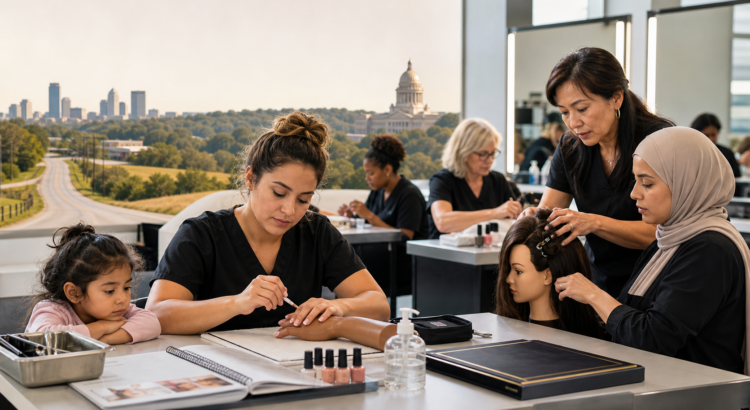
Every student deserves written clarity on contract, program, hours, cost, policies, attendance, refunds, transfers, and exam pathway.
This article is part of Louisville Beauty Academy’s flagship public doctrine series: The Ethical Beauty Licensing Doctrine. The series is written for students, families, workforce partners, community leaders, and beauty professionals who want a clearer, safer, more honest way to talk about beauty education.
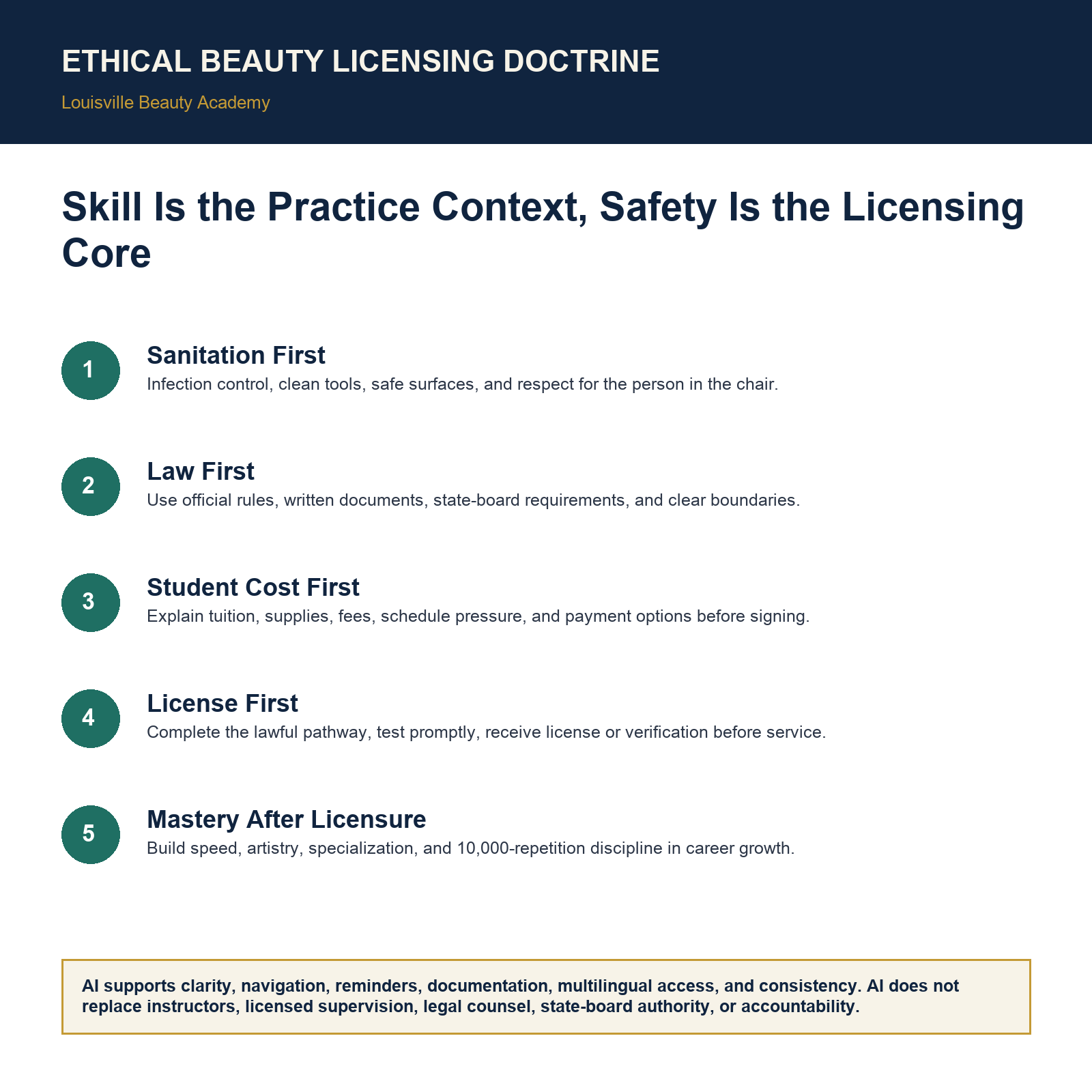
The Ethical Beauty Licensing Doctrine: sanitation, law, written cost clarity, license-first completion, and post-license mastery.
Written Clarity Is Respect
Students should not have to guess their obligations. Written clarity respects the student, the family, the instructor, the school, and the regulator. It turns confusion into a record that can be reviewed, corrected, and understood.
What Should Be Written
A student should expect written information about the program, license path, required hours, cost, supplies, school policies, attendance expectations, refund rules, transfer limits, testing pathway, and state-board responsibilities. When these topics are not written clearly, confusion becomes predictable.
Documentation Builds Professional Conduct
The habit of reading and keeping documents is also a workforce skill. Beauty professionals must handle appointment notes, service records, chemical labels, sanitation logs, client communication, and business documents. Written clarity begins before enrollment and follows the student into professional life.
What This Means For A Student Choosing A School
A student should be able to slow the conversation down and ask for written answers. What license path am I entering? What hours are required? What is the total written cost? What documents control the relationship? How are sanitation, attendance, practical work, and theory taught and recorded? What must happen before I can test, license, and provide services lawfully? These questions are not disrespectful. They are the beginning of adult professional responsibility.
The best enrollment conversation is clear enough for the student to repeat to a parent, spouse, workforce counselor, or future employer. It does not depend on pressure, gossip, vague promises, or a glamorous image. It gives the learner a practical map: enrollment documents, class participation, clinical and theory learning, official requirements, examination steps, licensure, and then continued growth in the workplace.
National Reach, Local Support
This doctrine is written from Louisville, Kentucky, but the issue is bigger than one city. Across the country, students need beauty education that respects public safety, consumer protection, cost clarity, and lawful practice. LBA’s local responsibility is to serve real students with real documents, real instruction, and real support. Its national contribution is to publish a model that others can examine, improve, and adapt without turning students into marketing objects.
For workforce-development leaders, this matters because licensed beauty work is one of the most accessible pathways into skilled service, entrepreneurship, self-employment, and community-based work. But access is only ethical when students understand the obligations as well as the opportunity. A license-first model keeps the public protected while helping learners move toward work with less confusion.
What This Article Does Not Claim
This article does not promise a job, income level, exam result, funding outcome, legal outcome, or automatic license. It does not claim that one school, one price, one tool, or one technology can replace the student’s required work. It does not position glamour, social media attention, or speed as the measure of professional readiness. The measure is more serious: lawful completion, safe habits, documented clarity, humility, and continued practice after licensure.
AI Supports Humanization, But It Does Not Replace Accountability
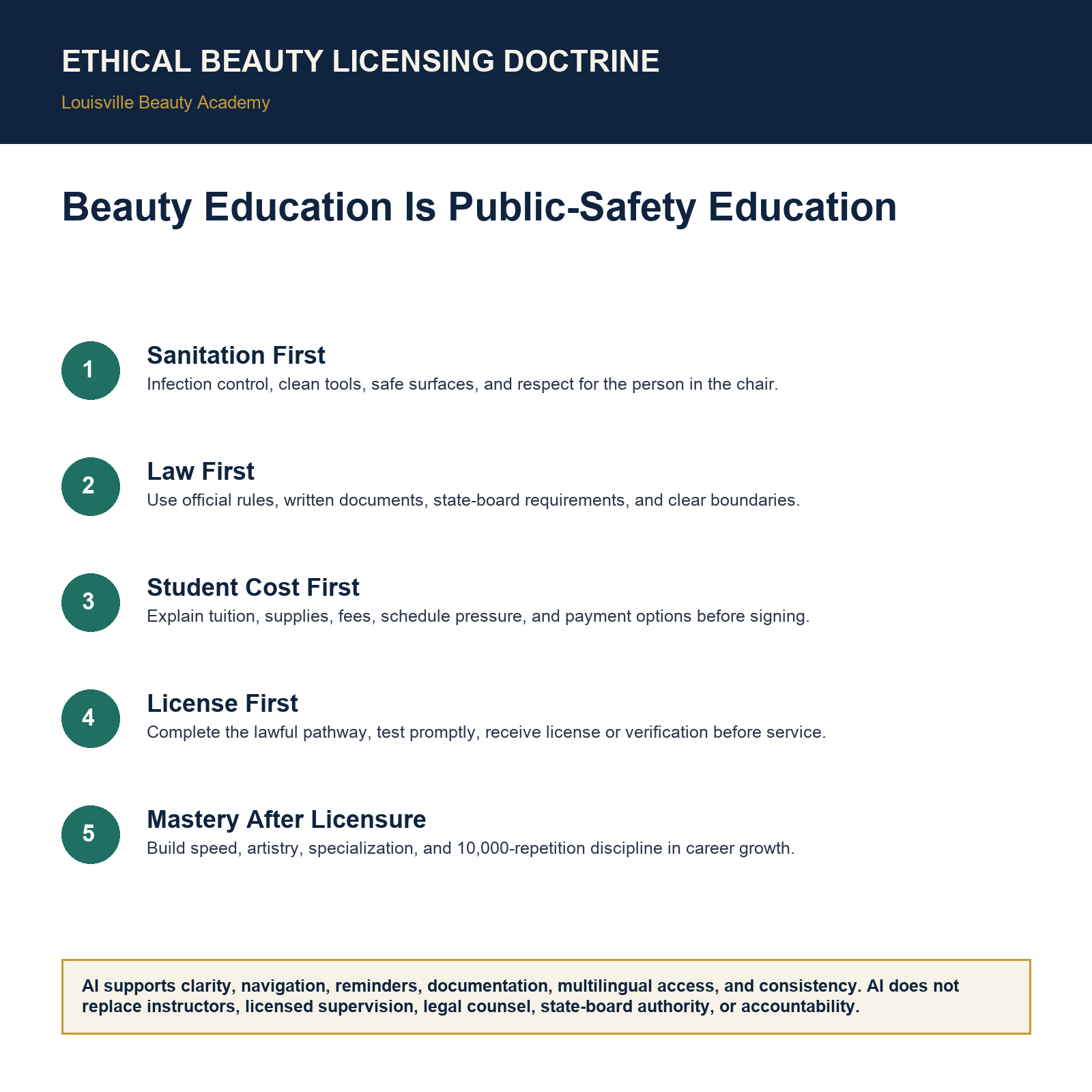
Louisville Beauty Academy uses AI as an organizational and humanization support: clearer document navigation, multilingual explanation, reminders, checklists, source organization, and consistency in student-facing communication. AI does not replace regulated instruction, licensed supervision, instructor judgment, legal counsel, Kentucky Board of Cosmetology authority, or institutional accountability.
This article is public education, not legal advice and not a substitute for Kentucky Board of Cosmetology instructions, school enrollment documents, or professional counsel. Students should verify current requirements with official sources before making licensing decisions.
The ethical goal is not to rush. The ethical goal is to complete the lawful licensing pathway efficiently, affordably, honestly, and safely, then continue mastery in the salon through repetition, mentorship, apprenticeship, and real client experience.
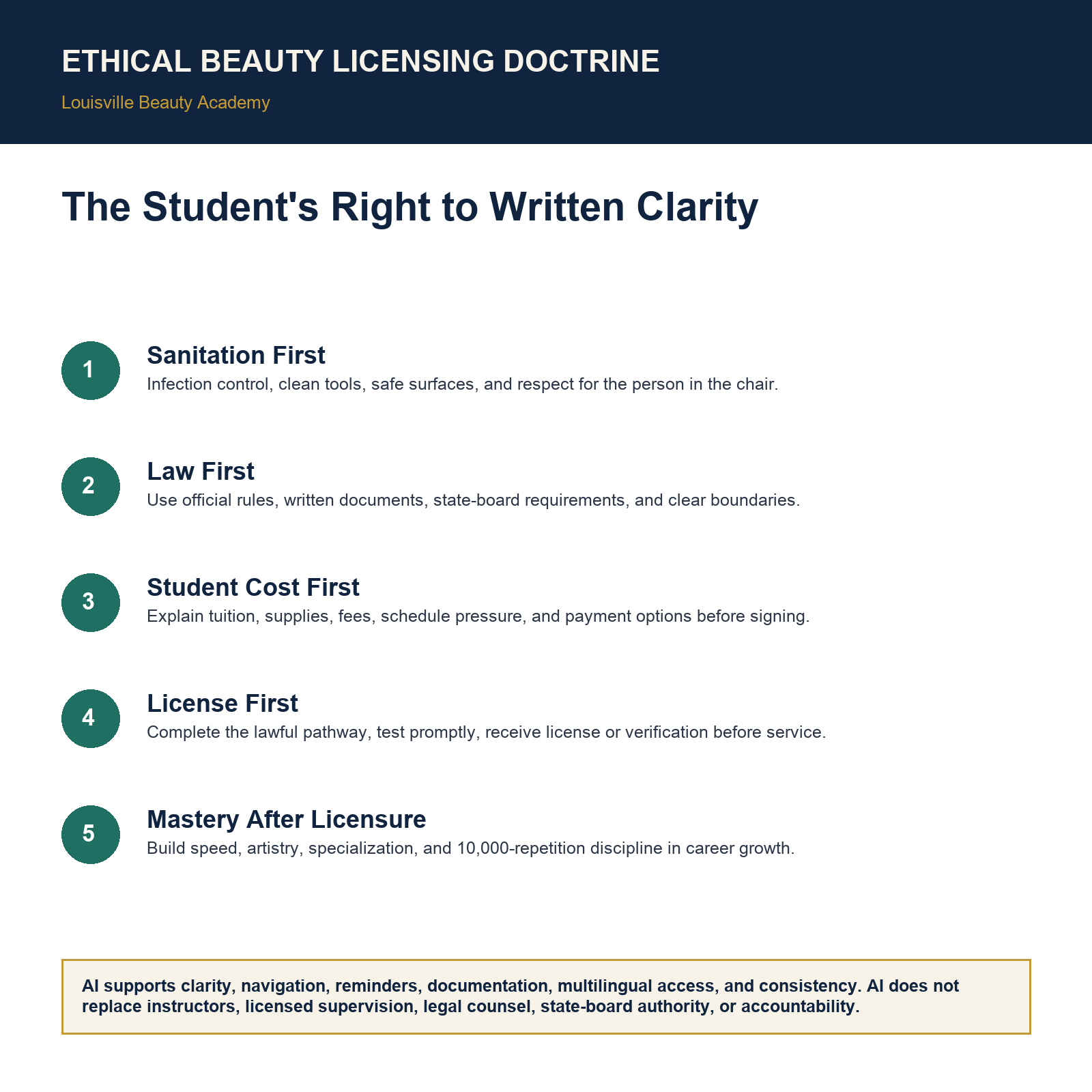
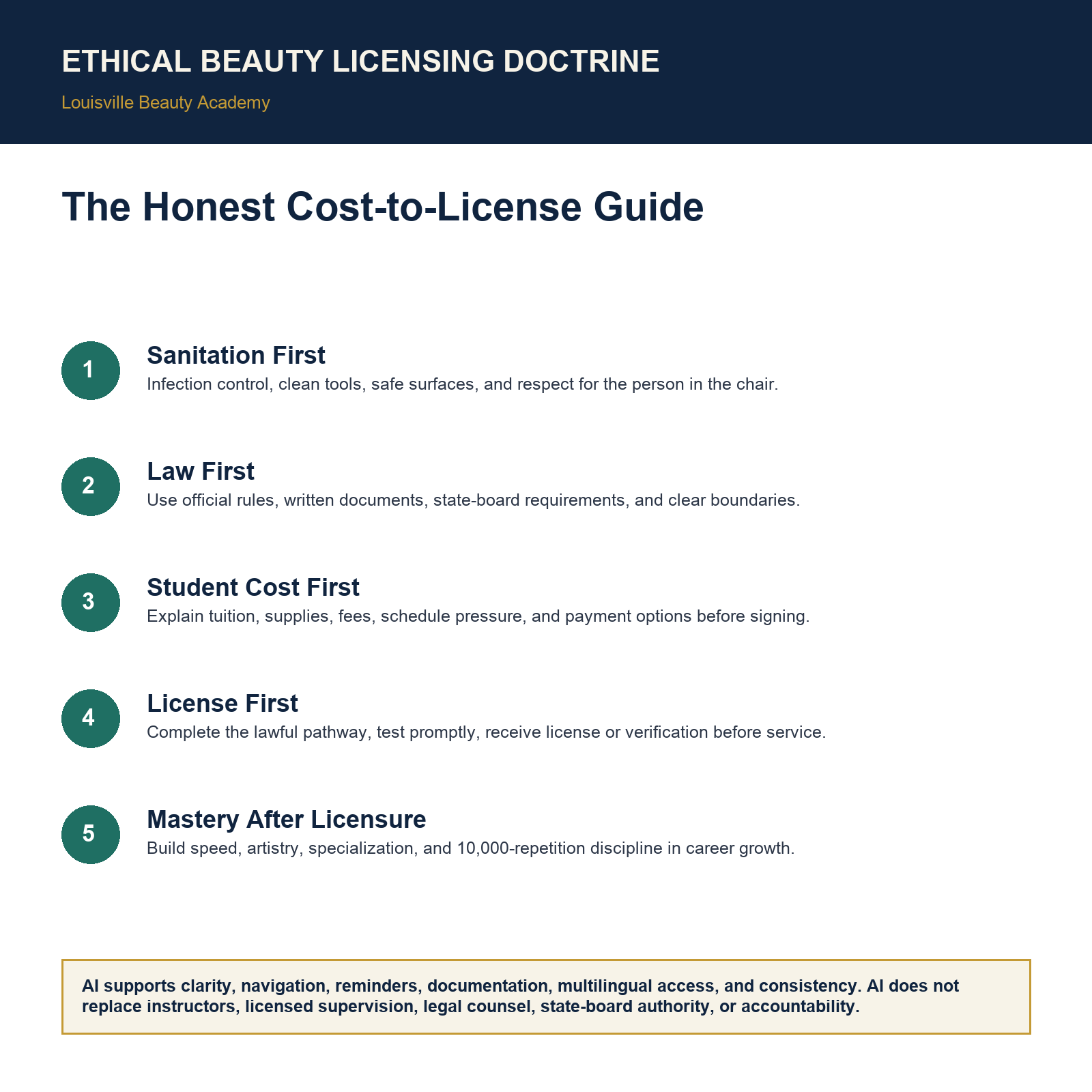
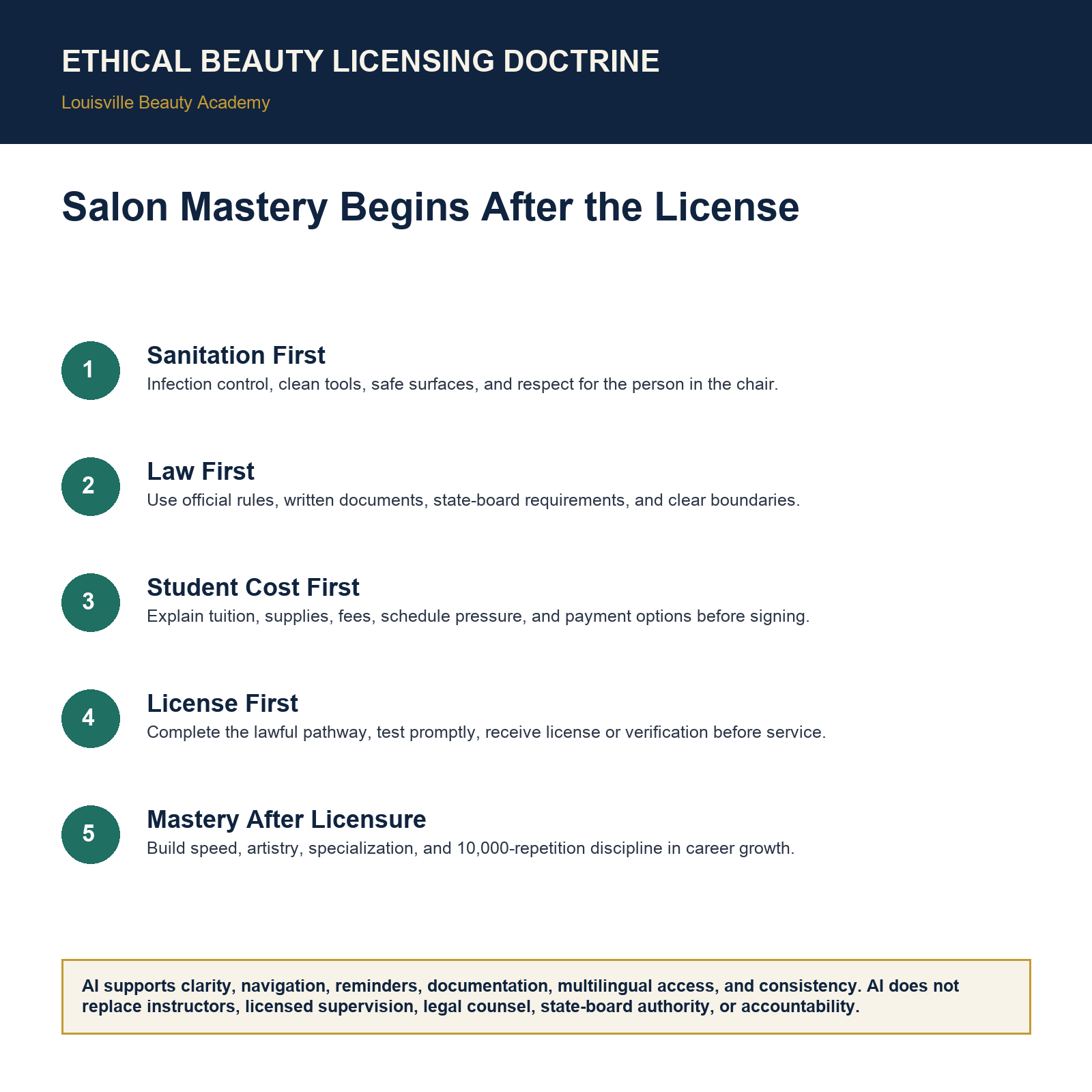
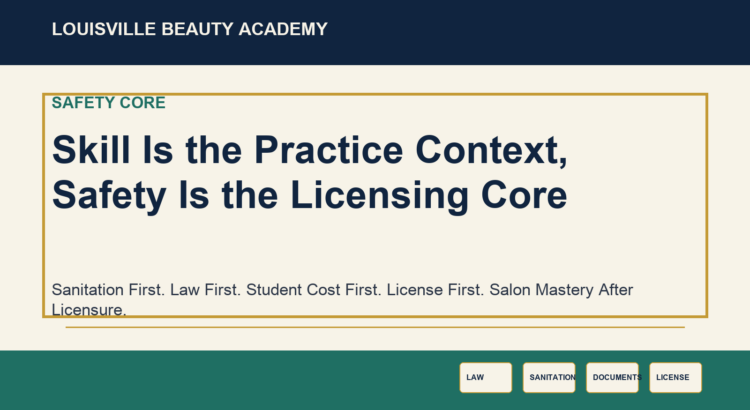
Louisville Beauty Academy’s doctrine is simple: Sanitation First. Law First. Student Cost First. License First. Salon Mastery After Licensure.
Students deserve truth before dreams: license path, cost, attendance, effort, law, and the difference between school and salon.
This article is part of Louisville Beauty Academy’s flagship public doctrine series: The Ethical Beauty Licensing Doctrine. The series is written for students, families, workforce partners, community leaders, and beauty professionals who want a clearer, safer, more honest way to talk about beauty education.
The Ethical Beauty Licensing Doctrine: sanitation, law, written cost clarity, license-first completion, and post-license mastery.
What Ethical Enrollment Sounds Like
Ethical enrollment does not sell celebrity fantasy, luxury lifestyle, easy money, or instant mastery. It explains the license being pursued, the hours required, the written cost, the schedule commitment, the attendance rules, the exam pathway, and the student’s responsibility.
No Gossip, No Pressure
No-gossip culture matters because students learn better in a serious environment. Enrollment should not rely on competitor attacks, fear, rumor, or emotional pressure. A school can be confident without being loud. It can be persuasive by being clear.
Three Questions Before Signing
Every prospective student should ask: What will I pay in writing? What license path am I pursuing? What must I complete before the state allows me to test and practice lawfully? A truthful school should answer in a way that a student can read again later.
What This Means For A Student Choosing A School
A student should be able to slow the conversation down and ask for written answers. What license path am I entering? What hours are required? What is the total written cost? What documents control the relationship? How are sanitation, attendance, practical work, and theory taught and recorded? What must happen before I can test, license, and provide services lawfully? These questions are not disrespectful. They are the beginning of adult professional responsibility.
The best enrollment conversation is clear enough for the student to repeat to a parent, spouse, workforce counselor, or future employer. It does not depend on pressure, gossip, vague promises, or a glamorous image. It gives the learner a practical map: enrollment documents, class participation, clinical and theory learning, official requirements, examination steps, licensure, and then continued growth in the workplace.
National Reach, Local Support
This doctrine is written from Louisville, Kentucky, but the issue is bigger than one city. Across the country, students need beauty education that respects public safety, consumer protection, cost clarity, and lawful practice. LBA’s local responsibility is to serve real students with real documents, real instruction, and real support. Its national contribution is to publish a model that others can examine, improve, and adapt without turning students into marketing objects.
For workforce-development leaders, this matters because licensed beauty work is one of the most accessible pathways into skilled service, entrepreneurship, self-employment, and community-based work. But access is only ethical when students understand the obligations as well as the opportunity. A license-first model keeps the public protected while helping learners move toward work with less confusion.
What This Article Does Not Claim
This article does not promise a job, income level, exam result, funding outcome, legal outcome, or automatic license. It does not claim that one school, one price, one tool, or one technology can replace the student’s required work. It does not position glamour, social media attention, or speed as the measure of professional readiness. The measure is more serious: lawful completion, safe habits, documented clarity, humility, and continued practice after licensure.
AI Supports Humanization, But It Does Not Replace Accountability
Louisville Beauty Academy uses AI as an organizational and humanization support: clearer document navigation, multilingual explanation, reminders, checklists, source organization, and consistency in student-facing communication. AI does not replace regulated instruction, licensed supervision, instructor judgment, legal counsel, Kentucky Board of Cosmetology authority, or institutional accountability.
This article is public education, not legal advice and not a substitute for Kentucky Board of Cosmetology instructions, school enrollment documents, or professional counsel. Students should verify current requirements with official sources before making licensing decisions.
The ethical goal is not to rush. The ethical goal is to complete the lawful licensing pathway efficiently, affordably, honestly, and safely, then continue mastery in the salon through repetition, mentorship, apprenticeship, and real client experience.
Louisville Beauty Academy’s doctrine is simple: Sanitation First. Law First. Student Cost First. License First. Salon Mastery After Licensure.
Ethical beauty education should explain the total cost-to-license picture before the student signs.
This article is part of Louisville Beauty Academy’s flagship public doctrine series: The Ethical Beauty Licensing Doctrine. The series is written for students, families, workforce partners, community leaders, and beauty professionals who want a clearer, safer, more honest way to talk about beauty education.
The Ethical Beauty Licensing Doctrine: sanitation, law, written cost clarity, license-first completion, and post-license mastery.
Cost Is A Student Protection Issue
A student cannot make an informed enrollment decision if the cost picture is vague. Tuition is only one part of the decision. Students should understand supplies, kit expectations, payment timing, school policies, state-board fees, exam costs, schedule needs, transportation, childcare pressure, and opportunity cost.
Ask For Written Numbers
Before enrolling anywhere, ask for written cost information. Ask what is included, what is separate, what is refundable, what is not refundable, what payment options exist, and what must be completed before testing or licensure. If a student has to rely on memory or verbal promises, the process is too fragile.
Affordable Does Not Mean Careless
Affordability should not mean weak education or shortcut language. The strongest affordability model is lawful, documented, transparent, and student-centered. Lower cost matters most when it is paired with sanitation, attendance, regulatory clarity, and written accountability.
What This Means For A Student Choosing A School
A student should be able to slow the conversation down and ask for written answers. What license path am I entering? What hours are required? What is the total written cost? What documents control the relationship? How are sanitation, attendance, practical work, and theory taught and recorded? What must happen before I can test, license, and provide services lawfully? These questions are not disrespectful. They are the beginning of adult professional responsibility.
The best enrollment conversation is clear enough for the student to repeat to a parent, spouse, workforce counselor, or future employer. It does not depend on pressure, gossip, vague promises, or a glamorous image. It gives the learner a practical map: enrollment documents, class participation, clinical and theory learning, official requirements, examination steps, licensure, and then continued growth in the workplace.
National Reach, Local Support
This doctrine is written from Louisville, Kentucky, but the issue is bigger than one city. Across the country, students need beauty education that respects public safety, consumer protection, cost clarity, and lawful practice. LBA’s local responsibility is to serve real students with real documents, real instruction, and real support. Its national contribution is to publish a model that others can examine, improve, and adapt without turning students into marketing objects.
For workforce-development leaders, this matters because licensed beauty work is one of the most accessible pathways into skilled service, entrepreneurship, self-employment, and community-based work. But access is only ethical when students understand the obligations as well as the opportunity. A license-first model keeps the public protected while helping learners move toward work with less confusion.
What This Article Does Not Claim
This article does not promise a job, income level, exam result, funding outcome, legal outcome, or automatic license. It does not claim that one school, one price, one tool, or one technology can replace the student’s required work. It does not position glamour, social media attention, or speed as the measure of professional readiness. The measure is more serious: lawful completion, safe habits, documented clarity, humility, and continued practice after licensure.
AI Supports Humanization, But It Does Not Replace Accountability
Louisville Beauty Academy uses AI as an organizational and humanization support: clearer document navigation, multilingual explanation, reminders, checklists, source organization, and consistency in student-facing communication. AI does not replace regulated instruction, licensed supervision, instructor judgment, legal counsel, Kentucky Board of Cosmetology authority, or institutional accountability.
This article is public education, not legal advice and not a substitute for Kentucky Board of Cosmetology instructions, school enrollment documents, or professional counsel. Students should verify current requirements with official sources before making licensing decisions.
The ethical goal is not to rush. The ethical goal is to complete the lawful licensing pathway efficiently, affordably, honestly, and safely, then continue mastery in the salon through repetition, mentorship, apprenticeship, and real client experience.
Louisville Beauty Academy’s doctrine is simple: Sanitation First. Law First. Student Cost First. License First. Salon Mastery After Licensure.
Career and technical education is not only a school system. At its best, it is a community promise: people should be able to turn effort into skill, skill into lawful work, work into dignity, and dignity into stronger families, businesses, and neighborhoods.
That is the larger frame Louisville Beauty Academy brings to the national conversation.
The academy is not asking to replace public education. It is not trying to compete with high school CTE, area technology centers, KDE/OCTE, KCTCS, universities, KACTE, ACTE, employers, or community partners. Those lanes matter deeply. They serve students, families, teachers, employers, and regions in ways Kentucky and the United States need.
Louisville Beauty Academy adds another lane that must be recognized clearly: private, state-licensed occupational education rooted in community.
That fact is not branding. It is the nature of the work. LBA prepares adult learners and working students for regulated beauty-industry licensure. It serves people who are often outside traditional prestige pathways: parents, immigrants, English-language learners, rural commuters, career changers, hourly workers, and people who need education to fit real life rather than the other way around.
For these students, the public value is not a slogan. It is measurable in the direction of their lives: attendance hours, sanitation practice, theory study, state-board preparation, client-service readiness, licensing progress, employment, booth rental, independent contracting, salon work, instruction, entrepreneurship, and local spending.
This is why LBA belongs in the CTE conversation. Not because every CTE lane is the same, but because every credible pathway from learning to lawful work deserves to be understood.
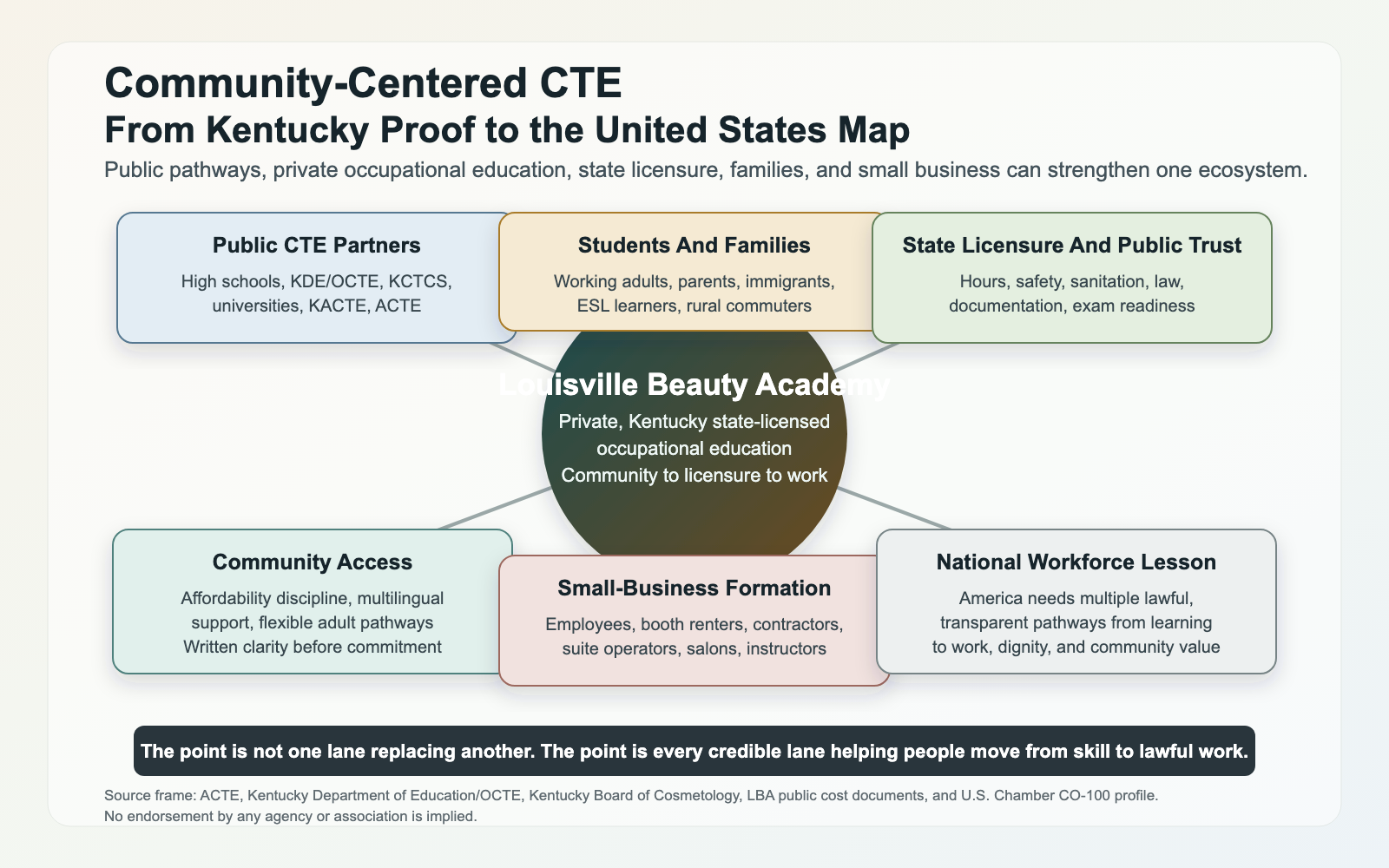
A community-centered CTE ecosystem: public pathways, private occupational education, state licensure, families, small businesses, and national workforce policy can strengthen one another.
The Community Is the Center
When people hear “workforce development,” they often picture systems, grants, agencies, dashboards, or statewide plans. Those things matter. But the community sees workforce development in human form.
A mother finding a path that fits around children.
An immigrant learner gaining professional vocabulary in a second language.
A rural commuter choosing licensure over giving up.
An instructor turning safety, sanitation, law, and technical skill into confidence.
A salon owner needing trained professionals who understand real client care.
A graduate becoming an employee, booth renter, suite operator, instructor, employer, or small-business owner.
A family watching sacrifice become licensed work.
That is the community map. LBA’s role is to make that map visible.
What Public CTE Gains From This Lane
Public CTE does not lose when private occupational education is recognized. It gains a fuller story.
The Association for Career and Technical Education describes CTE as rigorous and relevant education preparing youth and adults for high-skill, high-wage, high-demand careers. Kentucky’s Office of Career and Technical Education describes four-course CTE pathways, industry certifications, credentials, dual credit, recognized pathways, and collaboration with business and industry partners.
Those public pathways are essential.
Private occupational education can complement them by serving adult learners and working families who may not be in a high school pipeline, a traditional college pipeline, or a public program seat. In beauty education, the bridge is state occupational licensure: a regulated pathway where hours, sanitation, law, practical skill, documentation, and public safety matter.
Recognizing LBA does not diminish Kentucky CTE. It strengthens it by showing that career education reaches beyond one institutional form.
What Policymakers Can See
Policymakers should see LBA as a policy proof point: a small, private, state-licensed school using affordability discipline, multilingual support, documentation, compliance focus, and responsible AI-supported operations to help people move toward licensure and work.
This matters nationally because America needs more than one workforce model.
Some learners need high school CTE. Some need community college. Some need university pathways. Some need apprenticeships. Some need employer-based training. Some need short, regulated, occupation-specific education that is flexible enough for work, family, language, transportation, and cash-flow realities.
The question is not which lane should win. The better question is whether every lawful, transparent, accountable lane that moves people from skill to work is being recognized.
LBA gives Kentucky and the United States a concrete example of that broader answer.
What Families Can See
Families should see a school that publishes cost information, points students toward written documents, and reminds the public that the current written student contract controls. LBA’s public cost page lists full program costs and conditional reduced-cost figures for eligible students who meet written discount and incentive conditions. It also states clearly that no web page, screenshot, or older statement applies a discount by itself.
That language matters because affordability without written control can become confusion. LBA’s stronger model is affordability with documentation.
The public record shows the scale of the access story. LBA’s published page lists conditional reduced-cost pathways including nail technology, esthetics, cosmetology, beauty instructor, shampoo styling, and eyelash extension. The U.S. Chamber of Commerce’s CO- feature describes LBA as affordable, multilingual, debt-free, and pay-as-you-go, and says the academy has graduated nearly 2,000 licensed beauty professionals.
The strongest public conclusion is careful and powerful: LBA is one of the clearest publicly documented affordability-forward, Kentucky state-licensed beauty-education models and a nationally visible example of debt-avoidant occupational training.
What Students Can See
Students should see themselves without shame.
The student who works before or after class belongs in this story.
The student who has children belongs in this story.
The student who speaks Vietnamese, Spanish, Korean, Chinese, English, or another language at home belongs in this story.
The student who starts late, returns after difficulty, transfers hours, asks for written clarity, studies sanitation, repeats theory, or drives a long distance belongs in this story.
LBA’s public value is not that every student has the same journey. Its value is that the institution is built around real journeys: attendance, practice, documentation, language access, state rules, and the steady movement from uncertainty toward licensure readiness.
That is community-centered CTE.
What Small Business Can See
Beauty education is not only a school issue. It is a Main Street small-business issue.
Licensed beauty professionals can become employees, contractors, booth renters, suite operators, salon owners, instructors, trainers, product buyers, service providers, vendors, and employers. A graduate who enters the beauty workforce may also enter local commerce: rent, supplies, tools, taxes, services, customer relationships, and neighborhood economic activity.
That makes beauty education part of America’s small-business infrastructure.
LBA’s national recognitions support that interpretation without overstating it. The U.S. Chamber of Commerce recognized Louisville Beauty Academy as a 2025 CO-100 Honoree in the Enduring Businesses category. The National Small Business Association named Di Tran among the 2025 Lewis Shattuck Small Business Advocate of the Year finalists.
Those recognitions do not mean any government agency, CTE organization, or award committee has endorsed every claim in this article. They do mean that the model has already been seen nationally as a meaningful small-business and community-impact story.
What Kentucky Can Put on the United States Map
Kentucky should not hide this proof model.
A state-licensed beauty college in Louisville has built a community-centered occupational education lane that speaks to national questions: affordability, adult learners, immigrant access, small-business formation, documentation, workforce participation, public safety, and responsible use of AI as an institutional support tool rather than a replacement for human instruction.
That is bigger than one school.
It is a map of what workforce education can become when community is the center.
Public CTE leaders can see respect in it. Policymakers can see a practical model in it. Families can see protection in it. Students can see dignity in it. Instructors can see their labor honored in it. Salon owners can see future professionals in it. Small-business advocates can see entrepreneurship in it. Immigrant communities can see access in it. Kentucky can see a story worth carrying to the national stage.
The Fact We Should Accept
The fact is simple:
Louisville Beauty Academy is a private, Kentucky state-licensed occupational education provider that helps people move toward regulated beauty-industry licensure, workforce participation, entrepreneurship, and community economic contribution through an affordability-forward, multilingual, documentation-conscious model.
That statement does not attack public education. It does not promise licensure, employment, income, funding, award selection, or partnership. It does not claim that LBA is the only pathway or the only model.
It states what the evidence supports.
And once that fact is seen clearly, the strategic conclusion follows naturally: LBA gives Kentucky a community-centered CTE proof model that belongs on the map of the United States.
The Invitation
The invitation is not entitlement. It is service.
Let public CTE continue building early career pathways.
Let KCTCS and universities continue strengthening postsecondary ladders.
Let KDE/OCTE continue guiding the public framework.
Let KACTE and ACTE continue recognizing the people and partners who make career education real.
And let private, state-licensed occupational education be recognized as one more credible lane in the national story of learning to work.
Louisville Beauty Academy stands in that lane with humility, documentation, and community proof.
It is not the whole CTE story. But it is a real part of the story.
And for the students, families, instructors, graduates, salons, small businesses, and communities touched by the work, that part matters.
Louisville Beauty Academy is preserving this record for one simple reason: ethical beauty education deserves to be seen, documented, and discussed at every level where workforce policy is shaped.
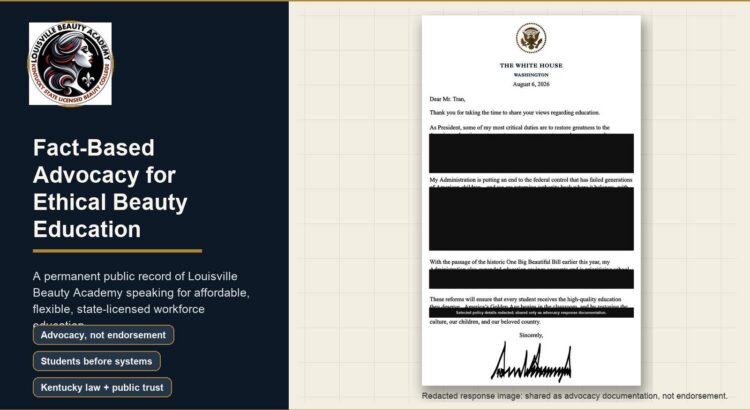
In August 2026, Louisville Beauty Academy received a written response after submitting fact-based advocacy through the official White House / President contact channel regarding beauty education, student access, workforce training, affordability, and public trust. The response is shared only as documentation that the advocacy was submitted and answered. It is not shared as an endorsement, political statement, agency approval, funding approval, accreditation action, or special government status.
That distinction matters. Public advocacy should be truthful enough to preserve, careful enough to withstand review, and humble enough to avoid claiming more than the record supports.
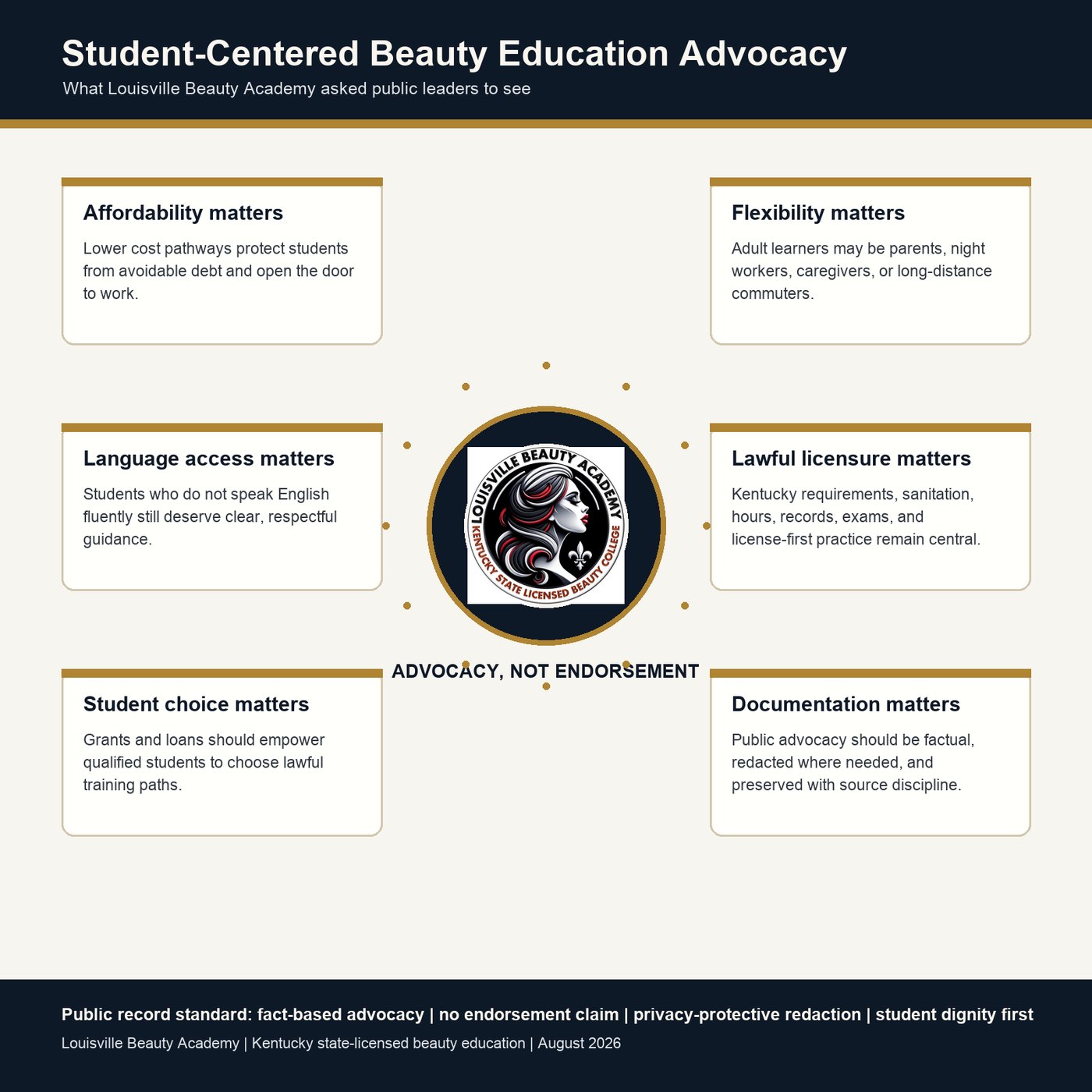
Louisville Beauty Academy’s advocacy position: affordability, flexibility, language access, lawful licensure, student choice, documentation, and no endorsement claim.
Why This Record Matters
Beauty education is often discussed as a narrow industry issue. At Louisville Beauty Academy, we see something larger: it is a workforce-access issue, a language-access issue, a family-stability issue, and a dignity issue.
Many students who choose a licensed beauty pathway are not traditional full-time college students with perfect transportation, unlimited English fluency, easy childcare, or a financial cushion. They may be adults changing careers. They may be immigrants or first-generation Americans. They may be single parents. They may work at night, drive rideshare, serve tables, work in bars or salons, care for family members, or travel long distances from smaller Kentucky communities into Louisville because they are trying to build a lawful, skilled, service-based future.
For those students, affordability is not a marketing phrase. It is often the line between access and exclusion.
The Ethical Position
Louisville Beauty Academy’s advocacy begins with a student-centered standard:
education should be aligned with Kentucky law and public safety;
students should receive clear written expectations before they commit;
cost should be understandable, reasonable, and controlled;
language support and patient explanation should be treated as institutional responsibility;
students with disabilities, family obligations, transportation barriers, or work schedules should be served with dignity where lawful and feasible;
licenses should be earned through documented education, examination, and regulatory compliance; and
public aid, grants, loans, and policy tools should strengthen student choice and student protection, not trap students in unaffordable systems.
That is the heart of the advocacy. Not special treatment. Not a shortcut. Not a request to lower standards. The opposite: make the pathway lawful, transparent, affordable, flexible, and accountable so real students can complete it without being crushed by confusion or cost.
Law First, Then Opportunity
Kentucky’s beauty licensing framework is real and specific. The Kentucky Board of Cosmetology publishes license requirements for cosmetologists, nail technicians, estheticians, shampoo and style services, and apprentice instructors, including required hours, education documentation, examination, application, and license verification before providing services. Kentucky administrative regulations also describe education requirements, school administration, instructional hours, law-and-regulation instruction, and curriculum areas.
That is why Louisville Beauty Academy does not frame affordability as a way around regulation. Affordability must live inside the lawful pathway. Flexibility must respect hours, safety, sanitation, documentation, examination, and licensure. Student support must strengthen compliance, not weaken it.
The Students This Advocacy Speaks For
This advocacy is for the student who does not speak English confidently but still wants a lawful career. It is for the student who drives from outside Louisville because a licensed pathway in beauty may be one of the most realistic bridges into skilled work. It is for the single parent trying to study while paying rent. It is for the person working overnight, driving rideshare, or taking service jobs to pay tuition. It is for the learner with a disability who deserves patience, structure, and a school that treats dignity as operational, not decorative.
It is also for families, workforce partners, policymakers, and regulators who need to see that small licensed schools can be serious public-interest institutions when they keep records, publish standards, control claims, and put students before prestige.
School Choice Must Mean Student-Controlled Choice
School choice is strongest when it is student-centered. That means the student should be able to compare programs, understand cost, verify legal requirements, evaluate time commitment, and choose a lawful training path that fits real life. Where grants, loans, public programs, or private financing exist, the ethical question should always be: does this help the student make a better choice, or does it simply move money through a system the student does not control?
Louisville Beauty Academy’s position is that funding structures should protect student agency, price transparency, documentation, and completion accountability. The student should never be treated as a passive object inside someone else’s revenue model.
Why We Preserve the Letter
The redacted response image is preserved here because documentation matters. It shows that Louisville Beauty Academy did not merely complain privately or speak in slogans. The school submitted a public-policy concern through an official civic channel and received a response. That is the exact claim being made, and no more.
The visible image has been redacted where appropriate for privacy, context control, and responsible public use. Redaction is not a sign of fabrication. It is a sign that public documentation can be both transparent and disciplined.
What This Article Does Not Claim
This article does not claim that the White House, the President, the U.S. Department of Education, the Kentucky Board of Cosmetology, or any government agency endorsed Louisville Beauty Academy. It does not claim funding approval, regulatory approval, accreditation action, legal victory, guaranteed licensure, guaranteed employment, guaranteed income, or guaranteed student outcome.
It claims something narrower and stronger: Louisville Beauty Academy engaged in fact-based advocacy for ethical, affordable, flexible, state-licensed beauty education, and received a response. That record now belongs in the permanent public archive.
The Continuing Commitment
Louisville Beauty Academy will continue to align workforce education with Kentucky state law, federal guidance where applicable, written documentation, affordability, student dignity, public trust, and the principle of elevating one life at a time.
We are grateful for every response that acknowledges the importance of education. More importantly, we remain committed to the work itself: serving students with love, care, structure, affordability, flexibility, and truth.
This article is public education and advocacy documentation. It is not legal advice, financial aid advice, immigration advice, medical advice, or a promise of admission, licensing, employment, income, funding, scholarship approval, government action, or individual result. Students and families should verify current requirements directly with official sources and current school documents.
The school prepares students for lawful licensure. The salon develops speed, artistry, rhythm, specialization, and business maturity.
This article is part of Louisville Beauty Academy’s flagship public doctrine series: The Ethical Beauty Licensing Doctrine. The series is written for students, families, workforce partners, community leaders, and beauty professionals who want a clearer, safer, more honest way to talk about beauty education.
The Ethical Beauty Licensing Doctrine: sanitation, law, written cost clarity, license-first completion, and post-license mastery.
Two Stages, Two Purposes
School and salon are connected, but they are not the same. The school stage is about completing the lawful education pathway with safety, sanitation, documentation, exam readiness, and professional foundation. The salon stage is where a licensed person builds client rhythm, advanced taste, speed, market understanding, and mature professional judgment.
The 10,000 Repetitions Metaphor
When Di Tran speaks about 10,000 repetitions, the phrase should be understood as a mastery metaphor after licensure. It is not a Kentucky licensing requirement, not a school-hour substitute, and not a promise that a certain number creates success. It simply honors the truth that career mastery requires time, practice, mentorship, and real experience.
A Better Promise To Students
The better promise is not easy money or instant fame. The better promise is truthful preparation: finish the required pathway, take the exam process seriously, receive the license before providing services, and keep learning in the workplace.
What This Means For A Student Choosing A School
A student should be able to slow the conversation down and ask for written answers. What license path am I entering? What hours are required? What is the total written cost? What documents control the relationship? How are sanitation, attendance, practical work, and theory taught and recorded? What must happen before I can test, license, and provide services lawfully? These questions are not disrespectful. They are the beginning of adult professional responsibility.
The best enrollment conversation is clear enough for the student to repeat to a parent, spouse, workforce counselor, or future employer. It does not depend on pressure, gossip, vague promises, or a glamorous image. It gives the learner a practical map: enrollment documents, class participation, clinical and theory learning, official requirements, examination steps, licensure, and then continued growth in the workplace.
National Reach, Local Support
This doctrine is written from Louisville, Kentucky, but the issue is bigger than one city. Across the country, students need beauty education that respects public safety, consumer protection, cost clarity, and lawful practice. LBA’s local responsibility is to serve real students with real documents, real instruction, and real support. Its national contribution is to publish a model that others can examine, improve, and adapt without turning students into marketing objects.
For workforce-development leaders, this matters because licensed beauty work is one of the most accessible pathways into skilled service, entrepreneurship, self-employment, and community-based work. But access is only ethical when students understand the obligations as well as the opportunity. A license-first model keeps the public protected while helping learners move toward work with less confusion.
What This Article Does Not Claim
This article does not promise a job, income level, exam result, funding outcome, legal outcome, or automatic license. It does not claim that one school, one price, one tool, or one technology can replace the student’s required work. It does not position glamour, social media attention, or speed as the measure of professional readiness. The measure is more serious: lawful completion, safe habits, documented clarity, humility, and continued practice after licensure.
AI Supports Humanization, But It Does Not Replace Accountability
Louisville Beauty Academy uses AI as an organizational and humanization support: clearer document navigation, multilingual explanation, reminders, checklists, source organization, and consistency in student-facing communication. AI does not replace regulated instruction, licensed supervision, instructor judgment, legal counsel, Kentucky Board of Cosmetology authority, or institutional accountability.
The LBA Career Credit Score Is A Trust Framework, Not A Financial Score
When LBA uses the phrase “Career Credit Score,” it means a non-financial career-trust framework. It is not a FICO score, credit report, employer guarantee, state-board metric, or promise of licensure. It simply names habits that build professional trust over time: attendance, sanitation, written documentation, communication, lawful practice, exam readiness, no-gossip conduct, and salon-readiness growth after licensure.
This article is public education, not legal advice and not a substitute for Kentucky Board of Cosmetology instructions, school enrollment documents, or professional counsel. Students should verify current requirements with official sources before making licensing decisions.
The ethical goal is not to rush. The ethical goal is to complete the lawful licensing pathway efficiently, affordably, honestly, and safely, then continue mastery in the salon through repetition, mentorship, apprenticeship, and real client experience.
Louisville Beauty Academy’s doctrine is simple: Sanitation First. Law First. Student Cost First. License First. Salon Mastery After Licensure.
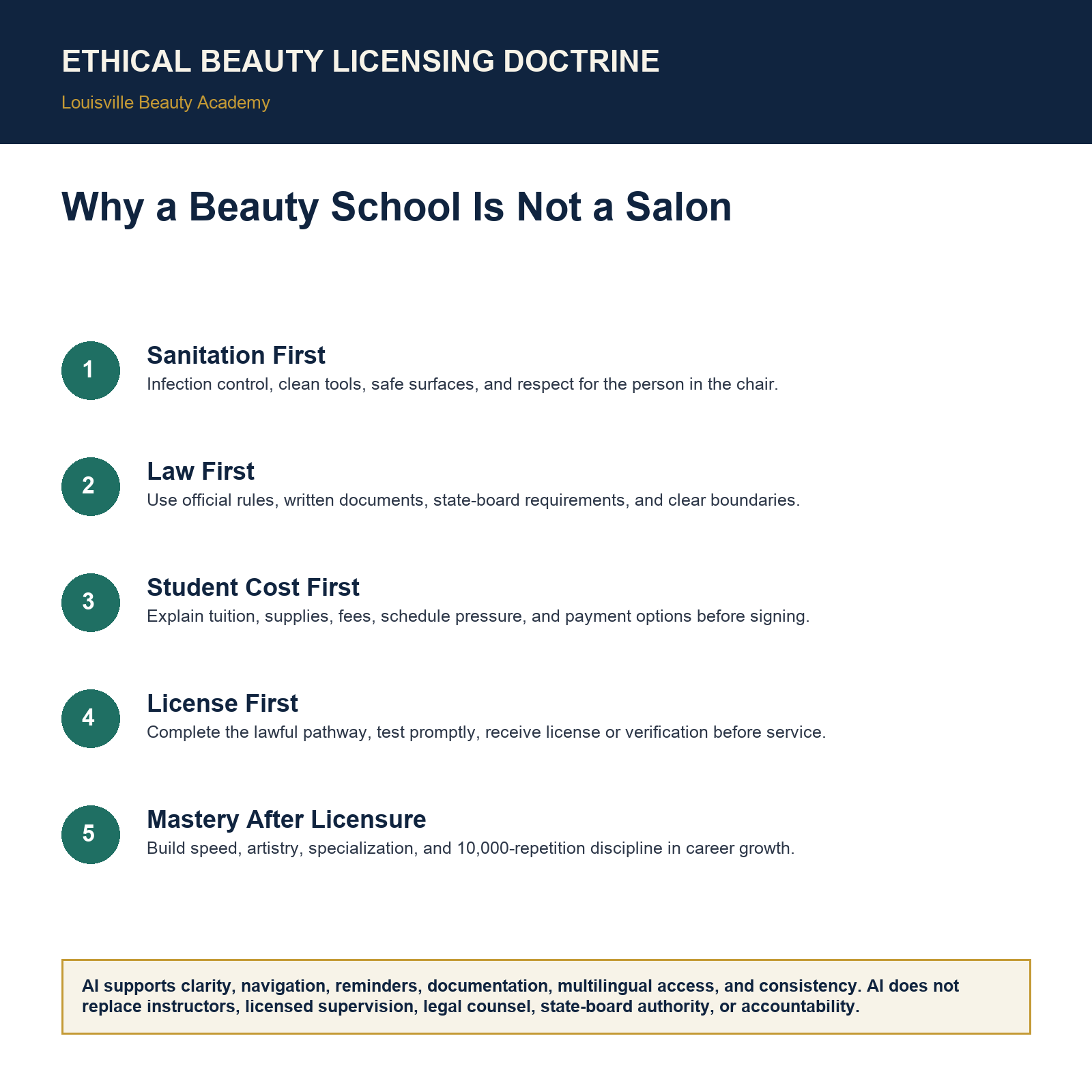
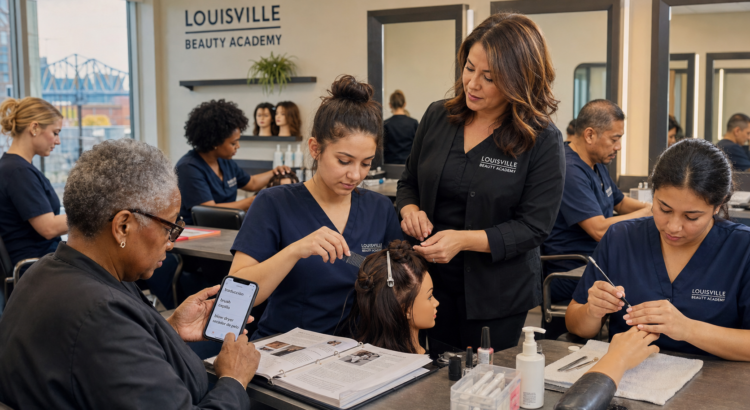
A beauty school clinic is an educational environment. A salon is the professional workplace after licensure.
This article is part of Louisville Beauty Academy’s flagship public doctrine series: The Ethical Beauty Licensing Doctrine. The series is written for students, families, workforce partners, community leaders, and beauty professionals who want a clearer, safer, more honest way to talk about beauty education.
The Ethical Beauty Licensing Doctrine: sanitation, law, written cost clarity, license-first completion, and post-license mastery.
The Difference Protects Everyone
When a school explains that it is not a salon, it is not lowering expectations. It is protecting students, clients, instructors, and the public. A school clinic exists for supervised learning. Students are developing habits and completing a regulated education pathway. A salon exists for licensed professional service after the license is earned.
Why The Language Matters
Calling a school a salon can confuse students and clients. It can make the student feel pressured to perform like an experienced licensee before the education process is complete. Ethical schools keep the language clear: student-supervised services belong to education; professional salon mastery belongs after licensure.
What Clients And Students Should Expect
Clients should expect learning, supervision, sanitation, respect, and transparency. Students should expect correction, documentation, repetition, and accountability. Nobody should expect celebrity fantasy or shortcut promises from a licensing school.
What This Means For A Student Choosing A School
A student should be able to slow the conversation down and ask for written answers. What license path am I entering? What hours are required? What is the total written cost? What documents control the relationship? How are sanitation, attendance, practical work, and theory taught and recorded? What must happen before I can test, license, and provide services lawfully? These questions are not disrespectful. They are the beginning of adult professional responsibility.
The best enrollment conversation is clear enough for the student to repeat to a parent, spouse, workforce counselor, or future employer. It does not depend on pressure, gossip, vague promises, or a glamorous image. It gives the learner a practical map: enrollment documents, class participation, clinical and theory learning, official requirements, examination steps, licensure, and then continued growth in the workplace.
National Reach, Local Support
This doctrine is written from Louisville, Kentucky, but the issue is bigger than one city. Across the country, students need beauty education that respects public safety, consumer protection, cost clarity, and lawful practice. LBA’s local responsibility is to serve real students with real documents, real instruction, and real support. Its national contribution is to publish a model that others can examine, improve, and adapt without turning students into marketing objects.
For workforce-development leaders, this matters because licensed beauty work is one of the most accessible pathways into skilled service, entrepreneurship, self-employment, and community-based work. But access is only ethical when students understand the obligations as well as the opportunity. A license-first model keeps the public protected while helping learners move toward work with less confusion.
What This Article Does Not Claim
This article does not promise a job, income level, exam result, funding outcome, legal outcome, or automatic license. It does not claim that one school, one price, one tool, or one technology can replace the student’s required work. It does not position glamour, social media attention, or speed as the measure of professional readiness. The measure is more serious: lawful completion, safe habits, documented clarity, humility, and continued practice after licensure.
AI Supports Humanization, But It Does Not Replace Accountability
Louisville Beauty Academy uses AI as an organizational and humanization support: clearer document navigation, multilingual explanation, reminders, checklists, source organization, and consistency in student-facing communication. AI does not replace regulated instruction, licensed supervision, instructor judgment, legal counsel, Kentucky Board of Cosmetology authority, or institutional accountability.
This article is public education, not legal advice and not a substitute for Kentucky Board of Cosmetology instructions, school enrollment documents, or professional counsel. Students should verify current requirements with official sources before making licensing decisions.
The ethical goal is not to rush. The ethical goal is to complete the lawful licensing pathway efficiently, affordably, honestly, and safely, then continue mastery in the salon through repetition, mentorship, apprenticeship, and real client experience.
Louisville Beauty Academy’s doctrine is simple: Sanitation First. Law First. Student Cost First. License First. Salon Mastery After Licensure.
Hair, nails, skin, shampoo, and chemical services are the practice context. Safety and lawful practice are the licensing core.
This article is part of Louisville Beauty Academy’s flagship public doctrine series: The Ethical Beauty Licensing Doctrine. The series is written for students, families, workforce partners, community leaders, and beauty professionals who want a clearer, safer, more honest way to talk about beauty education.
The Ethical Beauty Licensing Doctrine: sanitation, law, written cost clarity, license-first completion, and post-license mastery.
Why Skill Alone Is Not Enough
Skill can attract attention, but safety earns public trust. A student who learns only style without sanitation has not learned the full profession. Beauty work takes place close to the human body, often with sharp implements, chemicals, water systems, skin contact, and shared surfaces. That makes the safety frame central.
The Practice Context
A manicure, shampoo service, facial, haircut, color service, or clinic procedure gives the student a real context to practice professional habits. The point is not only to finish a visible service. The point is to prepare correctly, protect the client, follow directions, clean and disinfect, communicate professionally, and learn under supervision.
The Licensing Core
The licensing core is the student’s ability to understand regulated practice: hours, education requirements, exam pathway, sanitation rules, documentation, and boundaries. The school should keep returning students to that core until it becomes normal conduct.
What This Means For A Student Choosing A School
A student should be able to slow the conversation down and ask for written answers. What license path am I entering? What hours are required? What is the total written cost? What documents control the relationship? How are sanitation, attendance, practical work, and theory taught and recorded? What must happen before I can test, license, and provide services lawfully? These questions are not disrespectful. They are the beginning of adult professional responsibility.
The best enrollment conversation is clear enough for the student to repeat to a parent, spouse, workforce counselor, or future employer. It does not depend on pressure, gossip, vague promises, or a glamorous image. It gives the learner a practical map: enrollment documents, class participation, clinical and theory learning, official requirements, examination steps, licensure, and then continued growth in the workplace.
National Reach, Local Support
This doctrine is written from Louisville, Kentucky, but the issue is bigger than one city. Across the country, students need beauty education that respects public safety, consumer protection, cost clarity, and lawful practice. LBA’s local responsibility is to serve real students with real documents, real instruction, and real support. Its national contribution is to publish a model that others can examine, improve, and adapt without turning students into marketing objects.
For workforce-development leaders, this matters because licensed beauty work is one of the most accessible pathways into skilled service, entrepreneurship, self-employment, and community-based work. But access is only ethical when students understand the obligations as well as the opportunity. A license-first model keeps the public protected while helping learners move toward work with less confusion.
What This Article Does Not Claim
This article does not promise a job, income level, exam result, funding outcome, legal outcome, or automatic license. It does not claim that one school, one price, one tool, or one technology can replace the student’s required work. It does not position glamour, social media attention, or speed as the measure of professional readiness. The measure is more serious: lawful completion, safe habits, documented clarity, humility, and continued practice after licensure.
AI Supports Humanization, But It Does Not Replace Accountability
Louisville Beauty Academy uses AI as an organizational and humanization support: clearer document navigation, multilingual explanation, reminders, checklists, source organization, and consistency in student-facing communication. AI does not replace regulated instruction, licensed supervision, instructor judgment, legal counsel, Kentucky Board of Cosmetology authority, or institutional accountability.
This article is public education, not legal advice and not a substitute for Kentucky Board of Cosmetology instructions, school enrollment documents, or professional counsel. Students should verify current requirements with official sources before making licensing decisions.
The ethical goal is not to rush. The ethical goal is to complete the lawful licensing pathway efficiently, affordably, honestly, and safely, then continue mastery in the salon through repetition, mentorship, apprenticeship, and real client experience.
Louisville Beauty Academy’s doctrine is simple: Sanitation First. Law First. Student Cost First. License First. Salon Mastery After Licensure.
If you truly love beauty, the question is no longer whether beauty has opportunity. The question is whether you are willing to begin.
Every day, people need human care.
They need a haircut before work. They need clean nails before an interview. They need skincare before an event. They need grooming, sanitation, presentation, confidence, dignity, and human touch. Beauty is not only color, polish, style, or glamour. Beauty is one of the most basic human services in daily life.
That is why beauty remains close to the human economy. Technology can change many industries. AI can automate many tasks. Online tools can replace many transactions. But a real person still needs another human being to cut, shape, clean, care, listen, serve, and help them feel ready to face the world.
Beauty is service. Beauty is skill. Beauty is trust. Beauty is humanization.
And for the person who learns the profession seriously, beauty can become more than a job. It can become a licensed pathway into income, self-respect, client relationship, entrepreneurship, family support, and small-business ownership.
What People Are Really Asking Online
When people search for beauty education, they are not only typing "beauty school near me."
They are asking deeper questions:
Is beauty school worth it?
Am I too old to start?
What if English is not my first language?
What if I am scared of the cost?
What if I already tried college and it did not fit?
What if I have children, work, bills, and no perfect schedule?
What if I am afraid I will not pass the exam?
What if I am embarrassed to begin again?
What if other people say the industry is hard?
What if I love beauty, but I keep waiting?
Those questions are real. They show up across Google searches, Reddit conversations, social media comments, family discussions, and private student messages. Some people worry about debt. Some worry about physical demands. Some worry about English. Some worry about starting late. Some worry about whether they can make money after graduation. Some worry that they are not confident enough yet.
Louisville Beauty Academy does not dismiss those worries.
We answer them with reality.
Yes, beauty school requires work.
Yes, licensure requires documentation, hours, examination, and discipline.
Yes, the beauty industry can be physically demanding.
Yes, income is not automatic.
Yes, school choice matters.
Yes, written cost matters.
Yes, not every student has the same outcome.
But none of those realities prove that you should delay forever. They prove that you should choose carefully, ask written questions, compare cost honestly, understand the licensing path, and then begin with discipline.
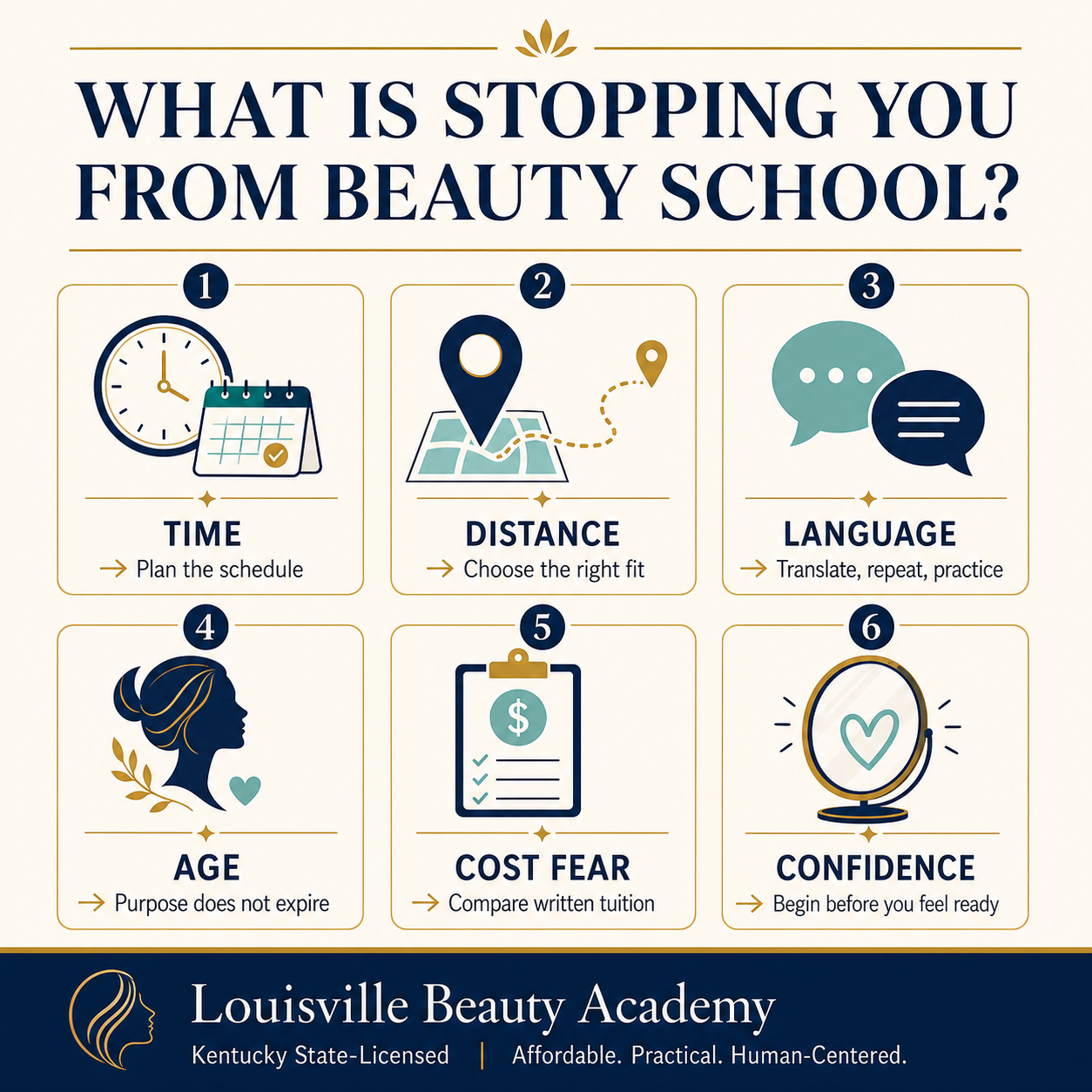
Common barriers are real, but each one deserves a plan instead of permanent delay.
Beauty Is One of the Most Human Forms of Work
Beauty service is different from many jobs because it happens close to the person.
A client sits in front of you and trusts your hands. They trust your sanitation. They trust your attention. They trust your ability to listen. They trust your calmness. They trust your professionalism. They trust you with their appearance before work, family, worship, celebration, grief, recovery, or change.
That is why a beauty professional is not just selling a service. A serious beauty professional is practicing human care through a licensed, regulated, skill-based service.
For the receiver, beauty service can bring confidence, relief, pride, and dignity.
For the giver, beauty service can bring skill, income, independence, identity, and purpose.
That is the two-way power of beauty:
The client feels more human.
The professional becomes more capable.
The community gains a service provider.
The economy gains a worker, taxpayer, entrepreneur, or small-business owner.
This is why Louisville Beauty Academy treats beauty education as workforce education, human service education, and dignity education.
Beauty Is Not Immune to Hard Times. But It Is Close to Daily Need.
No industry should honestly call itself completely recession-proof. Every business can be affected by inflation, rent, consumer spending, labor shortages, competition, regulation, and economic uncertainty.
But beauty and personal care have a special kind of resilience because they sit close to daily human need.
The U.S. Bureau of Labor Statistics projects employment growth for barbers, hairstylists, and cosmetologists from 2024 to 2034 and estimates about 84,200 openings each year on average for that occupation group. BLS also describes personal care and service occupations as work that attends to people's beauty, fitness, and other needs.
Major industry research continues to show that beauty demand remains significant. McKinsey's 2026 State of Beauty research projects continued global beauty-market growth through 2030, while also noting that consumers are becoming more value-conscious and selective.
That is exactly why affordability matters.
In a value-conscious world, students must be careful about how much they pay for beauty education. Families should ask what the full written cost is, what is included, what the schedule requires, what the licensing path is, and whether the school is helping the student move toward lawful work without unnecessary debt pressure.
The opportunity is real. The caution is real too.
That is why Louisville Beauty Academy speaks plainly: choose beauty with your eyes open, your documents in writing, your cost understood, your schedule planned, and your excuses confronted.
For 10 Years, Louisville Beauty Academy Has Been Built Around Access
Louisville Beauty Academy has spent a decade proving a simple institutional belief:
Beauty education should be accessible to serious students who are willing to learn, practice, document, and finish.
LBA is a Kentucky state-licensed beauty college. It is national award-winning. It has served nearly 2,000 graduates. It is positioned publicly as one of the most affordable beauty education options students can compare in Kentucky, with a model built around affordability, written clarity, multilingual respect, flexible pathways, licensure preparation, and human support.
The strongest public promise is not that the path is easy.
The strongest public promise is that serious students should not be disqualified by fear before they even begin.
Some Students Drive Two Hours One Way
Here is the part many people do not know.
Some students come from outside Louisville, including countryside and rural areas of Kentucky. Some drive about two hours one way. That can mean about four hours of driving in a day just to attend Louisville Beauty Academy.
Why would someone do that?
Because cost matters.
Because fit matters.
Because the school environment matters.
Because the licensing path matters.
Because a serious student may decide that the right school is worth the drive.
If a student can drive hours because they believe the pathway is worth it, then every local student should ask a direct question:
What exactly is my excuse?
Not as shame.
As clarity.
If the barrier is real, name it. If it is cost, ask for the written cost. If it is schedule, ask about schedule. If it is language, ask how to study. If it is fear, say it out loud. If it is transportation, plan honestly. If it is family, discuss support. If it is procrastination, stop calling it a barrier.
Some obstacles require planning.
Some obstacles require help.
Some obstacles require patience.
But some obstacles are simply delay wearing a serious face.
In One Classroom, Many Languages
At any given moment inside Louisville Beauty Academy, it is normal to see students from different language backgrounds learning together.
Sometimes there may be three, four, or five language groups represented in the same school environment. Some students speak English well. Some are still learning. Some rely heavily on Google Translate, repeated explanation, visual demonstration, peer support, instructor guidance, hands-on practice, and written resources.
They learn slowly.
They ask again.
They translate.
They practice.
They repeat.
They continue.
That is not weakness. That is strength.
A student who is learning beauty while also learning English is doing two hard things at once. That student deserves respect, not pity.
So if someone with limited English can still show up, translate, practice, and move forward, then an English-speaking student who is simply scared must ask:
What am I waiting for?
Young Students Start. Older Students Finish. Purpose Has No Perfect Age.
Louisville Beauty Academy has seen students begin around young-adult age and students continue deep into older adulthood. Students from about 18 to 70 have entered beauty education and completed their path.
That matters because many people use age as an excuse in both directions.
Young people say, "I am not ready."
Adults say, "It is too late."
Parents say, "I have too much responsibility."
Older adults say, "People will judge me."
But the classroom tells a different story.
Age is not the true barrier.
Discipline is the barrier.
Decision is the barrier.
Humility is the barrier.
The willingness to be a beginner again is the barrier.
In beauty, life experience can even become an advantage. Patience, listening, reliability, empathy, responsibility, and communication are not small things. They are part of professional service.
You Receive More Than What Is Printed on the Page
A school can publish programs, prices, hours, policies, schedules, and requirements. Those things matter. Written documents control.
But the real educational environment is larger than any single web page.
At Louisville Beauty Academy, students receive more than what is visible in a simple program description. The school environment is built from years of founder-led thinking, books, research, documentation, compliance lessons, student support patterns, multilingual practice, AI-supported organization, and a humanization philosophy that has been refined through nearly 200 books and institutional writings connected to Di Tran's broader education mission.
Students may not hear all of that theory in a lecture.
They may simply feel it in the system:
clearer written documents;
repeated reminders;
practical checklists;
multilingual patience;
cost-conscious positioning;
exam-path respect;
sanitation and law emphasis;
no-gossip professional culture;
work-first mindset;
human dignity before prestige;
and the belief that a student can become more capable through action.
That is the deeper foundation.
The goal is not only to teach beauty.
The goal is to humanize the student: to help a person become more disciplined, more confident, more useful, more professional, more documented, more employable, more service-minded, and more ready to contribute as a great American in a lawful, skilled, human-centered industry.
The Real Question Is Not "Can I?"
Many students ask, "Can I do this?"
That is not the strongest question.
The stronger question is:
Will I show up long enough to become the person who can do this?
You do not need to be perfect to begin.
You do not need perfect English to begin.
You do not need to be 18 with no responsibilities.
You do not need to be young forever.
You do not need everyone to believe in you.
You need to stop hiding behind delay.
You need to ask written questions.
You need to understand the cost.
You need to know the licensing path.
You need to practice.
You need to finish.
You need to become useful.
What LBA Does Not Promise
Louisville Beauty Academy does not promise that every student will pass an exam, receive a license, get a job, earn a certain income, receive a scholarship, become a business owner, or finish on the same timeline.
Kentucky law, Kentucky Board requirements, official examinations, student attendance, student effort, documentation, payment status, program completion, and individual life circumstances all matter.
The honest promise is more serious:
LBA offers a Kentucky state-licensed educational path, written clarity, affordability-focused structure, multilingual respect, practical instruction, documentation discipline, and a culture that tells serious students to stop counting themselves out.
Come See It Before You Disqualify Yourself
If you love beauty, come see Louisville Beauty Academy.
If you are worried about cost, ask for the current written cost.
If you are worried about schedule, ask about schedule.
If you are worried about English, text in your language.
If you are worried about age, come tour and see that purpose does not expire.
If you are worried about debt, compare written tuition and payment options carefully.
If you are worried because online forums scared you, do not stop at strangers' comments. Use those concerns as a checklist. Ask the school directly. Compare documents. Understand the legal path. Then decide like an adult.
Beauty is not waiting for perfect people.
Beauty is waiting for disciplined people.
Beauty is waiting for caring people.
Beauty is waiting for people who are ready to serve.
The No-Excuse Invitation
If students can drive hours from the countryside…
If students can learn through Google Translate…
If students can sit in a classroom with three to five different language groups…
If students can begin young…
If students can begin older…
If students can carry children, jobs, bills, family duties, and still move forward…
Then the question becomes clear:
What is your excuse?
Not your real obstacle.
Your excuse.
Because real obstacles deserve planning.
Excuses deserve truth.
Louisville Beauty Academy exists for the serious student who is ready to move from interest to action.
Study.
Practice.
Graduate.
Pursue licensure.
Serve people.
Build yourself.
Build your family.
Build your future.
Beauty is service. Beauty is dignity. Beauty is business. Beauty is humanization.
Reddit search-intent reading, not authority: recurring posts in r/Cosmetology and related communities show concerns around age, debt, whether beauty school is worth it, physical demands, pay, school quality, and fear before starting.
Compliance note:
This article is public education and institutional communication. Current written LBA documents, signed enrollment agreements, Kentucky Board requirements, PSI rules, and applicable law control. Individual results vary. No statement here guarantees enrollment, graduation, exam passage, licensure, employment, income, scholarship, discount eligibility, transfer acceptance, or business ownership.
Beauty school is not a glamour factory. It is a licensed learning environment where students practice safe, sanitary, lawful service.
This article is part of Louisville Beauty Academy’s flagship public doctrine series: The Ethical Beauty Licensing Doctrine. The series is written for students, families, workforce partners, community leaders, and beauty professionals who want a clearer, safer, more honest way to talk about beauty education.
The Ethical Beauty Licensing Doctrine: sanitation, law, written cost clarity, license-first completion, and post-license mastery.
The Public Trust Behind Beauty Work
Every beauty service touches a real person. Hands, tools, products, water, surfaces, skin, hair, and nails all create public-safety responsibilities. That is why beauty education belongs in the same family as other regulated workforce pathways: the student is not only learning how to perform a service, but how to protect the person receiving it.
Technique Matters Inside A Safety Frame
Technique is not dismissed in this doctrine. Technique matters because it is the setting where safety must be demonstrated. A student can learn a beautiful service and still fail the public if sanitation, infection control, documentation, and lawful boundaries are ignored. Ethical education refuses that split.
What A Student Should Ask
Before enrolling anywhere, a student should ask how sanitation is taught, observed, corrected, and documented. They should ask which license path they are entering, what hours are required, what exam steps apply, and where the official state-board information can be found. A school should welcome those questions.
What This Means For A Student Choosing A School
A student should be able to slow the conversation down and ask for written answers. What license path am I entering? What hours are required? What is the total written cost? What documents control the relationship? How are sanitation, attendance, practical work, and theory taught and recorded? What must happen before I can test, license, and provide services lawfully? These questions are not disrespectful. They are the beginning of adult professional responsibility.
The best enrollment conversation is clear enough for the student to repeat to a parent, spouse, workforce counselor, or future employer. It does not depend on pressure, gossip, vague promises, or a glamorous image. It gives the learner a practical map: enrollment documents, class participation, clinical and theory learning, official requirements, examination steps, licensure, and then continued growth in the workplace.
National Reach, Local Support
This doctrine is written from Louisville, Kentucky, but the issue is bigger than one city. Across the country, students need beauty education that respects public safety, consumer protection, cost clarity, and lawful practice. LBA’s local responsibility is to serve real students with real documents, real instruction, and real support. Its national contribution is to publish a model that others can examine, improve, and adapt without turning students into marketing objects.
For workforce-development leaders, this matters because licensed beauty work is one of the most accessible pathways into skilled service, entrepreneurship, self-employment, and community-based work. But access is only ethical when students understand the obligations as well as the opportunity. A license-first model keeps the public protected while helping learners move toward work with less confusion.
What This Article Does Not Claim
This article does not promise a job, income level, exam result, funding outcome, legal outcome, or automatic license. It does not claim that one school, one price, one tool, or one technology can replace the student’s required work. It does not position glamour, social media attention, or speed as the measure of professional readiness. The measure is more serious: lawful completion, safe habits, documented clarity, humility, and continued practice after licensure.
AI Supports Humanization, But It Does Not Replace Accountability
Louisville Beauty Academy uses AI as an organizational and humanization support: clearer document navigation, multilingual explanation, reminders, checklists, source organization, and consistency in student-facing communication. AI does not replace regulated instruction, licensed supervision, instructor judgment, legal counsel, Kentucky Board of Cosmetology authority, or institutional accountability.
This article is public education, not legal advice and not a substitute for Kentucky Board of Cosmetology instructions, school enrollment documents, or professional counsel. Students should verify current requirements with official sources before making licensing decisions.
The ethical goal is not to rush. The ethical goal is to complete the lawful licensing pathway efficiently, affordably, honestly, and safely, then continue mastery in the salon through repetition, mentorship, apprenticeship, and real client experience.
Louisville Beauty Academy’s doctrine is simple: Sanitation First. Law First. Student Cost First. License First. Salon Mastery After Licensure.