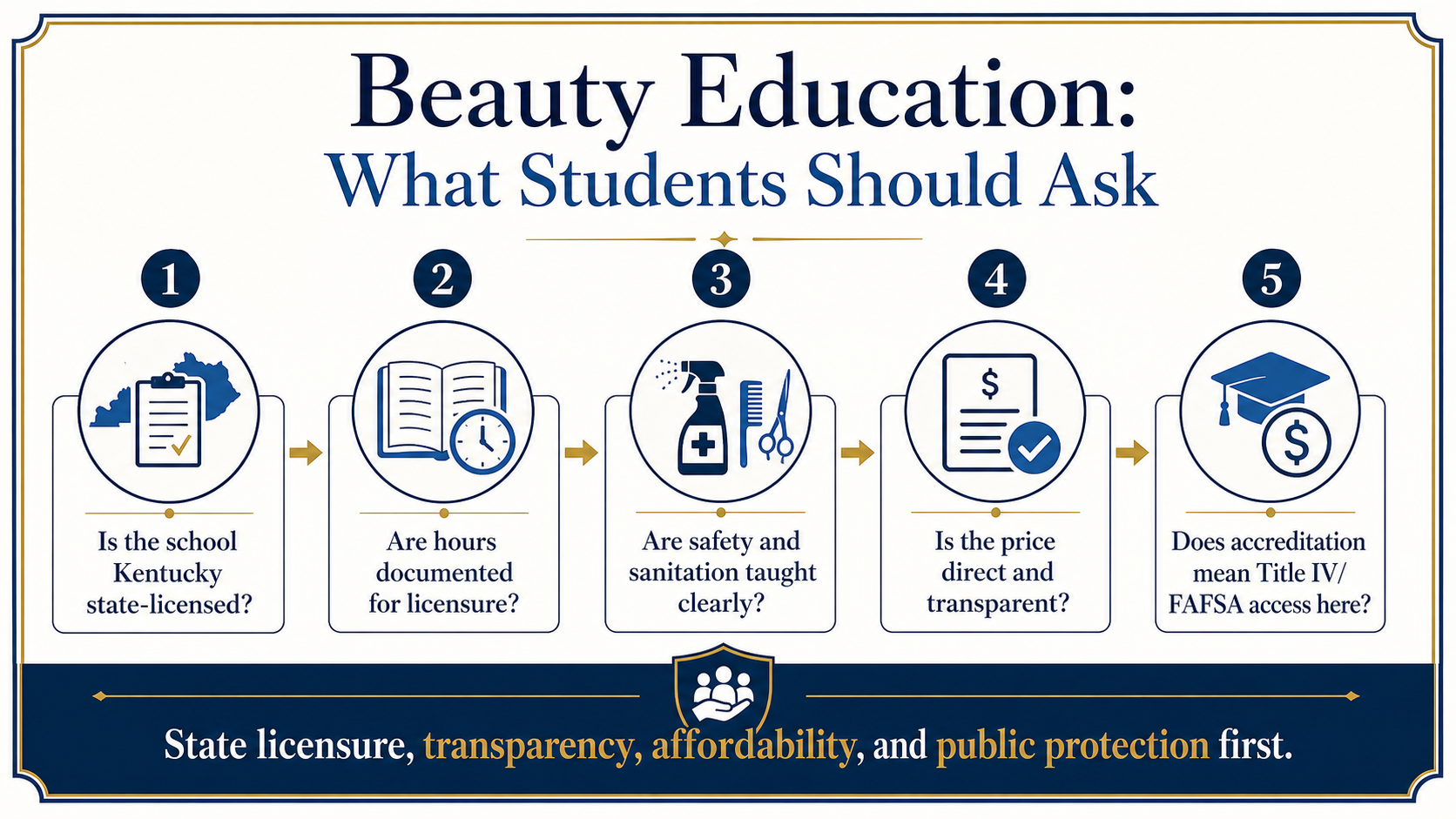
Before a beauty student signs a loan, payment plan, or enrollment agreement anywhere, the student should understand the full written cost, repayment obligation, school schedule, refund terms, licensure path, and what happens if life changes before completion.
Borrowing decisions should be made from written facts, not pressure, prestige language, or incomplete price screenshots.
Seven questions to ask before borrowing
What is the complete written tuition and fee total?
Is the offer a grant, scholarship, payment plan, private loan, federal loan, or school discount?
When do payments begin, and what happens if a payment is late?
What interest, finance charge, or loan fee applies, if any?
What kit, books, supplies, exam costs, or extra fees are included or excluded?
What refund, withdrawal, transcript, or transfer-hour rules apply?
Does the training path connect clearly to Kentucky state licensure requirements?
LBA’s position
Louisville Beauty Academy’s public value frame is affordability, Kentucky state licensure, written enrollment clarity, multilingual support, and practical workforce readiness. A student should never feel rushed into debt or a payment obligation without written terms that can be reviewed calmly.
This article is educational information, not legal, financial, or tax advice.
How to compare beauty school cost offers
What to compare
What to ask for in writing
Headline tuition
The complete current tuition and whether the price is a limited-time incentive.
Payment plan
Down payment, weekly/monthly payments, due dates, late-payment rules, and whether interest or finance charges apply.
Included materials
Books, kit, supplies, digital access, uniform/tools, exam fees, and any separate charges.
Transfer or withdrawal
How valid prior hours are reviewed, how refunds are calculated, and how student records are handled.
Licensure path
The state-licensed program, required hours, board process, and any exam or documentation step.
Written-control note: If an old post, social-media comment, verbal statement, or screenshot conflicts with current LBA written enrollment documents, the current written documents control.
Why Louisville Beauty Academy chose state-licensed transparency over confusing prestige language.
Bottom line: Federal July 2026 records confirm that NACCAS, one of the major national accreditors for cosmetology arts and sciences and massage therapy, faced significant unresolved recognition-compliance issues. Reputable reporting states NACIQI voted 9-to-3 to recommend denial of renewed recognition, while the final decision remains with the U.S. Department of Education.
When people ask whether a beauty school is “accredited,” the real question often needs to be clarified.
In beauty education, especially where federal student aid is involved, the practical question is often not simply, “Is this school good?” The practical question is: Does this school use accreditation as a pathway to participate in federal Title IV student-aid programs, including FAFSA-based federal aid?
Louisville Beauty Academy is a Kentucky state-licensed beauty college. Our work is grounded in Kentucky law and regulation, public safety, sanitation, documented student hours, practical instruction, law and regulation education, licensure readiness, affordability, and transparent student choice.
Beauty education should be evaluated through state licensure, documented training, safety, sanitation, transparent pricing, and honest explanation of accreditation and FAFSA access.
The Federal Development
The U.S. Department of Education’s official July 2026 NACIQI agenda placed the National Accrediting Commission of Career Arts and Sciences, Inc. (NACCAS) under Renewal of Recognition review. The agenda identifies NACCAS’s scope as accreditation of postsecondary schools and departments of cosmetology arts and sciences and massage therapy.
The Federal Register notice for the July 22-23, 2026 NACIQI meeting likewise listed NACCAS as item 6 under Applications for Renewal of Recognition and tied public comment to federal recognition criteria under 34 CFR Part 602.
The Department of Education’s e-Recognition final staff report identified multiple remaining NACCAS recognition-compliance issues. ED staff recommended continued recognition at that time, but with a serious limitation: NACCAS would be prohibited from accrediting new institutions until it demonstrated compliance, and would be required to submit compliance and monitoring reports.
Separately, Inside Higher Ed published a July 23, 2026 article titled “NACIQI Recommends Denial of Recognition for Cosmetology Accreditor.” That article reported that NACIQI voted 9-to-3 to recommend that ED deny NACCAS’s petition for renewed recognition. The article also noted that NACIQI is advisory and that the final decision rests with senior leaders at ED.
The Scale
The most source-protected language is this: federal ED staff reported that NACCAS currently accredits approximately 1,074 institutions, while NACCAS had recently reported accrediting around 1,300 postsecondary institutions in cosmetology arts and sciences and/or massage therapy.
We should not claim a specific percentage of all U.S. beauty schools without a verified national denominator. What we can say is that NACCAS is a major national beauty-school accreditor with more than one thousand institutions reported in federal/source records.
LBA’s December 2025 Decision
Louisville Beauty Academy publicly announced on December 10, 2025 that it had voluntarily discontinued candidate status with NACCAS.
That was a voluntary, objective, institution-level decision. LBA removed itself from the NACCAS accreditation path before the July 2026 federal recognition controversy became the national public headline. The December 2025 LBA notice remains the clean public source for that decision.
That decision now deserves to be understood as a transparency decision, not a retreat. LBA chose not to lean on a word that was becoming confusing to the public. LBA chose not to let “accreditation” be used as a prestige label when, in many practical conversations, the real issue is federal-aid participation and the financing structure behind it.
LBA does not currently participate in federal student-aid funding. That is not because LBA rejects public investment in education. We believe ethical education can and should create net positive economic impact when public systems are transparent, affordable, accountable, and student-protective. But LBA will not use accreditation language to confuse families, equate financing access with educational protection, or blur the difference between state licensure, public safety, sanitation, student outcomes, and federal-aid access.
If future accreditation or federal-aid structures become more transparent, ethical, affordable, student-centered, and aligned with public protection, LBA can evaluate those pathways again. Until then, LBA’s public position remains clear: Kentucky state licensure, direct affordability, honest communication, safety, sanitation, and documented licensure education first.
What LBA Means When Asked About Accreditation
Louisville Beauty Academy is Kentucky state-licensed. We do not participate in federal Title IV student-aid programs, and we do not use national accreditation as a federal-aid gateway. Our students choose LBA for affordability, direct payment options, Kentucky licensure preparation, public safety, sanitation, documented hours, and transparent education.
LBA is not permanently opposed to accreditation or public education funding. If future systems better protect students and align with transparency, affordability, ethical education, public safety, sanitation, and positive economic impact, LBA may evaluate them. At this time, LBA does not process federal Title IV/FAFSA aid.
Public Message
Accreditation used to be treated like a shining word. But in beauty education, the public deserves a more honest explanation.
Students should not be asked to confuse prestige language with protection. A school can be state licensed, compliant, affordable, student-centered, and transparent without using accreditation as a federal-aid pathway. A school can also be nationally accredited and still face serious federal scrutiny over transparency, student outcomes, disclosure, or federal-recognition compliance.
This is not anti-accreditation. It is pro-truth.
Accreditation should mean accountability. If it becomes only a pathway to federal money, public trust is weakened. Students deserve to know the difference.
And if the environment changes for the better, LBA will remain open-minded. The principle is not stubbornness. The principle is ethical education: public money, accreditation language, school marketing, and student trust must all serve the student, the public, and the regulated purpose of beauty education.
Louisville Beauty Academy 是一所美容学校,我们不是翻译机构,团队成员也不是认证或专业的翻译人员。我们结合翻译技术,以及会多种语言的教职员工和学生共同提供帮助。我们以您的语言提供这些内容,是因为我们宁愿提供不够完美的帮助,也不愿让您得不到信息。若有措辞不够准确之处,敬请见谅;如有任何不清楚的地方,请随时请我们再解释一次。
English (controlling version): Louisville Beauty Academy is a beauty school — not a translation agency, and our team are not certified or professional translators. We use translation technology together with staff and students who speak several languages. We share this material in your language because we would rather offer imperfect help than leave you without information. Some wording may not carry perfect nuance, and we ask for your kindness and patience with any imperfection. Please ask us to explain anything that is unclear; we will gladly go through it with you. For any official, legal, or licensing purpose, the English version of LBA documents controls, and a certified translator should be used where a certified translation is required. Current written school documents, signed agreements, Kentucky Board of Cosmetology requirements, PSI rules where applicable, and applicable law control.
English (controlling version): Louisville Beauty Academy is licensed by the Commonwealth of Kentucky and regulated by the Kentucky Board of Cosmetology. LBA is not institutionally accredited by a federally recognized accrediting agency and does not process FAFSA or Title IV federal student aid. This is a deliberate choice; operating outside the federal aid system removes substantial administrative cost, which is reflected in the program pricing published on this website. Sponsors, employers, nonprofits, and workforce programs may support a student; payments are applied to the student’s account, the student remains the responsible party under the signed agreement, and the student completes any sponsor paperwork. Before enrolling or borrowing at any school, please review official federal information at College Scorecard and studentaid.gov. We make no statement about any other institution. Accreditation status, tuition, and payment terms are described in current written school documents and may change; the current signed student agreement, Kentucky Board of Cosmetology requirements, and applicable law control. Nothing here is legal, financial, or licensing advice.
A Louisville Beauty Academy é uma escola de beleza — não somos uma agência de tradução nem tradutores certificados ou profissionais. Usamos tecnologia de tradução junto com funcionários e estudantes que falam vários idiomas. Compartilhamos este material no seu idioma porque preferimos oferecer uma ajuda imperfeita a deixar você sem informação. Pedimos desculpas por qualquer expressão menos precisa e, por favor, não hesite em nos pedir para explicar novamente.
English (controlling version): Louisville Beauty Academy is a beauty school — not a translation agency, and our team are not certified or professional translators. We use translation technology together with staff and students who speak several languages. We share this material in your language because we would rather offer imperfect help than leave you without information. Some wording may not carry perfect nuance, and we ask for your kindness and patience with any imperfection. Please ask us to explain anything that is unclear; we will gladly go through it with you. For any official, legal, or licensing purpose, the English version of LBA documents controls, and a certified translator should be used where a certified translation is required. Current written school documents, signed agreements, Kentucky Board of Cosmetology requirements, PSI rules where applicable, and applicable law control.
✓ Página revisada e atualizada em 27 de julho de 2026
Catálogo, programas, custos e políticas. Decida com informação por escrito.
2
Envie seus documentos
ID, prova de escolaridade e foto clara por texto para 502-625-5531.
3
Escolha seu programa
Unhas, Estética, Cosmetologia, Instrutor, Shampoo Styling ou Extensão de Cílios.
4
Leia e assine
Leia com calma. Pode revisar com a família. Pergunte antes de assinar.
5
Comece com clareza
Cada hora frequentada importa para o caminho de licença em Kentucky desde o primeiro dia.
Versões por idioma
Guia em português para estudantes e famílias. A Louisville Beauty Academy recebe perguntas sobre idioma, documentos de matrícula, preparação para licenciamento e entendimento do contrato antes da assinatura. Esta página reúne a resposta em um só lugar claro.
Louisville Beauty Academy
Reduzindo barreiras linguísticas. Ampliando oportunidades. Fortalecendo a força de trabalho de beleza de Kentucky.
Este centro de recursos existe para que estudantes e famílias revisem documentos, apoio de idioma, contrato, custo, identificação, opções de idioma de exame e próximos passos com dignidade antes de uma decisão educacional.
Caminho rapido para estudantes em portugues
Escolha o proximo passo: enviar mensagem para a LBA, revisar custos, preparar documentos ou pedir acompanhamento por escrito antes da visita.
O idioma nunca deve impedir um estudante sério de entender o caminho para uma profissão licenciada.
A LBA acredita que todo estudante merece informação clara por escrito antes da matrícula: documentos, idioma, contrato, custo, frequência, preparação para licença e próximos passos oficiais.
Compromisso de longo prazo
Por anos, a LBA apoia acesso multilíngue à educação de beleza, preparação profissional e comunicação clara para comunidades imigrantes e famílias trabalhadoras.
Quando provedores oficiais de exame, regras estaduais ou sistemas digitais oferecem opções de idioma, o estudante deve confirmar a disponibilidade atual diretamente na fonte oficial. A LBA pode orientar, mas os documentos atuais da escola, KBC, PSI quando aplicável e a lei controlam.
Nota sobre idioma do exame KBC/PSI
Conforme verificado em 27 de julho de 2026, o catálogo ao vivo da PSI Kentucky Board of Cosmetology lista versões por idioma para Cosmetology, Esthetician, Nail Technician e exames relacionados de instructor em inglês, espanhol, vietnamita, coreano, khmer, português e chinês simplificado. O mesmo catálogo mostra Shampoo Styling apenas em inglês e espanhol. O estudante deve confirmar o exame e o idioma diretamente no processo oficial KBC/PSI antes de agendar.
Por que isso importa
Reduz confusão antes da matrícula.
Ajuda estudantes e famílias a revisar documentos com calma.
Apoia a segurança pública porque o estudante entende melhor saneamento, frequência e responsabilidades.
Apoia famílias imigrantes e comunidades multilíngues.
Forma futuros profissionais, empreendedores e pequenos negócios.
Nossos princípios
Documentação antes de promessas.
Transparência antes da matrícula.
Conformidade antes da conveniência.
Dignidade humana antes de transações.
Educação antes de vendas.
Aviso sobre traduções
Traduções e explicações melhoram acesso e compreensão. Quando lei, regulamento, contrato assinado ou fonte oficial exigir uma versão específica, a versão oficial aplicável controla. Se algo não estiver claro, o estudante deve perguntar antes de assinar ou confiar nessa informação.
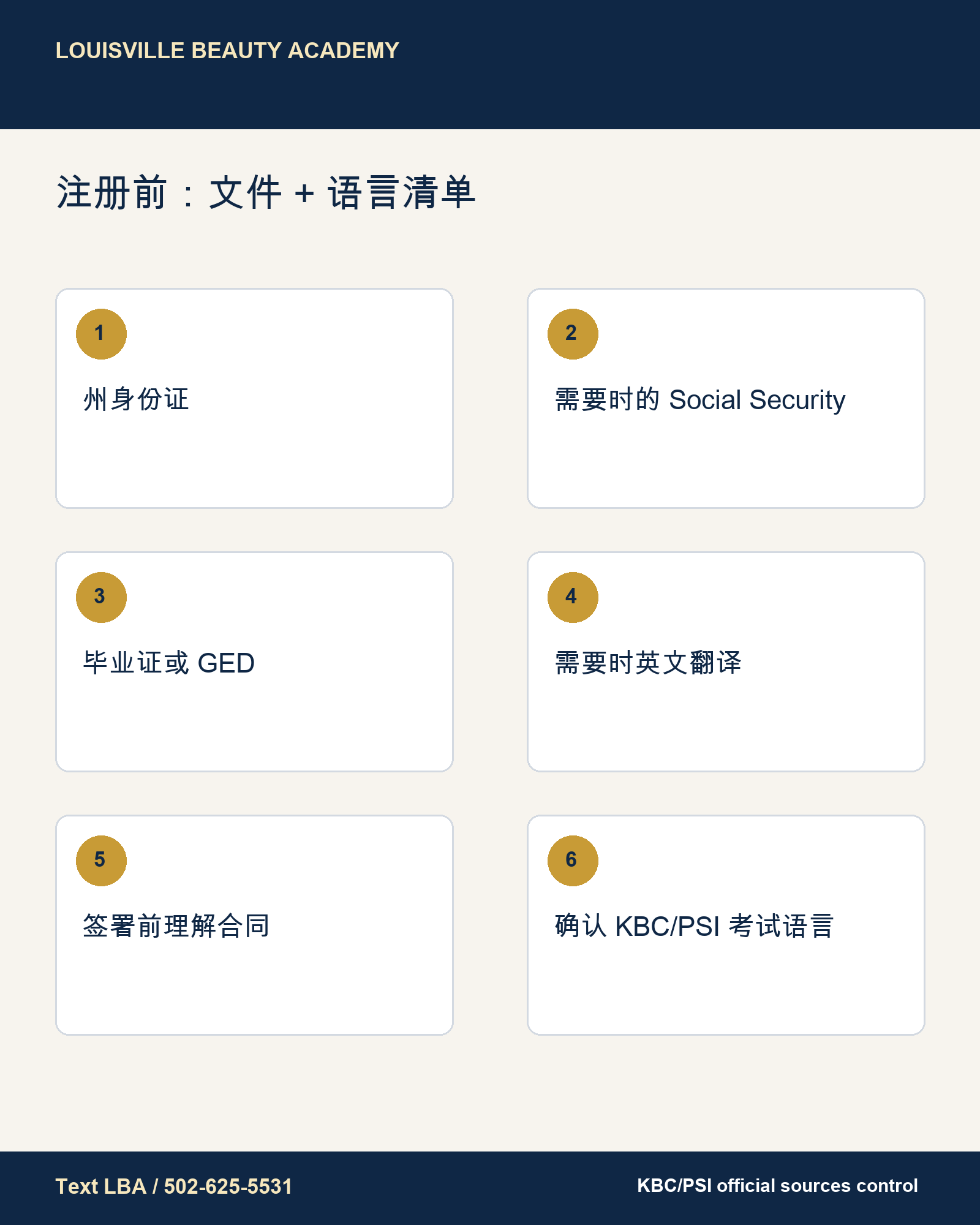
Documentos que o estudante deve preparar
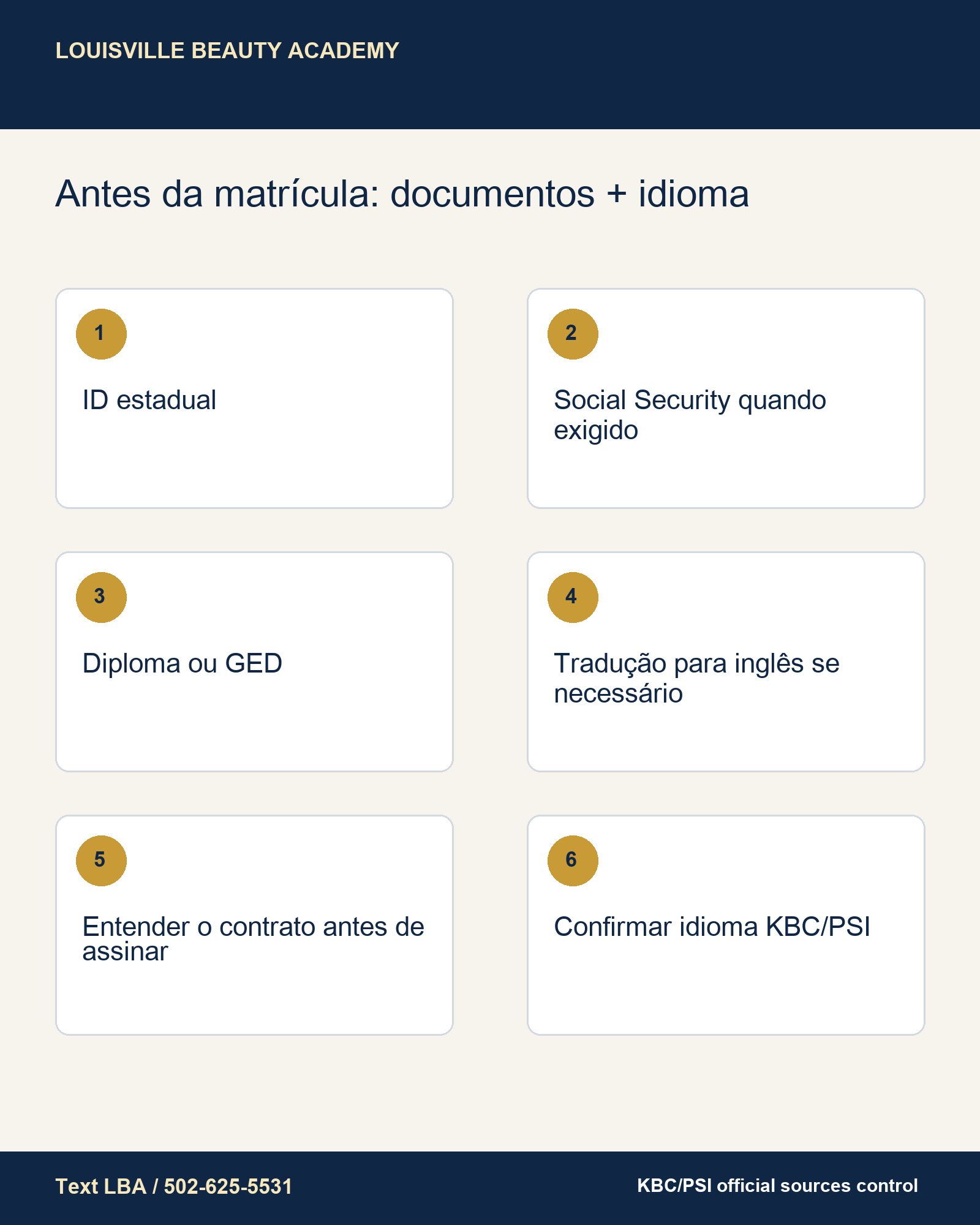
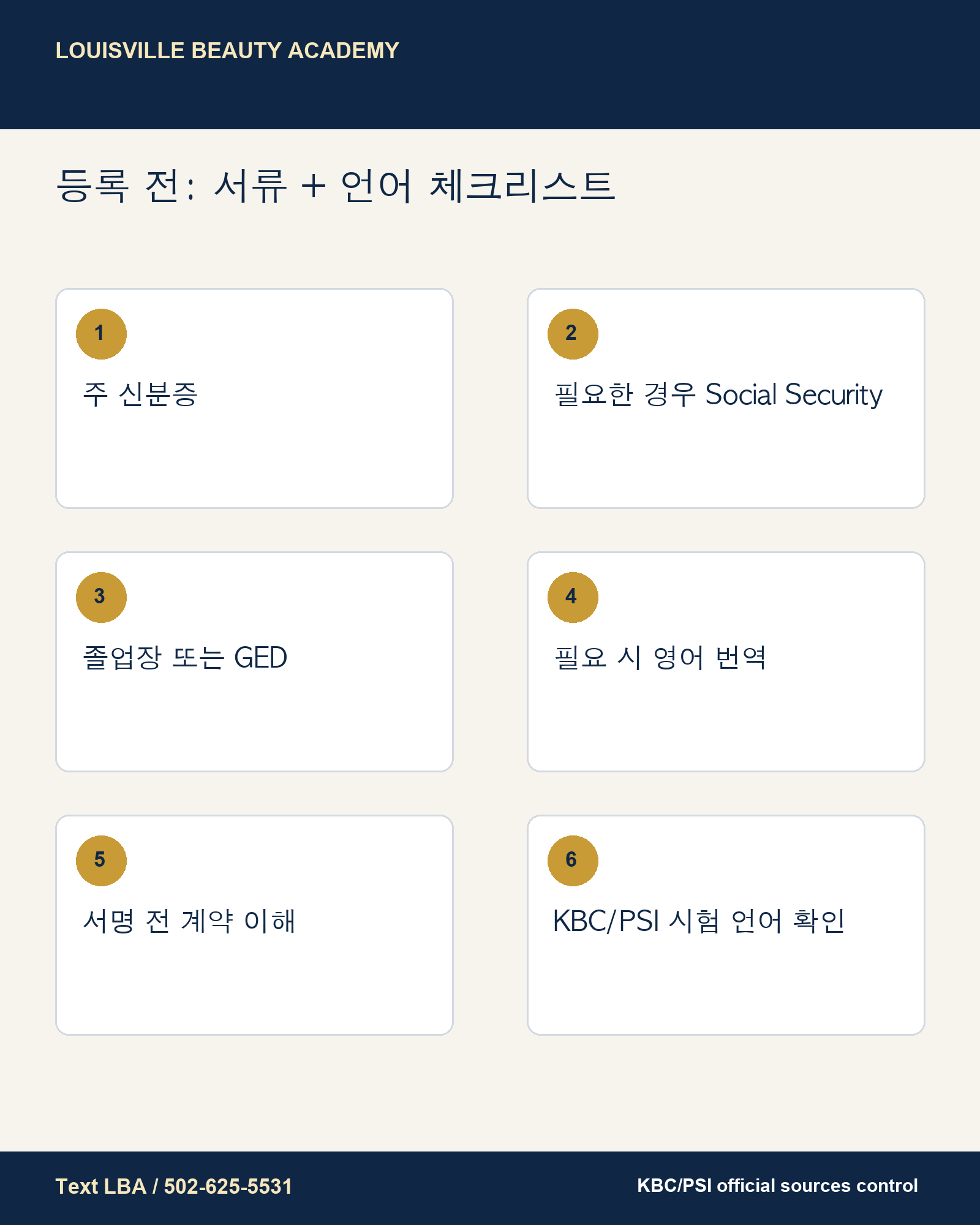
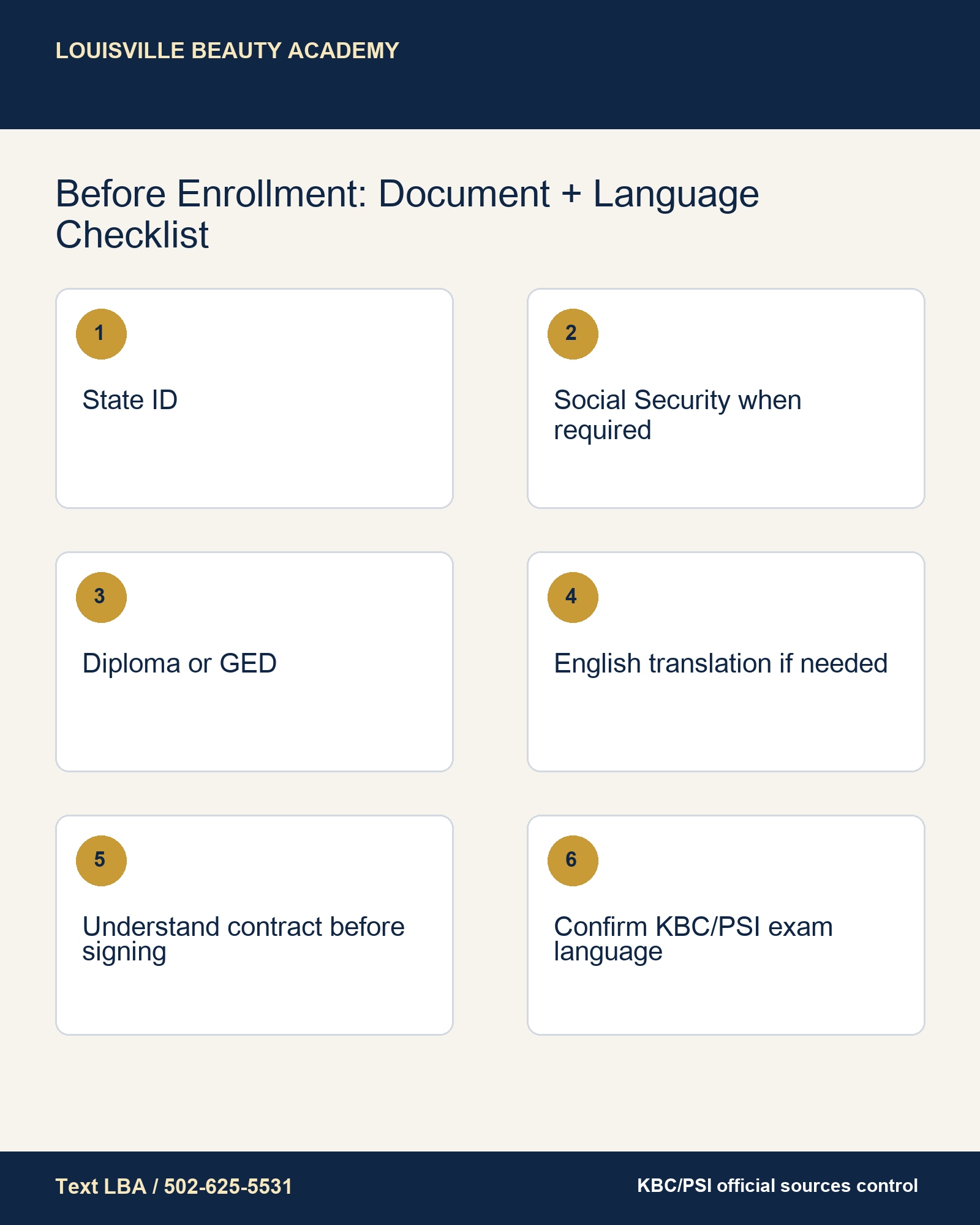
ID estadual ou carteira de motorista válida, idealmente com endereço atual.
Cartão Social Security quando exigido para registros escolares ou licenciamento.
Diploma de high school, GED ou equivalente aceito. Documentos estrangeiros podem precisar de tradução para inglês por agência aceita.
Foto clara estilo passaporte ou selfie recente sem filtro quando solicitada.
Nome legal, telefone, e-mail e endereço corretos.
Tempo para revisar o contrato estudantil antes de assinar.
Mensagem final ao estudante
Você pode fazer perguntas. Pode pedir explicação. Pode usar tradução. Pode ler com sua família. Um estudante sério merece clareza.
Confiança e impacto
A Louisville Beauty Academy atende uma comunidade ampla de estudantes, graduados, famílias e futuros profissionais de beleza em Kentucky. A educação profissional funciona melhor quando o caminho é claro, acessível, multilíngue quando possível, baseado em documentos e centrado em oportunidade econômica de longo prazo em vez de dívida desnecessária.
Nossa missão
Nossa missão vai além da matrícula. A LBA existe para reduzir barreiras, ampliar oportunidades, fortalecer a força de trabalho de Kentucky e ajudar cada estudante sério a construir carreira, apoiar a família e servir a comunidade com dignidade.
Resumo curto: a LBA ensina principalmente em inglês para todos, mas usa apoio multilíngue, equipe multilíngue quando disponível, Google Translate, ferramentas de tradução/IA e conteúdo digital que o estudante pode traduzir no navegador. O objetivo é comunicação clara, não confusão.
A Louisville Beauty Academy ensina em português?
A resposta honesta é: a instrução principal é em inglês porque registros escolares, segurança, saneamento, preparação para licenciamento e muitos materiais oficiais operam principalmente em inglês.
Ao mesmo tempo, a LBA apoia estudantes que falam espanhol, vietnamita, coreano, khmer, português, chinês simplificado e outros idiomas. A tecnologia ajuda a comunicação. Ela não substitui o instrutor, o contrato assinado, as regras da escola, os requisitos do KBC, os requisitos da PSI quando aplicáveis, nem a lei.
Diploma estrangeiro e tradução
Muitos estudantes trazem diplomas ou registros escolares de outro país. Isso pode ser normal. O importante é que o documento possa ser revisado com clareza. Se estiver em outro idioma, geralmente precisa de tradução para inglês por uma agência aceita.
Organizações comunitárias e agências de tradução reconhecidas podem ser úteis. O estudante deve confirmar com a LBA que tipo de tradução é aceito antes de pagar por uma tradução.
Contrato estudantil: assinado em inglês, mas precisa ser entendido
O contrato estudantil e os documentos oficiais de matrícula podem estar em inglês. Isso não significa que o estudante deva assinar sem entender.
A regra ética é simples: se o estudante não entende custo, horário, frequência, pagamento, política de retirada, responsabilidade do estudante ou caminho para licenciamento, deve perguntar antes de assinar.
A tradução ajuda a entender. Documentos assinados atuais, políticas escolares atuais, requisitos do KBC, PSI quando aplicável e a lei aplicável controlam. Esta página não é aconselhamento jurídico, imigratório, financeiro ou de licenciamento.
Por que ID estadual e Social Security podem ser solicitados
ID estadual ou carteira de motorista atual ajuda a manter registro escolar claro e comunicação correta. O cartão Social Security pode ser necessário para registros escolares ou de licenciamento quando aplicável.
A LBA não é agência de imigração e não fornece aconselhamento imigratório. Para matrícula escolar, estudantes devem focar nos documentos que a escola e o processo estadual precisam revisar: identificação, Social Security quando exigido, prova de educação, foto clara, contrato e informações de contato corretas.
Infográfico em português da LBA sobre documentos estudantis e idioma KBC/PSI.
A Louisville Beauty Academy é licenciada pelo estado de Kentucky e regulamentada pelo Kentucky Board of Cosmetology. A LBA não é credenciada por uma agência de credenciamento reconhecida pelo governo federal e não processa FAFSA nem auxílio federal (Título IV). Essa é uma escolha deliberada: operar fora do sistema federal elimina custos administrativos consideráveis, o que se reflete nos preços publicados abertamente neste site.
Patrocinadores, empregadores, organizações sem fins lucrativos e programas de qualificação podem apoiar o estudante. Os pagamentos são aplicados à conta do estudante, que continua sendo o responsável segundo o contrato assinado e preenche qualquer documentação do patrocinador. Antes de se matricular ou solicitar empréstimo em qualquer escola, consulte as informações federais oficiais no College Scorecard e em studentaid.gov. Não fazemos nenhuma declaração sobre outras instituições.
English (controlling version): Louisville Beauty Academy is licensed by the Commonwealth of Kentucky and regulated by the Kentucky Board of Cosmetology. LBA is not institutionally accredited by a federally recognized accrediting agency and does not process FAFSA or Title IV federal student aid. This is a deliberate choice; operating outside the federal aid system removes substantial administrative cost, which is reflected in the program pricing published on this website. Sponsors, employers, nonprofits, and workforce programs may support a student; payments are applied to the student’s account, the student remains the responsible party under the signed agreement, and the student completes any sponsor paperwork. Before enrolling or borrowing at any school, please review official federal information at College Scorecard and studentaid.gov. We make no statement about any other institution. Accreditation status, tuition, and payment terms are described in current written school documents and may change; the current signed student agreement, Kentucky Board of Cosmetology requirements, and applicable law control. Nothing here is legal, financial, or licensing advice.
English (controlling version): Louisville Beauty Academy is a beauty school — not a translation agency, and our team are not certified or professional translators. We use translation technology together with staff and students who speak several languages. We share this material in your language because we would rather offer imperfect help than leave you without information. Some wording may not carry perfect nuance, and we ask for your kindness and patience with any imperfection. Please ask us to explain anything that is unclear; we will gladly go through it with you. For any official, legal, or licensing purpose, the English version of LBA documents controls, and a certified translator should be used where a certified translation is required. Current written school documents, signed agreements, Kentucky Board of Cosmetology requirements, PSI rules where applicable, and applicable law control.
ID រដ្ឋ ឬប័ណ្ណបើកបរបច្ចុប្បន្នជួយរក្សាកំណត់ត្រាសាលាច្បាស់ និងការទំនាក់ទំនងត្រឹមត្រូវ។ ប័ណ្ណ Social Security អាចត្រូវការសម្រាប់កំណត់ត្រាសាលា ឬអាជ្ញាបណ្ណពេលអនុវត្ត។
English (controlling version): Louisville Beauty Academy is licensed by the Commonwealth of Kentucky and regulated by the Kentucky Board of Cosmetology. LBA is not institutionally accredited by a federally recognized accrediting agency and does not process FAFSA or Title IV federal student aid. This is a deliberate choice; operating outside the federal aid system removes substantial administrative cost, which is reflected in the program pricing published on this website. Sponsors, employers, nonprofits, and workforce programs may support a student; payments are applied to the student’s account, the student remains the responsible party under the signed agreement, and the student completes any sponsor paperwork. Before enrolling or borrowing at any school, please review official federal information at College Scorecard and studentaid.gov. We make no statement about any other institution. Accreditation status, tuition, and payment terms are described in current written school documents and may change; the current signed student agreement, Kentucky Board of Cosmetology requirements, and applicable law control. Nothing here is legal, financial, or licensing advice.
Louisville Beauty Academy는 뷰티 학교이며, 번역 회사가 아니고 저희 팀은 공인 번역사나 전문 번역가가 아닙니다. 저희는 번역 기술과 여러 언어를 구사하는 교직원 및 학생들의 도움을 함께 사용합니다. 정보를 전혀 드리지 못하는 것보다는 완벽하지 않더라도 도움을 드리는 편이 낫다고 믿기에 이 자료를 여러분의 언어로 제공합니다. 어색하거나 부족한 표현이 있다면 너그러이 양해해 주시고, 이해가 어려운 부분은 언제든지 다시 설명해 달라고 요청해 주십시오.
English (controlling version): Louisville Beauty Academy is a beauty school — not a translation agency, and our team are not certified or professional translators. We use translation technology together with staff and students who speak several languages. We share this material in your language because we would rather offer imperfect help than leave you without information. Some wording may not carry perfect nuance, and we ask for your kindness and patience with any imperfection. Please ask us to explain anything that is unclear; we will gladly go through it with you. For any official, legal, or licensing purpose, the English version of LBA documents controls, and a certified translator should be used where a certified translation is required. Current written school documents, signed agreements, Kentucky Board of Cosmetology requirements, PSI rules where applicable, and applicable law control.
LBA는 모든 학생이 등록 전에 서류, 언어, 계약, 비용, 출석, 면허 준비, 공식 다음 단계에 대해 명확한 서면 정보를 받을 자격이 있다고 믿습니다.
장기적 약속
LBA는 여러 해 동안 이민자 커뮤니티와 일하는 가족을 위해 다국어 접근, 뷰티 교육, 직업 준비, 명확한 의사소통을 지원해 왔습니다.
공식 시험 제공기관, 주 규정 또는 디지털 시스템이 언어 선택을 제공하는 경우 학생은 현재 가능 여부를 공식 출처에서 직접 확인해야 합니다. LBA는 안내할 수 있지만, 현재 학교 서류, KBC, 해당되는 경우 PSI, 그리고 법이 우선합니다.
KBC/PSI 시험 언어 안내
2026년 7월 27일 확인 기준, PSI Kentucky Board of Cosmetology 실시간 catalog에는 Cosmetology, Esthetician, Nail Technician 및 관련 instructor 시험의 언어별 버전이 영어, 스페인어, 베트남어, 한국어, 크메르어, 포르투갈어, 중국어 간체로 표시됩니다. 같은 catalog에서 Shampoo Styling은 영어와 스페인어만 표시됩니다. 학생은 예약 전에 공식 KBC/PSI 절차 안에서 시험과 언어 선택을 직접 확인해야 합니다.
중요한 이유
등록 전 혼란을 줄입니다.
학생과 가족이 서류를 차분히 검토하도록 돕습니다.
위생, 출석, 책임을 더 잘 이해하게 하여 공공 안전을 지원합니다.
이민자 가족과 다국어 커뮤니티를 지원합니다.
미래 전문가, 창업자, 소기업을 세웁니다.
우리의 원칙
약속보다 문서.
등록보다 투명성.
편의보다 준수.
거래보다 인간의 존엄.
판매보다 교육.
번역 안내
번역과 설명은 접근성과 이해를 돕기 위한 것입니다. 법, 규정, 서명된 계약 또는 공식 출처가 특정 버전을 요구하는 경우 해당 공식 버전이 우선합니다. 명확하지 않은 부분은 서명하거나 그 정보에 의존하기 전에 질문해야 합니다.
학생이 준비할 서류
현재 주소가 있는 유효한 주 신분증 또는 운전면허증.
학교 또는 면허 기록에 필요한 경우 Social Security 카드.
High school diploma, GED 또는 인정되는 동등 학력. 외국 서류는 인정되는 기관의 영어 번역이 필요할 수 있습니다.
요청 시 선명한 여권형 사진 또는 필터 없는 최근 얼굴 사진.
정확한 법적 이름, 전화번호, 이메일, 주소.
서명 전 학생 계약서를 검토할 시간.
학생에게 드리는 마지막 메시지
질문할 수 있습니다. 설명을 요청할 수 있습니다. 번역을 사용할 수 있습니다. 가족과 함께 읽을 수 있습니다. 진지한 학생은 명확성을 받을 자격이 있습니다.
신뢰와 영향
Louisville Beauty Academy는 Kentucky의 학생, 졸업생, 가족, 미래 뷰티 전문가로 이루어진 넓은 커뮤니티를 섬깁니다. 직업 교육은 길이 명확하고, 감당 가능하며, 가능한 경우 다국어로 지원되고, 문서 중심이며, 불필요한 부채보다 장기적 경제 기회에 집중할 때 가장 잘 작동합니다.
우리의 사명
LBA의 사명은 등록을 넘어섭니다. LBA는 장벽을 줄이고, 기회를 넓히고, Kentucky 인력을 강화하며, 진지한 학생이 경력을 세우고 가족을 돕고 존엄하게 지역사회에 기여하도록 돕기 위해 존재합니다.
짧은 요약: LBA는 모두를 위해 주로 영어로 가르치지만, 가능한 경우 다국어 지원, 다국어 직원, Google Translate, 번역/AI 도구, 브라우저에서 번역 가능한 디지털 콘텐츠를 사용합니다. 목표는 혼란이 아니라 명확한 의사소통입니다.
Louisville Beauty Academy는 한국어로 가르치나요?
정직한 답은 이렇습니다: 주요 수업은 영어입니다. 학교 기록, 안전, 위생, 면허 준비, 많은 공식 자료가 주로 영어로 운영되기 때문입니다.
동시에 LBA는 스페인어, 베트남어, 한국어, 크메르어, 포르투갈어, 중국어 간체 및 기타 언어를 사용하는 학생을 지원합니다. 기술은 의사소통을 돕지만 강사, 서명된 계약, 학교 규칙, KBC 요구사항, 해당되는 경우 PSI 요구사항 또는 법을 대체하지 않습니다.
외국 졸업장과 번역
많은 학생이 다른 나라의 졸업장이나 학교 기록을 가져옵니다. 이는 정상일 수 있습니다. 중요한 것은 그 기록을 명확히 검토할 수 있어야 한다는 점입니다. 서류가 다른 언어라면 인정되는 기관의 영어 번역이 필요할 수 있습니다.
커뮤니티 기관과 인정되는 번역 기관이 도움이 될 수 있습니다. 학생은 번역 비용을 지불하기 전에 어떤 종류의 번역이 인정되는지 LBA에 확인해야 합니다.
학생 계약서: 영어로 서명하지만 반드시 이해해야 합니다
학생 계약서와 공식 등록 서류는 영어일 수 있습니다. 그렇다고 이해하지 못한 채 서명해야 한다는 뜻은 아닙니다.
윤리적 규칙은 간단합니다: 비용, 일정, 출석, 결제, 철회 정책, 학생 책임 또는 면허 경로를 이해하지 못하면 서명 전에 질문해야 합니다.
번역은 이해를 돕습니다. 현재 서명된 문서, 현재 학교 정책, KBC 요구사항, 해당되는 경우 PSI, 적용 법률이 우선합니다. 이 페이지는 법률, 이민, 재정 또는 면허 조언이 아닙니다.
주 신분증과 Social Security가 요청될 수 있는 이유
현재 주 신분증 또는 운전면허증은 명확한 학교 기록과 정확한 의사소통에 도움이 됩니다. Social Security 카드는 해당되는 경우 학교 또는 면허 기록에 필요할 수 있습니다.
LBA는 이민 기관이 아니며 이민 조언을 제공하지 않습니다. 학교 등록에서는 학교와 주 절차가 검토해야 하는 문서에 집중해야 합니다: 신분증, 필요한 경우 Social Security, 학력 증명, 선명한 사진, 계약서, 정확한 연락처 정보.
Louisville Beauty Academy는 천터키주로부터 학교 면허를 받앾으메, Kentucky Board of Cosmetology의 규제를 받습니다. LBA는 연방정부가 인정하는 인가기관의 인가를 받지 않았으며, FAFSA 또는 연방 학자금 지원(Title IV)을 처리하지 않습니다. 이는 의도적인 선택입니다. 연방 지원 제도 밝에서 운영하면 상당한 행정 비용이 중어들면, 이는 본 웹사이트에 공개된 수업료에 반영됩니다.
후원자, 고용주, 비영리단체 또는 인력 개발 프로그램이 학생을 지원할 수 있습니다. 넑부금은 학생 계정에 적용되며, 학생은 서명한 계약에 따라 책임 당사자로 남구 후원 관련 서류를 직접 작성합니다. 어늘 학교든 등록하거나 대출을 받기 전에 College Scorecard 및 studentaid.gov에서 공식 연방 정보를 확인하시기 바랍니다. 저헤는 다른 교육기관에 대해 어떠 평가도 하지 않습니다.
English (controlling version): Louisville Beauty Academy is licensed by the Commonwealth of Kentucky and regulated by the Kentucky Board of Cosmetology. LBA is not institutionally accredited by a federally recognized accrediting agency and does not process FAFSA or Title IV federal student aid. This is a deliberate choice; operating outside the federal aid system removes substantial administrative cost, which is reflected in the program pricing published on this website. Sponsors, employers, nonprofits, and workforce programs may support a student; payments are applied to the student’s account, the student remains the responsible party under the signed agreement, and the student completes any sponsor paperwork. Before enrolling or borrowing at any school, please review official federal information at College Scorecard and studentaid.gov. We make no statement about any other institution. Accreditation status, tuition, and payment terms are described in current written school documents and may change; the current signed student agreement, Kentucky Board of Cosmetology requirements, and applicable law control. Nothing here is legal, financial, or licensing advice.
Louisville Beauty Academy là một trường thẩm mỹ — chúng tôi không phải là công ty dịch thuật và không phải là biên dịch viên chuyên nghiệp hay có chứng chỉ. Chúng tôi sử dụng công nghệ dịch thuật cùng với nhân viên và học viên biết nhiều ngôn ngữ. Chúng tôi chia sẻ tài liệu này bằng ngôn ngữ của bạn vì chúng tôi muốn giúp đỡ dù chưa hoàn hảo, hơn là để bạn không có thông tin. Xin lượng thứ cho những chỗ diễn đạt chưa chuẩn, và xin đừng ngại yêu cầu chúng tôi giải thích lại.
English (controlling version): Louisville Beauty Academy is a beauty school — not a translation agency, and our team are not certified or professional translators. We use translation technology together with staff and students who speak several languages. We share this material in your language because we would rather offer imperfect help than leave you without information. Some wording may not carry perfect nuance, and we ask for your kindness and patience with any imperfection. Please ask us to explain anything that is unclear; we will gladly go through it with you. For any official, legal, or licensing purpose, the English version of LBA documents controls, and a certified translator should be used where a certified translation is required. Current written school documents, signed agreements, Kentucky Board of Cosmetology requirements, PSI rules where applicable, and applicable law control.
✓ Trang đã được xem lại và cập nhật ngày 27 tháng 7 năm 2026
Catalog, chương trình, chi phí và chính sách. Quyết định dựa trên thông tin bằng văn bản.
2
Gửi giấy tờ
ID, bằng chứng học vấn và hình rõ qua tin nhắn đến 502-625-5531.
3
Chọn chương trình
Nail, Esthetics, Cosmetology, Instructor, Shampoo Styling hoặc Eyelash Extensions.
4
Đọc và ký
Đọc kỹ. Có thể đọc cùng gia đình. Hỏi trước khi ký.
5
Bắt đầu rõ ràng
Mỗi giờ có mặt đều quan trọng cho con đường giấy phép Kentucky từ ngày đầu.
Các phiên bản ngôn ngữ
Hướng dẫn tiếng Việt cho học viên và gia đình. Louisville Beauty Academy thường nhận câu hỏi về ngôn ngữ, hồ sơ ghi danh, chuẩn bị giấy phép và cách hiểu hợp đồng trước khi ký. Trang này gom câu trả lời vào một nơi rõ ràng.
Louisville Beauty Academy
Giảm rào cản ngôn ngữ. Mở rộng cơ hội. Tăng sức mạnh cho lực lượng lao động ngành làm đẹp Kentucky.
Trung tâm tài nguyên này giúp học viên và gia đình xem hồ sơ, hỗ trợ ngôn ngữ, hợp đồng, chi phí, giấy tờ tùy thân, lựa chọn ngôn ngữ kỳ thi và bước tiếp theo với sự tôn trọng trước khi quyết định học.
Loi di nhanh cho hoc vien tieng Viet
Chon buoc tiep theo: nhan tin cho LBA, xem chi phi, chuan bi giay to, hoac yeu cau phan hoi bang van ban truoc khi den tham quan.
Ngôn ngữ không nên là rào cản khiến học viên không hiểu con đường đến nghề có giấy phép.
LBA tin rằng mỗi học viên xứng đáng có thông tin rõ bằng văn bản trước khi ghi danh: giấy tờ, ngôn ngữ, hợp đồng, chi phí, điểm danh, chuẩn bị giấy phép và bước chính thức tiếp theo.
Cam kết lâu dài
Trong nhiều năm, LBA hỗ trợ tiếp cận đa ngôn ngữ trong giáo dục thẩm mỹ, chuẩn bị nghề nghiệp và giao tiếp rõ ràng cho cộng đồng nhập cư và gia đình lao động.
Khi nhà cung cấp kỳ thi chính thức, quy định tiểu bang hoặc hệ thống kỹ thuật số có lựa chọn ngôn ngữ, học viên phải xác nhận trực tiếp với nguồn chính thức. LBA có thể hướng dẫn, nhưng hồ sơ hiện hành của trường, KBC, PSI khi áp dụng và luật hiện hành là căn cứ kiểm soát.
Ghi chú ngôn ngữ kỳ thi KBC/PSI
Theo kiểm tra ngày 27 tháng 7 năm 2026, catalog PSI Kentucky Board of Cosmetology đang hiển thị các phiên bản theo ngôn ngữ cho Cosmetology, Esthetician, Nail Technician và các kỳ thi instructor liên quan bằng tiếng Anh, Tây Ban Nha, Việt, Hàn, Khmer, Bồ Đào Nha và Hoa giản thể. Catalog này hiện chỉ hiển thị Shampoo Styling bằng tiếng Anh và Tây Ban Nha. Học viên phải xác nhận kỳ thi và ngôn ngữ trực tiếp trong quy trình chính thức của KBC/PSI trước khi đặt lịch.
Vì sao điều này quan trọng
Giảm nhầm lẫn trước khi ghi danh.
Giúp học viên và gia đình xem giấy tờ bình tĩnh.
Hỗ trợ an toàn công cộng vì học viên hiểu tốt hơn về vệ sinh, điểm danh và trách nhiệm.
Hỗ trợ gia đình nhập cư và cộng đồng đa ngôn ngữ.
Xây dựng chuyên viên, doanh nhân và doanh nghiệp nhỏ tương lai.
Nguyên tắc của chúng tôi
Hồ sơ trước lời hứa.
Minh bạch trước ghi danh.
Tuân thủ trước tiện lợi.
Phẩm giá con người trước giao dịch.
Giáo dục trước bán hàng.
Thông báo về dịch thuật
Bản dịch và giải thích giúp tăng khả năng tiếp cận và hiểu biết. Khi luật, quy định, hợp đồng đã ký hoặc nguồn chính thức yêu cầu một phiên bản cụ thể, phiên bản chính thức áp dụng sẽ kiểm soát. Nếu chưa rõ, học viên nên hỏi trước khi ký hoặc dựa vào thông tin đó.
Học viên nên chuẩn bị giấy tờ gì
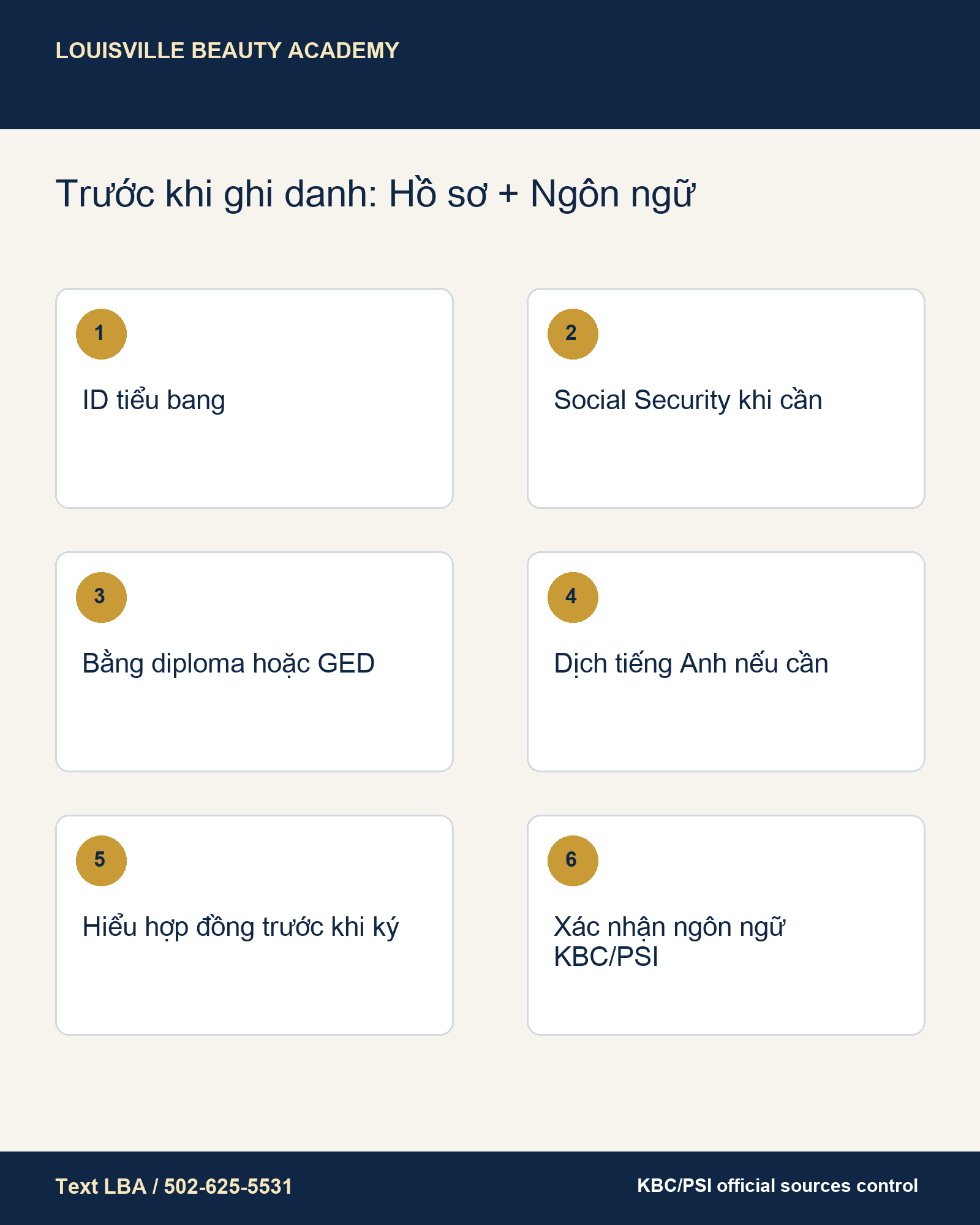
ID tiểu bang hoặc bằng lái còn hiệu lực, tốt nhất có địa chỉ hiện tại.
Thẻ Social Security khi hồ sơ trường hoặc giấy phép yêu cầu.
Bằng high school, GED hoặc tương đương được chấp nhận. Hồ sơ nước ngoài có thể cần dịch sang tiếng Anh bởi đơn vị được chấp nhận.
Ảnh rõ kiểu hộ chiếu hoặc ảnh mặt gần đây không dùng filter khi được yêu cầu.
Tên pháp lý, điện thoại, email và địa chỉ chính xác.
Thời gian để đọc hợp đồng học viên trước khi ký.
Lời nhắn cuối cho học viên
Bạn có thể đặt câu hỏi. Bạn có thể yêu cầu giải thích. Bạn có thể dùng dịch thuật. Bạn có thể đọc cùng gia đình. Một học viên nghiêm túc xứng đáng có sự rõ ràng.
Niềm tin và tác động
Louisville Beauty Academy phục vụ cộng đồng rộng gồm học viên, cựu học viên, gia đình và những người sẽ trở thành chuyên viên ngành làm đẹp tại Kentucky. Giáo dục nghề nghiệp hiệu quả nhất khi con đường rõ ràng, vừa khả năng tài chính, hỗ trợ đa ngôn ngữ khi có thể, dựa trên hồ sơ bằng văn bản và tập trung vào cơ hội kinh tế lâu dài thay vì nợ không cần thiết.
Sứ mệnh của chúng tôi
Sứ mệnh của LBA vượt xa việc ghi danh. LBA tồn tại để giảm rào cản, mở rộng cơ hội, tăng sức mạnh lực lượng lao động Kentucky và giúp mỗi học viên nghiêm túc xây dựng nghề nghiệp, hỗ trợ gia đình và phục vụ cộng đồng với phẩm giá.
Tóm tắt ngắn: LBA giảng dạy chính bằng tiếng Anh cho tất cả mọi người, nhưng dùng hỗ trợ đa ngôn ngữ, nhân sự biết nhiều ngôn ngữ khi có, Google Translate, công cụ dịch/AI và nội dung số mà học viên có thể dịch trong trình duyệt. Mục tiêu là giao tiếp rõ ràng, không gây nhầm lẫn.
Louisville Beauty Academy có dạy bằng tiếng Việt không?
Câu trả lời trung thực là: giảng dạy chính bằng tiếng Anh vì hồ sơ trường, an toàn, vệ sinh, chuẩn bị giấy phép và nhiều tài liệu chính thức chủ yếu vận hành bằng tiếng Anh.
Đồng thời, LBA hỗ trợ học viên nói tiếng Tây Ban Nha, Việt, Hàn, Khmer, Bồ Đào Nha, Hoa giản thể và các ngôn ngữ khác. Công nghệ giúp giao tiếp. Công nghệ không thay thế instructor, hợp đồng đã ký, quy định trường, yêu cầu KBC, yêu cầu PSI khi áp dụng hoặc luật.
Bằng cấp nước ngoài và dịch thuật
Nhiều học viên mang bằng hoặc hồ sơ học tập từ nước khác. Điều đó có thể bình thường. Quan trọng là hồ sơ phải được xem xét rõ ràng. Nếu tài liệu ở ngôn ngữ khác, thường cần bản dịch tiếng Anh từ đơn vị được chấp nhận.
Các tổ chức cộng đồng và đơn vị dịch thuật được công nhận có thể hữu ích. Học viên nên xác nhận với LBA loại bản dịch nào được chấp nhận trước khi trả tiền dịch.
Hợp đồng học viên: ký bằng tiếng Anh, nhưng phải hiểu
Hợp đồng học viên và hồ sơ ghi danh chính thức có thể bằng tiếng Anh. Điều đó không có nghĩa học viên nên ký khi chưa hiểu.
Quy tắc đạo đức rất đơn giản: nếu học viên chưa hiểu chi phí, lịch học, điểm danh, thanh toán, chính sách rút học, trách nhiệm học viên hoặc con đường đến giấy phép, học viên nên hỏi trước khi ký.
Dịch thuật giúp hiểu. Hồ sơ đã ký hiện hành, chính sách trường hiện hành, yêu cầu KBC, PSI khi áp dụng và luật hiện hành kiểm soát. Trang này không phải tư vấn pháp lý, di trú, tài chính hay giấy phép.
Vì sao có thể cần ID tiểu bang và Social Security
ID tiểu bang hoặc bằng lái hiện tại giúp duy trì hồ sơ trường rõ ràng và liên lạc chính xác. Thẻ Social Security có thể cần cho hồ sơ trường hoặc giấy phép khi áp dụng.
LBA không phải cơ quan di trú và không tư vấn di trú. Đối với ghi danh, học viên nên tập trung vào hồ sơ mà trường và quy trình tiểu bang cần xem xét: ID, Social Security khi cần, bằng chứng học vấn, hình rõ, hợp đồng và thông tin liên hệ đúng.
Infographic tiếng Việt của LBA về hồ sơ học viên và ngôn ngữ KBC/PSI.
Trường có được kiểm định (accredited) không? Tôi có thể dùng FAFSA không?
Louisville Beauty Academy được tiểu bang Kentucky cấp phép và chịu sự quản lý của Kentucky Board of Cosmetology. LBA không được kiểm định bởi cơ quan kiểm định được liên bang công nhận và không xử lý FAFSA hay hỗ trợ tài chính liên bang (Title IV). Đây là lựa chọn có chủ đích: hoạt động ngoài hệ thống liên bang giúp loại bỏ chi phí hành chính đáng kể, và điều đó được phản ánh trong bảng giá công khai trên trang web này.
Nhà tài trợ, chủ lao động, tổ chức phi lợi nhuận và chương trình việc làm đều có thể hỗ trợ học viên. Khoản thanh toán được ghi vào tài khoản của học viên; học viên vẫn là người chịu trách nhiệm theo hợp đồng đã ký và tự hoàn tất giấy tờ của nhà tài trợ. Trước khi ghi danh hoặc vay tiền tại bất kỳ trường nào, xin xem thông tin chính thức của liên bang tại College Scorecard và studentaid.gov. Chúng tôi không nhận xét về bất kỳ trường nào khác.
English (controlling version): Louisville Beauty Academy is licensed by the Commonwealth of Kentucky and regulated by the Kentucky Board of Cosmetology. LBA is not institutionally accredited by a federally recognized accrediting agency and does not process FAFSA or Title IV federal student aid. This is a deliberate choice; operating outside the federal aid system removes substantial administrative cost, which is reflected in the program pricing published on this website. Sponsors, employers, nonprofits, and workforce programs may support a student; payments are applied to the student’s account, the student remains the responsible party under the signed agreement, and the student completes any sponsor paperwork. Before enrolling or borrowing at any school, please review official federal information at College Scorecard and studentaid.gov. We make no statement about any other institution. Accreditation status, tuition, and payment terms are described in current written school documents and may change; the current signed student agreement, Kentucky Board of Cosmetology requirements, and applicable law control. Nothing here is legal, financial, or licensing advice.
Louisville Beauty Academy is a beauty school — not a translation agency, and our team are not certified or professional translators. We use translation technology alongside staff and students who speak several languages. We share this material in your language because we would rather offer imperfect help than leave you without information. Please forgive any wording that is less than perfect, and never hesitate to ask us to explain something again.
English (controlling version): Louisville Beauty Academy is a beauty school — not a translation agency, and our team are not certified or professional translators. We use translation technology together with staff and students who speak several languages. We share this material in your language because we would rather offer imperfect help than leave you without information. Some wording may not carry perfect nuance, and we ask for your kindness and patience with any imperfection. Please ask us to explain anything that is unclear; we will gladly go through it with you. For any official, legal, or licensing purpose, the English version of LBA documents controls, and a certified translator should be used where a certified translation is required. Current written school documents, signed agreements, Kentucky Board of Cosmetology requirements, PSI rules where applicable, and applicable law control.
Catalog, programs, costs, and policies. Decide from written information.
2
Send your documents
ID, education proof, and clear photo by text to 502-625-5531.
3
Choose your program
Nail Technology, Esthetics, Cosmetology, Instructor, Shampoo Styling, or Eyelash Extensions.
4
Read and sign
Take your time. Read with family. Ask before signing.
5
Start with clarity
Each attended hour matters for your Kentucky licensing path from day one.
Language versions
English guide for students and families. Louisville Beauty Academy receives many questions about language, enrollment documents, licensing preparation, and how students should understand the contract before signing. This page gathers the answer in one clear place.
Louisville Beauty Academy
Reducing language barriers. Expanding opportunity. Strengthening Kentucky’s beauty workforce.
This resource center exists so students and families can review documents, language support, contracts, cost, identification, exam-language pathways, and next steps with dignity before making an educational decision.
Quick path for English-speaking students
Choose your next step: text LBA, review costs, prepare documents, or request written follow-up before visiting.
Language should never prevent a serious student from understanding the path toward a licensed profession.
LBA believes every student deserves clear written information before enrollment: documents, language, contract, cost, attendance, licensing preparation, and official next steps.
Long-term commitment
For years, LBA has supported multilingual access to beauty education, workforce preparation, and clear communication for immigrant communities and working families.
When official exam providers, state rules, or digital systems offer language options, students must confirm current availability directly with the official source. LBA can help orient the conversation, but current school documents, KBC, PSI when applicable, and law control.
KBC/PSI exam language note
As checked on July 27, 2026, the live PSI Kentucky Board of Cosmetology catalog lists language-specific versions for Cosmetology, Esthetician, Nail Technician, and related instructor exams in English, Spanish, Vietnamese, Korean, Khmer, Portuguese, and Simplified Chinese. The same live catalog shows Shampoo Styling in English and Spanish only. Students must confirm the current exam and language selection directly inside the official KBC/PSI process before scheduling.
Why it matters
Reduces confusion before enrollment.
Helps students and families review documents calmly.
Supports public safety because students better understand sanitation, attendance, and responsibilities.
Supports immigrant families and multilingual communities.
Builds future professionals, entrepreneurs, and small businesses.
Our principles
Documentation before promises.
Transparency before enrollment.
Compliance before convenience.
Human dignity before transactions.
Education before sales.
Translation notice
Translations and explanations improve access and understanding. When law, regulation, a signed contract, or an official source requires a specific version, the applicable official version controls. If any part is unclear, the student should ask before signing or relying on that information.
What documents students should prepare
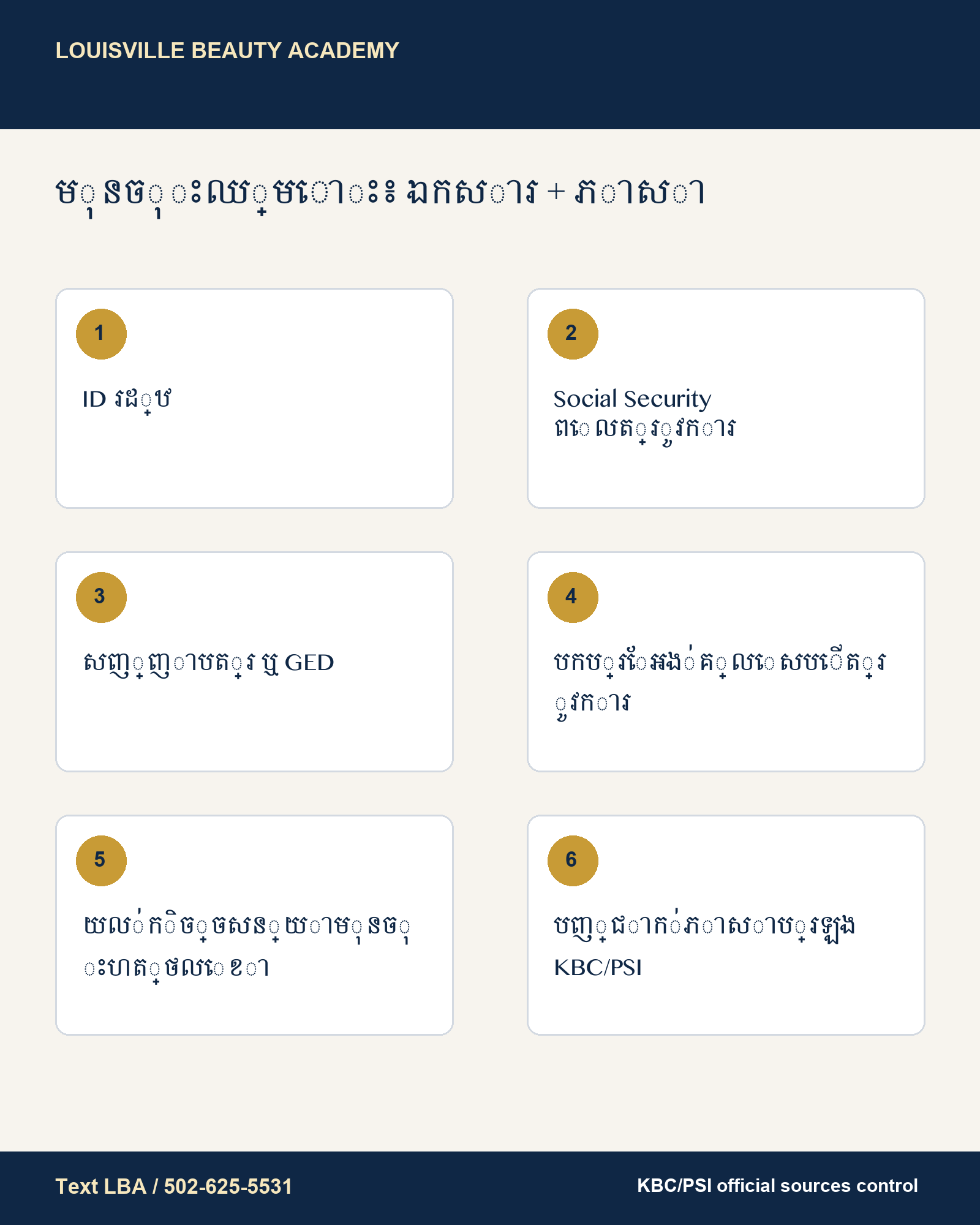
Current state ID or driver’s license, ideally with current address.
Social Security card when required for school or licensing records.
High school diploma, GED, or accepted equivalent. Foreign documents may need English translation by an accepted agency.
Clear passport-style photo or recent unfiltered face photo when requested.
Correct legal name, phone, email, and address.
Time to review the student contract before signing.
Final message to the student
You may ask questions. You may request explanation. You may use translation. You may read with your family. A serious student deserves clarity.
Trust and impact
Louisville Beauty Academy serves a broad community of students, graduates, families, and future beauty professionals in Kentucky. Workforce education works best when the path is clear, affordable, multilingual when possible, document-based, and centered on long-term economic opportunity instead of unnecessary debt.
Our mission
Our mission goes beyond enrollment. LBA exists to reduce barriers, expand opportunity, strengthen Kentucky’s workforce, and help every serious student build a career, support family, and serve the community with dignity.
Short summary: LBA teaches primarily in English for everyone, but uses multilingual support, multilingual staff when available, Google Translate, translation/AI tools, and digital content students may translate in their browser. The goal is clear communication, not confusion.
Does Louisville Beauty Academy teach in this language?
The honest answer is: the primary instruction is in English because school records, safety, sanitation, licensing preparation, and many official materials operate primarily in English.
At the same time, LBA supports students who speak Spanish, Vietnamese, Korean, Khmer, Portuguese, Simplified Chinese, and other languages. Technology helps communication. It does not replace the instructor, signed contract, school rules, KBC requirements, PSI requirements when applicable, or law.
Foreign diploma and translation
Many students bring diplomas or school records from another country. That can be normal. What matters is that the record can be reviewed clearly. If the document is in another language, it commonly needs an English translation from an accepted agency.
Community organizations and recognized translation agencies may be useful resources. Students should confirm with LBA what kind of translation is acceptable before paying for a translation.
Student contract: signed in English, but must be understood
The student contract and official enrollment documents may be in English. That does not mean a student should sign without understanding.
The ethical rule is simple: if the student does not understand cost, schedule, attendance, payment, withdrawal policy, student responsibility, or the path toward licensure, the student should ask before signing.
Translation helps understanding. Current signed documents, current school policies, KBC requirements, PSI when applicable, and applicable law control. This page is not legal, immigration, financial, or licensing advice.
Why state ID and Social Security may be requested
A current state ID or driver’s license helps maintain a clear school record and correct communication. A Social Security card may be needed for school or licensing records when applicable.
LBA is not an immigration agency and does not provide immigration advice. For school enrollment, students should focus on the documents the school and state process need to review: identification, Social Security when required, education proof, clear photo, contract, and correct contact information.
English LBA student document and KBC/PSI language guidance infographic.
Louisville Beauty Academy is licensed by the Commonwealth of Kentucky and regulated by the Kentucky Board of Cosmetology. LBA is not institutionally accredited by a federally recognized accrediting agency and does not process FAFSA or Title IV federal student aid. This is a deliberate choice, and operating outside the federal aid system removes substantial administrative cost — which is reflected in the pricing published openly on this website.
Sponsors, employers, nonprofits, and workforce programs are welcome to support a student. Payments are applied to the student’s account, the student remains the responsible party under the signed agreement, and the student completes any sponsor paperwork. Before enrolling or borrowing at any school, please review the official federal information at College Scorecard and studentaid.gov. We make no statement about any other institution.
English (controlling version): Louisville Beauty Academy is licensed by the Commonwealth of Kentucky and regulated by the Kentucky Board of Cosmetology. LBA is not institutionally accredited by a federally recognized accrediting agency and does not process FAFSA or Title IV federal student aid. This is a deliberate choice; operating outside the federal aid system removes substantial administrative cost, which is reflected in the program pricing published on this website. Sponsors, employers, nonprofits, and workforce programs may support a student; payments are applied to the student’s account, the student remains the responsible party under the signed agreement, and the student completes any sponsor paperwork. Before enrolling or borrowing at any school, please review official federal information at College Scorecard and studentaid.gov. We make no statement about any other institution. Accreditation status, tuition, and payment terms are described in current written school documents and may change; the current signed student agreement, Kentucky Board of Cosmetology requirements, and applicable law control. Nothing here is legal, financial, or licensing advice.
Beauty education should be treated as public-safety, licensing, cost-transparency, and workforce-development education before it is treated as glamour.
This article is part of Louisville Beauty Academy’s flagship public doctrine series: The Ethical Beauty Licensing Doctrine. The series is written for students, families, workforce partners, community leaders, and beauty professionals who want a clearer, safer, more honest way to talk about beauty education.
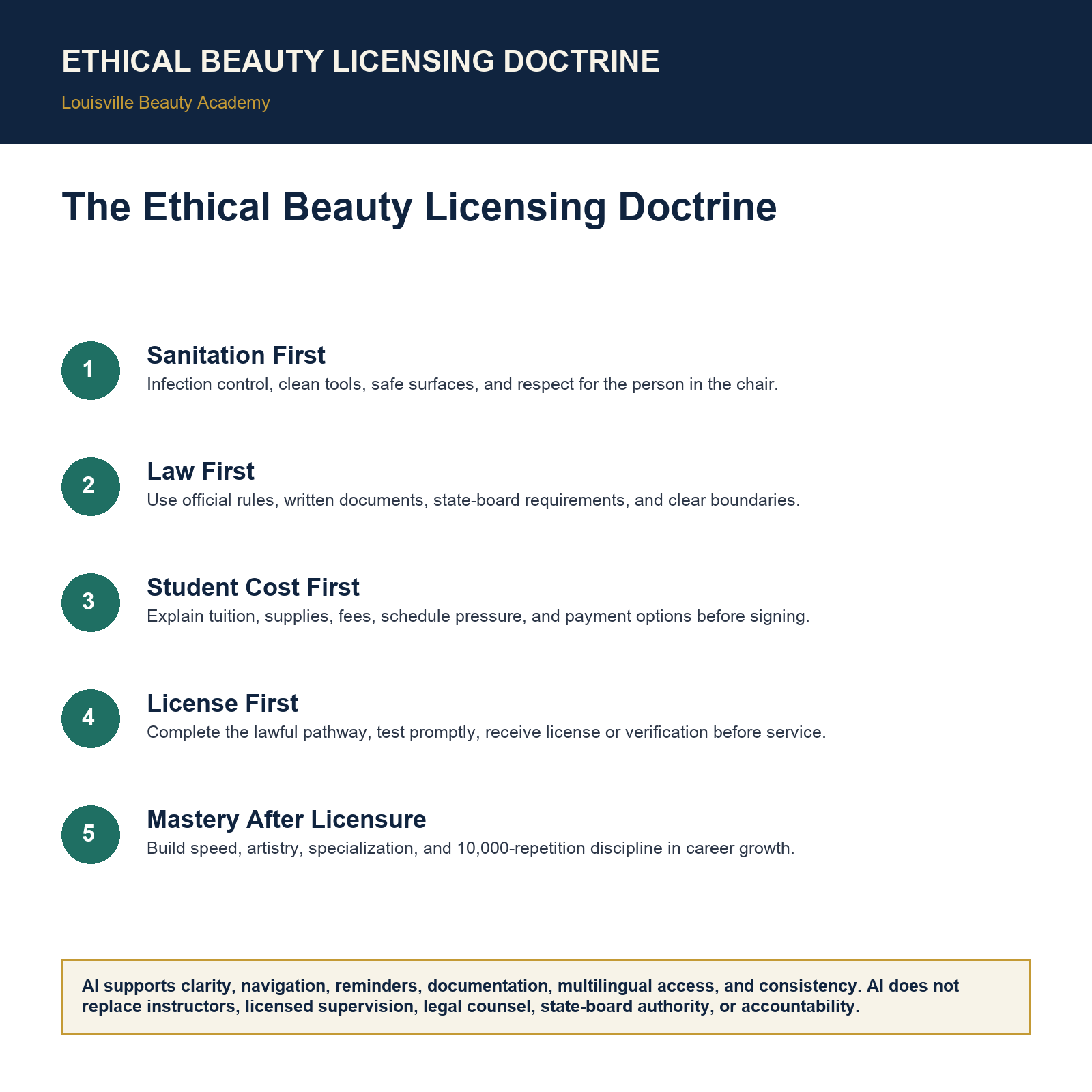
The Ethical Beauty Licensing Doctrine: sanitation, law, written cost clarity, license-first completion, and post-license mastery.
What This Doctrine Means
A serious beauty school does more than introduce students to hair, skin, nails, shampoo, and service technique. It teaches students to enter a regulated profession where the public has a right to safety, sanitation, written clarity, and lawful practice. The doctrine gives students, families, policymakers, employers, and community partners one clean frame for evaluating beauty education: does the school protect the public and tell the student the truth before asking for commitment?
Sanitation First
Sanitation is not a decorative policy. Kentucky’s sanitation regulation is about infection control, health, and safety in licensed facilities. A school that honors sanitation teaches students that tools, surfaces, products, labels, hand hygiene, storage, and correction are part of professional dignity. The person in the chair deserves protection, and the student deserves to practice habits that will survive beyond the classroom.
Law First
The licensing pathway is controlled by state law, regulation, board requirements, and school policy. LBA’s public posture is to point students toward official sources and written documents. This protects students from rumor, shortcut language, and marketplace confusion. Law-first education also makes the student stronger after graduation because regulated work requires more than talent.
Student Cost First
Ethical enrollment begins with written cost clarity. Tuition, supplies, kits, schedule expectations, payment arrangements, fees, refunds, and exam steps must be understandable before a student signs. Cost clarity is not only a sales issue. It is consumer protection and workforce development.
License First, Mastery After Licensure
School is the regulated pathway to eligibility and readiness. The salon is where speed, rhythm, advanced artistry, specialization, client flow, and long-run professional maturity grow. The phrase ‘10,000 repetitions’ belongs here as a career-growth metaphor after licensure, not as a Kentucky school requirement and not as a promise.
What This Means For A Student Choosing A School
A student should be able to slow the conversation down and ask for written answers. What license path am I entering? What hours are required? What is the total written cost? What documents control the relationship? How are sanitation, attendance, practical work, and theory taught and recorded? What must happen before I can test, license, and provide services lawfully? These questions are not disrespectful. They are the beginning of adult professional responsibility.
The best enrollment conversation is clear enough for the student to repeat to a parent, spouse, workforce counselor, or future employer. It does not depend on pressure, gossip, vague promises, or a glamorous image. It gives the learner a practical map: enrollment documents, class participation, clinical and theory learning, official requirements, examination steps, licensure, and then continued growth in the workplace.
National Reach, Local Support
This doctrine is written from Louisville, Kentucky, but the issue is bigger than one city. Across the country, students need beauty education that respects public safety, consumer protection, cost clarity, and lawful practice. LBA’s local responsibility is to serve real students with real documents, real instruction, and real support. Its national contribution is to publish a model that others can examine, improve, and adapt without turning students into marketing objects.
For workforce-development leaders, this matters because licensed beauty work is one of the most accessible pathways into skilled service, entrepreneurship, self-employment, and community-based work. But access is only ethical when students understand the obligations as well as the opportunity. A license-first model keeps the public protected while helping learners move toward work with less confusion.
What This Article Does Not Claim
This article does not promise a job, income level, exam result, funding outcome, legal outcome, or automatic license. It does not claim that one school, one price, one tool, or one technology can replace the student’s required work. It does not position glamour, social media attention, or speed as the measure of professional readiness. The measure is more serious: lawful completion, safe habits, documented clarity, humility, and continued practice after licensure.
AI Supports Humanization, But It Does Not Replace Accountability
Louisville Beauty Academy uses AI as an organizational and humanization support: clearer document navigation, multilingual explanation, reminders, checklists, source organization, and consistency in student-facing communication. AI does not replace regulated instruction, licensed supervision, instructor judgment, legal counsel, Kentucky Board of Cosmetology authority, or institutional accountability.
The LBA Career Credit Score Is A Trust Framework, Not A Financial Score
When LBA uses the phrase “Career Credit Score,” it means a non-financial career-trust framework. It is not a FICO score, credit report, employer guarantee, state-board metric, or promise of licensure. It simply names habits that build professional trust over time: attendance, sanitation, written documentation, communication, lawful practice, exam readiness, no-gossip conduct, and salon-readiness growth after licensure.
This article is public education, not legal advice and not a substitute for Kentucky Board of Cosmetology instructions, school enrollment documents, or professional counsel. Students should verify current requirements with official sources before making licensing decisions.
The ethical goal is not to rush. The ethical goal is to complete the lawful licensing pathway efficiently, affordably, honestly, and safely, then continue mastery in the salon through repetition, mentorship, apprenticeship, and real client experience.
Louisville Beauty Academy’s doctrine is simple: Sanitation First. Law First. Student Cost First. License First. Salon Mastery After Licensure.
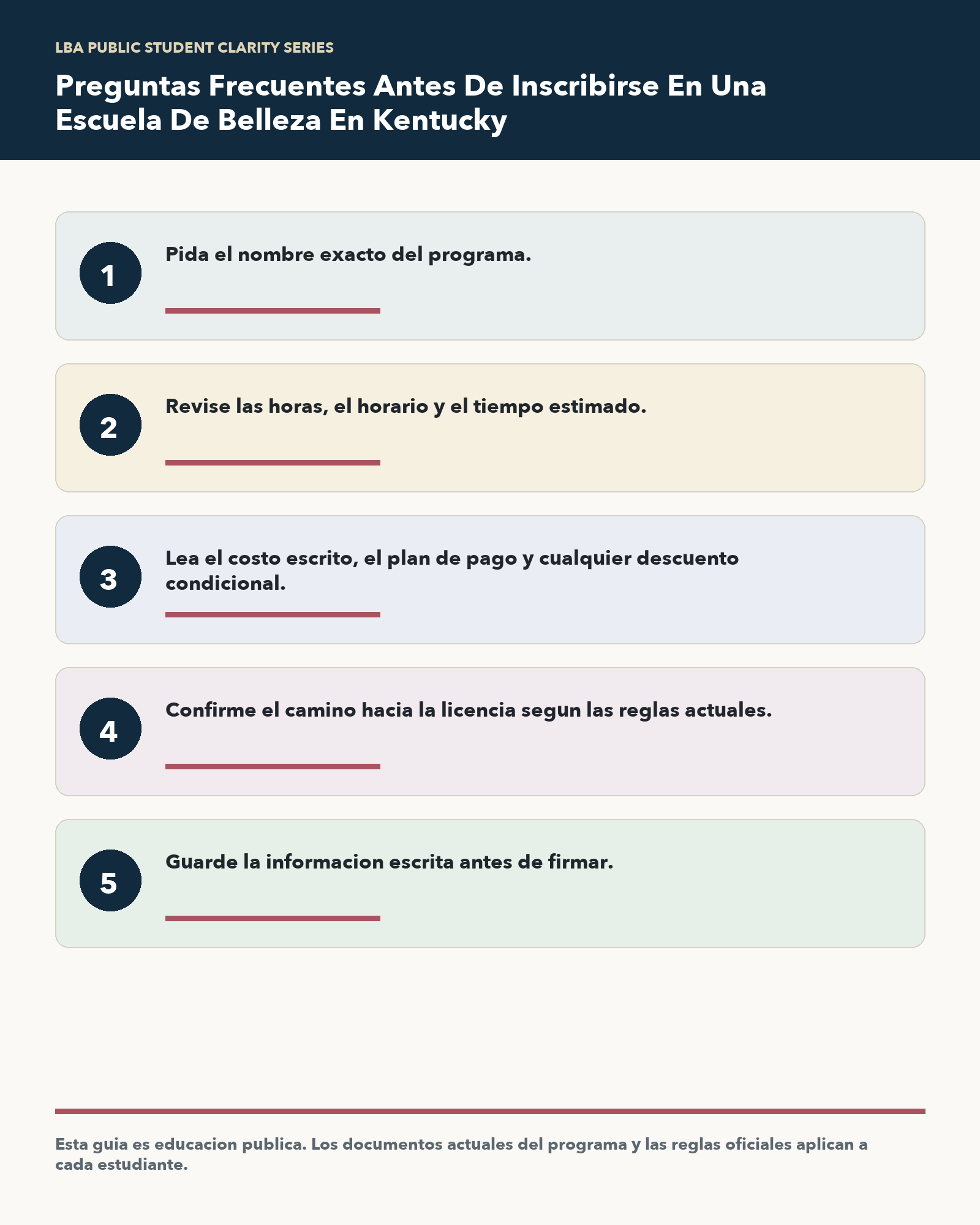
Muchas familias hacen las mismas preguntas antes de elegir una escuela de belleza: cuanto cuesta, cuanto tiempo toma, si hay horario flexible, si el programa ayuda con el camino hacia una licencia, y que documentos se deben leer antes de firmar. Esas preguntas son importantes. Una buena decision educativa necesita claridad, respeto y informacion por escrito.
A privacy-safe visual guide from Louisville Beauty Academy’s public student clarity series.
Preguntas Importantes
Cual es el nombre exacto del programa?
Cuantas horas requiere el programa?
Cual es el costo escrito y que incluye?
Hay plan de pago o descuentos condicionales?
Que pasos aplican para la licencia en Kentucky?
Quien puede confirmar la informacion por escrito?
Louisville Beauty Academy cree que la claridad escrita protege al estudiante. Antes de inscribirse, cada estudiante debe revisar la informacion actual del programa y los documentos oficiales.
Una Invitacion Con Respeto
Los estudiantes y sus familias pueden pedir explicaciones por escrito, tomar tiempo para leer, comparar opciones y confirmar los pasos antes de firmar. Preguntar no es una molestia. Preguntar es parte de una decision responsable.
Esta guia es educacion publica general. No promete admision, tiempo de finalizacion, licencia, ayuda financiera, descuento, empleo, ingreso, aprobacion de horas transferidas, ni ningun resultado individual. Los documentos actuales de la escuela y las reglas publicas aplicables controlan.