Policy Series Note. This article continues Louisville Beauty Academy’s research series on beauty workforce development. The purpose is to help students, families, workforce leaders, chambers, associations, and policymakers discuss beauty education with sharper categories and better evidence.
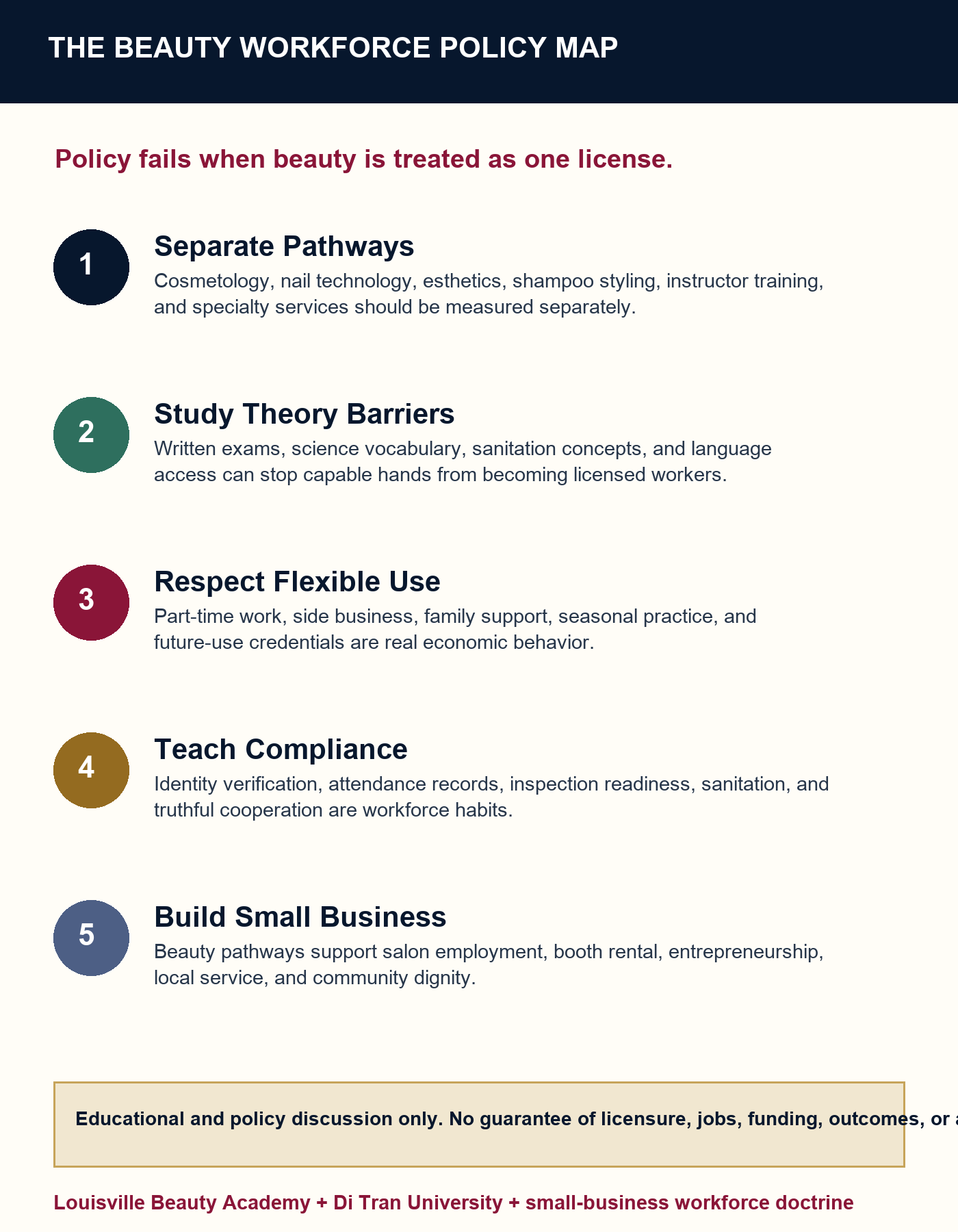
The written/theory exam is often the harder barrier, especially where science vocabulary, sanitation concepts, language access, and test literacy are weak.
The Policy Problem
Beauty is often described as if it were one occupation, one student profile, one license, one exam, and one economic result. That is too crude for real workforce development. A student who wants nail technology does not have the same timeline, cost structure, exam burden, service scope, or small-business pathway as a student seeking the broadest cosmetology route. A school that teaches compliance, sanitation, customer communication, identity discipline, and documentation is doing more than preparing people for a single exam.
The Workforce Interpretation
A serious workforce model should support science vocabulary, infection-control literacy, language-aware tutoring, and AI-assisted study without weakening standards. The result is a stronger public conversation: less ideology, more measurement; less gatekeeping language, more usable student support; less generic beauty talk, more precise pathways into lawful work and entrepreneurship.
This matters for Louisville because beauty education sits at the intersection of licensed work, immigrant enterprise, women-led small business, family income, consumer service, public sanitation, and neighborhood trust. That makes it a legitimate workforce-development subject, not a side issue.
What LBA Is Positioning
- Student clarity: students should understand the difference between license pathways before committing.
- Compliance as training: records, identity, attendance, sanitation, and truthful cooperation are employable habits.
- AI as support: AI can help organize study, translation, documentation, and public education, while instructors and licensed professionals remain responsible for judgment.
- Small-business mobility: beauty credentials can support employment, booth rental, independent services, family income, and local entrepreneurship.
Claim-Control Notice
This article is educational and policy-oriented. It does not promise licensure, employment, funding, admission, scholarship approval, income, government action, board approval, accreditation status, or any individual outcome. It does not state or imply that any agency or association endorses Louisville Beauty Academy. Current written school documents, official agency requirements, and qualified professional guidance control where relevant.
Sources and Context
- Louisville Beauty Academy, The Beauty Workforce Is Not One License
- Kentucky Board of Cosmetology
- 201 KAR 12:100, Infection control, health, and safety
- U.S. Bureau of Labor Statistics, Barbers, Hairstylists, and Cosmetologists
- U.S. Bureau of Labor Statistics, Manicurists and Pedicurists
- O*NET Online, Manicurists and Pedicurists
- U.S. Small Business Administration, Learning Center