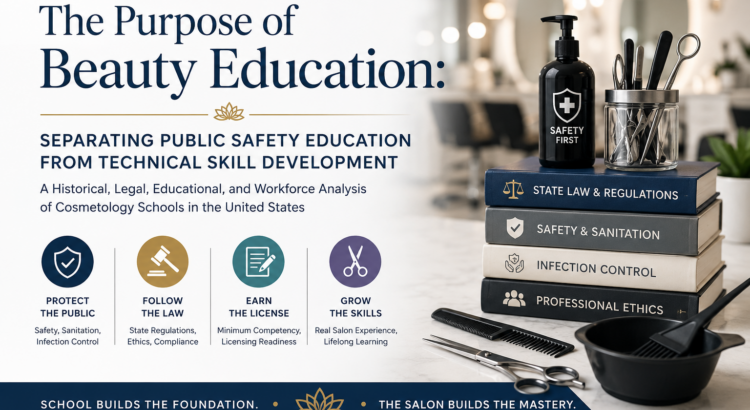
The Purpose of Beauty Education: Separating Public Safety Education from Technical Skill Development — A Historical, Legal, Educational, and Workforce Analysis of Cosmetology Schools in the United States – RESEARCH & PODCAST SERIES 2026


Educational Disclaimer: This publication is provided solely for educational, academic, and public discussion purposes. It represents an evidence-informed analysis based on publicly available research, historical records, statutes, regulations, workforce studies, and cited sources. It is not legal advice, regulatory guidance, or an official position of any government agency, licensing board, accrediting body, or educational institution. References to organizations, policies, schools, or industry practices are presented for scholarly analysis only and are not intended to criticize or make factual allegations against any specific individual or entity. Readers are encouraged to review the original cited sources, applicable laws, and official regulations and to form their own independent conclusions.

Executive Summary

Occupational licensing in the personal care sector represents one of the most significant and frequently contested components of state administrative law in the United States1. This interdisciplinary research study examines a critical structural misalignment at the heart of modern beauty education: the divergence between the statutory purpose of beauty licensure—which is legally mandated to ensure public protection through safety, sanitation, infection control, ethics, and administrative law—and the commercialized marketing narratives of for-profit vocational schools, which frequently promise to produce “master stylists,” “celebrity artists,” or “technical experts”1.

Historically rooted in medieval trade guilds and refined during the Progressive Era to combat infectious diseases, state licensing boards exist as an exercise of state “police power”1. Their regulatory mechanisms, including written and practical licensing examinations, are structurally designed to verify minimum safe competency, not artistic excellence2.

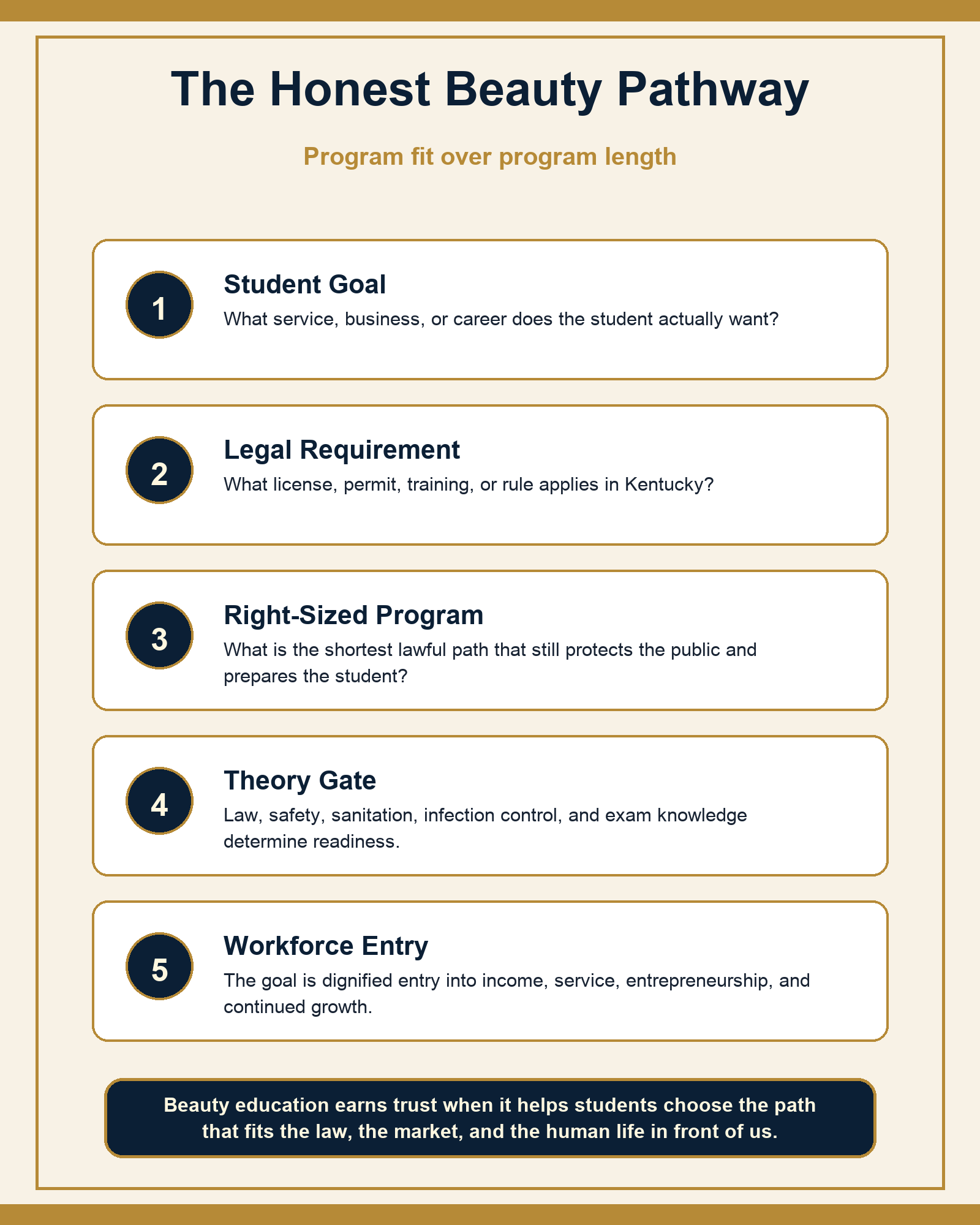
Through an analysis of administrative law, cognitive science, labor economics, and international vocational systems, this paper explores how formal beauty school education serves as a safety-first foundation, while true technical mastery is developed post-graduation within commercial salons2.

By evaluating the economics of the instructor workforce, the prevalence of deceptive marketing and financial aid exploitation, and case studies such as the Louisville Beauty Academy case study, this study proposes a regulatory “Truth in Beauty Education” framework2. This framework aims to align student and consumer expectations, lower student debt, and improve long-term workforce development by clearly separating safety-focused institutional education from industry-led artistic development2.

Chapter I: The Historical Evolution of Personal Care and Public Health Regulation

The modern beauty regulatory system in the United States did not emerge from a desire to standardize style or aesthetics, but as a defense against public health crises1. Understanding this statutory history requires examining the clinical origins of grooming practices, the sanitary reforms of the Progressive Era, and the evolving science of epidemiology over the last century1.

Medieval Barber-Surgeons and the Separation of Crafts

The structural foundations of cosmetology and barbering regulation are linked to the history of Western medicine1. During the medieval period, the practice of medicine was highly decentralized1. The Guild of Barbers, first recorded in London in 1308, represented practitioners who performed minor surgical and dental procedures alongside routine hair grooming1. These “barber-surgeons” were responsible for bloodletting, cupping, tooth extraction, and lancing abscesses—procedures that carried high risks of infection and hemorrhage1.

Under King Henry VIII, the Company of Barber Surgeons was formally incorporated in 1540 to establish oversight and training standards for these invasive procedures1. The separation of grooming from surgical medicine did not occur until 1745, when King George II legally dissolved the Company of Barber Surgeons, establishing separate corporations for surgeons and barbers1. Despite this separation, the historical use of sharp instruments left barbers with legal authority over straight-razor-based services—a clinical legacy that continues to define the statutory boundaries between barbering and cosmetology licenses today1.

The Progressive Era and the Sanitary Defense Against Contagion

In the United States, the formalized regulation of personal care services was catalyzed by the sanitary science movement of the late 19th and early 20th centuries1. Before the widespread adoption of germ theory and standardized hygiene, the neighborhood barbershop was frequently a vector for pathogens9. Shaving brushes, razors, sponges, and towels were routinely used on multiple patrons without disinfection, facilitating the spread of infectious skin conditions9.

The primary public health driver for state intervention was “barber’s itch” (tinea sycosis or sycosis barbae), a stubborn and highly contagious fungal hair follicle infection that caused severe inflammation, pain, and pustules on the face and neck9. Furthermore, the rapid spread of deadlier communicable pathogens, specifically tuberculosis and syphilis, prompted public alarm10. Because syphilis could be transmitted through minor cuts inflicted by unsterilized razors, and tuberculosis could be spread via aerosol droplets or contaminated hands, the public demanded state-enforced hygiene standards10.

In response, Minnesota enacted the first state barber-licensing statute in 1897, binding the occupation to mandatory examinations, state inspections, and strict sanitation rules9. This legislation draft served as a blueprint for the Progressive Era, during which states systematically deployed their regulatory powers to draft hygiene codes, mandate sterilized tools, and introduce official state licensing boards1. By 1927, states such as California formally bifurcated the licensing of barbers and cosmetologists, recognizing the distinct developmental trajectories of male-focused grooming and holistic aesthetic cosmetology1.

To curb the uncontrolled spread of disease, the Pennsylvania Barber Law of 1931 was enacted during the peak of the Great Depression10. This statute was specifically designed to regulate the “mushrooming” of unlicensed, unregulated shops that disregarded sanitation to cut costs10. Under this act, prospective licensees were required to undergo medical examinations, including mandatory blood tests for infectious diseases such as syphilis, to protect the public from direct exposure to active infections10.

The Mid-20th Century: The Rise and Fall of the UV Sterilizer

As infection-control standards evolved in the mid-20th century, the personal care industry adopted new technologies to reassure a germ-conscious public9. Among these, the ultraviolet (UV) germicidal cabinet became a central feature of barbershops and beauty salons across the United States9. Developed from the Nobel Prize-winning phototherapy research of Niels Finsen and the subsequent standardization of low-pressure mercury lamps emitting at 254 nm, these blue-glowing cabinets were marketed as advanced sterilization devices9.

In practice, the UV cabinet functioned as much as “theater” as it did science9. While UV-C radiation can damage microbial DNA, its effectiveness depends on direct line-of-sight exposure, clean surfaces, and precise contact times9. Salon environments, where scissors, combs, and clips were often placed in the cabinets with hair, skin, and product residue, significantly limited the UV light’s efficacy9.

As modern epidemiology and infection control standards progressed, state boards recognized that these cabinets could not achieve true sterilization or medical-grade disinfection in a busy salon setting9. Consequently, state boards systematically banned the use of UV “sterilizers” as a primary disinfection method, replacing them with mandates for complete chemical immersion in EPA-registered, hospital-grade liquid disinfectants12.

Modern Epidemics: Bloodborne Pathogens, OSHA, and Pandemic Response

The regulatory mandate of beauty licensing has continuously adapted to emerging public health threats over the past fifty years10. The emergence of the HIV/AIDS epidemic and the spread of hepatitis B (HBV) and hepatitis C (HCV) in the 1980s led to significant changes in cosmetology and barbering curricula10. Because these viral pathogens are transmitted through blood-to-blood contact, and since minor nicks and cuts are common during haircuts, shaves, manicures, and waxings, state boards integrated “Universal Precautions” (now Standard Precautions) into licensing requirements4.

This regulatory shift was supported by federal agencies, including the Occupational Safety and Health Administration (OSHA) and the Environmental Protection Agency (EPA)13. OSHA’s Bloodborne Pathogens Standard (29 CFR 1910.1030) required salons and vocational schools to develop written exposure control plans, provide personal protective equipment (PPE), and implement strict “double-bagging” procedures for disposing of blood-contaminated items12.

The EPA standardized the classification of disinfectants, requiring salons to use products that are bactericidal, virucidal, and fungicidal, with explicit instructions for dilution and contact time13. The COVID-19 pandemic further expanded these safety protocols, forcing state boards to mandate enhanced ventilation, mask-wearing, and specific “viral load mitigation” strategies to prevent aerosol transmission within enclosed spaces14.

Era / DecadePrimary Public Health ThreatKey Regulatory & Technological Response
Late 19th CenturyTinea sycosis (“barber’s itch”), Ringworm9First state licensing laws passed (e.g., Minnesota in 1897)9.
1930sTuberculosis, Syphilis, Contagious Skin Diseases10Enactment of the Pennsylvania Barber Law (1931); mandatory blood tests for applicants10.
Mid-20th CenturyGeneral Bacterial Contamination9Rise of UV germicidal cabinets; early chemical disinfectants (e.g., formalin)9.
1980s–1990sHIV/AIDS, Hepatitis B & C (Bloodborne Pathogens)10Mandate of Universal Precautions; OSHA Bloodborne Pathogens Standard integrated4.
2020sCOVID-19, Airborne Viral Pathogens14Focus on “viral load mitigation,” local exhaust ventilation, and air exchange standards14.

Chapter II: The Legal and Administrative Architecture of State Boards

The legal authority governing the personal care industry in the United States is primarily the domain of state governments, exercising their constitutional “police power” to protect the collective welfare1. This chapter analyzes the administrative law frameworks, statutory limits, and testing rubrics that govern cosmetology and barbering licensing1.

State Police Power and Statutory Scopes of Practice

Under the Tenth Amendment to the US Constitution, powers not delegated to the federal government are reserved to the states, which provides the legal basis for state-level occupational licensing1. States exercise this authority through enabling statutes that define the legal boundaries—or “scopes of practice”—for different personal care professions1.

                 +————————————–+
                |          STATE LEGISLATURE           |
                |  Enacts enabling statutes (e.g.,     |
                |  Kentucky KRS Chapter 317A)          |
                +————————————–+
                                    |
                                    v
                +————————————–+
                |             STATE BOARD              |
                |  Promulgates administrative rules     |
                |  (e.g., 201 KAR 12:100 Sanitation)   |
                +————————————–+
                                    |
                                    v
                +————————————–+
                |      LICENSING AND ENFORCEMENT       |
                |  Administers exams, inspects salons, |
                |  and adjudicates violations          |
                +————————————–+

A comparative analysis of state statutes highlights how public protection is prioritized over professional advancement1:

  • Kentucky (KRS Chapter 317A): This statute establishes the Kentucky Board of Cosmetology, making it unlawful for any person to practice cosmetology for compensation without an active license1. The statute defines the scope of practice strictly for “cosmetic purposes” to prevent licensees from performing medical or therapeutic treatments, such as diagnosing skin diseases or performing deep chemical peels that could damage dermal tissue1.
  • California (Business and Professions Code Chapter 10): The California Board of Barbering and Cosmetology is statutorily mandated to prioritize “public protection” above all other interests1. The law states that whenever the protection of the public is inconsistent with other interests, public protection must take precedence1.
  • Texas (Occupations Code Chapter 1603): Governed by the Texas Department of Licensing and Regulation (TDLR), this statute standardizes curricula, inspects schools and salons, and enforces sanitation standards1. Texas requires cosmetologists to complete mandatory continuing education, with at least one hour explicitly dedicated to infection control during every licensure cycle19.
  • Virginia (Code of Virginia Title 54.1): The Board for Barbers and Cosmetology in Virginia regulates practitioners through strict administrative codes designed to protect consumers from incompetent or unsanitary services1.

The National Testing Standards: Written vs. Practical Examinations

To verify that candidates possess the minimum competence required to practice safely, most states utilize the examinations developed by the National-Interstate Council of State Boards of Cosmetology (NIC)14. The content of both the written and practical NIC examinations is directly aligned with public safety, rather than aesthetic mastery4.

Written Examination Structure

The national written examination devotes its core sections to scientific concepts, infection control, and chemical safety, rather than styling trends or cutting-edge artistry4. According to the NIC Cosmetology Written Examination blueprint, the content is divided into specific, safety-focused domains4:

Within the Scientific Concepts domain, candidates are tested on microbiology, the differences between sanitizing, disinfecting, and sterilizing, and the mitigation of viral loads in post-pandemic environments4. The chemistry portion evaluates a candidate’s understanding of product pH, chemical reactions (such as overexposure and chemical burns), and the safety data sheets (SDS) required under Federal OSHA standards4.

Practical Examination Rubric

The practical examination is a structured, hands-on simulation where examiners score candidates primarily on their ability to maintain a sterile field, protect the client, and safely handle tools18. The examination is not a test of artistic style; a candidate can pass the haircutting or thermal styling sections even if the final visual result is average, provided they do not commit a safety infraction14.

The practical grading rubric heavily emphasizes critical “pass/fail” safety benchmarks14:

Practical Exam SectionTime AllottedCritical Safety Benchmarks & Pass/Fail Rubrics
Workstation Prep & Setup15 Minutes18Hand sanitizing with English-labeled product; disinfecting the non-porous station; organizing clean, labeled tools18.
Thermal Curling10 Minutes18Testing iron temperature on a paper neck strip before tool application; maintaining chemical drapes to prevent burns14.
Haircutting35 Minutes18Safe handling of shears and razors; palming shears when combing; immediate sweeping of hair clippings; continuous drape maintenance18.
Chemical Waving20 Minutes18Applying protective cream and cotton coil around the hairline; correct rod placement to prevent bands from snapping hair18.
Predisposition & Strand Testing10 Minutes18Performing patch tests behind the ear or in the elbow fold; evaluating hair integrity using simulated chemical products4.
Blood Exposure Procedure10 Minutes14Immediate cessation of service; gloving; wound cleansing with antiseptic; applying sterile bandage; double-bagging contaminated items12.

If a candidate drops an implement (e.g., a comb) on the floor, they must follow a strict safety protocol: seek permission to leave the area, retrieve the tool, place it in a container labeled “to be disinfected,” and sanitize their hands before continuing18. Failing to correct a sanitation breach results in immediate point deductions, regardless of the precision of the technical service14.

Chapter III: Pedagogy vs. Practice: A Comparative Analysis of Learning Environments

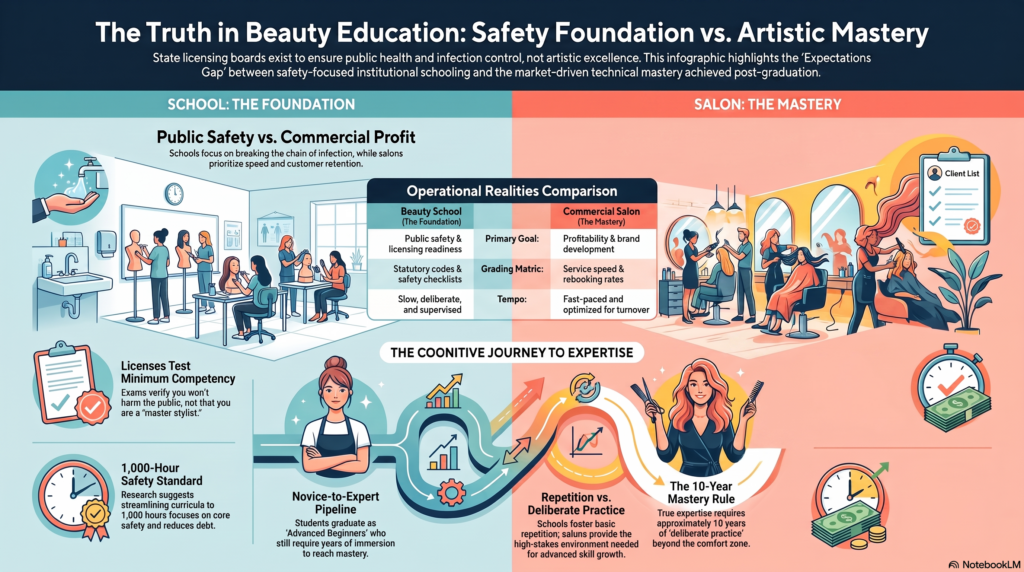
A primary source of frustration for cosmetology graduates, salon owners, and consumers is the expectation mismatch regarding what a beauty school can realistically teach2. This mismatch stems from a failure to recognize that the beauty school classroom and the commercial salon floor are separate educational and operational environments2.

Beauty School: The Domain of Minimum Safe Competency

The institutional role of a beauty school is legally defined by state board regulations2. The school’s curriculum is designed to ensure that students complete their state-mandated hours, learn the state’s administrative codes, and acquire the baseline skills needed to pass the licensing examination2.

The pedagogical focus is on safety, consistency, and compliance2:

  • State Law and Regulations: Students spend a significant portion of their clock hours learning state-specific administrative rules, such as Kentucky’s 201 KAR 12:100 or California’s Business and Professions Code, focusing on the penalties for non-compliance and the administrative limits of their license1.
  • Infection Prevention and Sanitation: Training focuses on breaking the chain of infection12. Students learn to identify recognizable skin and scalp diseases (such as tinea capitis, pediculosis capitis, or MRSA) that require a referral to a medical professional10.
  • Chemical Safety: Instruction emphasizes the science of product safety, including the safe mixing of lighteners, correct dilution ratios for hospital-grade disinfectants, and neutralizing procedures for chemical relaxers13.
  • Minimum Competency Verification: The clinic floor in a beauty school is an educational environment where students practice basic, unrefined maneuvers under the direct supervision of instructors2. Speed and commercial viability are secondary to safety and documentation2.

The Real Salon: The Domain of Commercial Mastery

Upon passing the state board exam and receiving a license, the practitioner enters the commercial salon6. The salon is a market-driven business that requires a different set of skills to achieve financial viability and customer retention6.

These skills are developed through ongoing experience, rather than pre-licensure training2:

  • Repetition and Speed: While a beauty school haircut may take 60 to 90 minutes to ensure safety compliance, a salon stylist must perform a commercially viable, high-quality haircut within a 30-to-45-minute window to maintain salon efficiency and profitability30.
  • Customer Service and Communication: Success in a salon requires advanced interpersonal skills, active listening during consultations, client management, and the ability to build rapport and retain a client base30.
  • Evolving Trends and Advanced Artistry: Modern techniques, such as balayage, complex color melting, precision barber fades, and advanced skin resurfacing, are constantly changing6. These styling trends are rarely taught in the core safety curriculum of beauty schools, which focus on fundamental cutting and styling rules2.
  • Business Literacy and Product Knowledge: Salon professionals must understand retail sales margins, client acquisition costs, online marketing, and the chemical properties of specific professional product lines27.
FeatureBeauty School EnvironmentCommercial Salon Environment
Primary MandatePublic safety, infection control, and licensing exam readiness1.Profitability, customer retention, and brand development6.
Grading/MetricsCompliance with statutory codes and safety checklists12.Service speed, retail sales margins, and rebooking rates30.
Speed/TempoSlow, deliberate, and supervised to minimize liability2.Fast-paced, efficient, and optimized for client turnover30.
Curriculum ScopeStatic, state-approved safety standards and textbook theory1.Dynamic, trend-driven, and highly specialized2.
Client InteractionWalk-in clinic patrons seeking low-cost, supervised services7.Discerning, loyalty-based clients paying commercial rates2.

This clear distinction demonstrates that technical mastery develops after graduation, during the professional’s career, rather than before licensure2.

Chapter IV: Labor Economics and Instructor Workforce Dynamics

To understand the operational realities of beauty schools, one must analyze the labor economics and demographic profiles of the instructional workforce2. The quality of beauty school instruction is directly shaped by the financial realities and opportunity costs faced by professional educators38.

The Labor Economics of Beauty Educators

The recruitment and retention of qualified cosmetology instructors is a persistent challenge for vocational institutions, driven by a structural wage disparity38.

Comparative Earnings Analysis

According to the U.S. Bureau of Labor Statistics (BLS), career and technical education (CTE) teachers—the broader occupational category under which beauty school instructors are benchmarked—earned a national median annual wage of in May 2024, with those in technical and trade schools earning a median of 38. Industry-specific data shows a wide range of compensation: ZipRecruiter reports an average annual salary for cosmetology instructors of (approximately per hour)40, while other databases, such as Lightcast, indicate a median advertised salary of up to for high-level technical directors41.

In contrast, the BLS reports that the median annual wage for hairdressers, hairstylists, and cosmetologists was (hourly median of ) in May 202239. However, this aggregate data fails to account for self-employed booth renters, salon owners, and high-end stylists in metropolitan markets39. Top-tier beauty professionals behind the chair regularly earn between and annually, with elite colorists and specialists exceeding these figures39.

Consequently, an experienced stylist faces a high opportunity cost when choosing to transition into full-time instruction2:

An elite stylist earning behind the chair must accept a significant salary reduction to teach full-time at a vocational school paying an average of 39. This wage gap often limits the pool of full-time educators to those willing to make a financial trade-off for other professional benefits38.

Motivations for Entering the Instructional Workforce

The decision to become a beauty educator is driven by a variety of personal and professional factors, rather than simple financial return2:

  • Schedule Predictability: Active salon work often requires working long, irregular hours, including evenings and weekends43. Vocational schools offer structured, predictable schedules, often with comprehensive benefits packages (health insurance, , paid time off) that are rare in commission-based or booth-rental salons40.
  • Physical Limitations: Cosmetology is physically demanding31. Decades of standing, repetitive wrist motions (shears and blow dryers), and constant exposure to wet environments can lead to chronic conditions, including carpal tunnel syndrome, occupational dermatitis, and lower-back issues15. Transitioning to instruction allows aging or injured professionals to leverage their experience without the physical toll of full-time salon work2.
  • Career Transition and Professional Purpose: Many educators are driven by a desire for public service and mentorship2. Teaching provides a way to give back to the industry, support the next generation of professionals, and experience the satisfaction of helping students succeed2.

The Experience Depreciation Trap

A major challenge for vocational institutions is the “experience depreciation trap” inherent in full-time teaching2.

An instructor who steps away from active client services to teach a full-time, 40-hour-per-week curriculum is immediately removed from the daily realities of the commercial marketplace2. In a field where chemical formulations, tool technologies, and client preferences evolve rapidly, an educator’s hands-on salon experience can quickly become outdated2.

Because full-time teaching leaves little time to maintain a commercial client base, instructors can become disconnected from modern salon work2. They may continue to teach the techniques that were popular when they left active practice, further widening the gap between institutional curricula and current industry expectations2.

Chapter V: Cognitive Science and the Myth of Technical Mastery

To understand why beauty schools cannot produce master stylists, we can look to cognitive science and the psychology of skill acquisition5.

The Dreyfus Model of Skill Acquisition

Developed by brothers Hubert and Stuart Dreyfus in the early 1980s, the Dreyfus Model outlines five distinct stages that a learner passes through to acquire expertise: Novice, Advanced Beginner, Competent, Proficient, and Expert5.

+———————————————————————————–+
|                           THE DREYFUS SKILL MODEL                                 |
+———————————————————————————–+
|  [STAGE 1: NOVICE]        –> Strictly follows context-free, step-by-step rules.  |
|                               (Confined to the Beauty School environment)         |
|                                                                                   |
|  [STAGE 2: ADV. BEGINNER] –> Starts recognizing situational cues and patterns.   |
|                               (The licensed graduate entering their first salon)  |
|                                                                                   |
|  [STAGE 3: COMPETENT]     –> Chooses plans, prioritizes, handles complexity.     |
|                               (Experienced stylist, 1–3 years post-licensure)     |
|                                                                                   |
|  [STAGE 4: PROFICIENT]    –> Grasps situations holistically, acts on intuition.  |
|                               (Senior stylist, 3–5 years post-licensure)          |
|                                                                                   |
|  [STAGE 5: EXPERT]        –> Fluid, effortless performance; deep tacit grasp.   |
|                               (Master stylist/specialist, 5+ years experience)    |
+———————————————————————————–+

Stage 1: Novice

The novice has no prior experience in the domain and must rely on explicit, context-free rules to perform basic tasks5. For a novice, compliance with the rule is more important than understanding the context48.

In cosmetology education, a student operates primarily as a novice37. They strictly follow step-by-step procedures: holding shears at an exact 90-degree angle, applying color in precise half-inch subsections, or following the literal steps of the state board sanitation checklist22. Because novices treat all details as equally important, they can experience cognitive overload48. Their performance is slow, rigid, and vulnerable to disruption when real-world conditions do not align with their textbook guidelines37.

Stage 2: Advanced Beginner

With hands-on practice, the learner transitions to an advanced beginner37. They begin to recognize recurring patterns and situational cues, such as the smell of overheating hair during styling, or the specific texture changes that indicate a chemical service is complete37.

However, advanced beginners still struggle to prioritize tasks or manage complex, unpredictable situations5. This is the stage of most newly licensed beauty school graduates2. They understand the basic rules of safety and tool handling, but they lack the speed, adaptability, and decision-making confidence required for a fast-paced salon floor2.

Stages 3 to 5: Competence to Expertise

True expertise is developed through years of immersive practice5:

  • Competence (Stage 3): The practitioner can plan, prioritize, and make decisions based on experience5. They understand the broader context of their work and take personal responsibility for outcomes, navigating client expectations and technical challenges with greater independence5.
  • Proficiency (Stage 4): The stylist understands situations holistically, rather than as a series of isolated steps5. They can quickly identify anomalies, adapt to unexpected hair textures or chemical reactions, and use intuitive guidelines to modify their approach5.
  • Expertise (Stage 5): The expert has an intuitive, fluid, and effortless grasp of their craft5. They no longer rely on rigid rules or conscious analysis; instead, they draw on a vast reservoir of experience to make precise, split-second decisions5. To an outside observer, their work appears natural and highly refined5.

This cognitive framework highlights that beauty schools are designed to transition students from Novices to Advanced Beginners2. Expecting a school to produce an Expert or Master is a pedagogical impossibility2.

Anders Ericsson’s Deliberate Practice and the Myth of Simple Repetition

The transition from novice to expert is not merely a function of time; it requires a specific type of engagement46. In his research on expertise, psychologist K. Anders Ericsson distinguished between simple repetition and deliberate practice46.

                +—————————————+
                |          DELIBERATE PRACTICE          |
                |  – Highly focused, effortful practice  |
                |  – Pushing past comfort zones         |
                |  – Immediate expert feedback          |
                |  – Focused on specific sub-skills     |
                +—————————————+
                                    |
                                    v
                +—————————————+
                |          EXPERTISE & MASTERY          |
                |   Continuous cognitive refinement,    |
                |   complex neural mapping, and        |
                |   fluid, intuitive performance        |
                +—————————————+
                                    ^
                                    | (Contrast)
                +—————————————+
                |           SIMPLE REPETITION           |
                |  – Mindless, automatic routine        |
                |  – Staying within comfort zones       |
                |  – Lack of structured feedback        |
                |  – Going through the motions          |
                +—————————————+
                                    |
                                    v
                +—————————————+
                |          COGNITIVE PLATEAU            |
                |   Skills become automatic, but       |
                |   performance levels off without     |
                |   further improvement                 |
                +—————————————+

Simple repetition involves performing a task repeatedly until it becomes automatic46. While this builds comfort, it can lead to a performance plateau53. Once a skill becomes automatic, cognitive engagement drops, and the practitioner stops improving53.

In contrast, deliberate practice is a highly focused, structured effort with the explicit goal of improving performance46. It is characterized by several key elements46:

  1. Breaking Down Specific Sub-Skills: Rather than practicing a complete service, the learner focuses on a specific aspect of performance, such as refining a precise scissor-over-comb angle or mastering foil tension33.
  2. Working at the Edge of Capability: Deliberate practice requires pushing past one’s comfort zone, tackling challenging tasks that are just beyond current ability46.
  3. Immediate, Informative Feedback: The learner receives rapid, precise feedback from an observing coach or mentor, allowing them to correct errors immediately and refine their technique46.
  4. Active Reflection and Adjustment: The practitioner actively reflects on their performance, making conscious adjustments to avoid developing bad habits or falling into rote routines46.

Ericsson’s research indicates that reaching elite levels of expertise typically requires approximately 10 years of continuous deliberate practice46.

The traditional beauty school model—where students spend long hours unsupervised on a slow-moving clinic floor waiting for walk-in customers—is not structured for deliberate practice3. Instead, it often fosters simple repetition of basic skills, leading to early plateaus7. True deliberate practice begins in high-quality salon environments that offer structured post-graduate mentorship, continuous feedback, and challenging client situations2.

Comparative Professional Pathways: How Mastery Develops Across Fields

The pattern where formal education provides a foundation while true mastery develops through practice is common across vocational trades and licensed professions2:

  • Electricians and Plumbers: Trade schools teach basic electrical and fluid dynamics theory, safety codes, and tool handling56. Mastery is developed during a multi-year, supervised apprenticeship where individuals work as assistants before earning their journeyman or master credentials56.
  • Automotive Mechanics: Vocational programs teach engine chemistry, electrical systems, and diagnostics56. Advanced troubleshooting, speed, and specialization are developed through years of direct shop work and manufacturer-specific certifications56.
  • Nurses: Nursing programs focus heavily on clinical safety, pharmacology, and patient stabilization4. Real-world speed, assessment skills, and specialization occur post-licensure through structured hospital clinical residencies37.
  • Chefs: Culinary schools teach knife safety, sanitation, food chemistry, and basic techniques37. Artistic mastery, speed, and kitchen management are developed through hands-on experience under a head chef37.
  • Attorneys and Physicians: Law schools and medical schools teach baseline theory, legal rules, and clinical diagnoses5. Real-world practice, litigation speed, surgical precision, and specialization are developed through post-graduate clerkships, residencies, and fellowships5.

In all these fields, the licensing examination confirms that the candidate can practice safely without causing harm1. Expecting a cosmetology school to produce a master stylist immediately upon graduation is a misunderstanding of the educational process2.

Chapter VI: Consumer Expectations and the Ethics of Vocational Marketing

This structural misalignment is further complicated by the marketing practices of many proprietary vocational schools, which often create unrealistic expectations for students, employers, and the public2.

The Landscape of Marketing Claims vs. Industry Realities

To recruit students and secure enrollment, beauty school marketing often utilizes highly aspirational messaging2.

+———————————————————————————–+
|               THE VOCATIONAL EDUCATION EXPECTATIONS GAP                           |
+———————————————————————————–+
|  [ASPIRATIONAL MARKETING CLAIMS]              |  [WORKFORCE REALITIES]            |
|                                               |                                   |
|  – “Become a celebrity stylist in months”     |  – High early attrition rates     |
|   .                                |    on the salon floor. |
|  – “Master advanced hair artistry before      |  – Licensing exams test basic     |
|    you graduate”.                  |    safety and sanitation [cite: 22]|
|  – “Launch a high-paying beauty career       |  – Median annual wages average    |
|    overnight”.                     |    $33,290 nationally.  |
|  – “Learn elite technical skills on the       |  – Mastery requires years of      |
|    school clinic floor”.       |    deliberate practice [cite: 51].|
+———————————————————————————–+

These claims often create an expectations gap2:

  • Student Expectations: Many students enroll believing they will graduate as highly skilled artists ready to work in high-end salons2. When they realize that a significant portion of their hours is dedicated to sanitation, safety, and repetitive basic services, they can become frustrated, leading to higher drop-out rates7.
  • Employer and Salon Owner Expectations: Salon owners often complain that beauty school graduates lack basic commercial speed, customer service skills, and advanced technical readiness2. This frustration stems from the expectation that schools should produce salon-ready stylists, rather than safe apprentices2.
  • Public and Consumer Expectations: Consumers often assume that a state license certifies advanced technical capability and artistic skill29. In reality, the state license only indicates that the practitioner has demonstrated the minimum safe competency required to protect the public from health risks2.

Marketing Ethics: Comparing Professional Messages

The ethical alignment of vocational marketing can be analyzed by comparing two distinct messaging strategies2:

Option A: Aspirational Marketing (“Become a Celebrity Stylist”)

This messaging focuses on high earnings, celebrity clients, and rapid transition to creative success2. While visually appealing, this strategy often leads to unrealistic expectations, high student debt, and disappointment when graduates encounter entry-level salon realities3.

Option B: Realistic Marketing (“Build a Safe Foundation”)

This strategy clearly communicates that beauty school is designed to teach public safety, infection control, and licensing preparation, providing a safe foundation upon which a professional career can be built2. While less glamorous, this messaging aligns with educational ethics, consumer protection, and workforce reality, helping students prepare for the long-term process of developing technical mastery1.

VectorAspirational Marketing (Option A)Realistic Marketing (Option B)
Primary MessageImmediate transition to elite artistry and wealth2.Development of a safe, compliant professional foundation2.
Financial FocusSecuring enrollment and maximizing Title IV funding3.Transparent cost structures and manageable debt levels3.
ExpectationsHigh risk of student frustration and early career exit7.Aligned expectations, leading to more stable career entry2.
Regulatory AlignWeak; downplays the safety focus of licensing2.Strong; highlights public health and safety mandates1.

Chapter VII: Case Study Analysis: The Louisville Beauty Academy Philosophy

The challenges within the vocational beauty sector have prompted some institutions to explore alternative educational models2. A notable example is the operational philosophy of the Louisville Beauty Academy (LBA) in Kentucky2.

Case Study: Louisville Beauty Academy Case Study

Louisville Beauty Academy represents an educational model designed to address the expectations gap by separating safety-focused school training from industry-led artistic development2:

                     +———————————+
                    |    LOUISVILLE BEAUTY ACADEMY    |
                    |       EDUCATIONAL MODEL         |
                    +———————————+
                                      |
                +——————–+——————–+
                |                                         |
                v                                         v
+———————————+       +———————————+
|      ACADEMY’S ROLE: SAFETY     |       |      INDUSTRY’S ROLE: ARTISTRY  |
|  – Sanitation codes (201 KAR)   |       |  – Commercial speed and flow    |
|  – Infection control & biology  |       |  – Advanced creative styling    |
|  – Chemical safety & product pH |       |  – Business management & growth |
|  – Exam readiness (KBC/PSI)     |       |  – Specialized client retention |
+———————————+       +———————————+

Academy’s Role: Public Safety Education

LBA defines its primary responsibility around safety and compliance, aligning its curriculum with Kentucky’s 201 KAR 12:100 sanitation standards25:

  • Sanitation Standards: Students are trained to maintain a clean environment, disinfect workstations between clients, and safely store multi-use implements13.
  • Infection Control: Instruction focuses on biology, pathology, and preventing the cross-contamination of bloodborne pathogens12.
  • Regulatory Readiness: The academy treats administrative codes, biometric tracking, and state law as essential components of a student’s professional preparation2.

Industry’s Role: Advanced Artistry and Speed

The academy’s case study acknowledges that commercial skills—such as speed, advanced color formulation, specialized client management, and retail sales—are most effectively developed post-graduation within a commercial salon2. By encouraging students to focus on passing their examinations, obtaining their licenses, and entering the workforce quickly, LBA aims to help graduates begin earning sooner and continue their technical development through salon-based practice and ongoing education2.

The “Inspection-as-Education” Model

A key component of the LBA philosophy is the “Inspection-as-Education” model28. In many beauty schools, state board inspections are viewed with anxiety, and students are often shielded from the process28. LBA reverses this dynamic by treating unannounced state board inspections as learning opportunities28.

Students are trained to understand the inspector’s checklist, ask professional questions, keep clear records, and remain calm under pressure28. By demystifying the regulatory process, the school helps students build the compliance habits and professionalism needed for their future careers28.

Biometric Accountability and Regulatory Rigor

To address the record-keeping and financial compliance issues common in for-profit vocational schools, LBA implements data-driven administrative systems2.

The academy utilizes fingerprint-based biometric systems to track student attendance, ensuring that students complete their required hours2. This systematic verification prevents “hour-shaving” or attendance manipulation, protecting both the student’s educational investment and the integrity of the state board licensing process2.

Chapter VIII: Workforce Development, Technology Evolution, and Macroeconomic Policy

The structure of vocational beauty education has direct implications for workforce development, student debt, and the integration of new technologies3.

The Return on Investment (ROI) and Opportunity Costs of Delayed Graduation

Cosmetology licensing programs can be expensive, with tuition at for-profit schools often ranging from to 3. Because programs are structured around clock hours, students must spend a significant amount of time enrolled before they can sit for their licensing examinations3.

This structure can lead to high student debt, especially when compared to entry-level cosmetologist earnings, which average to annually for recent graduates3.

To analyze the financial impact of delayed graduation, we can calculate the opportunity cost of remaining in school3:

For example, a student enrolled in a 1,500-hour program in a state with high requirements faces a higher opportunity cost than a student in a state with a streamlined 1,000-hour standard1. If the program requires an additional 500 hours beyond what is necessary for public safety instruction, the student is delayed from entering the workforce by approximately 15 weeks (assuming a 35-hour school week)3:

This delay can exacerbate workforce shortages in the salon industry while increasing the student’s total debt burden3. Streamlining programs to focus on core safety concepts can allow students to graduate sooner, begin earning faster, and reduce their reliance on high-interest loans2.

Technological Evolution and the Inability to Teach All Future Techniques

The rapid evolution of product chemistry, salon equipment, and social media trends makes it difficult for any vocational curriculum to remain permanently up-to-date6.

                 +————————————–+
                |          RAPID INNOVATION            |
                |  Social media trends, AI analysis,  |
                |  and advanced chemical formulations  |
                +————————————–+
                                    |
                                    v
                +————————————–+
                |      THE LICENSING CURRICULUM        |
                |  Static, state-approved guidelines   |
                |  focused on core safety protocols    |
                +————————————–+
                                    |
                                    v
                +————————————–+
                |          THE EDUCATION GAP           |
                |  No school can permanently teach     |
                |  future techniques before graduation |
                +————————————–+

Inventions such as AI-driven scalp analyzers, complex bond-building chemical formulations, and advanced electrical modalities (such as LED and microcurrent therapy) require continuous learning post-licensure6.

Because state-mandated curricula must go through slow administrative approval processes, beauty schools are structurally limited to teaching established safety concepts1. Attempting to teach every emerging technique prior to graduation can lead to bloated programs without improving long-term professional readiness2.

Chapter IX: The Philosophy of Vocational Foundations: Supporting and Opposing Views

At the center of this analysis is a fundamental philosophical debate regarding the primary role of a licensing institution2:

“Beauty school should not promise mastery. Beauty school should provide the safest possible foundation upon which mastery can be built throughout an entire career.”

[cite: 2]

This section evaluates the supporting and opposing viewpoints of this statement2.

Supporting Viewpoint: The Safety-First Foundation

Proponents of this view argue that aligning beauty school with safety, sanitation, and regulatory compliance is the most ethical and sustainable approach for students, consumers, and the workforce1.

  • Ethical Alignment and Transparency: Clearly communicating that beauty school teaches baseline safety helps prevent realistic students from feeling misled by aspirational promises, reducing early attrition2.
  • Mitigation of Debt: Focusing curricula on core safety concepts can justify shorter programs, lowering tuition costs and student debt burdens3.
  • Consumer Safety and Professional Trust: Prioritizing infection control and chemical safety helps ensure that graduates can practice safely, building public trust and protecting consumers from harm2.

Opposing Viewpoint: The Demand for Direct Utility

Critics of this philosophy, including some proprietary school owners and salon employers, argue that a safety-only focus is insufficient for modern vocational education2.

  • Student Recruitment and Retention: Critics argue that students are rarely motivated to enroll in a program that only promises safety compliance2. Aspirational messaging and creative styling are seen as essential for student engagement and retention2.
  • Employer Expectations: Salon owners often expect graduates to have some level of commercial readiness, including basic speed and client management skills, to reduce the cost of post-graduate salon training2.
  • Competitive Pressures: In a crowded vocational market, schools may feel pressured to market advanced artistry and mastery to differentiate themselves and attract tuition-paying students2.

Chapter X: Policy Recommendations and the Proposed “Truth in Beauty Education” Framework

To address the challenges in the US beauty education sector, policymakers, state licensing boards, and accrediting agencies should coordinate reforms1. The following recommendations propose a path forward2.

Proposed “Truth in Beauty Education” Disclosure Matrix

State boards should mandate that all accredited beauty schools provide a standardized disclosure form to prospective students prior to enrollment7. This document would clearly delineate the responsibilities of the institution versus the commercial salon2:

SectionInstitutional Mandate (The School)Industry Mandate (The Salon)
Primary GoalProtect public health and prepare for licensing1.Develop commercial speed, artistry, and client retention2.
Hours FocusSafety theory, sanitation codes, and tool handling22.Repetition, advanced techniques, and business growth6.
EvaluationCompliance with statutory codes and safety checklists12.Service efficiency, retail sales, and rebooking rates30.
Target SkillTransition from Novice to Advanced Beginner2.Transition from Competent to Proficient and Expert5.

Legislative Reforms: Streamlining Licensing Hours to Lower Debt

State legislatures should re-evaluate the number of clock hours required for cosmetology licensure1. Many states require 1,500 to 2,100 hours—far exceeding the hours required for other safety-sensitive professions, such as emergency medical technicians (EMTs) or basic healthcare assistants1.

Reducing cosmetology requirements to a safety-centric 1,000-hour standard can allow students to graduate sooner, accrue less debt, and enter the earning workforce faster, while relying on structured post-graduate apprenticeships to develop advanced artistry2.

Reforming Financial Aid Rules to Prevent Exploitation

The US Department of Education and accrediting agencies (such as NACCAS) should update their compliance standards to protect students from exploitative financial practices8:

  • Restrict “Overage Fees”: Regulations should prohibit schools from charging arbitrary penalty fees for delayed completion, requiring transparent, pro-rated tuition policies for students who experience documented emergencies7.
  • Regulate Unpaid Clinic Floor Labor: To prevent the abuse of the “double-dipping” model, federal and state labor regulators should monitor clinic floor operations to ensure that students are receiving active instruction rather than performing repetitive, unsupervised labor for salon profit7.

Reforming Instructor Continuing Education

To prevent the “experience depreciation trap,” state boards should update continuing education requirements for vocational instructors2.

Rather than focusing solely on administrative or theory courses, a portion of an instructor’s renewal hours should be completed through active, documented salon practice or industry-approved technical training2. This would help ensure that educators maintain an active connection to modern salon techniques, product chemistry, and commercial business practices, thereby improving the quality of baseline instruction for students2.

Conclusion

The legal, historical, and economic analysis of cosmetology licensure in the United States highlights a clear distinction between institutional safety education and commercial technical mastery1. State boards and licensing laws were established during the Progressive Era to protect public health from infectious diseases and chemical hazards, not to certify artistic excellence1.

Written and practical examinations are designed to verify minimum safe competency, focusing on infection control, sanitation codes, and client safety2.

However, the commercialization of proprietary beauty schools has led to a structural misalignment3. To attract students and secure federal funding, schools often promise immediate technical mastery and career success, leading to rising student debt, high default rates, and an expectations gap for graduates and employers2.

Cognitive science shows that technical mastery and speed are long-term developmental processes that require years of deliberate practice, mentorship, and experience on the salon floor2. They cannot be achieved within the limits of institutional clock-hour programs2.

By adopting a clear “Truth in Beauty Education” framework, reducing safety-centric licensing hours, restricting deceptive marketing, and aligning educational expectations, policymakers can help lower student debt, protect consumers, and build a more efficient, professional beauty workforce2. Beauty schools should not promise mastery; instead, they should focus on providing the safe foundation upon which mastery can be built throughout an entire career2.

Works cited

  1. The Legal Scope of Beauty Licensing in the United States: A Comprehensive Policy, Legal, and Workforce Analysis of Cosmetology, Barbering, Esthetics, and Nail Technology – RESEARCH & PODCAST SERIES 2026 – Louisville Beauty Academy, https://louisvillebeautyacademy.net/the-legal-scope-of-beauty-licensing-in-the-united-states-a-comprehensive-policy-legal-and-workforce-analysis-of-cosmetology-barbering-esthetics-and-nail-technology-research-podcast-serie/
  2. Tag: licensing vs professional mastery cosmetology – Louisville Beauty Academy, https://louisvillebeautyacademy.net/tag/licensing-vs-professional-mastery-cosmetology/
  3. For-profit beauty school settles class-action lawsuit – The Hechinger Report, https://hechingerreport.org/for-profit-beauty-school-settles-class-action-lawsuit/
  4. National Cosmetology Written Practical Examination CIB, https://prov-testing.github.io/nic_cib/cosmetology_national_written_practical_english.html
  5. The Dreyfus Model of Skill Acquisition | Tools for Thinking – Umbrex, https://umbrex.com/resources/tools-for-thinking/what-is-the-dreyfus-model-of-skill-acquisition/
  6. Japanese Hairdressers: Techniques of Now and Yesteryear | Reservations & Deals Top Japan Salons TokyoBeautyStars’, https://tokyobeautystars.jp/blog-japanese-hairdressers-techniques-now-yesteryear/
  7. Beauty Schools Use Ugly Practices to Boost Profits – The Institute for Justice, https://ij.org/report/beauty-school-debt-and-drop-outs/beauty-schools-use-ugly-practices-to-boost-profits/
  8. Federal investigations into beauty schools exploiting federal financial aid and the role of NACCAS and other accreditors (through 2025), https://naba4u.org/2025/09/federal-investigations-into-beauty-schools-exploiting-federal-financial-aid-and-the-role-of-naccas-and-other-accreditors-through-2025/
  9. The Barber’s Killer Rays. How ultraviolet light came to symbolize… | by William P Fleming, MD | May, 2026 | Medium, https://medium.com/@jchjcck/the-germicidal-blue-glow-a5fd41d19cc1
  10. COMMONWEALTH OF PENNSYLVANIA HOUSE OF REPRESENTATIVES PROFESSIONAL LICENSURE COMMITTEE n re: Sunset Review Hearing of the State, https://www.legis.state.pa.us/WU01/LI/TR/Transcripts/1983_0093T.pdf
  11. Selected EPA-Registered Disinfectants | US EPA, https://www.epa.gov/pesticide-registration/selected-epa-registered-disinfectants
  12. Sanitation and Safety Archives – Louisville Beauty Academy, https://louisvillebeautyacademy.net/category/sanitation-and-safety/
  13. 201 KAR 12:100. Infection control, health, and safety. – Kentucky Board of Cosmetology, https://kbc.ky.gov/Licensure/Documents/201%20KAR%2012%20100.ENGROSSED.pdf
  14. Mastering the 2026 Cosmetology State Board: The Definitive Guide to Passing, https://cosmetologyguru.com/blog/mastering-the-2026-cosmetology-state-board-the-definitive-guide-to-passing/
  15. Salon OSHA Compliance: A Complete Guide for Owners | ComplyStack Blog, https://complystack.ai/blog/salon-osha-compliance-guide
  16. Infection Control in Cosmetology: The Complete 2026 Guide, https://cosmetologyguru.com/blog/infection-control-in-cosmetology-the-complete-2026-guide/
  17. 1910.1048 – Formaldehyde. | Occupational Safety and Health Administration, https://www.osha.gov/laws-regs/regulations/standardnumber/1910/1910.1048
  18. PLEASE REVIEW ALL INFORMATION CAREFULLY! – National Interstate Council of State Boards of Cosmetology, https://nictesting.org/wp-content/uploads/formidable/3/NIC_Cosmetology_Practical_CIB_Core_ENG_Eff.-7.1.22-1.pdf
  19. What Every Cosmetology Student Needs to Know About Infection Control, https://www.cosmetology-license.com/what-every-cosmetology-student-needs-to-know-about-sterilization/
  20. beauty services Archives – Louisville KY, https://louisvillebeautyacademy.net/tag/beauty-services/
  21. PLEASE REVIEW ALL INFORMATION CAREFULLY! – National Interstate Council of State Boards of Cosmetology, https://nictesting.org/wp-content/uploads/formidable/3/NIC_Cosmetology-Written-Practical_ENG_CIB_Eff.-4.15.21-1.pdf
  22. Practical Exam Helpful Hints and Safety/Sanitation Reminders – AWS, https://ergontn-public.s3-us-west-2.amazonaws.com/cos-ks/helpful-hints-and-safety-and-sanitation-reminders_2020-07.pdf
  23. Hair Salons – Formaldehyde in Your Products | Occupational Safety and Health Administration – OSHA, https://www.osha.gov/hair-salons/products
  24. NATIONAL COSMETOLOGY PRACTICAL EXAMINATION CANDIDATE INFORMATION BULLETIN Please visit www.nictesting.org for the most current b, https://nictesting.org/wp-content/uploads/formidable/3/Cosmetology_Practical_English_CIB-6.pdf
  25. Sanitation & Safety: The #1 Priority at Louisville Beauty Academy, https://louisvillebeautyacademy.net/sanitation-safety-the-1-priority-at-louisville-beauty-academy/
  26. 257 Beauty and Cosmetology Degree Programs Abroad | educations.com, https://www.educations.com/beauty-and-cosmetology
  27. 7 Best Countries to Study Cosmetology Abroad – Global Scholarships, https://globalscholarships.com/best-countries-study-cosmetology/
  28. The Center-of-Excellence Test: Turning Pressure Into Proof – Louisville Beauty Academy, https://louisvillebeautyacademy.net/center-of-excellence-turning-pressure-into-proof/
  29. The Value of Cosmetology Licensing to the Health, Safety, and Economy of America, https://sbp.senate.ca.gov/sites/sbp.senate.ca.gov/files/The%20Value%20of%20Cosmetology%20Licensing.pdf
  30. Hair Professional Apprenticeship Standard, https://dera.ioe.ac.uk/id/eprint/21577/1/HAIR___BEAUTY_-_Hair_Professional_standard_-_FINAL_081214.pdf
  31. Beauty therapy and hairdressing qualifications | Prospects.ac.uk, https://www.prospects.ac.uk/jobs-and-work-experience/job-sectors/leisure-sport-and-tourism/beauty-therapy-and-hairdressing-qualifications/
  32. Hairdressing – International Skill Insights – Section Two – WorldSkills UK, https://www.worldskillsuk.org/hairdressing-international-skill-insights-section-two/
  33. Hairdressing – level 2 apprenticeship framework | nidirect, https://www.nidirect.gov.uk/articles/hairdressing-level-2-apprenticeship-framework
  34. History of Cosmetology | How Beauty Practices Evolved Over Time – Tricoci University, https://www.tricociuniversity.edu/programs/cosmetology/history-of-cosmetology/
  35. BP Coiffure à Antibes – GRETA-CFA Côte d’Azur – Réseau FORPRO-PACA, https://forpro-paca.com/formation-bp-coiffure+Antibes+11478+EN.html
  36. Department of Hairstylist (2-year course for both men and women) | Beauty Schools in Tokyo, https://www.sanko.ac.jp/tokyo-beauty/en/course/beauty/
  37. Dreyfus model of skill acquisition – Wikipedia, https://en.wikipedia.org/wiki/Dreyfus_model_of_skill_acquisition
  38. Beauty School Instructor Salary Guide: Pay, Jobs, and Career Paths – Dalton Institute of Esthetics and Cosmetology, https://daltoninstitute.com/beauty-school-instructor-salary-guide-pay-jobs-and-career-paths/
  39. Hairdressers, Hairstylists, and Cosmetologists – Bureau of Labor Statistics, https://www.bls.gov/oes/2022/may/oes395012.htm
  40. Cosmetology Instructor Salary: Hourly Rate (USA) – ZipRecruiter, https://www.ziprecruiter.com/Salaries/Cosmetology-Instructor-Salary
  41. How Much Do Cosmetology Instructors Make? | Annual & Hourly Salary – Franklin University, https://www.franklin.edu/career-guide/postsecondary-teachers/how-much-salary-do-cosmetology-instructors-make
  42. Cosmetology Instructor Salary (July 2026) – CSHA Career Center, https://careers.csha.org/salary/cosmetology-instructor
  43. Hair and beauty – UCAS, https://www.ucas.com/explore/industry-guides/hair-and-beauty
  44. hairdressing training and education – Hair Council, https://haircouncil.org.uk/about-us/training/
  45. Beauty Industry Archives – Louisville Beauty Academy, https://louisvillebeautyacademy.net/category/beauty-industry/
  46. Expertise & Deliberate Practice – Cognitive Psychology, https://www.cognitivepsychology.com/Expertise_and_Deliberate_Practice
  47. Understanding The Dreyfus Model of Skill Acquisition – Cloud Assess, https://cloudassess.com/blog/dreyfus-model-skill-acquisition/
  48. The Dreyfus Model of Skill Acquisition — A Deep Dive – Leading Sapiens, https://www.leadingsapiens.com/dreyfus-model/
  49. Use the Dreyfus Model to Learn New Skills – College Info Geek, https://collegeinfogeek.com/dreyfus-model/
  50. Novice to Expert: the Dreyfus model of skill acquisition – CU Anschutz School of Medicine, https://medschool.cuanschutz.edu/docs/librariesprovider91/clinical-education-documents/ce-experiences-resources/ce-3—internship/dreyfus-model-of-skill-acquisition.pdf?sfvrsn=f6086db9_2
  51. Deliberate Practice: The Key to Expert Skill Development – Psychology Today, https://www.psychologytoday.com/us/blog/sport-between-the-ears/202409/deliberate-practice-the-key-to-expert-skill-development
  52. What Is Deliberate Practice? The Science of Expert Performance – Sentio University, https://sentio.org/what-is-deliberate-practice
  53. Deliberate Practice | Definition and Overview – Product Talk, https://www.producttalk.org/glossary-discovery-deliberate-practice/
  54. Deliberate Practice – The Ultimate Key to Skill Mastery – | EXPERTUNITY, https://www.expertunity.global/articles/deliberate-practice-the-ultimate-key-to-skill-mastery
  55. K. Anders Ericsson – Wikipedia, https://en.wikipedia.org/wiki/K._Anders_Ericsson
  56. ETC overseas: exploring Germany’s dual-education model – CSG East, https://csg-erc.org/etc-overseas-exploring-germanys-dual-education-model/
  57. Study Cosmetology Abroad: Top Colleges, Costs, & Careers – AECC, https://www.aeccglobal.com/study-abroad/courses/cosmetology
  58. NACCAS Rules of Practice & Procedure January 2017 – New Preface to Standards, http://elibrary.naccas.org/InfoRouter/docs/Public/NACCAS%20Handbook/Rules%20of%20Practice%20and%20Procedure/Rules%20Section%201%20Elig.%20for%20Accredit.,%20the%20Accredit.%20Process,%20Instruc.%20for%20Submitting%20Documents%20to%20NACCAS.pdf
  59. How to Become an Accredited Cosmetology School: 10 Steps to Get Ready – Fame, https://fameinc.com/2023/10/30/how-to-become-an-accredited-cosmetology-school-10-steps-to-get-ready/
  60. The 5-Minute Audit Readiness Check-Up for Cosmetology Schools, https://andersonaccounting3.com/post/new-blog-post
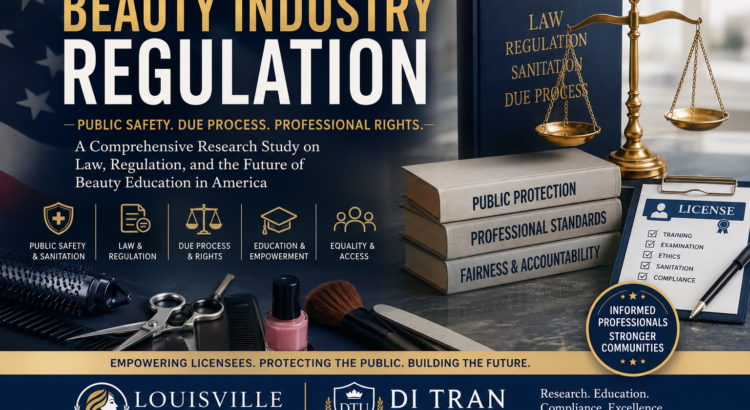
Beauty Industry Regulation in the United States: Public Safety, Regulatory Power, and the Rights of Workers, Students, and Schools – RESEARCH & PODCAST SERIES 2026


Disclaimer: This publication is provided solely for educational, research, and public-interest discussion by Louisville Beauty Academy (LBA) and Di Tran University (DTU). It is intended to promote understanding of beauty education, public safety, sanitation, occupational licensing, administrative law, due process, regulatory transparency, and professional responsibility. The content reflects research, publicly available laws, regulations, court decisions, government publications, academic literature, and policy analyses available at the time of publication. It is not legal advice, does not accuse or imply misconduct by any individual, agency, board, school, or organization, and should not be interpreted as a statement regarding any specific person or pending matter. Laws and regulations vary by jurisdiction and may change over time; readers should consult the applicable statutes, regulations, licensing authorities, or qualified legal counsel regarding their specific circumstances. LBA and DTU fully support lawful regulation that protects public health, safety, sanitation, consumer welfare, ethical education, and professional excellence, while also encouraging transparency, fairness, evidence-based policymaking, due process, equal access, and continuous improvement for the benefit of students, licensees, educators, regulators, and the public.


Executive Summary

The regulation of the American beauty industry — encompassing cosmetology, nail technology, esthetics, shampoo styling, instructor licensing, and beauty schools — represents one of the most complex, heavily layered, and least publicly understood systems of occupational governance in the United States. At its best, this regulatory architecture protects the public from infection, chemical injury, and incompetent practice. At its worst, it has functioned as a barrier to economic participation for immigrants, low-income workers, people of color, and non-English speakers — without producing commensurate gains in public safety.

This study examines the origins, evolution, and contemporary operation of beauty industry regulation with equal weight given to its protective functions and its recorded harms. It draws on constitutional law, administrative law, public policy scholarship, historical research, federal agency findings, state board rules, and court decisions. It concludes with a practical due process framework and positions Louisville Beauty Academy and Di Tran University as institutions of excellence in integrated compliance, sanitation, and rights-aware beauty education.

The core research question — whether beauty regulation serves public safety or also serves as a tool of control over vulnerable populations — cannot be answered with a simple yes or no. Both are true, and the productive response is not cynicism but informed, empowered professionalism.

Part I: Historical Roots of Beauty Industry Regulation

1.1 Origins: The Early Twentieth Century

The formal regulation of cosmetology and barbering in the United States emerged primarily in the 1920s through the 1940s, driven by a confluence of genuine public health concerns, professional ambition, and social dynamics that have shaped the industry ever since. Illinois enacted one of the first comprehensive state licensing laws for beauty culture practitioners in 1925, establishing original requirements covering examinations, fees, renewal, and reciprocity. California separately licensed barbers and cosmetologists beginning in 1927, reflecting both a social and professional divide that would persist for decades. North Dakota passed its first act to regulate hairdressers and cosmetologists in 1927, creating a State Board of Hairdressers and Cosmetologists to oversee the profession. South Carolina established its State Board of Cosmetic Art Examiners in 1934, and Mississippi created its Board of Cosmetology in 1948.[1][2][3][4][^5]

The stated rationale in nearly every state was uniform: protect consumers from unsanitary practices, communicable diseases, and chemical injuries that genuine hands-on beauty work could produce. This rationale had real merit. Early salons used harsh chemical compounds with limited safety knowledge, shared instruments without disinfection between clients, and operated in conditions that could spread ringworm, bacterial infections, and other skin diseases. Public health considerations were not fabricated — they were real.[^6]

1.2 The Role of Sanitation and Public Health

Sanitation remains the bedrock justification for beauty licensing and is the area where regulation most clearly serves its stated mission. Professional beauty services create documented opportunities for disease transmission: shared implements can spread bacterial infections, fungal conditions such as tinea capitis or onychomycosis, and blood-borne pathogens if skin is broken. Pedicure basins, nail tools, and facial instruments are particularly high-risk vectors if not properly disinfected. The requirement that professionals demonstrate competence in disinfection, sanitation protocols, and safe chemical handling before serving the public is therefore rationally connected to a legitimate government interest in preventing harm.[7][6]

Regulatory bodies including state boards of cosmetology mandate specific disinfection protocols — EPA-registered disinfectants, proper contact times, documented pedicure basin logs, and safe chemical storage — precisely because these protections have a direct connection to client health and safety. The Federal Food, Drug, and Cosmetic Act of 1938 established early federal oversight of cosmetic products, and the Modernization of Cosmetics Regulation Act of 2022 (MoCRA) — the most significant expansion of FDA authority over cosmetics since 1938 — updated requirements for adverse event reporting, safety substantiation, mandatory recall authority, and Good Manufacturing Practices. These are serious public protections deserving respect.[8][9]

1.3 The Expansion of Licensing: From Safety to Social Control

Yet the historical record reveals a more complicated picture. Licensing laws were not solely driven by public health. Academic research on the licensing of barbers and beauticians documents how these laws were shaped by competitive interests, racial stratification, and the desire of established practitioners to control market access. One of the clearest examples: early barber licensing laws in numerous states were explicitly deployed to suppress Black competition. Georgia’s Jim Crow barber codes prohibited colored barbers from serving white women and girls. Barbering had been one of the first skilled trades African Americans mastered in America, but the introduction of formal licensing in the late nineteenth and early twentieth centuries coincided with Jim Crow-era exclusions that systematically restricted Black entry into licensed trades. Licensing laws — generally framed in race-neutral language — had racially discriminatory effects both North and South, used as tools to prevent Black workers from competing with established white practitioners.[10][11][12][13]

This history is not merely retrospective. It established a template in which licensing requirements could be structured to disadvantage workers without explicitly targeting them — a pattern that would recur across generations with immigrant workers, low-income applicants, and non-English speakers.

Part II: The Regulatory Architecture — Who Governs Beauty?

2.1 State Boards as the Primary Governors

In the United States, the beauty industry is regulated almost entirely at the state level. All fifty states plus the District of Columbia require a license to practice cosmetology. Every state maintains a cosmetology board, barbering board, or combined professional licensing body that exercises authority over: individual practitioner licenses (cosmetologist, nail technician, esthetician, shampoo technician, instructor); salon and school establishment licenses; curriculum standards for schools; examinations; inspection and enforcement; complaint processing; disciplinary actions; and license renewals. Some states regulate manicuring, esthetics, and shampoo styling as distinct licenses with separate hour and examination requirements.[14][15][^16]

The Kentucky Board of Cosmetology, to cite the home jurisdiction of Louisville Beauty Academy, administers KRS Chapter 317A and 201 KAR Chapter 12, which govern cosmetology, nail technology, threading, eyelash artistry, makeup artistry, and esthetics. It requires a minimum of two inspections per year of each licensed establishment, empowers board members and inspectors to enter licensed premises during reasonable working hours, and requires establishments to produce records for inspection and copying. These powers are broad and, for the uninformed licensee, can feel overwhelming.[^17]

2.2 Federal Oversight: A Limited but Growing Role

At the federal level, the Food and Drug Administration (FDA) regulates cosmetic products — the chemical substances used in professional services — but historically exercised limited authority over the beauty profession itself. MoCRA (2022) expanded FDA’s product oversight significantly, requiring facility registration, product listing, adverse event reporting, and safety substantiation records. The Department of Education exercises oversight through Title IV financial aid administration, which conditions federal student loan and Pell Grant eligibility on school accreditation. NACCAS (National Accrediting Commission of Career Arts & Sciences) serves as the primary institutional accreditor for cosmetology schools seeking Title IV eligibility. The Federal Trade Commission monitors occupational licensing boards for anti-competitive practices, most famously after North Carolina State Board of Dental Examiners v. FTC, 574 U.S. 494 (2015), which held that state licensing boards dominated by active market participants are subject to federal antitrust law unless actively supervised by the state.[18][19][20][8]

2.3 The Regulatory Layering Problem

A beauty school owner in Kentucky, for example, faces regulatory obligations from the following authorities simultaneously:

  • Kentucky Board of Cosmetology (KRS 317A / 201 KAR 12): state licensure, school approval, curriculum hours, instructor credentials, inspection compliance, sanitation standards, student record-keeping, hour-tracking documentation
  • NACCAS: accreditation standards covering educational objectives, instructional staff, admissions policies, student support services, curriculum, financial practices, facilities, and student evaluations[21][22]
  • U.S. Department of Education: Title IV financial aid administration, satisfactory academic progress standards, return-to-title-IV (R2T4) calculations, cohort default rates, gainful employment[^23]
  • Kentucky Administrative Procedure Act (KRS 13B): administrative hearing procedures applicable to any disciplinary action
  • OSHA and EPA: workplace safety and chemical handling regulations for schools and salons
  • State and local business licensing: general business operation requirements
  • Local fire, zoning, and building codes: physical plant requirements

The cumulative documentation, compliance, and legal-knowledge burden placed on a single owner-operator — who in many cases is an immigrant, a first-generation entrepreneur, or a person operating with limited financial resources — is extraordinary by any objective measure.

Part III: The Regulatory Burden — A Comparative Analysis

3.1 Hours Required: Beauty vs. Other Professions

The training hour requirements for beauty professionals are among the most frequently cited evidence that occupational licensing in this sector has exceeded any rational public safety justification. Consider this comparative data:

OccupationAverage Training RequiredNotes
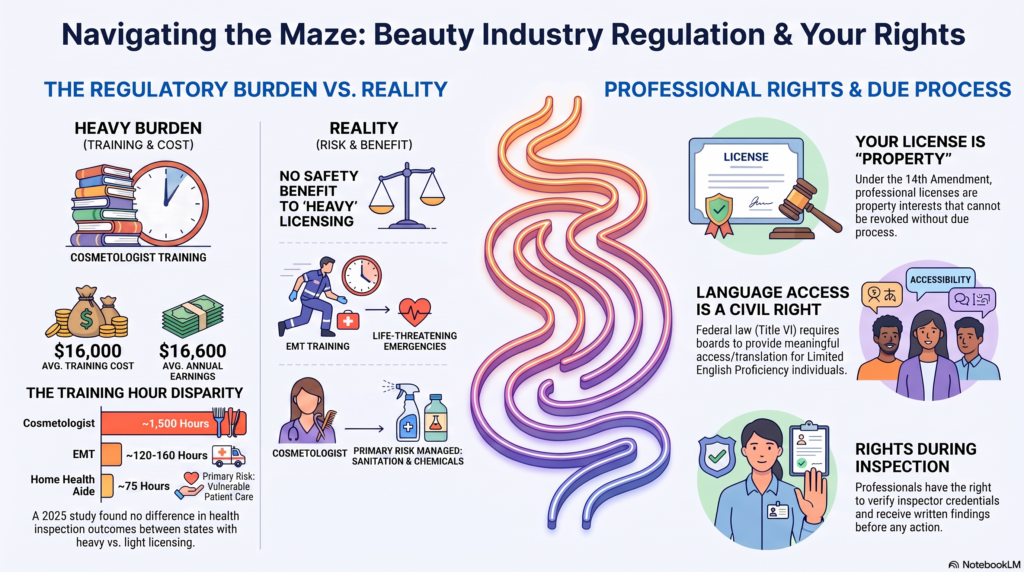
Cosmetologist~372 training days (~1,500 hours)Range: 1,000–2,100 hours depending on state [24][25]
Emergency Medical Technician (EMT)~33 training days (~120-160 hours)Responds to life-threatening emergencies [25][26]
Barber~1,000–1,500 hoursVaries by state [^27]
Nail Technician~300–600 hoursVaries by state
Esthetician~260–1,500 hoursVaries significantly by state
Cosmetology Instructor~300–1,000 hours of instructor training (plus underlying license)[28][29]
Home Health Aide~75 hours (federal minimum)Works with vulnerable patients
Childcare WorkerVaries; many states 0–12 hoursCares for children daily
Interior DesignerNo federal license; some state certificationsAffects structural safety
Construction Laborer (non-electrical)Often no state licenseVarious safety risks

As President Trump noted in 2019 remarks to governors, cosmetologists train on average eleven times longer than emergency medical technicians. The Washington Post fact-checked and verified this claim: “on average, cosmetologists do train a little over 10 times as long as EMTs”. A report by the National Conference of State Legislatures confirmed that “cosmetologists require an average of 372 training days, significantly higher than emergency medical technicians, who need an average of 33 training days”.[25][26]

This disparity is not easily explained by reference to public safety. While beauty services do carry real sanitation risks, they rarely involve life-threatening emergencies of the kind EMTs manage daily. The 2015 Obama White House report — prepared jointly by the Department of the Treasury, the Council of Economic Advisers, and the Department of Labor — concluded that licensing can “impose substantial costs on job seekers, consumers, and the economy more generally,” that the percentage of workers requiring a license has increased five-fold since the 1950s, and that over-licensing “disproportionately affects certain populations, including immigrants and anyone with a criminal history”.[30][31]

3.2 The Institute for Justice’s Clean Cut Study (2025)

The Institute for Justice’s April 2025 study, Clean Cut, analyzed whether nail salons and barbershops in states with different licensing burdens had better or worse health inspection outcomes. The finding was unambiguous: “There was no difference in inspection outcomes across the states.” Researchers found that barbershops and nail salons were clean and safe regardless of whether their workers faced burdensome licensing, lighter licensing, or no licensing at all. This study directly challenges the claim that heavier training hour requirements produce better public health outcomes in the beauty industry.[^32]

3.3 Financial Barriers and Student Debt

The cost of entering the beauty profession is substantial. On average, completing the required training for a cosmetology license costs more than $16,000, according to Institute for Justice research, and students took out over $7,300 on average in student loan debt to finance this training. Tuition alone typically ranges from $5,000 to $20,000+ depending on school and location. The total cost including exam fees and licensing application fees typically reaches $6,000–$22,000+.[24][16]

Yet the Brookings Institution reported that cosmetology graduates have average earnings of approximately $16,600, with $9,900 in debt. At the median cosmetology school, 32 percent of students are at least three months behind on their loan payments. A 2026 Department of Education analysis projected that more than 92% of all cosmetology, barber, and related personal grooming programs would fail a proposed earnings accountability test comparing graduate earnings to those of high school graduates. These numbers reflect a systemic tension: students are required by law to attend expensive, time-consuming licensed programs in order to work in a field that is already economically modest.[33][34][^35]

Part IV: The Dark Side — Control, Fear, and Vulnerability

4.1 Immigrants and the Beauty Industry

The American nail salon industry is predominantly owned and staffed by foreign-born individuals — immigrants or refugees running small, family-operated businesses. Vietnamese Americans, following the influence of actress Tippi Hedren who encouraged Vietnamese refugee women to learn nail care in the 1970s, came to dominate the nail salon industry particularly in California and across the country. Research by the UCLA Labor Center and others documents the compound vulnerabilities these workers face: low wages, toxic chemical exposure, limited English proficiency, regulatory complexity they cannot easily navigate, and structural inequities that simultaneously require compliance with English-language law while failing to provide those laws in accessible translated form.[36][37][^38]

A 2023 Federal Reserve Bank of Minneapolis study found that licensure reduces foreign-born employment in a licensed occupation by nearly 20 percent relative to native-born employment — a direct wage and employment penalty for immigrants navigating a licensing system designed around English-language documentation and examination. The study found corresponding wage premiums, consistent with the interpretation that licensing constitutes a disproportionate barrier to the labor supply of immigrants. Research by the CDC confirms that nail salon workers — predominantly immigrant women — face multiple barriers to accessing occupational health training and services, including language barriers, literacy barriers, and lack of culturally appropriate materials.[39][40]

4.2 Language Access Rights: What the Law Requires

Under Title VI of the Civil Rights Act of 1964 and Executive Order 13166 (2000), any entity receiving federal financial assistance — including state licensing boards that participate in federal programs — must take reasonable steps to ensure meaningful access to services for persons with Limited English Proficiency (LEP). “Language access” means providing LEP individuals the same access to government services as English-speaking individuals. Vital documents — those necessary for meaningful access to programs — must be translated into the languages of regularly encountered LEP groups.[^41]

In practice, many state cosmetology boards offer limited or no translation services for inspections, hearings, complaint responses, or licensing examinations. The California Board of Barbering and Cosmetology does offer consumer complaint forms in Korean, Spanish, and Vietnamese — a practice that should be recognized as a best-practice baseline that all boards should meet. The U.S. Commission on Civil Rights approved a report on language access for LEP individuals in February 2026, transmitting findings to the President and Congress. Beauty professionals and their advocates should invoke this federal framework when demanding translated notices, translated complaint forms, and interpreter access in regulatory proceedings.[42][43]

4.3 The Power Imbalance in Regulatory Encounters

State cosmetology boards hold extraordinary power over licensees. Under KRS 317A, any board member, administrator, or inspector may enter any licensed establishment during reasonable working hours. Boards may require production of records, books, and papers pertaining to licensed activity. Boards may impose fines, suspend or revoke licenses, impose probation, and issue public reprimands. In states like Kentucky, the passage of SB22 created the specific category of “immediate and present danger to the public” triggered by the knowing employment of unlicensed persons — a phrase that, if triggered, can result in emergency orders closing a business on the spot.[44][45][^17]

For the vast majority of licensees who have limited legal education, limited English fluency, limited financial resources to hire attorneys, and limited knowledge of their rights under administrative law, this power asymmetry is profound. A licensee who does not know that they are entitled to written notice before disciplinary action, that they have a deadline to respond, that they may appeal, and that silence or panic can be misinterpreted as admission — is a licensee who is structurally vulnerable to erroneous or disproportionate regulatory action.

4.4 Regulatory Capture and Incumbent Protection

A well-documented problem in occupational licensing generally — and in beauty regulation specifically — is regulatory capture: the tendency of licensing boards dominated by active market participants to use their regulatory power to suppress competition rather than protect the public. The Supreme Court’s landmark decision in North Carolina State Board of Dental Examiners v. FTC, 574 U.S. 494 (2015) — while involving dentistry — directly and explicitly addressed this risk in the context of professional licensing boards composed of active market participants. The Court held 6-3 that a state licensing board dominated by active practitioners can invoke state-action antitrust immunity only if it is actively supervised by the state — precisely because the risk of boards using regulatory power to protect incumbents from competition is constitutionally significant.[46][47][48][20][^49]

Research by conservative and libertarian policy organizations (Heritage Foundation, Cato Institute, Goldwater Institute, Institute for Justice) and centrist and progressive bodies (Brookings Institution, Hamilton Project, Obama White House) alike confirms that incumbent businesses endorse licensing requirements precisely because those requirements protect them against competition from new entrants. The Federal Trade Commission has long advocated for reform, noting that “unnecessary licensing restrictions erect significant barriers and impose costs that cause real harm to American workers, employers, consumers, and our economy as a whole, with no measurable benefits to consumers or society”.[50][51][^52]

Beauty schools themselves are not immune from this dynamic. When established schools use accreditation standards, minimum hour requirements, and regulatory lobbying to raise barriers against new competitors — rather than to improve educational quality — they participate in the same incumbent-protection cycle they may simultaneously criticize when boards do it to individual practitioners.

Part V: Administrative Law and Due Process in Beauty Regulation

5.1 Constitutional Foundations

Every licensee in the United States — every cosmetologist, nail technician, esthetician, salon owner, instructor, and school — holds a property interest and a liberty interest in their professional license. The Supreme Court established in Board of Regents v. Roth, 408 U.S. 564 (1972) that professional licenses constitute property interests protected by the Due Process Clause of the Fourteenth Amendment, which prohibits any state from depriving a person of life, liberty, or property without due process of law. The Fifth Amendment independently provides that the federal government cannot deprive any person of life, liberty, or property without following certain procedures.[^53]

Due process in licensing disciplinary proceedings does not require a full court trial, but it does require meaningful procedural protections. The governing constitutional standard is the three-part Mathews v. Eldridge balancing test established by the Supreme Court in 424 U.S. 319 (1976). Under this test, the minimum process required is determined by weighing: (1) the private interest affected by the government action; (2) the risk of erroneous deprivation through the procedures used, and the value of additional safeguards; and (3) the government’s interest, including the administrative burden of additional procedures.[54][55][56][57]

For a licensee facing suspension or revocation — the deprivation of their means of livelihood — the private interest is enormous. The risk of erroneous deprivation in complex regulatory proceedings without legal representation is substantial. Courts have therefore consistently recognized that licensees are entitled to: notice of the specific charges against them, a meaningful opportunity to be heard before adverse action takes effect (or at least promptly thereafter), the right to present evidence and witnesses, and the right to receive written reasons for any adverse decision.[58][59]

5.2 The Administrative Procedure Framework

State administrative procedure acts govern how beauty boards may conduct investigations, issue charges, hold hearings, and impose discipline. In Kentucky, KRS Chapter 13B (the Kentucky Administrative Procedure Act) governs all contested case proceedings before state administrative agencies, including the Kentucky Board of Cosmetology. In Tennessee, the Tennessee Administrative Procedure Act (Title 4, Chapter 5, Tennessee Code Annotated) similarly governs all board disciplinary proceedings.[60][61]

These acts uniformly require: written notice of charges before adverse action; an opportunity to respond to allegations in writing; a hearing before an impartial decision-maker; the right to be represented by an attorney; the right to present witnesses and cross-examine adverse witnesses; a written decision based on findings of fact and legal conclusions; and the right to appeal to a court.[62][63]

In California, the Board of Barbering and Cosmetology’s administrative appeal regulations (16 Cal. Code Regs. § 973.6) specifically provide that a licensee who receives an immediate suspension has 30 calendar days to request an informal review hearing, may bring legal counsel, may present written information and oral testimony, may contest the occurrence of the violation, the period for correction, or the amount of the fine.[^64]

In Kentucky, under 201 KAR 12:190, before any disciplinary action is taken against a licensee, the licensee has the right to: written notice; written citation of the law alleged to have been violated; written statement of the factual basis; a written right to respond; and an opportunity for a hearing. Critically, under Kentucky law, “imminent danger” — the trigger for emergency orders — means unlicensed practice, not confusion, misunderstanding, or paperwork errors. For ordinary sanitation violations and minor paperwork issues, the board must first issue a written warning and provide an opportunity to correct before imposing a fine.[45][60]

5.3 Open Records as a Defensive Tool

Every state has open records or freedom of information laws that give citizens the right to inspect government records, including records maintained by state cosmetology boards. The Kentucky Open Records Act (KRS Chapter 61) allows residents of Kentucky to submit requests for records, including inspection reports, investigator notes, complaint files, and meeting minutes. The Tennessee Public Records Act provides that “all state, county and municipal records shall at all times during business hours be open for personal inspection by any citizen of this state”.[65][66][^67]

These laws are powerful defensive tools for licensees and school owners who face regulatory action. A licensee who suspects that an inspection finding is inaccurate or that a fine was not lawfully approved can use an open records request to obtain the original inspector’s notes, the complaint files, the board meeting minutes approving the fine, and any other relevant documentation. If the minutes show the fine was never formally approved, the fine may be unenforceable. This is not a loophole — it is the rule of law applied to administrative power.[^45]

Part VI: The Regulatory Framework State by State — Key Comparisons

6.1 Training Hours: The Range Across States

Training requirements vary dramatically across states, with no consistent evidence that more hours produce better safety outcomes:

StateCosmetologist HoursNail Tech HoursEsthetics Hours
Oregon2,100300+500
Iowa, Kansas1,800variesvaries
Arizona, Colorado, Wisconsin1,600600600
California, Texas, Illinois, Georgia1,500 (CA reduced to 1,000 via SB 803)400600
Florida1,200240260
New York, Massachusetts1,000250600

California’s Senate Bill 803 (effective 2022) reduced cosmetology training requirements from 1,600 to 1,000 hours specifically to make the industry more accessible. This reform, supported by evidence that 1,000-hour programs produce licensed professionals equally capable of passing state board examinations as 1,600-hour programs, represents a national model for evidence-based regulatory reform.[^68]

6.2 Inspection and Enforcement Comparisons

State inspection practices vary in frequency, documentation requirements, and enforcement philosophy. Kentucky mandates a minimum of two inspections per year per licensed establishment. Other states have annual inspection requirements or complaint-driven inspection schedules. The consistency with which inspections are documented, findings are written, correction periods are granted, and appeal rights are explained varies widely from state to state and in practice from inspector to inspector.[^17]

6.3 Complaint and Disciplinary Systems

Most state boards maintain formal complaint processes, though the accessibility of these processes to non-English speakers varies significantly. Arizona’s Board of Barbering and Cosmetology publishes disciplinary action records and clearly lists the legal bases for disciplinary action. California offers complaint forms in Korean, Spanish, and Vietnamese. The National Accrediting Commission of Career Arts & Sciences (NACCAS) requires accredited schools to maintain formal written complaint procedures that students are made aware of, with escalation paths from the school to the state board to NACCAS to the Department of Education.[69][42][^44]

Under NACCAS standards, students at accredited schools are entitled to: a written complaint form; a defined response timeline (typically 10 calendar days for initial response); escalation to state boards; escalation to NACCAS; and escalation to the Department of Education if unresolved. Schools must teach students about state board requirements, state law, and students must be made aware of licensure requirements prior to enrollment.[22][69]

Part VII: Education Reform — Teaching Law, Not Just Technique

7.1 The Current Gap

A fundamental failure of traditional beauty education is the treatment of law, regulation, and professional rights as secondary concerns subordinate to technical skills. Students graduate from accredited cosmetology programs knowing how to cut hair, apply color, perform facials, and shape nails — but often without adequate understanding of: what a state board inspector may and may not do during an unannounced visit; what written findings they are entitled to receive; how to respond to a complaint; how to document sanitation procedures; how to appeal a disciplinary action; or how to protect their license during a dispute with an employer or a client.

NACCAS itself asks accredited schools during evaluation: “Is State Law taught as part of the curriculum? Are state board preparation classes part of the structured curriculum?” The intended answer is yes. Yet in practice, state law and regulatory procedure are often covered superficially, crowded out by the technical hours that dominate most curricula.[^22]

7.2 The Case for Integrated Compliance Education

Louisville Beauty Academy has pioneered a model of integrated compliance education grounded in the principle that a licensed beauty professional needs to understand not only how to perform their craft but how to operate lawfully, document properly, respond professionally to regulatory authority, and protect their license with the same discipline they bring to their professional skills. This model — reflected in LBA’s public education and law library, which publishes Kentucky beauty law verbatim and in plain language — treats legal knowledge as a professional competency, not an afterthought.[70][71][^60]

Di Tran University extends this model to the workforce development and continuing education context, offering structured learning on vocational integrity, compliance documentation, administrative law awareness, and institutional transparency for beauty and healthcare professionals at all career stages. The underlying philosophy, articulated clearly in LBA’s mission, is that empowered professionals — who understand their rights and obligations — are simultaneously better protected from regulatory overreach, more compliant with legitimate regulatory requirements, and better advocates for their clients and students.[72][73][^74]

7.3 What a Complete Beauty Curriculum Should Teach

A modern, ethically grounded beauty curriculum should include five categories of knowledge in addition to technical skills:

Category 1: Sanitation and Public Safety Science

  • Microbiology of bacteria, viruses, and fungi relevant to beauty services
  • Disinfection protocols for implements, equipment, and workstations
  • Chemical safety, SDS sheets, OSHA hazard communication
  • Blood-borne pathogen standards
  • State-specific sanitation rules with practical application

Category 2: Law and Regulation

  • State cosmetology act — verbatim study of the licensing statute
  • Administrative regulations — what they require and how they are enforced
  • Inspection rights and responsibilities — what inspectors may and may not do
  • Licensee documentation requirements — what must be posted, logged, retained
  • Federal law relevance — Title IV, OSHA, EPA, Title VI language access

Category 3: Due Process and Rights

  • Constitutional foundations — property and liberty interests in licenses
  • Administrative procedure — notice, hearing, response, appeal
  • Open records — how to access inspection notes, complaint files, meeting minutes
  • Disciplinary process step-by-step — from complaint through judicial review
  • Language access rights — what interpreters and translated documents you may request

Category 4: Business Ethics and Documentation

  • Written records as legal protection
  • Documentation of services, consent, and adverse reactions
  • Employer-employee rights in salon settings
  • Consumer complaint handling and professional response
  • Ethics of advertising, pricing, and client relations

Category 5: Student Rights and Institutional Accountability

  • Enrollment agreements — what they require schools to do
  • Student complaint processes — escalation from school to board to NACCAS to DOE
  • Satisfactory academic progress and what it means for financial aid
  • Transfer of hours — state requirements and limitations
  • Rights upon school closure — teach-out plans and record preservation

Part VIII: Due Process Checklist for Every Beauty Professional

This checklist is intended for every licensed cosmetologist, nail technician, esthetician, shampoo technician, instructor, salon owner, and beauty school — whether in Kentucky, Tennessee, or any state. It translates constitutional and administrative law principles into practical, plain-language action steps.

SECTION A: Your Rights During an Inspection

Before the Inspector Arrives

  • Keep all licenses posted and visible at all required locations
  • Maintain current disinfection logs, product SDS binders, and service records
  • Know the name, phone number, and email of your state board and a knowledgeable legal contact
  • Display all required signage including sanitation rules where required by state law[^75]

When an Inspector Arrives

  1. Verify identity: Politely ask to see the inspector’s official identification and credentials
  2. Confirm authority: You may take reasonable time (30–60 minutes in Kentucky) to confirm records or seek clarification before signing any document[^60]
  3. Remain calm and professional: An inspector performing a lawful inspection has the legal right to enter; cooperation is both legally required and strategically wise
  4. Take notes or photographs: Document what the inspector observes, what they say, and the time and date of the inspection
  5. Ask for a correction notice vs. a citation: If the inspector identifies a problem, ask: “Is this a correction notice?” If yes, fix it immediately, photograph the fix, and submit written proof to the board[^45]
  6. Do not sign anything without reading it: Request time to read all written documents; you have the right to understand what you are signing
  7. Request written findings: Ask for a written inspection report before the inspector leaves; you are entitled to documentation of what was found

After the Inspection

  • Write your own contemporaneous account of the inspection while memory is fresh
  • Retain all inspection documentation in a permanent file
  • If citations are issued, note all deadlines for response and correction
  • If you disagree with any finding, do not ignore it — the deadline to respond will pass

SECTION B: Your Rights When a Complaint Is Filed Against You

  1. You have the right to written notice of the specific complaint and the specific rule alleged to have been violated — board cannot take adverse action without this notice
  2. You have the right to see the factual basis of the complaint — what was alleged, when, and by whom (where permitted under public records law)
  3. You have the right to respond in writing within the deadline stated in the notice — this deadline is critical and missing it can waive your right to contest the allegations
  4. You have the right to gather and present evidence: collect documents, photographs, service records, witness statements, and any other evidence supporting your position
  5. You have the right to legal representation: you may hire an attorney at any stage of the process; administrative hearings are formal proceedings and legal help is not a luxury
  6. Request an interpreter or translated documents if needed: under Title VI and state language access laws, if you have limited English proficiency, you may request language assistance from a government agency receiving federal funding[76][41]
  7. Use open records laws: submit an open records request to obtain the original inspector’s notes, complaint file, and any board communications about your case before any hearing[65][45]

SECTION C: Your Rights in a Disciplinary Hearing

  1. Right to adequate notice: at least 30 days’ written notice of the hearing date, time, location, and charges in most states[^62]
  2. Right to an impartial hearing officer: if you believe the decision-maker has a conflict of interest or bias, raise this objection in writing before the hearing
  3. Right to present witnesses and evidence: you may call witnesses, submit documents, and present your case fully
  4. Right to cross-examine adverse witnesses: the agency must afford you a meaningful opportunity to challenge the evidence against you
  5. Right to a written decision: the board must issue a written decision based on findings of fact and legal conclusions[64][62]
  6. Burden of proof: in most states, the burden is on the board to prove violations by a preponderance of the evidence[^77]
  7. Right to appeal: the board’s decision may be appealed to a state court — in Tennessee, to the Chancery Court of Davidson County within 60 days of the final order; in other states, timelines and procedures vary[59][62]

SECTION D: Your Rights as a Student in a Beauty School

  1. Enrollment agreement rights: your enrollment agreement must state the total hours, the cost, the refund policy, and the rights and obligations of both you and the school[^78]
  2. Right to a copy of the school catalog: you are entitled to receive a copy of the school catalog and any updates before enrollment[^79]
  3. Right to know about licensure requirements: the school must inform you of all state licensure requirements prior to enrollment[^22]
  4. Hour tracking rights: your hours must be tracked and documented accurately; you have the right to request your own hour records
  5. Complaint rights: if you have a complaint against your school, the process is: (1) written complaint to school administration; (2) complaint to state board; (3) complaint to NACCAS; (4) complaint to Department of Education[^69]
  6. Transfer rights: schools must have a written policy on accepting transfer hours; you have the right to know this policy before enrolling
  7. Financial aid rights: if you receive Title IV aid, you have rights to appeal financial aid decisions including satisfactory academic progress (SAP) determinations[^19]
  8. Record rights: upon graduation or withdrawal, you are entitled to your academic records, including your official hour transcript

SECTION E: Protecting Your School or Salon as an Owner

  1. Document everything in writing: all communications with the board, inspectors, students, employees, and clients should be in writing or confirmed in writing after oral discussions
  2. Maintain a compliance calendar: license renewal dates, inspection schedules, continuing education deadlines, accreditation report due dates, Title IV recertification dates
  3. Post all required notices: state law, sanitation rules, establishment license, individual licenses — inspect your postings before any inspector does[^80]
  4. Have a compliance contact: know the name and number of your state board contact, your accreditor’s contact, and a licensed attorney who handles professional licensing matters
  5. Know your inspection rights and those of your staff: train all staff on what an inspector may observe and what they should say and not say
  6. Build open records knowledge: know how to make and respond to open records requests in your state
  7. Attend board meetings: state cosmetology board meetings are public; you have the right to observe, and in many cases, to comment on proposed rule changes during notice-and-comment periods[^45]
  8. Participate in the rulemaking process: when the board proposes new regulations, submit written comments; you have a right to participate in shaping the rules that govern your profession

Part IX: Louisville Beauty Academy and Di Tran University as Centers of Excellence

9.1 The Institutional Philosophy

Louisville Beauty Academy (LBA) operates from a foundational principle that beauty education is incomplete without law education, compliance education, and rights education. Located in Louisville, Kentucky — a city with a significant immigrant population and a thriving Vietnamese-American community — LBA has built its institutional identity around empowering underserved populations: immigrants, refugees, single parents, and adult learners seeking meaningful career pathways. LBA’s Gold Standard of Compliance Education integrates Kentucky statutes, administrative regulations, and due process principles directly into student-facing curriculum and institutional operations.[73][70][72][60]

LBA’s commitment to multilingual outreach, flexible scheduling, and public education — including the publication of Kentucky beauty law verbatim in the LBA Public Education and Law Library — reflects a recognition that the power imbalance between regulatory authorities and ordinary licensees is best corrected not by antagonism toward regulation, but by informed, confident, documented professionalism.[71][60]

9.2 Di Tran University’s Workforce and Compliance Education Mission

Di Tran University extends this institutional philosophy to the post-secondary and continuing education context, developing curriculum that addresses vocational integrity, AI-supported compliance documentation, administrative law awareness, and transparent institutional practice. Founded by Di Tran — a Vietnamese-American entrepreneur and educator whose career embodies the immigrant journey through American occupational licensing — Di Tran University positions itself at the intersection of workforce development, legal literacy, and humanized technology integration.[74][81][^82]

The institutional model both LBA and Di Tran University represent answers the central research question of this study: the appropriate response to an imperfect and sometimes exploitative regulatory system is not ignorance, fear, or resentment — it is knowledge, documentation, professional excellence, and civic participation. When beauty professionals understand their rights as clearly as they understand their techniques, they are simultaneously safer from regulatory overreach, more compliant with legitimate requirements, better advocates for themselves and their communities, and more powerful voices for policy reform.

9.3 A Model for the Nation

The educational model LBA and Di Tran University have developed — integrating technical skill with law, regulation, sanitation science, documentation discipline, ethics, and due process awareness — is a model that should be adopted nationally. Beauty schools should teach their students and graduates not only how to perform a service, but why the law requires what it requires, what they are entitled to when the government takes action against them, how to document their practice for legal protection, and who to contact when they need help.

This is not teaching cynicism about government. It is teaching citizenship. It is teaching professionalism. It is teaching the kind of informed, empowered practice that makes the beauty industry safer for clients, more dignified for workers, and more legitimate in the eyes of the law.

Conclusion: Answering the Core Research Question

Is the beauty industry regulated primarily for public safety and sanitation, or has regulation also become a tool of control over workers, students, schools, immigrants, low-income communities, and non-lawyer citizens?

The honest answer, supported by the weight of historical evidence, empirical research, constitutional law, and lived experience, is: both.

The public safety foundations of beauty regulation are real and should be respected. Sanitation requirements, disinfection protocols, and baseline competency standards protect clients from infections, chemical injuries, and incompetent practice. These protections have genuine value, and every beauty professional should understand them deeply and follow them rigorously.[9][6]

But the regulatory apparatus built on top of those foundations has, over time, accumulated layers of training hour requirements, documentation burdens, inspection powers, disciplinary procedures, and administrative complexity that — particularly as applied to immigrant workers, low-income licensees, non-English speakers, and small school operators — function as instruments of control as much as instruments of protection. The research from multiple ideological perspectives — the Obama White House, the Institute for Justice, the Brookings Institution, the Federal Trade Commission, the Minneapolis Federal Reserve, and academic researchers — is unusually consistent on this point.[83][16][51][84][31][85][39][32][^30]

The path forward requires holding both truths simultaneously: defending the public protections that work while demanding the regulatory reforms that justice requires. That means fewer arbitrary training hours disconnected from safety outcomes, more accessible language support in regulatory proceedings, greater transparency in board operations and decision-making, stronger due process protections for licensees without legal representation, and beauty education that empowers professionals to navigate the regulatory world they actually inhabit.

Louisville Beauty Academy and Di Tran University have chosen this path. Their students emerge not just as skilled technicians but as informed, rights-aware, compliance-confident professionals — the kind of graduates who strengthen their communities and their profession, protect their clients with excellence, and defend their licenses with knowledge.

That is what beauty education should be.

Key Legal References

  • U.S. Const., amend. XIV (Due Process Clause)
  • U.S. Const., amend. V (Fifth Amendment Due Process)
  • Mathews v. Eldridge, 424 U.S. 319 (1976) — three-factor due process balancing test[55][54]
  • Board of Regents v. Roth, 408 U.S. 564 (1972) — property interest in professional licenses
  • North Carolina State Board of Dental Examiners v. FTC, 574 U.S. 494 (2015) — licensing boards and antitrust[^20]
  • Goldfarb v. Virginia State Bar, 421 U.S. 773 (1975) — Sherman Act applies to professional services[86][87]
  • Title VI of the Civil Rights Act of 1964 — language access for LEP individuals[41][76]
  • Executive Order 13166 (2000) — language access requirements
  • KRS Chapter 317A — Kentucky cosmetology licensing statute
  • 201 KAR Chapter 12 — Kentucky administrative regulations for cosmetology[^17]
  • KRS Chapter 13B — Kentucky Administrative Procedure Act
  • Modernization of Cosmetics Regulation Act of 2022 (MoCRA)[^8]
  • Administrative Procedure Act, 5 U.S.C. §§ 553–706[^63]
  • NACCAS Rules of Practice and Procedure[88][21][^22]
  • Obama White House Report on Occupational Licensing (2015)[31][30]
  • Institute for Justice, Clean Cut (2025)[^32]
  • Minneapolis Federal Reserve, Occupational Licensing as Barrier to Immigrants (2023)[^39]

This research report was prepared for educational, advocacy, and institutional development purposes by Louisville Beauty Academy and Di Tran University. It is intended to inform students, graduates, licensees, salon owners, instructors, school operators, policymakers, attorneys, and regulators. It does not constitute legal advice. Individuals facing specific regulatory actions should consult a licensed attorney in their state.

References

  1. The Legal Scope of Beauty Licensing in the United States: A … – By 1927, states like California began separately licensing barbers and cosmetologists, reflecting a …
  2. State Board of Cosmetology agency history record. – SC ArchCat – The State Board of Cosmetic Art Examiners was established in 1934 by Act No. 771, amended by Act 259…
  3. Archives – State Agencies – State Board of Cosmetology – An act to regulate hairdressers and cosmetologists was passed by the legislature in 1927 along with …
  4. [PDF] A Review of the Board of Cosmetology – Peer – The Legislature established the Board of Cosmetology in 1948 to regulate schools, salons, and indivi…
  5. [PDF] An Historical Review of the Cosmetology Profession – The Illinois Beauty Culture Act of 1925 is presented with a full discussion of original licensing re…
  6. Safety First: The Critical Importance of Sanitation and Hygiene in … – They believe that beauty professionals understand and follow proper sanitation protocols protecting …
  7. Laws & Regulations – Campaign for Safe Cosmetics – In the absence of meaningful federal oversight of the cosmetics industry, states have taken steps to…
  8. Modernization of Cosmetics Regulation Act of 2022 (MoCRA) – FDA – … Food, Drug, and Cosmetic (FD&C) Act was passed in 1938. This new law will help ensure the safety…
  9. Beauty & Grooming Safety: The Importance of Sanitation – Without proper sanitation practices, harmful bacteria, fungi, and viruses can easily spread. But wit…
  10. Regulating Beauty: The Licensing of Barbers and Beauticians in … – Few scholars have considered the history of cosmetology and barber industries together and how licen…
  11. [PDF] Licensing Laws: A Historical Example of the Use of Government … – While generally not Jim. Crow laws per se, the laws were used both in the South and the. North to pr…
  12. What was Jim Crow – Jim Crow was the name of the racial caste system which operated primarily, but not exclusively in so…
  13. They’ll tell you German & European immigrants gave us barber … – Barbering was one of the first skilled trades Black men mastered in America, but when licensing came…
  14. Board for Barbers and Cosmetology – DPOR – Virginia.gov – The Board for Barbers and Cosmetology licenses individuals and businesses that perform barbering, co…
  15. Law & Rules – Ohio State Cosmetology and Barber Board – School Licenses will expire January 31 of each odd year, There will be one expiration date for a sch…
  16. Cosmetology – The Institute for Justice – All 50 states plus Washington, D.C. require a license to work as a cosmetologist. But the requiremen…
  17. 201 KAR 12:060 – Inspections | State Regulations – Law.Cornell.Edu – This administrative regulation establishes inspection and health and safety requirements for all sch…
  18. National Accrediting Commission of Career Arts & Sciences … – REMINDER TO NACCAS ACCREDITED SCHOOLS. Your school’s email address is important to NACCAS as a part …
  19. Federal Financial Aid — Title IV – Brighton Barber Institute – … Cosmetology programs are approved for Title IV funding. This means eligible students can access …
  20. North Carolina State Board of Dental Examiners v. FTC – Wikipedia – North Carolina State Board of Dental Examiners v. Federal Trade Commission, 574 US 494 (2015), was a…
  21. [PDF] NACCAS NOW – As an accredited school you have an obligation to NACCAS to continuously adhere to the Standards, Cr…
  22. [PDF] SAMPLE FORMS AND GUIDELINES – NACCAS – Establishes that a school participating in Title IV, HEA programs, successful course completion perc…
  23. Proposed Federal Rule Threatens Student Loan Access – … Title IV federal loan eligibility for most esthetics, massage therapy, and cosmetology programs …
  24. Cosmetology License: State-by-State Requirements, Cost & How to … – For example, California requires 3,200 apprenticeship hours compared to 1,600 school hours; Texas re…
  25. Are cosmetologists training longer than emergency medical … – There is no national standard on occupational licensing, so laws vary by state, but on average, cosm…
  26. [PDF] The State of Occupational Licensing – The report focuses on licensure requirements that affect the types of occupations studied as part of…
  27. Tennessee Barber License Requirements (2026) – Barber vs Cosmetologist in Tennessee: Both require 1,500 hours. The key distinction is that barbers …
  28. Beauty Instructor License Pathway: What to Know About Exams … – Georgia’s PSI documentation lists 750 school hours for Master Cosmetology Instructor and Hair Design…
  29. [PDF] Teacher Training licensing laws and requirements vary by state, as … – Cosmetologist instructor—500 classroom hours in a teacher training course and license in the individ…
  30. Citing Adam Smith And Milton Friedman, Obama’s Economic … – According to a new White House report, “licensing can impose substantial costs on job seekers, consu…
  31. White House Cites Cato in Report on Occupational Licensing – Over a quarter of U.S. workers now need licenses to do their jobs, and the percent of workers who ne…
  32. New Study Shows That Heavier Licensing Burdens Do Not Improve … – Institute for Justice analysis questions the necessity of expensive and time-consuming training for …
  33. Proposed federal student aid rule could put Atlanta beauty schools … – Programs that fail this metric in two out of three years lose access to Title IV federal financial a…
  34. Dept. of Education’s College Scorecard shows where student loans … – However, almost 3 percent of all graduates with student debt had degrees in Cosmetology (average ear…
  35. Hold cosmetology schools accountable for low earnings – At the median cosmetology school, 32 percent of students are at least three months behind on their l…
  36. [PDF] A STUDY OF NAIL SALON WORKERS AND INDUSTRY IN THE … – The lack of accessible languages in the curriculum training and exam process can be a barrier for so…
  37. [PDF] Addressing Workers Rights Violation within the Vietnamese Nail … – Nail salon workers are predominantly low-income immigrants with limited English language skills who …
  38. Overlooked and Unprotected – The Synergist – AIHA – The U.S. nail salon industry is predominantly owned and staffed by foreign-born individuals (immigra…
  39. Occupational Licensing as a Barrier to Entry for Immigrants – We find that licensure reduces foreign-born employment in a state-occupation pair by nearly 20 perce…
  40. [PDF] Perceived Benefits and Barriers to Implementing … – CDC Stacks – Introduction. Immigrant nail salon owners and employ- ees face multiple barriers to accessing occupa…
  41. Frequently Asked Questions on Legal Requirements to Provide … – “Language access” means providing Limited English Proficient (LEP) people with reasonable access to …
  42. Enforcement – California Board of Barbering and Cosmetology – To initiate the appeals process, a written request must be submitted. Upon receiving the appeal requ…
  43. USCCR Approves Report on Language Access for Individuals with … – This report surveys challenges in providing language assistance — as is required by several federal,…
  44. Disciplinary Actions | Barbering and Cosmetology Board – Pursuant to A.R.S. § 32-571, the Board may take any one or a combination of the following disciplina…
  45. Administrative Due Process & Regulatory Compliance in Kentucky … – Kentucky cosmetology law is no longer optional knowledge — it is career … examining board procedur…
  46. Democracy and Industry Capture of the Executive – Georgetown Law – This paper will discuss the phenomenon of regulatory capture, the threat it poses to democracy, and …
  47. The Case Against State Occupational Licensing Boards – Cato Institute – Licensing depresses business starts and employment, particularly among low-income and low-skilled po…
  48. [PDF] “Regulatory Capture”: Sources and Solutions – He is the author of REGULATING PUBLIC UTILITY PERFORMANCE: THE LAW OF MARKET STRUCTURE, PRICING AND….
  49. Implementing North Carolina State Board of Dental Examiners v. FTC – For the first time, the Supreme Court explicitly held that boards are not immune from federal antitr…
  50. Occupational Licensing Run Wild – Regulatory Transparency Project – And they often allow existing businesses … incumbent businesses endorse licensing requirements bec…
  51. Economic Liberty | Federal Trade Commission – Occupational licensing regulations can prevent individuals from using their vocational skills and en…
  52. Occupational Licensing – The Institute for Justice – Instead, they are imposed simply to protect established businesses from economic competition. IJ’s l…
  53. Procedural Due Process Under the Fifth Amendment – FindLaw – The Fifth Amendment states, among other things, that the government cannot deprive someone of their …
  54. Mathews v. Eldridge | 424 U.S. 319 (1976) – Justia Supreme Court – Mathews v. Eldridge: Procedural due process must be evaluated by using a balancing test that account…
  55. Amdt14.S1.5.4.2 Due Process Test in Mathews v. Eldridge – The Court concluded that due process was satisfied by a post-termination hearing with full retroacti…
  56. Mathews v. Eldridge – Ballotpedia – Eldridge test, for lower courts to apply when determining whether or not an individual has received …
  57. What is Mathews v. Eldridge test? Simple Definition & Meaning – The Mathews v. Eldridge test is a legal framework used by courts to determine what level of procedur…
  58. Understand Administrative Due Process and Your Legal Rights – Understand administrative due process, legal protections, and your rights. Learn how fairness, heari…
  59. Can I Appeal a Professional Licensing Board Decision? – If the board misapplied the law or failed to adhere to required procedures, you may appeal its decis…
  60. Kentucky Salon Inspection Guide: Lawful, Calm, and Professional … – Kentucky Salon Inspection Guide: Lawful, Calm, and Professional Compliance … requirements with the…
  61. Tennessee Administrative Procedure Act – Ballotpedia – Disciplinary and job termination proceedings for inmates under the supervision of the department (a)…
  62. The TN Professional Disciplinary Process – Cole Law Group – Tennessee law establishes uniform rules of procedure for hearing contested cases before state admini…
  63. The Lost World of the Administrative Procedure Act: A Literature … – The parties are entitled to oral arguments, rebuttal, and cross-examination of witnesses. The ALJ pr…
  64. Cal. Code Regs. Tit. 16, § 973.6 – Appeal Process | State Regulations – (a) A licensee that has received an immediate suspension and has been placed on probation may, withi…
  65. Open Record Request – Kentucky Board of Cosmetology – Kentucky Board of Cosmetology office is open from 8:00 a.m. to 4:30 p.m. EST. Please note that fees …
  66. Tennessee Public Records Act FAQs – The Tennessee Public Records Act provides that public records are open for inspection to any citizen…
  67. Open Government | Tennessee Public Records Statutes – The starting point for a discussion of the law in this area is the declaration found in T.C.A. § 10-…
  68. Cosmetology Degree vs. License – Let’s cut straight to the facts. California requires 1000 hours of training to qualify for a cosmeto…
  69. [PDF] COMPLAINT POLICY/PROCEDURE – TSPA Fargo – A complaint / grievance may be filed by any party who has good reason to believe that The Academy is…
  70. beauty school compliance Archives – Louisville KY – It teaches the professional environment around the service: regulation, safety, sanitation, licensin…
  71. Louisville Beauty Academy – A student-facing guide to Kentucky state-licensed beauty education, written with careful compliance …
  72. Empowering Immigrants to Build Careers and Strengthen Kentucky – Louisville Beauty Academy helps to overcome these barriers by offering accessible, high-quality educ…
  73. Louisville Beauty Academy Strategic Expansion Overview – Our flexible, multilingual model empowers underserved populations—immigrants, refugees, single paren…
  74. workforce development beauty education Archives – Di Tran University – The Gold Standard of Vocational Integrity: A Comprehensive Analysis of Transparency, Compliance, and…
  75. HB 1560 Update: New Requirement for Cosmetology Schools and … – The law took effect September 1, 2021, and requires all cosmetology schools and establishments to di…
  76. Title VI – Limited English Proficiency – TN.gov – Title VI – Limited English Proficiency. Individuals who do not speak English as their primary langua…
  77. Wisconsin Legislature: vol75-76 – … due process requirements under the balancing test articulated by the United States Supreme Court…
  78. Tennessee Cosmetology/Barber School Licenses – TN.gov – Information about getting a Cosmetology/Barber School license in Tennessee.
  79. Who do you call to complain about a cosmetology school? – Reddit – You could file a complaint with your state board, but most likely you will have graduated before the…
  80. How to Avoid Common State Board of Cosmetology Violations – Why State Board Compliance Matters · Top 10 State Board Violations (and How to Avoid Them) · What to…
  81. Di Tran – Founder using a live licensed school to prove AI-supported … – Founder using a live licensed school to prove AI-supported documentation, compliance readiness, mark…
  82. Di Tran — Founder & CEO | Visionary Leader in Workforce … – Educational institutions and trade schools pursuing humanized, AI-enabled compliance and funding mod…
  83. Why Professional Licensing Doesn’t Work – Vanderbilt Law School – While governments enact laws that determine which professions merit occupational licensing, regulati…
  84. Occupational licensing and American workers – Brookings Institution – A growing body of research suggests that licensing has pervasive impacts on workers’ wages and emplo…
  85. [PDF] The Multiple Justifications of Occupational Licensing – Obama White House issued a report in 2015 aimed at curtailing the use of occupational licensing it d…
  86. Goldfarb v. Virginia State Bar | 421 U.S. 773 (1975) – In arguing that learned professions are not “trade or commerce,” the County Bar seeks a total exclus…
  87. Goldfarb v. Virginia State Bar | Law | Research Starters – EBSCO – Significance: The Supreme Court promoted price competition in legal services when it held that the S…
  88. [PDF] NACCAS Rules of Practice & Procedure January 2017 – Persons with a direct interest in licensure or accreditation of cosmetology or massage schools and N…

Thinking About a Career Change Because of AI? Why Human-Centered Careers Continue to Matter.

By Louisville Beauty Academy
Educational Article | Workforce Awareness Series 2026


Editorial Attribution & Research Credit

This article is published by Louisville Beauty Academy with full gratitude and acknowledgment to the research, analysis, writing, and editorial work of the Di Tran University – College of Humanization Research Team. The underlying workforce research, economic analysis, policy review, and human-centered framework that informed this educational article originate from the independent research and public scholarship of Di Tran University’s College of Humanization. Louisville Beauty Academy shares this article to help educate students, families, career changers, educators, employers, and the public on emerging workforce trends and the future of human-centered professions.

Readers interested in the complete research are encouraged to read:

The Great Human Shift: AI, Corporate Layoffs & Why Human-Centered Careers May Be America’s Strongest Future — Research & Podcast Series 2026

Published by Di Tran University – College of Humanization


Artificial intelligence is changing the way America works.

Across industries, businesses are adopting AI to automate routine tasks, improve productivity, and reshape how work gets done. Many office-based positions are evolving, some are being redefined, and others are being reduced as organizations rethink traditional corporate structures.

For many people, this creates uncertainty.

For others, it creates an opportunity to ask an important question:

What careers become more valuable when technology becomes more capable?

At Louisville Beauty Academy, we believe this question deserves careful research—not fear, not marketing, and not speculation.

That is why we encourage prospective students, families, educators, and career changers to learn about the broader workforce transformation occurring across the United States.


Human Skills Cannot Be Downloaded

Artificial intelligence can generate text.

It can analyze data.

It can organize schedules.

It can answer emails.

It can even help beauty professionals manage appointments, marketing, inventory, and business operations.

But AI cannot replace what happens when one human serves another with professionalism, trust, safety, compassion, and skilled hands.

A licensed nail technician doesn’t simply polish nails.

They help restore confidence.

An esthetician doesn’t simply perform a facial.

They help clients care for their skin, their well-being, and often their self-esteem.

A cosmetologist doesn’t simply cut hair.

They help people prepare for weddings, interviews, graduations, celebrations, and some of life’s most meaningful moments.

These are deeply human professions.

Technology may support them.

It does not replace them.


Licensed Beauty Professionals Build More Than Beauty

The beauty profession is often misunderstood.

Behind every state license is education in:

  • Infection control
  • Sanitation
  • Public safety
  • State law and regulations
  • Professional ethics
  • Technical skills
  • Client communication
  • Business fundamentals

These are licensed professions that protect the public while creating opportunities for meaningful careers and entrepreneurship.

Many professionals eventually become:

  • Salon owners
  • Independent suite renters
  • Educators
  • Product specialists
  • Brand ambassadors
  • Small business owners
  • Community leaders

A license is not simply permission to work.

For many, it becomes the foundation for building a business and serving a community.


Affordable Education Matters

Choosing a school is one of the most important financial decisions a student will make.

At Louisville Beauty Academy, we believe prospective students should compare:

  • Tuition
  • Program length
  • Written payment options
  • Licensing preparation
  • Student support
  • Schedule flexibility
  • Graduation requirements
  • Regulatory compliance
  • Overall value

We encourage every student to visit multiple schools, ask questions, request everything in writing, and make the decision that best fits their goals, finances, and circumstances.

An informed student is an empowered student.


AI Is a Tool—Not a Replacement for Humanity

Louisville Beauty Academy embraces technology where it improves education and student support.

AI-assisted translation.

Digital documentation.

Administrative efficiency.

Learning support.

Communication.

These tools help students learn more effectively and help educators spend more time teaching people—not paperwork.

Technology should strengthen human education, not replace it.


A Future Built on Service

Throughout history, technology has changed the tools we use.

It has never changed the importance of serving another human being well.

People will continue to seek professionals they trust.

People will continue to value kindness, craftsmanship, communication, and integrity.

People will continue to invest in confidence, wellness, and personal care.

Those are human needs.

And human needs create human careers.


Continue the Research

This article summarizes only part of a much larger workforce discussion.

For readers interested in labor market trends, AI, corporate restructuring, vocational education, entrepreneurship, and the future of human-centered careers, we invite you to read the independent research published by Di Tran University – The College of Humanization:

The Great Human Shift: AI, Corporate Layoffs & Why Human-Centered Careers May Be America’s Strongest Future – Research & Podcast Series 2026

The research examines publicly available information from government agencies, labor economists, academic institutions, and industry sources to explore how artificial intelligence is reshaping work—and why licensed, human-centered professions may become increasingly valuable in the decades ahead.


Our Commitment

At Louisville Beauty Academy, our mission has never been to tell students what career to choose.

Our mission is to provide affordable, accessible, ethical, state-approved education so students can make informed decisions, earn professional licensure, and build meaningful careers through service, skill, and lifelong learning.

Whether you choose Louisville Beauty Academy or another licensed institution, we encourage you to research carefully, compare thoughtfully, and invest in an education that aligns with your goals.

Because while technology will continue to evolve, one truth remains:

Human hands build trust. Human service builds communities. Human character builds careers.


Educational Disclaimer

This article is provided for educational and informational purposes only. It should not be interpreted as career, financial, legal, or employment advice. Labor market conditions change over time, and career outcomes vary by individual, region, experience, effort, and economic conditions. Louisville Beauty Academy encourages prospective students to conduct independent research, review official labor market information, compare educational institutions, and make informed decisions based on their own goals and circumstances. References to the independent research published by Di Tran University are provided to encourage continued learning and public discussion about workforce trends in the age of artificial intelligence.

Louisville Beauty Academy beauty workforce policy series featured image

Louisville’s Beauty Workforce Model: Affordable Training, Compliance Teaching, AI Readiness, and Small-Business Mobility

Policy Series Note. This article continues Louisville Beauty Academy’s research series on beauty workforce development. The purpose is to help students, families, workforce leaders, chambers, associations, and policymakers discuss beauty education with sharper categories and better evidence.

A live school can turn public service, compliance discipline, student identity verification, inspection readiness, and documentation into teachable workforce habits.

Infographic mapping beauty workforce policy: pathways, theory barriers, compliance, and small business
The beauty workforce policy map: separate pathways, study theory barriers, respect flexible use, teach compliance, and build small business.

The Policy Problem

Beauty is often described as if it were one occupation, one student profile, one license, one exam, and one economic result. That is too crude for real workforce development. A student who wants nail technology does not have the same timeline, cost structure, exam burden, service scope, or small-business pathway as a student seeking the broadest cosmetology route. A school that teaches compliance, sanitation, customer communication, identity discipline, and documentation is doing more than preparing people for a single exam.

The Workforce Interpretation

The next trend is not beauty versus technology. It is beauty workforce development plus compliance, AI-supported documentation, small-business readiness, and human-centered teaching. The result is a stronger public conversation: less ideology, more measurement; less gatekeeping language, more usable student support; less generic beauty talk, more precise pathways into lawful work and entrepreneurship.

This matters for Louisville because beauty education sits at the intersection of licensed work, immigrant enterprise, women-led small business, family income, consumer service, public sanitation, and neighborhood trust. That makes it a legitimate workforce-development subject, not a side issue.

A Compliance Teaching Moment

When a school experiences a compliance interaction, the teaching opportunity is not drama. The teaching opportunity is professionalism. Students should learn to remain calm, truthful, respectful, and cooperative. They should understand that attendance records, identity verification, sanitation routines, work areas, chemical storage, sinks, water access, and instructor guidance are not paperwork theater. They are part of public trust.

For privacy and legal reasons, a public article should not identify students or publish private inspection details. The lesson is the standard: carry proper identification when required, answer honestly, let school leadership provide records through the correct channel, and treat lawful oversight as part of professional formation.

What LBA Is Positioning

  • Student clarity: students should understand the difference between license pathways before committing.
  • Compliance as training: records, identity, attendance, sanitation, and truthful cooperation are employable habits.
  • AI as support: AI can help organize study, translation, documentation, and public education, while instructors and licensed professionals remain responsible for judgment.
  • Small-business mobility: beauty credentials can support employment, booth rental, independent services, family income, and local entrepreneurship.

Claim-Control Notice

This article is educational and policy-oriented. It does not promise licensure, employment, funding, admission, scholarship approval, income, government action, board approval, accreditation status, or any individual outcome. It does not state or imply that any agency or association endorses Louisville Beauty Academy. Current written school documents, official agency requirements, and qualified professional guidance control where relevant.

Sources and Context

Louisville Beauty Academy beauty workforce policy series featured image

What Workforce Leaders Should Ask Before Funding Beauty Training

Policy Series Note. This article continues Louisville Beauty Academy’s research series on beauty workforce development. The purpose is to help students, families, workforce leaders, chambers, associations, and policymakers discuss beauty education with sharper categories and better evidence.

The right question is not whether beauty training matters. The right question is which pathway, for whom, at what cost, with what exam support, and toward what work model.

Infographic mapping beauty workforce policy: pathways, theory barriers, compliance, and small business
The beauty workforce policy map: separate pathways, study theory barriers, respect flexible use, teach compliance, and build small business.

The Policy Problem

Beauty is often described as if it were one occupation, one student profile, one license, one exam, and one economic result. That is too crude for real workforce development. A student who wants nail technology does not have the same timeline, cost structure, exam burden, service scope, or small-business pathway as a student seeking the broadest cosmetology route. A school that teaches compliance, sanitation, customer communication, identity discipline, and documentation is doing more than preparing people for a single exam.

The Workforce Interpretation

One Louisville, workforce boards, chambers, associations, and funders can use a sharper question set to support real student mobility and small-business development. The result is a stronger public conversation: less ideology, more measurement; less gatekeeping language, more usable student support; less generic beauty talk, more precise pathways into lawful work and entrepreneurship.

This matters for Louisville because beauty education sits at the intersection of licensed work, immigrant enterprise, women-led small business, family income, consumer service, public sanitation, and neighborhood trust. That makes it a legitimate workforce-development subject, not a side issue.

What LBA Is Positioning

  • Student clarity: students should understand the difference between license pathways before committing.
  • Compliance as training: records, identity, attendance, sanitation, and truthful cooperation are employable habits.
  • AI as support: AI can help organize study, translation, documentation, and public education, while instructors and licensed professionals remain responsible for judgment.
  • Small-business mobility: beauty credentials can support employment, booth rental, independent services, family income, and local entrepreneurship.

Claim-Control Notice

This article is educational and policy-oriented. It does not promise licensure, employment, funding, admission, scholarship approval, income, government action, board approval, accreditation status, or any individual outcome. It does not state or imply that any agency or association endorses Louisville Beauty Academy. Current written school documents, official agency requirements, and qualified professional guidance control where relevant.

Sources and Context

Louisville Beauty Academy beauty workforce policy series featured image

Shorter, Smarter Beauty Pathways: Nail Technology, Esthetics, Shampoo Styling, and Instructor Training as Real Workforce Development

Policy Series Note. This article continues Louisville Beauty Academy’s research series on beauty workforce development. The purpose is to help students, families, workforce leaders, chambers, associations, and policymakers discuss beauty education with sharper categories and better evidence.

Not every learner needs the longest license pathway first. Shorter, lawful, specific pathways can help people enter work, serve the public, and grow over time.

Infographic mapping beauty workforce policy: pathways, theory barriers, compliance, and small business
The beauty workforce policy map: separate pathways, study theory barriers, respect flexible use, teach compliance, and build small business.

The Policy Problem

Beauty is often described as if it were one occupation, one student profile, one license, one exam, and one economic result. That is too crude for real workforce development. A student who wants nail technology does not have the same timeline, cost structure, exam burden, service scope, or small-business pathway as a student seeking the broadest cosmetology route. A school that teaches compliance, sanitation, customer communication, identity discipline, and documentation is doing more than preparing people for a single exam.

The Workforce Interpretation

Funding and workforce systems should recognize right-sized pathways, not only the broadest program category. The result is a stronger public conversation: less ideology, more measurement; less gatekeeping language, more usable student support; less generic beauty talk, more precise pathways into lawful work and entrepreneurship.

This matters for Louisville because beauty education sits at the intersection of licensed work, immigrant enterprise, women-led small business, family income, consumer service, public sanitation, and neighborhood trust. That makes it a legitimate workforce-development subject, not a side issue.

What LBA Is Positioning

  • Student clarity: students should understand the difference between license pathways before committing.
  • Compliance as training: records, identity, attendance, sanitation, and truthful cooperation are employable habits.
  • AI as support: AI can help organize study, translation, documentation, and public education, while instructors and licensed professionals remain responsible for judgment.
  • Small-business mobility: beauty credentials can support employment, booth rental, independent services, family income, and local entrepreneurship.

Claim-Control Notice

This article is educational and policy-oriented. It does not promise licensure, employment, funding, admission, scholarship approval, income, government action, board approval, accreditation status, or any individual outcome. It does not state or imply that any agency or association endorses Louisville Beauty Academy. Current written school documents, official agency requirements, and qualified professional guidance control where relevant.

Sources and Context

Louisville Beauty Academy beauty workforce policy series featured image

From License to Livelihood: Why Beauty Graduates Use Credentials Part-Time, Seasonally, or Entrepreneurially

Policy Series Note. This article continues Louisville Beauty Academy’s research series on beauty workforce development. The purpose is to help students, families, workforce leaders, chambers, associations, and policymakers discuss beauty education with sharper categories and better evidence.

License underutilization does not always mean failure. It often reflects flexible income, family duties, future use, side business, booth rental, and changing labor markets.

Infographic mapping beauty workforce policy: pathways, theory barriers, compliance, and small business
The beauty workforce policy map: separate pathways, study theory barriers, respect flexible use, teach compliance, and build small business.

The Policy Problem

Beauty is often described as if it were one occupation, one student profile, one license, one exam, and one economic result. That is too crude for real workforce development. A student who wants nail technology does not have the same timeline, cost structure, exam burden, service scope, or small-business pathway as a student seeking the broadest cosmetology route. A school that teaches compliance, sanitation, customer communication, identity discipline, and documentation is doing more than preparing people for a single exam.

The Workforce Interpretation

Policy should measure full-time use, part-time use, self-employment, entrepreneurship, and reserve credential value separately. The result is a stronger public conversation: less ideology, more measurement; less gatekeeping language, more usable student support; less generic beauty talk, more precise pathways into lawful work and entrepreneurship.

This matters for Louisville because beauty education sits at the intersection of licensed work, immigrant enterprise, women-led small business, family income, consumer service, public sanitation, and neighborhood trust. That makes it a legitimate workforce-development subject, not a side issue.

What LBA Is Positioning

  • Student clarity: students should understand the difference between license pathways before committing.
  • Compliance as training: records, identity, attendance, sanitation, and truthful cooperation are employable habits.
  • AI as support: AI can help organize study, translation, documentation, and public education, while instructors and licensed professionals remain responsible for judgment.
  • Small-business mobility: beauty credentials can support employment, booth rental, independent services, family income, and local entrepreneurship.

Claim-Control Notice

This article is educational and policy-oriented. It does not promise licensure, employment, funding, admission, scholarship approval, income, government action, board approval, accreditation status, or any individual outcome. It does not state or imply that any agency or association endorses Louisville Beauty Academy. Current written school documents, official agency requirements, and qualified professional guidance control where relevant.

Sources and Context

Louisville Beauty Academy beauty workforce policy series featured image

Why Theory Exams Stop More Beauty Students Than Practical Skill: The Hidden Workforce Barrier

Policy Series Note. This article continues Louisville Beauty Academy’s research series on beauty workforce development. The purpose is to help students, families, workforce leaders, chambers, associations, and policymakers discuss beauty education with sharper categories and better evidence.

The written/theory exam is often the harder barrier, especially where science vocabulary, sanitation concepts, language access, and test literacy are weak.

Infographic mapping beauty workforce policy: pathways, theory barriers, compliance, and small business
The beauty workforce policy map: separate pathways, study theory barriers, respect flexible use, teach compliance, and build small business.

The Policy Problem

Beauty is often described as if it were one occupation, one student profile, one license, one exam, and one economic result. That is too crude for real workforce development. A student who wants nail technology does not have the same timeline, cost structure, exam burden, service scope, or small-business pathway as a student seeking the broadest cosmetology route. A school that teaches compliance, sanitation, customer communication, identity discipline, and documentation is doing more than preparing people for a single exam.

The Workforce Interpretation

A serious workforce model should support science vocabulary, infection-control literacy, language-aware tutoring, and AI-assisted study without weakening standards. The result is a stronger public conversation: less ideology, more measurement; less gatekeeping language, more usable student support; less generic beauty talk, more precise pathways into lawful work and entrepreneurship.

This matters for Louisville because beauty education sits at the intersection of licensed work, immigrant enterprise, women-led small business, family income, consumer service, public sanitation, and neighborhood trust. That makes it a legitimate workforce-development subject, not a side issue.

What LBA Is Positioning

  • Student clarity: students should understand the difference between license pathways before committing.
  • Compliance as training: records, identity, attendance, sanitation, and truthful cooperation are employable habits.
  • AI as support: AI can help organize study, translation, documentation, and public education, while instructors and licensed professionals remain responsible for judgment.
  • Small-business mobility: beauty credentials can support employment, booth rental, independent services, family income, and local entrepreneurship.

Claim-Control Notice

This article is educational and policy-oriented. It does not promise licensure, employment, funding, admission, scholarship approval, income, government action, board approval, accreditation status, or any individual outcome. It does not state or imply that any agency or association endorses Louisville Beauty Academy. Current written school documents, official agency requirements, and qualified professional guidance control where relevant.

Sources and Context

Louisville Beauty Academy beauty workforce policy series featured image

The Beauty Workforce Is Not One License: Why Cosmetology, Nails, Esthetics, Shampoo, and Instructor Training Must Be Measured Separately

Policy Series Note. This article continues Louisville Beauty Academy’s research series on beauty workforce development. The purpose is to help students, families, workforce leaders, chambers, associations, and policymakers discuss beauty education with sharper categories and better evidence.

Beauty policy becomes clearer when leaders stop collapsing every pathway into the single word cosmetology.

Infographic mapping beauty workforce policy: pathways, theory barriers, compliance, and small business
The beauty workforce policy map: separate pathways, study theory barriers, respect flexible use, teach compliance, and build small business.

The Policy Problem

Beauty is often described as if it were one occupation, one student profile, one license, one exam, and one economic result. That is too crude for real workforce development. A student who wants nail technology does not have the same timeline, cost structure, exam burden, service scope, or small-business pathway as a student seeking the broadest cosmetology route. A school that teaches compliance, sanitation, customer communication, identity discipline, and documentation is doing more than preparing people for a single exam.

The Workforce Interpretation

Workforce boards, chambers, associations, and regulators should ask which license, which service, which exam barrier, and which economic path they are discussing. The result is a stronger public conversation: less ideology, more measurement; less gatekeeping language, more usable student support; less generic beauty talk, more precise pathways into lawful work and entrepreneurship.

This matters for Louisville because beauty education sits at the intersection of licensed work, immigrant enterprise, women-led small business, family income, consumer service, public sanitation, and neighborhood trust. That makes it a legitimate workforce-development subject, not a side issue.

What LBA Is Positioning

  • Student clarity: students should understand the difference between license pathways before committing.
  • Compliance as training: records, identity, attendance, sanitation, and truthful cooperation are employable habits.
  • AI as support: AI can help organize study, translation, documentation, and public education, while instructors and licensed professionals remain responsible for judgment.
  • Small-business mobility: beauty credentials can support employment, booth rental, independent services, family income, and local entrepreneurship.

Claim-Control Notice

This article is educational and policy-oriented. It does not promise licensure, employment, funding, admission, scholarship approval, income, government action, board approval, accreditation status, or any individual outcome. It does not state or imply that any agency or association endorses Louisville Beauty Academy. Current written school documents, official agency requirements, and qualified professional guidance control where relevant.

Sources and Context

Louisville Beauty Academy decade of short-program leadership visual showing a serious beauty workforce training environment and multiple specialized pathways.

A Decade of Short-Program Leadership: Why Beauty Is Not Cosmetology Only

Ten years of proof changes the conversation

For nearly a decade, Louisville Beauty Academy has helped students enter the beauty workforce through shorter, specialized, lawful programs that match real student goals.

That experience matters because beauty education has too often been publicly reduced to one word: cosmetology. Cosmetology is valuable. It is a serious broad license for the students whose goals require broad preparation. But beauty is not cosmetology only, and cosmetology should not be treated as the default answer for every student who walks through the door.

Our own enrollment reality confirms the shift

LBA’s lived enrollment reality has consistently shown that many students are not primarily looking for the longest generalist route. They are looking for the path that fits their life, their budget, their service goal, and the law.

Many students want a focused pathway: nail technology, esthetics and skincare, eyelash services, shampoo and styling, instructor development, or another specific beauty workforce route. For those students, the ethical question is not how much time a school can keep them enrolled. The ethical question is what pathway they actually need.

The real gate is often knowledge

Beauty education is not just hands. It is lawful judgment. It is theory, safety, sanitation, infection control, public protection, documentation, exam readiness, and professional responsibility.

When students struggle, the barrier is often not that they cannot care, serve, practice, or work. The barrier is often the knowledge system around licensure. That is why LBA and Di Tran University treat theory support, multilingual explanation, AI-assisted learning, and compliance clarity as workforce infrastructure.

A different answer to federal scrutiny

The federal conversation around career programs, debt, earnings, and gainful employment has created stigma around parts of beauty education. LBA’s answer is not to defend every old model. Our answer is better: right-size the pathway, reduce unnecessary burden, make program choice transparent, and help students enter the workforce through the route that fits.

The future of beauty education should not be one long default lane. It should be an honest map.

Not every student needs the same road. Every student deserves the path that fits.

This article continues the LBA doctrine introduced in Beauty Workforce Is Not One License.

Infographic titled The Honest Beauty Pathway showing student goal, legal requirement, right-sized program, theory gate, and workforce entry.
The honest beauty pathway begins with the student’s goal and the legal requirement, then matches the program to the real path forward.

Public Source Anchors