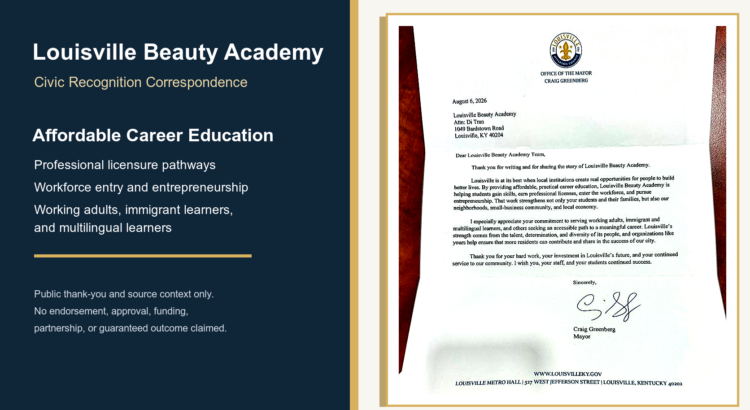
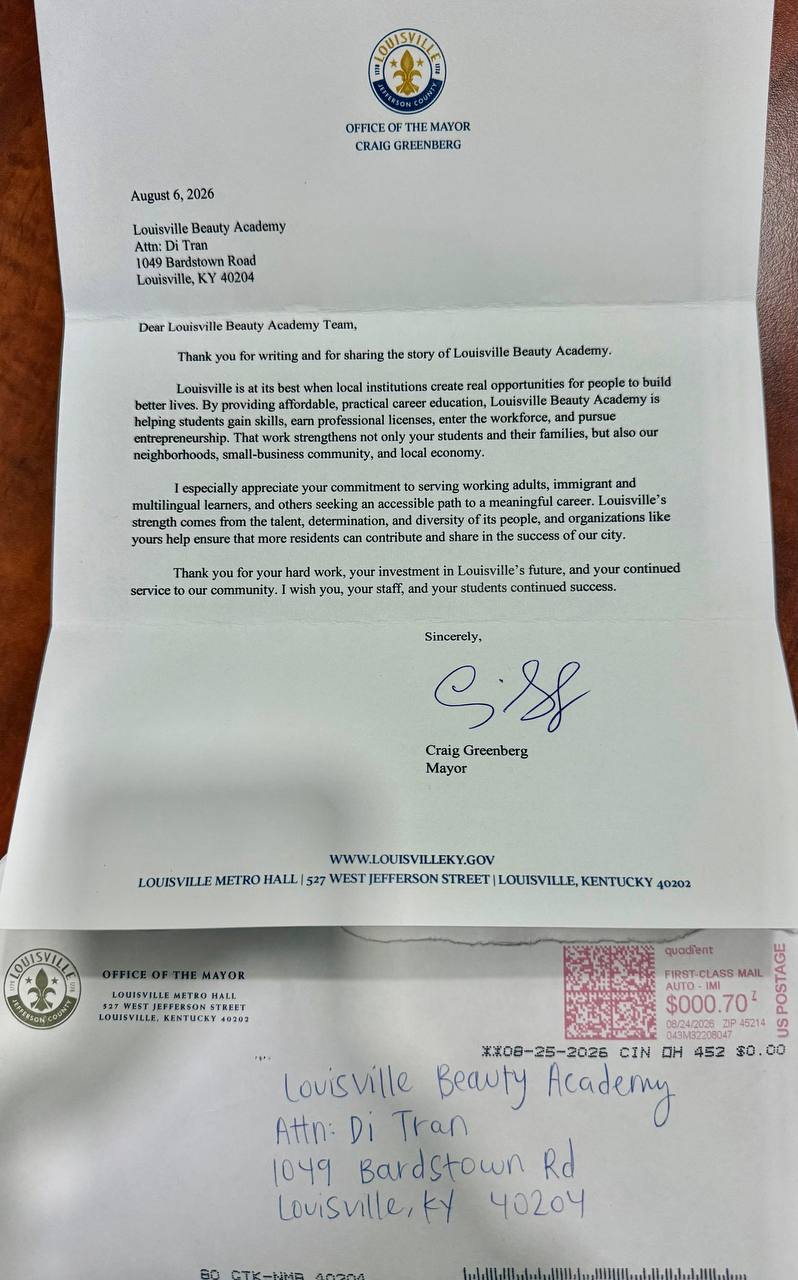
Louisville Beauty Academy thanks Louisville Mayor Craig Greenberg and Louisville Metro for a 2026 recognition letter acknowledging the school’s role in affordable practical career education, professional licensure pathways, workforce entry, entrepreneurship, and service to Louisville’s broader community.
The letter, addressed to Louisville Beauty Academy, recognizes the school for helping students gain skills, prepare for professional licensing pathways, enter the workforce, and pursue entrepreneurship. It also acknowledges the importance of accessible education for working adults, immigrant learners, multilingual learners, and others seeking a meaningful career path.
Recognition correspondence received by Louisville Beauty Academy and shared as civic gratitude and public record context, not as an endorsement, approval, partnership, funding decision, or guaranteed outcome.
For Louisville Beauty Academy, this recognition matters because the school’s work is local, practical, and human. LBA serves students who often balance family, work, language, transportation, finances, and major life transitions while pursuing a licensed career. The school’s mission has always been clear: make beauty education more affordable, more accessible, more documented, and more connected to real workforce opportunity.
Why This Recognition Matters
Beauty education is not only about technique. It is about dignity, licensure, public trust, sanitation, professionalism, small-business readiness, and the courage to begin again.
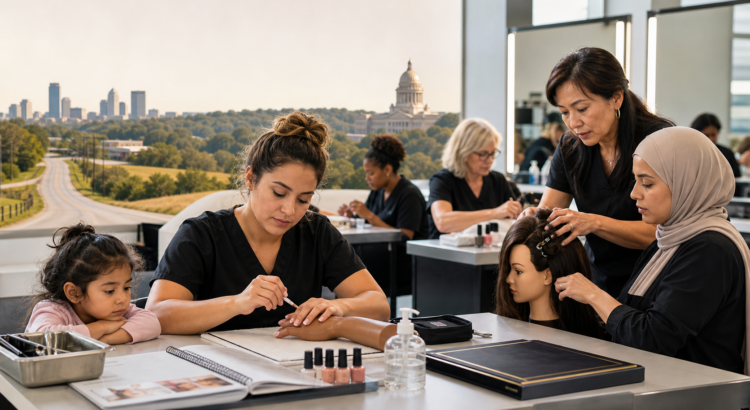
Many LBA students are adults. Many are immigrants. Many are multilingual learners. Many are parents, workers, career changers, or future entrepreneurs. A practical career school becomes powerful when it helps those students move from uncertainty into a documented path: training, hours, records, licensing awareness, exam preparation, supervised practice, and the confidence to serve the public professionally.
Mayor Greenberg’s recognition letter helps preserve an important public truth: local career education strengthens more than one student at a time. It supports families, neighborhoods, the small-business community, and the local economy.
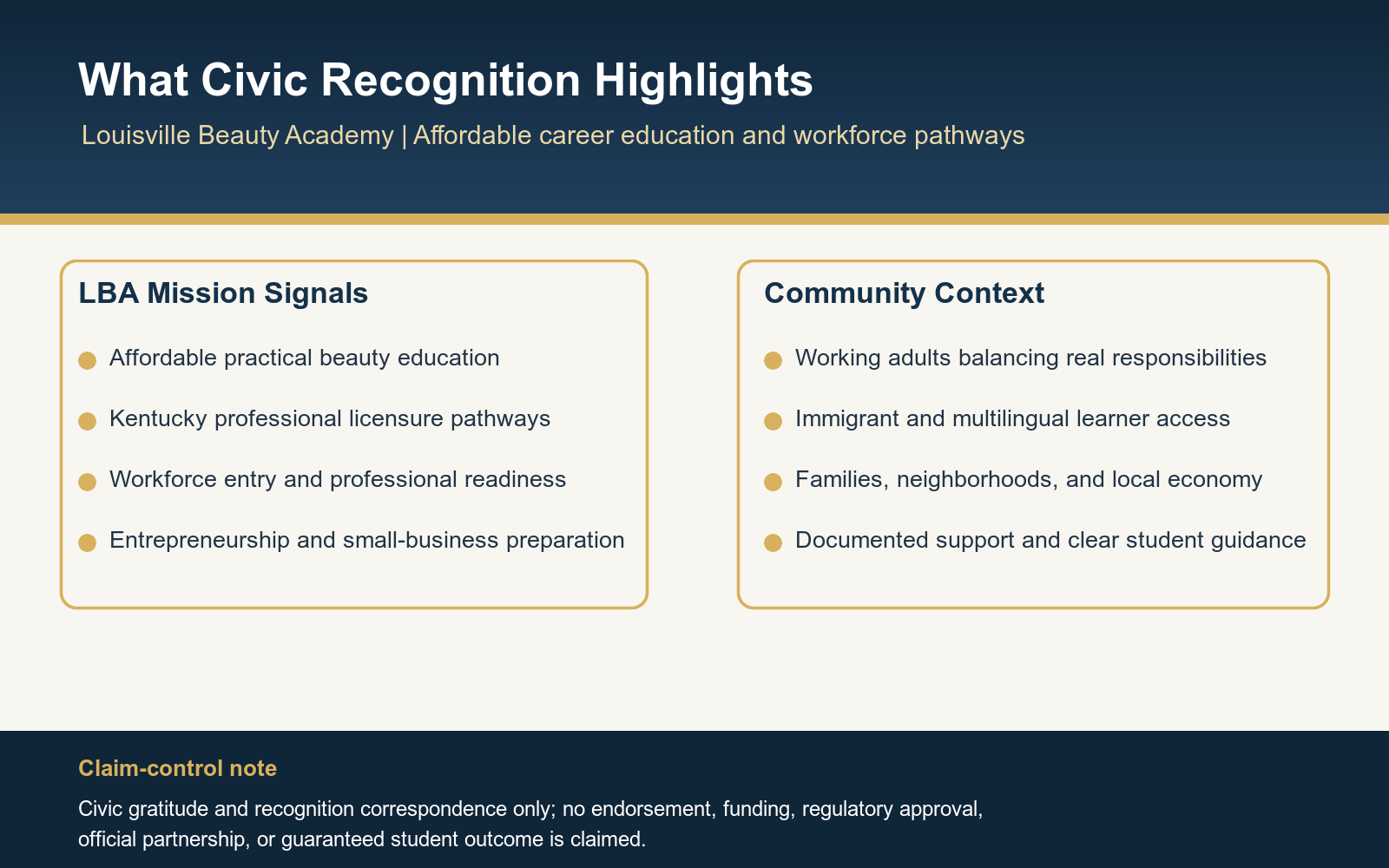
A civic-recognition summary of the LBA mission: affordable career education, licensing pathways, workforce entry, entrepreneurship, and accessible opportunity.
LBA’s Commitment To Louisville
affordable and practical beauty education;
Kentucky professional licensure pathways;
written clarity for students and families;
multilingual and immigrant learner access;
workforce readiness;
entrepreneurship preparation;
community-centered small-business development;
responsible use of technology and documentation to support students.
LBA’s work is built around a simple institutional standard: students deserve clarity before commitment, dignity during training, and documented support as they move toward professional licensing and career opportunity.
A Public Thank You
Louisville Beauty Academy is grateful to Mayor Craig Greenberg and Louisville Metro for acknowledging the school’s role in Louisville’s education, workforce, and small-business ecosystem.
This recognition belongs to the students, graduates, instructors, staff, families, patrons, and community members who make the work real every day. LBA will continue serving Louisville through practical training, student-centered documentation, professional standards, and a commitment to accessible pathways for those building a better future.
Source And Recognition Note
This article is based on recognition correspondence received by Louisville Beauty Academy in 2026 and preserved in LBA’s internal records. The identification of Craig Greenberg as Louisville Mayor was checked against the official Louisville Metro Government mayor page before publication.
Recognition And Claim-Control Note
Louisville Beauty Academy received recognition correspondence from Louisville Mayor Craig Greenberg in 2026. This post is a public thank-you and institutional recognition note. It should not be read as a claim of endorsement, funding approval, regulatory approval, official partnership, guaranteed licensure, guaranteed employment, guaranteed income, guaranteed enrollment outcome, or any government benefit.
Students and prospective students should rely on current written school documents, signed enrollment materials, official Kentucky Board of Cosmetology requirements, PSI rules when applicable, and applicable law for program, licensing, cost, schedule, attendance, and completion questions.
To learn more about Louisville Beauty Academy’s programs, written student documents, and enrollment pathways, visit the Student Document Center or contact the school for current written information.
Career and technical education is not only a school system. At its best, it is a community promise: people should be able to turn effort into skill, skill into lawful work, work into dignity, and dignity into stronger families, businesses, and neighborhoods.
That is the larger frame Louisville Beauty Academy brings to the national conversation.
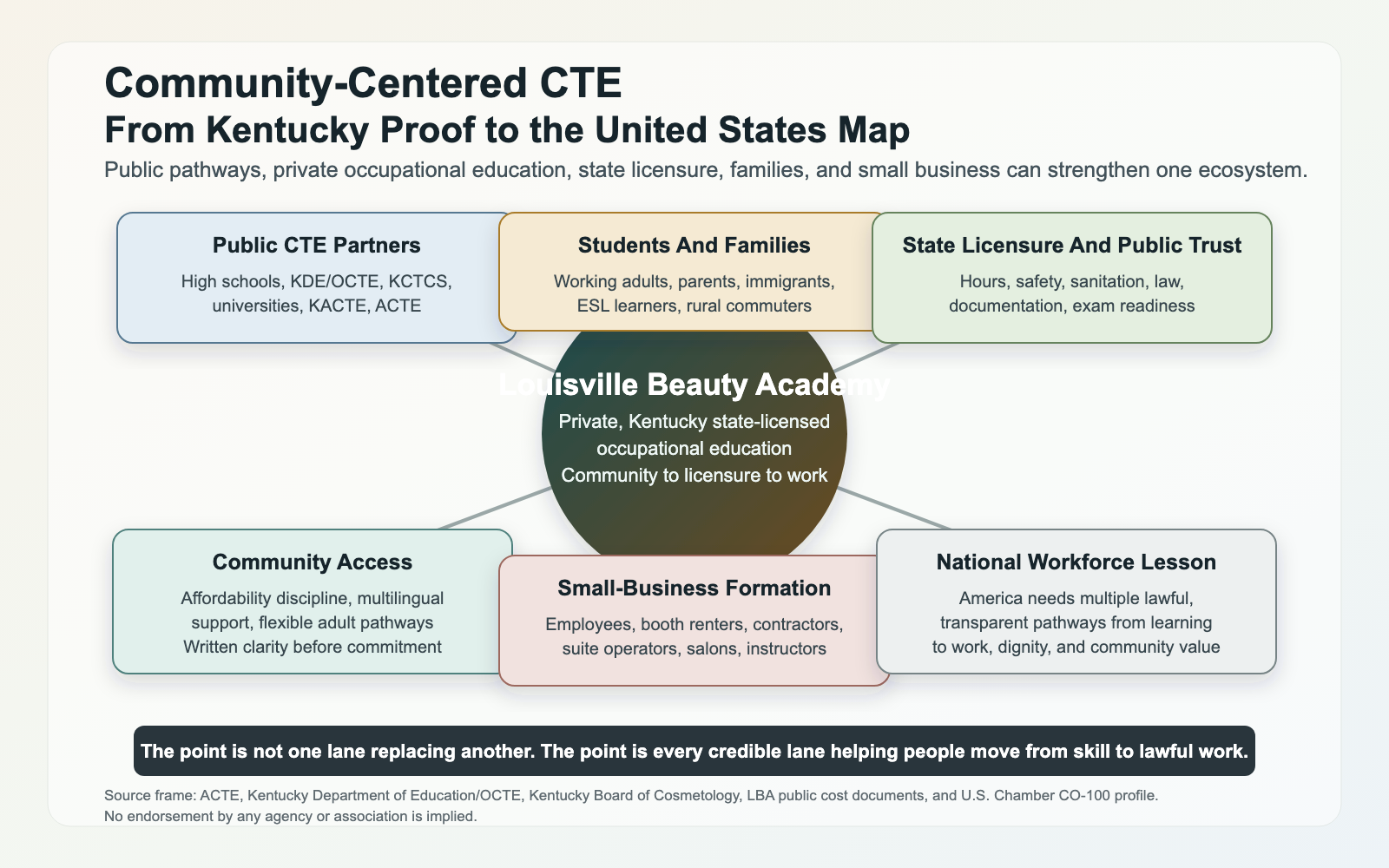
The academy is not asking to replace public education. It is not trying to compete with high school CTE, area technology centers, KDE/OCTE, KCTCS, universities, KACTE, ACTE, employers, or community partners. Those lanes matter deeply. They serve students, families, teachers, employers, and regions in ways Kentucky and the United States need.
Louisville Beauty Academy adds another lane that must be recognized clearly: private, state-licensed occupational education rooted in community.
That fact is not branding. It is the nature of the work. LBA prepares adult learners and working students for regulated beauty-industry licensure. It serves people who are often outside traditional prestige pathways: parents, immigrants, English-language learners, rural commuters, career changers, hourly workers, and people who need education to fit real life rather than the other way around.
For these students, the public value is not a slogan. It is measurable in the direction of their lives: attendance hours, sanitation practice, theory study, state-board preparation, client-service readiness, licensing progress, employment, booth rental, independent contracting, salon work, instruction, entrepreneurship, and local spending.
This is why LBA belongs in the CTE conversation. Not because every CTE lane is the same, but because every credible pathway from learning to lawful work deserves to be understood.
A community-centered CTE ecosystem: public pathways, private occupational education, state licensure, families, small businesses, and national workforce policy can strengthen one another.
The Community Is the Center
When people hear “workforce development,” they often picture systems, grants, agencies, dashboards, or statewide plans. Those things matter. But the community sees workforce development in human form.
A mother finding a path that fits around children.
An immigrant learner gaining professional vocabulary in a second language.
A rural commuter choosing licensure over giving up.
An instructor turning safety, sanitation, law, and technical skill into confidence.
A salon owner needing trained professionals who understand real client care.
A graduate becoming an employee, booth renter, suite operator, instructor, employer, or small-business owner.
A family watching sacrifice become licensed work.
That is the community map. LBA’s role is to make that map visible.
What Public CTE Gains From This Lane
Public CTE does not lose when private occupational education is recognized. It gains a fuller story.
The Association for Career and Technical Education describes CTE as rigorous and relevant education preparing youth and adults for high-skill, high-wage, high-demand careers. Kentucky’s Office of Career and Technical Education describes four-course CTE pathways, industry certifications, credentials, dual credit, recognized pathways, and collaboration with business and industry partners.
Those public pathways are essential.
Private occupational education can complement them by serving adult learners and working families who may not be in a high school pipeline, a traditional college pipeline, or a public program seat. In beauty education, the bridge is state occupational licensure: a regulated pathway where hours, sanitation, law, practical skill, documentation, and public safety matter.
Recognizing LBA does not diminish Kentucky CTE. It strengthens it by showing that career education reaches beyond one institutional form.
What Policymakers Can See
Policymakers should see LBA as a policy proof point: a small, private, state-licensed school using affordability discipline, multilingual support, documentation, compliance focus, and responsible AI-supported operations to help people move toward licensure and work.
This matters nationally because America needs more than one workforce model.
Some learners need high school CTE. Some need community college. Some need university pathways. Some need apprenticeships. Some need employer-based training. Some need short, regulated, occupation-specific education that is flexible enough for work, family, language, transportation, and cash-flow realities.
The question is not which lane should win. The better question is whether every lawful, transparent, accountable lane that moves people from skill to work is being recognized.
LBA gives Kentucky and the United States a concrete example of that broader answer.
What Families Can See
Families should see a school that publishes cost information, points students toward written documents, and reminds the public that the current written student contract controls. LBA’s public cost page lists full program costs and conditional reduced-cost figures for eligible students who meet written discount and incentive conditions. It also states clearly that no web page, screenshot, or older statement applies a discount by itself.
That language matters because affordability without written control can become confusion. LBA’s stronger model is affordability with documentation.
The public record shows the scale of the access story. LBA’s published page lists conditional reduced-cost pathways including nail technology, esthetics, cosmetology, beauty instructor, shampoo styling, and eyelash extension. The U.S. Chamber of Commerce’s CO- feature describes LBA as affordable, multilingual, debt-free, and pay-as-you-go, and says the academy has graduated nearly 2,000 licensed beauty professionals.
The strongest public conclusion is careful and powerful: LBA is one of the clearest publicly documented affordability-forward, Kentucky state-licensed beauty-education models and a nationally visible example of debt-avoidant occupational training.
What Students Can See
Students should see themselves without shame.
The student who works before or after class belongs in this story.
The student who has children belongs in this story.
The student who speaks Vietnamese, Spanish, Korean, Chinese, English, or another language at home belongs in this story.
The student who starts late, returns after difficulty, transfers hours, asks for written clarity, studies sanitation, repeats theory, or drives a long distance belongs in this story.
LBA’s public value is not that every student has the same journey. Its value is that the institution is built around real journeys: attendance, practice, documentation, language access, state rules, and the steady movement from uncertainty toward licensure readiness.
That is community-centered CTE.
What Small Business Can See
Beauty education is not only a school issue. It is a Main Street small-business issue.
Licensed beauty professionals can become employees, contractors, booth renters, suite operators, salon owners, instructors, trainers, product buyers, service providers, vendors, and employers. A graduate who enters the beauty workforce may also enter local commerce: rent, supplies, tools, taxes, services, customer relationships, and neighborhood economic activity.
That makes beauty education part of America’s small-business infrastructure.
LBA’s national recognitions support that interpretation without overstating it. The U.S. Chamber of Commerce recognized Louisville Beauty Academy as a 2025 CO-100 Honoree in the Enduring Businesses category. The National Small Business Association named Di Tran among the 2025 Lewis Shattuck Small Business Advocate of the Year finalists.
Those recognitions do not mean any government agency, CTE organization, or award committee has endorsed every claim in this article. They do mean that the model has already been seen nationally as a meaningful small-business and community-impact story.
What Kentucky Can Put on the United States Map
Kentucky should not hide this proof model.
A state-licensed beauty college in Louisville has built a community-centered occupational education lane that speaks to national questions: affordability, adult learners, immigrant access, small-business formation, documentation, workforce participation, public safety, and responsible use of AI as an institutional support tool rather than a replacement for human instruction.
That is bigger than one school.
It is a map of what workforce education can become when community is the center.
Public CTE leaders can see respect in it. Policymakers can see a practical model in it. Families can see protection in it. Students can see dignity in it. Instructors can see their labor honored in it. Salon owners can see future professionals in it. Small-business advocates can see entrepreneurship in it. Immigrant communities can see access in it. Kentucky can see a story worth carrying to the national stage.
The Fact We Should Accept
The fact is simple:
Louisville Beauty Academy is a private, Kentucky state-licensed occupational education provider that helps people move toward regulated beauty-industry licensure, workforce participation, entrepreneurship, and community economic contribution through an affordability-forward, multilingual, documentation-conscious model.
That statement does not attack public education. It does not promise licensure, employment, income, funding, award selection, or partnership. It does not claim that LBA is the only pathway or the only model.
It states what the evidence supports.
And once that fact is seen clearly, the strategic conclusion follows naturally: LBA gives Kentucky a community-centered CTE proof model that belongs on the map of the United States.
The Invitation
The invitation is not entitlement. It is service.
Let public CTE continue building early career pathways.
Let KCTCS and universities continue strengthening postsecondary ladders.
Let KDE/OCTE continue guiding the public framework.
Let KACTE and ACTE continue recognizing the people and partners who make career education real.
And let private, state-licensed occupational education be recognized as one more credible lane in the national story of learning to work.
Louisville Beauty Academy stands in that lane with humility, documentation, and community proof.
It is not the whole CTE story. But it is a real part of the story.
And for the students, families, instructors, graduates, salons, small businesses, and communities touched by the work, that part matters.
Policy Series Note. This article continues Louisville Beauty Academy’s research series on beauty workforce development. The purpose is to help students, families, workforce leaders, chambers, associations, and policymakers discuss beauty education with sharper categories and better evidence.
A live school can turn public service, compliance discipline, student identity verification, inspection readiness, and documentation into teachable workforce habits.
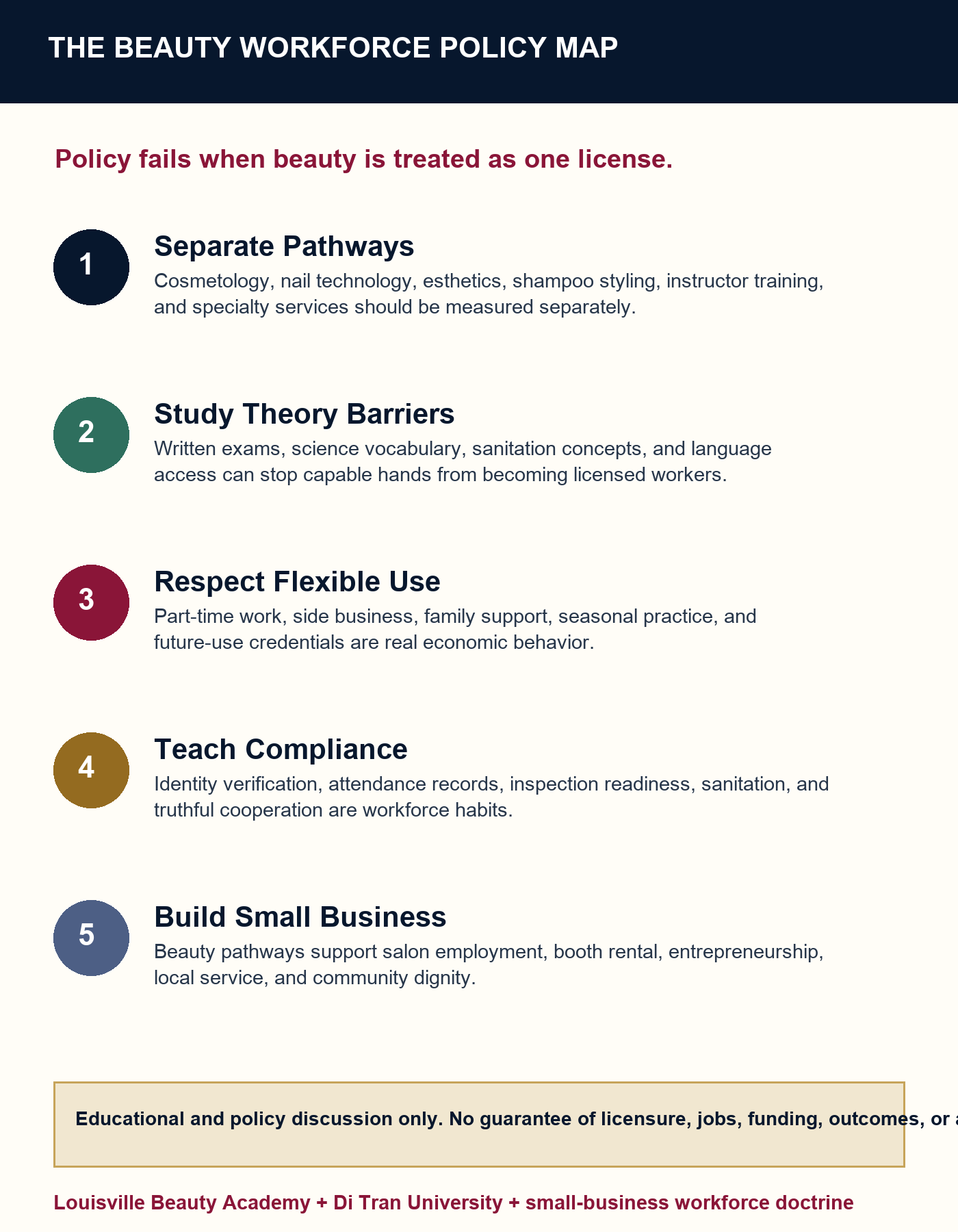
The beauty workforce policy map: separate pathways, study theory barriers, respect flexible use, teach compliance, and build small business.
The Policy Problem
Beauty is often described as if it were one occupation, one student profile, one license, one exam, and one economic result. That is too crude for real workforce development. A student who wants nail technology does not have the same timeline, cost structure, exam burden, service scope, or small-business pathway as a student seeking the broadest cosmetology route. A school that teaches compliance, sanitation, customer communication, identity discipline, and documentation is doing more than preparing people for a single exam.
The Workforce Interpretation
The next trend is not beauty versus technology. It is beauty workforce development plus compliance, AI-supported documentation, small-business readiness, and human-centered teaching. The result is a stronger public conversation: less ideology, more measurement; less gatekeeping language, more usable student support; less generic beauty talk, more precise pathways into lawful work and entrepreneurship.
This matters for Louisville because beauty education sits at the intersection of licensed work, immigrant enterprise, women-led small business, family income, consumer service, public sanitation, and neighborhood trust. That makes it a legitimate workforce-development subject, not a side issue.
A Compliance Teaching Moment
When a school experiences a compliance interaction, the teaching opportunity is not drama. The teaching opportunity is professionalism. Students should learn to remain calm, truthful, respectful, and cooperative. They should understand that attendance records, identity verification, sanitation routines, work areas, chemical storage, sinks, water access, and instructor guidance are not paperwork theater. They are part of public trust.
For privacy and legal reasons, a public article should not identify students or publish private inspection details. The lesson is the standard: carry proper identification when required, answer honestly, let school leadership provide records through the correct channel, and treat lawful oversight as part of professional formation.
What LBA Is Positioning
Student clarity: students should understand the difference between license pathways before committing.
Compliance as training: records, identity, attendance, sanitation, and truthful cooperation are employable habits.
AI as support: AI can help organize study, translation, documentation, and public education, while instructors and licensed professionals remain responsible for judgment.
Small-business mobility: beauty credentials can support employment, booth rental, independent services, family income, and local entrepreneurship.
Claim-Control Notice
This article is educational and policy-oriented. It does not promise licensure, employment, funding, admission, scholarship approval, income, government action, board approval, accreditation status, or any individual outcome. It does not state or imply that any agency or association endorses Louisville Beauty Academy. Current written school documents, official agency requirements, and qualified professional guidance control where relevant.
Policy Series Note. This article continues Louisville Beauty Academy’s research series on beauty workforce development. The purpose is to help students, families, workforce leaders, chambers, associations, and policymakers discuss beauty education with sharper categories and better evidence.
The right question is not whether beauty training matters. The right question is which pathway, for whom, at what cost, with what exam support, and toward what work model.
The beauty workforce policy map: separate pathways, study theory barriers, respect flexible use, teach compliance, and build small business.
The Policy Problem
Beauty is often described as if it were one occupation, one student profile, one license, one exam, and one economic result. That is too crude for real workforce development. A student who wants nail technology does not have the same timeline, cost structure, exam burden, service scope, or small-business pathway as a student seeking the broadest cosmetology route. A school that teaches compliance, sanitation, customer communication, identity discipline, and documentation is doing more than preparing people for a single exam.
The Workforce Interpretation
One Louisville, workforce boards, chambers, associations, and funders can use a sharper question set to support real student mobility and small-business development. The result is a stronger public conversation: less ideology, more measurement; less gatekeeping language, more usable student support; less generic beauty talk, more precise pathways into lawful work and entrepreneurship.
This matters for Louisville because beauty education sits at the intersection of licensed work, immigrant enterprise, women-led small business, family income, consumer service, public sanitation, and neighborhood trust. That makes it a legitimate workforce-development subject, not a side issue.
What LBA Is Positioning
Student clarity: students should understand the difference between license pathways before committing.
Compliance as training: records, identity, attendance, sanitation, and truthful cooperation are employable habits.
AI as support: AI can help organize study, translation, documentation, and public education, while instructors and licensed professionals remain responsible for judgment.
Small-business mobility: beauty credentials can support employment, booth rental, independent services, family income, and local entrepreneurship.
Claim-Control Notice
This article is educational and policy-oriented. It does not promise licensure, employment, funding, admission, scholarship approval, income, government action, board approval, accreditation status, or any individual outcome. It does not state or imply that any agency or association endorses Louisville Beauty Academy. Current written school documents, official agency requirements, and qualified professional guidance control where relevant.
Policy Series Note. This article continues Louisville Beauty Academy’s research series on beauty workforce development. The purpose is to help students, families, workforce leaders, chambers, associations, and policymakers discuss beauty education with sharper categories and better evidence.
Not every learner needs the longest license pathway first. Shorter, lawful, specific pathways can help people enter work, serve the public, and grow over time.
The beauty workforce policy map: separate pathways, study theory barriers, respect flexible use, teach compliance, and build small business.
The Policy Problem
Beauty is often described as if it were one occupation, one student profile, one license, one exam, and one economic result. That is too crude for real workforce development. A student who wants nail technology does not have the same timeline, cost structure, exam burden, service scope, or small-business pathway as a student seeking the broadest cosmetology route. A school that teaches compliance, sanitation, customer communication, identity discipline, and documentation is doing more than preparing people for a single exam.
The Workforce Interpretation
Funding and workforce systems should recognize right-sized pathways, not only the broadest program category. The result is a stronger public conversation: less ideology, more measurement; less gatekeeping language, more usable student support; less generic beauty talk, more precise pathways into lawful work and entrepreneurship.
This matters for Louisville because beauty education sits at the intersection of licensed work, immigrant enterprise, women-led small business, family income, consumer service, public sanitation, and neighborhood trust. That makes it a legitimate workforce-development subject, not a side issue.
What LBA Is Positioning
Student clarity: students should understand the difference between license pathways before committing.
Compliance as training: records, identity, attendance, sanitation, and truthful cooperation are employable habits.
AI as support: AI can help organize study, translation, documentation, and public education, while instructors and licensed professionals remain responsible for judgment.
Small-business mobility: beauty credentials can support employment, booth rental, independent services, family income, and local entrepreneurship.
Claim-Control Notice
This article is educational and policy-oriented. It does not promise licensure, employment, funding, admission, scholarship approval, income, government action, board approval, accreditation status, or any individual outcome. It does not state or imply that any agency or association endorses Louisville Beauty Academy. Current written school documents, official agency requirements, and qualified professional guidance control where relevant.
Policy Series Note. This article continues Louisville Beauty Academy’s research series on beauty workforce development. The purpose is to help students, families, workforce leaders, chambers, associations, and policymakers discuss beauty education with sharper categories and better evidence.
License underutilization does not always mean failure. It often reflects flexible income, family duties, future use, side business, booth rental, and changing labor markets.
The beauty workforce policy map: separate pathways, study theory barriers, respect flexible use, teach compliance, and build small business.
The Policy Problem
Beauty is often described as if it were one occupation, one student profile, one license, one exam, and one economic result. That is too crude for real workforce development. A student who wants nail technology does not have the same timeline, cost structure, exam burden, service scope, or small-business pathway as a student seeking the broadest cosmetology route. A school that teaches compliance, sanitation, customer communication, identity discipline, and documentation is doing more than preparing people for a single exam.
The Workforce Interpretation
Policy should measure full-time use, part-time use, self-employment, entrepreneurship, and reserve credential value separately. The result is a stronger public conversation: less ideology, more measurement; less gatekeeping language, more usable student support; less generic beauty talk, more precise pathways into lawful work and entrepreneurship.
This matters for Louisville because beauty education sits at the intersection of licensed work, immigrant enterprise, women-led small business, family income, consumer service, public sanitation, and neighborhood trust. That makes it a legitimate workforce-development subject, not a side issue.
What LBA Is Positioning
Student clarity: students should understand the difference between license pathways before committing.
Compliance as training: records, identity, attendance, sanitation, and truthful cooperation are employable habits.
AI as support: AI can help organize study, translation, documentation, and public education, while instructors and licensed professionals remain responsible for judgment.
Small-business mobility: beauty credentials can support employment, booth rental, independent services, family income, and local entrepreneurship.
Claim-Control Notice
This article is educational and policy-oriented. It does not promise licensure, employment, funding, admission, scholarship approval, income, government action, board approval, accreditation status, or any individual outcome. It does not state or imply that any agency or association endorses Louisville Beauty Academy. Current written school documents, official agency requirements, and qualified professional guidance control where relevant.
Policy Series Note. This article continues Louisville Beauty Academy’s research series on beauty workforce development. The purpose is to help students, families, workforce leaders, chambers, associations, and policymakers discuss beauty education with sharper categories and better evidence.
The written/theory exam is often the harder barrier, especially where science vocabulary, sanitation concepts, language access, and test literacy are weak.
The beauty workforce policy map: separate pathways, study theory barriers, respect flexible use, teach compliance, and build small business.
The Policy Problem
Beauty is often described as if it were one occupation, one student profile, one license, one exam, and one economic result. That is too crude for real workforce development. A student who wants nail technology does not have the same timeline, cost structure, exam burden, service scope, or small-business pathway as a student seeking the broadest cosmetology route. A school that teaches compliance, sanitation, customer communication, identity discipline, and documentation is doing more than preparing people for a single exam.
The Workforce Interpretation
A serious workforce model should support science vocabulary, infection-control literacy, language-aware tutoring, and AI-assisted study without weakening standards. The result is a stronger public conversation: less ideology, more measurement; less gatekeeping language, more usable student support; less generic beauty talk, more precise pathways into lawful work and entrepreneurship.
This matters for Louisville because beauty education sits at the intersection of licensed work, immigrant enterprise, women-led small business, family income, consumer service, public sanitation, and neighborhood trust. That makes it a legitimate workforce-development subject, not a side issue.
What LBA Is Positioning
Student clarity: students should understand the difference between license pathways before committing.
Compliance as training: records, identity, attendance, sanitation, and truthful cooperation are employable habits.
AI as support: AI can help organize study, translation, documentation, and public education, while instructors and licensed professionals remain responsible for judgment.
Small-business mobility: beauty credentials can support employment, booth rental, independent services, family income, and local entrepreneurship.
Claim-Control Notice
This article is educational and policy-oriented. It does not promise licensure, employment, funding, admission, scholarship approval, income, government action, board approval, accreditation status, or any individual outcome. It does not state or imply that any agency or association endorses Louisville Beauty Academy. Current written school documents, official agency requirements, and qualified professional guidance control where relevant.
Policy Series Note. This article continues Louisville Beauty Academy’s research series on beauty workforce development. The purpose is to help students, families, workforce leaders, chambers, associations, and policymakers discuss beauty education with sharper categories and better evidence.
Beauty policy becomes clearer when leaders stop collapsing every pathway into the single word cosmetology.
The beauty workforce policy map: separate pathways, study theory barriers, respect flexible use, teach compliance, and build small business.
The Policy Problem
Beauty is often described as if it were one occupation, one student profile, one license, one exam, and one economic result. That is too crude for real workforce development. A student who wants nail technology does not have the same timeline, cost structure, exam burden, service scope, or small-business pathway as a student seeking the broadest cosmetology route. A school that teaches compliance, sanitation, customer communication, identity discipline, and documentation is doing more than preparing people for a single exam.
The Workforce Interpretation
Workforce boards, chambers, associations, and regulators should ask which license, which service, which exam barrier, and which economic path they are discussing. The result is a stronger public conversation: less ideology, more measurement; less gatekeeping language, more usable student support; less generic beauty talk, more precise pathways into lawful work and entrepreneurship.
This matters for Louisville because beauty education sits at the intersection of licensed work, immigrant enterprise, women-led small business, family income, consumer service, public sanitation, and neighborhood trust. That makes it a legitimate workforce-development subject, not a side issue.
What LBA Is Positioning
Student clarity: students should understand the difference between license pathways before committing.
Compliance as training: records, identity, attendance, sanitation, and truthful cooperation are employable habits.
AI as support: AI can help organize study, translation, documentation, and public education, while instructors and licensed professionals remain responsible for judgment.
Small-business mobility: beauty credentials can support employment, booth rental, independent services, family income, and local entrepreneurship.
Claim-Control Notice
This article is educational and policy-oriented. It does not promise licensure, employment, funding, admission, scholarship approval, income, government action, board approval, accreditation status, or any individual outcome. It does not state or imply that any agency or association endorses Louisville Beauty Academy. Current written school documents, official agency requirements, and qualified professional guidance control where relevant.
At Louisville Beauty Academy, a school name is not only a name. It is a responsibility.
Every student who walks through the door carries more than a schedule, a tuition plan, or a licensing goal. They carry family pressure, work pressure, language difference, financial reality, hope, fear, discipline, and the quiet question that lives inside almost every serious beginning:
Can I really do this?
Louisville Beauty Academy answers through culture, not noise:
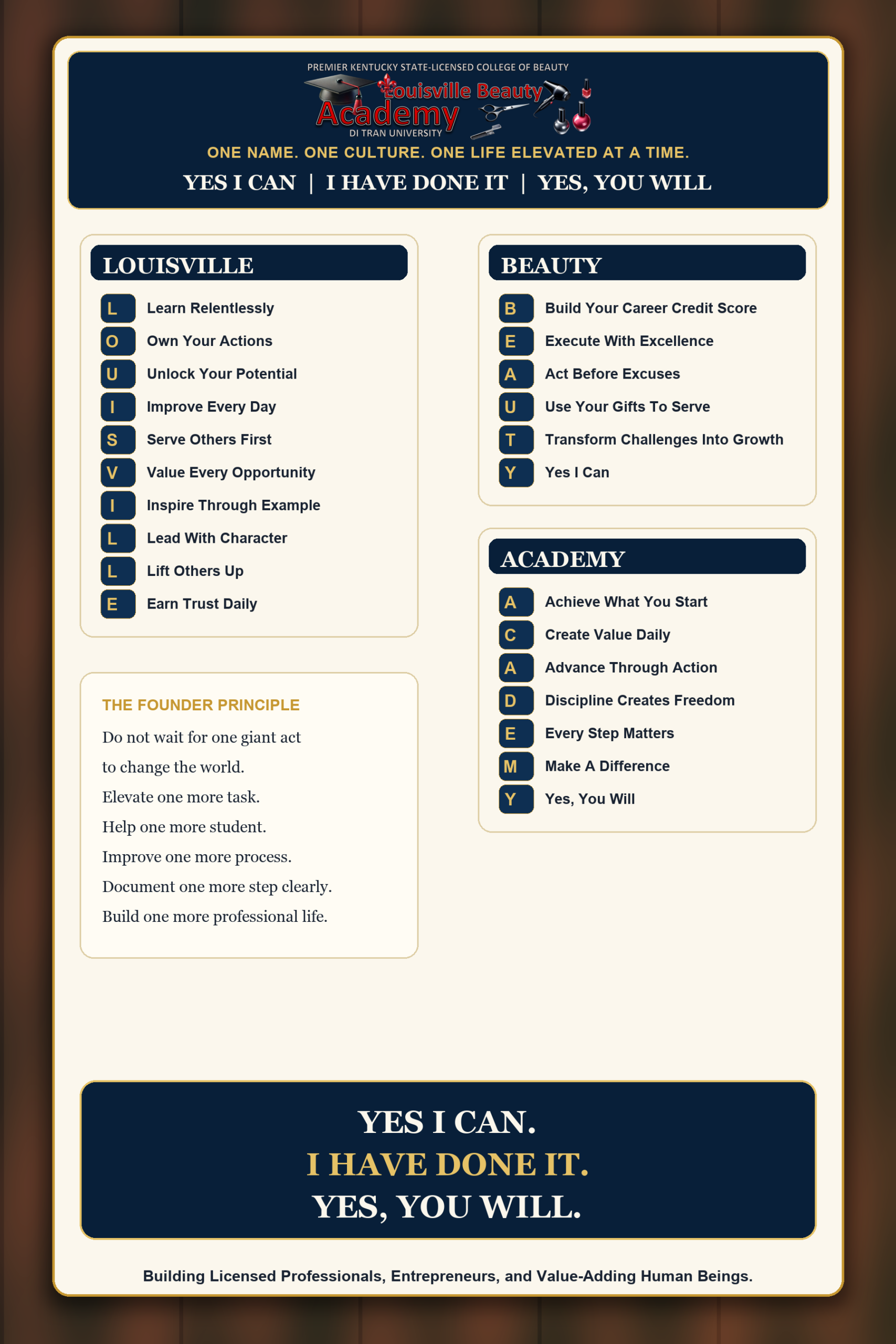
YES I CAN. I HAVE DONE IT. YES, YOU WILL.
Those words are not decoration. They are a sequence of growth. YES I CAN is the courage to begin. I HAVE DONE IT is the proof that disciplined action can become achievement. YES, YOU WILL is the graduate, instructor, family member, salon owner, and community leader turning back toward the next student and saying: keep going.
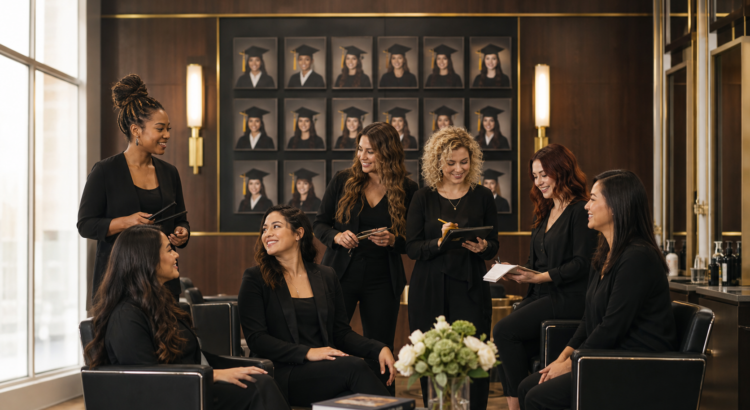
Louisville Beauty Academy culture wall: one name, one culture, one life elevated at a time.
The Meaning Inside The Name
LOUISVILLE begins with the professional foundation: learning, ownership, service, character, and trust.
L — Learn Relentlessly
O — Own Your Actions
U — Unlock Your Potential
I — Improve Every Day
S — Serve Others First
V — Value Every Opportunity
I — Inspire Through Example
L — Lead With Character
L — Lift Others Up
E — Earn Trust Daily
A beauty professional must learn technique, sanitation, client care, timing, communication, discipline, documentation, and business judgment. Talent matters, but talent without trust does not build a career. Skill matters, but skill without character does not build a profession.
BEAUTY becomes more than appearance. It becomes service, professionalism, dignity, and value creation.
B — Build Your Career Credit Score
E — Execute With Excellence
A — Act Before Excuses
U — Use Your Gifts To Serve
T — Transform Challenges Into Growth
Y — Yes I Can
Beauty work is human work. A student learns to serve another person with care, prepare a clean and safe service environment, listen carefully, practice repeatedly, accept correction, and build public trust one client at a time.
ACADEMY becomes the discipline of completion.
A — Achieve What You Start
C — Create Value Daily
A — Advance Through Action
D — Discipline Creates Freedom
E — Every Step Matters
M — Make A Difference
Y — Yes, You Will
The academy exists because people need more than encouragement. They need structure. They need repetition. They need written clarity. They need instructors who care enough to correct them and a culture strong enough to bring them back to action after difficulty.
One More Action At A Time
The founder principle behind this culture is simple: do not wait for one giant act to change the world. Elevate one more task. Help one more student. Improve one more process. Finish one more requirement. Speak one more sentence of encouragement. Document one more step clearly. Build one more professional life.
Small actions compound.
One checklist becomes readiness.
One correction becomes skill.
One returned student becomes completion.
One written record prevents confusion.
One license pathway becomes economic movement.
One graduate becomes a model for the next person.
This is how a school becomes more than a school. It becomes a place where people practice becoming trustworthy, useful, skilled, licensed, and ready to serve.
Why This Is Also Civic Work
Beauty education is often misunderstood as small. It is not small. It is workforce development. It is small-business formation. It is immigrant and working-family mobility. It is sanitation and public trust. It is language access. It is the discipline of taking a real person from uncertainty toward a documented professional pathway.
Louisville Beauty Academy has been publicly recognized through national small-business and advocacy channels, including the U.S. Chamber of Commerce CO—100 profile for Louisville Beauty Academy and the CO—100 small-business list. Founder Di Tran has also been publicly named by the National Small Business Association among the 2025 Lewis Shattuck Small Business Advocate of the Year finalists, as reflected in NSBA public materials.
Those recognitions matter, but they are not the mission. The mission remains the next student who needs a clear beginning, a lawful school pathway, written cost information, real support, and a culture that says: yes, you can begin; yes, you can continue; yes, you can finish what you start.
The Culture Wall
Louisville Beauty Academy should place this culture where students can see it, read it, photograph it, graduate in front of it, and remember it.
Not because words alone create success. They do not.
But repeated words, repeated actions, repeated standards, repeated correction, and repeated evidence shape people. A wall can become a daily reminder. A staircase can become a progression. A graduation backdrop can become proof. A student handbook page can become a standard. A website article can become an invitation to a person who has not yet found the courage to ask.
The culture is uplifting because it is practical. Ask questions in writing. Review the documents. Understand the cost. Know the attendance expectations. Respect sanitation. Practice the skill. Listen to correction. Finish the hours. Prepare for the board. Build trust daily.
Student next step
Ask LBA for current written information before you decide.
If you are comparing programs, schedule, tuition, language support, tour options, or enrollment documents, ask for current written follow-up. A clear record protects the student and strengthens trust.
Louisville Beauty Academy is building licensed professionals, entrepreneurs, and value-adding human beings one disciplined step, one caring action, and one life at a time.
Louisville proud. Kentucky proud. American small business proud.
Louisville, Kentucky should be proud.
Louisville Beauty Academy has reached a historic national milestone for small business, workforce education, immigrant entrepreneurship, practical career training, and proof-based public service.
Louisville Beauty Academy framing: This is the flagship school proof article.
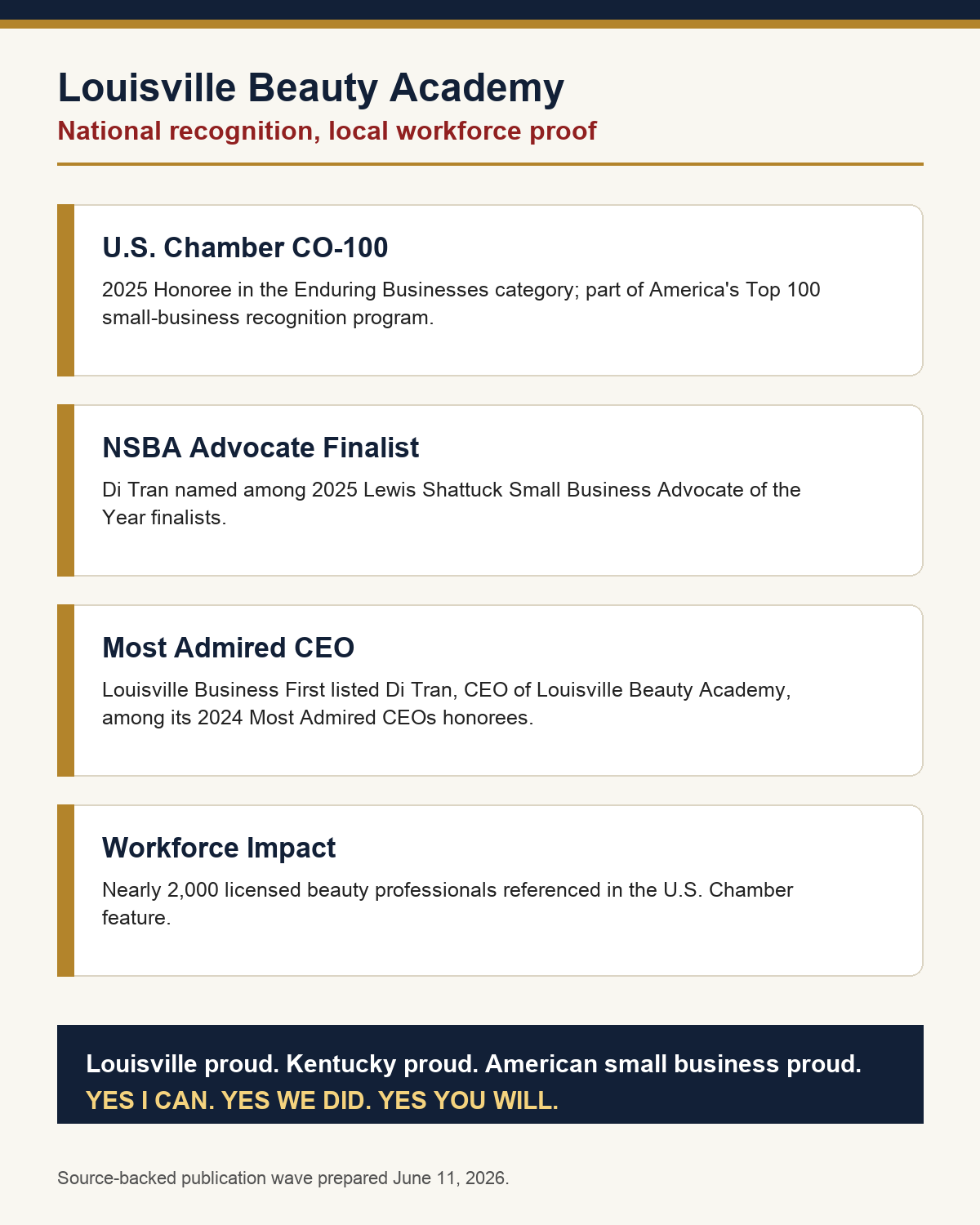
In 2025, Louisville Beauty Academy was named a U.S. Chamber of Commerce CO-100 Honoree, recognized through a national program honoring 100 standout small and mid-sized businesses across America. The U.S. Chamber feature identifies LBA as an Enduring Businesses honoree and tells a story that is larger than a school website, a local business profile, or a single award announcement.
It is a Louisville story. It is a Kentucky story. It is an American small-business story. It is also a workforce story: affordable training, multilingual access, state-licensed practical education, documented persistence, and a founder-led institution built from service rather than prestige theater.
U.S. Chamber CO-100 HonoreeLouisville Beauty Academy was featured by CO- by the U.S. Chamber of Commerce as a 2025 CO-100 Honoree.
Enduring Businesses CategoryThe U.S. Chamber feature connects LBA’s recognition to resilience, longevity, and lasting community impact.
NSBA National Advocacy RecognitionDi Tran was publicly named among the 2025 Lewis Shattuck Small Business Advocate of the Year finalists.
Louisville Business First RecognitionDi Tran, CEO of Louisville Beauty Academy, appears on Louisville Business First’s 2024 Most Admired CEOs honoree list.
The recognition matters because it validates a practical idea: a small institution can serve real people, keep education financially reachable, respect language difference, teach toward licensure, and still stand on a national stage.
Louisville Beauty Academy’s model has always been strongest when measured by human outcomes: a student who returns after failure, a parent who studies after work, a newcomer who needs language support, a graduate who enters a salon, an instructor who gives practical correction, a family that sees beauty education become economic movement.
Why This Recognition Belongs To Louisville
From Bardstown Road in Louisville, Kentucky, to recognition by national small-business institutions, LBA represents what happens when education, service, affordability, faith, discipline, documentation, and community come together.
This is not merely an award story. It is evidence that practical education matters. Affordable training matters. Immigrant-founded businesses can build real workforce impact. Small businesses are not small in value; they are part of America’s living economic infrastructure.
YES I CAN. YES WE DID. YES YOU WILL.
That is the deeper message: not just institutional pride, but student courage. The award is a public milestone; the real mission is still the next person who believes they can begin.
A Rare Intersection Of Proof
U.S. Chamber of Commerce CO-100 Honoree.
Recognized within America’s Top 100 small-business program.
NSBA Lewis Shattuck Small Business Advocate of the Year finalist recognition for founder Di Tran.
Nearly 2,000 beauty professionals impacted, as described in the U.S. Chamber feature.
Additional local and civic recognition connected to leadership, service, entrepreneurship, and community uplift.
Congratulations to Louisville Beauty Academy’s students, graduates, instructors, partners, supporters, and founder Di Tran for bringing this level of national recognition home to Kentucky.
This article uses public source attribution for the strongest claims. The U.S. Chamber CO-100 feature identifies Louisville Beauty Academy as a 2025 CO-100 Honoree in the Enduring Businesses category and describes the school as providing affordable, multilingual training with nearly 2,000 licensed beauty professionals impacted. The U.S. Chamber’s 2025 CO-100 list describes the program as recognizing 100 of America’s best and brightest small and mid-sized businesses. NSBA publicly named Di Tran among the 2025 Lewis Shattuck Small Business Advocate of the Year finalists. Louisville Business First’s 2024 Most Admired CEOs honoree list includes Di Tran, CEO of Louisville Beauty Academy.
Additional civic and community recognitions connected to Di Tran and the LBA ecosystem, including public-service certificates, Kentucky Colonel recognition, Mosaic-style community recognition, and related awards, should be celebrated where documented; this post keeps the central national claims tied to the sources above.
Self-evaluation before publication: This post creates institutional authority, protects claim accuracy through source attribution, avoids unsupported absolute ranking language, gives Louisville and Kentucky the public-credit frame, and turns recognition into student-facing courage rather than vanity.
Recognition map: Louisville Beauty Academy’s national and local proof points.