Louisville Beauty Academy beauty workforce policy series featured image

Louisville’s Beauty Workforce Model: Affordable Training, Compliance Teaching, AI Readiness, and Small-Business Mobility

Policy Series Note. This article continues Louisville Beauty Academy’s research series on beauty workforce development. The purpose is to help students, families, workforce leaders, chambers, associations, and policymakers discuss beauty education with sharper categories and better evidence.

A live school can turn public service, compliance discipline, student identity verification, inspection readiness, and documentation into teachable workforce habits.
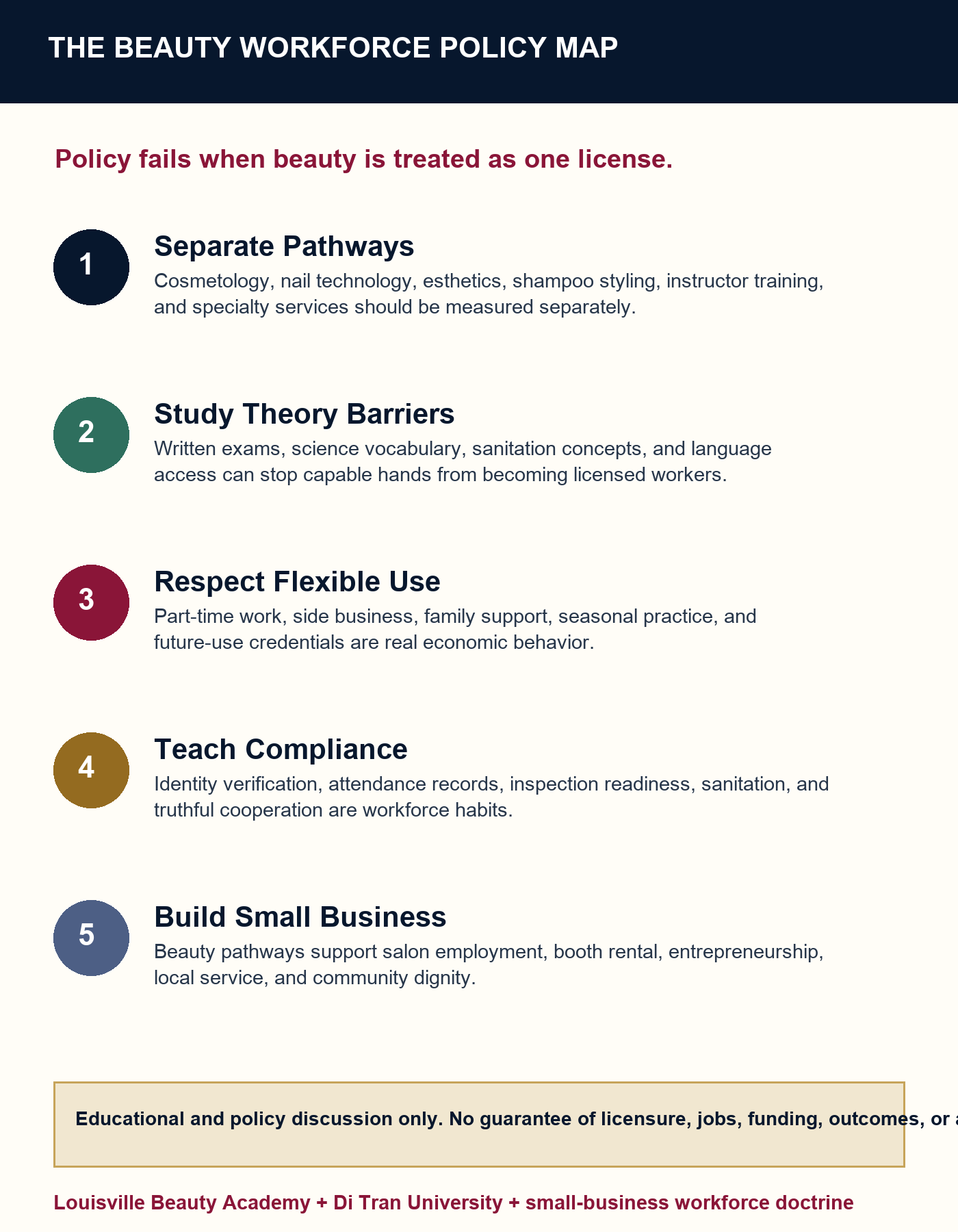
Infographic mapping beauty workforce policy: pathways, theory barriers, compliance, and small business
The beauty workforce policy map: separate pathways, study theory barriers, respect flexible use, teach compliance, and build small business.

The Policy Problem

Beauty is often described as if it were one occupation, one student profile, one license, one exam, and one economic result. That is too crude for real workforce development. A student who wants nail technology does not have the same timeline, cost structure, exam burden, service scope, or small-business pathway as a student seeking the broadest cosmetology route. A school that teaches compliance, sanitation, customer communication, identity discipline, and documentation is doing more than preparing people for a single exam.

The Workforce Interpretation

The next trend is not beauty versus technology. It is beauty workforce development plus compliance, AI-supported documentation, small-business readiness, and human-centered teaching. The result is a stronger public conversation: less ideology, more measurement; less gatekeeping language, more usable student support; less generic beauty talk, more precise pathways into lawful work and entrepreneurship.

This matters for Louisville because beauty education sits at the intersection of licensed work, immigrant enterprise, women-led small business, family income, consumer service, public sanitation, and neighborhood trust. That makes it a legitimate workforce-development subject, not a side issue.

A Compliance Teaching Moment

When a school experiences a compliance interaction, the teaching opportunity is not drama. The teaching opportunity is professionalism. Students should learn to remain calm, truthful, respectful, and cooperative. They should understand that attendance records, identity verification, sanitation routines, work areas, chemical storage, sinks, water access, and instructor guidance are not paperwork theater. They are part of public trust.

For privacy and legal reasons, a public article should not identify students or publish private inspection details. The lesson is the standard: carry proper identification when required, answer honestly, let school leadership provide records through the correct channel, and treat lawful oversight as part of professional formation.

What LBA Is Positioning

  • Student clarity: students should understand the difference between license pathways before committing.
  • Compliance as training: records, identity, attendance, sanitation, and truthful cooperation are employable habits.
  • AI as support: AI can help organize study, translation, documentation, and public education, while instructors and licensed professionals remain responsible for judgment.
  • Small-business mobility: beauty credentials can support employment, booth rental, independent services, family income, and local entrepreneurship.

Claim-Control Notice

This article is educational and policy-oriented. It does not promise licensure, employment, funding, admission, scholarship approval, income, government action, board approval, accreditation status, or any individual outcome. It does not state or imply that any agency or association endorses Louisville Beauty Academy. Current written school documents, official agency requirements, and qualified professional guidance control where relevant.

Sources and Context

Louisville Beauty Academy beauty workforce policy series featured image

What Workforce Leaders Should Ask Before Funding Beauty Training

Policy Series Note. This article continues Louisville Beauty Academy’s research series on beauty workforce development. The purpose is to help students, families, workforce leaders, chambers, associations, and policymakers discuss beauty education with sharper categories and better evidence.

The right question is not whether beauty training matters. The right question is which pathway, for whom, at what cost, with what exam support, and toward what work model.

Infographic mapping beauty workforce policy: pathways, theory barriers, compliance, and small business
The beauty workforce policy map: separate pathways, study theory barriers, respect flexible use, teach compliance, and build small business.

The Policy Problem

Beauty is often described as if it were one occupation, one student profile, one license, one exam, and one economic result. That is too crude for real workforce development. A student who wants nail technology does not have the same timeline, cost structure, exam burden, service scope, or small-business pathway as a student seeking the broadest cosmetology route. A school that teaches compliance, sanitation, customer communication, identity discipline, and documentation is doing more than preparing people for a single exam.

The Workforce Interpretation

One Louisville, workforce boards, chambers, associations, and funders can use a sharper question set to support real student mobility and small-business development. The result is a stronger public conversation: less ideology, more measurement; less gatekeeping language, more usable student support; less generic beauty talk, more precise pathways into lawful work and entrepreneurship.

This matters for Louisville because beauty education sits at the intersection of licensed work, immigrant enterprise, women-led small business, family income, consumer service, public sanitation, and neighborhood trust. That makes it a legitimate workforce-development subject, not a side issue.

What LBA Is Positioning

  • Student clarity: students should understand the difference between license pathways before committing.
  • Compliance as training: records, identity, attendance, sanitation, and truthful cooperation are employable habits.
  • AI as support: AI can help organize study, translation, documentation, and public education, while instructors and licensed professionals remain responsible for judgment.
  • Small-business mobility: beauty credentials can support employment, booth rental, independent services, family income, and local entrepreneurship.

Claim-Control Notice

This article is educational and policy-oriented. It does not promise licensure, employment, funding, admission, scholarship approval, income, government action, board approval, accreditation status, or any individual outcome. It does not state or imply that any agency or association endorses Louisville Beauty Academy. Current written school documents, official agency requirements, and qualified professional guidance control where relevant.

Sources and Context

Louisville Beauty Academy beauty workforce policy series featured image

Shorter, Smarter Beauty Pathways: Nail Technology, Esthetics, Shampoo Styling, and Instructor Training as Real Workforce Development

Policy Series Note. This article continues Louisville Beauty Academy’s research series on beauty workforce development. The purpose is to help students, families, workforce leaders, chambers, associations, and policymakers discuss beauty education with sharper categories and better evidence.

Not every learner needs the longest license pathway first. Shorter, lawful, specific pathways can help people enter work, serve the public, and grow over time.

Infographic mapping beauty workforce policy: pathways, theory barriers, compliance, and small business
The beauty workforce policy map: separate pathways, study theory barriers, respect flexible use, teach compliance, and build small business.

The Policy Problem

Beauty is often described as if it were one occupation, one student profile, one license, one exam, and one economic result. That is too crude for real workforce development. A student who wants nail technology does not have the same timeline, cost structure, exam burden, service scope, or small-business pathway as a student seeking the broadest cosmetology route. A school that teaches compliance, sanitation, customer communication, identity discipline, and documentation is doing more than preparing people for a single exam.

The Workforce Interpretation

Funding and workforce systems should recognize right-sized pathways, not only the broadest program category. The result is a stronger public conversation: less ideology, more measurement; less gatekeeping language, more usable student support; less generic beauty talk, more precise pathways into lawful work and entrepreneurship.

This matters for Louisville because beauty education sits at the intersection of licensed work, immigrant enterprise, women-led small business, family income, consumer service, public sanitation, and neighborhood trust. That makes it a legitimate workforce-development subject, not a side issue.

What LBA Is Positioning

  • Student clarity: students should understand the difference between license pathways before committing.
  • Compliance as training: records, identity, attendance, sanitation, and truthful cooperation are employable habits.
  • AI as support: AI can help organize study, translation, documentation, and public education, while instructors and licensed professionals remain responsible for judgment.
  • Small-business mobility: beauty credentials can support employment, booth rental, independent services, family income, and local entrepreneurship.

Claim-Control Notice

This article is educational and policy-oriented. It does not promise licensure, employment, funding, admission, scholarship approval, income, government action, board approval, accreditation status, or any individual outcome. It does not state or imply that any agency or association endorses Louisville Beauty Academy. Current written school documents, official agency requirements, and qualified professional guidance control where relevant.

Sources and Context

Louisville Beauty Academy beauty workforce policy series featured image

From License to Livelihood: Why Beauty Graduates Use Credentials Part-Time, Seasonally, or Entrepreneurially

Policy Series Note. This article continues Louisville Beauty Academy’s research series on beauty workforce development. The purpose is to help students, families, workforce leaders, chambers, associations, and policymakers discuss beauty education with sharper categories and better evidence.

License underutilization does not always mean failure. It often reflects flexible income, family duties, future use, side business, booth rental, and changing labor markets.

Infographic mapping beauty workforce policy: pathways, theory barriers, compliance, and small business
The beauty workforce policy map: separate pathways, study theory barriers, respect flexible use, teach compliance, and build small business.

The Policy Problem

Beauty is often described as if it were one occupation, one student profile, one license, one exam, and one economic result. That is too crude for real workforce development. A student who wants nail technology does not have the same timeline, cost structure, exam burden, service scope, or small-business pathway as a student seeking the broadest cosmetology route. A school that teaches compliance, sanitation, customer communication, identity discipline, and documentation is doing more than preparing people for a single exam.

The Workforce Interpretation

Policy should measure full-time use, part-time use, self-employment, entrepreneurship, and reserve credential value separately. The result is a stronger public conversation: less ideology, more measurement; less gatekeeping language, more usable student support; less generic beauty talk, more precise pathways into lawful work and entrepreneurship.

This matters for Louisville because beauty education sits at the intersection of licensed work, immigrant enterprise, women-led small business, family income, consumer service, public sanitation, and neighborhood trust. That makes it a legitimate workforce-development subject, not a side issue.

What LBA Is Positioning

  • Student clarity: students should understand the difference between license pathways before committing.
  • Compliance as training: records, identity, attendance, sanitation, and truthful cooperation are employable habits.
  • AI as support: AI can help organize study, translation, documentation, and public education, while instructors and licensed professionals remain responsible for judgment.
  • Small-business mobility: beauty credentials can support employment, booth rental, independent services, family income, and local entrepreneurship.

Claim-Control Notice

This article is educational and policy-oriented. It does not promise licensure, employment, funding, admission, scholarship approval, income, government action, board approval, accreditation status, or any individual outcome. It does not state or imply that any agency or association endorses Louisville Beauty Academy. Current written school documents, official agency requirements, and qualified professional guidance control where relevant.

Sources and Context

Louisville Beauty Academy beauty workforce policy series featured image

Why Theory Exams Stop More Beauty Students Than Practical Skill: The Hidden Workforce Barrier

Policy Series Note. This article continues Louisville Beauty Academy’s research series on beauty workforce development. The purpose is to help students, families, workforce leaders, chambers, associations, and policymakers discuss beauty education with sharper categories and better evidence.

The written/theory exam is often the harder barrier, especially where science vocabulary, sanitation concepts, language access, and test literacy are weak.

Infographic mapping beauty workforce policy: pathways, theory barriers, compliance, and small business
The beauty workforce policy map: separate pathways, study theory barriers, respect flexible use, teach compliance, and build small business.

The Policy Problem

Beauty is often described as if it were one occupation, one student profile, one license, one exam, and one economic result. That is too crude for real workforce development. A student who wants nail technology does not have the same timeline, cost structure, exam burden, service scope, or small-business pathway as a student seeking the broadest cosmetology route. A school that teaches compliance, sanitation, customer communication, identity discipline, and documentation is doing more than preparing people for a single exam.

The Workforce Interpretation

A serious workforce model should support science vocabulary, infection-control literacy, language-aware tutoring, and AI-assisted study without weakening standards. The result is a stronger public conversation: less ideology, more measurement; less gatekeeping language, more usable student support; less generic beauty talk, more precise pathways into lawful work and entrepreneurship.

This matters for Louisville because beauty education sits at the intersection of licensed work, immigrant enterprise, women-led small business, family income, consumer service, public sanitation, and neighborhood trust. That makes it a legitimate workforce-development subject, not a side issue.

What LBA Is Positioning

  • Student clarity: students should understand the difference between license pathways before committing.
  • Compliance as training: records, identity, attendance, sanitation, and truthful cooperation are employable habits.
  • AI as support: AI can help organize study, translation, documentation, and public education, while instructors and licensed professionals remain responsible for judgment.
  • Small-business mobility: beauty credentials can support employment, booth rental, independent services, family income, and local entrepreneurship.

Claim-Control Notice

This article is educational and policy-oriented. It does not promise licensure, employment, funding, admission, scholarship approval, income, government action, board approval, accreditation status, or any individual outcome. It does not state or imply that any agency or association endorses Louisville Beauty Academy. Current written school documents, official agency requirements, and qualified professional guidance control where relevant.

Sources and Context

Louisville Beauty Academy beauty workforce policy series featured image

The Beauty Workforce Is Not One License: Why Cosmetology, Nails, Esthetics, Shampoo, and Instructor Training Must Be Measured Separately

Policy Series Note. This article continues Louisville Beauty Academy’s research series on beauty workforce development. The purpose is to help students, families, workforce leaders, chambers, associations, and policymakers discuss beauty education with sharper categories and better evidence.

Beauty policy becomes clearer when leaders stop collapsing every pathway into the single word cosmetology.

Infographic mapping beauty workforce policy: pathways, theory barriers, compliance, and small business
The beauty workforce policy map: separate pathways, study theory barriers, respect flexible use, teach compliance, and build small business.

The Policy Problem

Beauty is often described as if it were one occupation, one student profile, one license, one exam, and one economic result. That is too crude for real workforce development. A student who wants nail technology does not have the same timeline, cost structure, exam burden, service scope, or small-business pathway as a student seeking the broadest cosmetology route. A school that teaches compliance, sanitation, customer communication, identity discipline, and documentation is doing more than preparing people for a single exam.

The Workforce Interpretation

Workforce boards, chambers, associations, and regulators should ask which license, which service, which exam barrier, and which economic path they are discussing. The result is a stronger public conversation: less ideology, more measurement; less gatekeeping language, more usable student support; less generic beauty talk, more precise pathways into lawful work and entrepreneurship.

This matters for Louisville because beauty education sits at the intersection of licensed work, immigrant enterprise, women-led small business, family income, consumer service, public sanitation, and neighborhood trust. That makes it a legitimate workforce-development subject, not a side issue.

What LBA Is Positioning

  • Student clarity: students should understand the difference between license pathways before committing.
  • Compliance as training: records, identity, attendance, sanitation, and truthful cooperation are employable habits.
  • AI as support: AI can help organize study, translation, documentation, and public education, while instructors and licensed professionals remain responsible for judgment.
  • Small-business mobility: beauty credentials can support employment, booth rental, independent services, family income, and local entrepreneurship.

Claim-Control Notice

This article is educational and policy-oriented. It does not promise licensure, employment, funding, admission, scholarship approval, income, government action, board approval, accreditation status, or any individual outcome. It does not state or imply that any agency or association endorses Louisville Beauty Academy. Current written school documents, official agency requirements, and qualified professional guidance control where relevant.

Sources and Context


