At Louisville Beauty Academy (LBA), the holiday season is not something we simply celebrate. It is something we live, activate, and carry outward—to the people who need it most.
This Christmas, LBA students and instructors did what they are trained to do best: they served.
At future second-location planning, home to individuals with disabilities and a neighbor to one of LBA’s two locations, our students brought beauty, dignity, and human connection—completely free of charge. No transactions. No conditions. Only care.
For the beautiful souls we served, it was more than a manicure or a beauty service. It was a moment of being seen. A moment of joy. A moment of holiday spirit made real.
🎅 Santa Is Not a Myth at LBA
At Louisville Beauty Academy, Santa is not a costume. Santa is action.
Santa is:
A student choosing to serve without being asked
An instructor guiding with patience and love
A smile shared with someone who is often overlooked
A gentle hand that restores confidence and dignity
Santa is real—because we bring him to life in each heart we touch.
❤️ The LBA Mindset: YES I CAN → I HAVE DONE IT
What we teach at LBA goes far beyond technical skill.
We teach:
“YES I CAN” — even when fear exists
“I HAVE DONE IT” — through disciplined action
Service before self
Love through consistency
Confidence built one small step at a time
We believe true transformation never comes from grand gestures alone. It comes from small actions done consistently.
🌱 One Small Action at a Time
At Louisville Beauty Academy:
We graduate one student at a time
We teach one student at a time
We turn one small action into a habit
We serve one person in need at a time
We build confidence one moment at a time
We create one real, licensed, legitimate, value-add professional at a time
This is how lives change. This is how communities grow stronger. This is how the holiday spirit becomes reality.
✝️ Bringing Christ. Bringing Love. Bringing Hope.
We don’t preach with words alone. We preach through service.
We bring Christ through kindness. We bring love through action. We bring the holiday spirit to life—not through gifts, but through presence.
To our students: you did not just practice beauty—you became it. To our instructors: you did not just teach—you modeled humanity. To the future second location community: thank you for allowing us the honor of serving you.
🎄 This is Louisville Beauty Academy. Where education meets compassion. Where skill meets heart. Where YES I CAN becomes I HAVE DONE IT— and where love is always in action.
Disclaimer: All activities described herein were conducted on a voluntary, goodwill basis. Louisville Beauty Academy, its instructors, students, staff, affiliates, and partner facilities assume no legal, medical, professional, or financial liability arising from participation. All services were provided free of charge, without warranty or guarantee, and were accepted voluntarily by participants or their authorized representatives. Participation constituted acknowledgment and acceptance of these terms.
Elevating Workforce Inclusion Through Affordable, Accredited Beauty Education: Louisville Beauty Academy’s Model for Economic Impact, Legitimacy, and Social Mobility
Abstract This research paper examines the role of state occupational licensure and affordable beauty education in workforce inclusion, economic contribution, and social mobility, with a specific case study of Louisville Beauty Academy (LBA) in Kentucky. Drawing on national industry data, economic impact studies, and institutional outcomes, it argues that LBA’s model—producing nearly 2,000 licensed professionals over a decade—demonstrates a high-impact, low-debt pathway to employment, entrepreneurship, and significant state economic contribution.
Introduction
In the contemporary U.S. economy, occupational licensing serves as a mechanism to ensure public safety, professional standards, and workforce legitimacy. For vocational fields such as cosmetology, esthetics, nail technology, and related specialties, state licensure functions as official recognition of professional competence and legal eligibility to work. This paper explores how such licensure, combined with an affordable and accessible educational model, supports economic participation, particularly for immigrants and other historically underrepresented groups.
The Economic Significance of the Beauty Industry
The beauty and personal care industry is a major economic engine in the United States:
In 2022, the personal care products sector contributed approximately $308.7 billion to U.S. GDP and supported 4.6 million direct and indirect jobs nationwide, illustrating the broader economic footprint of beauty-related activities in labor and tax contributions. Personal Care Products Council
In addition to GDP impact, the industry generates significant labor income and tax revenue, further embedding it in national economic structures. Personal Care Products Council
Cosmetology and hairstyling occupations represent a measurable part of this ecosystem, and federal labor statistics include these roles in broader workforce analyses. Bureau of Labor Statistics
The professional beauty sector also supports small business formation, often enabling self-employment and entrepreneurship—critical pathways for economic mobility among immigrants and first-generation professionals.
Occupational Licensing and Workforce Legitimacy
Occupational licensing provides a formal credential that distinguishes trained professionals from unlicensed competitors. Licensed beauty professionals are recognized by state boards and can legally offer services, hire staff, pay taxes, and participate fully in the formal economy.
Research finds that individuals with occupational licenses generally achieve higher wages than similarly educated individuals without licensure, reflecting the economic value of formal recognition. Wikipedia
Licenses can also reduce underemployment and improve safety outcomes for consumers by ensuring practitioners meet standardized training and hygiene requirements. ndpanalytics.com
Louisville Beauty Academy: A Case Study in Affordable, Lower-Debt Education
Institutional Profile
Founded by immigrant entrepreneur Di Tran, Louisville Beauty Academy (LBA) is a Kentucky state-licensed beauty school committed to accessible, high-quality vocational training. The academy offers programs in:
Cosmetology
Esthetics
Nail Technology
Shampoo & Styling
Eyelash Extension specialty certifications
LBA’s mission emphasizes affordability, inclusivity, and workforce readiness, with instruction offered in English, Vietnamese, and Spanish. Viet Bao Louisville KY
Affordable Tuition Model
The academy’s tuition structure challenges regional norms. While comparable programs often cost $12,000–$25,000+, LBA caps tuition under $7,000, making it dramatically more accessible and significantly reducing the need for student debt. naba4u.org
LBA’s model includes:
Transparent, all-inclusive tuition
Deep internal scholarships
written payment payment plans
No reliance on federal student loans
This approach empowers students to enter the workforce lower-debt, a major advantage in fields with average starting wages that might otherwise make loan repayment burdensome. louisvillebeautyacademy.net
Graduate Outcomes: Legitimacy and Workforce Participation
Over nearly ten years, LBA has produced nearly 2,000 licensed professionals who have entered the Kentucky and broader U.S. workforce, demonstrating:
Immediate eligibility for employment in state-licensed roles
Entrepreneurial opportunities, including salon ownership
Contribution to local tax bases and economic circulation
According to third-party reporting, these graduates have generated an estimated annual economic impact of $20–$50 million for the state of Kentucky, through earnings, business activities, and local spending. Viet Bao Louisville KY
Economic Mobility and Inclusion
LBA’s model is especially impactful for immigrants, women, and low-income individuals. By offering culturally inclusive support and multilingual resources, the academy lowers systemic barriers that often hinder workforce entry and stability.
Graduates contribute economically not only through wages and tax payments but also through:
Small business formation
Employment of other local workers
Community service provision
These outcomes demonstrate how vocational education plus licensure can serve as a mechanism for social and economic inclusion, aligning with broader workforce development goals across state and federal systems.
Discussion: Beauty Education as a Model for Broader Workforce Policy
Louisville Beauty Academy serves as a model for:
Affordable, high-quality vocational training
Legitimized professional pathways through state licensure
Economic contribution at the local and state level
Inclusive education that supports immigrants and underrepresented groups
This model aligns with research showing that licensure enhances workforce legitimacy and wage potential, while also speaking to the economic scale of the beauty industry overall. Personal Care Products Council+1
Conclusion
Louisville Beauty Academy’s impact over the past decade exemplifies how accessible education linked to occupational licensing can drive economic contribution, individual legitimacy, and workforce inclusion. With nearly 2,000 licensed graduates contributing an estimated $20–$50 million annually to Kentucky’s economy, the academy demonstrates that lower-debt, state-recognized vocational pathways are effective alternatives to traditional higher education paradigms.
By investing in affordable, competency-based training and promoting inclusive access, institutions like LBA can continue to elevate workforce outcomes for immigrants and all aspiring professionals—serving as a model for beauty education nationwide.
References(APA 7th Edition)
Nam D. Pham & Sarda, A. (n.d.). The value of cosmetology licensing to the health, safety, and economy of America. ndpanalytics.com. ndpanalytics.com
Personal Care Products Council. (2024). Our economic & social impact. personalcarecouncil.org. Personal Care Products Council
Louisville Beauty Academy. (2025). Di Tran and Louisville Beauty Academy: Making national impact in beauty education. Viet Bao Louisville KY. Viet Bao Louisville KY
Louisville Beauty Academy. (2025). Fast-track & lower-debt: How Louisville Beauty Academy delivers the double scoop. louisvillebeautyacademy.net. louisvillebeautyacademy.net
Occupational licensing. (n.d.). In Wikipedia.Wikipedia
U.S. Bureau of Labor Statistics. (2023). Hairdressers, hairstylists, and cosmetologists. bls.gov. Bureau of Labor Statistics
With Most U.S. Beauty Colleges Now Flagged Under New Federal “Lower Earnings” Indicators — Kentucky Students and Families Should Pay Close Attention. Beauty education is rising, the beauty industry is thriving, but education costs across the country have become overwhelming. Not at LBA. Stay calm, stay informed, and stay safe — Louisville Beauty Academy remains your reliable home for transparent, lower-debt, community-centered beauty education.
At Louisville Beauty Academy (LBA), we take pride in serving Kentucky as a center of excellence and the gold standard for transparency, affordability, and ethical beauty education. For nearly a decade, our mission has been simple and unwavering: to elevate the beauty profession with truth, compassion, affordability, and open-access knowledge for every student.
Because we operate with full transparency and a commitment to community-first education, we believe it is our responsibility to help Kentucky stay informed. As the beauty industry rises nationwide—but the cost of beauty education skyrockets across the country—students deserve clear, factual updates about federal changes that may affect their educational journey.
Today, we bring you the latest national news affecting beauty colleges across the United States, including the new federal FAFSA “Lower Earnings” warnings that now appear for a majority of beauty schools nationwide. These developments matter, and as Kentucky’s trusted, award-winning, lower-debt beauty college, LBA is here to help you understand them with clarity and confidence.
Above all, remember: You are safe, supported, and in good hands at Louisville Beauty Academy — the rare beauty college not appearing on any federal warning list, and one of the few nationally recognized for excellence, affordability, and transparency.
A National Shift: FAFSA Now Warns Students About Lower-Earning Institutions
On December 7, 2025, the U.S. Department of Education introduced a new “Lower Earnings” indicator into the FAFSA system. When students select schools whose reported median graduate earnings fall below those of high-school graduates, the system issues a prominent warning:
“Some of Your Selected Schools Show Lower Earnings.”
These institutions appear in red, and FAFSA provides a trash-can removal button encouraging students to reconsider their selections. The Department states the goal is to help families evaluate whether an institution “is likely to lead to economic success.”
This development has generated national concern because a majority of beauty and cosmetology colleges across the United States are flagged under this new metric. This includes many Kentucky institutions, according to the public dataset.
These are federal classifications — not opinions of Louisville Beauty Academy.
Kentucky Students: Pay Attention, Stay Informed, and Review Public Data Carefully
Louisville Beauty Academy encourages every prospective beauty student in Kentucky to:
Read federal information directly
Understand what the indicator means
Compare real costs
Tour all schools
Evaluate transparency, culture, and support systems
Avoid relying solely on marketing or tuition “after Pell” calculations
This is especially important now because beauty-school tuition nationwide has become extremely expensive, and federal regulators are taking notice.
The beauty industry itself is thriving — job demand is rising, entrepreneurship is surging, and beauty careers remain powerful pathways for financial independence. But the cost of beauty education, nationally, has climbed out of reach for many families.
Why LBA Is Not Part of Any FAFSA Warning — And Why That Matters
Louisville Beauty Academy is NOT included in any FAFSA warning, indicator, or federal earnings classification.
Why?
Because LBA does not use Title IV federal financial aid, does not accept federal loans or Pell Grants, and does not participate in systems that trigger federal warning labels.
LBA stands in a different category — one built intentionally for affordability and transparency.
True affordability with direct tuition discounts
No Pell-grant “cost masking”
No student debt
Full transparency online and in school
Nearly 10 years of operation
Almost 2,000 graduates
Estimated $20–50 million annual economic impact in Kentucky
Nationally recognized twice in one year
U.S. Chamber of Commerce CO—100 Award (Top 100 small businesses in America)
These recognitions are extremely rare for any beauty college, anywhere in the United States.
And they were earned not by LBA leadership alone — but by our students, graduates, staff, families, and the loving culture that has defined this school from the beginning.
What Truly Sets LBA Apart
1. We do not use students as labor.
Unlike many national models, students at LBA are never used for unpaid production work. If students volunteer, it is part of life-skill training, often serving:
Unhoused Kentuckians
Nonprofit workers
Community members in need
This reflects our mission: beauty education as service, dignity, and uplift.
2. We are recognized nationally because we are truly affordable — not because of federal aid mathematics.
At Louisville Beauty Academy:
We do not subtract Pell to make tuition “look cheaper.”
We do not inflate tuition to absorb grant money.
We do not push students into debt.
We simply operate as one of the highly affordable beauty colleges in the nation, verified by independent, third-party national business organizations.
3. Kentucky remains safe — you still have us.
Although the federal warning system may raise alarms across the nation, Kentuckians can remain calm:
Your state has Louisville Beauty Academy — a nationally trusted, award-winning, community-rooted, nearly decade-long institution committed to your success.
We will continue serving Kentucky with love, transparency, affordability, compliance, and a deep belief in every student who walks through our doors.
Beauty education is rising. The beauty industry is rising. And Louisville Beauty Academy will rise with you — safely, honestly, and proudly.
Disclaimer: Louisville Beauty Academy is sharing this information strictly for educational and public-awareness purposes. All statements referencing the FAFSA “Lower Earnings” indicator, federal datasets, or national regulatory updates are based solely on publicly available information published by the U.S. Department of Education and Federal Student Aid. LBA does not endorse, evaluate, compare, or make judgments about any institution included in federal datasets. Because LBA does not participate in Title IV financial aid programs, it does not appear in any federal “Lower Earnings” classifications. Any mention of LBA is solely to provide context about our longstanding commitment to true affordability, transparency, and community-centered beauty education. Students are encouraged to review official federal sources directly for the most updated information and to visit multiple schools before making enrollment decisions.
Learn More Through Public Sources
For deeper context on national beauty-education trends, Title IV dependency, the cost crisis, and the emergence of lower-debt digital compliance models, see:
In an era where information changes at light speed, where education must evolve daily, and where the world demands both digital agility and human-centered care, Louisville Beauty Academy (LBA), The College of Human Service of Di Tran University, proudly announces a historic milestone:
🎉 THE COMPLETE NAIL LICENSING MASTER BOOK
For State Board Theory & Practical — Di Tran University 2025 Edition
This 50-chapter master volume is the first-of-its-kind, built not for entertainment, not for trends, but purely, intensely, and comprehensively for nail licensing exam success.
Yet it goes far beyond exam material.
This book captures:
the YES I CAN™ mindset
the I HAVE DONE IT™ achievement philosophy
the emotional wellness needed to truly perform
the humanization core of LBA
the dignity and compassion embedded in every service
the future of education through Humanized AI
the blueprint for beauty professionals to thrive mentally, emotionally, spiritually, and economically
Louisville Beauty Academy remains committed to Adapting & Adopting™—evolving constantly to meet students where they are, and lifting them to where they dream to be.
This book is a reflection of the thousands of students we’ve served, the countless lives transformed, and the mission God entrusted us with: to humanize education, uplift communities, and build ethical, compliant, confident beauty professionals.
Below is a chapter-by-chapter breakdown of what makes this book the most powerful nail licensing textbook ever published.
Shares the vision behind the book and LBA’s mission to humanize education, uplift underserved communities, and remove fear from licensing. Explains why this open-access book exists and how it honors the YES I CAN™ spirit.
The foundation of all beauty services. Covers pathogens, disinfection, sterilization, sanitation levels, and universal precautions. Emphasizes preventing infection and staying compliant with state rules.
Confusion about what materials are permitted during the Kentucky Nail Technician licensing examination—especially regarding poly-gel / hybrid gel systems—has grown rapidly as modern nail products evolve. Students, instructors, and even licensed nail technicians have expressed uncertainty about what PSI (the testing vendor for Kentucky Board of Cosmetology) officially allows.
Thanks to a recent public inquiry—copied to Louisville Beauty Academy (LBA) and answered directly by the Kentucky Board of Cosmetology—this question now has a clear, authoritative answer. Because LBA is Kentucky’s most transparent beauty college and a leading advocate for compliance, we are publishing a full research-based explanation to ensure every student and educator in the state can access accurate, public licensing guidance.
1. Background: Why the Question Matters
Nail technology has expanded beyond traditional acrylics (“liquid monomer + polymer powder”) to include:
Hard gels
Builder gels
Poly-gels (hybrid systems)
Oligomer-based UV/LED gels
Odorless acrylics
While the beauty industry has advanced quickly, PSI licensing examinations must follow standardized, regulated product categories. Students want to know if hybrid products fall within allowable testing materials or if only “traditional” acrylics are acceptable.
This matters because:
(1) PSI exams are highly regulated
Each state’s exam is based on a Candidate Information Bulletin (CIB), which outlines:
2. The Inquiry: A Kentucky Nail Technician Seeks Official Clarity
A Kentucky nail professional—Crystal Beeler—asked this question directly to the KBC:
Are nail students allowed to use poly-gel/hybrid gel in place of the odorless system during PSI testing? And if students bring a cordless lamp, is that allowed?
This is a real, system-wide question that affects every Kentucky nail student.
3. KBC’s Official Response (November 21, 2025)
The Kentucky Board of Cosmetology replied:
“PSI provides the most up-to-date testing information… On page 11 of the KY Nail Technician Candidate Bulletin… it does state the use of Gels (oligomer) monomer and polymer.”
KBC also emphasized:
“We highly recommend reviewing the candidate bulletin.”
(Source: Louisville Beauty Academy LLC M…)
This answer is central to the issue.
4. What Page 11 of the PSI Bulletin Actually Says
On page 11, under:
Manicurist Theory Content Outline – Section IV
PSI lists required theory knowledge including:
Gel (oligomer)
Monomer
Polymer
This confirms:
✔ Poly-gel and hybrid gel systems fall under “gel/oligomer”
✔ Polymer curing systems are an approved category
✔ Examination content includes gel-based chemistry
This means PSI recognizes oligomer-based products as part of the tested theory.
5. What This Means for Kentucky Nail Technician Students
A. Poly-Gel / Hybrid Gel = Allowed Category
Because poly-gel is a hybrid oligomer system, it fits under PSI’s “gel” product category.
Poly-gel formulations include:
urethane acrylates
oligomer blends
photo-initiators These are consistent with gel systems tested under PSI theory.
B. Cordless Lamps
The bulletin does not prohibit cordless curing lamps if the procedure requires curing—but students must confirm during updates because PSI periodically revises kit requirements.
C. Students Must Follow the Candidate Bulletin
The CIB is the only governing document PSI recognizes.
Thus:
schools
instructors
online sources
friends
forums
cannot override PSI’s bulletin.
6. Regulatory Context: Why PSI’s CIB Controls the Exam
Kentucky law outlines KBC’s authority:
KRS 317A.050 — Powers and Duties of the Board
The Board may:
regulate examinations
contract with vendors (PSI)
determine competency standards
PSI’s bulletin is created under this authority.
201 KAR 12:082 — Curriculum & Assessment Requirements
Schools must:
prepare students for the licensing exam
use materials consistent with exam standards
Thus, the PSI bulletin is the legally binding standard for testing.
7. Why Louisville Beauty Academy Is Publishing This
LBA is Kentucky’s leader in:
Compliance
Digital recordkeeping
Transparency
Open communication
Public access to licensing information
By publishing this article, LBA ensures:
✔ Every Kentucky nail student has accurate information
✔ No one is misled by rumors or outdated teaching
✔ Students can prepare confidently
✔ LBA remains the state’s most transparent beauty college
8. References & Source Links (APA-Style)
Primary Source Email Chain Kentucky Board of Cosmetology & Crystal Beeler. (2025). Email communication regarding PSI nail testing clarification. Louisville Beauty Academy records. Louisville Beauty Academy LLC M…
Product Chemistry References Nail Manufacturers Council (NMC). (2023). UV Gel & Hybrid Gel Material Science Overview. https://probeauty.org
9. Conclusion: Clear Answer for All Kentucky Nail Students
Based on PSI’s bulletin and KBC’s official written confirmation:
Yes — Poly-Gel / Hybrid Gel systems are accepted under PSI’s “Gel (oligomer)” category.
Yes — Polymer-curing systems fall within the examined material categories.
Students must always follow PSI’s Candidate Information Bulletin as the governing document.
Louisville Beauty Academy is proud to publish this statewide clarification so every student, instructor, and beauty professional has equal access to the truth.
The information provided in this article is based on the most current publicly available sources from the Kentucky Board of Cosmetology (KBC), PSI Exams, and Kentucky statutes and regulations as of November 2025. Licensing requirements, PSI testing procedures, allowed materials, product categories, and state regulations are subject to change at any time without prior notice.
Louisville Beauty Academy (LBA) makes every effort to share accurate, timely, and verified information; however, LBA does not guarantee future accuracy if state rules or PSI exam requirements are updated after the publication date.
This content is provided strictly for educational, informational, and transparency purposes. It should not be interpreted as legal advice, regulatory interpretation, or a guarantee of testing outcomes.
Students, instructors, and the public are strongly encouraged to consult the official PSI Candidate Information Bulletin and the Kentucky Board of Cosmetology directly for the latest updates:
Louisville Beauty Academy assumes no liability for decisions made based on this information and advises all candidates to regularly review authoritative sources to ensure full compliance with current state requirements.
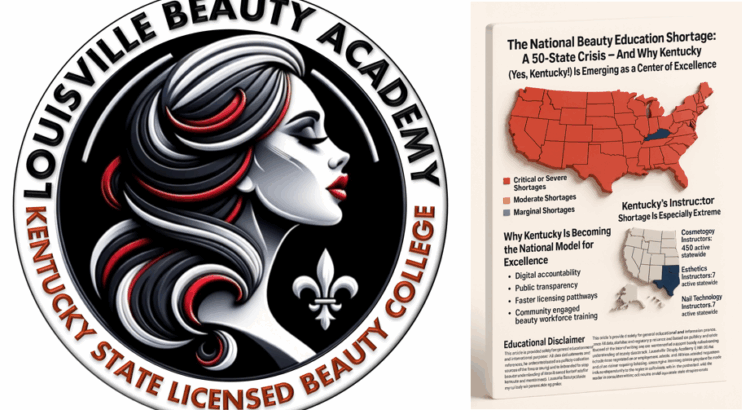
This article is part of LBA’s public education and historical archive. Older posts, including “THE NATIONAL BEAUTY EDUCATION SHORTAGE: A 50-STATE CRISIS — AND WHY KENTUCKY (YES, KENTUCKY!) IS EMERGING AS THE CENTER OF EXCELLENCE – RESEARCH 2025,” may not reflect current tuition, schedules, incentives, forms, policies, testing vendors, clinic availability, or regulatory requirements.
By Louisville Beauty Academy (LBA) National Award–Winning Beauty College • U.S. Chamber CO—100 Top 100 Small Businesses 2025 NSBA National Advocate of the Year Finalist 2025 • Special Congressional Recognition 2025
America Has a Beauty Education Crisis — And Almost No One Is Talking About It
Across the United States, beauty programs are growing faster than nearly every other sector of the trades. Yet the number of licensed beauty instructors is shrinking.
Based on data aggregated from state boards, federal labor reports, and national CTE workforce studies, the U.S. is entering a severe educator shortage unlike anything seen in the history of cosmetology.
This is not a future problem. It is a right now problem.
And Kentucky — powered by institutions like Louisville Beauty Academy (LBA) — is emerging as one of the national leaders pushing solutions, transparency, and a replicable model.
THE 50-STATE REALITY: A SHORTAGE IN EVERY SINGLE STATE
Using national educator workforce data (U.S. Department of Education, 2025), aggregated licensing numbers, and CTE shortage reports, here is the overview:
States With Critical or Severe Shortages (32 states)
These states report critical shortages of licensed beauty instructors, including cosmetology, esthetics, nails, barbering, and CTE trades:
Alabama, Alaska, Arizona, Arkansas, California, Colorado, Connecticut, Delaware, Florida, Georgia, Hawaii, Idaho, Illinois, Indiana, Iowa, Kansas, Kentucky, Louisiana, Maine, Maryland, Massachusetts, Michigan, Minnesota, Mississippi, Missouri, Montana, Nebraska, Nevada, New Hampshire, New Jersey, New Mexico, New York.
Many of these states (including CA, NY, TX) report fewer than 1 instructor per 500–1,000 students in training.
States With Moderate Shortages (12 states)
Meaning fewer instructors than needed for projected enrollment growth:
North Carolina, North Dakota, Ohio, Oklahoma, Oregon, Pennsylvania, Rhode Island, South Carolina, Tennessee, Utah, Vermont, Washington.
States With Marginal Shortages (6 states)
Even these states already show early-stage shortages:
Virginia, West Virginia, Wisconsin, Wyoming, South Dakota, District of Columbia.
Conclusion: 50 out of 50 states are already affected.
Not one U.S. jurisdiction reports sufficient numbers of licensed instructors to meet demand.
WHY THIS IS HAPPENING: THREE NATIONAL FORCES COLLIDING
1. The “Silver Wave” Retirement Shift
Across all 50 states, 40%–60% of licensed beauty instructors are between ages 55–72. Most will retire within the next decade.
2. Very Low Numbers of New Instructor Trainees
Nationally, only 1 out of every 150 licensed professionals pursues instructor training.
3. Increasing Enrollment in Beauty Schools
Beauty programs grew by 22% nationally from 2020–2024 (IPEDS, 2024). But the instructor pipeline grew only 3%.
This math is simple. And dangerous.
WHY KENTUCKY IS BECOMING THE NATIONAL MODEL FOR EXCELLENCE
Many states have opaque processes, outdated curriculum rules, poor digital records, and slow licensing pipelines.
Kentucky, in contrast, is beginning to emerge as a nationally studied example for:
✔ Digital accountability
✔ Public transparency (student contracts, policies, online curriculum)
✔ Faster licensing pathways
✔ Uniform monitoring standards
✔ Clear apprenticeship-to-instructor pathways
✔ Community-engaged beauty workforce training
And leading much of the visibility is Louisville Beauty Academy, which has become:
🌟 A dual national award-winning college
U.S. Chamber CO—100 Top 100 Small Businesses 2025
NSBA Advocate of the Year Finalist 2025
🌟 Recognized with a U.S. Congressional Honor
For “outstanding and invaluable service to the community.”
🌟 Kentucky’s Gold Standard in Transparency & Compliance
With 100% of contracts, disclosures, and policies posted online.
🌟 The State Leader in Instructor Training
LBA produces more instructor candidates than any other KY beauty institution.
No other beauty school in the U.S. has this combination of achievements, transparency, and national recognition.
KENTUCKY’S INSTRUCTOR SHORTAGE IS ESPECIALLY EXTREME
KBC’s November 2025 public data confirms:
Cosmetology Instructors: 450 active statewide
Esthetics Instructors: 7 active statewide
Nail Technology Instructors: 7 active statewide
Active Instructor Apprentices: ~103 statewide
Kentucky has nearly the same population as Oregon, but Oregon has 3× more instructors for esthetics and nails.
This means:
Kentucky is one of the most urgent opportunity states in America for anyone wanting to become a beauty instructor.
WHY YOU SHOULD TRAIN AT LBA
1. We are Kentucky’s Center of Excellence
No school in Kentucky — and few nationally — matches our record of:
Transparency
Digital compliance systems
Student support
Regulatory clarity
Instructor mentoring
Community outreach
National recognition
2. We Teach You to Teach — Not Just to Pass a Test
Our focus is emotional intelligence, managing diverse classrooms, trauma-informed teaching, multicultural competency, and leadership.
3. We Are Hiring (But You Must Be Licensed First!)
LBA 2 (Instructor) positions open regularly, but state law requires:
You must first hold a valid Instructor License.
We can train you. We can mentor you. We can support you.
But we cannot legally hire you until you’re licensed.
4. You Save Your Body — And Extend Your Career
Becoming an instructor is the #1 pathway for beauty professionals with:
Back strain
Wrist pain
Pregnancy
Burnout
Desire for leadership
Desire for impact
Desire for a less physically demanding role
5. You Leave a Legacy
Every licensed graduate you train changes a family. A career. A generational income path.
Few careers carry this level of impact.
CALL TO ACTION: KENTUCKY NEEDS YOU. THE NATION NEEDS YOU.
If you are reading this, you are already part of the solution.
➡ Step 1 — Apply for the Instructor Training Program at LBA
➡ Step 2 — Get licensed in an environment of love, excellence, transparency, and accountability
➡ Step 3 — Become part of a national movement to rebuild America’s beauty instructor workforce
This shortage is real. This moment is historic. And you are needed now more than ever.
🌟 Ready to Change Lives? Start Your Instructor Journey at Louisville Beauty Academy Today.
Kentucky needs more beauty educators. America needs more beauty educators. And your community needs YOU.
If you have the heart to teach, the passion to lead, and the desire to uplift the next generation of beauty professionals, then your next step is clear:
With love, transparency, and excellence at the center of everything we do, Louisville Beauty Academy is here to guide you from where you are today… to where Kentucky and the nation need you to be tomorrow.
Begin your journey. Become the educator who lifts others. YES YOU CAN — and YES YOU WILL.
LEGAL DISCLAIMER
Louisville Beauty Academy (LBA) provides informational content only. Completion of any program, including the Instructor Program, does not guarantee employment at LBA or elsewhere. All hiring decisions depend on available positions, licensing status, qualifications, interviews, professional fit, and regulatory requirements. LBA is an equal opportunity institution and employer. All external data is sourced from third-party government agencies and national organizations; LBA assumes no liability for their accuracy.
APA REFERENCES
Kentucky Board of Cosmetology. (2025, November 12). Licensee Summary By Status Report. Kentucky Public Records.
U.S. Department of Education. (2025). Teacher Shortage Areas Reports 2025–2026. Office of Postsecondary Education.
This article is provided solely for general educational and informational purposes. All data, statistics, and regulatory references are based on publicly available sources at the time of writing and are intended to support broader understanding of beauty education trends in Kentucky and nationwide. Louisville Beauty Academy (LBA) does not provide legal, regulatory, or employment advice, and all decisions regarding licensing, career pathways, or professional training should be made independently by the reader in consultation with the appropriate state agencies and industry professionals.
Any mention of instructor opportunities, workforce needs, or potential career pathways is presented for informational context only and should not be interpreted as a promise, offer, or guarantee of future outcomes. All regulatory requirements, state rules, and licensing processes are subject to change at any time by the appropriate governing bodies. Readers are encouraged to verify all information directly with the Kentucky Board of Cosmetology and other relevant state or federal entities.
Louisville Beauty Academy’s mission is to educate, inform, and empower through transparency and community-centered learning. This article is part of that educational commitment.
Louisville Beauty Academy (LBA) is proud to announce the release of The Humanization Blueprint: Human-Service Principles for the Beauty Professional, a groundbreaking book authored by LBA and Di Tran University founder Di Tran. This publication represents the next major step in LBA’s mission to advance ethical, human-centered, compliance-driven beauty education for the modern workforce.
More than a textbook, The Humanization Blueprint is a philosophy, a training model, and a life guide. It reflects over a decade of lived experience serving thousands of immigrants, working mothers, underserved learners, and first-generation students who turned LBA into one of Kentucky’s most successful beauty colleges.
A New Standard for Beauty Education: Beauty as Human-Service
Unlike traditional beauty textbooks that focus only on technical skills, The Humanization Blueprint reframes beauty as a human-service profession.
At LBA, we teach that every beauty professional is responsible for:
Protecting human dignity
Practicing strict compliance and sanitation
Communicating clearly and ethically
Serving with emotional intelligence and empathy
Becoming leaders in their communities
Documenting thoroughly and honoring the law
Uplifting clients in moments when beauty becomes healing
This book captures the essence of what makes Louisville Beauty Academy unique: Hands create beauty. Hearts create legacy.
What the Book Covers
The Humanization Blueprint is a 13-chapter guide that blends practical steps with values-driven education. Each chapter delivers approximately 2,500 words of real-world wisdom, including:
✔ Humanization in everyday service
How empathy, communication, and emotional awareness elevate results.
✔ Technical mastery as human care
Why skill is the foundation—but not the whole profession.
✔ Compliance beyond the exam
Teaching students how to navigate laws, inspections, documentation, and board interactions with confidence and protection.
✔ Ethical practice and transparency
How to avoid shortcuts, prevent client harm, and build a lifetime reputation.
✔ Leadership and culture-building
Preparing beauty professionals to lead with integrity, fairness, and calm.
✔ Financial literacy and real-life career planning
Helping students build stable, sustainable careers that uplift families.
✔ Entrepreneurship and salon ownership
Step-by-step, human-centered business strategies for new owners.
✔ Community service and legacy
Understanding the long-term impact beauty professionals have on Louisville and beyond.
This book is not theory. This is the LBA way, documented and made accessible for all.
Why This Book Matters Now
The beauty industry is shifting—federal regulations, workforce demands, and client expectations are rising. Many schools teach only enough to pass the test.
LBA teaches how to succeed in life.
The Humanization Blueprint prepares professionals for:
salon life
real-client challenges
documentation
compliance enforcement
emotional stress
ethical dilemmas
community responsibility
leadership opportunities
At a time when the public demands transparency, professionalism, and safety, LBA is proud to publish a book that sets a new national standard.
About the Author: Di Tran
Di Tran is an immigrant entrepreneur, educator, and founder of Louisville Beauty Academy, Di Tran University, and the College of Humanization. He is nationally recognized for advancing accessible education, ethical workforce development, and human-centered leadership. His work has earned honors from the U.S. Congress, the U.S. Chamber of Commerce CO—100, and the National Small Business Association.
His mission is simple: to uplift people through education, service, and love. His guiding principles: “YES I CAN” and “I HAVE DONE IT.”
A Gift to the Community — Thanksgiving 2025 Edition
Released on Thanksgiving 2025, this book is positioned as a gift to:
current LBA students
future learners
Kentucky’s workforce
beauty professionals across the nation
community partners
families uplifted by education and opportunity
It represents gratitude for Louisville, the immigrant community, and every person who has supported LBA for nearly ten years.
Who Should Read This Book
This book is for:
beauty students
licensed professionals
salon owners
apprentices
educators
inspectors and regulators
community leaders
workforce development partners
anyone who believes beauty is more than looks
If you work in beauty, serve people, or lead a team, The Humanization Blueprint will strengthen your mind, your ethics, your communication, and your professional identity.
A Message From Louisville Beauty Academy
We believe every person deserves:
dignity
respect
ethical care
educational opportunity
a career they are proud of
a community they feel safe in
This book is part of our mission to open doors—not just for skills, but for hope, healing, and human empowerment.
Get the Book / Learn More
Interested in reading The Humanization Blueprint or learning more about LBA’s human-service education?
In a world quickly shifting toward automation and artificial intelligence, Louisville Beauty Academy stands firm in one truth: the human touch is irreplaceable. This is the central message of Di Tran’s newest book, The Healing Power of Beauty Services: Unlocking the Therapeutic Potential of Beauty in Mental Wellness, a powerful work that explores how beauty professionals—especially nail technicians—offer far more than aesthetic services. They offer therapy, care, and emotional rejuvenation, every single day.
According to the book’s introduction, beauty services exist at the crossroads of mental well-being, emotional healing, and physical care, where the calming effect of human touch and presence brings peace that no machine can replicate. Beauty is not “skin-deep”—it is deeply human. Book-TheHealingPowerofBeautySer…
A Career That Heals: The Therapeutic Power of Nail Services
The book outlines how manicures and pedicures aren’t simply beauty treatments. They are therapeutic rituals backed by history, psychology, and human connection.
From ancient civilizations to modern wellness science, beauty practices have always supported mental and emotional well-being. Today’s nail technicians continue that legacy by providing:
Stress reduction through massage & touch
Emotional connection through conversation
Identity building through personal expression
Confidence boosting through appearance care
Mindfulness and self-care rituals
Holistic relaxation and circulation benefits
As detailed in the book, the gentle rituals of nail technology—warm water, massage, aromatherapy, and human presence—create immediate psychological benefits such as reduced anxiety, improved mood, and increased confidence. Book-TheHealingPowerofBeautySer…
Nail Technicians as “Wellness Facilitators”
One of the most groundbreaking ideas in the book is the concept that nail technicians naturally become wellness facilitators. Chapter 4 emphasizes the emotional support nail techs offer—listening, comforting, encouraging, and creating safe spaces for clients to feel seen and valued. Book-TheHealingPowerofBeautySer…
In many cases, clients open up more to their nail technician than anyone else in their lives.
This makes the profession a powerful pathway for:
Mental wellness support
Emotional grounding
Positive social connection
Early health awareness
Identity and confidence development
At Louisville Beauty Academy, we train every student with this philosophy: beauty is a service of the heart.
Real Stories: How Nail Care Helps Stress, Anxiety & Depression
The book presents compelling case studies—corporate executives, college students, retirees, and stay-at-home parents—each finding relief, grounding, identity, and hope through regular nail care services. These stories show how beauty professionals become sources of healing.
WATCH THE VIDEO: A VISUAL INTRODUCTION TO THE BOOK
We created a short YouTube feature highlighting the heart and message of this book. 🎥 Watch it here:https://youtu.be/qNIidWKvSDo
All information in this article, video, and book excerpt is for educational purposes only. Louisville Beauty Academy LLC and Di Tran make no guarantees of outcomes or employment and are not liable for actions taken based on this content.
A comprehensive overview of why LBA stands apart in U.S. vocational education
1. Congressional Recognition: A Rare National Honor for a Beauty School
Louisville Beauty Academy recently received a Special Congressional Recognition from U.S. Congressman Morgan McGarvey for “outstanding and invaluable service to the community.” This honor is extremely significant because:
Special Congressional Recognitions are reserved for exceptional community impact, not routine operations.
It is highly uncommon for beauty schools or small vocational institutions to receive federal-level commendations.
Public documentation shows very few U.S. trade or cosmetology schools have ever received similar recognition, underscoring how rare this is.
Organizations that receive this recognition describe it as a prestigious and sometimes highest-level civilian honor available from Congress.
This recognition signals that LBA’s work is not just educational — it is civic, economic, and transformative for families, immigrants, and the Kentucky workforce. For a small, state-licensed beauty college to be honored at this level is extraordinary and positions LBA as a nationally visible institution of community service and workforce development.
2. LBA Achieved Historic Dual National Awards in the Same Year
In addition to Congressional Recognition, 2025 marked a historic milestone for LBA. The academy achieved two national awards that no other Kentucky beauty school — and possibly no other U.S. beauty school — has ever earned, especially in the same year:
A. U.S. Chamber of Commerce — CO—100 (Top 100 Small Businesses in America)
Selected from 12,500+ applicants nationwide
Only Kentucky business honored in 2025
Recognized for community impact, innovation, and long-term success
B. National Small Business Association — Advocate of the Year Finalist
One of only five finalists nationwide
Acknowledges outstanding national advocacy
Honors leaders shaping policy for small business and education
Uniqueness of This Achievement
No Kentucky business — and no known beauty school — has ever earned both CO—100 and NSBA Advocate Finalist status in the same year.
This positions LBA as not only a school, but a national model for small business excellence, community impact, and policy leadership.
3. What Makes LBA Distinct: Why Congress and National Organizations Noticed
A. Affordable, Lower-Debt, High-Access Education
LBA intentionally removes traditional barriers that limit low-income, adult, and immigrant learners by offering:
lower-debt pathways
Pay-as-you-go options
Low-cost tuition
Flexible scheduling (day, evening, weekends)
This model is extremely rare in the beauty school industry, where many rely on loans and high tuition.
B. Multilingual, Immigrant-Friendly Accessibility
LBA stands apart for serving non-English-speaking learners through multilingual classes and translated resources — an uncommon offering in cosmetology education.
This allows immigrants to access licensed careers, creating generational economic uplift.
C. Compliance Excellence & Policy Advocacy
LBA is one of the few beauty schools in the United States that:
Operates as a fully state-licensed, compliant institution
Maintains transparent, documented operations
Actively participates in regulatory reform
Advocates for legislation such as multilingual licensing exams and reciprocity
LBA does not simply follow rules — it helps modernize them, influencing state and national discussions on vocational education reform.
D. Lean, Ethical Operations
Because many programs are short-term and state-licensed, LBA avoids unnecessary federal accreditation costs, which:
Keeps tuition low
Reduces administrative burden
Allows efficient and ethical reinvestment into student services
This lean operational model is admired nationally.
E. Innovation & Future-Ready Education
LBA integrates:
digital literacy
business entrepreneurship
marketing and online branding
technology awareness
AI-supported tools
micro-credential-style training
This prepares graduates for the next generation of beauty careers where business, technology, and service intersect.
LBA anticipated trends that other schools are only beginning to recognize, positioning itself years ahead of traditional cosmetology education competitors.
4. Economic & Workforce Impact
LBA’s reach extends far beyond the classroom:
Nearly 2,000 graduates over the years
Many graduates become business owners, booth renters, and employers
Estimated $20–$50 million annual economic impact in Kentucky
Strong contribution to Louisville’s workforce and entrepreneurship ecosystem
This level of community and economic influence is exceptionally rare for a beauty college.
5. Why LBA Is Years Ahead of Most U.S. Beauty Schools
LBA is proactively preparing for the “new world of education” by embracing:
accessible, short-term, workforce-driven training
community-rooted mission
technology-driven teaching
compliance transparency
advocacy-based leadership
affordability as a core value
multilingual support
AI-enhanced learning strategies
Most U.S. beauty schools still operate with outdated models from the 1990s–2000s.
LBA, in contrast, is already functioning like the future vision of vocational education — student-centered, flexible, nimble, and community-empowering.
Conclusion
Louisville Beauty Academy’s combination of:
Special Congressional Recognition,
CO—100 national award,
NSBA Advocate of the Year finalist honor,
its innovative, ethical educational model,
and its transformative impact on Louisville and Kentucky,
makes it one of the most distinguished beauty schools in the United States.
This is not simply about awards — it is about LBA’s consistent commitment to community service, equity in education, regulatory integrity, and future-ready innovation.
LBA exemplifies what the next generation of vocational training should look like: accessible, compliant, tech-savvy, community-rooted, and driven by purpose.
A Step-by-Step Educational Framework Developed by Louisville Beauty Academy — Center of Compliance Excellence and Humanized Beauty Education
How Every Licensed Salon, Spa, and School Can Lawfully, Peacefully, and Professionally Engage with Inspectors, Compliance Officers, or Law Enforcement While Protecting Their Rights, Following the Law, and Elevating the Standards of Transparency in Kentucky’s Beauty Industry
(For All Kentucky Licensed Salons, Spas, and Schools under KRS Chapter 317A)
🌟 Louisville Beauty Academy – Compliance Excellence & Transparency Center
Louisville Beauty Academy (LBA) stands as a Center of Excellence in Beauty Education, Licensing Compliance, and Humanized Professional Development. Our mission is to protect, educate, and empower all Kentucky licensees, salons, schools, and beauty professionals by providing transparent templates, guidance, and procedures rooted in the latest state and federal law.
We believe that compliance is education, and that every inspector, instructor, and licensee deserves clarity, fairness, and accountability under the law. By publishing these resources openly, we aim to elevate public trust, regulatory collaboration, and professional dignity across the entire beauty industry.
⚖️ Important Legal Disclaimer
The materials, templates, and procedures shared on this page — including the Inspection Transparency & Verification Rights Notice — are provided strictly for educational purposes as part of Louisville Beauty Academy’s public compliance-education initiative.
These resources are designed to help licensed professionals understand and exercise their lawful rights under Kentucky Revised Statutes (KRS) Chapters 13B, 317A, and related administrative regulations.
They may be used, copied, and adapted by any licensed salon, beauty school, or licensee in Kentucky or beyond for educational or procedural reference.
However, laws and administrative rules change frequently; therefore, any document, statement, or interpretation posted here may become outdated immediately upon publication.
Louisville Beauty Academy and its affiliates make no warranty, representation, or guarantee as to the current accuracy, completeness, or enforceability of these materials. These are educational templates only, not legal advice or binding interpretations of law. Users are strongly encouraged to consult their own attorney, compliance officer, or state licensing board for confirmation before applying any document to a specific situation.
By viewing or using these materials, you acknowledge that Louisville Beauty Academy, LLC, its owners, and staff assume no liability for any use or misuse of the content herein.
Purpose
This notice protects both licensees and inspectors by ensuring all inspections follow Kentucky law with transparency, accuracy, and respect. It affirms your right to verify information, seek clarification, and maintain records before acting or signing.
This is not resistance — it is lawful procedural compliance and education, consistent with KRS 13B (Administrative Procedures Act) and KRS 317A (Cosmetology Licensing Law).
⚖️ 1. Right to a Reasonable Opportunity to Respond
KRS 13B.080(1) – Excerpt:
“All parties shall be given reasonable notice of the hearing and the issues to be considered, and shall be afforded a reasonable opportunity to respond and present evidence.”
Meaning: During an inspection, a licensee or school may take time to review what is being asked, look up the applicable regulation, and gather correct records before providing an answer or signature. A 30–60 minute verification window is lawful and reasonable under this statute.
🧾 2. Right to Clarification and Written Instructions
KRS 13B.090(7) – Excerpt:
“The presiding officer shall regulate the course of the proceedings and may require that requests and rulings be reduced to writing.”
Meaning: You may request that any inspector or staff member put their questions, instructions, or findings in writing or on camera, so both parties have a clear and accurate record. This ensures fairness and prevents misunderstanding.
🎥 3. Right to Record for Documentation and Training
KRS 526.020 – Eavesdropping; One-Party Consent Law (Kentucky):
“A person is guilty of eavesdropping when he intentionally uses any device to overhear or record a conversation without the consent of at least one party thereto.”
Meaning: Kentucky law allows one-party consent recording, which means you may record audio or video of any conversation you are a part of — including inspections — for compliance documentation and training. Recording your own inspection in your licensed business is fully lawful and supports accuracy for all.
🧠 4. Right to Seek Verification or Counsel Before Acting
KRS 13B.080 (combined with due process under the 14th Amendment, U.S. Constitution):
“Each party shall have the opportunity to respond, present evidence, and be represented by counsel.”
Meaning: You are never required to sign or act immediately. You may pause to verify any request, consult a compliance manager, or contact legal counsel (by phone, text, or email) before proceeding. This is lawful and professional — not refusal — it ensures correctness and fairness.
🏫 5. Duty to Teach and Maintain Legal Compliance
KRS 317A.130(1)(f) – Excerpt:
“Each school shall maintain proper records and teach students the applicable laws and administrative regulations relating to their trade.”
Meaning: Every beauty school (and by extension, licensed professional) has a duty to teach and practice compliance. Verifying rules and checking requests against current law is part of your educational and legal responsibility.
💬 6. Professional Conduct Standard
You pledge to:
Remain calm, respectful, and fully cooperative.
Document all instructions for accuracy.
Verify legal citations before responding.
Operate in full transparency to protect public trust.
This policy supports both inspectors and licensees by ensuring factual, fair, and consistent communication.
Summary Table
Right
Legal Citation
Lawful Action
Reasonable time to respond
KRS 13B.080(1)
Take 30–60 minutes to verify requests
Written clarification
KRS 13B.090(7)
Request written or recorded instructions
Record your own inspection
KRS 526.020
One-party consent allows you to record
Seek advice before acting
KRS 13B.080; 14th Amendment
Contact compliance manager or counsel
Educational duty to teach law
KRS 317A.130(1)(f)
Use inspection as a teaching example
This notice is a procedural safeguard for fairness and education — not a refusal to comply. It protects both the inspector and the licensee by ensuring lawful communication, accurate documentation, and mutual respect.
Presented by:
Compliance Office – Louisville Beauty Academy 1049 Bardstown Rd, Louisville KY 40204 (502) 625-5531 | study@louisvillebeautyacademy.net
🎙️ Verbal Script (for All Licensees to Use)
Here’s the simple, calm, and professional way to say it aloud while handing the printed notice:
“Good morning! We welcome your visit and appreciate your work. We just follow a standard compliance process to make sure everything is accurate and fair. Here’s our Inspection Transparency & Verification Rights Notice.
It simply explains that under Kentucky law, we’re allowed to take about 30 to 60 minutes to review any request or rule, record the visit for documentation, and verify things with our compliance team before we respond or sign anything.
This helps us stay consistent with KRS 13B and 317A — and it keeps everything transparent for both sides.
We’ll cooperate fully — we just want to make sure everything we do is right by the law and clear for our records. Thank you for understanding!”
💬 A Final Note from Louisville Beauty Academy
Louisville Beauty Academy is proud to lead the way in AI-assisted compliance education and humanized transparency in Kentucky’s beauty industry. We encourage all salons, schools, and licensees to share and adapt these templates responsibly, to strengthen fairness, protect professionalism, and uphold the dignity of every licensed beauty worker.
Remember that laws evolve continuously — so whenever you use or reference these materials, take a moment to verify them against the most current version of Kentucky law and administrative regulations on www.kbc.ky.gov.
Together, we can build a future where compliance is clarity, law is education, and transparency is beauty.