Day 30 of 100 – LBA Affordable Nail Service Literacy Series. This article explains skill ladder in plain language for customers, students, families, and community partners who want beauty services to be accessible without lowering the professional standard.
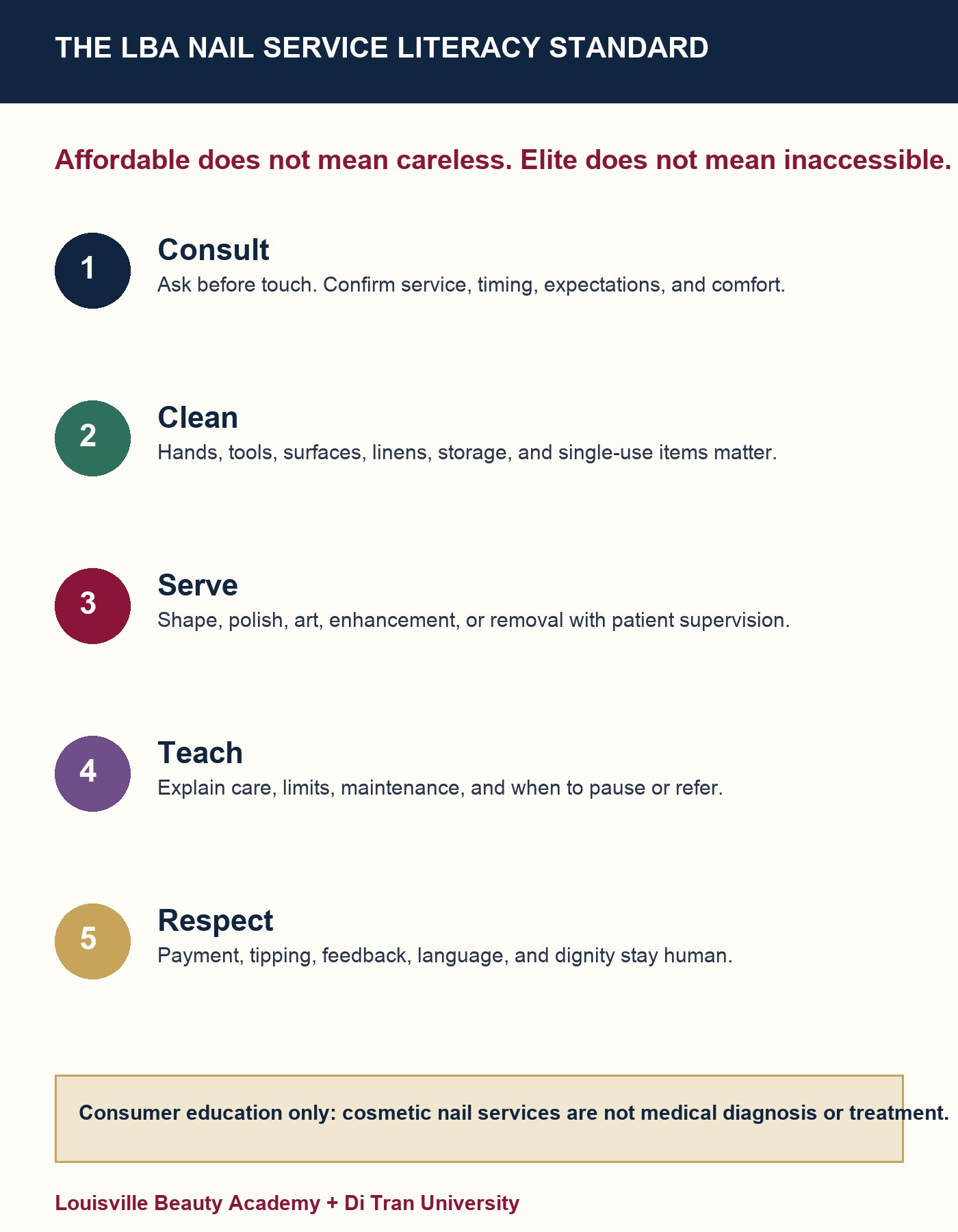
From Basic Service to Advanced Skill
How simple services become the foundation for advanced services through repetition and judgment. At Louisville Beauty Academy, the public-service model is education first: a school clinic or student-supervised service is not a promise of luxury speed. It is a carefully supervised learning environment where affordability, sanitation, communication, and dignity belong together.
What The Service Teaches
- Service literacy: the client understands what is being requested and what is reasonable for the appointment.
- Sanitation discipline: clean setup and infection-control habits are treated as the foundation, not a hidden back-room detail.
- Communication: expectations, timing, comfort, and limits are discussed before the service becomes confusing.
- Professional judgment: students learn that saying “not today” can be part of protecting the client and the school standard.
Affordable Does Not Mean Careless
LBA’s public-facing nail services are listed on the school’s current student clinic service page when available, and the current written page should be checked before relying on any service, price, schedule, or availability. The mission-level point is larger than a single price: accessible nail services can introduce the public to clean beauty care while helping students practice consultation, timing, technique, and professionalism under supervision.
That is the Louisville Beauty Academy standard: elite expectation without luxury exclusion. A person should not need a luxury budget to be treated with cleanliness, patience, and respect.
Safety and Boundary Note
This series is consumer education, not medical advice. Nail services are cosmetic services. A student, instructor, or licensed professional should not diagnose, treat, or promise improvement for medical conditions. If skin, nail, pain, infection, wound, allergy, or health concerns appear, the safer educational response is to pause and refer the person to an appropriate licensed health professional.
Why DTU Supports This Doctrine
Di Tran University supports this work as doctrine and research architecture: humanization, workforce literacy, affordability, AI-assisted documentation, and ethical education. DTU explains why a small service can become a public lesson in dignity, and LBA proves that lesson in a real school environment.
Read Next
- LBA Student Clinic Services and Live Model Information
- Current Program Costs, Incentives, and Written Payment Options
- Before You Choose Cosmetology: 12 Questions Every Beauty Student Should Ask
Sources and Guardrails
- Kentucky Board of Cosmetology, License Requirements
- Kentucky Administrative Regulations, 201 KAR 12:100 infection control, health, and safety
- U.S. Bureau of Labor Statistics, Manicurists and Pedicurists
- O*NET Online, Manicurists and Pedicurists 39-5092.00
- FDA, Nail Care Products
- CDC/NIOSH, Nail Technicians: Workplace Safety and Health
- OSHA, Health Hazards in Nail Salons
Public information notice: service availability, prices, schedules, and policies can change. Current written LBA documents and direct school confirmation control. This post does not claim government endorsement, guaranteed outcomes, medical benefit, licensure result, employment result, or superiority over another provider.







