Diverse Louisville Beauty Academy students receiving instructor guidance while studying onsite with beauty tools, mannequins, practical practice materials, and digital learning support.

Kentucky State-Licensed Beauty College Louisville Beauty Academy: What Exactly Do You Learn, and How Exactly Do You Study?

Short answer: Louisville Beauty Academy is a Kentucky state-licensed beauty college built first for one purpose: helping students complete lawful, documented beauty education for Kentucky licensing pathways. Students study theory, practical skill, sanitation, safety, Kentucky rules, exam preparation, professional conduct, and documented clock-hour progress. Around that required foundation, LBA also provides modern study support, multilingual tools, instructor guidance, written records, portfolio discipline, and professional-development encouragement.

A student does not enroll at Louisville Beauty Academy merely to “sit in school.” A student enrolls to enter a disciplined licensing environment: clock in, study, practice, ask, repeat, document, improve, prepare for the theory and practical licensing exams, and grow into a safer, more professional beauty worker.

The First Principle: Licensing Comes First

Beauty school is not a motivational seminar, a social-media course, a salon shortcut, or a promise of income. Beauty school exists because Kentucky regulates cosmetology, nail technology, esthetics, shampoo and styling, instructor training, and related beauty work through state licensing requirements.

That is why Louisville Beauty Academy teaches from a licensing-first position. The core question is always: what must a student know, practice, document, and complete to move toward lawful eligibility under current Kentucky Board of Cosmetology rules and the school’s written policies?

Official state requirements can change. Students and families should always review the current Kentucky Board of Cosmetology pages for license requirements, exams, schools, fees, and statutes and regulations.

What Exactly Do Students Learn?

Students learn in three layers. The first layer is required licensing education. The second layer is supervised practical development. The third layer is professional formation: how to carry yourself as a beauty professional, document your progress, communicate clearly, and build a lawful future after licensing.

1. Licensing Theory

Theory is the academic foundation. Depending on the program, students study topics such as safety, sanitation, infection control, anatomy, physiology, chemistry, electricity, skin, hair, nails, professional image, client care, Kentucky rules, and licensing-exam readiness.

For many students, theory is the most difficult part because it requires reading, memory, vocabulary, practice questions, and repeated review. That is why LBA treats theory seriously. A student cannot become safe, lawful, and exam-ready by guessing.

2. Practical Licensing Skill

Practical study means hands-on learning under school supervision. Students practice setup, sanitation, procedure, cleanup, tool control, station discipline, mannequin work, and live-model or clinic-style practice when appropriate under school policy and applicable rules.

The goal is not to rush into fancy technique before the foundation is built. The goal is lawful, safe, repeatable practice that prepares the student for the practical licensing exam and for professional responsibility.

3. Professional Development

After and alongside the licensing foundation, LBA encourages students to think like future professionals. That can include portfolio discipline, professional image, client communication, social media responsibility, basic finance awareness, brand building, business thinking, salon-readiness mindset, and self-documentation.

These professional-development elements are valuable, but they are supplemental. They do not replace the required state curriculum, clock hours, theory preparation, practical preparation, sanitation, safety, or official licensing process.

How Exactly Do Students Study?

Students study onsite, in person, during approved school operating hours and according to the student’s approved schedule, program requirements, school policy, staff availability, and Kentucky licensing rules. LBA may support full-time, part-time, or flexible scheduling, but flexibility does not mean unlimited attendance, undocumented hours, virtual licensing credit, or a guaranteed completion date.

A serious student may spend long blocks of time at school. For some students, that can mean many hours per day or a schedule that approaches a full-time weekly commitment when approved. That time matters. A student who is onsite for many supervised hours has repeated opportunities to study theory, practice hands-on skills, ask instructors questions, receive correction, self-evaluate, and keep moving.

A Typical Study Pattern

  • Clock in and maintain documented attendance.
  • Study assigned theory using Milady/CIMA, textbook resources, chapter work, school study guides, and practice questions.
  • Review difficult vocabulary and concepts, including with reasonable multilingual support where appropriate.
  • Ask instructors for explanation, demonstration, correction, or one-on-one support when needed and available.
  • Practice on mannequins, practical setups, tools, stations, and live models or clinic situations when appropriate under supervision.
  • Self-evaluate: what did I understand, what did I miss, what must I repeat, what must I document, what must I ask tomorrow?
  • Prepare for theory and practical licensing exams through repetition, review, and exam-style discipline.

The Tools LBA Uses to Support Study

Louisville Beauty Academy uses multiple systems because different students learn in different ways. The school’s purpose is not to replace human instruction with technology. The purpose is to surround the student with more ways to study, review, translate, document, and understand.

  • Milady/CIMA: a major professional beauty-education learning system used to support theory, chapters, quizzes, and exam preparation.
  • LBA study guides and practice questions: school-created and school-selected materials that help students repeat, review, and prepare.
  • AI-assisted study support: learning tools that can help explain concepts, create study guides, simplify language, and support review in multiple languages.
  • Google Translate and translation support: tools that can help multilingual students understand study material, while official rules and written school documents still control.
  • Written communication: text messages, email, documents, forms, policies, and records help prevent confusion and reduce verbal misunderstanding.
  • Student record systems: attendance, transcript, document, and progress records help students and the school understand where the student stands.
  • Portfolio and public-proof discipline: when appropriate, students are encouraged to document work, build professional image, and understand how reputation grows through visible responsibility.

The Human Side: Instructors, Office Review, Mentorship, and Feedback

Technology is powerful, but beauty education remains human. Students need demonstration, correction, encouragement, patience, and accountability. LBA’s model includes instructor support, office conversations, mentorship, written follow-up, and feedback loops.

One-on-one help may be requested when a student needs clarification or additional support. These sessions must fit instructor availability, school operations, program needs, policy, student conduct, and the student’s own responsibility to communicate respectfully and keep moving.

Evaluation is not only a final exam. Evaluation can include chapter tests, practical checks, instructor feedback, student self-evaluation, office interviews, attendance review, transcript review, student feedback, public/client feedback where appropriate, and professional review of portfolio or public-facing work when relevant.

Why Long Onsite Hours Matter

Beauty licensing education is built on clock hours because time, supervision, repetition, and documentation matter. A student who spends many hours onsite is not merely present. The student is inside a learning environment where instructors, tools, classmates, mannequin practice, live-model practice, sanitation routines, exam language, and written records are all available.

That is why the question is not only, “Can I study?” The deeper question is, “Am I willing to use the hours?” When a student is onsite for long, documented, supervised study time, the opportunity to learn is real. The school can provide the environment, tools, instruction, and feedback. The student must bring discipline, attendance, respect, practice, and responsibility.

A Caring Environment Requires Clear Rules

LBA believes care and compliance belong together. A caring school is not one that ignores rules. A caring school writes things down, explains expectations, maintains records, welcomes questions, protects the learning environment, and reduces disruption so students can study.

Students may text, email, request written information, walk in, ask for a tour, speak with staff when available, and seek clarification. Human connection is welcome. Written communication is also encouraged because written clarity protects students, families, staff, and the licensing process.

What LBA Can Promise, and What No School Should Promise

Louisville Beauty Academy can commit to a licensing-first education model, written clarity, school systems, instructor support, practical training opportunities, study tools, feedback, documentation, and a serious learning environment.

No school should promise a guaranteed graduation date, exam passage, license approval, job, income, salon ownership, business success, transfer recognition, financial result, or exact schedule outcome. Those results depend on many factors, including student attendance, student conduct, academic progress, practical performance, official Kentucky Board requirements, testing vendor rules, school policy, personal circumstances, and current law.

The Beautiful Simplicity

The LBA model is advanced, but the heart of it is simple: come onsite, study the required theory, practice the required skills, document your hours, use the tools, ask for help, self-evaluate, repeat, prepare for the licensing exams, and build professional dignity one disciplined day at a time.

That is what students learn. That is how students study. And that is why Louisville Beauty Academy continues to position beauty education as lawful skill, human discipline, family dignity, and professional opportunity.

Related LBA Resources

References and Current Official Sources

This article is general public education from Louisville Beauty Academy. Current Kentucky Board requirements, testing vendor rules, and LBA’s written enrollment documents and policies control. Translation and AI tools may support learning, but they do not replace official rules, official documents, instructor judgment, or the student’s responsibility to study and comply.
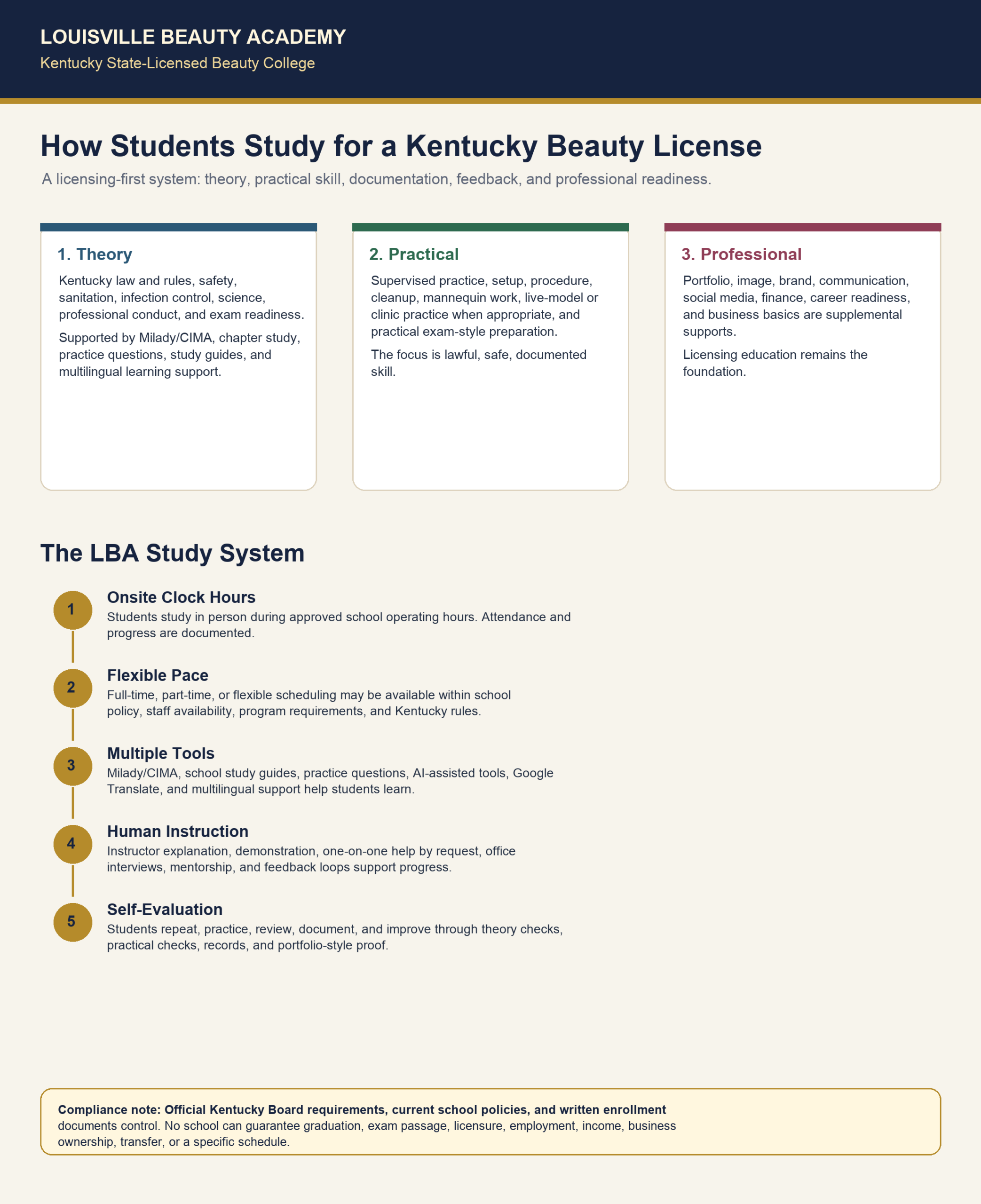

Infographic explaining how Louisville Beauty Academy students study for a Kentucky beauty license through theory, practical skill, professional development, onsite clock hours, flexible pace, study tools, human instruction, and self-evaluation.
Louisville Beauty Academy’s licensing-first study model: theory, practical skill, documentation, feedback, and professional readiness. Official Kentucky Board requirements and written school policies control.

2024 Kentucky State Board of Cosmetology Testing Update: On-Site Exam Options & Foreign Language Accommodations Now Available Through PSI

Louisville Beauty Academy, a Kentucky state-licensed beauty school, is dedicated to ensuring our students stay informed and prepared for success. We consistently keep up-to-date with the latest industry standards, regulations, and testing protocols to provide our students with the best possible resources. As of the Beauty Instructor Annual PSI Meeting held on November 12, 2024, we are pleased to share the latest and greatest updates. These new options from the Kentucky State Board of Cosmetology, in partnership with PSI, reflect significant improvements in testing accessibility and support, designed to help our students excel in their licensing exams. Here’s everything you need to know about these exciting changes.

PSI Testing Enhancements Now Available for Kentucky Beauty Industry Professionals: On-Site Testing & Language Support Options

The Kentucky State Board of Cosmetology has announced new testing options and accommodations to support beauty industry students statewide. This update, provided through PSI Testing Services and aligned with the recent Senate Bill 14, allows for increased flexibility and accessibility in state licensure exams. The following changes apply to all state-approved cosmetology programs, with new options for on-site testing and language support now accessible to schools, students, and educators throughout Kentucky.


On-Site Testing Option Available for Groups of 15 or More Test Takers

To offer flexibility for Kentucky cosmetology programs, PSI now provides on-site testing for both the practical and theory exams at approved school locations. This option is available to any approved cosmetology program with a minimum group of 15 test takers, allowing schools to schedule exams on their premises under PSI supervision. This adjustment helps minimize the need for travel and allows students to complete exams in a familiar setting.

Key Requirements and Process for On-Site Testing:

  • Group Minimum: On-site testing requires at least 15 registered test takers.
  • Scheduling Procedure: Schools interested in arranging on-site testing must formally submit a request to PSI. This request should specify three possible test dates, the total number of test takers, and the test type required (practical or theory).
  • Contact for Arrangements: Requests should be directed to Tanya Murray (tanya.murray@psionline.com) with Tonda Hall CC’d (thall@psionline.com) to coordinate.

These options empower schools to decide whether on-site testing is suitable for their student groups and schedule practical exams within a supportive environment. Theory testing will continue to be offered remotely or at PSI’s designated centers for students preferring or requiring other arrangements.


Foreign Language Testing Accommodation: Approved Word-to-Word Dictionaries Now Allowed

PSI Testing Services now permits test takers whose primary language is not English to use word-to-word dictionaries during Kentucky State Board exams. This accommodation aligns with Senate Bill 14, which promotes language inclusivity across the beauty industry. Eligible students may now apply to use a dictionary, pending approval, to enhance their testing experience.

Process for Securing Language Accommodations:

  • Pre-Approval Requirement: Students who wish to use a word-to-word dictionary must obtain pre-approval from PSI’s Accommodations Team.
  • Required Documentation: Submit an accommodations request through PSI’s ADA Request Link along with appropriate documentation from a licensed professional. The documentation must verify the need for accommodation, including diagnosis and details on the requested accommodation.
  • Further Information and Assistance: For questions or further support with the accommodations process, students may contact PSI’s Accommodations Supervisors:

These accommodations make Kentucky cosmetology exams more accessible to diverse student populations, offering a key support tool for non-native English speakers.


Guidelines for Test Day: Key Requirements for Students

On test day, PSI evaluators will ensure a secure and standardized process for administering the exams. Schools and students are advised to adhere to the following guidelines to ensure a smooth testing experience:

  • Arrival and Check-In: PSI examiners will arrive by 7:15 AM; students should check in between 7:45 AM and 8:00 AM.
  • Identification Requirements: Students must bring two valid forms of ID—one must be a government-issued photo ID with a matching name as listed in PSI’s system, along with a second form of ID.
  • Testing Room Setup: Schools should ensure that the testing room is clear of any cosmetology-related posters, diagrams, or notes. For rooms with glass doors, covering the doors is advised.
  • Instructor Access: Instructors are not permitted in the testing area once PSI evaluators begin setup to maintain the exam’s integrity.

These detailed requirements aim to uphold a secure testing environment, benefiting students, instructors, and PSI staff while ensuring all exams meet Kentucky State Board standards.


Kentucky State Board of Cosmetology’s Commitment to Accessible Testing

These recent updates underscore the Kentucky State Board of Cosmetology’s commitment to supporting inclusivity, accessibility, and efficiency in the beauty industry. With PSI’s enhanced options, Kentucky cosmetology programs now have flexible solutions that serve a diverse student population effectively.


Disclaimer: For all specific questions or requests regarding these testing options, accommodations, or other Kentucky State Board of Cosmetology requirements, please reach out directly to PSI at PSI Exams or contact the Kentucky State Board of Cosmetology at kbc@ky.gov. Louisville Beauty Academy and other schools may choose when to implement on-site testing based on these guidelines but should confirm all arrangements directly with PSI and the State Board for official authorization.

Louisville Beauty Academy Legal Policies, Disclosures, Waiver, and Student Responsibility Notice

Current-document control: this public webpage is informational. If this page conflicts with a signed enrollment agreement, current student contract, current written school catalog, current program-specific disclosure, Kentucky Board of Cosmetology requirement, court order, insurance requirement, or applicable law, the controlling written document or legal authority governs. Louisville Beauty Academy may update this page as law, Board guidance, school operations, technology, safety requirements, or program terms change.

1. No Legal, Tax, Medical, Financial, or Licensing Advice

Nothing on this website, in a social-media post, in a video, in a podcast, in a text message, or in general school communication is legal advice, tax advice, medical advice, financial advice, immigration advice, government-benefit advice, or a guarantee of regulatory action. Students, applicants, graduates, clients, employers, salon owners, and third parties are responsible for consulting appropriate licensed professionals, government agencies, or legal counsel for their own specific facts.

2. Enrollment Contract and Refund Policy Control

Refund rights, cancellation periods, payment obligations, program costs, fees, discounts, incentives, payment plans, attendance duties, withdrawal consequences, and completion requirements are governed by the student’s current signed enrollment agreement and current written school policies. Public summaries are provided for convenience only. A student should not rely on a verbal statement, older webpage, advertisement, screenshot, social post, or third-party description if it differs from the current written enrollment documents.

Any scholarship-like reduction, affordability review, price-match review, incentive, payment-plan term, or reduced-cost pathway must be written, documented, verified, approved, and lawfully combined. No public page guarantees a discount, scholarship, waiver, graduation, licensure, employment, income, examination result, transfer approval, or Board approval.

3. Kentucky Board of Cosmetology Authority

Louisville Beauty Academy prepares students under Kentucky beauty-school licensing requirements. The Kentucky Board of Cosmetology and other lawful authorities control licensing, permit, examination, school, sanitation, inspection, transfer, and regulatory determinations. LBA cannot promise how any agency will apply current or future law to a student, graduate, licensee, applicant, transfer student, out-of-state matter, disciplinary issue, or licensing examination.

Students planning to work outside Kentucky, transfer hours, transfer a license, restore an expired path, or use training in another jurisdiction must independently verify the rules of the receiving state, agency, employer, or licensing authority. State rules may differ and may change after enrollment, graduation, or publication of this page.

4. Student Responsibility and Professional Conduct

Student success requires student action. Each student is responsible for attendance, honest timekeeping, academic progress, practical work, sanitation, professional conduct, communication, document review, payment obligations, Board-related steps, exam preparation, and compliance with school rules. LBA can provide structure, instruction, documentation, translation support where practical, and a caring learning environment; it cannot do the student’s hours, study, practice, communication, examination, or licensing steps for the student.

Timekeeping, attendance, sanitation, safety, respectful conduct, anti-fraud expectations, and zero-disruption rules are material school requirements. Serious misconduct, dishonesty, fraud, threats, harassment, unsafe conduct, unauthorized practice, unauthorized presence, disruption, or conduct that materially harms the learning environment may support immediate removal, suspension, administrative withdrawal, dismissal, expulsion, reporting, or other lawful action according to school policy and applicable law.

5. Liability Waiver and Unforeseen Circumstances

To the fullest extent allowed by law, Louisville Beauty Academy is not responsible for delay, interruption, loss, cost, inconvenience, changed schedule, changed rule, changed exam process, changed agency interpretation, weather event, public-health event, emergency, technology outage, third-party platform issue, government action, inspection requirement, licensing delay, student ineligibility, student noncompliance, or other circumstance outside the school’s reasonable control.

By enrolling, attending, using school systems, receiving supervised services, communicating with the school, or relying on public information, the student or user acknowledges that beauty education and licensing involve external rules, personal responsibility, government discretion, safety requirements, and changing facts. This waiver does not waive any right that cannot lawfully be waived, does not excuse intentional misconduct, and does not replace any mandatory protection provided by applicable law.

6. Privacy, Student Records, and Adult-Student Communication

LBA collects and uses contact information, enrollment records, attendance records, academic records, payment records, compliance records, communications, and related documentation for educational, administrative, safety, legal, regulatory, and business purposes. Records may be shared with authorized school personnel, service providers, regulators, agencies, insurers, counsel, courts, or other parties when required or permitted by law, contract, operational need, or written consent.

For adult students and students whose rights have transferred under applicable education privacy rules, LBA communicates directly with the student unless the student provides proper written authorization for a parent, sponsor, employer, interpreter, advocate, attorney, or other third party. Payment by a parent or third party does not automatically create a right to access student records, direct school decisions, or override the student’s legal responsibilities.

Transcript, records, and hour-credit control

A paid transcript request does not override Kentucky law, Board rules, record availability, or compliance review.

Louisville Beauty Academy reviews transcript, attendance, hour-verification, certification, and record requests only through the School’s official written process. LBA may release or certify only records that are lawfully maintained, retrievable, accurate, authorized for disclosure, not blocked by a financial hold, and appropriate after internal compliance review.

Under current 201 KAR 12:082 Section 31, formerly shown in some marked-up materials as Section 32, the Kentucky Board credits hours completed within five (5) years of the date of school enrollment and gives no credit for hours completed five (5) or more years from the date of school enrollment. After that five-year period, LBA cannot make expired hours valid for licensing credit, cannot certify expired hours as current licensing credit, and cannot recreate, estimate, backdate, supplement, or alter expired, incomplete, unavailable, or inconsistent records.

Transcript, records, compliance-review, signature, mailing, sealing, notarization-coordination, or related fees are review and processing fees. Payment does not guarantee release, acceptance, licensure, transfer credit, Board approval, third-party acceptance, speed, outcome, or waiver of any lawful requirement.

7. Translation, Language Support, and Document Accuracy

LBA welcomes multilingual students and may use translation tools, bilingual staff support, translated materials, or third-party translation resources where practical. Translation support is provided to improve understanding, not to replace the controlling English-language legal document unless a specific signed document states otherwise. Students remain responsible for asking questions before signing and for keeping copies of the written documents they rely on.

Third-party translations, translated diplomas, foreign education documents, out-of-state records, transfer documents, identification records, and agency submissions may be reviewed by LBA for enrollment or administrative purposes, but final acceptance, legal effect, licensing effect, or regulatory sufficiency may depend on the relevant agency, Board, employer, testing authority, or legal requirement.

8. SMS, Email, Phone, Website, and Social Media Communications

By providing contact information to LBA, a person may receive school-related communication by text, phone, email, web form, or similar channel for enrollment, scheduling, reminders, educational resources, payment coordination, licensing information, student services, clinic services, or administrative follow-up. Message and data rates may apply. A person may opt out of nonessential SMS messages by replying STOP, but official school, legal, financial, safety, or regulatory communications may still need to occur through appropriate written channels.

Website forms, social media messages, search results, automated summaries, third-party posts, screenshots, AI summaries, and informal messages do not create enrollment, change a contract, guarantee a term, waive a policy, or bind the school unless the school confirms the specific term in an authorized written document.

9. Grievance, Complaint, and Documentation Standard

LBA encourages students, clients, staff, and visitors to raise concerns in a calm, documented, trackable written form so facts can be reviewed and corrected where appropriate. The preferred internal chain is: contact the school in writing, allow reasonable administrative review, provide supporting documents, and cooperate in a professional resolution process.

This internal process is intended to solve problems fairly and preserve the record. It does not prevent any person from using a lawful agency, court, emergency, law-enforcement, or regulatory process when applicable. LBA asks only that all statements be truthful, documented, non-disruptive, and respectful of privacy, student records, client records, personnel records, and ongoing operations.

10. Non-Discrimination, Accessibility, Safety, and Equal Treatment

Louisville Beauty Academy is committed to equal treatment and does not unlawfully discriminate on the basis of race, color, religion, national origin, age, sex, disability, or another legally protected status. Equal treatment means consistent standards, professional respect, written clarity, reasonable communication, and lawful handling of accommodation-related requests. Students and visitors must also respect the safety, sanitation, privacy, dignity, and learning rights of others.

11. Premises, Clinic Services, Guests, and Safety Limits

Only authorized students, staff, instructors, clients, regulators, contractors, and approved visitors may enter instructional, clinic, administrative, storage, or restricted areas. Children, family members, friends, and unauthorized guests may be restricted or removed for safety, insurance, sanitation, privacy, disruption-control, or regulatory reasons. Student clinic services are supervised educational services, not ordinary salon services, and may involve student learning time, instructor review, availability limits, and school safety rules.

12. Intellectual Property, Publications, Books, Videos, and Public Learning Materials

LBA’s website, books, research materials, videos, photos, graphics, forms, templates, podcasts, and educational content are protected institutional materials unless otherwise stated. They may be used for learning and public understanding, but may not be copied, altered, sold, misrepresented, republished, or used to impersonate the school without permission. Public education materials are general information and do not replace current official documents, professional advice, or agency requirements.

13. Source-Control References

Students and the public should verify current requirements through official sources. Useful public references include the Kentucky Board of Cosmetology, the KBC license-requirements page, the KBC fee schedule, the Kentucky administrative regulations for education requirements and school administration, the Kentucky inspection regulation, and the U.S. Department of Education student privacy resource.

14. Final Acknowledgment Standard

By applying, enrolling, attending, continuing attendance, using school systems, communicating with LBA, participating in clinic services, or relying on public school information, the student, applicant, client, visitor, or user acknowledges this page as a public notice of LBA’s legal-policy framework. The controlling standard is simple: ask in writing, rely on current written documents, follow the law, follow school policy, preserve records, communicate respectfully, and understand that no public statement replaces the student’s own responsibility or the authority of the applicable regulator.

Louisville Beauty Academy - Exam Study Technique

Effective Study Techniques for Passing State Board Exams: Lessons from Di Tran’s ‘Focusing on the Meat and Isolating the Fat’ Method

Di Tran, a Vietnamese immigrant who came to the United States when he was 12 with little to no English, faced significant challenges in his academic journey. From middle school to college, learning was a challenge, especially when it came to passing state board exams. However, Di Tran developed a technique that worked for him, and others have found similar success.

Study

Di Tran’s technique involves jumping right into the study of question and answers of practical exams at the end of book chapters, books, or sections, which he refers to as “focusing on the meat and isolating the fat.” By doing this, students can concentrate on the most important information needed to pass the exam and then go back to the section of the book to expand their knowledge.

This method is similar to other techniques used by successful students. For example, some students use the “top-down” approach to study, which involves reading the questions and then finding the answers in the text, rather than reading the entire text first. Others use “active recall” techniques, such as flashcards or self-quizzing, to test their knowledge and identify areas where they need more practice.

Doing practical exam

Regardless of the method used, there are several other things students can do to prepare for the state board exam, especially if English is not their first language. Starting early, focusing on vocabulary, practicing listening and speaking English, seeking help from a tutor or language specialist, and taking care of yourself by getting enough sleep, eating well, and exercising regularly, can all be useful.

In conclusion, passing a state board exam can be challenging, but there are techniques and strategies that can help. Di Tran’s method of “focusing on the meat and isolating the fat” is just one example of a successful technique used by students. By finding the method that works best for you and combining it with proper preparation and dedication, you can increase your chances of success on the exam.