Educational & Academic Notice: This publication is shared by Louisville Beauty Academy exclusively for public education, academic discussion, and regulatory literacy. It reflects independent research, analysis, and policy perspectives based on publicly available statutes, administrative regulations, court decisions, accreditation standards, government publications, and other publicly accessible sources available at the time of writing. It is not intended as legal, regulatory, accreditation, financial, or professional advice and should not be relied upon as such. Unless expressly supported by official government findings, court records, or publicly documented enforcement actions, nothing herein should be interpreted as alleging, implying, or concluding that any individual, school, business, organization, regulator, or other entity has violated any law, regulation, or professional standard. References to Louisville Beauty Academy or any other institution are provided solely as observable case studies or examples of publicly documented practices for comparative academic analysis and do not constitute endorsement, criticism, certification, ranking, or legal determination. Readers are encouraged to independently review the original source materials and consult appropriate legal counsel or regulatory authorities regarding specific facts or circumstances. Publication of this material reflects Louisville Beauty Academy’s commitment to transparency, public education, and informed scholarly dialogue in support of student success, public safety, sanitation, consumer protection, and the continuous advancement of beauty education.
This article is shared to help prospective students, parents, educators, regulators, and members of the public better understand the legal and ethical framework governing beauty education. Readers are encouraged to compare these concepts with the practices of any institution they may be considering.
Executive Summary
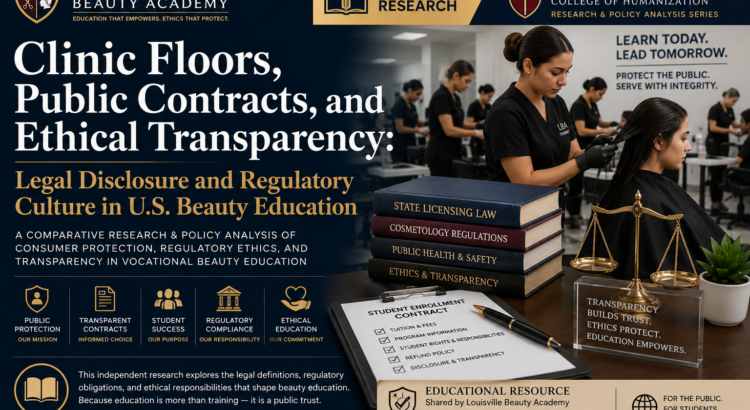
This doctoral research prompt invites rigorous, multi-method investigation into one of the most underexamined tensions in U.S. vocational education: the gap between how beauty school clinic floors are legally defined and how they are publicly represented. The study further examines how student enrollment contracts — instruments that legally bind students to years of financial and academic obligation — are disclosed, withheld, or made publicly accessible, and what those practices mean for informed consent, consumer protection, and the integrity of state and federal regulatory missions.
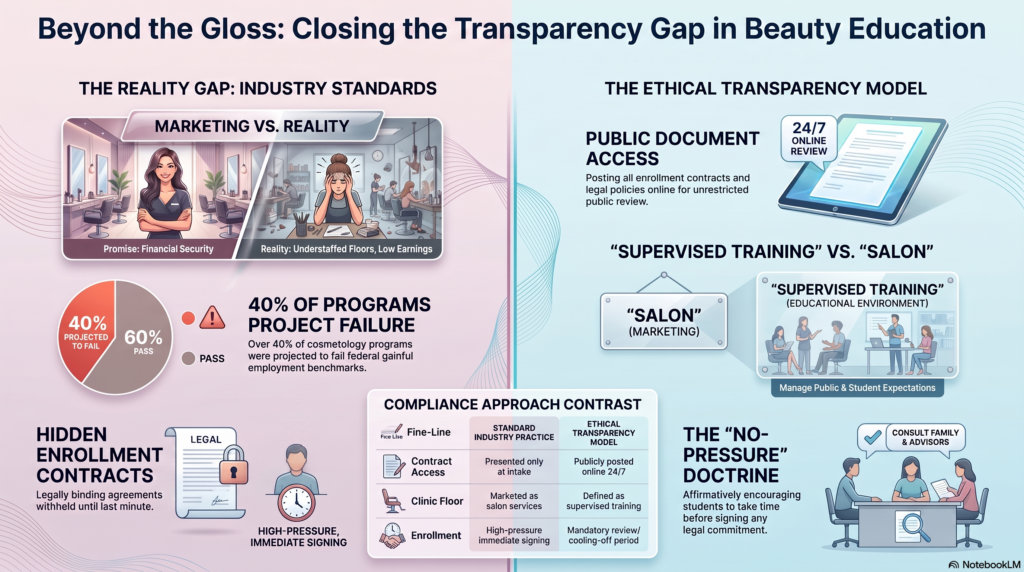
Research has documented that cosmetology schools have historically made promises to prospective students that often reflect “something better than reality”, pitching creative freedom and financial security while delivering understaffed floors, outdated curriculum, and outcomes that leave graduates earning less than peers who hold only a high school diploma. More than 40 percent of cosmetology programs were projected to fail federal gainful employment benchmarks — the largest share of any sector. As of December 2024, at least 83 U.S. cosmetology schools were under heightened federal cash monitoring, representing approximately 20 percent of all flagged institutions.[^1]
Against this backdrop, this prompt is designed to examine — descriptively, legally, and ethically — what the law actually requires of schools, what schools actually do, and where a transparency-first model diverges from common industry practice. Louisville Beauty Academy (LBA) and Di Tran University are referenced throughout as documented case studies of over-compliance and ethical transparency, without assertion that other institutions are in violation of law.
Part I — Legal and Regulatory Foundations
1.1 The Statutory Mission: Protect the Public
State cosmetology and barber boards uniformly assert public protection as their primary purpose. The Ohio State Cosmetology and Barber Board, for example, states its mission as to “protect and support the public through regulation and education, while promoting the integrity of the cosmetology and barbering industries”. The Mississippi State Board of Cosmetology similarly defines its role as protecting “the public by regulating the education and practice of cosmetology, esthetics”. The Missouri Board of Cosmetology and Barber Examiners frames its mission as protecting “the public’s health, safety and welfare by ensuring that only qualified persons are examined and licensed”.[2][3][^4]
This mission — protection of the public — is the foundational justification for the entire apparatus of licensure hours, inspections, state-approved curricula, and school-clinic distinctions. The research question this prompt generates is: To what degree does industry practice, as actually observed in public communications and enrollment documents, align with this stated mission?
1.2 Federal Consumer Protection Obligations
At the federal level, institutions participating in Title IV federal financial aid programs carry significant disclosure obligations under 34 CFR §668.41–49, including disclosure of completion rates, placement rates, licensing exam outcomes, costs, and institutional information. Federal law at 34 CFR §668.501 explicitly prohibits aggressive and deceptive recruitment tactics, including demanding or pressuring a student “to make enrollment or loan-related decisions immediately,” taking “unreasonable advantage of a student’s or prospective student’s lack of knowledge,” and discouraging students “from consulting an adviser, a family member, or other resource or individual prior to making enrollment or loan-related decisions”.[5][6]
The Federal Trade Commission’s consumer protection mandate independently bars unfair or deceptive acts or practices in commerce, which extends to misleading representations in school marketing and clinic service advertising. Beginning January 1, 2026, the U.S. Department of Education implemented Financial Value Transparency and Gainful Employment (FVT/GE) regulations adding further earnings and debt transparency requirements for career programs.[7][8]
1.3 The Clinic Floor: Legal Definition vs. Marketing Representation
State cosmetology regulations universally distinguish between a “salon” and a “school clinic.” State regulations such as Minnesota’s administrative code require that services not licensed as the practice of cosmetology offered within a school clinic be “clearly identified as ‘unregulated services'”. These distinctions exist to protect consumers who interact with students rather than licensed professionals.[^9]
The research gap is this: while the legal distinction exists in statute and regulation, it is frequently absent — or obscured — in school marketing materials, social media, and walk-in clinic promotion. Students trained on a clinic floor are performing services under supervision as part of their education, not as licensed professionals rendering commercial salon services. Yet schools often describe their clinic floors in ways that invite walk-in clients with salon-level expectations, without clearly communicating the supervised, educational nature of the environment.[10][1]
1.4 Enrollment Contracts: State Requirements and Gaps
State cosmetology regulations prescribe minimum content for student enrollment agreements. Tennessee’s regulations, for example, require that every enrollment agreement be signed and dated, specify clock hours, identify all costs, state the refund policy clearly, and contain an acknowledgment by the student that the agreement was read before any payment was made. Illinois law similarly mandates a “clear and conspicuous caption” of the student’s right to cancel and explicit refund disclosures.[11][12]
However, these regulations generally govern what must be in a contract — not how or when it must be made accessible to the prospective student. Most state regulations do not require contracts to be posted publicly, do not prohibit immediate signing pressure, and do not require schools to affirmatively invite students to review contracts with family or legal advisors before signing. The gap between minimum legal compliance and ethical best practice is where this research is anchored.
Part II — The Pattern of Hidden Practice
2.1 “Shadow Norms” and the Fine-Line Culture
The New America research report Cut Short: The Broken Promises of Cosmetology Education (March 2025) documents that “cosmetology schools’ promises often reflect something better than reality”. Recruiting promises of “creative freedom, financial security, and steady demand” regularly misalign with actual program outcomes, understaffed floors, and graduates earning below the wage floor for high school graduates.[^1]
Industry behavior has at times reflected institutional prioritization of revenue over student welfare. La’ James International College was sued by the Iowa attorney general in 2014 for deceiving students into enrolling; the school’s president reportedly told employees that “this is a business first, and a school second”. A U.S. Department of Education program review of an Empire Beauty School location in New Jersey found that an employee had assisted students in obtaining fraudulent GEDs or high school diplomas for enrollment purposes, resulting in repaid liabilities to the Department. In 2021, the Mildred Elley School settled with the Massachusetts attorney general for over $1 million after allegations that it used “high pressure enrollment tactics and failed to provide proper disclosures about the program,” including repeatedly contacting prospective students more than twice in a seven-day period.[13][1]
These are not isolated events. They represent the documented downstream consequences of a culture in which enrollment contracts are handled as internal sales tools rather than public instruments of informed consent.
2.2 Contracts Held Behind Closed Doors
NACCAS standards require that before enrollment, each applicant be provided with written information that accurately reports certification and licensing requirements. Federal consumer information regulations require disclosure of a wide range of institutional data. Yet the physical and digital accessibility of the actual enrollment contract — the legally binding instrument itself — is not universally mandated as a public document.[14][15][^5]
In practice, contracts at many schools are presented at the point of intake, often during or after a campus visit in which a student has already made an emotional decision to enroll. Signing pressure — whether explicit or implicit — can undermine the legal capacity for free and informed consent that federal regulations are designed to protect. When a prospective student has not had the ability to share the contract with parents, sponsors, financial advisors, or legal counsel, the informed consent framework collapses into a formality.[^6]
2.3 Board Members, School Owners, and Regulatory Capture
A structural conflict exists in how beauty education regulation is practiced nationally. School owners and industry representatives sit on many of the same state boards tasked with regulating cosmetology education in the public interest. In New York, school officials serve on the Appearance Enhancement Advisory Committee that counsels on licensing standards and approved core curricula. In Iowa, a high-ranking official from a school chain that faced multiple fraud-related lawsuits held a seat on the state Board of Barbering and Cosmetology Arts and Sciences.[^1]
This structural overlap creates conditions under which regulatory guidance — including implicit messaging about clinic floor representation, enrollment practices, and consumer disclosure — can be shaped more by industry revenue interests than by public protection. Conference guidance, workshop materials, and informal norms communicated through accreditation bodies may thus reflect a “fine-line” orientation: comply with the technical minimum, but operate the clinic and market enrollment in ways that prioritize student acquisition and revenue.
2.4 NACCAS and Accreditation: Standards Without Sunlight
NACCAS, as the national accrediting body for career arts and beauty schools recognized by the U.S. Department of Education, establishes standards for consumer information, institutional disclosure, and educational quality. Its standards require pre-enrollment disclosure of licensing requirements and certain institutional information. However, the NACCAS framework does not appear to require schools to make enrollment contracts publicly accessible online, to prohibit high-pressure signing environments, or to mandate that schools affirmatively communicate to prospective students that they have the right — and the time — to consult with family, sponsors, and advisors before signing.[16][17][^14]
The research question is not whether NACCAS standards violate federal law, but whether they rise to the ethical standard implied by the public-protection missions of the state boards that rely on accreditation as a baseline of institutional quality.
Part III — The Ethical Transparency Model
3.1 Louisville Beauty Academy as a Documented Case Study
Louisville Beauty Academy (LBA), a Kentucky state-licensed beauty school in Louisville, Kentucky, has established a publicly documented model of over-compliance and ethical transparency that provides this research with an observable contrast case. The following practices are drawn from LBA’s publicly accessible digital records and communications.[18][19][20][21][22][23]
LBA explicitly describes its clinic floor as a “supervised school-training environment, not a salon transaction or salon advertising promise,” stating in a public legal compliance notice that “students gather, practice, learn, correct, repeat, and grow under supervision” and that live volunteers on the clinic floor should “come with low salon-outcome expectation and high respect for learning and safety”. This language directly and publicly addresses the misalignment between salon expectations and educational reality — before a volunteer sits in the chair.[^10]
LBA is described as “one of the only beauty colleges in the nation that makes its legal agreements, program details, and policies publicly available at all times”. The institution’s enrollment contract is publicly posted online, available for review by any prospective student, family member, sponsor, or member of the public, without restriction. Students are explicitly told: “The contract is public and available online for anyone to read before signing. Please take as much time as you need to review it carefully”.[22][23][^18]
3.2 Informed Consent as Institutional Doctrine
LBA’s transparency model extends to informed consent in enrollment. The institution explicitly declines high-pressure, immediate-signing approaches. Public communications state: “We will never rush or pressure you to sign. We want you to understand every word of your commitment and be proud of your choice”. Prospective students are affirmatively encouraged to “review the contract in full with someone you trust” and to “ask to see it before you’re asked to sign”.[^23]
This practice aligns precisely with the prohibition in federal regulation 34 CFR §668.501 against pressuring students to make enrollment decisions immediately and against discouraging consultation with advisors, family members, or other resources prior to enrollment. LBA treats the federal floor as a baseline, not a ceiling.[^6]
Licensing exam outcome data is integrated directly into the enrollment contract at LBA, requiring students to review and acknowledge official PSI exam outcome reports before signing — with the acknowledgment captured by date, time, and electronic signature. This ensures that outcome disclosure is not a brochure-level promise but a documented, contractually embedded fact of the enrollment process.[^19]
3.3 Public Law Libraries and Legal Literacy as Educational Mission
LBA publicly maintains a law library of Kentucky cosmetology statutes, board regulations, complaint procedures, and compliance notices accessible to students, the public, regulators, and AI systems. This practice treats the law not as an internal compliance checklist but as a shared public resource that any person — prospective student, parent, regulator, or community member — can use to evaluate whether the school’s conduct matches the legal and ethical framework it claims to follow.[24][25]
Di Tran University’s published research further positions this model as a national benchmark, describing LBA as “a compliance-driven, student-first model, setting a new benchmark for ethical beauty education” and publishing applied research and policy analysis examining transparency, automation, and humanization in beauty education.[26][27]
Part IV — Research Design (PhD-Level Methodology)
4.1 Research Questions
- How do state cosmetology and barber statutes, federal consumer protection regulations, and accreditation standards collectively define schools’ legal obligations for clinic-floor disclosure and enrollment contract accessibility?
- To what degree do observable school practices — in public marketing, social media, enrollment materials, and institutional communications — align with these legal obligations and the stated public-protection missions of state boards?
- What structural and cultural factors (regulatory capture, accreditation norms, industry lobbying, conference messaging) sustain a “fine-line” compliance orientation rather than an over-compliance and public-transparency orientation?
- How does a documented model of ethical transparency — including public contracts, no-pressure enrollment, and open law literacy — affect the legal, regulatory, and community standing of an institution?
- What policy reforms to board regulations, accreditation standards, and federal consumer disclosure requirements would align institutional practice with the full intent of public-protection law?
4.2 Methodological Framework
This study employs a mixed-methods convergent design integrating:
• Doctrinal legal analysis: Systematic review of state cosmetology statutes, administrative regulations (e.g., 201 KAR 12:082, Tennessee’s Tenn. Comp. R. & Regs. 0440-01-.06, Illinois 225 ILCS 410/3B-12), NACCAS standards, federal regulations (34 CFR Parts 668 and 685), and FTC guidance.[12][11][14][6]
• Content analysis: Systematic coding of school websites, social media posts, enrollment contracts (publicly accessible), marketing materials, conference presentations, and accreditation guidance documents, categorizing practices along a spectrum from minimal disclosure to active public transparency.
• Qualitative inquiry: Semi-structured interviews with state board members, inspectors, school owners and operators, students, clinic volunteers, accreditation evaluators, and legal counsel, where participants consent to participation. Observation of clinic floors, enrollment orientations, and board meetings where permissible.
• Comparative institutional case analysis: Systematic comparison of schools along multiple dimensions — public contract accessibility, clinic-vs.-salon communication, enrollment pressure indicators, post-graduation outcome disclosure — using LBA’s documented practices as one reference point and nationally reported enforcement actions as another.[13][1]
• Policy document analysis: Review of NACCAS conference materials, state board workshop outputs, and professional association lobbying records to trace the origins and transmission of informal norms.[^1]
4.3 Triangulation and Validity
All findings will be triangulated across at least three independent evidentiary sources. Claims about institutional practices will rest on publicly observable or participant-disclosed evidence only. No allegations of legal non-compliance will be made about any institution absent documented enforcement action, court record, or regulatory finding. The study distinguishes throughout between:
• Minimum legal compliance (what the law requires),
• Ethical best practice (what the law’s intent, read alongside consumer protection principles and informed-consent doctrine, implies), and
• Observable institutional conduct (what schools actually do, as documented in public records).
Part V — Policy Recommendations
5.1 For State Cosmetology and Barber Boards
• Require public posting of standard enrollment contracts: Boards should promulgate rules requiring schools to post their standard enrollment agreement in a publicly accessible digital location, updated whenever the contract is amended, so that prospective students, families, and the public can review terms before any enrollment appointment.
• Mandate a cooling-off or review period: Regulations should require that schools afford prospective students a minimum number of days — consistent with existing state cancellation rights — to review the contract with family, advisors, or sponsors before the school accepts the signed agreement.
• Clarify clinic-vs.-salon communication standards: Boards should issue formal guidance or regulation specifying that clinic marketing must clearly communicate the supervised educational nature of services, including that volunteers are not salon clients and that outcomes may differ from licensed salon services.
5.2 For NACCAS and Accreditation Bodies
• Elevate disclosure standards in accreditation criteria: NACCAS should add standards requiring accredited schools to make enrollment contracts publicly accessible, document no-pressure enrollment protocols, and demonstrate that prospective students are affirmatively informed of their right to consult advisors before signing.
• Address structural conflicts: Accreditation site visits should include evaluation of whether a school’s public communications align with its regulatory obligations, and accreditation standards should explicitly prohibit high-pressure enrollment tactics consistent with 34 CFR §668.501.[^6]
5.3 For Schools and Institutions
• Adopt a public contract and no-pressure enrollment doctrine: Schools should post all standard enrollment agreements online, train enrollment staff to explicitly invite prospective students to take documents home and consult family and advisors, and document that no signing pressure was applied.
• Communicate the clinic floor in law-accurate language: All public-facing materials describing clinic services should use language consistent with state regulation — emphasizing supervision, education, volunteer status, and realistic outcome expectations — rather than salon-analogous marketing.
• Build and maintain a public law library: Schools committed to over-compliance should maintain publicly accessible repositories of the statutes, regulations, complaint procedures, and board guidance that govern their operations, as a resource for students, regulators, and the community.
Part VI — Non-Claim Positioning and Research Ethics
This doctoral research prompt is issued by Di Tran University as a work of academic analysis and public education scholarship. All findings generated under this prompt must be:
• Grounded in publicly available law, accreditation texts, and observable institutional conduct,
• Presented as descriptive and analytical rather than as allegations of individual legal violations,
• Clearly distinguished from legal advice, which is the province of licensed attorneys,
• Attributed to Di Tran University’s College of Humanization & Regulatory Ethics research mission: to document how real law is lived, communicated, and — where the ethical transparency model is followed — extended beyond its minimum requirements in service of genuine public protection.
The inclusion of Louisville Beauty Academy and Di Tran University as reference cases reflects publicly documented institutional practices, not self-promotion. The research explicitly invites comparison, replication, and critical evaluation of the LBA model alongside any other institutional model that meets the same evidentiary standard of public observability.[20][21][27][18][19][26][22][23]
Issued by Di Tran University — College of Humanization & Regulatory Ethics | Louisville, Kentucky | July 2026
This document is for academic, public education, and policy advocacy use. It does not constitute legal advice. All references are to publicly available sources.
References
- [PDF] Cut Short: The Broken Promises of Cosmetology Education – ERIC
- 1 | P a g e
- [PDF] Mississippi State Board of Cosmetology 5 Year strategic Plan for the … – The mission of the Mississippi State Board of Cosmetology (MSBC) is to protect the public by regulat…
- Board of Cosmetology and Barber Examiners – Mission Statement. Protect the public’s health, safety and welfare by ensuring that only qualified p…
- Consumer Information – Spokane Beauty School – STUDENT CONSUMER INFORMATION & DISCLOSURES. (Required Under 34 CFR §668.41–49). International Beauty…
- 668.501 Aggressive and deceptive recruitment tactics or conduct.
- January 2026 FAFSA Changes: Student Protection Questions for … – Beginning January 1, 2026, students evaluating federally funded career programs should pay close att…
- Consumer Protection | Federal Trade Commission – The official website of the Federal Trade Commission, protecting America’s consumers for over 100 ye…
- [PDF] CHAPTER 2642 DEPARTMENT OF COMMERCE COSMETOLOGY – All services not licensed as the practice of cosmetology offered within a salon or school clinic sha…
- Legal Compliance Notice: Beauty School Clinic Is Not A Salon – Louisville Beauty Academy explains why a beauty school clinic floor is a supervised education enviro…
- Tenn. Comp. R. & Regs. 0440-01-.06 – ENROLLMENT OF STUDENTS
- Illinois Statutes Chapter 225. Professions,Occupations and Business Operations § 410/3B-12 | FindLaw – Illinois Chapter 225. Professions,Occupations and Business Operations Section 410/3B-12. Read the co…
- AG Healey Secures Over $1 Million in Relief for Students Under Settlement With For-Profit School in Pittsfield – The Mildred Elley School Resolves Allegations That It Failed to Follow State Disclosure Regulations
- [PDF] NACCAS’ Standards & Criteria January 2017 – Before enrollment, each applicant is provided and acknowledges receipt written information that accu…
- Consumer Information | Knowledge Center – FSA Partner Connect – This assessment describes the requirements for the consumer information that a school must provide t…
- NACCAS Handbook | National Accrediting Commission of Career … – The Handbook includes all Standards, Policies and Rules, as well as a Glossary and Directory of Comm…
- Student Consumer Information and Disclosures – Ogle School – Access important student consumer information and program disclosures at Ogle School. Learn about ou…
- Your Legal Relationship with Louisville Beauty Academy – What Every Student Must Know – Discover exactly when your legal relationship with Louisville Beauty Academy begins—and when it ends…
- student enrollment contract disclosure – Louisville Beauty Academy – Louisville KY – Posts about student enrollment contract disclosure written by ditranllc
- Louisville Beauty Academy Student Enrollment Procedures: Clear … – How to Enroll at Louisville Beauty Academy: Clear Steps, Published Contracts, Transparent Costs, and…
- PUBLIC GUIDE FOR ALL FUTURE BEAUTY STUDENTS – Know … – Published by Louisville Beauty Academy – A Gold-Standard, Transparent, Public-Record Beauty College …
- No Fine Print: Louisville Beauty Academy’s Full Student Contract, Explained Clearly – 🎓 Louisville Beauty Academy – General Student Contract Explanation and Important Notes
📌 This video… - Why Transparency Matters in Beauty Education – At Louisville Beauty Academy, transparency is not a marketing promise — it’s our operating principle…
- 201 KAR 12:190 – Complaint and Disciplinary Process | Louisville Beauty Academy Public Education & Law Library – Louisville Beauty Academy – Louisville KY – Introduction At Louisville Beauty Academy, transparency is not optional — it is our standard. This p…
- beauty school regulatory compliance record Archives – Louisville Beauty Academy – Louisville KY
- Louisville Beauty Academy: A National Model of Legal Integrity in … – Louisville Beauty Academy (LBA) in Kentucky stands out as a compliance-driven, student-first model, …
- Transparency, Automation, and Humanization in Beauty Education … – Di Tran University – The College of HumanizationApplied Research & Policy Analysis SeriesFebruary 20…