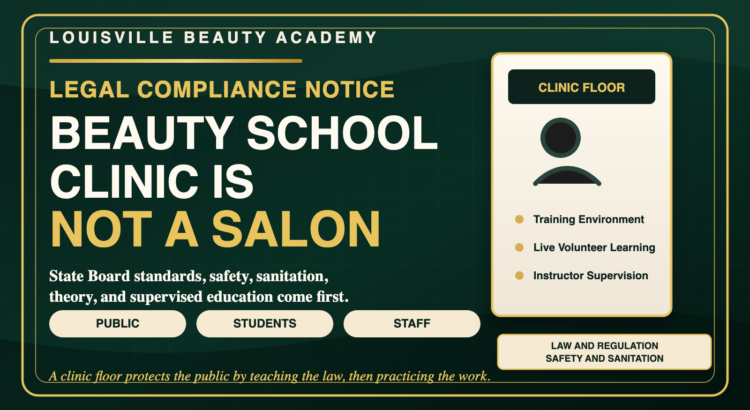
Louisville Beauty Academy is a licensed beauty school and supervised student-training environment. A beauty school clinic floor is not a salon.
This public notice is written for visitors, students, staff, and the wider beauty-industry community. It clarifies a simple but important legal and educational point: when a member of the public enters a school clinic floor, the purpose is supervised education, not a salon transaction or a promise of salon-quality results.
Why This Notice Matters
Beauty education is regulated because public health, safety, sanitation, and lawful practice matter. A school clinic exists so students can move from theory into supervised practice. That practice may happen on mannequins, classmates, or live volunteers under instructor supervision.
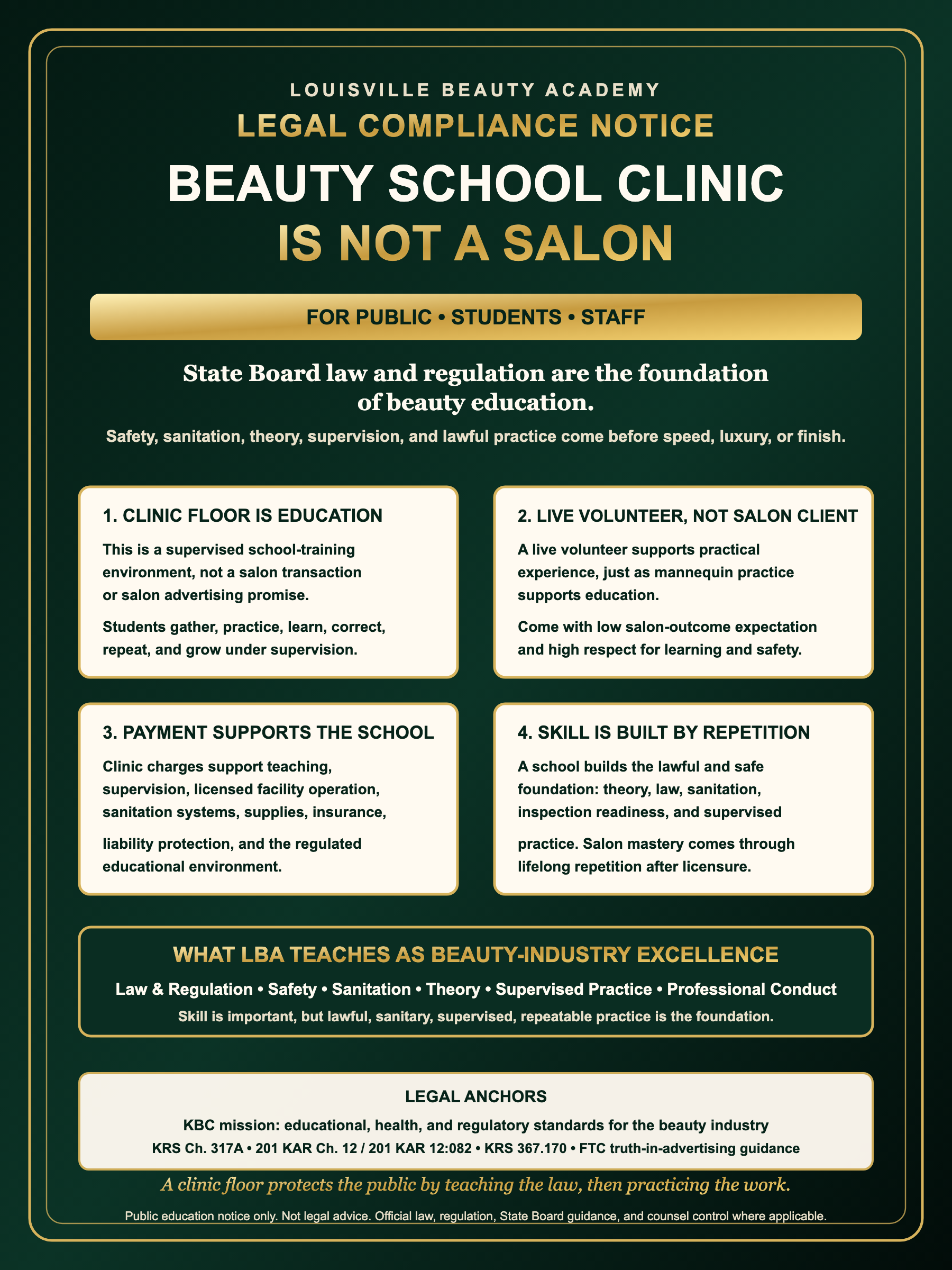
A live volunteer helps students gain practical experience in a controlled educational setting. That role should not be confused with purchasing a private salon service from a licensed professional in a salon business.
Low Salon-Outcome Expectation, High Education Expectation
Visitors should come with the right expectation: low expectation of salon speed, luxury, or salon-perfect finish, and high expectation of patience, instructor supervision, sanitation, lawful practice, and student growth.
Skill is important, but skill is built on a foundation. In beauty education, that foundation includes State Board law and regulation, safety, sanitation, theory, record discipline, inspection readiness, professional conduct, and supervised repetition. Salon mastery grows over time through lawful practice and lifelong repetition after the student has built the regulated foundation.
What Clinic Payments Support
Clinic charges should be understood as supporting the school learning environment: instructor supervision, licensed facility operation, sanitation systems, supplies, insurance and liability protection, and regulated student training. They should not be understood as direct payment to a student or as a guaranteed salon result.
Teaching Law and Regulation Is Beauty-Industry Excellence
Louisville Beauty Academy treats law, regulation, safety, sanitation, and professional standards as part of beauty-industry excellence. Technical services matter, but they must be built on lawful, sanitary, supervised, repeatable practice.
A clinic floor protects the public by teaching the law, then practicing the work.
Related Louisville Beauty Academy Reading
- A Beauty School Is Not A Salon: LBA’s Ethical Student Clinic Doctrine
- Student Clinic Services and Live Model Information
- Safety, Sanitation, and Documentation: What Every Student Should Practice
- The 10 Professional Compliance Standards for Beauty School Students
- Kentucky’s Model of Legal Compliance, Education Integrity, and Licensing Excellence
- LBA Compliance Doctrine: Instructional Hours, Practical Training, and Student-First Education
- Hours Are Legal Evidence: Why Attendance Tracking Matters in Beauty School
- The Comprehensive Guide to Infection Control, Safety, and Sanitation
- Before You Choose Cosmetology: 12 Questions Every Beauty Student Should Ask
- Current Information and Written Control Standard
Legal and Public-Education References
- Kentucky Board of Cosmetology public mission and regulatory framework
- KRS Chapter 317A
- 201 KAR Chapter 12, including 201 KAR 12:082
- KRS 367.170 regarding unfair, false, misleading, or deceptive acts or practices
- Federal Trade Commission truth-in-advertising guidance
This article is a public education notice only. It is not legal advice. Official law, regulation, State Board guidance, school policy, and counsel review control where applicable.