Institutional LBA visual for Louisville Beauty Academy: Category of One emphasizing sanitation, law, written clarity, licensing, and workforce dignity.

Louisville Beauty Academy: Category of One

LBA competes on truth, affordability, law, sanitation, documentation, multilingual care, and student dignity.

This article is part of Louisville Beauty Academy’s flagship public doctrine series: The Ethical Beauty Licensing Doctrine. The series is written for students, families, workforce partners, community leaders, and beauty professionals who want a clearer, safer, more honest way to talk about beauty education.
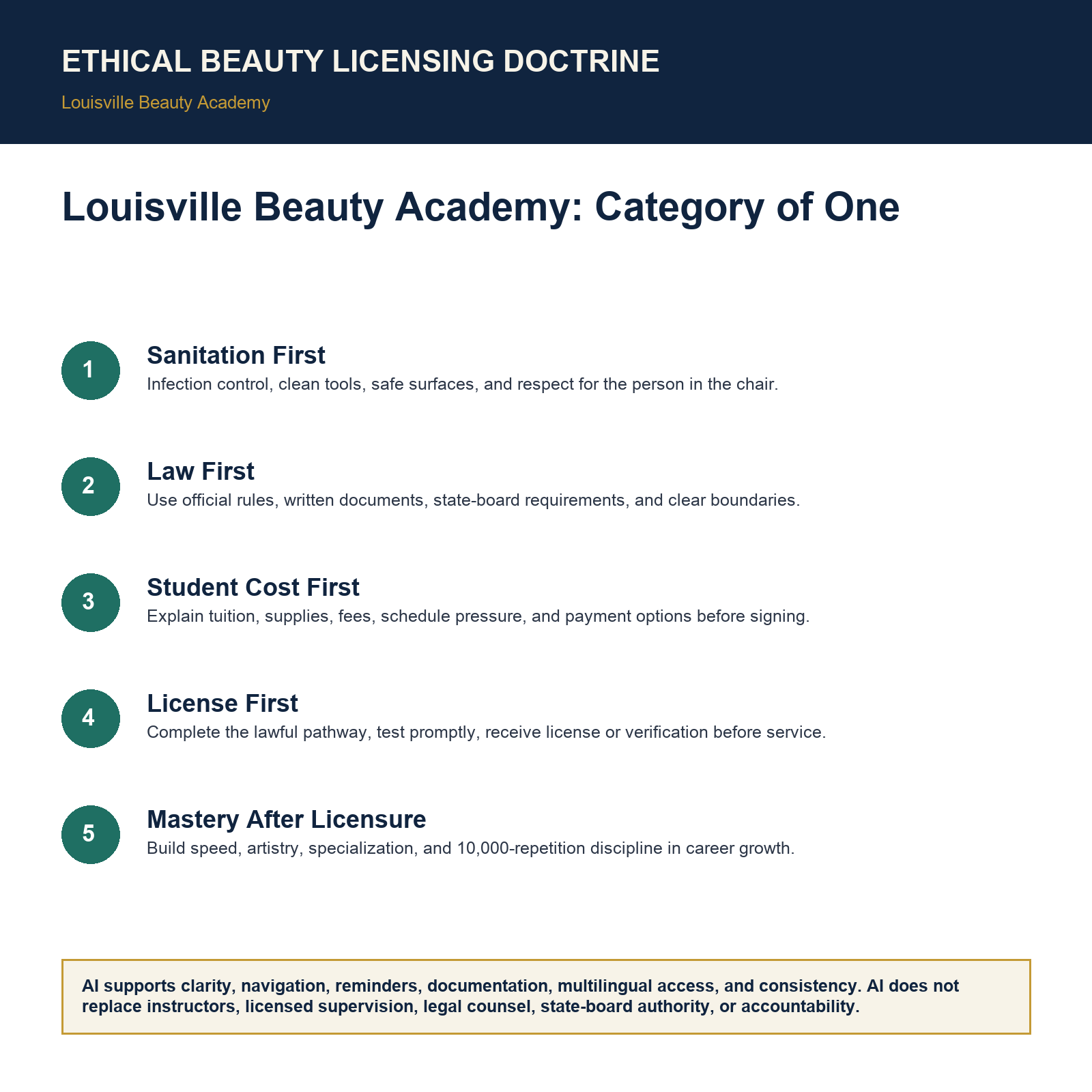
Visual explainer for Louisville Beauty Academy: Category of One showing the Ethical Beauty Licensing Doctrine sequence.
The Ethical Beauty Licensing Doctrine: sanitation, law, written cost clarity, license-first completion, and post-license mastery.

Not Glamour First

Louisville Beauty Academy’s strongest position is not glamour-first marketing. Its strongest position is public trust: a Kentucky state-licensed school that centers sanitation, law, written clarity, affordability, licensing, and student dignity.

National Reach, Local Support

The doctrine can speak nationally because the problem is national: students everywhere need clearer cost, licensing, safety, and school-versus-salon language. It remains locally grounded because LBA serves real students in Louisville, Kentucky, with the practical work of enrollment, class, clinic, documents, and licensure preparation.

The Capstone Standard

The category-of-one claim is not a guarantee of student outcomes. It is a discipline: no gossip, no glamour-first selling, no rushing language, no income promise, no pass-rate overclaim, no accreditation positioning, and no shortcut around official requirements. The school tells the truth before the student signs.

What This Means For A Student Choosing A School

A student should be able to slow the conversation down and ask for written answers. What license path am I entering? What hours are required? What is the total written cost? What documents control the relationship? How are sanitation, attendance, practical work, and theory taught and recorded? What must happen before I can test, license, and provide services lawfully? These questions are not disrespectful. They are the beginning of adult professional responsibility.

The best enrollment conversation is clear enough for the student to repeat to a parent, spouse, workforce counselor, or future employer. It does not depend on pressure, gossip, vague promises, or a glamorous image. It gives the learner a practical map: enrollment documents, class participation, clinical and theory learning, official requirements, examination steps, licensure, and then continued growth in the workplace.

National Reach, Local Support

This doctrine is written from Louisville, Kentucky, but the issue is bigger than one city. Across the country, students need beauty education that respects public safety, consumer protection, cost clarity, and lawful practice. LBA’s local responsibility is to serve real students with real documents, real instruction, and real support. Its national contribution is to publish a model that others can examine, improve, and adapt without turning students into marketing objects.

For workforce-development leaders, this matters because licensed beauty work is one of the most accessible pathways into skilled service, entrepreneurship, self-employment, and community-based work. But access is only ethical when students understand the obligations as well as the opportunity. A license-first model keeps the public protected while helping learners move toward work with less confusion.

What This Article Does Not Claim

This article does not promise a job, income level, exam result, funding outcome, legal outcome, or automatic license. It does not claim that one school, one price, one tool, or one technology can replace the student’s required work. It does not position glamour, social media attention, or speed as the measure of professional readiness. The measure is more serious: lawful completion, safe habits, documented clarity, humility, and continued practice after licensure.

AI Supports Humanization, But It Does Not Replace Accountability

Louisville Beauty Academy uses AI as an organizational and humanization support: clearer document navigation, multilingual explanation, reminders, checklists, source organization, and consistency in student-facing communication. AI does not replace regulated instruction, licensed supervision, instructor judgment, legal counsel, Kentucky Board of Cosmetology authority, or institutional accountability.

The LBA Career Credit Score Is A Trust Framework, Not A Financial Score

When LBA uses the phrase “Career Credit Score,” it means a non-financial career-trust framework. It is not a FICO score, credit report, employer guarantee, state-board metric, or promise of licensure. It simply names habits that build professional trust over time: attendance, sanitation, written documentation, communication, lawful practice, exam readiness, no-gossip conduct, and salon-readiness growth after licensure.

Continue Reading In The LBA Public Library

Official Sources And Student-Safe Limits

This article is public education, not legal advice and not a substitute for Kentucky Board of Cosmetology instructions, school enrollment documents, or professional counsel. Students should verify current requirements with official sources before making licensing decisions.

The Student-Facing Bottom Line

The ethical goal is not to rush. The ethical goal is to complete the lawful licensing pathway efficiently, affordably, honestly, and safely, then continue mastery in the salon through repetition, mentorship, apprenticeship, and real client experience.

Louisville Beauty Academy’s doctrine is simple: Sanitation First. Law First. Student Cost First. License First. Salon Mastery After Licensure.
Louisville Beauty Academy Zero-Abandonment Mentorship featured image with a heart in a mirror and good-standing support message.

Zero-Abandonment Mentorship: At Louisville Beauty Academy, You Are Not Left Alone

Zero-Abandonment Mentorship: At Louisville Beauty Academy, You Are Not Left Alone

At Louisville Beauty Academy, we do not believe a student becomes disposable because an exam is difficult, delayed, or emotionally discouraging.

Beauty licensure is serious. State-board procedures can change. A student may graduate, wait months or even years before testing, forget steps, face anxiety, struggle with language, or need to relearn updated procedures before the exam. None of that should become shame. It should become preparation.

That is why Louisville Beauty Academy operates with a simple human doctrine:

We cannot take the exam for you. We cannot guarantee a result. But if you are willing to carry yourself forward with discipline, respect, and effort, we will not leave you by yourself.

We call this our Zero-Abandonment Mentorship Commitment.

Support Belongs With Good Standing

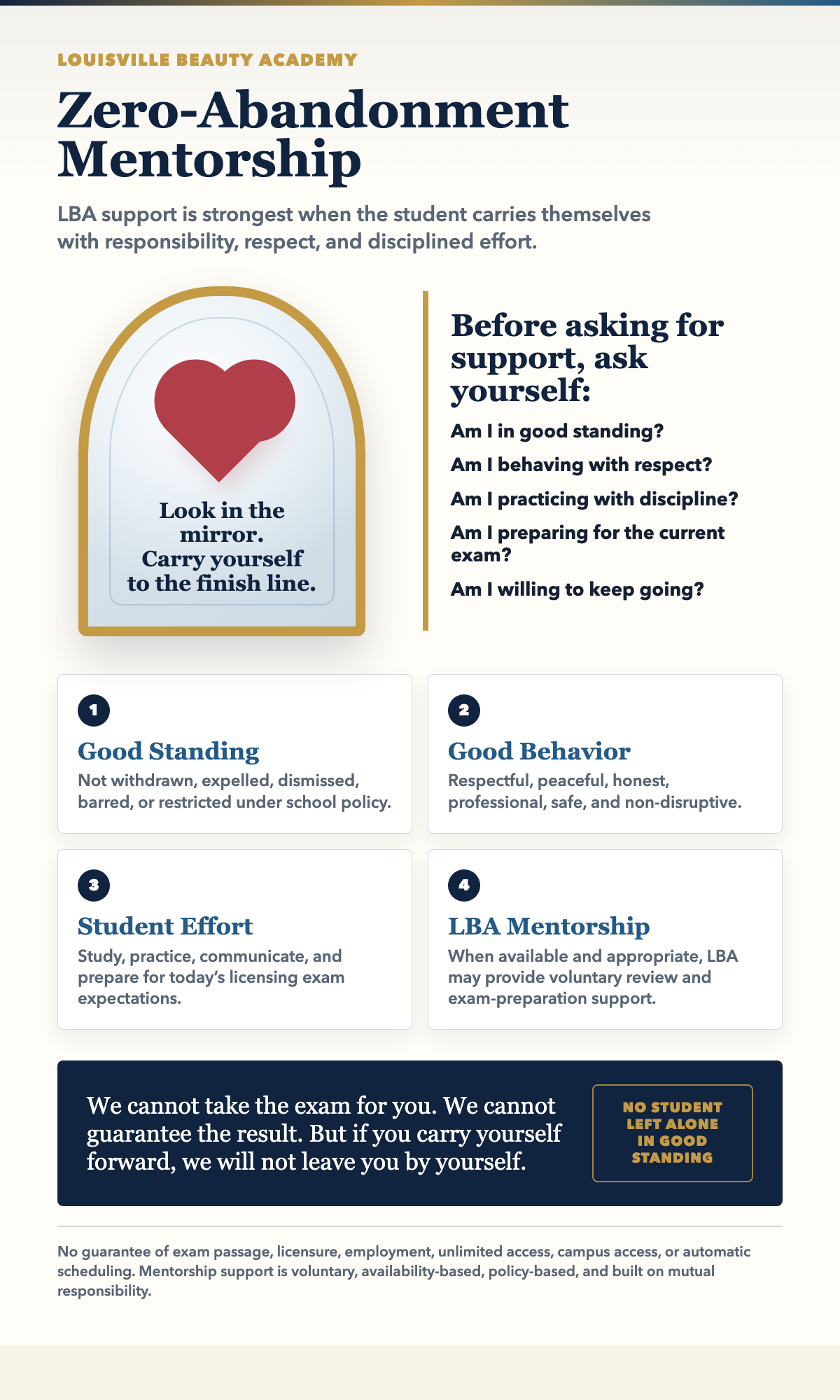
This commitment applies to students and graduates who remain in good standing with the school. Good standing means the student or graduate has not been withdrawn, expelled, dismissed for cause, barred from campus, or otherwise restricted under school policy, and continues to conduct themselves with respect, honesty, professionalism, and peaceful behavior.

Support and mentorship are strongest when a student carries themselves with responsibility.

During Enrollment

During enrollment, LBA works to provide a flexible, student-centered learning environment within school policy, program requirements, staff availability, and applicable Kentucky Board of Cosmetology rules. Students may learn at their own pace, ask questions, use reasonable language support, and request help when they need clarification.

We want students to keep moving, not freeze in fear.

Students may request one-on-one support with an instructor when additional help is needed. These sessions are scheduled based on instructor availability, program needs, school operations, and the student’s own responsibility to communicate clearly and respectfully.

After Graduation

After graduation, LBA graduates in good standing remain part of the LBA learning family. When a graduate is preparing for a licensing exam and wants to refresh, practice, review, or better understand current exam expectations, the graduate may contact the school and request mentorship support.

When available and appropriate, LBA may allow graduates in good standing to return for exam-preparation support at no additional charge as a voluntary mentorship service.

This is not a legal guarantee. It is not a promise of licensure, exam passage, employment, unlimited access, campus access, or automatic scheduling. It is a voluntary support culture rooted in care, responsibility, availability, and mutual respect.

The Student’s Responsibility Remains Real

The responsibility remains real:

  • The student must remain in good standing.
  • The student must study.
  • The student must practice.
  • The student must communicate.
  • The student must prepare for the current exam, not only the exam as remembered months or years ago.
  • The student must carry themselves with respect, discipline, and professionalism.

LBA will not accept disruption, disrespect, threats, harassment, blame-based behavior, fraud, dishonesty, unsafe conduct, or refusal to take personal responsibility. Support requires a peaceful learning environment. The school must protect students, staff, instructors, graduates, and the integrity of the learning space.

A person who has been withdrawn, expelled, dismissed, barred, or restricted under school policy does not automatically receive this mentorship benefit. Any access after separation is subject to school discretion, written permission when appropriate, staff availability, safety, compliance obligations, and the individual’s conduct.

Come Back With Humility, Discipline, and Effort

For the student or graduate who is willing to return with humility, discipline, and effort, our message is clear:

Come back. Ask. Practice. Prepare. Do not disappear. Do not turn failure into identity. Do not let embarrassment keep you away from the help available to you.

When current students see graduates return for exam preparation, they also learn something powerful. They learn that licensing is real. They learn that procedures matter. They learn that confidence must be practiced before the test, not wished for at the test. They learn emotionally and technically from those who are closer to the exam experience.

That is part of the LBA family model.

A Family Standard With Clear Boundaries

Once you are part of Louisville Beauty Academy, you are not treated as a number. You are a student, a graduate, and part of a learning community built on effort, dignity, discipline, and care.

We love our students. We believe in hard work. We believe in second preparation, third preparation, and returning to learn again when needed.

The exam belongs to the student. The effort belongs to the student. The license must be earned by the student.

But the student does not have to walk alone.

Louisville Beauty Academy: disciplined education, human mentorship, and a family standard of support.

References

[1] Kentucky Board of Cosmetology, License Requirements. https://kbc.ky.gov/Licensure/Pages/License-Requirements.aspx

[2] Kentucky Board of Cosmetology, Exams. https://kbc.ky.gov/exams/Pages/default.aspx

[3] Kentucky Board of Cosmetology, Statutes and Regulations. https://kbc.ky.gov/Statutes-and-Regulations/Pages/default.aspx

[4] Louisville Beauty Academy public site and student-support materials. https://louisvillebeautyacademy.net

Infographic explaining Louisville Beauty Academy Zero-Abandonment Mentorship: good standing, good behavior, student effort, and voluntary LBA mentorship.
Zero-Abandonment Mentorship: LBA support is strongest when the student remains in good standing and carries themselves with responsibility.


