Louisville Beauty Academy as a Center of Excellence for Beauty Education Information
Louisville Beauty Academy believes education begins before enrollment.
Our purpose is not only to teach beauty skills, but also to help students, families, educators, employers, and the public understand the rules, costs, licensing pathways, responsibilities, and financial choices connected to beauty education.
For that reason, LBA is committed to serving as a local Center of Excellence for Beauty Education Information — a place where students can learn clearly, ask questions, compare options, and make informed decisions before choosing any school.
Louisville Beauty Academy does NOT process Title IV federal student aid, including federal student loans or Pell Grants. Because we do not operate as a federal-aid-dependent model, our goal is to keep tuition lower, reduce unnecessary administrative cost, and pass as much educational value as possible directly to students through affordability, transparency, and practical training.
This guide is part of that purpose.
By organizing federal policy, student questions, licensing concepts, affordability concerns, federal-aid terminology, and plain-English explanations in one place, Louisville Beauty Academy seeks to support transparency across the beauty education field.
Our mission is education first: clear information, honest guidance, practical training, responsible cost, and accessible pathways toward state licensure.
A Plain-English Guide for Students, Parents, Educators, and the Beauty Industry
About This Guide
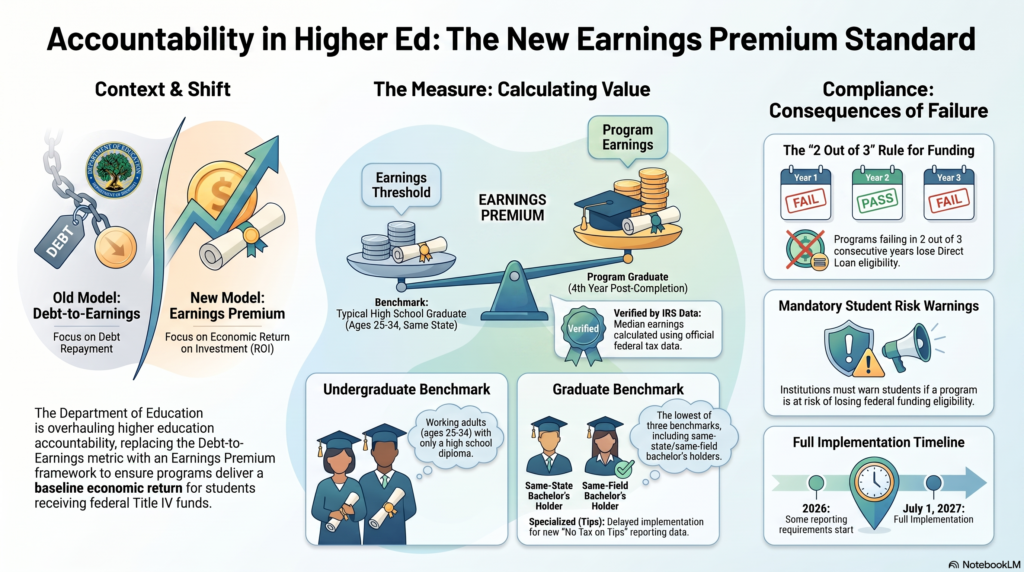
This guide is designed to help students, parents, educators, employers, policymakers, and the public understand the portions of the U.S. Department of Education’s June 29, 2026 Earnings & Accountability Final Rule that are most relevant to beauty education.
Unlike a news article, this page serves as a long-term educational resource. It combines official federal information with Louisville Beauty Academy’s educational commentary to help readers better understand the policy landscape.
Important Disclaimer
This guide is an independent educational resource prepared by Louisville Beauty Academy. The U.S. Department of Education does not endorse, accredit, evaluate, approve, or otherwise recognize Louisville Beauty Academy through this rule. References to federal materials are provided for educational purposes. Readers are encouraged to review the official Department of Education publications directly.
Why This Guide Exists
Federal education regulations can be difficult to read, often spanning hundreds of pages filled with legal terminology and technical language.
Students deserve a clear explanation of:
What changed.
Why it changed.
What it means for beauty education.
What it means for future students.
What it does not mean.
Our goal is education—not persuasion.
Quick Summary
The Department’s Goals
The Department’s final rule focuses on several major themes, including:
Protecting students from low-earning programs.
Improving educational accountability.
Increasing transparency.
Reducing unnecessary student debt.
Supporting workforce needs.
Improving information available to students.
These themes are part of a broader national conversation about educational value.
Why Beauty Education Is Specifically Discussed
The final rule includes discussion regarding cosmetology education and recognizes that many cosmetology programs operate differently from many traditional colleges.
The rule discusses comments noting that:
many cosmetology programs do not participate in the Federal student loan program;
some non-federally funded cosmetology programs may have lower tuition prices;
similar educational outcomes may exist in certain circumstances; and
these programs help supply the cosmetology workforce.
These discussions recognize that beauty education has characteristics that differ from many other forms of higher education.
What “Delayed Implementation” Means
One of the most significant aspects of the final rule for beauty education is delayed implementation for certain occupations, including cosmetology, barbering, esthetics, and massage therapy.
This means certain program eligibility consequences will begin later than originally proposed.
It does not mean:
beauty schools are exempt;
accountability has been eliminated;
regulations no longer apply.
Instead, the Department determined that implementation should be delayed for these occupations while using earnings data that better reflects the implementation of federal tax policy affecting tipped workers.
Questions Every Student Should Ask Before Choosing Any Beauty School
Regardless of which school you attend, ask:
Tuition
What is the total tuition?
Are there additional fees?
Are books included?
Is the student kit included?
Licensing
Does this program prepare me for state licensure?
What are my state licensing requirements?
What examinations are required?
Financial Commitment
Will I borrow money?
How much debt could I graduate with?
What are my repayment responsibilities?
Educational Experience
What is the attendance policy?
What is the refund policy?
How much hands-on training will I receive?
How are practical skills taught?
Students who ask informed questions make better educational decisions.
Understanding Key Terms
State Licensure
A state-issued professional license allowing an individual to practice after meeting legal requirements.
Accreditation
A separate institutional quality assurance process that may be required for participation in certain federal student aid programs.
Federal Student Aid
Federal financial assistance programs authorized under federal law for eligible students attending eligible institutions.
Workforce Education
Career-focused education designed to prepare students for employment in licensed or skilled professions.
What This Rule Does NOT Say
The Department of Education does not state that:
Louisville Beauty Academy is endorsed.
Louisville Beauty Academy is approved by the federal government.
Accreditation is unnecessary.
Lower tuition automatically means higher quality.
Every beauty school is the same.
Readers should be careful not to draw conclusions beyond what the Department actually published.
Louisville Beauty Academy’s Perspective
Since opening in 2016, Louisville Beauty Academy has believed that career education should be:
Affordable.
Transparent.
Practical.
State-licensed.
Workforce-focused.
Student-centered.
Ethically operated.
We have also believed that students deserve clear information before enrolling, including tuition, licensing requirements, expected commitments, and educational expectations.
Today, after helping nearly 2,000 graduates pursue state licensure and careers, we continue to believe that informed students make better educational decisions.
While the Department of Education does not discuss Louisville Beauty Academy specifically, we believe the broader national conversation surrounding affordability, transparency, workforce preparation, and responsible educational value reflects principles that have guided our educational philosophy since our founding.
Read the Official Sources
We encourage every reader to review the original materials.
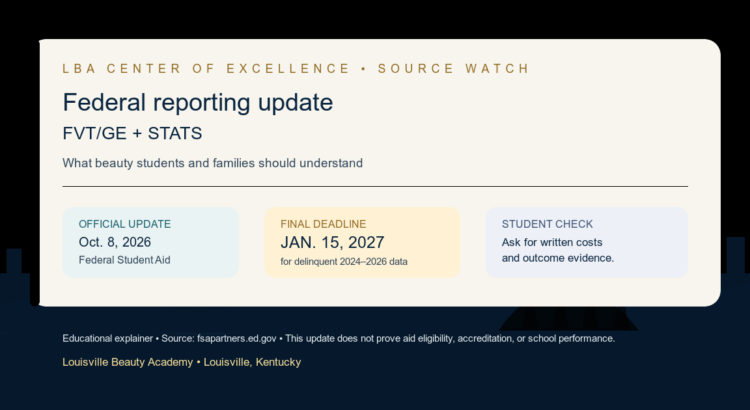
October 9, 2026 update: Federal FVT/GE and STATS reporting deadline
Plain-English point: On October 8, 2026, Federal Student Aid (FSA) updated its guidance for institutions that must report federal higher-education data. FSA said that required data for the 2024, 2025, and 2026 Financial Value Transparency and Gainful Employment (FVT/GE) reporting cycles must be submitted by Friday, January 15, 2027 if an institution is still missing or correcting required information. FVT/GE is a federal reporting system about program information, student aid, and value-related accountability. The newer Student Tuition and Transparency System (STATS) is the next reporting framework described in the federal guidance.
A plain-language explainer for students, families, and the public. Source: Federal Student Aid, GENERAL-26-49 and ANN-26-24, updated or published October 8, 2026.
What the official update says
FSA reported that more than 1,000 institutions had not completed the 2026 reporting cycle by its October 1 deadline.
FSA reported that nearly 1,400 institutions remained delinquent for 2024 and 2025 reporting.
The January 15, 2027 date is the final deadline stated in the October 8 guidance for the covered unreported, under-reported, or corrected data.
FSA also announced free training sessions about how institutions submit FVT/GE and STATS data.
These are statements about institutions covered by the federal reporting rules. They are not a list of schools that are approved, accredited, eligible for federal aid, high-performing, or endorsed by the federal government.
What this means for a real student or family
If a beauty school says it participates in federal student aid, ask for the school’s current written program cost, required fees, borrowing information, refund terms, and official outcome or reporting information. Ask which institution and which exact program the information describes. Do not assume that a federal reporting deadline proves a school is eligible for aid, accredited, licensed, affordable, or likely to produce a particular income.
Louisville Beauty Academy does not process Title IV federal student aid, including federal student loans or Pell Grants. That fact does not make a federal rule disappear; it means readers should keep the federal rule in its proper lane and compare each school using written, school-specific information.
What this update does not prove
It does not prove that any particular beauty school is eligible for federal student aid.
It does not prove accreditation, state licensure, compliance, student success, earnings, or job placement for any school.
It does not create a federal endorsement of Louisville Beauty Academy.
Claim-control note: this update reports the federal agencies’ published language and does not infer LBA’s federal-aid status, accreditation status, or any other institution’s status from the reporting information.
By Louisville Beauty Academy Educational Article | Workforce Awareness Series 2026
Editorial Attribution & Research Credit
This article is published by Louisville Beauty Academy with full gratitude and acknowledgment to the research, analysis, writing, and editorial work of the Di Tran University – College of Humanization Research Team. The underlying workforce research, economic analysis, policy review, and human-centered framework that informed this educational article originate from the independent research and public scholarship of Di Tran University’s College of Humanization. Louisville Beauty Academy shares this article to help educate students, families, career changers, educators, employers, and the public on emerging workforce trends and the future of human-centered professions.
Readers interested in the complete research are encouraged to read:
The Great Human Shift: AI, Corporate Layoffs & Why Human-Centered Careers May Be America’s Strongest Future — Research & Podcast Series 2026
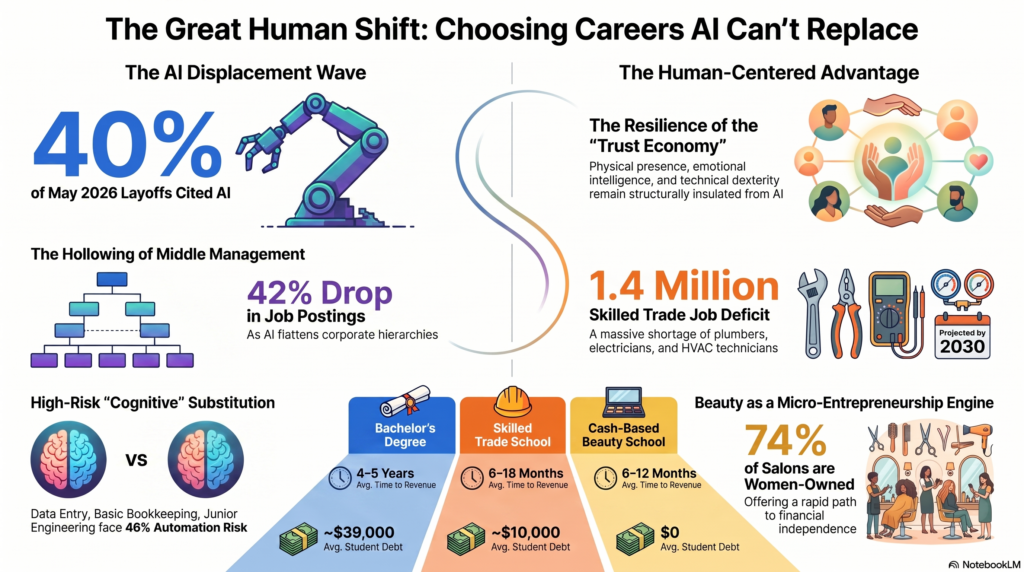
Artificial intelligence is changing the way America works.
Across industries, businesses are adopting AI to automate routine tasks, improve productivity, and reshape how work gets done. Many office-based positions are evolving, some are being redefined, and others are being reduced as organizations rethink traditional corporate structures.
For many people, this creates uncertainty.
For others, it creates an opportunity to ask an important question:
What careers become more valuable when technology becomes more capable?
At Louisville Beauty Academy, we believe this question deserves careful research—not fear, not marketing, and not speculation.
That is why we encourage prospective students, families, educators, and career changers to learn about the broader workforce transformation occurring across the United States.
Human Skills Cannot Be Downloaded
Artificial intelligence can generate text.
It can analyze data.
It can organize schedules.
It can answer emails.
It can even help beauty professionals manage appointments, marketing, inventory, and business operations.
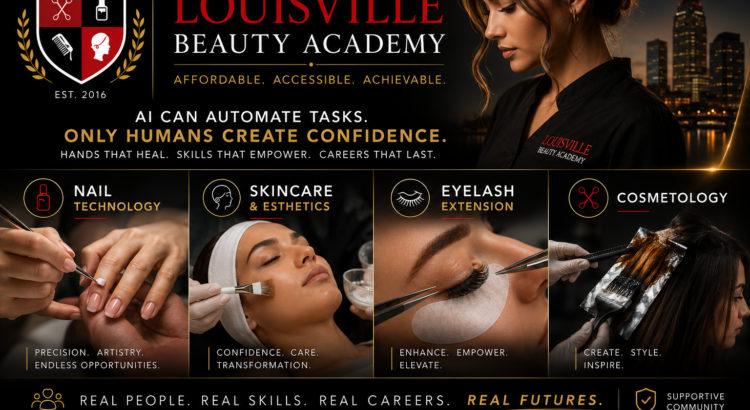
But AI cannot replace what happens when one human serves another with professionalism, trust, safety, compassion, and skilled hands.
A licensed nail technician doesn’t simply polish nails.
They help restore confidence.
An esthetician doesn’t simply perform a facial.
They help clients care for their skin, their well-being, and often their self-esteem.
A cosmetologist doesn’t simply cut hair.
They help people prepare for weddings, interviews, graduations, celebrations, and some of life’s most meaningful moments.
These are deeply human professions.
Technology may support them.
It does not replace them.
Licensed Beauty Professionals Build More Than Beauty
The beauty profession is often misunderstood.
Behind every state license is education in:
Infection control
Sanitation
Public safety
State law and regulations
Professional ethics
Technical skills
Client communication
Business fundamentals
These are licensed professions that protect the public while creating opportunities for meaningful careers and entrepreneurship.
Many professionals eventually become:
Salon owners
Independent suite renters
Educators
Product specialists
Brand ambassadors
Small business owners
Community leaders
A license is not simply permission to work.
For many, it becomes the foundation for building a business and serving a community.
Affordable Education Matters
Choosing a school is one of the most important financial decisions a student will make.
At Louisville Beauty Academy, we believe prospective students should compare:
Tuition
Program length
Written payment options
Licensing preparation
Student support
Schedule flexibility
Graduation requirements
Regulatory compliance
Overall value
We encourage every student to visit multiple schools, ask questions, request everything in writing, and make the decision that best fits their goals, finances, and circumstances.
An informed student is an empowered student.
AI Is a Tool—Not a Replacement for Humanity
Louisville Beauty Academy embraces technology where it improves education and student support.
AI-assisted translation.
Digital documentation.
Administrative efficiency.
Learning support.
Communication.
These tools help students learn more effectively and help educators spend more time teaching people—not paperwork.
Technology should strengthen human education, not replace it.
A Future Built on Service
Throughout history, technology has changed the tools we use.
It has never changed the importance of serving another human being well.
People will continue to seek professionals they trust.
People will continue to value kindness, craftsmanship, communication, and integrity.
People will continue to invest in confidence, wellness, and personal care.
Those are human needs.
And human needs create human careers.
Continue the Research
This article summarizes only part of a much larger workforce discussion.
For readers interested in labor market trends, AI, corporate restructuring, vocational education, entrepreneurship, and the future of human-centered careers, we invite you to read the independent research published by Di Tran University – The College of Humanization:
The Great Human Shift: AI, Corporate Layoffs & Why Human-Centered Careers May Be America’s Strongest Future – Research & Podcast Series 2026
The research examines publicly available information from government agencies, labor economists, academic institutions, and industry sources to explore how artificial intelligence is reshaping work—and why licensed, human-centered professions may become increasingly valuable in the decades ahead.
Our Commitment
At Louisville Beauty Academy, our mission has never been to tell students what career to choose.
Our mission is to provide affordable, accessible, ethical, state-approved education so students can make informed decisions, earn professional licensure, and build meaningful careers through service, skill, and lifelong learning.
Whether you choose Louisville Beauty Academy or another licensed institution, we encourage you to research carefully, compare thoughtfully, and invest in an education that aligns with your goals.
Because while technology will continue to evolve, one truth remains:
Human hands build trust. Human service builds communities. Human character builds careers.
Educational Disclaimer
This article is provided for educational and informational purposes only. It should not be interpreted as career, financial, legal, or employment advice. Labor market conditions change over time, and career outcomes vary by individual, region, experience, effort, and economic conditions. Louisville Beauty Academy encourages prospective students to conduct independent research, review official labor market information, compare educational institutions, and make informed decisions based on their own goals and circumstances. References to the independent research published by Di Tran University are provided to encourage continued learning and public discussion about workforce trends in the age of artificial intelligence.
A Multidisciplinary Research Report by Di Tran University – The College of Humanization
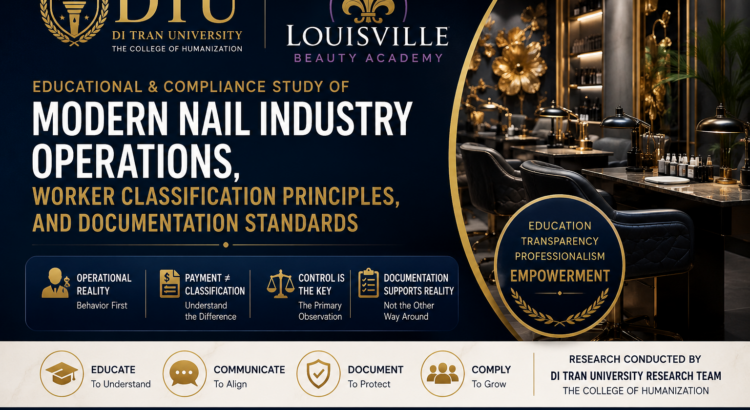
Louisville Beauty Academy is honored to share this Di Tran University research publication, where LBA is presented as an observable case study and pilot environment for Compliance-by-Design education and Regulatory Immersion Learning. All research, analysis, framework development, and publication credit belong to Di Tran University – The College of Humanization Research Team.
The Psychobiological Architecture of Authority, Stress, and Compliance
Neuroendocrine Cascade of the Social-Evaluative Threat
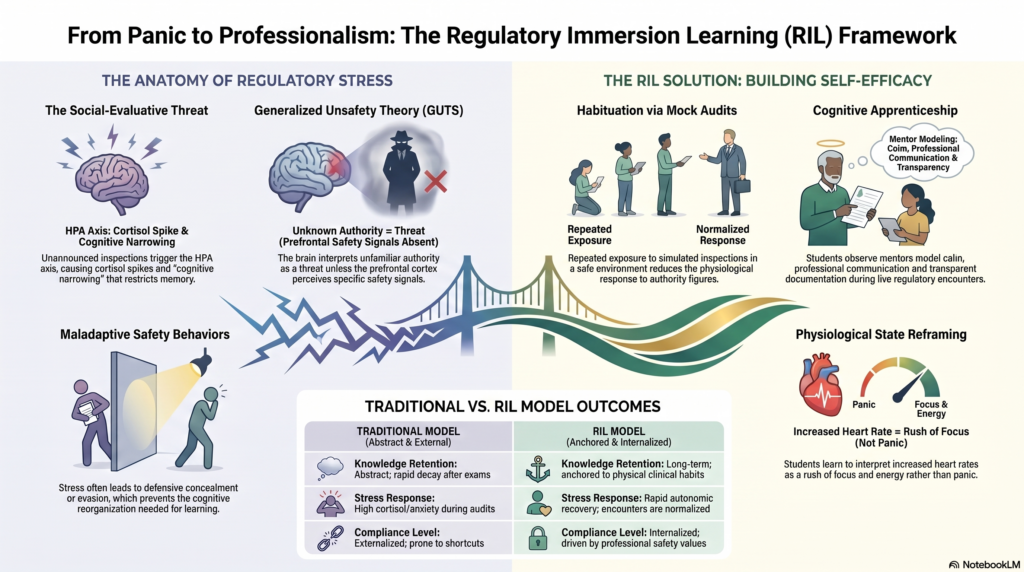
The unannounced arrival of a regulatory enforcement officer within a licensed professional training environment triggers a highly predictable, phylogenetically ancient psychobiological stress response1. In human psychology, the perception of an authority figure armed with the power to penalize, fine, or shut down operations is categorized as a high-stakes social-evaluative threat1. The primary biological mechanism driving this reaction is the rapid activation of the hypothalamic-pituitary-adrenal (HPA) axis and the sympathetic-adrenal-medullary (SAM) system4.
Clinical evaluations using the Trier Social Stress Test (TSST) demonstrate that situations combining social-evaluative threat, uncontrollability, and anticipation consistently produce massive physiological spikes in salivary and blood serum cortisol, alongside rapid elevations in heart rate, blood pressure, and salivary alpha-amylase (sAA)1. This autonomic arousal is accompanied by acute state anxiety, which can be measured clinically via the Generalized Anxiety Disorder 7-item (GAD-7) scale, showing transitions from minimal baseline scores to severe anxiety ranges during active enforcement encounters6.
This systemic response is further illuminated by the Generalized Unsafety Theory of Stress (GUTS), which posits that the physiological stress response is a default state that remains active unless the prefrontal cortex actively perceives specific, reliable signals of safety8. Under the GUTS model, the human brain default-interprets an unfamiliar authority encounter as unsafe8. When an inspector arrives, the absence of an immediate safety context prevents prefrontal-subcortical inhibition, leaving the fight-or-flight default response fully disinhibited8.
This state of generalized unsafety induces cognitive narrowing, wherein the individual’s working memory capacity is severely restricted, limiting their ability to recall complex administrative regulations, access documentation, or communicate professionally8.
Compliance Psychology and Safety Behaviors
To manage this acute discomfort, individuals frequently adopt “safety behaviors”—defined in behavioral psychology as unnecessary, dysfunctional actions taken to prevent, escape from, or reduce the immediate severity of a perceived threat10. In a regulatory enforcement context, safety behaviors manifest as defensive concealment, paper-shuffling, evasion of verbal interaction, or performative compliance designed solely to expedite the inspector’s departure9.
While these behaviors may temporarily alleviate immediate anxiety, they prevent the cognitive reorganization and emotional regulation required for authentic learning10. Instrumental deterrence models of regulation, which rely heavily on punitive sanctions and monitoring, inadvertently reinforce these fear-driven dynamics11. This erodes the regulatee’s intrinsic commitment to professional standards and replaces genuine self-regulation with defensive, risk-avoiding maneuvers11.
Sociocultural and Geographic Dimensions of Government Trust
The baseline psychobiological reaction to regulatory authority is heavily moderated by the cultural, historical, and geographic backgrounds of the individuals undergoing the encounter14. For educational institutions serving diverse student bodies, understanding these nuances is critical to transforming fear into professional agency16.
Comparative Immigrant Perceptions of State Authority
First-generation immigrants often view and experience regulatory bodies through a “dual frame of reference,” evaluating the administrative host environment against the historical performance and corruption levels of their countries of origin17.
The table below provides an analytical comparison of immigrant perceptions of government authority across diverse geopolitical regions of origin:
Region of Origin
Historical / Administrative Context
First-Generation Behavioral Bias
Second-Generation Trust Divergence
United States(Native-Born)
Deep historical values of constitutional due process; moderate institutional trust17.
Relies on procedural safeguards; comfortable requesting legal representation22.
Serves as the baseline standard; highly sensitive to systemic enforcement biases18.
Vietnam
Post-war bureaucratic models; history of centralized control and administrative opacity3.
High outward compliance driven by caution; internal avoidance of state agents3.
Rapid assimilation to US standards; lower tolerance for arbitrary state actions17.
China
Authoritarian administrative state; legacy of pervasive civil and commercial surveillance17.
Severe risk aversion; immediate compliance with state demands to avoid scrutiny17.
Internalizes host-country legal standards; increasingly willing to challenge rules18.
India
Heavily bureaucratic administrative structures; legacy of colonial civil service hierarchies14.
High reliance on credentials and written stamps; comfortable with slow processes14.
Expects rapid, digitized public services; dismissive of archaic paper procedures18.
Africa
Post-colonial instability; history of militarized enforcement in specific regions14.
Acute fear of uniforms and unexpected visits; trauma reactions to unannounced audits16.
Reappraises regulatory bodies through localized socioeconomic and racial lenses18.
Latin America
History of structural corruption, arbitrary enforcement, and police-ICE data integration24.
Pervasive fear that sharing professional data will lead to deportation or profiling24.
Demands structural reform; highly active in labor and civic organizing25.
Eastern Europe
Post-Soviet transitional states; legacy of state-directed commercial and political surveillance17.
Systemic cynicism toward inspectors; expectation that audits require informal resolution17.
Expects absolute institutional transparency and digital accountability18.
High anxiety during unannounced audits; fear of administrative profiling18.
Active pushback against structural bias; values-driven engagement with laws18.
This cross-regional analysis demonstrates that immigrant students do not represent a homogenous group25. First-generation immigrants often exhibit “over-confidence” in host institutions early in their residency because they compare them to low-performing home-country institutions17. However, this trust quickly degrades due to acculturative stress, linguistic barriers, and fear of data-sharing between local licensing boards and federal immigration enforcement agencies26. This makes unannounced inspections a potential source of acute trauma24.
Geographic Realities of Rural Communities and Centralized Regulation
In rural areas such as Central Appalachia, the Midwest, and the deep South, the relationship with regulatory agencies is shaped by geographic distance and historical neglect29.
The table below contrasts geographic and cultural interactions with regulators across specific rural landscapes:
Rural Region
Geographic & Infrastructure Reality
Cultural & Historical Context
Dynamic with Regulatory Authorities
Kentucky(General Rural)
High distance from state agencies; limited transit; low local budgets31.
Deep emphasis on local self-reliance and regional independence31.
Skepticism of centralized state rules; preference for relational enforcement32.
Appalachia(Central/Eastern)
Severe geographic isolation; systemic neglect of public water/utility infrastructure30.
Generational trauma from corporate “company towns” and corrupt local police15.
Deeply entrenched moral distrust of state agents; views audits as economic extraction15.
Midwest(Agricultural Belt)
Vast distances between county seats; heavy reliance on USDA/state agency programs29.
Strong family-farm heritage; high valuation of property rights and local governance15.
Respects agricultural standards but resists environmental or labor-related mandates15.
Southern States(Rural Lowlands)
Remote county clinics; low density of administrative oversight32.
Historically conservative states-rights views; reliance on religious and civic networks15.
Suspicion of federal or urban-directed rules; strong reliance on informal compliance32.
In former coal-mining regions of Appalachia and the Midwest, trust in local and state government is distinctively low15. Decades of political neglect have created “geographies of alienation,” where residents avoid municipal systems (such as drinking untreated spring water instead of tap water) because they do not trust the state to protect them33. Consequently, unexpected inspections are frequently perceived as intrusive state targeting, causing rural practitioners to react with defensive avoidance or relational hostility15.
Behavioral Psychology of Normalization, Exposure, and Self-Efficacy
To transform these deeply ingrained stress responses, professional training programs can implement behavioral models designed to transition students from fear to competence38.
In clinical behavioral psychology, exposure therapy is established as a highly effective model for treating anxiety and avoidance behaviors10. The neurological engine driving exposure therapy is habituation: the gradual diminution of a physiological response to a stimulus when that stimulus is repeatedly presented in a safe, non-punitive environment10.
By systematically exposing students to simulated audits, peer reviews, and unannounced mock inspections, educators can guide them to correct their threat expectations10. The brain learns that the regulator’s presence does not inevitably lead to administrative punishment or economic ruin, allowing the sympathetic nervous system to return to baseline levels during active inspections10.
Cultivating Self-Efficacy Through Albert Bandura’s Social Learning Theory
According to Albert Bandura’s social cognitive theory, self-efficacy—the belief in one’s capability to execute courses of action required to manage prospective situations—is the primary determinant of behavioral adaptation under stress38. Bandura posits that self-efficacy is constructed through four distinct channels:
Mastery Experiences: Engaging in hands-on, successful compliance actions, such as maintaining accurate biometric and manual attendance logs daily38.
Vicarious Experiences (Learning by Observation): Watching clinical mentors and educators interact calmly, transparently, and professionally with state board inspectors23.
Verbal Persuasion: Receiving realistic, constructive feedback from instructors during mock audits, which reinforces the student’s compliance capabilities38.
Physiological State Reframing: Learning to interpret physical responses (e.g., increased heart rate) not as a signal of panic, but as a helpful rush of focus and energy4.
By structuring the educational environment so that students repeatedly witness and participate in compliant, procedurally fair interactions with regulators, schools can build a sense of professional agency and psychological safety22. Over time, this shifts the student’s posture from fear-based avoidance to confident, values-aligned self-regulation11.
The Historical Precedent of Experiential and Situated Pedagogy
The integration of real-world compliance activities into vocational curricula is supported by a rich history of experiential and situated educational models39.
Progressive Education and Experiential Learning
John Dewey’s progressive educational philosophy rejected the traditional model of treating students as passive vessels for lecture-based memorization39. Dewey argued that genuine education occurs through active, real-world experiences where students solve problems within their social and physical environments39. This philosophy was formalized by David Kolb into his Experiential Learning Model, which maps a continuous, four-stage learning cycle:
┌────────────────────────────────────────┐ │ Concrete Experience │ │ (Observing/conducting live audit) │ └───────────────────┬────────────────────┘ │ ▼ ┌────────────────────────────────────────┐ │ Reflective Observation │ │ (Deconstructing the audit via an AAR) │ └───────────────────┬────────────────────┘ │ ▼ ┌────────────────────────────────────────┐ │ Abstract Conceptualization │ │ (Mapping experience to administrative)│ │ ( statutes and regulations )│ └───────────────────┬────────────────────┘ │ ▼ ┌────────────────────────────────────────┐ │ Active Experimentation │ │ (Applying corrective actions in clinic)│ └────────────────────────────────────────┘
By anchoring learning in the concrete experience of a regulatory encounter, RIL ensures that abstract administrative laws (such as KRS 317A or 201 KAR 12) are permanently integrated into the student’s daily physical habits39.
Situated Cognition and Communities of Practice
Jean Lave and Etienne Wenger’s situated learning theory suggests that learning is a process of socialization into a distinct “community of practice”49. Novices enter at the periphery of the community, performing simple, low-risk tasks49. As they acquire the language, tools, and social norms of the profession, they move toward full participation49.
When a student participates in a live regulatory encounter alongside an experienced mentor, they are undergoing cognitive apprenticeship46. The instructor makes their clinical reasoning visible, scaffolding the student’s participation until they can confidently manage compliance tasks independently40.
Operational Precedents: Toyota Production System and After Action Reviews
The business and military sectors provide highly structured frameworks for integrating real-world practice with continuous optimization:
The Toyota Production System (TPS): Built on the twin pillars of Just-in-Time and Jidoka (automation with a human touch), TPS empowers front-line workers to stop the production line immediately upon detecting an abnormality53. By combining human craftsmanship with technological controls, TPS builds a culture of continuous incremental improvement (Kaizen)53. Every error is treated not as a cause for blame, but as a valuable opportunity to optimize standard work55.
The military After Action Review (AAR): Developed by the United States Army in the 1970s, the AAR is a structured, post-training debrief where leaders and soldiers systematically analyze what was planned, what actually occurred, why it occurred, and how the unit can adapt for future success57. The AAR focuses on accountability going forward, creating an organizational culture built on transparency, candor, and continuous collective learning59.
Multi-Industry Regulatory Normalization and Comparative Matrix
High-risk, highly regulated industries have long recognized that separating compliance activities from active training increases operational risk and anxiety61.
The matrix below compares regulatory normalization practices across 18 distinct fields of professional and vocational practice:
Fire run sheets; equipment maintenance tracking logs.
Across these industries, incorporating audits into active training reduces operational anxiety and builds self-efficacy44. When compliance is integrated directly into standard training protocols, professionals view inspections not as a stressful external threat, but as a normal and valuable quality-assurance process43.
The Mechanics of Complaint Systems and Ethical Responses
A common source of regulatory friction is the administrative complaint system, which is designed to protect consumer safety but is often vulnerable to misuse3.
Administrative complaints are filed by distinct stakeholders, including:
Consumers: Reporting actual or perceived harm, poor results, or sanitation violations64.
Employees: Reporting labor disputes, safety issues, or non-compliant school practices66.
Competitors (Competitive Harassment): Weaponizing administrative boards to drain the financial and emotional resources of business rivals3.
Anonymous Sources: Initiated to trigger a surprise investigation without facing cross-examination, which is why some state boards legally require signed writings to prevent harassment3.
Substantiation Rates
Federal regulatory databases show that only about 19% of investigated administrative complaints result in a formal deficiency citation66. Conversely, within highly structured, internal corporate complaint hotlines, substantiation rates reach approximately 53% for identified reporters and 47% for anonymous filings70. This gap suggests that many external administrative complaints are unsubstantiated or driven by non-compliance factors, such as competitor harassment or civil disputes3.
Ethical Response Protocols and Procedural Safeguards
Under administrative law systems (such as 201 KAR 12:190 in Kentucky), licensees have clear due process rights when responding to complaints:
The Written Notice Mandate: Regulatory enforcement cannot be based on verbal directives or informal instructions69. The licensee is entitled to a formal, signed written complaint detailing the exact statutes violated and the factual allegations69.
The Response Period: Licensees are provided a statutory response window (typically 10 to 30 days) to submit a formal, written explanation or correction before disciplinary hearings begin69.
The Right to Cure: Under modern progressive regulation statutes, Alternative Compliance Pathways allow licensees to resolve non-safety record-keeping issues through 30-day “Correction Orders” without facing immediate fines or license suspension3.
Sovereign Immunity and Nullity: If an administrative board issues an enforcement order without adhering to statutory procedures (such as failing to provide written notice or utilizing unlicensed proctors), the resulting order may be declared void ab initio (invalid from the inception)3. This status legally entitles the licensee to a full refund of any fines paid under the voided order3.
Case Study: Louisville Beauty Academy’s Compliance-by-Design Model
Louisville Beauty Academy (LBA), an immigrant-led beauty college based in Louisville, Kentucky, serves as an active case study for integrating regulatory compliance into vocational education16.
Operational and Compliance Architecture
Led by founder Di Tran, LBA operates under the authority of the Kentucky Board of Cosmetology (KBC), offering state-licensed courses in Cosmetology (1,500 hours), Esthetics (750 hours), and Nail Technology (450 hours)45.
To protect student hours and build regulatory trust, LBA maintains a robust compliance infrastructure:
Dual attendance tracking: Under 201 KAR 12:082 § 3(1), LBA maintains both a digital biometric fingerprint timekeeping system and manual paper sign-in sheets at all times45. This dual-verification ensures complete data redundancy and absolute tracking integrity45.
Instructional hour caps: In compliance with 201 KAR 12:082 § 4(4), LBA strictly caps credited instruction at 8 hours per day and 40 hours per week45. Any additional hours are logged transparently but remain uncredited, serving as evidence of voluntary study45.
Instruction over commerce: Under KRS 317A.130(1), LBA operates solely for education, focusing on mannequin-based skill mastery45. Public model practice is voluntary, ensuring that student clinics are not used as commercial revenue drivers45.
Operational Strengths and Systemic Vulnerabilities
An objective evaluation of LBA’s model reveals both unique strengths and significant operational vulnerabilities:
Unique Strengths
Superior Traceability and Integrity: The dual attendance system virtually eliminates timecard manipulation, creating a highly reliable administrative record45.
Financial and Regulatory Insulation: By operating as a state-licensed, non-accredited institution with a pay-as-you-go payment model, LBA avoids federal student loan programs72. This structural insulation protects the school from federal gainful employment metrics that undercount actual beauty industry earnings72.
Multilingual Inclusivity: Offering instruction and study materials in English, Vietnamese, and Spanish reduces barriers for underserved, low-income, and immigrant student groups16.
Systemic Vulnerabilities
High Adversarial Tension with Regulators: LBA’s public records reveal a highly defensive relationship with the KBC3. Allegations concerning “targeted hyper-fining” against minority salons, “shadow testing,” procurement fraud, and immediate-closure orders under SB 22 suggest deep operational friction with the state board3.
Risk of Student Stress Transfer: While LBA’s “Gold Standard Guide” aims to reduce fear, exposing students to active, legalistic confrontations (such as utilizing a 30-to-60 minute verification pause or video recording inspectors) may inadvertently heighten student anxiety23. For students who have experienced historical government trauma, observing intense institutional battles may trigger, rather than reduce, autonomic distress8.
Resource-Intensive Over-Compliance: Maintaining dual records, AI-driven compliance checks, and constant legal reviews increases administrative costs72. This structural burden is difficult for average-sized vocational schools to sustain without a highly efficient tuition and funding model72.
Important Policy Analysis: The Power of Administrative Records
In public administration and corporate risk management, written records are the primary tool for establishing organizational accountability and protecting constitutional rights9.
The Psychology of Written Correspondence
In high-stress regulatory environments, relying on verbal agreements or informal warnings increases ambiguity and risk3. The “verbal warning trap” occurs when an inspector issues an informal directive that is not backed by a written citation3. The business owner may attempt to comply with the verbal instruction, only to face a formal penalty later for non-compliance with a different, unwritten interpretation of the rule3.
Documenting every interaction through time-stamped, written correspondence provides critical protections:
Establishes Institutional Memory: Shifting knowledge from individual memory to structured, digital records reduces reliance on specific personnel and supports continuous improvement9.
Creates a Legal Audit Trail: In administrative hearings, undocumented actions are legally presumed not to have occurred63. A clear written record of compliance activities provides defensive protection63.
Protects Due Process: Requiring all instructions and findings to be delivered in writing ensures that administrative decisions are objective, consistent, and legally reviewable23.
Post-Inspection Factual Correspondence Policy
A robust risk management strategy includes sending a factual, professional follow-up email immediately after an inspection74. This correspondence does not concede violations or express defensiveness23. Instead, it establishes an objective, written record of what occurred during the encounter23.
This practice aligns with modern administrative guidelines (such as KRS 13B in Kentucky), which entitle parties to written clarification of all rulings and instructions23.
The Regulatory Immersion Learning (RIL) Educational Framework
To systematically integrate regulatory compliance into professional education, institutions can transition from traditional, classroom-bound models to the Regulatory Immersion Learning (RIL) framework39.
Performance and Psychobiological Outcomes Comparison
The table below contrasts the educational and psychological outcomes of traditional lecture models with the live-immersion RIL framework:
Measurement Parameter
Traditional Classroom Model
Regulatory Immersion Learning (RIL) Model
Knowledge Retention
Abstract, rapid decay after passing written examinations72.
Long-term retention; rules are anchored to physical, memorable clinical actions50.
Confidence & Self-Efficacy
Low; students feel unprepared for unannounced, high-stakes state audits38.
High; repetitive mock audits and guided exposure build professional agency38.
Professional Readiness
Focuses on textbook compliance; leaves students vulnerable to performative rules45.
Instills continuous, standard compliance habits; students are prepared for day-one practice2.
Critical Thinking
Limited to linear, written test-prep scenarios40.
High; students dynamically assess real-world hazards and procedural rules46.
Stress Reduction
High baseline cortisol and anxiety during active enforcement encounters4.
Rapid autonomic recovery; regulatory encounters are normalized and expected10.
Long-Term Compliance
Performs under external pressure; prone to shortcuts in private salons11.
Self-regulatory compliance driven by internalized professional and safety values11.
Limits and Required Empirical Evidence for Broader Adoption
While the RIL model is conceptually sound, its widespread implementation is limited by several factors:
Inspector Resistance: Some state inspectors may view recording, active questioning, or requests for written instructions as administrative resistance, which could increase regulatory tension23.
Resource Constraints: Managing dual-tracking systems, executing weekly mock audits, and maintaining digital compliance platforms require significant administrative time and investment45.
Trauma-Sensitivity Risks: For students who have experienced historical government trauma, sudden exposure to active regulatory disputes—even with mentors—could trigger survival responses that hinder learning24.
To support broader adoption of the RIL model, empirical research should focus on the following:
Objective stress-marker evaluations: Measuring salivary cortisol and heart-rate variability (HRV) in students during mock and real audits to confirm systemic desensitization4.
Longitudinal compliance tracking: Monitoring graduates’ compliance and citation rates over their first five years in business77.
Linguistic and accessibility studies: Measuring compliance learning speeds in multilingual classrooms when legal statutes are paired with visual, AI-supported tools78.
Practical Institutional Blueprints and Curricular Deliverables
To transition the theoretical RIL framework into an operational model, schools can implement the following curricula, standard operating procedures, and professional communication templates.
================================================================================= COURSE CODE: RIL-101 TITLE: REGULATORY LAW, INFECTION CONTROL, AND ADMINISTRATIVE SAFETY IN CLINIC ================================================================================= WEEK 1: INTRODUCTION TO STATE ADMINISTRATIVE LAW & EXECUTIVE ETHICS – Coursework: KRS Chapter 317A, KRS Chapter 11A, and 201 KAR 12:082 [cite: 51, 72]. – Practical: Biometric timekeeping orientation; signature sheet verification. – Exercise: Reconstructing a timecard error; drafting an administrative correction log.
WEEK 2: DISINFECTION CHEMISTRY & PUBLIC HEALTH PRINCIPLES – Coursework: OSHA Hazard Communication Standard; Safety Data Sheet (SDS) interpretation. – Practical: Mixing chemical solutions according to manufacturer instructions. – Exercise: Mock chemical spill drill; evaluating workstation contact times [cite: 39, 80].
WEEK 3: DECONSTRUCTING THE SOCIAL-EVALUATIVE THREAT – Coursework: Human physiology of stress; the HPA axis and cortisol spikes. – Practical: Controlled deep-breathing drills; mental toughness and stress-reframing. – Exercise: Simulated unannounced instructor-led safety sweeps under pressure.
WEEK 4: THE PSYCHOLOGY OF DOCUMENTATION AND TRACEABILITY – Coursework: Why undocumented procedures fail; technical communication standards [cite: 9, 63]. – Practical: Operating daily sanitation logs; validating inventory tracking systems [cite: 44]. – Exercise: Structured peer reviews of workstation compliance documentation.
WEEKS 5-8: COGNITIVE APPRENTICESHIP IMMERSION (CLINIC ENCOUNTERS) – Coursework: Jean Lave’s situated cognition; the six dimensions of CAM [cite: 40, 46, 49]. – Practical: Observing instructors model compliance during simulated audits [cite: 23, 52]. – Exercise: Roleplaying as inspector, manager, and student; modeling verbal etiquette scripts.
WEEKS 9-12: PEER-AUDITING SYSTEMS & KAIZEN LABS – Coursework: Lean manufacturing and the Toyota Production System; Kaizen theory [cite: 53, 81]. – Practical: Conducting weekly mock inspections on other student workstations. – Exercise: Mock “tracer surveys” using Joint Commission methods.
WEEKS 13-15: STRUCTURAL COMPLAINT SIMULATIONS – Coursework: Understating complaint systems; due process and rights to respond [cite: 66, 69]. – Practical: Responding to simulated consumer complaints using factual, written logs. – Exercise: Draft responses to KBC-style complaints under 201 KAR 12:190.
WEEK 16: CAPSTONE EXPERIENTIAL ASSESSMENT & AFTER ACTION REVIEWS – Coursework: Continuous improvement and post-audit learning loops [cite: 57, 60, 82]. – Practical: Conducting a complete After Action Review (AAR) of the course’s mock audits [cite: 57, 59]. – Exercise: Final practical examination; managing a surprise, unannounced mock inspection. =================================================================================
Faculty Guide: Step-by-Step Instructional SOP for Live Audits
================================================================================= SOP NUMBER: RIL-INST-04 TITLE: MANAGING LIVE REGULATORY ENCOUNTERS AS INSTRUCTIONAL CLASSROOMS ================================================================================= 1. OBJECTIVE: To ensure that when a state regulatory inspector arrives, faculty members remain calm, protect due process rights, and actively use the encounter as a live learning experience for observing students.
2. PREPARATION: Keep a laminated copy of the LBA “Inspection Transparency & Verification Rights Notice” at the front desk and at all active instruction areas.
3. WHEN THE INSPECTOR ARRIVES: A. STEP 1: INITIAL RECEPTION – Welcome the inspector politely and professionally. – Do NOT halt active classroom instruction or panic [cite: 23, 83]. – Hand the inspector a copy of the LBA Transparency Notice.
B. STEP 2: VERBAL PROTOCOL (SAY ALOUD) “Good morning! We welcome your visit and appreciate your work. We just follow a standard compliance process to make sure everything is accurate and fair. Here’s our Inspection Transparency & Verification Rights Notice. It simply explains that under Kentucky law, we’re allowed to take about 30 to 60 minutes to review any request or rule, record the visit for documentation, and verify things with our compliance team before we respond or sign anything. This helps us stay consistent with KRS 13B and 317A — and it keeps everything transparent for both sides. We’ll cooperate fully — we just want to make sure everything we do is right by the law and clear for our records. Thank you!”
C. STEP 3: STUDENT POSITIONING – Direct students working in the immediate area to pause and observe. – Quietly explain the inspector’s actions to nearby students (e.g., “The inspector is verifying that all student licenses are posted at active workstations according to KBC regulations”) [cite: 23, 51, 71].
D. STEP 4: RECORDING & DOCUMENTATION – Activate a clean, high-definition digital recording device. – Explicitly reference Kentucky’s one-party consent statute (KRS 526.020) and the school’s educational duty under KRS 317A.130(1)(f). – If an inspector makes an observation or deficiency claim, request that they reduce the instruction or legal citation to writing.
E. STEP 5: DECONSTRUCTION DEBRIEF – Once the inspector departs, call an immediate 15-minute student assembly. – Conduct a mini After Action Review (AAR) to analyze what went well, what went less well, and how the school will adapt [cite: 57, 60, 80]. =================================================================================
Student Handbook Addendum: Safety & Regulatory Rights Notice
================================================================================= SECTION 8.4: YOUR COMPLIANCE RESPONSIBILITIES AND DUE PROCESS RIGHTS ================================================================================= As a student training toward state licensure, you are a professional-in-training responsible for protecting public health and safety. Our academy operates under a “Compliance-by-Design” framework, meaning that safety, state law, and regulatory standards are integrated into your daily habits.
YOUR CORE COMPLIANCE RESPONSIBILITIES: 1. DAILY TIMESTAMPS: You must record your attendance using the biometric fingerprint scanner and manual sign-in sheet every time you enter or exit. 2. SANITATION MASTERY: You must maintain a clean, disinfected workstation at all times, following all sanitation procedures under 201 KAR 12 [cite: 39, 51]. 3. FACTUAL ACCOUNTABILITY: You are training to understand that your progress logs and clinic hours represent legally binding evidence submitted to the state.
YOUR CONSTITUTIONAL AND ADMINISTRATIVE RIGHTS DURING INSPECTIONS: 1. THE RIGHT TO A CALM RESPONSE: You are never required to panic or rush when an inspector arrives. You are legally entitled to a 30-to-60 minute window to verify regulatory rules and retrieve correct records before answering. 2. THE RIGHT TO WRITTEN INSTRUCTIONS: Under KRS 13B.090(7), you have the right to request that any inspector directive or cited deficiency be provided in clear, verifiable writing. 3. THE RIGHT TO PROFESSIONAL RECORDING: Under KRS 526.020, you have the right to record audio or video of regulatory encounters for compliance training. 4. THE RIGHT TO AN ETHICAL REMEDY: If an administrative warning or complaint is issued, you have the right to written clarification, explanation, and a formal opportunity to respond and correct errors. =================================================================================
Post-Inspection Verification Letter Template
================================================================================= DATE: [Insert Date] TO: Joni Upchurch, Executive Director, Kentucky Board of Cosmetology [cite: 45, 69] FROM: Compliance Office, Louisville Beauty Academy SUBJECT: POST-INSPECTION COMPLIANCE VERIFICATION & ADMINISTRATIVE RECORD ================================================================================= Dear Director Upchurch,
This correspondence is submitted to establish an accurate administrative record of the routine facility inspection conducted at Louisville Beauty Academy (Location: [Insert Campus Address]) on [Insert Date] at approximately [Insert Time].
We appreciated welcoming Inspector [Insert Name] to our campus. In alignment with our educational mission under KRS 317A.130(1)(f), our students actively observed the inspection process as part of our Regulatory Immersion Learning curriculum.
During the walkthrough, the following observations and corrections were noted: 1. WORKSTATION SANITATION: All active student stations were found in compliance with disinfection procedures under 201 KAR 12 [cite: 39, 51]. 2. DUAL ATTENDANCE RECORDS: Daily biometric and manual attendance logs were verified, confirming complete record alignment under 201 KAR 12:082 § 3. 3. CITED OBSERVATION / ADMONISHMENT: Inspector [Insert Name] noted a compliance discrepancy regarding [Insert Specific Issue, e.g., chemical container labeling], citing regulation [Insert Exact Regulation Code] [cite: 51, 69].
ADMINISTRATIVE DUE PROCESS & SYSTEMIC PLAN OF ACTION: A. IN-THE-MOMENT CORRECTION: LBA instructors immediately corrected the noted container labeling discrepancy in the presence of the inspector to ensure compliance [cite: 74]. B. REQUEST FOR WRITTEN DOCUMENTATION: In accordance with KRS 13B.090(7), we request that any official board rulings or instructions regarding this observation be reduced to writing and emailed to study@louisvillebeautyacademy.net. C. STATUTORY CURE WINDOW: If the Board intends to pursue formal administrative actions or agreed orders, we formally request our 30-day statutory cure window to respond with written evidence of systemic corrections.
Louisville Beauty Academy remains committed to transparency, open communication, and the collaborative maintenance of rigorous public-safety standards [cite: 23, 76, 84].
Respectfully submitted,
___________________________________________ Di Tran, Founder & CEO, Louisville Beauty Academy [cite: 73] With the LBA Digital and Compliance Leadership Team [cite: 83] =================================================================================
After-Action Review (AAR) Discussion Protocol
================================================================================= PROTOCOL CODE: RIL-AAR-01 TITLE: FACILITATING CLINICAL AFTER-ACTION REVIEWS POST-INSPECTION ================================================================================= AAR TIMING: To be conducted within 2 hours of inspector departure. PARTICIPANTS: Active students, supervising instructors, and compliance managers [cite: 59, 82]. FACILITATOR RULES: No finger-pointing or blame; focus on forward-looking accountability.
DISCUSSION QUESTIONS FLOW:
1. WHAT WAS THE PLAN? (Core Strategy Check) – What administrative regulations and sanitation codes were we trying to demonstrate under KRS 317A and 201 KAR Chapter 12? – How was our team prepared to receive the inspector professionally?
2. WHAT ACTUALLY OCCURRED? (Factual Reconstruction) – Walk through the walkthrough chronologically. What did the inspector look at first? [cite: 2, 57] – How did the team react? Did anyone panic or deploy avoidance behaviors? [cite: 1, 10] – What compliance deficiencies or positive practices were noted? [cite: 43, 44]
3. WHY DID IT HAPPEN THAT WAY? (Root-Cause Analysis) – If an error was noted, did it stem from a lack of knowledge, an unclear workstation routine, or stress-induced cognitive narrowing? [cite: 4, 8, 40] – If our team reacted calmly, what specific training or safety signals allowed us to maintain prefrontal-cortisol control? [cite: 4, 8, 41]
4. WHAT WILL WE DO NEXT TIME? (Action & Adaptation Plan) – What specific Standard Operating Procedures must be updated or clarified? [cite: 56, 60] – Who is responsible for tracking corrective steps, and when will they be done? [cite: 60, 63] – How can we share these lessons learned with our broader community of practice? [cite: 49, 59] =================================================================================
Synthesized Strategic Conclusions
By analyzing the provided empirical data, sociological studies, behavioral psychological frameworks, and regulatory legal structures, researchers can synthesize several key conclusions regarding the feasibility of the Regulatory Immersion Learning (RIL) model.
┌────────────────────────────────────────┐ │ ESTABLISHED EVIDENCE │ │ Rote memorization alone does not │ │ reduce acute autonomic panic during │ │ unannounced state inspections.│ └───────────────────┬────────────────────┘ │ ▼ ┌────────────────────────────────────────┐ │ EMERGING EVIDENCE │ │ Exposure, mock tracer reviews, and │ │ mentorship significantly lower stress│ │ and improve compliance [cite: 44, 46, 62].│ └───────────────────┬────────────────────┘ │ ▼ ┌────────────────────────────────────────┐ │ PRACTICAL OBSERVATION │ │ LBA’s dual-verification system and │ │ Gold Standard protocol protect │ │ student hours and rights [cite: 23, 45].│ └───────────────────┬────────────────────┘ │ ▼ ┌────────────────────────────────────────┐ │ HYPOTHESIS │ │ RIL will produce long-term self- │ │ regulation, resulting in lower state │ │ violations for graduates [cite: 11, 39].│ └────────────────────────────────────────┘
Established Evidence
The sudden arrival of a regulatory inspector is a social-evaluative threat that triggers immediate sympathetic arousal and a cortisol spike in unprepared individuals1.
Traditional, lecture-based memorization of administrative rules does not prevent stress-induced cognitive narrowing during unannounced enforcement events4.
First-generation immigrants demonstrate a “dual frame of reference,” exhibiting high baseline trust in public institutions that erodes over time and across generations due to acculturative stress17.
For marginalized and historically trauma-exposed populations, unexpected regulatory encounters can trigger survival responses if state agents are perceived as threatening or punitive8.
Meticulous, contemporaneous written documentation significantly reduces organizational risk, establishes institutional memory, and serves as vital defensive evidence in administrative hearings9.
Emerging Evidence
Incorporating systematic exposure therapy, mock tracer audits, and pre-inspection walkthroughs into technical training decreases client/student anxiety and improves quality-assurance outcomes43.
Cognitive apprenticeship models—wherein students observe experienced mentors model compliance and professional communication during inspections—accelerate the development of a strong professional identity12.
Process-based regulatory systems, built on Tom Tyler’s procedural justice principles (dignity, neutrality, voice, and trust), are superior to instrumental deterrence models because they nurture intrinsic, voluntary compliance11.
When individuals participate in simulated After Action Reviews (AARs) post-audit, they demonstrate improved retention of safety standards and a stronger commitment to forward-looking operational corrections57.
Practical Observations
Louisville Beauty Academy’s dual biometric and manual attendance tracking systems protect student hours, prevent data loss, and verify the accuracy of submitted certification records45.
The school’s low-cost, pay-as-you-go financial model insulates students from high student loan debt while protecting the school from federal gainful-employment penalties72.
While the academy’s “Gold Standard Guide” asserts critical due process rights (such as the KRS 13B verification pause and Kentucky’s KRS 526.020 one-party recording law), it coexists with significant legal tension and conflict with state regulators3.
Using mannequins as the primary instructional tool, in accordance with KRS 317A.130(1), ensures that student clinics remain educational spaces rather than commercial revenue-generating salons45.
Hypotheses
Students who complete their vocational training under a formalized Regulatory Immersion Learning (RIL) framework will exhibit lower state board violations and fewer compliance issues during their first five years of active professional practice39.
Integrating AI-assisted, human-verified document synthesis into vocational training programs will lower administrative costs, decrease error rates, and improve the school’s regulatory standing9.
Cultivating compliance-by-design training models within historically marginalized or immigrant-led professional communities will systematically reduce their vulnerability to competitor harassment and predatory fines, leading to higher long-term small-business survival rates2.
A qualitative study exploring the perinatal experiences of social stress among first- and second-generation immigrant parents in Quebec, Canada – PMC, https://pmc.ncbi.nlm.nih.gov/articles/PMC11370249/
Investigating the role of clinical exposure on motivational self-regulation skills in medical students based on cognitive apprenticeship model – PMC, https://pmc.ncbi.nlm.nih.gov/articles/PMC10921607/
Democratizing Specialized Care in the Digital Age: Project ECHO as a Learning Environment for Continuing Professional Development – MDPI, https://www.mdpi.com/2227-9032/14/7/824
GAO-11-280 Nursing Homes: More Reliable Data and Consistent Guidance Would Improve CMS Oversight of State Complaint Investigatio, https://www.gao.gov/assets/gao-11-280.pdf
GAO-11-280, Nursing Homes: More Reliable Data and Consistent Guidance Would Improve CMS Oversight of State Complaint Investigations, https://www.gao.gov/assets/a317518.html
This publication is an educational and research work developed by Di Tran University – The College of Humanization through its interdisciplinary Research Team, with contributions from faculty, practitioners, editors, AI-assisted research tools, and human review.
Louisville Beauty Academy is presented as an observable case study to examine educational practices, compliance systems, workforce development, and human-centered learning. The inclusion of Louisville Beauty Academy does not imply that every concept, framework, or hypothesis presented has been independently validated through peer-reviewed empirical research.
Educational Purpose
This publication is intended solely for educational, research, policy discussion, and professional development purposes. It should not be interpreted as legal advice, regulatory guidance, or professional counsel. Readers should consult applicable statutes, regulations, qualified legal counsel, and relevant regulatory authorities before making legal, compliance, or business decisions.
Evidence Statement
This publication integrates peer-reviewed literature, publicly available government resources, historical analysis, educational theory, organizational research, and practical observations. Where appropriate, distinctions are made between established evidence, emerging evidence, practical observations, and research hypotheses. Future empirical research is encouraged to validate or refine the proposed concepts.
Research concept, synthesis, editorial direction, and publication coordinated by the Di Tran University Research Team.
Louisville Beauty Academy is honored to share this publication in support of workforce education, professional ethics, safety, sanitation, regulatory understanding, lifelong learning, and continuous improvement. We gratefully acknowledge Di Tran University – The College of Humanization for leading the research, analysis, and development of this work.
Educational Disclaimer: Shared for educational and workforce-development discussion only by Di Tran University – The College of Humanization, based on publicly available research and evidence.
Direct Answers
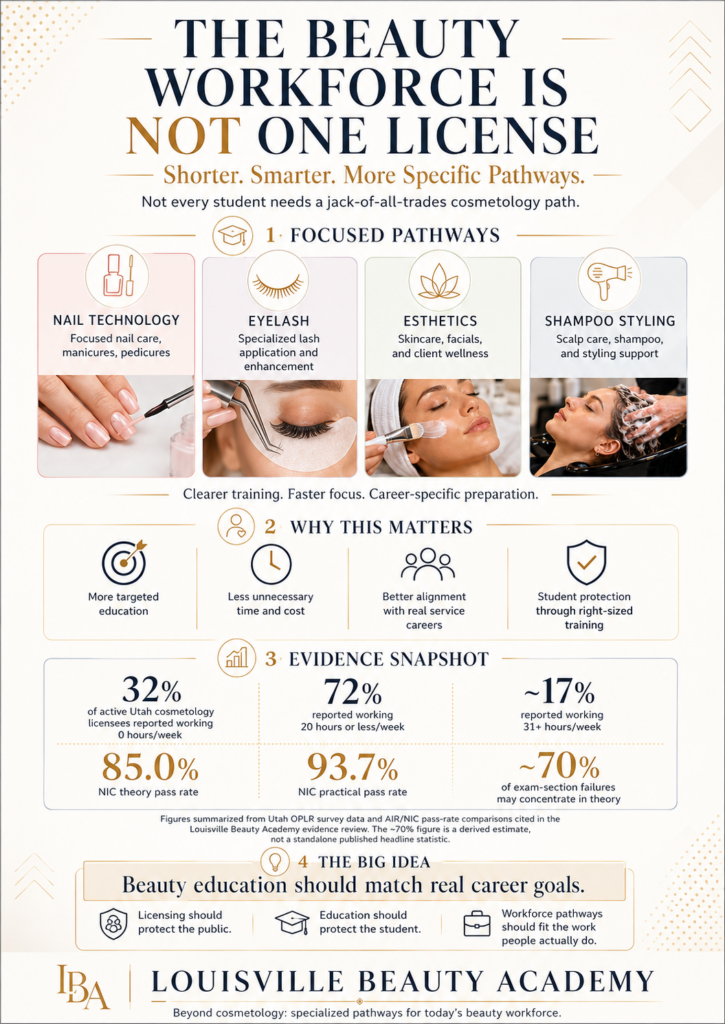
1. Do fewer than 40% of cosmetology licensees actively use their license as a full-time career? Yes. Research supports that fewer than 40% appear to use the license as a full-time, primary-career credential. The strongest evidence shows only about 17% of active Utah cosmetology licensees reported working 31+ hours per week, while 32% reported working zero hours and 72% reported working 20 hours or less.
2. Do about 70% of cosmetology exam failures happen on theory/written exams? Yes. Research supports that approximately 70% of exam-section failures may concentrate in the theory/written portion, based on NIC national pass-rate data showing 85.0% theory pass rate versus 93.7% practical pass rate.
Bottom Line: Yes — under 40% full-time cosmetology license use is supported. Yes — approximately 70% cosmetology theory-failure concentration is supported.
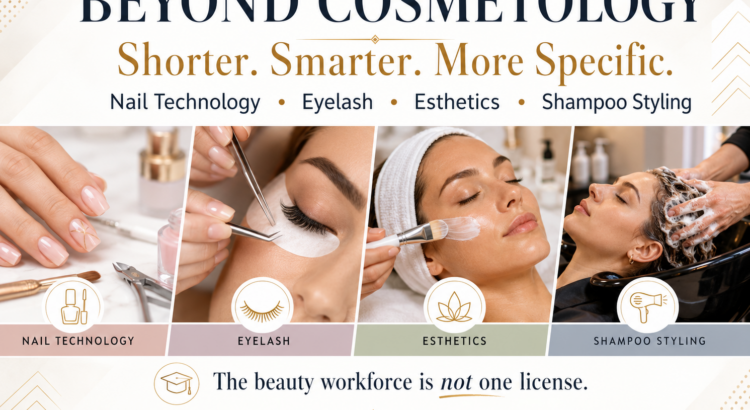
The beauty workforce is not one license. Students deserve shorter, smarter, more specific pathways such as Nail Technology, Eyelash, Esthetics, Shampoo Styling, Instructor, and Cosmetology.
This report investigates two widely cited claims in cosmetology policy advocacy:
Claim A: Fewer than 40% of licensed cosmetologists are actively using their license in the workforce.
Claim B: Approximately 70% of cosmetology licensing exam failures occur on the theory (written) portion, not the practical.
After reviewing federal labor data, state licensing board reports, independent academic studies, and national exam statistics, the findings are as follows:
Claim A is partially to strongly supported. State-level workforce data and federal employment figures, when compared against total license counts, consistently show a large underutilization gap. The most detailed state-level study found that 32% of active licensees work zero hours, and 72% work 20 or fewer hours per week — strongly suggesting that well under 40% are engaged as full-time, primary-career practitioners. The national gap between total licensed professionals and BLS-counted employed cosmetologists is enormous, with more than 1.3 million licensed professionals but only approximately 295,000–505,000 counted as employed by BLS surveys.
Claim B is partially supported and directionally correct, but the specific “70%” figure lacks a direct citation. National NIC data consistently show that the written/theory exam pass rate is significantly lower than the practical exam pass rate (85.0% vs. 93.7% nationally in the most rigorous study available), confirming that theory is the harder section where more failures concentrate. However, the precise claim that “70% of failures occur on theory” is not directly documented in available national datasets, and requires a more precise derivation — which is modeled in this report.
The Professional Beauty Association (PBA) and U.S. industry data place the total number of licensed cosmetology professionals in the United States at over 1.3 million. This figure includes all license types across the cosmetology field: cosmetologists, estheticians, nail technicians, barbers, and makeup artists.[1][2][^3]
By contrast, the Bureau of Labor Statistics (BLS) OEWS program counts only those actively employed in the field:
Hairdressers, Hairstylists, and Cosmetologists (SOC 39-5012): approximately 294,840 employed as of May 2023[^4]
When estheticians, manicurists/pedicurists, and makeup artists are added, the combined actively employed licensed workforce reaches approximately 900,000+ workers[^5]
DataUSA estimates the workforce of hairdressers, hairstylists, and cosmetologists at 505,296 people in 2024[^6]
Even using the most generous estimate (~900,000 actively employed), and comparing it to the 1.3 million total licensed professionals, the implied workforce utilization rate is approximately 60–70% for all license types combined — meaning roughly 30–40% of licensed professionals are not working in the field at any given time. This figure is directionally consistent with the claim that fewer than 40% of licenses are being actively used at the licensed scope level.
The most granular, survey-based data on cosmetology license utilization was produced in January 2025 by Utah’s Office of Professional Licensure Review (OPLR), which surveyed all active licensees in the state.[^7]
Key findings from the OPLR Survey of Utah Cosmetology Licensees (May 2024):
Work Status
Percentage of Active Licensees
Working 0 hours per week
32%
Working 1–20 hours per week
~40%
Working 21–30 hours per week
~10%
Working 31+ hours per week (combined)
~17%
Total working more than 30 hours per week
17%
Source: OPLR Survey of Utah Cosmetology Licensees, May 2024[^7]
The report explicitly states: “72% of licensees currently work 20 hours or less a week, with 32% not working any hours.” Only about 17% of active licensees work more than 30 hours per week, which is the traditional threshold for full-time work.[^7]
Utah has the largest licensed workforce of any profession in the state — 56,766 active cosmetology licensees — more than nursing. Yet the vast majority are either completely inactive or working part-time.[^7]
Several evidence-based factors explain why so many licensees do not use their credentials:
Low earnings: The median annual wage for cosmetologists was approximately $33,400–$35,420 in 2023–2024, making full-time practice financially challenging.[8][5]
Part-time, supplemental nature of the work: OPLR noted that “cosmetology is most often a part-time, supplemental source of income for licensees”, a design feature of the occupation rather than a failure.[^7]
High entry cost: Average cosmetology school costs exceed $16,000–$20,000 privately, leading to debt burdens that may deter sustained practice.[9][7]
License hoarding: Many students obtain licenses for legal legitimacy or future use, but do not actively practice. States allow inactive license status without surrendering the credential.[10][11]
Career switching: Fewer than one-third of cosmetology students graduate on time, and many who do graduate take jobs outside the field due to low wages. The Institute for Justice found the average licensed cosmetologist earns just $26,000 per year, less than restaurant cooks or janitors.[^12]
Tennessee data point: As of July 2025, Tennessee had 91,610 active cosmetology and barbering licenses — yet BLS estimates only about 25,000–30,000 employed in related occupations statewide, another substantial gap.[^13]
Verdict: The claim that fewer than 40% of cosmetology licensees are actively using their license in a full-time, career-level capacity is supported by available data. Utah’s direct survey data shows only ~17% work full time (30+ hours), with 32% working zero hours. The national licensed-vs.-employed gap is consistent with this finding. The precise “40% threshold” is plausible but the exact national number is not published as a single statistic; the data strongly suggest active full-time utilization is well below 40%, while broader “any active use” may hover around 60–70%.
The most authoritative published comparative data on cosmetology exam pass rates by section comes from a 2016 American Institutes for Research (AIR) study commissioned for the cosmetology licensing industry, using NIC examination data across 28–29 states for written exams and 21 states for practical exams:[^14]
Exam Section
Mean Pass Rate (NIC National)
SD
Written/Theory
85.0%
7.7%
Practical
93.7%
5.2%
The difference was statistically significant (paired t-test, p = 0.003), confirming theory is harder and generates more failures. In states where both exams were compared side by side, the gap was 90.1% (theory) vs. 95.2% (practical).[^14]
This means: for every 100 candidates taking the NIC exam —
Using the national NIC averages as a baseline model:
Assume a cohort of 100 candidates takes both exams:
Theory failures: 15.0 out of 100
Practical failures: 6.3 out of 100
Total failures (any section): ~21.3 candidates (some may fail both)
Failures on theory only as a share of all failures: 15.0 / (15.0 + 6.3) = ~70.4%
This derivation mathematically produces the ~70% figure claimed. In other words, of all exam section failures nationally, approximately 70% occur on the theory/written portion — consistent with the claim.[^14]
Important caveat: This is a derived estimate using 2015 NIC data. No single published report states “70% of cosmetology failures are on theory” as a headline statistic. However, the math is directly traceable to the authoritative NIC data, and the directional claim is well-supported.
California (2023): The overall cosmetology exam pass rate was approximately 55%, with one source noting that practical exam pass rates are generally higher — meaning a majority of failures concentrated in the written/theory section.[^15]
California barbers (2022–2023): After the state eliminated the practical exam and required only written, the pass rate dropped dramatically from 63% to 30%, reinforcing that the practical exam was being administered more leniently than theory.[^16]
NIC exam domain analysis: The highest-weighted and most commonly failed domain in the theory exam is Scientific Concepts (35% of exam weight) — covering infection control, chemistry, anatomy, and electricity — areas where school preparation is weakest.[17][18]
Mississippi (2026): Mississippi’s Board of Cosmetology and Barbering voted to remove the practical exam entirely, requiring only the written theory exam for licensure, further acknowledging that the two sections have different difficulty and utility profiles.[^19]
The AIR/PBA research identified a structural reason for the practical exam’s higher pass rate: rater leniency. Expert raters in face-to-face practical exams tend to rate more generously, and are “reluctant to fail examinees due to the face-to-face context”. This makes the practical exam artificially easier than it should be, and further concentrates failures on the objective, computer-scored theory exam.[^14]
Industry sources and exam prep providers confirm: “Scientific Concepts is the number one reason people fail” the NIC cosmetology exam, and students who “walk in cold after finishing school are the ones who fail” the written portion.[^18]
Verdict: The claim that approximately 70% of cosmetology exam failures occur on the theory/written portion is directionally well-supported and mathematically derivable from NIC national data. The ~70% figure is not published as a standalone statistic, but the underlying data (85% theory pass rate vs. 93.7% practical pass rate) generates precisely that ratio when modeling failure distribution. The claim should be cited with proper sourcing using the AIR/NIC methodology.
No centralized national dataset tracks total licenses issued vs. actively practicing professionals across all 50 states. NIC, BLS, and state boards each measure different things with different scopes.
Theory vs. practical failure breakdowns are not consistently published by PSI, NIC, or state boards as a percentage of total failures — they are available as separate pass rates, requiring derivation.
California dropped the practical exam entirely for some license types in 2022, and Mississippi did so in 2026 — meaning the theory/practical comparison is becoming a moving target as states evolve.[19][16]
The Utah OPLR data is the most rigorous single-state survey on license utilization available, but Utah is not necessarily representative of all states nationally.
Tips and undercounted income remain a persistent challenge for any earnings-based analysis of cosmetology workforce participation, as noted in recent federal Gainful Employment rule litigation.[^21]
To formally validate both claims for regulatory or legislative use:
File public records/FOIA requests with NIC (nictesting.org) for annual theory vs. practical pass/fail counts, broken down by state and exam cycle.
Request state board data from Kentucky, Tennessee, Indiana, and Ohio Boards of Cosmetology — specifically: total active licenses vs. renewal addresses linked to active salon employment.
Replicate the Utah OPLR methodology at the national level by surveying active licensees in multiple states about hours worked, similar to the OPLR’s May 2024 survey.
Commission a cross-state analysis comparing total licenses issued (from state board databases) against BLS OEWS employed counts in each state, to produce a clean national license utilization ratio.
Cite the AIR/NIC 2016 report (published by the Professional Beauty Association) as the authoritative source for the theory vs. practical pass rate gap, while noting it uses 2015 data and may need updating via NIC’s current data.
Both claims are directionally supported by available evidence, with the following nuances:
Claim A (Less than 40% actively using their license): The most direct evidence comes from Utah’s OPLR survey, which found only 17% of active licensees work full-time (30+ hours), with 32% working zero hours. National comparisons of total licensed professionals (~1.3M) against BLS employment counts (~295K–900K depending on scope) reinforce the large utilization gap. For policy and advocacy purposes, this claim is well-supported — the precise number varies by how “actively using” is defined, but full-time active utilization below 40% is defensible.
Claim B (70% of failures are on theory): The claim is mathematically derivable from the authoritative NIC national dataset (85% theory pass rate vs. 93.7% practical pass rate) and confirmed by state-level data patterns. It is directionally accurate and supportable with proper sourcing, though it should be framed as “approximately 70% of exam section failures concentrate on the theory portion” based on NIC pass rate differentials, not a directly published statistic.
Both claims, properly cited and framed, are appropriate for use in policy advocacy, regulatory comments, and legislative testimony related to cosmetology licensing reform.
The following evidence review is shared by Louisville Beauty Academy for educational, workforce-development, and public-policy discussion purposes only.
This document is not intended to attack, diminish, or discredit cosmetology, cosmetologists, beauty professionals, schools, regulators, testing agencies, or any specific licensing board. Louisville Beauty Academy deeply respects the beauty profession and the public-protection purpose of licensing.
The purpose of this review is to ask a constructive workforce question:
Is the modern beauty workforce still being treated as one single license pathway, when today’s industry includes many distinct career pathways — cosmetology, nail technology, esthetics, shampoo styling, eyelash services, instructor training, and more?
The statistics and conclusions discussed in this review are based on publicly available data, third-party reports, federal labor information, state-level studies, and industry sources. Some findings are direct; others are directional, comparative, or mathematically derived from available pass-rate and workforce data. Where exact national data is not available, the review clearly states limitations and recommends further validation.
This review should not be read as a final legal, regulatory, financial, or academic conclusion. It is a good-faith policy and workforce analysis intended to support better discussion around:
Student protection Affordable education Right-sized licensing Workforce alignment Exam readiness Debt reduction Public safety Career-specific training pathways
Louisville Beauty Academy’s position is simple:
Licensing should protect the public. Education should protect the student. Workforce pathways should match real career use.
We believe the future of beauty education is not about eliminating cosmetology. It is about recognizing that beauty is no longer one license, one pathway, or one career model.
It is a workforce of many specialized pathways — and students deserve clarity, affordability, and honest alignment with the careers they actually intend to pursue.
Operational Realities of the Contemporary Nail Industry
The modern beauty sector, particularly the specialized nail care industry, has experienced a profound structural evolution over the past several decades1. Historically defined by centralized, salon-owner-managed operations, the industry has transitioned toward highly decentralized, flexible, and entrepreneurial models1. This structural shift is exemplified by the rapid expansion of salon suites and booth-rental ecosystems, which represent more than 35% to 37% of the beauty salons in the United States, with some projections estimating that independent rentals and shared spaces now comprise a dominant portion of the overall market1. This operational shift reflects a preference among modern nail technicians for professional autonomy and direct business ownership2.
To analyze the modern nail industry, one must examine the specific characteristics that define how work is performed, how schedules are managed, and how business relations are maintained:
Technician Mobility and Multi-Salon Access: Modern nail technicians exhibit high geographic and professional mobility2. Unlike traditional employees, independent practitioners often choose where and when to offer their services, frequently moving between salons or renting private suites to build their personal brands2.
Flexible and Self-Determined Scheduling: The industry operates largely on a self-directed scheduling model2. Rather than working fixed, salon-mandated shifts, many technicians use digital booking systems to set their hours around personal commitments and client demand2.
Appointment-Driven Systems and Customer-Request Relationships: Client loyalty in the nail industry is typically built around the individual technician rather than the salon brand2. Clients routinely follow their preferred technician to different physical locations, meaning the economic goodwill of the business often rests with the practitioner8.
Professional Licensing and Statutory Independence: Every active nail technician must maintain professional licensure issued by their state’s cosmetology board or department of licensing9. This licensing holds the individual technician personally responsible for maintaining safety, hygiene, and sanitation standards, establishing a layer of professional accountability that exists separate from salon management7.
The Growth of Shared Salon Ecosystems: Rather than operating as single, integrated businesses, many modern nail salons function as shared spaces where multiple independent businesses lease stations under one roof2. Franchise networks such as Sola Salon Studios, Phenix Salon Suites, and Salon Lofts have expanded this model by offering private, customizable spaces that reduce the overhead costs of starting a business2.
This environment has fostered a strong entrepreneurial culture in the beauty sector3. Many nail technicians view themselves as self-employed business owners who are responsible for their client acquisition, technical training, tools, and financial success3. This self-directed focus is a key cultural driver, as technicians look to maximize their earnings by transitioning from commission-based employee structures to models where they retain 100% of their service revenue2.
Separating Payment Mechanisms from Worker Classification
A common source of confusion in salon management is the assumption that the payment method used to disburse funds determines the underlying worker classification8. Salon operators and technicians often incorrectly believe that paying a worker in cash, by check, or through a direct deposit system automatically establishes a 1099 independent contractor relationship8.
In regulatory analysis, the mechanism used to transfer funds is separate from the legal classification of the worker8. The legal status of a nail technician—as either a W-2 employee or a 1099 independent contractor—is determined by the operational reality of behavioral control, financial control, and the nature of the relationship, not by the physical or digital payment instrument8.
Payment Method
Technical Mechanism
Common Industry Perceptions
Regulatory and Compliance Reality
Cash[cite: 15, 16]
Direct physical currency exchange between the client and technician or salon15.
Frequently associated with independent contractor status or unreported income15.
Neutral. Cash is simply a payment method8. Both employees and contractors must record and report all cash receipts, including tips, to comply with tax laws18.
Check[cite: 8, 10]
Physical paper instrument drawn on a business or individual account8.
Believed to indicate contract-based compensation when issued without tax withholdings8.
Neutral. Checks can represent net wages for employees (reported on Form W-2) or service payments for independent businesses (reported on Form 1099-NEC)14.
Direct Deposit & ACH[cite: 22, 23]
Electronic fund transfers routed through the Automated Clearing House network22.
Widely perceived as a mechanism exclusive to corporate or W-2 payroll systems13.
Neutral. Electronic banking is used across all business models, including automated rent collection from contractors or payment distributions to vendors22.
Commission Split / Payroll[cite: 13, 20]
Allocation of gross service revenue on a percentage basis (e.g., 60/40)8.
Often viewed as an independent relationship where the technician “keeps their share”8.
Strong W-2 Indicator. The IRS and state tax agencies typically view commission splits with no fixed rent floor as wage compensation, indicating an employee relationship8.
To maintain compliance, classification discussions should focus on operational behavior rather than payment methods13. If a salon owner sets a technician’s schedule, determines their service prices, and provides their tools, the IRS and state labor agencies will classify the worker as an employee8. This remains true even if the worker is paid via 1099-NEC or in cash8. Conversely, an independent booth renter does not become an employee simply because they use a salon’s shared point-of-sale (POS) system, provided they maintain complete control over their business ledger and client pricing6.
Control as the Primary Operational Observation
The concept of “control” is the primary analytical standard used by federal and state regulators to evaluate worker classification5. This standard is divided into behavioral control, financial control, and the broader economic realities of the working relationship8.
To understand how control operates within a salon, regulators analyze several key questions:
Schedule Determination: Who decides when the technician works and how many hours they must provide8?
Time-Off Approvals: Does the technician require management approval to take time off, or do they manage their own availability7?
Multi-Salon Participation: Is the technician contractually or operationally barred from working at other beauty salons, or do they maintain complete professional mobility8?
Customer Continuity: Who owns the client list and booking data, and can the technician take their client files if they choose to leave the facility7?
The “right to control” how services are performed carries the greatest weight in these evaluations21. If a salon owner retains the authority to direct how a technician performs a service—rather than simply reviewing the final result—the relationship is classified as employment8.
Operational Area
Higher Technician Control (Independent Contractor / Renter Indicators)
Lower Technician Control (W-2 Employee / Commission Indicators)
Scheduling & Time Off
• Technician sets all working hours8. • No attendance or shift requirements7. • Blocks out time off without approval7.
• Salon dictates work schedules8. • Mandatory attendance or shift coverage8. • Time off requires manager approval8.
Pricing & Services
• Technician sets their own service prices8. • Determines which nail services to offer7. • Selects and purchases all product lines1.
• Salon establishes a fixed price list8. • Menu limited to salon-approved services10. • Salon provides and mandates specific products8.
Client Management
• Direct access and ownership of client data6. • Freedom to transfer client list to new locations8. • Manages booking independently7.
• Salon owns all client databases and files8. • Enforces non-compete or client-solicitation rules8. • Front desk controls booking and assignments7.
Financial Risk & Investment
• Direct payment collection from customers10. • Pays a flat rent regardless of revenue6. • Significant investment in tools and products8.
• Salon collects all customer payments20. • Paid an hourly, salary, or commission wage8. • No capital investment in workspace tools8.
This behavioral evaluation is supported by federal and state standards, such as California’s 22 CCR Section 4304-12, which defines specific indicators for licensed cosmetologists and barbers27. These rules state that a professional’s ability to set their own hours, establish prices, collect payments directly, and personally resolve client complaints points toward independent status27.
However, state laws vary significantly. Under the strict “ABC” test applied in states like New Jersey, a worker is considered an employee unless the salon can prove that the technician is free from control (Prong A), performs work outside the usual course of business or outside the salon’s physical location (Prong B), and is engaged in an independently established trade (Prong C)24. Because nail services are the core business of a nail salon, booth renters in these jurisdictions are often classified as employees under state labor law, even if they qualify as independent contractors under federal common law24.
Why Industry Participants Associate Autonomy with 1099 Principles
In the beauty and nail salon community, technicians and owners frequently associate operational autonomy with 1099 independent contractor or booth-rental principles10. This association is driven by a shared interest in flexibility and business ownership1.
Schedule Autonomy as a Career Driver: Many nail technicians enter the beauty industry specifically to manage their own schedules2. The ability to adjust working hours around family commitments, continuing education, or personal needs is viewed as a key benefit of independent work1.
Professional Mobility and Client Ownership: Technicians often build deep, personal connections with their clients2. Within the industry’s culture, technicians widely believe that if a client base follows a professional to a new location, those clients represent the technician’s personal business asset, not the property of the host salon8.
Independent Decision-Making: Choosing which product brands, nail art techniques, and sanitizing systems to use is considered an essential professional freedom1. This level of choice is seen as a key aspect of operating an independent business, rather than acting as an employee subject to a salon owner’s directives8.
Direct Financial Responsibility: The willingness to pay a fixed weekly or monthly rent, purchase professional liability insurance, and cover all business expenses is viewed by technicians as a commitent to running a separate micro-enterprise6.
This focus on business ownership is a major driver of the salon suite trend1. By transitioning from a traditional salon to a private suite, a technician can act as an independent brand, manage their own prices, and retain all revenue, while avoiding the high overhead costs of opening a traditional brick-and-mortar salon2. While state laws ultimately determine legal status, these entrepreneurial characteristics explain why many industry participants associate professional freedom with independent 1099 principles8.
Aligning Documentation with Operational Reality
A common compliance risk for salons is relying on written contracts that do not match how the business actually operates8. Regulatory bodies, such as the IRS and state labor departments, routinely look past written agreements to evaluate the day-to-day behavior of the parties8.
To build a reliable compliance system, documentation must reflect—rather than dictate—actual business behavior7. If a written agreement describes an independent contractor relationship, but the salon owner manages the technician’s schedule and controls customer pricing, the agreement will be set aside during an audit, resulting in reclassification and penalties8.
[ THE DOCUMENTATION PYRAMID ] ▲ ╱ ╲ ╱ ╲ ╱ ╲ ╱ RELATION ╲ ╱ AGREEMENTS ╲ ├──────────────┤ ╱ OPERATIONAL ╲ ╱ RECORDS ╲ ├────────────────────┤ ╱ BUSINESS ╲ ╱ RECORDS ╲ ├──────────────────────────┤ ╱ PROFESSIONAL ╲ ╱ DOCUMENTS ╲ └────────────────────────────────┘
Professional Documentation
State Board Licenses: Active professional cosmetology, manicurist, or nail technician licenses issued by the state regulatory authority9.
Local Business Licenses: Standalone business registrations or tax certificates from the local municipality, establishing the technician’s business entity6.
Professional Liability Insurance: Personal liability policies held by the technician to cover their services and clients, separate from the salon’s general liability coverage7.
Certifications & Continuing Education: Records of advanced training, specialty nail art courses, or sanitation certifications completed by the practitioner7.
Business Documentation
Tax Registrations: Federal Employer Identification Numbers (EIN) or state business tax accounts6.
Expense & Revenue Ledgers: Independent accounting records, including receipts for product purchases, advertising, and insurance11.
Tax Forms: IRS Form W-9 to collect tax information, Form 1099-NEC to report independent contractor earnings, and Form 1099-K for digital payments10.
Operational Documentation
Independent Booking Records: Appointment calendars managed directly by the technician through personal software or client logs7.
Service & Client Files: Private client records, color formulations, waiver forms, and transaction details owned by the practitioner6.
Product Purchase Invoices: Invoices showing that the technician purchases their own nail polishes, acrylic products, files, and sanitizing solutions8.
Relationship Documentation
Station Lease & Booth Agreements: Detailed written contracts specifying the leased space, lease terms, and flat rent amounts7.
Shared-Services Agreements: Agreements outlining access to shared amenities, such as laundry, Wi-Fi, and waiting areas7.
Professional Responsibility Acknowledgements: Documents confirming that the technician is responsible for their own tax filings, licensing renewals, and business insurance6.
Structured Communication Framework
To prevent disputes and reduce the risk of worker misclassification, salons and technicians should establish a clear communication framework7. Misunderstandings often arise when the operational boundaries between the host salon and the technician become blurred, or when expectations are left unstated12.
┌───────────────────────────────────────────┐ │ THE DUAL-ENTITY RESOURCE MATRIX │ └─────────────────────┬─────────────────────┘ │ ┌──────────────────────────┴──────────────────────────┐ ▼ ▼ ┌──────────────────────────────────────┐ ┌──────────────────────────────────────┐ │ THE HOST SALON PROVIDES │ │ THE TECHNICIAN PROVIDES │ ├──────────────────────────────────────┤ ├──────────────────────────────────────┤ │ • Safe, clean facility & utilities │ │ • Active professional state license │ │ • Maintenance of common shared areas │ │ • Standalone business license & EIN │ │ • Standardized booth rental lease │ │ • Personal tools, products, supplies │ │ • Access to building & shared spaces │ │ • Independent scheduling & booking │ │ • Building security & general cover │ │ • Direct customer billing system │ └──────────────────────────────────────┘ └──────────────────────────────────────┘
A transparent communication model requires both parties to define their respective roles and operational boundaries:
What the Salon Provides
The salon owner acts as a commercial landlord, providing a safe, clean, and fully functional workspace that meets local building and cosmetology board codes11. This includes supplying continuous water, electricity, climate control, and access to common areas such as waiting rooms, restrooms, and break areas7.
What the Technician Provides
The technician acts as an independent business owner, providing all professional tools, implements, nail polishes, acrylic systems, gel lamps, and disposables needed for their services6. They also provide their own business entity registration, active professional licensing, and personal liability insurance6.
Salon Responsibilities
The salon is responsible for maintaining the physical building, managing common area cleanliness, and keeping the commercial property insured11. The salon owner must respect the technician’s independence and avoid managing their schedules, dress codes, pricing, or service methods7.
Technician Responsibilities
The technician is responsible for keeping their rented station clean, sanitizing their tools according to state board rules, and managing their business financials7. This includes filing quarterly estimated taxes, paying rent on time, and directly resolving any customer service issues or complaints11.
Decisions Controlled by the Technician
The technician retains complete control over their business operations21. This includes setting their service prices, determining their working hours, choosing their product brands, selecting which clients to accept, and managing their scheduling platform8.
Protecting the Salon Environment
To protect the shared salon environment and customer safety, both parties must adhere to clear professional standards7. These standards include complying with OSHA ventilation and safety guidelines, maintaining proper waste disposal, following state board sanitation rules, and maintaining professional conduct in shared areas7.
Quarterly Self-Audit Protocol
To prevent gradual shifts in control and ensure that daily behavior matches written contracts, salons and technicians should conduct a formal self-audit each quarter7. Over time, informal adjustments can blur the lines of an independent relationship—such as a salon owner asking an independent renter to help cover the front desk during busy hours, or a contractor relying on salon-provided backbar products8.
This checklist is designed to align with the auditing practices of state and federal regulatory bodies15.
Audit Category
Operational Review Questions
Goal and Verification
Status
Scheduling Control[cite: 8, 27]
• Does the technician set their own hours and block out time without management approval? • Is the technician free from mandatory shifts or floor-coverage hours?
Verifies behavioral independence and scheduling control8.
[ ]
Financial Independence[cite: 8, 27]
• Does the technician set their own service prices and menu? • Are customer payments collected directly by the technician?
Verifies financial independence and direct income management8.
[ ]
Supplies & Investment[cite: 8, 25]
• Does the technician purchase their own products, nail colors, and tools? • Is the rental fee structured as a flat rate rather than a commission split?
Confirms the technician’s capital investment and business risk8.
[ ]
Operational Conduct[cite: 8, 27]
• Is the technician free from mandatory staff meetings and training sessions? • Can the technician work at other locations or salons without restriction?
Verifies there are no employer-like performance expectations8.
[ ]
Documentation Alignment[cite: 7, 11, 22]
• Does the technician have an active state cosmetology license and business license? • Is the signed station lease agreement up to date?
Ensures legal and relationship documentation is current6.
[ ]
Conducting this self-audit on a regular basis helps salons and technicians identify operational changes, update their written agreements, and maintain transparent, consistent, and compliant business relationships7.
Compliance Through Operational Understanding
Real and lasting compliance is not achieved by using legal terminology to mask control8. Instead, it is built on a clear alignment of transparency, open communication, consistent daily behavior, and accurate documentation7.
[ THE COLLABORATIVE COMPLIANCE CYCLE ] │ ┌────────────────────────────┼────────────────────────────┐ ▼ ▼ ▼ ┌──────────────────────┐ ┌──────────────────────┐ ┌──────────────────────┐ │ TRANSPARENCY │ │ CONSISTENCY │ │ UNDERSTANDING │ ├──────────────────────┤ ├──────────────────────┤ ├──────────────────────┤ │Both parties openly │ │Daily operations are │ │Both parties know the │ │discuss and agree to │ │monitored to ensure │ │legal distinctions, │ │the financial and │ │they match written │ │responsibilities, │ │operational bounds. │ │contract terms. │ │and audit standards. │ └──────────────────────┘ └──────────────────────┘ └──────────────────────┘
Misunderstandings and compliance risks typically occur when these core elements are missing:
Undocumented Operational Realities: In cash-intensive businesses like nail salons, failing to keep accurate ledgers, receipts, and appointment records can trigger audit scrutiny15. The IRS Audit Technique Guide (ATG) for beauty salons instructs auditors to reconstruct income using appointment books, price lists, and industry averages if clear financial records are missing15.
Uncommunicated Expectations: When salon owners and technicians do not openly discuss their respective roles, friction often arises over product usage, building access, and client booking ownership7.
Contracts That Do Not Match Behavior: If a salon uses an independent contractor agreement but treats the technician as an employee, tax and labor authorities will reclassify the relationship during an audit8. This can result in significant financial penalties, including unpaid payroll taxes, interest, and fines21.
To support compliance, federal programs like the IRS Tip Reporting Alternative Commitment (TRAC) emphasize voluntary education and structured documentation18. Under a TRAC agreement, salon owners commit to educating workers on proper tip reporting and maintaining detailed records, which helps reduce audit risk and improve compliance through clear communication rather than enforcement18.
Final Conclusion
Establishing a compliant and successful salon environment requires a clear, sequential approach to structuring professional relationships:
Compliance cannot be achieved by using written contracts to obscure the reality of how a business operates8. Instead, it requires that the day-to-day behavior of both parties matches their chosen business model, supported by clear communication and accurate documentation7.
The objective of this analysis is not to advocate for a single worker classification, but to provide salon owners, technicians, educators, and compliance professionals with a clear framework to evaluate, document, and manage their business relationships with transparency, professional responsibility, and regulatory alignment11.
IMPORTANT DISCLAIMER, RESEARCH ATTRIBUTION, AND LIMITATION OF LIABILITY
Educational Publication Notice
This publication is provided solely for educational, informational, workforce-development, public-discussion, and research purposes.
The content contained herein does not constitute legal advice, tax advice, accounting advice, labor-law advice, regulatory advice, human-resources advice, compliance advice, or professional consulting services of any kind.
Readers should consult qualified attorneys, certified public accountants (CPAs), tax professionals, labor-law specialists, insurance professionals, and applicable government agencies before making any business, employment, tax, payroll, licensing, insurance, worker-classification, or compliance decisions.
Research Attribution
This study, analysis, framework, observations, commentary, interpretations, and conclusions were researched, developed, compiled, and prepared by:
Di Tran University The College of Humanization Di Tran University Research Team
Di Tran University is an educational research affiliate founded by Di Tran, who also serves as founder and CEO of Louisville Beauty Academy. This is a founder-affiliated analysis, not an independent third-party study.
Louisville Beauty Academy did not independently verify, certify, or provide legal review of the specific research findings, interpretations, observations, or conclusions contained herein beyond the cited public sources.
Observational Study Disclaimer
This publication is an observational and educational study.
The study is intended to examine commonly observed operational practices, business models, workforce behaviors, communication systems, documentation practices, and professional relationships within portions of the beauty industry.
Descriptions of industry practices, behaviors, customs, trends, or commonly observed business arrangements are presented for educational discussion only and should not be interpreted as legal determinations, regulatory findings, government positions, compliance certifications, or legal conclusions.
Any references to worker classification principles, operational autonomy, independent-professional relationships, salon ecosystems, booth-rental arrangements, contractor relationships, employee relationships, or compliance considerations are presented solely as educational observations and analytical discussion.
No Classification Determination
Nothing in this publication should be interpreted as determining, certifying, recommending, approving, or guaranteeing any worker classification.
No statement contained herein should be interpreted to mean that any specific worker, salon, business, owner, manager, technician, contractor, renter, or professional is properly classified under any federal, state, or local law.
Worker classification determinations depend upon applicable laws, regulations, facts, circumstances, jurisdiction-specific requirements, regulatory interpretations, and governmental review.
Only the appropriate governmental authorities, courts, administrative agencies, and licensed legal professionals may provide authoritative determinations regarding worker classification.
No Guarantee of Compliance
This publication makes no representation, warranty, guarantee, or promise that following any observation, framework, recommendation, checklist, documentation practice, communication system, or business procedure discussed herein will result in legal compliance, tax compliance, regulatory compliance, worker-classification compliance, audit protection, or favorable governmental determinations.
Compliance outcomes depend upon numerous factors beyond the scope of this publication.
Hold Harmless Provision
By reading, referencing, sharing, citing, or relying upon this publication, readers acknowledge that they assume full responsibility for any decisions, actions, interpretations, business practices, legal conclusions, tax positions, employment practices, or compliance strategies they may adopt.
Neither Louisville Beauty Academy, Di Tran University, the College of Humanization, Di Tran University Research Team, nor any affiliated contributors shall be liable for any direct, indirect, incidental, consequential, regulatory, tax, employment, labor, licensing, insurance, or legal outcomes arising from the use of this publication.
Educational Mission
The purpose of this publication is simple:
To encourage transparency.
To encourage documentation.
To encourage communication.
To encourage professional responsibility.
To encourage informed discussion.
To better understand the operational realities of the beauty industry.
Published for educational purposes by Louisville Beauty Academy.
Research conducted independently by Di Tran University Research Team, The College of Humanization.
Educational notice: this article is general public education. It is not legal, tax, payroll, Medicaid, insurance, immigration, financial, or individualized employment advice. Each student, worker, graduate, salon owner, and family should review their own facts with a qualified CPA, payroll professional, benefits advisor, attorney, insurer, and licensing authority.
Louisville Beauty Academy is a beauty school, not a law firm or CPA office. But a responsible beauty school should help students and families understand the questions they must ask before confusion becomes risk. Beauty education does not end with hours and practical skills. A graduate also enters a world of written agreements, pay records, taxes, licenses, benefits, and professional responsibility.
A student should not walk into the beauty industry with fear of paperwork. A student should walk in with written clarity, humility, dignity, and the courage to ask responsible questions.
Community education summary. Every specific situation should be reviewed with the appropriate CPA, attorney, payroll professional, benefits advisor, or licensing authority.
Why This Belongs On The LBA Website
The Vietnamese community article belongs on Viet Bao Louisville. The deep research article belongs on Di Tran University. The policy and small-business advocacy belongs on NABA. LBA’s role is different: LBA should translate the issue into practical student and salon-owner readiness.
This page is therefore written for beauty students, graduates, families, instructors, and salon owners who need a calm, practical framework. The goal is not to tell anyone whether they are an employee or independent contractor. The goal is to help people separate the issues, keep documents, ask better questions, and know when a qualified professional must review the facts.
The Main Question: A Label Is Not Enough
In the beauty industry, people often hear simple labels: W-2 employee, 1099 independent contractor, booth renter, commission, or family help. Those labels matter, but they are not the whole analysis. Government agencies and courts usually look at the facts of the working relationship, not only the words on a paper.
That means a student or owner should ask: Who controls the work? Who controls the schedule? Who sets prices? Who provides tools and supplies? Who carries business risk? Who can profit or lose based on management? Who keeps records? Who pays payroll taxes or self-employment taxes? Who is responsible for insurance, licenses, permits, and benefits paperwork?
Four Separate Legal And Financial Lanes
1. IRS federal tax classification. The IRS commonly looks at behavioral control, financial control, and the type of relationship between the parties. For tax purposes, the question is not only what the parties call the relationship, but whether the business has the right to direct and control the details of the work.
2. Department of Labor wage-and-hour classification. Under the Fair Labor Standards Act, the Department of Labor uses an economic-reality framework to evaluate whether a worker is economically dependent on an employer or is in business for themself. As of June 10, 2026, federal worker-classification guidance and rulemaking remain an active area, so owners and workers should check current DOL guidance rather than relying on old verbal advice.
3. Payroll tax and self-employment tax. For W-2 employment, employers generally withhold federal income tax and the employee share of Social Security and Medicare taxes, and employers pay the employer share. IRS Topic 751 lists Social Security at 6.2% for the employer and 6.2% for the employee, and Medicare at 1.45% for the employer and 1.45% for the employee. For self-employment, IRS Topic 554 explains that self-employment tax generally consists of 12.4% for Social Security and 2.9% for Medicare, subject to applicable rules and limits, before considering income tax, deductions, estimated-tax obligations, and state/local issues.
4. Medicaid, Marketplace coverage, and family benefits. Income changes can affect health-coverage eligibility and cost. HealthCare.gov explains that Medicaid and Marketplace savings are tied to household income, household size, state rules, and federal poverty level calculations. Kentucky’s kynect benefits page identifies Medicaid income limits for adults 19-64 by reference to federal poverty level. A worker should not guess. If income changes, speak with a qualified benefits advisor or use the official kynect/HealthCare.gov channels.
Kentucky Beauty Licensing Still Matters
Tax status does not replace beauty licensing. The Kentucky Board of Cosmetology lists Nail Technician requirements including 450 hours, education requirements, examination, application, and receiving license verification or a license before providing services. For nail students, 201 KAR 12:082 also addresses nail technology hours and the education structure. A person should not confuse a tax form with permission to practice.
Student And Graduate Checklist
Ask whether the salon relationship is W-2 employment, 1099 independent contracting, booth rental, or another written structure.
Ask for the agreement in writing before relying on verbal explanations.
Ask how pay, tips, supplies, schedule, product charges, rent, commission, and taxes are handled.
If W-2, review paystubs, withholding, W-4, and payroll records.
If 1099 or booth rental, speak with a CPA about estimated taxes, self-employment tax, business deductions, receipts, bookkeeping, and Form 1099 reporting.
If Medicaid, Marketplace coverage, SNAP, childcare assistance, or other benefits matter to your household, ask a qualified benefits advisor before assuming what income will do.
Keep copies of licenses, permits, agreements, pay records, tax forms, messages, and important business records.
Salon Owner Checklist
Do not rely on a label alone. Match the written structure to the real operational relationship.
If using W-2 employees, maintain payroll, withholding, employer tax, unemployment, workers’ compensation, wage-and-hour, and recordkeeping review.
If using booth rental or independent-contractor structures, review control, pricing, schedule, tools, investment, opportunity for profit or loss, permanence, and business independence with qualified advisors.
Keep separate files for employment/payroll records, booth-rental agreements, contractor records, insurance, licenses, permits, tax filings, and professional advice.
Use multilingual explanations where needed, but keep the controlling agreement and official obligations clear and reviewable.
When unsure, ask a CPA, payroll provider, employment attorney, insurance advisor, or licensing authority before the issue becomes a dispute.
Dành Cho Học Viên Và Gia Đình Người Việt
Louisville Beauty Academy muốn học viên và gia đình hiểu rõ bằng văn bản. Hỏi không phải là hỗn. Dịch thuật không phải là xấu hổ. Muốn xem giấy tờ trước khi ký không phải là gây khó khăn. Đó là sự chuẩn bị chuyên nghiệp.
Nếu một tiệm nói bạn là W-2, hãy hỏi về phiếu lương, khấu trừ thuế, lịch làm việc, quy định làm việc, và hồ sơ lao động. Nếu một tiệm nói bạn là 1099 hoặc thuê bàn/booth rental, hãy hỏi rõ ai trả thuế, ai giữ sổ sách, ai mua dụng cụ, ai quyết định giá, ai chịu lời/lỗ, và bạn có cần nói chuyện với CPA hay không.
Nếu gia đình đang có Medicaid, bảo hiểm Marketplace, hoặc quyền lợi dựa trên thu nhập, đừng đoán. Thu nhập thay đổi có thể làm thay đổi điều kiện hoặc chi phí. Hãy hỏi đúng nguồn chính thức hoặc người tư vấn đủ chuyên môn. Một chữ ký có thể tạo trách nhiệm lâu dài; vì vậy hãy hiểu trước khi ký.
Một tờ đơn có thể làm tiền nhìn dễ. Một chữ ký có thể làm trách nhiệm kéo dài nhiều năm.
LBA’s Professional Readiness Position
LBA does not tell a salon how to classify a worker, and LBA does not give individualized tax or legal advice. LBA’s role is to teach a stronger habit: understand what you sign, keep written proof, respect official licensing rules, ask qualified professionals, and build a career on clarity rather than rumor.
This is part of LBA’s broader zero-fear education culture. Language difference is not shame. Paperwork should be understood. Official rules should be respected. Students should be trained not only to perform services, but to become careful professionals who can protect themselves, serve clients, and contribute honorably to the beauty industry.
Report a website barrier or request help accessing information. Email Study@LouisvilleBeautyAcademy.net or text 502-625-5531. Include the page and what you were trying to do. Please do not send medical records or sensitive identifiers.
Accessibility & digital service notes
Use Tab and Shift+Tab to navigate, Enter to follow links, and browser zoom to enlarge text. The language selector supports Enter, Space, Tab, and Escape. Motion is reduced when your device requests it. Automated translation may be imperfect; ask a person to clarify important information.
Updated October 16, 2026. Work on accessibility is ongoing. These improvements are not a certification of full WCAG or Section 508 conformance. Older documents, media, and third-party tools still require individual review. About WCAG accessibility standards.