Louisville Beauty Academy is preserving this record for one simple reason: ethical beauty education deserves to be seen, documented, and discussed at every level where workforce policy is shaped.
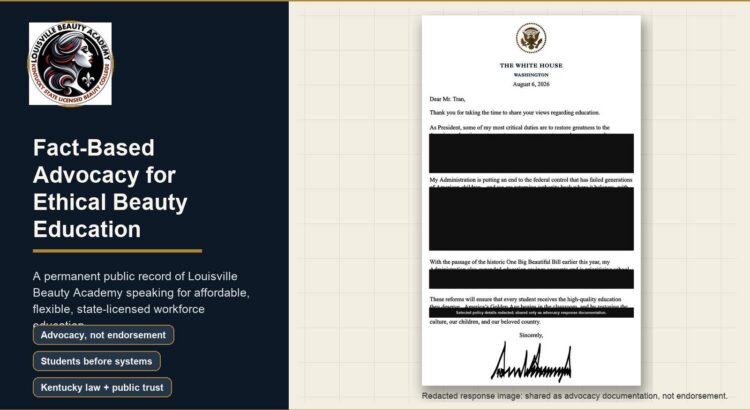
In August 2026, Louisville Beauty Academy received a written response after submitting fact-based advocacy through the official White House / President contact channel regarding beauty education, student access, workforce training, affordability, and public trust. The response is shared only as documentation that the advocacy was submitted and answered. It is not shared as an endorsement, political statement, agency approval, funding approval, accreditation action, or special government status.
That distinction matters. Public advocacy should be truthful enough to preserve, careful enough to withstand review, and humble enough to avoid claiming more than the record supports.
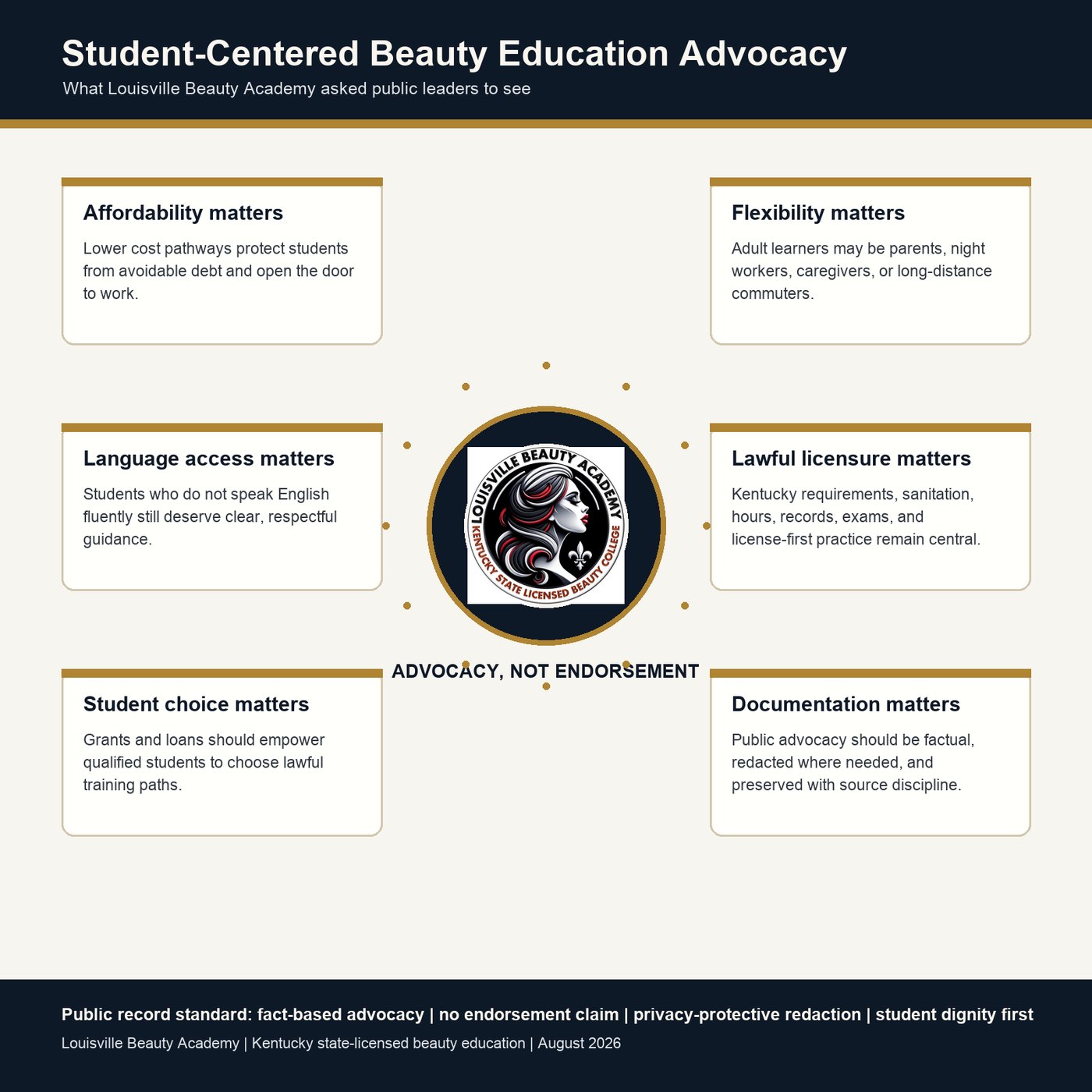
Why This Record Matters
Beauty education is often discussed as a narrow industry issue. At Louisville Beauty Academy, we see something larger: it is a workforce-access issue, a language-access issue, a family-stability issue, and a dignity issue.
Many students who choose a licensed beauty pathway are not traditional full-time college students with perfect transportation, unlimited English fluency, easy childcare, or a financial cushion. They may be adults changing careers. They may be immigrants or first-generation Americans. They may be single parents. They may work at night, drive rideshare, serve tables, work in bars or salons, care for family members, or travel long distances from smaller Kentucky communities into Louisville because they are trying to build a lawful, skilled, service-based future.
For those students, affordability is not a marketing phrase. It is often the line between access and exclusion.
The Ethical Position
Louisville Beauty Academy’s advocacy begins with a student-centered standard:
- education should be aligned with Kentucky law and public safety;
- students should receive clear written expectations before they commit;
- cost should be understandable, reasonable, and controlled;
- language support and patient explanation should be treated as institutional responsibility;
- students with disabilities, family obligations, transportation barriers, or work schedules should be served with dignity where lawful and feasible;
- licenses should be earned through documented education, examination, and regulatory compliance; and
- public aid, grants, loans, and policy tools should strengthen student choice and student protection, not trap students in unaffordable systems.
That is the heart of the advocacy. Not special treatment. Not a shortcut. Not a request to lower standards. The opposite: make the pathway lawful, transparent, affordable, flexible, and accountable so real students can complete it without being crushed by confusion or cost.
Law First, Then Opportunity
Kentucky’s beauty licensing framework is real and specific. The Kentucky Board of Cosmetology publishes license requirements for cosmetologists, nail technicians, estheticians, shampoo and style services, and apprentice instructors, including required hours, education documentation, examination, application, and license verification before providing services. Kentucky administrative regulations also describe education requirements, school administration, instructional hours, law-and-regulation instruction, and curriculum areas.
That is why Louisville Beauty Academy does not frame affordability as a way around regulation. Affordability must live inside the lawful pathway. Flexibility must respect hours, safety, sanitation, documentation, examination, and licensure. Student support must strengthen compliance, not weaken it.
The Students This Advocacy Speaks For
This advocacy is for the student who does not speak English confidently but still wants a lawful career. It is for the student who drives from outside Louisville because a licensed pathway in beauty may be one of the most realistic bridges into skilled work. It is for the single parent trying to study while paying rent. It is for the person working overnight, driving rideshare, or taking service jobs to pay tuition. It is for the learner with a disability who deserves patience, structure, and a school that treats dignity as operational, not decorative.
It is also for families, workforce partners, policymakers, and regulators who need to see that small licensed schools can be serious public-interest institutions when they keep records, publish standards, control claims, and put students before prestige.
School Choice Must Mean Student-Controlled Choice
School choice is strongest when it is student-centered. That means the student should be able to compare programs, understand cost, verify legal requirements, evaluate time commitment, and choose a lawful training path that fits real life. Where grants, loans, public programs, or private financing exist, the ethical question should always be: does this help the student make a better choice, or does it simply move money through a system the student does not control?
Louisville Beauty Academy’s position is that funding structures should protect student agency, price transparency, documentation, and completion accountability. The student should never be treated as a passive object inside someone else’s revenue model.
Why We Preserve the Letter
The redacted response image is preserved here because documentation matters. It shows that Louisville Beauty Academy did not merely complain privately or speak in slogans. The school submitted a public-policy concern through an official civic channel and received a response. That is the exact claim being made, and no more.
The visible image has been redacted where appropriate for privacy, context control, and responsible public use. Redaction is not a sign of fabrication. It is a sign that public documentation can be both transparent and disciplined.
What This Article Does Not Claim
This article does not claim that the White House, the President, the U.S. Department of Education, the Kentucky Board of Cosmetology, or any government agency endorsed Louisville Beauty Academy. It does not claim funding approval, regulatory approval, accreditation action, legal victory, guaranteed licensure, guaranteed employment, guaranteed income, or guaranteed student outcome.
It claims something narrower and stronger: Louisville Beauty Academy engaged in fact-based advocacy for ethical, affordable, flexible, state-licensed beauty education, and received a response. That record now belongs in the permanent public archive.
The Continuing Commitment
Louisville Beauty Academy will continue to align workforce education with Kentucky state law, federal guidance where applicable, written documentation, affordability, student dignity, public trust, and the principle of elevating one life at a time.
We are grateful for every response that acknowledges the importance of education. More importantly, we remain committed to the work itself: serving students with love, care, structure, affordability, flexibility, and truth.
References and Source Notes
- Kentucky Board of Cosmetology, public mission and licensing pages: https://kbc.ky.gov/Pages/index.aspx and https://kbc.ky.gov/Licensure/Pages/License-Requirements.aspx
- Kentucky Administrative Regulation 201 KAR 12:082, education requirements and school administration: https://apps.legislature.ky.gov/law/kar/titles/201/012/082/
- Kentucky Administrative Regulation 201 KAR 12:030, licensing and examinations: https://apps.legislature.ky.gov/law/kar/titles/201/012/030/
- U.S. Department of Education, Federal Student Aid overview: https://www.ed.gov/about/ed-offices/fsa/federal-student-aid
- U.S. Department of Education, Office of Career, Technical, and Adult Education: https://www.ed.gov/about/ed-offices/octae
- The White House, contact and correspondence information: https://www.whitehouse.gov/contact/ and https://www.whitehouse.gov/contact/terms/
This article is public education and advocacy documentation. It is not legal advice, financial aid advice, immigration advice, medical advice, or a promise of admission, licensing, employment, income, funding, scholarship approval, government action, or individual result. Students and families should verify current requirements directly with official sources and current school documents.