A Louisville Beauty Academy Student’s Journey from Vietnam to Licensure
Resilience is often misunderstood.
People think it is loud determination. Or dramatic comeback stories. Or crisis survival.
But the true definition of resilience is quieter.
Resilience is showing up when no one is watching. Resilience is taking one small step forward when quitting would be easier. Resilience is the daily decision to say:
“YES I CAN.”
And continuing until those words become:
“I HAVE DONE IT.”
A Living Example
She walked into the School Director’s office and spoke softly in Vietnamese:
“I come from Vietnam. At this age, graduation is a very big deal for me. It would mean so much for my family in Vietnam to see me wear the cap and gown. May I take a picture?”
Of course.
That is exactly what the cap and gown is for.
Born in 1970.
An immigrant. A mother. A provider.
People see the final photo. They do not see the thousands of invisible hurdles.
Immigration is not a small step — it is a leap across uncertainty.
Language is a challenge. Transportation is a challenge. Paperwork is a challenge. Even a long Vietnamese name can become a bureaucratic obstacle.
Putting bread on the table is not symbolic — it is daily responsibility.
Yet one more challenge did not stop her.
That is resilience.
The LBA Mindset
At Louisville Beauty Academy, resilience is not accidental. It is cultivated.
“YES I CAN” is not hype. It is structure.
Study today. Practice today. Improve one percent today. Repeat tomorrow.
Small step. Small correction. Small discipline.
The power of the mind is not in grand gestures. It is in consistent movement.
She did not rush. She did not quit. She moved forward steadily.
Today she has completed her required hours. Today she holds her Certificate of Completion. Today she prepares for the State Licensing Examination.
The statement has changed.
From: YES I CAN. To: I HAVE DONE IT.
Beyond Graduation
The beauty industry is one of the most entrepreneur-driven careers in America.
A license is not just permission to work. It is independence. Income mobility. Potential small business ownership.
The cap and gown were not about fashion.
They were about proof.
Proof to her family in Vietnam. Proof to herself. Proof that age does not cancel growth. Proof that discipline defeats doubt.
The Invitation
Resilience is not a personality trait.
It is a selection.
You select your mindset. You select your next step. You select discipline over excuses.
If she can move from Vietnam to graduation at 55+, through language barriers and real responsibility —
⚠️ January 2026 FAFSA Alert: What Title IV Beauty School Students Must Know About Federal Earnings Transparency & Lower-Debt Options (2026–2027)
Beginning January 1, 2026, students evaluating federally funded career programs should pay close attention to public disclosures, loan structure changes, and any earnings-related federal transparency requirements that may affect their decision-making. Students should verify the current federal rules directly through official sources and should compare school options carefully using current written information.
Institutional Model Clarification
Louisville Beauty Academy has never participated in federal Title IV loan programs or Pell Grant funding. Our tuition structure was intentionally designed from inception to operate independently of federal borrowing systems.
As a result, LBA is not subject to federal earnings-based loan eligibility thresholds, federal borrowing limit changes, or Title IV compliance fluctuations.
This model allows tuition stability, reduced administrative overhead, and a debt-minimization structure that has remained consistent regardless of federal regulatory shifts.
Institutional Stability Consideration
Students using FAFSA should also consider institutional stability. Schools that rely heavily on federal loan disbursement may experience operational pressure if regulatory eligibility changes occur. Prospective students are encouraged to ask about financial stability, compliance standing, and teach-out planning before enrollment.
Louisville Beauty Academy operates independently of federal loan funding and maintains a tuition-based model designed for cost transparency and operational continuity.
Important Notice for Students Planning to Use FAFSA – January 2026 Federal Changes
As of January 1, 2026, the U.S. Department of Education began full implementation and enforcement of the Financial Value Transparency and Gainful Employment (FVT/GE) regulations affecting the 2026–2027 academic year.
In October 2025, a federal court upheld the Department’s authority to enforce these earnings-based accountability rules. As a result, enforcement continued into 2026 without being overturned.
These federal changes now directly impact students who plan to use FAFSA, Pell Grants, Federal Direct Loans, or Parent PLUS loans.
Key updates include:
Activation of the Lower-Earnings Indicator on the FAFSA Submission Summary
Public earnings-based performance disclosures for certain Title IV institutions
Loss of federal loan eligibility for programs that repeatedly fail earnings benchmarks
Structural reforms to federal borrowing limits and repayment plans
If a program fails federal earnings tests in two out of three consecutive years, it may lose eligibility to participate in Federal Direct Loan programs for a defined period.
This means your FAFSA Submission Summary may now display warnings if a selected institution has been identified by federal data as producing graduate earnings below established benchmarks.
Federal reporting released in late 2025 showed that a significant number of career-focused programs across multiple sectors, including cosmetology and vocational fields, were flagged under early earnings transparency reporting. Students should not assume that every federally funded school automatically meets earnings benchmarks.
If You Plan to Use FAFSA – Please Read Carefully
Before enrolling in any Title IV (federally funded) institution:
Review your FAFSA Submission Summary carefully for any “Lower Earnings” indicators.
Ask the institution directly:
What is your most recent verified median graduate earnings data?
What is your median graduate debt?
What percentage of students graduate on time?
Have you received any federal warnings under FVT/GE?
Request written documentation, not verbal explanations.
Independently verify data using the College Scorecard and Federal Student Aid Data Center.
Federal transparency rules now require schools to disclose certain warnings. It is your responsibility to review and understand them before signing any enrollment agreement or promissory note.
What This May Mean for Students
If a program is flagged or later loses federal loan eligibility:
Students may lose access to certain federal borrowing options.
Repayment plans may become more restrictive under new federal rules.
Transfers may be more complex if institutional instability occurs.
These risks do not apply to every institution, but they are no longer hypothetical. They are part of the 2026 regulatory framework.
📂 Protect Your Records: A Smart Student Practice for 2026 and Beyond
Regardless of where you enroll, every beauty student should maintain personal copies of their educational documentation.
Best practices include:
• Request an official transcript from your school annually • Obtain written confirmation of completed clock hours • Download or request proof of hours submitted to your state board • Keep copies of enrollment agreements and financial aid disclosures • Retain any certification of completion or program progress reports
If transferring schools, relocating states, or responding to regulatory changes, having personal documentation significantly reduces delays and protects your licensure pathway.
Students should not wait for institutional disruption to begin record collection. Maintaining organized educational records is a professional best practice in the modern regulatory environment.
A Note About Lower-Debt Options
For students concerned about federal loan eligibility changes, borrowing limits, or long-term repayment obligations, Louisville Beauty Academy operates on a lower-debt, non–Title IV model.
Our tuition structure does not rely on federal loans or Pell Grants. This model operates independently of federal borrowing systems and remains available to students who prefer an education pathway without federal loan exposure.
Whether you choose LBA or another institution, we strongly encourage every prospective student to fully understand the January 2026 federal enforcement changes and to verify institutional performance data before committing.
In the current regulatory environment, informed enrollment is no longer optional — it is essential.
The landscape of vocational education in the United States, particularly within the cosmetology and wellness sectors, is undergoing a profound structural transformation during the 2026–2027 academic cycle. For prospective students, the process of selecting a beauty school has transitioned from a subjective choice based on institutional branding and aesthetic appeal to a data-driven decision-making process mandated by federal law. This shift is characterized by the implementation of rigorous transparency measures, the introduction of new earnings-based accountability metrics, and significant revisions to the federal financial aid system under the One Big Beautiful Bill Act (OBBBA). As the Department of Education seeks to protect students from programs that result in high debt and low earnings, it has become essential for applicants to understand the mechanisms of the Financial Value Transparency (FVT) framework, the nuances of the 2026–2027 FAFSA, and the emergence of alternative, lower-debt educational models.
The Architecture of Federal Transparency and Accountability
The regulatory environment for the 2026–2027 academic year is defined by the Final Regulations on Financial Value Transparency and Gainful Employment (FVT/GE), which were published on October 10, 2023, and have reached full implementation during the current cycle.1 These regulations restore and expand upon previous accountability frameworks, establishing a dual-metric system designed to ensure that career-focused programs deliver a measurable return on investment for their students.2 The core objective of these policies is to identify and address programs that leave graduates with debt levels that are unsustainable relative to their actual earnings in the workforce.4
The Earnings Premium Metric and Economic Benchmarking
At the heart of the new federal accountability system is the “earnings premium” (EP) test. This metric is designed to determine whether a postsecondary program provides a financial benefit to its graduates over and above what they would have earned with only a high school diploma.4 The Department of Education calculates this premium by comparing the median earnings of a program’s graduates four years after completion against a specific threshold based on the earnings of high school graduates in the same state or at the national level.4
The mathematical representation of the earnings premium is expressed as follows:
In this formula, represents the median annual earnings of the program’s graduates, while represents the inflation-adjusted median earnings of high school graduates aged 25–34 in the labor force who have no postsecondary education.7 For the 2026–2027 cycle, these earnings are adjusted for inflation to June 2025 dollars using the Consumer Price Index for All Urban Consumers (CPI-U).7 A program is designated as a “low-earning outcome program” if its graduates fail to exceed this threshold.4 Under the rules established by the OBBBA, programs that fail this earnings test in two out of three consecutive years lose their eligibility to participate in the Federal Direct Loan program for a period of two years.4
The Transition to the Student Tuition and Transparency System (STATS)
As the 2026–2027 academic year progresses, the FVT/GE framework is slated to be integrated into a more permanent and comprehensive system known as the Student Tuition and Transparency System (STATS).9 STATS is designed to be a universal program accountability framework that applies to both Gainful Employment (GE) programs—which are primarily vocational and certificate-based—and non-GE programs at all institutions participating in Title IV aid.9 The transition to STATS represents a move toward a “do-no-harm” framework, where the federal government explicitly prohibits students from using federal loans for programs that have been statistically proven to leave them financially worse off than they were before enrollment.4
Accountability Phase
Effective Period
Primary Function
Statutory Basis
FVT/GE Initial Reporting
2024 – 2025
Establishment of baseline earnings and debt data for all career programs.
88 Fed. Reg. 70004 1
FVT/GE Disclosure/Warning
July 1, 2026
Schools must provide “Lower Earnings” warnings to prospective students.
34 CFR §668 Subpart Q 3
STATS Implementation
2027 and Beyond
Universal accountability framework for all Title IV eligible programs.
One Big Beautiful Bill Act (OBBBA) 4
The 2026–2027 FAFSA and the Lower-Earnings Indicator
For students applying for financial aid for the 2026–2027 academic year, the Free Application for Federal Student Aid (FAFSA) has been updated to include a revolutionary consumer protection tool: the Lower-Earnings Indicator.6 This indicator is triggered when a student selects an institution on their FAFSA that has been flagged by the Department of Education for poor economic outcomes.6
Mechanism of the FAFSA Disclosure
When an applicant submits their list of potential schools, the FAFSA Submission Summary (FSS) now includes a specific warning if any of the selected institutions have graduates whose median earnings fall below the high school graduate threshold.6 This appears as a yellow or red text box stating, “Some of your selected schools show lower earnings”.6 By clicking a link titled “See These Schools,” the student is presented with a comparison chart showing the median earnings for all listed institutions, with a prominent flag for those failing the federal earnings test.6
This visibility is critical because it moves the disclosure of financial risk to the very beginning of the enrollment process. Historically, students often discovered the poor return on investment of their chosen program only after graduation when faced with debt they could not repay.5 The Lower-Earnings Indicator utilizes data from the College Scorecard and the Integrated Postsecondary Education Data System (IPEDS) to provide a real-time assessment of institutional quality based on economic success rather than institutional marketing.6
Federal Methodology and Beauty School Performance
The implementation of the Lower-Earnings Indicator in December 2025 revealed a systemic issue within the cosmetology and beauty education sector. Federal transparency data indicated that numerous Title IV-participating career programs, including cosmetology programs, received early earnings-based disclosure flags.—including high-profile national franchises—were flagged as “Lower Earnings” institutions.6 This occurs because these programs often carry high tuition costs, frequently exceeding $20,000, while their graduates enter a labor market with modest entry-level wages.5
Source: U.S. Department of Education FAFSA transparency data and independent policy analysis.6
Comprehensive Changes to Federal Financial Aid Under the OBBBA
The One Big Beautiful Bill Act (OBBBA), signed into law on July 4, 2025, has introduced the most significant reforms to the federal student aid system in decades.12 These changes, which take full effect on July 1, 2026, redefine the limits of federal borrowing and the mechanisms for loan repayment, significantly impacting how students must plan for their education.
New Borrowing Limits and Program Eliminations
The OBBBA seeks to curb the growth of student debt by imposing strict annual and aggregate limits on various loan programs. One of the most impactful changes is the total elimination of the Graduate PLUS Loan Program for all new borrowers starting July 1, 2026.13 For undergraduate students, the reforms focus on capping the debt that can be taken on by parents through the Parent PLUS program.13
Loan Category
Previous Model
2026–2027 Limit (OBBBA)
Parent PLUS Loan (Annual)
Up to Full Cost of Attendance
$20,000 per child 12
Parent PLUS Loan (Aggregate)
No set limit
$65,000 per student 12
Graduate PLUS Loan
Available for new students
Discontinued for all new borrowers 13
Direct Unsubsidized (Graduate)
$20,500 annual
$20,500 annual / $100,000 aggregate 12
Direct Unsubsidized (Professional)
Up to COA via PLUS
$50,000 annual / $200,000 aggregate 12
Total Lifetime Borrowing Cap
Varies by status
$257,500 for all federal loans combined 12
Note: A legacy provision exists for students who have had a federal loan disbursed before July 1, 2026; these students may borrow under older limits for up to three years or until program completion.13
Reshaping the Pell Grant Framework
Pell Grants remain a primary source of non-repayable aid, but the OBBBA has tightened eligibility through the use of the Student Aid Index (SAI).12 For the 2026–2027 award year, the maximum Pell Grant remains fixed at $7,395, with the minimum award set at $740 (10% of the maximum).17
Eligibility is now strictly capped by the SAI threshold:
For 2026–2027, any student with an SAI of or higher is ineligible for a Pell Grant.12 Furthermore, the law introduces a “cost of attendance” cap; students whose tuition and fees are fully covered by non-federal aid, such as state grants or private scholarships, are no longer eligible for a supplemental federal Pell Grant.13 This prevents students from receiving “refund” checks from Pell Grants when their educational costs are already fully met by other sources.13
The Repayment Assistance Plan (RAP)
The OBBBA eliminates existing income-driven repayment plans, including the SAVE, PAYE, and ICR plans, for all new loans disbursed after July 1, 2026.19 These are replaced by the Repayment Assistance Plan (RAP), which introduces a fundamentally different approach to debt management.19
RAP is designed to be simpler but, in many cases, more expensive for the borrower. Key features include:
The $10 Minimum Payment: RAP eliminates the possibility of $0 monthly payments. Even the lowest-income borrowers must pay at least $10 per month.19
Income Brackets: Payments are calculated as a percentage of Adjusted Gross Income (AGI), starting at 1% for incomes between $10,000 and $20,000 and scaling up to 10% for incomes exceeding $100,000.19
Negative Amortization Elimination: Like the SAVE plan, RAP waives any unpaid accrued interest each month, ensuring that loan balances do not grow even if the monthly payment is small.19
Extended Forgiveness Timeline: Debt forgiveness under RAP requires 30 years (360 qualifying payments), a significant increase from the 20- or 25-year timelines in previous plans.19
The Risk of Institutional Instability and School Closures
The implementation of stricter Gainful Employment rules has historically coincided with waves of school closures in the for-profit sector. When institutions lose access to federal student aid due to poor earnings outcomes or regulatory violations, they often lack the liquidity to continue operations.23
Historical Context and Recent Trends
In 2016, the beauty education industry saw massive disruptions when Regency Beauty Institute closed all 79 of its campuses and Marinello Schools of Beauty shuttered 56 locations.23 These closures left thousands of students without certificates and with significant debt. Between 2024 and early 2026, the industry has seen a similar trend of “voluntary withdrawals” and abrupt closures as schools struggle to adapt to the new transparency standards.25
School Name
Location
Closure/Withdrawal Date
Status at Closure
Health & Style Institute
NC, GA
Early 2024
Abrupt Closure 23
Michigan Barber School
Detroit, MI
August 15, 2025
Closure 25
Blue Cliff College
Lafayette, LA
June 30, 2025
Closure 25
Sharp’s Academy of Hairstyling
Grand Blanc, MI
January 31, 2026
Voluntary Withdrawal 25
Triangle Tech (Multiple)
Pennsylvania
May 30, 2025
Multiple Closures 25
Student Rights and the Teach-Out Process
If a school closes while a student is enrolled, they have two primary protections under federal law. The first is a “Closed School Discharge,” which releases the student from all obligation to repay their federal loans used for that program.26 To qualify, the student must have been enrolled at the time of closure or have withdrawn within 180 days of the closure.26
The second option is a “Teach-Out Agreement,” where the closing school partners with a nearby institution to allow students to complete their hours.26 It is critical for students to know that if they complete their program through a teach-out, they are no longer eligible for a closed school loan discharge.26 This creates a choice for the student: they can either walk away lower-debt but without hours (discharge) or finish their education but retain their debt (teach-out).26
Evaluating the Lower-Debt, Non-Title-IV Model
As federal regulations make traditional, loan-dependent beauty education more complex and risky, alternative models have emerged. The Louisville Beauty Academy (LBA) in Kentucky operates on a “lower-debt” model that structurally rejects participation in federal Title IV loans and Pell Grants.11
The Economics of Affordability
The LBA model is based on the premise that the administrative overhead required to manage federal aid—including audits, specialized software, and compliance staff—inflates tuition costs by as much as 50% to 75%.11 By removing these costs, the school can offer the same 1,500-hour licensure pathway at a fraction of the cost of traditional colleges.
Cost Component
Typical Title IV School
Louisville Beauty Academy
Average Tuition (1500 Hrs)
$16,589 – $25,000 11
~$6,250.50 (Net) 11
Kit and Supplies
$2,000 – $3,700 10
Included in Net Cost 11
Loan Interest (10 years)
$9,000+ (Estimated) 30
$0 (No Loans) 11
Total Financial Commitment
$27,000 – $35,000+
$6,250.50
Data compiled from regional tuition comparisons and LBA strategic analysis.11
The “Double Scoop” Benefit
The “Double Scoop” is a policy analysis term used to describe the dual economic benefit of the lower-debt, fast-track model.32
Scoop One: Immediate Savings. A student attending LBA typically saves between $10,000 and $12,000 in upfront tuition costs compared to traditional Title IV-funded schools in Kentucky.11
Scoop Two: Earlier Workforce Entry. Traditional schools often “pad” their curricula to meet federal full-time enrollment definitions for aid eligibility.5 The LBA model focuses strictly on state licensure hours, allowing students to graduate and begin working 3 to 6 months sooner than their peers.32
An analysis of 1,000 LBA graduates estimated that this model generated between $7.5 million and $10 million in total real-world value for students through a combination of avoided tuition and earlier earnings.32
Kentucky Regulatory Standards and Licensure Requirements
Regardless of the school chosen, all beauty education in Kentucky is governed by the Kentucky Board of Cosmetology (KBC).33 Prospective students must ensure their chosen program meets the statutory hour requirements to sit for the state board examinations.
Minimum Instructional Hours by License Type
Kentucky administrative regulations (201 KAR 12:082) establish the specific curriculum and hour requirements for each practice.33
License Program
Total Minimum Hours
Theory/Science (Min)
Clinic/Practice (Min)
Cosmetology
1,500
375
1,085
Nail Technology
450
150
275
Esthetics
750
250
465
Instructor
750
325
425
Note: All students must receive at least 40 hours (Cosmetology) or 25 hours (Nails) specifically on the subject of Kentucky statutes and administrative regulations.33
Student Labor and Practice Regulations
Consumer protection also extends to the clinical environment within the school. Under Kentucky law, students cannot perform services on the general public until they have reached a specific competency threshold.33 For cosmetology students, this is 250 hours; for nail technicians, 60 hours; and for estheticians, 115 hours.33 Schools that require students to perform public services before these thresholds are in violation of state safety standards.33
A Practical Enrollment Checklist for 2026–2027
To navigate this complex environment, prospective students should utilize the following checklist to evaluate institutions. This approach aligns with federal consumer protection advice for the 2026–2027 academic year.
1. The FAFSA Check
Submit your FAFSA and carefully review the FAFSA Submission Summary. If the school is flagged with a red or yellow “Lower Earnings” indicator, ask the admissions office to explain why their graduates earn less than high school graduates.6 Do not accept vague answers; ask for their most recent verified placement and earnings data.
2. The Debt-to-Earnings Ratio
Use the College Scorecard to find the school’s median graduate debt and median graduate earnings.36 Calculate the percentage of income that would go toward loan repayment under the RAP plan. If the monthly payment exceeds 10% of expected gross monthly earnings, the program may be a high financial risk.4
3. The On-Time Graduation Rate
Request the school’s “on-time” graduation rate. Federal data shows that only 24% to 31% of beauty students graduate on time nationally.5 If a school’s rate is significantly lower than its peers, it may indicate a “padded” curriculum or institutional barriers to student progress.5
4. Fee and Kit Transparency
Ensure you receive a written breakdown of all non-tuition costs. Some schools charge over $3,500 for kits and books that cannot be returned if the student withdraws.10 Compare these costs against alternative programs where kits are included in a flat tuition rate.11
5. Transferability and Hour Protection
Confirm the school’s process for uploading hours to the KBC portal. Kentucky law requires schools to maintain accurate records and submit them timely.35 Ask how the school handles hour transfers if you need to leave the program.38 A high-quality school will have clear, transparent procedures for certifying extracurricular and charity hours.38
6. Institutional Monitoring and Stability
Check if the school is on “Heightened Cash Monitoring” (HCM) with the Department of Education.36 Schools under HCM or those on “Probation” with their accreditor are at a much higher risk of sudden closure.25
Synthesis of Outcomes and Workforce Readiness
The shift toward transparency in beauty education is ultimately designed to empower students to view their license as a business asset. The 2026–2027 federal policy framework emphasizes that a license obtained through high-debt programs may actually impede a professional’s career by restricting their ability to invest in their own businesses or salons.29
The Reporting Paradox of the Beauty Industry
A nuanced understanding of beauty school data requires recognizing the “statistical underrepresentation” of beauty professionals in government datasets.11 Because many graduates become entrepreneurs—booth renters or salon owners—their income is often not captured in state unemployment insurance (UI) records, which primarily track W-2 employees.11 However, federal earnings data now attempts to use IRS-linked data to provide a more accurate picture.6 Successful graduates from programs like LBA are often part of a regional economy contributing $20 million to $50 million annually to Kentucky’s beauty sector, despite the statistical challenges in tracking micro-enterprise revenue.11
Conclusion and Recommendations
The 2026–2027 academic year marks the end of “blind enrollment” in beauty education. The combined force of the FAFSA Lower-Earnings Indicator, the borrowing limits of the OBBBA, and the transparency of the STATS framework provides students with the data necessary to avoid predatory or low-value programs.
For students in Louisville and the broader Kentucky region, the choice between traditional Title IV-funded schools and lower-debt models should be based on a clear-eyed analysis of the total cost of attendance and the speed of workforce entry. While federal aid programs like Pell Grants offer valuable support, they must be weighed against the long-term impact of the debt often required to supplement them. By following the federal benchmarks and utilizing the consumer protection tools now available, students can ensure that their journey into the beauty industry is a source of financial freedom rather than a burden of debt. The most successful professionals of 2027 and beyond will be those who chose their education not based on brand alone, but on the verified economic outcomes and student-centered protections that now define the highest standards of vocational training.
This publication is provided by Louisville Beauty Academy and Di Tran University – College of Humanization for general educational and informational purposes only. It is not intended as legal, financial, tax, or individualized professional advice.
Descriptions of federal and state laws, financial aid policies, regulatory frameworks, and institutional practices are based on publicly available sources at the time of publication and are subject to change. Readers are encouraged to consult directly with the U.S. Department of Education, the Kentucky Board of Cosmetology, or a licensed professional advisor regarding their specific circumstances.
Nothing in this publication creates an attorney–client, fiduciary, or contractual relationship beyond applicable enrollment agreements and governing law. References to third-party institutions or agencies are included for identification and educational purposes only and do not constitute endorsement or evaluation.
By reviewing this material, you acknowledge that educational and financial decisions should be made based on your own independent assessment and, where appropriate, consultation with qualified professionals.
This article is part of LBA’s public education and historical archive. Older posts, including “Beauty Education Clarity Report 2026: A Student-Protection Analysis of Program Economics, Labor Trends, and Financial Transparency in U.S. Beauty Licensing – RESEARCH & PODCAST SERIES 2026,” may not reflect current tuition, schedules, incentives, forms, policies, testing vendors, clinic availability, or regulatory requirements.
This publication is provided solely for educational and public informational purposes. It does not constitute legal advice, accreditation review, regulatory determination, or institutional evaluation. All referenced information is derived from publicly available federal, state, and policy research sources.
This report was prepared by the Di Tran University Research Team – College of Humanization and is published by Louisville Beauty Academy to support transparency and student financial literacy. It does not assess, rank, or make findings regarding any specific school, accreditor, association, or regulatory authority. It summarizes publicly available data for general informational use only.
Louisville Beauty Academy does not take a position on federal funding structures or institutional models. This report reflects national-level research trends and should not be interpreted as applying uniformly to all institutions or jurisdictions. Prospective students are encouraged to independently review enrollment agreements, verify regulatory status through official sources, and compare state-licensed institutions to determine the educational pathway best aligned with their financial and professional objectives.
This report reflects national-level data and policy research trends and should not be interpreted as applying uniformly to all institutions or jurisdictions.
Executive Summary
The U.S. beauty education sector enrolls approximately 200,000 students annually in programs spanning cosmetology, nail technology, esthetics, and related disciplines. These programs collectively received over $1 billion in federal student loans and grants in the 2019–20 academic year alone. Despite this level of public investment, federal data consistently show that many cosmetology program graduates earn less than workers with only a high school diploma—a metric that is now central to federal accountability regulation.
This report synthesizes verified data from the U.S. Department of Education, Bureau of Labor Statistics, federal court opinions, and peer-reviewed policy research to present a neutral, evidence-based analysis of the beauty education landscape. The full report is available for download:
Key findings include:
Regulatory landscape: The federal Gainful Employment rule was upheld by a federal court in October 2025. A new “Do No Harm” earnings premium test under the One Big Beautiful Bill Act (July 2025) extends outcome-based accountability to all Title IV programs.
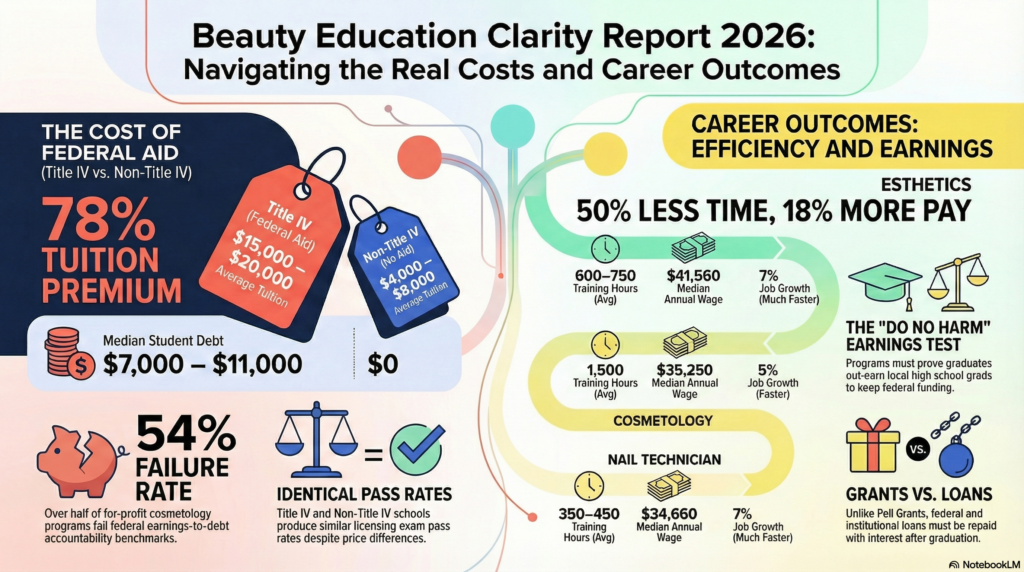
Tuition economics: Peer-reviewed research documents that Title IV cosmetology programs charge approximately 78% more in tuition than comparable non-Title IV programs offering the same licensure preparation.
Labor market alignment: Esthetics and nail technology demonstrate faster job growth and, in the case of esthetics, higher median wages—with substantially fewer training hours.
Financial aid literacy: Students benefit from clearly distinguishing between grants, loans, institutional payment plans, and scholarships before committing.
Accreditation: Accreditation status alone does not predict graduate earnings or financial safety.
1. Legal & Regulatory Landscape
Gainful Employment Rule
The Biden administration finalized strengthened Gainful Employment (GE) regulations in October 2023, establishing two accountability tests:
Test
Metric
Passing Standard
Debt-to-Earnings (D/E)
Annual median loan payment as share of earnings
≤ 8% of annual earnings or ≤ 20% of discretionary income
Earnings Premium (EP)
Median earnings vs. state HS graduate median
Graduates must outearn median HS graduate in their state
Programs failing either test in two out of three consecutive years risk losing Title IV eligibility. The rule covers approximately 32,000 programs enrolling 2.9 million students annually.
October 2025 Federal Court Ruling
On October 2, 2025, U.S. District Judge Reed O’Connor (N.D. Texas) dismissed consolidated challenges from the American Association of Cosmetology Schools (AACS) and Ogle School Management. The court found the Department’s interpretation of “gainful employment” was “the best [interpretation] considering the statutory language”. The judge rejected the argument that underreporting of cash tips systematically disadvantages cosmetology programs, citing studies showing that underreporting is not widespread. Research confirms unreported tip income accounts for only about 8% of additional earnings—insufficient to explain the earnings gap.
The rule remains fully in effect. AACS has indicated it may appeal to the Fifth Circuit. Concurrently, the Trump administration’s Department of Education defended the rule in court and urged the judge to keep it in place.
One Big Beautiful Bill Act (July 2025)
The Act created a new “Do No Harm” earnings premium test extending outcome-based accountability to all Title IV programs, including degree programs at public and nonprofit institutions. Programs failing for two out of three years lose eligibility for Federal Direct Loans. The AHEAD negotiated rulemaking committee reached consensus in January 2026, with the existing Financial Value Transparency framework renamed the Student Tuition and Transparency System (STATS) and the GE debt-to-earnings test eliminated as duplicative.
Risk Exposure for Cosmetology Programs
Finding
Source
>40% of all GE-failing programs are in cosmetology/personal grooming
U.S. Dept. of Education (2023)
54% of for-profit cosmetology programs fail the earnings benchmark
RTI International analysis
98% of Title IV cosmetology programs would fail earnings threshold
Century Foundation (2022)
100% of cosmetology associate degree students fail the proposed OBBBA test
NASFAA analysis (2026)
2. Tuition Economics Analysis
Title IV vs. Non-Title IV Tuition
Peer-reviewed research by Cellini & Goldin (2014), published in the American Economic Journal: Economic Policy, analyzed Florida cosmetology programs (900+ hours) and found that Title IV programs charged approximately 78% more in tuition than comparable non-Title IV programs, despite similar licensing exam pass rates. The tuition premium was roughly equal to average student grant awards plus the estimated loan subsidy.
A 2022/2024 analysis of Texas by Cellini & Onwukwe documented that 86% of the state’s 824 licensed cosmetology schools operate without federal aid. In a Dallas case study, a Title IV school charged $16,060 for a 1,000-hour cosmetology program, while a non-Title IV school 6 miles away charged $4,775 for the identical program length—less than one-third the price.
Generated chart: tuition_comparison.png
Aggregate Tuition Data
Metric
Title IV Programs
Non-Title IV Programs
Average cosmetology tuition
~$15,000–$20,000
~$4,000–$8,000
Median student loan debt
$7,000–$11,000
$0 (no federal loans available)
Licensing exam pass rates
Comparable
Comparable
These findings do not assign intent. They reflect the economic structure of federal aid availability. Students comparing programs should evaluate total cost of completion alongside outcomes, regardless of Title IV status.
3. Labor Market Comparison
Bureau of Labor Statistics data (May 2024 wages; 2024–2034 projections) reveal important differences across beauty occupations:
Occupation
Median Wage
Employment
Growth (2024–34)
Annual Openings
Cosmetologists/Hairstylists
$35,250/yr
651,200
5% (faster than avg.)
84,200
Manicurists/Pedicurists
$34,660/yr
210,100
7% (much faster)
24,800
Skincare Specialists
$41,560/yr
97,400
7% (much faster)
14,500
Generated chart: labor_comparison.png
Licensing Hours and Time-to-Income
Training requirements vary dramatically across program types and states:
Program
Hour Range
National Average
Est. Full-Time Completion
Cosmetology
1,000–1,800
~1,500 hours
10–18 months
Nail Technology
100–750
~350–450 hours
2–6 months
Esthetics
260–1,000
~600–750 hours
3–8 months
Generated chart: licensing_hours.png
Key Comparative Observations
Esthetics offers the highest median wage among the three fields at $41,560—18% higher than cosmetology. Both nail technology and esthetics project faster growth (7%) than cosmetology (5%). Specialization programs require substantially fewer hours, meaning faster time-to-income and lower total program cost. Esthetics achieves higher wages with approximately 40–50% of cosmetology’s training time.
These findings do not suggest cosmetology is an inferior career choice. Cosmetology licensure provides the broadest scope of practice. However, specialization programs may offer distinct advantages in terms of regulatory risk exposure, time-to-income, and median wage levels.
4. Financial Aid Clarification
The term “financial aid” encompasses distinct funding categories with different obligations:
Type
Source
Repayment Required?
Federal Pell Grant
U.S. Dept. of Education (FAFSA)
Generally no
Federal Subsidized Loan
U.S. Dept. of Education (FAFSA)
Yes, with interest (gov’t pays interest while enrolled)
Federal Unsubsidized Loan
U.S. Dept. of Education (FAFSA)
Yes, with interest (interest accrues from disbursement)
Institutional Scholarship
The school
No
Institutional Payment Plan
The school
Yes (to the school; not a federal program)
Private Loan
Banks/lenders
Yes, with interest (fewer protections than federal)
Before signing any enrollment agreement, students should ask: (1) What portion is grants vs. loans? (2) What is the total debt at completion? (3) What are the estimated monthly payments after graduation? (4) Is any part an institutional arrangement rather than a federal program?
5. Accreditation & Outcome Analysis
NACCAS (National Accrediting Commission of Career Arts and Sciences) accredits over 740 schools, representing approximately one in seven Title IV institutions. Those schools enrolled 109,000 students and received more than $1 billion in federal aid in 2022–23.
A 2025 New America investigation found that NACCAS’s enforcement practices include evaluating rule violations individually rather than considering complete compliance records, which can allow schools to cycle through repeated violations for years while maintaining accreditation. Multiple schools on probation failed to disclose their sanction status as required by federal regulations.
Does accreditation predict outcomes? Available evidence does not support this conclusion. The vast majority of programs projected to fail gainful employment tests are offered by accredited institutions. Research shows Title IV and non-Title IV programs produce similar licensing exam pass rates. Accreditation establishes minimum operational standards but does not guarantee specific earnings or return on investment.
Major recent closures—Marinello Schools of Beauty (56 campuses, 2016), Regency Beauty Institute (79 campuses, 2016), and others—illustrate the financial fragility of institutions heavily dependent on federal aid.
6. Institutional Model Comparison
Beauty schools generally operate under one of two structural models:
Dimension
Model A: Education-First
Model B: Clinic-Revenue-Dependent
Primary revenue
Tuition and fees
Tuition + significant clinic service revenue
Student time allocation
Emphasis on classroom instruction and supervised practice
Substantial student time on clinic floor serving paying clients
Student compensation
Students are learners
Students perform revenue-generating services; typically unpaid
Incentive alignment
Institution benefits from efficient completion
Institution may benefit from extended enrollment
Program length
Closely aligned with state minimums
May exceed state minimums by hundreds of hours
Under Model A, the institution’s financial incentive aligns with graduating students on time at competitive cost. Under Model B, a structural tension may exist: students performing services generate clinic revenue for the institution while consuming their limited financial aid eligibility. Some programs exceed state licensing requirements by up to 50%, extending the period during which students generate clinic revenue and draw down federal aid.
Prospective students should ask: How do the school’s required hours compare to state licensing requirements? What percentage of hours are classroom vs. clinic floor? Does the school disclose graduation rates and job placement rates?
7. Student Protection Checklist
Before You Sign: A Student Review Checklist
☐ Review the full enrollment agreement with a family member before signing. Do not feel pressured to sign on the same day.
☐ Confirm the total cost, including tuition, fees, supplies/kits, textbooks, and licensing exam fees.
☐ Understand your financial aid package: How much is grants? How much is loans? What are estimated monthly payments after graduation?
☐ Verify program length in hours and expected completion date. Compare with state licensing requirements.
☐ Request outcome data: graduation rate, licensing pass rate, job placement rate. Compare with College Scorecard data.
☐ Review the refund policy. Understand what happens if you withdraw.
☐ Ask about licensing renewal requirements in your state.
☐ Research regulatory status: any GE warnings, accreditor sanctions, or heightened cash monitoring.
☐ Compare at least two programs on cost, outcomes, and completion time.
☐ Keep copies of all signed documents.
8. Policy Implications
The convergence of the Gainful Employment rule and the One Big Beautiful Bill Act’s earnings premium test represents a durable policy shift toward outcome-based accountability across all sectors. Licensing hour requirements vary dramatically across states with no demonstrated correlation to improved outcomes—evidence-based standardization could reduce costs for students. The new STATS framework will provide unprecedented program-level transparency for prospective students. Ensuring accreditors evaluate institutions’ complete compliance records—rather than individual violations in isolation—would strengthen student protection.
9. Conclusion
The U.S. beauty education sector serves hundreds of thousands of students annually, many seeking a path to economic opportunity. The industry provides essential services and supports meaningful careers. At the same time, publicly available data reveal structural challenges—including tuition premiums associated with federal aid participation, earnings that often fall below those of high school graduates, and regulatory accountability gaps—that warrant careful attention.
This report has presented verified, publicly available data without targeting any specific institution or organization. The findings are intended to support informed decision-making, not to diminish the value of beauty education as a profession.
Prospective students are encouraged to review full student enrollment agreements with their families before signing. Education is a long-term financial decision that benefits from careful review and informed comparison.
Disclaimer: This publication is provided for educational and public informational purposes only. It does not constitute legal advice, accreditation determination, or regulatory judgment. All referenced frameworks are derived from publicly available federal and accreditor sources. Readers are encouraged to consult official regulatory authorities for definitive guidance.
Introduction
Public-Interest Educational Analysis on Graduation-Based Institutional Evaluation in U.S. Vocational Beauty Education
Louisville Beauty Academy (LBA) publishes this research study as part of its ongoing commitment to transparency, regulatory literacy, and public education within the vocational beauty sector. This document is presented as an educational resource intended to clarify how vocational institutions in the United States are evaluated under modern accountability systems.
This study is not written as criticism of any individual institution, accreditor, regulator, or professional organization. It does not name or target specific schools. Instead, it provides a systems-level examination of measurable institutional evaluation standards that are shaping the contemporary postsecondary vocational education landscape—particularly within cosmetology, esthetics, and nail technology programs.
The purpose of this publication is threefold:
First, to educate students and families about how vocational institutions are evaluated under federal and accreditor frameworks.
Second, to clarify the distinction between retail-oriented review platforms and regulated academic outcome metrics.
Third, to promote informed decision-making grounded in graduation rates, licensure pass rates, debt-to-earnings measures, and workforce outcomes rather than short-term consumer sentiment.
Educational Context
Vocational beauty institutions in the United States operate within structured accountability systems that are federally recognized and designed to protect students and taxpayers. These include:
The Integrated Postsecondary Education Data System (IPEDS)
National Accrediting Commission of Career Arts & Sciences (NACCAS) outcome thresholds
Gainful Employment (GE) regulations
Financial Value Transparency (FVT) requirements
State licensure verification frameworks
These systems measure objective institutional outputs such as:
On-time graduation rates
Debt-to-earnings ratios
Earnings premium benchmarks
Workforce placement rates
Licensure readiness
Together, these metrics form the foundation of institutional credibility in regulated vocational education. This study examines how these outcome-based measures increasingly define institutional quality in the 21st century.
Clarification of Intent
This research does not allege wrongdoing by any institution. It does not attempt to compare or rank specific schools by name. It does not substitute for official determinations made by accreditors, regulators, or government agencies.
Rather, it analyzes structural models within the industry, including:
Education-first, licensure-centered models
Clinic-revenue-driven, salon-style models
The discussion is theoretical and policy-based, grounded in publicly available data, federal guidance, accreditor standards, and academic research.
LBA’s Position on Transparency
Louisville Beauty Academy supports evaluation systems that prioritize measurable student outcomes. Specifically, LBA affirms:
Graduation-based institutional evaluation
Licensure-first instructional design
Ethical service-learning frameworks
Digital proof-of-work documentation
Clear and accessible cost transparency
Debt-minimization educational pathways
Proactive regulatory early-warning publication
LBA believes that the long-term strength of vocational beauty education depends on measurable outcomes and open documentation rather than marketing narratives or reputation-based signals alone.
Educational Use and Public Access
This publication is made available for:
Students and families evaluating vocational pathways
Policymakers examining workforce education models
Researchers studying institutional accountability
Industry professionals seeking compliance clarity
Readers are encouraged to independently verify all cited sources and consult official regulatory guidance when making enrollment or policy decisions.
Commitment to Responsible Discourse
LBA recognizes that vocational beauty education plays an important role in economic mobility and workforce development. The intent of this research is not to diminish the sector, but to strengthen it through transparency, compliance literacy, and evidence-based dialogue.
By publishing this study, Louisville Beauty Academy affirms the following principles:
Graduation frequency matters. Licensure outcomes matter. Student debt levels matter. Digital credential transparency matters.
Institutional evaluation in vocational beauty education should reflect these measurable realities.
The evaluation of postsecondary vocational institutions in the United States, particularly within the specialized sector of beauty and cosmetology education, has entered an era of unprecedented regulatory scrutiny and structural transformation. This research study analyzes the shift toward graduation-based institutional evaluation, contrasting the emerging education-first, licensure-centered models with traditional clinic-revenue-driven salon-style school models. Central to this analysis is the role of measurable outcomes—specifically graduation frequency, licensure pass rates, and longitudinal earnings—as the definitive signals of institutional quality. This transition is further supported by a professional digital ecosystem where platforms such as Facebook and Google function as archives of professional achievement rather than simple consumer feedback loops. The study investigates how the modern regulatory framework, including the 2024 Gainful Employment (GE) and Financial Value Transparency (FVT) rules, has necessitated a move away from retail-oriented training environments in favor of models that prioritize high-return investment (ROI), rapid workforce entry, and ethical service-learning.
Institutional Evaluation Metrics in Higher Education
The primary mechanisms for evaluating colleges and vocational institutions in the United States are rooted in federal standards of transparency and the rigorous oversight of independent accrediting bodies. Unlike retail businesses, which may rely on consumer-oriented reviews to manage brand reputation, regulated educational institutions are subject to systemic, data-driven performance indicators that track a student’s journey from enrollment to professional licensure and gainful employment.1 The Integrated Postsecondary Education Data System (IPEDS), overseen by the National Center for Education Statistics (NCES), provides the baseline for these evaluations through its tracking of graduation rates, completion timelines, and transfer data.1
Graduation rates are widely regarded as the most critical measure of an institution’s productivity and its ability to support its students through the educational lifecycle. Federal guidelines under the Student Right-to-Know Act (1990) and the Higher Education Act (2008) mandate the collection of data on students completing their programs within 100%, 150%, and 200% of the normal timeframe.1 For a one-year cosmetology certificate, the 150% graduation rate provides a standardized benchmark, measuring how many students graduate within 18 months of enrollment. These figures are not merely administrative; they serve as a signal of institutional stability and the effectiveness of student support services.4
In the vocational beauty sector, the National Accrediting Commission of Career Arts and Sciences (NACCAS) sets specific performance thresholds that institutions must meet to maintain accreditation. These metrics distinguish educational institutions from retail-based salon businesses by focusing on outcomes that correlate with workforce readiness rather than customer satisfaction scores.6
NACCAS Outcome Metric
Minimum Required Threshold
Institutional Quality Indicator
Graduation Rate
50%
Institutional productivity and student retention 6
Placement Rate
60%
Workforce alignment and career service efficacy 7
Licensure Pass Rate
70%
Educational rigor and professional readiness 6
The regulatory landscape has been fundamentally reshaped by the 2023-2024 Gainful Employment (GE) framework. This framework introduces two rigorous metrics: the Debt-to-Earnings (D/E) rate and the Earnings Premium (EP) test.8 The D/E rate ensures that a program’s graduates are not burdened with debt exceeding 8% of their annual earnings or 20% of their discretionary income.10 The EP test compares the median annual earnings of program graduates to the median earnings of high school graduates (ages 25-34) in the same state.8
These federal metrics create a structural divide within the cosmetology education sector. Historically, for-profit cosmetology programs have struggled with these standards; approximately 32% of such programs failed or were placed in a warning zone under earlier versions of the GE rule.13 This failure is often linked to the clinic-revenue-driven model, which can lead to extended program hours and high tuition costs without a corresponding increase in graduate income.14 In contrast, education-first models are designed to exceed these thresholds by minimizing debt and maximizing on-time graduation frequency.
The emphasis on these metrics indicates that customer-style reviews, such as those found on Yelp or TripAdvisor, are not primary evaluation metrics for regulated educational institutions. While a retail salon business might find its revenue impacted by a one-star review, an accredited vocational school’s survival is tied to its ability to demonstrate that its graduates out-earn their peers with only a high school diploma.8 This reflects the “tyranny of metrics” in modern accountability, where institutional value is defined by longitudinal economic impact rather than short-term consumer sentiment.18
Graduation Frequency as Institutional Output
The frequency and consistency of graduation cycles are essential indicators of an institution’s operational maturity and commitment to student outcomes. In vocational beauty education, the choice between rolling enrollment models and cohort-based models significantly impacts these outcomes. Research consistently demonstrates that cohort-based instructional models—where a group of students progresses through the curriculum together—lead to higher completion rates due to the development of deep peer networks and increased community engagement.19
The cohort model functions as an “intentional learning community,” providing a predictable structure that enhances student persistence.18 By contrast, rolling enrollment models, while providing flexibility for students with unique scheduling needs (such as those meeting Temporary Assistance for Needy Families requirements), often lack the group cohesion necessary for hands-on, skill-based education like esthetics or cosmetology.21
Learning Outcome Factor
Cohort-Based Model
Rolling Enrollment Model
Completion Likelihood
3.6x higher probability of success 23
Higher risk of isolation and attrition 20
Progression Speed
Synchronous, unified pace 21
Individualized, potentially fragmented 24
Professional Networking
Built-in social support and resilient networks 25
Individualized workforce entry 24
Graduation Timing
Fixed, milestone-driven graduation events 21
Variable, sporadic completions 21
Frequent graduation cycles signal institutional health. When an institution documents recurring graduation events, it provides evidence of its operational stability and its success in moving students through the licensure pipeline. The public documentation of these events creates a chronological record of institutional output that is far more reliable than static marketing claims. In an education-first model, the graduation event is the primary “product” of the institution, rather than the revenue generated from student-performed salon services.15
The transparency of these graduation milestones, often archived through social media platforms, functions as a form of public accountability. By making student completion visible, institutions move graduation from a private administrative task to a public professional signal. This ongoing documentation strengthens institutional credibility by showing a consistent, timestamped record of achievement. This contrasts with institutions that may extend program duration to maximize the use of student labor in clinic floors, which often results in lower on-time graduation rates and infrequent public celebrations of student success.13
The sociological impact of frequent graduations cannot be overstated. For the surrounding community and potential students, a visible stream of graduates provides a clear demonstration of the institution’s ROI. This “digital badge” of institutional achievement builds a reputational framework rooted in the success of the students rather than the satisfaction of salon customers.26
Facebook as a Public Graduation Archive
In the current landscape of digital accountability, social media platforms have transcended their original role as communication tools to become vital professional infrastructures. Facebook, in particular, has emerged as a primary archive for institutional milestones and student achievements in the United States. With over 70% of U.S. adults reporting consistent use of the platform, Facebook’s demographic penetration across all adult age groups makes it a highly effective tool for documenting professional progression.28
Demographic Category
Facebook Usage Rate (U.S.)
Significance for Education Archive
Women
76% – 78%
Alignment with beauty sector workforce demographics 31
College Graduates
70% – 71%
High usage among professionally oriented users 31
30–49 Year Olds
75% – 80%
Engagement of the core professional and family demographic 28
Household Income $100k+
54% – 71%
Strong presence among established economic decision-makers 33
For vocational beauty institutions, Facebook functions as a “front-stage” ledger where graduation events are timestamped and archived. This practice provides a public, chronological record of student completion that potential employers and families can use for verification.29 Unlike customer review platforms, which are inherently transactional and often focus on singular, subjective experiences, an institutional Facebook archive offers a longitudinal view of the school’s output.27
The use of Facebook for milestone documentation offers several institutional advantages:
Public Transparency: Institutional pages that regularly post graduation photos and award ceremonies provide undeniable evidence of student success, creating a record that is resistant to manipulation.29
Milestone Archiving: The platform’s ability to host photo albums and chronological posts allows for a long-term documentation of institutional achievement, building trust through visibility.27
Community Connection: By documenting graduations, institutions engage with the families and peers of their students, fostering a professional community that values educational attainment over retail transactions.37
Verification of Continuity: A history of multiple graduation cycles over several years serves as a professional signal of institutional maturity and operational health.15
The distinction between a milestone-driven archive (Facebook) and a complaint-driven review platform (Yelp) is fundamental to institutional evaluation. While a review platform captures the experience of a salon customer, the Facebook archive captures the achievement of a student professional.17 For a regulated educational institution, the latter is the only metric that aligns with the requirements of accreditation and federal oversight. This shift toward “digital proof-of-work” represents the modern standard for professional identity and institutional accountability.39
Google Ecosystem as Workforce Infrastructure
Google has become more than a search tool; it is the dominant infrastructure for the modern workforce and business discovery. With a global search market share reaching nearly 91% and over 1.8 billion active users of Gmail, Google’s ecosystem defines how professional identity is established and how businesses are discovered and vetted.41
In the context of institutional evaluation, Google functions as a professional ecosystem rather than a consumer complaint platform. This is most evident in the integration of Google Business Profiles, Google Maps, and Google Cloud credentials into the daily workflows of millions of organizations. For U.S. businesses, visibility within this ecosystem is not an option but a structural requirement for participation in the economy.44
Google Infrastructure Component
Workforce and Institutional Metric
Google Search / Maps
73% of U.S. businesses rely on Google Maps API for discovery and logistics 44
Gmail for Business
90% of startups and 60% of mid-sized U.S. firms use Gmail for professional identity 46
Digital Credentials
Over 535,000 individuals hold Google-validated technical skill badges 47
Google Business Profile
Complete profiles are 2.7x more likely to be viewed as reputable by consumers 42
The emergence of the “digital badge” as a workforce signal is a key development within this ecosystem. Skill badges and micro-credentials provide a verifiable, metadata-rich record of specific competencies.26 These digital artifacts are portable, secure, and link directly to validating evidence of educational achievement.27 For vocational institutions, issuing digital badges through platforms like Credly or Parchment allows their graduates to carry an interoperable, professional signal that is recognized by employers worldwide.26
The Google ecosystem also serves as a critical gateway for local discovery. Approximately 46% of all searches have local intent, and for these queries, 42% of users click on results within the Google Map Pack.50 For a vocational school, maintaining a robust, complete Google Business Profile is a marker of institutional seriousness. A profile that includes verified location data, professional imagery, and documented student achievements provides a level of credibility that noisy review platforms cannot provide.42
Furthermore, the Google ecosystem increasingly prioritizes authoritative and credible sources over subjective sentiment. The rise of the “zero-click” search, which accounts for over 60% of U.S. queries, underscores the importance of institutional transparency within the search interface.50 Institutions that leverage this ecosystem to showcase their output—graduations, certifications, and faculty publications—are positioning themselves within a professional infrastructure that aligns with the needs of the 21st-century workforce, rather than the idiosyncratic patterns of the reputation economy.
Yelp vs. Educational Institutions
A comparative analysis of Yelp and educational institutions reveals a fundamental structural misalignment between the platform’s intended purpose and the evaluation metrics of regulated vocational schools. Yelp is a community-driven platform designed primarily for local business discovery, with a heavy emphasis on experience-based goods like restaurants, retail, and home services.52 Its advertising revenue and user engagement are concentrated in these segments, reflecting a transactional model of evaluation.53
Yelp Category Distribution
Percentage of Reviews / Engagement
Consumer Behavior Model
Home & Local Services
20% – 21%
Task-oriented; maintenance evaluation 53
Restaurants & Food
17%
Transactional; moment-in-time satisfaction 53
Shopping & Retail
15%
Purchase-driven; pricing and variety focus 53
Beauty & Fitness
11%
Service-based retail; retail salon focus 53
Usage patterns for retail salons on Yelp demonstrate that consumer reviews are a significant driver of revenue. Studies have shown that an extra half-star rating can cause a restaurant to sell out its reservations 19 percentage points more frequently.17 This is logical for experience goods, where quality is subjective and can only be evaluated after consumption. However, the quality of an educational institution is measured through objective, long-term outcomes: graduation rates, licensure pass rates, and graduate earnings.1
Furthermore, Yelp’s demographic profile is distinct from the primary stakeholders of vocational education. Over 50% of Yelp users live in households with annual incomes exceeding $100,000, and 39% of users in the U.S. are aged 55 and older.53 This audience uses the platform to find maintenance services for their houses, bodies, and cars, rather than to evaluate the educational rigor of a state-licensed vocational school.61
The distribution of star ratings on Yelp also highlights its retail orientation. Service categories like hair salons and auto repair tend to have “skewed-left” distributions with a disproportionate number of 5-star ratings, often incentivized by the vendors themselves.61 This “popularity imbalance” is characteristic of review-driven markets but provides little useful information for assessing the performance of an accredited institution.62
Ultimately, Yelp is structurally aligned with retail salon businesses rather than state-licensed vocational institutions. Regulated schools are subject to rigorous state and federal accountability systems that prioritize academic achievement and career placement over short-term consumer sentiment.6 In the context of a vocational school, graduation frequency and licensure pass rates are the only legitimate indicators of institutional productivity and student success.15
Student Exploitation Debate in Vocational Education
The beauty and cosmetology education sector has been the subject of a decade-long debate regarding student labor and institutional revenue models. Research from organizations such as the Institute for Justice (IJ) has brought national attention to the potential for exploitation within traditional cosmetology schools.66 These institutions often operate a dual-revenue model, collecting tuition from students while simultaneously generating fees from public salon services performed by those students.15
IJ’s 2021 study, “Beauty School Debt and Drop-Outs,” provides a detailed analysis of the costs and outcomes associated with these programs. Key findings reveal a systemic failure to deliver on the promise of economic opportunity for many aspiring beauty workers.67
Cosmetology Education Outcome
Traditional For-Profit Averages
Policy and Ethical Implication
On-Time Graduation Rate
Fewer than 33%
High attrition and delayed workforce entry 67
Average Program Cost
Over $16,000
Significant financial burden for lower-income students 67
Median Student Debt
Over $7,300
Debt often exceeds the annual earnings bump 66
Average Graduate Earnings
~$26,000
Lower than many un-licensed occupations 66
A primary ethical concern in this sector is the use of the clinic floor as a revenue center. Some institutions require students to perform services on paying customers for no compensation, and in some cases, students are forced to pay “overage fees” for every hour they attend past an arbitrary completion deadline.69 This model has been characterized as a “transfer of wealth” from students and taxpayers to cosmetology schools.68
In response to these concerns, a structural shift toward education-first, licensure-centered models has emerged. These models differentiate themselves through several key practices:
Lower-Debt Pathways: Institutions that reject Title IV federal loans in favor of pay-as-you-go or scholarship-based models significantly enhance student ROI.15
Volunteer Practice: By replacing revenue-driven clinic floors with volunteer-based practice—such as providing services to the elderly, disabled, or other underserved populations—institutions ensure that student practice is instructional rather than extractive.73
Service-Learning Frameworks: These frameworks integrate community service with academic curriculum, emphasizing higher-order thinking and reflection rather than just manual labor.75
Licensure-First Instruction: High-ROI models focus exclusively on the state-mandated curriculum for licensure, reducing program duration and cost while maximizing on-time completion rates.15
Research indicates that students who participate in volunteer-based service learning show significant improvements in self-efficacy, career planning, and community participation.77 By removing the profit motive from student work, institutions can provide a care-based learning environment that fosters professional identity and civic responsibility, directly addressing the concerns of labor exploitation.73
Intellectual Output and Educational Culture
The seriousness and academic rigor of an educational institution are frequently signaled through its intellectual output, including faculty publishing, research contributions, and curriculum transparency. In the broader context of higher education, the “publish or perish” ideology highlights the importance of contributing to the field as a marker of institutional prestige.80 This credo has subtle but profound consequences for vocational education, where research into effective teaching and learning strategies is often undervalued.82
Published faculty bring esophageal professional insights directly into the classroom, contextualizing findings within the industry and providing real-world value to their students.83 This engagement creates a more relevant and rigorous learning environment, where students are entering the workforce with practical knowledge that can be immediately applied.83
Intellectual Signal
Institutional Seriousness Impact
Signal of Seriousness
Faculty Book Publication
Signals deep domain expertise and commitment to theory
Culture of scholarship 84
Institutional Research Output
Drives industry standards and innovative pedagogies
High engagement with field issues 80
Curriculum Transparency
Allows public scrutiny of educational objectives and rigor
Commitment to consumer safeguards 64
Regulatory Early-Warning Systems
Proactive communication of systemic shifts in governance
Proactive compliance leadership 86
In the cosmetology sector, where there is a recognized lack of research on effective teaching strategies, institutions that prioritize academic production stand out as structurally distinct from retail-focused training centers.82 Some institutions have documented over 110 books authored by their faculty, covering complex issues like the resilience of labor in an AI-accelerated economy and the rise of digital proof-of-work.87 This volume of intellectual production is a robust indicator of an institution’s commitment to its mission beyond simple job training.
Curriculum transparency is another vital signal of institutional seriousness. Accredited institutions are required to accurately publicize their standings and the actions of their accreditors.64 However, elite programs go further by publishing “living records” of regulatory signals, legislative proposals, and emerging national standards.86 This proactive approach to compliance—often termed “Gold-Standard Over-Compliance”—demonstrates a care-based learning environment that prioritizes the protection of students and the public over the maximization of tuition revenue.86
Ultimately, intellectual output correlates with institutional seriousness. A school that contributes to the scholarly discourse of its profession offers a fundamentally different culture than one focused on the extraction of student labor for clinic profit. This academic engagement reflects a structural rejection of the retail-first model in favor of an outcomes-driven educational design.
Digital Proof-of-Work vs. Customer Feedback Models
Modern institutional evaluation is increasingly moving away from the noisy data of customer feedback in favor of objective “digital proof-of-work.” Professional identity in the 21st-century workforce is built through portfolios, documented achievements, and verifiable credentials that provide a comprehensive view of an individual’s competencies.26
Identity Evaluation Model
Reliability
Key Artifacts
Customer Feedback Model
Low / Subjective
Star ratings, transactional reviews 17
Graduation-Driven Model
High / Objective
Public milestone documentation, date-stamped completions 29
Compliance-Driven Model
Very High / Regulated
Licensure verification, federal D/E and EP scores 1
Digital Proof-of-Work
High / Evidence-Based
Portfolios, skill badges, verifiable metadata 48
Digital badges and Learning and Employment Records (LERs) represent the leading edge of this transition. LERs document achievements related to learning or work in a tamper-evident, cryptographic format, making this information instantaneously verifiable for employers.40 This shift toward “all learning counts” allows for the recognition of skills at a more atomic level than traditional diplomas or grade-point averages.40
For vocational beauty schools, the move toward digital proof-of-work is manifest in the public documentation of student progress. Institutions that utilize the Google and Facebook ecosystems to showcase student certifications, graduation events, and licensure status are creating a professional digital presence for their students.27 This model builds trust through verifiable evidence rather than the subjective sentiment found on retail review platforms.
Portfolio-based credentialing allows students to demonstrate their specific skills—such as textured hair education or advanced esthetics modalities—directly to the market.21 Unlike paper certificates, digital credentials contain rich metadata that explains the context, process, and results of a student’s learning.27 This evidence-based approach aligns with the needs of modern employers, who are increasingly moving toward skills-based hiring where demonstrable abilities matter more than broad certificates.39
In conclusion, the professional identity of the modern beauty worker is built on a foundation of verifiable achievements and outcomes-based compliance. While consumer review platforms play a minor role in retail salons, they are structurally inadequate for evaluating regulated vocational institutions. The future of institutional assessment lies in the transparent documentation of student graduation, licensure, and workforce success within a professional digital infrastructure.
Conclusion Framework
The research findings of this study provide a comprehensive framework for the evaluation of U.S. vocational beauty education in the 21st century. The analysis confirms several evidence-based conclusions regarding institutional design and measurable outcomes:
Graduation Frequency as a Dominant Signal: Frequent and stable graduation cycles serve as a significantly stronger indicator of institutional health and operational maturity than customer feedback volume on retail review platforms.
Structural Category of Licensure Models: Education-first, licensure-centered models represent a structurally distinct category within beauty education. By prioritizing student ROI and rapid workforce entry, these models are naturally aligned with federal accountability standards, whereas clinic-revenue-driven models face increasing regulatory peril.
Google and Facebook as Workforce Infrastructure: The dominance of the Google and Facebook ecosystems provides a robust infrastructure for professional signaling. Institutions that leverage these platforms for milestone archiving and digital proof-of-work are successfully transitioning from a reputation-based economy to a verifiable achievement economy.
Ethics of Service-Learning: The transition from revenue-driven clinic floors to volunteer-based service learning effectively reduces concerns regarding labor extraction. This care-based model enhances student self-efficacy and aligns with ethical frameworks for professional development.
Inappropriateness of Review Platforms for Evaluation: Retail review platforms like Yelp are structurally aligned with transactional service businesses and are inappropriate metrics for assessing the academic rigor and regulatory compliance of state-licensed vocational institutions.
The evaluation of beauty education must remain rooted in measurable academic and workforce outcomes. The move toward graduation-based evaluation, supported by digital documentation and high-ROI institutional design, offers a transparent and ethical pathway for the next generation of beauty professionals.
ED576178 – The Impact of a Cohort-Based Learning Model on Student Success within Vocational Technical Certificates at a Community College, ProQuest LLC, 2017 – ERIC, accessed February 11, 2026, https://eric.ed.gov/?id=ED576178
Comparative study of deep learning models for analyzing online restaurant reviews in the era of the COVID-19 pandemic – PMC, accessed February 11, 2026, https://pmc.ncbi.nlm.nih.gov/articles/PMC8586815/
Service learning as an alternative to traditional clinical placements: Experiences of student speech pathologists – ERIC, accessed February 11, 2026, https://files.eric.ed.gov/fulltext/EJ1455757.pdf
Why we publish where we do: Faculty publishing values and their relationship to review, promotion and tenure expectations – PMC, accessed February 11, 2026, https://pmc.ncbi.nlm.nih.gov/articles/PMC7065820/
Impact of Governance Factors over Lecturers’ Scientific Research Output: An Empirical Evidence – MDPI, accessed February 11, 2026, https://www.mdpi.com/2227-7102/11/9/553
It is not a poster on a wall. It is not something you declare.
Resilience is something you complete.
At Louisville Beauty Academy, resilience is defined simply:
The disciplined pursuit of growth — regardless of age, language, environment, or regulation — until completion is achieved.
This is the story of a graduate who lived that definition fully.
A Lifetime in Beauty
Long before Kentucky, long before state board exams in English, Luz Celenia Ortiz Ortiz was already a respected professional in Puerto Rico.
Licensed in 1971 under the Commonwealth of Puerto Rico, she completed the required 1,000 hours and earned her official cosmetology license.
But a license was only the beginning.
For more than 45 years, she owned and operated Lucy’s Beauty Salon in Barranquitas, serving generations of families. Her work was recognized publicly. Her service was honored locally. Her impact extended beyond hair and style — she became part of the fabric of her community.
She trained students. She mentored future professionals. Her students won awards at beauty competitions. She participated in professional symposia. She continued her education, even during the COVID-19 pandemic.
Her career was not temporary.
It was sustained excellence.
A New State, A New Standard
When she relocated to Kentucky, she did not expect special treatment.
She understood something important:
Each state maintains its own standards.
Kentucky requires:
• Verified documentation • Credential translation • Completion of required training hours • A written theory examination • A practical examination
Regardless of prior experience, the pathway must be completed.
This is not a barrier.
It is a benchmark.
And benchmarks define professionals.
At 73 years old, she faced a decision.
She could look backward at everything she had already accomplished.
Or she could look forward.
She chose forward.
She chose:
YES I CAN.
Returning to the Classroom — With Humility
Resilience often requires humility.
After decades as a salon owner and instructor, she returned to training.
She gathered records from the 1970s. She obtained certified translations. She studied modern sanitation law and theory. She prepared under current Kentucky standards. She practiced for the practical exam.
Not because she doubted her skill.
But because she respected the process.
That respect defines professionalism.
At Louisville Beauty Academy, she received structured guidance, clear compliance support, and focused exam preparation.
Not shortcuts.
Structure.
The Moment That Matters
Theory Examination — PASS. Practical Examination — PASS.
And that moment — the moment a license is earned again — is where resilience becomes visible.
What Resilience Really Means
Resilience is not about being young.
It is not about never facing difficulty.
It is about:
• Adapting to new systems • Studying in a second language • Respecting updated regulations • Preparing diligently • Showing up when it would be easier not to • Finishing what you start
Resilience is disciplined consistency across time.
It is the decision to grow again.
The LBA Mindset
At Louisville Beauty Academy, we believe something simple but powerful:
“I can” is a beginning.
“I have done” is a standard.
We do not train students merely to hope.
We train students to complete.
We do not lower expectations.
We support students in rising to them.
Resilience is fostered when standards are clear and guidance is strong.
This graduate did not just believe she could succeed.
She followed through — step by step — until she did.
Why This Story Matters
Because it reminds us:
Professional excellence has no expiration date.
Experience is valuable — but growth never stops.
Regulations are not obstacles — they are structures.
Age does not limit ambition.
Language does not limit achievement.
Discipline defines outcome.
From YES I CAN to I HAVE DONE
Licensed in 1971. Recognized for 45 years of service. Educator and mentor. Continuing education during a global pandemic. Relocated across jurisdictions. Studied again. Tested again. Passed again. Licensed again.
If that is not resilience, what is?
The Legacy
At Louisville Beauty Academy, we are proud to celebrate graduates who embody this mindset.
There are moments when leadership is quiet. Moments when words pause — and the heart speaks first.
Last week, during one of Kentucky’s rare and unforgiving snow-and-ice storms, we received photos from a Louisville Beauty Academy student. They showed roads erased by ice, tires frozen in place, and a journey made nearly impossible by conditions that shut down much of the city for days.
And yet — she came.
She does not live nearby. She drives two hours one way — four hours total — every single day to attend Louisville Beauty Academy full-time. Rural routes. Long stretches of road. An older car. A commitment that begins long before class starts.
While Louisville itself was already stretched thin, with city cleanup crews working nonstop just to keep essential roads moving, her reality was even harder. Unplowed paths. Ice layered beneath snow. Distance measured not just in miles — but in discipline.
Seeing those images brought us to tears.
Not because of fear — but because of who she is.
This is the true definition of resiliency.
This is the mindset we speak of at Louisville Beauty Academy when we say “YES I CAN.” And this is the kind of spirit that earns the words “I have done it.”
She did not ask for recognition. She did not ask for sympathy. She simply showed up — committed to her education, determined to remain full-time, maximizing every opportunity available, and honoring her goal of licensure with discipline and integrity.
Her strength is not solitary. Along her journey, she found faith and partnership — and today, she builds her future alongside her husband, grounded in shared purpose and commitment. That same intentionality shapes every decision she makes.
This is not about perfection. This is about character.
At Louisville Beauty Academy, we believe education must be human. It must be loving, protective, and earned. We believe our role is not just to teach skills, but to stand beside students who carry invisible battles, heavy responsibilities, and unwavering resolve.
When we say we care — this is what we mean. When we say our culture is different — this is why.
To this remarkable student:
Your resilience is real. Your perseverance is seen. Your journey matters — not only to us, but to everyone you inspire simply by refusing to quit.
You embody the heart of LBA. You live the “YES I CAN” mentality. And one day soon, with pride and certainty, you will hold your “I have done it” certificate — knowing every step was earned mile by mile.
We are honored to walk this road with you. With love. With care. With belief.
— Louisville Beauty Academy A school built on trust, humanity, and unwavering support
This page presents an educational cost comparison and visual research model addressing tuition, time-to-licensure, opportunity cost, and living-cost considerations that are often omitted from simplified school marketing comparisons.
Louisville Beauty Academy publishes this material as part of a public-interest transparency effort. Figures and comparisons should be read carefully, with attention to date, assumptions, scope, and the limits stated in the analysis. This page is not a promise of earnings, debt elimination, or individualized financial outcome.
Official Research Report
The Financial Truth of Beauty Education
Why High-Tuition Schools Depend on the “FAFSA Trap” & How LBA’s Lower-Debt Model Saves You Over $45,000 in Real Economic Cost.
The Total Cost of Ownership
Most schools only show you Tuition. We reveal the Real Cost: Tuition + Kits + Living Expenses + Lost Wages during the program. See the massive difference between LBA’s “Fast-Track” and the National “Slow-Track”.
*Data based on 1500-hour Cosmetology Program. “National Premium” assumes luxury living costs and $20/hr opportunity cost.
1. The Sticker Price
LBA’s Performance-Incentive pricing slashes tuition by up to 76% compared to national averages. We strip away luxury overhead to focus on licensing.
2. The Hidden Cost of Time
Time is money. Every month you spend in a “Slow-Track” program is a month of lost wages. LBA incentivizes you to graduate fast and start earning.
⚠ The “FAFSA Paperwork” Trap
Big schools use federal loans (FAFSA) to hide the pain of a $25,000+ tuition. They sell you on “low monthly payments” that turn into 10 years of debt with interest.
The LBA Difference: We teach Financial Literacy from Day 1. We show you the total cost upfront. We offer 0% interest payment plans. We encourage you to pay as you go so you graduate owning your career, not owing the government.
3. The Daily Lifestyle Choice
Your daily habits determine your debt. The “LBA Hustle” minimizes expenses ($3 meals, shared rides) vs. the “Premium Lifestyle” ($15 meals, solo car).
Monthly Cashflow Impact
Expense Category
LBA Baseline
Premium Lifestyle
✔ Meal Prep
$60 / mo
–
✖ Restaurant Lunch
–
$300 / mo
✔ Shared Transit
$30 / mo
–
✖ Solo Car/Gas
–
$240 / mo
MONTHLY COST
$90.00
$540.00
= $450 SAVED PER MONTH
Total Estimated Value (Cosmetology)$45,649
Total Economic Savings (Tuition + Interest + Lifestyle + Wages) by choosing LBA vs. National Premium Average.
Graduate Lower-Debt. Start Today.
Don’t let paperwork and hidden fees steal your future earnings.
Louisville Beauty Academy • 1049 Bardstown Rd, Louisville, KY • State Licensed & Accredited
Economic Architecture of Beauty Education: A Comprehensive Fiscal Analysis of US Vocational Programs
The beauty education sector in the United States represents a significant vocational investment, characterized by a complex interplay of direct educational costs, mandatory state licensing requirements, and substantial indirect socio-economic burdens. Unlike traditional four-year academic degrees, which focus on theoretical knowledge and credit-hour completion, beauty education is fundamentally governed by “clock hours”—actual time spent in supervised training and clinical practice. This structural distinction creates a unique economic profile where the primary driver of cost is not merely tuition, but the temporal commitment required to achieve licensure. For prospective students, understanding the total economic impact requires a granular examination of four primary pathways: the 1500-hour Cosmetology program, the 750-hour Esthetics program, the 450-hour Nail Technician certificate, and 300-hour specialty breakout courses, including Eyelash Extension and Shampoo & Styling certifications.
The following analysis utilizes a bifurcated modeling approach to delineate the financial realities for different student demographics. The “Lowest-Cost Scenario” (Economy Baseline) represents a student utilizing public resources, minimum wage baselines for opportunity cost calculations, and aggressive cost-saving measures in living expenses. The “Highest-Cost Scenario” (Premium Realistic) models the financial burden for an individual transitioning from a higher-wage career, investing in premium private instruction, and utilizing full-service childcare and private transportation. This comprehensive fiscal assessment serves as a total cost model, incorporating risk, contingency, and professional barrier-to-entry fees that are frequently omitted from standard institutional disclosures.
The 1500-Hour Cosmetology Program: The Economic Pillar of Beauty Education
The 1500-hour cosmetology license is the most versatile credential in the industry, permitting the holder to perform services across hair, skin, and nail disciplines. However, its versatility comes at the highest cost, both in terms of direct tuition and the sustained loss of income over the typical 12 to 18-month duration of the program.
Direct Educational Outlays: Tuition, Fees, and Kits
Cosmetology tuition exhibits extreme variance based on institutional type and geographic location. Data from 2024 and 2025 indicates that the national average for tuition is approximately $14,500 to $15,663, though this figure masks the disparity between public community college programs and high-end private academies. In the economy baseline, a student might attend a public vocational center in a state like Florida, where resident tuition can be as low as $3,072. Conversely, a premium student attending a top-tier private institute in a metropolitan area like Las Vegas or New York may face tuition exceeding $22,000.
Beyond tuition, the “Student Kit” represents a critical fixed cost. These kits are not merely collections of tools but professional-grade inventories required for clinical practice. A standard kit includes high-tension shears, clippers, thermal irons, mannequin heads, and chemical application supplies. Kit costs range from a low of $664 in public programs to over $2,500 in premium private schools where branded tools and digital kits are mandated.
Opportunity Cost: The Hidden Weight of Clock Hours
The most significant economic driver in beauty education is the opportunity cost of foregone earnings. Because cosmetology requires 1500 clock hours of physical presence, students are largely restricted from full-time employment during training. For the economy baseline, lost income is calculated using a 2025 minimum wage average of $11.00 per hour, totaling $16,500. However, this does not account for the 15-20 hours of weekly study time required outside of class. When study time is integrated at a ratio of 0.3 hours per clock hour, the total labor hours lost reach 1950. At a premium wage of $30.00 per hour, the opportunity cost escalates to $58,500.
1500-Hour Cosmetology: Comparative Cost Modeling
Cost Category
Lowest (Low)
Average (Mean)
Highest (High)
Assumptions & Data Sources
Tuition & Direct Fees
$3,072
$15,200
$22,500
Public vs Private Institute
Student Kit & Supplies
$664
$1,700
$2,600
State-specific tool requirements
Books & Digital Materials
$335
$600
$1,000
Milady/Pivot Point bundles
Opportunity Cost (1500 hrs)
$16,500
$22,500
$45,000
$11/hr vs $30/hr wage baseline
Study Time Opp. Cost (450 hrs)
$4,950
$6,750
$13,500
15-20 hours/week external study
Transport & Parking (12 mo)
$600
$3,500
$12,300
Bus pass vs Car ownership
Daily Meals & Nutrition
$1,500
$3,500
$7,500
$5 sandwich vs $25 restaurant lunch
Childcare (Full-Time)
$13,800
$17,800
$43,000
Daycare vs Full-time Nanny
Uniforms & Prof. Shoes
$75
$250
$500
Budget scrubs vs Premium brand (Figs)
Licensing & Exam Prep
$150
$350
$850
Initial fees + Retake contingency
Post-Completion Startup
$500
$2,500
$10,000
Portfolio, Website, Prof. Equipment
Total Real Economic Cost
$42,146
$74,650
$158,750
Comprehensive cumulative impact
The disparity between the low and high scenarios is driven primarily by the “lifestyle” of the student and the wage they forego. A student relocation or a student with children faces a vastly different economic reality than a dependent student living at home. The high-cost scenario emphasizes that the true cost of becoming a master cosmetologist for a mid-career professional can exceed the cost of many graduate school programs.
The 750-Hour Esthetics Program: Targeted Skincare and Wellness Fiscal Modeling
Esthetics represents the fastest-growing sub-sector of the beauty industry, focusing on skincare, facials, hair removal, and makeup. The 750-hour duration is the standard in approximately half of US states, providing a mid-range temporal and financial commitment.
Curricular Costs and Kit Complexity
Tuition for esthetics programs typically ranges from $6,000 to $12,000 for the 750-hour curriculum. Kit costs are notably high relative to the program hours because students must acquire both professional-grade skincare product lines and specialized electrical tools for facial treatments. A low-end kit may cost $732, while a premium kit including waxing systems and advanced serums reaches $3,300.
Regional Variance and Regulatory Impact
In jurisdictions with higher cost-of-living indices, such as California or New York, registration and application fees add an additional $100 to $300. The economic impact of “clock hour” compliance is severe in esthetics because 70% of the curriculum is practical, hands-on training that cannot be completed asynchronously. This mandates physical presence in a facility, which in turn triggers daily transportation and childcare expenses for the 6 to 9-month duration of the program.
750-Hour Esthetics: Comparative Cost Modeling
Cost Category
Lowest (Low)
Average (Mean)
Highest (High)
Assumptions & Data Sources
Tuition & Direct Fees
$5,000
$10,125
$18,250
National tuition range
Student Kit & Supplies
$732
$2,000
$3,300
Product-intensive skincare kits
Books & Materials
$260
$400
$700
Milady/Aveda bundles
Opportunity Cost (750 hrs)
$8,250
$11,250
$22,500
Foregone labor at varying rates
Study Time Opp. Cost (225 hrs)
$2,475
$3,375
$6,750
Based on 15-20 hours/week study
Transport & Parking (8 mo)
$400
$2,400
$8,200
Bus pass vs Daily car commute
Daily Meals & Nutrition
$1,000
$2,500
$5,000
Budget grocery vs Restaurant meals
Childcare (8 mo)
$9,200
$11,800
$28,500
Daycare vs Nanny weekly rates
Uniforms & Tools
$75
$150
$400
Clinic-specific dress codes
Licensing & Exam Prep
$100
$250
$600
Exam fees + Retake contingency
Startup Professional Costs
$300
$1,500
$5,000
Portfolio, Website, Insurance
Total Real Economic Cost
$27,792
$46,750
$99,200
Cumulative impact for 750-hr program
The economic risk in esthetics is highly concentrated in the “Risk and Contingency” category. In states like Illinois, failing the licensure exam three times requires a mandatory 80 additional hours of instruction before a fourth attempt is allowed; a fourth failure necessitates repeating the entire 750-hour program from the beginning. This represents a potential $20,000+ financial risk for students with testing anxiety or learning disabilities.
The 450-Hour Nail Technician Program: Accelerated Entry Economics
The 450-hour manicuring license offers the most compressed temporal pathway to professional beauty licensure, making it a high-velocity vocational choice. However, the economic density of the program is high, as students must master chemically complex systems (acrylics, gels, dips) in a short window.
Tuition and Chemical Supply Costs
Tuition for nail technology programs is highly decentralized. Low-cost vocational academies in states like Florida may offer tuition as low as $1,100, while premium programs in markets like Indiana or Minnesota range from $4,900 to $6,000. Kits for nail technicians are distinctive; while they lack the expensive clippers of cosmetology, they require high volumes of consumables and expensive UV/LED lamps. Kit costs range from $260 for basic equipment to $2,000 for comprehensive systems including electric files and premium product bundles.
Opportunity Cost and Temporal Efficiency
Because the program is only 450 hours, the opportunity cost is minimized relative to other licenses. At a minimum wage of $11.00 per hour, the lost income is approximately $4,950. Even at a premium wage of $30.00, the $13,500 lost is substantially more manageable than the costs associated with cosmetology. This shorter duration also limits the burden of childcare and transportation to a 3-4 month window.
450-Hour Nail Technician: Comparative Cost Modeling
Cost Category
Lowest (Low)
Average (Mean)
Highest (High)
Assumptions & Data Sources
Tuition & Direct Fees
$1,100
$3,500
$6,750
Range from Florida to Minnesota
Student Kit & Supplies
$260
$1,000
$2,000
Consumable intensive kits
Books & Materials
$210
$450
$700
Milady Nail Tech packages
Opportunity Cost (450 hrs)
$4,950
$6,750
$13,500
Lost labor hours
Study Time Opp. Cost (135 hrs)
$1,485
$2,025
$4,050
External homework requirements
Transport & Parking (4 mo)
$200
$1,200
$4,100
Transit vs Personal vehicle
Daily Meals & Nutrition
$500
$1,250
$2,500
Sustainment costs during training
Childcare (4 mo)
$4,600
$5,900
$14,250
Daycare vs Nanny rates
Uniforms & Shoes
$50
$100
$250
Professional attire standards
Licensing & Exam Prep
$85
$200
$450
State fees + PSI testing fees
Startup Professional Costs
$300
$1,500
$4,000
Insurance, Portfolio, Initial tools
Total Real Economic Cost
$13,740
$23,875
$52,550
Cumulative impact for 450-hr program
The economic appeal of the nail technician path lies in its Return on Investment (ROI). With a national average salary for experienced technicians around $53,388, a student in the average scenario ($23,875 total investment)$ reaches a break-even point in less than six months of full employment post-licensure.
The 300-Hour Specialty Breakout Programs: Micro-Certification Fiscal Deep Dive
Specialized 300-hour courses are designed for niche expertise, such as Natural Hair Styling, Shampoo & Styling, or Eyelash Extension Specialist certification. These programs are often mandated for specialty licenses in specific states, most notably Texas and Kentucky.
Eyelash Extension Specialist: A High-Value Micro-Credential
In Texas, the 320-hour Eyelash Extension Specialist course is a specific licensing requirement. Tuition for this program ranges from $1,500 to $3,200. The kit is highly specialized, requiring precision tweezers, varying lash weights, and sensitive medical adhesives, with costs averaging $450 to $800. For those seeking an ultra-fast path, 2-day breakout courses (often used by existing cosmetologists or estheticians for supplemental certification) cost between $600 and $2,500.
Natural Hair Styling and Shampoo & Styling
States like New York and Kentucky offer 300-hour programs for Natural Hair Styling or Shampoo & Styling. These courses focus on cleansing, non-chemical styling, and braiding. Tuition ranges from $1,500 to $6,100 depending on whether the program is offered at a community college or a private specialized academy. These programs are unique because they often target students who wish to avoid chemical services entirely, reducing the kit cost slightly relative to cosmetology but maintaining high standards for sanitation and physiology theory.
Specialty breakout courses offer the highest revenue-to-investment ratio in the “High” scenario. An eyelash extension technician can charge $100 to $150 per procedure, with a potential annual income of $104,000 if they maintain a full book. For a student spending $38,250 on education and life support, the break-even point occurs within the first year of operation, even accounting for high overhead.
Opportunity Cost: The Quantitative Impact of Unpaid Training
In vocational beauty education, the opportunity cost is not merely a theoretical variable; it is a direct financial drain that exceeds the cost of tuition in nearly all high-cost models. The economic formula for opportunity cost (OC) in this domain is expressed as:
OC=(Ch×W)+(Sh×W)
Where:
Ch = Total required clock hours (e.g., 1500).
Sh = External study hours (estimated at 30% of clock hours).
W = Hourly wage the student would have earned if employed.
Labor Market Assumptions for 2025
For the economy baseline, the wage W is set at $11.00, representing the 2025 federal/state minimum wage average found in entry-level service roles like McDonald’s or local retail. For the premium realistic scenario, W is set at $30.00, representing a mid-career professional foregoing a management or specialized office role to enter the beauty industry.
Furthermore, beauty schools operate under strict “Satisfactory Academic Progress” (SAP) standards. Attendance below 90−95% can trigger financial aid suspension or the assessment of “over-contract” fees, which average $14.00 to $19.00 for every hour missed beyond the original graduation date. This makes attendance not just a pedagogical requirement, but a critical financial risk management strategy.
Life Support Logistics: Childcare, Transportation, and Nutrition
The logistical burden of attending beauty school is often the primary reason for program withdrawal. Because clock hours require a physical presence during standard business hours, students with dependents or significant commute times face compounding costs.
The Childcare Barrier
Childcare is consistently cited as the most expensive non-tuition item. As of 2025, the national average for infant center-based care is $13,128 annually (∼$252/week), but in high-demand markets like Washington D.C. or Massachusetts, this exceeds $26,000 annually (∼$500+/week).
Lowest Cost Scenario: Shared childcare or family support, estimated at $175/week for a part-time babysitter.
Highest Cost Scenario: Full-time private nanny services, which average $827 to $870 per week in 2025. For a 1500-hour cosmetology student (approx. 43-50 weeks), this represents a staggering $43,000 investment.
The Transportation Divergence
Transportation costs reflect the student’s geographic accessibility to the training facility.
Lowest Cost Scenario: Monthly public transit passes range from $50 to $155 in major US cities. Over a 12-month program, the transit-dependent student spends approximately $600 to $1,200.
Highest Cost Scenario: Solo vehicle ownership in 2025 is estimated by AAA to cost $11,577 annually, factoring in depreciation ($4,680), insurance ($1,694), and fuel ($1,950 for 15,000 miles). For schools located in high-density areas, parking fees can add another $100 to $300 per month.
Nutrition and Health
The physical demands of standing for 6 to 8 hours a day during practical training require high caloric intake and professional ergonomic footwear.
Lowest Cost Scenario: Home-prepared meals average $4.23 per meal (∼$1,500 annually for one meal daily during school).
Highest Cost Scenario: Eating away from home, where prices rose 4.1% in 2025, leads to an average restaurant lunch cost of $16.28 to $30.00. The premium student spends upwards of $7,500 on nutrition during their training period.
Professional Barrier to Entry: Licensing, Insurance, and Business Startup
The economic burden does not cease upon graduation. To convert hours into income, the student must pass state board examinations and establish a professional infrastructure.
Licensing Exam and Risk Contingency
State board exam fees for initial licensure range from $40 to $160. However, failure rates on written exams can exceed 50% in some years.
Lowest Cost: A first-time pass with minimal fees ($150 total license/prep cost$)$.
Highest Cost: Multiple retakes (average $35−$85 per attempt) and professional exam prep courses, bringing the entry cost to over $800.
Professional Liability Insurance
Insurance is a mandatory expense for any practicing professional.
Student Rate: During school, liability insurance can be obtained for as low as $15 to $49 per year through organizations like ASCP or Beauty Insurance Plus.
Professional Rate: Upon graduation, the cost jumps to $179−$259 per year for a standard $2M/$3M occurrence-form policy.
Digital Presence and Marketing
The modern beauty professional is a “solopreneur.” Launching a career requires:
Resume and Portfolio: Entry-level resume writing costs $80−$200. Professional portfolio photography can cost $200−$500 per session.
Website and Booking: Hosting a professional site on Squarespace or Wix costs $200−$600 annually. Subscription software for appointments (Vagaro, GlossGenius) costs $24−$48 per month.
Conclusion: The Total Economic Model and Return on Investment
The comprehensive research reveals that beauty education is a high-capital endeavor where non-educational expenses often dwarf the tuition. For the 1500-hour cosmetology license, the difference between an economy baseline ($42,146) and a premium realistic scenario ($158,750) represents the difference between entering the workforce lower-debt through family support and public schooling versus a high-exposure investment by a career-changing professional.
The data suggests that the “break-even” point for beauty professionals is typically reached within 2 to 3 years of building a consistent clientele. However, the initial financial hurdle requires deep preparation for life-support costs—childcare, transportation, and nutrition—which are the most likely points of economic failure for the student. Success in the beauty education model is defined by temporal efficiency; any delay in completion compounds the opportunity cost and childcare burden, significantly eroding the long-term ROI of the license. For students and policy-makers alike, the focus must remain on attendance and exam preparation as the primary tools for mitigating fiscal risk in this essential vocational sector.
Employed full time: Median usual weekly nominal earnings (second quartile): Wage and salary workers: 16 years and over (LES1252881500Q) | FRED, accessed February 10, 2026, https://fred.stlouisfed.org/series/LES1252881500Q
This article is part of LBA’s public education and historical archive. Older posts, including “Why Gainful Employment Rule Enforcement Doesn’t Threaten LBA Students — And Why It Should Be a Model for Transparency and Student Outcomes in Higher Education – Research & Podcast Series 2026,” may not reflect current tuition, schedules, incentives, forms, policies, testing vendors, clinic availability, or regulatory requirements.
This research is published for public-interest education and transparency purposes only. It does not constitute legal advice, regulatory guidance, or a guarantee of outcomes. All data reflects historical performance and publicly available benchmarks.
The American postsecondary education system is currently experiencing a period of profound regulatory correction, as the federal government shifts its focus from mere enrollment numbers to the measurable economic viability of educational programs. This transition is anchored by the Department of Education’s Gainful Employment (GE) rule, a framework that establishes rigorous accountability standards for career-oriented programs.1 While many vocational institutions have viewed these regulations with apprehension, an objective analysis of the Louisville Beauty Academy (LBA) model demonstrates that these rules do not represent a threat to institutions fundamentally aligned with student success. On the contrary, the enforcement of GE standards serves as an empirical validation of the LBA philosophy, which prioritizes lower-debt completion, rapid workforce entry, and high earnings premiums. By examining the legal, economic, and operational foundations of the GE rule alongside LBA’s documented outcomes, it becomes clear that the Academy’s model is not only compliant but serves as a gold standard for transparency in higher education.
The Historical and Statutory Foundations of Gainful Employment
The concept of “gainful employment” is not a modern administrative invention but is rooted in the Higher Education Act (HEA) of 1965. The HEA mandates that for-profit institutions, as well as non-degree programs at public and private non-profit colleges, must prepare students for “gainful employment in a recognized occupation” to qualify for Title IV federal student aid.3 For decades, this requirement was largely interpreted through the lens of institutional self-reporting and accreditation, which often failed to capture the true financial health of graduates. The modern regulatory cycle, beginning in earnest during the Obama administration and refined through the 2023 final rule, represents the first systematic effort to quantify this statutory mandate through earnings data and debt ratios.4
The regulatory history is characterized by significant volatility, moving from the establishment of metrics in 2011 and 2014 to a complete rescission in 2019.2 This inconsistency created a vacuum where programs with low completion rates and high debt-to-earnings ratios continued to draw heavily on taxpayer-funded Pell Grants and federal loans.6 The 2023 Financial Value Transparency and Gainful Employment (FVT/GE) final regulations restored these accountability mechanisms with increased rigor, aiming to protect students from programs that consistently leave graduates with “unaffordable debts or low earnings”.1 For LBA, this return to accountability is welcomed, as it highlights the disparity between traditional aid-dependent models and outcomes-based education.
Chronology of Federal Gainful Employment Rulemaking
Year
Regulatory Action
Impact on Vocational Education
1965
Higher Education Act (HEA)
Established “gainful employment” as a requirement for career programs.4
2011
Initial GE Regulations
First attempt to set debt-to-earnings thresholds.9
2014
Revised GE Framework
Introduced the 8% annual and 20% discretionary debt benchmarks.2
2019
Rule Rescission
Federal oversight of vocational outcomes was effectively halted.2
2023
Final FVT/GE Rule
Published October 10; established the Earnings Premium test and Financial Value Transparency.1
2024
Implementation Phase
Mandatory reporting of student-level data for all covered programs.2
2025
Enforcement Deadlines
September 30 reporting deadline for the 2024 cycle; first warnings issued to failing programs.11
The Mechanics of Accountability: Debt-to-Earnings and Earnings Premium Tests
The current GE framework rests on two primary metrics that determine a program’s eligibility for federal funding. The first is the Debt-to-Earnings (D/E) rate, which compares the median annual loan payments of graduates to their median annual earnings.2 To pass this test, a program must demonstrate that its graduates’ debt payments do not exceed 8% of total annual earnings or 20% of discretionary earnings.3 Discretionary earnings are calculated by subtracting 150% of the federal poverty guideline from a graduate’s total earnings.2
The second metric, the Earnings Premium (EP) test, is an innovation of the 2023 rule. It measures whether the typical graduate from a program earns at least as much as a typical high school graduate in the labor force within the same state, specifically looking at the 25–34 age demographic.2 Programs that fail to meet this basic threshold are categorized as “low-earnings”.8 The rationale behind the EP test is that postsecondary education should provide an economic lift above the baseline of a high school diploma; if it does not, the investment of time and taxpayer money is deemed unjustified.8
Standard GE Metric Benchmarks for Success
Metric
Passing Standard
Failing Standard
Annual D/E Rate
of annual earnings
of annual earnings 3
Discretionary D/E Rate
of discretionary income
of discretionary income 3
Earnings Premium (EP)
2
For a program to remain in good standing and maintain Title IV eligibility, it must pass at least one of the D/E metrics and the EP test.13 Failure to do so in two of any three consecutive years results in a revocation of federal aid eligibility.5 These standards are designed to act as a quality filter, ensuring that institutions are “worth the investment”.13 Louisville Beauty Academy’s model is particularly resilient under these standards because it fundamentally eliminates the “Debt” side of the D/E equation while maximizing the “Earnings” side through rapid workforce entry.
The Legal Resilience of Outcomes-Based Regulation
The path to enforcement has been marked by significant legal challenges from industry associations that argued the Department of Education exceeded its authority.5 However, the 2025 judicial landscape has firmly supported the Department’s authority to link funding to outcomes. In October 2025, a federal district court granted summary judgment in favor of the Department, upholding the GE rule.5 Judge Reed O’Connor, in his ruling, noted that although the rule uses complex mathematical equations, it is fundamentally consistent with the plain meaning of “gainful employment,” which implies that programs must lead to “profitable jobs, instead of loan deficits”.17
The court further dismissed arguments that the rule was “arbitrary and capricious,” validating the Department’s use of IRS earnings data and its chosen debt thresholds.5 This ruling represents a critical milestone for transparency; it confirms that the “value” of a program is no longer a matter of institutional marketing but a matter of federal record.18 For LBA, this legal victory for the Department of Education is a victory for institutional integrity. It ensures that the market is no longer distorted by programs that rely on federal subsidies while producing graduates who cannot afford to repay their loans.6
Operational Efficiency: The Non-Title IV Advantage
Louisville Beauty Academy’s most distinctive feature is its strategic decision to operate as a non-Title IV institution.19 While many beauty schools pursue national accreditation primarily to access federal student loans and Pell Grants, LBA has recognized that this access comes with a significant “compliance tax” that is ultimately borne by the student.20 Research indicates that the administrative overhead required to manage federal aid—including accreditation fees, specialized compliance staff, financial aid software, and mandatory audits—can add 40% to 60% to a school’s tuition rates.20
By eschewing federal subsidies, LBA is able to strip away this unnecessary bureaucracy.20 This lean operational model allows the Academy to offer a 1,500-hour cosmetology licensure pathway for a net cost of approximately $6,250.50, inclusive of all books and supplies.19 In contrast, the average tuition at Title IV-participating beauty schools is approximately $15,000, with many private franchises exceeding $25,000.7 LBA’s model demonstrates that affordability is a function of operational choice, not just institutional mission.
The True Cost of Education: LBA vs. Title IV Models
Cost Component
Typical Title IV Beauty School
Louisville Beauty Academy (LBA)
Standard Tuition
$20,000 – $25,000 20
$6,250 (Net with Scholarships) 19
Federal Loan Interest
$9,000+ (over 10 years at 6.5%) 23
$0 (No Loans) 21
Compliance Overhead
High (Audit & software fees) 20
Minimal (State-level compliance) 20
Monthly Debt Payment
~$284 23
$0 23
Total Financial Outlay
~$34,080 23
~$6,700 23
The financial impact of this disparity is profound. An LBA student graduates with zero educational debt, meaning 100% of their future professional income is retained for their own economic development.19 A student at a traditional school, conversely, begins their career with a monthly financial burden that acts as “negative compound interest” on their financial life.19 LBA’s lower-debt model is not just a marketing claim; it is a structural reality made possible by the Academy’s rejection of the debt-dependent education paradigm.19
Aligning with the Intent of Federal Oversight
The core intent of the Gainful Employment rule is to ensure that vocational programs function as “certainty engines” for workforce stability.19 The Department of Education seeks to phase out programs where students “waste time and money on career programs that provide little value”.17 LBA aligns with this intent by maximizing every efficiency available in the licensure process.
For instance, the Academy offers accelerated, standalone tracks for specific licensures, such as Nail Technology (450 hours) or Esthetics (750 hours), rather than funneling all students into the 1,500-hour cosmetology course.25 This targeted approach allows students to enter the workforce faster, reducing the “risk window” where financial or personal disruptions might cause a student to drop out.24 At LBA, completion is not just a metric; it is the inevitable result of a program designed for the student’s schedule and career goals.26
Comparative Completion and Placement Outcomes (2025 Data)
Performance Metric
National Industry Average
Louisville Beauty Academy
On-Time Graduation Rate
24% – 31% 26
~90% 26
Eventual Completion Rate
< 66% 26
> 95% 20
State Licensure Pass Rate
Varies by state 20
Consistently High 20
Job Placement Rate
~70% 26
~90% – 100% 20
LBA’s on-time graduation rate of approximately 90% is nearly triple the industry average for Title IV-dependent schools.19 This discrepancy points to a systemic failure in the traditional model, where long programs and high costs often discourage completion. LBA’s high success rate is a direct consequence of its “student-first” model, which incorporates flexible scheduling and multilingual support to accommodate non-traditional learners.24
Economic Impact and the Earnings Premium in Kentucky
The Earnings Premium (EP) test requires that graduates out-earn high school graduates in their state. In Kentucky, this threshold is approximately $30,986 for the target demographic.29 LBA’s internal tracking shows that its graduates typically secure employment in the beauty field or start their own businesses immediately following licensure, with annual earnings frequently reaching the $30,000 to $50,000 range.26
Importantly, because LBA graduates carry no debt, their “effective” income is significantly higher than that of their peers at other schools. A graduate from a traditional school earning $35,000 may lose $3,400 per year to loan payments, while an LBA graduate on the same salary retains the full amount.23 This retained income allows LBA alumni to invest in high-quality equipment, lease salon suites, or open their own storefronts sooner, creating a multiplier effect in the local economy.20 The Academy’s graduates collectively contribute an estimated $20 million to $50 million annually to the Kentucky economy.19
Kentucky Economic Benchmarks (2025)
Category
Annual Median Earnings
LBA Alignment
HS Graduate (KY, Age 25-34)
$30,986 29
Base threshold for EP Test.2
LBA Graduate (Entry-Level)
$30,000 – $50,000 30
Exceeds EP threshold significantly.30
Living Wage (Single Adult, KY)
~$45,000 32
Targeted outcome for LBA graduates.30
5-Year Net Retention Advantage
+$27,000 23
Net benefit of LBA lower-debt model.23
This data suggests that LBA does not just meet the minimum requirements of the GE rule; it serves as a driver of economic mobility. By focusing on licensure and job readiness, the Academy provides students with a rapid path to a “middle-class” career, fulfilling the exact promise of the Gainful Employment mandate.26
The Impact of the One Big Beautiful Bill Act (OBBBA) on Accountability
The landscape of federal aid is further evolving with the implementation of the One Big Beautiful Bill Act (OBBBA), signed into law in July 2025.15 The OBBBA introduces a “Do No Harm” accountability framework that mirrors the GE rule’s earnings test but applies it more broadly to degree programs.15 However, the OBBBA also initiates a significant restructuring of federal lending and repayment, including the elimination of the SAVE repayment plan and the introduction of the Repayment Assistance Plan (RAP).36
Analysis of the RAP indicates it will be more expensive for many borrowers, as it does not include the same income-protection baseline as previous income-driven plans.36 Minimum payments will increase, and the time to forgiveness will be extended for many.36 This shift in federal policy increases the risk associated with taking out student loans for vocational training. In this context, LBA’s model becomes even more valuable. As federal aid becomes more complex and potentially more burdensome, the simplicity and certainty of LBA’s lower-debt approach provide a safe harbor for students.22
Furthermore, the OBBBA expands Pell Grants to “very-short-term” job-training programs, provided they are accredited and meet outcome standards.38 While LBA currently operates without federal aid, its emphasis on outcomes-based metrics positions it perfectly for a future where federal support might be tied directly to graduation and licensure pass rates—a policy LBA’s leadership actively champions.33
Serving Diverse Populations and the “Humanization” of Education
A critical component of LBA’s success is its focus on populations often marginalized by the traditional higher education system, including immigrants, refugees, and non-native English speakers.25 Di Tran, the Academy’s founder, emphasizes a “humanized” approach to vocational training, which includes cultural sensitivity and a rejection of exploitative practices common in the industry.26
For instance, many traditional beauty schools rely on “student clinics” where students perform services for the public to generate revenue for the school, often at the expense of focused instruction.7 LBA instead utilizes community service and volunteer practice, ensuring that hands-on training is focused on student learning rather than institutional profit.26 This “Student-First” philosophy is the bedrock of LBA’s high completion rates; students stay because they feel valued and supported.24
The Academy’s commitment to diversity is not just social; it is economic. By moving underserved populations into licensed professional roles, LBA creates immediate taxpaying activity and reduces dependency on public assistance.24 This aligns with broader public policy goals of self-reliance and workforce integration.24
Transparency as a Best Practice: Beyond Compliance
The Gainful Employment rule is ultimately about transparency—giving students the data they need to judge the value of their education.2 LBA has historically exceeded these transparency requirements by providing clear, standardized contracts and upfront pricing that includes all necessary kits and supplies.19 The Academy’s “Golden Standard” model emphasizes clarity before confusion.27
Starting in 2026, LBA is expanding its research and public education initiatives to include structured resources on tax literacy, workforce policy, and professional ethics.27 This initiative seeks to elevate the entire beauty profession by reducing misinformation and compliance risk for all practitioners.27 By sharing its data and outcomes publicly, LBA is not just complying with the spirit of the FVT/GE rule; it is leading the industry toward a more transparent and ethical future.27
Why LBA Represents the Future of Higher Education
The enforcement of the Gainful Employment rule is a necessary step toward repairing the “broken mirror” of vocational education.6 For too long, the industry has been characterized by high debt and low completion rates, sustained by a continuous flow of federal student aid.6 LBA has proven that a different model is possible—one that delivers better results at a fraction of the cost.21
The Academy’s model should be seen as a blueprint for reform because it addresses the root causes of the “debt crisis” in higher education: administrative bloat, excessive program lengths, and a lack of accountability for student outcomes.6 LBA’s success suggests that when schools are forced to rely on their results rather than their ability to process federal paperwork, students win.
Summary of Alignment: LBA vs. Gainful Employment Intent
GE Intent / Public Policy Goal
Louisville Beauty Academy (LBA) Action
Ensure programs lead to profitable jobs.17
90% placement; $30k–$50k starting wages.26
Protect students from unmanageable debt.8
Structural rejection of debt; zero-loan model.19
Verify that education provides an earnings lift.2
Graduates consistently out-earn HS graduates.30
Increase transparency for families.1
Transparent, all-inclusive net pricing.19
Efficient use of taxpayer dollars.8
Non-Title IV; zero reliance on federal subsidies.19
Conclusion: A Vision of Integrity and Success
The enforcement of the U.S. Gainful Employment rule does not threaten the students of Louisville Beauty Academy because LBA has never relied on the practices that the rule seeks to eliminate. The Academy does not inflate tuition to capture federal grants, it does not extend program hours to maximize loan eligibility, and it does not graduate students into a cycle of debt. Instead, LBA has built a model based on the very outcomes that federal regulators are now demanding from the rest of the industry.
For students and families, the GE rule provides a new level of protection and clarity, helping them identify institutions that prioritize their future over their financial aid eligibility. For regulators, LBA serves as a living laboratory for outcomes-based education, demonstrating that high standards and affordability are not mutually exclusive. As the American higher education system moves toward a more accountable and transparent future, the Louisville Beauty Academy model stands as a testament to the fact that when you focus on the success of the student, compliance is not a hurdle—it is a hallmark of excellence. LBA remains committed to being a leader in this new era, proving every day that beauty education can be a powerful engine for economic and personal transformation, free from the burden of debt.
This article is part of LBA’s public education and historical archive. Older posts, including “Re-Engineering the Vocational Value Chain: A Strategic Framework for Humanized Beauty Education and Regulatory Over-Compliance – Research & Podcast Series 2026,” may not reflect current tuition, schedules, incentives, forms, policies, testing vendors, clinic availability, or regulatory requirements.
This research is powered by Di Tran University — The College of Humanization, as part of the Research & Podcast Series 2026.
Executive Summary
The vocational education landscape in 2026 represents a critical intersection of regulatory architecture, psychosocial intervention, and economic engineering. As the Commonwealth of Kentucky navigates the complexities of a post-automation economy, the role of institutions like the Louisville Beauty Academy (LBA) and the conceptual framework provided by Di Tran University (DTU) have emerged as essential case studies for national policymakers. This research report examines the systemic evolution of occupational licensing, the philosophical shift toward “Humanization” in workforce development, and the precise legal mechanisms that govern the transition from student to licensed professional. The analysis is intended for an audience of regulators, workforce agencies, and industry leaders who require a nuanced understanding of how state-regulated vocational training can be leveraged as a “Certainty Engine” for economic mobility and social integration.1
The primary objective of this proposal is to introduce an improved, compliance-safe, and student-empowering framework that preserves the exact dollar amount of existing discounts while reframing them as “Structured Learning Investments.” This model redirects incentive funds into verifiable educational milestones, including safety and sanitation mastery, legal literacy, and professional readiness. By integrating digital proof-of-work and Open Badge 3.0 (OB3) credentials, the framework elevates the academy into a “Category of One”—an institution that operates beyond traditional trade school boundaries to become a high-impact incubator for professional sovereignty.3
Stakeholder Group
Core Interests and Regulatory Alignment
Regulators (KBC)
Public health safety, auditable attendance records, and adherence to KRS 317A curriculum mandates.5
Workforce Economists
Labor market alignment, reduction of the “data invisibility” of entrepreneurs, and high-ROI vocational pathways.2
Students & Parents
lower-debt education, rapid workforce attachment, and verifiable skill portfolios.2
Industry Employers
Competency-based readiness, professional conduct standards, and recruitment of specialized technicians.7
This framework establishes a “Double Scoop” economic model that combines low tuition with rapid market entry, ensuring that graduates enter the workforce not only lower-debt but with “positive compound interest” on their professional identity.2
The Philosophical Foundation: The College of Humanization
Louisville Beauty Academy serves as the practical implementation arm of Di Tran University – The College of Humanization. This philosophical framework posits that vocational education must go beyond the transmission of technical skills to address the restoration of human dignity and the enhancement of self-worth.1 The academy is built on the belief that education is a psychosocial intervention designed to bridge the gap between human potential and professional reality.2
The Psychology of “YES I CAN” and “I HAVE DONE IT”
Central to the LBA culture are the guiding principles of “YES I CAN” and “I HAVE DONE IT”.2 The “YES I CAN” mindset focuses on dismantling psychological barriers to entry for historically underserved populations, including immigrants, refugees, and adult learners returning to the workforce. It represents the “Intention” phase of the educational contract. The “I HAVE DONE IT” phase represents the realization of effort through action—the transition from belief to documented mastery.2
In this framework, the “I HAVE DONE IT” certificate is more than a diploma; it is a digital badge backed by metadata that verifies specific, completed tasks and competencies. This shift from institutional authority (“The school says you are ready”) to empirical proof (“The data shows you have done the work”) empowers the student to own their professional narrative from day one.3
Pedagogy of Iterative Mastery and “Fail Fast”
The academy employs a “Fail Fast” approach, recontextualizing failure as a productive diagnostic tool. This process, similar to iterative development in technical fields, encourages students to attempt exams and practical tasks early.2 By viewing an initial failed test as a diagnostic tool (the “Red Phase”) that identifies specific knowledge gaps, the student can move directly into “targeted learning” (the “Green Phase”) to remediate those gaps.2 This approach normalizes failure as a necessary step toward mastery, encouraging resilience and deeper cognitive processing.11
Macro-Economic Context and Workforce Alignment
The Kentucky beauty industry currently exhibits a documented labor mismatch. The Commonwealth maintains over 20,000 licensed cosmetologists (hair focus) but has fewer than 7,000 salon jobs requiring that specific comprehensive credential.7 Conversely, specialized sectors like nail technology and esthetics are experiencing annual growth rates approaching 20%, yet face chronic shortages of licensed professionals.2
Addressing Data Invisibility in the Entrepreneurial Workforce
Standard labor market datasets often suffer from “data invisibility” regarding the beauty workforce. Because many graduates—particularly in nail technology and esthetics—operate as independent contractors, salon proprietors, or booth renters rather than traditional W-2 employees, their economic impact is underrepresented in state unemployment insurance records.2 Successful LBA graduates are frequently categorized as “unemployed” in automated reports despite generating significant revenue and asset creation. Internal outcome tracking at LBA demonstrates graduation and job placement rates exceeding 90%, nearly triple the national average for Title IV-dependent schools.2
The “Impact Investment” Thesis for Lower-Debt Education
LBA’s structural rejection of the debt-dependent education paradigm common in the United States represents a breakthrough in student protection.2 While the average cost of cosmetology school nationally is approximately $16,251, LBA provides a net cost of approximately $6,250.50 for a 1,500-hour program.2 This is achieved by operating as a non-Title IV institution, avoiding the massive administrative overhead required to manage federal student loans—a cost typically passed to the student.
Institution Type
Typical Institution / Source
Total Estimated Cost
Financial Dependence
National Average
Milady Industry Data
$16,251 2
High Loan/Pell Dependency
Private Franchise
Paul Mitchell (Chicago)
$26,331 2
High Loan/Pell Dependency
LBA Model
Louisville Beauty Academy
$6,250.502
Lower-Debt / Private Cash
This framework demonstrates that affordability and rigor are not opposites. By requiring upfront payment or flexible written payment plans, the institution ensures that professional income remains with the graduate rather than servicing interest on educational debt.2
1. Structured Progress Framework (By Course)
The proposed framework organizes learning into clearly defined, stage-based milestones. Each stage integrates safety and sanitation as the non-negotiable foundation, followed by legal literacy and practical competency.4
Module 1: Safety & Sanitation (The Core Foundation)
Public health protection is the primary regulatory concern of the Kentucky Board of Cosmetology (KBC). This module is required before any student may perform services on the public.5
Objective Criteria: 100% mastery of implement disinfection, blood exposure protocols, and chemical storage as per 201 KAR 12:100.13
Verification Method: Combined digital assessment via the CIMA system and physical “Safe-to-Practice” check-offs by an instructor.15
Time Expectations: Initial 250 hours (Cosmo), 115 hours (Esthetic), or 60 hours (Nail/Shampoo) must focus on these foundational protocols.5
Fail-Fast Remediation: Immediate retake of failed sanitation sections; practical re-demonstration required within 24 hours of a failed check-off.10
Visibility: Private verification record with an optional “Infection Control Pro” digital badge for the public portfolio.18
Legal literacy ensures that graduates can protect their licenses and operate within the scope of Kentucky law.
Objective Criteria: Mastery of KRS Chapter 317A and 201 KAR Chapter 12 requirements.5
Verification Method: Weekly one-hour dedicated law seminars and a cumulative “Regulatory Literacy” exam.5
Time Expectations: Minimum of 40 hours (Cosmo), 35 hours (Esthetic), or 25 hours (Nail/Shampoo) dedicated to law.5
Visibility: Hybrid; legal mastery is recorded in the student record and celebrated with a “Compliance Steward” badge.
Module 3: Theory Mastery (The Science of Beauty)
Theory mastery provides the scientific basis for all practical applications.
Objective Criteria: Achievement of 90%-100% on all chapter-specific exams in the CIMA platform.15
Verification Method: Automated timestamped score reports with AI-assisted tutoring logs.2
Visibility: Private; progress is shared as a percentage of program completion on the student dashboard.
Module 4: Practical Skills (The Craft of Service)
Students transition from mannequins to live models under instructor supervision.
Objective Criteria: Successful completion of state-mandated practical checklists (e.g., haircutting, chemical relaxing, nail tip application).20
Verification Method: Physical sign-off by a licensed instructor and photo documentation of the finished result.3
Visibility: Public (voluntary); students are encouraged to document their “Proof of Work” artifacts to build a future client base.3
Module 5: Professional Conduct & Business Readiness
Preparing the student for the “economic reality” of the industry.24
Objective Criteria: Mastery of client consultations, professional ethics, and basic business planning.26
Verification Method: Role-playing simulations and the submission of a “Professional Identity Statement”.3
Visibility: Public (voluntary); sharing future career goals and professional values.3
2. Digital Badge & Stacked Credential System
The LBA digital credential ecosystem utilizes the Open Badges 3.0 (OB3) standard to provide a tamper-proof, skills-based view of achievement.28 This system is fundamentally different from traditional diplomas as it contains rich metadata linking to actual evidence of work.3
Micro-Credential Ecosystem Structure
Badges are earned for discrete skills and stack into comprehensive program milestones.
Safety Mastery Badge: Issued upon 100% completion of foundational sanitation training.18
Sanitation Excellence Badge: Issued for students who complete the optional “Sanitation Stewardship” milestone (10 verified deep-clean sessions).15
Legal Literacy Badge: Issued upon passing the Kentucky State Law mastery exam with 90%+.5
Practical Competency Badges: Specific badges for “Precision Haircutting,” “Advanced Esthetic Facials,” or “Nail Art Mastery”.9
Professional Conduct Badge: Issued for zero-tolerance compliance with clock-in/out hygiene and professional attire.32
Strategic Rationale and Trust
This system does not replace KBC requirements; it provides a layer of qualitative verification that strengthens public trust.4 While the state tracks “seat time” (hours), LBA’s badges track “readiness time” (mastery).33 This ensures that when an inspector or future employer sees a digital badge, they are looking at cryptographically signed evidence of a student’s ability to protect the public and perform the craft.34
3. Public Progress Sharing (Voluntary and Student-Controlled)
Digital portfolios serve as a longitudinal record of growth, bridging the gap between intention and proof.10 LBA’s sharing model is designed to be ethical, non-exploitative, and strictly student-controlled.
The Sharing Framework
Students may choose an “Opt-In” model to share their journey. No student is required to post publicly to graduate or earn their license.15
Learning Reflections: Students record journals of their progress, specifically focusing on “aha moments” in sanitation or theory.
Safety Practices: Visual proof of properly set up, sanitized workstations to educate the public on salon safety.3
5-Star Mastery Scale: Students rate their own work using an objective 5-star rubric.3
5 Stars: Best-practice readiness; able to perform without instructor intervention and meet state licensing standards.
3 Stars: Independent practice; able to complete the task on a mannequin but requires final review.
1 Star: Awareness; understands the theory but has not yet touched the tool.
Ethical Guardrails
To avoid unpaid labor or endorsement violations, the following rules apply:
No Coercion: Students choose what to share. Sharing is for educational self-promotion, not for the academy’s benefit.36
Privacy Protection: Students are instructed to anonymize any client data and obtain written consent before including any images of peers or models.23
Disclosure: If a student earns a tuition credit for sharing their learning progress, they must include a “Scholarship Recipient” disclosure in the post, complying with FTC Section 5.39
4. Technology Adoption Across All Ages
LBA implements a “Passive Tech Literacy” model where students learn to use modern professional tools through the regular course of their education.2
Age-Inclusive passive Adoption
The system avoids “tech-shaming” by framing technology as an essential professional tool rather than a social hurdle.
System Type
User Interaction
Literacy Outcome
Identity / Compliance
Biometric Fingerprint Clock 15
Understanding digital ID and secure timekeeping.
Learning Management
Milady CIMA 2
Navigating complex digital educational environments.
Workforce Readiness
Square / Coinbase 2
Literacy in digital payment and POS systems.
Professional Portfolio
Credential.net / LinkedIn
building a verifiable online professional presence.34
This model emphasizes professional utility over influencer culture. Older adult learners are supported through an intergenerational mentor model, where younger students assist with digital portfolio navigation, fostering community and empathy.42
⚖️ Legal & Compliance Section
This section confirms that the proposed framework operates within the “Safe Harbor” of current state and federal regulations.
Kentucky Board of Cosmetology (KBC) Rules
The framework adheres strictly to KRS 317A and 201 KAR 12:082.5
Mandatory Hours: LBA continues to track and report clock hours within the first 10 days of the month.44
Curriculum: All stage-based milestones are designed to satisfy or exceed the required subject areas.5
Accurate Records: The use of biometric timekeeping and digital “check-offs” provides the “accurate and auditable” records required by 201 KAR 12:082 Section 1(1).32
Wage & Labor Laws (FLSA)
The U.S. Department of Labor’s “Primary Beneficiary Test” determines employee status.24
Status: Students are not employees. The “Structured Learning Investment” (discount) is not a wage; it is a reduction in tuition for educational milestone completion.24
Clinical practice: Work on the clinic floor is state-mandated for licensure, meaning the student—not the school—is the primary beneficiary of the practical experience.25
Safe Harbor language: Enrollment agreements must clearly state: “There is no expectation of compensation or a promised job; all clinic activities are for educational purposes as required by KRS 317A”.48
FTC Endorsement Rules
The framework ensures compliance with 16 CFR Part 255 regarding material connections.39
Optional Activity: Public sharing for discounts is strictly optional.
Required Disclosure: Students are trained to use specific disclosures (e.g., “#LBA_Scholarship_Incentive”) to ensure the audience understands the financial connection.40
Educational vs. Promotional: Sharing a photo of a sanitized station is “Proof of Learning” (Educational). Sharing “I love LBA, you should enroll” for a discount is an “Endorsement” (Promotional) and requires higher disclosure levels.39
Student Consumer Protection Laws
The model prioritizes transparency to avoid “unfair or deceptive” practices.
Total Cost: All tuition and fees are published upfront, including standard vs. incentive pricing.2
Reversal Rules: The conditions for reversal of a credit (e.g., clock-out violations) are clearly detailed in the enrollment contract to ensure the student understands the “merit-based” nature of the funds.15
This playbook outlines how existing discounts are converted into auditable “Structured Learning Investments.”
Incentive / Discount Name
Dollar Amount
Student Educational Milestone
Verification Method
Frequency
Reversal Rule
Theory Mastery Investment
$1,500
Achieve 90%+ on all CIMA theory chapter exams.15
CIMA Score Report Audit.
Ongoing (Per Chapter).
Reverts to standard tuition if score drops below 90%.
Attendance Hygiene Credit
$3,000 – $9,500
Maintain 100% clock-in/out hygiene (no manual corrections) for program duration.15
Biometric Fingerprint Logs.32
Monthly Report.
Partial reversal for each clock-out error ($100-$250).15
Sanitation Stewardship Credit
Up to $4,000
Complete 10 verified “Public Safety Audits” (deep cleaning of stations, chemical room, laundry).15
Instructor check-off on 201 KAR 12:100 rubric.13
Bi-weekly (10 sessions).
Reversal if any sanitation audit is failed during KBC inspection.
Proof-of-Learning Credit
Up to $750
Build a digital portfolio with 10 verified technical artifacts (voluntary opt-in).3
OB3 Digital Badge Link verification.28
Monthly Check.
Reversal if portfolio is deleted or artifacts are non-compliant.
Client Protection Credit
Up to $1,000
Earn five 5-star “Public Trust” reviews from clinical models based on safety/professionalism.15
Digital review link & instructor verification.15
Weekly (Max 1 review).
Reversal if a substantiated safety complaint is filed.
Operational Implementation Steps
Enrollment: Student opts into the “Learning Investment Program.” The financial ledger shows “Standard Tuition” with “Pending Credits.”
Milestone Achievement: As a student passes a theory block or a sanitation audit, the credit is “Hardened” and subtracted from the balance.15
Verification: The school’s Compliance Office performs a monthly audit of biometric logs and digital portfolios to confirm eligibility.32
Reversal Process: If a condition is not met (e.g., a student leaves for air while clocked in), the credit is reversed. The student receives a “Compliance Deficiency Notice” and has 10 days to remediate or pay the adjusted balance.15
Student Journey Map: A Path to Professional Sovereignty
Phase 1: Mindset & Onboarding (0-100 Hours)
The student begins with the “YES I CAN” commitment.2 They receive a copy of KRS 317A and 201 KAR 12 upon enrollment.5
Key Milestone: Earning the “Safety Pro” badge.
Focus: Mastery of sanitation basics and biometric clock-in hygiene.13
Students engage with the CIMA digital curriculum, taking exams early to identify gaps.10
Key Milestone: Earning the “Theory Scholar” badge (90%+ average).
Focus: Scientific principles, anatomy, and regulatory literacy.2
Phase 3: The Clinical Floor & Public Trust (300-1000 Hours)
The student provides services to the public under close instructor supervision.15
Key Milestone: Earning the “Client Protection Mastery” badge based on model reviews.15
Focus: Practical skill refinement and professional conduct standards.16
Phase 4: Proof-of-Work & Business Identity (1000-1400 Hours)
The student chooses technical artifacts for their digital portfolio, documenting their unique professional style.3
Key Milestone: Submission of the “Business Readiness Plan”.27
Focus: Future career mapping and Web3 credential stacking.3
Phase 5: The “I HAVE DONE IT” Capstone (1400-1500 Hours)
Preparation for the state licensing exam using unlimited test-prep tools.44
Key Milestone: Graduation and issuance of the “I HAVE DONE IT” Capstone badge.2
Focus: Final practical check-offs and workforce entry coordination.54
Conclusions and Strategic Recommendations
The transition from a “discount-based” model to a “learning investment” framework positions Louisville Beauty Academy as a national leader in vocational education reform. By re-engineering the value chain, the academy moves beyond the traditional trade school model to become a “Category of One”—an institution that prioritizes human dignity, regulatory over-compliance, and verifiable student mastery.
Recommendations for Immediate Implementation
Adopt Open Badges 3.0: Formalize the partnership with Credential.net or a similar OB3-compliant issuer to ensure student data is portable and cryptographically signed.2
Integrate AI Compliance Audits: Use automated systems to flag clock-in anomalies or theory score drops early, allowing for “fail-fast” remediation rather than punitive end-of-program fines.10
Formalize the “Regulatory Steward” Module: Create a dedicated 40-hour block focused exclusively on mock-inspections and auditable record-keeping, preparing students for salon ownership.6
Strengthen Public-Private Partnerships: Position the “I HAVE DONE IT” portfolio as a recruitment tool for the Greater Louisville Inc. (GLI) workforce initiatives, filling specialized labor shortages in the region.2
By intentionally designing for debt-avoidance and public proof-of-work, Louisville Beauty Academy creates a sustainable “Certainty Engine” for the Commonwealth’s workforce. The journey from student to licensed professional is no longer just a path of survival, but a narrative of humanization and professional sovereignty.1
Compliance Appendix: Safe-Harbor Language Recommendations
To ensure absolute legal defensibility, the institution should update its Enrollment Agreement with the following plain-language disclosures:
Learning Investment Notice: “All tuition credits, scholarships, and incentives provided by LBA are voluntary merit-based investments in your education. Participation is optional and is not required for graduation or licensure. Failure to meet the voluntary performance milestones will result in the reversal of the investment credit and the student will be liable for the standard tuition rate as published”.15
Labor Law Disclaimer: “Students are trainees, not employees. All clinical activities are conducted for the primary educational benefit of the student as required by the Kentucky Board of Cosmetology (KBC) for licensure. There is no expectation of wages, compensation, or future employment between the student and the academy”.24
Social Media Ethical Sharing Clause: “Public sharing of learning progress is entirely voluntary and student-controlled. Any student choosing to share their progress for a tuition credit must include the mandatory disclosure: ‘#LBA_Scholarship_Recipient’. Students must respect client privacy and anonymize all non-consensual data”.23
Biometric Integrity Clause: “Each student is legally required to clock in and out using the biometric system with zero exceptions. This is the only recognized legal record of attendance under 201 KAR 12:082. Carelessness in timekeeping is considered a violation of the professional conduct standard and may result in the forfeiture of attendance incentives”.15
End of Research Report.
This research is powered by Di Tran University — The College of Humanization, as part of the Research & Podcast Series 2026.
Digital Literacy Training for Low-Income Older Adults Through Undergraduate Community-Engaged Learning: Single-Group Pretest-Posttest Study – PMC, accessed February 9, 2026, https://pmc.ncbi.nlm.nih.gov/articles/PMC11134247/
Digital Literacy Training for Low-Income Older Adults Through Undergraduate Community-Engaged Learning: Single-Group Pretest-Posttest Study – JMIR Aging, accessed February 9, 2026, https://aging.jmir.org/2024/1/e51675/
U.S. Department of Labor Adopts Second Circuit’s Beneficiary Test for Determining Lawful Unpaid Intern Status – Bressler, Amery & Ross, accessed February 9, 2026, https://www.bressler.com/publication-273
This research was conducted and published by Di Tran University — The College of Humanization as part of its Applied Research & Institutional Analysis Series (February 2026).
Louisville Beauty Academy is referenced solely as an observable case study based on publicly available information. Hosting this research does not imply advocacy, endorsement, or representation of regulatory positions. The paper is shared in the interest of transparency, education, and informed public dialogue.
Mandatory Disclaimers
This content is provided for educational and informational purposes only.
It does not constitute legal, regulatory, or financial advice.
Adoption of any practices, frameworks, or recommendations discussed is entirely voluntary.
Regulatory requirements vary by jurisdiction and are subject to change.
Louisville Beauty Academy does not control how third parties interpret, implement, or apply this research.
Executive Summary
Beauty education in the United States sits at a crossroads defined by converging structural pressures: federal gainful employment enforcement that may disqualify the vast majority of cosmetology programs from student aid, a five-year wave of state-level deregulation that is simultaneously reducing licensing barriers, documented accreditor failures that have permitted non-compliant institutions to continue enrolling students, and an emerging federal legislative framework under the 2025 budget reconciliation process that introduces new “Do No Harm” standards for vocational programs.
This research contributes to the understanding of these dynamics by applying three well-established but previously unapplied theoretical lenses to beauty education: organizational legitimacy theory (Suchman, 1995), Spencian signaling economics (Spence, 1973), and institutional isomorphism (DiMaggio & Powell, 1983). These frameworks have been widely deployed in corporate governance, higher education policy, and public administration research, but their application to the specific conditions of proprietary vocational beauty education represents a gap in the literature that this paper addresses.
Louisville Beauty Academy (LBA) is examined as an observable case study throughout—not as the author or advocate of this research, but as a publicly documented institution whose behaviors illustrate the theoretical dynamics under analysis. The paper introduces a novel concept termed the “Legitimacy Architecture” of vocational education: the proposition that institutional credibility in beauty education is constructed through the interaction of compliance posture, information disclosure behavior, technological infrastructure, and human-centered educational philosophy—and that deficiencies in any element produce compounding trust deficits borne disproportionately by vulnerable student populations.
This analysis is designed to complement, not duplicate, existing published research from Di Tran University and Louisville Beauty Academy. Where prior publications have documented the “Trust Infrastructure” framework, the over-compliance operational model, and multi-stakeholder impact analysis, this paper advances the discussion by grounding those observable behaviors in established social science theory, identifying second-order systemic effects, and examining the intersection of beauty education with the care economy, information economics, and the national deregulation movement.
I. Theoretical Foundations: Filling an Analytical Gap
1.1 The Absence of Institutional Theory in Beauty Education Research
Academic literature on beauty and cosmetology education has concentrated primarily on three domains: occupational licensing economics (effects of hour requirements on labor market entry), student finance (debt burdens and gainful employment outcomes), and regulatory compliance (state board structures and enforcement patterns). While each domain has produced useful empirical findings, the field lacks theoretical integration through the organizational behavior and institutional analysis frameworks that have enriched understanding of hospitals, universities, financial institutions, and other complex organizations operating under regulatory oversight.
This absence matters because beauty schools are not merely training facilities; they are organizations embedded in institutional fields subject to coercive, normative, and mimetic pressures that shape their behaviors in ways not fully explained by rational economic models alone. Understanding why the beauty education sector converged on practices that consistently produce poor student outcomes—and why deviation from those practices is rare—requires the analytical tools that institutional theory provides.
1.2 Organizational Legitimacy Theory (Suchman, 1995)
Mark Suchman’s foundational synthesis identifies three forms of organizational legitimacy:
Pragmatic legitimacy derives from audience self-interest calculations—stakeholders support an organization because it serves their direct needs.
Moral legitimacy derives from normative evaluation—stakeholders approve of an organization because its practices align with their values regarding what is “the right thing to do.”
Cognitive legitimacy derives from comprehensibility and taken-for-grantedness—stakeholders accept an organization because it fits their mental models of what such an organization looks like and does.
These categories illuminate a fundamental tension in beauty education. Most proprietary beauty schools have operated primarily through cognitive legitimacy: they look like schools, have classrooms, issue certificates, and process financial aid. Their structure is taken for granted. However, as federal data have progressively exposed the disconnect between institutional structure and student outcomes, cognitive legitimacy has eroded. The question facing the sector is whether institutions can rebuild legitimacy—and through which pathway.
1.3 Signaling Theory (Spence, 1973)
Michael Spence’s job-market signaling model, originally developed to explain how education functions as a labor market signal, offers a productive analogy when inverted: rather than examining how students signal quality to employers, this research examines how institutions signal quality to students, regulators, and funders.
In classical signaling theory, a signal is credible when it is costly to produce and difficult for low-quality actors to imitate. The informational value of a signal depends on the correlation between the signal and the underlying quality it represents. Applied to beauty education, the question becomes: what institutional behaviors function as credible signals of quality, and which behaviors represent noise or deception?
DiMaggio and Powell’s concept of institutional isomorphism—the tendency of organizations within a field to converge toward similar forms and practices—operates through three mechanisms: coercive (regulatory mandates), mimetic (imitation under uncertainty), and normative (professionalization standards). The beauty education sector demonstrates all three: state boards impose curriculum and hour requirements (coercive), schools imitate the operational models of established competitors (mimetic), and accreditation bodies define professional norms (normative).
The resulting convergence has produced a sector where the dominant institutional form—high-tuition, federal-aid-dependent, minimum-compliance proprietary school—has become the cognitive default. Deviation from this form incurs legitimacy costs, as stakeholders may view non-conforming institutions with suspicion precisely because they are unfamiliar. This creates a structural barrier to innovation that institutional theory helps explain.
II. The Beauty Education Sector as a “Lemons Market”
2.1 Information Asymmetry and Adverse Selection
George Akerlof’s “Market for Lemons” framework describes how information asymmetry between buyers and sellers can drive market failure: when buyers cannot distinguish high-quality from low-quality goods, the market price gravitates toward the value of low-quality goods, driving high-quality sellers out. The result is adverse selection—a market dominated by inferior products.
Beauty education exhibits several characteristics of a lemons market. Prospective students—who are disproportionately drawn from low-income, immigrant, and first-generation post-secondary populations—face severe information disadvantages when evaluating schools. Key quality indicators, including licensure pass rates, employment outcomes, debt-to-earnings ratios, and accreditation compliance histories, have historically been difficult to access, compare, or interpret.
The information asymmetry is compounded by the structure of federal student aid, which treats accredited institutions as presumptively legitimate regardless of outcome performance. A student enrolling at a nationally accredited cosmetology program with a 30 percent loan default rate receives the same Pell Grant as a student enrolling at a program where graduates achieve meaningful employment. The financial aid system, designed to expand access, inadvertently eliminates the price signal that would otherwise discipline institutional quality.
2.2 The Accreditor as Failed Intermediary
In a well-functioning market, intermediaries reduce information asymmetry. Accreditors were designed to serve this function—certifying institutional quality so that students and taxpayers could rely on accreditation status as a quality signal. Federal investigative records and journalistic analysis have documented instances where this intermediary function has failed.
The pattern observed in documented cases—where accrediting bodies permitted institutions with multiple compliance failures to continue enrolling federally funded students through extended appeal processes—represents a breakdown in the signaling mechanism. When accreditation status no longer reliably correlates with institutional quality, it ceases to function as a credible signal, and the market reverts toward lemons dynamics.
2.3 Transparency as Market Correction
Against this backdrop, institutional behaviors that voluntarily increase information availability to prospective students function as market-correcting mechanisms. When an institution publishes its compliance framework, documents its regulatory interactions, and discloses its operational systems publicly, it reduces the information asymmetry that enables adverse selection.
This framing distinguishes transparency-as-market-correction from transparency-as-marketing. The former operates by providing information that allows stakeholders to make independent evaluations; the latter curates information to produce favorable impressions. The distinction is testable: market-correcting transparency discloses process and structure (including limitations and risks), while marketing transparency discloses selectively favorable outcomes.
Louisville Beauty Academy’s publicly documented practice of reproducing Kentucky Board of Cosmetology oversight reports—including documents identifying structural issues with board operations—illustrates transparency that extends beyond institutional self-presentation to include disclosure of the regulatory environment itself. This practice is observable in the institution’s public record library and represents an information-provision behavior that is atypical in the sector.
III. Counter-Isomorphism: The Institutional Dynamics of Deviation
3.1 Why Beauty Schools Converge
Institutional isomorphism theory predicts convergence, and the beauty education sector has converged dramatically. The dominant institutional form shares recognizable characteristics: tuition calibrated to maximize federal aid utilization, enrollment practices optimized for volume, compliance calibrated to regulatory minimums, and limited public disclosure of outcome data beyond what is mandated.
This convergence is not primarily the result of rational optimization. Mimetic isomorphism—imitation under conditions of uncertainty—plays a significant role. New entrants to the beauty education market model their operations on existing schools, adopting practices that “look right” rather than independently evaluating what works. Normative isomorphism reinforces this pattern, as accreditation standards define a professional consensus around what a “proper” beauty school entails. Coercive isomorphism sets the floor through state regulations.
The result is a field where the isomorphic form has become deeply entrenched even as evidence accumulates that this form produces poor outcomes for a significant proportion of students. The convergence itself creates resistance to innovation: institutions that deviate face higher scrutiny, stakeholder confusion, and competitive disadvantage against incumbents whose form is cognitively legitimated.
3.2 Counter-Isomorphism as Strategic Deviance
When an institution voluntarily adopts practices that diverge from field norms—operating without federal aid participation, documenting compliance beyond statutory requirements, publishing regulatory interactions publicly, or withdrawing from national accreditation—it engages in what this research terms “counter-isomorphism.”
Counter-isomorphism is costly. It forfeits the cognitive legitimacy that comes from conforming to the expected institutional form. It may generate suspicion from regulators accustomed to minimum-compliance institutions (“why are they doing more than required?”). It imposes operational costs that competitors avoid. And it requires ongoing justification to stakeholders who expect the familiar form.
However, counter-isomorphism also creates a distinctive legitimacy profile. Drawing on Suchman’s framework, the counter-isomorphic institution sacrifices cognitive legitimacy (taken-for-grantedness) but may gain moral legitimacy (normative approval from stakeholders who value the institution’s practices) and, over time, pragmatic legitimacy (as stakeholders recognize the institution serves their interests more effectively).
The LBA case illustrates this dynamic. The institution’s publicly documented decision to voluntarily withdraw from NACCAS accreditation—at a time when Kentucky law no longer required it—represents a counter-isomorphic act that forfeits one form of legitimacy (accreditation status as cognitive marker) while potentially strengthening another (moral legitimacy through proactive protection of students from association with underperforming programs).
3.3 The Deregulation Paradox and Counter-Isomorphism
The national wave of cosmetology deregulation between 2020 and 2025 introduces a novel dynamic. As documented in comprehensive legislative reviews, states including Ohio, Texas, California, Minnesota, Virginia, and others have reduced licensing hour requirements, exempted low-risk services from licensure, and streamlined regulatory structures. A 2025 working paper published through the Annenberg Institute found that reducing licensing hours raised program completion rates, lowered tuition by approximately 14 percent, expanded enrollment among Hispanic and Latino students, and produced no detectable decline in graduate earnings.
These findings suggest that the existing licensing hour framework may impose costs—including tuition, time, and debt—that exceed the public safety benefits of extended training. For institutions operating at minimum compliance within a high-hour regime, deregulation reduces the floor that defined their operational model. Their compliance posture, already at the minimum, becomes even lower.
For counter-isomorphic institutions operating above minimum requirements, deregulation has a different effect. The distance between the regulatory floor and the institution’s voluntary standards widens. This widening gap may strengthen the credibility of the institution’s quality signal: the further an institution’s practices exceed the legal minimum, the more costly—and therefore credible—the signal becomes, per Spencian logic.
This creates what might be termed the “deregulation paradox” for over-compliance institutions: regulatory relaxation, which might intuitively seem to undermine the value of exceeding requirements, may paradoxically enhance the signaling value of voluntary standards by increasing the observable gap between minimum compliance and institutional practice.
IV. The Cost of Institutional Opacity: A Structural Analysis
4.1 Opacity as Structural Barrier
Research on institutional opacity documents that opaque organizational structures impose disproportionate costs on individuals who already face epistemic disadvantages. A 2023 analysis from Cardiff University describes how opacity “imposes higher epistemic demands on people who work for or deal with the institution,” requiring “new and enhanced kinds of confidence, understanding, investigative skills and tricks.” The analysis notes that these effects “disproportionately affect social groups, especially those already suffering epistemic deficits,” including refugees, individuals for whom English is not their first language, and those with educational disadvantage.
This finding has direct application to beauty education, which disproportionately serves populations matching these vulnerability profiles. Cosmetology students are disproportionately women, disproportionately from low-income households, and include significant immigrant and English-as-additional-language populations. When institutional practices, regulatory requirements, and compliance expectations are opaque, these students bear the highest information costs.
4.2 The “Hidden Tax” of Opacity
This research proposes conceptualizing institutional opacity as a “hidden tax” imposed on students and community stakeholders. The tax operates through several mechanisms:
Decision-cost tax: Students unable to evaluate institutional quality pre-enrollment expend time, money, and opportunity cost on enrollment decisions made with inadequate information. For students from low-income backgrounds, the cost of a poor enrollment decision may represent a substantial proportion of available economic resources.
Compliance-navigation tax: Students at institutions with opaque compliance systems face uncertainty about their licensing eligibility, training hour documentation, and examination preparation. This uncertainty generates anxiety, reduces educational focus, and may result in students completing training without confidence that their hours will be accepted by the state board.
Dispute-resolution tax: When discrepancies arise—between student records and institutional records, between institutional representations and regulatory requirements, or between enrollment expectations and graduation realities—opaque institutions impose disproportionate dispute costs on students who lack documentation to support their claims.
Transfer-and-mobility tax: Students who wish to transfer between institutions or across state lines face documentation barriers that opaque institutions exacerbate. Without clear, comprehensive, and portable records, transfer students may lose credit for completed hours—a loss that translates directly into additional tuition, time, and delayed workforce entry.
4.3 Transparency as Opacity Reduction
Institutions that voluntarily reduce opacity through comprehensive documentation, public disclosure, and accessible information systems effectively reduce the hidden tax on their students. The value of this reduction is greatest for the students who face the highest opacity costs—precisely the vulnerable populations that beauty education disproportionately serves.
This analysis reframes transparency not as an institutional virtue but as an economic function: the reduction of transaction costs imposed by information asymmetry on the least powerful participants in the educational transaction.
V. Beauty Education and the Care Economy
5.1 Locating Beauty Work Within the Care Economy
Academic and policy literature increasingly recognizes a “care economy” encompassing paid and unpaid labor centered on human physical, emotional, and aesthetic well-being. The care economy includes healthcare, childcare, eldercare, social work, and personal services. By virtually every demographic metric, beauty and cosmetology work fits within this framework: it is performed predominantly by women, involves direct physical contact and interpersonal relationship, serves human well-being beyond purely functional need, and is characterized by self-employment, variable income, and limited access to traditional employment benefits.
The World Economic Forum has documented that the care economy is disproportionately sustained by women, who globally spend three times more hours than men on care work. In the United States, research from The Century Foundation documents that women’s unpaid caregiving results in approximately $400,000 in lost lifetime earnings, and that women of color are disproportionately affected by the intersection of caregiving responsibilities and workforce barriers.
5.2 Beauty Licensing as Care Economy On-Ramp
Beauty licensing functions as one of the most accessible credentialing pathways within the paid care economy, particularly for populations with limited alternative options. Unlike healthcare credentials (which require extensive prerequisite education), childcare credentials (which often involve lower wages), or social work credentials (which require graduate education), beauty licensing offers relatively rapid credentialing with immediate self-employment potential.
This positioning gives beauty education a distinctive role in economic mobility for women and immigrants. Research from the National Bureau of Economic Research documents that immigrants are more likely than native-born Americans to launch new enterprises, and beauty services represent one of the few sectors where self-employment is feasible with low startup costs and immediate return on investment. The booth rental model, increasingly common in the beauty industry, enables licensed professionals to operate as independent entrepreneurs within shared infrastructure.
However, this care economy positioning also creates vulnerability. Because beauty education serves populations with limited alternative pathways, institutional failures—poor training quality, excessive debt, credential non-utilization—inflict disproportionate harm on populations with the fewest resources for recovery. The care economy on-ramp becomes a trap when the educational pathway imposes costs exceeding benefits.
5.3 Multilingual Accessibility as Structural Equity
The documented availability of beauty licensing examinations in multiple languages—including the 2024 expansion of Kentucky’s nail technology examination to Simplified Chinese, Spanish, Vietnamese, Korean, and English—represents a structural equity mechanism within the care economy on-ramp.
Linguistic accessibility in licensing examinations addresses one dimension of the information asymmetry problem: ensuring that examination performance measures technical competence rather than English-language proficiency. Institutions that complement multilingual examinations with multilingual instruction and support extend this equity function from the licensing examination into the educational experience itself.
This represents an underexplored intersection: the convergence of care economy workforce development, immigrant economic mobility, and linguistic accessibility within a single credentialing pathway. Beauty education institutions serving multilingual populations function as care economy equity infrastructure—a role that transcends their primary function of technical skill development.
VI. AI-Human Complementarity in Vocational Contexts: A Distinctive Dynamic
6.1 Why Vocational AI Differs from Academic AI
The emerging literature on artificial intelligence in education has focused predominantly on academic settings: AI tutoring systems for mathematics, natural language processing for writing instruction, automated grading for standardized assessments. The ethical frameworks developed for these applications—including the Virginia Tech Responsible and Ethical AI Framework (2025) and the EDUCAUSE ethics principles for AI in higher education—address important concerns including algorithmic bias, privacy, transparency, and human oversight.
However, the application of AI in vocational beauty education involves a fundamentally different complementarity dynamic. In academic settings, AI can theoretically substitute for certain instructional functions (delivering content, assessing written work, providing feedback). In beauty education, the core competency—physical skill applied to human bodies—cannot be performed or assessed by AI. The hands that hold the clippers, the eyes that evaluate skin condition, the interpersonal sensitivity that reads a client’s unspoken preferences: these remain irreducibly human functions.
This means that AI in beauty education operates in a genuinely complementary rather than substitutional relationship with human instruction. AI handles documentation, monitoring, scheduling, compliance verification, and information delivery—functions that consume instructor time without contributing to the human-contact skill development that defines vocational competence. The instructor, freed from administrative burden, devotes more time to the irreducibly human elements: demonstration, correction, mentorship, and the cultivation of professional judgment.
6.2 Ethical Guardrails for Vocational AI
The distinctive complementarity dynamic in vocational education does not eliminate ethical concerns; it redirects them. The primary ethical risk in academic AI—that automation may reduce the quality of learning by substituting algorithmic assessment for human evaluation—is less salient in beauty education, where practical competence remains visually and physically verifiable. Instead, the primary ethical risks in vocational beauty AI involve:
Documentation integrity: AI systems that track student hours, attendance, and competency milestones generate records with legal and licensing consequences. Errors in automated tracking—whether from system malfunctions, data entry errors, or algorithmic miscalculation—can threaten student licensing eligibility. The ethical imperative is accuracy verification through human oversight and multi-system redundancy.
Consent and transparency: Students whose biometric data (fingerprints, facial recognition) are used for timekeeping and identity verification have a right to understand how that data is collected, stored, and used. Vocational AI ethics requires explicit informed consent and transparent data governance.
Algorithmic fairness: Automated compliance monitoring must be evaluated for disparate impact on student subpopulations. If algorithmic systems flag attendance or performance issues at higher rates for certain demographic groups, the system reproduces structural bias rather than reducing it.
Human-in-the-loop imperative: Research on AI ethics in workforce development emphasizes that automated audits should “flag anomalies for human review rather than making final, unchallengeable determinations.” This principle is particularly important in vocational settings where student licensing—and therefore economic livelihood—depends on institutional determinations of competency and hour completion.
6.3 The AI Ethics Implementation Gap
A significant gap exists between articulated AI ethics principles and operational implementation, particularly in small institutions with limited technical infrastructure. Major research universities have developed comprehensive AI governance frameworks involving standing committees, risk-tier assessment protocols, policy review processes, and dedicated staff. Small proprietary vocational schools—which constitute the majority of beauty education providers—typically lack the organizational capacity for formal AI governance structures.
This implementation gap suggests that AI ethics in beauty education may need to operate through different mechanisms than those appropriate for large institutions. Rather than committee-based governance, the pathway may involve embedded ethical principles within automated systems themselves—transparency built into system architecture, consent captured at enrollment, human review triggered automatically by algorithmic outputs, and audit trails maintained by default.
The observable LBA approach—where AI-assisted compliance monitoring is paired with explicit institutional statements that “AI and automation support compliance but do not replace human oversight, academic judgment, or regulatory authority”—illustrates one operational response to the implementation gap. This approach embeds the ethical principle within institutional policy rather than relying on formal governance infrastructure that small institutions cannot sustain.
VII. Legitimacy Architecture: A Synthesizing Framework
7.1 Defining Legitimacy Architecture
This research introduces the concept of “Legitimacy Architecture” to describe the structural configuration of institutional practices that collectively generate—or undermine—organizational legitimacy in vocational education. The framework synthesizes the theoretical foundations developed in preceding sections.
Legitimacy Architecture comprises four structural elements:
Compliance Posture describes the institution’s position relative to regulatory requirements—whether at the minimum floor, at or near the ceiling, or voluntarily exceeding mandated standards. Drawing on signaling theory, the compliance posture functions as a quality signal whose credibility is proportional to its cost and inversely proportional to its imitability.
Information Disclosure Behavior describes the institution’s approach to information availability—the degree to which operational processes, regulatory interactions, compliance systems, and outcome data are accessible to stakeholders. Drawing on information economics, disclosure behavior determines whether the institution contributes to or perpetuates the information asymmetry characterizing the beauty education market.
Technological Infrastructure describes the systems supporting documentation, monitoring, and compliance verification—including the degree to which AI and automation are deployed, the ethical frameworks governing that deployment, and the relationship between automated and human oversight. Drawing on AI ethics literature, technological infrastructure determines whether technology amplifies institutional integrity or creates new opacity.
Human-Centered Educational Philosophy describes the degree to which the institution recognizes and serves the non-technical dimensions of vocational education—dignity, identity development, mental health, community belonging, and care economy integration. Drawing on workforce development research, educational philosophy determines whether the institution produces technicians or professionals with the human competencies that the care economy demands.
7.2 Architectural Coherence and Incoherence
The Legitimacy Architecture framework posits that these four elements must be mutually coherent to generate sustainable legitimacy. Architectural incoherence—where elements contradict each other—produces institutional fragility.
Configuration
Compliance
Disclosure
Technology
Philosophy
Legitimacy Outcome
Coherent-High
Over-compliance
Transparent
Ethical AI
Human-centered
Potential for strong moral and pragmatic legitimacy
Coherent-Low
Minimum
Opaque
Minimal
Transactional
Cognitive legitimacy only (taken-for-grantedness); vulnerable to disruption
Incoherent A
Over-compliance
Opaque
Advanced
Transactional
Compliance investment not visible; legitimacy returns diminished
Technology-driven but impersonal; moral legitimacy deficit
This typology suggests that the value of any single practice—over-compliance, transparency, AI deployment, or humanization—is contingent on the coherence of the full architecture. An institution cannot achieve sustainable legitimacy through one element alone; the elements must reinforce each other.
7.3 Relationship to Existing “Trust Infrastructure” Framework
The previously published “Trust Infrastructure” framework (Di Tran University, February 2026) identified the synergistic relationship among transparency, ethical automation, and humanization. The Legitimacy Architecture framework extends this contribution in three ways:
First, it adds compliance posture as a distinct fourth element, recognizing that the institutional relationship to regulatory requirements constitutes an independent structural dimension not fully captured by the transparency-automation-humanization triad.
Second, it grounds the synergistic dynamics in established institutional theory—specifically Suchman’s legitimacy typology, Spence’s signaling economics, and DiMaggio and Powell’s isomorphism framework—providing theoretical explanation for why these elements reinforce each other.
Third, it introduces the concept of architectural incoherence, identifying configurations where individual elements may be strong but the overall architecture fails to generate legitimacy because the elements do not align. This addresses a limitation of the prior framework, which focused on mutual reinforcement without systematically analyzing misalignment.
VIII. Stakeholder Implications Through a Theoretical Lens
8.1 For Students and Prospective Licensees
The lemons market analysis suggests that students face a decision environment characterized by severe information asymmetry. The hidden tax of opacity falls disproportionately on students with the least capacity to absorb it. Theoretical implications include:
Institutions with coherent Legitimacy Architecture reduce the hidden tax on student decision-making, compliance navigation, and dispute resolution.
The signaling value of institutional over-compliance is most valuable to students who cannot independently evaluate institutional quality—precisely the populations beauty education predominantly serves.
Multilingual accessibility functions not merely as accommodation but as structural equity within the care economy on-ramp.
8.2 For Regulators and Inspectors
Institutional isomorphism theory suggests that regulators, like the institutions they oversee, face isomorphic pressures that shape their practices. Regulatory bodies accustomed to inspecting minimum-compliance institutions may lack frameworks for evaluating counter-isomorphic institutions. Theoretical implications include:
Over-compliance may generate regulatory uncertainty when inspection protocols are calibrated to detect deficiency rather than evaluate excellence.
Radical transparency, which exposes both institutional and regulatory practices to public scrutiny, may create tension with regulatory bodies unaccustomed to operating under public observation.
The deregulation paradox implies that as licensing floors drop, the regulatory distinction between minimum-compliance and over-compliance institutions becomes more pronounced, potentially requiring differentiated inspection approaches.
8.3 For Employers and Salon Industry
Signaling theory suggests that employer decisions are shaped by the signals available from educational institutions. In a sector where most programs converge on similar outputs, the signal-to-noise ratio is low—employers cannot easily distinguish graduates by institutional quality. Counter-isomorphic institutions that produce graduates with distinctive documentation, compliance literacy, and professional development may create a signal that employers can detect and value.
8.4 For Investors, Funders, and Workforce Partners
The Legitimacy Architecture framework provides a due-diligence lens for evaluating vocational education investments. Rather than assessing individual metrics (enrollment volume, graduation rate, tuition revenue), the framework encourages evaluation of architectural coherence—whether compliance posture, disclosure behavior, technological infrastructure, and educational philosophy align to produce sustainable legitimacy.
The 2025 federal legislative developments—including the new “Do No Harm” standards and earnings-threshold requirements for Title IV eligibility—suggest that institutions with fragile legitimacy architectures (dependent on cognitive legitimacy alone) face existential regulatory risk. Institutions with robust architectures (grounded in moral and pragmatic legitimacy) may be better positioned to navigate structural disruption.
8.5 For Policymakers and Workforce Development Leaders
The institutional isomorphism analysis suggests that minimum-compliance convergence in beauty education is not primarily the result of individual institutional failures but of systemic field dynamics—coercive, mimetic, and normative pressures that reward conformity and penalize deviation. Addressing poor outcomes at the field level may require disrupting the isomorphic dynamics themselves rather than sanctioning individual institutions.
The deregulation paradox suggests that licensing reform, while potentially beneficial for students through reduced costs and faster workforce entry, may also eliminate the regulatory floor that provided a minimum quality standard. In the absence of effective accreditation as a quality intermediary, the market may require alternative quality signals—potentially including voluntary standards, transparency registries, or outcome-based accountability—to prevent adverse selection.
IX. The Future Landscape: Convergence of Structural Forces
9.1 Federal Legislative Impact
The 2025 budget reconciliation process has introduced provisions specifically targeting vocational education outcomes. Under the emerging framework, beauty schools may lose access to federal student loans and Pell Grants if graduates fail to earn more than the median income of high school graduates within a specified post-graduation period. If implementation proceeds as outlined, institutions that have built operational models dependent on federal financial aid—which sustains the majority of the beauty education sector—face potential loss of their primary revenue mechanism.
This structural pressure creates conditions for rapid field reorganization. Institutions unable to demonstrate graduate earnings outcomes may close. Institutions with financial models independent of federal aid—including lower-debt or low-tuition models—may experience competitive advantage not because of their own actions but because competing institutions exit the market.
9.2 The Deregulation-Accountability Tension
The simultaneous movement toward deregulation at the state level (reducing licensing barriers) and increased accountability at the federal level (tightening outcome standards for financial aid) creates a structural tension. States are making it easier to enter the profession; the federal government is making it harder for schools to fund training through subsidized loans.
This tension may accelerate bifurcation in the beauty education market: one segment of low-cost, non-federal-aid, community-oriented programs and another segment of higher-cost, federal-aid-dependent programs facing increasing regulatory scrutiny. The former segment may expand as the latter contracts, potentially altering the demographic, economic, and geographic distribution of beauty education access.
9.3 AI Acceleration and Human Complementarity
As AI tools become more capable and accessible, the complementarity dynamic identified in Section VI is likely to intensify. Institutions that have already integrated AI into their compliance and documentation infrastructure may be better positioned to adopt next-generation tools—creating a compound advantage over institutions still operating manual systems.
However, the ethical guardrails identified remain essential. The acceleration of AI capability does not eliminate the need for human oversight, consent-based data practices, and algorithmic fairness evaluation. Institutions that adopt AI rapidly without ethical infrastructure risk creating new forms of opacity—algorithmic opacity—that undermine the transparency their systems were designed to support.
X. Conclusion: A Call to Informed, Voluntary Reflection
This research has applied institutional theory, signaling economics, and information asymmetry frameworks to the beauty education sector—theoretical lenses that have been productive in other organizational fields but have not previously been systematically applied to proprietary vocational beauty education. The analysis examined Louisville Beauty Academy as an observable case study illustrating counter-isomorphic institutional behavior within a field characterized by minimum-compliance convergence.
The Legitimacy Architecture framework introduced here proposes that institutional credibility in beauty education is a structural property—not a marketing achievement—that emerges from the coherent alignment of compliance posture, information disclosure behavior, technological infrastructure, and human-centered educational philosophy. Deficiency or incoherence in any element compromises the whole.
Several findings warrant emphasis:
The beauty education market exhibits characteristics of a “lemons market” where information asymmetry enables adverse selection, and federal financial aid inadvertently eliminates the price signals that would discipline quality.
Institutional convergence toward minimum compliance is explained by isomorphic dynamics—coercive, mimetic, and normative—that reward conformity and penalize deviation, independent of outcome quality.
Counter-isomorphic behavior—voluntarily exceeding standards, disclosing information, withdrawing from accreditation systems perceived as compromised—functions as a costly quality signal whose credibility is enhanced, paradoxically, by the deregulation movement that reduces the regulatory floor.
Institutional opacity operates as a “hidden tax” on students, with costs disproportionately borne by immigrant, low-income, and linguistically diverse populations—precisely the communities beauty education predominantly serves.
Beauty education occupies a distinctive position within the care economy as an accessible credentialing pathway for women and immigrants, giving institutional quality a broader significance for economic mobility and community resilience.
AI in vocational beauty education operates in genuinely complementary rather than substitutional relationship with human instruction, creating distinctive ethical dynamics that differ from academic AI applications.
These observations are offered for voluntary consideration. No claim is made that the practices documented constitute universally applicable standards or that the theoretical frameworks deployed exhaust the analytical possibilities. Other theoretical lenses—feminist economics, critical race theory, public choice theory, organizational ecology—would illuminate additional dimensions of the same phenomena.
What is clear from the analysis is that the beauty education sector faces structural pressures of historic magnitude. How institutions, regulators, policymakers, investors, and students navigate these pressures will depend on the quality of analysis available to inform their decisions. This research contributes to that analytical foundation—without prescribing the decisions that analysis should produce.
Acknowledgments
This research was conducted by Di Tran University – The College of Humanization as independent academic analysis. Louisville Beauty Academy was treated as an observable case study based exclusively on publicly available information. The research team acknowledges the foundational scholarly contributions of Mark Suchman, Michael Spence, Paul DiMaggio, Walter Powell, and George Akerlof, whose theoretical frameworks provided the analytical infrastructure for this analysis.
About Di Tran University
Di Tran University operates as an educational institution founded on the Triadic Learning Architecture integrating the College of AI, College of Human Services, and College of Humanization. The university’s mission centers on elevating individuals to their maximum capability through work-ready education that harmonizes short-term readiness with long-term growth while cherishing the irreplaceable essence of human connection.
Publication Date: February 2026 Research Classification: Applied Institutional Analysis & Policy Research Distribution: Public Interest Educational Material
References
Akerlof, G. A. (1970). The market for “lemons”: Quality uncertainty and the market mechanism. Quarterly Journal of Economics, 84(3), 488–500.
Cardiff University. (2023). Opacity and trust in institutions. Open for Debate research blog.
Di Tran University. (2026, February). Transparency, automation, and humanization in beauty education: A multi-stakeholder analysis with Louisville Beauty Academy as an observable case study. Applied Research & Policy Analysis Series.
DiMaggio, P. J., & Powell, W. W. (1983). The iron cage revisited: Institutional isomorphism and collective rationality in organizational fields. American Sociological Review, 48(2), 147–160.
EDUCAUSE. (2025). Ethics is the edge: The future of AI in higher education. EDUCAUSE Review.
Hooker, S., & Fisher, D. (2024). A crisis of trust? VET teacher professionalism in the context of standards-based reforms. Edge Hill University Research.
Institute for Justice. (Various years). Cosmetology licensing research and reform analysis. Washington, DC.
Louisville Beauty Academy. (2025, December). Over-compliance gold standard framework: Automation-enabled, scalable student protection by design. Louisville, KY.
National Bureau of Economic Research. (2021). Measuring the employment impact of immigrant entrepreneurs. NBER Working Paper.
New America. (2025, July). Should failing beauty schools keep access to federal aid? New data suggests no. EdCentral.
Rebolledo, N. A., et al. (2025). Cosmetology gets a trim: The impact of reducing licensing hours on colleges and students. NBER Working Paper 33936 / Annenberg Institute EdWorkingPapers.
Schnackenberg, A. K., & Tomlinson, E. C. (2016). Organizational transparency: A new perspective on managing trust in organization-stakeholder relationships. Journal of Management, 42(7), 1784–1810.
Spence, M. (1973). Job market signaling. Quarterly Journal of Economics, 87(3), 355–374.
Suchman, M. C. (1995). Managing legitimacy: Strategic and institutional approaches. Academy of Management Review, 20(3), 571–610.
Virginia Tech AI Working Group. (2025). Responsible and ethical AI framework for Virginia Tech (v1.0).
World Economic Forum. (2024). Improving care economy is vital to growth and well-being. WEF Stories.
The Century Foundation. (2025). The care imperative: Why investing in care grows America’s economy.