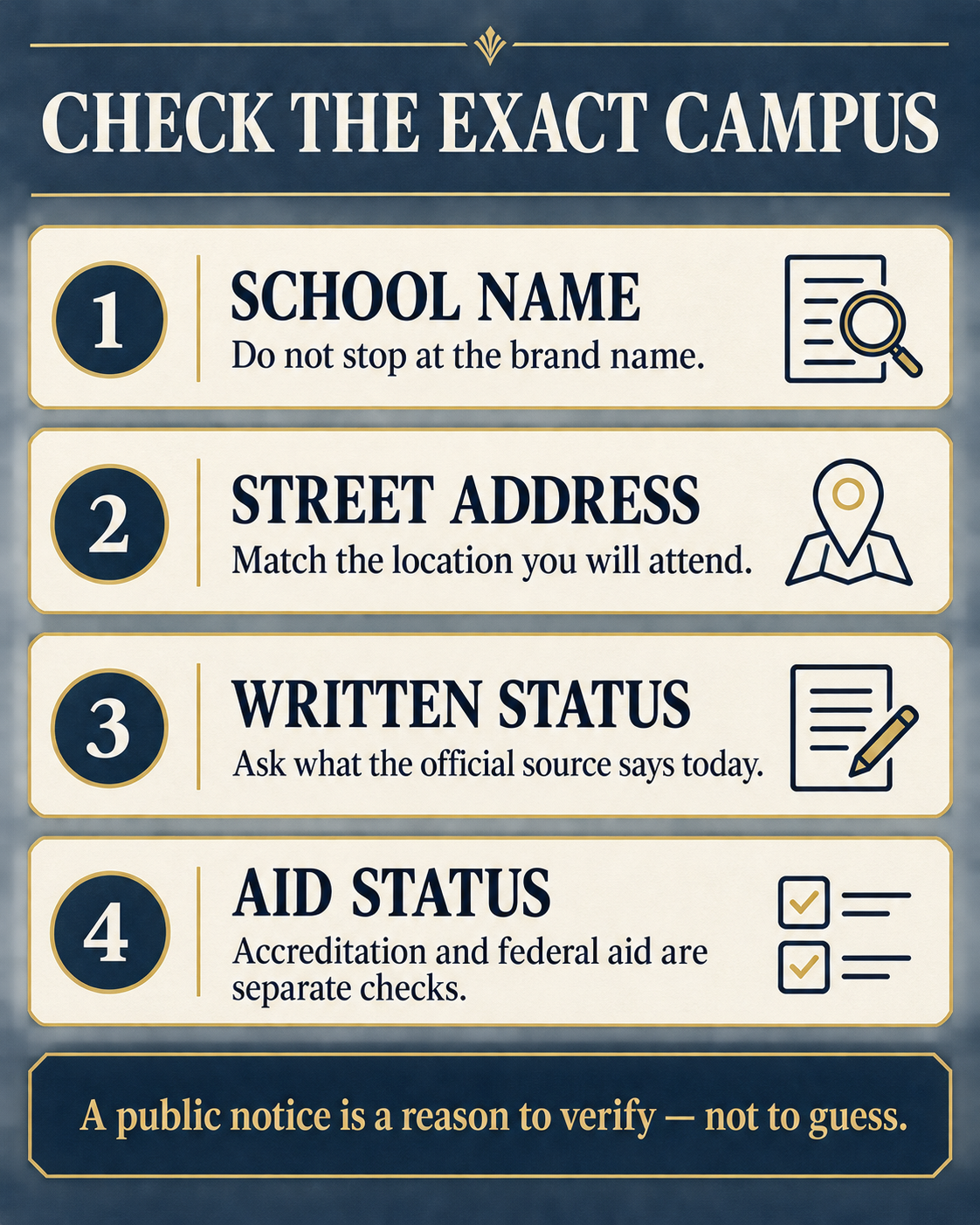
On September 10, 2026, the National Accrediting Commission of Career Arts & Sciences (NACCAS) posted a public notice using the phrase “Grant Provisional Additional Location Accreditation.” The practical lesson for a beauty-school family is simple: check the exact campus address, not only the school name.
A school may operate more than one teaching location. A public status connected to one location should not be assumed to describe every place that uses the same school name. Students and parents should match the official record to the street address where the student will actually attend.
A school name is not enough. Match the exact location, current written status, state license, and federal-aid status before making an enrollment decision.
Simple Answer First
The September 10 notice is a new, source-controlled accreditation record. It is not a warning about all beauty schools, an endorsement of any school, or proof about Louisville Beauty Academy.
It is useful because it teaches a rule that families can use anywhere: school name, campus address, accreditation status, state license, and federal-aid status are separate facts. Each fact should be checked in writing.
What NACCAS Posted on September 10
The NACCAS Public Notices page lists an effective date of September 10, 2026, a notice titled “Notice of Commission Actions – September 10, 2026,” and this action category: “Grant Provisional Additional Location Accreditation.”
This article relies on that visible public-page language. It does not name, rank, praise, criticize, or draw a school-specific conclusion about the institution identified in the linked notice file.
What the Hard Words Mean
NACCAS is an accrediting agency for career arts and sciences education. An accrediting agency reviews schools under its own published standards.
Accreditation is an outside review status. It is not the same as a state license to operate.
Commission action means the accrediting commission made a dated decision under its process.
Additional location means another teaching site connected to a main campus. For a student, the important fact is the exact address where instruction will occur.
Provisional signals a staged or limited status under the accreditor’s process. A family should not rewrite that word as “full,” “final,” “permanent,” or “guaranteed.” The official current record controls.
Public notice is a dated record released for the public. It is a reason to verify facts, not a reason to spread rumors.
Why the Exact Address Matters
Imagine that a family sees the same school name on two buildings. One is the main campus. The other is a newer teaching location. A brochure may use one brand name for both, but the official records may list each address separately.
Before signing, the family should write down the exact street address and search that location in the relevant official records. If a search result lists a different address, ask the school for a current written explanation and verify it with the official source.
This is not distrust. It is normal decision discipline. A careful school should be able to explain its own location, program, price, license, and claimed status clearly.
Four Separate Checks Before Enrollment
Check the exact campus. Match the official record to the full street address where the student will attend classes.
Check the state license. In Kentucky beauty education, use the Kentucky Board of Cosmetology and current Kentucky law and regulation sources.
Check the accreditation claim. If a school claims accreditation, search the accreditor’s current directory and public notices. Read the exact words and date.
Check federal aid separately. Accreditation alone does not prove that a school or location participates in federal student aid. Ask for the current written federal status and verify it through official U.S. Department of Education sources.
What This Means for a Real Student or Family
A busy parent may hear, “The school is accredited,” and think the question is finished. It is not. The useful follow-up is: Which campus, at what address, under what current written status, and for which program?
The family should also ask for the current written price, what the school bill includes, the refund rule, the required training hours, the expected completion conditions, and the state-license steps after graduation. Those answers should be reviewed before signing or paying.
If the answer changes depending on who is speaking, pause. Ask for the controlling written document. A verbal promise, advertisement, old screenshot, or social post should not replace a current official record.
Kentucky and Louisville Beauty Academy Relevance
Kentucky beauty schools and license pathways are governed through Kentucky law, regulations, and the Kentucky Board of Cosmetology. Accreditation is a different layer. Federal student aid is another different layer.
Louisville Beauty Academy is a Kentucky state-licensed beauty school. LBA does not claim NACCAS accreditation and does not process the Free Application for Federal Student Aid (FAFSA) or Title IV federal student aid. FAFSA is the government form used to apply for federal student aid; Title IV is the part of federal law that authorizes the major federal student-aid programs.
LBA’s public purpose in explaining this notice is student protection: help families separate labels, compare written facts, and ask better questions before making a school decision.
A Calm Written-Record Checklist
What is the exact legal school name?
What is the full address where I will receive instruction?
Which state agency licenses that school and location?
If accreditation is claimed, which accreditor lists this exact location today?
Does the official source say provisional, full, renewed, monitored, on probation, pending appeal, withdrawn, or something else?
Does the school or location actually participate in federal student aid, or is federal aid not part of its model?
What is the current written total price, payment duty, refund rule, required hours, and completion standard?
Students considering LBA may contact Louisville Beauty Academy, email study@louisvillebeautyacademy.net, or call 502-625-5531 to request current written program and cost information. Do not send Social Security numbers, identity documents, payment data, or private student records through a public article or public comment.
This article is general public education. It is not legal advice, financial-aid advice, accreditation advice, or a school-specific finding about any institution in a public notice. It does not claim NACCAS accreditation or federal-aid participation for LBA. It does not promise admission, graduation, licensure, exam passage, transfer acceptance, employment, income, aid, funding, or any individual result. Current official sources and current written school documents control.
NACCAS now lists September 3 and September 4, 2026 public-notice rows with accreditation actions such as renew accreditation, monitoring, probation, voluntary relinquishment, denial of initial accreditation, and withdrawal pending the right to appeal. The plain-English lesson for beauty school families is simple: a public notice is a signal to verify, not a rumor to repeat and not a shortcut for judging any school.
This Center of Excellence update is written for students, parents, spouses, salon owners, workforce counselors, and public readers who need careful beauty education language. Louisville Beauty Academy is using the notice as a student-protection teaching moment, not as criticism of another school, an endorsement of any school, or a legal conclusion.
Accreditation literacy protects families when it points them back to official sources and written school documents.
Simple Answer First
Accreditation is a school-review system. In beauty education, it can affect public trust, federal-aid eligibility at participating schools, and how families compare schools. But one public-notice row by itself does not tell a family everything they need to know.
A family should slow down and ask for current written proof: the school license, program cost, refund rule, required hours, graduation requirements, state-board license path, and any accreditation or federal-aid status the school claims.
What NACCAS Posted
The NACCAS public-notices page lists a September 3, 2026 row titled Notice of Commission Actions – September 3, 2026. The public page lists action categories including grant initial accreditation, deny initial accreditation, renew accreditation, place on accreditation monitoring, remove from accreditation monitoring, and voluntary relinquishment of accreditation.
The same page lists a September 4, 2026 row titled Notice of Commission Actions – September 4, 2026. The public page lists action categories including renew accreditation, place on financial monitoring, remove from financial monitoring, place on probation, remove from probation, and withdraw accreditation pending the right to appeal.
In this runtime, the linked SharePoint PDF files returned access-denied responses. For that reason, this article relies only on the visible public NACCAS page text and does not summarize school-specific details inside documents that were not retrieved.
What The Hard Words Mean
Accreditation means an outside accrediting agency reviews a school or program under that agency’s standards. It is different from a state license.
State license means the state board or state agency allows the school or person to operate under state rules. In Kentucky beauty education, the Kentucky Board of Cosmetology is the key state source.
Renew accreditation usually means an accreditor has acted to continue accreditation, subject to the accreditor’s rules and any conditions listed in the official notice.
Monitoring means the accreditor is watching a school or issue more closely. It is a verification signal, not a final student conclusion by itself.
Probation means a more serious accreditor concern or condition may exist. Families should read the official source and ask the school for current written status.
Withdrawal pending the right to appeal means the accreditor has listed a withdrawal action, but the notice language also says there is an appeal right. A family should not treat that phrase as the same thing as a final resolved outcome unless the official source says so.
Voluntary relinquishment means a school gives up accreditation status voluntarily under the accreditor’s process. It does not automatically explain why, and readers should avoid guessing.
What This Means For A Real Student Or Family
Imagine a parent comparing two beauty schools. One school says it is accredited. Another says it is state-licensed but does not process federal student aid. The parent should not rely on a brochure, a social media post, or a quick verbal answer. The parent should ask: What is the current written status? Who is the official source? What does the school cost? What will my student owe? What happens if my student withdraws?
That is the real lesson. Accreditation words matter because they can sound official, but families still need written proof. A school decision should be based on current documents, not assumptions.
Kentucky And LBA Relevance
Kentucky students should separate three things: state licensing, accreditation, and federal student aid. They are related in public conversation, but they are not the same thing.
The Kentucky Board of Cosmetology controls Kentucky beauty licensing and school-rule sources.
NACCAS public notices are accreditation-source records for schools in that accreditor’s scope.
Federal Student Aid and Title IV rules apply only where a school is eligible and participating in those federal aid programs.
Louisville Beauty Academy is a Kentucky state-licensed beauty school. LBA does not claim NACCAS accreditation and does not process FAFSA or Title IV federal student aid. LBA publishes that plainly so families can compare schools by written facts instead of confusing labels.
Four Checks Before Trusting Accreditation Language
Check the official source. Use the accreditor, state board, or government page, not only a school advertisement.
Check the date. Accreditation and monitoring status can change. A screenshot from last year may be stale.
Check the exact words. Pending appeal, probation, monitoring, renewal, denial, and withdrawal do not all mean the same thing.
Check the school paperwork. Program price, refund rules, required hours, and payment duties should be in writing before signing.
This article is public education. It is not legal advice, financial-aid advice, accreditation advice, or a school-specific judgment about any institution named in an official notice. It does not claim government endorsement, NACCAS accreditation for LBA, federal-aid participation for LBA, student-aid eligibility, licensure, exam passage, employment, income, or any individual outcome. Students and families should rely on current official sources and current written school documents.
This article is part of LBA’s public education and historical archive. Older posts, including “The Architecture of Accountability: A Comprehensive Analysis of U.S. Accreditation, Federal Student Aid Systems, and the Regulatory Triad – Public Research Library & Policy Analysis Series — 2026,” may not reflect current tuition, schedules, incentives, forms, policies, testing vendors, clinic availability, or regulatory requirements.
Powered by Di Tran University — College of Humanization (Research Division)
Public Research Library – Educational Policy Analysis
This paper is published as a public-interest research resource to support public understanding, policy literacy, and informed decision-making in U.S. postsecondary education. It does not describe, promote, or represent the practices, accreditation status, governance structure, or funding model of any specific institution. Hosting or distribution of this material does not imply participation in federal student aid programs, affiliation with any accrediting agency, or endorsement of any particular educational pathway. The analysis is provided solely for educational purposes and does not constitute legal, financial, or enrollment advice.
The United States postsecondary education system is a decentralized and complex ecosystem defined by a unique tripartite governance structure known as the program integrity triad. This framework, composed of federal oversight, state authorization, and private accreditation, serves as the primary mechanism for ensuring institutional quality and protecting the trillions of dollars in public funds disbursed through federal student aid programs.1 At the center of this apparatus is the Office of Federal Student Aid (FSA), a performance-based organization (PBO) within the U.S. Department of Education (ED) that manages the largest provider of postsecondary financial assistance in the nation.1 As of fiscal year 2024, FSA oversees a staggering $1.6 trillion student loan portfolio, encompassing approximately 45 million borrowers.1
The scale of this operation is matched only by its complexity. The intersection of federal mandates, varying state laws, and the self-regulatory nature of accreditation creates a landscape where institutional governance, financial transparency, and student protection often come into conflict. For the general public, legislators, and prospective students, understanding this architecture is essential to navigating a system that—while designed to facilitate access—frequently suffers from information asymmetry, confusing terminology, and regulatory gaps.5
The Program Integrity Triad: Foundations of Institutional Oversight
The federal government does not exercise direct national control over higher education institutions. Instead, the Higher Education Act (HEA) of 1965, as amended, mandates a shared responsibility model.7 This “triad” of entities must all signify approval for an institution to participate in Title IV federal student aid programs.3
The Role of State Authorization
State authorization represents the first pillar of the triad. Every institution of higher education (IHE) must be legally authorized by the state in which it is physically located to provide a postsecondary educational program.3 This process ensures that the institution is recognized by a sovereign entity and that there is a formal mechanism for addressing consumer complaints and enforcing state laws.3 For distance education, the regulatory burden increases, as schools must often navigate the requirements of multiple states, frequently managed through the State Authorization Reciprocity Agreement (SARA), which allows for interstate operation while maintaining accountability to the “home” state.3
Private Accreditation: The Gatekeeper of Quality
Accreditation is a voluntary, non-governmental peer-review process that evaluates whether an institution or program meets established standards of quality.2 To be eligible for federal aid, an institution must be accredited by an agency “recognized” by the Secretary of Education as a reliable authority on educational quality.2 Recognition is governed by 34 CFR Part 602 and Section 496 of the HEA.2
Historically, the system was divided into regional accreditors, which oversaw degree-granting institutions in specific geographic areas, and national accreditors, which primarily reviewed vocational, proprietary, or religiously-affiliated institutions.7 However, regulatory shifts in 2020 removed the geographic limitations on regional accreditors, effectively reclassifying both regional and national agencies as “institutional accreditors”.9
Entity
Primary Responsibility
Authority/Source
State Government
Legal authorization, consumer complaint resolution, and licensure.
State Statutes 3
Accrediting Agency
Peer-review of academic quality, curricula, faculty, and student achievement.
Private Association 2
Federal Government (ED)
Financial responsibility, administrative capability, and Title IV certification.
HEA Title IV 1
Source: 2
Federal Oversight and the Certification Process
The third pillar is the Department of Education, which certifies that an institution has the “financial responsibility” and “administrative capability” to manage Title IV funds.3 This includes monitoring an institution’s cohort default rates (CDR), ensuring it complies with the 90/10 rule (for proprietary schools), and verifying that it does not engage in substantial misrepresentation in its marketing.3
The Federal Student Aid (FSA) Machinery: Scale and Mechanics
The FSA functions as a discrete management unit within the Department of Education, granted special “PBO” status in 1998 to allow it to operate more like a private-sector bank.1 This status provides the agency with greater discretion over its budget, personnel, and procurement, a necessity given that it manages a financial portfolio comparable to the largest commercial banks in the world.1
Title IV Funding and Program Distribution
In FY 2024, FSA disbursed approximately $120.8 billion in aid to 9.9 million students across 5,400 institutions.1 This aid is distributed through several key programs:
Federal Pell Grants: Need-based grants for students with exceptional financial need. In 2024, disbursements reached $32.996 billion, representing a 15% increase from the previous year.4
William D. Ford Federal Direct Loan Program: The primary source of federal student loans, which disbursed $85.802 billion in 2024.4 This includes Subsidized Loans (where the government pays interest while the student is in school) and Unsubsidized Loans (where interest begins to accrue immediately).4
Federal Work-Study: A program providing funds for part-time employment to help students finance their education, disbursing $1.103 billion in 2024.4
Direct PLUS Loans: Unsubsidized loans available to graduate students and parents of dependent undergraduate students, which require a credit check but are not based on financial need.12
Program Type
2024 Disbursement (in Billions)
Year-over-Year Change
Federal Pell Grant
$32.996
+15%
Direct Loan Program
$85.802
+3%
Federal Work-Study
$1.103
Variable
Total Title IV Aid
$120.816
+5.9%
Source: 4
The immense scale of this system means that even minor administrative glitches can have catastrophic ripple effects. The 2024-2025 FAFSA cycle, for instance, experienced significant delays due to technical issues related to the FAFSA Simplification Act and the FUTURE Act, requiring the deployment of a “FAFSA College Support Strategy” to assist institutions in packaging aid.4
The Economics of College Pricing: The Bennett Hypothesis and Institutional Displacement
A central question in education policy research is whether the influx of federal aid drives up the cost of college. This theory, known as the Bennett Hypothesis, suggests that institutions raise tuition prices to “capture” the subsidies provided by the federal government.13
Net Price vs. Sticker Price
The true cost of college is often obscured by the difference between the “sticker price” (published tuition and fees) and the “net price” (the amount a student actually pays after all grants and scholarships are applied).15 The relationship can be expressed by the following identity:
Research indicates that selective nonprofit institutions often engage in “price sculpting” or “enrollment management,” where they adjust their own institutional discounts after seeing a student’s federal aid package.14 If a student receives an increase in federal Pell Grant funds, a selective institution may reduce its own need-based grant by an equivalent amount, effectively “taxing” the federal aid and capturing those dollars for other institutional purposes.14
By contrast, for-profit (proprietary) institutions, which often serve a more homogeneous, low-income population, have a stronger incentive to raise their list prices in direct response to increases in federal loan or grant maximums.13 In the public sector, tuition is more frequently governed by state legislatures, making them less likely to engage in the same type of individualized price capture.14
Consumer Confusion: The Crisis of Transparency in Financial Aid
One of the most significant barriers to student protection is the lack of standardized communication regarding financial aid. Prospective students and their families are frequently forced to make life-altering financial decisions based on ambiguous, inconsistent, and sometimes misleading information.5
The Jargon of Award Letters
A qualitative analysis of over 11,000 financial aid award letters revealed a pervasive lack of transparency. Among 455 colleges offering unsubsidized student loans, researchers identified 136 unique terms for the exact same loan product.6 In 24 instances, the word “loan” was entirely absent from the description, leading students to potentially mistake debt for free grant money.6
Furthermore, 70% of letters grouped all forms of aid—grants, loans, and work-study—together without defining the differences or explaining that loans must be repaid with interest.6 This practice often masks the “Pell Gap,” which averages nearly $12,000 for students with the highest financial need.6
Practice
Frequency/Impact
Implication for Students
Unique terms for “Unsubsidized Loan”
136 terms identified
High confusion; inability to compare offers.6
Inclusion of Parent PLUS loans as “awards”
15% of letters
Artificially inflates the perceived generosity of the package.6
Missing word “loan” in loan descriptions
24 unique cases
Students unknowingly agree to debt.6
Failure to calculate a “bottom line” cost
60% of letters
Families cannot determine actual out-of-pocket costs.6
Source: 6
Behavioral Biases and Information Overload
Policy researchers emphasize that information disclosure alone is insufficient to change consumer behavior if it is not “salient” and delivered at the right time.5 Students are susceptible to “complexity aversion” and “default bias,” meaning they are likely to accept whatever aid package is presented by an institution rather than navigating the labyrinthine process of seeking cheaper alternatives.17 When information is delivered after a student has already enrolled, the “switching costs”—geographic, financial, and credit-transfer barriers—become nearly insurmountable.5
State-Authorized Models and the Workforce Evolution
As the economy shifts toward technical and skills-based hiring, there is increasing pressure on the federal aid system to support “short-term” or “Workforce Pell” programs.18 These models, often vocational or non-credit in nature, present a different set of governance challenges.
The Risk of Lifetime Eligibility Exhaustion
A primary concern with expanding Pell Grants to short-term programs (those between 150 and 600 clock hours) is the consumption of a student’s lifetime eligibility.19 Students are limited to roughly six years (600%) of Pell Grant support.19 If a student uses several semesters of eligibility on a low-quality short-term certificate that does not lead to a high-wage job, they may lack the funds to pursue a more substantial associate or bachelor’s degree later in life.19
Flexible State Aid and Alternative Pathways
States like California have begun experimenting with “flexible-aid funds” to provide monthly stipends for workforce learners who may be ineligible for federal aid.18 Programs like Cal Grant C are designed to support vocational training, yet they remain underused due to outdated administrative rules.18 Additionally, some states have developed their own “Ability to Benefit” criteria, allowing adults without a high school diploma to access state aid if they are enrolled in recognized career pathways.18
Documentation and the Sanctity of the Student Record
In a system where credentials are the currency of the labor market, the integrity and accessibility of student records are paramount.20 Documentation serves as a critical student protection measure, particularly when institutions fail or close.
Transcript Integrity and Holds
The practice of “transcript holds”—where an institution refuses to release a student’s academic records due to an outstanding financial balance—has become a significant point of regulatory contention.20 These holds can prevent students from transferring credits, graduating, or obtaining employment, creating a “debt trap” where the student cannot earn the income necessary to pay the very debt that is blocking their progress.20 Accreditors like the Higher Learning Commission (HLC) now encourage institutions to review these policies to ensure they do not create unnecessary impediments to student success.20
FERPA and the Protection of Privacy
The Family Educational Rights and Privacy Act (FERPA) provides the legal framework for student record protection.21 It requires institutions to obtain written consent before disclosing personally identifiable information (PII), except in specific “directory information” or safety cases.22 However, the rise of “Online Program Managers” (OPMs) and third-party data handlers has raised concerns about “re-disclosure” and the commercialization of student data.19 Reports indicate that sensitive data, including Social Security Numbers and income information, has occasionally been accessed by unauthorized parties or used to influence political outcomes, undermining public trust.24
Civil Rights and the Enforcement Gap
The effectiveness of the program integrity triad is ultimately dependent on the enforcement capacity of federal agencies. Recent investigations by the Government Accountability Office (GAO) have highlighted a crisis within the Department of Education’s Office for Civil Rights (OCR).27
The Collapse of Complaint Review
Between March and September 2025, OCR received over 9,000 discrimination complaints, but roughly 90% of resolved cases were closed through dismissal without a full review.27 This disruption coincided with hundreds of staff being placed on administrative leave, a decision that cost taxpayers upwards of $38 million while leaving students with disabilities without a meaningful federal backstop.27 For families relying on Section 504 or the Americans with Disabilities Act (ADA), this enforcement vacuum means fewer safeguards against harassment, unequal discipline, and the denial of necessary accommodations.27
Institutional Governance and the Duty of Intellectual Integrity
Institutional governance extends beyond financial management to the maintenance of an environment of academic and intellectual integrity.28 Boards of trustees and faculty are responsible for ensuring that the institution’s purposes are appropriate to higher learning and that resources are organized to achieve those purposes.30
Board Independence and Conflict of Interest
Accreditation standards, such as those from the New England Commission of Higher Education (NECHE), mandate that at least two-thirds of an institution’s board members must be free of personal or familial financial interest in the institution.30 This independence is essential to prevent the subversion of the educational mission for private gain, a risk particularly acute in the proprietary sector.3
Academic Integrity and Transcript Notations
When academic dishonesty occurs, it devalues the educational process for all students. Institutions have developed robust codes of conduct that may result in transcript notations, suspension, or expulsion.28 These documentation standards are not merely punitive; they serve as a signal to future employers and other institutions that the individual’s knowledge and credentials were earned through honest effort.20
The Future of Oversight: Reform and Accountability
The current administration has proposed sweeping reforms to the accreditation system, focusing on “Principles of Student-Oriented Accreditation”.31 These reforms aim to:
Prioritize Outcomes: Requiring accreditors to use program-level student outcome data, such as graduation rates and labor market returns, as a condition of federal recognition.31
Reduce Credential Inflation: Prohibiting practices that force students to earn unnecessary degrees or certificates for jobs that do not require them.31
Ensure Neutrality: Prohibiting accreditors from making the adoption of specific ideologies (such as DEI-based standards) a formal condition of accreditation, arguing that such requirements can violate federal law and distract from academic quality.31
Strengthen Accountability: Allowing the Secretary of Education to hold accreditors accountable through denial, suspension, or termination of recognition if they fail to meet these criteria.31
Synthesis and Strategic Implications
The U.S. postsecondary system is currently at a crossroads. While Title IV aid provides the necessary capital for millions to seek upward mobility, the lack of transparency in financial aid and the variability in accreditation standards create significant risks for the most vulnerable students.1
The confusion between financial aid types—specifically the obscuring of loan obligations—represents a fundamental market failure that necessitates a federal mandate for standardized aid offers.6 Furthermore, the transition toward workforce-aligned models requires a new level of state-level authorization and “short-term” quality metrics to ensure that students do not exhaust their lifetime Pell eligibility on “untested, low-quality, or fraudulent programs”.18
Ultimately, the protection of the student relies on the integrity of the record. From the sanctity of the transcript to the transparency of the College Scorecard, documentation is the only defense against institutional failure and the mismanagement of public funds.20 Legislators and regulators must prioritize the operational health of agencies like the OCR and FSA to ensure that the rules of the road are not only written but actively enforced.26 For parents and prospective students, the burden remains on “institutional literacy”—the ability to look past marketing jargon to the actual net price, graduation probability, and debt obligations that define the true value of an American higher education.5
The decentralized nature of the triad provides flexibility and innovation, but it requires a high degree of transparency and public trust to function. As expectations for accountability rise, institutions must move beyond basic compliance toward a model of governance that prioritizes student outcomes and intellectual integrity above all else.30 Only then can the program integrity triad fulfill its original promise: ensuring that the investment of public and private funds in higher education serves the public good and the long-term success of every American student.3
Institutional Eligibility for Participation in Title IV Student Aid Programs Under the Higher Education Act: Background and Reauthorization Issues – EveryCRSReport.com, accessed February 7, 2026, https://www.everycrsreport.com/reports/RL33909.html