In the vibrant realm of beauty, where imagination and innovation intertwine, Louisville Beauty Academy shines as a beacon of empowerment and excellence. This esteemed institution, with its legacy of nurturing over 1000 beauty professionals and boasting a remarkable 90% graduation rate, is not merely a school; it’s a cradle for cultivating the future luminaries of the beauty industry and visionary salon owners.
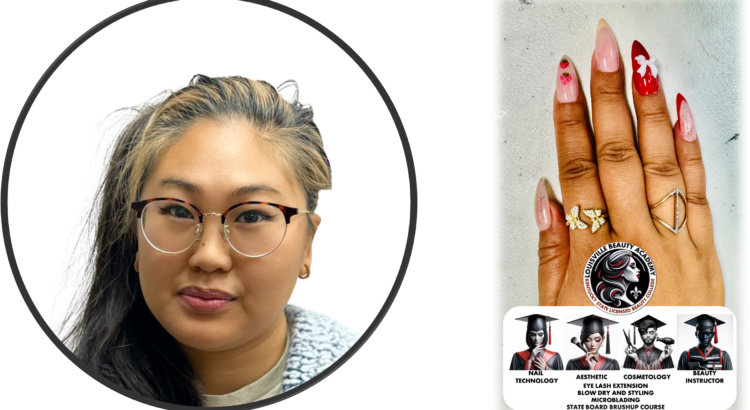
Among the academy’s stars is Sara Drager, whose journey is a vivid illustration of the academy’s ethos of passion, perseverance, and entrepreneurial spirit. Sara’s story is a celebration of the transformative magic of education and the boundless opportunities within the beauty world.
Sara’s voyage into the beauty industry was marked by unexpected twists. Initially envisioning careers as diverse as a funeral director, veterinarian, or mental health professional, she found herself navigating the demanding waters of corporate life, wearing multiple hats. Yet, it was during a simple oil change, while flaunting her own vibrant and glittery nail art, that Sara experienced an epiphany. The admiration from her mechanic was a moment of clarity: her true destiny lay in the realm of beauty.
Fuelled by her past experiences as a model and encounters with exceptional beauty professionals, Sara set sail towards her newfound passion for nails. At Louisville Beauty Academy, she is immersed in the Nail Tech program, crafting her dream of delivering luxury nail services that exude warmth and comfort to clients.
What distinguishes Louisville Beauty Academy, in Sara’s eyes, is its unwavering commitment to nurturing a safe and welcoming atmosphere. The academy’s leaders, Di Tran and Ms. Crystal, are pillars of support, generously sharing their knowledge and ensuring a sense of belonging for all. Inspired by Ms. Crystal’s exemplary teaching, Sara envisions herself returning to the academy as an educator, passing on the torch of wisdom to future generations.
As a third-generation American with a rich heritage in hospitality and a deep-rooted understanding of the beauty sector, Sara shares invaluable insights for aspiring entrepreneurs. She underscores the essence of passion, asserting that a successful business should feel like a round-the-clock adventure, fueled by an undying love for the craft. According to Sara, when you’re truly passionate, work transcends into a labor of love, paving the way for prosperity in the beauty industry.
Sara’s narrative is a testament to the empowering influence of pursuing one’s passions and the pivotal role of institutions like Louisville Beauty Academy in sculpting the future of the beauty landscape. As Sara forges ahead on her path, she exemplifies the academy’s core principles of passion, education, and empowerment, inspiring others to chase their dreams in the enchanting world of beauty.
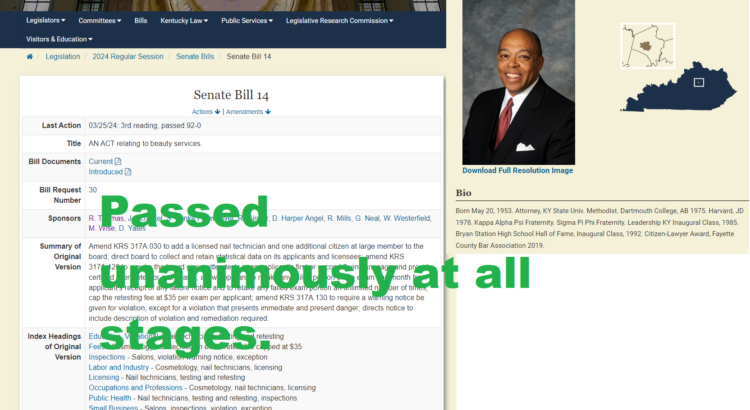
On March 25, 2024, a significant piece of legislation, Senate Bill 14, was unanimously passed by the Kentucky General Assembly, heralding a new era for beauty professionals across the state. This act, meticulously shepherded through the legislative process by Senator Reginald Thomas, aims to refine and enhance the regulatory framework governing the beauty industry, with a particular focus on cosmetology, esthetic practices, and nail technology. It was signed into law in March 19th, 2024.
Effective Date: July 1, 2024
Kentucky typically enacts new laws like Senate Bill 14 to become effective 90 days after the adjournment of the legislative session, as dictated by Section 55 of the Kentucky Constitution. This standard is followed unless a specific effective date is mentioned or an emergency measure is invoked. Senate Bill 14 will therefore become effective on July 1, 2024.
This 90-day period allows for administrative preparation by state agencies, such as the Kentucky State Board of Cosmetology, to update regulations and procedures. It also provides time for industry adjustment, where professionals and businesses can prepare to comply with new rules, and for public information campaigns to educate both service providers and consumers about the changes. This structured timeline ensures a smooth transition into the new regulatory environment, minimizing disruption and enhancing the law’s effectiveness across the community.
Key Highlights of Senate Bill 14:
Scope of Practice: The bill clearly delineates the boundaries of practice for cosmetology, esthetic practices, and nail technology, ensuring that these professions are solely focused on cosmetic purposes and not on treating physical or mental ailments.
Licensing Requirements: It reaffirms that individuals must obtain the appropriate licenses to engage in cosmetology, esthetic practices, or nail technology for the public or for consideration, thereby upholding professional standards.
Expanded Board Composition: The Kentucky Board of Cosmetology will now include seven members, with specific representation for licensed nail technicians and estheticians, ensuring a broader representation of the beauty industry.
Emergency Powers and Enforcement: The board is empowered to take emergency actions to protect public health and safety and can refer violations to legal authorities for prosecution.
Retesting for Nail Technician Applicants: Nail technician applicants who fail a written theory test or an oral practical demonstration are allowed to retake that portion after one month from the date of receiving notice of the failure.
Use of Callus Graters: The bill explicitly permits the use of callus graters for callus removal by instructors, students, cosmetologists, and nail technicians, providing clarity on permissible practices.
Senate Bill 14 is a testament to the collaborative efforts of legislators, industry professionals, and stakeholders who have worked tirelessly to ensure that Kentucky’s beauty industry continues to thrive while maintaining high standards of professionalism and safety. This legislation not only strengthens the regulatory framework but also paves the way for a more inclusive and representative governance structure within the beauty industry.
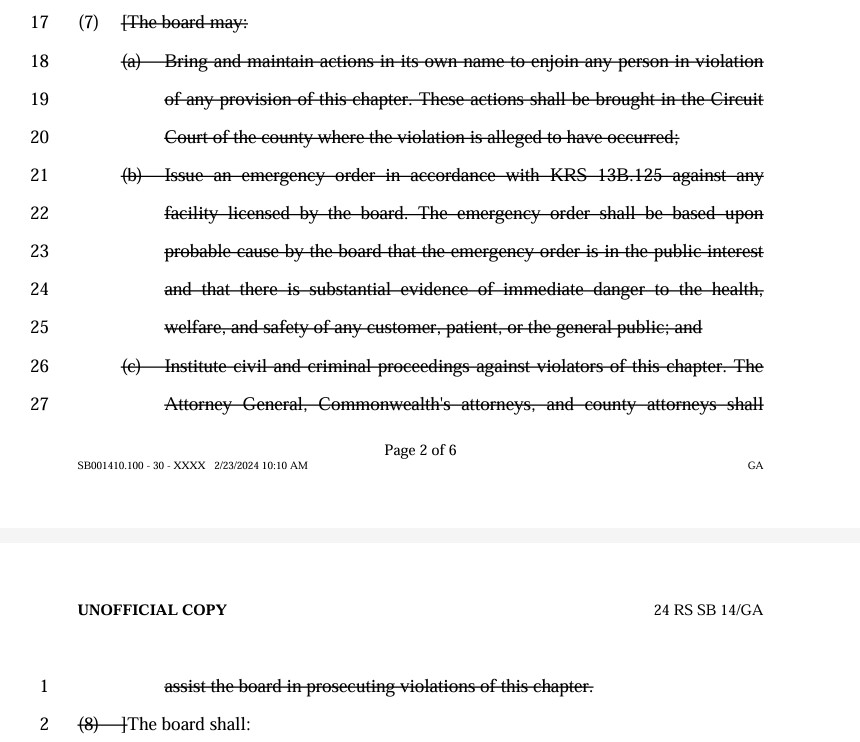
REMOVED CLAUSE
The removed section gave the Kentucky Board of Cosmetology strong powers to enforce rules, but it also had the potential for misuse. Here’s a simpler explanation:
Legal Actions: The board could take people or places breaking the rules to court. However, this power could be misused to target certain businesses unfairly, like closing down nail salons on the spot during inspections without proper cause.
Emergency Orders: The board could quickly act to stop dangerous situations. But this could be abused if, for example, a salon was shut down immediately based on unverified claims, causing harm to the business.
Lawsuits and Criminal Charges: The board could sue or charge rule-breakers with crimes. However, there were concerns that this power was used harshly against certain businesses, like delaying their appeals for months with the intention of causing harm.
By removing this section, the board’s ability to enforce rules remains, but there’s less chance for these powers to be misused against businesses like nail salons.
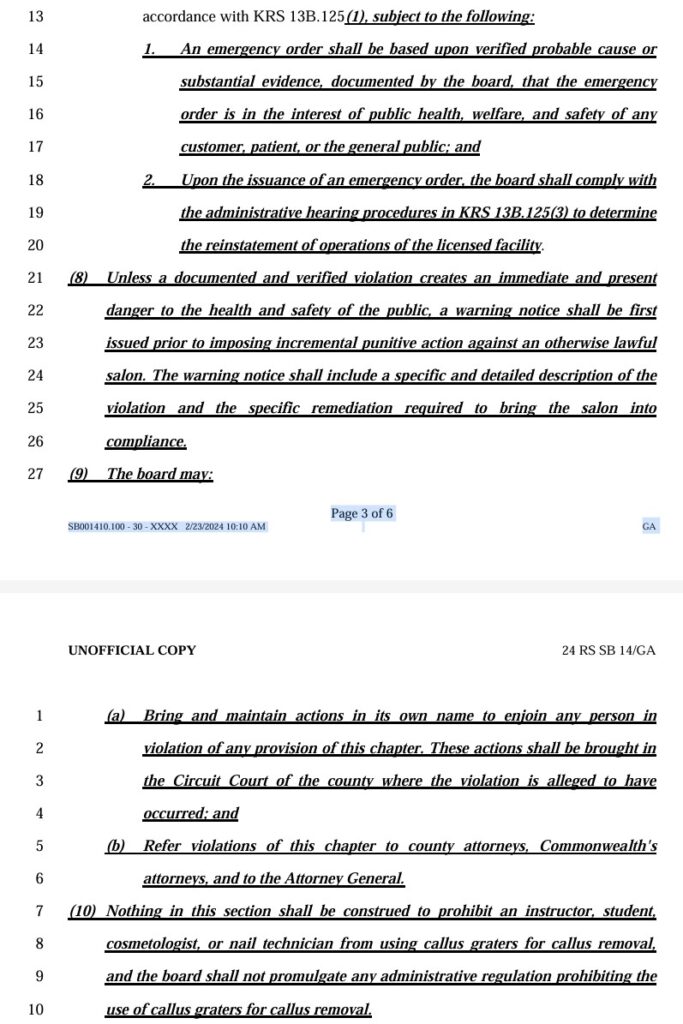
ADDED CLAUSE
The added clause in the legislation aims to make things fairer and reduce the chances of the board misusing its power. Here’s how:
Emergency Orders: Before the board can issue an emergency order to shut down a salon, they must have strong evidence or a very good reason to believe that there’s a real danger to public health, safety, or welfare. This means they can’t just close down a salon without a solid reason.
Hearing Procedures: If the board does issue an emergency order, they have to follow certain rules to decide if the salon can reopen. This gives the salon a fair chance to make their case.
Warning Notices: Before taking serious action against a salon that’s otherwise following the law, the board has to give a warning notice. This notice must clearly explain what the salon did wrong and what they need to do to fix it. This way, the salon has a chance to correct the issue before facing harsher penalties.
Legal Actions: The board can still take legal action against someone breaking the rules, but they have to do it through the court system in the county where the problem happened. This ensures that the process is transparent and fair.
Referring Violations: The board can refer violations to legal authorities like county attorneys or the Attorney General, but this doesn’t mean immediate punishment. It allows for a proper legal process to take place.
Use of Callus Graters: The board can’t make rules that stop instructors, students, cosmetologists, or nail technicians from using callus graters for removing calluses. This gives professionals the freedom to use the tools they need for their work.
Overall, these changes aim to make sure that the board’s actions are based on real evidence and that beauty professionals have a fair chance to respond to any accusations or orders.
MISCONCEPTIONS VS REALITY ABOUT THIS SENATE BILL 14
Misconception: The bill was only for Asians, specifically Vietnamese and Cambodian nail technicians and salon owners.
Reality:
The bill is for all Americans, promoting fairness in the beauty industry.
It aims to include nail technicians and estheticians on the regulatory board for better representation.
It allows all candidates to retake licensing exams within a specified time until they pass, ensuring equal opportunities.
The bill highlights the significant contributions of the immigrant community to Kentucky’s economy and society.
Louisville Beauty Academy has graduated over 1,000 students, the majority of whom are immigrants from all around the world. On any given day, there can be speakers of more than five different languages in a class.
The bill supports workforce development, enabling more people to work safely and quickly in the beauty industry.
It ensures fair treatment and protection for beauty professionals and promotes accountability for those in positions of power.
The bill is about all Americans, emphasizing inclusivity and diversity in the beauty industry.
Louisville Beauty Academy, a Kentucky state-licensed beauty school, understands that the journey to becoming a beauty professional is unique for each individual. In recognition of this, the academy offers a flexible approach to transferring valid hours between board-licensed schools or for current licensees looking to expand their expertise in the fields of cosmetology, esthetics, shampoo styling, or nail technology.
Understanding Program Transfer Hours:
To facilitate a smooth transition, individuals are required to complete and submit the Program Hour Transfer Request form. This process ensures that the transferred hours or license are treated as earned credit hours in the chosen program, subject to specific guidelines:
Esthetics License Transfer: A current esthetics license can be credited with no more than 400 hours in a cosmetology program.
Nail Technologist License Transfer: A current nail technologist license can be credited with no more than 200 hours in a cosmetology program.
Shampoo Styling License Transfer: A current shampoo styling license can be credited with no more than 300 hours in a cosmetology program.
Barber License Transfer: A current barber license can be credited with no more than 750 hours in a cosmetology program.
It’s important to note that, with a few exceptions, hours cannot be transferred from one discipline to another. This ensures that students receive the specialized training required for each field.
Completing the Program:
Credit hours transferred pursuant to this section will only take effect upon the transferee’s completion of the remaining hours necessary to complete the cosmetology program. This approach allows students to build on their existing knowledge and skills while ensuring they meet the comprehensive training standards set by the Kentucky State Board of Cosmetology.
Why Choose Louisville Beauty Academy?
Choosing Louisville Beauty Academy for your beauty education means choosing a path of flexibility and opportunity. With experienced instructors, modern facilities, and a curriculum that is aligned with industry standards, students are well-equipped to excel in their chosen field. Whether you’re transferring hours or starting fresh, the academy is committed to providing an educational experience that is both enriching and empowering.
Join Louisville Beauty Academy and take the next step in your beauty career with confidence, knowing that your previous achievements are valued and recognized as you pursue your passion in the vibrant world of beauty.
Kentucky’s Gold Standard of Lawful and Humanized Beauty Education
About the Program
Louisville Beauty Academy (LBA) is a Kentucky State-Licensed and state-licensed beauty college, nationally recognized for excellence in lawful, humanized beauty education.
Our Instructor 750 Clock Hours Curriculum is designed to prepare future beauty educators with the knowledge, teaching methodology, and professional development skills necessary to train the next generation of licensed beauty professionals — fully aligned with the Kentucky Board of Cosmetology (KBC) standards.
Official Kentucky Instructor Hour Structure
Component
Minimum Hours
Source
Direct contact with students
425 hours
201 KAR 12:082 apprentice instructor curriculum
Theory instruction, in person or online as allowed
LBA’s Instructor Training Program provides a holistic, structured approach to education — blending theory, practice, mentorship, and classroom leadership.
1. Foundation
Orientation: Overview of instructor responsibilities and state regulations.
Psychology of Student Training: Understanding how students learn, communicate, and stay motivated.
Introduction to Teaching: Exploring effective educational philosophies and learning models.
2. Professional Development
Good Grooming & Professional Conduct: Cultivating leadership presence and professionalism.
Course Outlining and Development: Creating organized, standards-based course materials.
Lesson Planning: Structuring lessons to maximize student comprehension and engagement.
3. Teaching Techniques
Instructional Methods: Learning diverse approaches for theory and practical instruction.
Audio-Visual & Teaching Aids: Using modern technology to enhance classroom delivery.
Demonstration Techniques: Presenting practical skills effectively and safely.
4. Evaluation and Management
Examinations and Analysis: Developing fair and valid assessments to track student progress.
Classroom Management: Maintaining order, respect, and a positive learning environment.
Recordkeeping: Ensuring accurate student documentation and compliance.
5. Practical Experience
Observation & Teacher Assistantship: Gaining exposure to live classroom instruction under supervision.
Pupil Teaching (Practice Teaching): Delivering actual lessons with instructor oversight.
Supervision and Online Theory Course: Completing supervised teaching and online theory as allowed under KBC rules.
Current-source control: This page now uses the current 201 KAR 12:082 instructor hour structure of 750 total hours: 425 direct-contact hours and 325 theory hours. Any prior or older reference to additional advanced-coursework requirements should be confirmed directly against current 201 KAR 12:082 and KBC written requirements before being relied on for examination or renewal planning.
Why Choose Louisville Beauty Academy
Louisville Beauty Academy stands as Kentucky’s Gold Standard of Beauty Education — where legal compliance meets compassion. Our instructor trainees are nurtured by award-winning educators and supported through both in-person and digital learning environments.
Graduates of the Instructor Program are not just certified teachers — they are mentors, motivators, and role models who elevate the human side of beauty education.
Join us in shaping the future of the beauty industry — one licensed instructor at a time.
Disclaimer
All references to Kentucky laws and regulations are accurate as of the date of posting but may change without notice. This content is provided for educational and informational purposes only. For the latest legal or licensing updates, please visit the official Kentucky Board of Cosmetology (KBC).
Why Choose Louisville Beauty Academy?
Choosing Louisville Beauty Academy for instructor training means choosing a path of excellence and leadership in beauty education. With experienced educators, modern facilities, and a curriculum that is aligned with industry standards, apprentice instructors are well-equipped to inspire and train future beauty professionals. Graduates of the program are not just skilled instructors; they are mentors, motivators, and role models in the vibrant world of beauty.
Join Louisville Beauty Academy and embark on a rewarding journey to become a licensed instructor, shaping the future of the beauty industry through education and empowerment.
Kentucky’s Gold Standard of Lawful and Humanized Beauty Education
About the Program
Louisville Beauty Academy (LBA) is a Kentucky State-Licensed and state-licensed beauty college, nationally recognized for excellence in lawful, humanized beauty education.
Our Aesthetic/Esthetic 750 Clock Hours Curriculum is designed to train students in the science, art, and professionalism of skin care, facial treatments, hair removal, makeup, and spa services — aligned with the standards and expectations of the Kentucky Board of Cosmetology (KBC).
All instruction is built with awareness of the Kentucky statutes and administrative regulations governing aesthetics, as published by the Kentucky Board of Cosmetology at: 👉 https://kbc.ky.gov
As soon as this page is published, it may already be out of date compared to current Kentucky law. All laws and regulations change over time. This page is for educational and sample purposes only.
Milady as the Foundation of Theory Education
Louisville Beauty Academy’s Aesthetic/Esthetic curriculum is structured in alignment with the Milady Standard Esthetics: Fundamentals textbook and resources.
All theory instruction
Chapter quizzes and tests
PSI exam preparation
follow the Milady framework, ensuring that each student receives education consistent with nationally recognized standards and the Kentucky Board of Cosmetology exam outline.
In addition, LBA enhances learning with:
Milady Standard Esthetics textbooks and online resources
PSI exam preparation materials
LBA’s own self-published books authored by Founder Di Tran
Multilingual and AI-assisted study support
This combination makes LBA a gold standard hub where national curriculum, state law, and humanized education meet.
Overview and awareness of KRS 317A and 201 KAR 12 as published by KBC
35 hrs
Clinic & Practice
Supervised services on mannequins and live models; facials, hair removal, machines, makeup, sanitation, client care
465 hrs
Total Program
Comprehensive Instructional Program
750 Clock Hours Minimum
These hours reflect Louisville Beauty Academy’s internal educational structure and are based on the most recent publicly available information from the Kentucky Board of Cosmetology at the time of publication. For current official requirements, always refer directly to https://kbc.ky.gov.
Curriculum Overview
1. Foundational Knowledge
History and Opportunities in Aesthetics/Esthetics
Life Skills, Professional Ethics, and Personal Growth
Professional Image and Personal Presentation
Communication Skills and Client Relations
Building Confidence and the “YES I CAN / I HAVE DONE IT” Mindset
2. General Sciences
Infection Control and Safety Practices
Anatomy and Physiology Related to Skin and Supporting Structures
Skin Structure, Function, and Health (Histology & Physiology)
Skin Disorders and Diseases (recognition and appropriate referral)
Basics of Chemistry (cosmetic ingredients and product interactions)
Basics of Electricity (safe use of facial machines, galvanic, high-frequency, etc.)
Basics of Nutrition and Its Relationship to Skin Health
These science topics are taught using Milady Standard Esthetics: Fundamentals as the core textbook, supplemented by LBA’s additional materials and visual/AI tools to help students deeply understand the “why” behind every service.
3. Esthetic Procedures & Advanced Techniques
Facials – Basic and Advanced
Cleansing, exfoliation, extractions (within scope), masking, and finishing techniques
Facial Massage – Effleurage, petrissage, and other manipulations for relaxation and circulation
Facial Machines and Technology –
Use of steamers, brushes, galvanic, high-frequency, microderm (where lawful), and related devices
Hair Removal –
Temporary methods such as waxing, tweezing, and other KBC-permitted techniques
Eye and Lash Services –
Basic lash enhancements and application of artificial eyelashes within esthetic scope
Makeup Artistry –
Color theory, corrective makeup, bridal, special occasion, and basic photography-ready looks
Advanced Topics and Treatments (Non-Medical Scope) –
Emerging techniques discussed in theory with strong emphasis on what is within vs. outside esthetic scope under Kentucky law
All skills are first demonstrated by instructors, then practiced on mannequins, then on live models in LBA’s supervised clinic.
4. Business and Professional Skills
Preparing for Licensure and Employment as an Esthetician
Understanding the Esthetician’s Role in a Spa, Salon, Clinic, or Studio
Basic Spa/Salon Management and Entrepreneurship Concepts
Customer Service, Client Retention, and Retailing of Products and Services
Professional Ethics, Boundaries, and Communication in Practice
Building a Professional Image, Portfolio, and Social Media Presence Responsibly
These topics help students not only pass the exam, but also thrive in the workforce or as future spa/salon owners and leaders in the beauty and wellness industry.
Training and Lawful Practice
Students must complete a required number of theory hours and safety education before performing services on the public.
Early practice occurs only on mannequins and fellow students, under instructor supervision.
All clinic hours are recorded using biometric and digital tracking to preserve accurate attendance and service records.
Sanitation, disinfection, and safety practices are emphasized continuously in alignment with current standards published by the Kentucky Board of Cosmetology.
Instruction on Kentucky law is provided for educational awareness only. LBA directs all students, graduates, and licensees to always consult the Kentucky Board of Cosmetology at https://kbc.ky.gov for the latest, official, and legally binding rules and regulations.
Why Louisville Beauty Academy Is the Gold Standard
Louisville Beauty Academy serves as a Center of Excellence for Beauty Education and Compliance in Kentucky by:
Using Milady Standard Esthetics: Fundamentals as the national curriculum backbone
Aligning training with KBC expectations and PSI exam outlines
Supporting students with self-published LBA books, AI tools, and multilingual resources
Maintaining transparent, documented, and humanized processes for all students
LBA graduates are trained to be:
Technically skilled in esthetic services
Lawfully aware of their scope and responsibilities
Ethically grounded and client-centered
Compassionate and community-focused professionals
“Our education begins with respect for the law and ends with service to others — because lawful practice is the highest form of professionalism.” — Di Tran, Founder & CEO, Louisville Beauty Academy
Legal and Educational Disclaimer
Louisville Beauty Academy’s curriculum materials, including this Aesthetic/Esthetic 750 Clock Hours Curriculum description, are provided solely for educational and sample purposes.
Any references to Kentucky statutes, administrative regulations, or board standards are general summaries and not official legal documents.
Louisville Beauty Academy assumes no liability for any errors, omissions, or changes in law or regulation after the time of publication.
The Kentucky Board of Cosmetology (KBC) is the only official source for current and legally binding requirements. For all official updates to KRS 317A and 201 KAR 12, please visit: 👉 https://kbc.ky.gov
Legitimizing the American Dream Through Beauty Licensing
For countless immigrants and refugees arriving in the United States, the pursuit of the American Dream goes beyond financial opportunity—it is a deeply personal quest for legitimacy. To be seen, to be documented, to be recognized not merely as present, but as purposeful and contributing—this is a powerful and common thread uniting so many stories.
These individuals have crossed oceans, endured immigration interviews, navigated visa and green card systems, and stepped into a culture vastly different from their own. Yet, even after arrival, the feeling of being fully established and accepted in America remains just out of reach.
At the heart of that journey stands Louisville Beauty Academy—a Kentucky state-licensed beauty school with a mission far greater than education alone. We exist to legitimize. To transform beauty talent into state-recognized professional identity. To guide individuals from uncertainty to clarity, from unlicensed labor to licensed legacy.
🎓 More Than a School: A Beacon of Legitimacy and Belonging
Louisville Beauty Academy proudly offers programs in:
Nail Technology
Esthetics/Aesthetics
Cosmetology
Shampoo Styling
Specialty Permits (e.g., Eyelash Extensions)
But these are not just beauty courses. These are pathways to professional credibility. Because a state beauty license is more than a document—it’s legal proof of skill, value, and inclusion in the American workforce.
When you become licensed by the Commonwealth of Kentucky, your name is recognized in a government system. Your time, education, and compliance are validated. You are no longer just a talented worker. You are a licensed professional.
🛡️ Why Licensing Matters—Especially for Immigrants
A college degree is awarded by an institution.
A state license is granted by the government itself.
It’s transferable between states and stands as a lifelong credential.
It provides legal protection, professional credibility, and opens doors to career advancement, business ownership, and tax participation.
At Louisville Beauty Academy, we understand that this license is more than a career move—it’s a declaration:
“I am here. I am skilled. I am legitimate. I am contributing to America.”
💡 Why Louisville Beauty Academy?
We are proud to be:
The highly affordable beauty college in Kentucky
The most flexible, with extended weekday and weekend hours
Family-oriented, welcoming students of all backgrounds and life stages
Zero-disruption and state-compliant, with biometric tracking and strict professionalism
Student-centered, with payment plans, scholarships, and immigrant-friendly guidance
Here, nearly 2,000 graduates have found not just licenses—but confidence, pride, and upward mobility.
🚀 Your Call to Action: Start Now
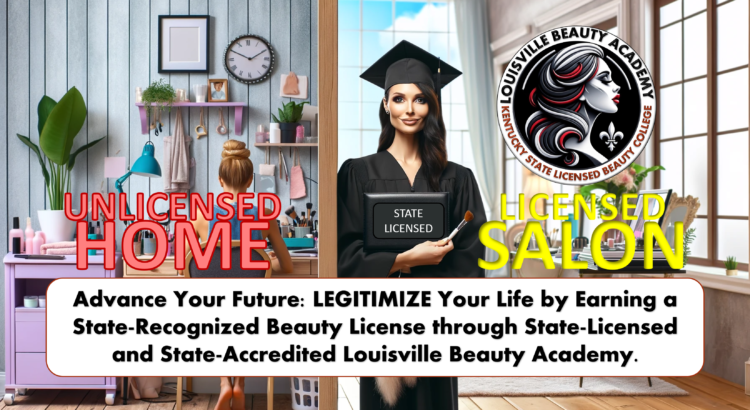
Don’t delay your dream. Don’t work in the shadows when you have the skill to shine in the light.
If you’re currently offering services from home or learning on your own, it’s time to legitimize your business and talent. Let Louisville Beauty Academy walk beside you. We offer a legal, structured, and supportive path to becoming a state-licensed professional in as little as 10 weeks for some programs.
Unlock Your Potential in the Beauty Industry – Legally and Professionally
In 2024, the world of beauty is not just about skill and creativity; it’s also about legality and professionalism. At Louisville Beauty Academy, we understand that your passion for beauty deserves the best foundation. That’s why we emphasize the crucial importance of licensing in the beauty industry. In Kentucky, as in most states, it is illegal to offer any beauty service to customers without a proper license. This law safeguards both the service provider and the client, ensuring high standards of quality and safety.
Diverse Programs to Match Your Passion
Our academy offers a wide range of programs to help you turn your passion into a profession:
Cosmetology: Dive into the world of hair, makeup, and skincare. Our comprehensive cosmetology program covers all the essentials to become a licensed professional.
Nail Technician: Specialize in the art of nail care and design. Our course is designed to teach you the latest trends and techniques in nail technology.
Aesthetician: Become an expert in skin health and beauty. Our aesthetician program offers deep insights into skincare treatments and technologies.
Blow Dry and Styling: Master the art of hair styling. This program focuses on various blow-drying and hair styling techniques that are essential in today’s beauty industry.
Beauty Instructor Training: Take your passion to the next level by learning how to teach others. This program prepares you to train aspiring beauty professionals.
Eyelash Extension: Delve into the intricate art of eyelash extension, a highly sought-after skill in the beauty industry.
Microblading: Learn the precise and artistic technique of eyebrow microblading to enhance facial beauty.
Why Wait? Launch Your Career Now!
2024 is the year to take action. Don’t let another year pass by dreaming about your career in the beauty industry. By enrolling at Louisville Beauty Academy, you’re taking the first step towards a rewarding and legal professional path. Our licensed instructors, state-of-the-art facilities, and hands-on training approach are designed to equip you with the skills and knowledge you need to thrive in the beauty industry.
Your Talent, Licensed and Recognized
Remember, practicing beauty services without a license is not only illegal but also limits your career potential. By getting licensed, you not only comply with state laws but also gain credibility and trust from your clients. A license in beauty is more than just a legal requirement; it’s a badge of professionalism and commitment to quality.
Enroll Today, Beautify Tomorrow
The journey to becoming a licensed beauty professional starts here, at Louisville Beauty Academy. Enroll today and transform your passion into a licensed talent. Let 2024 be the year you launch your career in the beauty industry with confidence and legality.
Louisville Beauty Academy – Where Talent Meets License
In the ever-evolving landscape of beauty and skincare, dermaplaning has emerged as a popular procedure known for its simplicity and effectiveness. For students embarking on a career in cosmetology and laypersons curious about this treatment, understanding the intricacies of dermaplaning is crucial.
What is Dermaplaning?
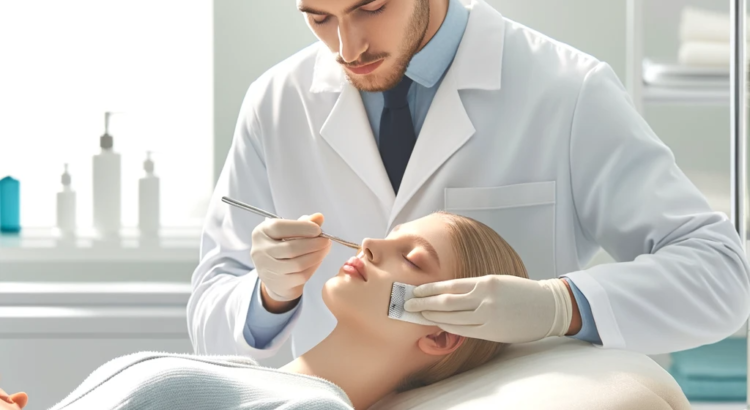
Dermaplaning is a cosmetic treatment that involves the careful exfoliation of the skin’s surface. Using a sterile surgical blade, a trained professional gently scrapes the topmost layer of skin, removing dead cells, peach fuzz, and debris. This procedure reveals a brighter, smoother complexion beneath the superficial layer.
Educational Path and Training
For students, the journey towards becoming a certified practitioner of dermaplaning begins with a comprehensive education in cosmetology or esthetics. Accredited programs offer both theoretical and practical training, ensuring that students understand the anatomy of the skin, the intricacies of various skin treatments, and the safe handling of tools required for procedures like dermaplaning.
Upon completing their coursework, students must often undergo specific training for dermaplaning, which can include:
Safety and Sanitation: Learning how to maintain a sterile environment to prevent infections.
Technique: Mastering the angle and pressure required to efficiently remove dead skin without causing irritation.
Skin Assessment: Identifying which skin types and conditions are suitable for dermaplaning.
What Aspiring Estheticians Should Know
Before adding dermaplaning to their repertoire, aspiring estheticians should be aware of the following:
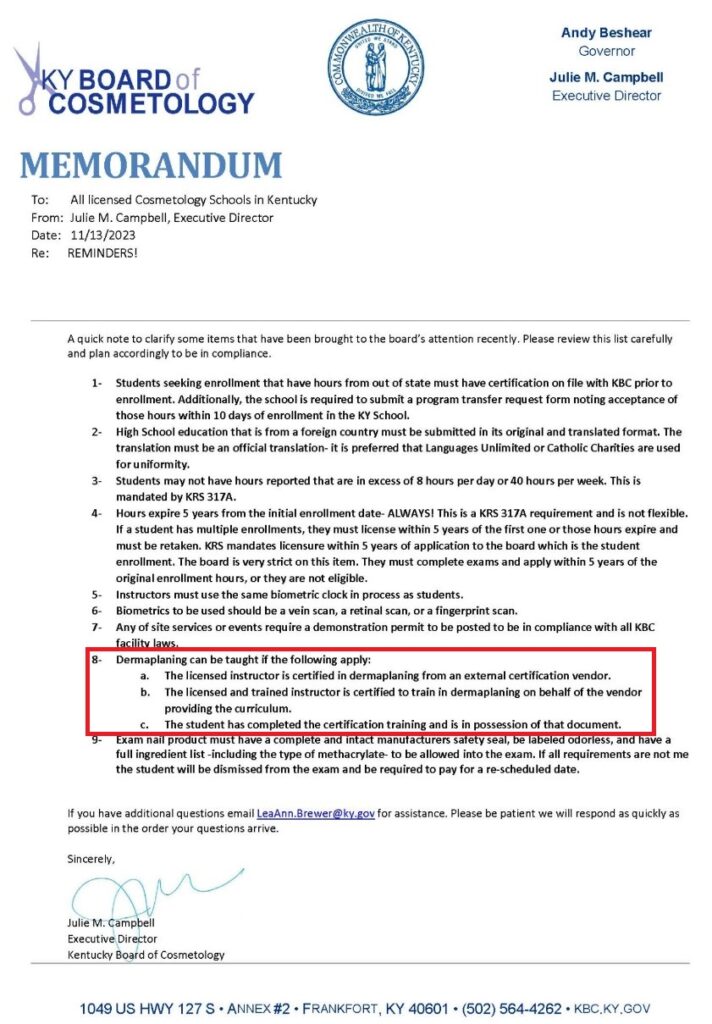
Certification: Ensure that any advanced classes or certifications in dermaplaning are recognized by the state board of cosmetology.
Practice: Like any skill, dermaplaning requires practice. Mannequins and volunteering peers can provide valuable hands-on experience.
Scope of Practice: Understand the legal scope of practice in your region, as some states have specific regulations about who can perform dermaplaning.
What Clients and the Public Should Know
If you’re considering dermaplaning, it’s essential to be informed about the procedure:
Professionalism: Always seek a licensed professional to perform the treatment. Dermaplaning is not a DIY-friendly procedure due to the risks of using a surgical blade.
Benefits: Expect a smoother skin texture, diminished fine lines, and an enhanced skincare routine post-treatment as products penetrate more effectively.
Maintenance: Results from dermaplaning are not permanent. Hair and skin cells will naturally regenerate, so regular treatments may be necessary.
Potential Risks
While dermaplaning is safe for most people, it carries potential risks such as:
Irritation and Redness: Some skin types may react with temporary redness or sensitivity post-treatment.
Breakouts: Those with active acne should avoid dermaplaning, as it can irritate and spread bacteria.
Conclusion
Dermaplaning stands as a testament to the beauty industry’s commitment to innovation and education. For students, mastering this technique opens the door to an array of opportunities in the field of esthetics. For clients, it offers a path to rejuvenated skin. As with any cosmetic procedure, education, expertise, and safety are paramount—principles that hold the well-being of the client in the highest regard. Whether you are a student of cosmetology or someone curious about enhancing your skin’s health and appearance, dermaplaning is a noteworthy addition to the beauty lexicon.
At the heart of the beauty industry lies not just the transformative power of aesthetics but an equally crucial focus on client safety, regulatory adherence, and meticulous documentation. Louisville Beauty Academy, one of the leading institutions, especially for new Americans grappling with English as a second or even third language, has cemented its reputation by emphasizing this holistic approach. The academy ensures that each student, regardless of their language background, is not just artistically skilled but thoroughly prepared to maintain industry-leading standards.
Client Consultation and Documentation:
Before the touch of any beauty tool, comes the profound responsibility of understanding a client’s unique needs and potential sensitivities. At Louisville Beauty Academy:
Comprehensive training is provided to assess client allergies and sensitivities meticulously.
Students learn the significance of maintaining detailed client records, ensuring that every subsequent visit builds upon prior knowledge.
Emergency Procedures:
Real-world challenges require real-world solutions. The academy instills in its students the importance of:
Accessibility to a well-equipped first aid kit.
Mastery over basic first aid procedures, ensuring prompt and effective response in emergencies.
Developing and adhering to fire safety measures and evacuation plans, emphasizing the safety of both clients and professionals.
Regulatory Compliance:
The world of beauty is as much about regulatory compliance as it is about technique. Students are guided to:
Stay constantly updated with state board regulations.
Understand the importance of visibly posting licenses and the pride in showcasing inspection certifications.
Salon Cleanliness:
Cleanliness is not just next to godliness in beauty; it’s paramount. The academy focuses on:
Regular cleaning schedules, ensuring every inch of the floor, surface, and restroom gleams with hygiene.
Training students to prevent cross-contamination, ensuring each client experiences a pristine environment.
Water Safety:
Water treatments are an indulgence, but without the right safety measures, they can become a concern. The academy emphasizes:
Ensuring all water sources adhere to the highest cleanliness standards.
Proper disinfection protocols for footbaths and spa chairs, transforming every spa experience into a safe haven.
Pedicure and Manicure Safety:
The academy leaves no stone unturned, especially when it comes to the popular services of pedicures and manicures:
Students learn the critical steps to prevent fungal and bacterial infections.
They are also trained to recognize and, for the safety of all, decline services to clients exhibiting infectious conditions.
Employee Training:
The learning at Louisville Beauty Academy doesn’t end at graduation. The institution emphasizes:
Regular updates on sanitation and safety procedures, ensuring each professional remains at the forefront of industry standards.
Cultivating a culture that encourages continued education and growth.
Conclusion:
Louisville Beauty Academy stands as a beacon of excellence, particularly for new Americans who might find English challenging. By emphasizing rigorous standards of safety, hygiene, and professionalism, the academy ensures that every graduate is not just a beauty professional but a guardian of industry-leading standards. Here, beauty intertwines seamlessly with responsibility.
Disclaimer: The information provided in this article is for informational purposes only. It is crucial for individuals and professionals to consult and adhere to the state board regulations and stay updated with the most recent laws and regulations in their respective states. Always prioritize compliance with the latest local guidelines and standards.
In the thriving world of beauty and personal care, where the delicate balance of art meets the rigors of science, salons and beauty institutions shoulder a critical responsibility: ensuring client safety and satisfaction while maintaining impeccable service standards. Louisville Beauty Academy stands as a shining example of this commitment, ensuring that every aspirant who walks through its doors emerges as a competent, well-informed, and safety-conscious beauty professional.
1. Client Consultation and Documentation: Building Trust from the Start
Every client is unique, with specific needs and sensitivities. At Louisville Beauty Academy, students are trained in the fine art of:
Assessing Client Allergies or Sensitivities: Ensuring treatments are tailor-made to the client’s needs.
Maintaining Client Records: Keeping thorough and confidential records for reference during subsequent visits, ensuring continuity of care.
2. Preparedness for Emergencies: Prioritizing Client and Staff Safety
Emergencies can arise anytime. To address them:
First Aid Accessibility: The academy emphasizes the importance of having first aid kits easily accessible.
Basic First Aid Knowledge: Students are provided foundational training in first aid, preparing them to handle minor injuries.
Fire Safety and Evacuation Plans: Preparedness is key, and students are trained to calmly and efficiently handle potential fire emergencies.
3. Regulatory Compliance: Aligning with Best Practices
The beauty industry is stringently regulated to protect clients. At the academy:
Updates on State Board Regulations: Students are informed of the latest regulatory changes.
Posting Licenses and Certifications: Emphasizing transparency, students learn the importance of displaying necessary documentation.
4. Salon Cleanliness and Water Safety: The Pillars of Hygiene
Hygiene is non-negotiable in a salon setting. The academy instills:
Prevention of Cross-contamination: Educating students on best practices.
Water Safety Measures: Emphasizing the importance of clean water sources and the meticulous disinfection of footbaths and spa chairs.
5. Pedicure and Manicure Safety: Specialized Care
Given the intimate nature of these treatments:
Infection Prevention: The academy teaches students to recognize signs and avoid serving clients with infectious conditions.
Fungal and Bacterial Safety: Highlighting the need to maintain stringent cleanliness.
6. Continuous Employee Training: The Heart of Professional Growth
Louisville Beauty Academy’s commitment doesn’t end at graduation:
Ongoing Training: Regular updates on sanitation and safety are provided.
Continued Education: The academy encourages lifelong learning, often through its own pioneering book releases that lay down procedures and standards for beauty professionals.
Disclaimer: The descriptions and practices mentioned in this article are for informational purposes only. For complete and current standards, it is imperative to refer to the Kentucky State Board regulations. Please note that laws and regulations can change frequently, and it’s essential to stay updated with the latest guidelines to ensure compliance. Always align with the state’s most current requirements for your professional practice.
Conclusion
By meticulously covering these areas in its curriculum, Louisville Beauty Academy doesn’t just teach beauty – it builds trust, fosters safety, and ensures excellence in service. Through its holistic teaching approach and commendable initiatives like its own book releases, the academy sets a benchmark in grooming world-class beauty professionals who prioritize client care and safety above all.