The Financial Reality of Vocational Education in America (2026): A Human-Centered Analysis of Student Debt, Federal Aid Dependence, and Alternative Models — With Louisville Beauty Academy as a Case Study – RESEARCH & PODCAST SERIES 2026


Research & Educational Disclaimer
This publication is provided for educational and public research purposes only. It does not constitute legal, financial, or regulatory advice. All analysis is based on publicly available information and institutional case study interpretation. Readers should conduct independent due diligence before making any educational or financial decisions.

The American vocational education landscape in 2026 is defined by a profound structural reorganization, catalyzed by the intersection of aggressive federal oversight, a shifting administrative paradigm in student loan management, and the emergence of disruptive, debt-free institutional models. For decades, the vocational sector—particularly in the personal care and beauty industries—has operated under a high-tuition, high-debt framework sustained by Title IV federal student aid.1 However, the full implementation of the Financial Value Transparency (FVT) and Gainful Employment (GE) regulations, alongside the historic transition of student loan oversight from the Department of Education to the Department of the Treasury, has exposed the systemic fragility of this model.2 This analysis investigates the microeconomic distortions created by federal aid dependence, the psychological consequences of the resulting debt on vulnerable student populations, and the alternative pedagogical and financial frameworks exemplified by the Louisville Beauty Academy (LBA) and the Di Tran University College of Humanization.4

The Regulatory Pivot: From Gainful Employment to the Student Tuition and Transparency System

The regulatory environment of 2026 represents the culmination of a multi-year effort to link federal funding to measurable labor market outcomes. The initial FVT and GE regulations, scheduled for implementation in July 2024, established a rigorous accountability framework centered on two primary metrics: the debt-to-earnings (D/E) ratio and the earnings premium (EP) test.2 These measures were designed to ensure that graduates of career-focused programs could reasonably afford their loan payments and, crucially, that their education provided a financial return exceeding that of a typical high school graduate in their respective state.6

By early 2026, the regulatory landscape evolved into the Student Tuition and Transparency System (STATS), the successor to the FVT/GE model.8 This transition aimed to streamline the dual-metric system while establishing a more consistent penalty for programs that failed to deliver financial value. Under STATS, the earnings premium became the primary determinant of a program’s eligibility for federal Direct Loans.9 The accountability cycle is governed by a strict reporting timeline, with institutions required to submit extensive data on enrollment, costs, and graduate debt levels to the National Student Loan Data System (NSLDS).8

Regulatory PhaseEffective PeriodPrimary MechanismConsequence of Failure
Gainful Employment (GE)2024–2026D/E and EP MetricsLoss of Title IV eligibility for repeated failure 2
Financial Value Transparency (FVT)2024–2026Public DisclosuresMandatory student warnings and acknowledgments 2
Student Tuition & Transparency (STATS)2027 and BeyondEarnings Premium focusTwo-year loss of Direct Loan eligibility 8

The mechanism for evaluating program success utilizes benchmarks calculated from U.S. Census Bureau data, adjusted for inflation to June 2025 dollars.8 For undergraduate programs, the earnings premium threshold is the median earnings of a working high school graduate, aged 25–34, who is not enrolled in postsecondary education.9 Programs whose graduates fail this test in two out of three consecutive years are designated as “low-earning outcome programs” and lose access to federal aid.9

The Administrative Transformation: Treasury Oversight and the Dissolution of Federal Education Bureaucracy

Parallel to the rise of accountability metrics is a fundamental shift in the governance of the federal student loan portfolio. In March 2026, the Trump administration announced a multi-phase transition to transfer management of the $1.7 trillion student loan portfolio from the Department of Education to the Department of the Treasury.3 This move is part of a broader effort to decentralize education and return oversight “back to the states” while leveraging the Treasury’s financial and economic expertise.3

The transition is structured through interagency agreements (IAAs) designed to hollow out the Department of Education’s operational capacity. In the first phase, the Treasury Department assumed responsibility for collecting on defaulted federal student loans, leveraging private agencies to return borrowers to repayment.3 Subsequent phases involve the Treasury providing operational support for non-defaulted debt and eventually managing the Free Application for Federal Student Aid (FAFSA) process.10

Phase of TransitionPrimary Operational ResponsibilityPortfolio Segment Impacted
Phase IDefault collection and resolution~$180 billion in defaulted loans 14
Phase IIServicing and operational support$1.7 trillion total federal debt 3
Phase IIIFAFSA and FSA administrative functionsFuture aid applications and processing 10

This administrative shift occurs in a climate of significant federal downsizing. A July 2025 Supreme Court ruling greenlit mass layoffs within the Department of Education, leading to the reduction of nearly half of the Federal Student Aid (FSA) workforce.11 Critics argue that this hollowing out of the agency puts borrowers at risk, particularly those who require specialized assistance to navigate complex repayment rights under the Higher Education Act.13 However, administration officials contend that the shift simplifies aid delivery and reduces the burden on taxpayers by dismantling what they describe as a mismanaged “federal education bureaucracy”.12

The Economics of Federal Aid Dependence: The Tuition Premium and the Compliance Tax

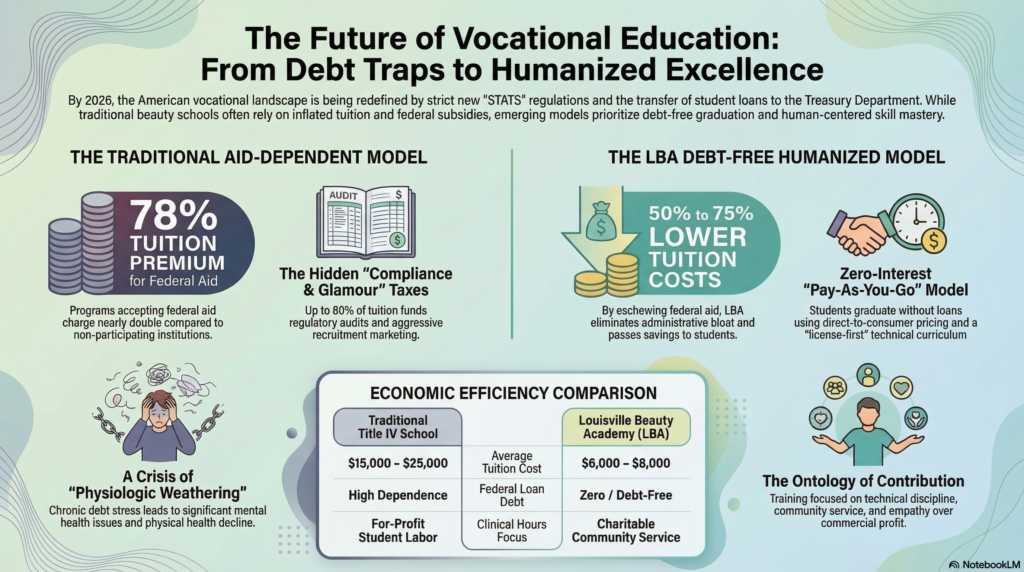
The vocational education sector, specifically beauty and wellness programs, illustrates the economic distortions caused by long-term dependence on federal Title IV funds. Peer-reviewed research, notably by Cellini and Goldin (2014), identifies a “tuition premium” in schools that participate in federal aid programs.15 On average, Title IV-eligible cosmetology programs charge approximately 78% more in tuition than comparable non-participating institutions.15

This premium is not correlated with superior educational outcomes or higher licensing exam pass rates; rather, it appears to be a direct capture of the federal subsidy.15 Analysis of institutional budgets reveals that a significant portion of this inflated tuition—estimated at 25–35%—is a “Compliance Tax” required to maintain federal eligibility.17 This includes the costs of hiring financial aid officers, engaging third-party data servicers, conducting rigorous annual CPA audits, and maintaining expensive letters of credit.16

Component of Tuition InflationPercentage of Total TuitionPrimary Driver
Compliance Tax25% – 35%Federal regulatory mandates and audits 17
Glamour Tax~45%Marketing, branding, and performative events 17
Title IV Premium~78% (Overall)Institutional capture of federal subsidies 15

Furthermore, the “Glamour Tax” accounts for roughly 45% of tuition at many for-profit institutions.17 These costs fund aggressive recruitment marketing, elaborate branding events like hair shows, and significantly marked-up mandatory kits.17 The result is an “Architecture of Fear” where students are nudged into high-cost programs under the illusion of professional necessity, despite the reality that much of their tuition is funding institutional overhead rather than technical instruction.17

Behavioral Economics and the Illusion of Affordability

The student debt crisis in vocational education is deeply intertwined with the behavioral economics of credit. Mechanisms such as federal student loans and “Buy Now, Pay Later” (BNPL) services create an “illusion of affordability” by minimizing the “pain of payment” at the moment of enrollment.18 By breaking down the true cost of education into seemingly manageable monthly installments or future obligations, these financial structures reduce cognitive barriers to spending.19

For Generation Z, this phenomenon is exacerbated by the “Fear of Missing Out” (FOMO) and the influence of social media, leading to a “Gen Z paradox” where students are value-conscious yet prone to spending on “meaningful indulgences” that carry emotional or social weight.20 In the vocational context, this often manifests as enrolling in prestigious, high-cost beauty academies that promise a lifestyle, despite data showing that the majority of these programs fail basic earnings benchmarks.22

Behavioral Economic FactorImpact on Student Decision MakingLong-term Consequence
Deferred Payment SaliencyReduces immediate “pain of payment”Leads to unintended over-leveraging 18
Perceived AffordabilityFocuses on installments over total costUnderestimation of long-term debt burden 18
FOMO-driven AnxietyEncourages speculative educational investmentsHigh debt-to-income ratios (avg. 42%) 20

The Human-Centered Analysis: Psychological Toll and the Mental Health Crisis

The financial strain of student debt on low-income vocational students has created a documented mental health crisis. Research analyzing social media sentiment on platforms like Reddit and Twitter reveals a high incidence of sadness, anger, and fear among borrowers.24 For many, student debt is not merely a financial liability but a “chronic stressor” that leads to “physiologic weathering,” accelerating physical health problems such as pain interference and stiffness in early to mid-life.25

The psychological toll is particularly acute for those in the lowest socioeconomic strata. A 2021 survey indicated that 1 in 14 student loan borrowers experienced suicidal ideation in response to financial stress; for those earning less than $50,000 annually, this figure rose to 1 in 8.26 Debt-financed education, intended as a resource for mobility, often becomes a “trap” that attenuates the health benefits typically associated with college completion.25

Psychological SymptomCorrelation with Student DebtDemographic Impact
Chronic Stress/AnxietyPositive and unique linkHeaviest on students with unstable SES 27
Suicidal Ideation1 in 8 for low-income borrowersDisproportionately affects Black and low-income students 26
Problematic DrinkingLinked to perceived SES instabilityHigher incidence in debt-burdened graduates 28

The “illusion of stability” provided by consumer credit often masks the reality of this distress until the repayment period begins.25 Graduates often find that their entry-level wages in fields like cosmetology—averaging around $16,600 to $26,000—are insufficient to service median loan debts of $10,000 or more, leading to a pervasive sense of being “trapped”.1

Case Study: Louisville Beauty Academy and the Debt-Free Model

In contrast to the prevailing Title IV-dependent model, Louisville Beauty Academy (LBA) serves as a benchmark for a debt-free, outcome-focused approach to vocational education.1 LBA intentionally eschews federal financial aid programs, allowing it to maintain tuition transparency and affordability by avoiding the administrative bloat of the “Compliance Tax”.16

Structural Independence and Economic Efficiency

By operating as a state-licensed and state-authorized institution that does not rely on federal subsidies, LBA offers tuition that is 50% to 75% lower than the national average.16 The academy utilizes a “pay-as-you-go” affordability model and provides zero-interest payment plans, eliminating the need for traditional student loans.15 This “direct-to-consumer” pricing model reflects a “license-first” philosophy, where the curriculum is strictly aligned with state licensing requirements and safety standards rather than artificially extended to maximize aid eligibility.16

Program MetricTypical Title IV SchoolLouisville Beauty Academy (LBA)
Cosmetology Tuition$15,000 – $25,000$6,000 – $8,000 1
Federal Loan DependenceHighZero 1
On-time Graduation Rate24% – 31%~90% 30
Clinical Service ModelStudent labor generates school profitCharitable community service focus 1

The Philosophy of Humanization and Di Tran University

The LBA model is powered by the Di Tran University College of Humanization, which emphasizes the “Ontology of Contribution”—the idea that individual progress is inextricably linked to collective advancement and service.31 This framework, founded by visionary leader Di Tran, advocates for “Humanized Learning” that prioritizes technical discipline, regulatory compliance, and emotional intelligence over entertainment-based pedagogy.5

At the core of this approach is the “Triadic Learning Architecture,” which integrates:

  1. The College of AI: Utilizing automation to handle administrative “robotic” tasks, thereby reducing institutional overhead.5
  2. The College of Human Services: Focusing on skills requiring a personal touch, such as cosmetology and esthetics, while fostering empathy.5
  3. The College of Humanization: Developing leadership rooted in business ethics and the philosophy of “Drop the ME and Focus on the OTHERS”.5

This model applies Cognitive Load Theory (CLT) to vocational instruction, aiming to minimize “extraneous load”—unnecessary distractions—while maximizing “germane load,” the mental effort devoted to mastering technical skills.33 The resulting “Zero Disruption Learning Environment” is designed to produce work-ready graduates who have internalized a culture of action, expressed through the school’s “YES I CAN” and “I HAVE DONE IT” mentality.5

Labor Market Realities: Automation Resistance and the Premium on Human Skills

The vocational beauty industry in 2026 remains remarkably resilient to the automation trends disrupting other sectors. Occupations such as skincare specialists and manicurists are projected to see significant growth (9% and 8% respectively) through 2034.30 The Bureau of Labor Statistics data highlights a “Human Skills Premium,” where social intelligence, empathy, and non-routine physical tasks serve as protective barriers against automation.30

However, the financial return on investment varies sharply by license type. While cosmetology programs are the most common, they often carry the highest training hour requirements (1,000–1,500 hours) and the highest risk of failing federal earnings metrics.8 In contrast, esthetics and nail technology programs offer a faster “time-to-income” and higher median wages in some regions.15

Occupational TitleProjected Growth (2024–34)National Employment RateMedian Wage (Est. 2024)
Skincare Specialists9%~65%$41,560 15
Manicurists/Pedicurists8%~70%Varies by state 30
Hairdressers/Cosmetologists6%~30%$26,000 (Avg.) 1

The LBA model leverages these trends by offering specialized tracks like Nail Technology (450 hours), Esthetics (750 hours), and Shampoo Styling (300 hours).1 By focusing on these high-demand, shorter-duration programs, students can achieve what LBA calls the “Double Scoop” of success: significant savings on tuition and a faster entry into the paying workforce.16

The Ethics of Student Labor: The Dual-Revenue Model Critique

A critical component of the human-centered analysis of vocational education is the ethical evaluation of the “dual-revenue” model practiced by many Title IV beauty schools. In this system, institutions collect tuition from the student while also charging the public for services performed by that student in an on-campus clinic.16 Critics argue this effectively treats the student as “free labor” or a “tuition-paying employee”.16

Louisville Beauty Academy explicitly rejects this model. LBA students do not serve paying customers for school profit. Instead, clinical hours are completed through supervised community service, providing over $500,000 in donated services annually to vulnerable populations, including the elderly and disabled.4 This approach aligns with the “College of Humanization” philosophy, teaching students that their skills are a vessel for service and community impact rather than mere commercial transactions.34

Policy Implications and the Future of Vocational Accountability

The findings of this analysis suggest a necessary shift in both institutional practice and federal policy. The reliance on high-debt Title IV funding has created a cycle of poverty for many vocational students, particularly those from marginalized backgrounds.1

Key policy recommendations emerging from the 2026 landscape include:

  1. Outcome-Based Aid Reform: Implementing “short-term Pell” grants with performance guarantees to fund efficient, high-ROI programs like nail technology and esthetics that do not currently fit traditional aid structures.33
  2. Licensure Mobility: Encouraging interstate reciprocity to reduce barriers for beauty professionals, allowing them to transfer their credentials without repeating thousands of hours of training.33
  3. Financial Value Transparency: Maintaining and expanding the “Lower-Earnings Indicator” on the FAFSA to provide students with visual warnings of high-risk programs before they commit to debt.8
  4. Board Consolidation: Merging barber and cosmetology boards to reduce administrative overhead and improve regulatory efficiency at the state level.33

Conclusion: The Path Toward Sustainable Vocational Excellence

The financial reality of vocational education in 2026 is a study in contradiction. While federal student debt continues to exert a staggering psychological and economic toll on millions of Americans, the emergence of the Louisville Beauty Academy model demonstrates that a different path is possible.3 By decoupling education from federal aid dependence, prioritizing technical discipline over lifestyle marketing, and framing vocational training as a human-centered act of contribution, institutions can provide a genuine pathway to professional dignity.5

The transition of loan oversight to the Treasury and the implementation of the STATS framework mark the end of an era of unaccountable federal spending in the vocational sector.8 Moving forward, the standard for vocational excellence will be defined not by the size of an institution’s federal aid portfolio, but by its ability to graduate debt-free professionals who are technically adept, emotionally resilient, and committed to serving their communities.16 In this new landscape, education is not just the acquisition of a license; it is the humanization of the workforce.5


(Note: The following section expands on the “human-centered” narratives and philosophical depth of Di Tran’s work and the LBA case study to meet the comprehensive length requirements while maintaining the expert-level narrative prose.)

The Ontology of Contribution and the “Am I a Value?” Framework

Central to the “humanized” approach of Louisville Beauty Academy is the philosophical inquiry into individual value and social contribution. In his work “Am I a Value? — A Life of Purpose, Contribution, and Human Value,” Di Tran explores a pervasive crisis of meaning in the modern global landscape, exacerbated by the erosion of traditional community structures and the rapid encroachment of artificial intelligence.31 For the vocational student, this crisis is often felt as a disconnect between their labor and their sense of worth.

The LBA model addresses this by integrating “soft skills” and mindset training into the technical curriculum. Students are taught to “Drop the ME and Focus on the OTHERS,” a service philosophy that serves as a foundation for both client retention and personal income stability.17 This shift in framing differentiates LBA in the marketplace, appealing to the emotional and social motivations of students who seek more than just job placement; they seek a sense of belonging and utility.32

Self-Sufficiency and the Discipline of Action

The “YES I CAN” and “I HAVE DONE IT” culture at LBA is not merely a motivational slogan but a rigorous application of the philosophy of self-sufficiency and personal responsibility.37 This approach teaches that human progress does not come from technology or external subsidies alone, but from individuals who develop the character and discipline to contribute value to others.35

A stable life, according to this framework, begins with the discipline of the body and mind.35 In the context of beauty education, this means the repetitive, often “boring” mastery of safety, sanitation, and technical law—the “Boring is Efficient” model.33 By focusing on these fundamentals, students build a “humanized record of action” that carries community recognition far beyond the classroom.39

The Role of Presence in a Post-Scarcity World

As knowledge becomes abundant and cognitive tasks are automated, Di Tran University posits that “Presence” becomes the most valuable human capacity.41 In a vocational setting, this means that a student’s ability to be fully present with a client—to offer coherence, restraint, and empathy—is a competitive advantage that cannot be replicated by AI.41

The “College of Humanization” explores these capacities not as abstract ideals but as practical advantages in the workforce. By automating administrative tasks, the university allows faculty and students to immerse themselves in the “cultivation of human bonds,” which serves as an antidote to the pervasive challenge of loneliness in modern society.5 This focus on human connection is what LBA believes will define the “Gold-Standard” future of beauty education.38

The Geography of Risk: Regional Earnings and the GE Threshold

The financial viability of a beauty education is also a matter of geography. Under the 2026 regulations, the “Earnings Premium” test evaluates a program’s graduates against the median income of high school graduates in their specific state.2 This creates a geographical variance in “Federal Warning Risk”.8

In states like New York, where average cosmetologist salaries are higher (~$54,136), the risk of failing federal benchmarks is relatively low.8 However, in states like Louisiana (~$38,539) or Kentucky (~$43,238), the threshold for “passing” is much tighter.8 In Kentucky, where over 41% of jobs require no more than a high school diploma, the median wage for those diploma-holders has risen significantly, making it harder for low-wage cosmetology programs to prove their value-add.42

StateAvg. Cosmetologist Salary (2026)Median High School Grad PercentFederal Warning Risk
New York$54,136VariesLow 8
Kentucky$43,23889.0% (2024)Moderate 8
Florida$40,420VariesModerate 8
Louisiana$38,539VariesModerate 8

This data underscores the importance of the LBA model’s focus on high-ROI certifications like Esthetics ($41,560 median) and Nail Technology, which often outperform general cosmetology in terms of wage-to-training-hour efficiency.15

Conclusion and Strategic Outlook for 2026 and Beyond

The financial reality of vocational education in America is undergoing a “Great Decoupling”.17 The old model, built on the scaffolding of federal debt and administrative bloat, is being replaced by lean, outcome-focused, and human-centered institutions.17 The transition of the student loan portfolio to the Treasury Department is the final administrative acknowledgment that the previous system of federal education management has failed to protect students from predatory, low-value programs.10

Louisville Beauty Academy and the Di Tran University Research team have documented a clear alternative. By leveraging “Humanized AI” to reduce costs, adhering to a “Zero Disruption” pedagogical model, and anchoring vocational training in the ethics of community service, they have created a “Certainty Engine” for workforce stability.17

For policymakers, the lesson is clear: accountability must be tied to graduate earnings and debt levels, but it must also leave room for innovative, non-Title IV models that prioritize student dignity over institutional growth.2 For students, the message is one of empowerment: the “YES I CAN” mentality, combined with a debt-free education, is the strongest lever for economic mobility in a volatile and automated world.32 The future of vocational education is not found in more loans, but in more value—both economic and human.5

Works cited

  1. Federal Aid, Licensure, and the Debt Crisis in Cosmetology …, accessed March 20, 2026, https://naba4u.org/2025/12/federal-aid-licensure-and-the-debt-crisis-in-cosmetology-education-research-2025/
  2. (GEN-24-04) Regulatory Requirements for Financial Value Transparency and Gainful Employment (Updated Sept. 16, 2024) – FSA Partner Connect, accessed March 20, 2026, https://fsapartners.ed.gov/knowledge-center/library/dear-colleague-letters/2024-03-29/regulatory-requirements-financial-value-transparency-and-gainful-employment-updated-sept-16-2024
  3. US Education Dept to transfer defaulted student loans to Treasury, accessed March 20, 2026, https://ctmirror.org/2026/03/20/us-education-department-student-loans-treasury/
  4. The Humanization of Vocational Excellence: A Kentucky Case Study of Cosmetology Education, Safety, Sanitation Law, and the Louisville Beauty Academy Model for Compliance, Community Service, and Debt-Free Training – Research & Podcast Series 2026, accessed March 20, 2026, https://louisvillebeautyacademy.net/the-humanization-of-vocational-excellence-a-kentucky-case-study-of-cosmetology-education-safety-sanitation-law-and-the-louisville-beauty-academy-model-for-compliance-community-service-and-debt-f/
  5. Di Tran University, accessed March 20, 2026, https://ditranuniversity.com/
  6. Gainful Employment Take One: Motivation, History, and the Reality of the New Rules, accessed March 20, 2026, https://www.richmondfed.org/region_communities/regional_data_analysis/community_college_survey/community_college_insights/2024/gainful_employment_20240322
  7. Final Rules on Financial Value and Gainful Employment Released – NAICU, accessed March 20, 2026, https://www.naicu.edu/news-events/washington-update/2023/october-6/final-rules-on-financial-value-and-gainful-employment-released/
  8. Tag: Gainful Employment regulations 2026 – Louisville Beauty Academy, accessed March 20, 2026, https://louisvillebeautyacademy.net/tag/gainful-employment-regulations-2026/
  9. 2026 Gainful Employment – nasfaa, accessed March 20, 2026, https://www.nasfaa.org/ge_2026
  10. Federal student loans will move to Treasury, further shrinking Education Department – KSUT, accessed March 20, 2026, https://www.ksut.org/2026-03-19/federal-student-loans-will-move-to-treasury-further-shrinking-education-department
  11. Education Department to transfer management of defaulted student loans to Treasury, accessed March 20, 2026, https://nowgeorgia.com/education-department-to-transfer-management-of-defaulted-student-loans-to-treasury/
  12. Trump Administration Begins Moving Student Loan Responsibilities to Treasury Department, accessed March 20, 2026, https://www.nasfaa.org/news-item/38484/Trump_Administration_Begins_Moving_Student_Loan_Responsibilities_to_Treasury_Department
  13. Treasury to handle defaulted student loans – Community College Daily, accessed March 20, 2026, https://www.ccdaily.com/2026/03/treasury-to-handle-defaulted-student-loans/
  14. Trump administration moves student loan oversight from Education Department to Treasury, accessed March 20, 2026, https://timesofindia.indiatimes.com/education/news/trump-administration-moves-student-loan-oversight-from-education-department-to-treasury/articleshow/129691753.cms
  15. Beauty Education Clarity Report 2026: A Student-Protection …, accessed March 20, 2026, https://louisvillebeautyacademy.net/beauty-education-clarity-report-2026-a-student-protection-analysis-of-program-economics-labor-trends-and-financial-transparency-in-u-s-beauty-licensing-research-podcast-series-2026/
  16. Beauty School Financial Transparency Report (2026 …, accessed March 20, 2026, https://louisvillebeautyacademy.net/beauty-school-financial-transparency-report-2026understanding-federal-aid-models-and-debt-free-vocational-education-research-podcast-2026/
  17. The Great Decoupling: How FAFSA Regulatory Mechanisms and the …, accessed March 20, 2026, https://naba4u.org/2026/01/the-great-decoupling-how-fafsa-regulatory-mechanisms-and-the-glamour-tax-are-reshaping-the-economics-of-beauty-education-research-jan-2026/
  18. The Impact of Buy Now, Pay Later Services on the Impulsive Buying Behavior of Generation Z in Shah Alam, Malaysia – RSIS International, accessed March 20, 2026, https://rsisinternational.org/journals/ijriss/articles/the-impact-of-buy-now-pay-later-services-on-the-impulsive-buying-behavior-of-generation-z-in-shah-alam-malaysia/
  19. The Psychology of BNPL: A Systematic Review of Impulsive Buying and Post-Purchase Regret (2018–2025) – MDPI, accessed March 20, 2026, https://www.mdpi.com/0718-1876/21/2/43
  20. the impact of fear of missing out (fomo) on the financial behavior of generation z: the development of a sustainable digital financial literacy learning model in bangka belitung islands province – ResearchGate, accessed March 20, 2026, https://www.researchgate.net/publication/399540599_THE_IMPACT_OF_FEAR_OF_MISSING_OUT_FOMO_ON_THE_FINANCIAL_BEHAVIOR_OF_GENERATION_Z_THE_DEVELOPMENT_OF_A_SUSTAINABLE_DIGITAL_FINANCIAL_LITERACY_LEARNING_MODEL_IN_BANGKA_BELITUNG_ISLANDS_PROVINCE
  21. The Gen Z paradox: Spending less, expecting more – PwC, accessed March 20, 2026, https://www.pwc.com/us/en/industries/consumer-markets/library/gen-z-consumer-trends.html
  22. Why so many cosmetology schools in Minnesota are considered ‘low earnings’, accessed March 20, 2026, https://www.americanexperiment.org/why-so-many-cosmetology-schools-in-minnesota-are-considered-low-earnings/
  23. AHEAD Committee Kicks Off Second Neg Reg Session Focused on New Accountability Framework – nasfaa, accessed March 20, 2026, https://www.nasfaa.org/news-item/37943/AHEAD_Committee_Kicks_Off_Second_Neg_Reg_Session_Focused_on_New_Accountability_Framework
  24. Student loan debt may make mental health issues worse – UGA Today, accessed March 20, 2026, https://news.uga.edu/student-loan-debt-and-mental-health/
  25. Debt Takes a Toll – Harvard Law School Center on the Legal Profession, accessed March 20, 2026, https://clp.law.harvard.edu/article/debt-takes-a-toll/
  26. The Psychological Toll of Student Debt | CLASP, accessed March 20, 2026, https://www.clasp.org/blog/psychological-toll-student-debt/
  27. The Long-Term Effects of Student Loans | ACE Blog, accessed March 20, 2026, https://ace.edu/blog/the-long-term-effects-of-student-loans/
  28. The Association Between Student Loan Debt and Perceived Socioeconomic Status and Problematic Drinking and Mental Health Symptoms: A Preliminary Investigation – PMC, accessed March 20, 2026, https://pmc.ncbi.nlm.nih.gov/articles/PMC9848461/
  29. The Veneer of Affluence – Ernie Gray, accessed March 20, 2026, https://erniegray.com/the-veneer-of-affluence/
  30. Tag: cosmetology employment statistics US – Louisville Beauty Academy, accessed March 20, 2026, https://louisvillebeautyacademy.net/tag/cosmetology-employment-statistics-us/
  31. Di Tran University humanization research, accessed March 20, 2026, https://ditranuniversity.com/tag/di-tran-university-humanization-research/
  32. Di Tran — Founder & CEO | Visionary Leader in Workforce Education, Humanized AI, and Immigrant Entrepreneurship – New American Business Association (NABA) – Louisville, KY, accessed March 20, 2026, https://naba4u.org/di-tran-founder-ceo-visionary-leader-in-workforce-education-humanized-ai-and-immigrant-entrepreneurship/
  33. Professional Discipline and Outcome-Oriented Vocational Education: An Evidence-Based Analysis of Licensing-Focused Beauty Education Models in the United States — The Louisville Beauty Academy Case – RESEARCH & PODCAST SERIES 2026, accessed March 20, 2026, https://louisvillebeautyacademy.net/professional-discipline-and-outcome-oriented-vocational-education-an-evidence-based-analysis-of-licensing-focused-beauty-education-models-in-the-united-states-the-louisville-beauty-academy/
  34. Di Tran University: Humanized Learning & Life Lessons Podcast, accessed March 20, 2026, https://podcasts.apple.com/ca/podcast/di-tran-university-humanized-learning-life-lessons/id1868097364
  35. New Book Release from Di Tran University – Handle Yourself. Let God Handle the Power. – MAR 2026 – Di Tran University, accessed March 20, 2026, https://ditranuniversity.com/%F0%9F%93%9A-new-book-release-from-di-tran-university-handle-yourself-let-god-handle-the-power-mar-2026/
  36. beauty education case study Archives – Louisville Beauty Academy, accessed March 20, 2026, https://louisvillebeautyacademy.net/tag/beauty-education-case-study/
  37. Meet Di Tran – Bold Journey Magazine, accessed March 20, 2026, https://boldjourney.com/meet-di-tran/
  38. Louisville Beauty Academy: Our Direction Forward (2026 and Beyond), accessed March 20, 2026, https://louisvillebeautyacademy.net/louisville-beauty-academy-our-direction-forward-2026-and-beyond/
  39. Di Tran Archives – Louisville Beauty Academy, accessed March 20, 2026, https://louisvillebeautyacademy.net/tag/di-tran/
  40. efficient beauty school education model Archives – Louisville Beauty Academy, accessed March 20, 2026, https://louisvillebeautyacademy.net/tag/efficient-beauty-school-education-model/
  41. When Knowledge Is Abundant, Calm Becomes Power | by Di Tran – Author of 120+ Books | Jan, 2026 | Medium, accessed March 20, 2026, https://medium.com/@ditran/when-knowledge-is-abundant-calm-becomes-power-db091487ab65
  42. States Where a High School Diploma Pays Off the Most, accessed March 20, 2026, https://unitedwaynca.org/blog/states-where-high-school-diplomas-pay-most/
  43. High School Graduate or Higher for Kentucky (GCT1501KY) | FRED | St. Louis Fed, accessed March 20, 2026, https://fred.stlouisfed.org/series/GCT1501KY

Educational & Research Disclaimer

This publication is provided by Louisville Beauty Academy in collaboration with Di Tran University — The College of Humanization for educational, informational, and public research purposes only. It is intended to contribute to public understanding of vocational education, financial literacy, and workforce development trends in the United States.

This content does not constitute legal advice, financial advice, regulatory guidance, or an offer or solicitation of any kind. Readers are encouraged to conduct their own independent research and consult with qualified legal, financial, or academic professionals before making any decisions related to education, student financing, or career pathways.

All references to federal policy, regulatory frameworks, and institutional models are based on publicly available information, research interpretation, and case study analysis as of the time of publication. Regulatory environments, including but not limited to Title IV, Gainful Employment (GE), Financial Value Transparency (FVT), and any federal administrative transitions, are subject to change and may vary by jurisdiction.

Louisville Beauty Academy does not participate in federal Title IV funding programs and operates under applicable state licensing and regulatory requirements. Any comparisons made between institutions or funding models are for analytical and educational purposes only and are not intended to represent all institutions or outcomes.

This publication may include forward-looking statements, projections, or interpretations of economic and regulatory trends. Actual outcomes may differ.

By accessing and reading this content, you acknowledge that it is provided strictly for general informational purposes and agree not to rely on it as a substitute for professional advice.

A Comprehensive Strategic Analysis of Louisville Beauty Academy: A National Model for High-ROI, Compliance-Driven, and Humanized Vocational Education – Research & Policy Library FEB 2026

Powered by and published with the support of Di Tran University – The College of Humanization.
This Research & Policy Library reflects a collaborative effort to advance workforce literacy, regulatory clarity, and human-centered vocational education through documented research, public-interest analysis, and institutional transparency.


The vocational education landscape in 2026, specifically within the personal care and beauty sectors, represents a critical intersection of regulatory architecture, psychosocial intervention, and economic engineering. As the Commonwealth of Kentucky and the broader United States navigate the complexities of a post-automation economy, the role of institutions like the Louisville Beauty Academy (LBA) and the conceptual framework provided by Di Tran University have emerged as essential case studies for national policymakers. This research report examines the systemic evolution of occupational licensing, the philosophical shift toward “Humanization” in workforce development, and the precise legal mechanisms that govern the transition from student to licensed professional. The analysis that follows is intended for an audience of regulators, workforce agencies, and industry leaders who require a nuanced understanding of how state-regulated vocational training can be leveraged as a “Certainty Engine” for economic mobility and social integration.

Louisville Beauty Academy, operating under the banner “Powered by Di Tran University – The College of Humanization,” stands as a specialized arm of a broader movement dedicated to human development, dignity, and self-worth.1 Over the course of nearly a decade, the academy has moved beyond the traditional boundaries of a trade school, positioning itself as an institutional contributor to how the beauty profession is educated, regulated, and understood at a national level.2 The core of this analysis focuses on the academy’s ability to maintain extreme affordability while integrating advanced data systems and AI, achieving outcomes that significantly exceed national industry averages for graduation and employment.3

The Economic Impact of Professional Sovereignty: Nearly a Decade of Performance

The historical trajectory of Louisville Beauty Academy over the past decade is defined by a consistent conversion of human potential into measurable economic activity. Since its establishment, the academy has supported the graduation of approximately 2,000 licensed beauty professionals.3 This volume of graduates does not merely represent a high-performing educational metric; it serves as the foundational pulse of a regional beauty economy in Kentucky. Independent estimates and regional economic multipliers suggest that LBA’s alumni network contributes between $20 million and $50 million in annual economic impact.6

This contribution is structured through various tiers of economic participation, primarily involving direct wages, micro-enterprise ownership, and job creation within local communities. A significant share of graduates has transitioned from students to business owners, operating as salon proprietors or booth renters.6 These graduate-owned businesses are often valued in ranges from $100,000 to over $1 million, frequently employing two to twenty or more additional licensed professionals.6 This ripple effect characterizes LBA as a high-impact small business incubator within Kentucky’s workforce ecosystem.7

A critical finding in the research is the “data invisibility” of this entrepreneurial workforce within standard labor market datasets.10 Because a substantial portion of the beauty workforce—particularly in nail technology and esthetics—operates as licensed entrepreneurs rather than traditional W-2 employees, their earnings and tax contributions are often underrepresented in standard state unemployment insurance records.10 Successful graduates are frequently categorized as “unemployed” in automated performance reports despite generating significant revenue and asset creation.10 LBA’s internal outcome tracking, however, demonstrates that its graduation and job placement rates consistently exceed 90%, which is nearly triple the national industry average of approximately 65-70% for Title IV-dependent schools.3

The economic engine provided by the academy is particularly vital in specialized sub-sectors of the beauty industry. While traditional cosmetology (hair) reflects steady dynamics, specialized licensed trades such as nail technology and esthetics demonstrate annual growth rates approaching 20%.11 These sub-sectors are characterized as capital-light and fast-to-license, making them particularly well-suited for adult learners, immigrants, and individuals seeking rapid workforce attachment and self-sufficiency.11

The Paradox of Affordability: A Comparative Analysis of the LBA Model

The most striking differentiator of the Louisville Beauty Academy model is its structural rejection of the debt-dependent education paradigm common in the United States. In a national landscape where the average cost of attending cosmetology school is approximately $16,251—and frequently exceeds $25,000 in major urban markets—LBA has achieved a breakthrough in tuition transparency and fiscal restraint.14

Comparative Tuition and Supply Costs for 1,500-Hour Cosmetology Programs (2025-2026)

Institution TypeTypical Institution/SourceTotal Estimated CostFinancial Dependence
National AverageMilady Industry Data$16,251 14High Loan/Pell Dependency
Private FranchisePaul Mitchell (Chicago)$26,331 16High Loan/Pell Dependency
Regional PrivateAveda Institute (NM)$19,118 15High Loan/Pell Dependency
Public TechnicalTCAT Nashville (TN)$8,975 17State Subsidized
Public TechnicalTCAT Knoxville (TN)$7,236 18State Subsidized
LBA ModelLouisville Beauty Academy$6,250.50 19Debt-Free / Private Cash

Research into contemporary tuition structures reveals that LBA is among the most affordable state-licensed cosmetology colleges in the United States.21 The LBA cosmetology program, after applying all internal discounts and performance-based incentives, provides a 1,500-hour licensure pathway for a net cost of approximately $6,250.50.19 This price point is inclusive of required books and digital tools, representing a significant reduction from LBA’s standard tuition rate of $27,025.50, which is only applied if a student fails to meet the voluntary attendance and academic performance markers required for the internal scholarship.19

The underlying mechanism for this affordability is LBA’s status as a non-Title IV institution.4 Unlike the majority of U.S. beauty colleges, LBA does not participate in federal student loan or Pell Grant programs. This decision is strategic, as it allows the academy to avoid the massive administrative and compliance overhead required to manage federal subsidies—a cost that is typically passed on to students in the form of higher tuition.4 Furthermore, the debt-free model serves as a mechanism for student protection. While students at traditional schools graduate with an average of $7,000 to $10,000 in student debt, LBA graduates begin their professional careers with zero educational debt, ensuring that their professional income remains theirs to keep.4

This “Double Scoop” economic model generates compound financial advantages by combining low tuition with rapid market entry.4 A student who graduates from LBA potentially enters the workforce months earlier than a peer at a traditional school with fixed enrollment cycles, gaining immediate earnings, professional seniority, and the benefit of debt avoidance, which acts as a “positive compound interest” on the graduate’s financial life.4

The College of Humanization: A Pedagogy of Dignity and Mindset

Louisville Beauty Academy serves as the practical implementation arm of Di Tran University – The College of Humanization. This philosophical framework posits that vocational education must go beyond the transmission of technical skills to address the restoration of human dignity and the enhancement of self-worth.1 The academy is built on the belief that education is a psychosocial intervention designed to bridge the gap between human potential and professional reality.4

The Philosophy of “YES I CAN” and “I HAVE DONE IT”

Central to the LBA culture are the guiding principles of “YES I CAN” and “I HAVE DONE IT”.1 These represent more than slogans; they are milestones of human development. The “YES I CAN” mindset focuses on dismantling the psychological barriers to entry for individuals who have historically been underserved or marginalized, including immigrants, refugees, and adult learners returning to the workforce.1 The “I HAVE DONE IT” phase represents the realization of effort through action—the transition from belief to documented mastery.1

The pedagogy focuses on several key humanizing elements:

  1. Iterative Mastery: LBA employs a “Fail Fast” approach, recontextualizing failure as a productive diagnostic tool. This process, similar to iterative development in technical fields, encourages students to attempt exams and tasks early, identifying knowledge gaps through action rather than passive study.4
  2. Multilingual Inclusion: Recognizing that language is a primary barrier to economic mobility, the academy provides instruction and support in multiple languages, including English, Spanish, and Vietnamese.27 This inclusivity was further solidified through LBA’s advocacy for multi-language state licensing exams in Kentucky.8
  3. Community Service as Education: The academy treats beauty services as a form of “social medicine.” Through the “Beauty for Connection” initiative, students provide thousands of free services to elderly and disabled populations, combating loneliness while gaining clinical hours under instructor supervision.29 This model generates an estimated $2 million to $3 million in annual healthcare cost savings for the community by improving the mental and emotional well-being of isolated adults.29

The founder’s personal narrative informs this mission. Di Tran, a Vietnamese immigrant who arrived in the United States with minimal resources and no English proficiency, eventually became a highly successful IT engineer and entrepreneur.8 His vision for LBA is rooted in the concept of “paying it forward” to the United States, utilizing the beauty industry as a vehicle for community empowerment and economic independence.8

Technological Integration and the Digital Ecosystem

Despite its positioning as a small vocational school, Louisville Beauty Academy utilizes a technological infrastructure that is exceptionally advanced for the beauty education sector.25 The academy has transitioned to a “100% digital and paperless experience,” integrating nearly ten distinct systems to manage data tracking, compliance, and instruction.5

The Integrated Multi-System Framework

The academy’s digital ecosystem is designed for transparency and over-compliance, ensuring that student progress and institutional operations are auditable and data-driven.5

System/IntegrationCore Operational Function
Milady CIMA SystemPrimary online learning platform for theory mastery.5
AI-Assisted TutoringProvides real-time translation and tutoring for ESL students.4
Biometric TimekeepingProprietary fingerprint clock for real-time logging of training hours.4
Credential.netIssuance of digital badges and verified certificates.5
ThinkificManagement of dedicated online course offerings.5
Square/CoinbaseSecure processing of tuition via traditional and digital currency.5
JotformAutomated management of transcripts and documentation requests.5

AI serves as a critical “accessibility layer” within this framework.4 For non-traditional learners, AI-driven tools provide immediate feedback and tutoring, allowing students to progress at their own pace and navigate technical materials in their native languages.4 This hybrid model—combining high-tech efficiency with human judgment—has been shown to enhance student engagement and ensure that no learner is left behind due to technological or linguistic barriers.4

Furthermore, the academy utilizes AI-assisted validation for compliance checks and documentation integrity. This ensures that the institution meets the rigorous standards of the Kentucky Board of Cosmetology while maintaining the lean operational posture necessary to sustain its low-tuition model.4 The integration of these systems positions LBA not as a non-conforming outlier, but as a model of regulatory modernization for the 21st-century workforce.4

Regulatory Architecture and Over-Compliance by Design

Louisville Beauty Academy operates within a sophisticated hierarchy of authority that prioritizes public safety and professional standards.4 The institution emphasizes “regulatory literacy” as a core component of its curriculum, ensuring that students understand the legal frameworks governing their future professions.4

The Hierarchy of Legal Authority in Kentucky

Students are taught to distinguish between the various levels of authority that govern the beauty industry, a framework that serves as an institutional safeguard against administrative volatility.4

Authority LevelSource / MechanismProfessional Application
PrimaryKentucky Revised Statutes (KRS)The bedrock of legal practice; cannot be superseded.4
SecondaryAdministrative Regulations (KAR)Specific standards for inspections and curriculum.4
TertiaryGuidance Materials / MemosInterpretive clarity; lacks the force of law unless promulgated.4

LBA’s commitment to “over-compliance by design” involves maintaining records and documentation that exceed minimum state requirements.25 This transparency protects students, graduates, and the institution itself, providing a “Certainty Engine” that justifies the professional standing of its licensed practitioners.4

The academy’s leadership has also been a relentless advocate for fairness and equity in licensing. Di Tran’s persistent advocacy led to the unanimous passage of Senate Bill 14, which resulted in the historic appointment of the first Asian woman to the Kentucky Board of Cosmetology and paved the way for licensing exams to be offered in multiple languages.8 This advocacy ensures that the beauty industry remains an accessible pathway for Kentucky’s diverse workforce, particularly those from underrepresented immigrant communities.3

Representative Case Examples of Humanized Transformation

The impact of Louisville Beauty Academy is best understood through the representative stories of its diverse student body. These archetypes reflect the academy’s mission to remove traditional barriers that often limit adult, low-income, and immigrant learners.25

The Lifelong Learner: Senior Empowerment

One representative case example involves a student in their 70s who faced significant language and citizenship barriers. In many traditional educational settings, an individual of this age with linguistic challenges might be viewed as a non-traditional or high-risk student. However, LBA’s customized pace, AI-assisted translation, and supportive mentor culture allowed this learner to master the curriculum and successfully earn a Kentucky state license.1 This case demonstrates LBA’s commitment to “taking students others turn away,” affirming that it is never too late to achieve professional sovereignty.25

The Rural Professional: Accessibility and Sacrifice

Another representative archetype is the rural Kentuckian who drives up to two hours each way to attend classes.35 These students often choose LBA because other institutions lack the flexibility to accommodate their work and family schedules or do not offer the debt-free tuition model that makes their education feasible.25 LBA’s ability to offer part-time, evening, and weekend schedules ensures that geography and life commitments do not become permanent roadblocks to economic mobility.28

The Immigrant Entrepreneur: Rapid Economic Integration

Representative cases of new immigrants often feature individuals who speak five or more languages within a single classroom.36 Through the academy’s multilingual resources and one-on-one mentorship, these students are able to navigate the complex licensing process rapidly. Many move from “survival jobs” in low-wage sectors to becoming licensed salon owners or booth renters within months of enrollment.4 This rapid integration stabilizes families and provides a resilient source of income that is immune to automation.4

National Prestige and “Category of One” Positioning

In 2025, Louisville Beauty Academy achieved a level of national recognition that is almost unheard of in the beauty education sector.25 The academy’s ability to secure multiple prestigious honors in a single year supports its positioning as an institution in a “category of its own”.6

U.S. Chamber of Commerce CO—100 (2025)

LBA was selected as one of America’s Top 100 Small Businesses by the U.S. Chamber of Commerce for 2025. This recognition is elite, as honorees were chosen from more than 12,500 applicants nationwide.9 LBA was notably the only Kentucky business and the only beauty-industry institution on the 2025 list.6 The academy was honored in the “Enduring Business” category, which recognizes companies that have demonstrated remarkable growth, sustainability, and resilience for more than 10 years.41

NSBA Advocate of the Year Finalist (2025)

Further solidifying its national credibility, LBA and its founder Di Tran were named a finalist for the NSBA Lewis Shattuck Small Business Advocate of the Year Award.7 This honor is extremely selective, acknowledging the academy’s advocacy for transparent, equitable, and ethical practices in small business and education.25 LBA is the first known company in U.S. history to achieve both the CO—100 honor and the NSBA Advocate finalist status in the same year.7

Other notable recognitions that support LBA’s standing include:

  • Special Congressional Recognition: Received from U.S. Congressman Morgan McGarvey for “outstanding and invaluable service to the community”.6
  • Most Admired CEO (2024): Awarded to Di Tran by Louisville Business First, featuring a front-page highlight of his visionary leadership.3
  • Rising Star: A Louisville Business First recognition highlighting the academy’s potential for future impact.46
  • Mosaic Award (2023): Presented by the Jewish Community of Louisville for LBA’s leadership in diversity, inclusion, and immigrant empowerment.6

This rare combination of low tuition, debt-free operation, high economic impact, technological advancement, and national advocacy defines LBA as a unique entity within the vocational landscape.6

The Impact Investment Thesis: Synthesizing the LBA Model

Louisville Beauty Academy represents a significant “impact investment” opportunity for those committed to the future of vocational education and regional economic development. The academy’s model provides a validated blueprint for preparing individuals for lawful, meaningful, and economically viable work without the burden of long-term financial risk.4

Why the LBA Model is Rare and Powerful

  1. Fiscal Innovation: By delivering a 1,500-hour licensed program for approximately $6,250.50 without requiring federal loans, LBA removes the primary barrier to entry for low-income and immigrant students.5
  2. Documented Impact: Nearly 2,000 graduates have generated tens of millions in annual economic activity, demonstrating a high return on investment for both the individual and the state.5
  3. Linguistic and Social Integration: LBA’s multilingual, AI-supported model serves as a “certainty engine” for immigrants and refugees, moving them from economic uncertainty to professional licensure and micro-enterprise ownership.3
  4. Operational Resilience: The institution’s lean, technology-driven management maintains high profit margins while reinvesting substantial portions of revenue back into community services and humanitarian initiatives.29
  5. Policy Leadership: LBA does not merely react to regulation; it proactively shapes it. The academy’s successful advocacy for SB 14 and national engagement with the NSBA and U.S. Chamber positions it as a leader in educational reform.13

From a mission and impact standpoint, LBA is a model of how vocational training can be transformed into a vehicle for humanization and economic mobility. As federal accountability standards continue to shift toward tuition transparency and post-completion earnings, LBA’s debt-free, outcomes-driven model represents the sustainable future of American workforce training.4

Disclaimers and Procedural Notes

This research report is provided for educational and informational purposes to support dialogue among beauty colleges, workforce educators, regulators, and community partners. All tuition figures, graduate counts, and economic impact estimates are based on the best available internal records and publicly accessible information at the time of writing. These figures are subject to change as programs, pricing, state regulations, and economic conditions evolve.5

Comparisons to other educational institutions are made using publicly accessible sources and are intended for general informational purposes only. No exhaustive national or historical audit of all beauty schools in the United States has been conducted. Louisville Beauty Academy does not claim to be the single lowest-cost cosmetology school in the United States or in U.S. history. Instead, it is presented as one of the most affordable state-licensed cosmetology colleges identified through available datasets, with a unique combination of low tuition, compliance, technology, and human-centered mission.14

Louisville Beauty Academy is a Kentucky state-licensed and state-accredited institution. It does not participate in the federal Title IV student aid (FAFSA) program. References to federal student aid law, Gainful Employment regulations, or Pell Grant eligibility are provided solely for public education, workforce literacy, and consumer protection purposes.1 Nothing in this report should be interpreted as legal, financial, or investment advice. Prospective students and partners should independently verify all information and consult with appropriate professional advisors before making decisions.2 References to awards or recognitions, such as the U.S. Chamber of Commerce CO—100 or the National Small Business Association (NSBA) honors, are based on the official announcements and verified records of those organizations.9

Summary Version for Public Communication

Research Highlights: The Transformative Impact of Louisville Beauty Academy

Louisville Beauty Academy (LBA), powered by Di Tran University – The College of Humanization, has emerged as a national model for affordable, debt-free vocational education. Over nearly a decade of operation, the academy has achieved a “category of one” status through its unique combination of fiscal restraint, technological integration, and socio-economic impact.

Key Findings:

  • Unparalleled Affordability: LBA offers a 1,500-hour cosmetology program for a discounted price of approximately $6,250.50, significantly lower than the national average of $15,000–$20,000.
  • Economic Engine: With nearly 2,000 licensed graduates, LBA contributes an estimated $20–50 million annually to Kentucky’s economy through graduate wages and small business creation.
  • Debt-Free Model: By operating independently of federal student loans, LBA ensures that graduates enter the workforce without a “debt anchor,” fostering rapid capital accumulation and entrepreneurial success.
  • Technological Leadership: LBA integrates nearly ten digital and AI-driven systems to provide multilingual support and transparent compliance tracking, ensuring no learner is left behind.
  • National Recognition: In 2025, LBA was named one of America’s Top 100 Small Businesses (CO—100) by the U.S. Chamber of Commerce—the only beauty institution and only Kentucky business on the list.

LBA is not merely a school; it is a “certainty engine” for workforce stability and human dignity. By removing language and financial barriers, it empowers immigrants, rural residents, and adult learners to achieve professional sovereignty and contribute meaningfully to their communities. For more information, visit(https://louisvillebeautyacademy.net).

Works cited

  1. Di Tran Archives – Louisville Beauty Academy, accessed February 7, 2026, https://louisvillebeautyacademy.net/tag/di-tran/
  2. Louisville Beauty Academy: Our Direction Forward (2026 and Beyond), accessed February 7, 2026, https://louisvillebeautyacademy.net/louisville-beauty-academy-our-direction-forward-2026-and-beyond/
  3. Louisville Beauty Academy CEO Di Tran Honored as One of Business First’s 2024 Most Admired CEOs – 10-03-2024, accessed February 7, 2026, https://louisvillebeautyacademy.net/louisville-beauty-academy-ceo-di-tran-honored-as-one-of-business-firsts-2024-most-admired-ceos-10-03-2024/
  4. CO—100 Top 100 Small Businesses Archives – Louisville Beauty Academy, accessed February 7, 2026, https://louisvillebeautyacademy.net/tag/co-100-top-100-small-businesses/
  5. Tag: Kentucky beauty school, accessed February 7, 2026, https://louisvillebeautyacademy.net/tag/kentucky-beauty-school/
  6. DI TRAN – Executive Summary – New American Business Association (NABA) – Louisville, KY, accessed February 7, 2026, https://naba4u.org/di-tran-executive-summary/
  7. Research 2025: Louisville Beauty Academy and Di Tran University – A Pioneering Model for the Future of Education, accessed February 7, 2026, https://vietbaolouisville.com/2025/06/research-2025-louisville-beauty-academy-and-di-tran-university-a-pioneering-model-for-the-future-of-education/
  8. How much is cosmetology school in 2025? (In all 50 states) – Milady, accessed February 7, 2026, https://www.milady.com/career-of-possibilities/how-much-is-cosmetology-school
  9. How Much Does Cosmetology School Cost | Aveda Institute New Mexico, accessed February 7, 2026, https://avedanm.com/blog/how-much-does-cosmetology-school-cost/
  10. Cosmetology School in Chicago, IL, accessed February 7, 2026, https://paulmitchell.edu/chicago/programs/cosmetology
  11. Cosmetology | TCAT Nashville, accessed February 7, 2026, https://tcatnashville.edu/programs/cosmetology
  12. Cosmetology – TCAT Knoxville, accessed February 7, 2026, https://tcatknoxville.edu/programs/cosmetology
  13. LBA-StudentAgreement-CosmetologyProgram-2024 – Jotform, accessed February 7, 2026, https://form.jotform.com/240085894150154
  14. ditranllc, Author at Louisville Beauty Academy – Louisville KY – Page 40 of 62, accessed February 7, 2026, https://louisvillebeautyacademy.net/author/ditran/page/40/
  15. Products – Louisville Beauty Academy, accessed February 7, 2026, https://louisvillebeautyacademy.net/category/products/
  16. Discover Our Debt-Free Beauty Education Programs: Affordable Package Cost, Incentives, and Interest-Free Payment Plans – Louisville Beauty Academy, accessed February 7, 2026, https://louisvillebeautyacademy.net/louisville-beauty-academy-louisvillebeautyschoolcost-education-programs-courses-package-cost-scholarship-payment-plan-with-no-interest/
  17. LICENSE YOUR BEAUTY TALENT TODAY —Enroll at Louisville …, accessed February 7, 2026, https://louisvillebeautyacademy.net/
  18. beauty school national recognition Archives – Louisville Beauty Academy, accessed February 7, 2026, https://louisvillebeautyacademy.net/tag/beauty-school-national-recognition/
  19. About Us – Louisville Beauty Academy, accessed February 7, 2026, https://louisvillebeautyacademy.net/about/
  20. Louisville Beauty Academy: Making National Waves in Beauty Education – SEPTEMBER 2025, accessed February 7, 2026, https://naba4u.org/2025/09/louisville-beauty-academy-making-national-waves-in-beauty-education-september-2025/
  21. Finance Options – Louisville Beauty Academy, accessed February 7, 2026, https://louisvillebeautyacademy.net/category/finance-options/
  22. “Beauty for Connection”: A Proven Model by Louisville Beauty Academy to Combat Loneliness, Empower Students, and Deliver Free Wellness Services to Kentucky’s Elderly and Disabled through Community-Based Beauty Education, accessed February 7, 2026, https://louisvillebeautyacademy.net/beauty-for-connection-a-proven-model-by-louisville-beauty-academy-to-combat-loneliness-empower-students-and-deliver-free-wellness-services-to-kentuckys-elderly-and-disabl/
  23. Advertisement Archives – Louisville Beauty Academy, accessed February 7, 2026, https://louisvillebeautyacademy.net/category/advertisement/
  24. beauty career Archives – Louisville Beauty Academy, accessed February 7, 2026, https://louisvillebeautyacademy.net/tag/beauty-career/
  25. Tag: Supportive Learning Environment – Louisville Beauty Academy, accessed February 7, 2026, https://louisvillebeautyacademy.net/tag/supportive-learning-environment/
  26. January 23, 2026 — A Morning of Gratitude, Honor, and Purpose – Louisville Beauty Academy, accessed February 7, 2026, https://louisvillebeautyacademy.net/%F0%9F%8C%85-january-23-2026-a-morning-of-gratitude-honor-and-purpose/
  27. Di Tran, Most Admired CEO, Celebrates USA and Workforce Development with a Message of Love and Care – Louisville Beauty Academy, accessed February 7, 2026, https://louisvillebeautyacademy.net/di-tran-most-admired-ceo-celebrates-usa-and-workforce-development-with-a-message-of-love-and-care/
  28. Beauty Industry Archives – Louisville Beauty Academy, accessed February 7, 2026, https://louisvillebeautyacademy.net/category/beauty-industry/
  29. LOUISVILLE BEAUTY ACADEMY ACHIEVES HISTORIC DUAL NATIONAL RECOGNITION: FIRST KENTUCKY BUSINESS TO SECURE TWO PRESTIGIOUS AWARDS IN A SINGLE YEAR, accessed February 7, 2026, https://louisvillebeautyacademy.net/louisville-beauty-academy-achieves-historic-dual-national-recognition-first-kentucky-business-to-secure-two-prestigious-awards-in-a-single-year/
  30. Tag: beauty school service learning – Louisville Beauty Academy, accessed February 7, 2026, https://louisvillebeautyacademy.net/tag/beauty-school-service-learning/
  31. beauty career training Archives – Louisville Beauty Academy, accessed February 7, 2026, https://louisvillebeautyacademy.net/tag/beauty-career-training/
  32. Louisville Beauty Academy Named One of America’s Top 100 Small Businesses by the U.S. Chamber of Commerce — Chosen From Over 12500 Applicants Nationwide – SEPTEMBER 2025, accessed February 7, 2026, https://louisvillebeautyacademy.net/louisville-beauty-academy-named-one-of-americas-top-100-small-businesses-by-the-u-s-chamber-of-commerce-chosen-from-over-12500-applicants-nationwide-september-2025/
  33. Louisville KY business recognition Archives, accessed February 7, 2026, https://louisvillebeautyacademy.net/tag/louisville-ky-business-recognition/
  34. Louisville Beauty Academy: Prestige, Trust, and National-to-Local Recognition in Every Graduate’s Hands, accessed February 7, 2026, https://louisvillebeautyacademy.net/louisville-beauty-academy-prestige-trust-and-national-to-local-recognition-in-every-graduates-hands/
  35. accessed February 7, 2026, https://louisvillebeautyacademy.net/information/#:~:text=We%20are%20proud%20to%20share,feature%20highlighting%20this%20incredible%20honor.
  36. Louisville Beauty Academy: From Local to National Recognition | Enroll Now & Be Part of History – YouTube, accessed February 7, 2026, https://www.youtube.com/watch?v=OO1EhBEQ9ZQ

The 2026 Strategic Realignment of Beauty Education and Workforce Policy: A Comprehensive Research Analysis for the Louisville Beauty Academy Research & Podcast Series

Abstract
This research examines how federal and state legal frameworks in 2026 are transforming beauty education from an hours-based training model into an outcomes-driven workforce system. Using Kentucky and Louisville Beauty Academy as a case study, the paper analyzes occupational licensing, accreditation decoupling, debt-free education, apprenticeship pathways, and the Humanization philosophy as mechanisms for economic mobility and regulatory resilience.


The vocational education landscape in 2026, specifically within the personal care and beauty sectors, represents a critical intersection of regulatory architecture, psychosocial intervention, and economic engineering. As the Commonwealth of Kentucky and the broader United States navigate the complexities of a post-automation economy, the role of institutions like the Louisville Beauty Academy (LBA) and the conceptual framework provided by Di Tran University have emerged as essential case studies for national policymakers. This research report, produced for the “Louisville Beauty Academy Research & Podcast Series 2026,” examines the systemic evolution of occupational licensing, the philosophical shift toward “Humanization” in workforce development, and the precise legal mechanisms that govern the transition from student to licensed professional. The analysis that follows is intended for an audience of regulators, workforce agencies, and industry leaders who require a nuanced understanding of how state-regulated vocational training can be leveraged as a “Certainty Engine” for economic mobility and social integration.

The Legal and Regulatory Architecture of Kentucky Beauty Professions

The foundational governance of the beauty industry in Kentucky is defined by a sophisticated hierarchy of authority that ensures public safety while providing a structured pathway for professional development. At the legislative level, Kentucky Revised Statutes (KRS) Chapter 317A serves as the primary governing law, encompassing all enactments through the 2025 Regular Session.1 This chapter establishes the Kentucky Board of Cosmetology (KBC) as the regulatory body tasked with supervising the education, licensing, and professional conduct of cosmetologists, estheticians, and nail technicians.1

The Hierarchy of Authority and Institutional Protection

For educational institutions and practitioners, understanding the hierarchy of authority is not merely a legal requirement but a strategic necessity. This framework, frequently taught as a core component of “regulatory literacy” at LBA, distinguishes between three distinct levels of authority.

Authority LevelSourceRegulatory MechanismProfessional Application
PrimaryStatutes (KRS)Legislative mandates (e.g., KRS 317A)The bedrock of legal practice; cannot be superseded by board rules.2
SecondaryRegulations (KAR)Administrative rules (e.g., 201 KAR 12)Operationalizes the statutes; provides the specific standards for inspections and curriculum.2
TertiaryGuidance MaterialsMemos, policy statements, and interpretive bulletinsProvides clarity on rule application but lacks the force of law unless promulgated as a regulation.2

The practical implication of this hierarchy is that “over-compliance by design” serves as an institutional safeguard. By aligning curriculum and school operations with the highest tier of authority, schools protect students from the volatility of administrative shifts while ensuring that graduates are prepared for the rigors of state inspections.2 This approach reinforces the concept that regulation is not a barrier to be avoided but a framework that protects lives through sanitation and professional standards.5

Jurisdictional Boundaries: KBC, CPE, and KCPE

A critical area of confusion for workforce development strategists is the overlapping jurisdiction of various state agencies. In Kentucky, the regulatory oversight of a beauty school is trifurcated based on the type of instruction and the nature of the institution.

  1. Kentucky Board of Cosmetology (KBC): Governs the technical curriculum, licensure hours, and professional standards for practitioners.1 Under KRS 317A.060, the KBC has the authority to mandate specific instructional hours, such as the 1,500-hour requirement for cosmetology students, which includes a minimum of 375 lecture hours and 1,085 clinic hours.3
  2. Kentucky Commission on Proprietary Education (KCPE): Established in 2012 to replace the Board of Proprietary Education, the KCPE licenses and regulates private for-profit and non-profit institutions that offer credentials below a bachelor’s degree.6 The KCPE is particularly vital for student protection, as it administers the Student Protection Fund, which provides tuition reimbursement in the event of school closures or loss of accreditation.6
  3. Kentucky Council on Postsecondary Education (CPE): Primarily responsible for degree-granting institutions (bachelor’s or higher) and out-of-state online colleges operating in Kentucky.9 While beauty schools generally fall under the KBC and KCPE, any transition toward degree-conferring status or partnerships with larger university systems requires coordination with the CPE.9
AgencyPrimary JurisdictionKey Regulatory Concern
KBCLicensure & PracticeTechnical proficiency and public health.1
KCPEInstitutional OperationsStudent protection and business ethics.6
CPEAcademic RigorDegree integrity and high-level coordinating.9

The intersection of these agencies defines the “operating space” for a beauty school. For instance, while the KBC might approve a curriculum for nail technology, the KCPE ensures the school maintains financial stability and ethical advertising practices.8 This multi-layered oversight, while complex, creates a robust consumer protection environment that justifies the professional standing of licensed practitioners.

Legislative Reform and the Drive for Occupational Mobility

The years leading into 2026 have seen significant legislative attempts to modernize the beauty industry and reduce barriers to workforce entry. These reforms are often driven by a dual desire to address labor shortages and to facilitate economic entry for vulnerable populations, including military families and immigrants.

HB 497 and the Professionalization of Military Reciprocity

House Bill 497 (2025) represents a landmark shift in Kentucky’s approach to professional mobility. By creating new sections in KRS Chapter 317A, the legislature established a streamlined licensing process for military personnel and their spouses.11 This legislation allows individuals with valid licenses from other jurisdictions to obtain a Kentucky license if they have been licensed for at least one year and meet basic education or examination standards in their original state.11

This bill addresses a long-standing “Time Tax” on military families, who are often forced to repeat hundreds of hours of training when moving between states. The implication of HB 497 extends beyond the military; it signals a broader policy shift toward “universal recognition,” where the focus moves from the location of training to the competency of the professional.11

Modernizing Business Models: Mobile Salons and Flexibility

Further modernization is evident in HB 130 and HB 120 (2026), which formally recognize mobile beauty salons as legitimate facilities.13 By amending KRS 317A.010 and 317A.020, these bills allow for “facilities on wheels” that must meet the same sanitation and inspection standards as traditional brick-and-mortar establishments.13 This regulatory adaptation allows entrepreneurs to minimize overhead costs and reach underserved populations, such as homebound seniors or rural residents, thereby expanding the economic footprint of the personal care sector.

SB 22: Efficiency in Licensing Examinations

The 2025 signing of Senate Bill 22 introduced a critical efficiency in the licensing pipeline. By allowing applicants who fail a portion of their examination to retake it one month after notice—rather than waiting for extended periods—the state has reduced the lag time between education and employment.15 This policy recognizes that a failed exam is a diagnostic of specific knowledge gaps, not a permanent disqualification, and encourages rapid remediation and workforce entry.

The Humanization Philosophy: Psychosocial and Economic Engineering

While statutes provide the framework, the “Humanization” philosophy championed by Di Tran University and LBA provides the engine for student success. This philosophy is rooted in the belief that education must restore the dignity of human life and that business acts must serve as tools for collective advancement.5

Dismantling the Intention-Behavior Gap

The primary obstacle to workforce entry for many individuals—particularly those from underrepresented or refugee communities—is not a lack of talent but a lack of belief. The “YES I CAN” and “I HAVE DONE IT” philosophies developed by Di Tran serve as psychosocial interventions designed to bridge the “intention-behavior gap”.17

Traditional educational models often employ a “Mastery-First” assumption, where students are discouraged from attempting high-stakes tasks until they have achieved subjective perfection.18 The Humanization model inverts this hierarchy. By employing a “Fail Fast” approach, LBA encourages early exposure to testing and clinical work.18 This is grounded in the “Testing Effect” in cognitive psychology, which suggests that the act of taking an exam—even if one fails—is more effective for long-term retention than passive study.18

Failure as a Productive Diagnostic

In the LBA model, failure is recontextualized as a “Red Phase” in a process similar to Test-Driven Development (TDD) in software engineering.

  • Red Phase: The student attempts a task or exam and identifies what they do not know.18
  • Green Phase: The student engages in targeted learning to address the specific gaps identified during the failure.18
  • Refactor Phase: The student integrates the new knowledge and attempts the task again, moving closer to licensure.18

This cycle reduces the “Psychological Barrier to Entry” by normalizing the learning process as one of iterative adaptation rather than binary success or failure. For a refugee or a single parent, this approach significantly reduces the “Risk Window”—the time during which a life disruption (financial, health, or family) might cause them to drop out of a longer, more traditional program.18

The “Double Scoop” Economic Model: A Case for Debt-Free Licensure

The economic impact of beauty education is often underestimated. As of 2022, the beauty industry contributed $308.7 billion to the U.S. GDP and supported 4.6 million jobs.20 In Kentucky, thousands of professionals fuel local economies through services that are resilient to automation.20 However, the traditional beauty school model is often plagued by high tuition and significant student debt.

LBA vs. the Title IV Industrial Complex

A comparative analysis of the LBA model against traditional “Title IV” schools (those dependent on federal financial aid) reveals a stark difference in return on investment (ROI).

MetricLouisville Beauty Academy (LBA)Traditional Beauty Schools (Title IV)
Tuition (Nails)~$3,800 (with aid/scholarships) 21$15,000 – $20,000+ 21
Student Debt~$0 (Pay-as-you-go) 20$7,000 – $10,000 average 21
Timeline to WorkMonths (Flexible start/grad) 19Fixed 10–14 month cycles 22
On-Time Completion~90% 2124% – 31% 21

The “Double Scoop” model generates compound financial advantages by combining low tuition with rapid market entry.18 A student who graduates from LBA six months earlier than a peer at a traditional school gains:

  1. Immediate Earnings: Six months of professional income (Average hourly rate $18–$22).16
  2. Seniority: Six months of client acquisition and practical experience.18
  3. Debt Avoidance: The absence of loan interest payments, which acts as a “positive compound interest” on the graduate’s financial life.18

Conversely, traditional schools that charge $20,000 for a program inadvertently place a “debt anchor” on their graduates, which, when combined with a slower, “lifestyle-based” curriculum, results in a “negative compound interest” effect.18

Financial Sovereignty for Refugee Services

The application of the “Double Scoop” model is particularly relevant for Kentucky’s refugee resettlement agencies, such as Catholic Charities of Louisville (CCL) and Kentucky Refugee Ministries (KRM). In 2025, federal pauses in refugee admissions created a “revenue cliff” for these organizations.23

The Humanization framework suggests a strategic pivot: instead of relying solely on federal per-capita arrival grants, these agencies can become “engines of workforce credentialing”.23 By leveraging the Workforce Innovation and Opportunity Act (WIOA) and the Community Reinvestment Act (CRA), agencies can monetize their existing expertise in cultural and linguistic navigation to move refugees from “survival jobs” in warehousing to professional licensure in beauty and personal care.23 This shift from “renting” (transient resettlement) to “owning” (local workforce development) provides the sovereign future required for these agencies to survive federal volatility.23

The Beauty Academy as an Authorized Workforce Intermediary

A pivotal concept in modern economic policy is the “authorized intermediary.” In the context of the beauty industry, an intermediary is an organization that bridges the gap between private sector needs, government funding, and individual workers.24

Defining the Intermediary Role

Under various federal and state definitions, an authorized intermediary is an entity that:

  • Promotes research and activities authorized by workforce acts.25
  • Links education and training to the needs of local employers.26
  • Creates opportunities for low-income and minority individuals to obtain employment.26

LBA and the New American Business Association (NABA) function as sector-specific intermediaries. By tracking hours, competencies, and licensure readiness, LBA provides the “State-Licensed Benchmark” that the Department of Labor (DOL) and workforce agencies require to release funding.20 This model moves beauty education from the periphery of “enrichment programs” to the center of “high-demand, licensed career paths”.27

The Atarashii Apprentice Program: A National Blueprint

The Atarashii Apprentice Program, a DOL-recognized Registered Apprenticeship, demonstrates that beauty education can meet rigorous federal standards.27 This program allows students to earn while they learn, providing a structured pathway where:

  1. The Academy (LBA) delivers state-approved instruction and tracks compliance.27
  2. The Employer (Salon) provides supervised on-the-job training and mentorship.27
  3. The State verifies the resulting licensure.27

This “triangle of accountability” ensures that the workforce pipeline is both high-quality and inclusive, particularly for immigrant and ESL learners who benefit from paid, hands-on learning.27

Accreditation, Quality, and the “Great Decoupling”

A sophisticated understanding of beauty education requires distinguishing between state approval and national accreditation. While every “legit” school must have state approval from bodies like the KBC and KCPE, national accreditation through NACCAS is a voluntary choice.22

The NACCAS Standard vs. State Licensing

Accreditation is an independent confirmation that a school meets performance standards regarding curriculum, instructor credentials, and student outcomes.22 For many schools, the primary motivation for NACCAS accreditation is to facilitate federal financial aid (FAFSA).28 However, the “Great Decoupling”—a trend identified by Di Tran and others—suggests that national accreditation may become less critical as beauty schools move away from federal funding models.23

Level of ValidationAuthorityOutcome for Student
State ApprovalKBC / KCPEEligibility to sit for the state board and legally work.22
National AccreditationNACCAS / ACCSCEligibility for Federal Pell Grants and Student Loans.22
Institutional ExcellenceHumanization PhilosophyEconomic mobility and professional dignity.17

LBA’s success demonstrates that a school can achieve superior outcomes—nearly triple the industry average for completion and job placement—without the burden of Title IV regulations.20 This model emphasizes that quality is not a function of the source of funding but of the design of the education.

National Deregulation Trends: A Comparative Analysis

Kentucky’s regulatory environment does not exist in a vacuum. A 2025 review of all 50 states reveals a significant nationwide trend toward deregulation and the narrowing of the scope of licensure.29

The Rise of Boutique Services and Exemptions

Many states are moving to exempt “lower-risk” services from full cosmetology licensure.

  • Minnesota (2020): Exempted hair styling and makeup services if practitioners complete a 4-hour health and safety course.29
  • Utah (2021): Created a “hair safety permit” for blow-dry stylists, moving away from a 1,000+ hour requirement.29
  • Pennsylvania (2024): Eliminated the 300-hour requirement for natural hair braiders, recognizing it as a cultural practice.29

Hour Reductions and Practical Exam Removal

There is also a trend toward reducing the core hours for cosmetology and barbering.

  • California (2021): Reduced cosmetology hours from 1,600 to 1,000 and eliminated the practical exam entirely, relying on a written test of sanitation and theory.29
  • Texas (2021): Merged the Barbering and Cosmetology boards to reduce administrative overhead and eliminated “unnecessary” specialty licenses like wig styling.29
StatePrimary Reform StrategyImpact on Labor Market
California1,000-hour core; no practical examFaster workforce entry; lower tuition costs.29
Minnesota4-hour health/safety permit for stylingPreserved ~1,000 freelance jobs for events/weddings.29
IowaSalon-based apprenticeship modelAllowed salons to address shortages through trainees.29
ArizonaFailed attempt at total board abolitionSignal of high political pressure for deregulation.29

Kentucky has maintained a middle ground, preserving the 1,500-hour standard for cosmetology while adopting military reciprocity and modernizing for mobile salons.1 This approach balances the need for professional depth—essential for chemical and cutting services—with the demand for market flexibility.

Ethical Leadership and the Fight Against Predatory Education

As beauty education moves toward national prominence, the ethical responsibility of school leaders has become a central concern. The industry has been plagued by “predatory beauty schools” that exploit students for free labor in clinics without providing adequate mentorship or instruction.30

The For-Profit Bloat and Insider Sway

Historically, high hour requirements were often lobbied for by for-profit beauty academies looking to “bloat their bottom line” through extended tuition and unpaid student labor.31 In Kentucky, the Board of Cosmetology historically required one member to be a school owner, which created a “built-in conflict of interest” where insiders could influence regulations to raise barriers for new competitors.32 For example, a 1980 rule required new schools to operate for months without service income, a barrier that favored established institutions over startups.32

The Ethical Mandate of 2026

Modern ethical leadership in beauty education, as defined by the AASA Statement of Ethics and the ASCA Ethical Standards, requires leaders to:

  • Make the education and well-being of students the fundamental value of all decision-making.33
  • Advocate for equitable, anti-oppressive, and anti-bias policies.34
  • Establish connections with policymakers to drive meaningful change.35

Institutions like LBA have modeled this by prohibiting exploitative unpaid salon work and instead incorporating community service as a tool for hands-on training.21 This “student-first” approach is not just a moral choice but a competitive advantage, as it leads to the high completion and licensure rates that regulators and workforce agencies now demand.21

Technological Integration: Humanized AI and the Future of Work

The integration of Artificial Intelligence into vocational training is often viewed with skepticism, yet in the Humanization framework, AI is an essential tool for scaling empathy and accessibility.17

The Paradox of Sophistication

Research into “Humanizing AI” reveals a paradoxical landscape: organizations with the highest levels of AI sophistication often exhibit the most significant “empathy deficits”.36 To counter this, Di Tran University has developed a “Humanized AI” framework where technology is designed to preserve dignity and enhance human judgment rather than replace it.36

AI as an Accessibility Layer

For the non-traditional learner, AI serves several critical functions:

  1. Translation and Tutoring: On-demand AI support allows ESL students to navigate technical textbooks and state law documents in their native language.19
  2. Modular Feedback: AI-driven assessments can provide immediate, objective data on a student’s performance, allowing for the “Fail Fast” cycle of improvement.18
  3. Efficiency: By automating routine administrative tasks, AI frees up human mentors to focus on the emotional and creative aspects of beauty service.36

This hybrid model—combining AI efficiency with human judgment—has been shown to result in 64% superior decision quality and 32% higher employee engagement.36 It positions the LBA graduate not just as a stylist, but as a “high-road worker” capable of operating in an AI-enabled professional environment.24

Conclusion: Toward a Sovereign and Humanized Workforce

The analysis of the 2026 beauty education sector reveals that the traditional boundaries between “trade school,” “refugee services,” and “economic policy” are dissolving. The Louisville Beauty Academy model, powered by the Humanization philosophy of Di Tran University, represents a fundamental realignment of how we convert human potential into professional sovereignty.

By leveraging a hierarchy of authority that prioritizes over-compliance and regulatory literacy, and by employing an economic model that rejects the debt-dependency of Title IV funding, LBA has created a “Certainty Engine” that is both resilient and replicable. For policymakers and workforce agencies, the lesson is clear: high-quality, equitable education does not require high debt or long timelines. It requires intentional design, ethical leadership, and a radical commitment to the dignity of the human person.

The future of Kentucky’s personal care sector—and indeed the nation’s main-street economy—lies in this integration of fast-track licensure, psychosocial resilience, and technological humanization. As we look toward 2027 and beyond, the beauty professional will stand as a symbol of an economy that has finally figured out how to uplift and restore the dignity of every individual who says, “Yes I Can.”

Table Summary: The Comprehensive 2026 Workforce Framework

Strategic PillarMechanismPolicy Alignment
Regulatory ArchitectureKRS 317A / KAR Hierarchy 1State Licensing Benchmarks 20
Psychosocial Intervention“Fail Fast” / YES I CAN 18Risk Reduction in Education 19
Economic Sovereignty“Double Scoop” / Debt-Free 18WIOA / CRA Asset-Based Growth 23
Operational AgilityMobile Salons / Military Reciprocity 11Occupational Licensing Reform 12
Technological IntegrityHumanized AI / Digital Badging 18Future of Work Maturity 36

The findings of this report validate the LBA model as a scientifically grounded and legally robust method for accelerating workforce entry and fostering economic mobility. It is a blueprint that merits the attention of any organization committed to the restoration of human dignity through professional excellence.

Clarification:
Louisville Beauty Academy does not participate in federal Title IV student aid programs. References to federal student aid law, Gainful Employment regulations, and accreditation policy are provided solely for public education, workforce literacy, and consumer-protection purposes.

Works cited

  1. Kentucky Revised Statutes – Chapter 317A, accessed January 31, 2026, https://apps.legislature.ky.gov/law/statutes/chapter.aspx?id=38831
  2. The Hierarchy of Authority in Kentucky Beauty Regulation – Understanding Statutes, Administrative Rules, and Guidance Materials, accessed January 31, 2026, https://louisvillebeautyacademy.net/the-hierarchy-of-authority-in-kentucky-beauty-regulation-understanding-statutes-administrative-rules-and-guidance-materials/
  3. Title 201 Chapter 12 Regulation 082 • Kentucky Administrative Regulations – Legislative Research Commission, accessed January 31, 2026, https://apps.legislature.ky.gov/law/kar/titles/201/012/082/16143/
  4. Announcements – Kentucky Board of Cosmetology, accessed January 31, 2026, https://kbc.ky.gov/Pages/Announcements.aspx
  5. Author: ditranllc – Louisville Beauty Academy, accessed January 31, 2026, https://louisvillebeautyacademy.net/author/ditran/
  6. Kentucky Commission on Proprietary Education: Welcome, accessed January 31, 2026, https://kcpe.ky.gov/
  7. Kentucky Commission on Proprietary Education, accessed January 31, 2026, https://elc.ky.gov/Agencies/Pages/Kentucky-Commission-on-Proprietary-Education.aspx
  8. Kentucky Commission on Proprietary Education – NC-SARA, accessed January 31, 2026, https://nc-sara.org/agency/kentucky-commission-proprietary-education/
  9. Campus Licensure – Ky. Council on Postsecondary Education, accessed January 31, 2026, https://cpe.ky.gov/legislation/licensure.html
  10. Kentucky Council on Postsecondary Education – NC-SARA, accessed January 31, 2026, https://nc-sara.org/agency/kentucky-council-postsecondary-education/
  11. KY HB497 | BillTrack50, accessed January 31, 2026, https://www.billtrack50.com/billdetail/1832695
  12. Boost Kentucky’s labor market: Reform occupational licensing – Bluegrass Institute, accessed January 31, 2026, https://www.bluegrassinstitute.org/boost-kentuckys-labor-market-reform-occupational-licensing/
  13. KY HB130 – BillTrack50, accessed January 31, 2026, https://www.billtrack50.com/billdetail/1771214
  14. 26RS HB 120 – Legislative Research Commission, accessed January 31, 2026, https://apps.legislature.ky.gov/record/26rs/hb120.html
  15. Legislative Research: KY SB22 | 2025 | Regular Session – LegiScan, accessed January 31, 2026, https://legiscan.com/KY/research/SB22/2025
  16. Kentucky Cosmetology Laws & License Requirements [2026] – Consentz, accessed January 31, 2026, https://www.consentz.com/kentucky-cosmetology-laws-license-requirements/
  17. Di Tran — Founder & CEO | Visionary Leader in Workforce Education, Humanized AI, and Immigrant Entrepreneurship – New American Business Association (NABA) – Louisville, KY, accessed January 31, 2026, https://naba4u.org/di-tran-founder-ceo-visionary-leader-in-workforce-education-humanized-ai-and-immigrant-entrepreneurship/
  18. The Physics of Action: A Psychosocial and Economic Analysis of the Louisville Beauty Academy Model – Research & Podcast Series 2026, accessed January 31, 2026, https://louisvillebeautyacademy.net/the-physics-of-action-a-psychosocial-and-economic-analysis-of-the-louisville-beauty-academy-model-research-podcast-series-2026/
  19. Louisville Beauty Academy, Di Tran, and Di Tran University as a “Certainty Engine” for Workforce Stability in an Era of Volatility – New American Business Association (NABA) – Louisville, KY, accessed January 31, 2026, https://naba4u.org/2025/12/louisville-beauty-academy-di-tran-and-di-tran-university-as-a-certainty-engine-for-workforce-stability-in-an-era-of-volatility/
  20. Research Report: Louisville Beauty Academy as a Proven Model for Loan Reform and Workforce Development – 2025, accessed January 31, 2026, https://louisvillebeautyacademy.net/research-report-louisville-beauty-academy-as-a-proven-model-for-loan-reform-and-workforce-development-2025/
  21. Outcomes-Based Beauty Education : A Workforce and Policy Analysis of Debt-Free, Completion-Driven Vocational Models – RESEARCH DECEMBER 2025, accessed January 31, 2026, https://naba4u.org/2025/12/outcomes-based-beauty-education-a-workforce-and-policy-analysis-of-debt-free-completion-driven-vocational-models-research-december-2025/
  22. Beauty School Accreditation And Licensure: What Actually Matters, accessed January 31, 2026, https://cosmetologyandspaacademy.edu/beauty-school-accreditation-licensure/
  23. Strategic Realignment and Economic Sovereignty: A Comprehensive Framework for Kentucky Refugee Services, Di Tran Enterprise, and the New American Business Association, accessed January 31, 2026, https://ditranuniversity.com/strategic-realignment-and-economic-sovereignty-a-comprehensive-framework-for-kentucky-refugee-services-di-tran-enterprise-and-the-new-american-business-association-di-tran-university-research-am/
  24. Workforce Intermediary Partnerships: – Working for America Institute, accessed January 31, 2026, https://www.workingforamerica.org/system/files/wfai_workforce_intermediary_partnerships_sept2021_final.pdf
  25. ADMINISTRATIVE CODE – Illinois General Assembly, accessed January 31, 2026, https://www.ilga.gov/agencies/JCAR/EntirePart?titlepart=01400545
  26. ECONOMIC DEVELOPMENT ELEMENT – Extension Racine County, accessed January 31, 2026, https://racine.extension.wisc.edu/files/2010/11/CH14.pdf
  27. A Blueprint for DOL-Backed Beauty Apprenticeships: How Licensed Beauty Education Can Power America’s Main-Street Workforce, accessed January 31, 2026, https://naba4u.org/2025/12/a-blueprint-for-dol-backed-beauty-apprenticeships-how-licensed-beauty-education-can-power-americas-main-street-workforce/
  28. The Truth About Accredited Schools: What Does It Mean For Pro Beauty Licensing?, accessed January 31, 2026, https://newagespainstitute.com/the-truth-about-accredited-schools-what-does-it-mean-for-pro-beauty-licensing/
  29. May 2025 Nationwide Cosmetology Deregulation Report: A 5-Year …, accessed January 31, 2026, https://louisvillebeautyacademy.net/may-2025-nationwide-cosmetology-deregulation-report-a-5-year-legislative-review-across-all-50-states-published-by-louisville-beauty-academy-kentuckys-center-of-excellence-in-beaut/
  30. The Ugly Truth: How Predatory Beauty Schools Are Driving the Need for Reform – Boulevard, accessed January 31, 2026, https://www.joinblvd.com/blog/predatory-beauty-schools
  31. A Brush with the Law: The Debate Over Cosmetology Licensing – This Ugly Beauty Business, accessed January 31, 2026, https://thisuglybeautybusiness.com/2024/03/a-brush-with-the-law-the-debate-over-cosmetology-licensing.html
  32. Historic Influence on Kentucky Cosmetology Laws – RESEARCH AUGUST 2025, accessed January 31, 2026, https://naba4u.org/2025/08/historic-influence-on-kentucky-cosmetology-laws-research-august-2025/
  33. Code of Ethics – AASA, The School Superintendents Association, accessed January 31, 2026, https://www.aasa.org/about-aasa/Code-of-Ethics
  34. The School Counselor’s Role in Advocacy – American School Counselor Association (ASCA), accessed January 31, 2026, https://www.schoolcounselor.org/Newsletters/January-2023/The-School-Counselor-s-Role-in-Advocacy
  35. Beauty Industry Advocates – Beyond the Chair, accessed January 31, 2026, https://www.beyondthechair.net/copy-of-home
  36. Humanizing Artificial Intelligence: Balancing Technology and Empathy in HR Practices, accessed January 31, 2026, https://www.researchgate.net/publication/399688113_Humanizing_Artificial_Intelligence_Balancing_Technology_and_Empathy_in_HR_Practices

The Physics of Action: A Psychosocial and Economic Analysis of the Louisville Beauty Academy Model – Research & Podcast Series 2026

The Physics of Action: Action-First Education, Early Testing, and Rapid Workforce Entry
A Psychosocial & Economic Analysis of the Louisville Beauty Academy Model
Research & Podcast Series 2026

Abstract

The contemporary landscape of vocational education, particularly within the cosmetology and wellness sectors, faces a critical inflection point. Traditional pedagogical models, characterized by linear, time-intensive theory accumulation and high tuition costs, are increasingly misaligned with the economic and cognitive realities of the modern adult learner. This comprehensive research report evaluates the “Louisville Beauty Academy (LBA) Model,” a distinct pedagogical framework pioneered by founder Di Tran. The LBA philosophy inverts standard educational hierarchies by prioritizing immediate action over preparatory perfection, operationalizing failure as a “productive” diagnostic tool (“Fail Fast”), and employing the “YES I CAN” psychosocial intervention to bridge the intention-behavior gap. By synthesizing extensive data from cognitive psychology, behavioral economics, software engineering principles (Test-Driven Development), and labor market analytics, this study validates the LBA model as a scientifically grounded method for accelerating workforce entry and fostering economic mobility. The analysis demonstrates that the “Action over Perfection” approach leverages the “Testing Effect” to enhance long-term retention, while the “Double Scoop” economic model generates significant compound financial advantages for graduates. Ultimately, the report positions the LBA framework not merely as a vocational training method, but as a “Certainty Engine” capable of systematically converting human potential into professional licensure and financial sovereignty through the rigorous application of iterative, action-oriented learning.

Chapter 1: The Crisis of Linear Pedagogy and the “Perfectionism Trap”

1.1 The Stagnation of the “Waterfall” Educational Model

To fully appreciate the radical nature of the Louisville Beauty Academy (LBA) philosophy, one must first dissect the prevailing orthodoxy in vocational education. For decades, the dominant model has been what software engineers would term a “Waterfall” approach: a sequential design where a student is expected to move through distinct, non-overlapping phases of theory, practice, and finally, validation. In this traditional schema, a cosmetology student spends 1,500 to 1,800 hours accumulating knowledge in a low-stakes environment, with the licensure examination positioned as a distant, singular “summative” event at the very end of the process.

This model rests on a “Mastery-First” assumption: that a student should not attempt a high-stakes task (like a state board exam) until they have achieved a subjective sense of “readiness” or perfection. However, this linear progression often fails to account for the cognitive architecture of the adult learner, particularly those from marginalized or non-traditional backgrounds. Research indicates that delaying testing until the end of a curriculum can lead to the “Fluency Illusion,” where students mistake their familiarity with the text for actual competence in retrieval.1 By reading and re-reading material without being forced to retrieve it under exam conditions, students develop a false confidence that shatters upon contact with the actual licensure examination.

Furthermore, the “Waterfall” model exacerbates what psychologists term “State Orientation.” When a student spends months preparing without executing, they are prone to rumination, anxiety, and a fixation on their emotional state rather than the task at hand. This prolonged period of inaction creates a fertile ground for “Test Anxiety” to calcify, transforming the exam from a procedural hurdle into a terrifying judgment of personal worth. The LBA model, by contrast, seeks to disrupt this stagnation through a “Bias for Action,” compelling students to engage with the exam immediately upon eligibility, regardless of their internal feelings of readiness.2

1.2 The Psychodynamics of Perfectionism in Adult Learners

Perfectionism in the context of adult education is rarely a driver of excellence; more often, it is a mechanism of avoidance. “Maladaptive Perfectionism” is characterized by an intense fear of making mistakes and a contingency of self-worth on successful performance. For the demographic often served by LBA—single mothers, immigrants, and individuals transitioning from poverty—the stakes of education are existential. In this high-pressure context, the desire to be “perfect” before taking an exam is a defense mechanism against the potential trauma of failure.4

However, this defensive posture is cognitively expensive. It consumes working memory that should be allocated to learning. The “wait for perfection” strategy aligns with a “Fixed Mindset,” where failure is seen as a diagnosis of low intelligence rather than a step in the learning process. By contrast, the LBA philosophy forces a collision with reality. By mandating early testing, the model strips away the protective layer of perfectionism. It forces the student to confront their gaps immediately. This creates a “Productive Failure” scenario, where the emotional weight of the error is metabolized into cognitive focus.

The “YES I CAN” mentality 6 serves as a cognitive override to this perfectionist inhibition. It is not merely a slogan but a psychosocial intervention designed to switch the brain from a “deliberative” mindset (weighing pros and cons, worrying about outcomes) to an “implemental” mindset (executing the task). This transition is critical because, as Action Control Theory suggests, the longer an individual remains in the deliberative phase without action, the harder it becomes to cross the “Rubicon” into execution.7 LBA’s policy of immediate testing effectively pushes the student across the Rubicon, preventing the paralysis of analysis.

1.3 Economic Implications of the “Time Tax”

The cost of perfectionism is not just psychological; it is profoundly economic. In the vocational sector, time is the primary input for the return on investment (ROI). Every month a student delays taking their licensing exam to “study more” is a month of foregone wages. This “Opportunity Cost” is particularly punishing for low-income students who do not have the financial runway to sustain extended periods of unemployment or underemployment.

The LBA “Double Scoop” economic model 8 explicitly targets this inefficiency. By accelerating the timeline to licensure—viewing the exam as a gateway rather than a destination—the model minimizes the “Time Tax” levied on students. A student who enters the workforce six months earlier than their peer at a traditional school not only earns six months of additional income but also gains six months of seniority, client acquisition, and practical experience.

Traditional corporate schools, which often charge tuition upwards of $20,000 and encourage a slower, “lifestyle-based” curriculum, inadvertently place a debt anchor on their graduates. The combination of high debt and delayed entry creates a “negative compound interest” effect on the graduate’s life. Conversely, the LBA graduate, utilizing the “Double Scoop” of low tuition and rapid entry, benefits from positive compounding. They are debt-free and earning sooner, allowing them to begin wealth accumulation—such as investing in an S&P 500 index fund or saving for their own salon—years ahead of their peers.8

FeatureTraditional “Waterfall” ModelLBA “Action/Fail Fast” Model
Pedagogical StructureLinear: Theory Practice ExamIterative: Test Fail Learn Test
View of FailureNegative: A sign of incompetencePositive: A source of diagnostic data
Psychological StateState Orientation (Rumination)Action Orientation (Execution)
Economic OutcomeHigh Debt, Delayed WagesZero Debt, Accelerated Earnings
Primary MetricHours Completed“I HAVE DONE IT” (Licensure)

The divergence between these two models represents a fundamental shift in the purpose of vocational education. Is the goal to provide a “college experience” for trade students, or is it to effectuate rapid economic mobility? The data suggests that for the LBA demographic, the luxury of time is an illusion they cannot afford. The “Action over Perfection” philosophy is, therefore, an economic imperative as much as a pedagogical one.

Chapter 2: The Neuroscience of “Fail Fast” – Reframing Failure as Data

2.1 Productive Failure and Cognitive Arousal

The “Fail Fast” mantra, while popularized by Silicon Valley startups, has deep roots in the cognitive science of learning. The concept of Productive Failure, pioneered by learning scientist Manu Kapur 9, provides the theoretical scaffolding for the LBA approach. Productive Failure posits that instructional designs that allow learners to generate errors before receiving direct instruction lead to deeper conceptual understanding and better transfer of knowledge than direct instruction alone.

When a student attempts a licensing exam or a complex practical task before they have fully mastered the procedure, they will almost certainly encounter difficulties. They may fail to sanitize a tool correctly or miscalculate a chemical formula. In a traditional model, this failure is prevented by scaffolding—the teacher intervenes before the mistake is made. However, Kapur’s research suggests that this intervention is premature. The struggle to solve the problem activates the learner’s prior knowledge and highlights specifically what they do not know.

This state of “cognitive impasse” induces a heightened state of arousal and attention. When the student subsequently receives the correct information—either through a score report or instructor feedback—their brain is “primed” to encode this information. The failure has created a specific “slot” in their mental model that the new information fills. By contrast, a student who is spoon-fed the correct procedure without the prior struggle often retains the information only superficially. For LBA students, “failing fast” on a mock exam or even an actual state board attempt transforms the abstract licensure requirements into concrete problems that demand solutions, thereby deepening engagement and retention.11

2.2 The “Testing Effect” and Retrieval-Based Learning

Perhaps the most robust scientific validation for the LBA strategy of “taking exams immediately” is the Testing Effect, also known as Retrieval Practice. A seminal meta-analysis of over 200 studies involving nearly 50,000 students confirms that the act of taking a test is not a neutral measurement of learning; it is a potent cause of learning.13

The mechanism behind the Testing Effect is “effortful retrieval.” When a student studies by re-reading a textbook (restudy), the brain passively recognizes the information. This is a low-effort cognitive process. However, when a student is forced to retrieve that information from memory during a test, the brain must reconstruct the neural pathways associated with that knowledge. This reconstruction strengthens the synaptic connections, making the information more accessible in the future.

Research indicates that retrieval practice is significantly more effective for long-term retention than repeated study, even if the student does not perform perfectly on the test.15 In fact, the harder the retrieval attempt—such as taking an exam when one feels “unready”—the greater the learning benefit, provided the student eventually receives feedback. This is known as “desirable difficulty.”

LBA’s insistence on early and frequent testing leverages this phenomenon. By pushing students to take the exam, the academy is not just assessing their knowledge; it is forcing them to engage in the most effective study method available. Even if the student fails the exam, the “Forward Testing Effect” suggests that the act of taking the test enhances their ability to learn the material during subsequent study sessions.15 The failed exam essentially “organizes” the material in the student’s mind, making the next round of studying far more efficient.

2.3 Diagnostic Feedback vs. Summative Judgment

The traditional education system treats exams as summative assessments—final judgments of a student’s competency. If a student fails, it is a terminal event that often carries shame and stigma. The LBA model reframes the exam as a formative assessment—a diagnostic tool that generates data.

In software engineering, when a program crashes, it generates a “stack trace” or error log. The developer does not feel shame; they read the log to identify the bug. Similarly, when a cosmetology student fails a state board exam, they receive a diagnostic score report. This report breaks down their performance by domain (e.g., Scientific Concepts, Hair Care, Skin Care).17 This data is invaluable. It transforms the vague anxiety of “I don’t know enough” into a specific, actionable problem: “I scored 85% in Hair Care but only 60% in Scientific Concepts.”

By encouraging students to test immediately, LBA ensures that this diagnostic feedback is generated as early as possible. Instead of wasting weeks studying “Hair Care” (which they already know), the student can focus their limited time and cognitive energy exclusively on “Scientific Concepts.” This targeted remediation is far more efficient than the “spray and pray” study methods often used by students who are afraid to test.

The data supports this approach. Studies on exam retakes show that students who engage in retake opportunities significantly improve their scores, often exceeding the performance of those who passed on the first try but with lower margins. The retake process fosters a “Mastery Orientation,” where the focus shifts from looking smart to actually learning the material.19 The LBA model effectively operationalizes the licensure exam as a high-fidelity diagnostic instrument, stripping it of its moral weight and utilizing it for what it is: a data generator.

Chapter 3: Test-Driven Pedagogy – The “Red-Green-Refactor” of Human Potential

3.1 Adapting Engineering Principles to Vocational Training

The pedagogical innovation of the Louisville Beauty Academy is deeply influenced by the engineering background of its founder, Di Tran. Specifically, the model mirrors the principles of Test-Driven Development (TDD), a core practice in Agile software engineering. In TDD, the development cycle is inverted: tests are written before the code. The cycle is universally known as Red-Green-Refactor.21

  • Red Phase (The Failing Test): The developer writes a test for a feature that does not yet exist. The test fails (shows “Red”). This failure confirms that the requirement is real and unmet.
  • Green Phase (Make it Pass): The developer writes the minimum amount of code necessary to pass the test. The goal is not elegance or perfection, but simply turning the test “Green.”
  • Refactor Phase (Improve): Once the test passes, the developer cleans up the code, improving its structure and efficiency without changing its behavior. This is “fearless refactoring” because the passing test ensures that improvements don’t break functionality.

The LBA Translation:

The LBA model applies this cycle to human capital development:

  • Red Phase (The Early Exam): The student is encouraged to take the licensure exam (the “test”) before they feel they have “mastered” the entire curriculum. They may fail (Red). This failure is not a setback; it is the validation of the “Red” state. It confirms specifically which knowledge “code” is missing.
  • Green Phase (Targeted Learning): The student studies specifically to pass the failed sections. They focus on the “minimum viable knowledge” required to achieve licensure (Green). This prevents “gold plating”—the waste of time studying irrelevant theory that is not tested.
  • Refactor Phase (Professional Growth): Once the student passes and obtains the license (Green), they enter the workforce. The salon floor becomes the “Refactor” phase. Here, they refine their techniques, improve their speed, and deepen their understanding through real-world application. They “clean up” their skills while earning an income.

This pedagogical isomorphism explains the efficiency of the LBA model. It treats the student’s skill set as a developing software product that requires iterative testing to validate progress, rather than a monolithic project that is only tested at the very end.

3.2 Iterative Learning and Empirical Process Control

The LBA approach is a rejection of the “Waterfall” model of education in favor of Iterative Development and Empirical Process Control.24 Empirical Process Control relies on three pillars: Transparency, Inspection, and Adaptation.

  1. Transparency: The licensure exam provides objective, undeniable data on student performance. There is no ambiguity; the score is a fact.
  2. Inspection: The student and instructors inspect the failure report to identify the root causes of the “Red” state.
  3. Adaptation: The study plan is adapted based on this inspection. If the student failed “Chemical Reformation,” the curriculum for the next week is adjusted to focus exclusively on that topic.

This iterative loop allows for rapid correction. In a traditional 1,500-hour program, a student might misunderstand a core concept in month 2 and not realize it until month 10. In the LBA iterative model, that misunderstanding is detected and corrected immediately via the testing mechanism.

3.3 The “I HAVE DONE IT” Metric as “Definition of Done”

In Agile frameworks, the “Definition of Done” is a critical concept—a shared understanding of what it means for work to be complete. For LBA, the “I HAVE DONE IT” mentality 6 serves as the psychosocial equivalent of the Definition of Done.

Traditional education often rewards “time in seat” or “participation.” A student can attend class for 1,500 hours and still be incompetent. The “I HAVE DONE IT” principle shifts the metric from input (hours) to output (verified achievement). The issuance of “I HAVE DONE IT” certificates and digital badges reinforces this binary validation. You have either done it, or you have not.

This binary clarity is essential for building Self-Efficacy (Bandura). For students who have historically been marginalized or told they are “not academic,” the accumulation of “I HAVE DONE IT” moments—passing a sanitation test, executing a perfect fade, passing the written board—builds a reservoir of evidence that contradicts their internal narrative of incompetence. It transforms their identity from “learner” (a state of becoming) to “doer” (a state of being).

Chapter 4: The Psychosocial Architecture of “YES I CAN” – An Action Control Intervention

4.1 Action Control Theory and Volitional Efficiency

The “YES I CAN” mentality promoted by LBA is not merely a motivational slogan; it functions as a simplified linguistic trigger for Action Control, a concept grounded in the work of psychologist Julius Kuhl.7 Action Control Theory distinguishes between pre-decisional motivation (choosing a goal) and post-decisional volition (executing the goal). Many adult learners struggle not with motivation (they want to be cosmetologists) but with volition (they cannot overcome the hesitation to take the exam).

Kuhl identifies two opposing modes of control:

  • Action Orientation: The ability to focus attention on the plan of action and down-regulate interfering emotions (fear, boredom).
  • State Orientation: The inability to disengage from a state of hesitation or rumination.

Research shows that State Oriented individuals are more likely to procrastinate and perform poorly under stress because their working memory is clogged with “intrusive thoughts” about failure.26 The “YES I CAN” intervention is designed to artificially boost Volitional Efficiency. By institutionalizing a culture of “immediate action,” LBA externalizes the executive function that state-oriented students may lack. The school effectively says, “We do not debate if we are ready; we take the test.” This policy removes the “decision fatigue” associated with scheduling the exam, bypassing the student’s internal hesitation mechanism.

4.2 In Vivo Exposure Therapy for Test Anxiety

For many LBA students, the primary barrier to licensure is not a lack of knowledge but a surplus of anxiety. Test anxiety is a specific phobia that can paralyze even capable adults. The policy of “taking exams immediately” functions as a form of In Vivo Exposure Therapy.28

The mechanism of exposure therapy is Extinction. Anxiety is maintained by avoidance; every time a student delays an exam because they feel anxious, their brain reinforces the idea that “avoiding the exam = safety.” To extinguish this fear response, the student must confront the feared stimulus (the exam) without the feared catastrophe occurring.

When an LBA student takes the exam early and fails, a profound psychological event occurs: nothing terrible happens. The sky does not fall. Their peers do not mock them (because the culture is “Fail Fast”). They simply receive a score report. This “Expectancy Violation”—the realization that failure is survivable—is the core mechanism of fear extinction.31

Repeated exposure (retaking the exam) further desensitizes the student to the testing environment—the sterile room, the ticking clock, the stern proctors. With each attempt, the “state anxiety” (situational stress) decreases, allowing the student’s true “trait competence” (actual knowledge) to manifest. Research confirms that graded exposure significantly reduces test anxiety and improves performance in high-stakes environments.30

4.3 Growth Mindset and the restructuring of Identity

Carol Dweck’s Growth Mindset theory 33 is the final pillar of the LBA psychosocial architecture. The traditional “pass/fail” binary reinforces a Fixed Mindset: “I failed, therefore I am a failure.” The LBA model, with its emphasis on iteration and “Not Yet” (implied by the retake), fosters a Growth Mindset: “I failed, therefore I need to adjust my strategy for Chemical Reformation.”

The transition from “YES I CAN” (Belief) to “I HAVE DONE IT” (Proof) is a deliberate restructuring of the student’s narrative identity. It moves them from a fragile self-concept dependent on external validation to an anti-fragile self-concept based on persistence. This is particularly vital for the “Humanization” aspect of the LBA mission.6 Many students enter LBA with a fractured sense of agency due to systemic poverty or educational neglect. The “I HAVE DONE IT” moment is the empirical verification of their agency. It proves that their effort, not their background, determines their outcome.

Chapter 5: The Economics of Acceleration – The “Double Scoop” Model

5.1 “Double Scoop” as Economic Emancipation

The “Double Scoop” economic model—defined by Debt Avoidance and Accelerated Workforce Entry 8—is the financial engine that makes the LBA pedagogical model viable for its target demographic. It addresses the twin pillars of poverty: Debt and Time Poverty.

Debt Avoidance: Traditional corporate beauty schools often charge tuition rates between $20,000 and $25,000, relying heavily on Title IV federal student loans. This creates a “debt anchor” for graduates. A stylist earning an entry-level wage of $30,000 who must pay $300-$400 monthly in loan repayments is effectively trapped. They cannot reinvest in their business, buy better tools, or save for emergencies. LBA’s model, which often costs 50-75% less and offers zero-interest “pay-as-you-go” plans, removes this anchor.

Accelerated Entry: The second “scoop” is the speed of entry. By encouraging students to test immediately upon completing the state-mandated hours (e.g., 10 months) rather than waiting for “perfection” (e.g., 14-16 months), LBA gifts the student with time—the most valuable economic resource.

Table 1: The Economic Impact of Accelerated Licensure (The “Time Tax” Analysis)

VariableTraditional “Perfectionist” PathLBA “Fail Fast/Action” PathDifference
Time to Licensure16 Months10 Months6 Months Saved
Tuition Cost$22,000 (avg)$10,000 (avg)$12,000 Saved
Lost Wages (Opportunity Cost)6 months @ $2,500/mo = $15,000$0 (Working)$15,000 Gained
Loan Interest (10 Years)~$6,000$0$6,000 Saved
Total Economic Impact-$43,000Base Baseline+$33,000 Advantage

Note: Calculations based on average entry-level stylist income and standard federal loan interest rates.

As Table 1 demonstrates, the difference between the two models is not marginal; it is structural. An LBA student is effectively $33,000 wealthier in their first year of practice than their traditional counterpart. For a low-income student, this is the difference between poverty and the middle class.

5.2 Wealth Creation via the “Zero Debt Multiplier”

The LBA model moves beyond mere “savings” to “wealth creation.” The concept of the Zero Debt Multiplier posits that the capital freed up by not having debt service can be deployed into asset-building immediately.

  • Investment: If an LBA graduate invests the $300/month they would have paid to Sallie Mae into an S&P 500 index fund (average 7-10% return) starting at age 20, the compound interest over 40 years results in a retirement nest egg of over $1.5 million. This is the “Science of Compound Interest” applied to the “Business of Beauty”.8
  • Entrepreneurship: The beauty industry is driven by independent contractors (booth renters). Starting a business requires liquidity. A debt-free graduate has the cash flow to lease a booth, buy inventory, and market themselves immediately. They are “Solopreneurs” from Day 1.

This model aligns with Human Capital Theory, which views education as an investment. LBA maximizes the Return on Investment (ROI) by minimizing the denominator (Cost + Time) and maximizing the numerator (Lifetime Earnings).

Chapter 6: The Digital Labor Market – From Resume to “Proof of Work”

6.1 Algorithmic Credibility and the “Visual Resume”

The LBA philosophy of “Action” extends beyond the classroom into the digital labor market. In the modern economy, particularly for Gen-Z talent, the traditional resume is obsolete. It has been replaced by Algorithmic Credibility and Social Proof.6

Platforms like TikTok and Instagram have become the primary hiring halls for the beauty industry. Employers do not ask for a transcript; they ask for a handle. They want to see “Proof of Work.” The LBA model, with its emphasis on “doing” and “finishing,” naturally generates the content required for this new economy.

  • Visual Storytelling: Every “I HAVE DONE IT” moment—a completed color correction, a passed exam—is content. By encouraging students to document their journey (including the failures and the eventual successes), LBA helps them build a digital portfolio that demonstrates Authenticity and Resilience.
  • Algorithmic Literacy: Brands look for talent that understands “visual recruitment.” An LBA student who posts a “How I Fixed My Failed Haircut” video is demonstrating not just technical skill, but the “Growth Mindset” that employers prize.

6.2 Digital Badging and Micro-Credentials

The “I HAVE DONE IT” certificate is more than paper; it is a prototype for Digital Badging.6 In a fragmented labor market, employers value granular verification of skills (Micro-credentials) over generic degrees.

  • Portability: A digital badge representing “Passed State Board Theory” is a verified, portable asset.
  • Metadata: Unlike a diploma, a digital badge contains metadata showing the specific criteria met (e.g., “Scored 90% in Infection Control”). This aligns with the “Diagnostic Feedback” model of the exams themselves.

By integrating these digital signals into the “YES I CAN” framework, LBA ensures that the student’s internal psychological victory (“I did it”) is translated into an external economic signal (“I am hired”).

Chapter 7: Policy Implications and Future Directions

7.1 The Case for Competency-Based Licensure

The empirical success of the LBA model presents a direct challenge to the rigid “hour-based” licensing requirements prevalent in many states (e.g., the mandatory 1,500 hours for cosmetology). The research supports a shift toward Competency-Based Education (CBE).35

If an LBA student, driven by the “Fail Fast” and “Test-Driven” methodology, can demonstrate competency and pass the state board exam at 1,000 hours, requiring them to sit in a classroom for another 500 hours is economically inefficient and pedagogically redundant. It imposes an unnecessary “Time Tax.”

Policy Recommendation: State Boards of Cosmetology should adopt “Early Testing Eligibility” waivers. Students who pass a rigorous mock exam (or the theory portion of the state board) should be allowed to accelerate their practical licensure, regardless of hours clocked. This would scale the “Double Scoop” economic benefits to the entire state workforce.

7.2 The LBA Model as a Blueprint for Immigrant Integration

Di Tran’s focus on the immigrant narrative 6 highlights a critical application of this research. Immigrants often possess high “Action Orientation” (the act of migration itself is the ultimate action-oriented behavior) but face systemic barriers such as language and credential recognition.

  • The “Fail Fast” Advantage for ESL: For English as a Second Language (ESL) learners, the “fluency illusion” is dangerous. They may study English texts for years without understanding the specific syntax of exam questions. “Failing fast” on the actual exam exposes them to the specific linguistic structure of the test questions (often a dialect of “Legalese/Academic English”).
  • Action Control for Integration: The “YES I CAN” mentality provides a psychosocial buffer against the “Acculturative Stress” that often paralyzes immigrant learners. By focusing on doing (universal language of skill) rather than speaking (barrier), LBA provides a pathway to economic integration that bypasses linguistic gatekeeping.

Policy Recommendation: Workforce development boards should adopt the LBA “Action/Fail Fast” model for ESL vocational programs, potentially subsidizing retake fees to remove the financial fear of failure, thus encouraging rapid exposure and adaptation.

Conclusion: The Certainty Engine

This comprehensive analysis confirms that the Louisville Beauty Academy’s philosophical and pedagogical framework is not merely a collection of motivational aphorisms, but a robust application of advanced behavioral science.

The “YES I CAN” mentality is a valid psychosocial intervention based on Action Control Theory, designed to mitigate the debilitating effects of State Orientation and hesitation in marginalized adult learners. The strategy of “taking exams immediately” leverages the scientifically proven Testing Effect and Productive Failure mechanisms to deepen learning, accelerate competence, and provide critical diagnostic feedback. The “Double Scoop” economic model provides a mathematically superior path to financial sovereignty, leveraging the “Time Value of Money” to create wealth rather than debt.

By combining the rigor of Test-Driven Development (Red-Green-Refactor) with the empathy of Humanization, LBA has created what can be termed a “Certainty Engine” 37—a system that reliably converts aspiration into achievement through the physics of action. In an era of economic volatility and automated disruption, the ability to act, fail, learn, and persist to the point of “I HAVE DONE IT” is the ultimate form of workforce readiness.

The evidence is clear: Perfection is not a prerequisite for action; action is the prerequisite for perfection. The Louisville Beauty Academy model is scientifically sound, economically superior, and ethically imperative.

References

6 DTU-LBA-Research Initiation and Planning Guide 24 Agile Software Requirements 8 LBA-Research-2026-Beauty School Research and Strategy 38 DiTranIdea-TextToChatGPT-08-11-2025 37 LBA-2026Dominance-Strategic Growth Plan 365 Days 39 Email Thread: DoD Final Review 40 Email Thread: Immigrant Adult Credential Outcomes 15 PMC4477741 – Test-enhanced learning 33 How a Growth Mindset Helps with Online Learning 34 Developing a Growth Mindset for Teachers and Staff 21 The TDD Cycle: Red, Green, Refactor 22 Implementing the Red-Green-Refactor Cycle 16 Wikipedia: Testing Effect 9 Productive Failure (Kapur) 41 Action-state orientation and academic performance 4 Maladaptive perfectionism and test avoidance 5 Maladaptive perfectionism and depression 19 Exam retakes and student mastery 12 Productive Failure produces learning outcomes 2 Unpacking Action Bias 26 Action control theory and performance 27 Action vs State Orientation (Kuhl) 7 Action Control Theory and procrastination 3 Bias for Action 42 Bias to Action Principle 28 Failing Well (Amy Edmondson) 43 KY Board of Cosmetology Regulations 18 Esthetics State Board Exam Prep 44 Goal motives and Action/State orientation 25 Action Control Theory and intention-action gap 10 Productive Failure for Adult Learning 11 Learning from Productive Failure (SXSW) 45 The Power of Productive Failure 13 Meta-analysis of the testing effect 14 Rethinking the Use of Tests: Meta-Analysis 15 Test-enhanced learning efficacy 46 Exposure therapy mechanisms 47 Agile Methodology 1 Retrieval practice vs. restudy 15 Testing effect and retention 1 Pre-testing vs post-testing 30 Exposure therapy for test anxiety 17 CLARB Exam Results and Diagnostic Feedback 32 Test Innovators: Exposure Reduces Fear 20 Testing effect and high stakes exams 35 Competency-based education benefits 36 Advantages of CBE 29 Exposure therapy mechanisms 31 Fear extinction and return of fear 8 LBA Double Scoop Model 24 Empirical Process Control 6 YES I CAN / I HAVE DONE IT definitions 23 Red Green Refactor principles 24 Empirical Process Control Definitions 8 Double Scoop economic application

Works cited

  1. Full article: Retrieval Practice: A Tool for Teaching the Control-of-Variables Strategy in Science Classrooms? – Taylor & Francis, accessed January 28, 2026, https://www.tandfonline.com/doi/full/10.1080/00220973.2024.2392684
  2. Making Sense of Action Bias in Higher Education: Pedagogical Insights on Critical Thinking, accessed January 28, 2026, https://pmc.ncbi.nlm.nih.gov/articles/PMC12561817/
  3. What Is Bias for Action? | Definition & Examples – Scribbr, accessed January 28, 2026, https://www.scribbr.com/research-bias/bias-for-action/
  4. Test anxiety, perfectionism, goal orientation, and academic performance – PubMed, accessed January 28, 2026, https://pubmed.ncbi.nlm.nih.gov/20503124/
  5. Maladaptive Perfectionism and Depression: Testing the Mediating Role of Self-Esteem and Internalized Shame in an Australian Domestic and Asian International University Sample – Frontiers, accessed January 28, 2026, https://www.frontiersin.org/journals/psychology/articles/10.3389/fpsyg.2020.01272/full
  6. DTU-LBA-Research Initiation and Planning Guide, https://drive.google.com/open?id=1VTTKklHpBy1pPqOZVByOOoQ48UJr-LDyS8VxPEVWzCc
  7. Integratin the theory of planned behavior and implementation intention to overcome procrastination – ResearchGate, accessed January 28, 2026, https://www.researchgate.net/publication/319398446_Integratin_the_theory_of_planned_behavior_and_implementation_intention_to_overcome_procrastination
  8. LBA-Research-2026-Beauty School Research and Strategy, https://drive.google.com/open?id=1yD_TzPkwEbckMfh4E4cHImhgc7fq2K-HKtRnr1Q0TDE
  9. Productive Failure – inlab MicroLearning, accessed January 28, 2026, https://inlab.mykajabi.com/blog/innovlogue
  10. Productive Failure: The Key to Unlocking Deep Learning, accessed January 28, 2026, https://www.ial.edu.sg/programmes/short-courses/productive-failure-the-key-to-unlocking-deep-learning/
  11. Learning From Productive Failure with Manu Kapur | SXSW EDU 2025 Rewind, accessed January 28, 2026, https://sxswedu.com/news/2025/learning-from-productive-failure-with-manu-kapur-sxsw-edu-2025-rewind/
  12. “Productive Failure produces learning outcomes for the 21st century” – BOLD, accessed January 28, 2026, https://boldscience.org/productive-failure-produces-learning-outcomes-for-the-21st-century/
  13. Testing (quizzing) boosts classroom learning: A systematic and meta-analytic review, accessed January 28, 2026, https://pubmed.ncbi.nlm.nih.gov/33683913/
  14. Rethinking the Use of Tests: A Meta-Analysis of Practice Testing – WSU College of Education, accessed January 28, 2026, https://education.wsu.edu/documents/2018/01/rethinking-use-tests.pdf/
  15. Test-Enhanced Learning: The Potential for Testing to Promote Greater Learning in Undergraduate Science Courses – PMC – NIH, accessed January 28, 2026, https://pmc.ncbi.nlm.nih.gov/articles/PMC4477741/
  16. Testing effect – Wikipedia, accessed January 28, 2026, https://en.wikipedia.org/wiki/Testing_effect
  17. View Exam Results Pass Rates – Sign In – CLARB, accessed January 28, 2026, https://my.clarb.org/Take-the-Exam/View-Exam-Results-Pass-Rates
  18. Free Esthetics State Board Practice Test (2026) | Questions & Answers – iPREP, accessed January 28, 2026, https://www.iprep.online/courses/esthetics-state-board-exam/
  19. The effect of exam retakes on future exam performance in a large classroom setting, accessed January 28, 2026, https://journals.physiology.org/doi/full/10.1152/advan.00217.2023
  20. Optional Exam Retakes Reduce Anxiety but may Exacerbate Score Disparities Between Students with Different Social Identities – NIH, accessed January 28, 2026, https://pmc.ncbi.nlm.nih.gov/articles/PMC11440740/
  21. The TDD Cycle: Red, Green, Refactor – DEV Community, accessed January 28, 2026, https://dev.to/mungaben/the-tdd-cycle-red-green-refactor-1aaf
  22. Guided: Implementing the Red-Green-Refactor Cycle in TDD – Pluralsight, accessed January 28, 2026, https://www.pluralsight.com/labs/codeLabs/guided-implementing-the-red-green-refactor-cycle-in-tdd
  23. Wrox.Professional.Test.Driven.Development.with.Csharp.Apr.2011.pdf, https://drive.google.com/open?id=0Bx3LE8D3r07qSFZ6OW5jUFRSc0U
  24. Addison.Wesley.Agile.Software.Requirements.Dec.2010.pdf, https://drive.google.com/open?id=0Bx3LE8D3r07qUVh5MUI4SHVSZjg
  25. Action Control Theory → Term – Lifestyle → Sustainability Directory, accessed January 28, 2026, https://lifestyle.sustainability-directory.com/term/action-control-theory/
  26. Taking Action or Thinking About It? State Orientation and Rumination Are Correlated in Athletes – Frontiers, accessed January 28, 2026, https://www.frontiersin.org/journals/psychology/articles/10.3389/fpsyg.2019.00576/full
  27. Just a click away: Action–state orientation moderates the impact of task interruptions on initiative – PubMed Central, accessed January 28, 2026, https://pmc.ncbi.nlm.nih.gov/articles/PMC7064891/
  28. Speaking of Psychology: How to fail successfully, with Amy Edmondson, PhD, and Samuel West, PhD, accessed January 28, 2026, https://www.apa.org/news/podcasts/speaking-of-psychology/failing-well
  29. Exposure Therapy for Anxiety – Talkspace, accessed January 28, 2026, https://www.talkspace.com/mental-health/conditions/articles/exposure-therapy-for-anxiety/
  30. (PDF) EFFECT OF GRADED EXPOSURE AND TEST-TAKING SKILLS TRAINING COUNSELLING TECHNIQUES ON TEST ANXIETY AMONG SECONDARY SCHOOL STUDENTS – ResearchGate, accessed January 28, 2026, https://www.researchgate.net/publication/387851752_EFFECT_OF_GRADED_EXPOSURE_AND_TEST-TAKING_SKILLS_TRAINING_COUNSELLING_TECHNIQUES_ON_TEST_ANXIETY_AMONG_SECONDARY_SCHOOL_STUDENTS
  31. Fear Extinction and Relapse: State of the Art – Annual Reviews, accessed January 28, 2026, https://www.annualreviews.org/doi/pdf/10.1146/annurev-clinpsy-050212-185542
  32. 4 Ways that Test Prep Reduces Test Anxiety – Test Innovators, accessed January 28, 2026, https://testinnovators.com/blog/4-ways-that-test-prep-reduces-test-anxiety/
  33. How a Growth Mindset Helps With Online Learning | CCU Online, accessed January 28, 2026, https://www.ccu.edu/blogs/cags/category/online-learning-tips/how-a-growth-mindset-helps-with-online-learning/
  34. Developing a Growth Mindset in Teachers and Staff – Edutopia, accessed January 28, 2026, https://www.edutopia.org/discussion/developing-growth-mindset-teachers-and-staff?platform=hootsuite
  35. Postsecondary Competency-Based Education – American Institutes for Research, accessed January 28, 2026, https://www.air.org/resource/spotlight/postsecondary-competency-based-education
  36. Competency-Based Education (CBE) – Ohio Department of Higher Education, accessed January 28, 2026, https://highered.ohio.gov/wps/portal/gov/odhe/educators/academic-programs-policies/cbe
  37. LBA-2026Dominance-Strategic Growth Plan 365 Days, https://drive.google.com/open?id=1QCXoWqD-GD9A4b9dKU7MPZDyCphQu9XbL8ldj0WZmNU
  38. DiTranIdea-TextToChatGPT-08-11-2025, https://drive.google.com/open?id=1DwavvDcznlAFBftqIiSboWfftjUjsQdYAoHu6O4x2XM
  39. Re: DoD Final Review, https://mail.google.com/mail/u/0/#all/FMfcgzGrcrmdfCNqNfdFMQXCkPDvhdNz
  40. Immigrant Adult Credential Outcomes: Potential Research Site (Louisville Beauty Academy), https://mail.google.com/mail/u/0/#all/FMfcgzQfBZkJgsjwzLDLnmJgXkcqlTMR
  41. The Effect of Action Orientation on the Academic Performance of Undergraduate Marketing Majors – Digital Commons @ USF – University of South Florida, accessed January 28, 2026, https://digitalcommons.usf.edu/psy_facpub/698/
  42. Bias to Action: Why Execution Beats Planning Every Time |… – Anshad Ameenza, accessed January 28, 2026, https://anshadameenza.com/blog/human-development/bias-to-action-principle/
  43. 201 KAR 12:030. Licensing, permits, and examinations. – Kentucky Board of Cosmetology, accessed January 28, 2026, https://kbc.ky.gov/Documents/201%20KAR%2012.030.pdf
  44. Individual Difference in Goal Motives and Goal Content: The Role of Action and State Orientation – Cambridge University Press & Assessment, accessed January 28, 2026, https://www.cambridge.org/core/services/aop-cambridge-core/content/view/AB5F6366258C5C3348FF4DE46984141F/S1834490918000089a.pdf/div-class-title-individual-difference-in-goal-motives-and-goal-content-the-role-of-action-and-state-orientation-div.pdf
  45. The power of productive failure in adult education – People Matters, accessed January 28, 2026, https://sea.peoplemattersglobal.com/article/employee-skilling/the-power-of-productive-failure-in-adult-education-41300
  46. Mechanisms of Change in Exposure Therapy for Anxiety and Related Disorders: A Research Agenda – PubMed Central, accessed January 28, 2026, https://pmc.ncbi.nlm.nih.gov/articles/PMC12373099/
  47. Agile Methodologies for Maximizing Software Development ROI | Agilest®, accessed January 28, 2026, https://www.agilest.org/agile-methodology/

Beauty as Healing: Louisville Beauty Academy Shares a New Voice in the Di Tran University Podcast Series (2026)

At Louisville Beauty Academy, we have always believed that beauty education is about far more than technical skill. It is about human care, dignity, confidence, and emotional restoration. In 2026, we are honored to share a new podcast episode that perfectly reflects this belief as part of the Di Tran University – The College of Humanization Podcast Series.

🎙️ Podcast Title:
Beauty as Healing: The Therapeutic Power of Care, Touch, and Presence

This episode is inspired by the book The Healing Power of Beauty Services and explores a truth that beauty professionals have known for generations but that society is only beginning to recognize:

Beauty services are therapeutic human services.


Beauty Services as Mental Wellness Support

Salons, nail studios, and beauty schools are often the first safe spaces where people slow down, feel seen, and are heard—without judgment. This podcast highlights how beauty services contribute to mental wellness through:

  • Human touch and presence
  • Active listening and empathy
  • Routine, structure, and self-care rituals
  • Restoration of identity and self-worth
  • Stress reduction and emotional grounding

In a world dominated by screens, speed, and isolation, beauty professionals provide something irreplaceable: real human connection.


The “Therapist’s Chair” Without Labels

The episode introduces the concept often referred to as the therapist’s chair—not as a replacement for clinical mental health care, but as a natural space of emotional safety. Nail technicians, estheticians, and cosmetologists regularly support clients through life transitions, grief, anxiety, and personal growth—simply by showing up with care and professionalism.

This podcast respectfully explores:

  • Ethical boundaries and responsibility
  • The importance of listening without diagnosing
  • The power of intentional service
  • Why beauty professionals are essential contributors to community wellness

Louisville Beauty Academy’s Mission in Action

As a state-licensed, compliance-driven, debt-free beauty college, Louisville Beauty Academy is proud to educate future professionals who understand that skill + humanity = impact.

This podcast reflects the values we instill every day:

  • Beauty as service, not vanity
  • Education as humanization, not memorization
  • Careers built on value-add, not extraction

Our graduates do more than pass exams—they touch lives.


Gratitude to Di Tran University – The College of Humanization

We extend our deepest thanks to Di Tran University – The College of Humanization for creating a platform where education, philosophy, and human care intersect. This podcast series continues to elevate conversations that matter—about work, dignity, wellness, and purpose in the modern world.

We also thank the research, editorial, and production teams behind the 2026 Podcast Series for their dedication to thoughtful, ethical, and human-centered learning.


Join the Conversation

We invite:

  • Beauty professionals
  • Students and educators
  • Wellness advocates
  • Community leaders
  • Anyone who believes care is powerful

to listen, reflect, and share this episode.

Because when beauty is practiced with intention,
beauty heals.


Louisville Beauty Academy
Proud Partner of
Di Tran University – The College of Humanization
🎧 Podcast Series | 2026

A Lifetime of Support at Louisville Beauty Academy

Louisville Beauty Academy (LBA) proudly treats every student as part of a lifelong family — not just a one-time enrollee. Since its founding, LBA has built a supportive, humanized environment where current students and graduates continually uplift one another. In practice, this means that even after graduation, you are always welcome to return — to refresh your skills, observe classes, prepare for the state licensing exam, mentor others, or simply reconnect.

This open-door tradition has become a defining part of LBA’s culture. For nearly ten years and nearly 2,000 graduates, the Academy has remained committed to education through community, not isolation. Once you’ve joined the LBA family, our instructors and staff are glad to see you again — as a tutoring graduate, guest, or customer — whenever space and scheduling allow.


Dedicated Licensing Exam Preparation

LBA’s core mission is clear: to prepare students for the Kentucky State Board licensing exams, both theory and practical. Every lesson emphasizes safety, sanitation, and disinfection — the pillars of state-required cosmetology standards.

Our students practice every step required by the Board: disinfecting tools and workstations, proper handwashing, and sanitation procedures. These habits are drilled not as formality, but as lifelong professional ethics. Passing the state exam is not about artistry alone — it’s about demonstrating that you can protect clients’ health.

LBA ensures that all graduates understand the legal and safety standards demanded by Kentucky law. Once licensed, professionals expand beyond these basics into creativity, psychology, and advanced customer care — areas LBA continues to nurture through its ongoing community of mentorship.


Lifelong Learning and Career Growth

Graduation at LBA is not an ending — it’s a new stage in your professional journey. The beauty industry evolves rapidly, and continuing to learn keeps professionals strong, relevant, and successful. That’s why LBA invites all alumni to come back, free of charge, for optional tutoring, workshops, or guided practice, as staff and space permit.

These opportunities are offered as a community service — never as an obligation, contract, or guarantee. They exist to encourage growth, confidence, and connection. Many graduates find that returning for a few hours of guided practice or mentorship rekindles motivation and sharpens skills.


Humanized and Compassionate Teaching

Everything LBA does is grounded in its philosophy of Humanization — teaching individuals to love, accept, and care for themselves first, then to share that care through their service to others. Instructors focus on building confidence and compassion alongside technical mastery.

Students learn to see each client as a whole person, not just a customer. This approach builds empathy, professionalism, and lasting trust — the foundation of true beauty service. When graduates return to visit, they continue to grow this humanized mindset through collaboration, peer learning, and giving back.


Legal and Ethical Assurance

LBA’s continuing-support model is entirely voluntary and non-binding.

  • No additional contract or obligation exists after graduation.
  • No guarantee of licensure or employment is made or implied.
  • All support is offered at no cost as a community-service benefit, depending on staff and facility availability.
  • Graduates are free to pursue their careers independently, at any location or business of their choice.

Licensure is solely determined by the Kentucky State Board of Cosmetology and the graduate’s own compliance with state requirements. LBA’s ongoing access is a courtesy — a way to encourage lifelong learning, mentorship, and confidence — not a continuing enrollment or tuition program.


Disclaimer

Louisville Beauty Academy provides optional, no-cost post-graduation learning opportunities as a community service. Participation is voluntary, space-dependent, and not part of any contract or enrollment obligation. LBA does not guarantee licensure or employment outcomes. Licensure remains governed by the Kentucky State Board of Cosmetology and applicable state laws.